




Abstract
Businesses that promote corporate social responsibility (CSR) through their supply chains by requiring their suppliers to report on and otherwise communicate their CSR are doing a great thing, aren’t they? In this article, we challenge this assumption by focusing on the impact on small and medium sized enterprise (SME) suppliers when their large customer firms pressurize them to make their implicit CSR communication more explicit. We expose a ‘dark side’ to assumed improvements in CSR reporting within a supply chain. We present a conceptual framework that draws on previous research on communication constitutes organization (CCO) theory, implicit and explicit CSR, and Foucault’s governmentality. We identify and discuss the implications of three resulting dilemmas faced by SMEs: authenticity commercialization, values control and identity disruption. The overarching contribution of our article is to extend theorizing on CSR communication and conceptual research on CSR in SME suppliers (small business social responsibility). From a practice and policy perspective, it is not ultimately clear that promoting CSR reporting among SMEs will necessarily improve socially responsible practice.
Keywords
Corporate social responsibility (CSR) research is beginning to come of age, with increasing presence across business, society and policy disciplines. The next wave requires greater sophistication and links across aspects of socially responsible business that address both theoretical and practice-based problems and challenges. In this article, we respond to this requirement by addressing the multifaceted arena of implicit and explicit communicative practices for social responsibility, and the particular case of small and medium sized enterprises (SMEs) 1 in their role as suppliers to large firms, seen through the prism of governmentality (that is, the conduct of conduct). In doing so, we contribute to SME research and communication theory as they relate to CSR, while also identifying practice and policy challenges in advancing positive social change.
Taking CSR communication as our starting point, research has argued that communication is constitutive for action, and that CSR communication serves to stimulate improved social action (Christensen et al., 2013, 2015). We are drawing on a research tradition that sees language as performative rather than a neutral means through which reality is described, disseminated and testified. This research suggests that when organizational leaders talk about CSR they simultaneously commit to bringing that talk into action (Ashcraft et al., 2009; Haack et al., 2012). Although this theorizing has brought many valuable insights to improve understanding of the complex relationship between communication and action, it has so far emphasized the positive performative potential of CSR talk to improve action, while largely ignoring potential dysfunctional effects of CSR communication.
In this article, we address the neglected ‘dark side’ of the constitutive potential of CSR communication. We investigate the dilemmas that occur when implicit CSR communication (i.e. CSR embedded in more covert forms of communication such as cultural values, organizational practices, word-of-mouth advertising and norms), is expected to be articulated as explicit CSR communication (i.e. CSR expressed in overt forms of communication such as strategic campaigns, codes of conduct, advertising and social reporting). We position our investigation of explicit and implicit CSR communication in the context of small and medium sized enterprises serving as business-to-business suppliers. Prior research has demonstrated a strong preference for implicit CSR communication among this group (Baden et al., 2011; Baumann-Pauly et al., 2013; Nielsen and Thomsen, 2009a, b), that is challenged in practice by newer expectations for SME suppliers to account for their CSR activities more overtly. This pressure to conform to explicit reporting most commonly occurs when SMEs are asked to document their CSR practices in order to remain the preferred supplier to MNC customers (Soundararajan and Brown, 2016; Wickert et al., 2016). Such drivers serve as incentives for SMEs to engage in more explicit CSR communication (Baden et al., 2009). Our focus is hence to explore the implications of the phenomenon of shifting emphasis from implicit CSR communication to explicit CSR communication, especially for SMEs. Pertinent to this is that prior research has pointed to how more than one-third of SMEs are either ‘put off tendering’ (Baden et al., 2009: 429) or regard more explicit CSR communications to be counterproductive. However, extant research has not in any depth unfolded the SME organizational dilemmas of such resistance, which is a purpose of the current article.
Before proceeding, we must make clear that we do not contend that implicit CSR communication is in any sense superior to CSR communication or vice versa. Nor are they mutually exclusive. Our approach adheres to the idea of a ‘dynamic duality’ (Fang, 2012; Li, 1998), where two dominant types of CSR communication co-exist at any point in all types of organizations, where they will transform each other in balancing processes. That is not to say that the co-existence of implicit and explicit CSR communication is unproblematic. Again, although we acknowledge that explicit and implicit CSR communication co-exist in large as well as in small and medium firms, prior research has pointed to how explicit communication has primarily been salient in large firms and implicit communication been salient in small and-medium sized enterprises. A review of research has indicated how this balance is currently changing for SMEs (Soundararajan et al., 2017); our interest is in exploring the implications thereof.
The overarching contribution of our article is to extend theorizing on CSR communication and research on CSR in SME suppliers with a nuanced framing of the more problematic implications provided by increased requests for more explicit social responsibility communication (e.g. Baden et al., 2011). We contribute to the communication constitutes organization (CCO, also called communicative constitution of organization) theories by showing how the performativity of explicit CSR communication introduces dilemmas for the SME preference for implicit CSR communication that are not necessarily constitutive of improved CSR action as suggested by prior research (e.g. Christensen et al., 2013; Haack et al., 2012) but rather of communicative dilemmas.
Second, we contribute to research on CSR in SME suppliers by eliciting how deeply held values of social responsibilities that have been embedded in implicit CSR communication may be called into question as they become exposed to requests for explicit CSR communication. More concretely, our Foucauldian inspired conceptualization points to how explicit CSR communication challenges the SME notions of authenticity, values and identity.
In addition to addressing these gaps in the literature, our article reveals that a narrow understanding of how best to govern socially responsible practice by asking for more explicit communication may indeed fail to enable, and rather obstruct, social responsibility among SME suppliers. We begin with an introduction to our theoretical framework on CCO theorizing, before we unfold the concepts of explicit CSR communication and implicit CSR communication as the foundation for our analysis. Through this lens, we review the pertinent literature relating to CSR, CSR communication and SMEs, before we introduce the theoretical notion of governmentality. Our conceptual framework shows how the main tensions between implicit and explicit CSR communicative practices manifest themselves as three governmentality dilemmas. We conclude with a discussion of the contribution of our work to scholarship and practice.
Communication constitutes organization theorizing: The performative role of the public declaration
As a theoretical framework to help us explain the role of explicit CSR communication and implicit CSR communication, we draw on CCO theorizing. With the ambition of extending traditional lines of inquiry about organizations, scholars have argued that organizations are ‘phenomena in and of language’ (Boje et al., 2004: 571). Communication is not inferior to action but has organizing properties (Austin, 1962). Thus, communication not only represents reality but does things (Ashcraft et al., 2009). In other words, communication has performative potential (Cabantous et al., 2016) and is not simply a matter of transmitting a message, as assumed in much communication research (Schmeltz, 2017) and in much CSR communication research (e.g. Ihlen et al., 2011). We draw on the CCO line of thinking as we are particularly interested in how CSR as an organizational phenomenon is a discursive construction that is ‘talked into being’ (e.g. Haack et al., 2012; Robichaud et al., 2004). Concretely, we want to understand more profoundly the implications of the expectations for SME suppliers to put their implicit CSR communication into publicly available explicit CSR communication declarations, or, in a sense, the implications of bringing ‘CSR being into CSR talk’.
To help us create a first conceptual distinction between implicit and explicit CSR communication which we expand in the next section, we draw on Searle’s (1979) notion of a particular kind of communication or ‘speech act’, namely the declaration. According to Searle and more recent CCO theorizing, a public declaration is an utterance that is stated outside the organization. This is in contrast to, for example, an utterance stated among organizational members in more informal settings. Because it is publicly declared, the utterance is likely to provide a sense of commitment to the words from the sender and hence lead to performative achievement (e.g. Haack et al., 2012; Schoeneborn and Trittin, 2013). So, when a firm makes a public declaration to adhere to a CSR standard, prints a CSR report or produces a CSR branding campaign, it does more than simply report on past actions or state some CSR claims or intentions. It transforms the social situation.
We acknowledge that implicit communications, such as values, norms and informal dialogue, are also speech acts with performative potential to accomplish things. Nevertheless, our main interest for the purpose of this article is to explore the role of the public declaration, or what we here refer to as explicit CSR communication. Important for our theoretical inquiry and contribution is how organizational utterances in public declarations are argued to ‘accomplish things’ and lead to social improvements in processes of what has been referred to as aspirational talk (Christensen et al., 2013) and creeping commitments (Haack et al., 2012). Austin’s (1962) early work on the notion of performativity did not imply a normative idea of social improvement as an implication of explicit communication. Austin’s main interest was describing how communication is able to bring about a reality that is not assessed along a true–false continuum, that is, studying how communication performs reality. More recent CCO-inspired research has proposed how explicit CSR communication may lead to improved social action. In the following, we unfold further our conceptualization of explicit and implicit CSR communication, as we draw on conventional management scholarly work on explicit and implicit approaches of CSR.
Explicit and implicit CSR communication
The CSR research that lays a foundation for our study is Matten and Moon’s (2008) conceptualization of explicit and implicit CSR, which we argue is closely allied to the architecture of CSR communication. Referring to the macro-phenomena of CSR strategies in different socio-political contexts (Anglo-Saxon vs continental European), they define explicit CSR as ‘corporate policies that assume and articulate responsibility for some societal interests. These normally consist of voluntary programmes and strategies by corporations that combine social and business value and address issues perceived as being part of the social responsibility of the company’ (Matten and Moon, 2008: 409). Conversely, for implicit CSR, Matten and Moon refer to the corporation’s ‘role within the wider formal and informal institutions for society’s interests and concerns. Implicit CSR normally consists of values, norms and rules that result in (mandatory and customary) requirements for corporations to address stakeholder issues and that define proper obligations of corporate actors in collective rather than individual terms’ (Matten and Moon, 2008: 409). We extend this approach by engaging with CSR in organizations to distinguish explicit from implicit communication strategies.
Although it has not been directly articulated as such, it is perhaps no surprise that the orientation of explicit and implicit CSR maps onto CSR communication fairly directly (Schmeltz, 2017). Drawing on corporate communication studies, we identify research in ‘explicit CSR communication’ as having demonstrated how large firms employ CSR standards, CSR reporting and CSR brand campaigns that result in improved economic outcomes such as favourable reputations (e.g. Castelló and Lozano, 2011; Frandsen et al., 2013). A central aspect has been to point out the importance of a tight coupling between corporate CSR talk and corporate CSR walk as a precondition for companies to appear trustworthy in their CSR communication (Wickert et al., 2016). Consumers and civil society organizations expect companies to live up to social and environmental expectations, and companies are rewarded accordingly by advanced sales and favourable reputations, and punished if the converse is the case (Delmas and Burbano, 2011). Large firms operating in transnational spheres with thousands of consumers and employees across geographies may be confronted with a plurality of differing expectations of social and cultural norms. In such globalized contexts, explicit CSR communication has proven a helpful strategy to signal to policy-makers and consumers that the company is in alignment with legitimate CSR norms (Gilbert et al., 2011). As argued above, we do not contend that implicit forms of CSR communication do not exist in large firms – such a dichotomy would overstate the case. In Table 1 we summarize our conceptualization of explicit and implicit CSR communication, before we unfold and exemplify further the two concepts.
Implicit CSR communication and explicit CSR communication.
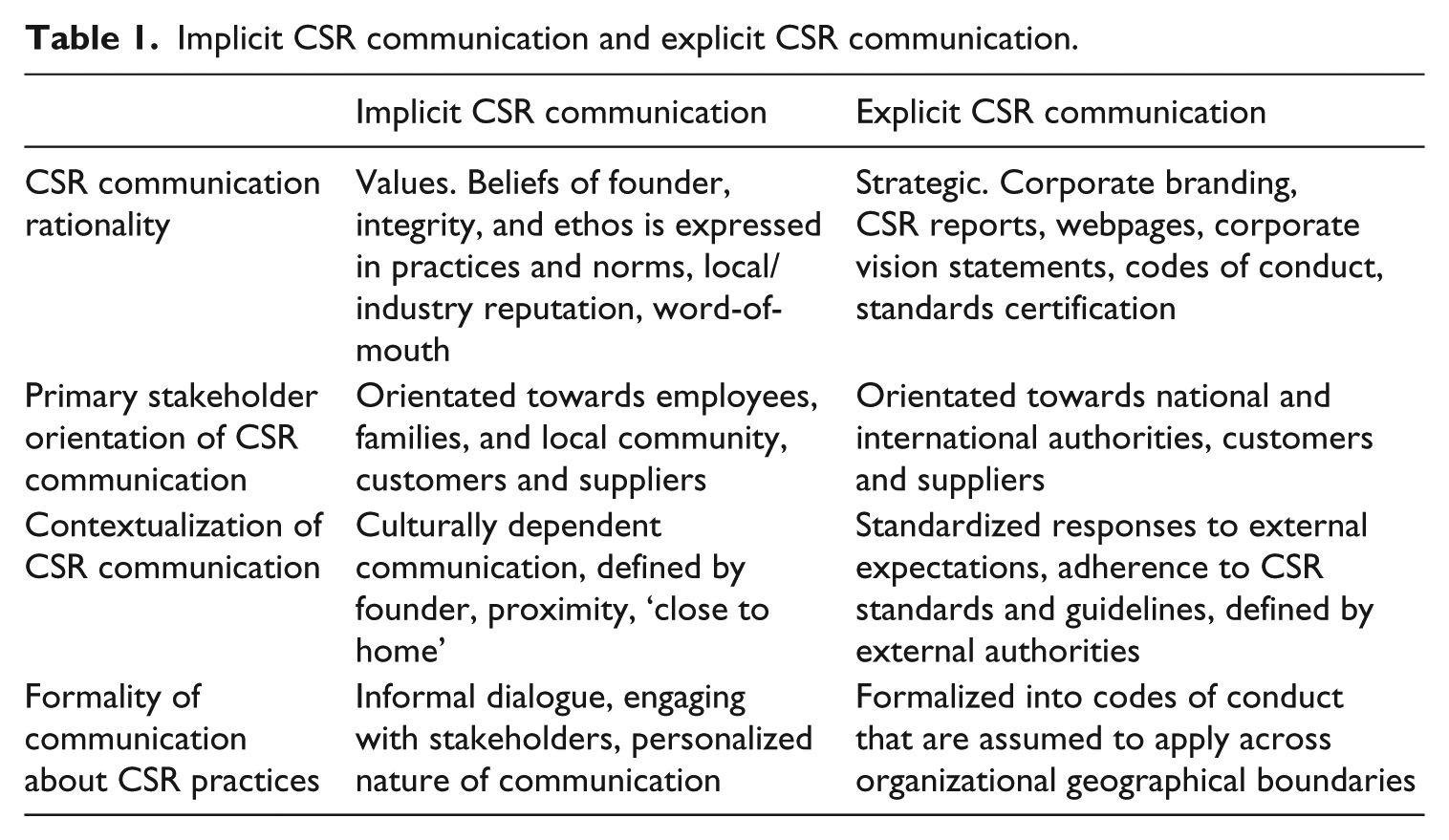
As we have argued, explicit CSR communication does not fully describe the story for SMEs, which most often operate in close relationship with their own suppliers, consumers and the local community. Although some explicit CSR communication may occur (for example, mentioning the sponsorship of a local community event in a newsletter, tweet or rudimentary CSR reports), SME communication is more embedded in the CSR practice itself than in a post facto formal report of that practice. In instances where CSR reporting is somewhat of an industry norm, such as in the oil sector, O’Connor et al. (2017) found that SME reporting focused on local community issues and young people as beneficiaries rather than on commercial orientations of stakeholders and shareholders. Some studies have shown at the extremes that ‘SMEs do not communicate their social practices to any great extent’ (Murillo and Lozano, 2006: 236). SME CSR communication is more characterized by an informal and poorly articulated implementation of a wide range of socially responsible practices and procedures (Morsing and Perrini, 2009) rather than explicit and formalized CSR communication. Scholars have referred to the SME preference for ‘walking CSR’ rather than ‘talking CSR’ as a ‘communication gap’ (Wickert et al., 2016). Based on institutional theory and cost-based theorizing, Wickert et al. (2016) provide valuable insights into how SMEs are more likely than large firms to be trusted to substantially engage in CSR activities. However, these studies do not help us understand the dilemmas faced by stretched SME owner-managers. We extend this research by conceptualizing in detail the dilemmas facing owner-managers in the communication gap in their role as suppliers to large business customers: having to navigate between the explicit and implicit positions for different audiences.
For conceptual clarity, we turn now in more detail to the perspective of explicit, externally facing expressions of CSR, that is, explicit CSR communication. Often mentioned examples of companies with strong explicit CSR communication traditions are global companies such as Novo Nordisk, the globally operating diabetes care company, with publicly stated corporate values (The Novo Nordisk Way), adherence to multiple codes of conduct and policies, and commitment to external standards such as the United Nations Global Compact since 2002, as well as externally visible branding and reporting on CSR activities (Morsing and Schultz, 2006; Morsing et al., 2018). Such practices act as a form of private regulation and are standard fare for large corporate and public sector customers to also require of their suppliers.
Although CSR governance via standards, accounting and marketing communication is well-trodden territory in the mainstream CSR field, very little research has directly attended to the relationship between these disciplinary mechanisms of CSR and SMEs (Baumann-Pauly et al., 2013). SMEs tend to be framed as the docile recipient of standards in the governance literature (Soundararajan and Brown, 2016), where they are commonly depicted as the problematic sites of poor practices that can be corrected by guidance, for example, from their large firm customers (Kim and Davis, 2016). Extant research has tended to focus on the monetary and non-monetary costs of compliance with CSR standards for SMEs (Wickert et al., 2016), and the disincentive to tender if social and environmental standards are prerequisites (Baden et al., 2009, 2011). Crucially though, the picture is complicated and overall standards may rise as a result of supply chain responsibility pressures but doubt remains about the assumed positive relationship between standards compliance within SMEs and improvements in CSR (Baden et al., 2009; Knudsen, 2013). Pertinent to our study is the crowding out of intrinsic motivators by extrinsic requirements (Baden et al., 2011). 2 These relate to our implicit and explicit CSR communication perspectives, but individual motivation is not the focus here; rather, we look to the organizational- and institutional-level drivers within the context of the SME.
It is important to remember that the taken-for-granted features of large firms (such as a website ‘shop window’ to display CSR) may not be available for SMEs owing to high maintenance costs, though social media is, of course, more accessible. Few studies to date have researched CSR reporting on SME websites. For example, Parker et al. (2015) studied the portrayal of stakeholder relationships in website CSR communications among a sample of 22 Australian media SMEs, some of which included CSR-type initiatives on their websites. Even where CSR communication does exist, they note a reluctance to highlight CSR as a way of developing market share or indeed as a ‘business issue’. They cite one publishing SME website, referring to its environmental activities that states in a comment directed at its clients, ‘We won’t ask you to contribute. If you feel you want to then implement a program in your own business and we will all be winners’ (Parker et al., 2015: 376). The picture of SME online communication is likely to change as website and social media communication become ubiquitous for even the smallest firm.
Perhaps more importantly than seeking to discern CSR communication on SME websites, research has found that the most credible form of effective communication in smaller firms is face-to-face and word-of-mouth marketing (Stokes and Lomax, 2002). As O’Donnell et al. (2002) explain, the power of word-of-mouth recommendations should not be underestimated as one of the primary drivers of competitive advantage for SMEs. Resnick et al. (2016) transfer the medium to ‘word-of-mouse’, reflecting on the value of word-of-mouth marketing via social media recommendations. They highlight the importance of the self-branding of the owner-manager, magnifying their personal perspective through social media. The research to date overall suggests that SME CSR communication may rather be implicit but not invisible. This brings us to clarification of the more implicit and often tacit communicative perspectives on CSR in SMEs, shown in Table 1. The implicit communication of CSR embraces those communicative practices that are, in contrast to the public declarations, of a more informal nature and primarily but not only orientated towards the employees, family and local communities of the SME. Versions of this have been referred to as ‘sunken CSR’ (Perrini, 2006) or ‘silent CSR’ (Jenkins, 2004). Researchers have identified examples of SME CSR that communicate the values of the owner-manager of the business such as the small manufacturer in the South East of England that hosts a Christmas drop-in barbeque for the town in which it is located, or the Bavarian marketing company which passed on some surplus furniture to a neighbouring company at no cost (Spence et al., 2003). The perspective of the owner-manager comes out clearly in the same study: ‘I feel that the community is the place we all live in and should be kept clean and tidy and everyone should live in harmony, you know … I have got quite strong feelings about that’ (Spence et al., 2003: 25).
At the centre of implicit CSR communication is dialogue. Here, dialogue is presented as the means to achieve understanding and consensus among divergent interests and stakeholders. From the corporate perspective, it implies engaging with stakeholders better to understand the shared business–stakeholder concerns and preferences for the improvement of business in society (Morsing and Schultz, 2006). However, this research makes no mention of the challenges of engaging in such dialogue for SMEs. Understanding the importance of local context and lived experience of SMEs is crucial here. Nielsen and Thomsen (2009a, 2009b) point out the dangers of assuming that CSR in SMEs is an externally facing instrumental add-on, rather than an expression of their values. They note: ‘SMEs have no interest in turning their local and authentic practice into a forced marketing and branding exercise’ (Nielsen and Thomsen, 2009a). SME CSR communication is personal, especially in terms of management’s relationship with employees (Soundararajan et al., 2017). CSR in SMEs is close to home, with proximity playing an important role in determining stakeholder salience (Lähdesmäki et al., 2017). As the owner-manager of an SME in Catalonia, Spain in the metallurgical sector says, ‘For us CSR is knowing that there are 80 families [because they have 80 employees] who depend on our company’ (Murillo and Lozano, 2006: 233).
A great deal of SME research focuses on the owner-manager (Blackburn and Smallbone, 2008), not least because he or she exercises both ownership and control in the organization, in stark contrast to publicly traded firms. This has important implications for SMEs and the legitimacy of the choices that can be made in using resources for non-pecuniary issues, not least in terms of enduring values (Murillo and Lozano, 2006) and where there are familial ties (Mitchell et al., 2011). Thus, as noted above, communication in the SME is personal, and at the epicentre of that communication is the character and integrity of the owner-manager, that is, his or her ethos and values.
The idiosyncratic language of CSR for SMEs is possibly the most consistently acknowledged feature that occurs in the literature. Murillo and Lozano (2006) find that the term ‘CSR’ is felt to be an external imposition in SMEs, which does not easily relate to the existing internal cultural practices of SMEs. Jenkins (2006) concurs, adding that large-firm-associated CSR terminology does not chime well with smaller firms, even with those SMEs that have been identified as CSR champions which ‘did not commonly use the term CSR’ (p. 246). The large-corporation perspective and association with government initiatives and drivers means that SMEs do not readily self-identify with CSR. This points to the need to further develop the emerging concept of small business social responsibility (SBSR) (Soundararajan et al., 2017; Spence, 2016). From these studies and the overview in Table 1, we take the following forward in building our conceptualization of CSR communication in SMEs. In explicit terms, the expressive formalization of CSR in SMEs is not a given, with, for example, limited evidence of CSR webpages, CSR branding, CSR reports or adherence to external standards. Where this does occur, it is often tied to supplier requirements. Context is also a factor, with some industries having particular compliance requirements (e.g. chemicals, construction, pharmaceuticals) that influence the likelihood of formalized communication by SMEs (O’Connor et al., 2017). In implicit terms, CSR communication relates to the establishment of routines of dialogue and the organization’s norms, values and relationships. Language and their associated norms and culture are important in relation to our conceptualizations, and thus we continue with the more appropriate moniker of SBSR when referring to SME perspectives, and CSR when referring to the wider (large firm) literature.
Given the possible tension between strands of explicit and implicit CSR, and SME social responsibility, we look to governmentality theory to help unfold the particular challenges of SME owner-managers – the ‘governmentality dilemma’ – to unravel the debate.
Governmentality, disciplinary technologies and corporate social responsibility
In this section, we unravel the disciplinary perspectives that our foregoing analysis has begun to identify, as experienced by the SME owner-manager in relation to social responsibility communication. Our approach takes inspiration from Michel Foucault’s (1977) earlier work in which he outlines forms of control and punishment. We look more specifically to his later work on governmentality (for further explanation, see Barratt, 2008). This extends his perspective on ‘the conduct of conduct’ beyond the penal system to understand the governing of others at multiple levels of society, beyond the nation-state government (Foucault, 1991, 2010). It includes the governing of others within the mechanisms and processes of business practice (see, for example, Moisander et al., 2018) in relation to precarious workers’ transition to being entrepreneurs).
Although Foucault acknowledges the need for reform in society in his early work, he also notes how such reform again and again leads to the formation of techniques and institutions that were often developed for innocuous purposes yet converge into a modern system of disciplinary power. In our context, CSR has been presented as such a reform. Examples include the introduction of CSR as a technique or an institution with an ethical and noble purpose aimed at reforming (and improving) companies into enhanced social and environmental action (Logsdon and Wood, 2008). Much research on CSR draws on the assumption that CSR is a positive reform with value for commercial business, that is, ‘the business case’ (e.g. Porter and Kramer, 2011), and for society (e.g. Prahalad, 2006). A more recent stream of research has begun to critique the idea of CSR as a technique established by corporations to ward off criticism while allowing them to ‘do business as usual’ (Fleming and Jones, 2012). This criticism of how the institutionalization of CSR – demonstrated, for example, by the emergence of a plethora of CSR standards and codes – has led to much obfuscation and green-washing (Delmas and Burbano, 2011). Such evaluations draw on the assumption that shareholders and managers do not want to or are unable to serve the ambitions of CSR, and therefore they only superficially adopt CSR.
Proceeding with our article, we are drawn to understand this conundrum: given that many SME owner-managers are positively disposed to contribute to the improvement of society, how can we explain the impact of the embedded network of expectations to communicate their CSR engagement, which potentially challenge and obviate their contribution? Put another way, their implicit drivers for CSR can in some instances be forestalled by the explicit drivers of CSR (Baden et al., 2009). We employ Foucault’s lens on disciplinary power as we investigate how CSR – as a presumably positive but at least innocuous phenomenon – can have disciplinary effects for SME owner-managers.
Corporate social responsibility as governmentality
We draw on governmentality theory to help us address and problematize the indirect modes of power and governing in relation to SBSR. Governmentality refers broadly speaking to ‘the conduct of conduct’ that embraces the ‘governing of self’ as well as the ‘governing of others’, or what Foucault refers to as ‘governing how others conduct themselves’ (Dean, 2010; Foucault, 1991). As an analytic vocabulary, governmentality provides a useful link between regime-level institutional arrangements and the processes of subjectification at the individual level (Siltaoja et al., 2015), which has been particularly employed in studies of power and power relations in liberal democratic regimes (e.g. Foucault, 1980). As such, for our study of SBSR, governmentality provides a helpful way of drawing together the macro-level expectations of SMEs in relation to social responsibility, and the micro-level drivers for the SME owner-manager to be socially responsible. A Foucauldian lens helps us explore how SBSR is distinctive from CSR in emphasizing how SMEs exist in a context in which they, on the one hand, are called upon to adopt norms and standards relating to the phenomenon of CSR defined by large multinationals and other global actors and institutions and, on the other hand, are driven by often personal motives to contribute to social and environmental improvement.
The particular Foucauldian perspective of disciplinary control helps us understand how that which may appear to be voluntary CSR may also be seen as a representation of a transformation of politics and restructuration of power. In this way, ‘subtle and intricate mechanisms of liberal and indirect means of steering’ influence business conduct without shattering its formally distinct and autonomous character (Vallentin and Murillo, 2012: 827). In a sense, the claim by SME owner-managers that CSR feels like an external government imposition (Baden et al., 2009) has some validity; however, importantly, a governing imposition is not necessarily that of the nation-state. Rather, it takes the form of a macro-level mechanism influencing practice that ‘acts on the governed as a locus of action and freedom’ (Dean, 2010: 15) while converging to disciplinary control. According to this view, governmentality refers to a broad variety of governing practices, where government as well as non-state actors and intermediaries such as NGOs, industry and trade, businesses, experts, the media and citizens employ a variety of techniques, calculations, commodities and expectations that serve to ‘conduct the conduct’ (Vallentin and Murillo, 2012). As Foucault (1982: 225) explains: ‘This encounter between the technologies of domination of others and those of the self I call “governmentality”.’
In our context, we explore SBSR as a technology of the regulation of SMEs, or as a means of the ‘governance of others’, which relates to the formal standards and informal norms of contemporary Western societies in which there is a growing expectation for SMEs to commit to CSR and publicly acknowledge such a commitment by being signatories, achieving accreditation or in other ways visibly engaging and communicating their support for social responsibility (Soundararajan and Brown, 2016). From the perspective of the SME owner-manager, in this scenario CSR emerges as a technology of domination, where external governance structures seek to control the internal workings of the SME. For instance, in a study on the knitwear industry in Tirupur, one respondent – interestingly, from a trade union – says, ‘In my opinion, small factory owners are under a lot of stress because of these certifications. I think there is a necessity for these standards. But, it should not be threatening. Buyers are doing it for their business’ (Soundararajan and Brown, 2016).
Whereas prior management research employing a Foucauldian lens has demonstrated how, for example, accounting practices serve as a disciplinary control by being seen as a ‘neutral mirror’ representing results that offer a ‘true and fair’ view of the results of business activity (Roberts, 1991), we draw attention to how SBSR research has shown how CSR is often regarded as an ethical, values-based and emotional issue with which SME owner-managers personally identify (Lähdesmäki and Suutari, 2012). Whereas accounting represents a Foucauldian idea of a truth regime with detailed facts and figures to be accounted for beyond dispute (Roberts, 1991), CSR is a ‘truth regime’ where many emotional, political and often divergent expectations are to be met (Lockett et al., 2006). As such, SME owner-managers do not necessarily regard CSR as a ‘neutral mirror’ that can guide the ethical practices of their business; rather, they know how to do the right thing in the context of their business. In a Foucauldian sense, owner-managers may already be subjects of disciplinary control, as the technologies of domination are often subtle, and individuals will not notice how they are subjected to control (Miller and Rose, 2008). Nevertheless, the recent turn from implicit to explicit approaches to CSR in Western Europe (Matten and Moon, 2008; Morsing et al., 2007) adds new expectations to SME owner-managers to visibly adhere to and comply with the institutional expectations of CSR. What for SME owner-managers used to be implicit and ethical practices of business are now expected to be explicitly communicated for external purposes. We discuss this turn from implicit to explicit in more detail later.
Our analysis conceptualizes the governmentality dilemma as SME owner-managers facing two simultaneous and possibly contrasting expectations: being subjected to the disciplinary control of externally prescribed standards, norms and expectations to CSR and having to maintain their ethos (i.e. their personal philosophy of morals and values) in the local context of family, employees and community and not least in their own self-perception. Thus, CSR is presented as a morally desirable phenomenon, managed and controlled by those in power, and learned and performed by SME owner-managers (Siltaoja et al., 2015: 445). These SME owner-managers see how their personal values and social engagement in this process are being transformed into an institutional ‘script’ with which they may not fully identify and that possibly challenges their identity. In the following, we present some of the main technologies of governmentality that are crucial to our analysis of the challenges for social responsibility in SMEs, as summarized in Figure 1 below.
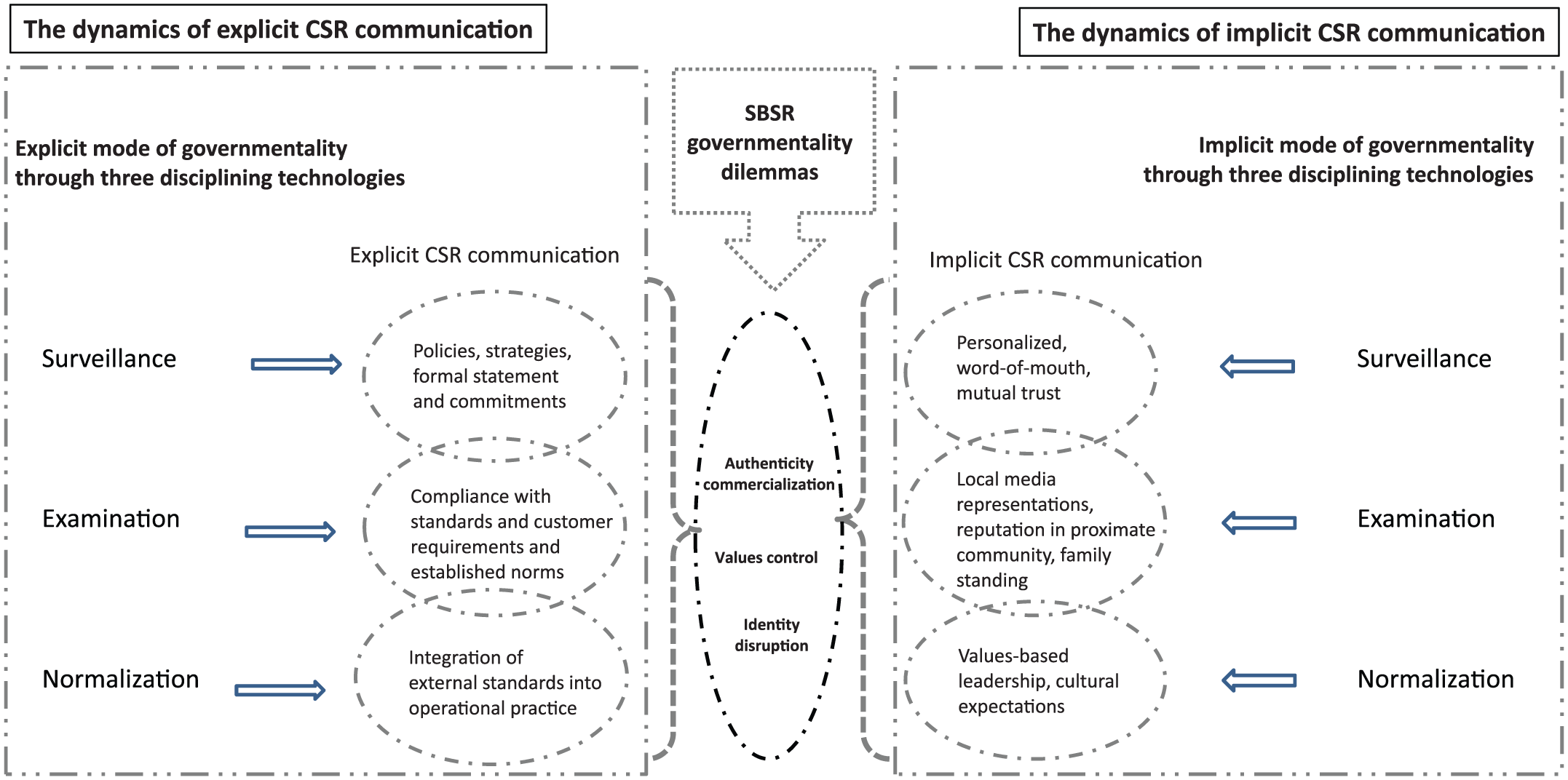
Governmentality dilemmas for small business social responsibility (SBSR): Caught between the dynamics of explicit and implicit corporate social responsibility (CSR) communication
The technologies of disciplinary power
Central to Foucault’s notion of power is that it differs from physical force, violence and domination. Power can ‘only be exercised over free individual or collective subjects that have some means of escape or possible flight at their disposal’ (Vallentin and Murillo, 2012: 830). Accordingly, Foucault’s notion of power not only entails passive individuals who are subjugated by dominant masters – as such, SME owner-managers are not only passively being disciplined by CSR. Rather, Foucault points our attention to how the individual – the SME owner-manager – participates in the formation and continuation of these power relationships. Power is a relational concept, and Foucault argues that ‘power is exercised rather than possessed; it is not a privilege, acquired or preserved, of the dominant class, but the overall effects of its strategic positions’ (Foucault, 1977: 26). Importantly, the individual’s freedom emerges not by escaping from such power relations but by actively and purposefully participating in them (Crane et al., 2008: 304).
Hence, in our analysis of the governmentality dilemma of CSR for SME owner-managers, we engage in an exploration of how they are (inescapably) governed by others while they simultaneously participate in their own domination by following (the rule-based models of) CSR. However, underpinning our exploration is the attempt to analyse how the SME owner-manager is able to define and manoeuvre his or her freedom to engage with CSR. Foucault notes three technologies of discipline – or techniques of control – that are particularly pertinent to our analysis of SBSR: surveillance, normalization and examination.
Surveillance implies the subtle yet forceful disciplinary power of the gaze, namely that by observing individuals, their conduct may be changed and controlled. In Foucault’s (1977) work, Jeremy Bentham’s Panopticon is the ideal symbol of this kind of control. Prison inmates are isolated from each other in separate cells but always visible to a monitor in the central tower. The person monitoring will not always focus on each inmate, but the sophistication of this disciplinary force is that the mere possibility of being observed makes inmates inclined to act as if they were continuously being observed. The primary purpose of surveillance by the Panopticon is reform (not revenge, as in medieval prisons), and to make individuals correct their own deviant behaviour. Foucault also notes how modern society is particularly concerned with how to change the behaviour of individuals who fail to live up to the required standards or norms (non-observance), and how observation serves to mobilize the individual to perform according to others’ expectations.
Examination is a disciplinary method of control that combines surveillance with normalization. Developed in his book Discipline and Punish, he refers to examination as ‘the deployment of force and the establishment of truth’ (Foucault, 1977: 184). Although examination is a less subtle form of disciplinary power, it has come to be accepted as an appropriate technology for eliciting the facts about those who are subjected to or subject themselves to examination (whether it is intellectual insights, CSR performance or state of health), and it controls their behaviour (by mobilizing them to study, directing them to a specific health treatment, organizing their business around certain CSR parameters or otherwise preparing for the exam). Examination also implies documentation, where results are recorded, reported and compared (e.g. grades across years or schools, absenteeism records, CSR performance reports, recoveries or patient charts at hospitals). Such results can provide input to leaders or policy-makers on how to define categories for future fund allocation, what is seen to be averages and other norms to inform and further control organizations. The individual is turned into a case in such examinations, which is studied, also becoming an object of care and therefore control. This situates individuals at the locus of a network of writing, making visible the examined aspects (Foucault, 1977: 189).
Normalization implies a discipline by imposing norms that are seen to be appropriate and represent what is right in society. According to Crane and colleagues, the disciplinary power of the ordering, categorization and ritualization of daily activities becomes a regime of truth – that rewards individuals who conform and penalizes those who resist – to impose and enforce certain norms of behaviour; in other words, ‘what is “right” in such contexts is what is normal’ (Crane et al., 2008: 302). Much of Foucault’s work has analysed the normal by exploring what is deemed abnormal. The idea of normalization pervades modern society in, for example, national standards for educational programmes and medical practice, industrial products and managerial processes. In our analysis, we come to see how the normalization of CSR becomes a technology that serves to seek to control the definition and conduct of SBSR, but is not universally successful in so doing. This brings us more closely to our governmentality dilemmas.
Conceptualization of small business social responsibility communication: The governmentality dilemmas
Our reflections on governmentality and the three disciplining technologies, surveillance, examination and normalization, as applied to SBSR, lead us to develop the analytical framework of SBSR communication and the governmentality dilemmas as illustrated in Figure 1. To be clear at the onset, our object of interest is SMEs that act socially responsibly; irresponsible business behaviour is beyond the scope of this article, but our work certainly has implications for small business social irresponsibility.
The framework emphasizes the occurrence of dysfunctional implications for SME managers (the governmentality dilemmas in the middle of Figure 1) when the dynamics of their preferred implicit CSR communication (right box of Figure 1) are challenged by the dynamics of explicit CSR communication (left box of Figure 1). The figure depicts how the increased pressures on SME owner-managers to publicly express their CSR in systematic ways challenges their preferred modus of ‘tacit’ social responsibility communication. The implication is the emergence of a conflicted space where SME managers are ‘caught’ between the explicit and implicit modes of disciplinary technologies, pressuring them from each side. SME managers must respond to the new requirement for more explicit CSR communication while they simultaneously have to maintain their own and others’ expectations of their habitual implicit CSR communication. Our framework reveals how SME managers’ sense of authenticity, values and identity are potentially compromised in the need to navigate simultaneously the pursuit of explicit and implicit CSR communication. This, in essence, is the space of the governmentality dilemmas.
The dynamics of respectively implicit and explicit CSR communication, and the space occupied by SME managers in navigating both of them, form the basis of our framework. The dynamics of SBSR communication are analysed as a mode of governance through the three disciplining technologies: surveillance, examination and normalization. We show how SME managers respond by engaging in different types of CSR communication. Importantly for our Foucauldian-inspired analysis, these dynamics occur for implicit as well as explicit CSR communication. The dynamics of implicit CSR communication and the associated implicit mode of governmentality occur through the disciplining technologies in ways that promote and support CSR communication as a tacit and personalized, values-based approach. Low-key local community engagement is the modus operandi according to previous SBSR research, as we have shown. Hence, in our framework, implicit CSR communication also implies disciplining technologies for SME managers. As Foucault argued, disciplinary power is not a characteristic of individuals or organizations but is enacted through a diffuse and complex set of relations through subtle practices and trivial processes (Foucault, 1977; Sauder and Espeland, 2009). Individuals gradually become ‘the objects of particular kinds of knowledge that construct them as mad, ill, criminal, sexual, or, most generally as individuals’ (Sauder and Espeland, 2009: 69). As our framework shows, through the dynamics of implicit CSR communication, SBSR is embedded in a variety of expectations that qualifies some and discredits other forms of knowledge and behaviour and hence disciplines SBSR communication accordingly. The dynamics of implicit CSR communication serve as the preferred reference point for SME managers, that is, their habitus, and the curly bracket pointing from the box on the right-hand side into the middle of Figure 1 indicates the pressure for SME managers to nurture and maintain the dynamics of implicit CSR communication.
The dynamics of explicit CSR communication and the associated explicit mode of governmentality occur through the disciplining technologies in ways that promote and support CSR communication as overt expressions of policies, strategies and public compliance with standards. In our framework, this explicit mode of governmentality introduces increased pressure on SMEs to express their CSR engagement in different forms of public declarations, often defined solely by external constituents. Our framework points attention to the increased pressure for SMEs to explicitly communicate about CSR (the curly bracket pointing from the left-hand side box into the middle in Figure 1), and in particular points attention to how the dynamics of explicit CSR communication qualify some forms of SME knowledge and behaviour and hence discipline SBSR communication distinctively.
Concretely, our framework suggests that in response to these explicit and implicit disciplinary technologies, SME managers develop accordingly certain types of explicit and implicit CSR communication. For example, in the Foucauldian lens, SME managers will often respond to implicit modes of surveillance by building trust via personalized relations and word-of-mouth communication, and to explicit modes of surveillance by developing policies and public statements about their CSR activities. In this way, our framework also draws on CCO theorizing to support our investigation of how public declarations (i.e. explicit CSR communication) accomplish things (Christensen et al., 2013) and how demands for more explicit CSR communication transform social situations for SME managers (for example, their habitus of implicit CSR communication). According to this theorizing, meaning is not located inside individuals, and communication is not a vehicle for representing or transmitting pre-existing meanings (Schoeneborn and Trittin, 2013). Rather, meaning is constituted in and through social practices, where communication is the dynamic process of producing meaning, that is, ‘the site of meaning construction’ (Kuhn, 2012; see also Kuhn et al., 2017; Putnam and Boys, 2006). We unfold these dynamics of the disciplinary technologies below.
Before proceeding, it is important to note that the analytical distinctions in our framework serve to conceptually distinguish aspects of the complex interwoven social fabric of CSR communication. We do not suggest that the three disciplinary technologies and their related organizational responses are mutually exclusive mechanisms, nor that they work separately to create certain distinct governmentality dilemmas. Although one disciplinary technology, for example surveillance, may in some situations stimulate the emergence of one governmentality dilemma, for example authenticity commercialization, our main point is that all three disciplinary technologies have implications for the general occurrence of governmentality dilemmas. For example, surveillance technologies also produce a sense of values control and identity disruption among SME managers, this being indicated by the two curly bracketed arrows. Rather, our framework draws on what CCO scholars refer to as a ‘flat’ or ‘relational ontology’, where all dimensions possess the same potential for meaning-making and for ‘bringing into being’ organizational phenomena (Kuhn, 2012; Kuhn et al., 2017). Our primary intention is to point at the processes of double pressure that SME managers are subjected to, and the general dysfunctional implications, which we label governmentality dilemmas. Therefore, the disciplinary technologies of surveillance, examination and normalization serve in our framework as an analytical platform to comprehend key aspects and key related SME managerial responses. In our conceptualization in Figure 1, the disciplinary technologies are interrelated and may possibly interfere, overrule or compensate for each other. We are aware of the price of oversimplification, and we emphasize that this is a streamlined framework that nevertheless allows us to uncover the connected nature of explicit and implicit CSR communication for SME managers. We are also freed to explore how SME managers’ sense of authenticity, values and identity are potentially compromised as an implication of having to publicly declare that which they prefer to be tacitly enacted, that is, ‘bringing CSR being into CSR talk’.
Commercialization of authenticity
For an SME manager caught between simultaneous explicit and implicit forms of surveillance, examination and normalization, we conceptualize a governmentality dilemma of ‘commercialization of authenticity’. This means that the SME manager experiences the compromise of their genuine and authentic SBSR engagement by being externally pressured to turn SBSR into a brand exercise. The different external expectations and requirements to articulate SBSR in policies and to make it part of an SME brand strategy (with the purpose of selling more products and services to remain the preferred supplier) is likely to be experienced by the SME manager as a marketization of SBSR and as an improper subordination of authenticity to a commercial rationale. As prior research has shown, such marketization of personal values is quite in contrast to SME managers’ sense of SBSR being personal, and a matter of trust and confidence in interpersonal relationships (O’Donnell et al., 2002). Nielsen and Thomsen (2009a) observed in their study that SME managers do not have any interest in turning authentic practices into a forced marketing and brand exercise. Socially responsible practices are embedded in the lived experiences of the SME, and any branding of CSR may be seen as a tasteless way to profit not only by local community stakeholders and employees, but perhaps most importantly, by the SME manager themselves. For example, an SME manager who sees their primary social responsibility as a personal obligation to take good care of their employees may feel deceitful if they quantify their personal care-taking in a CSR report or as part of a marketing campaign. They are likely to experience a degradation of their leadership authority if they sense that their personal values are transformed into an instrumental commercial function. They may even feel angry in the same way that Sauder and Espeland’s study shows how professional educators felt outrage when they had to publish evidence of how the school complied with externally defined metrics in rankings, and experienced it as ‘an attack on their professional and personal commitments, as well as their school’s’ (Sauder and Espeland, 2009: 76). While reporting that a firm has recruited socially excluded employees such as ex-offenders may seem admirable and advantageous in the large firm’s CSR report, it is likely to be experienced by the SME manager as a shameless exposure of deeply held values – as well as the personal lives of the individuals concerned – that ought to be kept private, and communicated only by their actions. In this context, the care-based concerns of implicit CSR communication that serve as a moral driver of SBSR for the SME manager (Lähdesmäki et al., 2017; Spence, 2016) are likely to be seen as compromised as they are developing explicit CSR communication strategies for the purpose of profit. This is what we here label the commercialization of authenticity.
Values control
The second governmentality dilemma that the SME manager experiences, navigating in the conflicted space between explicit and implicit forms of surveillance, examination and normalization, we label ‘values control’. This means that the SME manager experiences that their implicit personal values, that define responsible leadership for the SME, are seen to be controlled by external authorities setting standards, guidelines and norms to which they must develop an explicit CSR communicative response. Research has long demonstrated that a key driver for SME manager-ownership is the retention of independence and control over one’s working life (e.g. Goffee and Scase, 2015). For example, most SMEs are family firms, where succession is an extremely prescient issue (Mitchell et al., 2011), and hence the continuation of the personal familial values of the owner-manager are crucial for the future legacy of the firm. Spence (2016) shows that SME life blends the private and the public sphere, meaning that the way in which the family perceives, judges and measures the performance of the firm are considered more important and relevant than adhering to a distant, abstract, and externally formulated standard. Also, the SBSR owner-manager often enjoys a personal profile within the local community (Lähdesmäki and Suutari, 2012) and the local media, where they and the SME are associated with certain values. Being subject to an external examination and push for compliance with standards set by others is a threat to the control practised by the owner-manager. In particular, the comparing and contrasting with other SMEs (including across industries) that comes with reporting, standards, accreditation and rankings may be experienced as changing and seeking to correct SBSR values with the only purpose of adapting to external expectations. Other research has pointed to how such requirements for explicit communication may be seen by employees to fundamentally misrepresent the organization and to ‘cede too much power to outsiders with dubious motives’ (Sauder and Espeland, 2009: 76). However, for competitive reasons, it is highly counterproductive for the SME to neglect participation in such explicit communicative examinations of CSR, as we have discussed above. Consequently, the SBSR manager is put in the governmentality dilemma of values control: wanting to set their own direction based on what they personally believe are the better values for their firm’s SBSR, while having to not only accept and align with an externally enforced CSR agenda but also to express this in explicit communications. For example, an SME may have to abandon and replace a second-tier supplier of palm oil because that supplier does not live up to the CSR standard required by a business customer. The SME is thus subject to an examination that may conflict with the strongly held beliefs of the SME owner-manager that by continuing to trade with the local palm oil producer (where they may have developed strong interpersonal ties) they could continue to support the livelihoods of the local community while slowly working towards improving the second-tier palm oil firm’s social responsibility. This puts the SME owner-manager in a governmentality dilemma that they may experience as inappropriate yet irrefutable values control.
Identity disruption
The third governmentality dilemma that meets the SME owner-manager, as they navigate between the disciplining technologies of explicit and implicit CSR communication, we label identity disruption. Identity disruption means that the drives to developing more explicit CSR communication challenges the owner-manager’s preferred implicit modus of CSR communication by contesting the central, distinct and enduring SBSR identity. The idea that CSR is a moving target where firms need to adapt to changing foci, values and contents (Guthey and Morsing, 2014) seems highly relevant for large firms in need of public legitimacy and positive reputations across a variety of stakeholders and geographies. However, SMEs who also often operate in global production networks typically operate in rather local community orientated networks (Lähdesmäki and Suutari, 2012), with expectations of relatively stable and interpersonally nurtured relationships. The new perpetual requirements to SMEs to adapt to differing social responsibility agendas are therefore likely to generate instability and uncertainty in the organization, where the SME manager and their employees may experience a sense of being out of control of their own values. The SME manager’s ability to manage the global demands to new CSR expectations is seen as limited, because they are seen as having to adapt their personal values to a global agenda that is perhaps seen as irrelevant from the particular SME perspective.
Research has pointed to how new standards and rankings exacerbate anxiety and uncertainty, because managers and employees need to be on their toes and ‘cannot afford to relax their vigilance’ (Sauder and Espeland, 2009: 75). Such chronic attentiveness to externally termed expressions of the SME’s social responsibilities can be experienced as leading to ongoing ‘moral compromise’ (Sauder and Espeland, 2009: 75) and draining of energy for most managers and employees. If the SME owner-manager needs continuously to orientate themselves towards new trends and tendencies for what is seen to be responsible behaviour by an influential and critically savvy yet distant audience, this may lead to a competitive race that is seen by SME employees as emphasizing ticking the boxes at the cost of compromising the SME identity. The point here is that, in turn, the individual SME leader’s identity is challenged and they are potentially undermined as an SBSR leader, because they are seen to allow the SME identity to be colonized by the whims of the public sentiment at the time. Parallel research has delivered empirical evidence that shows how academic identity is challenged in the same way at a university when faculty are exposed to externally induced performance management systems, showing how this can lead to the disruption of a university’s academic ethos (Kallio et al., 2015). Rather than providing their own blueprint for behaviour within the firm (called by some a ‘fortress enterprise’ where the leader’s word is all, Curran and Blackburn, 1994), the socially responsible owner-manager is expected to put his or her own identity as a moral character to one side to follow externally set ideas of what is required. This displaces the owner-manager as leader in charge of their own professionalism and moral direction of the firm, instead becoming an organizational caretaker dependent on external others for who they are and what they do, or in Habermasian terms, allowing a colonization of ‘the lifeworld’ by ‘the system’ (Habermas, 1984). Accordingly, as societal norms for social responsibility change and new norms are normalized, this will continue to challenge the SBSR owner-manager’s leadership identity.
Although this may not seem a new challenge for SME owner-managers, who are inevitably subject to externally imposed requirements (as any manager), the new challenge relates in particular to how his or her personal values as a leader are closely associated with the SME itself and are displaced. His or her own values in leadership may seem abnormal, awkward and even counterintuitive outside the local region or industry in which the SME operates. For example, globally changing social norms about corruption or new norms about third-age recruitment may not correspond to the SME owner-manager’s values and understanding of social responsibility. Hence, the formalization or making explicit of SBSR makes it increasingly visible that as societal norms are changing, the SBSR owner-manager’s own norms are expected to change and align accordingly. Rather than the identity of the firm being near-synonymous with the leader’s identity, the firm now becomes visibly subject to other influences, and the leader’s identity is dislodged. Consequently, the SME owner-manager finds his or her personal identity as a leader being not only exposed but also critically challenged. We refer to this as the governmentality dilemma of identity disruption.
Discussion
Conceptualizing CSR communication as implicit and explicit in Table 1, we have investigated the dilemmas that occur between the two types of CSR communication in small and medium sized enterprises when implicit CSR communication is expected to be articulated as explicit CSR communication. This we have explained in Figure 1, showing the conflicted space that emerges when implicit values, practices and norms about social responsibilities are expected to be also expressed overtly as strategic campaigns, advertising and reporting. We have proposed a conceptual framework that lays out the governmentality dilemma of SMEs. In our unfolding of Figure 1 we have analysed SBSR communication in terms of being disciplined by technologies of surveillance, examination and normalization. We have argued how each of these mechanisms contributes individually and collectively to challenges for the SME owner-manager in their negotiation between the ambition to live up to others’ expectations of SBSR communication while simultaneously staying true to their personally defined way of doing the right thing. We refer to these challenges as the governmentality dilemmas of the commercialization of authenticity, values control and identity disruption. This leads to two key theoretical contributions.
First, our article contributes to CCO theorizing by showing how the performativity of explicit CSR communication may not always advance social action as suggested by prior research (e.g. Cabantous et al., 2016; Christensen et al., 2015, 2017; Schaefer and Wickert, 2016) but may also be counterproductive for the intended social change. We have shown how the demand for public CSR declarations by SME suppliers to large customer firms may lead to dilemmas for the SME leadership. And we have in particular shown how SMEs are exposed to three key governmentality dilemmas, as they have to navigate the balance of satisfying expectations of both implicit and explicit CSR communication. Prior research has assumed a transformative potential in producing a difference between public declarations and action. That is, organizational promises, or aspirational talk, indicate a vision which the organization will seek to transform into the indicated action. Our research points to how the SME experiences an uncomfortable stretching of their implicit CSR communication as they are asked for explicit CSR communication in turning their CSR values into branding, matrices and indicators designed by external authorities. Such drives for explicit CSR communication may, rather than influence positive social change, result in serious dilemmas for the SMEs that could prove counterproductive for improving their social responsibility engagement. Our research calls for renewed critical attention to what CCO scholars have labelled the performativity of the public declaration and the idea of ‘talking into being’. In the context of the SME, we have argued that that which is ‘talked into being’ is not necessarily improved social action but also some dysfunctional implications of explicit ‘talk’. In fact, we suggest that future CCO research should empirically explore the reverse order of the process, that is, analyse the mechanisms involved in the process from ‘being into talk’, where ‘being’ refers to implicit CSR communication and ‘talk’ refers to explicit CSR communication.
Second, our conceptualization of the three governmentality dilemmas contributes to research on CSR in SMEs by eliciting how the separate mechanisms represent collective challenges to SME authenticity, values and identity, as we have shown above in Figure 1. Our research more profoundly contributes to research in CSR in SMEs by pointing to the deep challenge to the SME owner-manager’s integrity in the context of the increased pressures to balance implicit and explicit CSR communication. The potential compromise to the SME owner-manager’s integrity as an implication of the requirement for suppliers to large firms to adopt explicit CSR communication practices has not been explored in prior research.
Critical here is the SME owner-manager’s need to find a balance between resisting external drivers which undermine their own practice, and acceptance of engaging in more explicit CSR communication and the associated temptation – or necessity – to double-talk when exposed to governmentality dilemmas. Double-talk means that the SME owner-manager may be tempted to strategically and systematically decouple words and action and potentially experience an advantage of doing so without losing integrity (Bromley and Powell, 2012; Christensen et al., 2013). While business engagement in social responsibility is mostly regarded as a desirable feature, our research suggests that the imposition of SME suppliers to practice explicit CSR communication may lead them to systematically engage in hypocrisy, that is, the systematic decoupling of words, decisions and action (Brunsson, 2003). Even if there is an immediately plausible overlap between internally lived CSR values and the external requirements to report on certain CSR values, the notion of authorizing an externally imposed standard to put tangible matrices and indicators on the SME’s implicit values poses a potential threat to the SME manager’s integrity. Such a threat to managerial integrity is likely to lead the SME owner-manager to pretend vis-a-vis external audiences to comply with the required set of standards, while at the same time vis-a-vis employees s/he needs to be sure to be consistent with the ‘true values’ of the firm.
From empirical observation of high-profile business scandals we know that claiming compliance with certain values is not always the same as actual good practice within the organization (e.g. ENRON, Rana Plaza, BP Gulf of Mexico, Volkswagen). Soundararajan and Brown (2016) show how SMEs in the global supply chain subjected to external attempts to govern their social responsibility can respond with gaming strategies that enable them to appear to comply with formal standards while actually continuing with their own local norms and practices. Although our article has contributed a first conceptualization of the governmentality dilemmas, there is a need for more empirical research to investigate these dilemmas in empirical depth in SMEs. Importantly, we have analysed the dilemmas navigating the implicit–explicit CSR communication in the context of SMEs in their role as supplier businesses, but we believe that these dilemmas also occur in large firms. We suggest for future research to also empirically explore the particular challenges for large firms to navigate the balance between implicit and explicit CSR communication.
Conclusion
In this article, we drew on research on CCO theory and governmentality theorizing to explore the role of CSR communication as a disciplinary power in SMEs. We conceptualized how CSR communication is predominantly an implicit phenomenon for SME owner-managers; yet, our discussion acknowledges that SMEs are currently requested to communicate much more explicitly about their CSR engagement than previously, as corporations seek to mitigate supply chain risks (Kim and Davis, 2016). The occasional tensions between implicit and explicit CSR communication challenge the way SME owner-managers operate and engage with ethical practices in their daily work and networks. We based our critical enquiry on the assumption that SME owner-managers wish to contribute positively to the improvement of society, but that they are embedded in a network of expectations on their CSR engagement, which potentially challenges and forestalls their contribution.
We employed a lens on CSR communication as a disciplinary power, as we investigated how the presumably positive reform of companies encapsulated as CSR communication has governing and possibly counterproductive effects on SME owner-managers’ ethical practices. Thus, our analysis conceptualizes the governmentality dilemma for SME owner-managers: being subjected to the disciplinary control of externally prescribed standards, norms and expectations on CSR requiring expressive forms of CSR communication and staying loyal to an internally driven values-based leadership style that favours more subtle and tacit forms of CSR communication. As a supplement to prior research that has primarily focused on describing and analysing the characteristics of SME owner-managers in their CSR work, our analysis describes some of the fundamental dilemmas that face them. We identify two broad routes: resistance or subjugation. Both of these involve moral costs to the organization.
This article has implications for both research and practice that call for empirical work to build and illustrate the indicators that we have found conceptually. Future studies may enquire to what extent such governmentality dilemmas also exist in pockets within large firms (such as small overseas branches) where moral and personal proximity to stakeholders may be vital. Our work does not address the intrinsic or extrinsic motivation of owner-managers, although this may have implications for willingness to engage in either implicit or explicit CSR communication. Whereas our study has focused on the case of SME suppliers to larger organizations, other scenarios in the business community would also be worthy of further reflection, such as circumstances where other actors – government, NGOS, consumer preference – are the main drivers of changes in CSR communication practices. We have not addressed fully the emerging phenomenon of social media communication by business, which may be personalized and informal but in that it represents a publicly available declaration could be considered to be explicit CSR communication. Future research could follow up on this to address the emerging digital environment for CSR communication. A better empirical understanding of under what conditions the dilemmas we have identified are mitigated would progress further our conceptualization of CSR communication dilemmas for SMEs. We noted earlier in the article the importance of a dynamic approach to understanding implicit and explicit CSR communication. Although our model is intended to convey this, future work could usefully extend this dynamism, especially empirically. Finally, we have extended research on the ‘walk and talk’ of CSR to the notion of ‘being and talk’. Although CCO research has challenged that walk and talk are dichotomies in communicative and practice terms, the addition of ‘being’ adds a further dimension that has not properly been addressed but that helps considerably to explain the case of the small firm in relation to CSR and communication. This requires more specific analysis and empirical evidence.
From a practice and policy perspective, our article calls for alternative considerations and new tools when advising and developing regulatory mechanisms to govern social responsibility in SMEs, not least suppliers to large customer firms which seek to influence and govern them. In particular, our article points to how continued explicit requests for CSR communication may be necessary for the large firm’s own assurance of a socially responsible supply chain. However, it may work counterproductively for SMEs in their striving to deliver more socially responsible action. Better understanding of how these drivers link to extrinsic and intrinsic motivation to be socially responsible would also be valuable. This leaves an open question mark about the value of CSR metrics, which is a critical point for further investigation given the reliance of governance organizations on the achievement of metrics orientated towards explicit CSR communication. Although they may create a structural situation where irresponsible or unaware SMEs start to be more socially responsible as a result of compliance (indeed, this would seem to be their intended purpose), and they clearly have a place in the support of CSR, CSR metrics are by no means a panacea for ensuring greater social responsibility in the supply chain. According to our research, collaboration and partnership with SME suppliers, rather than imposition of explicit CSR communication requirements, would be advisable for those genuinely wishing to enhance supply chain responsibility.
Footnotes
Acknowledgements
A number of people have helped guide us in the development of this article. We owe our thanks to our editor Tim Kuhn and three anonymous reviewers. In addition, we thank Dennis Schoeneborn and Christopher Wickert for their valuable input. Earlier versions of the article benefited from feedback at the CSR Communication Conference 2015 and the Academy of Management Conference 2016. We also thank Johanna Klatt for editorial assistance. Our respective contributions to the article are equal, that is, 50:50.
Funding
This research was supported by funding from Copenhagen Business School and MISTRA Foundation for Strategic Environmental Research.
