



Abstract
While operational firefighters in the UK fire and rescue service traditionally retired in their 50s, their working lives are now extending. However, external pressures and the emotional and physical demands of firefighting work, lead to questions about whether operational firefighters will be able to extend their working lives. In this article, we engage with Van der Klink et al.’s sustainable employability model, which focuses on situations that allow individuals to make valuable contributions through their work and reveal how working lives can be extended. We consider implications of the characteristics of operational firefighting work, individual circumstances and contextual factors for the extension of working lives. Drawing on interviews conducted with firefighters, crew managers and watch managers working in a UK fire and rescue service, we highlight the unsustainability of many future working lives because of wellbeing and organisational pressures.
Introduction
Public policy internationally has encouraged extended working lives (EWLs) beyond ‘traditional’ retirement ages (Sinclair et al., 2013). ‘Early’ retirement ages previously incentivised many working in the fire and rescue service (FRS) (Bracken-Scally et al., 2016). However, reforms to the firefighters’ pension scheme in the UK over the last 20 years have seen normal and deferred pension ages rise from 50 and 55 years to 60 and 65 years, respectively (HM Government, 1992, 2006, 2014; National Assembly for Wales, 2007, 2015; Northern Ireland Assembly, 2007, 2015; Scottish Government, 2007, 2015). Consequently, the UK-FRS workforce is ageing, as firefighters retire later and fewer (younger) firefighters are recruited (Bateman et al., 2016; NFCC, 2016). There are questions regarding the ability of firefighters to perform operationally in their 60s (Graveling and Crawford, 2011; Williams et al., 2013; Wrack, 2019). Existing research has discussed the issues facing, and contributions, of older firefighters (Bracken-Scally et al., 2016; Kragt, 2019; Kragt et al., 2017; Pickerden, 2013, 2018). However, there is a paucity of research on the implications of an ageing UK-FRS workforce. While there is service-level acknowledgement of workforce ageing (NFCC, 2016), no consideration has been made of how to sustainably achieve EWLs.
In this article, we respond to calls from Lain et al. (2020) to consider whether and how individuals can (and want) to extend their working lives. Prior research has discussed the challenges associated with EWLs, including older workers’ ability to work longer (Lain et al., 2020; Wainwright et al., 2019). While some public sector organisations are considering how to foster EWLs (e.g. the NHS Working Longer Review, 2014), consideration by the UK-FRS is lacking despite the extensive physical and psychological demands of firefighting work. We argue that in the UK-FRS, EWLs can only be achieved if firefighters have the capabilities to remain in work and perceive firefighting work as a valuable functioning (i.e. they are able and willing). We propose Van der Klink et al.’s (2016) sustainable employability model (SEM) as providing a valuable lens to reveal the factors that influence perceived ability and willingness to sustainably extend working lives. Applying this novel theoretical lens is an important theoretical contribution to EWLs literature as it allows us to integrate and categorise the interplay of factors that promote EWLs, the complexity of which is neglected by policy (Egdell et al., 2020). Building on the SEM and drawing on interviews undertaken with 99 firefighters, crew managers and watch managers (referred to here as ‘operational firefighters’) in a UK-FRS, we develop a theoretically informed understanding of the interplay of state, organisational and individual factors (Egdell et al., 2020; Lain et al., 2019; Phillipson, 2014, 2019; Phillipson et al., 2019) that shape ability and willingness to extend working lives in the UK-FRS.
The sustainable employability model
Amid concerns that population ageing will increase demand on the welfare state and labour shortages, public policy is encouraging EWLs (Phillipson, 2014, 2019). In the UK, the Department for Work and Pensions (2014) have emphasised the importance of ‘fuller’ working lives (i.e. working as long as is necessary to create the future that the individual wants) in contributing towards EWLs. However, EWLs policies ‘have tended to be quite simplistic, not acknowledging the complex labour market barriers faced by older workers that extend beyond the individual’ (Egdell et al., 2020: 786). Phillipson (2014, 2019) has argued for the importance of taking stock of how EWLs can be achieved and linking the ‘fuller’ working lives discourse to those of work quality and security; locating research on work/retirement in the economic, political and social context to provide improved policy insights.
We propose that Van der Klink et al.’s (2016) SEM provides a valuable lens to reveal the interplay of factors that influence perceived ability and willingness to extend working lives. Van der Klink et al.’s (2016) SEM is based on Sen’s (2003) Capability Approach (CA), which is concerned with an individual’s substantive freedom, choice and ability to live a life that they value (Sen, 2003, 2009), moving beyond resourcist approaches that prioritise ‘means’ of freedom (Rawls, 1999). It accounts for the resources available to individuals (commodities), as well as what individuals do and are (functionings). It considers an individual’s capability-set (all that they can do and be) and the ways in which conversion factors (personal, environmental and social conditions) mediate the transformation of commodities into functionings (Sen, 2003). It recognises that capabilities cannot always be realised, or that choices may be constrained, because of structural inequalities, internalised conceptions of self-worth and/or circumstances (Nussbaum, 1997). The CA has been operationalised to understand the contextual constraints shaping older workers’ labour market options (Flynn et al., 2017). In differentiating between the availability of, and the ability to make, choices, multi-faceted considerations of employability are possible (Leßmann and Bonvin, 2011).
Van der Klink et al.’s (2016) SEM, based on the CA, allows us to develop a contextualised understanding of firefighter’s EWLs: Sustainable employability means that, throughout their working lives, workers can achieve tangible opportunities in the form of a set of capabilities. They also enjoy the necessary conditions that allow them to make a valuable contribution through their work, now and in the future, while safeguarding their health and welfare. This requires, on the one hand, a work context that facilitates this for them and on the other, the attitude and motivation to exploit these opportunities. (Van der Klink et al., 2016: 74)
The SEM reflects the complexity of what constitutes functioning in work and the interactions between employees and work contexts (Fleuren et al., 2016). It considers how resources are converted into opportunities to achieve goals that workers value (Van der Klink et al., 2016). As illustrated in Figure 1, it accounts for work and personal means to achieve along with personal and contextual conversion factors. Potentials to achieve (the capability-set) are considered, as well as actual work functionings (what individuals do and are) (Van der Klink et al., 2016). Thus, the SEM is underpinned by notions of wellbeing, motivation, having the necessary skills and contributing to something valuable (Abma et al., 2016; Le Blanc et al., 2017; Van der Klink et al., 2016). It provides a lens to explore engagement and awareness of sustainable work contexts and how these are experienced.
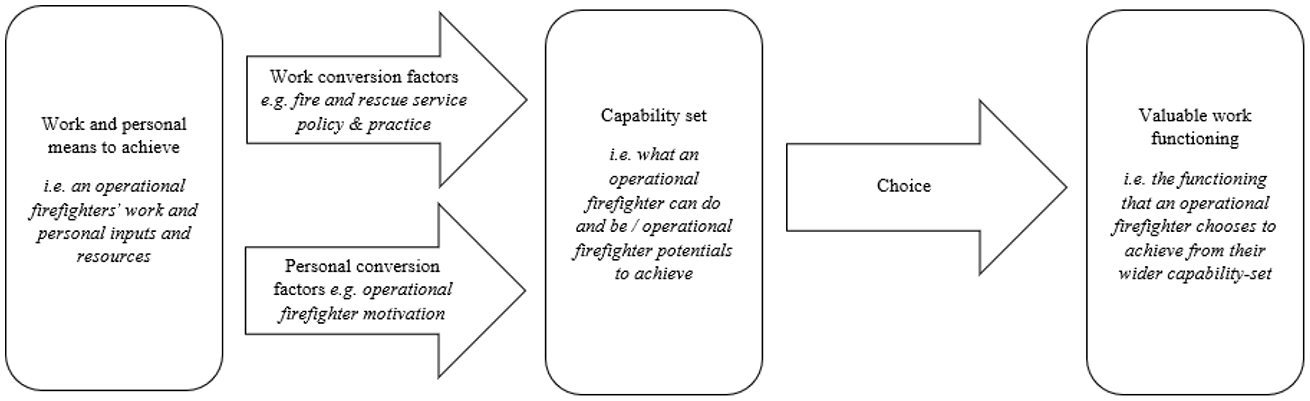
Model of sustainable employability of operational firefighters.
In operationalising the SEM, difficulties may arise in disentangling inputs and resources, and conversion factors and functionings. Observing capabilities and facets representing sustainable employability is challenging. Un-tested assumptions may be made that valuable work leads to sustainable employability (Fleuren et al., 2016; Leßmann and Bonvin, 2011). Nevertheless, the holistic framing offered by the SEM allows us to theoretically frame how the demands placed on operational firefighters’ wellbeing, the nature and meaning of firefighting work, and organisational pressure, are balanced against the legislative demands for EWLs.
The state, organisational and individual context of operational firefighting work
The SEM highlights the interplay of state, organisational and individual factors promoting sustainable employability. We now consider these in the context of firefighting work and their implications for sustainable EWLs.
Austerity and new public management (NPM) have placed financial constraints on emergency services, changing the meaning of work (Granter et al., 2019; Wankhade et al., 2019). For the UK-FRS, fire incident numbers have decreased (Home Office, 2020), in part the result of successful fire prevention activities. However, this has resulted in further budget and staffing reductions, especially in fire control and non-uniformed roles (e.g. communications) (Knight, 2013; National Audit Office, 2015). While some emergency services have remodelled the division of labour by using subcategories of part-qualified operational workers (e.g. Police Community Support Officers), the UK-FRS has not (Mather and Seifert, 2017). Nonetheless, there has been a refocusing of the UK-FRS’ work to encompass, for example, road traffic accident attendance and needs assessments of vulnerable groups (Local Government Association, 2016). McGuirk (2010: 18) describes this as a ‘fundamental shift in thinking and approaches . . . with every firefighter now expected to be both an emergency response professional, as well as a safety professional’. There are concerns regarding workforce deskilling as targets (e.g. for community visits) compromise training time, whether firefighters have the skills to undertake these roles and the potential displacement of other occupational groups (Braedley, 2015; Byrne-Davis et al., 2019; Mather and Seifert, 2017).
Staffing reductions and firefighting work reconfiguration have implications for EWLs. Non- or semi-operational posts are proposed by Kragt et al. (2017) and Pickerden (2013) as offering opportunities for EWLs. However, openings in these roles have diminished (National Audit Office, 2015) and/or have converted to lower salaried non-uniformed roles (Graveling and Crawford, 2011).
These challenges are in addition to the physical and emotional demands of operational firefighting work. It requires high physical fitness due to the risks associated with firegrounds (Bracken-Scally et al., 2016; Pickerden, 2018; Scandella, 2012) and regular physical fitness assessments to ensure firefighter safety in routine tasks (Siddall et al., 2016). Williams et al. (2013) in reviewing the firefighters’ normal pension age pointed towards the need for cardiorespiratory fitness, muscular strength and heat tolerance. It is these requirements that underpin questions regarding the ability of some firefighters to meet operational demands in their 60s (Graveling and Crawford, 2011; Williams et al., 2013). Indeed, research shows that ill-health, accident risk and absenteeism owing to work-related illness are greater for older firefighters compared to younger colleagues (Sluiter and Frings-Dresen, 2007).
Regarding the emotional challenges, research identifies that being older and longer years of service are associated with increased stress, depression and anger among firefighters (De Oliveira et al., 2012). These may be underreported and suggestions have been made that social supports mitigate the risk of post-traumatic stress (Haslam and Mallon, 2003). There are personal and work factors which promote wellbeing, which we postulate might serve to facilitate sustainable EWLs. At the personal level, research has identified high distress tolerance among firefighters and high levels of internally generated commitment (the belief that the role the individual plays is important to society’s welfare) (Lee and Olshfski, 2002; Stanley et al., 2018).
In terms of work factors, operational firefighters join a ‘watch’ comprised of those working the same shift. The traditional watch culture is ‘family-like’ and humour is used to cope with trauma (Hall et al., 2007; Sliter et al., 2014). Research underlines the importance of solidarity and mutual support in dangerous working environments. While high-risk tasks only account for a small proportion of firefighting work, they are most critical for trust (Pratt et al., 2019). Trust may be derived from repeated interactions between trustors and trustees (e.g. knowledge gathered about colleagues when observing mundane tasks/behaviours on-station) (Pratt et al., 2019; Rousseau et al., 1998). However, the watch culture in the UK-FRS has attracted criticism for being toxic, aggressive and bullying (Lucas, 2015; Thomas, 2016).
Methods
Face-to-face qualitative interviews, undertaken with 99 operational firefighters (firefighters, crew managers and watch managers) in one UK-FRS are drawn upon in this article. These data were collected over three months in 2019 as part of a larger mixed-methods project examining workplace culture in the participating UK-FRS (referred to as P-FRS for purposes of anonymity). We used an inductive, qualitative approach to provide in-depth understanding of meanings and contextual influences on firefighters’ experiences (Maxwell, 2013). The interviews allowed us to scope indicative priority areas to explore in the subsequent quantitative stage of the project (not reported on in this article). The research received ethical approval from Northumbria University (reference: 16217).
Interviews were held with operational firefighters as part of multiple field visits to nearly 65% of the P-FRS’ fire stations. The stations visited included smaller and larger stations (by appliance numbers); stations with different specialisms and/or appliance types; and stations serving different land-types. Stations reflected whole-time and retained crewing. Whole-time stations are crewed 24 hours per day, 365 days per year by crews divided into four watches working two day shifts and two night shifts, followed by four days off. These crews are normally attached to one station. In contrast, retained firefighters only attend the fire station they are attached to for emergency callouts, undertaking this role alongside their ‘normal’ occupation. They may be based in wholly retained stations, or stations with both whole-time and retained crewing. The selection and timing of visits encompassed access to different ‘watches’ and retained firefighters. Some participants worked both as whole-time and retained operational firefighters. Thus, the majority of the P-FRS’ stations and operational firefighters were represented.
Participation was voluntary. Once we determined the stations/watches we wished to visit, the P-FRS project officer cascaded interview/visit requests and project information. We also separately contacted stations/watches to reiterate this information and that participation was voluntary. Before the start of each interview, we reaffirmed this and that details on who had/had not participated would not be shared with the P-FRS. Written consent was taken from participants.
Ninety-nine individuals participated. Options for one-to-one or group interviews were offered. All participants opted for group interviews and, in some instances, they were followed up with subgroup discussions at the participants’ request. Both male and female operational firefighters were included, as well as those of all tenure length. We used a semi-structured approach to give a degree of consistency, while allowing participants to discuss issues of most relevance to them (Myers, 2008). The interview schedule considered what it was like working in the P-FRS, participant attitudes towards how they were managed and key factors affecting wellbeing. While no specific questions regarding EWLs were included, some discussions touched on this theme specifically and we followed this up as appropriate. Interviews were audio-recorded and transcribed.
For this article, secondary qualitative analysis of these interviews was undertaken (i.e. using the pre-existing qualitative dataset to apply a theoretical framework not included in the original study) (Sherif, 2018). We used Framework Analysis (Ritchie and Spencer, 1993), based on the building blocks of Van der Klink et al.’s (2016) SEM: (1) work and personal means to achieve; (2) conversion factors; and (3) achieving valuable work functionings (see Figure 1). The whole interview sample was included in recognition that sustainable employability applies to workers of all ages and that experiences of EWLs reflect inequalities accumulated over the life-course (Van Dam et al., 2017; Wildman, 2020). Following the Framework Analysis procedure, data relevant to the SEM were identified, extracted and charted via an iterative process of checking and refining until a clear coding representation emerged (Ritchie and Spencer, 1993).
Findings
Organised around the building blocks of the SEM, we consider the factors which may influence the ability and willingness of operational firefighters to extend working lives (in a sustainable manner). This highlights the commitment of operational firefighters and how this is balanced against operational demands, organisational practices and EWLs policy.
Work and personal means to achieve
The SEM accounts for work inputs (i.e. work means to achieve, such as task structure) and personal inputs (i.e. personal means to achieve, such as personal capacity) (Van der Klink et al., 2016). Concerning work inputs, across all interviews, participants described the task structure as ‘not your everyday going to work’ (Interview 151) because of the unpredictability of emergency calls. Task variety, reflecting the expansion of the role, was also mentioned. Other work inputs included the shift system, which was valued by many for facilitating work–life balance. However, the challenges of off-roster reserve shifts using a pool system (used in the P-FRS to reduce overtime need) were mentioned. Under this system, whole-time operational firefighters worked a fixed number of annualised hours as off-roster reserve shifts. On these shifts, they could be required to attend, dependent on staffing.
Work inputs linked to physical health included the refurbishment of the P-FRS’ on-station gyms and standardised fitness training (more generally P-FRS sought to maintain/develop the skills of operational firefighters through its training programme). The refurbishments were praised across the interviews: ‘We’re in the Premier League compared to what we were’ (Interview 2). In terms of emotional wellbeing, the P-FRS had a formal peer-provided traumatic risk management offer, and an externally provided employee assistance programme where counselling could be accessed.
Interactions on-station were another work resource. Station and watch managers were trusted and felt to be understanding and approachable: ‘Our station manager he’ll come and have a coffee . . . I don’t think anyone’s bothered about saying what they feel to him’ (Interview 5). The watch was described as a crucial source of camaraderie, emotional support and ‘a reason for coming to work’, connecting to research from Haslam and Mallon (2003) on the buffering effects of social support. Having close watch relationships was cited as important for building trust, and key to safety and efficiency: Everyone sat around this table trusts each other, to the point where we are potentially responsible for each other’s lives in an incident and that level of trust on a watch, it’s imperative to make it work. (Interview 3)
The watch provided emotional support. Some participants described how they would informally debrief on-station after an incident, using humour to cope – mirroring findings from previous research (Sliter et al., 2014): ‘We sort of deal with it ourselves and we joke about it . . . That’s the pressure release’ (Interview 7). Participants acknowledged that this culture had been criticised (e.g. by Lucas, 2015). However, they were keen to stress the culture’s value in bringing people together. Other participants detailed that problematic behaviours were a historical issue and/or had not happened on their watch.
Alongside work inputs and resources, the SEM considers the personal means to achieve (Van der Klink et al., 2016). Echoing findings from previous research (Lee and Olshfski, 2002), a commitment to firefighting and a deep sense of pride in being an operational firefighter – which was arguably greater than commitment to, and/or pride in working for, the organisation – was identified across all interviews. This commitment was cited as outweighing job-demands and organisational pressures (we revisit this later): ‘We are proud to be firefighters, but it doesn’t really matter what that badge says, it’s not [P-FRS] we’re proud to work for, we’re just proud to be firefighters’ (Interview 8).
In addition, participants across all interviews described a commitment to colleagues and the community. Their community standing (being trusted and approachable), making a difference in people’s lives and being professional and skilled were important components of this commitment and pride: ‘Ultimately that’s why everyone joins this job’ (Interview 16).
Conversion factors
According to the SEM, workers should not only be able to draw upon inputs. They should be able to convert these into tangible opportunities to achieve valuable work-related goals. Inputs are not mere determinants of sustainable employability; appropriate personal and contextual conversion factors must be present (Van der Klink et al., 2016). Our focus here is on the contextual conversion factors, reflecting the aims of the original research project.
Resourcing was a key contextual conversion factor, with the impacts of funding cuts acknowledged as shaping work experiences: ‘Every year it’s been “we’ve made this cut this year, this cut that year”, so you’ve never had a period of stability’ (Interview 12). However, many felt that in the P-FRS the cuts were disproportionately affecting frontline services (e.g. availability of personal protective equipment in addition to current provision, staffing, training). Concerns were raised about community and crew safety: ‘We just simply cannot, for the sake of risk to life, take any more cuts . . . It’s just ridiculous how thinly the cover is spread’ (Interview 9). Crews had reduced from five to four persons per appliance (fire engines), and there had been long-standing recruitment freezes leading to skills loss when firefighters left or retired from the P-FRS.
Participants felt that the off-roster reserve shift system was failing because of decreased staffing. A redeployment system had been introduced to keep the optimum number of appliances available. Reflecting the ‘divide’ between whole-time and retained crews identified by West and Murphy (2016), some (whole-time) participants felt that redeployment was used to ‘[plaster] over the cracks that the retained duty system isn’t working’ (Interview 8). At the same time, some participants perceived that future budget cuts would fall on whole-time crews, who would be replaced by retained crews: ‘Our relationship with the retained is not good because the fact that we see that as them taking over’ (Interview 14). This reflects arguments made by Mather and Seifert (2017) that retained crews are framed as cheaper, the implication being that they may displace costlier whole-time crews.
Participants cited that they never knew if they would spend a shift on their own station or be ‘redeployed’ to another. For watch managers, redeployment was a ‘lottery’ in terms of how experienced the day’s crew would be, which participants felt affected safety: ‘You might end up with a boatload of experience. You might end up with a spoonful’ (Interview 9). Crews might miss training with their watch. Even when crew members were redeployed, watch managers still had to meet community visit targets, with no adjustments made for redeployment: Say today like we were supposed to go out this afternoon and we would do [a number of] visits, [Appliance A’s crew] would do [a number of visits] and [Appliance B’s crew] would do [a number of visits]. But because they’re being [redeployed] today and they will be tomorrow, all the pressure’s on one [appliance’s crew] to still get them same targets. The targets don’t reduce. (Interview 15)
Asked whether they could express their frustrations to managers above station-level, participants detailed that they felt that there was no meaningful consultation/engagement. Additionally, the legacy of strike action in 2014 over pensions, where some senior managers had crossed the picket lines, had fractured trust. Even though many of these senior managers had retired, participants did not feel that ‘the bridges have ever been built since the last strike’ (Interview 11).
With regards to wellbeing, while there was a formal offer, there were barriers to the conversion of these inputs into tangible opportunities. Although the gyms had been refurbished, participants detailed a lack of systematically protected time on-shift to use them, despite fitness being crucial to the role: There still seems to be, from certain members of management team, that PT [physical training] is something that should be done in your lunch hour. That’s absolutely ridiculous . . . they want you to work until you’re 60 and they test you every year and they want you to be a certain standard, so PT is just as important as doing any other type of training. (Interview 2)
One participant detailed how this would challenge their ability to extend their working lives, especially when opportunities in non-operational/non-uniformed roles were limited (see also Knight, 2013; National Audit Office, 2015): If they expect me as a 60-year-old . . . to carry a ladder and carry someone out of a building, you know, it should be pushed on you, like for weight training and strength training . . . ‘cause there isn’t enough jobs up in management and in departments for all these people that are gonna break down and not be fit enough to carry out their jobs till their retirement. (Interview 11)
The formal peer-provided traumatic risk management offer was not felt to be delivered in a timely manner, sometimes a week after an incident. The offer was also led by trained peers, and some participants did not have confidence in this training and/or did not feel comfortable speaking to colleagues (outside their watch): ‘I wouldn’t want to talk to someone who was at a one-day training course who you work with’ (Interview 14). Participants also detailed that they lacked protected sickness absence as the P-FRS used the Bradford Factor to manage absence. The Bradford Factor identifies frequent short-term absence, giving higher scores to these than longer absence (CIPD, 2019). Scoring can trigger disciplinary procedures. Participants felt that this was not appropriate for operational firefighters as injuries could not be accommodated and led to injured firefighters coming to work to avoid triggering the disciplinary process.
Achieving valuable work functioning
The SEM reflects the process where individual workers convert resources into opportunities to achieve goals that they value (Van der Klink et al., 2016). Leßmann and Bonvin (2011) detail that it is possible to observe outcomes (functionings), yet observing potentials to achieve is harder. As such, we focus predominantly on work-states and activities that constitute wellbeing, and the value participants attached to these. Indicators of potentials to achieve are highlighted where possible.
Participants were concerned that they lacked the resources to maintain their physical health in the short- and long-term. For some, the cumulative wear-and-tear on their bodies did not make firefighting work physically sustainable: I find it daunting, like, that I’m gonna have to deal with this until 60, ‘cause it can be hard, can’t it? And like the little niggles you pick up and stuff, you don’t . . . you don’t get a chance for them to go away. So I feel like you’d just be adding onto it for 30 year and this time in 30 year I could be knackered, but you can’t retire before because the pension gets massively hit if you don’t reach the age. (Interview 7)
Declining morale was evident. Many participants did not feel appreciated, understood or supported by senior managers and/or those in non-operational roles. An ‘us-versus-them’ culture was consistently highlighted. The cumulative effects of participants feeling that they lacked voice was apparent. Some were fearful about speaking out: ‘If I do say anything I’m afraid of the repercussions’ (Interview 3). Other examples of distrust were illustrated in discussions about the lack of transparency in organisational processes and decision making.
Reflecting feelings of being devalued, several participants introduced themselves to us as ‘just a firefighter’. When asked why they had done this, a participant commented that ‘people get made to feel like that’ (Interview 17). Reflecting on the redeployment system, participants outlined that they felt like numbers who could be moved around to fill staffing gaps. They felt that the P-FRS did not acknowledge the importance of close team working: You wouldn’t say to Manchester City, ‘Right, okay, you all turned up today but what we’re going to do is send half of you out to play for Man United’, because that’s not my team and they wouldn’t perform as well, obviously, because teams work on communication, trust, discipline and the things that you can’t particularly measure on a graph. It seems to be now that we’re just numbers on a big chart as far as the management are concerned in terms of staffing-wise, we’re just like robots. (Interview 8)
Redeployment also threatened the emotional support colleagues could provide as they were not spending enough time together. One participant described redeployment as ‘frustrating and soul destroying’ (Interview 16). It presented challenges to training. Redeployed individuals could miss their watch’s training schedule. Some felt that their training time was also reduced to accommodate community activities that they did not have the skills/experience to undertake: ‘We are, in my opinion, starting to step on people’s toes a little bit, other organisations that are way more qualified and experience[d] than what we are’ (Interview 3). Links can be made here to Mather and Seifert (2017). Participants (from both whole-time and retained crews) reported taking paperwork home to manage their workloads. Challenges to work–life balance also arose because of a lack of personnel available to offer cover and the uncertainty of the off-roster reserve shifts: ‘You have to arrange childcare, you might not be called in, but you still have to pay for that childcare’ (Interview 16).
As per the aims of the wider project, we did not ask participants directly about future work intentions. However, in the context of these work-states, participants were asked why they continued to work in the P-FRS. The responses centred on the commitment they felt to serving the community, a love of the job and the watch, and pride. These factors were consistently cited as outweighing any job-demands and organisational pressures: ‘You’ve got people who’ve been here for 25-years telling you how bad it is, how rubbish it is, they’re still here, and it’s great and the actual job we do’ (Interview 16). Adopting SEM terminology, being an operational firefighter was a valuable functioning.
Yet, despite this commitment, participants also felt that while firefighting had previously been a ‘job-for-life’, there was no longer the incentive to stay in the service for a whole working life: ‘You find people using it as a stepping-stone to get to a different job. Whereas, years ago, that was never heard of. You were a firefighter and that was a job-for-life’ (Interview 6). For example, one participant disclosed that they were actively looking to leave P-FRS as they did not feel valued and were at a stage in their life where their children were no longer dependants: ‘I never thought it would happen, but yeah, I’m actively looking for another job. You know, I’ll be sorry to go, but I can’t see my next 10 years here anymore’ (Interview 9). The way in which being a firefighter was framed as a valuable functioning was felt to be changing. While some of this can be attributed to the changes in the pensions (the pension could be described as an input/resource), we would also argue that the demands and pressures detailed above undoubtedly play a role.
Discussion
Building on SEM, which is derived from the CA (Sen, 2003; Van der Klink et al., 2016) as a theoretical base, we have argued that the EWLs of operational firefighters can only be achieved if they have the capabilities to remain in work and perceive firefighting work as valuable functioning. In doing so, we have responded to assertions of the importance of considering whether and how individuals can (and want) to extend their working lives and the factors that shape this, recognising that an interplay of state, organisational and individual factors shape ability and willingness to extend working lives (Egdell et al., 2020; Lain et al., 2019, 2020; Phillipson, 2014, 2019; Phillipson et al., 2019). In utilising the SEM, we have developed a theoretically informed understanding of these factors in the context of firefighting work.
Speaking to concerns regarding the ability of firefighters to operationally perform in their 60s (Graveling and Crawford, 2011; Williams et al., 2013; Wrack, 2019), we have highlighted the need to be cognisant of the range of work-related and personal barriers and enablers to the sustainable EWLs of operational firefighters. In applying the SEM, we have demonstrated how this novel theoretical framework to EWLs research helps us to identify these conditions from the perspective of operational firefighters. In doing so, we have developed the existing research base on the experiences and support needs of older firefighters (Bracken-Scally et al., 2016; Kragt, 2019; Kragt et al., 2017; Pickerden, 2013, 2018) by theoretically and methodically exploring how EWLs can be sustainably supported. We have explored the implications of workforce ageing and EWLs in the UK-FRS in terms of work capability, role fulfilment and how to sustainably achieve an EWL. We have shown how contextual conversion factors (e.g. organisational policy/practice) shape the conversion of inputs into tangible opportunities to achieve valuable work-related goals (Sen, 2003; Van der Klink et al., 2016). For work to be sustainable, employees need to be motivated and have appropriate skills (Abma et al., 2016; Le Blanc et al., 2017; Van Dam et al., 2017) and EWLs can only be achieved if operational firefighters are able and willing to do so. However, our research highlights the fine balance between inputs/resources in the nature and organisation of firefighting work and ability to achieve valuable functioning.
In applying the SEM, we have identified that public policy and practice supporting EWLs in the UK-FRS needs to be aware of the barriers to the conversion of work-related and personal inputs into tangible opportunities. For instance, firefighting work requires high levels of physical fitness due to the operational risks firefighters are exposed to (Bracken-Scally et al., 2016; Pickerden, 2018; Scandella, 2012). In terms of EWLs, the SEM literature highlights that to become an older worker, employees must work in a healthy manner, with preventative measures maintaining capacity (Van Dam et al., 2017). While the P-FRS supported physical and emotional wellbeing, there were barriers to the conversion of these inputs into concrete opportunities. For example, there was a lack of systematically protected time on-shift to use the on-station gyms and redeployment eroded the ability of watches to provide emotional support.
For some participants, maintaining fitness as their working lives extended was daunting – which arguably may be exacerbated by the organisational policy/practices described above. Options for those unable to maintain their physical fitness were lacking. Non- or semi-operational posts have been proposed as offering operational firefighters with the opportunity to remain in work for longer if their physical capacity for operational tasks has diminished (Kragt et al., 2017; Pickerden, 2013). However, budget and staffing reductions associated with austerity and NPM mean that these proposals may not be realised (Graveling and Crawford, 2011; National Audit Office, 2015). Protected sickness absence was also lacking. Participants did not feel that the use of the Bradford Factor was appropriate and could lead to injured operational firefighters coming to work to avoid triggering a disciplinary process. Questions can be raised about whether this approach facilitates EWLs as it does not appear to recognise the importance of preventative measures (Van Dam et al., 2017) nor does it acknowledge ill-health, and absenteeism owing to work-related illness is highest among older firefighters (Sluiter and Frings-Dresen, 2007). As such, existing concerns regarding the ability of some firefighters to meet operational demands in their 60s (Graveling and Crawford, 2011; Williams et al., 2013) may be exacerbated by work conversion factors (Sen, 2003; Van der Klink et al., 2016).
We have argued that the work environment, individual wellbeing and skills, and policy/practice in the P-FRS might suggest an erosion of the ability and willingness of operational firefighters to extend their working lives. This is evidenced by accounts of firefighting work becoming a ‘steppingstone’ and participants feeling ‘daunted’ at the thought of EWLs. However, commitment was cited by participants as outweighing demands and pressures, explaining the long service of many. Notions of contributing to something valuable underpin the SEM (Sen, 2003; Van der Klink et al., 2016), and participants felt that their jobs were important and meaningful (see also Lee and Olshfski, 2002). Nevertheless, there was suggestion that the era of widespread long service was ending as there was no longer the incentive (e.g. the pension) to stay in the service for a whole (extended) working life. Adopting the language of the SEM, and the CA, this interplay of factors related to why participants in the context of challenging work-states continued to work in the P-FRS and provides a clear example of the way in which conversion factors mediate the transformation of inputs/resources into valuable work functionings (Sen, 2003; Van der Klink et al., 2016).
Study limitations
There are research limitations with the sample drawn from one UK-FRS. Therefore, the diversity of experience across the 53 UK-FRSs might not be reflected. The data presented were a subset from a larger mixed-methods research project and underwent secondary qualitative analysis. A potential limitation is that of data ‘fit’ as the way in which qualitative research is tailored can make it difficult to repurpose for secondary qualitative analysis. However, there is an argument for not squandering this rich dataset (Sherif, 2018). Nevertheless, further tailored research across the UK is justified. Research specifically addressing attitudes towards, and experiences of, EWLs in the UK-FRS would be useful. A detailed analysis of the factors that drive decisions to (or not to) extend working lives would help refine understanding of the aspects of firefighting work that represent sustainable employability (Fleuren et al., 2016).
Conclusions
In this article we have applied Van der Klink et al.’s (2016) SEM to consider the implications of the characteristics of operational firefighting work, individual circumstances and contextual factors for EWLs. In doing so, we have extended not only the knowledge base on the implications of an ageing UK-FRS workforce, but also the SEM and EWLs literature. Our findings have highlighted the importance of public policy considering the interplay of work, individual and contextual factors in enabling the sustainable extension of working lives. This is of particular importance given ongoing challenges to the changes to the firefighters’ pension scheme, including the 2018 Court of Appeal finding that the transitional arrangements to the new pension were discriminatory against younger members (Barclay, 2021). We have highlighted how austerity and NPM have mediated the ability of firefighters to convert work and personal inputs and resources into achieving valuable work functioning. While commitment to the job has mitigated these pressures and tensions, going forward questions are raised as to whether operational firefighters will tolerate them over an EWL. Others may not be physically able to, be supported by organisational policy and practice to be physically able to, or may be daunted by the prospect.
Footnotes
Acknowledgements
We would like to thank all those who gave their time to participate in this research. We would also like to thank the anonymous reviewers for their comments.
Funding
The authors disclosed receipt of the following financial support for the research, authorship, and/or publication of this article: The research on which this article is based was funded by the participating UK-FRS (who we do not specifically identify for purposes of anonymity). The analysis in this article reflects the views of the authors alone.
