




Abstract
This article theorises older ethnic minority women’s work attitudes and labour market behaviour from an intersectional cumulative perspective within the extended working lives contexts. Empirical evidence has been drawn from interviews with South Asian British Muslim women aged between 50 and 66 living in Greater Manchester, UK. The findings show that the cohort’s ageing process is asynchronous with the British work ageing outlook as their cultural understanding of working age, age roles and successful ageing defies the extended working lives philosophies, and cumulative factors including caring responsibilities, legacy inequalities, and health issues present additional challenges for extending their work lives. Their culture- and context-specific work ageing process remains absent in the UK’s labour market discourse and policy landscape. The article theorises their idiosyncratic work ageing including non-conformist attitudes to extending work lives by proposing a ‘divergent work ageing’ model that can guide policymakers in creating inclusive labour market policies.
Keywords
Introduction
One-quarter of the UK’s population is set to be over 65 by 2041 (McCurdy, 2019). Linked to such an ageing population is the issue of a greying UK workforce, which has been the centre of attention and interest for academics, researchers and policymakers alike. This research is guided by similar interests as it investigates the factors shaping older ethnic minority women’s later-life wage work (non-)participation in the UK and creates an evidence base of their heterogeneous later-life work attitudes and labour market behaviour. The key findings of the study indicate that premature work ageing propelled by socio-cultural ageist attitudes, cumulative health issues resulting from caring responsibilities/motherhood penalty, diverse perceptions of successful ageing and social age roles as well as cultural understanding of wage work, work ageing and working age position these cohorts uniquely within the UK’s ageing policy and labour market outlook. The article theorises their distinctive work ageing process by proposing a ‘divergent work ageing’ model that has significant implications for rethinking wage work alternatives for ageing migrants and developing more inclusive extended working lives policies.
Some recent retirement policy changes in the UK based on the ‘active ageing framework’ (European Commission, 1999, 2001; WHO, 2002) include abolishing the default retirement age in 2011 and increasing the state pension age (SPA), thus extending working lives and equalising the SPA for both men and women (currently 66) (DWP, 2014). Researchers argue that these steps are informed by neoliberal ideologies where the responsibility of older workers’ welfare increasingly lies with the workers themselves instead of welfare states (Foster, 2012). Further, scholars have criticised the perspective for being obsessed with labour market activity as it views ‘active ageing’ exclusively through an economic lens, which is unsustainable (Moulaert and Biggs, 2013). More critically, a blind spot for these policies remains the notion of homogeneous ageing among older workers (Léime et al., 2017). A lack of critical attention to diversity among older workers remains an issue across academic corners and the policy spectrum alike, particularly theorisation of the ageing workforce issues, and work ageing processes require further attention from researchers (Taylor et al., 2016). This research addresses this gap by problematising the heterogeneous ageing process of ethnic minority groups in the UK and theorising the phenomena of diverse work ageing within the inclusive labour market discourse.
It is argued by scholars that recent pension reforms mostly encourage privatisation and individualisation (Léime et al., 2017: 62), and in particular the UK’s move towards a self-reliant retirement model is problematic for some population groups, especially women (Lain and Loretto, 2016; Lain et al., 2019). The UK’s modified male-breadwinner model (O’Connor and Shortall, 1999) does not favour women’s positions since women usually do not accumulate adequate pensionable income because of intermittent or part-time work trajectories owing to motherhood/other caring responsibilities (Ginn et al., 2001). Furthermore, recent UK evidence suggests people in their 50s and 60s are more likely to have unpaid caring responsibilities than any other age groups in England and Wales, mostly older women (ONS, 2019). Unsurprisingly, the ‘extended-working-life’ concept too has an underlying assumption of men and women transitioning into retirement in a similar fashion, which in essence, ignores women’s life-long unpaid labour contributions to family welfare and the informal economy (Dewilde, 2012 as cited in Léime et al., 2017: 57; Ginn et al., 2001; Glucksmann, 2005; Loretto and Vickerstaff, 2015; Quick and Moen, 1998). Existing research evidence shows that women’s decision to contribute to pensions may not always be a matter of choice; rather, it is an issue of affordability (Addabbo et al., 2015), meaning extended working lives are favourable options for women with higher income and not so favourable for women in low-paid jobs (Vickerstaff, 2010). Thus, retirement choices, options for extending working lives, and access to and amounts of pension all have unique implications for different groups of older women (Ginn et al., 2001). ‘Gender’ alone cannot explain heterogeneity in women’s ageing process, and their implications for later-life work trajectories and other categories, like race, ethnicity and social class, all contribute to their diverse ageing outcomes (Krekula, 2007; Moore, 2009; Radl, 2012). Therefore, adopting an approach that recognises the interactions between different categories across the life course makes more sense to comprehensively understand their trajectories, preferences, options and decisions regarding paid work in later life (Loretto and Vickerstaff, 2015).
The theorisation of older workers’ issues has been scarce in work and employment research. Theories from interdisciplinary domains mostly attempt to study later-life employment issues (De Lange et al., 2006; Sterns and Doverspike, 1989) by applying sociological (Townsend, 1981), chronological, psychological (Levy, 2009) and moral/spiritual (Tornstam, 2005) perspectives, among others. For example, role theory and continuity theory have been used to assess or study the retirement behaviour of older workers (Atchley, 1989; Quick and Moen, 1998), while others have applied motivation theories to study older workers’ motivations to remain active in the labour market (e.g. Kanfer and Ackerman, 2004). However, there is still a dearth of research into the ‘behaviour, expectations and motivations’ of older workers (Taylor et al., 2016).
This research explores a specific ethnic minority group, the South Asian British Muslim older women’s later-life work attitudes and labour market behaviour to understand the factors shaping their labour market options and retirement choices. The rationale for focusing on this underexplored group is backed by their persistent high-level unemployment and economic inactivity despite the UK’s SPA changes and policies. The article theorises their work ageing process in relation to later-life employment and defines their culture- and context-specific understanding of work ageing and meaning of working age as ‘divergent work ageing’.
Extended working lives and ethnic minority older migrants
Butler’s (1969) prediction from more than five decades ago says: ‘ageism might parallel (it might be wishful thinking to say replace) racism as the great issue of the next 20 to 30 years’ (p. 245). But what happens when these two ‘isms’ take place simultaneously?
Several studies on ethnic minorities (e.g. South Asian and African Caribbean groups) have documented evidence of diverse inequalities facing ageing migrants, especially greater precarity for women (Blakemore and Boneham, 1994; Hochschild, 2000: 131; Phillipson et al., 2003). Research has also found that ethnic minority elderly groups are more likely to experience ‘structured dependency’ – that is, depend on welfare states (Grewal et al., 2004; Phillipson, 2013; Townsend, 1981). The life-course concept of ‘linked lives’ further indicates diversity in migrants’ ageing in host countries (Dannefer and Settersten, 2010; Phillipson, 2015; Schiller et al., 1999). Likewise, ‘transnational ageing’ (Horn et al., 2013) explores the transnational dimensions of old age, defining migrants’ ageing as ‘a process of organising, shaping and coping with life in old age in contexts which are no longer limited to the frame of a single nation-state’ (p. 7). In addition, research on ‘successful ageing’ points out cultural differences in migrants’ ageing (Torres, 2001; Torres and Hammarström, 2009) – notably, ‘cultural generativity’ (Manheimer, 1995), concerned with ‘establishing and guiding the next generation’ (Erikson, 1985: 267), stays relevant in decoding specific ageing aspects of older people migrating from the global south to global north countries. However, these frameworks do not account for employment-related inequalities facing older migrants and their work ageing, and there is still a lack of inclusive theorisation at the intersections of age, migration, gender and work. Scholars have consistently called for broadening the analytical scope by adopting interdisciplinary, intersectional and life-course approaches to study those issues (Crenshaw, 2013; Léime et al., 2017; McBride et al., 2015; Riach et al., 2015). This research responds to those calls by applying a combined lens of translocational positionality (Anthias, 2002, 2008) and cumulative inequality theory (Ferraro and Shippee, 2009; Ferraro et al., 2009) for its conceptual framing and empirical analysis.
Such a combined approach provides an alternative intersectional explanation whereby institutions, social norms and structures are associated with life-long social inequalities. The framework emphasises intersecting ‘systems’ and ‘processes’ rather than people’s individual characteristics (e.g. ‘gender’ or ‘age’), since the translocational positionality lens interprets people’s identity, belonging, agency and citizenship-related attributes/behaviour from a structural perspective (Anthias, 2020). That is, people’s individual marginalised identities such as age/gender/ethnicity intersect to create their ‘translocational positions’, and when placed within specific contexts, they create translocational positionalities or inequalities for them. This, in analytical terms, also means that it challenges us to rethink how to decode the cumulative aspects of migrants’ lives as they accumulate inequalities across borders, locations and time, often with competing structures and systems. It is worth noting that unlike other intersectional lenses (e.g. embodied intersectionality (Mirza, 2013); categorical complexity (McCall, 2005; Tapia and Alberti, 2019); nimble intersectionality (Mooney, 2016)), the translocational positionality (Anthias, 2008) framework dedicates a focus on lives across borders, and therefore more suitable for studying migrants’ lives. Other intersectional analytical strategies also lack the flexibility to accommodate and interpret life-long cross-border impacts from structural perspectives.
The Cumulative Inequality (CI) theory by Ferraro and Shippee (2009: 337) complements this focus; its five axioms postulate: (1) social systems generating inequalities are manifested over the life course through demographic and developmental processes; (2) disadvantage increases exposure to risk, but advantage increases exposure to opportunity; (3) life-course trajectories are shaped by the accumulation of risk, available resources, and human agency; (4) the perception of life trajectories influences subsequent trajectories; and (5) cumulative inequality may lead to premature mortality; therefore, non-random selection may give the appearance of decreasing inequality in later life.
Including the CI perspective has allowed this study to enhance our understanding of the interrelated spheres of family, community and labour market across life courses. For example, poor living conditions having long-term impacts on people’s health and well-being (Duncan et al., 1998) is relevant here since most participants (South Asian British Muslim older women) have been living in deprived neighbourhoods all their lives (Ministry of Housing, Communities & Local Government, 2019). Similarly, long-term unemployment adversely impacts future work trajectories through reducing human capital and mental readiness for work and makes people less attractive to employers (Ferraro and Shippee, 2009; Heckman and Borjas, 1980). This also applies to the research cohort whose labour market participation has been irregular, meaning future unemployment risks remain higher for them. Besides, the negative impacts of ‘motherhood’ and extensive caring responsibilities further apply to these women’s life-long work trajectories, lowering their chances of gaining future employment (Becker, 1985; Waldfogel, 1998). Further details on the research cohort’s backgrounds are outlined in the following section.
Research groups’ backgrounds: South Asian British Muslim diasporas in the UK
The predominantly Muslim Pakistani and Bangladeshi heritage groups of the South Asian British population in the UK have had persistent high unemployment rates for men and the highest economic inactivity and unemployment rates for women (DWP, 2021; Stokes, 2013). These trends sit opposite the extended working lives and active ageing agenda. These population groups have migrated with relatively low economic and social capital and resources. Historically, since migration, these groups have been concentrated in a few occupations such as the restaurant business, catering, the textile industry and taxi firms/services. As Mitter (1986) states, in the 1970s, the British society’s ethnic and gender-based divisions facilitate the textile industries’ revival but the industry workers remain an invisible part of the hidden economy. In the post-migration period, men from these diasporas mainly find jobs in the industrial areas in North West England (Brah, 1993) but as these industries collapse in the post-recession period in the 1980s, many of these men lose their jobs, thus putting them even further down the social hierarchy of income and status.
The women of the diaspora have mostly migrated as dependants through marriage and family reunification visas. Their home country culture views men as the usual breadwinners and women as homemakers and carers (Phillipson et al., 2003). These women mostly have had lower socio-economic and educational backgrounds and poor English language skills that have had far-reaching impacts on their life-long work trajectories and the level of integration with the host society of the UK. Furthermore, Brah’s (1993) classic account alludes to historical accumulations of inequalities as reasons for these diasporas’ existing precarious socio-economic conditions (mainly indicating the overlaps of their initial mass migration period with the economic recession in the 1980s). Therefore, labour market participation by the older population from these two ethnic groups may be shaped by cumulative factors including low-level education, disproportionate impacts of economic recession, a high concentration in low-paid jobs and racial discrimination, among others (Brah, 1993). For women from these two groups, additional structural and socio-cultural factors may be involved, such as extensive caring responsibilities, poor language skills and socio-cultural barriers (Ballard, 2009; Dale and Ahmed, 2008; House of Commons, Women and Equalities Committee, 2016). Previous studies show that most women from Pakistani and Bangladeshi ethnic groups make sense of wage work differently from other women’s groups; mostly, they do not face family pressures to pursue a career, resulting in intermittent wage work participation and lack of experience (Dale and Ahmed, 2008; Dale et al., 2002, 2006). Recent Labour Force Survey (LFS) data show that Pakistani and Bangladeshi British women (all age groups) have the lowest employment rate of all groups at 39% (DWP, 2021). The 50 to 64-year-old group had the lowest employment rate at 55% as compared with an overall rate of 73% (both men and women). The within-group gap between men and women’s employment is also the highest for them: 73% of men and 39% of women are employed (DWP, 2021).
The UK Race Disparity Audit’s (RDA) report (2017) classifies these women as the ‘most disadvantaged’, ‘furthest from the labour market’ and ‘stay at home’ groups in the UK. Almost all of these women are Muslim and unsurprisingly, according to recent data, Muslim women in the UK have the highest rate of unemployment and economic inactivity among all ethnic groups (21.8% and 41%, respectively) and more than double that of white native British groups (5.4% and 21.8%, respectively) (Cabinet Office, 2017; House of Commons, Women and Equalities Committee, 2016).
This study explores the older women from these diasporas living in Greater Manchester (GM), one of the UK cities where these groups are highly concentrated. Ethnic minority older groups face high-level discrimination and challenges in the GM labour market (GMCA, 2018). Previous Census (2011) data reveal worsening trends of employment inequalities for Black Caribbean, Bangladeshi and Pakistani groups between 2001 and 2011 (Cabinet Office, 2017; DWP, 2021). Furthermore, GM Combined Authority (GMCA) projects that the region’s economic growth can be achieved through increased economic participation among older groups; that is, reducing the number of older people leaving work and increasing the number of older people re-joining the labour market (GMCA, 2018). A priority for GMCA is also to create an overall age-friendly region (GMCA, 2018). In policy terms, the Greater Manchester Ageing Hub was established in 2016 to achieve a vision for ageing agreed upon by the GMCA and Local Enterprise Partnership: ‘for older residents in Greater Manchester to be able to contribute to and benefit from sustained prosperity and enjoy a good quality of life’ (GMCA, 2018). The Hub sits within GMCA and is a means for partners to coordinate strategic-level responses to the challenges associated with the region’s ageing population. Overall, the region needs more insights into ‘worklessness’ and job insecurity issues and challenges for those older groups to solve their issues and get them to join the labour market. Such regional emphasis strengthens the rationale for focusing on GM over other cities/regions – for example, Birmingham, London, Luton, Bradford and Leeds – where ethnic minorities are concentrated (ONS, 2019). The region is also named as one of the top 20 challenge areas in the Race Disparity Audit (2017) report for ethnic minority employment gaps (Cabinet Office, 2017), another reason why more focus is needed on this area.
Overall, the older cohorts from these diasporas, mostly the first-generation migrants, remain invisible in the labour market. The current literature highlights their low social and cultural capital, health issues and, to some extent, the persistent structural barriers and discrimination they face in the UK. However, significant gaps remain in exploring their agency, motivation and attitudes regarding later-life labour market participation. Informed by this, the main research objectives include investigating their later-life work attitudes and labour market behaviour, as shaped by socio-cultural factors and their UK labour market experiences.
Methodology
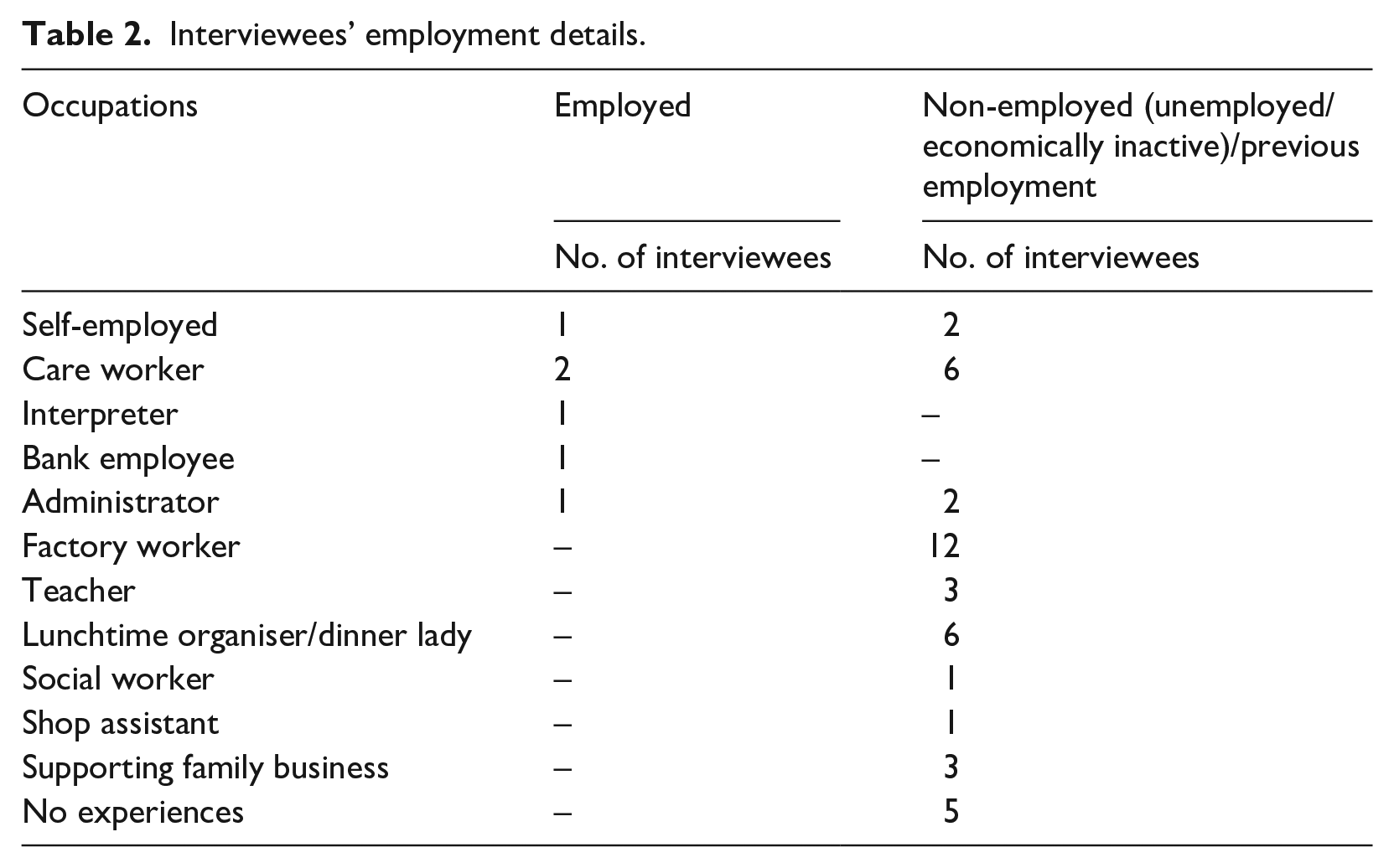
The research sample included South Asian British Muslim women of Pakistani and Bangladeshi heritage aged between 50 and 66 living in Greater Manchester, UK. Almost all of them hailed from rural parts of Sylhet, Chittagong (Bangladesh) and Mirpur (Pakistan) areas with low socio-economic backgrounds. There was a mix of employed/self-employed, economically inactive (including retired/pensioner) and unemployed (looking for jobs) women in the sample. Further particulars of the interviewees are outlined in Tables 1 and 2. In line with the historical patterns of these groups’ mass migration between the 1950s and 1980s, most interviewees were first-generation who migrated to the UK as spouses/dependants on a marriage/partner/commonwealth visa (Brah, 1993).
Interviewee details.
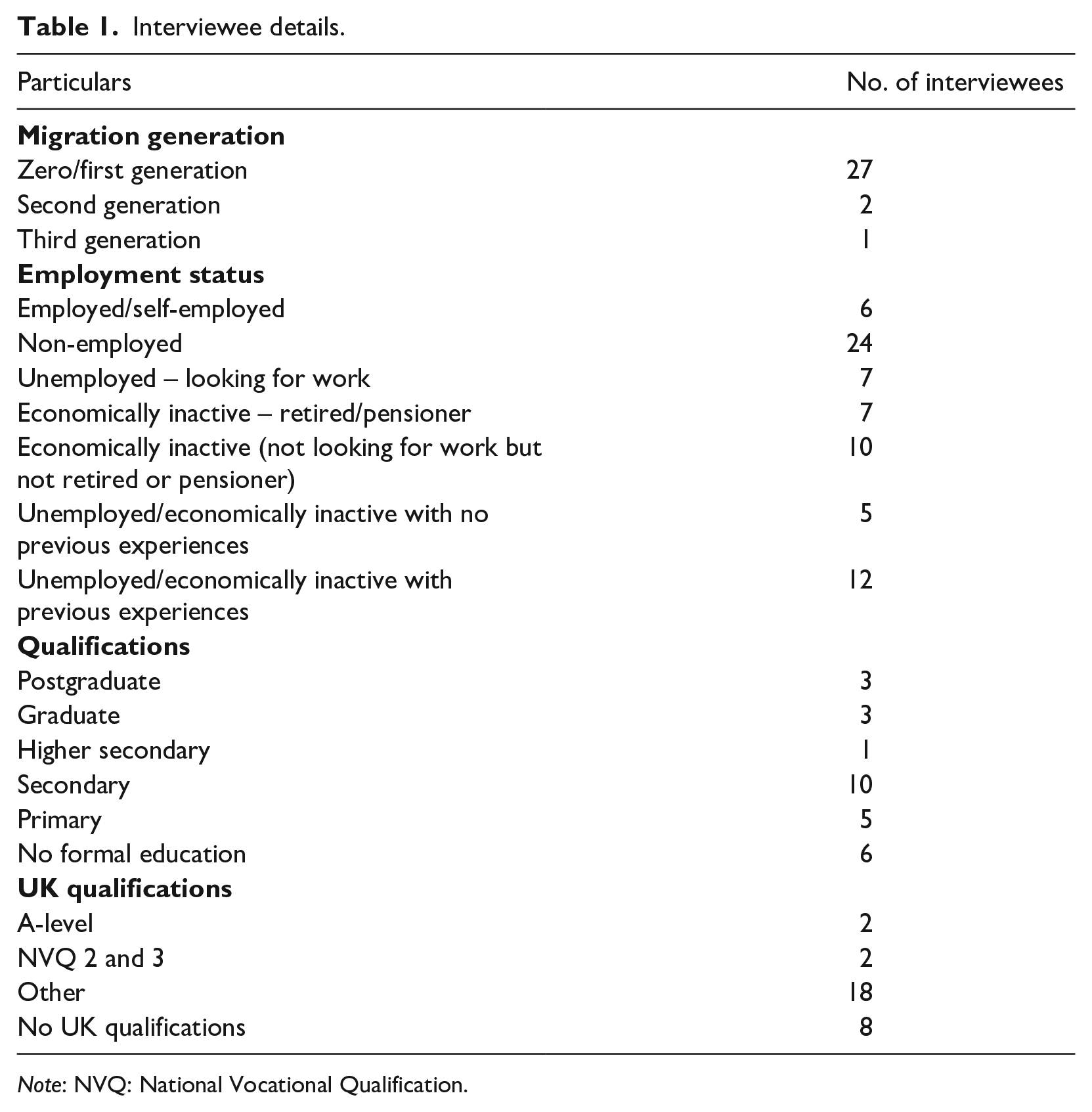
Note: NVQ: National Vocational Qualification.
Interviewees’ employment details.
Data have been collected in the form of 30 semi-structured in-depth interviews. The interviews were conducted by the researcher in Bengali, Sylheti, Urdu, Punjabi and English languages. Since the investigation began with relative clarity in its focus, semi-structured interviews were chosen, so that specific issues may be addressed (Bryman and Bell, 2007). Semi-structured interviews also allowed flexibility for the participants and encouraged them to talk at length and shape the direction of the interview as necessary (Robinson, 2014; Symon and Cassell, 2012). It was also the best way of achieving the depth and roundedness of understanding required by the complexity of the issues being investigated. For example, national-level data indicated that these women had high unemployment rates (DWP, 2019); however, the data did not provide explanations for the paradoxical outcomes of their low-level labour market participation post-equalisation of SPA and government initiatives for improving their employability. Semi-structured interviewing also offered a more flexible method that appeared more appropriate for capturing the complexities of the work orientations, gender-role attitudes and experiences of the women reconciling employment with other responsibilities and how changes had or had not occurred in their circumstances.
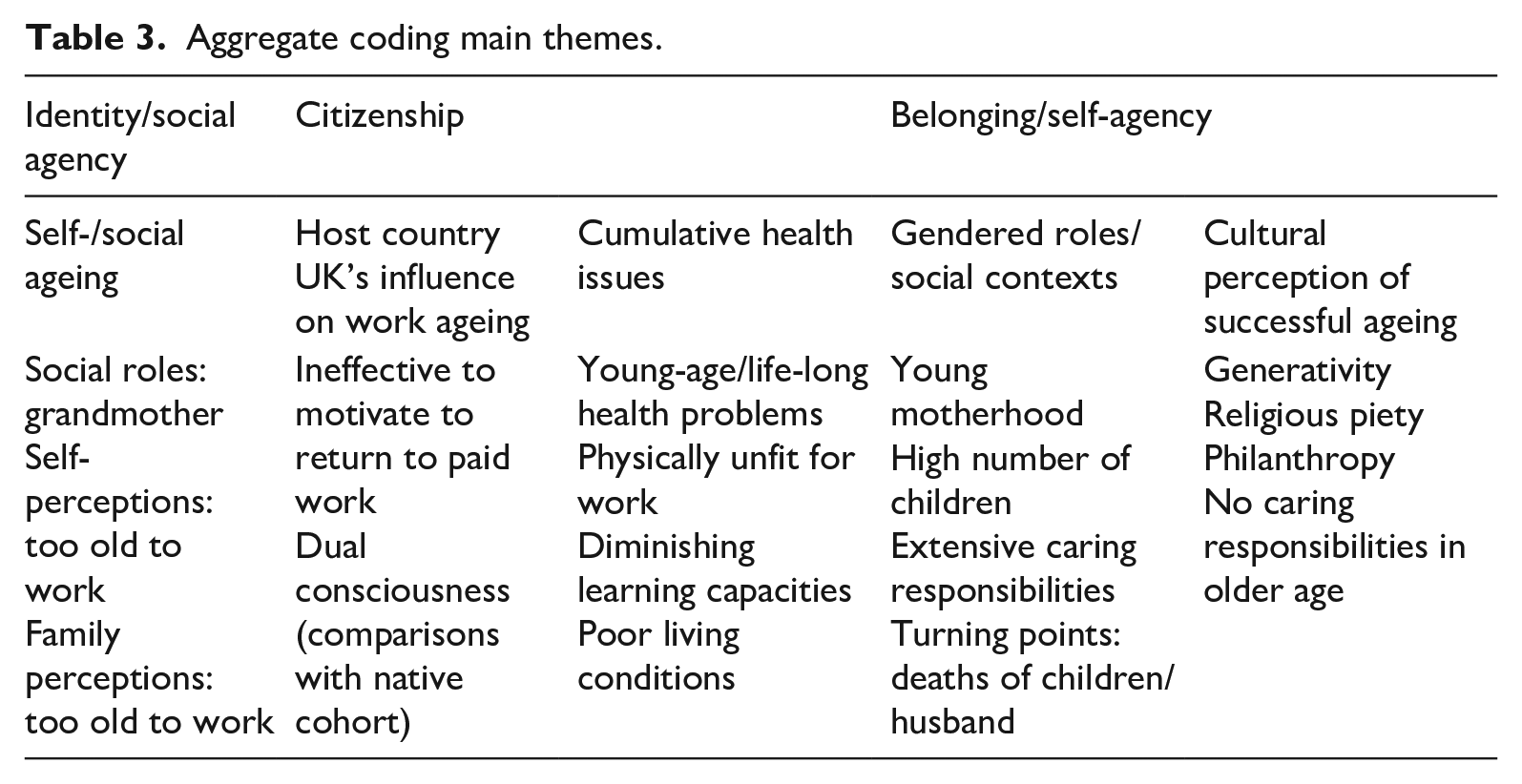
The selected interviews were conducted between October 2018 and January 2019. These were digitally recorded, transcribed and translated into English by the researcher. To secure anonymity, all real names were removed, and pseudonyms and interview numbers were used for the analysis. The transcripts were coded thematically (King, 2012) at three levels including primary, secondary and aggregate codes (see Table 3) – the aggregate codes were clustered based on the key markers of translocational positionality (i.e. identity, belonging, agency and citizenship) and the cumulative inequality markers, using the five axioms/indicators of the CI framework. The findings’ themes were positioned within the framework of translocational positionality and its core elements/markers of identity, belonging, agency and citizenship with regards to the different systems of social categories such as gender, age, class, race, religion and ethnicity to evaluate their positioning, wage work orientations and the patterns of their labour market participation. Simultaneously, it looked for signs of life-long accumulation and marked their impacts on older age attitudes and behaviour. For example, cultural, gendered and age roles for women and caring orientations/understanding were positioned within the host country’s system, which was different from their home country, putting them at a crossroad of negotiation between the competing understandings of successful ageing and working age.
Aggregate coding main themes.
The data analysis was completed in six steps: (1) Reading/re-reading the transcripts and contextualising the data by looking for emerging themes. (2) Removing irrelevant information, immersion and building a mental map of the overall patterns of the cohort’s life trajectories – this also involved open data coding following traditional thematic analysis (King, 2012). (3) Recognising the patterns and comparing them (e.g. commonalities and differences) with the existing literature. It was also when the translocational positionality and cumulative markers were operationalised (the markers of identity, belonging, agency and citizenship and the axioms of CI framework). While only the translocational markers were operationalised to the early life stages, both translocational and cumulative markers were applied to the interviewees’ mid to later lives; this is because early signs of socio-cultural ageing began to emerge for some interviewees in their mid or early 40s. (4) Clustering themes and findings to answer the research questions. (5) The research questions were answered using the analysis and its interpretations. (6) The theorisation of the interpretations was done, and overall contributions to theory, policy and practice were recognised.
While all interviews contained attitudinal data regarding wage work, more informative data within the labour market context were gathered from the employed women and women with previous work experiences in the UK. Conversely, during the analysis of interviews with the unemployed/economically inactive women with no previous experiences, the interpretive dimension would assume greater importance. That is, since data on their first-hand labour market experiences could not be gathered and interpreted, their conjectures and assumptions were indicative of their perceived realities, knowledge of which has been applied to develop a holistic understanding of their lost later-life work trajectories.
The researcher often had to reflect on their role as a researcher from ‘within’ (Ahmad, 2003) (a South Asian Muslim woman), whereby they had to look past their own position as a migrant woman of colour and an intersectional scholar – the aim was not to merely reproduce the existing narratives of oppression and victimisation about the cohort. Undoubtedly, their position also added advantages to the process since the interviewees opened up more to an ‘insider’ and ‘one of them’.
Findings
Culturally informed ‘working age’
Most of the interviewees were married off at a very young age (in their teenage years), and in many cases their children got married at a relatively young age too, meaning some of these women became grandmothers as early as in their 40s or early 50s. For most of them, the social and family roles of a grandmother acted as a catalyst for their premature social and work ageing. The analysis showed that the role of a grandmother was ritualised as a woman’s transition into old age within the family and community settings, meaning cultural age took precedence over chronological age for them (Ballard, 2009; Victor, 2004). While this fast-tracking of life stages positioned these women within family and community as older women, they had yet to reach that mark in the host country’s social and labour market contexts. Eight of the interviewees became ‘early’ grandmothers, who also perceived that their community saw them as ‘too old to work’ outside the home – a day in the life of an older adult in a rural village back home would mean not having to engage in many social activities (Dale et al., 2006, 2008; Phillipson et al., 2003). Their family members further reinforced those perceptions of early work ageing: Interviewee: My son says, ‘You don’t need to work anymore. You are too old now to work outside the home . . . don’t worry; we are here to take care of you.’ Interview 27 (62, non-employed)
Such affirmations by their family members had profound impacts on these women’s self-confidence and ambitions in older age (Levy, 2009). For example, on being asked about career plans, an interviewee said: Interviewee: What now? I am a grandmother now. Am I not too old? What’s there to look forward to? It’s time for the next generation to take over . . .. Interview 14 (61, non-employed)
Although evidence on early ageing may be found in current research, links with working age and understanding of later-life work ageing remain underexplored. This adds new knowledge to our understanding of work ageing outside the traditional institutionalised definition of working age and active ageing (DWP, 2021; OECD, 2006).
In contrast with the dominant discourse on older South Asian women, the cohort had reduced caring responsibilities in older age, albeit this did not appear to be an enabler of labour market participation in later life (ONS, 2019; Phillipson et al., 2003). Overall, only six interviewees had caring responsibilities: one looked after a grandchild, two cared for their own young children, two looked after ill husbands and one looked after an adult son. Despite a lack of evidence that the interviewees were actively engaged in traditional gendered age roles as carers of grandchildren, which was idiosyncratic in comparison with similar age groups from other ethnicities (Loretto and Vickerstaff, 2015; ONS, 2019), these women had internalised the community’s cultural attitudes and had assumed the normative community ageing roles that involved fewer activities and social withdrawal (Levy, 2009). This, interpreted through an intersectional translocational lens, shows how despite mobility and migration, women are often unable to shift their realities and remain confined within the home country’s cultural norms/expectations which they absorbed in early life, and post-migration from within the communities of the host country (Anthias, 2020). They stayed culturally tied to a different welfare system where state benefits in older age were almost non-existent and family units served as the pillars of old-age care (Phillipson, 2013, 2015).
Furthermore, the cohort understood their social positioning differently from their native white counterparts. There was evidence of dual and contradictory senses of realities; notably, those who were more integrated with the UK’s society and its systems through labour market participation held more dualistic and optimistic perceptions and attitudes: Interviewee: I have an English friend [. . .] she is probably 55, no older than 60 . . . if she can do it (extra shifts, long hours, etc.), then I should too . . . that’s how I think . . .. Interview 4 (50, employed)
In contrast, another interviewee described her understanding of the situations facing her native counterparts differently and attributed those differences to socio-economic backgrounds: Interviewee: Don’t forget to mention in your work that we didn’t receive the vaccines that these white women did in their childhood. We could never be physically as fit as them. Today’s generation is different, but we didn’t have them [the vaccines] back then. Interviewee 10 (62, non-employed)
Five other interviewees perceived themselves as ‘too old to work’ outside the home: Interviewee: My kids were small, and I had to look after them . . . and now, I am too old to work . . .. Interview 13 (51, non-employed) Interviewee: I feel like I’m already old . . . I feel old . . . I feel sick always . . . I feel fear . . . Researcher: What kind of fear? Interviewee: I don’t know. But it’s not depression. It’s my body – it’s very weak. I don’t feel good. Interviewee 11 (56, non-employed)
Their accounts reflected how cultural norms and community expectations from gendered roles dissuaded them from being an active agent in shaping their perceptions and understanding of ageing and work in later lives (Ginn et al., 2001; Glucksmann, 2005; Krekula, 2007).
Successful ‘cultural’ ageing vs (un)extended ‘work’ ageing
Overall, the analysis found that the interviewees did not need a successful career or financial freedom to feel satisfied and content in later life. They understood ‘successful ageing’ through the prism of ‘cultural generativity’ (Manheimer, 1995; Torres, 2001); that is, raising children with good morale, providing a good education so that they secure ‘respectable/honest’ earnings, instilling religiousness and marrying off with the ‘right kind’ of partner. Two interviewees considered their daughters marrying non-Muslims/different races were their personal failures (as they did not instil the ‘right’ set of values into their children). While another interviewee counted not teaching grandchildren her home country’s cultural values/language as life’s biggest failure. A happy immediate and extended family (children, siblings and parents) was what these women interpreted as a successful later life: Interviewee: I have raised my daughter well, so I’m happy. She is earning good money, she says she can help me. That makes me happy. I want nothing else . . .. Interview 7 (53, non-employed)
Such evidence corroborates with previous findings (Crewe, 2005; Grewal et al., 2004; Hochschild, 2000; Torres and Hammarström, 2009); however, their links with the understanding of later-life work ageing remain underexplored.
Moreover, saving money over their lifetime for pilgrimage was critical for them – again, a novel theme yet to be highlighted in current literature. Four interviewees felt content that they had reached the milestone of pilgrimage to Mecca, while two others had regrets about not being able to do so. Another interviewee thought that buying a house with bank loans was against her religious beliefs and, therefore, should be avoided at all costs: Researcher: You want to try for a council house then? Interviewee: Can you help? I wish someone would help me with that. I don’t want to take loans and go for a mortgage – that’s a sin. So, I don’t want to. If God willing, I will have it [a house] someday, or else, not . . .. Interviewee 15 (55, non-employed)
To attain piety in older age, the interviewees also put considerable efforts into philanthropic work, and therefore were happier to do unpaid instead of paid work: Interviewee: I do social work now. I’m involved with local charities. They are Christian people, but I love to mix with people from all backgrounds. I have many neighbours who are Christians. I feel like I am contributing to bridging the gap, and it’s [the job] flexible too. I also go to this other Muslim charity to help out, but that’s just once a week because it’s far from here and I have to drive to get there. Interviewee 30 (61, non-employed) Interviewee: What I do now is social enterprising. I am helping the community, but it is my business as well. I am also involved in local politics because I care for them. Interviewee 24 (53, self-employed) Interviewee: It makes me so happy to be able to help these other women who came from the same place as I did but not as fortunate. That is what I love most about this job. Interviewee 19 (55, employed)
It is worth noting that these jobs were more flexible too, so they could fit around their schedule and were not too demanding on their time and health (Lain and Loretto, 2016; Léime et al., 2017). The findings clearly showed how the need to have ample time to focus on the afterlife and attaining piety was crucial to them. Saving money over their lifetimes for pilgrimage is one of the pronounced signs of such devotion, which is further linked with their later-life paid work attitudes and motivation (Kanfer and Ackerman, 2004; Tornstam, 2005).
Cumulative translocational work ageing
Seven interviewees considered themselves physically unfit to do paid work, while seven non-employed participants had health issues that seriously impeded their mobility and regular physical activities. Eight interviewees stated that they were economically inactive, ‘mainly’ because of health issues. A couple of interviewees who were employed noted that they wanted to reduce hours as long hours are physically too demanding for them: Interviewee: I have significantly cut down my hours . . . I’m thinking of cutting them back further. I don’t feel physically well after working long hours. It’s just that I need the money . . .. Interview 17 (54, employed) Interviewee: I’ll work as long as I can, but I’ve reduced the hours . . . I’ve had a couple of surgeries in my toes, and I don’t feel as fit as before . . .. Interviewee 4 (50, employed)
Some other interviewees also shared how life-long health issues conditioned their work attitudes and behaviour: Interviewee: The thing is, I can’t do physically demanding work. I’ve always been like that. I’ll help my husband with setting up his business but can’t think of any available jobs suitable for my qualifications that wouldn’t be physically demanding . . .. Interviewee 1 (53, non-employed) Interviewee: I have arthritis, I’ve got asthma and cholesterol problems as well. Previously, I suffered from depression too . . . I can’t even cook or clean now. My daughter visits me and does all the household chores for me – my son doesn’t help much. Interview 27 (62, non-employed)
Moreover, ageing is also geographically constructed (McHugh, 2003) and the interviewees lived in poor conditions in the most deprived areas of Greater Manchester for all their migrant lives; therefore, low-income and more impoverished living conditions might also have affected their overall health and well-being (Duncan et al., 1998; Ministry of Housing, Communities & Local Government, 2019).
The analysis found their decaying health conditions to be linked to other social or labour market conditions too – such as ineligibility for certain jobs, location proximity of the workplace and working hours – creating more barriers and narrowing down their labour market choices (Dewilde, 2012; McCurdy, 2019). Although diminishing learning abilities, difficulties with storing new information and poor recollection capacities remain common old age issues (Sterns and Doverspike, 1989), the interviewees’ low level of education had particular impacts on their abilities to learn English in older age: Interviewee: I tried for several years, but I couldn’t memorise anything. And now? What can you learn at this age? Do you really think I could learn computer or English now? Interviewee 15 (55, non-employed) Interviewee: I learned English [. . .] for almost 10 years. But I’m slowly forgetting the words [vocabulary] . . . I’ve forgotten almost all of them. Interview 13 (51, non-employed)
Some crucial turning points in lives had further impacted their health, ageing and motivation to work or look for work, most notably the deaths of their husbands and children: Interviewee: Both my husband and my son died in the same year – 10 months apart. My husband died from cancer and my son died in an accident. It was during that time that I first fell into depression, and I’ve never been the same again. I just live to see my daughter and my grandchild, that’s all. Interviewee 12 (61, non-employed) Interviewee: After my husband’s death, I didn’t use to feel good. I used to sit at home and didn’t want to go outside, didn’t feel like doing anything; the doctor said it was depression. My daughter used to come and take me everywhere. I still take medicines for my depression; I can’t stop taking them. I still don’t feel like going outside . . .. Interview 7 (53, non-employed)
These accounts illustrate how turning points redirected the course of their lives and had impacts on their later-life social and labour market attitudes and behaviour (De Lange et al., 2006). As existing literature suggests, turning points are central to the measurement of life-course trajectories, especially for migrants, as their life-transitions take place across borders, creating more complexities, and are sometimes subject to drastic changes across systems and cultures (Foster, 2012; Radl, 2012; Tapia and Alberti, 2019).
Discussion
The findings have implications for the existing debates around the emergence of distinctive ageing of older migrants/migrant-citizens within the extended working lives contexts. As the evidence suggests, a singular focus on chronological ageing processes and simply using ‘age’ as a measure to understand work ageing disregard the inherent complexities and impacts of some nuanced gendered, economic and socio-cultural factors on ethnic minority migrant women’s diverse work ageing process (Krekula, 2007; Moore, 2009; Riach et al., 2015; Taylor et al., 2016; Victor, 2004). Most of the interviewees’ later-life employment potential remains effectually neglected because of socio-cultural ageist attitudes that further constrain their agency (Becker, 1985; Levy, 2009). Some of the issues specifically relate to premature work ageing; therefore, an understanding of the cumulative factors that shape their work orientations and attitudes account for the differences in their employment rates from the others, especially older women’s groups (Lain and Loretto, 2016; Léime et al., 2017; Loretto and Vickerstaff, 2015). The study provides strong evidence in this area by illustrating how diverse socio-cultural factors mark their trajectories differently from other groups and re-emphasises investigating the cumulative effects of interlocking trajectories on people’s work lives, particularly those of routinely marginalised people such as migrants, women and older workers (Lain et al., 2019; Léime et al., 2017).
For this cohort, the economic needs and caring responsibilities may have dwindled in later life; however, these have been replaced with the cultural and religious norms of successful ageing, norms that travelled with them when they migrated to the UK many decades ago (Crewe, 2005; Grewal et al., 2004; Manheimer, 1995; Torres, 2001). There is also a need for understanding their work attitudes in relation to their own assessment of employability in older age as these are weighed against their later-life motivation for engaging in paid work (Heckman and Borjas, 1980; Kanfer and Ackerman, 2004). With their qualifications/outdated skills, these women perceive themselves as unemployable at their age, reducing their motivation to actively search for jobs. A lack of motivation for upskilling is also informed by their perceptions of successful ageing, religious obligations, community/family responsibilities, pre-existing health issues and individual aspirations to be employed. There is little evidence or exploration of such relationships within the work and employment literature.
The extended working lives policies may not be a suitable long-term alternative for these groups in the absence of jobs that do not require English language skills or be not physically demanding while meeting religious norms (Bal and Jansen, 2014; Ballard, 2009; Dale et al., 2002, 2006). Therefore, the government and employers should rethink available alternatives for these women. Their cases epitomise translocational cumulative trajectories, guiding our understanding of migrant women’s diverse work attitudes and labour market behaviour. They further demonstrate how Western social age norms and institutional age structures situate the cohort precariously within the UK’s ageing policy landscapes (Anthias, 2002; DWP, 2021; McCurdy, 2019; Radl, 2012). Failing to assimilate with the changing work ageing climate, these women remain as ‘divergents’.
Based on their asymmetrical progress with the UK’s ageing outlook, reluctant later-life work attitudes and non-participatory behaviour in the extended working lives context, an alternative ‘divergent work ageing’ perspective is proposed here, which adds new knowledge to our theoretical understanding of social age and ageing via rethinking and advancing theorisation of work-related ageing. The analysis applies an intersectional cumulative framework to explain the translocational ‘work ageing process’ of the cohort where migrants’/migrant-citizens’ ageing takes place within the boundaries of a single nation-state (i.e. host country), but is influenced by two competing sets of values, systems and practices of home and host countries. Such an explanation enhances our understanding of both gendered and cumulative ageing within work contexts and shines a new light on the process of ‘divergent work ageing’ manifested in the cohort’s later lives.
The cohort’s attitudinal divergent work ageing may be defined as ‘a process that occurs when migrants’ transnational and socio-cultural ageing contradict with the host country’s institutional ageing structure, norms and retirement systems and diverge to create unique forms of work ageing inequalities and trajectories for them in the labour market’. Those unique sets of inequalities become the cohort’s divergent work ageing positionalities – that is, inequalities arising from the groups’ struggles to comply with and fit into the host’s evolving ageing policy norms/landscape.
These women’s cross-cultural experiences and understanding of ‘working age’ (Lain et al., 2019) and perceptions of successful ageing (Torres, 2001) coupled with their life-long accumulated inequalities (Dannefer, 2003; Ferraro and Shippee, 2009) have shaped their older age work attitudes and labour market behaviour. Some of those ageing factors, perceptions and processes have been recognised and labelled in current literature; for example, transnational ageing, linked lives, transnational motherhood and cumulative inequality (Ferraro and Shippee, 2009; Horn et al., 2013; Worts et al., 2016). However, within the extended working lives contexts, these experiences need to be conceptualised separately rather than clustering them as an extension of transnational or cumulative ageing. Such theorisation is few and far between in employment studies and in relation to working age/the work ageing process. This article addresses the gap by theorising their diverse work ageing process with the application of an intersectional cumulative life-course framework. The rationale for conceptualising such a heterogeneous process independently is supported by evidence of the formation of a unique set of inequalities (also interpreted as positionalities) for the cohort as a result of their translocational work ageing process, which remains at odds with recent changes in the UK state pension age, retirement and benefit systems, the notions of active ageing and policies of extended working lives (DWP, 2014; OECD, 2006; WHO, 2002). Simultaneously, the divergent work ageing process acknowledges the dominant role gender plays in the construction of such inequalities, which thus far has not been theorised in the labour market, migration or gerontological research (Duncan and Loretto, 2004; Krekula, 2007; Moore, 2009; O’Connor and Shortall, 1999). These women have not aged in tandem with the host country’s ageing systems, particularly relating to working age; rather, their behaviour and attitudes have shown some diverging patterns when compared with the host country’s Western understanding of ageing and its norms and expectations, showing resistance and reluctance to wage work in later life.
The theorisation of the ‘divergent work ageing’ model effectively contributes to expanding existing theoretical and conceptual debates around migrant/migrant-citizens’ work ageing issues and labour market participation, as well as broadening our understanding of the underpinning processes of transnational lives of older migrants in general.
Conclusion
Against the backdrops of extended working lives policies and high levels of unemployment and economic inactivity among particular older age groups in the UK labour market, this study explores the work attitudes and labour market behaviour of South Asian British Muslim older women living in Greater Manchester, UK. The findings indicate that the interviewees do not have positive attitudes towards wage work in later life and that most of the unemployed and economically inactive interviewees do not intend to return or join the labour market in the foreseeable future. Most interviewees often find themselves incompatible with the UK labour market environments, especially that of the extended working lives policies. Although there are some patterns in their cumulative older age predicaments in terms of wage work and ageing, individual life circumstances and turning points mark some heterogeneity among the groups (e.g. deaths of children and husbands). Furthermore, the persistent influences of social and community norms and expectations around gender, religious and age roles from their home countries’ culture have shaped these women’s early perceptions of domestic responsibilities and successful ageing, which have had life-long impacts on their wage work participation. In addition, life-long accumulation of other inequalities including deprivation, negative impacts of having intermittent work trajectories and decaying health conditions add to the long list of factors affecting their motivation to join or re-join the labour market.
More research is needed into these otherwise invisible groups, which only become visible for the high rates of unemployment and economic inactivity. Although existing research advocates paying attention to diversity in ageing among older workers, it lacks in theorisation of such diverse processes. This research fills those gaps and proposes the ‘divergent work ageing’ model to make sense of their work attitudes and labour market behaviour in later life. A combined translocational cumulative framework to a cross-sectional study is applied for this purpose. Future research should adopt a longitudinal approach to capture the impacts of events on life trajectories as they happen. Collecting data on only one group also limits the study’s ability to explore further variations in the lived experiences of older women across different ethnic minority groups. However, it may be argued that focusing on a particular group has added richness and depth to the analysis, and the study findings indeed have some universal relevance for other ageing migrant groups’ labour market participation in later lives. Future research in this area should compare across different ethnic groups to test the generalisability of the divergent work ageing model further.
Clearly, putting emphasis solely on the economic aspects of active ageing, as existing policies do, will ignore the diverse socio-cultural issues affecting ethnic minority older cohorts, having long-term implications for the inclusive labour market, extended working life and sustainability of the active ageing agenda. Policymakers and employers need to focus more on understanding those nuances, and although it may be difficult to find the right strategic balance – the novel ‘divergent work ageing’ model can be a guiding tool for achieving that purpose.
Footnotes
Acknowledgements
The author would like to thank the journal editor(s) and three anonymous reviewers for their insightful comments and feedback that have been reflected on and included in the final manuscript.
Funding
The author disclosed receipt of the following financial support for the research, authorship, and/or publication of this article: This research received funding from The Work and Equalities Institute of Alliance Manchester Business School, The University of Manchester’s ‘Just Work’ in Greater Manchester project, supported by Lord Alliance’s donation to the business school.
