




Abstract
In this article, task data from the German Qualification and Career Survey (BIBB/IAB) is matched against the Sample of Integrated Labour Market Biographies (SIAB) to investigate what patterns are discernible in retirement between 1985 and 2005 in Western Germany. Set against a background of pension reforms and substantial structural change, the article asks whether the nature of occupational tasks has any significant effect on the timing of retirement. Through the use of event history analysis, the article reveals that having a large percentage of routine manual tasks in one’s job is associated with a greater likelihood of a job holder leaving employment, while having medium to high percentages of non-routine manual tasks in one’s job will tend to decrease that likelihood. There is also evidence that holding a job that includes a medium to high concentration of analytical and interactive tasks will tend to reduce the likelihood of early retirement.
Introduction
Demographic change has had a substantial influence on retirement policies in Europe over the recent decades. One feature common to most European countries was a tendency to eliminate or restrict the options available for early retirement, a broadly consensual goal throughout Europe, as stated in the Lisbon (1999) and Stockholm (2000) agendas of the EU (Börsch-Supan and Coile, 2018; Arza and Kohli, 2011; Maltby et al., 2004; Rinklake et al., 2013). Against this background, the retirement behaviour of individual workers has been studied in a variety of contexts. This article focuses on Western Germany, where, in a pattern consistent with the EU policy agenda, reforms in 1992 and 1999 restricted opportunities for early retirement and reduced benefits for persons who retired early (Bonin, 2009). At the same time, collective agreements became more relevant in regulating early retirement and – through a reform introduced in 2001 – collective and company pension schemes acquired a new role in making up for cuts imposed on the statutory system (Klammer, 2020).
Retirement studies traditionally differentiate between push and pull factors governing the timing of retirement or classify determinants on three ‘levels’: micro (or socio-demographic) characteristics, meso (or company-specific) effects and macro factors (Buchholz, 2006; Dahl et al., 2003; De Preter et al., 2013; Van Oorschot and Jensen, 2009). While the conceptual framework that distinguishes between push and pull factors plays a prominent role in much of the literature (Hofäcker et al., 2016; Shultz et al., 1998), research shows that the two complementary approaches are intertwined (Ebbinghaus and Hofäcker, 2013; Radl, 2013) and that the influence of the relevant retirement culture should not be neglected in dealing with such issues (e.g. Jansen, 2018).
However, not enough is known about the influence of job content on the issue, apart from the fact that hard physical labour tends to lead to early retirement – for reasons of disability retirement in many instances (e.g. Blekesaune and Solem, 2005; Robroek et al., 2013) and the role played by workplace stress, the emotional demands of certain jobs and low levels of decision-making authority (Brussig, 2016; Carr et al., 2018; Sonnega et al., 2017). Less is known about the effect of actual job content (i.e. of actual tasks performed) on retirement. Owing to a paucity of data, researchers are often forced to treat the concept of ‘occupation’ as a proxy for job content (e.g. Carr et al., 2018). However, not only do tasks performed by workers in a particular occupation change over time, but even within a specific occupation tasks performed by women may be different compared to men and by older workers compared to their younger colleagues. It seems then that looking closely at the tasks performed within occupations is likely to help gain a deeper understanding of the retirement process than by looking at occupations alone.
This article adds to the literature by looking at the influence wielded by job content, as measured by the actual tasks performed by employees in the workplace. The period analysed (1985–2005) was a period of rapid technological change accompanied by a series of pension reforms in Germany. The study follows Brussig (2016) and other German literature on economic tasks (Antonczyk et al., 2009; Black and Spitz-Oener, 2010; Spitz-Oener, 2006) in that it is based on a combination of two representative data sets. Data on job histories are provided by the SIAB data set, a large representative sample of socially insured German workers. This is combined with the data from the BIBB/IAB survey, which collects information on tasks performed by employees at roughly six-year intervals. The two data sets are merged into one another to analyse whether tasks done by workers have any significant effect on their likelihood of leaving socially insured employment in Western Germany. Section two reviews the empirical literature on the determinants of retirement behaviour and discusses the theoretical links between tasks, technological progress and retirement. The data and methodology used are described in detail in the third section. The empirical analysis in section four begins with a descriptive analysis of the differences that exist between tasks performed within specific occupations before presenting a set of semi-parametric Cox models on leaving socially insured employment. The final section summarizes the major findings.
Theoretical framework: Workplace tasks and other determinants for the timing of retirement
Financial incentives
Most economic studies on retirement focus on financial incentives offered by institutions. According to Börsch-Supan (2000), a person’s ‘social security wealth’ may decline if their increase in annual pension resulting from postponing retirement is not large enough to offset the shorter time over which that person will be in receipt of that pension. Where this happens, workers will have a financial incentive to retire. The studies concluded that workers in Western Germany responded strongly to incentives to go into early retirement introduced in 1972, provoking a decline in the country’s average retirement age (Bonin, 2009). Berkel and Börsch-Supan (2004) and Bönke et al. (2018) show that disincentives introduced recently to penalize early retirement have also had a significant effect on retirement timing in Germany. Similar results on the effects of financial incentives have been found, for example, by Blundell et al. (2002) for the UK, as well as by De Preter et al. (2013) and Schils (2008) in multi-country settings. A recent work by Lorenz et al. (2020), however, studies the effects of increases in the standard retirement age in Germany – coupled with pension deductions when people take early retirement – and finds no consequent prolongation in the employment of older men. Employers seem to have pushed their employees to take advantage of the various bridging options provided by unemployment or semi-retirement instead, with the result that it seems the new incentives have not produced the effect that was expected of them a priori.
Societal norms
There is much literature (see, for example, De Preter et al., 2013; Kohli and Rein, 1991; Seibold, 2019; Van Oorschot and Jensen, 2009) to suggest that societal norms are an important determinant in retirement decisions, and that they potentially interact with economic incentives. Pfau-Effinger (2005), for example, points to the relevance of interactions between welfare state policies on the one hand and culture on the other. She defines the concept of ‘welfare culture’ as ‘the relevant ideas in a given society surrounding the welfare state and the way it is embedded in the society’ (Pfau-Effinger, 2005: 4). Van Dalen and Henkens (2002) examine individuals’ intentions to go into retirement under the influence of alternative early retirement policies in the Netherlands. The conclusion they reach is that financial incentives were not the only significant factor in retirement decisions on the grounds that the long-term trend towards earlier retirement had started before reforms encouraging early retirement were introduced. Jansen (2018) shows that retirement culture does indeed play an important role in retirement decisions: he finds a positive correlation between individual ideas about what constitutes the ideal transition into retirement and an individual’s likelihood of remaining employed into older age. On a societal level, he shows that countries with low rates of participation for older workers also tend to have a culture of transition into retirement that aims at early exit from the labour market. A relatively recent article by Seibold (2019) tries to disentangle the relative importance of incentives from that of culture. He presents evidence suggesting that statutory age thresholds – for both early and normal retirement age – serve as important reference points in retirement timing.
Workplace tasks
That job content influences retirement behaviour is fairly uncontroversial (e.g. Blekesaune and Solem, 2005; Brussig, 2016; Carr et al., 2016; Robroek et al., 2013; Sonnega et al., 2017). However, it is sometimes difficult to isolate job content in longitudinal data, a fact that results in studies on the issue being rather rare. Data on workplace tasks provide one route towards dealing with this question. Tasks are typically classified in the literature on the one hand into manual and non-manual (analytical and cognitive) activities and into routine and non-routine tasks on the other (Autor et al., 2003). One of the take-home messages in the existing literature on tasks is the proposition that technology affects different types of jobs in different ways, since routine tasks are increasingly being done by computers and machines. Against this, the demand for people to do non-routine tasks is set to increase in a process that is now leading to a polarization in demand for tasks (and/or skills) (Autor et al., 2003, 2014; Autor et al., 2006; Gallie, 1991; Goos et al., 2014). Such polarization is widely thought to be especially likely during times of rapid technological change, though the very idea of polarization in job demand is also challenged by some authors (Fernández-Macías and Hurley, 2017).
Another important finding of this line of literature is that task changes can often occur within occupations, meaning that controlling for occupation alone is not enough to pick up the full effects of technological change. In the context of older workers, following the logic of Blossfeld et al. (2006), certain job tasks can be interpreted as a proxy for ‘push factors’ driving workers towards early retirement. Technological advances can therefore be expected to translate into unequal chances of reaching statutory retirement age, depending on the tasks actually performed in the workplace. This article therefore investigates what influence certain tasks can be expected to have on retirement timing on the basis of what is already known from the literature about technological change and the demand for tasks to be performed.
As discussed above, routine manual and routine cognitive tasks (such as repetitive assembly work and bookkeeping) are increasingly done by computers and machines. Many workers now performing routine tasks will either be reallocated to other tasks for which they previously had no comparative advantage or – if such reallocation is not possible – leave the labour market. Therefore, workers whose jobs contain mainly routine tasks should be expected to leave employment earlier than those whose jobs involve less of such tasks (Hypothesis 1). Moreover, computers tend to complement non-routine tasks requiring higher skill levels (Acemoglu and Autor, 2011; Autor, 2014; Autor et al., 2003, 2006), meaning that the demand for highly educated workers to carry out analytical and interactive tasks is likely to increase. Thus, workers who perform mainly analytical and interactive tasks should be expected to retire later (Hypothesis 2). On the other hand, technological progress is expected to have little impact on the demand for non-routine interpersonal flexibility in jobs requiring a low level of formal qualification (Autor et al., 2006). Therefore, workers performing a lot of non-routine manual tasks will have a lower likelihood of early retirement than routine manual workers (Hypothesis 3).
Data and method
Employment data
The current study uses the Sample of Integrated Labour Market Biographies 1975–2010 (SIAB 7510), a 2% random sample drawn from the Integrated Employment Biographies (IEB) data set of the Institute for Employment Research (IAB) (Vom Berge et al., 2013). The empirical analysis uses employment information for Western Germany only, backed up by the associated data on unemployment to exploit the long period taken in by the data set. The data set’s greatest advantages include the following: (i) its long observation window, allowing us to track workers all the way back to the mid-1970s; (ii) the detailed data it contains on the duration of individual employment statuses, which are recorded precisely to the day, allowing us to estimate hazard rate models; (iii) the detailed information it contains on wages, occupation and company size; and last but not least (iv) the sheer size of the data set, containing the employment histories of no less than 1,639,325 individuals. As it excludes civil servants or the self-employed, the analysis in this article applies only to employed workers paying social insurance contributions.
Against this, the major disadvantage of the data set is that the socio-demographic information it contains is rather thin, though it does allow us to control for two important factors: age and education. Hours of work are not recorded, but it does give details on whether the surveyed workers are under a full- or part-time regime. Another disadvantage is that there is no specific code to show whether the end of a spell of employment is due to retirement. Retirement is therefore defined as the person’s last exit from socially insured employment from age 55 upwards. In order to avoid incorrectly biasing the estimates towards the end of the observation window, only employment spells up until the end of 2005 are included, though it is checked whether the individuals are employed at any time during the following five years (i.e. until 2010). If the spell recorded for workers aged 55 and older in 2005 is the last spell observed up until 2010, then the individual is deemed highly unlikely to have returned to socially insured employment since then, as in Germany the chances of returning to employment are relatively slim after the age of 60 (compare, for example, Heywood and Jirjahn, 2016; Rinklake and Buchholz, 2011). Though the data set begins in 1975, the first 10 years are used only to construct a variable for unemployment history (between the ages of 45 and 54), leaving only the data from 1985 to 2005 to investigate retirement behaviour.
Task data
Following the literature (Antonczyk et al., 2009; Black and Spitz-Oener, 2010), task-related data are merged into the SIAB information by generating task indicators at the mean for a set of occupations from the Qualification and Career Survey (BIBB/IAB, 1989, 1995; Jansen and Dostal, 2015), which provides self-reported information on activities performed in the surveyed workers’ day-to-day work. The BIBB/IAB is an employee survey carried out by the German Federal Institute for Vocational Training (BIBB) and the Institute for Employment Research (IAB). To match the analysed time span – between 1985 and 2005 – this article uses data from the 1985/86, 1991/92 and 1998/99 waves. Not only are later waves outside of the observation window, they also tend in general to be less comparable (see Rohrbach-Schmidt and Tiemann, 2013).
As the questionnaires have changed to adapt to changes in real-world tasks, the surveyors do not enquire about all job activity items in all three waves, meaning that the structure of the task categories needs to fulfil two requirements: first, the task variables should be as comparable as possible across all waves and, second, they need to take account of shifting tasks and the changing questionnaire over time. To achieve this trade-off, the job activity items were carefully selected from the BIBB/IAB data sets following the literature (Antonczyk et al., 2009; Rohrbach-Schmidt and Tiemann, 2013; Spitz-Oener, 2006), resulting in five task categories: routine manual, routine cognitive, non-routine manual, non-routine analytic and non-routine interactive. A detailed discussion of how task categories were generated can be found in Appendix A in the online supplemental data, where Table A1 shows the task items selected. For example, teaching and consulting are considered interactive tasks, clerical work and bookkeeping are routine cognitive tasks, research and organizing are analytical tasks, repairing, caring and cleaning are non-routine manual, while manufacturing and storing goods are defined as routine manual tasks. As many items available in all waves as possible are used and new items are added to reflect changes in job tasks over time. Table A2 in the online supplemental material shows that missingness is not an issue in the BIBB/IAB data.
Once the categories are established, task-related measurements are calculated following Antonczyk et al. (2009) for men and women separately for the three waves and then merged into the SIAB data set:

AFLijt is the proportion of tasks reported in category j from among all the categories reported by worker i. AFL can therefore be interpreted as an approximation of the share of their working time that a worker spends performing j. A mean for each of these task measurements (AFLijt) is calculated separately for men and women within each individual occupation. The metrics are then merged into the data for older workers of the SIAB sample on the basis of the occupational classification that the two data sets possess in common. The occupational classification is made by grouping the original occupational classification into 21 categories – 20 of which are used in the multivariate analysis (Table A3 in the online supplemental material). In order to homogenize the samples, a number of further selections are carried out: only older individuals of German nationality working at least 15 hours weekly in Western Germany (excluding Berlin) are considered for generating the task-related measures (separately for women and men) and are then merged into the same population in the SIAB data. The age range is extended slightly so that it now also includes workers as of the age of 50, on the grounds that the BIBB/IAB data set is relatively small and deleting workers between ages 50 and 54 would result in some task cells being left empty. Robustness checks reveal that this course of action does not introduce bias (Figure A1 in the online supplemental material).
Method
This study uses event history analysis to test the effect of tasks on the likelihood of retiring. Event history (or hazard rate) models allow analysis of longitudinal data containing information on the occurrence and timing of certain events – here retirement – and on socio-demographic factors and other job features. Event history models have advantages over standard forms of regression analysis in this context, since they allow information on people that do not retire to be included within the observation window – and are thus ‘censored’, and because they are capable of accounting for self-selection among older workers to either continue working or exit the labour market (Drobnič, 2002; Meghir and Whitehouse, 1997). Cox proportional hazard models are presented in this article as they have the benefit that they obviate the need to specify ‘baseline hazards’ parametrically. Even though we do not have to model the baseline hazard, we include year dummies in our Cox model to control for the important institutional changes in Germany over our observation window. In order to test whether the type of model used – parametric or semi-parametric – influences our estimates, we conduct robustness checks in the form of Piecewise Constant Exponential Models. These yield similar results, which are shown in the online supplemental material Table B4.
People are assumed to enter the risk age group for exiting the labour market in the year they turn 55. One peculiarity of the analysis carried out here is that it defines only one potential event per person, retirement: the last observation in the SIAB of that person in socially insured employment up until 2005. As discussed above in the Data section, if the spell of employment recorded for workers aged 55 and older in 2005 is the last such spell observed for them from then until 2010, then the individual is deemed highly unlikely to have returned to socially insured employment. If, on the other hand, further spells of employment subsequent to 2005 are observed, then the spell observed in 2005 is treated as censored in the event history analysis. The main focus in the multivariate analysis is on the task-related variables, but it also controls for other factors identified in the literature as influencing retirement: time period, socio-demographic traits and such job characteristics as earnings and working time.
Empirical results
Descriptive analysis of tasks
This section provides an overview of the AFL task measures used in the analysis. As described above in the Data section, men and women of German nationality aged between 50 and 65 who spend at least 15 hours weekly at work in Western Germany are included. Figure 1 shows the percentage of working time spent on different tasks, taking all occupations together for the three cross-sections chosen (see Data section above and online Appendix A for a detailed explanation).
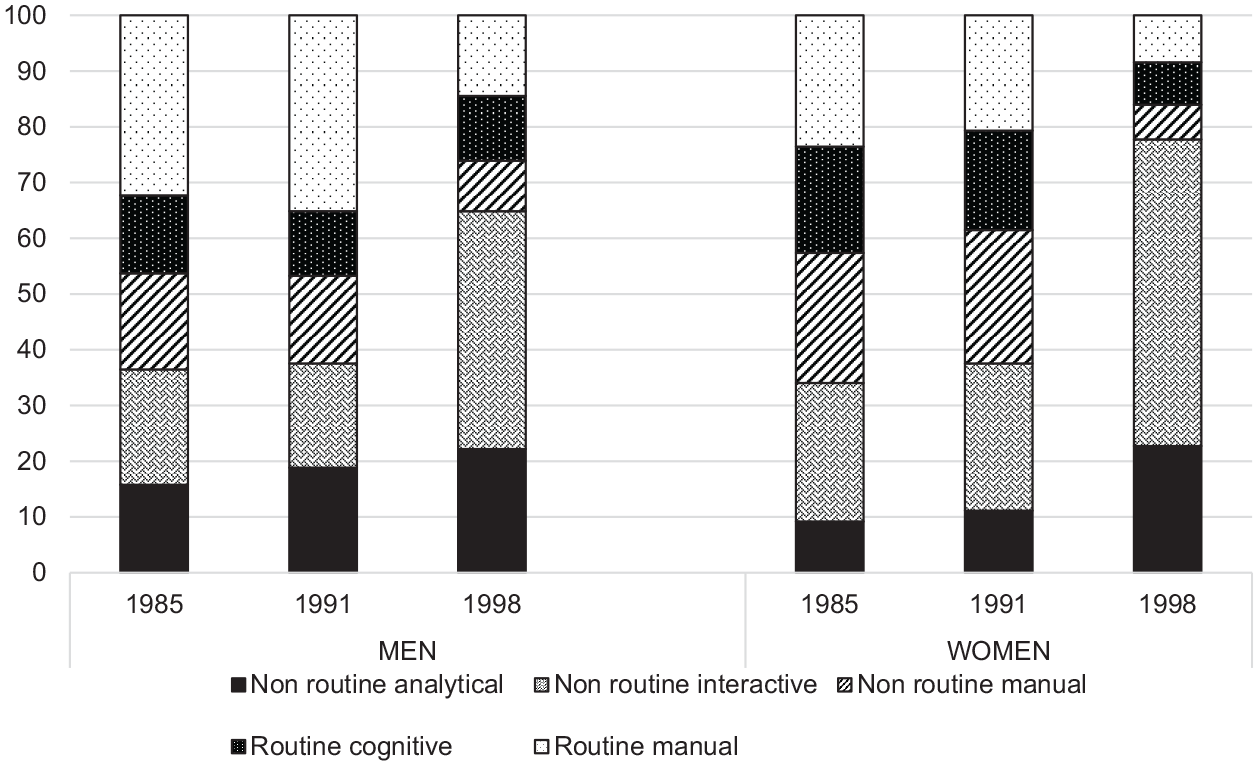
Percentage of overall working time spent on different tasks.
Routine tasks (whether cognitive or manual) were still highly significant at work in both 1985 and 1991. On average, employees spent 50% of their work time doing routine tasks. Yet one sees a remarkable change in this distribution between 1991 and 1998. By 1998, male employees were spending ‘only’ approximately 25% of their time doing routine tasks, with women dedicating even less time (15%) to such work. Since the questionnaire changed over time in an attempt to map the changing content of tasks in its list, one must keep in mind that reported changes are also likely to reflect, at least partly, changes made in the questionnaire itself. However, the general trend matches the changes in job content predicted in the literature, with interactive and analytical tasks growing in importance and manual tasks in decline, and with an ongoing increase in the relative importance of non-routine manual tasks, for men at least. As shown in Figure 1, average differences also exist in job content for men as compared against women. Men carry out more routine manual activities than women, while women carry out more non-routine manual tasks. And non-routine analytical tasks are (for 1985 and 1991) undertaken more often by men than by women. While these differences are partly due to gender differences in occupations (Trappe and Rosenfeld, 2004), there are gender differences in job content even within the same occupations (see Figure A2 in the online supplemental material). In summary, if one wishes to provide a comprehensive account of the full richness in the variety of tasks performed by different types of worker, simply controlling for occupations is insufficient, as there are clear gender differences even within occupations. And – what is more – task content also changes over time.
Event history analysis
Turning now to survival analysis of socially insured employment in the SIAB data, Kaplan–Meier survival curves for men and women – broken down by differing job content – serve as an initial descriptive test of the task change hypothesis. For this analysis, the individuals need to be grouped according to whether they spend a relatively large amount of their time performing one of the tasks grouped into the five task categories. Table 1 shows the percentages of workers spending less than 10%, 20%, 25% or 30% of their working time on a certain type of task. Taking non-routine analytical tasks as an example, only 22% of all male workers perform analytical tasks for more than 30% of their time. Based on the distribution found in the BIBB/IAB sample, a percentage below 10 is defined as being ‘low’, one between 10 and 30 as ‘medium’ and one from 30 upwards as ‘high’.
Task distribution in the social security data set (in percent).
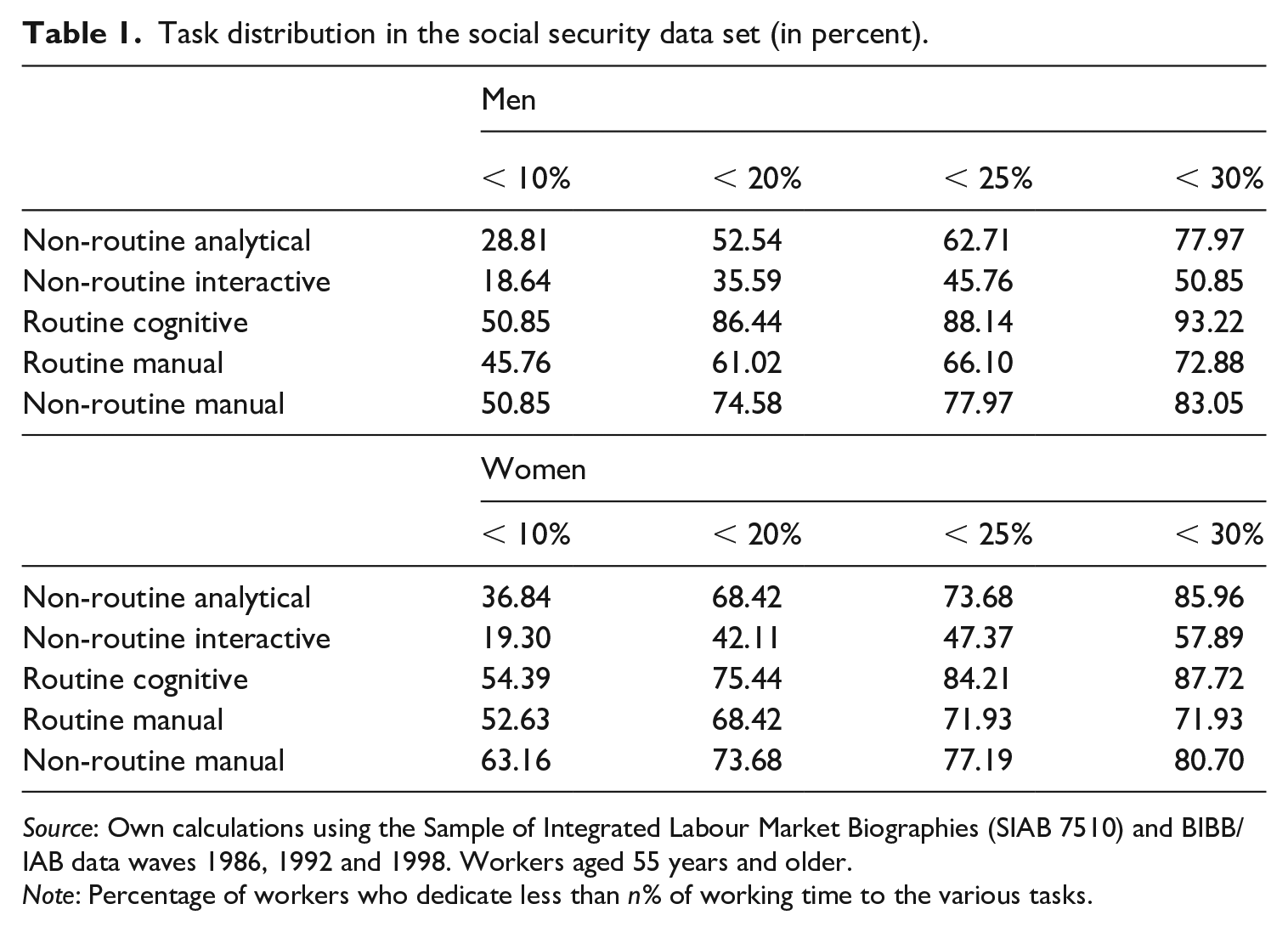
Source: Own calculations using the Sample of Integrated Labour Market Biographies (SIAB 7510) and BIBB/IAB data waves 1986, 1992 and 1998. Workers aged 55 years and older.
Note: Percentage of workers who dedicate less than n% of working time to the various tasks.
Figure 2 plots the curves for workers and employees who as of age 55 dedicate a relatively high proportion of their time – 30% or more – to any one of the various task categories (T = 1). 1 In order to provide a group against which to compare them, the graphic also shows a plot for those for whom this is not the case (T = 0). Table B1 in the online supplemental material provides an overview of the number of subjects and failures per year.
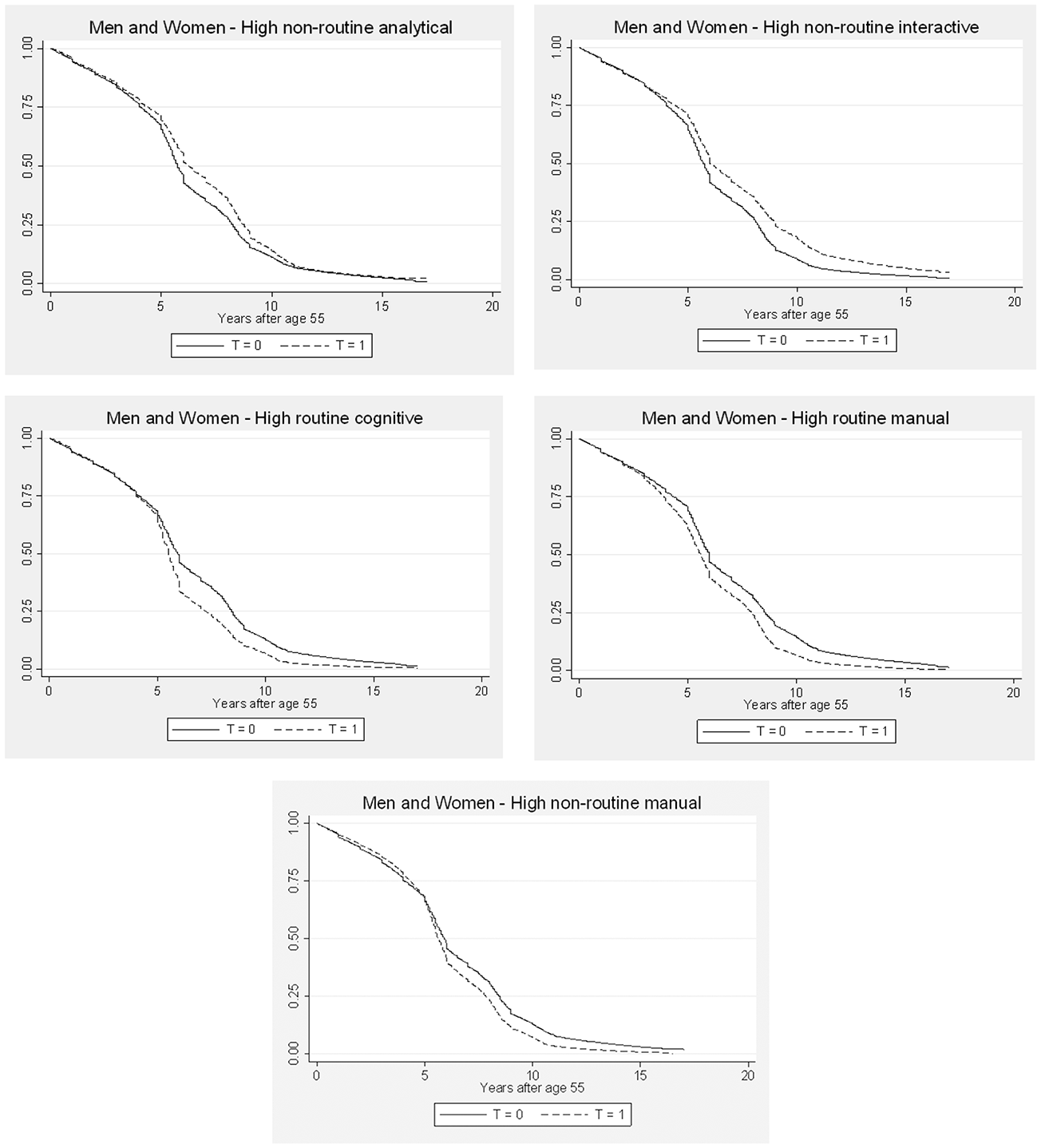
Kaplan–Meier survival curves by tasks.
In the absence of any further control variables, individuals whose jobs involve analytical activities are more likely to remain employed between the ages 60 and 65. The maximum gap between the two groups is roughly 10 percentage points. Those who dedicate 30% of their time or more to non-routine interactive activities are also more likely to remain employed for longer. The difference between the groups becomes apparent by the time they reach their sixtieth birthday and remains detectable until the age of 70. These findings provide the first descriptive support for Hypothesis 2. Against this, and as expected, individuals whose job content is dominated by either routine cognitive or routine manual tasks (Hypothesis 1) are less likely to remain active from age 60 onwards, an observation that continues to apply even after legal retirement age, though the difference is small. In fact, the disadvantage suffered by routine manual workers is observable even before the age of 60. At the same time, individuals whose job content includes at least 30% non-routine manual activities are less likely to remain active from the age of 60 onwards, the only observation that fails to chime with one of the hypotheses (Hypothesis 3). To summarize then, the descriptive analysis demonstrates that differences in relation to tasks exist that affect a worker’s likelihood of remaining in employment.
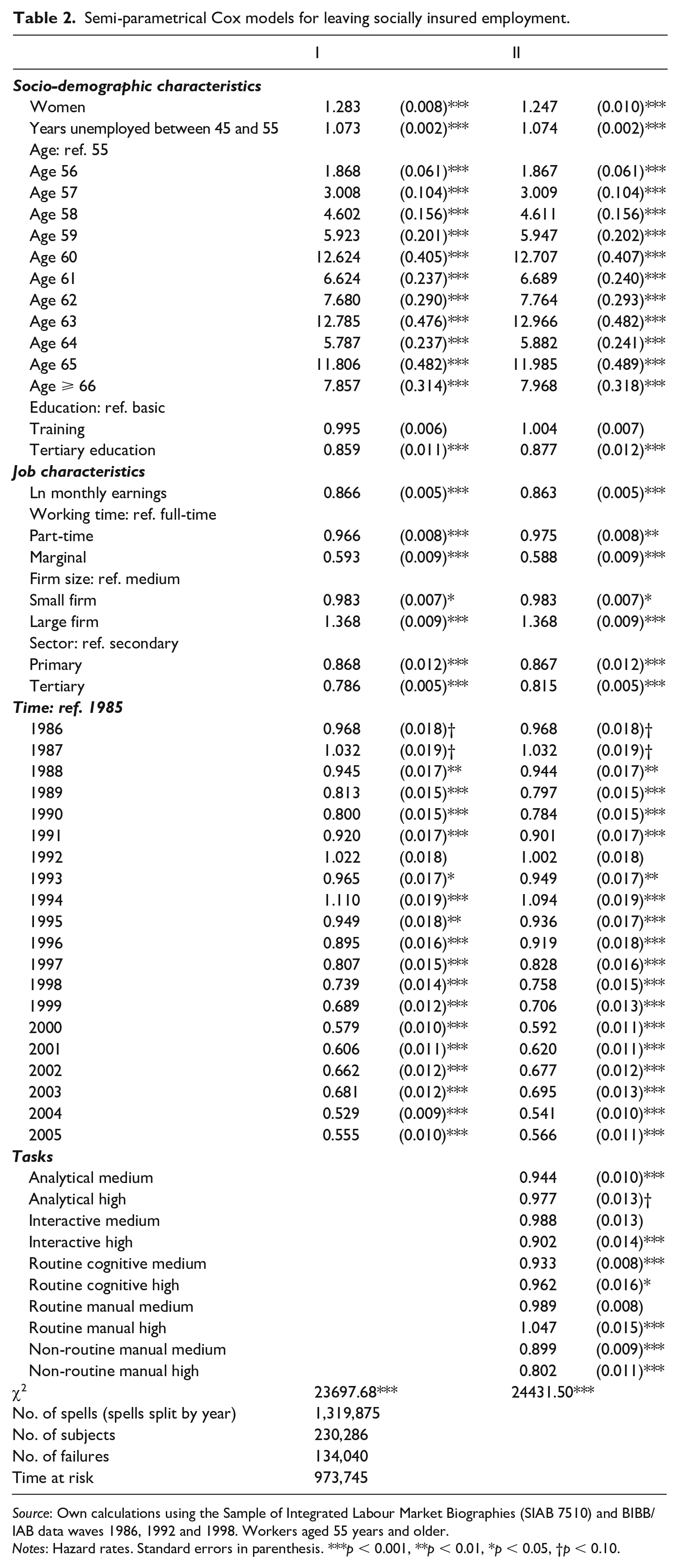
Turning now to the multivariate Cox proportional hazard models, a number of dummy variables designed to indicate a low, medium or high percentage of work in each of the five task groups are included as defined above. Two specifications are estimated (shown in Table 2). The first of these (Model I) contains controls for socio-demographic factors, job characteristics and period. In the second (Model II), the task variables – which measure job content – are added to the mix. Tables B2 and B3 in the online supplemental material provide summary statistics for the covariates included in the models.
Semi-parametrical Cox models for leaving socially insured employment.
Source: Own calculations using the Sample of Integrated Labour Market Biographies (SIAB 7510) and BIBB/IAB data waves 1986, 1992 and 1998. Workers aged 55 years and older.
Notes: Hazard rates. Standard errors in parenthesis. ***p < 0.001, **p < 0.01, *p < 0.05, †p < 0.10.
Leaving tasks aside for the moment, let us first discuss the results on the other covariates. In specification I, women experience a greater hazard of leaving employment than men. Age is controlled for by including a dummy for each single year of age from age 55 to 65 and another for workers aged 66 and older. As expected, the likelihood of leaving socially insured employment increases radically at 60. Another spike in the hazard is detected at age 63, an age at which during much of the observation window a large percentage of the workforce attained the option of leaving work without suffering any reduction in pension. The last visible spike is at the legal retirement age of 65. Interestingly, once individuals have gone on to work past the age of 65, though they remain more likely to retire than workers under 60, they are actually less likely to do so than at age 63 or 65. This chimes well with the findings of Dingemans et al. (2016), Engstler and Romeu-Gordo (2014), Komp et al. (2010) and Scherger (2015), all of whom show that the phenomenon of people working on past retirement age is on the rise. The model also controls for unemployment by adding a control for any years in which employees experienced unemployment within the last 10 years before turning 55, because spells of unemployment tend to lead to a loss of human capital, potentially leaving behind scarring effects and therefore often resulting in those affected ending up in less secure jobs (as discussed in the context of retirement by Rinklake and Buchholz, 2011, for example). The estimates show that each additional year of unemployment experience has the effect of increasing the hazard of leaving socially insured employment by roughly 7% in all specifications. Thus, people who have experienced longer periods of unemployment are considerably more likely to retire early. The opportunity costs of leaving work early seem to matter too: an increase in logged monthly earnings of 1 decreases the hazard of leaving within a year by roughly 13%. Aside from earnings, other job characteristics controlled for include working hours, firm size and sector. Marginally employed workers are considerably less likely to leave socially insured employment for good – the hazard for them is around 40% lower than for full-time workers (the control group). Part-time working also reduces the hazard slightly, suggesting that reducing working hours towards the end of a worker’s working life does indeed seem to function as a mechanism, allowing them to stay in employment for longer. Individuals working in larger firms – with 200 employees or more – reveal hazard rates around 37% higher than those employed in medium-sized firms, defined as having at least 25 employees (but less than 200). As large firms tend to resort more frequently to early retirement solutions in their efforts to restructure their workforce than their medium-sized equivalents, this difference cannot be explained simply by the institutional incentives that exist for leaving employment early, as such incentives are identical for workers in all sorts of organizations. Larger firms do indeed seem to actively encourage early exits, possibly by offering supplementary ‘golden hand-shakes’ on top of universal institutional supports. The economic sector also appears to play a role, as the secondary-sector workers are more prone to early exit than employees in either the service or agricultural sectors. Working in manufacturing increases the hazard by 20% as compared to the tertiary sector. Finally, year dummies reveal a negative trend in relation to retirement as retirement legislation becomes stricter over time.
The next step in the analysis is to test the central hypotheses on the influence of workplace tasks over early exit from the labour market. Controlling for tasks (Model II, Table 2) reveals some support for Hypothesis 2: doing non-routine analytical and interactive tasks will tend to reduce the hazard, though not all dummies produce particularly significant results. Some support for Hypothesis 1 can also be found for employees whose work involves a substantial component of routine manual tasks. Such workers are exposed to the greatest hazard of all, of leaving socially insured employment – 5% greater than the general population. One might expect workers whose jobs contain a large component of routine cognitive tasks – a situation often associated with the medium-level skills required in administrative jobs, for example – to suffer greater pressure to stop work earlier. Although the more descriptive evidence, as shown in Figure 2, points in this direction, the multivariate results do not reveal any significantly increased hazard: on the contrary, the coefficients yield significant negative values. However, the Cox models strongly support Hypothesis 3: departing from the results of the descriptive analysis, they show that people whose jobs involve a medium to large component of non-routine manual tasks will tend to have a 10–18% reduced hazard of retirement. It should be noted that task-related effects also have an influence on that hazard independently of skill level: the coefficients for tertiary education and training remain basically identical in both specifications. Tertiary education significantly reduces the likelihood of leaving socially insured employment for good. However, the analysis reveals no significant effects at lower levels of educational attainment and thus yields no evidence that workers possessing medium-level skills are being especially squeezed out of the labour market as compared against all other groups.
Concluding remarks
The literature on retirement traditionally analyses the influence of multiple ‘push’ and ‘pull’ factors on retirement. This article follows the logic of Blossfeld et al. (2006), who claimed that certain job tasks can be taken as a proxy for ‘push factors’ driving workers towards early retirement. In their efforts to measure the role of job content in retirement timing, most studies include information on occupations, largely because this is the metric most widely available in the existing data sets (e.g. Carr et al., 2018; Hayward et al., 1989). What this article does, in contrast, is to use a large data set containing details on socially insured workers in Germany that includes information on the tasks they do, thus allowing the effect of changing tasks on retirement within the various occupation and/or gender cells over time to be tested.
According to the literature on tasks, technological change leads to a polarization in job demand (Autor et al., 2006; also see Gallie, 1991), with the demand for people to do (high- and low-skilled) non-routine tasks increasing and the demand for medium-skilled routine cognitive and low-skilled routine manual jobs decreasing. Event history analysis yields findings that suggest tasks performed at work do indeed tend to influence the timing of retirement, though those findings chime only imperfectly with the polarization hypothesis. In fact, the general findings on tasks seem for the most part to fit what the technical change hypothesis predicts: that is, that routine manual tasks tend to increase – and non-routine manual tasks tend to decrease – the likelihood of retirement. There is also some evidence that having a job containing a medium to large component of analytical and interactive tasks will tend to reduce one’s likelihood of retiring early. However, contrary to the technological change hypothesis, the performance of routine cognitive tasks – the sort of work that employees possessing mid-level skills tend to do – does not significantly increase the likelihood of leaving employment.
A major strength of the approach presented here is that the data it seizes upon allows one to analyse the influence of workers’ job tasks on retirement over a 20-year period of parallel technological change and pension reform. It is important to note, though, that the social security data include only relatively few socio-demographic factors, and that information on health – likely an important determinant of early retirement – is not provided in the data set. Since individuals doing certain categories of task (notably manual workers) are more likely to experience worse health, it may be that the effect of tasks is somewhat overinterpreted, although controls for education are added – another important predictor of health status (Ross and Mirowsky, 2010; Ross and Wu, 1995). Another issue worth noting is the fact that manual workers tend to join the job market earlier than workers who require a longer-term investment in the educational system. The former are therefore likely to be in a position to retire early voluntarily without suffering serious economic penalties, a fact that may also influence the results for coefficients of routine manual tasks. However, this argument might be expected to apply equally to many workers in occupations containing a strong presence of non-routine manual tasks; yet, to the contrary, such workers are actually less likely to retire early.
Summarizing, the analysis predicts that workers who perform a lot of routine manual tasks are especially unlikely to continue working until legal retirement age. For those who have worked long enough to retire without suffering considerable reductions in pension benefits this may not be problematic, but routine manual workers with interrupted careers will typically face considerable losses, even where sector regulations are in place specifically to reduce this effect. The above-described results are likely to carry over to most European countries, in which significant efforts have been made over the 1990s and 2000s to increase labour participation among older workers by restricting early exit from the labour market against a background of technological change transforming the distinguishing characteristics of labour demand. Employment and training programmes for the unemployed and for older workers would do well to focus on counteracting the negative effects of technological change and on helping to equip them with the necessary skills to perform new tasks in order to facilitate their continued employment until legal retirement age.
Supplemental Material
sj-docx-1-wes-10.1177_09500170211011330 – Supplemental material for Retirement in Western Germany – How Workplace Tasks Influence Its Timing
Supplemental material, sj-docx-1-wes-10.1177_09500170211011330 for Retirement in Western Germany – How Workplace Tasks Influence Its Timing by Antje Mertens and Laura Romeu-Gordo in Work, Employment and Society
Footnotes
Acknowledgements
We would like to thank Daniela Rohrbach-Schmidt for valuable help with the BiBB/IAB data set.
Funding
The authors received no financial support for the research, authorship, and/or publication of this article.

Supplementary material
The supplementary material is available online with the article.
Notes
References
Supplementary Material
Please find the following supplemental material available below.
For Open Access articles published under a Creative Commons License, all supplemental material carries the same license as the article it is associated with.
For non-Open Access articles published, all supplemental material carries a non-exclusive license, and permission requests for re-use of supplemental material or any part of supplemental material shall be sent directly to the copyright owner as specified in the copyright notice associated with the article.
