




Abstract
This article investigates the gendered dynamics of motherhood and careers, as voiced by professionals in the knowledge-intensive business sector in Finland. It is informed by the CIAR method through 81 iterative, in-depth interviews with 23 women and 19 men. Among the women respondents with no children, one child, or two children, three dominant forms of discursive talk emerge: ‘It takes two to tango’, ‘It’s all about time management’ and ‘Good motherhood 2.0’. Though Finland provides a seemingly egalitarian Nordic welfare state context, with the ‘Finnish Dream’, women face contradictions between expectations of women as full-time ideal workers pursuing masculinist careers and continuing responsibilities at home, performing ‘good motherhood’. The women’s double strivings meet the double constraining demands of these ideals. The gendered pressures are imposed on the women by themselves, male colleagues, the organisation more broadly and society, leading the women to enact a form of ‘bounded individualism’.
Introduction
The social relations of care, home and work constitute fundamental aspects of gender relations. Strong assumptions remain embedded in the gendered discourses of production and reproduction in post-industrial societies. Yet, over recent decades, there have been significant changes in women’s careers, contestation of the male-breadwinner model (Duncan et al., 2003; Warren, 2007) and a diversity of perspectives on ‘good motherhood’ (Duncan and Edwards, 1999; Hilbrecht et al., 2008; Johnston and Swanson, 2006; Pfau-Effinger, 1998, 2004; Phoenix and Woollett, 1991). In Nordic countries, these changes notably entail a shifting gender contract (Ahlberg et al., 2008; Bergman and Hobson, 2002; Leira, 2010), often portrayed as a best-case scenario in relation to other Western nations (Dotti Sani and Scherer, 2017; Evertsson et al., 2015; Olsen, 2020). Indeed, one might expect the most dramatic changes in such fundamental relations of care, home and work would be within Nordic societies, and especially in sectors with many expert professional women. But is this assumption accurate?
First, this article contributes theoretically to the analysis of the relations of knowledge-intensive capitalist organisations to reproduction, in its broad sense. It analyses how expert professionals within the post-industrial economy, where the boundaries between work, family and ‘life’ are blurring, discuss having, postponing or not having children and a ‘family life’, often in relation to the interface between professional career and the ideal of ‘good motherhood’. The focus is women’s relation to motherhood, not necessarily women’s experience of being mothers or whether women themselves are mothers, whilst acknowledging the significance of men’s relation to family.
Second, it highlights the importance of societal context in conceptualising motherhood and professional work. Specifically, women’s professional knowledge-intensive work here is framed by demands of home and work within a specific, especially pertinent, Nordic welfare state context, namely that of Finland. Overall, the article addresses how the institution and experience of motherhood, specifically ‘good motherhood’, persists as a powerful social force, even in a Nordic society, where, additionally, women have long worked full time, and businesses employ many highly qualified and ambitious women.
It is important to highlight the specific national and local context of this study in terms of both general theoretical significance and its impact in shaping the expectations, ideals and responses of the respondents. Accordingly, what are the expectations of these women and from where do they originate? In macro-societal terms, part of the answer derives from the intersecting space–time–social relations (Massey, 1995) of national, historical, geopolitical and societal circumstances, and contemporary business corporate culture.
Finland is a well-resourced, high-income society, with relatively small income and gender gaps, as assessed by the World Economic Forum (2018), United Nations Development Programme and similar rankings. The country is often seen as an exemplary ‘Nordic welfare state’ model, based on notions of gender equality and social justice; however, this classification oversimplifies the national context.
First, Finland’s geopolitical history is distinct from Scandinavia, having been part of both the Swedish and Russian Empires, subsequent independence from the latter in 1917, and predominantly non-Scandinavian language and culture. Industrialisation occurred relatively late and the country shifted almost directly from an agricultural society, where all worked, to a modern service (Rantalaiho, 1997) or post-industrial society (Husu and Niemelä, 1993), led by information and communication technologies. As such, a strong male-breadwinner (or housewife) model never developed, and indeed Finnish women have long worked full time, unlike some of their Scandinavian counterparts.
Second, modernisation of the Finnish welfare state occurred through a loosely social democratic form, often portrayed as women- or family-friendly, combining career and family. Welfare and family support are well-developed, with universal rights to childcare. The Finnish system has a strong full-time working norm for all adults. Indeed, the welfare state has developed through strong traditions of coalition politics and neo-corporatist socio-economic policies. Moreover, the Finnish form of welfare state and gender equality policy co-exists with gender inequalities, relative gender invisibility, the so-called ‘genderless citizen’ (Parvikko, 1990; Rantalaiho and Heiskanen, 1997) and rights operating at the community rather than the individual embodied level (Nousiainen et al., 2001). Thus, power structures are disguised by gender-neutralising discourses and practices.
Third, following high unemployment in the early 1990s, the Finnish welfare model was moderately reformed via neo-liberal influences, including political challenge to universal childcare, and pressures for privatised health and welfare reform. A related area of tension, especially in business sectors, lies between national welfare conditions and increased tendencies towards transnational capitalism.
For these reasons, Finland, as a Nordic welfare state distinct from some Scandinavian forms, with their own variations, represents a complex case of organisational and societal gender relations. Advancement in some areas contrasts with male dominance in others. Furthermore, its persistently gender-segregated labour market, horizontally and vertically, creates contradictory implications for relations between home and work. Unintended tensions and paradoxes arise despite, or in response to, publicly stated egalitarianism.
Constructing motherhood
Motherhood is complex. It can be defined as ‘the state of being a mother’ (Roy, 2016: 1), understood as an institution (Berg, 2008) and described as a gendered and dynamic process (Elvin-Nowak and Thomsson, 2001). Motherhood is often intertwined with womanhood, whether or not women have children (Berg, 2008). It is closely linked to ‘mothering’, a social practice of nurturing children (Hollway and Featherstone, 1997). As an institution, motherhood is linked to ideologies and discursive constructions of ‘good motherhood’ (Phoenix and Woollett, 1991), defined by socio-cultural norms (Berg, 2008). These discourses are always context-bound, reflecting historical, cultural and social positions, and thereby producing and reproducing meanings related to motherhood in a given time and place (Johnston and Swanson, 2006). Though manifestations of motherhood are culturally specific, the constraining effects of motherhood are widespread.
Ideals of motherhood are also strongly shaped and moulded to individual choices and professional identities (Berg, 2008). Modern motherhood is partly produced and reproduced as an individualistic performance (Baraitser, 2009; Roy, 2016). Thus, neo-liberal and post-feminist values embracing choice, empowerment and individualism, as well as post-feminist constructs of ‘moderate feminism’ combining feministic ideas with individualised femininity, are critical (Gill, 2008; Lewis et al., 2017).
It is not unusual for highly educated professionals with demanding jobs to experience similar demands for involved parenthood (Bianchi and Milkie, 2010). Mothers especially may experience strong feelings of guilt for having career aspirations (Guendouzi, 2006). Despite the apparent gender-neutrality of parenthood demands, they remain highly gendered; caring is still primarily seen as the mother’s task (Bowlby et al., 2010). Importantly, the Nordic countries are not immune to these social currents. Though women are expected to pursue a career (Berg, 2008), a subtle balance between dedication to work and prioritisation of family is also required (Elvin-Nowak and Thomsson, 2001). In Finland, the culture of ‘state motherhood’ is supportive of mothers’ full-time employment (Pfau-Effinger, 1998); yet a paradoxical reality emerges: on the one hand, generous family leave is utilised by women; on the other, most professional women return to full-time employment during their child’s very first years (Salmi and Närvi, 2017).
Gendered structures of work organisations
Many organisations operate under the illusion of a gender-neutral meritocracy, where the most qualified individuals are recruited and promoted, without acknowledging systemic (dis)advantages and inequalities innate to masculine career structures (Geiger and Jordan, 2014). Yet, men in senior positions are viewed as self-evident representatives of leadership (Collinson and Hearn, 1994; Holgersson, 2013).
Previous research proposes that individuals in powerful positions in hierarchical post-industrial knowledge organisations, including women, often reproduce the gendered structures in organisations and business sectors, thus maintaining inequalities (Walsh, 2012). The masculinism of organisational cultures, persistent elusiveness of ‘legitimate’ professional identities, and inflexibilities of business models impact ambitious business women by constraining their everyday decisions and possibilities for career advancement. Linear career progress demands that women individually navigate unequal structures and understand how to ‘play the game’ (Haynes, 2012: 504; Pringle et al., 2017: 445).
Previous research on women’s careers has described them as relational and changing over time, depending on life stages and care relations (cf. Mainiero and Sullivan, 2005; O’Neil et al., 2008; Powell and Mainiero, 1992), even contributing to a naturalising of ‘women’s careers’ where ‘success’ in careers and ‘success’ in private relationships are trade-offs. Additionally, women are often portrayed as ‘less committed’ to fully embracing the working culture due to the ‘material dimensions’ of gender (Bolton and Muzio, 2008: 287). This focus on women’s ‘choices’ can impede more critical evaluation of contemporary knowledge work.
These configurations can be summed up by the persistent standard of the ‘ideal worker’, implicitly referring to a man fully dedicated to work with a wife at home managing family care, which complicates the ability of women in masculinist career models to pursue both career and family. Women in top positions tend to have fewer children than their male counterparts (Eurostat, 2018). According to Cram et al. (2016), while it is rare for either men or women to achieve a successful career and devote themselves to family, men more often choose to prioritise career success over familial obligations and women the opposite. Women also face disproportionate costs in pursuing a successful corporate career, as, due to the pressures between career and family, women might not have children at all, have fewer children than desired, or delay having children (Cram et al., 2016). This finding corroborates studies that attribute postponement of the first child to the long period of education and the time necessary to build a career despite optimal (biological) timing (Kontula, 2018; Mills et al., 2011).
However, in the current Finnish context, women appear to be very strongly socialised into the cultural belief of a meritocratic and achievable ‘Finnish Dream’ (cf. Merton, 1957), where a successful career and family are simultaneously possible. This belief contrasts strongly with the naturalisation of ‘women’s careers’, as well as the women’s social situation in terms of the dual pressures, presented above.
In summary
‘Good motherhood’ manifests at both societal and individual levels, where the latter case refers to the self-sufficient and simultaneous accomplishment of multiple motherhood tasks. It also affects the perception of women in work organisations. Notions of ‘ideal worker’ and ‘good motherhood’ constantly clash, especially in organisations where women pursue high-demand careers. This dynamic specifically applies to ‘mother-professionals’ (cf. Hearn and Niemistö, 2012) in current post-industrial knowledge organisations, where flexibility is synonymous with availability outside of ‘office hours’ (Bathini and Kandathil, 2019). Thus, despite the extensive state-supported daycare and flexible working arrangements in Finland, for these ‘mother-professionals’ in organisations where the ‘ideal worker’ norm persists, a core question remains: how to reconcile the demands of work and home. Unlike Hofmeister and Bauer’s study (2015) that concluded that German fathers, as primary providers, lacked certain choices in their employment due to tensions between responsibilities to children and to their households, whereas German mothers could choose between full-time, part-time, and non-earning employment statuses, Finnish women embrace the full-time working norm. This is also distinct from some Scandinavian contexts, where part-time work is still more usual for women professionals. In this context, Finnish ‘mother-professionals’ face the doubly constraining demands of successful careers and devoted mothering.
Through examining the experiences of motherhood at the interface between gendered organisational structures and the ideal of good motherhood in a seemingly egalitarian welfare state context, this article contributes to prior literature by illustrating the construction of ‘good motherhood’ simultaneously on an individual level and on the organisational level, further acknowledging the impact of societal expectations. It explores how Finnish women’s career aspirations are strongly affected by motherhood ideals, through collisions with organisational and social pressures. In practice, this dynamic means simultaneous, and often unattainable, dedication to work and care.
Methods, data and analysis
The data for this study were collected through semi-structured interviews. The empirical analysis is framed at the intersection of career aspirations of the knowledge professionals and how they talked about having or wanting to have a family, for the women more specifically about the construction of motherhood, while acknowledging the persistent gendered structures of organisations and contextual effects for contemporary neo-liberal and post-industrial service economy organisations operating in the Finnish welfare state context. These interlinked elements create a focus on how ambitious women working in this setting talk about having – or postponing having – children and construct their motherhood in relation to work and careers.
In terms of empirical methods and material, this article explores constructions of experiences through discursive talk: that is, ‘explicit uses of talk on and around a specific topic’ (Niemistö et al., 2016: 361; cf. Murray, 2009). It examines especially how women in the study construct meanings about their realities, in part through their experienced choices and career prospects. Discourses can produce, reproduce and strengthen thoughts, feelings and behaviours as realities and conventions in organisations and society (Fairclough, 1992; Phillips et al., 2004). In analysing how expert professional women talk about children and family life in relation to their careers, this article investigates how their discursive talk constructs or contrasts both motherhood and career orientation, through the emphasis or de-emphasis of themes in interviews.
While focusing on these constructions, the article locates them within their specific societal context: the cultural expectations of full-time work for both women and men in Finland, broader material gendered structures of ‘production’ and ‘reproduction’, and the unintended paradoxes that can arise from these juxtapositions. Whilst the primary analysis is informed by social constructionism, it connects these constructions to wider societal forms, as highlighted in scholarship at the boundary between, for example, critical theory and post-structuralism (Bidet, 2016), as well as material-discursive and materialist-oriented discourse analytic approaches (cf. Fairclough, 1992; Hearn, 2014).
The data comprise interviews with 23 women and 19 men across two international business-to-business (B2B) service organisations in the Metropolitan area of Finland, offering consultancy services in the legal, accounting, management and information technology sectors.1 Thirty-nine respondents were interviewed twice and three once, totalling 81 interviews with knowledge professionals in different career and family stages. Their organisations are characterised by an intensive work environment, stressful conditions, high organisational commitment and glamorisation of long-hours culture (cf. Hofmeister and Bauer, 2015). These situational attributes also correlate and coalesce with the archetype of the male ‘ideal worker’ who expresses his devotion to the organisation by working long hours (Acker, 1990).
The interviews focused on the work/non-work situations of participants and were strongly informed by the Collaborative Interactive Action Research (CIAR) method (Bailyn and Fletcher, 2002). This method has proven useful where the research seeks to make inequalities visible, for example, in studying gendered assumptions underlying the practices and procedures in specific organisational units (Bailyn and Fletcher, 2002: 2).
The interviews occurred in two separate phases: the first round focused on the respondent’s work situation, career aspirations and meaningful aspects of life outside work – as a way into questions related to family aspirations, motherhood or potential motherhood. The transcripts of these first interviews were analysed by performing close readings and thematic analysis, multiple cross-readings and researcher discussions. These data provided the basis for structured feedback in the second interview. This was done, in part, to ensure that the initial analysis of the respondent’s situation was accurate; it also provided a way to revisit the most interesting aspects in the first interview. Thus, the second interviews often involved further discussion of areas previously addressed, but now with more detail and reflection, with, especially in the interviews with women, issues around (potential) motherhood and combining work with children showcased more strongly.
The CIAR method typically includes an intervention in the target organisation. In this case, the intervention actualised through awareness-raising of individuals’ work/family situations during the research process. In the second interview, respondents often noted increased awareness of how their lives had evolved to be defined around the demands of work. Furthermore, they often explored the different realities of men and women in the organisation, by reflecting individually and talking to colleagues. These reactions are in line, even if more on the individual and interpersonal levels, with what Bailyn and Fletcher (2007: 2) mean by making gendered policies and practices visible. This manifestation appeared to be perceived as useful, even if at times painful, by the respondents.
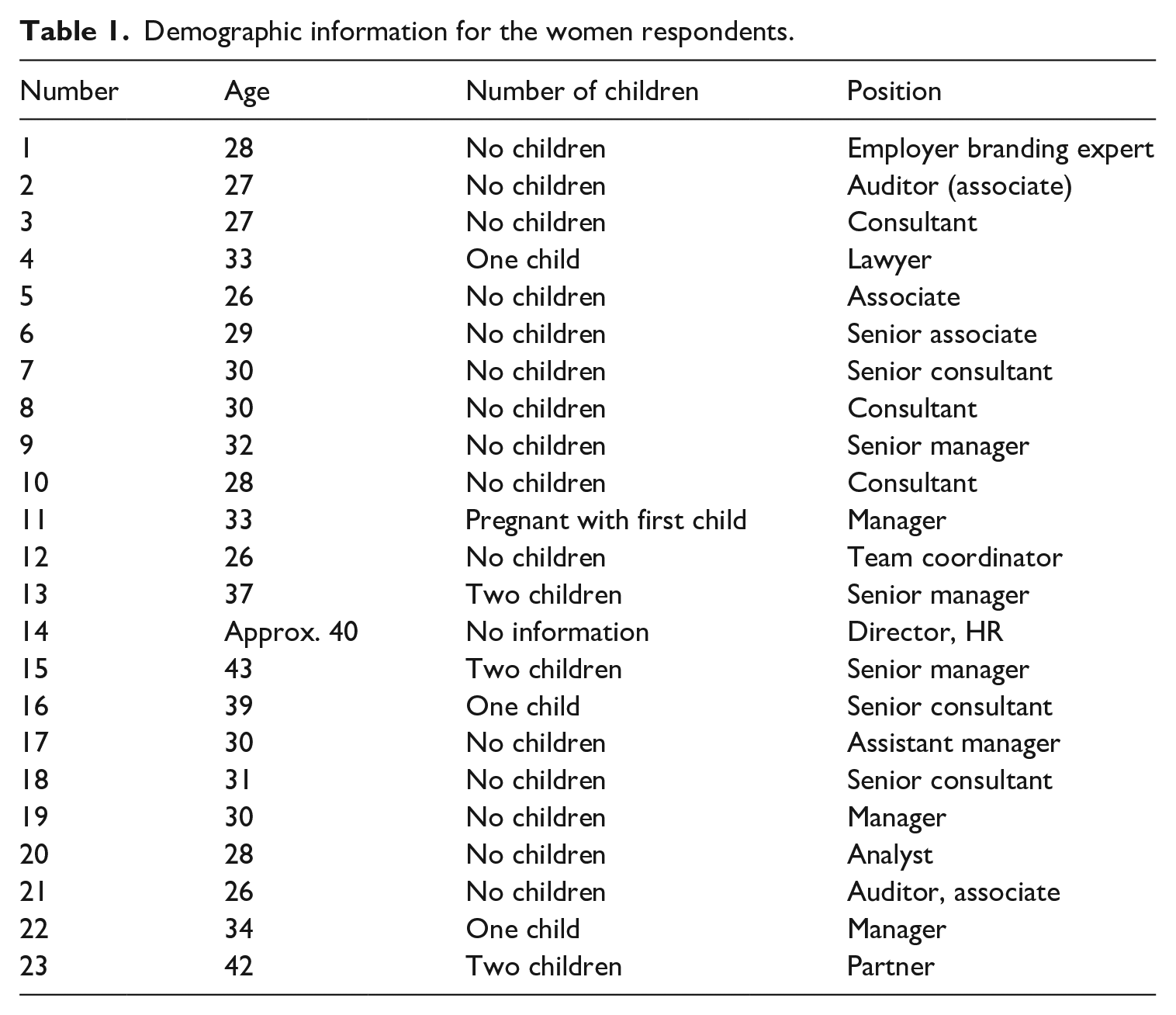
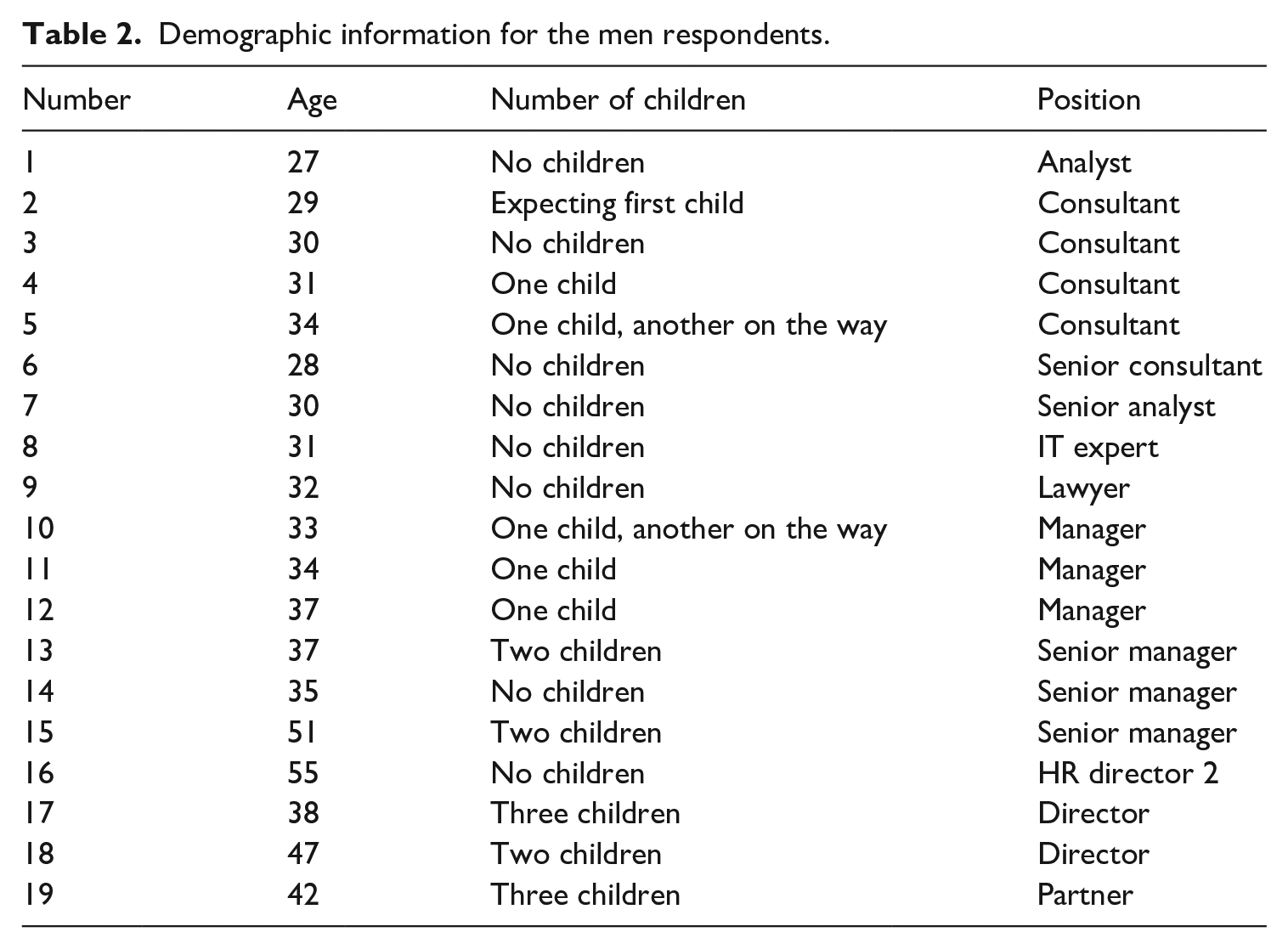
This article specifically examines women’s relation to motherhood and career. Thus, forms of ‘discursive talk’ around the themes of motherhood, children and family, in relation to work and careers, were analysed, regardless of the respondents having children or not. In practice, only a small number of the male respondents (not personal partners, but colleagues of the women respondents) spoke on the issue of motherhood. The inclusion of these few male respondents is not to establish a gender comparison, but rather to build a more comprehensive picture of motherhood. Of the women respondents, 15 were childless, one respondent was pregnant with her first child, three respondents had one child and three respondents had two children. Additionally, one of the respondents was an HR director and did not give any personal information. The ages of the childless women ranged from 26 to 32 years, the respondent pregnant with her first child was 33 years old, the women with one child were 33–39 years old, and the women with two children were 37–43 years old. One of the respondents was in top management, nine were in middle management2 and 13 in lower levels in the organisation.3 Of the 19 male respondents, eight were childless, one had his first child on its way. Five had one child, and two of these were expecting their second. Three had two children, and two had three children. The ages were relatively similar to the women’s ages, even if some male respondents with children were some years younger than the women. Tables 1 and 2 summarise demographic information on the respondents.
Demographic information for the women respondents.
Demographic information for the men respondents.
In line with Alvesson and Karreman (2000), this article takes the position that studying discourses – or merely ‘discursive talk’ – should start at the macro level, through establishing understanding of the studied phenomenon, even if meanings are always locally produced. In this regard, the analysis included an understanding of the interplay between macro- and meso-level phenomena: the specific welfare state context, partly universal yet partly local meanings of ‘good motherhood’, the characteristics of post-industrial knowledge work, the gendered structures of these organisations and women’s career (non-)advancements in them. From this point, it moved to the local settings of these two manifestations of B2B organisations and the respondents’ individual meaning-making regarding their career and family situations.
The transcribed and summarily analysed interview transcripts were first coded. In order to move beyond codes, classifications or categorisations, this analysis emphasised forms of speech, and through them made attempts to find representations and reconstructions of relevant social phenomena (cf. Coffey and Atkinson, 1996). By careful readings and analytical discussions, three dominant ways of talk emerged from the interview material. These were unprompted by specific questions, but rather naturally emerged as ways of discussing respondents’ work, career aspirations and other meaningful parts of their lives, including talk about existing children or the desire to eventually have children. Ultimately, the dominant forms of discursive talk were mirrored against the temporal and spatial contexts of the contemporary Finnish welfare state and the knowledge-intensive work setting.
Findings
This study identified three dominant forms of discursive talk in the women’s interviews, responding to and compensating for competing pressures around work and motherhood. These emerged from those respondents with no children, one child or two children, respectively: (1) ‘It takes two to tango’, (2) ‘It’s all about time management’ and (3) ‘Good motherhood 2.0’. The three forms of discursive talk could be presented as key success factors for the individual career women to succeed. Simultaneous contrasting talk by the men respondents is also included, enforced by one of the HR directors.
The HR interview informed the presumptive corporate discourse, for example, conveying the ‘diversity target’ to increase the number of women at manager, senior manager, director and partner levels by adding flexibility initiatives. The HR director noted the trend with similar kinds of companies where women tend to exit organisations permanently when they have children, even within the relatively egalitarian Nordic context and the comparatively well-compensated family leave and public daycare. The career steps in these companies are hierarchical and middle management positions with increased administrative responsibilities typically collide with the general timing of starting a family, about the age of 33 for white-collar metropolitan Finnish women. The HR director acknowledges the hidden tensions behind this outcome with her statement: ‘Often women leave us when they start a family, as combining work with family is challenging’ (HR director).
In the following sections, the three interlinked ways of discursive talk from other women respondents, which inform the experiences behind these challenges, are presented. The findings of the interviews of men are discussed in connection to this discursive talk, even if the talk of the men differed substantially from that of the women. Perhaps unsurprisingly, the interviews with men included more talk about their career, and much less about family and children. When their existing or potential family was discussed, much less tension between their career and having children was reported or envisaged, even when their personal partners were in similar career jobs.
‘It takes two to tango’
Respondents with no children were very aware of the time pressure and challenges of balancing career and family. Thus, a common way of talking about combining a career with children was to work diligently for a period, advance to middle management level, and then take a break and start a family: Those who don’t yet have [children] think that ‘the career has to be done now’, so these people are prepared to give it their everything now, as they think that at some point they are bound to take more time for themselves, family and these things. (Woman, 30, manager)
At lower levels, the ‘manager’ position was given as the minimum level to reach before having children. However, respondents in ‘manager’ positions, or even higher, did not necessarily think they were in the right phase to think about starting a family. In a way, the right time keeps slipping through the respondents’ fingers, as one senior manager explains: ‘I just don’t understand how the children would fit into all this’ (Woman, 32, senior manager).
In contrast to their female colleagues, the male respondents did not talk anxiously about having children or their partner’s motherhood. Yet, they did acknowledge the situation of their female colleagues. A childless male senior analyst in his thirties characterises his unit’s devotion to work as follows: ‘I don’t want to be sexist here, but if there were women with small children, I could imagine that it could be really hard to combine this work with family life’ (Man, 30, senior analyst).
Strong tension in the discourse around the right timing and right kind of relationship for having children reveals an underlying assumption of personal failure in pursuing a career and motherhood simultaneously. Many of the respondents had seen women leave the organisation immediately before or soon after starting a family. Many women also described their current situation of overwork and burnout as a career investment, regardless of future outcomes. Of note in the responses of these women is that, even if they were career-oriented, they equally described desires to devote time to their future children, even potentially becoming stay-at-home mothers, whereas the men did not. These contrasts potentially result from the paradox of motherhood in the studied, relatively egalitarian context. Additionally, they could at least partly derive from individualistic and neo-liberalist societal developments (e.g. Elliott and Lemert, 2006; Harvey, 2005) and the neo-liberalisation of feminism said to have contradictory effects on the strength of various social forces (Prügl, 2016).
Additionally, the need for an egalitarian relationship was emphasised while simultaneously stating that arrangements in these women’s personal relationships would need to change with the addition of children: [My partner has to leave] . . . on very short notice on business trips . . . as long as we don’t have children it’s more manageable, but when we’ll have children . . . well, then it can’t be like that [. . .] if and when our future children will go to daycare and stuff . . . well it does take two to tango, the other one can’t continue to be abroad nine months a year. (Woman, 30, assistant manager)
The same respondent stated that she would not mind being a stay-at-home mother with part-time voluntary work in a charity organisation, if it were economically feasible. However, neither this option nor housewife culture is generally the case in Finland as both partners usually need to work full time. These women also acknowledged how gendered societal structures affect the relationships of young people: I know a lot of young women who constantly consider a change of field only because they know that in their own situations they would not have a chance to continue their consultancy careers if they had children on the way [. . .] and I don’t think it’s only a corporate thing, I think it also has to do with the relationship’s man–woman balance. (Woman, 30, senior consultant)
Often, society presumes that gender equality will develop for the next generation. Instead, these traditional hierarchical careers reproduce gendered structures, not only in organisations, but also in individual relationships. Additionally, questions of optimal timing seemed to be relevant only from the perspective of the women’s careers as the career situations of their partners were not discussed.
‘It’s all about time management’
In interviews with mothers of one child, the respondents seemed to be ‘in transition’ from a position that prioritised work to a challenging balance between career and care responsibilities. Respondents were all in the mid-levels of the corporate ladder. Women in these ages, positions and life phases were also the ones whose peers had left their organisations in high numbers.
Their discourse concentrated largely on time use, time management and time pressures from: career, the organisation, their partners and themselves. However, it also provoked reflection on how much time is enough and necessary divisions between work and care to be ‘successful’ in both. The following example illustrates the delicate balance between flexibility and devotion, showing that the restricted amount of time during the workday is often insufficient to complete the corporate workload in time to start the ‘care shift’. Thus, time for the former kind of work is taken from the evening time allotted to care, which also could not be delegated: We have a very strong culture that work is done when work needs to be done, and that is why I sometimes have to work evenings too. I will anyway have to leave work to pick up my child, as will others who have children leave to pick up theirs and will continue to work in the evenings. (Woman, 39, senior consultant)
Both time and devotion were deemed crucial for the organisation in terms of career advancement, but these often conflicted with the care responsibilities created by children. The women respondents were ambitious in their careers and often had partners who were ambitious in theirs; the men respondents often had partners who had more regular jobs. The men in these organisations did not express the same time pressure. Rather, even if many tried to devote time for the family, they reported having the possibility to concentrate on work in the evenings or during weekends, whenever needed. The men thus had more support from their personal partners in their careers than the women, as expressed, and appreciated, in the following: ‘My wife does understand, and has seen how it is here, how the work weeks look like. She knows’ (Man, 31, consultant).
Despite diversity goals and flexibility programmes, the women who were promoted were described as those who gave everything to their career, often women without care responsibilities. In contrast, those with care responsibilities take on a work shift, a care shift and another work shift later in the evening. Thus, they experience constrained demands of work and care, with constant feelings of inadequacy. In that vein, the data also presented strong elements of the need to ‘make do’ by yourself, without having to rely on others (except the daycare provided by the state). This discourse is strongly connected to the assumption of gender equality in Finnish society with its history of strong, independent women. At the same time, these women experienced immense guilt when prioritising time at work over time with their children, thereby actualising the conflict of ‘good motherhood’ and changes in priorities after having a child. This sense of guilt in relation to prioritising work over childcare and the construction of ‘good motherhood’ is also hidden in discourse regarding the strong and capable child in outsourced care: [Our child] is extremely social and really likes it at daycare . . . always, well we are definitely not the first ones to pick him up, but every time he asks us why we came already. So, the child has never experienced that he should be too long there at daycare, and he started there already at one year old, so he has done a long career in daycare, but I feel that has been a very good solution for us because this child is the kind of person who needs a lot of stimuli, and I don’t think either of us could have provided that at home, so this has been good . . . (Woman, 34, manager)
This dialogue is relevant in relation to the individual construction of ‘good motherhood’. By describing the need of outsourced care as in the best interest of the child, career-centred choices are indirectly justified over care-centred choices, while motherhood and career identities are simultaneously reinforced.
‘Good motherhood 2.0’
The interviews with mothers of two children were both similar to and different from the others. These women had made it to upper management levels in the organisation and seemed to have achieved a balance of career and family with the help of a partner, networks and nannies. But, as motherhood and care are closely intertwined, there arose a need to justify oneself, and to explain ‘outsourcing of care’ as one element of ‘good motherhood’ when care was given by others: In my opinion, it is not so good for the children [to have the mother take care of the children] . . . this is of course something that people can have different opinions on, but that is not sensible from the children’s point of view either, to become attached only to the mother very much . . . I have a responsibility as a mother to see to it that they always have a safe adult taking care of them, but it does not have to be me. (Woman, 42, partner)
These interviews highlighted a strong egalitarian discourse, emphasising the role of the other parent or other caretakers. This talk was illustrated in their methods of constructing their motherhood, and responding to its pressures: We both have jobs like this, we do share the responsibilities, but we also have other help there, grandparents and nannies, we’ve had several of those too during the years [. . .] In principle we share daycare transports equally. And then we have . . . he . . . I cook but he can take care of . . . packing the stuff for the younger child to daycare. He knows exactly what the child needs with him, he never calls in the morning to ask where things are. If I haven’t put clean clothes ready for the child, he’ll find something in the closet. No problem there. (Woman, 37, senior manager)
This interview portrays explicit talk of an egalitarian division in combining challenging careers with childcare responsibilities. The respondent implicitly constructs ‘good motherhood’ by describing how she cooks the food for the children and prepares clean clothes for the younger child, even when it is the father’s turn to take the child to daycare. The same respondent discussed never feeding microwave dinners to her children, introducing developmental hobbies for them and teaching them good manners. Further, she compounds the dual obligations with the statement, ‘but nobody has to ask if I’ve done my work, either’.
Despite the emphasis on egalitarian partnerships, an undertone illustrating unequal societal structures could also be found in the discourse: The balance between work and care is a major challenge. I think that is a big issue, and the other thing is, that, in today’s world, even if this is a bloody equal country, it’s still easier for men to choose a career, if their wives have . . . another kind of job. But for a woman, it is a little, it is still . . . as I’ve said I have a damned good man. I could never make it without him. But . . . well, for a child, a mother is still a mother. (Woman, 37, senior manager)
A similar preference to mothers as primary caretakers was visible also in the talk of men. Despite the relatively egalitarian Finnish context and dominant family form of dual career relationships, the men often referred to the mothers as primary carers, both in terms of daily activities and realities, and also on a more fundamental, emotional and existential level.
An example of this preference is a situation where a top manager who works 18-hour days has a partner with her own management career, who is, according to the respondent, ‘stuck’ in care responsibilities of their three children, partly due to the husband’s long working hours, and partly due to the unwillingness of relying very much on external help in childcare and household chores. He explains: She does not fully trust [others with] children and home, I guess it’s the basic character of women – would you give your child to someone to care for? Not quite, she can do that for a couple of hours [. . .] The mother is always the mother [to the child]. (Man, 42, partner)
The social-temporal-spatial contexts and processes (Massey, 1995) interact at the local, more immediate, and even bodily level, with associated subjectivities. In social-space-time terms, this tension meant relatively localised ways of living, such as utilising local infrastructural resources, notably accessible childcare. With regard to women living in urban communities and working in the knowledge-intensive work business sector, not having children, delaying childbirth, and returning to work after childbirth relatively quickly were common strategies. In short, Finnish women and mothers are expected to work full time, pursue a career outside the home and family (Berg, 2008), and be the primary carer and ‘good mother 2.0’.
Concluding discussion
These three forms of discursive talk analysed here show a persistent paradox in Finnish society: seemingly gender-neutral societal and organisational structures that, under the surface, remain highly gendered. The reported balance between dedication to work in the knowledge-intensive business sector and prioritisation of family was subtle (Berg, 2008), especially for highly educated women, whose high standards at both work and home extend to motherhood. Even within the relatively egalitarian context, these women assumed the role of primary carer and ‘good mother 2.0’.
It might be expected that the most dramatic changes in the social relations of care, home and work might occur within Nordic societies, especially in sectors with many expert professional women. Theoretically, this article seeks to contribute to three ongoing debates on: motherhood as the prime focus; broader gendered, generational organisational-family dynamics as the wider framing; and the contextual relations of the national and the transnational as the overall context.
First, motherhood: analysis of the relations of knowledge-intensive businesses to reproduction has been approached, not through the frames of ‘work–life balance’ or ‘work–family reconciliation’, but rather women’s relations to motherhood, both the practice of and experience of being mothers, and motherhood as envisaged. Motherhood and good motherhood are formed partly in the public world of work, and not only in private, domestic spheres.
The expert professional women in knowledge-intensive businesses talked about having both a career and children, whether or not they themselves had children. While an aspiration for a successful career was shared by the women, despite differing career paths, motherhood or more accurately ‘good motherhood’ – in reality, in expectation or as an assumed norm – were concurrently important to the women. So, following Merton (1957), how did the women cope, or not, with the strain between cultural expectations of the ‘Finnish Dream’, of having a successful career and realising good motherhood, and the social realities of gender-neutrality or gender inequality at work, as with the high numbers of women of childbearing age in early to mid-career exiting the organisations?
Being a ‘mother-professional’ (see Hearn and Niemistö, 2012) entails high demands in both work and care, with trade-offs between career aspirations and ‘good motherhood’ continually re-negotiated, perhaps surprisingly so even in the context of the ‘Finnish Dream’. For childless women, this conflict created an inescapable tension surrounding a ‘safe’ or optimal timing, career-wise and partner-wise, to start a family, with the same discourses in their interviews despite their often higher-level organisational positions.
All the women with children worked the ‘normal’ workday and continued to work from home in the evenings. This is in line with previous research regarding tendencies for the ‘flexibility’ of knowledge work to extend the workday (Bathini and Kandathil, 2019). Rigorous time management and good care support networks were critical, especially for women with children. Self-sufficiency was a strong component in reaching top career positions, delegating responsibility to ‘make it work’ to the individual. Constraints on individuals to manage trade-offs in unequal corporate structures confirm the women’s limited choices (Bird and Rieker, 2008; Lewis and Humbert, 2010) in career and family – as within other studies where women professionals support broad egalitarian principles, but compromise at home and career-wise (Lyonette and Crompton, 2014). It seems that the same expectations and demands are present in very different contexts. Though the three groups of respondents claimed various methods to successfully combine career and family, these ‘success factors’ all fail, as individual women face limited possibilities when organisational structures steer outcomes.
To succeed in their careers, these women professionals adopted masculine career patterns and the ‘ideal worker’ norm. The mother-professionals sought to prove themselves at home to meet expectations of good mothers. This double burden is not expected of their male colleagues, nor apparently experienced as such, and inhibits the women’s success in both regards. In this business sector, social reality is not gender-equal, certainly not so above graduate entrant level. While many women did not openly reject belief in gender equality of the welfare society, all sought individualised ‘solutions’ in this organisational context, in coping with cognitive dissonance, even while those individual ‘solutions’ were often unsuccessful.
Second, the interplay between gendered generational organisational structures and processes, and gendered generational family and personal life: in lower organisational levels and early coupling, both may ‘initially’ be presented as relatively, even notably, egalitarian, yet then change over a short time. The corporations attracted high-performing graduate expertise in what appeared a gender-equal way at lower recruitment levels. Yet these organisations continue to have a highly unequal gender hierarchy at middle and top levels, with career obstacles for women, as elsewhere (Ford et al., 2020).
At lower levels, the female and male professionals were usually single or in dual-career, relatively egalitarian couples. These couples become less egalitarian after starting a family. The men interviewees clearly strengthened the gender-segmented practice and ideology of motherhood in relation to partners or potential partners. They were noticeably more relaxed than the women when talking about children, actual and potential, and family demands throughout the organisational-family lifecourse, with growing gender inequalities at home and work.
In parallel, the ‘mother-wives’ tended to take on the greater responsibilities of ‘good motherhood’, in smaller and larger demands, as when the husband ‘needed to work’, even within dual-career couples. At middle organisational levels, there was a mixed pattern in the extent of gender inequalities at work and home; at the top level, the men are in dual-career relationships to a lesser extent, and the few women are either single or in dual-career marriages, with complex support networks. Thus, these organisations show compressed gendered organisational micro-generations, with rapid change in the professionals’ lives, at home and work, in their thirties and early forties.
Third, this article engages with debates on the relations of the national and the transnational, in relation to everyday life in and around knowledge-intensive businesses. It highlights the importance of societal context, not just Nordic, but the specific Finnish context, in understanding strains between masculinist career patterns, the concept of the ‘ideal worker’ and practices, experiences and perceptions of motherhood.
These companies might seem the epitome of transnational corporations, although in practice their work was almost totally business-to-business, dealing with nationally based legal and financial matters. They celebrated cosmopolitan branding, but in fact were locally owned national enterprises. The employees were Finns, with expertise in national corporate business. Their image was dynamic and forward-looking, but their organisational practice was traditional in business and gender terms.
These corporations and their professionals are also nationally embedded in another sense, within relatively strong Nordic welfare and family policy provision. Thus, the gender inequalities analysed in this study are notable in the Nordic, in this case Finnish, context, often considered a model for egalitarian values, relative lack of strong male-breadwinner model, public universal childcare, shared care responsibilities, recent low birth rate, and late childbirth. It is thus all the more interesting that despite these societal conditions, motherhood, actual and potential, figured so strongly as a constraint on practice and an ideological figure. As Maria Charles (2011: 367) comments: In affluent postmaterialist societies, the gender inequalities that are most resilient are those that are not explicitly hierarchical and appear to reflect naturally distinct preferences of autonomous men and women.
Familialist framings of, and responses to, gender (in)equality can remain widespread, even in Nordic countries – as suggested in debates on the ‘Nordic paradox’ and the meaning and impact of welfare regimes and gender (in/equality) regimes (Garcia and Merlo, 2016; Hearn et al., 2020). Moreover, the context of this study is of interest as Finnish society has features in some contrast to Denmark, Norway and Sweden. The motherhood regime analysed has a nuanced Nordic form, a specific Finnish version of good motherhood 2.0, the good mother-professional, in aspiration and constraint, within everyday home and corporate life. This would suggest that as the social conditions in Finnish society and this work sector are certainly not completely equal, the ‘Finnish Dream’ is not attainable. In our study, women’s relations to these tensions lead to personal dissatisfactions.
These conditions create contradictions between expectations of women as full-time ideal workers pursuing ‘masculinist careers’ and continuing responsibilities at home, performing ‘good motherhood’. The women’s double strivings meet the double constraining demands of these ideals. Regarding motherhood, demands are imposed on the women by themselves, their partners and society at large. Regarding careers, the demands are imposed on the women by themselves, the organisation, as represented by HR and leadership, and society at large, in expecting women to have both a successful career and enact successful motherhood. In these simultaneous processes, men’s relative avoidance of engagement in the wider world of reproduction appears to override knowledge(-intensive) production, in its broadest sense, even for women without children.
In terms of the women’s freedom and choice to pursue these double strivings within doubly constraining gendered demands, we suggest that these women enact a form of ‘bounded individualism’, regarding both career and motherhood, that effectively obscures persistent organisational and societal inequalities in and around production and reproduction.
Footnotes
Funding
The authors disclosed receipt of the following financial support for the research, authorship, and/or publication of this article: This research has been conducted in the project ‘Social and Economic Sustainability of Future Working Life (WeAll)’, funded by the Strategic Research Council, Academy of Finland, project number 292883.
