




Abstract
Women are historically under-represented in senior management positions in almost all industries. Despite the UK hospitality industry being a major employer of women, there is a clear lack of women in management positions. This research aims to gain insight into the factors enabling women to access senior positions in the UK hospitality industry. Using the gendered organizations perspective, the study analyses female managers’ perceptions about their career advancement within this sector. It identifies key enablers and strategies to facilitate women’s career advancement. The findings reveal that despite improvements in career opportunities for women within the UK hospitality organizations, there is still a long way to go in terms of employment policies and practices that enable women’s career progression, which includes family-friendly practices; proactive and transparent gender equality measures; support networks and mentors; and personal development plan.
Keywords
Introduction
This study considers enabling factors for women’s career advancement in the UK hospitality industry. Despite recent initiatives such as the mandatory gender pay gap reporting, gender discrimination persists in the UK (PwC, 2019). The UK has one of the worst records on gender equality at work (Conley and Page, 2018; Glassdoor, 2016) and is ranked 11th out of 18 countries in the gender equality league table (Glassdoor, 2016).
The hospitality sector is the third largest UK employer and represents 3.2m jobs (UK Hospitality Workforce, 2018) with women accounting for approximately 60 per cent of its workforce (Gröschl and Arcot, 2014; Remington and Kitterlin-Lynch, 2018). As a major tourist destination and culturally varied megacity, London’s hospitality sector is diverse, comprising 64 per cent migrant workers (People 1st, 2017b) and women represent more than half of all applicants for hospitality jobs (Riley, 2019). However, the lack of women’s representation in senior management roles remains a critical concern in the sector. Despite implementing several measures such as flexible working hours, family-friendly policies and gender awareness training, only 11 per cent hold a senior managerial position (People 1st, 2017a) and women are paid 3.45 per cent less than men in a majority of the large hospitality businesses (The Caterer, 2019).
As Acker (2009) argues, it is rare to find women in top leadership positions in wealthy industrialized countries despite advances in gender equity in education and an increasing number of women entering professions and positions long held by men. Several researchers focus on the barriers that women encounter in reaching senior-level positions in the hospitality industry such as gender stereotypes, discriminatory masculine organizational culture, work-life balance, job incompatibility, family responsibilities, absence of networking and mentoring opportunities, ‘glass-ceiling’ and the ‘old boys club’ (Boone et al., 2013; Mate et al., 2019; Patwardhan et al., 2016; Peshave and Gupta, 2017; Remington and Kitterlin-Lynch, 2018; Segovia-Pérez et al., 2019; Sharma, 2016; Shrestha, 2016). However, limited research has been carried out regarding the key enablers of women’s career progression within this industry (Figueroa-Domecq et al., 2015).
The purpose of this research is to gain an insight into the factors enabling women’s career advancement to senior-level roles in the UK hospitality industry. Acker’s (1990, 1992) gendered organization perspective forms the framework to analyse these factors that make career progression possible within the highly gendered and precarious work environment of the hospitality industry (Alberti, 2014). Acker (1990, 1992, 2006) proposes organizational processes that lead to organizational gendering and argues that gender forms the basis of how divisions of labour, employee hiring, promotion and rewarding happen in organizations. The gendered organization perspective also recognizes organizational logic, inequality regimes, intersectionality and gender subtext instrumental in institutionalizing organizational gendering (Acker, 1992, 2012; Benschop and Doorewaard, 2012). Thus, gender becomes the lens to understand how wider societal issues influence gender inequalities in organizations. Understanding gender from this perspective helps dissect women underrepresentation at senior level to understand enablers to career progression.
The first part of the article reviews the literature on gender issues and gendered organizations as well as enablers to women’s career progression in the hospitality industry. The research methods employed are described next, followed by a discussion of the findings. Finally, the conclusions and implications of the study are presented.
Gender
There seems to be a lack of clear definition of the term gender. Terms such as ‘sex’, ‘female’ or ‘male’ are commonly misused to talk about gender (Harewood, 2014). The World Health Organization (2020: 1) defines gender as ‘the roles, behaviours, activities, attributes and opportunities that any society considers appropriate for women and men’, roles which may be the origin of gender inequalities, discrimination and marginalization. Despite approaches to define gender from many perspectives such as the social-constructionist viewpoint or as a social structure (Risman, 2004), it is seen as a mechanism for creating inequality between women and men (Harewood, 2014) and characterized by power and norms which all favour men (Thierry, 2006). Morgan and Pritchard (2019: 38) state that gender is ‘neither a homogenous nor a binary, but a fluid concept and various vectors intersect to produce multiple multi-faceted inequalities, challenges and oppressions’. Gender-based inequalities are linked to society, politics, history, culture and traditional norms of power relations (Said, 2005). As Ridgeway (2011) states, gender inequality remains because the current society is composed of outmoded ideas about gender that are mired in inequality. Recognizing the socially constructed nature of gender, the authors argue that it is a key determinant of career progression.
Gendered organizations
Organizations continue to be highly gendered (Acker, 1990) where the distinction between male and female determines the roles and responsibilities. As organizations are structured by men and for men, women are placed at a disadvantage and are victims of gender inequalities. According to Acker (2006: 443): Inequality is ‘systematic disparities between participants in power and control over goals, resources, and outcome; in work place decision-making such as how to organise work; in opportunities for promotion and interesting work; in security in employment and benefits; in pay and other monetary rewards; and in respect and pleasure in work and work relations’.
The leading forms of masculinity, whether business or hegemonic, are also associated with dominant male social power and gender inequalities (Connell and Messerschmidt, 2005; Connell and Wood, 2005). Acker (1990) in her seminal work on gendered organizations argues that gender inequality is built into the structure of the organizations and that organizational practices promoting inequalities are institutionalized. Acker (1990) identifies the division of labour along gender, gendered cultural symbols, gendered workplace interactions, gendered construction of individual identities and a gendered organizational logic that legitimized male-dominated hierarchies as the processes sustaining gender disparities in organizations. In her later work, Acker (2012) reduced these to four sets of gendering processes, viz. organizing processes, organization culture, interactions on the job, and gendered identities and social structures. Organizational logic, which Acker describes as the taken-for-granted policies and principles that managers use to exercise control over the workplace and legitimize hierarchies (Williams et al., 2012), was removed from her later version as she found it overlapping with her conceptualization of the gendered organizational substructure (Acker, 2012). Later research by Acker focused on the intersectionality of race, class and religion and inequality regimes that sustain gender inequalities (Acker, 2006, 2009, 2012). The very definition of a ‘job’ contains an implicit preference for male workers and employers prioritize hiring people who can devote themselves loyally to the organization without distractions outside of work (Acker, 1990; Williams et al., 2012). This excludes women who have family and care responsibilities, which advantages man as the ‘ideal worker’ (Acker, 1990).
The notion of an ‘ideal worker’ being male underlines the gendering process, with those of different gender identities struggling to advance without conforming to organizational gendering and characteristics of an ideal masculine worker (Acker, 1990; Benschop and Doorewaard, 2012). Within the hospitality industry, this ‘ideal worker’ is described as flexible, being ‘available at short notice for over-time, out-of-shift work and to spend multiple days away from home on business’ (Costa et al., 2017: 73), which contradicts the cultural expectations for women as family-oriented. As Segovia-Pérez et al. (2019) argue, the notion of an ‘ideal’ worker (Acker, 1990; Costa et al., 2017) places female leaders in a ‘double bind’. They are disliked by male colleagues when they exhibit masculine qualities and may be liked but not respected when they demonstrate feminine characteristics (Ibarra et al., 2013). Yet workplaces are considered as gender-neutral (Britton, 2017) where women blame themselves and downplay the significance of gender in career stagnation (Britton, 2017; Tharkude and Bhave, 2015). Instead of the prevalent structural barriers, career stagnation is attributed to women’s so-called inferior capabilities (Segovia-Pérez et al., 2019).
While Acker’s framework studies hidden discrimination, it has been criticized as an unfinished tapestry that seemed to miss the interdependent and sex-segregated nature of interaction in the gendering process (Dye and Mills, 2006). The present study is an attempt to unearth the hidden discriminations in the hospitality workplace.
Gender in the hospitality industry
The hospitality industry is known for gender disparities created by labour market discrimination brought about by the precarious nature of the hospitality work and patriarchy (Santero-Sanchez et al., 2015). Although service work plays an important role in the economy by employing women and minority groups (Casado-Díaz and Simon, 2016), poor working conditions make it unattractive (Lindsay and McQuaid, 2004).
The hospitality industry which is known as gender-segregated, paternalistic and with very strong traditions of nepotism (Morgan and Pritchard, 2019), has been struggling to achieve gender balance at the very top. Although there has been growth in women’s employment over the last 50 years, gender disparities in the European hospitality businesses continue to exist (Segovia-Pérez et al., 2019). The hospitality sector represents the most challenging environment for women for career advancement and job satisfaction (Brownell and Walsh, 2008). It includes zero-hour contracts, low pay, long and irregular shifts, hierarchical organizational structures, and highly gendered and sexualized working environment with a high degree of social contact (Baum, 2015; Mooney et al., 2016; Morgan and Pritchard, 2019; Segovia-Pérez et al., 2019). The precarious nature of hospitality work continues to somewhat perpetuate gender inequalities in a sector built on traditional male values placing female employees at an inherent disadvantage (Samkange and Dingani, 2013). Moreover, the prevalent discourse of a masculinized ‘ideal’ worker (Acker, 1990), which contradicts the cultural expectations for women, especially as wives, partners and mothers, means that female employees have limited opportunities to progress their careers (Costa et al., 2017). In tourism and hospitality organizations, women are confined to positions requiring domestic skills and/or femininity, such as receptionist and chambermaid (Campos-Soria et al., 2011), as extensions of their traditional, feminine domestic roles leading to a gendering of positions and segregation (Santero-Sanchez et al., 2015). The patriarchal division of labour in the society that assigns reproductive, childcare and caring responsibilities which are unpaid and under-appreciated to women is translated into hospitality work, where they are over-represented at the lower levels of a gendered pyramid in low-skilled, low-paid and low-status jobs with limited promotion opportunities and job security (Coleman, 2003; Morgan and Pritchard, 2019). As Mooney and Ryan (2009) state, the existing horizontal and vertical segregation within the hospitality industry manifests itself in the hierarchical structures of large hotels, where women are stereotyped into lower positions that are presumed more suitable to them and almost absent in decision-making senior roles.
Enablers of career progression for women
There has been some limited progress in female representation at the senior and executive-level positions in the UK hospitality industry with the fastest rate of change happening at the non-executive director (NED) level. Women make up 39 per cent of NEDs across FTSE 350 hospitality, tourism and leisure companies (WiH2020 Review, 2019).
Overcoming the many visible and invisible barriers to women’s career advancement requires conscious initiatives from all stakeholders. However, there is limited evidence of businesses actively taking measures to support women’s career advancement (Callan, 2007; Yu, 2019). Women looking for career progression will eventually be seeking companies that have family-supportive human resource (HR) practices (Brownell and Walsh, 2008; Yu, 2019). As Callan (2007) argues, an organization-wide culture change that supports family-friendly policies is important to address work-life imbalances for women.
As Sharma (2016) contents, a diverse workforce can help businesses enhance competitiveness, which requires an organizational culture that promotes a diversity-supportive work environment. Ensuring work-life balance and flexible working policies needs to be a priority for businesses (Lyness and Judiesch, 2014). Flexibility and a participative leadership style that promotes proactive career management initiatives for women are also important (Remington and Kitterlin-Lynch, 2018). Better accountability for gender-equality policies, gender-awareness training and open debates about women’s empowerment and gender equality are some of the HR management initiatives that can help promote women’s career progress (Segovia-Pérez et al., 2019). Support to women when they return from their career breaks, shared parental leave, the establishment of mentoring programmes and better use of technology to enable flexible working are also key enabling factors (WiH2020 Review, 2017). Employees themselves can also help eradicate the glass ceiling by taking advantage of work-life balance and flexible working programmes. Sharing of childcare responsibilities by men by availing of parental leave could help women not take a career break for childcare and provide them with more job stability and opportunities for career development (Segovia-Pérez et al., 2019).
There is extensive research on gender inequality and barriers to women’s career progression in the hospitality sector (Baum, 2013; Patwardhan et al., 2016; Shrestha, 2016), yet there exists limited research on strategies for women to overcome these barriers within hospitality businesses. As Munar (2018) argues, there is an urgent need to translate the awareness of gender inequality in hospitality into practical solutions and organizational change. Adopting the gendered organizations perspective (Acker, 1990) as the theoretical framework, this research addresses this gap by analysing experiences of women working within the British hospitality industry in senior management roles, focusing particularly on the factors that enabled them to succeed and reach these positions.
The following section describes the research methods employed to collect and analyse empirical data.
Research methodology
The study adopted a qualitative approach and data were collected through semi-structured in-depth face-to-face interviews to explore the experiences and beliefs about the enablers of women’s career progression in the hospitality industry. Facilitating a flexible two-way communication, semi-structured interviews allow researchers to elicit more detailed information through probing and prompting, and provide participants with more time and opportunity to share deeper thoughts and feelings on the subject matter (Galletta, 2012).
Purposive sampling method was employed to select a participants group comprising female managers occupying senior management positions in hotels, facility management, event management and restaurants. See Table 1 for the details of participants who were reached through the lead researcher’s existing personal network, Institute of Hospitality and networking events such as the 2018 London Hotelympia. Some interviewees recommended participants who they thought suitable for the research and a total of 10 interviews was carried out in the spring of 2018.
Characteristics of participants.
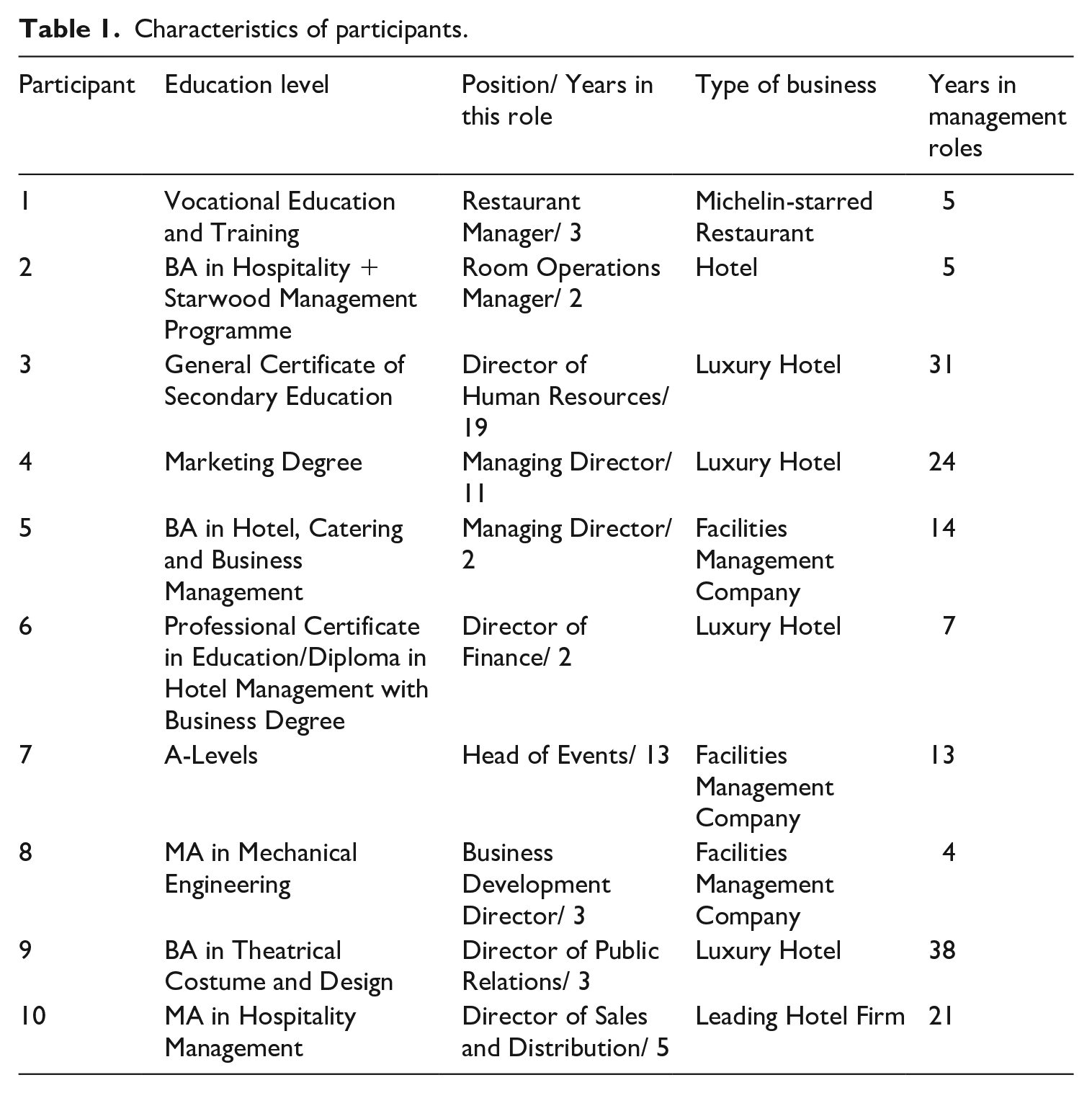
The interviews were recorded with a digital recorder with the interviewees’ approval to ensure methodical data recording and analysis (Veal, 2011). All interviews were conducted in London at the interviewees’ workplaces or via Skype by the lead researcher. The themes to be covered in the interviews were determined after mapping key literature surrounding the main topic of the study (Wengraf, 2001) (see Table 2). The semi-structured nature of the interviews allowed the researcher to prompt, probe and ask follow-up questions (Veal, 2011). Interviews were carried out in accordance with the relevant ethical conventions guiding social science research, which ensures participants’ privacy, confidentiality and anonymity as well as informed consent (Veal, 2011).
Interview questions design.
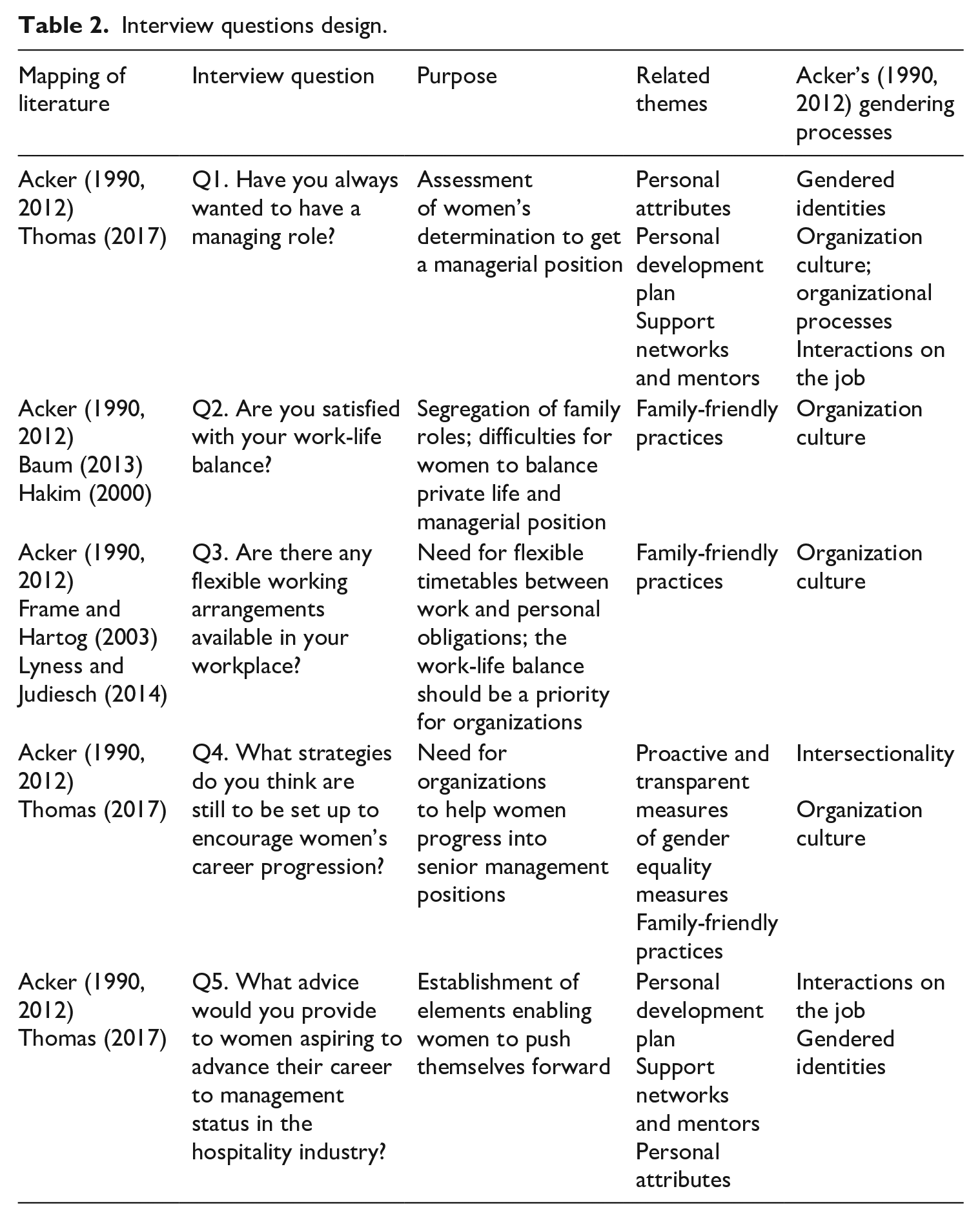
Thematic analysis was conducted using Braun and Clarke’s (2006) six-stages coding method: familiarization with data; generating initial codes; searching for themes among codes; reviewing themes; defining and naming themes; and producing the final report. After the first stage of analysis, initial codes were identified related to Acker’s (1990, 2012) gendered organizations perspective after which key themes were identified and reviewed, which are presented in the next section.
As a qualitative study, the researchers’ role in designing a research process that identifies and explores knowledge gaps cannot be over-emphasized (Corlett and Mavin, 2018). The researchers’ own experience of researching and working within the hospitality industry and other organizations has been instrumental in unearthing the research issue, development of the research instrument and the management of the interview process, where probes, prompts and follow-up questions were used to explore enablers of participants’ career advancement. The context of the research from the researchers’ perspective – as hospitality researchers and professionals – helped identify and align themes that emerged from the data with the notions of gendered hospitality organizations.
The following section discusses the key findings of the study.
Findings and discussion
This section discusses the findings on the enabling factors for the career advancement of women who have reached senior management positions in the hospitality industry in the UK. These are family-friendly practices, proactive and transparent gender equality measures, support network and mentors, personal development plans, personal attributes and operational divide which are discussed within the framework of Acker’s (1990, 2012) gendering processes of organizations.
Family-friendly practices
Given the range of structural, societal, family and cultural barriers that hinder women’s career progress, conscious initiatives to mitigate them on the part of businesses are crucial to facilitate advancement of women to senior management positions (Callan, 2007; Mate et al., 2019). With more women entering the labour market in professions and positions historically held by men, the issue of reconciling work and family commitments has assumed major importance (Carvalho et al., 2018). The flexible division of work (Acker, 1990), especially in the allocation of working hours, would allow women not only to balance their family and work commitments but to ensure career continuity, which is key to career progress (Mate et al., 2019).
Flexibility to balance work with family commitments emerged from the findings as a major driver of women’s career advancement as it enabled working mothers to balance their work with family and childcare responsibilities. The Business Development Director of a facilities management company indicated the importance of flexible working arrangements in her career development: Our company is amazing at supporting flexible working and if I were to have a family it would be here because they are so much more flexible than any company I worked for. They have very good paternity policies, they do a lot to encourage and support flexibility, talking about flexible hours and flexible working.
According to the Director of Finance of a luxury hotel: We are a 24 hour business so we should be able to be more flexible with things. I think my hotel group as a company, as a whole, is very supportive.
Compressed workweeks allowed participants to keep their full-time income and job while spending fewer days at work or leaving earlier when necessary, which was particularly helpful to working mothers. As Lyness and Judiesch (2014) state, the work-life balance must be the first concern for corporations. Demanding and inflexible work environments force women to choose between their family and professional career and, often, they sacrifice their careers for the sake of family, especially to raise children or look after sick relatives (Hakim, 2003). Such unequal organization culture (Acker, 2012) must be overcome since career disruption by women for family reasons has an adverse effect not only on women’s career development but on the firm’s human capital as they lose talented and experienced staff, adding to their attrition costs (Sharma, 2016). As Callan (2007) notes, supportive organizational culture is required to implement family-friendly policies, which was common in the workplaces of most of the participants. However, changing organizational culture from patriarchy to an equality-oriented one can be a major challenge to hospitality organizations.
Proactive and transparent gender equality measures
As Acker (2012) highlighted, the intersectionality of gender and structural factors act as a barrier to gender equality in organizations. Therefore, proactive and transparent measures promoting gender equality and equal opportunities have been noted as an enabler of women’s career advancement (Brownell and Walsh, 2008; Callan, 2007; Tlaiss and Kauser, 2010). For instance, the WiH2020 group advises hospitality businesses to set and announce specific targets to improve diversity and publish progress regularly (WiH2020 Review, 2017).
As the experience of the Head of Events for a facilities management company illustrates: companies such as mine are very diverse and proactive with a diverse and flexible workforce (. . .) great working for such a large established organization that has very supportive diversity policies.
Many participants stated that their organizations practised transparent and proactive gender equality and inclusion measures and demonstrated commitment to equality, diversity and inclusion, which helped them in their career management. Transparent recruitment and promotion practices were also highlighted as essential for women’s career advancement and to recruit and retain talented women employees, which is in line with Mate et al. (2019) and UK Hospitality Workforce (2018). Such an approach was recommended for all employers, as articulated by the Managing Director of a facilities management company: I recommend all organizations to be really proactive in introducing gender equality policy, (. . .) be transparent about what you want to achieve in that space because that will help you attract talents.
Transparent gender equality measures in all aspects of work and employee management, especially those related to promotion and pay are thus important for women to recognize the existence of such a system and take advantage of them. As Acker’s (2012) intersectionality of gender disparity indicates, the prevailing societal and cultural prejudices related to gender often influence women’s general perception of their place at work. Therefore, it is vital that all gender equality policies are transparent and proactively publicized for women to be aware of and benefit from them.
Support networks and mentors
Interactions between colleagues at different levels of power can be exploitative and belittling for women or can be a source of equality and respect (Acker, 2012). It has been argued that a lack of mentoring within companies results in slowing down women’s career progression (Remington and Kitterlin-Lynch, 2018; Sharma, 2016). Mentors and role models in powerful positions have been widely considered to play an important role in supporting women’s career management as they can help provide career guidance, acquire new skills and achieve job satisfaction (Gold et al., 2010; Mate et al., 2019). Participants stressed the importance of female mentors and role models in advancing career. The establishment of mentoring programmes was considered an enabler of participants’ career progression as affirmed by the Business Director of a facilities management firm: I have always had mentors in my businesses, and I have used them as advocates so if I have an issue then I can go to them to solve the problem. They are able to support you.
The Managing Director of the same facilities management company noted the advantages of a two-way process of mentoring: As female leaders we are to support females and help to mentor them through business in the industry (. . .) I wish we would be open to more two-ways mentoring where you learn from your boss but your boss learns from you too.
Many participants agreed that finding a mentor who can motivate and act as a critical friend was pivotal to their professional and personal development. However, some indicated that there was not enough formal mentoring available and that female mentors were few and far between. Women in senior positions can be major change agents who can help undo the gendering of organizations and lessen gender segregation within workplaces (Stainback et al., 2015). Women in senior positions are also excellent role models to emulate and find inspiration from. However, there is a real paucity of women leaders in most organizations in the hospitality sector. Therefore, it is important to ensure mentoring challenges faced by women are resolved by hospitality organizations (Hansman, 2003; Ibarra et al., 2010). Women in leadership roles too have a responsibility to mentor those who need support not only within their organizations but in the wider society as well.
Personal attributes
Organizational, cultural and structural factors have traditionally been held responsible for hindering women’s career advancement (Patwardhan et al., 2016; Peshave and Gupta, 2017). Therefore, a significant outcome of this study is the focus on the importance of personal attributes in progressing women’s careers as explained by the Room Operations Manager of a hotel: I think it is about females believing in themselves (. . .) and following other strong women so that they actually have the opportunity to learn while they are growing in their career.
Several participants also pointed out the importance of staying authentic, following personal beliefs and being bold when managing their careers. Such proactive behaviour also helped them achieve career success as noted by the Managing Director of a facilities management company: You have to stay true to yourself, be authentic (. . .) it is also about identifying what happens to you, that is a really good self-awareness.
Participants revealed that women need to learn to be bolder and come forward to seek managerial positions and promotions. Personal attributes such as resilience, self-efficacy, assertiveness, commitment, personal vision, networking skills and the ability to find inspirational role models were listed as important enablers of women’s career advancement, which is consistent with the literature (Bandura, 1997; Mate et al., 2019; Stainback et al., 2015) and conforms with the shift towards the ‘do-it-yourself’ career development (Cast, 2018), which requires relying on oneself to proactively seek out and seize opportunities for career advancement (Remington and Kitterlin-Lynch, 2018). As Stainback et al. (2015) argue, it is possible to undo the gendered organizations through self-belief and by being proactive in gaining work experience and skills to seize opportunities when they become available. However, such behavioural changes may take time since women have been conditioned to follow the male manager model and tend to be victims of the prevailing inequality regimes (Acker, 2006) that are ubiquitous in hospitality organizations, where the ‘ideal worker’ is still defined by male characteristics (Acker, 2012; Costa et al., 2017).
Personal development plan
A personal career plan, supported by structured and transparent promotion processes (Clevenger and Singh, 2013) is another driver to women’s career advancement. Personal career development plans provide women with a sense of direction and can help them overcome the gendered organization culture and identity processes (Acker, 1990, 2012) and focus on their professional advancement. Many participants considered themselves to be career-driven and having a personal development plan with clear career goals that helped them work more effectively towards advancing their career. As the Director of Public Relations of a luxury hotel stated: Have a personal plan of what you want to achieve, what are your personal objectives (. . .). Then, go with your instinct and observe as much as you can from as many people you admire as possible (. . .) be humble, never stop being inspired by what people do, say or feel.
Participants also stressed the need for keeping up to date with the latest trends in career development within the hospitality industry, which would help them review and adapt their career plans as explained by the Manager of a Michelin-starred restaurant: Read books or magazines about the industry, do a degree if you need to, boost your confidence (. . .). Apply for the position because the only thing you may lose is you might not get it, be confident, do your research about roles that you are applying for.
While a personal career plan was considered by several participants as essential to set career objectives, keep up with the male colleagues and plan for other life activities such as having a family while pursuing one’s career goals, it was never proposed as a formal organizational process. However, women may need support in the form of coaching, mentoring and career management training to be able to develop goal-oriented and achievable personal career plans. Hospitality organizations have to institutionalize personal career planning as part of their formal HR processes to support women’s career advancement and help achieve their career and personal life goals.
Operational divide
Most of the enablers discussed above have been reflective of the experience of women who have achieved career advancement. However, an unexpected outcome of the research was the divide in career advancement and aspirations between those in operational-level and non-operational-level positions. Employees in operational-level positions in the hospitality industry are known to have an advantage in achieving career advancement as their knowledge and experience of operational functions are deemed to make them better managers and leaders. Women employees face some level of discrimination in finding operational-level jobs due to the male-oriented nature of these roles in the hospitality industry, which was recognized and articulated by the Director of Sales and Distribution of a leading hotel firm who stated: We [the industry] already do a lot but maybe we could do a better job at encouraging women at getting positions that have been traditionally held by men, in general operational positions.
Participants agreed that operational roles were harder for women who wanted to have a family as well as a career and that senior operational roles were traditionally occupied by men. These exemplify Acker’s (2012) organizational logic and organizing processes as well as the gendered notions of an ‘ideal job’, whereby certain roles and promotional opportunities have been segregated to advantage the male and became part of a wider culture of the hospitality industry. Within this industry, operational roles often require working long and unsociable hours that conflict with family responsibilities. These put women, who tend to be the main caregivers at home (Coleman, 2003), at an inherent disadvantage forcing them to move away from operational roles that are important rungs of the career ladder in the sector and choose non-operational roles that slow down career progression. It is thus common for male workers within the hospitality industry to progress to a senior position through the operational track. Therefore, organizational policies and culture that facilitate operational roles for women form important enablers of women’s career advancement in the hospitality sector. As Shrestha (2016) argues, women will find it challenging to build their career in what is considered male territory. This lack of equality of promotional paths has been perpetuated over the years by the nature of the hospitality industry as offering a 24/7 service and being traditionally male-dominant in the operational areas. The issue was lucidly articulated by the Director of Finance of a luxury hotel: The issue with hospitality is that it never stops. This is part of the reason that I went away from operations because in my job now I can do probably 80 per cent of my job without needing to be in the hotel. Because technology has advanced and I can do a lot of what I need to do from my house, which is brilliant.
Conclusion
Organizations continue to be highly gendered, where career advancement depends on complying with the gendered characteristics of the workplace (Acker, 2006) and the hospitality industry is no exception. Factors such as structural, social and organizational barriers, glass ceiling, gender bias, incompatibility between job structures and family commitments, absence of networking and mentoring opportunities, ‘old boys club’ syndrome and a discriminatory masculine organizational culture are the key obstacles to women’s career progression in the hospitality industry (Boone et al., 2013; Mate et al., 2019; Patwardhan et al., 2016; Peshave and Gupta, 2017; Remington and Kitterlin-Lynch, 2018; Segovia-Pérez et al., 2019; Sharma, 2016).
Known for the paternalistic, gender-segregated traditions and nepotism, the hospitality industry finds it hard to achieve gender balance at senior levels (Morgan and Pritchard, 2019; Segovia-Pérez et al., 2019). Career precariousness and vulnerability of work continue to perpetuate gender inequalities in a sector built on traditional male values placing female employees at an inherent disadvantage that confines women to gendered roles and workplace segregation (Campos-Soria et al., 2011; Santero-Sanchez et al., 2015). Despite these historical disadvantages (Mooney and Ryan, 2009; Shrestha, 2016), some changes have taken place in terms of female representation at the senior-level positions in the UK hospitality industry. Yet there has been limited research on the key enablers of women’s career progression (Figueroa-Domecq et al., 2015).
Adapting the gendered organizations perspective (Acker, 1990), this study seeks to elucidate the experiences of women who have achieved senior and executive-level positions in the UK hospitality industry focusing on the factors that enabled them to succeed. These include initiatives such as flexible working conditions, family-friendly practices, proactive and transparent gender equality and inclusion practices, mentoring, transparent recruitment and promotion practices, support networks and promotion of a culture of gender equality as well as training and development programmes to develop resilience, self-confidence, and career planning. While employers have to invest in organizational enablers, there are also individual and operational factors that require organizational support. Training and development for promoting resilience and self-efficacy, introducing effective mentoring schemes and creating a transparent gender-equal or gender-neutral culture are crucial to women’s career advancement in the hospitality industry. Equally important are the proactive HR management practices that remove the gender barriers in operational roles. Such measures will help hospitality businesses attract and retain women employees who form a significant talent pool in society. Initiatives such as flexible working, mentoring and support networks, gender awareness training, transparent recruitment and promotion practices, and promotion of a gender-neutral culture represent organizational enablers for women’s career advancement. Having women leaders in strategic positions would help not only in developing women-friendly organizational policies but also providing female role models. It is also important that the hospitality industry supports women with the career transition between operational, junior management roles to senior management roles. Radical changes to the traditional notions of an ‘ideal worker’ and ‘ideal job’ (Acker, 2012) are necessary to create a gender-neutral hospitality industry and achieve gender equality.
This study informs hospitality businesses and HR managers on ways to enable women’s career progression and leverage a vital source of creativity, innovation and competitive advantage especially in a service industry such as hospitality. Drawing evidence from women in senior roles, it contributes to hospitality and HR management literature and practice by providing insights into key affirmative action strategies to enable women to attain leadership positions and achieve gender diversity and equality. From an academic viewpoint, this study contributes to the body of knowledge on gender issues in hospitality. Also, given the social dimensions of gender equality, this study builds on and supplements the growing body of literature on gender and work in sociology. It has become increasingly important to address gender issues in the hospitality industry and bring it into the mainstream of academic and societal debates.
The scope of this study is limited to women managers working within the London hospitality industry. Therefore, this article leads the way for larger-scale studies to provide more generalizable results. A longitudinal study would help understand whether the treatment of women in the hospitality sector has changed or broadly remains the same over time. The research could be replicated in other areas of the tourism and hospitality industry such as tour and travel businesses, airlines, visitor attractions and facility management. Also, this study could be a model for research on career development of other minority groups based on ethnicity, religion, class, age or sexual orientation. Finally, it would be useful to perform this research in other industries and countries that would provide comparative insights. Further, a more detailed investigation needs to be carried out to separate the organizational and individual enablers which this study seemed to indicate to exist. This study thus stresses that despite the considerable social, economic and technological progress achieved so far, equality of gender remains a work in progress. The hospitality industry, which epitomizes the gender disparities within the society and exemplifies Acker’s (2012) intersection of inequality regimes, is no exception to this.
Footnotes
Funding
The authors received no financial support for the research, authorship, and/or publication of this article.
