




Abstract
This study explores women’s attrition from male-dominated workplaces based on Norwegian public administrative records, covering individuals born 1945–1983, in the period between 2003 and 2013. It examines sex differences in rates of attrition and tests the significance of two commonly proposed explanations in the literature, namely the degree of numerical minority status and motherhood. It also investigates whether these explanations vary by occupational class. Selection into male-dominated workplaces is accounted for by using individual fixed effects models. The results show that attrition rates from male-dominated workplaces are considerably higher among women than among men. Moreover, the risk of female attrition to sex-balanced workplaces increases, regardless of occupational class, with increases in the percentage of males. Childbirth is associated with an increased risk of attrition to female-dominated workplaces, while having young children (⩽ 10 years old) lowered the risk. This association, however, was primarily evident among working-class women in manual occupations.
Introduction
Post-industrial labour markets are characterized by substantial sex segregation (Charles and Grusky, 2004; European Commission – Directorate-General for Employment and Equal Opportunities Unit, 2010) as men and women are unequally distributed horizontally across industries, sectors, occupations and workplaces, and vertically according to level, income, prestige and class (Ellingsæter, 2013). Despite a trend toward desegregation, as many women move into male-dominated fields (England, 2010), it is claimed that the propensity of women to leave contributes to the preservation of high levels of segregation (Jacobs, 1989). Consequently, there has been a growing body of research on women’s attrition from male-dominated settings (e.g. Cha, 2013; Torre, 2014, 2017).
The present study examines sex differences in rates of attrition from male-dominated workplaces in Norway and considers whether it can be attributed to women’s numerical minority status, motherhood and occupational class. By focusing on workplace mobility and the Nordic context, this study adds to the literature in several ways. To begin with, social-democratic welfare states such as Norway differ from liberal welfare states in many respects (Esping-Andersen, 1990), with the former considered forerunners in designing family-friendly policies promoting women’s labour force participation (Gupta et al., 2008). There is, however, considerable scholarly debate over whether the same public policies hamper women’s career prospects and contribute to labour market sex segregation (Korpi et al., 2013; Mandel, 2012b). That social-democratic welfare states such as Norway facilitate women’s access into the labour force but not into powerful and desirable positions has been identified as a ‘welfare state paradox’ (Ellingsæter, 2013). Norway thus represents an interesting case for studying patterns of labour market sex segregation such as women’s attrition from male-dominated settings.
Furthermore, the literature mainly attributes women’s exit from male-dominated settings to the psychosocial costs of being in the numerical minority (Jacobs, 1989; Kanter, 1977) and work–family conflicts (Cook and Minnotte, 2008). While previous studies have focused on the sex composition at the occupational level, examining the sex composition of the workplace seems more relevant, as the theoretical explanations focus on the actual interactions between individuals in a social setting (Bygren, 2004). For example, Kanter (1977) emphasizes face-to-face interaction. Moreover, sex segregation measured at the occupational level may not be a satisfactory proxy for sex composition, as the former does not necessarily correspond to the sex ratio in the actual workplace (Maume, 1999). It could also be argued that measuring segregation at the occupational level will underestimate attrition, as individuals can change workplace without changing occupation, whereas the opposite is rarely true. Hence, analyses of occupational change do not capture all workplace mobility, while workplace mobility captures most occupational mobility. Workplace mobility thus seems more relevant when examining women’s attrition.
While female exit is studied, sorting into male-dominated workplaces must also be considered, as entering or staying in male-dominated settings is likely to be a non-random process (Cha, 2013). In general, the biological, psychological and sociological processes underpinning the gendered division of labour (Wood and Eagly, 2012) make the female numerical minority a highly selected group, which probably affects their attrition rates. Moreover, women overcoming the barriers to entry into male-dominated workplaces and staying there may be different from other women (Cha, 2013), which further highlights the need to account for selection when studying attrition. For example, women’s previous experiences in male-dominated settings have been found to affect their likelihood of leaving (Torre, 2014). By using panel data techniques to account for all time-invariant unmeasured heterogeneity (see e.g. Allison, 2009), the present study improves on previous studies of female attrition, which have not considered selection to the same extent.
To study women’s attrition from male-dominated workplaces, longitudinal administrative register data covering the entire Norwegian population are used. The first aim is to provide a descriptive account of attrition over a 10-year span. Following previous studies (Cha, 2013; Cook and Minnotte, 2008; Glass et al., 2013; Torre, 2014, 2017), the second aim is to examine whether attrition can be attributed to degree of numerical minority status and motherhood. Additionally, the study explores whether the relationship between attrition and the degree of male dominance and motherhood varies by occupational class. The process of desegregation has been much more pronounced among individuals with higher education (Ellingsæter, 2013; England, 2010; Mandel, 2012a) and, as shown by Torre (2017), women’s attrition from male-dominated settings is likely to depend on their position in the occupational hierarchy. Overall, this study adds to our understanding of the persistence of high levels of segregation and women’s access to male-dominated positions, which continues to cause concern (Ellingsæter, 2013; Stier and Yaish, 2014).
The Norwegian context
The Norwegian social-democratic welfare state is often perceived as highly gender egalitarian with universal and generous work–family policies supporting a dual earner–carer regime. Parental leaves are fully paid for 49 weeks (with 15 weeks reserved for the father), there is paid leave to care for sick children and high-quality public day-care is prevalent. Accordingly, women’s labour force participation is high at 68% (Statistics Norway, 2018). However, there are sex differences in part-time work, managerial shares and work income, and the labour market is highly sex-segregated (Østbakken et al., 2017). While 37% of employed women work part-time, only 14% of men are part-time workers. Around 35% of managers are women. The average woman’s unadjusted annual salary is 87% of that of the average man’s (Statistics Norway, 2018). Moreover, a substantial proportion of women work in female-dominated public sector caring occupations, reflecting a highly sex-segregated labour market (Reisel and Teigen, 2014). Considering that Norway has one of the most male-dominated ‘blue-collar’ sectors in Europe (Torre, 2019), it is not surprising that the most male-dominated occupations in Norway are electrical equipment installers, machinery mechanics and repairers, moulders/welders, building finishers and building frame workers (Statistics Norway, 2018). In the administrative registers available for the present study, common occupations for women working in male-dominated workplaces are secretaries, accounting and bookkeeping clerks, computer systems designers and analysts, and finance and administration department managers (see Tables A1–A3 in the online supplementary material for the 10 most common occupations for women in male-dominated workplaces, sex-balanced workplaces and female-dominated workplaces).
The fact that the egalitarian social-democratic welfare states are sex-segregated has prompted questions of whether their work–family policies have the unintended consequence of (re)producing segregation (Hegewisch and Gornick, 2011). Critics argue that the same policies leading to higher labour market participation and economic independence for women in general limit their access to influential positions and high wages. On the one hand, it is claimed women are encouraged to self-select into a female- and family-friendly public sector. In Norway, 70% of public sector employees are women, which means that almost half of all working women are employed in the public sector. In the private sector, however, over 60% of employees are men, and only two out of ten men work in the public sector (Statistics Norway, 2018). Additionally, the sex gap in wages is lower in the public than the private sector (Reisel et al., 2019). On the other hand, it is argued, long periods of parental leave reduce women’s human capital accumulation and increase statistical discrimination from employers, hindering hiring and advancement in advantageous positions in the male-dominated private sector (Mandel, 2012b). Hence, the implications of policies associated with social-democratic welfare states may depend on women’s occupational class position (Korpi et al., 2013).
Thus, Norway provides an interesting case because the institutional specificities may simultaneously enhance and diminish women’s propensity to leave male-dominated workplaces. Arguably, gender-egalitarian norms and work–family policies could facilitate women’s participation in male-dominated settings, making women less likely to leave. Conversely, the same policies could also threaten their human capital accumulation, hindering career advancement and tempting women to seek shelter in female-friendly and female-dominated public sector workplaces.
Numerical minority status
Why would women leave male-dominated workplaces? A candidate explanation in the literature is that it is challenging for women to be accepted and integrated in male-dominated milieus due to their numerical minority status. In general terms, group-level mechanisms such as tokenism (Kanter, 1977), homophile behaviour (McPherson et al., 2001) and homo-social reproduction (Moore, 1988) can put numerical minorities (e.g. women) at a disadvantage in work settings. For example, Kanter (1977) argues that outnumbered women run the risk of becoming representatives (‘tokens’) of their sex rather than individuals, with negative implications in the form of performance pressure, isolation and stereotyping. Along the same lines, Jacobs (1989) claims that the lifelong social pressure on women to pursue female-dominated positions can make those who choose a gender-atypical job suffer social disapproval and be defined as ‘unfeminine’. This social control, Jacobs (1989) argues, is deeply rooted in gendered socialization that influences individual choices throughout working life. From a human capital perspective, some scholars contend that gendered socialization can lead to a training deficit even if the women have the appropriate education to enter male-dominated positions (Torre, 2014). It is argued that early socialization provides women with less information and training for traditional male jobs; hence, they have fewer work skills than their male counterparts (Reskin, 1993). This skill–task mismatch, in turn, may lead to attrition (Kmec et al., 2010).
Following this line of thought, we expect that women are more likely to leave male-dominated settings compared to men and that their propensity to leave increases as the proportion of men increases. Prior studies support the notion that numerical minority status and gendered socialization have consequences for women. Studies have found that women are more likely to leave male-dominated occupations as the percentage of men increases (Maume, 1999; Torre, 2017), to experience more harassment in male-dominated educational fields (Dresden et al., 2017), to receive less co-worker support (Cook and Minnotte, 2008; Taylor, 2010) and to have fewer promotional prospects (Boye and Grönlund, 2018; Maume, 1999). Combined, these factors can lead to women’s attrition from male-dominated workplaces. The question is whether this is the case in the Norwegian labour market. On the one hand, there is a widespread norm of gender egalitarianism which could possibly reduce the prominence of the above-mentioned mechanisms. On the other hand, and following the ‘welfare state paradox thesis’, women’s career prospects may be hampered in strongly male-dominated milieus due to statistical discrimination tempting women to switch to more female-friendly settings. An aim of this study is to explore whether women are more likely to leave male-dominated workplaces and whether the likelihood of leaving increases with the proportion of men at the workplace.
Motherhood
The present study also examines the association between motherhood and women’s attrition from male-dominated workplaces. In the literature, scholars argue that work and family life is less compatible in male-dominated settings. According to Acker (1992), the assumption that family responsibilities should be separate from work are more likely to prevail in workplaces and occupations that are dominated by men. A lack of accommodation for family-related needs, which women are more likely to require than men (Coltrane, 2000), could result in work–family conflict (Kalleberg, 2007). Moreover, even if policies aimed at alleviating work–family conflict are available, women working in male-dominated settings may be reluctant to take advantage of these if they view the workplace environment as being unsupportive of taking such an action (Cook and Minnotte, 2008). Arguably, workplaces which are not male-dominated are likely to have a more supportive work–family culture since female co-workers are more likely to acknowledge the challenges of combining family and work (Cook and Minnotte, 2008). Moreover, employers may strategically respond to accommodate the needs of their given constituency (i.e. offer family-friendly working conditions if they want to recruit and retain women) (Goodstein, 1994). Learning from this, male-dominated police organizations have offered opportunities for more flexible work arrangements to retain female workers (Dick and Cassell, 2004).
Among family-responsive workplace policies which can mediate the relationship between motherhood and attrition, Glass and Riley (1998) distinguish between three types: the option of reducing work hours, flexibility of timing and location of work, and workplace social support. In their research, they find that all these conditions are important for explaining the turnover intentions of women of childbearing age in the general workforce. Other studies have found that overwork in combination with motherhood make women more likely to leave male-dominated occupations (Cha, 2013), a desire for a flexible job is one of the top three reasons for women leaving the engineering field (Fouad et al., 2017) and as the proportion of men increases, women report less co-worker support and less supportive work–family culture (Cook and Minnotte, 2008; Taylor, 2010). Yet, besides the mentioned study by Cha (2013), other studies of motherhood and women’s attrition find no such association (Chan, 1999; Glass et al., 2013; Torre, 2014, 2017).
In sum, although the empirical evidence is mixed, there are reasons to believe that work–family conflict is more prevalent in male-dominated workplaces and that it may cause mothers to leave these, possibly for female-dominated ones. Consequently, we predict that motherhood is positively associated with female attrition. Furthermore, we explore whether an association is dependent on the ages of the children. Childbirth can be viewed as a critical juncture at which work–family issues become more salient, increasing the likelihood of attrition (Glass and Riley, 1998). Moreover, pregnancy can heighten women’s numerical minority status at work (Glass et al., 2013). Hence, we expect that the association between motherhood and attrition is stronger in the year of childbirth. Still, this relationship may be mediated by institutional specificities. Considering the dual earner–carer policies of Nordic countries strengthening women’s labour market activity and stimulating fathers to take a more active part in the care of minor children (Korpi et al., 2013), the association between motherhood and attrition is possibly weaker in Norway compared to liberal welfare states. However, as will be discussed in the next section, the opposite could also be true, as this association may follow a classed pattern.
The role of occupational class
Finally, the present study explores whether the importance of numerical minority status and motherhood for women’s attrition depends on occupational class. Torre (2017) claims that research on women’s attrition has overlooked the intersectionality between class and gender and that working in a male-dominated setting is not likely to have the same consequences for all women. Moreover, a central claim in the ‘welfare paradox thesis’ is that work–family policies of social-democratic welfare states such as Norway have different implications for women of different classes (Mandel, 2012b). Considering this, we expect that class matters for women’s attrition. In the following, we present candidate explanations for why occupational class may alter women’s propensity to leave male-dominated workplaces. Admittedly, the proposed explanations are not mutually exclusive, and the literature gives reason to expect that both a higher and lower position in the occupational hierarchy can heighten the risk of attrition. Consequently, we do not have a strong view on the direction of the assumed interaction.
Differences in preparations for their chosen occupational field and in parental strategies are possible explanations for why numerical minority status and motherhood’s association with attrition could be stronger for lower as opposed to higher occupational classes. Regarding the former, Torre (2017) argues that women in managerial and professional positions will be better equipped to overcome challenges associated with being a numerical minority, such as ‘tokenism’ (Kanter, 1977), since they are likely to have undertaken a lengthy male-dominated education, assisting the women to learn how to handle gendered issues. In her study, Torre finds support for this: the probability of women’s attrition increases with the number of males in the occupation more for low compared to high occupational classes (Torre, 2017). Additionally, many studies indicate that higher education is associated with increased gender egalitarianism for both men and women (see Davis and Greenstein, 2009 for a review). Women in occupations requiring higher education may thus have colleagues that feel more positive towards gender equality, reducing the impact of numerical minority status and motherhood on attrition. Besides differences in preparations for their chosen field, differences in parental strategies, as described by Lareau (2002), could also cause differences in attrition. Working-class parents in Norway have been described as emphasizing the mother as the primary caregiver, entailing adjustments of her career (e.g. working fewer hours) and later day-care enrolment for the child (Stefansen and Farstad, 2010). This could make mothers of lower occupational classes more likely to withdraw from male-dominated workplaces to seek workplace milieus that are more supportive of their parental strategies.
The opposite, however, may also be true; high occupational class may entail a higher likelihood of leaving male-dominated workplaces due to numerical minority status and motherhood. The argument of the ‘welfare state paradox thesis’ is that generous family policies and a large public sector decrease women’s chances of joining desirable positions due to both employers’ reluctance to hire and promote women that require costly investment in firm-specific human capital and female workers favouring the working conditions of female-dominated public sector jobs (Mandel, 2012b). Yet, it may also induce women to leave these positions once they have entered if they experience a lack of promotional prospects and ‘glass ceilings’. Hence, if statistical discrimination is more common in advantageous male-dominated jobs, women’s propensity to leave these for comparable non-male-dominated jobs may increase with the number of males in the workplace. Furthermore, such ‘white collar’ jobs may entail expectations of prioritizing work over family (Acker, 1992), with ideals of long work hours resulting in tensions between work and family (Maume and Houston, 2001). A recent study found that more educated mothers experience higher work–family conflict than less educated mothers, and that larger educational differences were found in countries with extensive child care, such as Norway (Tunlid, 2020). Hence, mothers may opt out of advantageous male-dominated jobs to accommodate the needs of their family. This has been demonstrated in a study by Halrynjo and Lyng (2009) who explored how the combination of demanding work conditions and generous parental leave arrangements made Norwegian mothers withdraw from high-commitment careers.
Data and methods
Data
Public administration registers were the source of the yearly panel data (2003–2013) of all employed Norwegian permanent residents born 1945–1983. The registers offer unique opportunities to link employees to workplaces and to study small subpopulations, such as women in male-dominated workplaces. They include information on all active employment relationships in the reference week but were restricted to the highest prioritized employment relationship in terms of wages each year for each individual. ‘Workplaces’ refers to locally defined establishments within firms, and only workplaces with at least 10 employees were included.
Two samples were used in the analyses. (1) For the descriptive analysis of attrition over time (Figure 1 and online supplementary Figure A1), all women and men contributing at least one year in a male-dominated workplace during the observation period were included. This sample consisted of 1,170,985 persons (12,880,835 person-years). (2) For the regression analyses (Figures 2 and 3), the sample was limited to women leaving male-dominated workplaces. After excluding men, those with missing information on any of the dependent variables (5.1%) and women constantly in male-dominated workplaces, the effective sample consisted of 73,619 women (337,495 person-years). Because women only contribute to person-years in male-dominated workplaces (time at risk for attrition), the panel is unbalanced. Table A4 (online supplementary material) provides the descriptive statistics of the effective sample. For comparative purposes, Table A4 also includes information on all women in male-dominated workplaces, including non-leavers (213,192 women contributing 919,182 person-years). The descriptive statistics show that the effective sample is similar to the full sample.
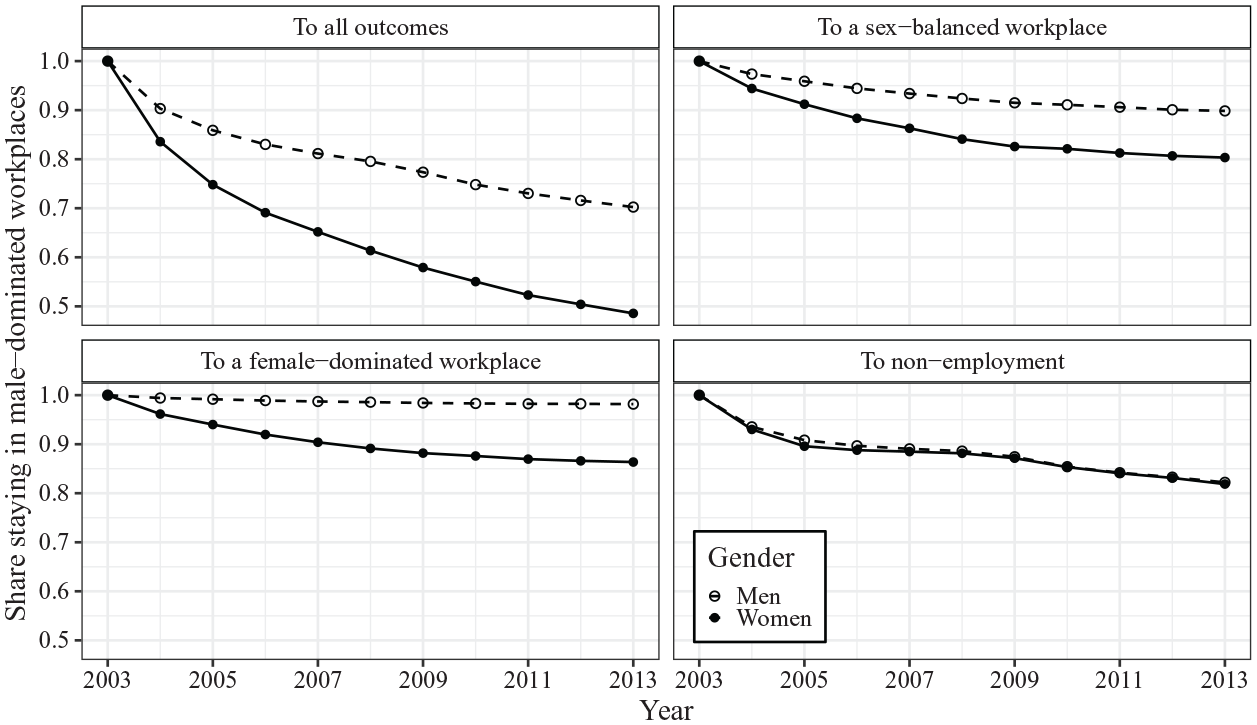
Attrition from male-dominated workplaces by sex over time (2003–2013).
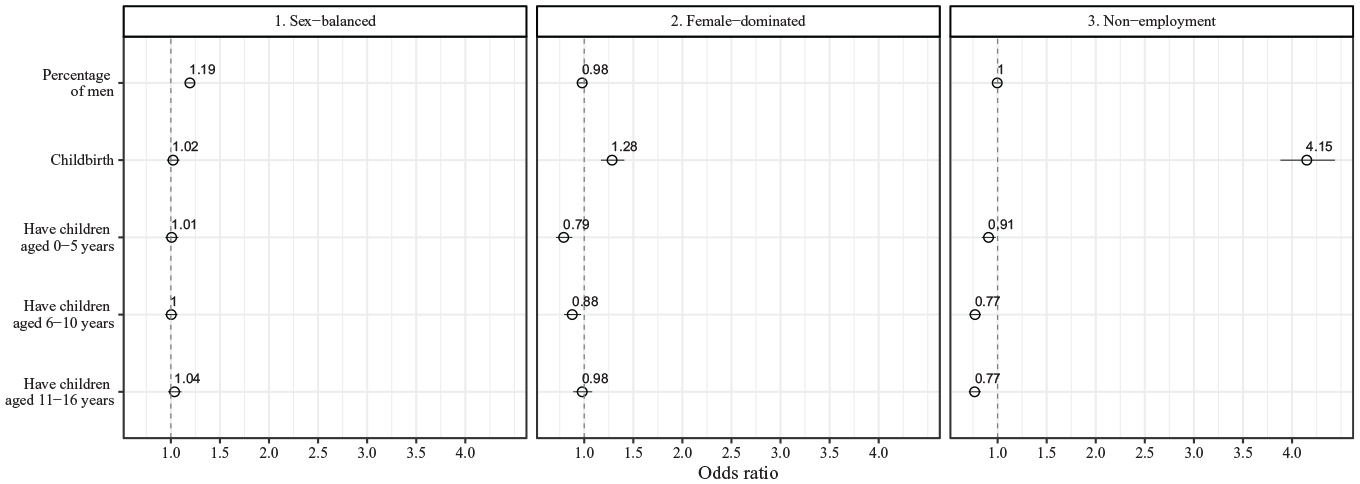
Odds ratios for percentage of men in the workplace and motherhood for women’s attrition from male-dominated workplaces to (1) a sex-balanced workplace, (2) a female-dominated workplace and (3) non-employment.
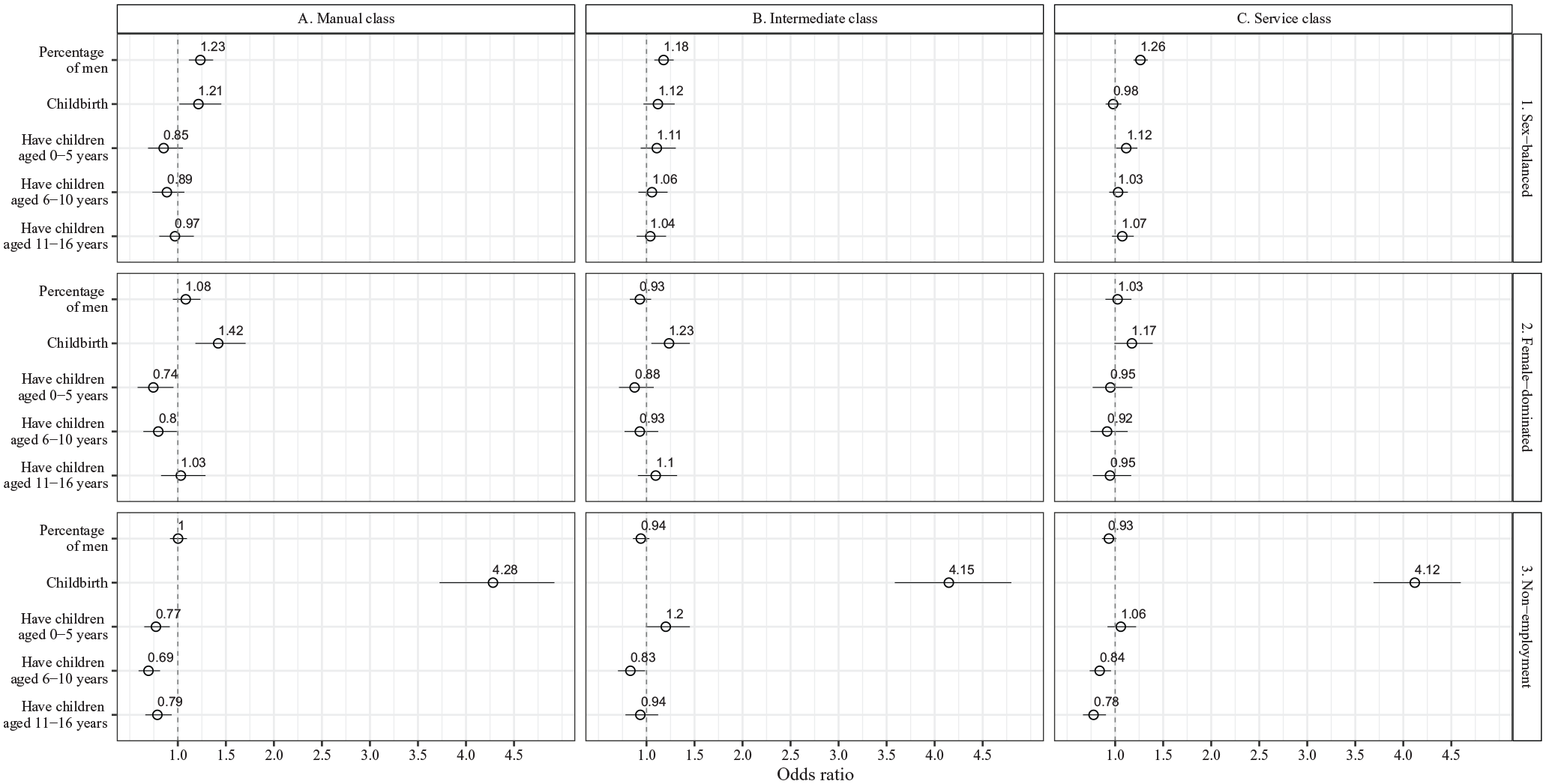
Odds ratios for percentage of men in the workplace and childbirth for women’s attrition from male-dominated workplaces to (1) a sex-balanced workplace (GB), (2) a female-dominated workplace (FD) and (3) non-employment (NE), according to occupational class.
Dependent variable
Attrition from male-dominated workplaces was the dependent variable in this study. The sex composition of the workplace was measured as the proportion of men in each of the thousands of workplaces. To account for changes in the composition of the labour force, the proportion of men was measured yearly. Male-dominated workplaces were defined as those where more than one-third of the employees were male, which is a conventional cut-off point (Torre, 2014). The results remained robust to other specifications.
The dependent variable measured the labour market status the following year (t + 1) and distinguished between four outcomes: (1) stay in or change to a male-dominated workplace; (2) change to a sex-balanced workplace (< 66.6% women and ⩾ 33.3% women); (3) change to a female-dominated workplace (⩾ 66.6% women); and (4) change to non-employment. Individuals without an employment relationship were defined as non-employed. Non-employed individuals might be students, welfare benefit recipients (e.g. receiving parental leave benefits) or unemployed. Attrition required both a change in the share of men (to < 66.6%) and a change of workplace.
Independent variables
The percentage of men was scaled so a one-point increase refers to an increase of 10 percentage points in the proportion of men. Motherhood was operationalized as a set of four time-varying dummy variables: (0/1) indicating childbirth, having children 0–5 years old, 6–10 years old and 11–16 years old. To measure occupational class, a four-class version of the Erikson and Goldthorpe class scheme (Breen, 2005) adapted to Norwegian register data (Hermansen, 2013) was used. The analyses differed only between the manual class, intermediate class and service class (small business owners were excluded owing to a lack of information on self-employed).
Additionally, we control for marital status (single and married/cohabitating), log-transformed personal and spousal income (inflation adjusted to 2011), weekly working hours, log-transformed size of workplace and sector (private and public) to adjust for time-varying factors that could confound the relationship between our explanatory variables and attrition. Finally, temporal variation is represented by a dummy variable for each (calendar) year (with 2003 as reference). Age was not included because it was collinear with time.
Statistical methods
The descriptive analysis of attrition over time (Figure 1) was obtained by tracking the labour market status of all individuals who were in male-dominated workplaces in 2003 (see Figure A1 for 2004–2009). For each year from 2004 to 2013, we calculate the proportion of individuals who are still in a male-dominated workplace. Hence, the figure shows how much the share of individuals has dropped off from the 100 % that was in a male-dominated workplace in 2003 due to attrition to all outcomes or to specific outcomes (sex-balanced workplaces, female-dominated workplaces or non-employment).
In the regression analyses (Figures 2 and 3), the dependent variable measured whether an individual left a male-dominated workplace the following year for either a sex-balanced workplace, a female-dominated workplace or non-employment. Because the outcome variable is nominal with more than two levels and there is a panel data structure, multinomial logistic regression with individual fixed effects was used (Chamberlain, 1980; Pforr, 2014). Individual fixed effects were applied to account for selection into male-dominated workplaces, as entering or staying in a sex-segregated workplace is likely to be a non-random process and the characteristics of the numerical minority may affect their propensity to leave (Cha, 2013). 1 The models can be specified with the following equation:

where P(γit = k) describes the probability of being in state k at t+1 of the possible states 0,. . ., m for individual i in year t. This study has m = 4, as the states include no attrition and attrition to a sex-balanced workplace, a female-dominated workplace and non-employment. The key parameters are β k representing the percentage of males in the workplace and θ k , which is a vector of dummy variables representing motherhood for individual i in year t estimated for each of the k outcomes, respectively. ϑ k represents a vector of time-varying control variables, including marital status, weekly working hours, personal and spousal income, size of workplace, sector and calendar year. α ki is a separate intercept for each individual, estimated for each outcome, which absorbs all time-invariant unmeasured heterogeneity; thus, no time-invariant covariates are included in the model as only variation between years within individuals is used to estimate the association between the time-varying explanatory variables and attrition from male-dominated workplaces. This reliance upon within-individual variation results in individuals with no variation in the dependent variable being dropped from the sample. Hence, only individuals experiencing attrition from a male-dominated workplace were studied. ϵ kit is an individual-specific error term. To account for the repeated measures of individuals over time, Huber–White sandwich standard errors were estimated (Pforr, 2014). Additionally, a linear probability model was estimated for each outcome to avoid the exclusion of non-mobile individuals and allow for cross-model comparison (Mood, 2010), and the results remained robust (see online supplementary material Tables A7 and A8).
In the result section (Figures 2 and 3), only the coefficients for the main explanatory variables are presented. Complete regression tables are available as online supplementary material (see Tables A5 and A6).
Results
Figure 1 shows attrition from male-dominated workplaces by sex over time (2003–2013) for all individuals born 1945–1983 who were in a male-dominated workplace in 2003. Overall, the results show that over 50% of the women did not work in a male-dominated workplace in 2013. By comparison, 30% of the men had left. Thus, women have a much higher propensity to leave. By 2013, 20% of the women had left for a sex-balanced workplace, compared with 10% of the men. The relative difference regarding female-dominated workplaces is even larger: 14% of the women had changed to a workplace with a minimum of 66.6% women, while this number was only 2% for men. Finally, attrition to non-employment was similar for men and women: 18% did not work in 2013. Consequently, the disparity in attrition between men and women is entirely the result of women switching out of male-dominated workplaces, but not out of the labour force; the same trend is evident for other cohorts (see Figure A1 in the online supplementary material). Moreover, Table A4 (online supplementary material) shows that the average yearly attrition rate for women in male-dominated workplaces is around 13% each year, 5% leave for sex-balanced workplaces, 3% leave for female-dominated workplaces and 5% leave for non-employment. However, as Figure 1 reveals, following individuals for a prolonged period reveals a higher attrition rate.
After establishing that women in the Norwegian population have a higher propensity than men to leave male-dominated workplaces, factors that can explain the attrition of women are explored. Figure 2 shows the results from a multinomial logistic regression with individual fixed effects examining how the percentage of men at the workplace and motherhood influences women’s attrition. The sample shown in Figure 2 consists of women who leave a male-dominated workplace at any time. The coefficients are interpreted as the percentage change in the odds of ending up in a sex-balanced workplace, a female-dominated workplace or non-employment relative to those of staying in or shifting to a male-dominated workplace (the reference category), for a one-unit change in the explanatory variables.
Figure 2 shows that an increase in the percentage of men is associated with a higher propensity to leave for a sex-balanced workplace (Figure 2, panel 1), but not for a female-dominated workplace (Figure 2, panel 2) or non-employment (Figure 2, panel 3). The odds of changing from a male-dominated to a sex-balanced workplace increase by 19% per 10 percentage-point increase in the proportion of males. The fixed effects design implies that the propensity to leave male-dominated for sex-balanced workplaces increases as women change to more male-dominated workplaces or the sex composition of their current workplace becomes more male-dominated from one year to the next.
Regarding motherhood, Figure 2 reveals that its association with attrition is dependent on the ages of the children and type of outcome. The results show that there is no association between motherhood and attrition to sex-balanced workplaces (Figure 2, panel 1). Conversely, motherhood matters for attrition to female-dominated workplaces, but the association is dependent on the ages of the children. In the year a child is born, mothers’ odds of changing to a female-dominated workplace increase by a factor of 1.28 (Figure 2, panel 2). Having children aged 0–5 years, however, decreases the odds by a factor of 0.79, while having children aged 6–10 decreases the odds by a factor of 0.88. Having children aged 11–16 years old does not seem to be associated with attrition to female-dominated workplaces at all. Hence, childbirth is associated with an increased risk of attrition to female-dominated workplaces, while having young children is associated with staying put in male-dominated workplaces. Childbirth is also associated with attrition to non-employment (OR 4.08, Figure 2, panel 3), which is likely to reflect a long period of parental leave provided by the Norwegian welfare state.
Figure 3 shows the results from the regression analyses separately by occupational class. The results show that the odds of changing from a male-dominated to a sex-balanced workplace increase by factors of 1.23, 1.18 and 1.26 with a 10 percentage-point increase in the proportion of males for women in the manual class (panel A1), intermediate class (panel B1) or service class (panel C1), respectively. Moreover, there is no association between the percentage of men and attrition to female-dominated workplaces or non-employment, regardless of occupational class. Overall, occupational class does not seem to matter much for the association between the percentage of men and attrition.
Furthermore, Figure 3 reveals that the association between motherhood and attrition is to some extent dependent on occupational class. First, only for women in the manual class is childbirth associated with attrition to sex-balanced workplaces. The odds of attrition to sex-balanced workplaces increase with a factor of 1.21 for women of this class (Figure 3, panel A1). Second, the magnitude of the association between childbirth and attrition to female-dominated workplaces decreases from low to high occupational class position (Figure 3, panels A2–C2). The association between childbirth and attrition is not significant for women in the service class. Finally, it is only for women in the manual class that having young children significantly decreases the likelihood of attrition to female-dominated workplaces (Figure 3, panel A2). Overall, the relationship between motherhood and attrition is similar across occupational classes with some exceptions. Primarily, motherhood seems to be to some extent more important for women’s attrition from male-dominated workplaces in the manual class compared to other occupational classes.
Discussion
Following recent studies of women’s attrition from male-dominated occupations, the present study shows also that high attrition rates from workplaces contribute to the strong labour market sex segregation characterizing modern welfare states. Additionally, it shows that women’s attrition from male-dominated settings is also prevalent in a social-democratic welfare state with extensive public work–family policies supporting women’s labour force participation. Because the fixed effects models control for all stable individual characteristics (a considerable source of self-selection into male-dominated workplaces), the study offers a stringent test of two main explanations of attrition in the literature and how they vary according to occupational class.
By demonstrating that the degree of numerical minority status is positively associated with women’s attrition at the workplace level, the study complements the findings of previous research on occupational attrition (Glass et al., 2013; Maume, 1999; Torre, 2014, 2017) and supports the notion that attrition may be the result of women facing challenges of being accepted and integrated in male-dominated milieus (see e.g. Jacobs, 1989; Kanter, 1977). The analysis nuances this finding in two ways with implications for future research; firstly, it demonstrates the importance of distinguishing between outcomes when studying women’s attrition, as also suggested by Chan (1999), by showing that an increase in the percentage of males at the workplace is only associated with attrition to sex-balanced workplaces. There is, however, a lack of plausible explanations for why degree of numerical minority status is not associated with attrition to female-dominated workplaces and non-employment. Perhaps it is due to overlooked mechanisms which only operate at the workplace level, or to particularities of the Norwegian labour market. For instance, attrition to non-employment is less likely in Norway since the employment rate among women is very high. Future studies of workplace attrition should explore possible mechanisms explaining this finding.
Secondly, the results show that the association between degree of numerical minority status and attrition to sex-balanced workplaces was the same regardless of occupational class. This finding is not consistent with the claim that higher education prepares women in advantageous occupations for the challenges of being a numerical minority and is at odds with the results of a recent study by Torre (2017). However, since the candidate explanations presented in the literature review are not mutually exclusive, the study cannot exclude that there are several mechanisms at play both heightening and lowering the risk of attrition by occupational class. Women in a high occupational class might be both better prepared for being outnumbered due to their long educational training, and simultaneously meet ‘glass ceilings’ and barriers to their careers due to statistical discrimination (which some scholars argue are more prevalent in social-democratic welfare states such as Norway (Mandel, 2012b)). A next step for research on women’s attrition and class is to untangle mechanisms mediating this relationship.
The present study also contributes to the literature on women’s difficulties with reconciling work and family life in male-dominated spheres (e.g. Acker, 1992; Cook and Minnotte, 2008) by demonstrating that motherhood is associated with attrition to female-dominated workplaces depending on the ages of the children and women’s position in the labour market. Attrition due to motherhood happens the year a child is born. This indicates that childbirth is a pivotal turning point in some women’s careers (Glass and Riley, 1998). An implication of this finding is that treating childbirth as an independent event can reveal important nuances in the relationship between motherhood and attrition which would have stayed hidden with a less fine-grained measure and suggests a link between exits and family issues that has not been evident in previous studies (i.e., Chan, 1999; Torre, 2014, 2017).
Additionally, that childbirth is primarily making women in lower (manual) class occupations change workplace is consistent with claims of class differences in gender egalitarianism and parental strategies. Scholars argue that working-class parents emphasize the mother as the primary caregiver, entailing career adjustments to accommodate the children (Lareau, 2002; Stefansen and Farstad, 2010). If male-dominated workplaces are less ‘family friendly’ and working-class women to a greater extent prioritize their family over work, this may explain why women in lower occupational classes are more likely to change to female-dominated workplaces due to childbirth. It is, however, possible that attrition due to childbirth is only present at the workplace level. The choice of changing jobs is arguably less drastic compared to changing occupations, which might be reflected in the findings of the study.
Furthermore, it is also possible that the observed association between childbirth and attrition is country specific. If public policies of social-democratic welfare states such as Norway contribute to labour market sex segregation by sorting women into ‘family-friendly’ and often female-dominated public sector jobs, which some scholars argue (Mandel, 2012b), the impact of childbirth on attrition to female-dominated workplaces could be due to the availability of such jobs. Learning from this, future research should apply a detailed measure of motherhood to study its impact on attrition in other institutional contexts, preferably by cross-country comparison with information at both the workplace and occupational level.
For social policy, it is significant that the study offers an appropriate test of key hypotheses of female attrition by studying women in actual work settings. By focusing on workplaces, the results lend support to some of the proposed explanations that have primarily been investigated in occupations, which do not necessarily constitute the settings in which people work (Bygren, 2004). Consequently, the study implies that policies aiming to decrease current levels of labour market sex segregation should also target workplaces. While policies aimed at reducing isolation, stereotyping and negative performance pressure associated with being a numerical minority should be targeted at all levels of the occupational structure, the findings indicate that exits related to motherhood impact women unevenly, with mothers in manual occupations more at risk of attrition.
Admittedly, the study leaves important questions unanswered, such as whether it is detrimental for women to leave male-dominated jobs. Does attrition lead to worse wages, status and career prospects? Although research shows that job mobility following motherhood is associated with a wage penalty (Gangl and Zeifle, 2009) and loss of occupational status (Abendroth et al., 2014), it is not clear whether leaving male-dominated jobs will harm women’s careers similarly. In fact, staying put may have its own costs (Maume, 1999). An important task for future research is to investigate the career consequences of women’s attrition from male-dominated settings.
Strengths and limitations
This study has three main limitations: first, it lacks explanatory variables mediating the effect of degree of numerical minority status and motherhood on women’s attrition, which could have tested the proposed explanations in the literature more directly. Second, the external validity of the study can be questioned because the fixed effects design excludes individuals who do not leave male-dominated workplaces. Third, the design also prevents the results from being presented in any form other than logit or odds ratio effects, 2 which can be challenging to interpret. Nonetheless, accounting for selection is a major strength of this study, and arguably compensates for these limitations. Other major strengths include longitudinal population data with workplace information, which allow for tracking of individual careers and measuring sex composition at the level that most plausibly reflects the everyday experiences of the workers.
Conclusions
The present study provides new insights into how women’s attrition from male-dominated workplaces can contribute to the continued labour market sex segregation characterizing modern welfare states. While previous studies have focused on attrition from occupations, this study demonstrates that women, to a considerable extent, also leave male-dominated workplaces. The findings reveal important nuances in the role of numerical minority status and motherhood and their interaction with occupational class for women’s attrition. Overall, the study underscores the importance of distinguishing between outcomes, to consider the ages of the children and to take occupational class into account when studying attrition at the workplace level.
Supplemental Material
sj-pdf-1-wes-10.1177_09500170211004247 – Supplemental material for Women’s Attrition from Male-Dominated Workplaces in Norway: The Importance of Numerical Minority Status, Motherhood and Class
Supplemental material, sj-pdf-1-wes-10.1177_09500170211004247 for Women’s Attrition from Male-Dominated Workplaces in Norway: The Importance of Numerical Minority Status, Motherhood and Class by Aleksander Å Madsen, Idunn Brekke and Silje Bringsrud Fekjær in Work, Employment and Society
Footnotes
Acknowledgements
We would like to thank the anonymous referees for their constructive feedback, and Andreea I Alecu and our research group at the Centre for the Study of Professions for valuable comments on an earlier draft of this article.
Funding
The authors received no financial support for the research, authorship, and/or publication of this article.

Supplementary material
The supplementary material is available online with the article.
Notes
References
Supplementary Material
Please find the following supplemental material available below.
For Open Access articles published under a Creative Commons License, all supplemental material carries the same license as the article it is associated with.
For non-Open Access articles published, all supplemental material carries a non-exclusive license, and permission requests for re-use of supplemental material or any part of supplemental material shall be sent directly to the copyright owner as specified in the copyright notice associated with the article.
