




Abstract
This article looks at the process of education-to-work transitions in female-dominated welfare professions within the Slovenian post-crisis context marked by a workfarist agenda. It departs from a scholarship that conceptualises precarity as a transitional vulnerability and disaffiliation exacerbated by workfarist policies to explore the contemporary experience of those trying to achieve professional integration under a volatile workfarist regime. The findings reveal a mismatch between established regulations for early career recruitment and professional licensing and actual chances in the labour market to meet these requirements through available workfarist non-standard, entry-level jobs/schemes designed for particular status and/or socio-demographic groups. It gives new evidence that European workfare regimes exacerbate precarity and a novel understanding of state-manufactured precarisation as an intersectional process of marginalisation and discrimination that not only hinders integration into welfare professions, but also downloads the costs of social reproduction on the next generation, causes precarious ageing and widens intersectional differences.
Keywords
Introduction
This article responds to the calls set out by a WES special issue on precarity to focus future research on precarisation as a process that can also be manufactured by the state and can extend into the realm of social reproduction (Alberti et al., 2018; Rubery et al., 2018). It looks at the process of education-to-work transitions in female-dominated welfare professions within the Slovenian post-crisis context marked by a workfarist agenda. It departs from sociology (of work) scholarship that explores precarity beyond the labour market and in the context of changing welfare states characterised by workfarist social and active labour market policies that are fundamentally changing work-centred societies and their welfare regimes (Castel, 2003; Della Porta et al., 2015; Dörre, 2015; Greer, 2016). This scholarship allows for a process-oriented interrogation of work transitions, which will in this research also remain intersectionally sensitive (McBride et al., 2015).
Through policy design the state can play a major role in manufacturing the precarisation of workers. Research shows that a workfarist turn has, throughout Europe, predominantly caused greater flexibility for employers and less security for workers (Dörre, 2015; Greer, 2016; Rubery et al., 2018). Especially in the post-crisis period, it has had a particularly negative impact on the young, who are entering an increasingly volatile and precarious labour market (O’Reilly et al., 2019). Moreover, the workfarist turn has also affected female-dominated welfare professions, which are closely tied to the development of the welfare states and their contribution to social reproduction (Evertsson, 2000; Himmelweit, 2017). The workfarist turn has considerably decreased professional and employment standards in welfare provision and recruitment by reducing paid internships and replacing them with unwaged labour, temporary projects and various active labour market policy (ALMP) schemes (Baines, 2004; Samaluk, 2017). Nevertheless, experience of becoming welfare professionals, who are entering through these non-standard recruitment channels, has been largely neglected, although it can offer a unique perspective on the mismatch between professional norms and standards and actual workfarist labour market conditions eroding these.
This article focuses on Slovenian nationally regulated education and social protection professions in a post-crisis context, characterised by largely unchanged entry rules, demanding the acquisition of specific university degrees and postgraduate work experience, and the radically hindered entry routes to meet these rules. Post-crisis austerity measures and continuous fiscal discipline have capped public sector hiring, eliminated traditional government-funded internships and replaced them with pre-conditioned EU-funded projects, quasi-internship or general ALMP schemes that have completely changed the way the transaction of funding provision is organised, increased workload for providers, and hindered entry and permanent integration into these professions (Greer et al., 2019; OECD, 2017; Samaluk, 2017). This article looks at the contemporary experience and strategies of those entering welfare professions under these volatile workfarist labour market conditions.
The article contributes by revealing a mismatch between professional and employment standards for early career recruitment and professional licensing set in laws and collective agreements and actual chances in the labour market to meet these requirements through available workfarist non-standard, entry-level jobs/schemes designed for particular status and/or socio-demographic groups. It offers new evidence that European workfare regimes exacerbate precarity and a novel understanding of precarisation as an intersectional process of marginalisation and discrimination that not only hinders integration into welfare professions, but also downloads the costs of social reproduction on the next generation, causes precarious ageing and widens intersectional differences. The article is structured as follows. First, the literature review presents the conceptual framework and the context underpinning this study. This is followed by an outline of the study, the methodology section and the presentation of findings. Finally, the conclusion summarises the article’s main arguments and contributions.
Education-to-work transitions of welfare professionals
This article explores education-to-work transitions within female-dominated welfare professions in a post-crisis Slovenia marked by a workfarist agenda. Female-dominated welfare professions emerged from and are closely tied to the development of the welfare states and their contribution to social reproduction in the form of welfare services and benefits provision that enable paid, and the support for unpaid, reproductive work (Himmelweit, 2017). The welfare state’s development has been characterised by the provision of stable public service labour markets that provided good conditions for professional and trade union organising and development of high professional and employment norms and standards (Evertsoon, 2000). The welfare state’s services and their role in social reproduction became increasingly compromised with austerity (Himmelweit, 2017) and workfarist policies.
In the EU, workfare has been promoted through the ideas of ‘flexicurity’ and ‘active inclusion’, which re-emphasise self-responsibility and change the notion of security from being understood as a protection from risk of unemployment to increasing the capacity to adapt to change through self-investment in knowledge, skills or competences (Keune and Jepsen, 2007; Keune and Payton, 2017). These ideas enable a move from employment towards employability and from social towards active inclusion, and are enacted through EU governing, including financial mechanisms that advocate for reduced public spending and various ALMP schemes (Keune and Jepsen, 2007; Keune and Payton, 2017). After the 2008 global financial crisis, the EU’s primarily soft approach became much more prescriptive and this had a particular impact on welfare administration and provision in the new member states, who had to rapidly adapt their welfare institutions to transnational pressures associated with fiscal discipline and more prescriptive EU governance (Samaluk, 2017). These external pressures resulted in reduced funding and the utilisation of EU resources for workfarist project-based services that introduced temporary project-based employment across welfare provision, hindering entry and permanent integration in the labour market (Greer et al., 2019).
The workfarist turn thus undermines Keynesian-welfarist ‘zones of integration’ characterised by strong employment and social protection and causes wider precarity, here conceptualised as insecure and unstable working, employment and living conditions that hinder one’s integration into secure employment and social networks that offer social protection and recognition, give opportunities for participation and offer possibilities to plan the future (Castel, 2003; Dörre, 2011, 2014). This definition does not treat precarity as a static analytical concept, but as a process of transitions between various work and non-work statuses in which people repeatedly disappear into ‘zones of vulnerability and disaffiliation’, also owing to state-facilitating insecure working, employment and living conditions (Castel, 2003; Dörre, 2014, 2015; Greer, 2016). Research has already shown that workfarist policies designed by the state construct precarious work as an acceptable or required alternative to unemployment, which has had particularly detrimental effects on the young, unemployed and other precarious workers (Dörre, 2015; Greer, 2016; O’Reilly et al., 2019; Rubery et al., 2018), but little attention has been given to those entering welfare professions.
In welfare states with historically strong welfare institutions, access to welfare professions has been channelled through established training/educational institutions and regulated by the state through the recognition of qualifications and/or professional licensing fixing the conditions for entry and instituting procedures for recruitment (Novoa, 2000). Early career recruitment has thus been characterised by a strong link between educational institutions and the public service labour market, traditionally organised through study practice and/or pre- or postgraduate internships that allow for supervised and gradual integration into a profession that reduces practice shock and early career dropout (Hussein, 2011; Lethbridge, 2017; Stokking et al., 2003).
While education has been expanding with the growth of various (sub)specialisations, which are not necessarily followed by state certifications, making it more difficult to steer professional development in the desired direction (Evertsson, 2000) and the Bologna process that aims to achieve greater compatibility across the EU (Hussein, 2011), the workfarist turn has considerably reduced standard recruitment channels and replaced them with temporary projects and conditioned ALMP schemes (Samaluk, 2017). There is also an increased impetus to perform unwaged labour, which starts at universities and continues at the postgraduate stage or even throughout careers (Baines, 2004; Samaluk, 2017). This raises a fundamental question of how the contemporary generation can achieve professional integration in the absence of traditional recruitment channels and their replacement with workfarist entry routes.
Moreover, increasing flexibilisation breaks the quasi-automatic coincidence between career expectations and chances and makes it impossible to invest in one’s future without being continuously exposed to risks (Sennett, 1998). It is thus important to take into account that precarisation is a complex and multidimensional process that is not only shaped by structural changes, but also by the actions of people themselves, as they anticipate the possible outcomes of their strategies in a given context (Della Porta et al., 2015). Both self-investments to increase employability or attempts to access workfarist ALMP schemes designed for specific socio-demographic/status groups and/or policy goals, can pose particular challenges and risks to new entrants with diverse characteristics and circumstances. This study thus remains sensitive to intersectional differences and the intersectional process emerging along education-to-work transitions (McBride et al., 2015). Research already shows that today’s youth–work transitions are characterised by the rising school-leaving age, extended early career insecurity and intersectional differences (O’Reilly et al., 2019), but little attention has been given to the education-to-work transitions of becoming welfare professionals, who have to undergo prolonged and (on-the-job) training to meet the entry requirements, but have increasingly slim chances to enter and remain in the professional labour market.
This article addresses this void by asking the following questions: (1) What strategies do those entering welfare professions take to increase their employability and meet work-related professional entry requirements amid workfarist replacement of standard with non-standard entry-level jobs? (2) Does the induction experience of new entrants on available entry-level jobs match with professional and employment standards set in laws and collective agreements? (3) Are new entrants able to achieve professional integration and aspirations within these structural conditions?
Slovenian case study
This article focuses on neo-corporatist Slovenia, characterised by capable welfare state institutions that used to provide relatively stable employment and social security but came under pressure with entry into the EU in 2004, the Eurozone in 2007 and a subsequent global financial crisis characterised by more invasive EU governance (Samaluk, 2017). It looks at the experience of becoming welfare professionals in social protection (‘socialno varstvo’), which includes diverse social services aimed at social integration of vulnerable groups and teachers in preschool, primary and secondary education. Both education and social protection are highly feminised professions: education comprising of 77% female workers in 2011 and social protection 79% combined with healthcare. 1
Both professional categories are defined and regulated by the law and collective agreements based upon professional and employment norms and standards, which also prescribe conditions for early career recruitment and professional licensing. University graduates from various diverse faculties can enter these professions, but in order to do so they need to acquire a compulsory postgraduate internship or equivalent work experience for a minimum of 6 months (or 840 hours), after which they can take a professional certification exam to become fully licensed professionals. Obtaining the latter became increasingly challenging in the post-crisis period.
Table 1 shows that until 2007/2008 the government provided funding for internship schemes in both professions, enabling organised and clearly evaluated induction into each profession through standard employment based upon collective agreements in education and a specific Public Work Programme (PWP) designed for those entering social protection. These were replaced by voluntary internships, which became outlawed in 2014, and intermittent and conditioned European Social Fund (ESF) and Youth Guarantee (YG) quasi-internship schemes.
Internship schemes in social protection (SP) and education (EDU).
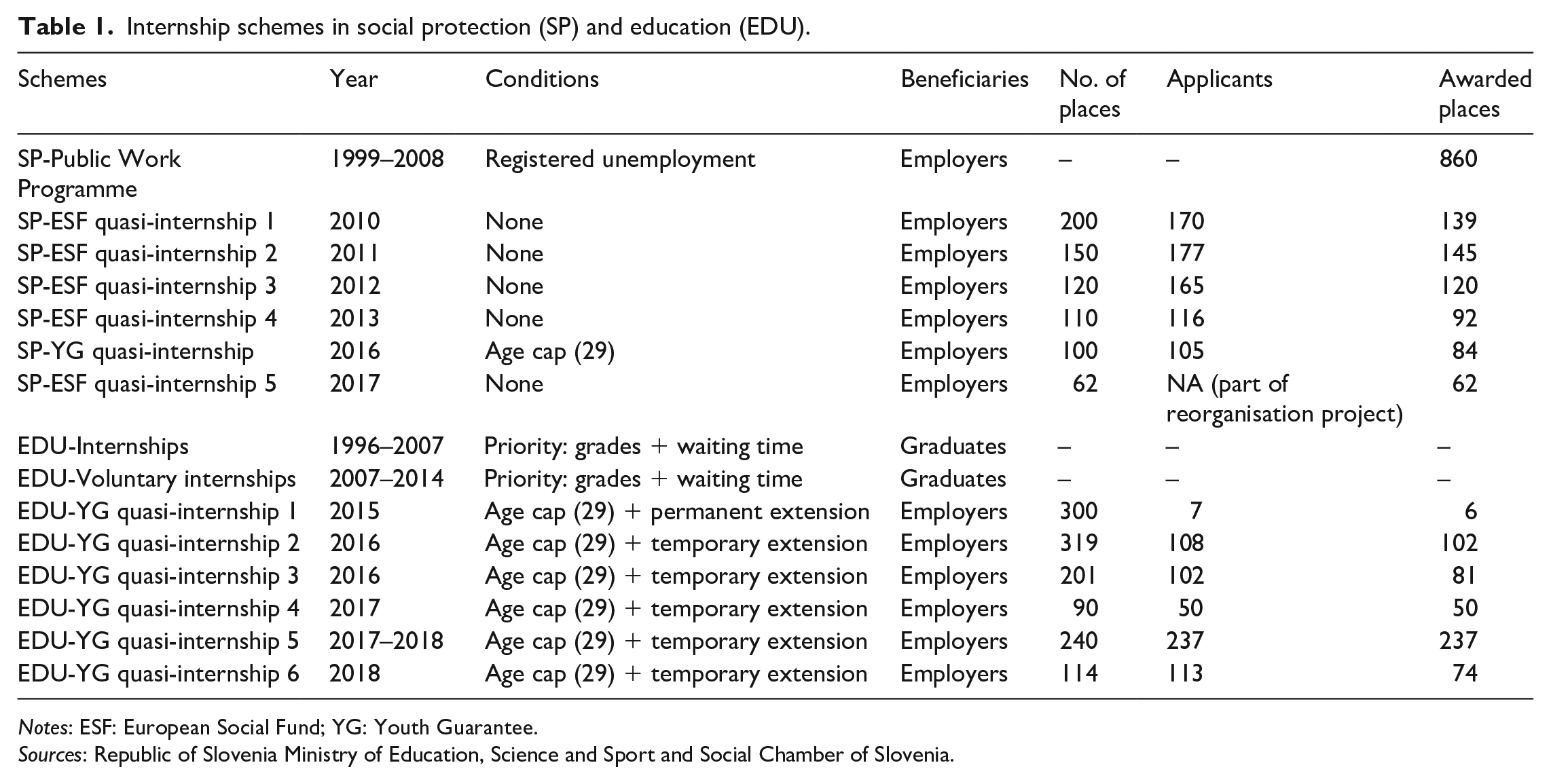
Notes: ESF: European Social Fund; YG: Youth Guarantee.
Sources: Republic of Slovenia Ministry of Education, Science and Sport and Social Chamber of Slovenia.
These gaps in the provision of organised induction were combined with the overall drop in public expenditure in education and social protection and the austerity measures capping employment in public sector and non-governmental social protection providers and predominantly public sector pre-primary, primary and secondary schools (OECD, 2017; Smolej-Jež et al., 2016). Consequently, there was a post-crisis increase in long-term unemployment among graduates entering these professions (ZRSZ, 2015). In education, the number of people who applied for professional exams dropped from 2031 in 2008 to 1124 in 2016. 2 Owing to austerity caps on public sector hiring, only 159 out of 476 interns on ESF quasi-internship schemes in social protection, running between 2010 and 2015, remained employed after their subsidised internships ended. 3 The next generation has also been facing a general post-crisis increase in non-standard employment, which was in welfare provision created also through various bureaucratically demanding EU-funded projects and general ALMP schemes (Samaluk, 2017). In social protection programmes, only 40% of workers in 2015 were employed full-time and one-third were employed through ALMP schemes (Smolej-Jež et al., 2016). In education, there was a two percent increase in part-time employment between 2008 and 2014, 4 and an eight percent drop in young teachers up to 30 years old between 2005 and 2015 (OECD, 2017).
While since 2016 there has been a gradual abolition of most austerity measures, continuous fiscal discipline still limits employment in welfare services and the reinstitution of government-funded internships. As professional actors and trade unions convey in their latest, 2019, appeal for reinstituting government-funded internship schemes in social protection, 5 there is a discrepancy between professional rules, laws, collective agreements and the practice that creates a legal void in which neither alternative work experience nor supervision are well defined or evaluated. While work done under employment contracts or ALMP schemes does count, there is ambiguity about the recognition of different types of civil law contracts (CLC) and voluntary or postgraduate student work, 6 with no clear guidelines as to what efforts might pay off, thus increasing risks for new entrants. In social protection, volunteering or student work is only ambiguously recognised in the postgraduate period and in education these types of work are recognised only within a limited scope (80 out of 840 hours) in the undergraduate and postgraduate period.
The latter is particularly problematic in Slovenia where the implementation of the Bologna reform brought to the extension and expansion of university programmes as faculties were competing for funding (Mlakar, 2015). This reform thus stimulated further extension of the average graduation age recognised also by Slovenian policy-makers, who opted for the highest possible age cap (29 years old) for EU-funded YG quasi-internship schemes (see Table 1). This article thus takes the perspective of diverse new entrants attempting to integrate from within various transitional statuses, which, along with their socio-demographic characteristics, define their eligibility for particular types of non-standard entry-level jobs/schemes and inform their job hunting strategies.
Methods
This study draws upon 53 in-depth individual interviews and three group interviews with 46 students, unemployed graduates and precarious new entrants, and 12 key informants. Interviews were conducted between June 2017 and June 2019 and include follow-up interviews with 26 respondents from the above sample of next-generation professionals.
The selection of key informants was guided by their stakeholder role within selected professions or the education-to-work transitions and included policy-makers, professional regulators, career advisors on relevant faculties and Employment Services of Slovenia, trade union activists and senior professionals. Key informant interviews aimed to get informants’ perspectives on professional regulations, policy change, its implementation and development, to probe their role and engagement with those in transitions and identify possible access routes to next-generation professionals.
The sampling of next-generation professionals in transition was guided by time frames of post-crisis policy change with regards to early career recruitment and intersectional sensitivities, that apart from diverse socio-demographic characteristics included also various transitional social and employment statuses. The sample involved those who were entering the professional labour market between 2010 and 2019, when government-funded internships were eliminated and replaced with ESF and YG quasi-internship (see Table 1) and other general ALMP schemes. It consisted of nine men and 37 women, between 22 and 54 years old. All five participants in their 40s or 50s were women, who had had health-related study interruptions or had changed career paths due to unemployment.
All interviewees have been acquiring or had suitable qualifications to enter these professions. Among graduates, 34 held bachelor’s and nine master’s degrees. In terms of status held, six were students (three finalising their undergraduate studies and three continuing on at master’s level), 14 were unemployed, 24 were temporary workers and two had permanent contracts linked to project funding. There were 24 interviewees from education and 22 from social protection; however, some interviewees tried to enter or worked in both areas.
Participants were accessed through channels and contacts obtained from trade unions, through alumni groups, online forums and Facebook groups, where they shared information or self-organised, and through the snowballing technique. Initial interviews lasted from half an hour to two hours. They explored respondents’ experience of work undertaken during studies, awareness of entry regulations and available entry routes, strategies and work undertaken to increase employability and access entry-level jobs, and their early career experience on available entry routes. Follow-up interviews lasted from 15 minutes to one hour and probed respondents’ progress with (re-)integration since the previous interview. All interviews were conducted in the Slovenian language and selected excerpts used in this article have been translated into English.
All interviews were recorded, transcribed and analysed through the process of open and focused coding (Charmaz, 2006). Analysis started with workers’ interviews and the initial coding process was partly informed by a pre-established framework and orienting concepts, such as (non-)paid, (non-)recognised work, ALMPs and intersectionality, and supplemented with in vivo and other codes emerging from findings. This was followed by focused coding, where most salient codes began to be sorted into themes. Identified themes guided the selective coding of key informant interviews and finally enabled data triangulation deriving from both sets of interviews.
Students’ and unemployed graduates’ attempts to increase employability
After graduation, most respondents experienced spells of unemployment: 31% short-term up to one year and 56% long-term unemployment up to 4 years. Under these spells many self-invested in further education. Both as students and unemployed graduates they also increased their employability through volunteering or poorly paid student work. Most respondents volunteered during their studies to increase networks and chances for postgraduate employment and 16 respondents engaged in field-related student work lasting from a couple of months up to several years. Both types of work are poorly recognised by professional regulators, even in the postgraduate period where unwaged labour also acted as a way to keep in touch with the profession and sometimes granted access/discounts to costly professional training: ‘I volunteer at one organisation . . . there they give me a discount or invite me, if they have free spaces . . . I am always on my toes’ (51-year-old female, unemployed).
Voluntary work also allowed unemployed graduates to escape disaffiliation: ‘I had some goal in the day, went out of the flat, to nursery, among people’ (28-year-old female, substitute teacher). However, this non-standard work in the postgraduate period was not recognised by regulators in education, as the failed attempt of this same respondent reveals: ‘I called the ministry to find out whether these hours would count as a suitable work experience: “According to the legislation on voluntary work, you should not benefit from it”’.
The same applied to postgraduate student work, despite new entrants’ strategies to cushion their precarity by keeping student status and access to the student work favoured by employers. Moreover, the new generations entering under the Bologna system had to study one year longer to be granted access to a professional exam: ‘We have to do master degree first . . . Previously it was right after university degree [4 years] . . . We are first generations . . . 4 plus 1’ (23-year-old female, master’s student).
Discrepancy between professional rules and practice was also present in social protection, but regulators were more flexible and were recognising the Bologna bachelor’s degree and postgraduate voluntary and student work on a case-to-case basis. Nevertheless, information about that was scarce and the Bologna reform still devalued their bachelor’s degree in the labour market: ‘With the Bologna system . . . they lowered the level of our degree . . . You can access a professional exam, but this doesn’t help . . . because most advertised professional jobs are for level 7, the Bologna master’s degree’ (27-year-old male, project worker).
This mismatch between professional norms and standards and changing training and precarious labour market conditions extended respondents’ graduation age and postgraduate insecurity, also hindering access to available workfarist entry-level jobs/schemes.
Hindered access to workfarist entry-level jobs/schemes
Occasional substitutions for traditional recruitment channels that came in the form of EU-funded quasi-internship and general ALMP schemes were not that easily accessible because they were aimed at reintegration of different age and/or unemployed groups and acted as subsidies for employers. All YG quasi-internship and ALMP schemes had an age cap that excluded older graduates (see Table 1). A 32-year-old graduate, who stopped trying after four years of failed attempts to find an entry level-job in education, expressed her anger over the age discrimination imposed: ‘I am over 29 and for me this is discrimination . . . Before [Youth Guarantee] I was trying to get an entry-level job and was not successful. Everyone has their own reasons for prolonging their studies [. . .] How much one had to work during studies, what was their family situation, none of these are taken into account . . . you put so much effort into studying for a desired profession . . . then you cannot even get to a professional licence, let alone employment’ (32-year-old female, employed outside education profession).
The YG age cap increased age and intersecting class and gender inequalities, since many of those utilising study extensions to keep their security, taking parental or sick leaves, or entering a profession later in life, suddenly became ineligible candidates. These conditioned quasi-internship schemes thus created a serious mismatch between professional aspirations and chances in the labour market. Overall, 21 respondents exceeded the age cap of 29 years old (six men and 15 women).
Also, access to general ALMP schemes was conditional on the time of registered unemployment and sometimes also on specific socio-demographic characteristics, defined upon policy makers’ standard categorizations or then available funding streams prioritizing specific unemployed groups. Among these, the most prevailing entry route became the government-funded PWP for long-term unemployed persons, which has been traditionally utilised by employers in welfare professions, but has seriously postponed professional integration for the contemporary generation. During the crisis, the waiting time to become eligible stretched way beyond one year due to the increased supply of long-term unemployed persons. In contrast, the last government-funded PWP quasi-internship scheme, running between 1999 and 2008 (see Table 1), designed specifically for unemployed graduates entering social protection, offered immediate entry – as recalled by a key informant who entered this way: ‘In January, I graduated, then I had to register with Employment Services and on 2nd February I already had an interview . . . at that time there were many more places available, so it was easier to enter the labour market’ (trade union representative).
These targeted PWP schemes allowed unemployed graduates with clear professional aspirations to quickly enter the profession and prevented a mismatch between advertised posts and work expected of graduates, as found in contemporary experience. An unemployed graduate recalled how she was mistakenly expecting to do the work that would count as a suitable professional experience: ‘Luckily I asked: “Will this count as social protection experience?” . . . I would be teaching computer skills to elderly, these are instructions . . . I declined’ (41-year-old female, unemployed).
Accepting this PWP would mean losing another year towards professional integration, which would have been particularly problematic at her age. However, not everyone could afford to say no to unsuitable jobs offering an escape from unemployment: ‘It was really difficult . . . not to work . . . you need to pay the bills, so I was also applying for other jobs . . . I got one in one firm . . . through an ALMP scheme’ (28-year-old female, employed outside social protection profession).
As a result, general ALMP schemes also acted as exits from desired welfare professions for respondents with clear professional aspirations, and on the other hand as entry routes into welfare professions for graduates with no such prior aspirations, as was the experience of six respondents.
Moreover, respondents faced particular challenges accessing the newly introduced EU-funded quasi-internship and other ALMP schemes, which also acted as subsidies for employers, but funding was based upon an unfamiliar and bureaucratically challenging transaction: At one organisation they told me that these tenders are so bureaucratically demanding for them that it is easier for them not to have interns . . . A colleague of mine who interned at an organisation had to prepare all the documentation herself . . . if she wanted the internship. (31-year-old female, intern)
Already overburdened welfare providers were not eager to deal with this new bureaucratically demanding transaction or they pushed project-management work onto prospective interns. Respondents’ repeated failed attempts also revealed that employers were unfamiliar with these new EU funded schemes or feared that subsidies would not cover the overall employment: I attempted to access two tenders . . . I contacted over 150 schools . . . the leadership did not know about these tenders . . . headmasters were afraid they would have to cover extensions from their own budget . . . I was not successful. (30-year-old male, unemployed)
Even if respondents managed to find interested employers, the funding could simply run out: ‘I was actively looking for interested employers . . . I found one . . . but then the money ran out’ (54-year-old female, project worker).
A key informant at Employment Services pointed to the same problem with unstable financing of EU-funded ALMP schemes, which had been gradually introduced into the Slovenian active labour market policy since the EU integration in 2004: ‘We are annoyed by unstable conditions of [EU] financing . . . we cannot secure continuity this way’.
The availability of the EU-funded ALMP scheme was thus constantly changing for new entrants with diverse statuses and socio-demographic characteristics. Moreover, employers’ reluctance to deal with these schemes has further increased with short deadlines: When this tender came out it had a really short deadline. Schools that were not prepared and had no pre-selected candidates . . . simply did not apply. I know many unemployed teachers who hoped to get in through these tenders, but they were not so lucky as me, who knew about them and was in contact with institutions. (25-year-old female, intern)
Short deadlines also encouraged selection of candidates who already had pre-established networks with employers and suitable skills to cover labour shortages. All in all, lack of interest on the demand-side resulted in a serious underutilisation of available EU-funded quasi-internship schemes (see Table 1). Overall, only seven respondents entered education or social protection profession through EU-funded quasi-internships and 11 through the general ALMP, mostly PWP, scheme. Another 10 respondents entered through regular job openings and nine through projects, mostly through previous networks gained through volunteering, student work or recommendations within the internal market.
Early career experience on available entry routes and exits into cyclical transitions
This section explores early career experience on available non-standard entry-level jobs/schemes and finds that these increased the flexibility for employers and postponed new entrants’ professional licensing, increased practices shock and early career insecurity leading to cyclical transitions.
Table 2 shows that only entrants on YG and ESF quasi-internship schemes had full-time fixed-term employment contracts based upon sectoral collective agreements providing a proper starting salary and access to a professional exam. Those who entered through projects or as substitutes were mainly employed on temporary full-time or part-time employment contracts and another five on different civil law contracts, three of them through bogus self-employment. Employment on general EU- and integrally funded ALMP schemes was organised through fixed-term tripartite contracts between registered jobseekers, employers and the Employment Services.
Respondents’ entry routes.
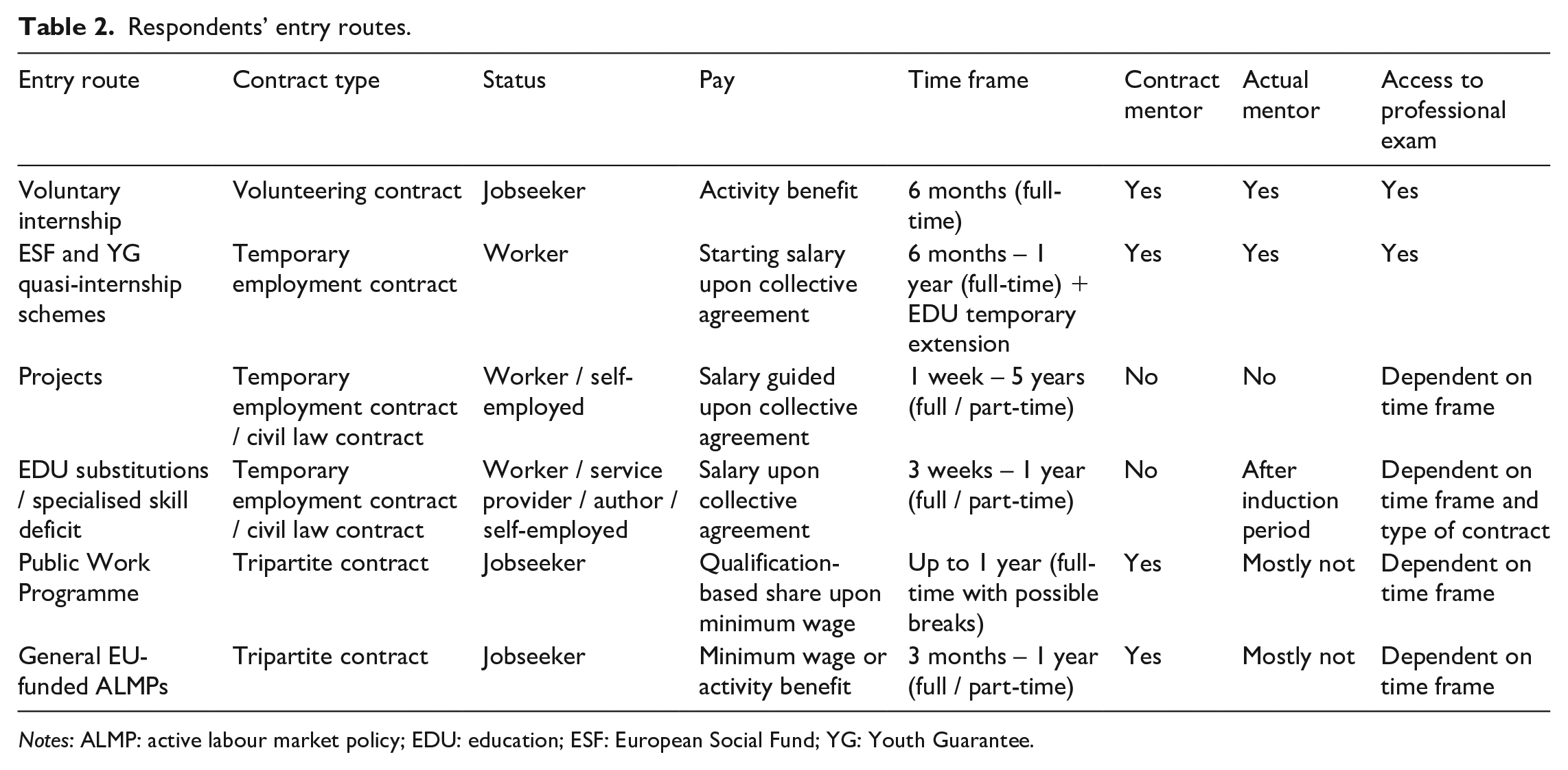
Notes: ALMP: active labour market policy; EDU: education; ESF: European Social Fund; YG: Youth Guarantee.
While salaries for those on projects and substitutions were generally guided by sectoral collective agreements, employers could still lower them by resorting to bogus self-employment: I agreed to a higher pay, but then he lowered it by €100 . . . the contract was through my self-employed status, so I had to cover all expenses, contributions [. . .] I couldn’t utilise the hours gained there, because I worked as a self-employed person. (29-year-old female, self-employed)
Not only were civil law contracts utilised by some employers to drive down labour costs, but, in education, regulators also failed to recognise copyright or service civil law contracts when they were done under a self-employed status. In both such cases, follow-up interviews revealed that respondents were unaware of or even misled about these ambiguous rules. A 32-year-old teacher working on a copyright civil law contract recalls how this ambiguity extended her professional integration by another year: ‘[When I was on this contract] they [the ministry] told me . . . it counts . . . I lost almost a year . . . I only needed another month of hours and was about to apply when I found out that all these hours don’t count’ (28-year-old female, temporary teacher). However, another informant entering in 2012 got a copyright civil law contract recognised by that same ministry. Ambiguous and differently applied rules considerably extended graduates’ transitional precarity and postponed their professional integration.
Wage squeezes were further possible through general, especially EU-funded, ALMP schemes. Salaries on fully subsidised integrally funded PWP are calculated as a qualification share from the minimum wage, which for graduates amounts to 120% of minimum wage. This used to be the same for EU-funded ALMP schemes, but was later reduced to minimum wage to incentivise employers to utilise EU subsidies: I almost had a heart attack when they sent me a contract with minimum wage. At the Employment Services they told me . . . that in the previous year these EU-funded schemes had not been utilised enough, because employers did not want to pay for qualifications . . . Now they had removed this condition. (30-year-old female, unemployed)
Moreover, some general EU-funded ALMP schemes also covered poorly remunerated job training or employment trials: ‘These three months on work trial I received €450 for a 40-hour week’ (35-year-old male, PWP worker). In these ALMP schemes, jobseekers received only an additional benefit for activity and had travel expenses covered.
In terms of professional integration and training, all quasi-internship and ALMP schemes included contractual obligations to provide some sort of supervision to workers (see Table 2), but in practice only quasi-internship schemes offered a secure, professional and gradual induction into professions, with an assigned and actual mentor and pre-set induction programme. Both entrants on general EU-funded ALMP schemes revealed that amid staff shortages they were mainly left to work unsupervised or found their own way to get trained.
A similar trend was found on PWP schemes, as explained by a graduate entering this way: ‘Without any experience I had to visit users at home, by myself. They pushed me into one family and now you work, write a report, without any prior knowledge’ (31-year-old female, project worker).
Except in two cases, those on PWPs had no proper induction and were utilised to cover organisations’ professional labour shortages and emerging needs: PWP workers are utilised as a jack-of-all-trades. If needed, you do house appliance work. Otherwise I had extended stay . . . all substitutions, not only my subject, also other subjects . . . Such induction is catastrophic. (30-year-old male, unemployed)
In schools, emerging needs included covering all ad hoc substitutions regardless of workers’ expertise and with little or no preparation time. Such harsh entry can completely cloud early careers’ view of the profession and encourage drop out.
Those who covered leave, a specialised skill deficit or were employed on projects initially had no mentor assigned and rarely received any induction. Mainly these new entrants were simply left to learn how to swim and had to rely on non-remunerated support of their colleagues or had to volunteer if they wanted some induction. Substitute teachers in particular had very little time to prepare to cover unexpected leave: I signed the contract on Friday and during the weekend I had no other option but to prepare, because on Monday I started teaching. Bam – no mentor – just swim . . . After half a year I got the mentor, because you need one for class presentations. (28-year-old female, substitute teacher)
Ironically, new entrants in education got mentors assigned only after they collected all the hours needed and had to do official class presentations as part of their professional exam.
Professional integration was also dependent on employment duration. Only 45% of respondents acquired the needed hours through their first employment and, overall, it took respondents from one to six years to get a professional licence. Projects and substitutions were often too short (many part-time) to cover the required intern period. While EU-funded quasi-internship, general ALMP schemes and projects all had pre-set time frames lasting from a couple of weeks up to five years, only voluntary and EU-funded internships guaranteed all the hours needed to get the professional licence (see Table 2). While most projects and ALMP schemes covering on-the-job training or employment trials were too short to cover the full intern period, integrally funded PWP schemes generally lasted for a year, but schools interrupted contracts during summer holidays and contracts had to be extended each new year, when integral funds were allocated for that scheme. In one case, a pending contract extension served as pressure to push workers to take up unsupervised weekend and holiday shifts.
Workers on projects could also be subject to conditioned contract extensions: They first employed me from July until October. The condition was that I undertake the exam on the General Administrative Procedure Act. I did that, so they prolonged it for another two months. Then I told them I was pregnant and things started getting complicated . . . I finally got another two months’ extension, but until the end I did not know if I would get it or not. (31-year-old female, project worker)
Both professional integration and support for unpaid reproductive work were subject to sufficient employment durations, as revealed by another pregnant teacher: I was employed for 3 months . . . and was hoping to acquire a professional licence . . . then I was laid-off . . . They called me back, but I was already pregnant . . . I told the headmistress . . . and that was the end of it . . . I’m about to start my maternity, but I am not entitled to [maternity leave]. (27-year-old female, unemployed)
Since women had greater involvement in unpaid reproductive work, they were more at risk of prolonged precarious work–life transitions affecting their professional integration, employment prospects, income and pensions.
Moreover, all entry routes, including quasi-internship schemes in education that covered temporary contract extensions, were temporary and led to cyclical transitions. While even previous generations rarely found permanent employment at the entry level, ‘these project systems now made things even worse . . . all is based on impermanence’ argued one trade unionist. Among all respondents, only six managed to get a permanent employment contract within the profession, among these two men in their mid-30s and three women – two in their early 30s and one in her early 50s. The time to get there was between two to six years and made a huge difference in terms of social and economic security and ability to plan personal and professional futures, as explained by a teacher who got a permanent contract in 2018: ‘Year-on-year uncertainty whether there will still be the need for my profile . . . is gone. There is a sense of security, because of the children, there is a possibility to get a bigger mortgage’ (31-year-old female, permanent teacher).
In contrast, those cycling between spells of (un)employment were completely disenabled from planning their careers or life-course: ‘I am afraid of starting a family . . . If there is no regular income [. . .] I would like to settle . . . I would like to deal with the future . . . instead of dealing with whether I will find work’ (35-year-old male, unemployed). During spells of unemployment, this same informant was also constantly volunteering and self-investing intermittent income in further professional education: ‘I am constantly working [volunteering] . . . I obtained a master’s degree in 2014 and finished another specialisation in 2016, but I received the certificate in 2018, when I paid all the fees. I could do that because I was employed through the PWP scheme.’
Those in transition were cycling between emerging temporary jobs and ALMP schemes, some abroad or outside education or social protection profession, some were investing low intermittent incomes in costly specialisations or additional qualifications (fees ranged between €1000 and €4000 per year) to get back in, increase their chances of permanent integration or steer careers in another direction: I still apply for teaching jobs, but it’s quite stressful, so I would do something else . . . this is why I am doing this additional qualification for a librarian . . . It’s hard to plan, you don’t know what comes next [. . .] For a school librarian I don’t need an additional professional licence . . . but for a general library, I would first need to acquire work experience there in order to apply for a professional exam. Similar process as entering teaching profession. (30-year-old male, unemployed)
In the context of reduced chances in the labour market, planning for or steering professional development in another direction can be particularly risky and time-consuming for those aiming at ever more diverse and specialised welfare professions.
Overall, early career experience revealed that the precarisation process in education-to-work transitions manufactured by the state increased early career insecurity and led to precarious ageing that completely reconfigured the normative life-career stages, diminished the next generation’s employment and social security, and downloaded the costs of social reproduction onto them, consequently also widening intersectional differences.
Discussion and conclusion
This article has explored students’, graduates’ and precarious early career professionals’ attempts to enter and fully integrate into state-regulated welfare professions in a post-crisis Slovenia marked by a workfarist agenda. Findings show that amid absent internships and their replacement with workfarist non-standard jobs and ALMP schemes, new entrants experience great difficulty in acquiring compulsory postgraduate work experience to achieve professional integration. Within these structural constraints, new entrants’ strategies include an extension or return to education and extensive unpaid or poorly paid and recognised work to increase employability. As Della Porta et al. (2015) argue, precarisation is a complex process also shaped by the actions of people themselves, as they anticipate the possible outcomes of their strategies in a given context. Although these self-investments in additional qualifications rarely pay off, unpaid and precarious work serves as a provisional escape from zones of disaffiliation and some aspects of precarity (Castel, 2003; Dörre, 2014). Unwaged labour allows those in transitions to build professional networks, to keep in touch with the profession and in some instances also gives opportunities for participation in professional training or brings professional recognition.
While welfare state retrenchment creates impetus for unwaged labour among those entering welfare professions (Baines, 2004), this work is often not recognised by regulators and gets pushed under the carpet, as it is not in accordance with the established entry regulations. Owing to this mismatch between established rules and actual labour market conditions, new entrants’ tactics are very risky as they have no guidelines or guarantees on whether these non-waged efforts will pay off and be recognised by regulators or potential employers. These tactics are also very costly and time-consuming and are increasing the university leaving age, early career insecurity and intersectional differences. While research shows that this is today’s characteristic of youth–work transitions across Europe (O’Reilly et al., 2019), this article demonstrates that age and intersecting inequalities can further increase for those trying to enter and stay within state-regulated welfare professions. In Slovenia, this was further stimulated by the implementation of the Bologna reform that has effectively prolonged studies and introduced several welfare (sub)specialisations through which precarious graduates try to increase their employability. While research already shows that steering professional development in a desired direction becomes increasingly difficult with various (sub)specialisations and states’ ambiguous certification of emerging welfare professions (Evertsson, 2000), this article points out that this difficulty is enhanced by a mismatch between state’s entry regulations and its workfarist policies manufacturing increasingly precarious entry-level jobs.
Findings show that workfarist ALMP schemes, which act as subsidies for employers and are designed for particular age/status groups, produce age and intersecting class and gender inequalities in early career recruitment and further prolong new entrants’ insecurity. Hindered access to quasi-internship and general ALMP schemes also creates a serious mismatch between professional aspirations and chances in the labour market and pushes aspiring graduates out of desired welfare profession and non-aspiring graduates into these profession. Moreover, EU-funded schemes pose additional challenges for new entrants. While research already demonstrates that EU-funded schemes increase bureaucratic workload and precarity for welfare providers (Greer et al., 2019; Samaluk, 2017), this article highlights the effects of this transaction on those entering welfare professions. Findings show that unfamiliar and bureaucratic transaction is for many employers simply not worth the effort, which results in underutilisation of available schemes and repeated failed attempts of eligible graduates to access these conditioned and constantly changing schemes. Moreover, lack of interest on the demand-side to utilise these EU subsidies also brought about a lowering of employment standards on available entry routes.
All in all, the experience of new entrants on available entry-level jobs/schemes reveals a serious mismatch between professional and employment standards for early career recruitment set in laws and collective agreements and the actual conditions in the labour market. Findings show that unlike standard channels for early career recruitment (Lethbridge, 2017; Stokking et al., 2003), workfarist entry-level jobs allow employers to flexibly utilise new entrants without supporting them, squeeze wages and shorten contracts. Workfarist entry routes thus postpone new entrants’ professional integration, increase practice shock and push them into cyclical transitions that can be particularly precarious for women and working-class entrants. This article thus confirms that a workfarist turn causes repeated cycling between ‘zones of vulnerability and disaffiliation’ and temporary ‘zones of integration’ (Castel, 2003; Dörre, 2011, 2014), but its added value comes in exposing how this precarity affects precarious early career welfare professionals, most of whom are women.
Those cycling between spells of (un)employment are completely disenabled from planning their careers or life-course and often continue working on increasing their employability in the hope of (re)integrating or steering their careers in another direction. However, under workfarist labour market conditions these efforts resemble a game of chance that break the quasi-automatic coincidence between career expectations and chances (Sennett, 1998). By maintaining intersectional sensitivity, both theoretically and methodologically (McBride et al., 2015), this study reveals that the precarisation process in education-to-work transitions enacted through the workfarist regime is also an intersectional process of discrimination and marginalisation that not only hinders integration into welfare professions, but also downloads the costs of social reproduction on the next generation, causes precarious ageing and widens intersectional differences.
While this article is limited in terms of scope and areas explored, it gives new evidence that European workfare regimes exacerbate precarity. It also offers a broader understanding of state-manufactured precarisation as an intersectional social process eroding states’ contribution in social reproduction and downloading the costs of both paid and unpaid reproductive work on the next generation, especially (working-class) women, who have always had greater involvement in social reproduction (Himmelweit, 2017). By extending the understanding of the precarisation process facilitated by states’ policies within the realm of social reproduction, this article importantly contributes to existing conceptualisations of state-manufactured precarity and precarisation (Alberti et al., 2018; Castel, 2003; Dörre, 2014, 2015; Greer, 2016; Rubery et al., 2018). As such, it can also stimulate future (comparative) research looking at the effects of state-manufactured precarity on welfare services and the broader realm of social reproduction and the resisting and (self-)organising practices emerging from that.
Footnotes
Acknowledgements
I would like to thank all my informants, who have contributed to this study by sharing their lives and experience. I would also like to thank the editor and anonymous reviewers for their valuable comments and my colleagues Ian Greer, Charles Umney and Jane Lethbridge for their insightful comments on earlier versions of this article.
Funding
The author disclosed receipt of the following financial support for the research, authorship, and/or publication of this article: Research presented in this article was funded by Leverhulme Trust Early Career Fellowship (ECF-2016 – 310).
