



Abstract
‘Work-first’ (or ‘workfare’) activation policies severely restrict the choices of the unemployed. Can third-sector organisations (TSOs), with their person-centred mission, support long-term unemployed adults to make their own choices, given individual and societal constraints? Commentators often focus on ‘what works’ in supporting those with complex needs; others draw on the ‘capabilities approach’ (CA). With commentators often talking past each other, two key issues emerge. First, what constitutes real choice, and, second, how do we deal with the testimonies of programme users when those experiencing social deprivation may overstate the choices available to them? We argue that the CA’s dichotomisation of ‘true/real’ versus ‘constrained/no’ choice is problematic for a balanced assessment of choice possibilities across different programmes. Building on insights from current literatures, we develop a framework for researching choice possibilities. Using qualitative research, we apply this framework to a TSO employability programme in England, and find users have more control over their choices compared with UK workfare policy. The article contributes to international debates on the value of the CA, the links between programme form, user choice and well-being, and the scope for TSOs to deliver on their user-centred mission and prefigure better alternatives to workfare.
Keywords
Introduction
The choices available to unemployed persons subject to active labour market policies (ALMPs) and employability programmes has attracted attention in the fields of social policy (Lindsay et al., 2018; Wright, 2012) and the sociology of employment (Beck, 2018; Briken and Taylor, 2018; Johnson et al., 2021). Most discussion focuses on ‘work-first’ (or ‘workfare’) approaches, pioneered in the US and UK (Peck, 2001). Under this approach, cash-transfer social security payments are ‘conditional’ on claimants undertaking activities to obtain fast job entry, with minimal help and support. Work-first tendencies are evident in many European nations (McGann et al., 2020: 964), including Nordic countries traditionally associated with a ‘human capital’ or ‘train-first’ approach (Fernandez-Urbano and Orton, 2021). Against this backdrop, Greer (2016) highlights the re-commodification of labour, aimed at stripping back welfare safety nets and disciplining the unemployed to accept low-paid, insecure jobs.
Workfare politics invoke moral judgements of the unemployed as welfare dependent, work-shy and ‘too picky’ about jobs (Dunn, 2013; Marsland, 1996). ‘Choice’ is, therefore, ideologically constructed, deflecting attention away from labour market problems and policy choices (Redman, 2021; Wright, 2012). However, real choice – or the freedom to make self-determined decisions – matters for personal well-being (Sen, 1993). Welfare conditionality, by forcing claimants to accept any job or lose their social security payments, severely curtails choice, and is unlikely to deliver sustainable employment as most of the long-term unemployed have complex needs and require intensive, personalised support (Adam et al., 2017).
‘Non-profit’, third-sector organisations (TSOs), with their ethos of person-centredness, have advantages in working with vulnerable groups (Damm, 2012; Lindsay et al., 2014). In a challenging funding environment, they are often drawn into public service delivery and varying forms of New Public Management (Pape et al., 2020). There is much debate as to whether TSOs can deliver better services using ‘co-production’ approaches that involve users in their design and delivery, including the crucial area of employment support (Lindsay et al., 2018; Pestoff, 2012). Simply put, then, can TSOs offer personalised approaches that empower the unemployed to make their own choices and achieve better outcomes?
This article focuses on the UK, where the Department for Work and Pensions (DWP) and Jobcentre-Plus (JC+) have presided over a punitive ‘work-first’ approach (Jordan, 2018; Wright et al., 2020). In an austerity-driven funding climate, some TSOs have joined the government’s ‘quasi-market’ for employment services, helping to deliver work programmes for claimants with particular ‘barriers’ to employment (Fuertes and Lindsay, 2016; Rees et al., 2014). This has prompted concerns that TSOs, and their key workers who deliver support to programme users, are drawn into administering welfare conditionality and experience ‘mission drift’. Other TSOs provide employability support outside of government programmes. However, the line between TSO-led programmes and state activation policy remains blurred as the former often deal with social security claimants and operate in the same weakly-regulated labour market (Beck, 2018). With workfare spreading across Europe, the UK offers a critical test case for whether TSO-led employability programmes can support user choice and avoid being pulled into the regulation of the unemployed.
Research has drawn divergent conclusions. Some studies have uncovered positive examples (Lindsay et al., 2018, 2021), with others remaining sceptical (Beck, 2018). Although such variance might reflect the content and focus of particular initiatives, the analytical lens also differs. The more positive accounts seek examples of ‘what works’ (WW), highlighting the value of co-production, personalisation and employer engagement (Adam et al., 2017); the more sceptical often draw on Nussbaum and Sen’s (1993) widely discussed ‘capabilities approach’ (CA). Both the WW and CA recognise individual and systemic constraints on choice, but differ in how they construe choice possibilities. The CA sets the bar higher for ‘real’ choice, and asks whether the socially deprived may unconsciously restrict their preferences (Bonvin and Farvaque, 2005), thereby problematising service users’ accounts of choice.
The innovation of this article lies in its search for dialogue between commentors using a WW or CA. Such scholars tend to talk past each other when interpreting whether the long-term unemployed have ‘real’ choice. Our concern is not only with the conditions for increasing user choice and its limits, but with the epistemological challenges confronting researchers when making such judgements. Our starting point is that it is difficult to explore choice without engaging with user testimony. Although we recognise the value of the CA for policy critique, we argue that a strict duality of ‘true’ versus ‘constrained/no’ choice (Edgell and Beck, 2020) can be problematic for a balanced assessment of choice possibilities under different programmes.
We suggest that Carter and Whitworth’s (2017) concept of ‘process well-being’ can help by focusing on how programme form may impact user choices and well-being. Integrating these different literatures, we offer a framework for researching the ‘problem of choice’ (Beck, 2018: 9), and use this to study ‘Project A’, a TSO delivering employability support for vulnerable, unemployed adults in a metropolitan area of England. Drawing upon interviews with managers, key workers and service users, we find users have greater control over their choices than under UK workfare policy, even though these choices remain bounded.
The article makes three central contributions. The first is to inform discussion of the value of the CA for assessing choice possibilities (Beck, 2018). The second is to develop an analytical framework for researching whether programmes can increase user choice and well-being. In focusing on process well-being, we make a crucial connection in terms of how TSO programmes can help to insulate users from the pressures of workfare and undo some of its psycho-social damage. The third contribution addresses the potential for TSOs to avoid mission drift, and the space for alternatives to workfare (Lindsay et al., 2018, 2021).
In addressing the problem of choice, theoretically and empirically, we argue that, although choices remain objectively constrained, feeling supported to make your own choices matters for well-being and offers researchers an analytical way forward. Although the article draws on a UK case study, it has resonance for researchers evaluating TSO-led employability programmes elsewhere (see, for example, Bontenbal and Lillie, 2021; Lindberg et al., 2022). The article initially discusses how the WW and CA frame the problem of choice, with examples drawn from studies of TSO programmes in the UK, and then expounds our analytical framework. After a brief background to ‘Project A’, the research methods are outlined, followed by the key findings. The article concludes with research and policy implications.
Framing choice
WW and CA are both critical of workfare, but frame choice possibilities in different ways. The WW approach seeks practical examples of how best to support the long-term unemployed into sustainable employment. In this sense, it broadly accepts the goal of ALMPs to move more people into work. An ‘employability’ lens is recognised to be problematic if it ignores structural factors affecting individuals’ ability to access sustainable work. Commentators typically draw a distinction, therefore, between factors affecting individuals’ employability on the ‘supply side’ of the labour market, and ‘demand-side’ factors linked to the quantity and quality of jobs and employers’ recruitment practices.
McQuaid and Lindsay (2005) distinguished between individual factors (e.g. skills, qualifications, experience, health/disability barriers), personal circumstances (e.g. help with caring responsibilities, social networks, financial supports) and external, ‘demand-side’ factors. Green et al. (2013) argued that although this employability framework was useful, it risked downplaying ‘enabling factors’, including well-designed ALMPs and national and local support services. For those with complex needs, WW is voluntary user participation in local programmes offering intensive personalised support, with users co-producing employment pathways with dedicated key workers, and engaging local employers in programme design and delivery (Adam et al., 2017).
The CA focuses on individual freedom and social justice, and sees choice over our lives as central to human well-being (Sen, 1992, 1993). Unlike the WW approach, the concern is not simply with employment outcomes but with the conditions for human flourishing. Central to this is a person’s freedom to choose ‘functionings’, or states of being or doing, they have ‘reason to value’. This depends on developing an individual’s ‘capabilities’ in terms of their resources and opportunities. Opportunities are mediated by conversion factors, including individual endowments such as skills, and wider social constraints. Individuals experiencing deprivation may also lower their preferences according to what they see as realistic in order ‘to make life bearable in adverse situations’ (Sen, 1999: 62). Hence, choice is further constrained by the corrosive effects of poverty on individuals’ ability to reason about what they value.
The CA suggests real freedom of choice may require far-reaching social change. It has been critiqued, however, for underplaying socio-structural constraints on choice within capitalist economies (Dean, 2009) and for an ‘in-built optimism about the possibilities for rational action and achieving fair results’ (Carpenter, 2009: 355). A common criticism is that it lacks sufficient specification, becoming an ‘open signifier’ that can be harnessed to political agendas on both the Right and Left (Walby, 2012: 114). As Sayer (2012) notes, its potentially anti-neoliberal/capitalist, or social democratic, implications require additional sociological analysis of choice constraints, the specification of which is unlikely to yield consensus.
Sen’s abstract theorisation offered no ‘detailed road map’ (Orton, 2011: 358) for researchers seeking to apply its principles to activation policies beyond enabling people to lead lives they value. Programmes have to be evaluated in terms of whether they provide individuals with the capacity to act and the freedom to choose (Bonvin, 2011). Commentators emphasise the importance of voluntary participation and user voice, with dedicated key workers who can help users to realise their goals, and wider policy frameworks that ensure access to decent work (Edgell and Beck, 2020). There is clearly much common ground with critical commentators focusing on WW, even if the latter does not take freedom of choice as its lode-star.
Dean et al. (2005) raise the bar still higher, arguing that the CA lacks a politics of needs centred around rights. They advocate a ‘life-first’ approach that includes the right to choose meaningful work, but also the right not to work and the right to care for others and be cared for. To facilitate real choice, the state would need to provide sufficient income to live free of poverty, good training opportunities, affordable childcare and work–life balance policies to help individuals wishing to combine decent work and care (Edgell and Beck, 2020; Orton, 2011). As Fernandez-Urbano and Orton (2021) note, such an approach is incompatible with ‘work-first’ conditionality, and even ‘train-first’ approaches are found wanting. Furthermore, by striking at the heart of the capitalist work ethic, ‘the very idea of CA-based ALMPs is perhaps something of a contradiction in terms’ (Fernandez-Urbano and Orton, 2021: 186).
Notwithstanding its analytical appeal for critics of workfare, such critique does not rely upon the CA. The ILO’s (2015) concept of ‘decent work’, enshrined in the United Nations’ Sustainable Development Goals, acknowledges individuals’ right to make choices in relation to paid work, unpaid care, or volunteering, and the need to provide full employment and a robust safety net for those who cannot, or choose not to, work. Arguably, however, the concept of capabilities is implicit here. Our concern is not with whether the CA is necessary to critique neo-liberal activation policy, however, but with the challenges for researchers using this approach to evaluate employability programmes and whether users have ‘real’ choice. Edgell and Beck (2020: 940), in critiquing workfare and the literature on the ‘scarring’ effects of unemployment, use the CA to distinguish between ‘a positive or “true” choice and the absence of choice or availability of “constrained” choices only’. This binary is somewhat problematic. It is not that the CA sets the bar for real choice too high and that we should settle for bounded choices under the present system. Rather, the problem for research is that any employability programme must fall short, rendering it difficult to assess choice possibilities under different programmes.
This is compounded by the problem of adaptive preferences (Sen, 1999), whereby deprived persons perceive their choices in terms of what they see as realistic. Just how far Sen recognises constraints on deprived persons’ reasoning about the jobs and lives they value remains moot (Dahmen, 2014; Edgell and Robertson, 2021). From a CA perspective, any evaluation of what a person experiencing deprivation might value must go beyond what s/he says they prefer, to a consideration of what s/he might value were other choices and opportunities available (Bonvin and Farvaque, 2005: 283). In short, individuals may think they have real choices which, under different circumstances, they may not regard as such. The CA, therefore, presents researchers with an epistemological challenge when interpreting what those experiencing social deprivation say about their choices and whether these can be construed as ‘real’. Again, the danger is that, short of radical systemic change, programme users are left with the illusion of choice, and assessments of ‘true’ choice remain in the eye of the researcher.
CA theorists are rightly concerned that the expressed preferences of the marginalised should not be taken as a single, reliable guide to policy reform for social justice. However, they insist that this does not mean neglecting their voices. To resolve these tensions, Bonvin and Farvaque (2005) put forward the idea of ‘capability for voice’, that is, including the voices of the unemployed both in programme design and public policy. Personal perspectives can then be informed through exposure to the experiences of others and objective information concerning choice constraints. Bringing the marginalised into public policy, including TSOs that can help represent them, is vitally important (Scholz and Ingold, 2021: 1612). However, capability for voice does not address how researchers are to deal with choice possibilities that might be opened up by different employability programmes, given existing policy constraints.
To summarise, both the WW and CA recognise constraints on the choices of unemployed persons by policy decisions, employers and labour market structures. Whereas the WW approach seeks better-designed ALMPs, the CA challenges their very logic. As such, evaluations based on a strict application of CA principles may neglect differences between programmes in the degree of control users have over their choices, and run the risk of downplaying user testimonies. In the next section, we consider the scope for TSOs to support the choices of vulnerable, unemployed adults in the UK, and how researchers have drawn on these approaches to assess choice possibilities and constraints.
The role of TSOs in UK activation and employability programmes
Since the 2000s, the UK has pursued a ‘work-first’ activation policy that became more punitive under Coalition and Conservative governments after 2010 (Jordan, 2018; Wright et al., 2020). Currently, claimants failing to meet strict job search requirements and mandatory work-related activities can be sanctioned by having their social security payments suspended for up to 26 weeks (Redman, 2021). Support from JC+ ‘work coaches’ is modelled on tightly-resourced, standardised provision, with 10-minute meetings geared towards monitoring claimant job search and enforcing sanctions. This has been shown to damage the well-being of some of the most vulnerable in society, and has been described as ‘state cruelty’ (Wright et al., 2020: 282).
Although the UK government acknowledges that some long-term unemployed with complex ‘barriers’ require personalised support, this is ‘often promised but rarely delivered’ (Lindsay et al., 2018: 585). The ‘contracting out’ of employment support to the private and third sectors, using ‘payments by results’ (PBR), is a case in point. With austerity-driven cuts, many cash-strapped TSOs have been drawn into delivering the Work Programme (2011–2017) and its successor, the Work and Health Programme (2017–). 1 Large, profit-driven, ‘prime’ providers oversee sub-contracting relationships, and push for clients to be moved into work quickly to receive fees (Rees et al., 2014). This incentivises ‘creaming’ and ‘parking’, with support directed towards individuals who are easiest to move into jobs and away from those with more complex needs (Greer et al., 2018; Scholz and Ingold, 2021). Those who enter work often find themselves churning between poorly-paid, insecure jobs or dropping back into unemployment (Redman, 2021), amid concerns TSOs may be sucked into administering welfare conditionality and hitting job entry targets (Edgell et al., 2016; Lindsay et al., 2014).
There have been attempts to broker more socially inclusive approaches through experimentation via government-funded, non-mandatory schemes. Johnson et al. (2021) discuss a regional pilot in England involving two contractors (one private and one non-profit). They found that key workers, ‘when freed from the policy straitjacket of simply enforcing strict welfare conditionality’, felt they could develop more personalised approaches to previously ‘parked’ clients (Johnson et al., 2021: 20). However, progress was limited by the complexity of client needs, PBR funding geared to fast job entry, and employers’ requirements to fill low-wage, low-skill jobs that required little training. Key workers, faced with current policy constraints which frame unemployment as a problem of individual deficits, focused on a familiar, but limited, suite of employability interventions involving CV/interview preparation and confidence-building. The study concluded that a ‘closed’ workfare policy model overwhelms local innovation and allows only minimal change.
Damm (2012: 17) noted that the ‘third sector’, often discussed through their involvement in government-funded programmes, is ‘only a small slice of the wider third sector and one about which comparatively little is known’. TSOs providing employability support outside of government programmes may experience an organisational context without PBR pressures and the calculative logic of which clients generate the quickest financial return. Crisp et al.’s (2010: 32) study of TSOs receiving European Social Funding (ESF) found most were positive about their prime/lead contractor, despite concerns around excessive bureaucracy. As such, ‘mission drift’ could be overstated, with researchers encouraged to ‘look in detail at how, and why, third sector provision might be beneficial’ for the hardest to help (Damm, 2012: 21).
A recent attempt to understand the under-researched role of TSO-led programmes, using a CA, is Beck’s (2018) study of ‘Charity A’ in England, which offered employment support to long-term unemployed adults. Drawing upon interviews with staff, focus groups of service users, and non-participant observation, the research identified ‘benevolent and personal relationships’ between key workers and users. Despite a commitment to supporting service users’ choices, however, its aims are seen as ‘close to’ the DWP (Beck, 2018: 12–13). Some users were referred from JC+, who had no option but to participate or face sanctions. These individuals used strategies of ‘protective resistance’, including non-commitment to project activities. Attempts to overcome such resistance are seen as ‘equivalent to complying with attempts to change attitudes and behaviour by JC+’, undermining the ‘avowed aim of developing individual service users’ choices’ (Beck, 2018: 13). Conversations between key workers and users were used to elicit suitable employment options on a ‘first-’, ‘second-’ and ‘third-’ choice basis and adapt user preferences towards ‘doable’ (i.e. easier-to-get) jobs (see also Johnson et al., 2021: 14). Beck (2018: 15) concludes that ‘even a charitable organization aiming to support this group cannot protect them, or hide the fact that available choices are dictated to individuals if not removed entirely’. Crucially, however, the study did not include interviews with users who are ‘underrepresented in this research’ (Beck, 2018: 10).
A more positive assessment of TSOs, from a WW perspective, is Lindsay et al.’s (2018, 2021) study of the ‘Making It Work’ (MIW) programme. Funded by the Big Lottery, MIW aimed to support lone parents into work across five areas of Scotland, where there is more governmental support for TSOs and their role in co-production compared with England. Drawing on interviews with staff and users, the study highlights a funding and governance model, based on medium-term grants, that supported multi-agency partnership working and co-production. The research found ‘a consistent emphasis on empowering users to make appropriate choices . . . rather than [users] feeling pressured to pursue unsuitable opportunities’ (Lindsay et al., 2018: 581). Although many entered low-paid, part-time employment, the authors maintain that such jobs were accepted voluntarily, with user accounts of choice contrasting sharply with their experience of JC+. MIW staff also helped users to navigate relations with JC+ and avoid sanctions. Although the study does not significantly engage with adaptive preferences, their conclusion is that TSOs can prefigure better alternatives to work-first activation policy.
Towards a balanced assessment of choice possibilities
As discussed above, the WW approach may sidestep the issue of adaptive preferences, whereas a CA risks downplaying choice possibilities and problematises service users’ accounts of choice. How, then, are researchers to arrive at a balanced assessment of choice possibilities on different programmes? A starting point is provided by Archer (2003: 130), who argues that, notwithstanding socio-structural constraints on individual agency, those in poverty may still know something about ‘what they care about most and what they seek to realize in society’.
The long-term unemployed clearly face restricted opportunities owing to factors such as poverty, poor schooling, ill-health, low/no qualifications, limited basic skills, low self-confidence, disability and employer discrimination (Beck, 2018). Employment options will vary according to an individual’s particular needs, skillset and distance from the labour market. There may also be geographical differences in terms of the jobs available in the local labour market/travel-to-work area, with UK researchers showing that for some social security claimants the options can be limited to ‘bad’ jobs characterised by brutal management (Briken and Taylor, 2018). However, although just any job is not better than no job (Chandola and Zhang, 2018), entry-level jobs are not all the same, even in a weakly-regulated labour market. Some may offer valuable features from a worker’s perspective (e.g. suitable hours, lower work intensity, social interaction), and represent a positive choice in terms of self-identity and well-being.
It is difficult to see how TSOs can foster individual choices without exploring with users how their goals and options might be supported. Just as a key worker might encourage a user to lower their horizons to accommodate more ‘doable’ jobs (Beck, 2018), they might also raise a user’s beliefs of what they might be capable of, and help with education and training to expand such possibilities. Even if key workers avoid voicing normative judgements to users about ‘good’/‘bad’ jobs (Johnson et al., 2021: 14), they may still seek to empower users to challenge what employers offer. Lindsay et al. (2021: 15) noted that the MIW programme encouraged lone parents ‘to challenge their employers to provide workable hours and shifts’.
For unemployed persons with complex needs, the low quality of jobs often available, nevertheless, presents major constraints. Because they operate on the supply side of the labour market, employability programmes have limited means to affect such constraints, which depend on labour market regulation and the decommodification of labour through strong welfare support (Greer, 2016). If we are to arrive at a balanced assessment of choice possibilities opened up by different employability programmes, we may need to distinguish between whether users feel in control of their choices within particular programmes before examining if this translates into better employment outcomes, not least because how users experience programme support may matter for their mental health and well-being.
Carter and Whitworth (2017) draw a useful distinction between ‘outcome well-being’ from finding suitable employment, and ‘process well-being’ linked to users’ experience of programme support. It is likely that the relationships between key workers and users, and how far these are based on ‘service user agency, preferences, and co-production’ (Whitworth and Carter, 2020: 856), are important for ‘process well-being’. Such support may even replicate mental-health benefits, such as self-confidence and self-belief, associated with decent work. Perceptions of choice and control within appropriately designed programmes, even if systemically constrained, may not only matter for user well-being; they may also develop the ‘self-efficacy’ needed to (re)engage with the labour market, and give users the confidence to consider jobs they might not otherwise feel themselves capable of doing (Lindsay et al., 2021).
There is no guarantee that TSOs can deliver on this agenda, but equally we might see different responses depending on programme design and organisational context. The beliefs and values of managers and key workers acting as moral agents in assessing who deserves support (Koch, 2021; Zacka, 2017) also warrants close scrutiny. Fundamentally, this means engaging with users’ views on choice, whose accounts are often missing (e.g. Beck, 2018; Johnson et al., 2021), while fronting up to the challenges presented by adaptive preferences. This can shed light on the space for agency, in respect of key workers and users, helping to avoid too structuralist a view of choice constraints and user preferences. Integrating existing literatures, we develop a framework for researching choice, represented by Figure 1 below.
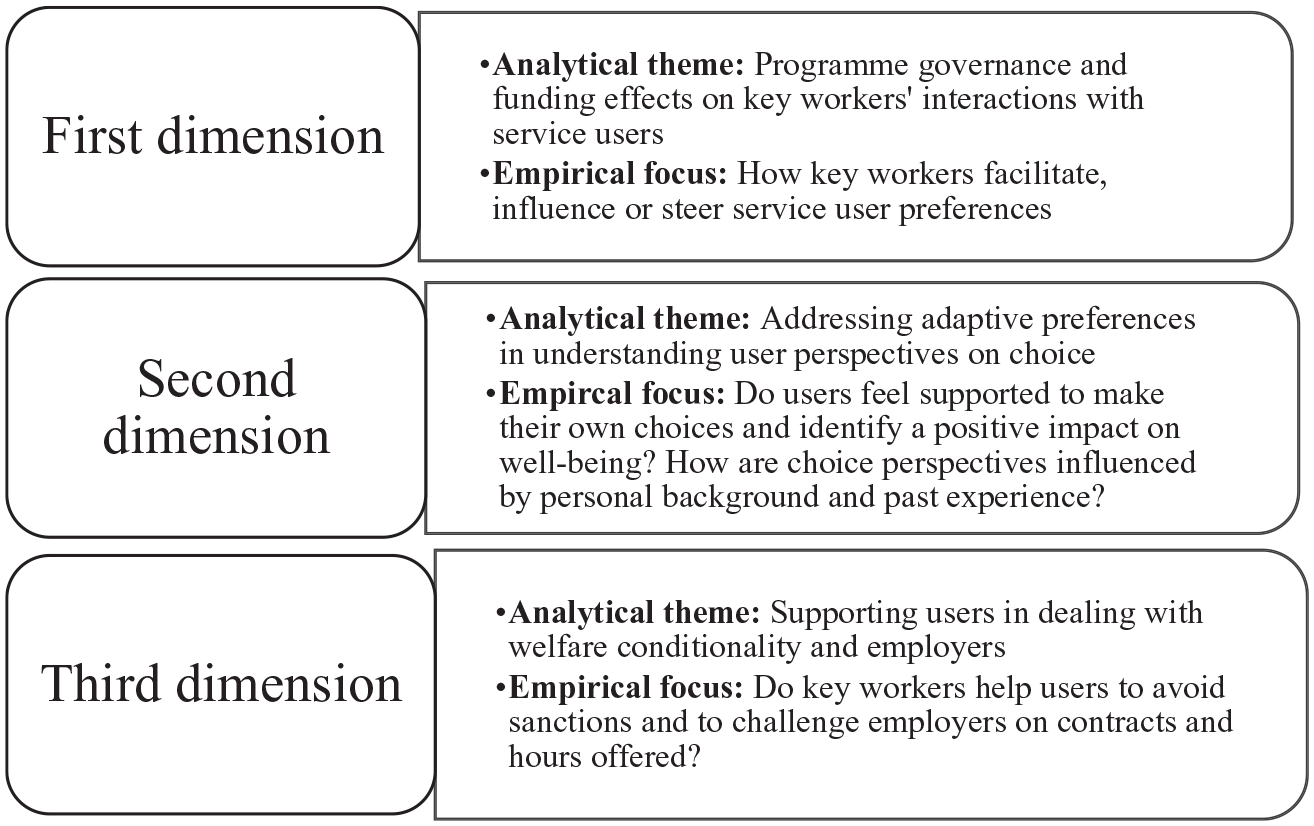
Framework for researching user choices on employability programmes.
The framework has three dimensions, each subdivided into an analytical theme and associated empirical focus. The first addresses how programme funding and governance affect the space for key workers to support user goals and choices. Do key workers feel able to support user choices and how do they work with user preferences? Do they adjust down user preferences towards ‘doable’ jobs, or identify options beyond what a user might think themselves capable of? How do programme workers decide when it is acceptable for a user to resist programme support or refuse a job? The second dimension addresses the problem of adaptive preferences when dealing with users’ accounts of choice. How do users see the choices available to them, the role of key workers in facilitating or constraining their choices, and the impact on their well-being? Do they feel in control of their choices or cajoled towards particular options? How do their life experiences impact their perspectives of choice? The third dimension examines how far programme workers acknowledge external constraints on user choices and try to challenge them. Do key workers help users to manage welfare conditionality and avoid sanctions, and to challenge employers in terms of contracts and hours? The rest of the article uses this framework to analyse ‘Project A’, a TSO-led employability programme operating in a metropolitan area of England.
Research context: Project A
Project A is part of the Building Better Opportunities (BBO) programme in England, which aims to reduce poverty and support social inclusion using matched funding from the National Lottery Community Fund (NLCF) and ESF. BBO funding is channelled to local projects in 38 Local Enterprise Partnership (LEP) areas. Project A supports vulnerable, unemployed adults to enter employment, education/training or job search, with a family-oriented focus on parents, or adults who live with their parents or other family members. A lead voluntary-sector organisation in the county, with long experience of supporting charities and community groups, manages the BBO contract. Project A is one of several of its projects, and is completely separate from the government’s Work and Health programme. Users join Project A voluntarily, although local JC+ are a common source of referrals.
Project A’s mission is to deliver personalised support to users experiencing domestic violence, alcohol/substance dependency, disability, health problems and so forth. Clients are assigned an Employment Support Officer (ESO) to guide them in writing CVs, accessing courses and searching for jobs. Workshops are available on interview techniques, teamworking, mental health and personal finances. Support is provided with the help of various delivery partners. ‘Business in the Community’, a national organisation, engages employers to help with interview technique, CV writing, workplace tours, placements and employment opportunities.
Between January 2017 and March 2021, Project A supported over 600 users, with 11% taking up education or training, 22% obtaining employment or self-employment and 13% commencing job search. No data are available on how long those entering work remain in employment, or the quality of employment destinations beyond the sector entered. Project A is an interesting case for exploring the problem of choice. The user group is broader than Lindsay et al.’s (2018) study of lone parents on the MIW programme in Scotland, being closer to Beck’s (2018) ‘Charity A’. Project A operates in the context of English state-TSO relations.
Research method
The research uses a single case-study involving semi-structured interviews with Project A managers, key workers and users – a method particularly suited to researching contextual conditions shaping social interactions within organisations (Johnson et al., 2021). Our central research questions focused on whether users have real choices within the programme, its impact on their well-being, and their ability to enact those choices given wider constraints. In triangulating different perspectives, we place particular emphasis on user testimony. Users have varied biographies that will impact their choices and preference formation. In illuminating these choices in their own words, we draw on biographical information, including changing life circumstances, interactions with the DWP and employment history, to understand both their preferences and constraints on choice.
The research was jointly funded by Project A’s lead organisation and the researchers’ university. This afforded excellent access to key workers and users who volunteered to be interviewed as well as statistical data already collected by the programme. Regular meetings were held with project managers to discuss progress and any empirical gaps that needed addressing. It was agreed that the researchers would share their findings and that the legitimacy of the research derived from the researchers’ independence.
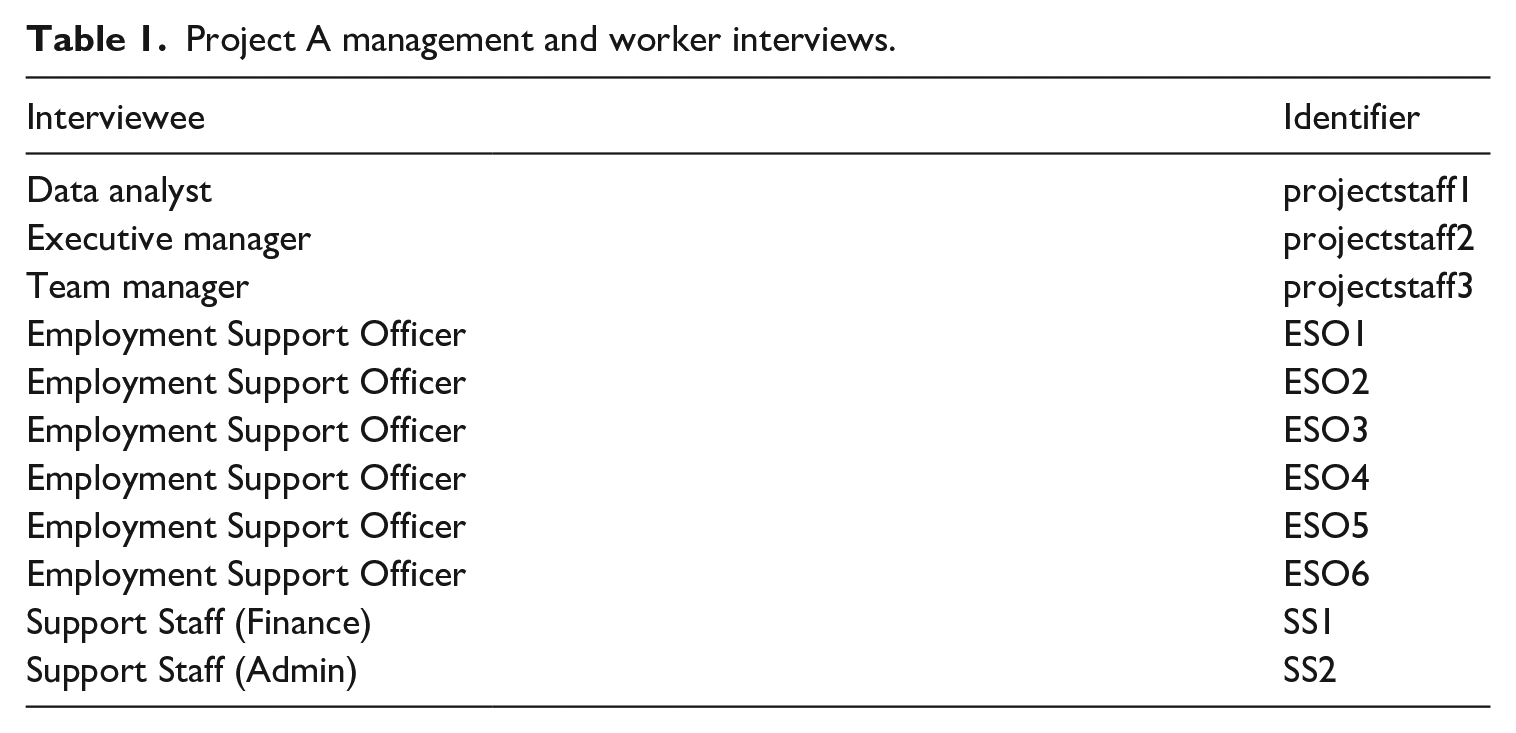
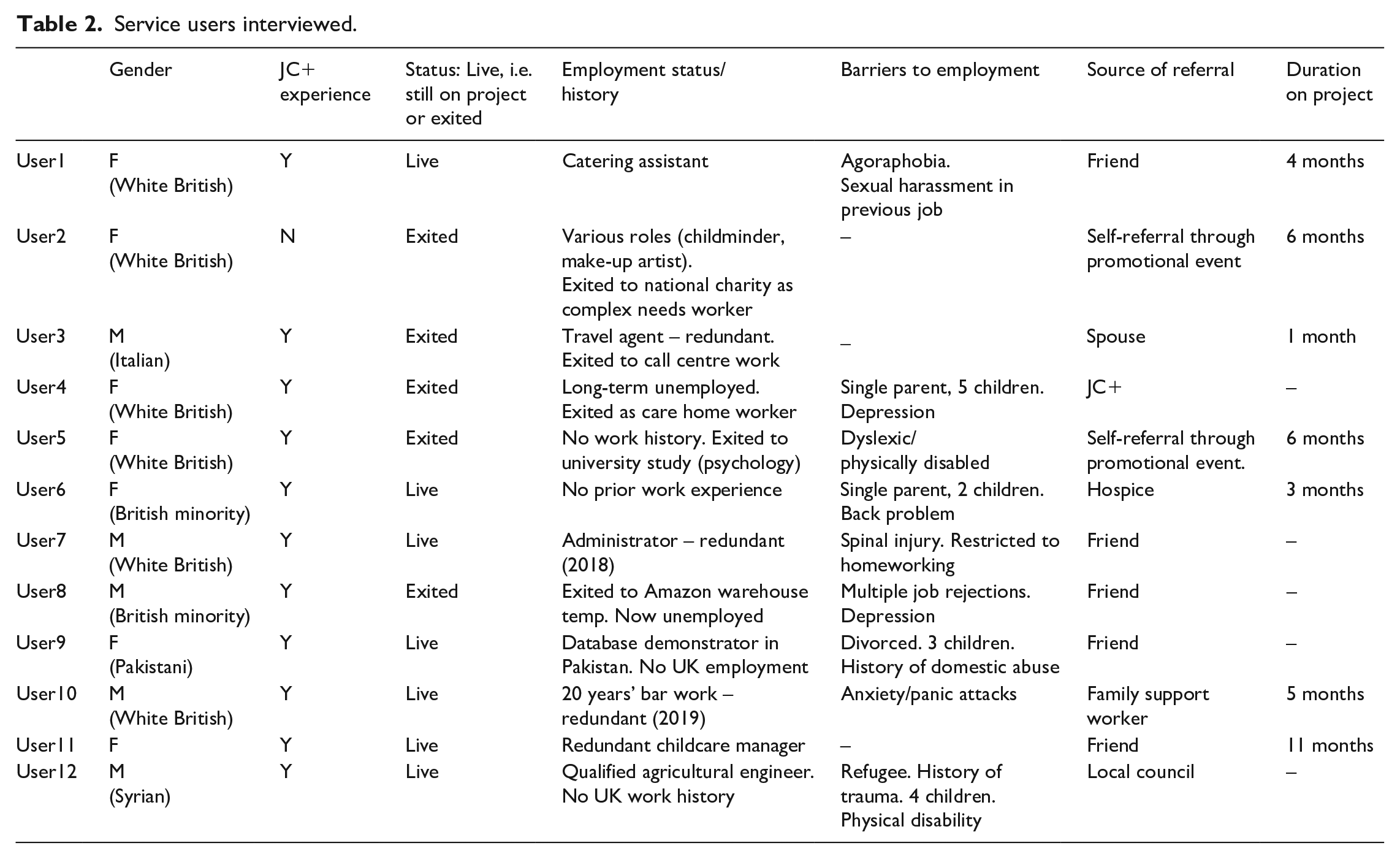
Semi-structured interviews were undertaken, using Microsoft Teams or Zoom, with the project manager, the data impact officer and team leader, all six ESOs, two administrators and 12 service users. Gaining research access to vulnerable, unemployed persons was challenging (Beck, 2018), with assistance sought from ESOs. In accordance with university ethics protocols, participation was based on informed consent. Mindful that ESOs may have encouraged users to participate, the researchers took special care to remind interviewees that it was their choice to participate or not. The researchers emphasised the importance of anonymity when feeding back findings so that interviewees could speak openly about their experiences. In total, 23 interviews were conducted between November 2020 and May 2021 (Tables 1 and 2). With one exception, all managers, team leads, ESOs and support staff were women from different ethnic backgrounds. Seven of the 12 service users were women. Half of the users were from British minority and ethnic backgrounds, and nine had long-term physical and/or mental health conditions (Scholz and Ingold, 2021).
Project A management and worker interviews.
Service users interviewed.
Interviews with project managers and team leaders lasted around one hour, and focused on governance and funding arrangements, relationships with the lead organisation, and performance evaluation. ESOs were asked about pressures to achieve targets, how they worked with individual users, and what they considered to be successful outcomes, with interviews averaging around an hour. Both project managers and ESOs were invited to reflect on labour market issues and implications for user choice. Interviews with users lasted around 30–45 minutes. The discussion covered biographical background, any previous experience of JC+, the relationship with their ESO, participation in workshops, whether they felt in control of their choices, and the benefits and limitations of the programme. A joint interview was also held with two administrative and finance staff, focusing on operational issues. All interviews were audio-recorded and transcribed verbatim. A small sample were initially coded according to key themes derived from the literature and interview proforma. Following discussions among the researchers, some additional codes were added to ensure key data were not missed. Where issues of clarification arose, the researchers asked for additional information from project leads.
Research findings
Using our three-dimensional framework, the research findings are structured as follows: (1) governance, funding and the role of programme workers; (2) users’ perspectives on choice and well-being; and (3) supporting users in dealing with JC+ and employers.
First dimension: Governance, funding and the role of programme workers
In this section, we examine how governance and funding arrangements impacted on the interactions between managers, programme workers and users, whether programme workers felt there was the space to support user choices, and how they worked with user preferences. Management behaviour is shaped by institutional and organisational factors in combination with an organisation’s espoused ethos or mission. The manager of Project A described the ‘lead’ organisation responsible for the BBO contract as an ‘enabling funder’ (projectstaff2). Funding is based on 3-year grants, with performance reviewed against quarterly targets, the main one being the number of users signed up, followed by those entering employment, education/training, or job search. The first year was one of understaffing, with only three ESOs recruited. ESOs referred to a period of ‘micro-management’, with pressure to move users towards a targeted ‘outcome’, which they attributed to Project A’s manager at the time. Following the manager’s replacement, the ESO team was expanded to eight, and a new team leader position created to undertake regular caseload reviews.
Since then, such pressures have significantly decreased. Targets are not based on PBR, though staff recognise their importance for continued funding. Although the participant target has been consistently over-achieved, getting ‘enough referrals’ remains challenging. ESOs, therefore, spend considerable time visiting local libraries, community centres and JC+ offices signing up new users. In terms of job-entry outcomes, the target of five users per ESO each quarter was seen as ‘very easy to meet’, although it had become more challenging during the pandemic (projectstaff1). Significantly, ‘failing to reach the targets never leads to more pressure on ESOs to deliver more; that is not the ethos of the project’ (projectstaff1). Participation on the programme is not time-limited, and users are expected to progress at their own pace, with little evidence of ‘creaming’ or ‘parking’: ‘we don’t screen and . . . say, no, you’re not right for us because you’re going to be too much hard work’ (projectstaff2).
With relatively relaxed targets, ESOs felt they could build personal relationships with users, based on mutual trust, and address individual needs and goals. If a user requires specialist, ‘wrap-around’ support with mental health, for example, helping them to access local services takes priority. ESOs, however, noted problems with cuts to local services and longer waiting times. ESOs are helped by strong team-based assistance and manageable caseloads of typically 15–20 users. The main criticism of funding arrangements was directed at the ESF bureaucracy, including the need to justify every item of expenditure, even down to a bus ticket for a user attending a training event. Although this consumed time that could be better spent working with clients, it did not unduly constrain how ESOs worked with individual users.
ESOs insisted that building trust was the foundation for helping users to progress. Sometimes the first steps in a person’s journey can be outwardly commonplace– for example, helping someone to leave the house or use public transport. A team leader described the qualities required of an ESO as being ‘approachable, understanding, patient . . . a listening ear’ (projectstaff3). ESOs insisted their role was to help users make their own choices at their own pace: ‘it’s all about choice . . . what is your goal, what would you like to achieve in your time?’ (ESO2). ESOs also stressed the benefits of workshops in building confidence, developing communication skills, and helping users to realise that other people faced similar challenges.
How did ESOs see themselves shaping user preferences? ESOs emphasised that they did not want users to take just any job. A few users were said to have unrealistic expectations, seeking ‘dream jobs’ for which they were unqualified and lacked experience. ESOs explained how they would try to open up a conversation about potential jobs or training by linking this to the user’s ‘interest’ or ‘passion’, but without forcing options. A more common problem was users’ low expectations of work and under-appreciation of their own abilities. ESOs were often frustrated when a user took a job out of financial necessity, when they thought they could have had more ambitious goals. Some single mothers were said to lack awareness of skills acquired through past employment or parenting, and were willing to settle for ‘cleaning’ jobs. A team leader (projectstaff3) noted how one of the roles of an ESO was to expand horizons: . . . it’s more around broadening choice . . . if your goal is to be a cleaner, I’m more than happy to support you . . . ticks a box for us, they’re off our caseload . . . But, actually, what value have we added to that person by just taking them from A to B really quickly?
ESOs have to walk a fine line between respecting users’ decisions and encouraging them to consider other options, or step out of their comfort zone. Several spoke about how they would voice concerns if they thought a job was unsuitable: I was helping a participant job search this morning and he was looking at a warehousing job but it was not finishing until 11 o’clock at night and it was a 45-minute walk. For him I said, ‘actually, is this job gonna be right for you?’ [ESO3]
ESOs also use a ‘better-off-in-work calculation’ to assess the impact on family finances of a person taking a job and losing social security payments. Although this does not rule out low-paid work, the aim is to ensure users and their families are at least better off financially by working.
Several ESOs contrasted their approach with that of JC+, describing incidents where users had come under pressure from the job centre to take just any job. One gave the example of a single mum with a doctorate in Mathematics: ‘She was someone . . . with a PhD and the work coach said, “I don’t care, get any job, go be a cleaner”’ (ESO1). By contrast, Project A was about ‘building people up, not knocking them down . . . believing in them’ (ESO2). Choice is more complex where users join the project simply ‘to get their [JC+] work coach off their back’, becoming difficult to engage and doing ‘absolutely nothing’ (projectstaff1). However, managers and ESOs could recall only two cases, and several were critical of the DWP and the stress inflicted on clients by JC+, which undermined the work they were doing with users.
Choice is further complicated as ESOs hold varied perspectives on what is an ‘acceptable’ job and when a user has a right to refuse employment. One had become frustrated when a user had turned down a cleaning job saying she had to do ‘school runs’. The ESO felt ‘she had her mother and her brother who were not working and they could do school runs for her . . . basically it’s her excuse . . . I don’t want to work’ (ESO1). The user had threatened the ESO with physical abuse and was removed from the programme. As researchers we have to question the presentation of the user’s motives, and whether ESOs should be making such judgements.
In terms of process well-being, ESOs spoke about their satisfaction from seeing an individual grow in confidence and self-belief, and placed great store on so-called ‘soft’ outcomes, even if employment did not materialise. One ESO summarised the general view: For us, a good outcome is increasing somebody’s confidence, getting into training as well as to gain new skills, getting out and meeting new people . . . our project is so much more than just getting people into work. (ESO3)
To summarise, governance and funding arrangements meant programme workers felt that they could support users to work towards their own goals at their own pace. This approach was seen to deliver positive benefits for user well-being, beyond narrow job outcomes. Next, we turn to the second dimension of our research framework, namely user perspectives.
Second dimension: User perspectives on choice and well-being
In this section, we explore users’ perspectives on their interactions with ESOs, whether they felt in control of their choices, and links to well-being. We draw on users’ personal background information to better understand preference formation. Users were universally positive about the support they received from ESOs. Typical comments included: ‘really good . . . professional . . . very patient’ (user6); ‘friendly, unjudgmental people that genuinely want to help you’ (user2); ‘almost like . . . chatting to a friend’ (user10). ESOs were often seen to go out of their way to support them. One user, for example, explained how their ESO had helped her to claim social security payments, coming ‘to the house when I couldn’t get out, so yeah, she’s amazing’ (user4). Users valued the continuity of having a designated ESO who knew them personally and did not give up on them.
Some gave examples of how their ESO had helped them to access training, such as courses in Microsoft Excel or basic computing. However, persuading users to consider other formal education and training courses was seen as challenging, and most support focused on interview techniques, job search, confidence building and communication skills (projectstaff1). As well as the support received from ESOs, users valued group-based activities that provided advice with interview technique, CV writing, mental health and money matters. Many commented how these ‘friendly’ and ‘informative’ workshops helped to overcome feelings of isolation: ‘It helps me a lot . . . we’re not the only one struggling, there are so many other people in the same position (user6).’ Users also welcomed help with crèche facilities, travel costs to attend sessions and purchasing uniforms needed for work.
Crucially, all users spoke about how they felt supported to make their own choices, whether it was education and training, job search or employment options: Everything is your own choice. They will help you and support you to where you want to go . . . they’re not pushing you into anything. (user7) [They] weren’t forcing me to do anything because they said to me it’s up to you if you want to do it . . . we’ll be happy to help you. (user8)
Users also provided examples of how their ESO had dissuaded them from taking work below their abilities. User2 had been tempted to take a part-time job for which she was ‘over-qualified’ as it was close to where she lived and her children were of an age that allowed her to contemplate a return to work. Her ESO had questioned whether she would be happy in the job, and had suggested a work placement with a charity counselling young people that would allow her to use counselling skills gained in previous employment: ‘It was very much in my control . . . So, I decided to give it a go and yeah . . . I found a job I absolutely love (user2).’
Many users drew on their experiences with JC+ to identify how differently they felt treated by Project A. One described how they felt like ‘a person’, whereas JC+ made them feel like ‘a number’ (user7). Others compared JC+ to a ‘conveyor belt’ (user1) that was ‘just there to tell you off and penalise you’ (user4). One user with chronic anxiety recalled how they had to concentrate on their breathing and ‘try not to panic’ every time they had attended JC+ (user10). Another talked about the lack of understanding that she could only work school hours, and felt she had to justify to her JC+ work coach why she had five children (user4). Several described feelings of shame: ‘you sleep with guilt every night that today you’re on benefit’ (user9). For many users, their overwhelming experience of JC+ left them feeling de-humanised, whereas Project A was seen to build self-esteem: I felt humiliated . . . [JC+] is a horrible, horrible experience . . . Whereas with [Project A], there’s absolutely nothing like that whatsoever. It’s all this is what we can suggest, this is what we can help with. It’s up to you . . . what you get is self-esteem and confidence and belief in yourself, and they are really, really important things. (user1)
Users also spoke about how being supported to make their own choices had given them the self-belief to re-enter work, start job search or take up education or training. Having experienced bullying and sexual harassment in her previous employment, user1 had found the confidence to undertake voluntary work, supporting witnesses at the local Crown Court. She had also set up a self-help group for people with mental health problems, and was now looking for part-time or voluntary work where she could ‘go on helping people’.
A single mother who had been unemployed for six years started at Project A ‘full of fear’ and ‘wouldn’t have dared go for an interview’ (user4). The project had broken down her barriers ‘one by one’, helping her to realise that she had valuable skills from previous experience as a sports coach until she felt ‘ready to go back to work’. She had taken a job in a care home on a 24 hours-a-week contract, working nights two days a week, while her 17-year-old daughter minded her younger children: I didn’t feel pushed at all by them. I didn’t think I would like caring for elderly people but I actually really enjoy it . . . they didn’t even mention care work, it was me that chose care work. (user4)
Her mental health had improved, and she was now able to ‘socialise a little bit and not be stuck at home’. She felt she had ‘found herself’ and was ‘part of society again’.
Others had gained the confidence to re-engage with education. One user had dyslexia and a physical disability, describing herself as ‘shy and timid’ (user5). The workshops had helped her to realise she was ‘good working with other people’, giving her the confidence to start a Psychology degree. For others, Project A had empowered them to believe they did not need to simply apply for just any job. A single mother from Pakistan with three children and a history of domestic abuse recalled how the project had given her back ‘a voice’: I don’t have to just throw myself out to any job . . . to be confident in yourself is very, very important . . . now if I go in an interview I won’t cry, I won’t beg for a job, you know I learned that and that was very important for me. (user9)
She was now a volunteer with a programme for victims of domestic abuse and was looking for a job that built on her previous experience as a database administrator in Pakistan.
There is no denying, however, that many users had very restricted job opportunities. User6, a foreign-born immigrant, had spent her life caring for four children, two of whom were disabled and now deceased. With limited English and no previous work experience, getting into work was ‘not a little thing, it’s really, really big’. She valued the ‘patient’ support and help with learning basic digital skills but emphasised that it was ‘going to take time’. Her ‘dream’ was to become a driving instructor and ‘be an example for my children’.
Others had low expectations of work. Before joining the project, user8 had been depressed, staying in his room, and described how hard it was ‘to get into any employment’. Project A had built his confidence, especially when speaking in a group. Through his own job search, he had found a temporary job in an Amazon warehouse, and was now hoping to get something more ‘stable’ in retail or warehouse work. His aim was to ‘keep the employers happy’ because ‘you never know, you could get a permanent job’. Another user had spent 20 years in bar work until his nerves were ‘absolutely shot’ and was now seeking a job in catering. Although his employment options were limited, the project had been ‘a real confidence booster’ and by ‘build[ing] me up . . . [had] done a world of wonders’ (user10).
Overall, users were extremely positive about the support they received. They felt able to make their own choices and described positive effects on their well-being. Several users had very restricted employment possibilities, however, whereas some still experienced pressure from JC+. The next section explores whether project workers recognised such constraints and if there was any attempt to empower users to challenge employers around contracts and hours.
Third dimension: Supporting users in dealing with JC+ and employers
Project A staff recognised that many users are under pressure from the welfare system and confront structural constraints on their employment options. Some ESOs came from similar social backgrounds and had experiences in common with users, such as being a past claimant of social security payments and/or having to fit work around caring responsibilities. ESOs will often help users who are unfamiliar with the social security system in their dealings with the DWP. One gave the example of a single mum who lacked confidence in speaking English. She was being pressurised by JC+ about her social security claim and was frightened of getting sanctioned: I said I’ll write down all the things you’re doing with us . . . you need to tell [JC+] that you’ve done all the search, but nothing’s come up but you’re also going to be doing x, y, z . . . you’re trying to help them understand . . . how to navigate a system. (ESO2)
Another described how his ESO had helped him respond to pressures from JC+ to take a job in food processing: ‘[My ESO] gave me a letter to give to job centre . . . and told me, just give them my phone number and my name and if they’ve got any questions they can ring me’ (user8). For many users, Project A was a haven that allowed them to keep JC+ at bay, providing some respite from its pressures. User9 felt that without the project’s support, and had she continued to face pressure from JC+, she ‘could easily have ended up in a mental hospital’.
ESOs acknowledged, however, that most users entering employment were taking entry-level positions in retail, care work and warehousing, whether through the programme or, more typically, their own job search. They also recognised constraints on users’ choices coming from employers. Single parents with young children, looking for school-based hours, were seen as constrained by employers’ inflexibility around hours and work scheduling: It’s really hard for us to actually find something that is from 9.30 to 2.00 or 9.00 to 2.00, and again it’s considering other factors such as is this person able to drive to get to work or do they have to get the bus? How long is that going to take them? And then . . . the time frame narrows down. (ESO4)
Reflecting the financial pressures on users and the problem of adaptive preferences, most users were felt to have low expectations of what constitutes a ‘good’ job: ‘for a lot of people a job for them is like “wow, I’ve got a job!”’ (ESO3). It was recognised that users’ preferences and understandings of choice were impacted by many factors: social deprivation, financial pressures, the experience of long-term unemployment, complex needs, and what was deemed possible in the labour market. Project staff also felt many users wanted to work because they believed they were not setting a good example to their children by being ‘on benefits’. This was corroborated by several interviews with users: ‘my Mummy is learning and she will get a job that she likes . . . it’s hitting my dignity, not working’ (user9).
Although project staff acknowledged the limited employment options available for many users, there was an acceptance that the project had to work within existing labour market constraints: ‘it’s about being realistic, sad, you know, with what is available’ (projectstaff3). With many users taking up jobs without talking with their ESO, it was often a case of ‘we worry about [job quality] as much as the participant will let us’ (projectstaff1). It was noted earlier how ESOs will try to expand employment options by helping users to recognise the skills they have acquired and what they might be capable of. User4, who had found a job she ‘loved’ in elderly care, explained how her ESO had initially advised her against enrolling as ‘bank staff’ (i.e. agency worker) without any guaranteed hours. ESOs encouraged users to think carefully about whether a job was the right option, both financially and in terms of personal well-being. Significantly, however, this did not extend to users challenging employers around hours and work schedules. Project managers did not see this as part of Project A’s remit and were concerned it might close down employment options.
Discussion
The article began by highlighting the challenges that researchers face when examining the choices available to long-term unemployed adults on TSO-led employability programmes. We have argued for a balanced assessment of choice possibilities across different programmes that avoids an unhelpful duality of ‘true’ versus ‘constrained/no’ choice associated with the CA. Drawing on Carter and Whitworth’s (2017) concept of ‘process well-being’, we developed a three-dimensional analytical framework for furthering empirical research on the problem of choice. How, then, does Project A measure up against our framework?
First, reflecting the importance of governance and funding arrangements (Lindsay et al., 2021; Johnson et al., 2021), Project A benefited from long-term funding that was not based on payments-by-results, with relaxed targets that allowed ESOs to work with users at their own pace towards their own goals. Differences between the early and later phases of the programme are, nevertheless, striking, and our study suggests that managerial style and leadership matter in creating the organisational culture for TSO workers to develop personalised support.
Given these arrangements, how did ESOs work with users and their preferences? Although funding was not geared to fast job entry, support focused on CV writing, interview technique and confidence building. ESOs were frustrated when users accepted just any job and sought to raise aspirations by encouraging them to re-evaluate their skills and consider how employment choices could be extended through education and training. However, persuading users with low confidence to undertake college-based training proved challenging, qualifying Johnson et al.’s (2021: 3) focus on the appeal of ‘familiar’ employability interventions for key workers.
The research found examples of ESOs steering user preferences downwards towards more ‘doable’ jobs (Beck, 2018), while embracing beliefs in user-centredness. Our research underlines the complexity and variation in ESO responses. ESOs have different backgrounds, experiences and values (Zacka, 2017), and can hold different views of what is an ‘acceptable’ job and when users have the right to refuse employment. This can lead to ‘hierarchies of deservingness’ in terms of who is deemed to deserve support (Koch 2021: 255), depending on who is felt to be really trying to find work. It is possible that other researchers examining TSO-led programmes may also find key workers raising user aspirations, alongside examples of others steering user preferences downwards towards more ‘realistic’ jobs within the same programme, or even in respect of a single key worker working with different users. The research has practical implications for how TSOs committed to user choice might foster more consistent approaches among key workers, including through formal training and workshops.
The second dimension of our analytical framework emphasises the critical importance of engaging with users’ preference formation, their perspectives on choice, and links between choice and well-being. The study found that ESOs’ commitment to supporting user choices was strongly corroborated by users, and shows how users’ past experience informs their views on choice and the opportunities available to them. Are such accounts simply a reflection of adaptive preferences? Although many users frustrate ESOs by quitting the programme to take almost any job, with the help of Project A some clearly found work they valued or ‘loved’. For some parents getting ‘off benefits’ was about setting an example for their children. This has to be seen in the context of how claimants internalise the ‘shame’ of being unemployed in a society where politicians stigmatise those ‘on benefits’ (Redman, 2021; Sage, 2019). Moreover, for those with the most complex needs, work options remained very limited (Beck, 2018).
That said, consideration must be given to the stabilising effect of Project A for those experiencing long-term unemployment (Scholz and Ingold, 2021: 1622), with users expressing process benefits in terms self-confidence, personal esteem and mental health (Carter and Whitworth, 2017). Many users had little difficulty contrasting their experience with the strain inflicted on them by JC+. In effect, what users were saying is that being treated as an individual, being listened to, and feeling someone is there to support you in achieving your own choices and goals, makes a real difference. Given the consistency of such accounts, it would seem remiss to discount such testimony as unreal, reflecting some form of illusory choice reasoning, just as it would be to ignore constraints on choice. Even if choices are objectively constrained, subjective feelings of being supported to make your own choices matter for well-being.
The third dimension in our analytical framework asks whether programme workers acknowledge external constraints on user choices and try to challenge them. The study found that ESOs help users to navigate their relationships with the DWP to access social security payments, or keep JC+ at bay, which again contributed to user well-being. ESOs recognised constraints on user choice presented by some employers’ inflexibility around hours and work scheduling, particularly for those with caring responsibilities. Although some sought to challenge employment choices where they felt users could do better for themselves, there was no evidence they encouraged users to challenge employers around hours or work scheduling. This contrasts with Lindsay et al.’s (2021) study of the MIW programme. The difference might reflect Project A’s user group, many of whom had complex needs and limited employment options.
Conclusion
Our study underlies the complexity of researching TSOs’ role in delivering employability support, and the value of integrating insights from different analytical perspectives when seeking a balanced assessment of whether users can exercise ‘real’ choice. The research found that users on Project A felt supported to make their own choices and gained tangible benefits in terms of ‘process well-being’ (Carter and Whitworth, 2017). This article makes three substantive contributions. The first concerns the analytical and operational value of the CA; the second is to provide an analytical framework for empirical research on the problem of choice, and the third addresses the space for local innovation, and the ability of TSOs to withstand ‘mission drift’ and prefigure better alternatives to workfare.
Despite the important insights offered by the CA, it sets demanding conditions for ‘real’ choice such that any employability programme must fall short unless there is radical systemic reform, including removing the obligation to undertake paid work. Coupled with the impact of deprivation on users’ choice reasoning, there is a risk of sliding into structural determinism if it only allows for ‘negative choices, adaptive preferences and obligatory exercising of choice’, given the wider UK context of workfare and a weakly-regulated labour market (Beck, 2018: 16). The choices potentially available to users on TSO programmes are discounted a priori with an assumption that agentic and individually valued decision making is rendered virtually impossible. The emphasis on theoretical deduction risks leaving the assessment of choice in the eye of the researcher, and may overlook varying degrees of choice available to users on different programmes. This does not mean rejecting the CA as a tool for policy critique, but it does behove researchers to give adequate weight to users’ experiences and testimony.
The second major contribution is the development of an analytical framework for researching the problem of choice that bridges key issues raised by commentators adopting a WW and CA. Drawing on Carter and Whitworth’s (2017) concept of ‘process well-being’, we demonstrated, through empirical research, the utility of such a framework for researching choice possibilities and constraints. Our study of Project A shows how respecting users’ choices keys into user well-being. Furthermore, by extending the concept of process well-being to third-sector programmes, it highlights how they can play an important role in helping to insulate users from the pressures of workfare. Such insulation is, however, fragile, constrained and impermanent; indeed, some Project A users have recently experienced pressure to join the government’s new Restart programme or lose social security payments. 2
A third contribution concerns the space for local experimentation, and for TSOs to avoid ‘mission drift’ (Damm, 2012). Even in the UK, it is important not to squeeze down space for more socially inclusive alternatives too far. Drawing on the concept of ‘policy closure’ (Fuertes and Lindsay, 2016: 538), Johnson et al. (2021) argue that neo-liberal workfare, by treating unemployment as a supply-side problem of individual deficits, conditions support workers’ approaches, and rules out almost any space for real alternatives. This is perhaps too stark a conclusion given that it derives from a government-funded programme involving PBR. Project A – a non-mandatory project, commissioned through a community-focused TSO, with funding decoupled from the inflexibilities of PBR, signals the presence of a better, if imperfect, option, even in the face of systemic constraints. Key worker ‘role tensions’ existed, but were less pronounced than in Johnson et al.’s (2021) study. ESOs could work with users at their own pace towards their own goals and were able to avoid ‘prioritising and de-prioritising’ users according to assessments of ‘job readiness’ (Johnson et al., 2021: 21).
Certainly, Project A does not reach the scale or heights of the MIW programme in Scotland (Lindsay et al., 2018, 2021). There are, however, certain parallels, suggesting MIW is not a Scottish anomaly and that similar TSO-led programmes can be found elsewhere in the UK. Our research suggests that TSOs can mitigate the risk of ‘mission drift’ by seeking governance and funding models consistent with their civil society and community origins, rather than those with a quasi-market, contractual agenda that crowd out their social functions.
Although the focus of the article is on the UK geographically, its analytical and empirical contributions have international resonance for researchers evaluating the role of TSOs in employability support at a time of creeping workfare (Bontenbal and Lillie, 2020; Lindberg et al., 2022). In allowing space for TSOs to support user choices, it could be argued that there is a grave danger of letting UK policymakers off the hook for failing to address systemic problems of poor job quality and coercive welfare policy. In other words, we lose focus on the ‘“bad” agency’ and choices of the powerful (Wright, 2012: 325). However, it is possible to argue that space exists for TSOs to support user choices, while still insisting on the need to tackle these wider policy problems. Indeed, to do so not only shines a light on policy failings but also underlines the important role of the third sector in any viable alternative.
Scaling up such approaches in the UK would not only require a policy volte-face away from ‘work-first’ activation, but also significant state investment in third-sector funding. Without such political will, much hinges on whether local TSO-led initiatives can go it alone. It is difficult to be optimistic given how the state has centralised control by ‘marketising’ employment services, bringing in large private providers and cutting local authority budgets (for a contrast with ‘insertion services’ in Paris, see Schulte et al., 2018). The result is that there is little on offer beyond JC+ and private contractors, with local alternatives that swim ‘against the tide’ of UK workfare policy (Johnson et al., 2021) remaining outliers. Yet, they exist, and it is vital that research brings them into public debate.
Research limitations and future research
Our study inevitably has certain limitations. Like Lindsay et al.’s (2018, 2021) research, it relies on those who volunteered to be interviewed and who may have had more positive experiences. It might also be argued that it is difficult to get at the effects of multiple deprivation on users’ choice reasoning without a ‘life-course’ approach involving in-depth biographical narratives that go deeper into understanding ‘the person in the changing situation’ (Hansen and Gubrium, 2021). Such research would be extremely valuable, but can be challenging with unemployed and vulnerable persons. In illuminating users’ accounts of choice, our study only takes us so far in this direction. A further limitation is that it relies on a single case study, and care is needed to avoid generalisation to other TSO-led programmes.
How, then, might research be taken forward using our analytical framework? Qualitative studies might apply our framework to other TSO-led programmes in the ‘devolved UK’, helping to identify the conditions which facilitate, or constrain, choice. As in Lindsay et al.’s (2018, 2021) research, most Project A users taking up employment were entering low-wage jobs. Research examining the jobs users enter, what they feel about them, and the impact on their lives could lead to fresh insights. Comparing programmes in different local labour markets would also be interesting in terms of the constraints on users’ employment choices (Briken and Taylor, 2018). International comparative research on the role of TSOs in providing employment support is limited, and would be particularly helpful in exploring the conditions that enable TSOs to support the choices of unemployed and vulnerable persons. This is a challenging but vitally important research agenda, and it is hoped that this article can help to inform future studies.
Footnotes
Acknowledgements
The authors would like to thank the editor, Melanie Simms, and the three anonymous reviewers for their helpful comments and suggestions.
Funding
The authors disclosed receipt of the following financial support for the research, authorship and/or publication of this article. The research was jointly funded by the lead voluntary-sector organisation and De Montfort University.
