




Abstract
Women remain poorly represented in the highest positions in academia, despite their increasing participation. This article seeks to understand how women who have reached senior occupational positions in Higher Education Institutions have navigated their organisational and disciplinary settings. In the process we explore how experiences compare across male and female-dominated spaces, integrating field theory with Acker’s work on ‘gendered organisations’ to develop the idea of academic disciplines as ‘gendered spaces’. Empirically we draw upon a qualitative study of women professors working across science, technology, engineering, maths and medicine (STEMM) and non-STEMM disciplines in a large research-intensive university in the UK. Utilising Bourdieu’s concept of ‘the game’, we show how they navigate the academic game within the context of differing ‘gendered spaces’; complicit in the game yet recognising it as unfair, and thus (inadvertently) reproducing gendered structures and practices.
Introduction
The position of women in education has markedly improved since the 1970s and yet employment remains segregated by gender. While this is particularly pronounced in science, technology, engineering, mathematics and medicine (STEMM) subjects, even in non-STEMM disciplines where women are often numerically dominant, such as education, arts, humanities and social sciences, they remain concentrated at the lower levels of the academic hierarchy. The majority (78%) of those who hold the rank of full professor are men, despite women constituting 44.6% of the UK academic workforce (Equality Challenge Unit, 2016).
Explanations for the under-representation of women in academic careers tend to mirror those identified in other occupations, and are either structurally or individualistically oriented (Bilimoria et al., 2014; White and Bagihole, 2013). Existing research concentrates on STEMM disciplines and focuses on why women leave academia, or fail to advance their careers, with an emphasis on the barriers encountered. Less is known about how the minority of women who are in full professorial roles (hereafter shortened to professor) have succeeded (Morley, 2013). Furthermore, there has been little comparison of the experiences of women across disciplines. The implicit assumption is that women are ‘better served’ in non-STEMM disciplines, where they tend to make up more of the workforce (see Boyle et al., 2015: 185). This, however, assumes that Higher Education Institutions (HEIs) are inherently ‘gender neutral’ and thus may mask the ways in which gender influences the experiences of women. In this article, we ask two questions: how have women at professorial level navigated their organisational and disciplinary settings? And how do their experiences compare in different gendered contexts?
In considering these questions, we draw upon Acker’s (1990) theorising of ‘gendered’ organisations to frame our analysis, conceptualising gender as social practice, dynamically situated ‘in various structural and cultural academic contexts’ (van den Brink and Benschop, 2012: 72). The primary theoretical contribution is to develop the geographical concept of ‘gendered spaces’ (Spain, 1992). To do so, Bourdieu’s (1993) and Fligstein and McAdam’s (2012) theory of ‘fields’ is utilised and, following Kalfa et al. (2018), Bourdieu’s metaphor of ‘the game’ is adopted to present a more nuanced understanding of gendered organisations. Interviews were conducted with 31 women professors employed in a large research-intensive HEI. The analysis reveals that in their navigation of academic culture, interviewees were simultaneously complicit in ‘the game’ and yet also critical of it. While interviewees’ perceptions of the rules of the game were broadly similar, across disciplines there were subtle differences according to whether these disciplines, or ‘gendered spaces’, were male or female-dominated.
The article is organised as follows: after reviewing the key literature on the under-representation of women at senior academic levels in general, and research on academic STEMM professions in particular, the conceptualisation of ‘gendered spaces’ and the research methodology is explained. The findings are then presented and discussed within the context of ‘gendered spaces’ and the wider literature on gender and equality in academia. The article begins with a snapshot of the current gender make up of academia and academic disciplines and the relevant policy context.
Women’s representation in academia: A snapshot
While women comprised 57.5% of UK graduates and 44.6% of the full-time academic workforce in 2016, academia remains horizontally and vertically segregated by gender, with women still under-represented in many STEMM disciplines, as well as in senior academic posts. Comparative data in UK HEIs, the EU-28, the USA and Australia are presented in Table 1. Overall, women fare slightly better in the USA, suggesting the route to gender equality is not simply about introducing family-friendly policies, given the USA ‘languishes near the bottom of parental pay and leave leagues’ (Urry, 2015: 472).
Percentage of women as professors and heads of institutions/college presidents, 2015–16.
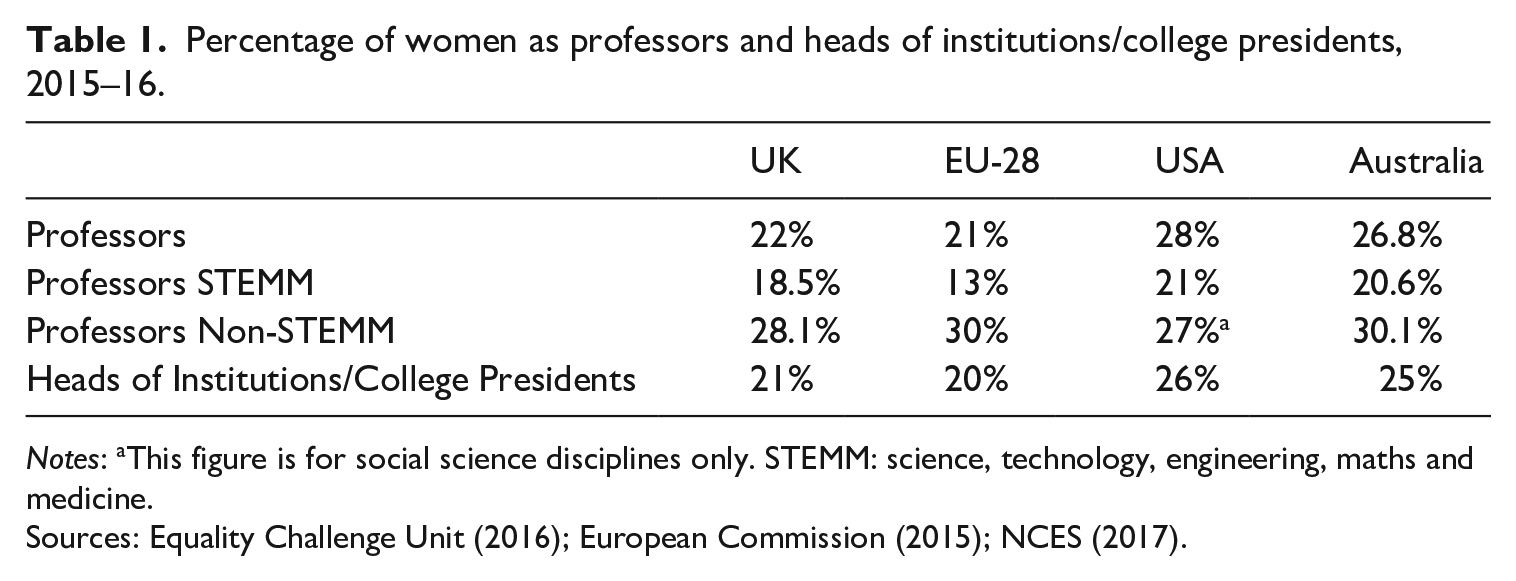
Notes: aThis figure is for social science disciplines only. STEMM: science, technology, engineering, maths and medicine.
In 2016, just 21% of Vice Chancellors of UK universities were women, with very few senior academic women from a minority ethnic background (Equality Challenge Unit, 2016). While this is a marked improvement on 2013, when women constituted just 14.2% of those at the top, the general pace of change is nonetheless described as ‘uneven’ (Morley, 2013).
Academia also remains horizontally segregated. In STEMM disciplines, women constitute 47.1% of academic staff, but just 18.5% of professors. In non-STEMM subjects, women constitute 49.0% of academic staff and 28.1% of professorial level staff (Equality Challenge Unit, 2016). However, as shown in Table 2, this is not simply a matter of differences between STEMM and non-STEMM disciplines. In a small number of STEMM subjects (such as nursing), women constitute a majority of academic staff, while in some non-STEMM subjects (such as economics), men constitute the majority.
Academic staff subject areas by gender in the UK.
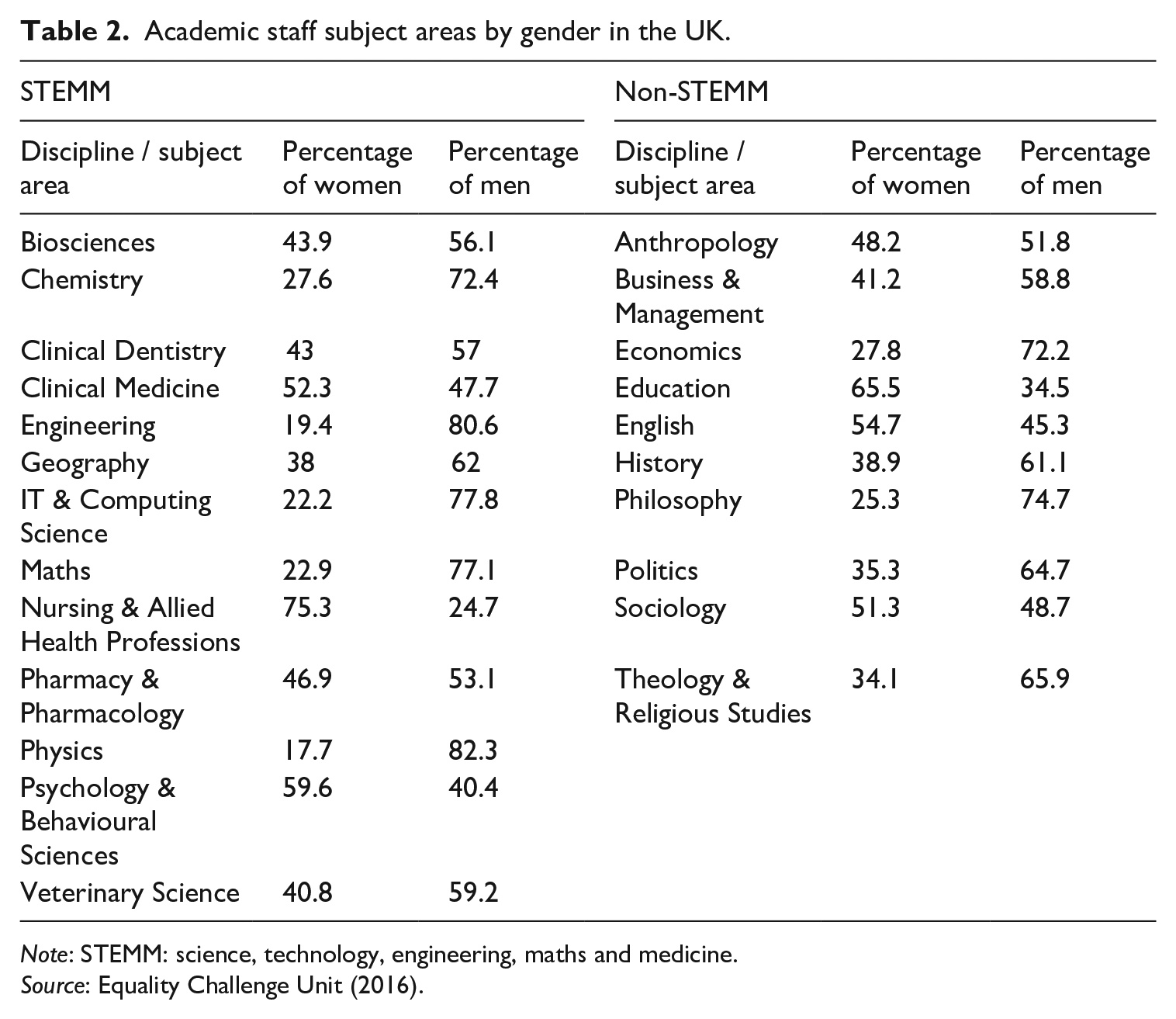
Note: STEMM: science, technology, engineering, maths and medicine.
Source: Equality Challenge Unit (2016).
Gender equality policy: Athena SWAN
To address occupational segregation by gender there has been a particular focus on interventions to encourage more women to study STEMM subjects, and to support women who pursue STEMM careers (Billimoria et al., 2014). More widely, efforts are being made to increase the presence of women in senior university positions and in their governing bodies (Morley, 2013), and in research and teaching decision-making bodies in the sector.
A significant innovation in the UK is the Athena SWAN Charter. Launched in 2005, this Charter initially aimed to improve women’s academic STEMM careers and was run by the Equality Challenge Unit until 2018, when responsibility passed to Advance HE. To gain accreditation, a university, research institute or department within a university must accept and promote the Athena SWAN principles, undertake an audit and develop a gender equality action plan. Bronze, Silver and Gold levels of attainment are awarded. In 2015, the Athena SWAN charter was expanded to encompass all academic disciplines.
Athena SWAN has secured near universal membership across the UK, with 143 member universities in 2018. 1 Evaluation has suggested a positive correlation between (women-friendly) organisational cultures and attitudes in university departments that sign up to the Athena SWAN scheme (Munir et al., 2014). However, it is not clear whether Athena SWAN accreditation is a cause, or consequence, of such changes (Gregory-Smith, 2018). So why, despite an improving policy context, do gender inequalities in UK academia persist?
Gender segregation in academic careers: Theoretical explanations
In line with research on occupational segregation by gender more widely (Fagan and Gonzalez Menendez, 2012), explanations for the vertical segregation characterising women’s academic careers are offered at the level of the individual, family, education system, the workplace and wider society (Bilimoria et al., 2014). Over time, there has been a shift in focus from ‘fixing the women’ (Sandberg, 2013) to ‘fixing the institutions’ in order to reduce gender inequalities. Feminist theorists such as Acker (1990) have argued that organisational structures and cultures are organised in gendered ways, revealing not only their gendered substructure, but the ways in which gender divisions and practices are continually being (re-)created and (re-)enacted in organisations. Acker (1990) originally identified five processes that reproduce gender in organisations: the division of labour; cultural symbols; workplace interactions; individual identities; and organisational logics (e.g. rules, procedures and hierarchies; job descriptions; pay scales; and job evaluations). She stressed the particular power of ‘gendered’ organisations is that they often maintain a neutral facade, making them difficult to challenge.
Policy and practice, however, remain dominated by individualistic explanations. In particular, there is a reliance on the ‘pipeline’ metaphor, which Branch (2016) argues conveys a misleading image of a smooth pathway once ‘leaks’ are fixed. This neglects gender differences in the constraints and obstacles that are encountered along the academic ‘road’ (Branch, 2016), and overlooks the agency of both men and women. Two themes emerge in the literature for the persistence of gender segregation in academic careers: the first is the construction and expectations of academic careers around the notion of the ideal, disembodied worker (Acker, 1990), while the second relates to ‘gendered’ academic culture.
Traditional notions of the academic career
Academia is constructed as an all-consuming, ‘carefree zone’ based on the assumption that academics have no commitments other than to ‘the job’ (Morley, 2013; White and Bagihole, 2013). The typical academic career entails long hours, international travel and networking, and is based on a competitive career path. The promotions process usually requires a strong track record of both research funding and publications (Bilimoria et al., 2014; Howe-Walsh and Turnball, 2016). Competitive pressures have increased as the sector has ‘internationalised’. Fixed-term and insecure contracts are increasingly prevalent, the volume of research outputs has proliferated, and associated citation and other performance metrics are increasingly used to assess individual and institutional performance in a manner that has become deeply embedded in university structures and cultures (Kalfa et al., 2018).
While promotion metrics focusing on research funding and publications are ostensibly meritocratic and gender-neutral, research is prioritised over teaching and administrative responsibilities, with women generally doing more of the latter. Research funding success rates for men are higher than for women in 70% of countries for which data are available in the EU-28 (European Commission, 2016). Although gender disparities regarding publication outputs are declining, subtle differences persist, with men dominating the more prestigious author positions (White, 2014).
The academic career thus remains predicated upon traditional expectations of the ideal ‘disembodied’ (male) worker (Acker, 1990). While in principle HEIs offer part-time working, take-up remains low among women (and men) in academic positions since it is viewed as compromising promotion chances (Teasdale, 2013). Further, part-time working tends only to partially reduce teaching loads, with expectations that the same amount of research and publications will be produced (Riordan, 2011). Women, particularly at the early stages of their career, often adopt ‘careerist femininity’, which is characterised by a ‘strong career commitment, [and] is prioritised over non-work relationship concerns’ (O’Connor et al., 2018: 318) cautions, however, of relying on parenthood and caring responsibilities alone to fully explain women’s under-representation at senior academic levels, since full-time women with children are generally no worse off than women without children. Both groups lag behind men.
Gendered academic cultures
Following Acker’s (1990) seminal work on ‘gendered’ organisations and ideal ‘disembodied’ workers, there has been growing recognition that deeply embedded gendered expectations pervade organisational structures and cultures, with gender performances created and re-created in the workplace and impacting on women’s and men’s workplace experiences.
Similar to other occupational areas, leadership in academia and perceptions of academics – especially those in the ‘hard’ sciences (i.e. physics, chemistry and biology), along with philosophers and economists – tend to be couched in stereotypically masculine terms such as rationality and objectivity, concerned with abstractions over the interpersonal, and success supposedly determined on skill and merit (Cain and Leahey, 2014; White, 2014). This limits the ways in which academics construct their professional identities, interact with co-workers and evaluate each other (Rhoton, 2011), and how they perform leadership. Women academic leaders may be subjected to particular scrutiny, finding themselves criticised for their transformational styles of leadership and demonstrating so-called softer skills (White and Bagihole, 2013). Yet, adopting a ‘male’ style of leadership and the role incongruity this engenders for women also attracts criticism from both men and other women (Morley, 2013).
Women’s absence from senior positions has also been linked to their lack of knowledge of the ‘rules of the game’. Drawing on Bourdieu’s metaphor, Kalfa et al. (2018) argue that academics are invested in the ‘game’: striving to maintain or improve their position. Those with greater awareness of the rules are better able to succeed. Women may also be reluctant to participate in the self-promotion adopted by men in academia (Morley, 2013). Senior men often appoint in their ‘own image’ (Kanter, 1977), with promotion to professor usually requiring peer endorsement within and external to the institution. The male-dominated networks that exist within academia can often act against the career progression of women (Howe-Walsh and Turnball, 2014). Role modelling, networking and mentoring schemes for women and other under-represented groups have been seen as a major factor contributing to decisions to enter and remain within an organisation or profession (Dashper, 2019). However, women often have greater difficulty accessing mentors or informal networks, with women-only networks tending not to have the same leverage (Van den Brink and Benschop, 2012).
Research has highlighted some of the strategies that women have utilised to adapt to male-dominated arenas. This includes cloaking their femininity to promote only ‘appropriate visibility’ (Watts, 2009). Faulkner (2009) talks of the ‘in/visibility paradox’, whereby women are simultaneously highly visible as women, yet invisible as engineers. Hatmaker’s (2012) engineering respondents drew upon the strategy of ‘blocking’ – shutting down interactions that foregrounded their identities as women, such as being asked to take meeting notes or make the coffee, as well as ‘rationalisation’ tactics, which involved accepting parts of the gendered culture, including questions about childcare and showing provisions were in place. Rhoton highlights how women in STEMM distance themselves from other women scientists, as well as adopting ‘practices that are more congruent with masculinity’ (2011: 698). Such tactics may inadvertently reinforce gender stereotypes and barriers, with women believing they have to be part of the masculine culture in order to progress and be accepted.
There is little consideration in the academic literature of the ways in which gender is ‘played out’ in more female-dominated disciplines. It could be perceived that non-STEMM disciplines do not have the same gender-related problems given that the balance of women to men is more equal than in STEMM disciplines. However, women are also under-represented in senior roles in non-STEMM disciplines.
‘Gendered spaces’: The relevance of field theory to Acker’s gendered organisation
While much emphasis has been placed on the organisation as a unit of analysis, organisations are in fact made up of different departments and teams. These all have distinct ‘milieus’, including assumptions, expectations and folk stories about success (Cain and Leahey, 2014: 518). They are also ‘spaces’ that have a physical element to them, connected and interrelated not only with the wider organisation, but the broader political, economic and social context in which they are historically situated (Fligstein and McAdam, 2012). Similar processes can be observed in the ways in which academic disciplines connect to the wider organisational unit of the university. Hence, academic disciplines are conceptualised in this article as ‘gendered spaces’ which occupy a physical space, and develop their own sets of rules influenced by wider disciplinary norms, while also being located within Acker’s (1990) wider gendered organisational substructure. The concept of ‘gendered spaces’ is borrowed from human geography, where scholars such as Spain (1992) see ‘space’ not simply as a stage for social behaviour and systems of interaction, but as a socially constructed arena where daily gender segregation occurs. Thus, not only are organisations a complex web of gender, class, race and sexualised power relations (Acker, 2006), but a complex web of interconnected ‘gendered spaces’.
These ‘gendered spaces’ also operate as ‘strategic action fields’ (Fligstein and McAdam, 2012). Following Bourdieu (1993), the field is the space in which the academic game is played, and where players seek to secure their position (Kalfa et al., 2018). The field is characterised by formal and informal rules governing behaviour and principles that are internalised and reproduced. However, not all players accept these rules, and may seek to change them, thus explaining why fields are not static over time (Fligstein and McAdam, 2012). Some feminist scholars would argue that every social field or ‘space’ is gendered (e.g. Moi, 1991). Hence, the academic game is expected to be ‘played out’ in different ways within spaces that are ‘gendered’ differently, through norms built up over time, and reflected in, and reproduced by, horizontal and vertical patterns of segregation.
Research design and methodology
This article draws upon an instrumental case study (Stake, 1995), of a broadly typical large research-intensive university in England (where both authors worked at the time of the research). This allows for consideration of (and to effectively control for) the wider institutional structure within which different ‘gendered spaces’ are located. The aim was to compare and contrast disciplinary areas within the institution, rather than seek to develop external generalisability through a multi-case model. Such an approach can allow for more detailed and discursive data to provide a deeper insight into the perceptions and experiences of people navigating the organisational hierarchy in both STEMM and non-STEMM settings.
Data were collected between 2014 and 2015. At the time of the research, the case study institution employed approximately 12,000 staff, of which 5000 were academics (nearly 2000 research-focused and 3000 teaching-focused). Approximately 24% of professors were women: slightly better than the 22.7% average for the Russell Group of UK research-intensive universities (Equality Challenge Unit, 2016). While the proportion of women professors varied across departments, it was lower in most STEMM disciplines (21.4%), as Table 3 indicates.
Female representation by position in STEMM and non-STEMM within the case study organisation.
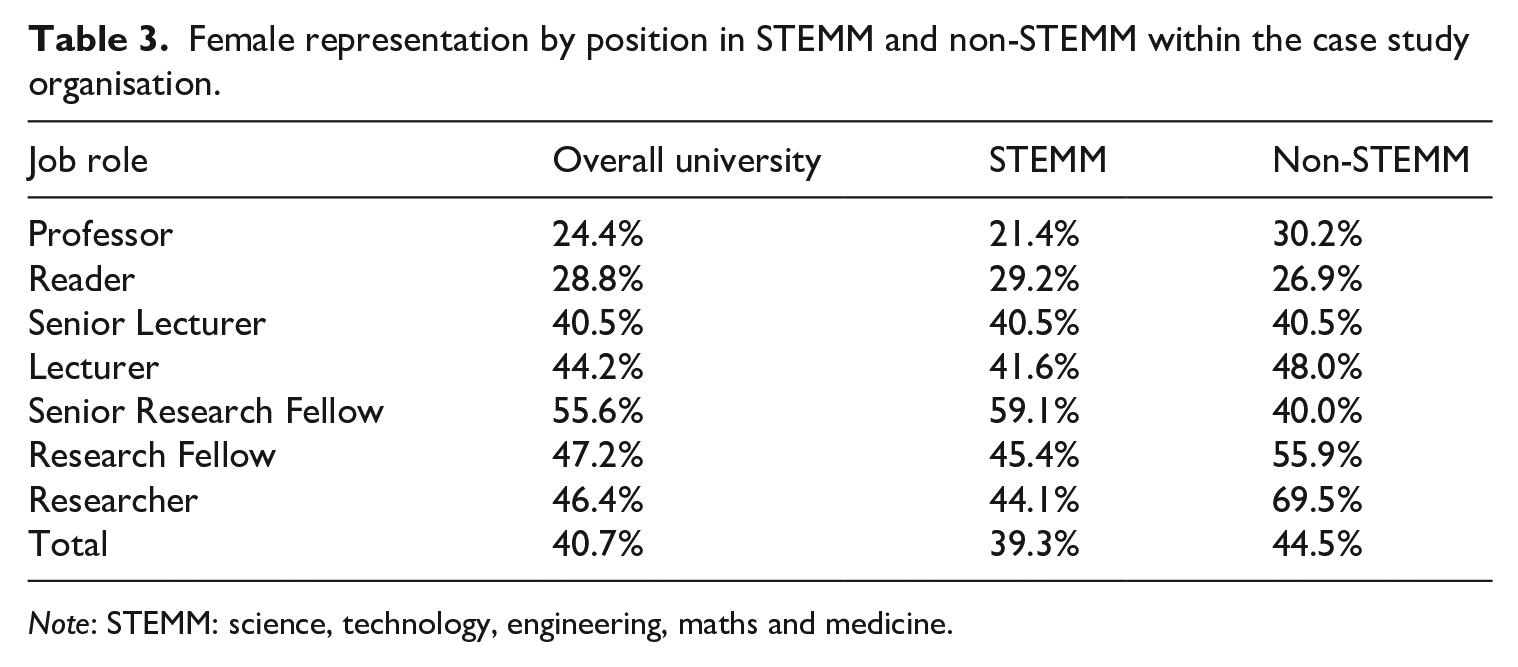
Note: STEMM: science, technology, engineering, maths and medicine.
Both authors, as ‘insiders’, had a good understanding of the case study setting and academic culture. As Floyd and Linet (2012) assert, insider status may confer privileged access to information and may facilitate access to participants. In recognition that the positions of the researchers within an organisation could potentially also act as a constraint, and limit who is willing to participate in a project and what is revealed, anonymity was assured to participants. Consequently, no specific details about the organisation or the departments are presented in this article.
After ethical approval was granted, women professors were identified across the organisation through the staff intranet and departmental pages. In total, the case study organisation had 93 STEMM female professors (out of approximately 450 professors in total) and 79 non-STEMM professors (out of 260). All were contacted via email and asked to take part in the research. Not all of the professors who were contacted responded at first, but there was a snowballing effect, with participants coming forward after hearing about the project and talking to colleagues who had been interviewed.
Semi-structured interviews lasted between 45 and 90 minutes and were conducted either face to face or by telephone. Thirty-one professors from a range of disciplines were interviewed: 20 from STEMM disciplines and 11 from non-STEMM disciplines (Table 4). Issues of class background were not directly pursued, although two women did speak of being the ‘first in the family’ to attend university. All interviewees were aged between 40 and 65 years old, none were from BME backgrounds and just one identified as LGBT. While the sample is homogeneous, this does reflect the poor representation of BME women at professorial level across a sector where 92% of women professors are white.
Research participants.
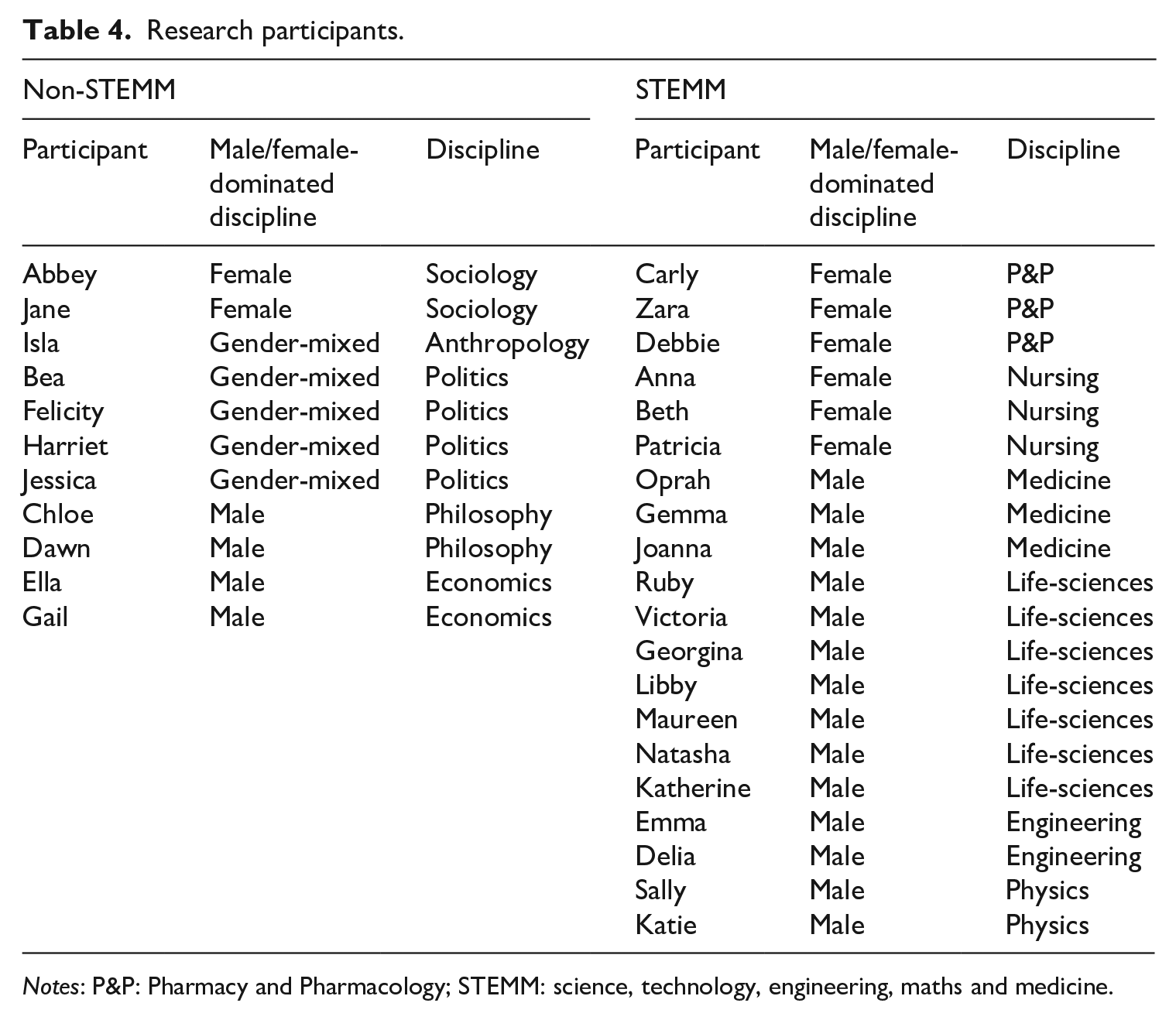
Notes: P&P: Pharmacy and Pharmacology; STEMM: science, technology, engineering, maths and medicine.
The interview schedule derived from a review of issues identified in the broader literature on women in academia, including questions around: career history and home lives; understanding and experiences of the academic promotion process; leadership and leadership training; mentoring and support; questions on organisational culture and their disciplinary settings; and their perspectives on gender and diversity issues. Interviews were undertaken by three members of the research team (including one of the authors), all junior in academic rank to the interviewees. The interview style was conversational, open and empathetic. The research team were alert to the fact that an explicit focus on gender can prompt defensiveness (Van den Brink and Benschop, 2012). While a small number of interviewees preferred to talk about meritocracy and personality, most spoke freely about gender issues and their experiences as women.
Interviews were digitally recorded and transcribed in full. Data were stored and analysed within NVivo 8 (QSR International) and coded initially according to the themes of the interview schedule. Project meetings involved group discussion of transcripts and further themes as they emerged. The process was iterative, involved reading and re-reading the material, as well as further engagement with the extant theoretical and empirical literature. In so doing, we developed an evolving conceptual framework around field theory, the geographic concept of ‘gendered spaces’, the academic ‘game’ and Acker’s theory of the gendered substructure of organisations.
The findings are presented around two interacting accounts summarising the ways in which the interviewees spoke about: (i) organisational culture and the rules of the academic ‘game’; and (ii) how they navigated the game to progress to professorial level and how this compared across disciplines as ‘gendered spaces’. The navigation strategies they adopted are organised into three themes: performing as ideal workers; building networks; and performing leadership. Each is discussed in turn.
Findings
The rules of the academic game
All interviewees described university culture and academic careers as all-consuming and centred on the demands of juggling research, publishing, teaching and attending conferences, as well as administrative, outreach and managerial responsibilities. Interviewees also spoke about international travel to conferences, and the need to be geographically mobile for career advancement. In line with previous research, a common theme was the highly competitive nature of academic culture and the salience of academia ‘as a way of life’ (Khiji and Harper Pumroy, 2019: 1032).
Nearly all the interviewees, without being prompted, drew upon the metaphor of ‘the game’ to describe academia and particularly the promotions process. They spoke about how the promotions process had become more transparent and formalised, indicating that it was advertised on an annual basis and eligible applicants were encouraged to apply, with workshops and other guidance provided to support applications. Interviewees were aware that the promotion process was presented as gender-neutral and meritocratic, many using such language to describe it, while simultaneously suggesting it tended to favour men. All interviewees, regardless of discipline, considered that excellence in research (securing funding and scientific publications) was the dominant criterion, and that teaching and administrative responsibilities, which tended to be undertaken more often by women, were undervalued. Many saw promotion metrics as a major obstacle for anyone unable to prioritise research and publications:
I felt it was very difficult with teaching commitments to really ramp up my research. I think in the days when my children were very young, it ticked over, but it was a struggle . . . I think because of that I got my papers out, but they weren’t the kind of papers I would have liked to be getting out – the really high-impact ones, essential for promotion. (Ruby)
While the rules of the game might appear generic across the institution, some subtle differences emerged when male and female-dominated spaces are compared. For example, many interviewees from male-dominated disciplines (physics, engineering, life sciences, medicine, economics and philosophy) reflected on being one of only a small number of women in their departments at the start of their careers and said that gendered practices and expectations influenced their working environment.
Interviewees spoke of the differing images and stereotypes of their disciplines, with those in male-dominated STEMM specialisms talking about rational and monastic scientists (White, 2014). Similarly, both economics and philosophy interviewees talked about the associations of their disciplines and specialisms as gendered. One commented:
You are not only a woman among men, but your subject specialism is often seen in male or female terms and its status deemed accordingly. (Chloe)
In contrast, in more female-dominated and gender-mixed disciplines, such as pharmacy, nursing, and social science disciplines, gender was deemed a less visible daily issue. Some of these interviewees associated the numerical presence of women as evidence of their discipline operating as a meritocracy, suggesting advancement to professorial level was a matter of choice and following the rules of the game. One interviewee (Anna) commented: ‘Look, I am surrounded by women, how can gender be a problem?’.
One difference in interviewees’ accounts related to whether disciplines involved ‘solitary working’ or laboratory-based cultures, where team working and submitting team funding bids were the ‘norm’. A non-STEMM interviewee remarked:
It sounds awful . . . but everything in my area is structured around individual self-interest. (Isla)
This suggested that non-STEMM interviewees had greater flexibility as regards working hours and choosing to work from home. While not all the STEMM interviewees worked in lab-based cultures, those who did said laboratories tended to revolve around long hours and ‘presenteeism’ when carrying out experiments, particularly during early career stages. Some interviewees commented on the potential of initiatives such as Athena SWAN to help drive progress on gender inequality in STEMM environments. However, many stressed that women were still regarded as the problem to be ‘fixed’. Furthermore, Athena SWAN was generally considered a ‘women’s issue’ that male colleagues detached themselves from. As one interviewee asserted:
Athena SWAN within our school almost backfires on senior women because we’re supposed to have female representation on all the different committees and there are only a small number of female professors within the field. It means your workload goes up, and they use it . . . well, it would be good to have a woman do it . . . so, it kind of backfires . . . in that sense. (Gemma)
The significance of disciplines as ‘gendered spaces’ was also evident when interviewees in gender-mixed and female-dominated disciplines talked about the ‘gendered’ hierarchy of subject specialisms and moving into senior leadership roles. In some cases, interviewees said they had aligned themselves and their work with (male-dominated) subject specialisms that were perceived to have greater ‘status’ in the academic hierarchy. As one interviewee from a female-dominated STEMM discipline explained:
I know how my disciplinary specialism is perceived and, you know, you look out for others – those in other disciplines – and feed yourself into those intellectual and disciplinary debates. (Anna)
For women emerging from female-dominated disciplines, it was only really when they moved into senior leadership positions that they recognised the significance of the gendering of disciplinary and organisational spaces. Interviewees commented that senior spaces were not only populated mainly by men, but were couched in ‘male’ terms. A non-STEMM interviewee commented:
There’s almost two very different environments in universities. You’ve got your school department level and you’ve got this upper level that seems to operate in completely its own way and is made up of mainly men. So, really, you’re dealing with many different cultures within a huge organisation. (Abbey)
Playing the game
Regardless of discipline, most interviewees spoke of having a clear career plan from the beginning. They saw the rules of the game as being ‘obvious’ as regards what needs to be done to achieve promotion. Others spoke of understanding ‘the game’ but taking a more ‘non-linear and varying path’ to professor. A few interviewees were critical of the game, particularly the focus on publications at the expense of teaching and other professional activities, which they said were more often undertaken by women. While they suggested that promotion criteria needed to widen to embrace activities beyond publications, they had nevertheless accepted the existence of the ‘game’ (and its gendered underpinnings) and learned what they needed to prioritise. Three navigation strategies were identified: performing as ideal workers; building networks; and performing leadership. These are now discussed in turn.
Performing as ideal workers
Interviewees offered similar accounts about their career paths to professorial level regardless of academic discipline, with long hours and expectations of dedication to the job a constant theme. Many studies report the challenges women face balancing academic careers with motherhood and caring responsibilities (Howe-Walsh and Turnball, 2014). Surprisingly, 27 out of 31 of the interviewees had children (ranging between six years and their mid-20s) and had managed to become professors while maintaining family responsibilities. All but one had a partner. Aware of the implications of time out for their careers, nearly all had taken short periods of maternity leave (generally three months) and most had returned full-time, adopting what O’Connor et al. (2018) refer to as ‘careerist femininity’: that is, performing as ‘ideal workers’ and presenting as prioritising work over non-work. A few talked about having been the first women in their departments to take maternity leave or return part-time. This was particularly the case in male-dominated disciplines. In every discipline, interviewees were clear that promotion was highly unlikely for those working on a part-time basis. One interviewee stated:
I did try working part-time, four days. But that’s what academia doesn’t do – no less is expected of you with your teaching, research, etc. So you might as well be full-time and that’s important if you want to get on. (Victoria)
Interviewees stressed the practical domestic support of their partners. Some had ‘role-reversed’ and their partners were responsible for childcare. All emphasised that a combination of access to good childcare (and being able to pay for it), and the input of their partner or children’s grandparents throughout their careers had been pivotal to enabling them to perform as ideal workers.
Concern about adhering to ideal worker expectations was expressed most by those working in male-dominated disciplines, particularly in lab-based teams. In such spaces it was said to be important to maintain an explicit separation between work and home, with children never mentioned: ‘the elephant in the room’ as one STEMM interviewee put it (Emma). Another STEMM interviewee remarked that working full-time hours, in a different pattern to the traditional 9 to 5, was something a small number of her male colleagues drew (negative) attention to:
I come in every day very early in the morning, before 8 a.m., and I work straight through until 3 p.m. Despite this and despite the fact most of my colleagues don’t get in until 9.30 a.m., one male colleague in particular still says, as I pass his office door: ‘Leaving early again I see’ . . . . (Natasha)
Key for these interviewees was not only performing as ideal workers but presenteeism and adhering to the team-based practices that formed part of the rules of the game in male-dominated lab-based disciplines:
I don’t think you can do science without putting in long hours . . . and if you’re doing certain research you have to be there in the lab to take samples, it is not something you can avoid. Most of my team come in at weekends. I try to encourage them not to, but there are no experiments that stop because it’s Saturday . . . We’re in competition with North America and if you don’t deliver, you/your team don’t get the paper, the funding . . . you don’t have a career. (Maureen)
Such adherence to ‘the way things are done’, however, overlooks the gendered terms on which women professors have progressed, as well as the ongoing implications for other women (i.e. the assumption that they will adhere to the ‘gendered’ rules of the game). Although some interviewees were critical of the expectation that experiments might mean being in the laboratory at weekends, they also perpetuated this, saying that it was ultimately an individual career choice.
Some interviewees in gender-mixed or female-dominated spaces expressed that they were still cautious about taking child-related time off for fear of being perceived in the ‘wrong light’ (i.e. as a non-ideal worker) (Jane; non-STEMM participant). However, they stressed there was greater scope for flexibility in gender-mixed or female-dominated disciplines, particularly where work did not have to be office-based. Long working hours nonetheless still threaded throughout their talk. As one interviewee stated:
Look, you work evenings and weekends, regardless of whether you have children or not . . . that’s what you have to do. (Harriet)
Building networks
Almost all interviewees highlighted informal support from senior colleagues and peers as pivotal to navigating ‘gendered spaces’. Many interviewees in male-dominated disciplines (STEMM and non-STEMM) reflected that at the start of their careers there were few women role models or mentors, particularly women role models with children. While interviewees said this was changing, and formal mentoring and networking programmes were now in place within their departments, informal support had been key to ‘playing the game’. One non-STEMM interviewee in a female-dominated discipline remarked:
I think it is very difficult to carve your way in academia if you either don’t have someone who’s really strongly promoting your interests or looking out for you . . . Having the support of senior leaders is important. (Abbey)
Interviewees from male-dominated disciplines were more strategic in actively establishing networks of relationships inside and outside of the organisation. A few STEMM interviewees had also undertaken MBAs or external leadership training, which they said helped increased their credibility as leaders. Of particular significance was a ‘Women in STEMM leadership’ course previously run by the university, which aimed to engender confidence in women to seek promotion and develop strong support networks.
Interviewees in female-dominated or more balanced ‘gendered spaces’, especially those outside of STEMM disciplines, were more cynical about women-only leadership courses, and also the strategic approach to networking, which they saw as a male practice. Some felt that leadership courses tended to focus on the challenges of combining motherhood and a career, and felt that gender should not come into leadership.
Navigating gendered spaces: Performing leadership
Women entering leadership from male-dominated disciplines found senior academic spaces as less of a change (since they had been partially acclimatised) than did women from female-dominated and gender-mixed disciplines. This latter group spoke of being seen (for the first time in their careers) as a woman first (rather than as a senior professional) and thus being both ‘visible yet invisible’ (Faulkner, 2009). For these interviewees, entering senior spaces was where the underlying tension between ‘doing leadership’ and ‘doing femininity’ became most apparent.
Women from female-dominated or gender-mixed disciplines spoke of having to learn to navigate new cultural senior ‘spaces’ with new expectations, unwritten rules and behaviours. They negotiated these gendered senior spaces by ‘keeping one’s head down’, ‘working twice as hard’, ‘fighting their corner’ and not drawing attention to their ‘femininity’ while also trying not to ‘behave like a man’. Senior ‘spaces’ opened their eyes to the fact the ‘old boys club’ had not been eradicated. A non-STEMM interview from a gender-mixed discipline stated:
Within my discipline there are a lot more women academics and more women professors than in other disciplines. And, so, you get used to being in a more 50/50 environment. But it then becomes a shock when you find yourself at the next level and find yourself the sole woman among men. (Isla)
Many acknowledged the difficulties of challenging ‘gendered’ images and stereotypes that are deeply embedded in senior spaces. When asked whether she performed as ‘one of the boys’, one interviewee commented:
Very regrettably, yes. I had too, to get things done. I tried to do the more collegial co-operative lets work this out, but I haven’t gotten anywhere with it . . . I had a very different relationship with the people that I look after than the people I work with further up. (Delia)
This final quote perhaps best reflects the difficulties facing the women in the study. While many recognised the gendered patterns inherent in the rules of the academic game, they also knew that to progress in their careers, they had to conform rather than explicitly challenge these rules. In turn, this reinforced those gendered structures and practices, at least at the highest levels of the organisational hierarchy.
Discussion and conclusions
This article set out to explore how women have successfully navigated the academic game in both STEMM and non-STEMM disciplines. The primary theoretical contribution is to build upon Acker’s (1990) theorising of gendered organisations by incorporating field theory (Bourdieu, 1993; Fligstein and McAdam, 2012). Conceptualising academic disciplines as ‘gendered spaces’ (Spain, 1992), permits a more nuanced understanding of the gendered substructure of organisations. It also enables us to explore the differentially ‘gendered spaces’ within which the academic ‘game’ takes place, and to develop comparative understanding of the ways in which women professors had navigated disciplinary ‘spaces’ to secure the most advantageous position (Kalfa et al., 2018).
While there has been extensive research on women’s representation in academic STEMM, little attention has been devoted to women’s experiences in more female-dominated disciplines where there is an implicit perception that women are ‘better served’ (Boyle et al., 2015: 185). The findings in this article suggest a more complex picture, where subtle differences relate to whether the disciplinary space is gender-mixed or male or female-dominated rather than merely STEMM or non-STEMM. The rules of the game are broadly consistent across differently ‘gendered spaces’, and there are broad similarities across ‘gendered spaces’ in how women ‘play the game’. Navigation strategies include performing as ideal workers, building networks and performing leadership. But how these strategies are enacted varies according to how academic spaces are gendered. While all the women highlighted the need to perform as ideal workers, those working in gender-mixed or female-dominated spaces, where being a woman was less visible, had greater scope for flexibility around the timings of the long hours they committed. Those working in male-dominated spaces, particularly lab-based cultures, generally had to maintain a visible presence, to publicly perform as the ‘ideal worker’.
While most interviewees accepted the importance of building networks, women in male-dominated spaces seemed more accepting of ‘masculine’ networking practices and leadership training. This might be a consequence of their ‘acclimatisation’ to masculine practices through their disciplinary backgrounds. While those working in lab-based cultures are bound by the same rules and promotions criteria as the rest of academia, they also recognise the need to collaborate with others inside and outside of the institution in order to achieve personal success, navigating and encountering these gendered rules and practices early in their careers. The significance of team working and team funding bids as part of ‘lab culture’ in a number of STEMM disciplines, and the gendered implications of such working, has tended to be overlooked in studies to date. This research thus adds knowledge of how women navigate such spaces within academia.
The ‘benefits’ of acclimatisation for women working in male-dominated spaces is especially apparent when women reach senior leadership roles and are invited into the ‘old boys club’ of senior management (Morley, 2013). Here, it was found that women from female-dominated and more mixed-gendered spaces became explicitly aware for the first time of gendered expectations, rules and norms, and had to learn to perform leadership traditionally couched in ‘male’ terms, while remaining visible as a ‘woman’ (Faulkner, 2009). Future work should pay greater attention to the experiences of women in senior positions based on their routes through differently ‘gendered spaces’.
While interviewees were explicitly aware of the game being played (Bourdieu, 1993), and some were critical of the way the academic game is gendered, they were nevertheless accepting of the game as being something ‘you just have to get on with’ (Anna). Similar to Kalfa et al. (2018), stories of explicit resistance were not encountered. As Fligstein and McAdam argue, although fields or spaces are rarely organised around consensus, ‘less powerful actors can learn how to take what the system will give them and improve their positions in the field’ (2012: 5). However, as Rhoton (2011) observes, such strategies eventually reinforce the gendered rules of the game, potentially disadvantaging other women, particularly those coming up behind them, and reinforcing gender inequalities.
The research was qualitative and exploratory in nature and, as such, has several limitations which point to the need for further research. First, the study was confined to a single organisation. While the more in-depth nature of the approach allowed for the ‘control’ of context, future work might fruitfully examine the extent to which the gendered patterns identified occur in other HEIs.
Relatedly, the number of interviewees in the sample was too small to draw out issues of intersectionality, and how experiences are influenced and shaped not only by gender but by class, ethnicity, disability and sexuality. There was no indication of the ‘game’ being structured by class as well as gender. This might reflect that class is overlooked as problematic for those with sufficient privilege to ignore it (Skeggs, 1997). Equally, it may be a consequence of not prioritising questions pertaining to social class. Future research should pay attention to the class background and identities of women professors and how they interact with understanding the rules of, and playing, the game. Further, given the poor representation of BME women at professorial level across the sector, a much larger sample size and/or more purposive sampling would be required in order to derive greater insight into the heterogeneity of senior women’s experiences. It would also be fruitful to explore generational differences as the younger cohort strive to move through the promotion ranks, at a time where academic careers are arguably becoming more competitive and precarious.
Finally, this research focused only on women. To fully understand the reproduction of gender inequality in academia, it is important to examine the roles of both men and women. While gender may appear less visible as an organising principle in female-dominated gendered spaces, this does not mean it has been eradicated, and thus exploration of such ‘spaces’ can shine a light upon the (in)visibility of gender, to present a more nuanced understanding of the persistently gendered substructure of organisations.
Footnotes
Acknowledgements
The authors would like to thank the Editor and anonymous reviewers for their extremely insightful and constructive comments. We would also like to thank Karen Hassel, along with Jane Ferguson and Elizabeth Seston for their assistance with the data collection as part of a previous project on women and leadership. Finally, thank you to Simon Teasdale and Michael Roy for their support, encouragement and critical reflection.
Both authors contributed equally to this work.
Funding
The authors disclosed receipt of the following financial support for the research, authorship, and/or publication of this article: This research received seed corn funding from the University of Manchester.
