




Abstract
This article examines the career histories of the first generation of UK women to enter professional employment in the 1970s and 1980s in comparatively large numbers. In so doing, it contributes to the sparse literature on older women’s working life histories. Presenting empirical research on women’s experiences in the legal and HR sectors, it reveals how women pioneers were often silenced by requirements to conform with male-dominated norms, values and practices governing masculine career pathways. They learned to speak a predominantly masculine language that in turn constituted a significant barrier to effective resistance and disallowed new ways of speaking about careers. The article argues that these earlier conditions of entry into careers continue to influence the barriers women face at work today. Through this analysis of older women’s working lives, the article also contributes to contemporary debates about intersectionality by illustrating how gender and age interact in ways that reinforce earlier patterns of career disadvantage.
Introduction
Second-wave feminism Equal Opportunities legislation in the 1970s, and major social changes then occurring, instigated structural changes that meant women in the UK were no longer required to abandon paid work on marriage or childbirth. Pathways to professional careers opened and, today, women equal or outnumber male entrants into many professions. Beyond entry-level, however, change is more limited. Proportions of women in senior management internationally declined in 2018 (Grant Thornton, 2018) and women remain under-represented at board-level (Vinnicombe et al., 2018), patterns mirrored across the professions. Women are under-represented at senior levels in engineering (Khilji and Pumroy, 2019), accounting (Castro and Holvino, 2016), medicine (Miller and Clark, 2008) and the two professions explored in this study: law (Pringle et al., 2017) and human resources (HR) (Webber, 2019a). Bowcott (2019) notes that while more than 60% of entrants to law are female, only half of practising solicitors and 30% of partners are women. While HR has long been female-dominated at entry-level, with over 80% of junior-level positions held by women, senior levels remain male-dominated (Webber, 2019a), with a gender pay gap of over 20% (Webber, 2019c).
These figures suggest that, though the gender landscape of careers has changed markedly since the 1970s, women continue to experience considerable disadvantage (Bolton and Muzio, 2008; Durbin and Tomlinson, 2014). They earn less than their male counterparts (Webber, 2019c), face structural, cultural and informal barriers to career progress (Pringle et al., 2017), and suffer from attempting to conform with inflexible career structures (Miller and Clark, 2008). The Everyday Sexism Project (Vachhani and Pullen, 2019), #metoo movement and numerous studies reveal the persistence of sexual harassment. Eradication of seemingly outdated prejudices, norms and antiquated modes of thinking is painfully slow, but understanding what causes such delays is partial. This article therefore explores why women continue to experience gender inequality in their careers. In so doing, it examines organizational gendering as productive of inequality (Calás et al., 2014). It first considers how gendering processes at early- and mid-career influence the falling away of women’s representation at more senior levels. It then reveals how, at the late-career stage, gendered ageism creates further career disadvantage (Riach et al., 2015). Intersectionality is an under-used concept in work and employment research (McBride et al., 2015) and this article evidences how the intersection of gender and age (Healy et al., 2019) reinforces earlier patterns of career disadvantage for women. In exploring gendered ageism, the article shows how barriers to women’s career progression and satisfying working lives continue, albeit shifting and changing, throughout the stages of the career life-course.
These processes are evidenced through the working life histories of women who pioneered entry to the professions in the 1970s/80s. The article illustrates how these women typically conformed with masculine norms governing careers, were able to speak using only masculine language and consequently had difficulty conceiving of alternative pathways to career success. Language is a necessary precondition for voicing demands for change (Simpson and Lewis, 2005), so an effective alternative language is needed. In developing this argument, the next section interrogates the terms ‘career’, ‘gendered careers’ and ‘gendered ageism’. The article then outlines the research approach and the study’s findings, before drawing conclusions.
Women, professional careers and voice
The significance of careers for women and men alike is well-documented (Muzio and Tomlinson, 2012). Traditionally, employees give loyalty and commitment in exchange for career progress and security (Inkson and King, 2011), expecting linear and cumulative progression (Sabellis and Schilling, 2013). Formally, at least, meritocracy governs career progression, but success requires sacrifice of personal and family interests. Typically premised on male breadwinner assumptions, this ‘masculine’ model is increasingly challenged (Inkson and King, 2011; Rodrigues et al., 2016), but the onus for change tends to remain on individuals rather than organizations (Bolton and Muzio, 2008). Women’s entry to the professions has had little impact on this long-established career model.
Studies that presume a deep-seated binary rather than socially constructed difference between the sexes suggest women and men approach careers differently (Powell and Mainiero, 1992). They presuppose that men value paid employment and women prioritize family (e.g. Gherardi and Poggio, 2007). Survey-based, large-sample, hypothesis-testing studies that measure women against male norms usually find women deficient and the cause of their own problems. Critics respond that the entrenchment of ‘masculine’ career pathways (Muzio and Tomlinson, 2012) is the problem. If gender differences are socially constructed then organizations are gendered (Calás et al., 2014) and their practices create or exacerbate difference and inequality (Acker, 2006). Work is organized for an ‘ideal’ white, male, middle-class worker unencumbered by external responsibilities (Acker, 1990) and linear career paths tend to reflect and reinforce these gendered dynamics.
Stereotypically masculine norms continue to shape professional practices (Muzio and Tomlinson, 2012), despite the professions’ changing gender balance (Pringle et al., 2017). As Muzio and Tomlinson (2012: 459) attest: ‘in a context where professional norms were constructed with reference to the experiences of white, middle-class men, closure regimes inevitably tend to have gender, class and ethnic dimensions’. Bolton and Muzio’s (2008) study of three professions – law, management and teaching – evidences the extent to which to be a professional is to ‘do gender’; that is, to comply with and reproduce traditionally masculine norms and practices. They note both vertical segregation, where men dominate at senior levels, and horizontal segregation. In law, for example, men are over-represented in high-status competitive fields such as commercial law, whereas women dominate the lower paid, lower status, ‘nurturing’ fields such as family law. Pringle et al. (2017) demonstrate the deep-seated, masculine nature of the law profession, despite the high entry levels of women, again questioning the time lapse thesis, which suggests that women’s increased entry at junior levels will ultimately lead to their equal representation in senior positions (Pringle et al., 2017). Further, Webber (2019b) evidences that sexual harassment continues to be widespread in the UK legal profession.
Although 80% of the HR profession is female, its senior levels remain male-dominated. The similarly feminized teaching profession remains governed by masculine norms (Bolton and Muzio, 2008). Indeed, women have learned to valorize male norms of career advancement (Gherardi and Poggio, 2007), often arguing (despite contrary evidence) that they do not experience discrimination (Simpson and Lewis, 2005), even though acknowledging they have to be better than men to progress (Padavic and Reskin, 2002). Narrow definitions of career success (linear progression to senior ranks) are often exclusionary for the many women who do not conform to the ideal worker norm. Their apparent non-normativity means professions remain highly gendered at a senior level as women often experience non-linear, complex and multi-dimensional career paths (O’Neil et al., 2008). Women’s careers are not boundary-less, protean or kaleidoscopic, but frayed; that is, complex and unpredictable (Sabellis and Schilling, 2013) due to their shouldering the burden of care (Acker, 2006). The inflexible and a-historic nature of the traditional linear career model (Tomlinson et al., 2013) results in women experiencing considerable career disadvantage (O’Neil et al., 2008).
While research has explored women’s career progression in the professions, it has focused largely on those in mid-career and the challenges and consequences of combining childbearing/rearing with traditional career models. As noted, the failure of women to conform to the ideal worker norm at this career stage is well-documented. The intersection of age and gender is less researched and, indeed, age as a base of inequality is under-explored (Healy et al., 2019), especially in relation to professional employment (Choroszewicz and Adams, 2019). This article contributes to the sparse literature on older women’s working life histories. Although Still and Timms (1998: 144) highlighted the need for ‘an understanding of the factors that shape the labour-force decisions and experiences of these individuals’, few subsequent studies have addressed these concerns. Most research concentrates on younger respondents and ignores insights to be gained from understanding the rapid changes in gender relations over the working lifetimes of this older cohort (Emslie and Hunt, 2009) who began employment just as equal opportunities legislation was introduced. Exceptions include Riach et al. (2015), who argue for better understanding of age as an aspect of gendering, Jack et al. (2019) who explore older women’s gendered agency, Durbin and Tomlinson’s (2014) sample of 46 successful business women – half of whom were aged 51 and over, and Elliott and Stead’s (2008) research into older female leaders.
Wider understanding is limited, as the older worker discourse remains gendered and based on masculine norms (Duberley et al., 2014), despite issues such as gendered ageism (i.e. disadvantage arising from the intersection of age and gender) (Jyrkinen and McKie, 2012). Thomas et al. (2014) argue that older workers contradict the ideal worker norm, and careers plateau amid assumptions about productivity, but note that this is particularly problematic for women who also experience gender discrimination. ‘Doing gender’ (West and Zimmerman, 1987) becomes ‘doing gendered ageing’ with negative perceptions of ageing bodies (Riach et al., 2015) that challenge professional norms valorizing younger male workers (Thomas et al., 2014). Negative perceptions of older women’s physical appearance and flexibility/energy (Moore, 2009) result in them being marginalized and silenced (Pritchard and Whiting, 2015). The analysis presented here of women’s career life histories offers new insights into why change has proved so slow.
The article’s central thesis is that women, lacking a legitimate language through which to articulate claims for new career norms, remain unheard by those with the power to achieve change (Simpson and Lewis, 2005). ‘Voice’ as a surface mechanism enabling speaking and being heard is well-understood in an employment relations literature influenced by works such as Hirschman’s (1970) on exit, voice and loyalty. Failure to express voice can lead to exit (leaving the organization) or loyalty (tolerating lack of voice but with often problematic outcomes for the employment relationship). Silence may, indeed, be a form of loyalty (Chappell and Bowes-Sperry, 2015). This body of literature presumes that voice is possible and silence a choice (e.g. Donaghey et al., 2011). Gendered readings, however, position voice as a discursive practice that removes certain matters from discussion and creates ‘deep processes’ of silencing so that some (often female) voices go unheard (e.g. Simpson and Lewis, 2005). It is this ‘removal of certain matters from discussion’ that is of concern in this article. It follows Acker’s (1990) influential thesis of how silence around gendered issues disadvantages women. Discourse can reproduce silence as a form of suppression, censorship or self-protection (Ward and Winstanley, 2003) – the voices of women (and other disadvantaged groups) are muted, stifled or silenced (Bell et al., 2003; Ward and Winstanley, 2003). Influential feminist theorists such as Kristeva, Cixous and Irigaray go further, arguing that women lack a language through which to speak, so must use language that reflects and reinforces male dominance (see Fotaki, 2013; Fotaki et al., 2014; Phillips et al., 2014). The supposed gender neutrality of organizations thus becomes a form of control over women (Simpson and Lewis, 2005) who have experienced a ‘lifelong training in linguistic accommodation to others’ (Riley, 2005: 80). Seeking to contribute to these debates about the persistence of gender inequalities in organizations, this article now reports a study of the career histories of older professional women.
The research
The study asked: what can the life histories of women who entered careers in the 1970/80s tell us about why they, their daughters and their granddaughters continue to struggle to achieve equality? A feminist research approach (DeVault, 1999) was adopted that explored women’s career life histories with 20 women aged 50 and over in the North of England. Recruitment was by both convenience and snowball sampling, through links with a local HR managers’ network and university contacts with the legal profession. The only criteria for inclusion were age and membership of one of the two professions. Data saturation meant participant recruitment stopped after 20 interviews. While the sample was convenience-based, the two professions provide an interesting contrast: HR being (supposedly) feminized and law more masculine. The HR managers worked both in businesses and as self-employed consultants, while the lawyers worked in high street law practices. Given the small sample and restricted geographical location, the research findings are not generalizable to all professional women workers, but as a qualitative study are generalizable to theory (Miles and Huberman, 1984).
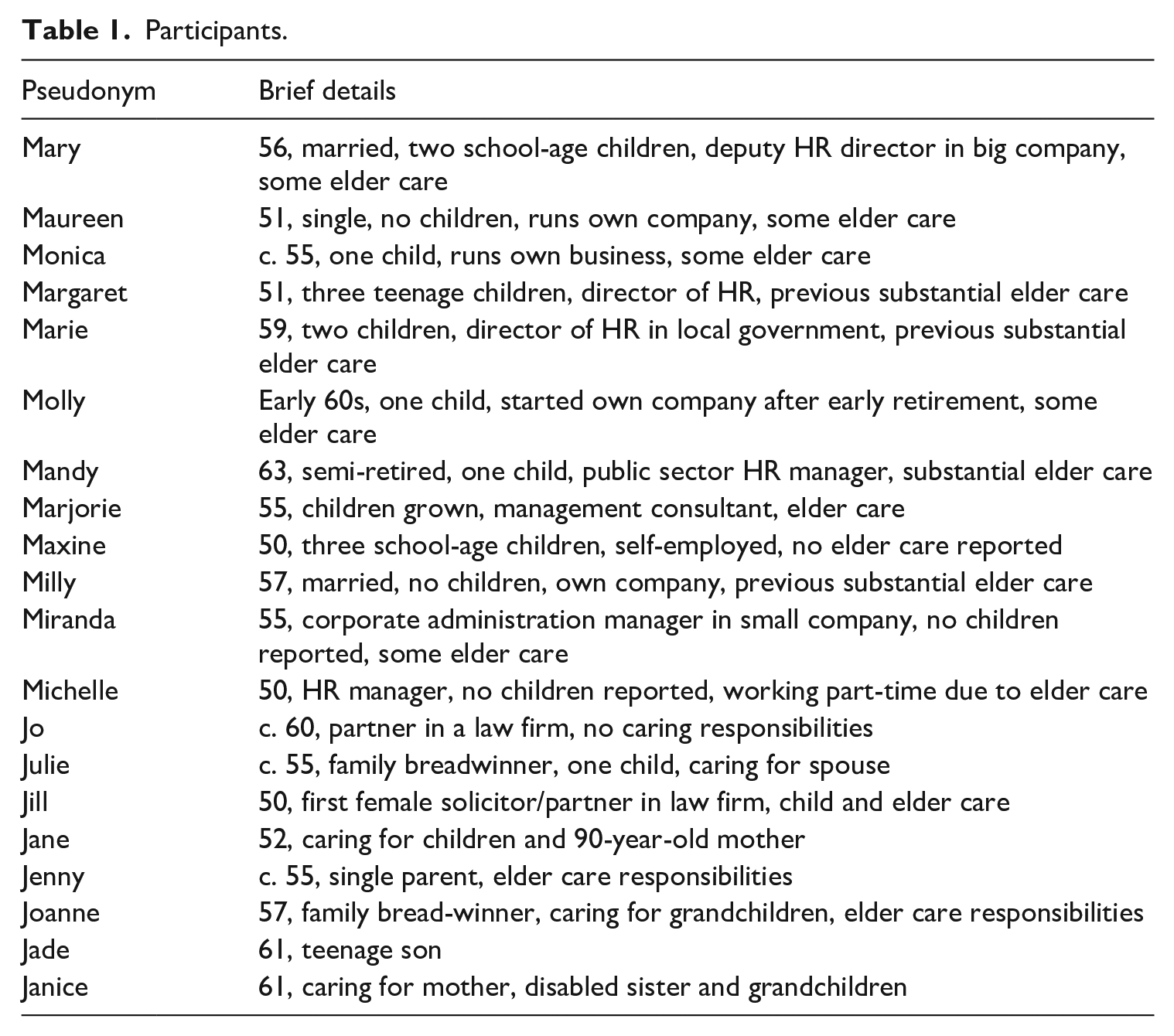
Table 1 gives brief details of the participants. Fieldwork took place in the summer and autumn of 2013, in participants’ or researchers’ offices. Interviews lasted 90–120 minutes, were digitally recorded and transcribed verbatim. Questions were open, seeking accounts of working lives, career histories and future plans. Confidentiality and anonymity were assured by using pseudonyms. The analysis suggested, while not seeking to compare and contrast, that participants’ experiences of gender dynamics had much in common across both professions. Nevertheless, we draw out interesting patterns whereby the two groups experienced frayed, that is, complex and unpredictable careers (Sabellis and Schilling, 2013), but in subtly different ways.
Participants.
Data analysis methods and findings
Data analysis methods were influenced by biographical research techniques. Following Polkinghorne (1995), biographies are tales in which disparate events are drawn together via a plot with apparently coherent plotlines or characters. Analysis involved ‘individual experimentation accompanied by reflection’; that is, numerous readings of each transcript to identify plot lines, chronologies and causality (‘as a result of’) (Czarniawaska, 1998: 19). The 20 individual stories all had beginnings (leaving education); a series of adventures (entering first jobs, moving through the career maze, struggling with adversity), sacrifice and contemplations of endings. This offers a somewhat rare retrospective approach to the study of careers, and allows participants’ voices to be combined into a composite story (Humphries and Brown, 2002). Individual women’s voices are articulated through attaching pseudonyms to each interview excerpt.
These stories were rich with ambivalence, understandings of women trying to ‘have it all’ and maintaining careers, but also of barriers, misrecognition, disappointment, harassment, discrimination and constant juggling between conflicting priorities. The focus was gender and, ultimately, its intersection with age. The importance of other bases of inequality is acknowledged, but participants were all white British, precluding analysis of race/ethnicity. They were similarly homogeneous in being graduates and/or professionally qualified, having worked in professional roles for circa three decades, class was not readily surfaced (Castro and Holvino, 2016), nor, despite appearing in a small number of interviews, open to analysis. The article next presents the composite working life histories of professional women born in the 1950s and 1960s, who experienced inequalities, discrimination and silencing on each stage of their journey.
Entering the professions and early-career
Analysis shows how great are the changes in career prospects since participants entered the workforce. The mothers of girls born in the 1950s/1960s were required to give up paid work after marriage or childbirth and some participants experienced similar expectations: A lot of people left school and went into factories because that’s what their mums had done and what their mum’s mums had done. You did that until you had a child. [. . .] When I told my employers that I was pregnant with the first child, there was no option. At 28 weeks you left, you didn’t go back, you didn’t get maternity pay, you stayed at home. (Jo)
Some stubbornly resisted; feminism gave them a voice. Jo left school at 15, married at 17 and grew bored, in her mid-20s, of being a full-time mother. She refused to accept that her desired job was exclusively ‘man’s work’, got the job and worked as the only woman in a team of 40. A careers adviser had told her she ‘set her sights far too high’, but ‘nobody tells me I can’t do something’.
University became an option, although women were often not expected to do well. Julie, told a law degree would be too difficult, responded: I’m sorry, but . . . if I think I’m going to do it then I’m going to go and do it. So I went and did it. No real thought other than a bloody-mindedness on the basis of I can, and somebody saying I shouldn’t.
Growing up during the era of second-wave feminism and amid great social changes, including increasing social mobility and prosperity, access to international travel, easily available contraception and the end of the ‘stiff upper lip’ and a culture of deference, these then-young women demanded the right to break free of women’s traditional confinement to the home, and legal and social changes appeared to offer them the requisite employment rights and opportunities. This new-found voice was, however, soon stifled.
Having secured entry to the professions, participants remembered feeling that if they did well, ‘I was doing well for a woman’ (Mary), something that, in hindsight, ‘quashes your ambition a little bit, because I felt a bit pioneering’. This acceptance is echoed in their experiences that made women feel uncomfortable, as the following (typical) recollection illuminates: I used to dread Christmas Eve [early 1980s] because one of the directors would come down, dressed as Father Christmas, and all the women had to go, one by one, queue up, sit on his knee, get a kiss and a present. It’s unbelievable now . . . . (Mary)
What would now be understood as sexism or sexual harassment was not resisted because ‘it wasn’t something that was talked about at the time . . . you just had to get on with it’ (Maureen). It is difficult, in the age of the #metoo movement, to appreciate just how recently women have developed a language with which to name and challenge men’s behaviour for what it is.
Participants’ accounts are replete with memories of misogynistic practices. They remembered being often denigrated by male colleagues defending masculine territory. ‘All the good jobs were male’ (Mary) and Monica recalled: ‘When I said I wanted to move into general management I was told “Yeah, of course you do, but that’s not going to happen”’ because ‘you aren’t tough enough, wouldn’t survive, couldn’t do the hours’. While the Sex Discrimination Act 1975 made available a legal (surface) language about unlawful discrimination, in these early years women struggled to use it in organizational contexts of deep silencing (Simpson and Lewis, 2005). This research revealed how women’s entry into the professions was met by their being reduced to sex objects or experiencing language and behaviours that positioned them as ‘alien intruders’ into masculine careers. Still in a minority in professions governed by masculine norms, they had little power with which to resist. Their present-day accounts suggest they lacked a language with which to articulate frustrations and were unable to give voice to the discriminatory practices they encountered. For example, Jo avowed, decades after seeing her boss without his trousers, that she had never ‘been discriminated against, by anyone, because I’m a woman’. The language available to women settling into careers was masculine, valorizing paid work above all other commitments. Participants felt they had to work harder and better than their male colleagues – a familiar argument (Padavic and Reskin, 2002) that needs further interrogation. Why did women feel they had to prove themselves in this way? We suggest the language available to women for speaking about careers allowed little choice. If successful careers required hard work and sacrifice (the pre-existing masculine model), then acculturation into the professions required that women not only conform with these discursive norms, but visibly prove their compliance.
What changes then have these pioneers seen? There have undoubtedly been some, with men and women more equally represented in early-career, and legislation and new forums creating a surface voice around discriminatory behaviours (e.g. reports to the Everyday Sexism Project) (Bates, 2016). Indeed, participants noted an extensive change in women’s views at entry-level: Women who join today, their expectations are far different from mine. I don’t know if it was just me, or women [generally] – I was kind of grateful for my job. Women these days . . . expect to have all that in front of them, proper career progression. (Mary)
The extent to which deep-seated change has occurred is, however, questionable. Processes of deep silencing remain and ongoing sexual harassment is rife within the law profession. Lack of language inhibits the expressions of resistance that could bring about structural change and ‘feminine’ gendered organizations (Acker, 1990). It allows reproduction of masculine professional norms that inhibit women’s development to senior positions in their mid- and late-career stages, as we explore below.
Mid-career
Participants retained their pioneering mantle as they entered mid-career and many sought, for the first time in substantial numbers, to combine professional careers and children. Masculine norms governed how women learned to talk about this (Pringle et al., 2017). Jane, for example, opined that women have to be: super-women . . . the few [women] that I know locally who have made it [to high management] . . . are the people who have had a baby and turned up at the office with a two-day old baby in a cot . . . .
In striving to be ‘ideal workers’, silencing around reproduction was evident. These women talked about how their careers were damaged by having children. Jenny, for example, argued that parenthood: definitely delayed becoming a partner because I took some time part-time . . . but I was a little irritated that it seemed to slow down my progression to partner.
That women should be superlative at their jobs, and able to simultaneously balance family lives was, in Jenny’s words, only ‘a little irritating’. This terminology understates the struggles women like Jenny faced to develop successful careers, suggesting again the absence of a language through which to resist the inference of second-class status arising from their biological, cultural and emotional roles as care-givers.
This new workplace phenomenon, of professional employees who gave birth but did not give up their jobs, was often perceived by employers to be problematic. Joanne, a lawyer, made redundant when she became pregnant, remembers that: It didn’t seem right at the time, and I did sort of challenge it, I thought: ‘Well, you can’t do this, you can’t make me redundant when I’m pregnant’.
Acker’s (1990) influential study suggests Joanne, whose challenge was only ‘sort of’ and whose resistance was ‘thought’ rather than articulated, is typical of women subjected to gendering regimes that require women’s habitual linguistic accommodation to masculine organizational norms. Alternatively, her ‘sort of’ challenge may have contained the seeds that led to women’s increasing demands for workplace change.
Careers continued to be constructed according to masculine norms and women, having no language with which to resist, were afforded two options: compromise either family relationships or careers. No participants admitted putting career first but, in Monica’s words, motherhood left them feeling they had ‘created [their] own glass ceiling’. That is, rather than voicing complaints about organizations’ failure to adapt for them, they assume responsibility for sometimes irreparable career damage. Julie, a solicitor, encapsulates this neatly. She worked part-time between her son’s birth and his starting school and: then they offered me a partnership, and the proviso was that I had to be full time, because . . . . They’d never had a female partner . . . so of course they’d never had a situation where they’d had anyone who was an equity partner who was less than full time.
Jill recalled her boss’s reaction to her request for maternity leave: I’d been here I think 14 years when I announced that I was pregnant, and he said to me ‘I think your pregnancy and your maternity leave are very badly planned’.
In recollecting her personal history, she added: ‘I never forgot him telling me that I’d planned it badly and that I shouldn’t have got pregnant just after a merger and just after I’d moved to run a Branch Office’. With all the benefits of hindsight and probably a sense of irony, some 18 years later, she has become more aware of how inappropriate his remarks were, how much social change has altered such conversations. Yet even though he accused her of putting family before the firm, Jill still argued that she had not faced barriers to career success.
Costs, it seems, were borne by women not careers or organizations. Guilt was the price paid when work ethic and family responsibilities were incommensurable. That is, participants recall difficulty in finding both emotional and temporal balance between their two loves – work and family: When my son was very young, there were undoubtedly times when I thought ‘I’m a rubbish mum and I’m a rubbish lawyer because I’ve either got to be good at one or the other’ and the two are not always compatible at all. (Julie)
For those who could not comply, their careers faltered as they accommodated motherhood (Sabellis and Schilling, 2013). Some of the HR professionals remained in large corporates, but many, lacking voice and a language of resistance, chose exit (Hirschman, 1970). Margaret, Maxine and several others left permanent employment after becoming pregnant and worked as freelance consultants but lamented their later difficulty in returning to salaried work. Silence in the form of loyalty was a more typical choice for lawyers (Chappell and Bowes-Sperry, 2015), all of whom worked in small high street practices rather than prestigious city firms, some part-time at various points. They accepted the burdens placed upon them, but progression to partner-level slowed or halted. Big city corporate firms were perceived as even less accommodating of their needs than high street practices and careers there were avoided.
In the absence of language/voice to effect deep-seated change from masculine-focused to family-friendly careers, many women saw their career progression falter and all experienced substantial burdens in trying to accommodate organizations, rather than being accommodated by them.
Late-career
These older female professionals, now entering late-career, were again taking a pioneering role as part of the first professional cohort (in substantial numbers) to reach this stage. Many had anticipated the promise of emphasizing career and/or self, and for a few this seemed to be realized: This phase for me personally is the most freedom I’ve ever had in my life because my children are self-sufficient with good jobs. (Mary)
For most, however, the caring burdens of mid-career continued. Of the 20 participants, 16 had experienced elder care responsibilities that, combined with career, proved demanding (Maureen), debilitating (Maxine) and emotionally burdensome: ‘guilt if [her mother] doesn’t come [to visit], as opposed to actually wanting her two days a week’ (Jill). For some, elder care was coupled with childcare (e.g. Molly, Mandy, Jane) or caring for grandchildren (Joanne) or spouses who were getting frailer (Julie). That this was a woman’s role continued uncontested: I have a brother, but I’m the one that gets the call if there’s an issue with my parents and I’m the one that – without even thinking – will go and deal with it. (Monica)
The older worker discourse remained highly gendered, based on a masculine norm of the putative ‘ideal worker’, ever-available to pursue hierarchical career progression. This continued to elude the participants. For most, anticipation of a ‘level playing field’ with men proved ill-founded and, irrespective of level of seniority, they continued to juggle caring and careers. These pressures created an often intolerable physical and emotional burden: I was running myself into the ground, you know, completely – but got through it. Did get through it. And just over 12 months ago my mum died . . . . There was a time I was on tablets, in that period, from the doctor to get me through it. (Margaret)
Margaret ‘gets through it’ with the help of medication. Jill describes how she has to ‘drop everything and go’ to take her elderly mother to hospital, but accommodated this through taking her laptop with her, ‘working wherever’, and lauded the IT systems that enabled this.
Participants recalled the pain of facing an unpalatable choice: either betraying families or sacrificing career progression or, by now, even their careers. Mandy, for example, was forced to forgo a promotion because of caring pressures and Michelle had moved to part-time hours and was considering leaving. They had no language through which to articulate resistance, only (sometimes reluctantly) accommodation. Responsibility was turned inwards. Feminists have long critiqued organizations’ insistence on women adapting to male working patterns, but this study is arguing something further – there is an absence of a language that allows women (or men who similarly suffer the oppressiveness of the archetypal career path) to talk differently about careers. Discourse reproduced silence as a form of suppression. Without the necessary language women lacked voice; none of these participants articulated anything except conformity with these demands, and no-one espoused resistance. Instead, they bent to the demands, as any other options would damage their careers. The absence of language and thus of voice incurred personal costs.
While some participants were anticipating retirement, others were seeking new challenges. Their aspirations were frustrated, however, not only by the ongoing disadvantage arising from their frayed mid-careers (Riach et al., 2015), but additionally by the spectre of gendered ageism (Jyrkinen and McKie, 2012). The complex interaction between social changes and legislation, now age as well as sex discrimination, again offered a surface voice for resistance, albeit, in the UK at least, legislation does not permit for their combination. As in their early careers, women lacked language to articulate unlawful discrimination, and deep processes of silencing again stifled their now mature voices. An ongoing narrative of lack of discrimination contradicted their observations of women having to perform better than men: I don’t feel discriminated against really, but I do feel that women have to be a lot better than men to get into senior jobs . . . . When I look around at the women who are in senior jobs in this organization, pretty much all of them are great, and then you set [these women] against the other 85% who are men and there’s a lot of dead wood in there in my view. (Mary)
Women felt that women, not men, experienced ageism, illuminating its gendered quality: They think: ‘Well, should she not be home looking after the grandchildren, or tending the garden’ or ‘Hasn’t she done her bit?’. Whereas I think there’s still a view that men go on forever, women have an end shelf life. (Monica)
Maureen argued that if she had not ‘made it to the top’ by her age (51), she never would have. She agreed with Monica that expectations of older women differed from those of older men: women ‘become irrelevant’. Indeed, Milly noted that she had experienced more ageism than sexism, because ‘as you get older, for women the ageing process is perhaps physically more marked than men’. This reflects intersecting discursive practices that exclude older professional women as a result of their looks or presumed energy levels. While experience could bring added respect, problems related to appearance and (in)visibility were a frequent theme in the interviews, with sex discrimination now relating more to this than the harassment of earlier career stages: When I was 30, I never wore any make up. But as you get older, you do have to put in some effort. Because you’re a mess! You don’t want to look like an old woman. If I come in looking like an old woman I will be absolutely – I would be sidelined. You do [become invisible], you know. (Miranda)
Margaret reflected that she didn’t dye her hair, even though this was ‘almost compulsory’ for older women, but people forgot her name and she became ‘that person from HR with grey hair’.
Their experiences suggested physical image spilled over into perceptions of competency and the lesser valuing of women’s knowledge: I think it gets harder as you get older to convince people that you can deliver what they want. Not because you can’t do it, but of what people’s perceptions of you are . . . I do think men are allowed to age without being criticized, and I think it is different for women . . . I think there’s a lot more pressure on women to try and look a bit younger and to not have the wrinkles. (Marjorie)
These intersecting gender/age-specific difficulties were also highlighted by Michelle, who noted the absence of older women in senior roles as they ‘tend to retire or go part-time’. Miranda, at job interviews, was told ‘You’re not quite the right fit’, which she related to her age. Masculine norms meant that career opportunities were not made available: I’m not getting these sexy projects now, I think I’m mentally written off as, you know, somebody, a safe pair of hands . . . you’re 50-odd, where are you going and what do you want to do, and, oh, you should be on wind down now. [. . .] in some people’s eyes [I’m] invisible. (Mandy)
In sum, masculine professional norms governed these women’s careers throughout their working lives. In their 50s and 60s, they still experienced over-work, exhaustion and guilt. They continued to try to fit the square pegs of their lives into the round holes of masculine career pathways, while also facing the challenges of gendered ageism. Absent from their accounts (DeVault, 1999) was a language of resistance and a voice that demanded change. Instead, there was a language of self-blame for failure to conform with dominant norms. Legislation offers a surface voice that is largely ineffective for gendered ageism. Processes of deep silencing continue, older women are under-valued and become invisible (Simpson and Lewis, 2005). Women professionals’ continuing inequality with men thus results partly from lack of a language through which different career pathways can be imagined, desired, fought for and valorized.
Discussion and conclusions
The literature is replete with accounts of the difficulties women face, and the sacrifices they must make, to secure successful professional careers (Bolton and Muzio, 2008; Durbin and Tomlinson, 2014; Pringle et al., 2017). Legislation’s initial promise of eradicating such inequalities has not been fulfilled (Webber, 2019b). This study, therefore, explored what the history of women who entered into careers in the 1970s and 1980s and their subsequent (lack of) progression might say about the persistence of gendered inequalities. It evidences, as have many others, the dominant masculine framework that valorizes the norm of the male family breadwinner who sacrifices self for career. This research also observed how women, although able to take advantage of anti-discrimination legislation to enter the professions, tended to absorb the norms of the masculine career. They accepted that women must be better than their male colleagues, work harder and make compromises. Their choices about careers versus family/caring responsibilities were merely rhetorical (Pringle et al., 2017) and their careers frayed. Participants’ accounts were suffused with culpability for their self-perceived failings as careerists and as carers. They felt guilty at failing to achieve the impossible, accepted the lesser status resulting from gendered ageism and were positioned as invisible, less capable, less valued. They internalized and turned back upon themselves the gendered causes of the irreconcilable demands they faced, rather than challenging their structural and cultural causes.
In seeking to explain these findings, the article draws upon the notion of voice and Hirschman’s (1970) strategies of voice, exit and loyalty. While exit and loyalty are both evidenced, as women tolerate disadvantage and their careers fray both within and without organizations, voice is largely absent. Studies that presume the existence of a language through which voice can be articulated may be flawed and silence might not be the choice it is sometimes assumed to be (Donaghey et al., 2011). While legislation and social change may offer a surface voice, discursive practices within norms create deep silencing (Simpson and Lewis, 2005) and the voices of women (and potentially other disadvantaged groups) are muted, stifled or silenced (Bell et al., 2003; Chappell and Bowes-Sperry, 2015). Participants had no language through which to express any different concept of career and their right to demand anything better was suppressed/silenced (Ward and Winstanley, 2003).
This reflects feminist theories of women’s subordination through language. Irigaray (1985), for example, critiqued a symbolic order that reduces everyone to an ‘economy of the same’, where women can be only inferior versions of men. Irigaray’s theory is seen in sharp relief in this study: women professionals become inferior versions of male counterparts, lacking a language through which to express alternatives. Participants had no language to question the inflexibility of careers nor corporate refusals to adapt to the necessity of combining careers with caring responsibilities across the life course. Posing questions, envisaging alternative futures and offering resistance requires a language through which claims can be made, dreams articulated, or resistance offered. Language is a precursor to voice. These career pioneers suffered from a lack of language and thus of voice.
This study demonstrates the need for a new language through which careers can be understood and demands for change voiced. In other words, careers need to be re-thought and re-described. Demands for flexible career pathways or better work–life balance start from an acceptance of ‘the career’ as currently conceived, seeking amelioration of iniquities rather than removing their causes. Organizations, not individual women, must change (Calás et al., 2014) and radical action to create feminine career norms is needed. For example, professions should value outputs produced where and when suits the worker, rather than inputs delivered at particular times/locations. New norms could specify (short) maximum working weeks scheduled to worker preference, offices built to accommodate female preferences, removal of normative dress codes and emphasis on appearance, and design of promotion processes that privilege women (e.g. by recognizing the skills offered from those who combine careers and caring). Shifting norms would offer voice that women could exercise through concerted action with their professional bodies, encouragement to negotiate and, ultimately, through having an equal voice at the senior table.
This study has identified a previously unrecognized deep structure of workplace gender inequalities: the absence of a necessary language for articulating change. As a small study in the North of England, its arguments are not necessarily generalizable to all women in employment. Other locations and other professions may offer different insights. Its findings are, however, generalizable to theory and demonstrate the need for a new language to facilitate voice. The study points to the need for revolutionary change: it shows that incremental changes drag historical baggage along with every step. This conclusion is related to the second major contribution of this article, which is to highlight the conceptual importance of gender/age’s intersection in general, and the sparse literature on older women’s working lives more particularly. The historical changes that have taken place over participants’ lifetimes are infused with stasis, a past that seems long-distant continues to reverberate through career pathways where it meets a new form of career disadvantage, gendered ageism. Although it is no longer acceptable for women in employment to feel silenced, undermined by stereotyped perceptions of the ageing process, or to believe that they ‘just have to get on with it’, the tenacious nature of intersecting gendered inequalities requires organizational transformation, particularly in relation to careers and how they are defined and enacted.
Footnotes
Acknowledgements
We would like to thank the managing editor and reviewers for their support and advice.
Funding
The authors received no financial support for the research, authorship, and/or publication of this article.
