




Abstract
Substandard labour practices continue to be observed in global value chains (GVCs), even where there are strong legal frameworks and in those that engage with ethical accreditation schemes. We argue that this indicates a slow rate of progressive change in GVC labour governance, that is due in part to the lack of attention paid to the interplay of men, masculinities and GVC operation. We offer a reading of Jeff Hearn’s ‘hegemony of men’ framework as a means of showing and deconstructing men’s power within GVC labour standards and welfare programmes, to understand how particular forms of masculinity are reproduced to detrimental effect. Our critical review of the GVC literature emphasises the need to recognise how the social category of ‘men’ has both material and discursive effects on GVCs. We then present a research agenda that emphasises how an intersectional lens on the hegemony of men can surface how complexities of race, class, caste and other experiences of working in GVCs interact with dominant forms of masculinity. This would significantly enhance our understanding of how governance mechanisms might be better designed and operationalised in GVCs, for the betterment of all.
Introduction: Global value chains, governance and the absence of men
Exploitation, low pay, dangerous sites, unsafe materials, excessively long hours, bullying and sexual harassment are just some of the damaging labour conditions and working practices that persist within the global value chains (GVCs) producing the majority of the world’s goods. Labour governance mechanisms such as labour standards, social audits and worker welfare programmes have all sought to eradicate or modify these conditions, with some success (Barrientos et al., 2003; Pedersen and Andersen, 2006). Notwithstanding, GVCs remain highly problematic with deleterious effects on labour that stretch across the globe.
In this critical review, we argue that labour governance mechanisms, designed to better working conditions in GVCs, could be significantly enhanced through greater attention to the intersection of practices and narratives of masculinity (Connell, 2005) and the social category of ‘men’ (Hearn, 2004). We draw on Hearn’s (2012) conceptual framing of ‘hegemony of men’ as a means of deconstructing and denaturalising the social construction of what it means to be ‘a man’. The aim here is not to essentialise men as beholden to biology, or to demonise them, but to develop a more complex understanding of ‘rigidities and movements of and around the taken-for-granted social category of men . . . and hegemony within and among men, whether in terms of ways of being or men’s practices’ (Hearn, 2004: 66). Applying this framing to GVC labour governance research shows how damaging or violent practices are experienced, reproduced and challenged both discursively and materially in GVCs. This key insight reframes critical analysis of GVCs as political-economic-cultural phenomena, with the aim of encouraging different interventions, especially in GVC gender relations, to the benefit of all.
A value chain is commonly defined as ‘the full range of activities that firms and workers perform to bring a product from its conception to end use and beyond . . . [which] includes activities such as design, production, marketing, distribution and support to the final consumer’ (Gereffi and Fernandez-Stark, 2011: 4). These chains become ‘GVCs’ when they begin to include ‘inter-firm networks on a global scale’ (Gereffi and Fernandez-Stark, 2011: 4). In terms of governance, questions around ‘when, where, what and how’ (Gibbon et al., 2008: 319) lead firms and suppliers should manage production have driven research towards detailing business efficiencies, coordination and instrumental power relationships (e.g. Gereffi et al., 2005). Attention has also been given to ‘the social relations of production and other non-market related dimensions’ (Reinecke et al., 2018: 475), particularly how actors might engage in ‘societal governance’ (Moon, 2002) of GVCs to avoid harmful working conditions, or unsustainable practices, especially as multilateral institutions and states often have limited scope to regulate.
Lead firms tend to be held accountable for substandard labour practices in far-away factories, plantations or mines (Boyd et al., 2007), such that many now incorporate labour conditions into contractual and relational exchanges (Bird and Soundararajan, 2020). These rely on two key mechanisms: top–down social auditing programmes and bottom–up welfare or empowerment programmes (Soundararajan and Brown, 2016). Social audit inspections measure and report on the social and ethical performance of suppliers against an adopted benchmark, to identify suppliers, establish trade relationships, monitor and improve supplier social and ethical performance, through codes of conduct and sustainability standards/certifications. Codes provide ethical guidelines developed by lead firms to guide stakeholder engagement (Emmelhainz and Adams, 1999). Third-party sustainability standards and certifications, also known as private regulations or multi-stakeholder initiatives (Mena and Palazzo, 2012), are quasi-voluntary benchmarks for monitoring and reporting developed through deliberation between multiple stakeholders, usually firms, civil society and state. Input and output legitimacies (Mena and Palazzo, 2012) can be higher for multi-stakeholder initiatives than codes, which both suppliers and lead firms use as a value creation tool to satisfy stakeholders, gain reputation and add price premiums. They are classified as industry-specific (Marine Stewardship Council, World Banana Forum) or issue-specific (Forest Stewardship Council, Rainforest Alliance). While the scope, process and/or content of these standards differ, they all claim to be collaborative. Yet much research questions the effectiveness and legitimacy of social audits (Pedersen and Andersen, 2006; Soundararajan et al., 2018).
Firm-led welfare and worker empowerment programmes, usually developed alongside non-governmental organisations (NGOs), are designed to govern GVC labour conditions from the ‘bottom–up’ (Prügl, 2015). Examples include Coca-Cola’s 5by20 women’s empowerment programme, operating across Africa, the Middle-East and South America (Tornhill, 2019), which trains women in finance and micro-entrepreneurship skills to ‘upgrade’ them in GVCs, and Gap’s PACE programme in India (Nanda et al., 2013), which delivers peer-to-peer health and finance education for women workers in factories. These operate on instrumentally rational logics: educated, empowered workers are said to take fewer sick days, be more loyal and work more efficiently (Nanda et al., 2013), but the extent to which they achieve their aims of empowerment has been questioned (McCarthy, 2017; Tornhill, 2019).
For us, the most important aspect of GVCs, and the labour governance mechanisms therein, is that they are embedded within gendered (Gibson-Graham, 1996) and racialised forms of capitalism (Bhattacharyya et al., 2016). The term ‘racial capitalism’, coined by Robinson (1983/2000), highlights how capitalism melded with pre-existing racialising processes of colonisation across Europe in feudal times. It has since been developed to show how racial difference is produced within capitalist systems to create ideas of differential value (i.e. a hierarchy of value based on race). Racism, as a by-product of racialisation, is then utilised within economic processes such as land ownership and labour (Pulido, 2017). We use the term ‘racialised’ as per Bhattacharyya et al. (2016) to emphasise the ongoing processual nature of the phenomenon. As Melamed (2015: 76) explains, ‘capital can only be capital when it is accumulating, and it can only accumulate by producing and moving through relations of severe inequality among human groups’. Capitalism is gendered and racialised because it seeks to derive value through difference (Pulido, 2017), and gender and race remain two of the most explicit and enduring ways of categorising difference (Federici, 2004). By emphasising difference between men–women, black–white, developed–underdeveloped–undeveloped, higher value is placed on men (and masculinity), whiteness and the global North (Federici, 2004). Racism and sexism become profitable.
GVCs are an economic structure where these differences are attenuated, emphasised and where some people’s value is rewarded while others are exploited (Bonacich et al., 2008). Within GVCs, these differences are produced along class, caste, religious and national identities in combination with race and gender (Bapuji and Chrispal, 2020). We build here on this argument, and therefore on work that has critiqued labour governance mechanisms’ lack of attention to differentiated postcolonial contexts (e.g. Özkazanç-Pan, 2019), gender (e.g. Barrientos et al., 2003) and unequal power relations between northern and southern actors (e.g. Khan and Lund-Thomsen, 2011). Our specific contribution is to shine light on the importance of men and masculinities in GVC practice and scholarship, a focus that has hitherto largely been lacking (Business Fights Poverty, 2020; Elias, 2008; Elias and Beasley, 2009). Despite many excellent accounts of gendered asymmetries of power in GVCs that focus on women workers (Elias, 2008), the central importance of how men enact and perpetuate, or challenge, damaging or violent practices, and inequalities, is missing from mainstream GVC analysis (see Cornwall et al. (2011) for a similar argument in development studies).
Men and masculinities disproportionately affect all structures, agents and cultural political economies (Hearn, 2012) that GVCs operate through, contexts characterised by organisational violence and force (Hearn, 1994). GVC governance can be understood differently by naming the social category of ‘men’ as a key analytic. This does not mean reproducing gender stereotypes or re-asserting binaries. Following Hearn (2004, 2012) we use man/woman as categories that have been socially constructed as different, with material and political implications for the people living with those categories (Levine, 2015). Added to this, we draw on intersectional feminist analysis (Crenshaw, 1989) to understand the power relations that masculinities and men reproduce or resist. This enables a quite different understanding of GVCs, focusing on ‘multiple differentiated patriarchies’ (Hearn, 2004: 66) and inequalities that are ‘the outcome of intersections of different social locations, power relations and experiences’ (Hankivsky, 2014: 1; see also Mohanty, 2003). This approach to men and masculinities clearly shows how the experiences of less-privileged group members can be erased (Crenshaw, 1989; Liu, 2017). To put it more simply, some men benefit from their assumed gender, while others do not, but dominant forms of patriarchal, racialised masculinity continue to drive exploitative conditions with differentiated intersectional effects within most GVCs. Ignoring this limits the effectiveness of GVC labour governance mechanisms, such as audit programmes and welfare interventions, with real impacts on the lives of all.
Our argument unfolds in three main sections. First, we review key debates in the Critical Studies on Men (CSM) literature, emphasising the untapped analytical potential of the ‘hegemony of men’ framework developed by Jeff Hearn. We then discuss two key labour governance mechanisms: auditing and welfare programmes, through dimensions of gender differentiation, power, practice and women’s roles, to show how they are inherently limited in ethics and effects because of the lack of attention paid to the social category of men. We then conclude by summarising the implications of our argument, and offer a renewed research agenda for analysis of GVCs and labour governance mechanisms.
Masculinities and men: Critical concepts for understanding labour governance in GVCs
Masculinities as a concept developed rapidly during the 1980s and 1990s, especially in the work of Connell with her notion of hegemonic masculinities. Initially, research focused on reasons for gender inequality – or, more precisely, explanations of women’s continued subordination to men (Carrigan et al., 1985; Connell, 2005). Analysis centred on ‘manhood acts’ (Schrock and Schwalbe, 2009: 277) and ‘configurations of practice’ (Connell, 2005: 44) that position women as different and subordinate across multiple, intersecting social, cultural, political and economic spheres, sometimes but not always drawing on feminist analytics (Schrock and Schwalbe, 2009). This work is often allied with feminist theories and movements, as a way of naming the ‘dominant centre’ in order to deconstruct it (Hearn, 1996), to de-naturalise men’s actions and behaviours in order to critique them (Hearn, 2012). In this, it provides a relational lens that derives from an understanding of gender as social construction (Connell, 1987) performed in everyday social life (Butler, 1990). Masculinities are acknowledged as relational, plural, temporally and spatially variable, and differentiated (Connell, 2005). Structural, material conditions and everyday embodied ‘doings’ and ‘sayings’ provide understandings of power relations and dynamics of resistance (Connell, 2005). As a gender dynamic, masculinities interact with other socially constructed categories such as ethnicity (hooks, 2003), sexuality (Connell, 2005), nationality (Kimmel, 2017), class (Collinson, 1988) and age (Hearn, 2011).
Connell’s work has been especially influential in its suggestion that a specific form, hegemonic masculinity, is a convincing explanation for the maintenance of patriarchy, the ‘system of social structures and practices in which men dominate, oppress and exploit women’ (Walby, 1989: 214). As a hegemon, masculinity is a ‘configuration of gender practice . . . which guarantees (or is taken to guarantee) the dominant position of men and the subordination of women’ (Connell, 2005: 77). Its persistent dominant form of ‘widespread ideals, fantasies and desires’ of what it means ‘to be a real man’ (Connell and Messerschmidt, 2005: 838), ‘aimed at claiming privilege’ (Schrock and Schwalbe, 2009: 281), is key. Connell notes that particular domains encourage hegemonic masculinity, including global markets and transnational corporations, two key sites for GVC operation.
Organisational research often identifies patriarchal (hooks, 2003) or hegemonic (Connell and Messerschmidt, 2005) masculinities in everyday practices that include control, aggression and violence (Alcadipani and Tonelli, 2014; Hearn, 1994), pathological risk-taking (Knights and Tullberg, 2011), callous competitiveness and emotional detachment (Kerfoot and Knights, 1998), belittlement (Collinson, 1988), direct and indirect discrimination (Slutskaya et al., 2016) and an absence of collaboration and trust (Ely and Meyerson, 2010). This shows in a range of organisations, men and work, mostly presenting the perspective of the global North (Elias, 2008). Extant research therefore neglects the places intimately connected to northern organisations through GVCs. This suggests that understanding about the social category of men and the implications of GVC practice lacks insight into global (Elias, 2008) and transnational dynamics (Hearn, 2015), especially in the global South (Hearn and Kimmel, 2007; Morrell and Swart, 2005). This could be remedied by repositioning men as key actors in maintaining the patriarchal structures that hegemonic masculinities seek to explain (Hearn, 2012).
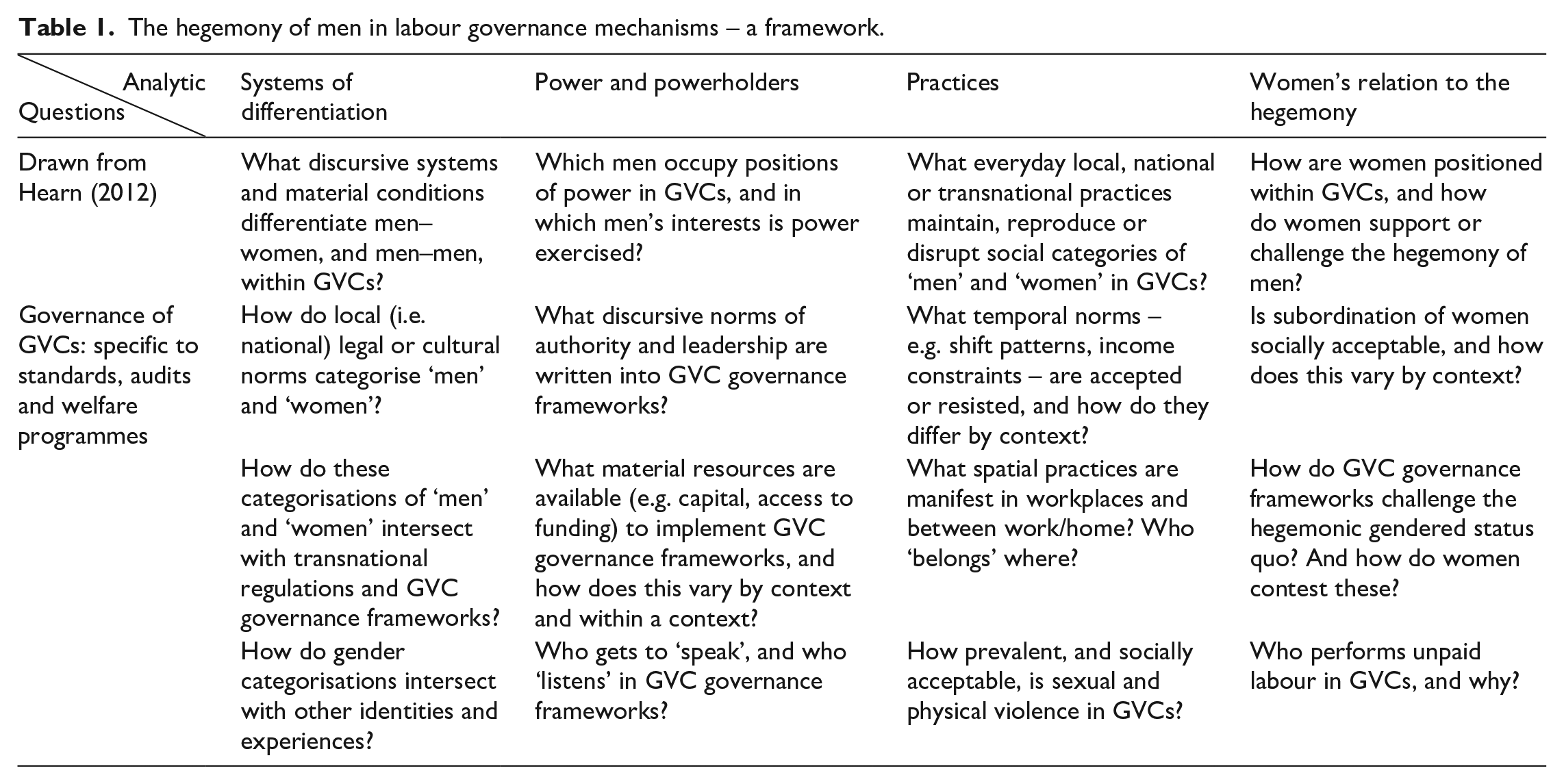
The most conceptually coherent way to do this is through careful reading of Hearn’s (2004, 2012) development of ways to see ‘the hegemony of men’, which ‘seeks to address the double complexity that men are both a social category formed by the gender system and dominant collective and individual agents of social practices’ (Hearn, 2004: 59, emphases in original). This highlights discursive and materialist experiences of gender (Hearn, 2012). Hearn’s argument draws on a wide range of theoretical influences, including Marxian feminist perspectives on political economy, historical scholarship, poststructuralist and postcolonial theory, queer theory and intersectional feminism, to allow for the development of a wide-ranging empirical agenda (see Hearn, 2012: 597–598). Importantly, Hearn advocates looking critically at ‘dominant constructions, powers and authorities of men in relation to women, children and other men, both men who are subordinate and those who are superordinate’ (Hearn, 2012: 597–598). This shows and deconstructs men’s categorical power, a practical action aligned with theoretical development that acknowledges the everyday realities of power relations within GVCs. This provokes a renewed research agenda for understanding the governance of GVCs (see Table 1), working with four of the categories that Hearn (2012) proposes. 1
The hegemony of men in labour governance mechanisms – a framework.
First, close examination of the system of differentiation shows the social category of men as a binary system of power relations with normative ideals embedded in it (Allen, 1998). This focuses on how and why men are set apart from women, discursively and materially, contributing to the social construction of a hierarchy of status designed to reproduce discriminatory gendered norms (Allen, 1998). This may include ‘conduct of state and statistical classifications; religious and educational practices; and institutional ways in which people are placed within the social category of men’ (Hearn, 2012: 597). Such systems of differentiation aid the hegemonic acceptance of a category of men. Within GVC research, it is especially important that race, religion, nationality, caste and migrant status be included in analysis of such systems of differentiation, given how embedded these are within racialised capitalism (Federici, 2004).
Second, detailed examination of which men, and therefore which men’s practices, shows how differentiation processes are framed. The category of men is best seen as a spectrum, a ‘composite, multi-layered hierarchical structure’ (Levine, 2015: 84) in itself. This spectrum is a political fact defined by dialectics of identity and difference articulated through social assumptions of binary reality (Manne, 2018). This translates into our proposal to treat the social category of men as: (a) different (from the social category of women, non-binary, trans and intersex people); (b) intersecting with other categorical experiences (e.g. race, religion and caste) in complex ways; and (c) open to material and symbolic differentiation within the broad overall category. This brings together discursive and materialist perspectives, to develop clarity on distinctions between men as individuals and group members, and the social construction of normative, repressive discourses as to how and why identity and membership are achieved/denied.
Third, it suggests more detailed attention to the everyday practices men engage in to maintain, reproduce or disrupt the social categories that patriarchal structures rely on. Hearn (2004) stresses that it is the everyday taken-for-granted naturalised, ‘normal’ performances of masculinity that should be detailed, rather than overt displays of ‘machismo’ (although these may also be present).
Finally, we turn to the effects of these systemic forms, power relations and practices on members of the social category of women and vice versa. This is distinctive from the excellent work that has been done on women’s experiences of working in GVCs (e.g. Barrientos et al., 2003). We propose starting with the specific question, following Hearn, of how a hegemony of men affects women and how they can support or undermine men’s practices. It is important to avoid any sense of women being responsible for the current dominance of men; however, there are complex responses written into women’s experiences, that may contribute to exploitation or resistance, individually or collectively (Kandiyoti, 1988).
Table 1 summarises these proposals, focusing on the questions that our review provokes in relation to the governance of GVCs. Taken together, this shows how analysing the social category of men as a means of critiquing GVC governance structures and practices can provide distinctive accounts of men’s agency for the analytical purpose of gaining insight (Hearn, 2004) into the power relations of GVCs. Power is a ‘very significant, pervasive aspect of men’s social relations, actions, and experiences’ (Hearn, 2004: 51) relative to women which, despite the increase in critical analysis of GVCs, corporate governance and labour conditions, continues to be under-theorised and under-analysed (Elias, 2008). Our argument leads to much more nuanced understandings of how key social categories are manufactured and maintained by a dominant group to reproduce social structures and everyday norms of practice. This reorientation towards dominant norms and taken-for-granted ideologies implies more attention to the ‘of whom and by whom’ (Hearn, 2004: 55) exercise of power to clarify the form and nature of dominance and resistance. It is also fundamentally practical in relation to lived experience, with the purpose of showing and deconstructing men’s power in order to understand and challenge exclusionary authority and patriarchal social systems. In this, it is the beginning of a feminist critical theory of power relations in GVC governance with emancipatory aims, challenging normative concepts and problematising their effects. We now turn to applying the framework to our field of GVC labour governance in order to demonstrate this.
Researching the hegemony of men in labour governance mechanisms: A framework
These four dimensions provoke a series of questions for GVC governance scholars, shown by brief illustrations drawn from our past research into labour governance standards and worker empowerment programmes in the UK, India and Ghana, alongside contributions from other scholars working in this area. Throughout we show how the hegemony of men is embedded in social audit and worker welfare programmes, which currently fail to capture or problematise asymmetries of gendered power manifest in the dominance of men. We raise the possibility that governance is based on (some) men’s interests in making the issues and interests of women and (some) men lesser or unimportant, and argue that this is a key research issue for the future.
Systems of differentiation
Hearn (2012) emphasises the social-structural forms that differentiate men from women, and between different groups of men. GVC governance is clearly structural in the shape of regulations, legislation and rules, and in the assumptions these forms make about who qualifies as ‘male’ or ‘female’, and differences within this binary (Connell, 1987). Feminist and postcolonial analyses have, to an extent, shown how and why contemporary global trade, commodities and capital flows – the fundamental systems that enable GVCs – are both gendered and racialised (Bhattacharyya et al., 2016; Gibson-Graham, 1996). Taking a historical perspective, Clark (1994) details how gender relations between men and women changed during British colonisation of Ghana, as women were excluded from the ‘masculine’ cash-crop business of cocoa, and pushed into more informal (and thus ‘inferior’) trading livelihoods. In India, Ramamurthy (2010) shows how the expansion of multinational corporations into cottonseed production relies on the intersection of caste and age to produce new gender roles, as men leave waged employment to grow cottonseed, formerly seen as young girls’ work. De Neve (2014) explores the different ways in which men and women within the garment sector in India navigate employment opportunities according to their gendered ages, class and caste statuses. Younger male textile workers are encouraged to compete with one another to produce most in the shortest amount of time, performing patriarchal forms of masculinity to reassert agency in repetitive and poorly paid work. This in turn sets the benchmark for women workers’ performance, often unachievable, leading to gender-based violence. These examples illustrate how GVCs not only thrive from systems of differentiation, but shape them by associating masculinities and femininities with different forms of work and worth.
Audit programmes which rely on the labour regulations, norms and assumptions of sourcing destinations create similar systems of differentiation. Their baseline is compliance with local regulations; however, state labour regulations act in themselves as a system of differentiation. For example, Indian labour regulations state maximum working hours as nine hours per day or 48 hours per week; beyond this, workers are entitled to receive overtime wages. These rules apply equally to both women and men; yet in addition, employers are encouraged to permit women to work only between 6 a.m. and 7 p.m. Even under exceptional circumstances, women should never be working between 10 p.m. and 5 a.m.; during working hours, women’s breaks are often closely monitored (Nagaraj, 2019). None of these latter restrictions apply to men. These temporal delineations show how labour regulations seek control over women’s time and work, and thereby societal position and role.
Norms and assumptions in context also act as systems of differentiation by characterising the types of work men and women will perform. Within GVCs, women are guided towards so-called lower-skill tasks, such as weeding, weaving, harvesting, fruit and flower picking, embroidery and packaging, positioned as diligent, unquestioning and delicate-fingered (Ahmed, 2018; Elson and Pearson, 1981; Ruwanpura and Hughes, 2016). Men are often found working at more physical tasks: pesticide-spraying, heavy machinery use, shifting, carrying and loading (McCarthy, 2018; Van der Gaag, 2014). Different tasks are socially constructed as suitable for women or men as an extension of normative gendered roles as carers or protectors (Salzinger, 2003), relevant to the spaces in which women and men are ‘supposed to’ be found: women ‘at home’ and men ‘at work’ (Ruwanpura and Hughes, 2016). This segregation affects pay, as roles women are encouraged into command less, or no, material reward (Bain, 2010).
Systems of differentiation are equally present within corporate-led welfare programmes, shown in a very clear distinction between social categories of ‘male’ and ‘female’ and the types of work people thus categorised are encouraged into. Such segregation is especially prevalent in the welfare focus on women’s economic empowerment. On one hand, these programmes represent awareness of women’s systemic oppression and exploitation; on the other, they reflect women as human capital, a resource for international agencies, governments and corporations (Prügl, 2015; Tornhill, 2019). Women are simultaneously positioned as victims and saviours, with implications for how men are situated in development (Cornwall et al., 2011) and corporate responsibility narratives (Lee and Parpart, 2018). Who is included in worker empowerment programmes, and how they are portrayed, reproduces the persistent, damaging norms that inflect the production of ‘correct’ roles and behaviours of women and men within systems of differentiation that uphold the hegemony of men.
Differentiation is also present in the types of economic activity women are encouraged into. Small-scale trading, baking, mobile phone charging or work designated as ‘craft’ are defined as suitable forms of ‘micro-entrepreneurship’ (Tornhill, 2019). These activities can fill gaps in regular working life, for example between harvests; however, they can also prevent women being recognised as legitimate agentic individuals. For example, in Ghana, female cocoa farmers were considered ‘helpers’ rather than full members of the profession (McCarthy, 2017). It is instructive to consider what jobs male workers might be encouraged to take if they were participants in a worker empowerment programme. Would they be guided to weave baskets, make jewellery or bake bread? Or would types of work and their attendant socially constructed notions of worth change, once men were involved (De Neve, 2005, 2014)?
In sum, both audit and welfare programmes neglect as well as contribute to continued systems of differentiation between women and men, and men and men, which in turn serve to maintain a hegemony of men and reproduce oppressive practices.
Powerholders
Hearn (2012) specifically calls for us to consider ‘which men?’. GVCs are sites of complex power imbalances (Nadvi, 2008), operating within racialised capitalism (Bhattacharyya et al., 2016), which tend to ‘concentrate power and dominance among particular groups of men’ (Patel-Campillo, 2012: 275) – white, usually European, Australasian or North American men. Hearn’s conceptualisation directs us beyond the North–South binary to consider the fluidity of intersectional power relations reproduced by men within a particular space (i.e. within North or South), which we now explore in this section.
Traces of racialised capitalism are found in the design and promotion of audit programmes that suggest southern actors are offenders to be externally monitored, in order to uphold northern righteousness (Elias and Beasley, 2009). This leads to the construction of northern consumers having an ethical conscience, and ‘white-knight’ heroic managers helping develop less fortunate local producers (Liu and Baker, 2016). Southern actors are depicted as ‘developing’ rule takers, their experiences or preferences given less importance (Khan et al., 2007). When orientation to change is based on practices of domination and top–down compliance, and when coercion and distrust surround the relationship, southern actors may resist through continuing irresponsible, oppressive practices, producing false evidence of compliance (Soundararajan and Brammer, 2018).
However, northern actors’ power can be diluted through the value chain (Nadvi, 2008; Soundararajan and Brown, 2016). Power is transient and contextually embedded (McCarthy, 2017) and although audit programmes are designed in the North, implementing actors are southern men who control resources on the ground. Within this, there is additional complexity, in that power and resources do not reside just with one group of southern men. Stratification through religion and caste in India, for example, plays a crucial role. There is uneven dispersion in resource endowment, uneven access to productive resources and opportunities and uneven rewards to resource contributions, making some groups of men more powerful than the others (Bapuji and Chrispal, 2020). Higher value generating activities in Indian GVCs are often controlled by upper caste Hindu men, while workers and those engaged in so-called lower value generating activities practice minority religions and ‘belong’ to lower castes (Soundararajan et al., 2018). Migrant men and women are discriminated and dehumanised by local residents and employers both in the North (Cohen, 2018) and the South (Revathy, 2018). In sum, some men have persistent control over other men and women, and some men are oppressed so that powerholders can retain their position. Unless these nuances are captured, as they are in the hegemony of men framework through its emphasis on men as a social category, audit programmes are unlikely to address oppression shaped by power relations in particular contexts.
Similarly, within corporate-led welfare programmes, power relations should ostensibly be re-balanced given the emphasis on ‘empowerment’ of workers (Tornhill, 2019). Yet defining women as ‘profitable subjects’ (Chatterjee, 2020: 10) does little to challenge systemic forms of gender, race and other oppressive social stratification (Özkazanç-Pan 2019). Participants are often selected based on demonstrations of compliance with programme agendas (Tornhill, 2019); the primary outcome is the promise of economic empowerment, however low quality the actual work itself. Claims that programmes help in achieving a form of economic independence are contrasted with low returns and high social and economic risks (Dolan and Scott, 2009; Prügl, 2015). While men in the global North finance and market such programmes (reaping reputational dividends), research suggests it is largely women who implement and run them, without full resources or a voice in the design (McCarthy, 2015). This omission is repeated in neglecting to consult producers’, workers’ and families’ preferences (Tornhill, 2019), as shown in McCarthy’s (2017) analysis of how women cocoa farmers were encouraged to work in ‘craft’ groups to supplement their farming income. The women preferred to work alone, resisting the programme’s design. Asking ‘which men’ are benefitting, and ‘which women’ are involved in empowerment programmes, opens up questions of intersectional power relations.
A focus on women workers and the exclusion of men within many corporate welfare programmes serves to reify the repressive system of difference on which the hegemony of men relies. For example, by only teaching women workers about health, nutrition and sanitation (modules offered by Primark’s Sustainable Lives or PACE), programmes continue to position women as family and community carers, with men absent, absolved or excluded from these responsibilities. This has considerable effects for allocation of unpaid care work, and contributes to male resistance to gender equality programmes (Van der Gaag, 2014). In combination with the feelings of powerlessness certain groups of men within GVCs may experience, further exclusion in this form may serve to exacerbate, rather than eradicate, inequalities.
Practices
We now direct attention to practices across GVCs through which systems of differentiation and power relations are reproduced. Two particular practices, exclusion and threat, are significant here. While audit programmes may be normatively based on the principle of democratic legitimacy, southern actors, especially women and marginalised men, are often excluded from design and implementation planning (Khan et al., 2007). Southern suppliers, unionists or workers are not fully represented on the standard governing boards (Alamgir and Alakavuklar, 2020); some may enjoy membership for observation, but without voting rights. This limits voice and has implications for the content of the benchmarks. For example, women’s specific needs related to working environments (e.g. safe transport, safe toilet facilities, access to breastfeeding space) are absent in part because of the exclusion of women’s voices and dominance of (some) men’s (Bain, 2010; Pearson, 2007). Simply adding women or marginalised people to these decision-making bodies does not equate to higher levels of equality (Alamgir and Alakavuklar, 2020). Even when appropriate provisions are included, control over resources can give dominant men power to maintain conventional business practices without implementing them.
Threat, another practice that maintains systems of differentiation and reproduces power relations, manifests at various levels in GVCs. At the transnational level, northern lead firms use threat as a tactic to make southern suppliers comply with preferred auditing programmes. Non-compliance is punished with penalties or order cancellation, encouraging compliance by any means possible. This rule-based approach to GVC labour governance reflects a patriarchal and racist discourse on control and authority. As Knights (2015: 212) explains: ‘[the use of] deontological rules and regulations . . . shores up, rather than threatens masculine phallic and logocentric power at the cost of an ethics of commitment to openness’. This helps explain how, despite the development of hundreds of auditing programmes, exploitation and corruption still occur in places that are apparently heavily ‘regulated’ (Connell and Wood, 2005).
As a result of threat, suppliers may engage in ‘evasion work’, everyday practices that appear ‘to follow the rules while violating the essence of those rules to misdirect the interpretation of others’ (Soundararajan et al., 2018: 1303). This creates a representation of conformity by, for example, bribing state authorities to obtain false documents or avoid inspection; training workers in ‘correct responses’ to questions; operating multiple facilities under different names; and falsifying workforce size for tax evasion purposes. This enables lead organisations and suppliers to satisfy stakeholders while perpetuating damaging or exploitative social and environmental practices.
Within factories and service spaces, threat is also used as a tactic to curb resistance and increase obedience. It is manifest in verbal or physical abuse, including sexual abuse, of women committed by dominant men such as male owners and supervisors (Global Labor Justice, 2019). Both women and men workers can be frightened away from expressing displeasure, speaking out during auditing practice or joining/forming unions (Anner, 2015). ‘Disobedient’ workers are dismissed or are subjected to further threat or physical violence.
The relationship between women and the hegemony of men
So far, we have explored how through systems of differentiation, positions of power, and practices, the hegemony of men is maintained through GVC labour governance. To conclude this section, we draw attention to women, to ask how women are positioned within GVCs in ways that support, or challenge, the production and maintenance of the hegemony of men.
Women negotiate positions in GVCs within a system of ‘patriarchal bargaining’ (Kandiyoti, 1988) that is especially significant to relative power within households, and therefore the degree to which women can contest gender relations. This process shapes not only women’s rational choices, to remain safe economically and socially while avoiding violence, but also their subjectivity and agency, varying from context to context. Within GVCs, some women make use of ‘coping mechanisms’, which suggests they (appear to) accept ascribed patriarchal practices. For example, women contribute to evading auditing practices by remaining silent or expressing what they were trained or ordered to do (Crane et al., 2019; Soundararajan et al., 2018). Some women (appear to) accept subordinate roles or less well-paid employment, positioning themselves as ignorant, refraining from expressing views or considering certain areas of work beyond their gender status (Kandiyoti, 1988). Women can adopt a ‘just world-view’ (Lerner, 1980) to make sense of gendered power relations, defending powerholders’ positions and attributing moral superiority to them. This can lead to intragroup othering: signalling of otherness among women workers, especially when one moves up in a role hierarchy as supervisor, manager or hostel warden. Within corporate-led welfare programmes in Ghana, some women emulate the competition and aloofness associated with (masculine) Ashanti leadership, further shoring up a particular narrative of masculinity and success in business (McCarthy, 2017).
Outside of work, unpaid labour such as housework, child and elder care or subsistence farming, and who performs it, is crucial to maintaining the hegemony of men, particularly within GVCs. Feminist scholars have long argued that girls’ and women’s opportunities in terms of education, paid work and leisure are reduced by unpaid caring tasks, which fall overwhelmingly to women (Folbre, 2006). Who performs unpaid care work matters because it contributes to assumptions about personal worth and value related to work (hooks, 2003), which in turn shore up the hegemony of men (Collinson and Hearn, 2005), and demean or ignore the unpaid labour on which capitalism also depends (Federici, 2004). In GVCs, women are associated with unpaid labour or poorly paid feminised labour, while men are associated with production and paid work (Ramamurthy, 2010). This has not changed as more women have moved into employment; many men still consider domestic work a fundamental subjective challenge to their identity as men (hooks, 2003; Kato-Wallace et al., 2014). Assumed roles and identities are naturalised such that women may insist they are responsible for these duties that men are ‘useless’ at, or unable to perform (hooks, 2003). This limits opportunities for men and women to engage in both spheres of experience, which would provide benefits for men, women and society (Van der Gaag et al., 2019). For example, men who experience shared caregiving in their childhood homes are more likely to practise this as adults (Levtov et al., 2014), indicating a pressing generational need for change in both attitudes (practices and relations) and structural policies (systems of differentiation) (Kato-Wallace et al., 2014) in the hegemony of men. Yet less than half of all nations provide paternity or shared parental leave, and where it is offered, men do not often use it (Van der Gaag et al., 2019).
GVC welfare programmes can contribute to damaging assumptions about unpaid labour practices, re-positioning women as carers and men as providers within the hegemony of men. When women are guided towards home-based crafts or trading that they can carry out alongside their caring responsibilities this can be read in two ways. It may be interpreted as a practical way of responding to how life is organised for the majority of women around the world, a corporate-led move to enable women to ‘bargain’ their time. However, these programmes do not challenge the damaging, discriminatory status quo; rather, they make it easier for assertions of appropriate practices for men (paid work, away from home) and women (unpaid or piecemeal work, close to home) to strengthen (McCarthy, 2017). This is problematic for any claims to ‘empowerment’ or ‘welfare’; without men taking on domestic unpaid labour, women cannot achieve freedom or equality (Folbre, 2006). Equally men’s lives are limited when they do not share in home-making and care of others (Van der Gaag et al., 2019). As much as unpaid labour is described as a ‘burden’, it is also an expression of love, belonging and community, that all human beings benefit from (Folbre and Nelson, 2000).
There are of course shifts in women’s relation to the hegemony of men. Bargaining connotes a repositioning of power, however small. In the cocoa value chain, some women used training and inclusion to call out inequities between men and women, particularly related to unfair sharing of unpaid labour (McCarthy, 2018). Women organised and vocalised against malpractice within Bangladeshi textile factories through trade unions (Alamgir and Alakavuklar, 2020), co-opted a ‘business-case’ for better treatment in Mexico (Plankey-Videla, 2012) and resisted gender expectations through ‘hysteric’ behaviours in Malaysia (Ong, 2010). Challenges to dominant power are facilitated through feminist NGOs and community groups, some of which work with GVC labour governance mechanisms to do so (Grosser and McCarthy, 2019). It is these small tales of resistance to the hegemony of men which we argue in the following section need to find more voice within our scholarship, as a means of renewing the research agenda on gendering in GVCs.
Renewing GVC research
Through this critical review, we offered observations about the relationship between the hegemony of men and two GVC labour governance mechanisms, standards/auditing and welfare programmes. Our argument, supported by accounts from our own and others’ research, develops a research agenda that focuses on the social category of men and the complex forms that interact with it. In this section, we show how this unfolds.
It is important to reiterate that we recognise how governance of GVCs and mechanisms developed to address labour injustices have produced material change at both producer and consumer ends of the chain. We also recognise that ‘gender’ is far from a silent aspect of GVC research. The detailed empirical work and sophisticated conceptual development that has been achieved within feminist work in particular is a model for the wider field of organisation studies, where there is still a tendency to ‘add women and stir’ as a means of demonstrating gender sensitivity, and an apparently unshakeable hostility to feminism, especially in its more radical implications, particularly in some of our higher prestige journals (Bell et al., 2020). However, GVC governance research approaches gendered analysis in a one-sided way, either presenting men as an absent structural presence or ignoring them altogether. As we have repeatedly made clear, men are not automatons and masculinity is not monolithic – there are many men and masculinities, many ways of seeing them and many manifestations of them among the many communities involved in GVCs.
Nonetheless, hierarchical binaries continue to structure everyday life, abjecting one side of the binary as ‘other’ and therefore subject to subordination in a hierarchy of thought, action and outcome. Within GVC research, we have shown that there is much important work on damaging hierarchies, especially in critical accounts of the social construction of gender and race. In renewing the GVC research agenda, Levine’s (2015) argument that hierarchies and binaries are not necessarily inevitably intertwined or mutually reinforcing is significant. For Levine (2015: 86), it is possible to take a formalist analytical approach that maintains analytical separation between hierarchy and binary, allowing the possibility of analysis through ‘multiple overlapping hierarchical binaries’ that are finely differentiated internally. We have used this in our argument already in two ways: in considering the significance of intersections of different forms of domination and oppression, and in observing that the social category of men is heterogeneous.
This creates empirical and conceptual complexity, but we remain convinced that there is a concise, clear and compelling case to respond to in our review of research in this area. The simple act of seeing and naming men provides focus on the presence of a hegemony of men across the complex inter-connected worlds of work and home embedded in GVCs. With this in mind, we conclude by outlining three routes derived from our analysis, pointing to ways in which research on GVCs and labour governance can be reoriented, with the aim of feeding insights into theory, policy and practice.
Theme 1: Naming men’s power in global value chains
Governing GVCs to improve labour practice requires explication of intersecting systems of differentiation, power, practices and women’s relationship to them. We know a substantial amount about women workers’ experiences, particularly in terms of workplace exploitation and harassment. In centring men as agentic subjects in their own right in discussions of gender, ethnicity, caste, religion, equality and labour relations, researchers can complement the powerful feminist work in this area. Paying more attention to the existence of the hegemony of men within GVCs has implications for everyone. For example, how do socio-cultural expectations of being a primary earner affect day to day decisions and behaviours (De Neve, 2014)? How do the pressures of securing and maintaining contracts with buyers in the global North intersect with localised, intersectional oppressions, and in what ways might this result in exploitative behaviour? What are the similarities and dissimilarities of pressures for ‘elite’ transnational business managers working in the global North and men working in the South? How is male power reproduced or challenged through social structural divisions in the global South? These questions viewed through a hegemony of men lens open up more ways of understanding power relations in GVCs, and how they contribute to the success or failure of labour governance.
One example shows the potential in this. Munir et al.’s (2018) insightful analysis of changes to Pakistan’s apparel industry provides an account of how a network of actors reconfigure a stable, long-established, culturally embedded, highly masculinised craft sector, transforming it into a precarious, globalised, feminised industrial context. Those who benefitted from changes were: the intermediaries and consultants who conducted recruitment campaigns, the factory owners and managers who extended their control over production, the governmental and development agencies who could take credit for the regeneration of Pakistani production, and of course western affluent consumers who can purchase low-cost apparel. (Munir et al., 2018: 578)
Each of these groups has, we would suggest, an interest in maintaining elements of the hegemony of men found in GVC labour governance mechanisms in their current form, rather than developing new, less damaging ways of working and organising. Starting with analysis of men as primary actors in the reproduction of patriarchal gender regimes and other forms of inequalities that sustain the kind of masculinities that have been identified as damaging provokes a very different understanding of GVCs that simultaneously centres and deconstructs men as actors.
Theme 2: Feminist methodologies and intersectional analyses
Rethinking GVC governance mechanisms through a hegemony of men lens also suggests a need to review our methodologies and methods. Greater use of feminist methods has already been suggested a number of times (e.g. Grosser and Moon, 2019), and is perhaps easily ignored by those disinterested in feminism. We would therefore suggest something more relational and contextual: the need to understand, in-situ, complex inter-relations enacted with reference to gender performances. An intersectional analysis (Crenshaw, 1989) is therefore key in surfacing assumptions related to men and masculinities. Understanding how masculinities are enacted in particular contexts, cognisant of the historical impact of global trade and colonisation, as well as the ongoing effects of globalisation and racialised capitalism (Liu, 2017, 2018), will provide a more nuanced account of how GVCs are structured, organised and governed by and for the social category of men.
This implies researching men-in-contexts, perhaps starting with the feminist principle that embodied, material, physically felt encounters (Sinclair, 2019) can generate research questions as meaningful as deductive reasoning. This more inductive approach builds on the impressive feminist postcolonial tradition of ethnography in global workspaces (Ong, 2010; Salzinger, 2003). Liu (2018: 81) also advocates the use of biographies and histories to ‘re-radicalise’ intersectional research: ‘Biography compels researchers to align ourselves with the struggles of marginalised subjects. History asks us to locate our subjects in their specific histories of social injustice’. This is crucial for research on GVCs and labour rights, in contexts imbued with many levels of practice and dark histories of racist trade and racialised colonisation. Feminist and intersectional methodologies ensure that we reject a ‘eurocentric’ or overly simplistic view on men and power (Liu, 2017, 2018), acknowledging the complexities of privilege and marginalisation within the social category of men in GVCs.
Getting physically close, seeing experiences from new angles and listening to people will ensure that the nuances of masculinity, men and resistance to hegemonic practices are noticed. We know that workers’ micro-resistance can destabilise the gendered and racialised status quo (Ong, 2010; Salzinger, 2003), but how we think about choice, agency and resistance in these often-constrained spaces needs close attention (Koggel, 2003). In the face of exclusion (Liu, 2017) and unemployment (Fernandez-Kelly and Wolf, 2001) some men may re-formulate codes of masculinity, perhaps in ways that enact and embody more collective, humanist principles (Morrell and Swart, 2005). Studies of masculinities enacted in ‘alternative’ or ‘caring’ modes in any kind of workplace (Elliot, 2016; Ely and Meyerson, 2010; hooks, 2003) are rare, but they offer intriguing suggestions for how labour governance mechanisms in GVCs might operate in different ways. Ely and Meyerson (2010) detail how oilrig managers govern safety issues with a focus on compliance and through collective care, encouraging employees to share learning, admit doubts, communicate thought-processes and engage in collectivist goals. Their analysis shows the potential for men to enact ‘masculine identities that reject domination and its associated traits and embrace values of care such as positive emotion, interdependence, and relationality’ (Elliot, 2016: 240). Other qualitative studies of environmental groups (Connell, 2005) and UN peacekeepers (Duncanson, 2009) provide illustrations of the existence, practicality and positive effects of alternatives to patriarchal forms of hegemonic masculinity, even in banking (Thym, 2019) where the hegemony of men is so strongly embedded and celebrated.
Yet such studies are rare, and empirical research which makes space for the stories of women and men in GVCs ‘doing gender’ differently, showing how difference and inclusion can be celebrated, is sorely needed. Recently BSR, a corporate social responsibility consultancy that promotes women’s empowerment programmes in GVCs, began including men within their ‘respect’ programmes addressing sexual and gendered violence in factory settings, in part through raising the issues of male dominance and alternative masculinities (BSR, 2019). How these programmes work, their strengths and weaknesses, and how they fit alongside wider structures and norms, are important areas for future research. Practising different ways of inhabiting the social category of men may, for example, involve resisting systems of binary differentiation, as powerholders navigate around or bypass them altogether, which may necessitate unique skills and capabilities.
Theme 3: The implications of analysing the hegemony of men for the intersection of GVCs and ‘grand challenges’
We have focused on working conditions and labour abuses in GVCs but exploring broader global challenges, such as the climate emergency, through a hegemony of men and masculinities lens is also obvious. Climate breakdown, pollution and the degradation of nature are all violence against humanity, often related to the social and economic dominance of men and masculinities. Sustainability transitions such as recycling or reducing carbon footprints are held back by some men’s perception of environmentalism as ‘unmanly’ and ‘gay’, and the fear that they will be categorised as such (Swim et al., 2020). Patriarchal masculinity, which also encourages avoidance of housework and childcare, considers caring for the planet to be emasculating at worst, and someone else’s problem at best (Brough et al., 2016). It may be coincidence that a number of prominent male politicians in North America, Australasia, Asia and South America currently deny climate emergency, despite growing evidence and protest; but it may not.
As we write this, another global crisis in the form of the COVID-19 pandemic is forcing us into new ways of governing GVCs, with classed, gendered and racialised dimensions. It is women, migrants and people of colour who continue to work in caring and essential roles throughout GVCs, often as commodity producers, supermarket stockists and cashiers, warehouse workers and couriers – work which is often insecure and low paid (Kikuci and Khurana, 2020). In homes, the gendered division of labour strengthens and extends (Adams-Prassl et al., 2020), and reports of gender-based violence proliferate (EIGE, 2020). At the beginning of many value chains, evidence suggests suppliers are having orders cancelled, driving already vulnerable workers into poverty (Anner, 2020). How men as a social category contribute to emerging crises, and how dominant forms of masculinity may be challenged to support change, is another crucial theme relevant to GVC scholars and beyond, more now than ever.
In conclusion
The overarching purpose of this article is to honour contributions to understanding gendered labour governance mechanisms and GVCs, while outlining a key empirical and conceptual framing that we believe has been overlooked. We have deliberately not presented this outlining as filling a ‘gap’ – given the volume of research in this area gap-spotting is not credible as a way of constructing an argument, nor would it respect the detailed research already published. We have however shown that there is a lack of recognition of masculinities and, especially, the social category of men, and suggested that this results in under-conceptualisation that affects all aspects of knowledge in the field. This is as true of the context that we work in, the North, as it is for knowledge that provides insight into the South. Masculinities have formed a transparent window through which researchers have looked, and hence made largely invisible. Men qua men have also been taken for granted in most GVC research, assumed as the norm or obscured, whatever the empirical setting. This article is a first step towards bringing masculinities and men into the light, as central to the governance of GVCs, and therefore integral to analysis. If this can be combined with existing intersectional understanding of women’s experiences wherever they live and work, the gendered nature of governance interventions from the North and feminist methodologies, then researchers in any cultural context will be better placed to inform the policy work that seeks to ameliorate labour practices throughout GVCs, while contributing to theoretical developments in gender studies.
Footnotes
Acknowledgements
We would like to thank Associate Editor Dr Helena Liu for generous editorial guidance on this article as it developed during the review process. The three reviewers were also generous in constructively critical readings of the argument. This article benefitted from comments and questions during presentation at the Academy of Management 2019, Gender Work & Organisation in Sydney 2018 and the International Centre for Corporate Social Responsibility, University of Nottingham.
Funding
The authors disclosed receipt of the following financial support for the research, authorship and/or publication of this article: University of Birmingham Institute of Advanced Studies.
