



Abstract
The purpose of this study was to assess the association between attention-deficit hyperactivity disorder (ADHD) symptoms and rejection sensitivity in college students, and whether it is mediated or moderated by elements of mental well-being. Using a cross-sectional design, the study examined 304 Hungarian college students who responded online to a set of questionnaires that included the Adult ADHD Self-Report Scale, The Mental Health Test, and the Rejection Sensitivity Questionnaire. Path analysis indicated that well-being, creative/executive proficiency, self-regulation, and resilience partially mediated the relationship between ADHD symptoms and rejection sensitivity, while savoring moderated this link. The model explained up to 50% of the total variance in rejection sensitivity scores. Findings suggest that university students with ADHD symptoms may particularly benefit from acquiring savoring skills to enhance their mental well-being and lower rejection to sensitivity. As such, the results carry significant implications for counseling psychologists, educators, and mental health professionals working in the higher education sector.
Young adulthood is marked by significant changes: individuation from family, development of new social connections, and increased responsibility and autonomy (Duffy et al., 2019). Moreover, this period presents a high risk for maladaptive cognitions, academic struggles, and the onset of mental health conditions, all while self-regulation skills are still under development (Tariq et al., 2021). Due to these unique stressors and vulnerabilities, university students are a population of particular interest to policy makers, mental health professionals, educators, and researchers (Emmerton et al., 2024). For many young adults, the university serves as the hoped-for environment for social and academic flourishing, yet the prevalence and intensity of mental health problems are on the rise (Sanders, 2023). While risk factors are well established, the literature offers little guidance on how to maintain positive mental health.
To help fill this gap in the literature, in this study we focused on the theory of positive psychology introduced by Seligman and Csikszentmihalyi (2000), which boosts research, enabling us to better understand the role of positive personality characteristics in flourishing at both individual and social levels. Flourishing, a relatively new concept in psychology, offers a promising framework to support the ongoing process of self-regulation and achieve emotional and social well-being. Notably, the well-established factors of positive psychology, such as competence, emotional stability, positive emotions, positive relationships, and resilience, significantly overlap with the characteristics needed for successful academic adjustment (Hassan et al., 2023). This is especially important for historically disadvantaged groups in higher education, who often find this transition particularly challenging. For example, diversity factors such as ethnicity, gender, sexuality, culture, socio-economic status, and disability can significantly heighten stress and psychological difficulties during this period (Volstad et al., 2020). Given the rising number of students with disabilities on college campuses (DuPaul et al., 2021), there is an urgent need for a framework that promotes our understanding of health maintenance, helps social adjustment, and empowers them to thrive in this environment.
Incoming first-year university students represent a population with a significant prevalence of attention-deficit hyperactivity disorder (ADHD), with Mak et al. (2022) reporting that 15.9% of university students across nine countries screened positive for ADHD risk and Shaw and Selman (2023) noting a prevalence of 8.4% in the United Kingdom. Despite increasing awareness, a concerning number of individuals remain undiagnosed (Lovett et al., 2015), however. This issue is particularly concerning in Hungary, as national data suggests that ADHD prevalence among adults falls between 2% and 4% (Bitter et al., 2010). However, data on the prevalence of ADHD among university students is still unavailable, and existing resources for diagnosis and intervention are insufficient to meet the significant demand (Kilencz et al., 2024). This disparity likely contributes to a high number of students with ADHD symptoms remaining undiagnosed.
University students with ADHD symptoms face substantial challenges in their education. Such struggles often stem from difficulties with emotion regulation and a heightened vulnerability to internalizing disorders (Farmer et al., 2023). Thus, growing research acknowledges emotional symptoms as intrinsic to ADHD, emphasizing their impact on well-being, educational outcomes, and mental health (Reimherr et al., 2020; Villemonteix et al., 2015). It is important to acknowledge that self-reported ADHD symptoms can overlap with other conditions, including substance use disorders (Bahji, 2024), autism spectrum disorder (Waldren et al., 2024), learning disabilities (Kellens et al., 2024), bipolar disorder (Barden et al., 2023), mood disorders (particularly major depressive disorder), and generalized anxiety disorder (Alarachi et al., 2024). However, the high prevalence of emotional dysregulation alongside ADHD symptoms is independent of comorbidity (Shaw et al., 2014), underscoring the need for a deeper understanding of these connections, especially within the unique population of university students (Lovett et al., 2015).
Highlighting the need for assessment and support for this population, our study investigated the connection between ADHD symptoms and rejection sensitivity (RS) among college students. Specifically, we examined whether constructs of mental well-being, including resilience, self-regulation, general well-being, and creative/executive functioning, mediate or moderate this relationship.
The Link Between RS and ADHD
RS is a cognitive-behavioral construct that refers to the predisposition to anxiously anticipate, quickly identify, and overreact to instances of rejection (Downey et al., 1997). While not recognized as a distinct diagnostic entity, it is understood to be a cognitive-affective bias or personality disposition characterized by an increased sensitivity to social rejection (Gardner et al., 2020). This negative emotional reaction, while widespread, is chronically understudied, especially in the context of adult ADHD symptoms.
The RS model (Downey & Feldman, 1996) suggests that extreme sensitivity to signals of rejection, leading to overreactions, stems from a natural learning process. Such sensitivity can be a product of early, extended, or intense experiences of rejection from caregivers or important individuals in a person's life (Gardner et al., 2020). Through these experiences, children learn to anticipate rejection in situations involving close relationships. Therefore, the anxious anticipation of rejection forms the starting point of the dynamics. This tends to result in a reduced threshold for perceiving negativity, a heightened tendency to take negative cues personally, and intense emotional responses (Pietrzak et al., 2005). This inclination toward oversensitivity, in turn, can alter behavioral patterns in a way that can result in actual rejection (Meehan et al., 2018; Mor & Inbar, 2009; Ng & Johnson, 2013).
Since high RS and the subsequent emotional symptoms are prevalent among individuals with ADHD traits (Babinski et al., 2019; Jaisle et al., 2023), some view them as an intrinsic aspect of the disorder rather than merely an associated characteristic (Faraone et al., 2019). Symptoms of ADHD are generally perceived negatively (Beaton et al., 2022) and often provoke a hostile emotional state and intense interpersonal rejection (Paulson et al., 2005). For example, children with ADHD symptomatology frequently experience peer rejection and negative interactions within their home environment. Further, parents are more inclined to demonstrate greater levels of criticism and lesser warmth towards children exhibiting ADHD traits (Psychogiou et al., 2007). Research has linked childhood ADHD symptoms and the often co-occurring oppositional behavior with negative attachment, implying that rejection by parents can, in some instances, be a persistent issue (Clarke et al., 2002; Gomez & Gomez, 2002).
The challenges that adults with ADHD symptoms encounter in social settings are well documented (Wymbs et al., 2021). Qualitative studies, for example, have revealed that adults with ADHD symptoms struggle with maintaining relationships (Kwon et al., 2018; Matheson et al., 2013) and moderating their behavior to conform to social norms (Schreuer & Dorot, 2017). In experimental research, undergraduate students expressed decreased levels of inclination to engage with individuals exhibiting behaviors characteristic of ADHD (Canu et al., 2008; Paulson et al., 2005). Further, negative perceptions of individuals living with ADHD symptoms are not contingent upon their success or abilities. Even high-functioning adults with ADHD symptomatology report experiencing heightened levels of judgment from others (Sedgwick et al., 2019).
Although adults with ADHD symptoms often encounter challenges in interpersonal relationships, social support can enhance functioning for this population (Ginapp et al., 2023). According to Segrin (2001), when individuals with ADHD symptoms face social rejection, they are more likely to respond by adopting avoidant behaviors. Additionally, they are prone to experience heightened psychological distress (Paulson et al., 2005).
The Mediating Role of Mental Well-Being in the Link Between ADHD and RS
Increased RS is associated with a lower quality of life, diminished social support, and reduced psychological well-being (Ng & Johnson, 2013). Furthermore, it has been found to predict the progression and outcome of depression, exhibiting a positive association with a higher prevalence of depressive symptoms (Ayduk et al., 2000; De Rubeis et al., 2017). While mental disorders have received extensive attention to date, there is a scarcity of published research on factors that promote positive adaptation and well-being in individuals with high RS.
In recent years, there has been a growing interest in well-being research (Rusk & Waters, 2015). Over this period, the concept of mental well-being has evolved from being solely defined as an absence of ill-being, focusing exclusively on positive individual functioning without accounting for emotions (Rose et al., 2017), to encompassing a state of flourishing (Keyes, 2007). Additionally, authors from the field of positive psychology emphasize the importance of assisting individuals in maintaining meaningful lives and achieving satisfaction. However, the mere elimination of negativity does not necessarily usher in positivity (Seligman et al., 2005).
Zábó et al. (2022) proposed the Maintainable Positive Mental Health Theory (MPMHT), an innovative framework building upon classical models and contemporary theories of positive psychology, which conceptualizes mental health as a function of personal capabilities such as resilience and creative/executive competencies. These attributes empower individuals to strike a balance with their external environment, thereby promoting personal growth. The components also ensure consistent functioning within an individual (through self-regulation) and facilitate the balance between positive and negative emotions (using coping and savoring strategies). The efficient interplay of these factors culminates in global well-being, a multifaceted construct encompassing personal and social dimensions. Notably, the MPMHT recognizes the critical role of social acceptance, making it potentially valuable for understanding and supporting adults with ADHD symptoms, who often experience heightened sensitivity to rejection.
In relation to RS, resilience acts as a mediator (Sart et al., 2016), enabling individuals to harness their mental resources to preserve their well-being in the face of stress and adversity. Higher resilience correlates with a more rapid recovery from stressful situations, including potential social rejections (Verdolini et al., 2021). Self-regulation strategies like delayed gratification and cognitive-attentional cooling can also help individuals with ADHD symptoms manage their emotional reactions to rejection, particularly in social situations (Ayduk et al., 2000). These strategies allow individuals to pause, assess the situation calmly, and respond more effectively, reducing the negative impact of the perceived rejection. Creative and executive efficiency refers to the ability to effectively generate diverse solutions to problems, both personally and socially (Zábó et al., 2022). By applying creative thinking to social interactions, individuals with ADHD symptoms can develop unique strategies to navigate potential rejections, minimizing their emotional impact (Kraines & Wells, 2017). Finally, global well-being encompasses not just psychological health but also spiritual and social dimensions (Zábó et al., 2022). This includes factors like social acceptance, self-actualization, and positive societal contributions. Individuals with higher levels of global well-being tend to view life and social interactions more positively (Lench & Bench, 2012). This positive outlook can alter the perception of social cues (Hecht, 2013), potentially mediating the perception of rejection.
The Role of Savoring Capacity in the Link Between ADHD and RS
Beyond well-being, resilience, self-regulation, and creative efficiency as potential mediators between ADHD symptoms and social functioning (Zábó et al., 2022), a fifth element may play a unique role in this relationship. Savoring, the ability and capacity to actively seek out, appreciate and hold onto positive experiences and pleasures (Bryant & Veroff, 2007; Bryan et al., 2022) is a prerequisite in the MPMHT framework (Zábó et al., 2022). Savoring is a key process within the broaden-and-build theory of positive emotions, which posits that positive emotions expand one's awareness and inspire a broader range of thoughts and actions. This expansion leads to the acquisition of new experiences, enhanced abilities, and stronger social ties, all of which contribute to greater health and relationship satisfaction. Furthermore, positive emotions can act as a cushion against the impact of negative emotions (Fredrickson, 2001; Smith & Bryant, 2016). This aligns with the Dynamic Model of Affect (DMA), suggesting that individuals have a wider range of emotional experiences in the absence of stress, with positive and negative emotions operating more independently (Walter & Bruch, 2008).
In addition to its direct association with well-being (eg, Bryant, 2003; Wood et al., 2003), savoring is further proposed as a moderator variable (Bryant & Veroff, 2007; Chadwick, 2012; Costa-Ramalho et al., 2015). That is, empirical research suggests that savoring acts as a moderating factor in various situations, from buffering the impact of traumatic experiences (Sytine et al., 2018) and moderating the link between negative emotions and suicidal behaviors (Klibert et al., 2019) to influencing the relationship between activity engagement and aspects of well-being, including life satisfaction, depression, loneliness, and sense of purpose (Smith et al., 2020). In the MPMHT framework, savoring belief refers to people's perceived capacity to savor positive life experiences. Although in the case of ADHD symptoms, sustaining attention to positive experiences often seems challenging (Segal, 2023), savoring could counterbalance the negative emotions associated with RS. While individuals with ADHD symptoms experience more stress and negative emotions during their university years than their peers without ADHD (Sahmurova et al., 2022), we anticipate that their capacity to savor may play a crucial role in experiences of rejection.
A previous study found that ADHD symptoms may directly predict RS (Hussain, 2024). However, given that RS likely stems from prior rejection by peers and parents (Gardner et al., 2020), rather than low capacity to savor, we proposed it would moderate rather than mediate (directly explain) the link between ADHD symptoms and RS. In particular, we expected higher levels of savoring to weaken or eliminate the association between ADHD symptoms and RS, while lower levels of savoring would strengthen this association. By enhancing the frequency and intensity of positive emotions, individuals with ADHD symptoms might experience a more balanced emotional state, potentially weakening the connection between the symptoms and RS.
Based on the related findings from the literature, the aim of our study was to (a) confirm a direct link between college students’ ADHD symptomatology and RS; (b) investigate whether the positive psychological constructs, well-being, creative and executive efficiency, self-regulation, and resilience, mediate the relationship between ADHD symptomatology and RS; and (c) to determine if savoring capacity moderates the relationship between the ADHD symptomatology and RS. Given the absence of a well-established theoretical framework regarding the potential predictive or moderating effects of savoring capacity in this relationship (Costa-Ramalho et al., 2015), the present study remains exploratory.
Method
Study Design and Participants
Between February and May of 2023, we conducted a cross-sectional study using an online Typeform survey. The study targeted all university students in Hungary by disseminating the survey through Neptun, a unified platform adopted by all Hungarian universities. To enhance reach, the questionnaire was also shared in Facebook groups popular among Hungarian students, particularly those focusing on research, psychology, and ADHD. Participation was voluntary, and no compensation was offered. To be included, participants had to (a) be over 18 years of age, (b) be active students at a Hungarian university, (c) give written informed consent, (d) report no difficulties in understanding the questions, and (e) admit to have responded truthfully and carefully. Application of these criteria did not lead to any exclusions. A total of 304 students, 237 (78%) female and 65 (21.4%) males, enrolled in higher education institutions in Hungary, participated in the study. Their ages ranged from 18 to 35 years (M = 24.38, SD = 4.39).
Hungary's universities and colleges award degrees through a well-established three-tier system aligned with the European Qualifications Framework (EQF). Bachelor's programs (EQF Level 6) typically take 6–8 semesters (3-4 years) to complete. Students can then pursue optional master's programs (EQF Level 7) lasting 2–4 semesters (1-2 years). A unique feature of the system is the undivided one-tier master's program, combining bachelor's and master's coursework into a single 5- to 6-year direct program for a master's degree in specific fields like medicine or teacher training. Finally, doctoral degrees (EQF Level 8) are pursued as 4-year postgraduate programs.
In our sample, 56.6% (n = 175) of the participants were in a bachelor's program, 21.7% (n = 66) in an undivided one-tier master's program, 13.8% (n = 42) in doctoral studies, and 6.9% (n = 21) were pursuing a master's degree. Most were full-time students (71.4%, n = 217), while 26.3% (n = 80) were part-time, and a minority were distance learners (2.3%, n = 7).
In the survey, participants could disclose learning disabilities/difficulties or decline disclosure. None of the participants reported having a learning disability (or chose to decline to answer); 11 participants (3.62%) reported a previous diagnosis of ADHD. All participants identified Hungarian as their primary language.
We strictly followed the principles of the Declaration of Helsinki and Recommendations for the Conduct, Reporting, Editing, and Publication of Scholarly Work in Medical Journals formulated by the International Committee of Medical Journal Editors (ICMJE). The study procedures received approval from the Institutional Review Board of the University of Szeged, Doctoral School of Education (7/2021). After providing informed consent, participants shared demographic details and completed the survey. Notably, the participants responded to all items on the respective scales; no data were missing. The study materials were administered in the Hungarian language.
Measures
Attention-Deficit Hyperactivity Disorder
ADHD symptoms were screened using the Adult ADHD Self-Report Scale (ASRS-v.1.1), developed by the World Health Organization (WHO) (Kessler et al., 2005). The scale, which can be completed in a self-reported manner, encompasses 18 items (eg, “How often do you fidget or squirm with your hands or feet when you have to sit down for a long time?”), each to be responded to on a five-point Likert scale indicating the frequency of the experienced symptoms from 0 (never) to 4 (very often). The primary goal of the ASRS-v1.1 is to serve as a reliable tool to identify adults who may need further assessment for ADHD. The scale is not intended to diagnose ADHD but to serve as a first step in the screening process. Total scores for the 18 items can range from 0 to 72. Higher scores reflect higher degrees of ADHD symptoms. In line with previous studies (eg, Hawi & Samaha, 2024; Garcia Pimenta et al., 2024), the current study assessed ADHD symptoms using the ASRS total scores, demonstrating good internal consistency (Cronbach's α = .87).
In addition to the total score, the first six items of the ASRS function as an effective screening tool for ADHD risk. While the original dichotomous scoring method (assigning 1 point for exceeding the threshold) has been updated, research suggests the 0–24 scale is more robust and better suited for studying ADHD prevalence and related factors compared to the 0–6 system (Kessler et al., 2007). This revised scale classifies scores into four categories: 0–9 (low negative risk), 10–13 (high negative risk), 14–17 (low positive risk), and 18–24 (high positive risk).
Mental Well-Being
The Mental Health Test (Zábó et al., 2022) was used to assess participants’ comprehensive picture of positive psychological well-being. The questionnaire consists of 18 items with five subscales. Three questionnaire items are suitable for measuring well-being (eg, “Joy is present more than sorrow in my everyday life.”), three assess savoring (eg, “I like to store memories of fun times that I go through so that I can recall them later.”), five items measure creative and executive efficiency (eg, “Others describe me as a problem solver.”). Three items assess self-regulation (eg, “I am impulsive: I act first and think second.”), and the final subscale made up of four items focuses on resilience (eg, “It does not take me long to recover from a stressful event.”). The items are responded to on a six-point Likert scale ranging from 1 (does not agree at all) to 6 (agrees completely). The internal consistency values of the subscales were above .70, more precisely: .89 for well-being, .76 for creative and executive efficiency, .70 for resilience, .71 for self-regulation, and .75 for savoring.
Rejection Sensitivity
The Rejection Sensitivity Questionnaire (A-RSQ; Berenson et al., 2009) assesses participants’ cognitive-emotional disposition to anticipate rejection anxiously. The A-RSQ comprises 18 scenarios presenting potential interpersonal encounters with a likelihood of rejection from an important figure (eg, “You ask your parents or another family member for a loan to help you through a difficult financial time.”). Participants are asked to assess their anxiety levels regarding the probable outcome of each presented situation. Additionally, they evaluate the perceived probability that the person of significance in each scenario would react with rejection. The cumulative RS score is calculated by the RS score for each situation by multiplying the rejection concern by the level of rejection expectancy. Scores can range from 18 to 432. Higher scores indicate a higher level of RS. Cronbach-α value = .84 in the current study.
Data Analysis
First, descriptive and correlational analyses were performed using the IBM Statistical Package for Social Sciences (SPSS, version 26.0.). Second, we conducted multiple mediators with a moderator analysis (Model 5) using Preacher and Hayes (2008) PROCESS macro v4.1 for IBM SPSS. The model used 5000 resamples through bootstrapping confidence intervals (CIs) to determine the significant effects. We followed Hayes’ (2022) recommendations, and the bias-corrected 95% CIs were selected. In this case, the indirect effect is significant if the CIs do not include 0. The conditional indirect effects were evaluated at three levels: one standard deviation above the sample mean, one below the sample mean, and the sample mean itself. Before conducting the path analyses, all continuous variables were standardized.
Results
Descriptive Statistics and Bivariate Relationships
Based on the ASRS screening tool, 23.9% (n = 89) of participants scored in the low negative, 35.9% (n = 109) in the high negative, 22.7% (n = 69) in the low positive, and 12.2% (n = 37) in the high positive category for ADHD risk. Before the mediation and moderation analysis, we examined the correlations between all variables, as detailed in Table 1. The ADHD symptom score demonstrated a positive correlation with RS scores (r = .46, p < .01). This suggests that as ADHD scores increased, RS scores also tended to increase. However, ADHD scores showed a significant negative correlation with measures of well-being (r = -.34, p < .01), indicating that higher ADHD scores were associated with lower well-being. Similarly, there were negative correlations with creative and executive efficiency (r = -.18, p < .01), self-regulation (r = -.23, p < .01), resilience (r = -.32, p < .01), and savoring (r = -.26, p < .01).
Intercorrelation Between Measured Variables for the Full Sample (N = 304).
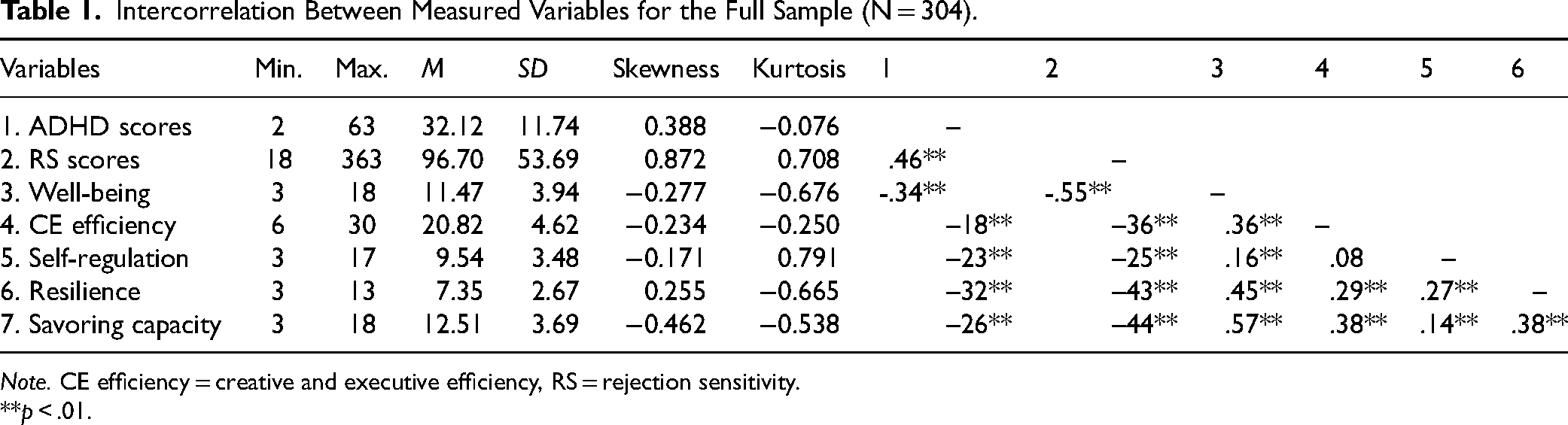
Note. CE efficiency = creative and executive efficiency, RS = rejection sensitivity.
**p < .01.
Further, the RS scores showed a significant negative correlation with well-being (r = -.55, p < .01), creative and executive efficiency (r = -.36, p < .01), self-regulation (r = -.25, p < .01), resilience (r = -.43, p < .01), and savoring (r = -.44, p < .01). Well-being, in turn, showed a positive correlation with creative and executive efficiency (r = .36, p < .01), self-regulation (r = .16, p < .01), resilience (r = .45, p < .01), and savoring (r = .57, p < .01). Creative and executive efficiency also positively correlated with resilience (r = .29, p < .01), and savoring (r = .38, p < .01). Lastly, there was a significant positive correlation between resilience and savoring (r = .38, p < .01). Finally, although the data indicated a positive correlation between creative and executive efficiency and self-regulation (r = .08, p > .05), it was not statistically significant.
The skewness and kurtosis values of the measured variables fell within the acceptable range of ± 1.0 (Hair et al., 2022), suggesting that the data distribution was approximately normal. Furthermore, variance inflation factors ranging from 1.07 to 1.66 and tolerance values between 0.60 and 0.71 indicated no substantial multicollinearity among the independent variables. The data also met the assumption of independent errors (Durbin–Watson = 1.93), and homoscedasticity was confirmed by the Breusch–Pagan test (χ² = 6.25, p = 0.09). Based on these results, all the correlated variables were included in the further analysis.
Mediation and Moderation Analyses
We conducted multiple mediators and a moderator analysis to assess the role of positive mental health constructs in the relationships between ADHD scores and RS. The mediator variables included well-being, resilience, self-regulation, and creative and executive efficiency competence. Furthermore, the model explored the direct effect of ADHD symptoms on RS and whether it was mediated or moderated by savoring capacity.
First, we assessed the relationships between ADHD scores and each of the mediators. ADHD scores were significantly associated with each mediator. The analysis revealed that an increase in ADHD scores was associated with a decrease in all four mediators. ADHD scores were negatively associated with well-being (β = -.343, p < .001), creative and executive efficiency competence (β = -.183, p < .01), self-regulation (β = -.230, p < .01), resilience (β = -.321, p < .001), indicating that as ADHD scores increased, scores on these variables tended to decrease.
Next, the direct effect of ADHD scores on RS scores was assessed. The analysis revealed a significant positive association (β = .466, p < .001), suggesting that as ADHD scores rise, there is a similar increase in RS scores. The relationships between the mediator variables and RS scores were also examined. Well-being (β = -.302, p < .001), creative and executive efficiency (β = -.157, p < .01), self-regulation (β = -.157, p < .01), and resilience (β = -.112, p < .05) had a direct effect on the outcome variable. These findings imply that lower scores on these variables were associated with higher RS scores.
Mediation Effect
Finally, we explored the indirect effects of ADHD scores on RS scores through the mediators. These indirect effects, represented by the total of the individual indirect effects via well-being (B = .103), creative and executive efficiency competence (B = .028), self-regulation (B = .023), and resilience (B = .036), indicate that these variables serve as pathways in the link between ADHD symptom severity and RS scores. Savoring capacity did not meet the criteria for mediation as defined by Baron and Kenny (1986) due to a non-significant beta coefficient (β = -.035, p = .526). After controlling for the measured variables, ADHD scores demonstrated a significant effect of .227 (p < .001) on RS scores, indicating partial mediation. Based on 5000 bootstrap samples, all direct and indirect paths were significant (except for savoring capacity as a mediator), as the 95% bias-corrected CIs did not include zero in each case (see Table 2).
Point Estimates and 95% CIs for the Indirect Effect of ASRS Scores on Rejection Sensitivity Through the Mediator Variables.
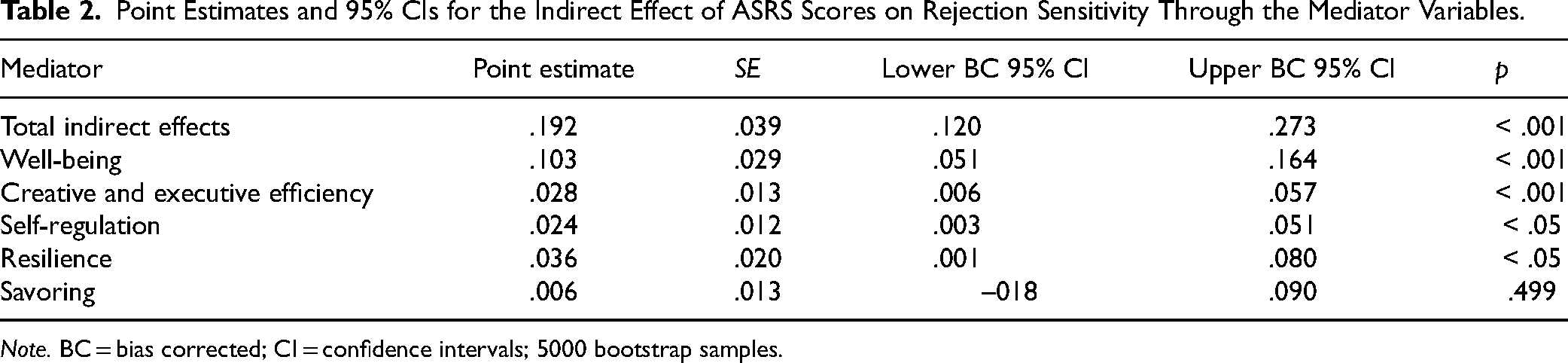
Note. BC = bias corrected; CI = confidence intervals; 5000 bootstrap samples.
Moderation Effect
The moderation analysis revealed that savoring capacity significantly moderated the relationship between ADHD and RS (β = −.244, p < .001). The buffering impact was significant at low (−1 SD) and mean levels of savoring, but diminishes at the higher level (+1 SD), as presented in Table 3. For students who reported low and mean levels of savoring, the relationship between ADHD and RS was stronger and significant. For students with high levels of savoring, on the other hand, the relationship between ADHD and RS was weaker and insignificant. The overall model explained 50% of the variance in the RS scores (R2 = .508, F = 43.787, p < .001). Figure 1 provides the final model, incorporating both direct and indirect effects.
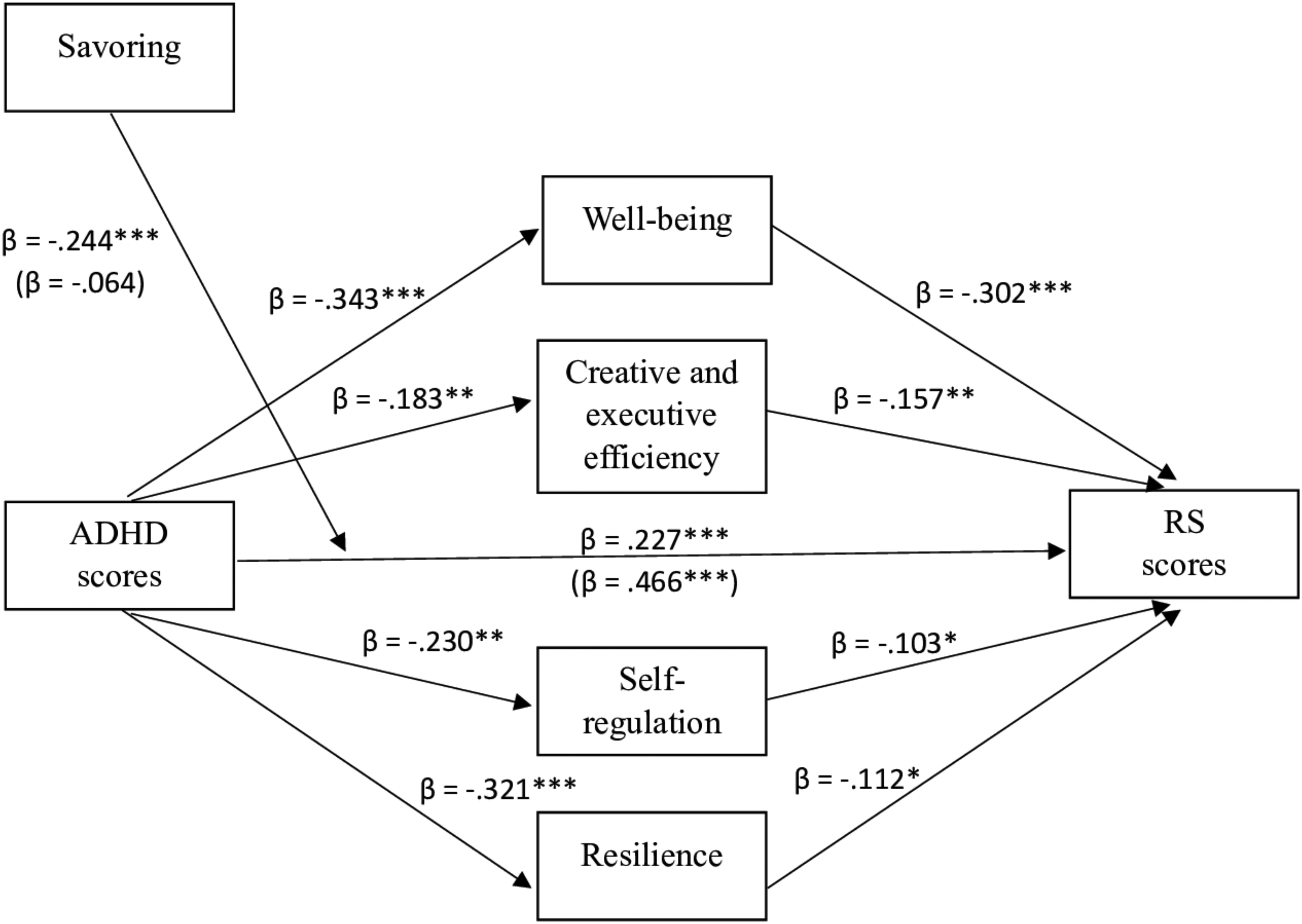
Multiple mediators and a moderator model
Point Estimates and 95% CIs for the Moderating Effect of Savoring Capacity on the Relationship Between ADHD and Rejection Sensitivity.
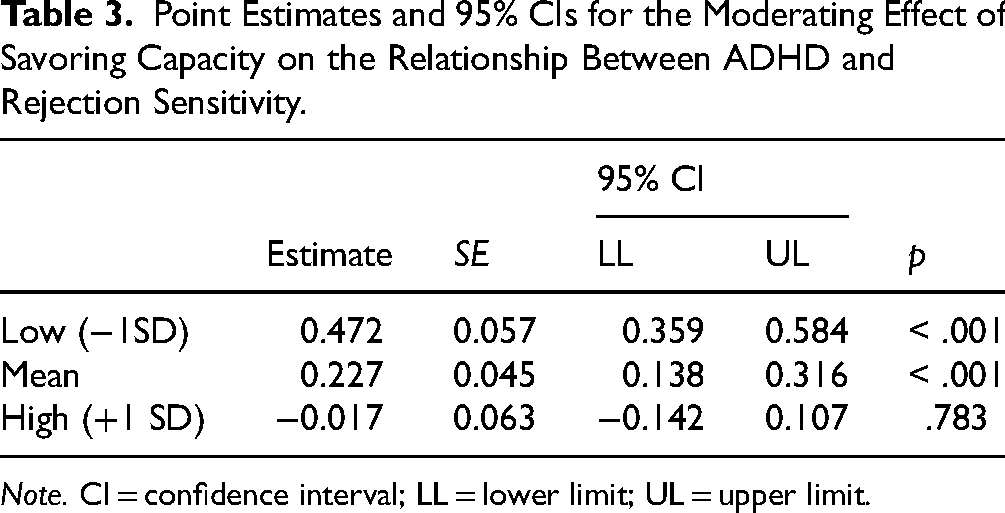
Note. CI = confidence interval; LL = lower limit; UL = upper limit.
Discussion
This study examined the underlying mechanisms in the link between ADHD symptoms and RS among college students, with particular emphasis on their mental well-being. As illustrated, our results indicated a direct positive link between ADHD symptoms and RS. This relationship can be partially explained by inadequate levels of well-being, creative and executive efficiency, self-regulation, and resilience. Additionally, savoring capacity acted as a moderator between these two constructs. Students with low levels of savoring capacity had a stronger connection between ADHD symptoms and RS.
The Mediating Role of Positive Psychological Constructs
The fundamental constructs of the MPMHT mediated the relationship between ADHD symptoms and RS scores and partially explain the observed connection. Previous studies have linked RS and reduced well-being (Efeoglu & Sen, 2022); however, the influence of ADHD symptoms within this context has remained unexplored.
First, well-being had the most substantial mediating effect, suggesting that ADHD symptoms might lead to reduced feelings of well-being (Fuller-Thomson et al., 2022). Individuals with ADHD symptoms often encounter social and emotional challenges that can affect their overall sense of well-being, subsequently heightening their awareness of signs of rejection. Second, creative and executive efficiency plays a pivotal role in this relationship. While individuals with ADHD symptoms may exhibit a rich diversity of creative thoughts (Girard-Joyal & Gauthier, 2022), they may struggle to filter, refine, or execute them efficiently due to executive function challenges. This inefficiency in managing creative thoughts could lead to heightened sensitivity to rejection, as these individuals might perceive their ideas as frequently dismissed or misunderstood. Reduced scores in creative and executive efficiency may lead to perceiving problems as threats, resulting in a tendency to avoid rather than proactively address challenges (Kraines & Wells, 2017). Third, resilience acts as a mediator. Given that individuals with ADHD symptoms frequently face setbacks and challenges that can diminish their capacity to rebound from adverse situations (Freire et al., 2021), individuals may develop a heightened sensitivity to negative feedback, as they may lack the adaptive mechanisms to recover from such experiences. Lastly, self-regulation, often compromised in ADHD (Christiansen et al., 2019), can lead to impulsivity and difficulties in managing emotional responses, further reducing its protective effect on sensitivity to rejection.
Although the proposed mediators provide a comprehensive framework for understanding the interaction between ADHD symptoms and RS, and explained a substantial proportion of the variance in RS scores in the current study, full mediation was not achieved. The partial mediation observed, along with existing literature (Hussain, 2024; Oti et al., 2024), suggests that other factors, such as depression, anxiety, and psychological flexibility, warrant further research in this context.
The Moderating Role of Savoring Capacity
Savoring capacity plays a crucial moderating role in the relationship between ADHD symptoms and RS. While prior research has highlighted the moderating role of savoring capacity on health and life satisfaction (Smith & Bryant, 2016), the specific relationship between ADHD symptoms and savoring capacity, especially concerning RS, has not been explored to the best of our knowledge. Our data indicate that at low savoring levels, the connection between ADHD symptoms and RS was most pronounced. This suggests that individuals with ADHD symptoms may be more prone to feelings of rejection when they have difficulty savoring positive moments. At a medium savoring level, the effect was reduced. Interesting, at high savoring levels, the effect was not significant.
These findings may be understood by examining attention, emotion, cognitive aspects, social behaviors, and self-esteem. One of the hallmark symptoms of ADHD is difficulty with sustained attention (Segal, 2023). Savoring requires one to be present and attentive to the current moment, especially positive moments (Gregory et al., 2023). When individuals with ADHD symptoms struggle with maintaining attention to positive experiences, they might miss out on the emotional benefit of those experiences. This might make negative experiences, like perceived rejections, more salient and impactful. Savoring involves experiencing positive moments and reflecting on them (Gentzler et al., 2016), which can help in the cognitive reframing of negative experiences. An individual with a strong savoring capacity might recall a positive interaction to counterbalance a negative one. If this capacity is diminished, however, as it might be in some individuals with ADHD symptoms, they could struggle with this reframing, leading to a heightened sensitivity to rejection.
Savoring can also contribute to perceived self-esteem and validation (Goodall, 2015). Consistently missing out on the opportunity to savor positive experiences might lead to feelings of low self-worth. This, combined with ADHD symptoms, might make individuals more sensitive to external validation and, consequently, more sensitive to perceived rejections. Our findings point to the protective role of strong savoring abilities against feelings of rejection in college students with ADHD symptoms, emphasizing the potential benefits of interventions focused on enhancing this ability.
Practical Implications
Universities are currently facing a surge in student demand for mental health services, outpacing enrollment growth. This mirrors the rising prevalence of mental health issues among young adults. Consequently, institutions of higher learning have the potential to become the forefront for mental health promotion, prevention, and early intervention (Duffy et al., 2019). This aligns with the recommendations of Solmi et al. (2022), who advocated for integrated models that address mental health needs within the university community, encompassing both at-risk students and those already experiencing mental health challenges.
Cognitive-behavioral therapy (CBT) programs are a common intervention for university students with ADHD symptoms. These programs address such areas as executive functioning, co-occurring conditions like depression and anxiety (Anastropoulos et al., 2021; Solanto & Scheres, 2020), academic skills and coping mechanisms, stress management (Bettis et al., 2017; Van der Oord et al., 2020), and overall ADHD symptoms and life functioning (Eddy et al., 2021). While mindfulness-based and neurofeedback approaches are less common (eg, Harris et al., 2019), most programs emphasize organizational skills and time management (Hartung et al., 2022; LaCount et al., 2018). A systematic review by Álvarez-Godos et al. (2023) examining these interventions found the greatest improvements were in attention, executive functioning, anxiety, and organization. Moderate improvements were seen in study skills, self-concept, and depression, with smaller effects on stress, academic performance, and hyperactivity. Interestingly, behavior regulation showed the least improvement.
Although positive coping programs demonstrably reduce negative emotions, evidence for mindfulness-based and relaxation-based programs improving positive emotional outcomes is mixed (Klibert et al., 2022). The results of the present study are highly promising and shed light on the potential of savoring-based psychosocial interventions. The novel Behavioral Activation plus Savoring (BA + S) intervention (Kumar et al., 2024) represents this approach, supporting Klibert et al.'s (2022) work on savoring exercises as a preventive strategy against social stressors.
It is worth noting that savoring interventions have not been specifically developed for students with ADHD symptoms. We suggest that interventions focusing on cognitive imagery, memorabilia, the Three Good Things, increasing self-awareness of personal achievements, positive imagination, noticing pleasurable features in their environment, structured photography exercises, and reflecting on recent acts of kindness could nurture the capacity for savoring and serve as a first-line intervention for this population (Parks & Schueller, 2014). A starting point in this process would be to incorporate these elements into existing interventions to enhance their effectiveness and improve the modest results currently seen in emotional and behavior regulation.
Strengths and Limitations
This study has several key strengths, including the use of the MPMHT as a novel framework for understanding the connection between ADHD symptoms and RS. It also offers a potential explanation of how factors of mental well-being may play a role in this relationship either as a mediator or a moderator. Moreover, our investigation of these associations within the Hungarian context adds a novel dimension to the research. However, this study is not without limitations.
First, our data are derived from self-reports. Although the ASRS scale has been validated for screening purposes (Farcas et al., 2018; Kessler et al., 2005), it cannot replace clinical diagnoses. While the recruitment materials did not explicitly mention the study's specific purpose to avoid self-selection bias, we distributed the questionnaire in groups frequented by students interested in ADHD and psychology. This approach poses a limitation as it may have resulted in a relatively higher proportion of students with high levels of ADHD symptoms in our sample. In our study, 31.9% of the participants met the criteria for ADHD risk (low and high positive). Our findings align with those of Farcas et al. (2018), who reported similar unweighted prevalence rates of ADHD risk (37.3%) in Hungarian university students using the same ASRS-v1.1 screening tool. Furthermore, the 2–3 years long waiting lists for ADHD screening in Hungarian hospitals (Kilencz et al., 2024) could contribute to a higher prevalence of undiagnosed students (or individuals awaiting diagnosis) within our sample.
Additionally, several factors may limit the generalizability of our findings. These include the relatively small sample size, the cross-sectional design, the absence of data on participants’ academic majors, and the disproportionately higher representation of female participants. With regard to the latter, our preliminary work did not reveal significant gender differences in the measured variables. While research suggests males are diagnosed with ADHD more frequently during childhood, this disparity appears to narrow by adulthood, with diagnoses becoming more balanced (Babinski, 2024). Although our findings are in line with this statement, the gender disparity in our sample cannot show ample evidence to confirm it; a more equal gender distribution with an exact diagnosis would be necessary for further justification. Anyway, the surplus of female respondents in our survey might be due to the observed tendency of women to participate more frequently in surveys than men (Becker, 2022). Since data are retrospective, reports of emotional intensity may be biased, potentially underestimating or overestimating actual experiences. Additionally, current mood can influence memories (Costa-Ramalho et al., 2015).
Future research on savoring experiences should employ longitudinal approaches with real-time assessments to address these limitations. Despite the extensive research on ADHD and savoring separately, there is a gap in the literature regarding the specific relationship between the two constructs. Future studies could explore how ADHD symptoms may impact an individual's ability to savor positive experiences and how this, in turn, affects their overall well-being and quality of life. While using validated self-report instruments in this study facilitates accessibility and replication with diverse international samples, it is important to acknowledge the limitations of focusing solely on savoring capacity. Further in-depth research is needed to fully understand the role of savoring experiences, processes, and strategies in this relationship. Despite these limitations, our study contributes significantly to our understanding of ADHD symptoms without pathologizing them which is especially relevant for university student populations.
Conclusion
This study contributes to the growing yet still limited body of research focusing on college students with ADHD symptoms. The results have shown that well-being, creative and executive proficiency, self-regulation, and resilience explain a significant portion of the association between ADHD symptoms and RS. Notably, the findings suggest that savoring – the ability to appreciate and amplify positive experiences – significantly moderates this connection, resulting in lower sensitivity to rejection. The primary takeaway of the study is that ADHD symptoms can increase RS due to compromised mental well-being. To counter this, interventions should focus on mental health promotion to support resilience and emotional well-being, and thereby help individuals with ADHD symptoms to navigate social challenges more effectively. The findings underscore the potential of incorporating interventions based on the MPMHT to effectively prevent the negative outcomes ADHD symptoms may spark. Such integration could improve current time management, planning, and CBT initiatives and pave the way for an innovative, strengths-based approach toward the target population.
Footnotes
Author Contributions
Vanessa Müller: Methodology, formal analysis, investigation, writing—original draft, and visualization. David Mellor: Writing —review and editing. Bettina Pikó: Conceptualization, validation, resources, supervision, and project administration.
Consent to Publish
Not applicable.
Data Availability Statement
The datasets generated during and/or analyzed during the current study are available from the corresponding author upon reasonable request.
Declaration of Conflicting Interests
The author(s) declared no potential conflicts of interest with respect to the research, authorship, and/or publication of this article.
Declaration of Generative AI in Scientific Writing
During the preparation of this work, the authors used Grammarly and Writefull in order to improve the manuscript's language clarity and overall coherence. After using this tool/service, the authors reviewed and edited the content as needed and take full responsibility for the content of the publication.
Ethical Approval
All procedures performed in the study are in accordance with the ethical standards of the Helsinki Declaration and the Institutional Review Board (7/2021). Informed consent was obtained from all individual participants included in the study.
Funding
The author(s) disclosed receipt of the following financial support for the research, authorship, and/or publication of this article: When data reported in this study were collected, Vanessa Müller was supported by the New National Excellence Program of the Ministry for Culture and Innovation from the National Research, Development and Innovation Fund, No. ÚNKP-23-3-SZTE-66. The content is solely the responsibility of the authors and does not represent the official views of the Ministry for Culture and Innovation.
