




Abstract
The expansion of the Rome Statute system is a clear indication of the judicialisation of international law, a normative trend that has accelerated in the past few decades. However, the current state of judicialisation cannot be regarded as “a linear story of success.” According to a critical analysis of Asian States’ overall engagement with the Rome Statute process, the International Criminal Court (ICC)-centered judicialisation has been stagnant in Asia. The author seeks to examine why Asian representation and participation in the ICC system have been consistently and significantly lower than in any other region. Just as the recent shift in Africa’s engagement with the ICC has attracted much scholarly attention for (re)assessing the relationship between African States and the Court, Asia’s continued silence in this field of law must also be raised as an important issue. This paper finds three types of common experiences shared by the overwhelming majority of Asian countries. It investigates ways in which the presence of one or a combination of these common contexts have affected Asian States’ ability and willingness to participate in the Rome Statute system.
Keywords
1. Introduction
Created with the adoption of the Rome Statute, 1 the International Criminal Court (ICC) has been celebrated as the first permanent judicial institution in international criminal law. As of 2017, 124 States have joined the ICC to establish effective accountability for the most egregious forms of violence. The expansion of the Rome Statute system is a clear indication of the judicialisation of international law, a process through which States and other relevant entities create, develop, and use treaty-based judicial bodies to resolve disputes addressing various matters of public policy. 2 In the shadow of tension with African State leaders, the year 2016 seemed to be the most difficult time throughout the Court’s history. Three African States Parties sought to trigger an official process to withdraw from the Statute. 3 At the 2017 African Union (AU) summit, the AU finally adopted a non-binding resolution to support a collective withdrawal from the ICC, despite vocal opposition to such a strategy. The growing continental grievance is disappointing as African stakeholders played a key role in advocating for the ICC during the Rome negotiations and in the early years of the Court’s operation. 4 Among Asian ICC Parties, the Philippines may become the next one to join this pullout attempt as President Rodrigo Duterte argued in his speech. 5 Equally disappointingly, since the Rome negotiations in the 1990s, China, India, and Indonesia – some of the most populated countries in the world – have remained negative about joining the ICC and accepting it as a central instrument of accountability for atrocity crimes. 6
In Asia, longstanding reluctance and rejection are key words in describing this region’s general attitude towards the ICC. To date, as this paper argues, Asian representation and participation in the Rome Statute system has been consistently and significantly lower than in any other region. Just as the recent shift in Africa’s engagement with the ICC has attracted much scholarly attention for (re)assessing the relationship between two sides, Asia’s continued silence in this field of law must also be raised as an important issue. This paper therefore seeks to examine why most Asian States have not been centrally involved in the ICC-centered judicialisation. What can be done to motivate Asian governments to participate more meaningfully in the Rome Statute system?
The structure of this paper is as follows. Section 2 establishes a general understanding of the meaning of Asia as a region, for the limited purpose of this research. Section 3 gives a broader picture of the judicialisation of international criminal law, and then examines Asia’s actual engagement with the ICC by analyzing the Rome Statute ratification patterns and practices of domestic implementation in the region. Section 4 aims to provide some possible reasons for the longstanding reluctance about joining the ICC. Exploring the decades of post-conflict and post-colonial periods in Asia, as well as the ICC’s formative years, Section 4 finds three types of common contexts shared by the overwhelming majority of Asian countries. This section also tackles on a question of why, despite the Asian and African regions having similar aspects with respect to these three contexts, there is a marked difference between two regions in their respective representation and participation in the Rome Statute system. Finally, Section 5 offers some concluding remarks.
2. Asia as a “region”
The analytical scope of this paper does not permit full elaboration of the definition of Asia. Nevertheless, it is necessary to establish a general understanding of what is meant by Asia or Asia-Pacific. The concept of Asia as a region was originally developed as an externally imposed, Eurocentric notion. Pursuant to the geographical understanding of the Greeks in the early classical era, the continental boundary between Europe and Asia was delineated for the first time. 7 The Asian continent was considered to cover present-day Turkish territory and a vast area of land beyond this point. Asia’s continental scope was largely solidified well before international law became a prevailing inter-state legal order with the spread of Westphalian tradition originated from the continental Europe. As one scholar succinctly states, ‘what we witness today is essentially the globalisation of Greek geographic categories’. 8 The externally imposed understanding of Asia has long been used as a method of framing the region in international law.
More recently, other factors became equally influential in shaping the concept of Asia. Social scientists from different disciplinary backgrounds have examined factors that are crucial to differentiate one region from others. Most commentators recognise geographical location (or proximity) as one of the key factors. In conceptualising the region, while some scholars focus more on historical, cultural, and economic attributes, others argue that the concept is primarily built around how different actors perceive and interpret the idea of region. 9 In the international law context, among other things, Asian countries have pushed forward the idea of Asia as a distinct community. Their political leaders have used this notion to address common political, economic, and social agendas. 10 The internally developed notion of Asia has been strategically advanced within the region. The development of the Association of Southeast Asian Nations (ASEAN) framework provides one of the examples. ASEAN was founded by Indonesia, Malaysia, the Philippines, Singapore, and Thailand in 1967. Its membership was extended to Brunei Darussalam, Cambodia, Laos, Myanmar, and Vietnam during the 1980s and 1990s. Under the names of ASEAN Observers, ASEAN Plus Three, and ASEAN Regional Forum, a range of other countries in the eastern, central, western, and southern parts of Asia have gathered to regulate common concerns in the areas as diverse as regional trade, investment, security, human rights, and environmental protection. Here the Asian identity is broadly shared by countries with varying historical, cultural, religious, and linguistic backgrounds. 11
As discussed, the notion of Asia originated from the externally imposed concept. This way of grouping has a continuing impact, and is similarly followed in the practices of intergovernmental and nongovernmental organisations including the ICC. However, Asian States have their own contributions to the development of the notion of Asia and the Asian identity in contemporary international law and relations. In this sense, despite the controversy over the accuracy and justifiability of defining Asia in the way it has been conceptualised, 12 one cannot simply dismiss the fact that the current categorisation of Asia has a ‘durable aspect’. 13 In international criminal law, there are several approaches to regional grouping, as employed by the ICC, and the leading NGOs such as the Coalition for the International Criminal Court (CICC) and the Parliamentarians for Global Action (PGA). 14 The ICC scheme seems to be the most broadly used one in scholarly works and policy papers of intergovernmental agencies. Having five regional groups in perspective, the ICC’s categorisation is identical to that of the UN’s Regional Groups of Member States. 15 According to this understanding, the Asian region consists of 54 countries. 16
3. Unevenness in the judicialisation of international law - On how the Rome Statute system has (not) worked in Asia
Considering the remarkable increase in the creation and use of international courts within the last few decades, some may conclude that the judicialisation of international law constitutes a universal trend. However, the current state of judicialisation cannot be regarded as ‘a linear story of successes’. 17 Instead, a great degree of regional and topical unevenness can be found in the judicialisation of international law. 18 Asian States’ relatively weak engagement in international criminal law is an indication of both regional and topical unevenness found in the ongoing process of judicialising international legal system.
3.1 Judicialising international criminal law and the role of state actors in the judicialisation
The growing involvement of judicial bodies in the political realm has prompted scholars to reflect on the meaning of judicialisation. According to Hirschl, it is an ‘umbrella-like’ term consisting of three interrelated processes: (i) the spread of judicial terminology and methodologies into the political system; (ii) expansion in the role of courts in making decisions on public policy; and (iii) the increased use of courts to resolve political controversies. 19 In international legal scholarship, Romano defines judicialisation as ‘increasing creation and use of international judicial institutions’. 20 In Stone Sweet’s analysis, judicialisation refers to the ‘process’ through which courts and tribunals develop authority and power over the ‘institutional evolution’ of the treaty system. 21 Alter uses the same term to describe a political reality in which judicial actors are increasingly involved in deciding what international agreements mean. 22 Many commentators seem to be in a broad agreement as to what judicialisation means. First, judicialisation requires a significant transfer of decision-making power to the hands of adjudicative bodies. Second, as a consequence of judicialisation, law adjudicators gain the authority to decide what the law means in the specific context of disputes involving a range of legal problems. Third, judicialisation is a dynamic process through which multiple actors of the legal system work towards the creation and development of judicial institutions.
For the purpose of the current research, the author understands the judicialisation of international law as a process through which States and other involved entities create, develop, and use treaty-based judicial bodies in order to resolve international disputes addressing various matters of public policy. Judicialisation of international criminal law can be defined as a multi-layered process of developing and using international courts to investigate, prosecute, and punish individuals responsible for the commission of specific atrocity crimes. With the judicialisation, international courts emerge as central actors in international criminal law. States are equally influential as they are creators of these judicial bodies, and their continued support for the courts is critical for the progression of judicialisation.
The initial proposal to establish an international criminal tribunal was made in 1872 with a view to punishing violations of the 1864 Geneva Convention for the Amelioration of the Condition of the Wounded in Armies in the Field. 23 From the perspective of concerned policymakers and commentators, it was unreasonable to leave accountability issues at the complete discretion of belligerent nations. However, until the mid-1940s, no international judicial institution was established to address individual criminal accountability for atrocity crimes. 24 The postwar tribunals of Nuremberg and Tokyo were the first generation of international criminal courts. Subsequently after the conclusion of these military tribunals, States made efforts not just to codify international criminal law with consideration of the prior trial experiences, but also to establish a standing judicial institution that could adjudicate war crimes and other atrocities. 25 However, during the subsequent Cold War decades, attempts to institutionalise international criminal prosecution were mired in the ‘Years of Silence’ 26 because of the ‘animosity’ and ‘distrust’ that dominated inter-state relations. 27
The agenda of creating an international criminal court reemerged in the late 1980s. 28 In the mid-1990s, under the UN Security Council’s Chapter VII power, two ad hoc tribunals were established as a multilateral response to the acute crisis in the Balkans, and to the Rwandan Genocide. 29 In Cambodia, East Timor, Lebanon, Kosovo and Sierra Leone, the ‘hybrid’ model of prosecution was adopted to punish atrocity crimes committed in those areas. 30 In parallel, to create a permanent criminal court having wider territorial and subject-matter jurisdiction, the Diplomatic Conference of Plenipotentiaries of an International Criminal Court was convened in Rome. At the end of negotiation in July 1998, States agreed to create the ICC by the vast majority vote of 120 to 7, with 21 abstentions. By ratifying the Rome Statute, States accept ICC jurisdiction with respect to core crimes stipulated in Article 5 (i.e. genocide, crimes against humanity, and war crimes, to date). 31 As a principle, in situations where the alleged perpetrator is a national of a State Party, or where the crimes were allegedly committed in the territory of a State Party, the ICC may exercise its jurisdiction if the States with primary jurisdiction are unable or unwilling to genuinely investigate and adjudicate those crimes. 32 A non-party State may file a declaration accepting ICC jurisdiction under Article 12(2). Irrespective of the foregoing conditions, pursuant to Article 13, the UN Security Council may refer a situation to the ICC Prosecutor. Under the ICC, States are introduced to an international process of individual criminal accountability that can profoundly change the ways in which they deal with perpetrators of mass atrocities. 33
3.2. The Asian region’s engagement with the Rome Statute system
This sub-section evaluates the role of Asian countries in the emergence and spread of the ICC-centered judicialisation. Asia as the ‘most underrepresented region’ and Asian ‘under-participation’ have been typical descriptions of this region’s engagement in the Rome Statute system. 34 Within the circle of the ICC and the Assembly of States Parties (ASP), Asian States’ passive attitude towards ratification and implementation has also been noted as a critical concern for the future development of the Court. 35 The following sections substantiate as well as update such findings of previous studies
3.2.1. Regional representation ‘at the ICC’
At the conclusion of the Rome Conference, China cast a negative vote against the Statute. India, Singapore, and Sri Lanka explained their reasons for abstention during the post-voting session. In the early years of the ICC, regional representation of Asia was extremely low compared with that of other regional groups. In 2002, Asia was the most underrepresented region, having only eight parties (of 76 parties in total). The number of ICC ratifications reached three digits for the first time in October 2005. Asia was, however, still the least represented region, with only 12 States having ratified the Rome Statute up to this point. Even Japan had not acceded to the Statute until 2007. Only in the 2010s, Southeast Asian countries such as Bangladesh and the Philippines joined the Court. In comparison, ICC ratification in the African group showed a more promising growth during the first several years of the Court. At the end of 2005, Africa became the one with the largest regional constituency. Currently, the Asian region has 19 parties of 124 parties in total, 36 and is the second-smallest group among the five regional groups in the ICC. By merely taking into account the conventional way of assessing regional representation, the Eastern European group might seem to be the most underrepresented region, having the smallest number of States Parties (18 parties).
3.2.2. Region-wide commitment to the ICC ‘within Asia’
When analyzing the ratification patterns in Asia, existing studies merely focus on how Asia, in comparison with other regional groups, is represented ‘at the ICC’. 37 However, the ratification analysis can also be associated with evaluating the extent to which the Rome Statute system is accepted as a tool of accountability and conflict resolution ‘within Asia’. The proportional rate of ICC Parties within a particular regional group can be a helpful indicator in this regard. This rate is obtained by taking the number of States Parties located in the region and dividing it by the total number of countries contained in the same region. A higher rate could indicate greater regional commitment to using this judicial process with regard to punishing certain international crimes.
Rome Statute Ratification and Region-wide Commitment to the ICC.
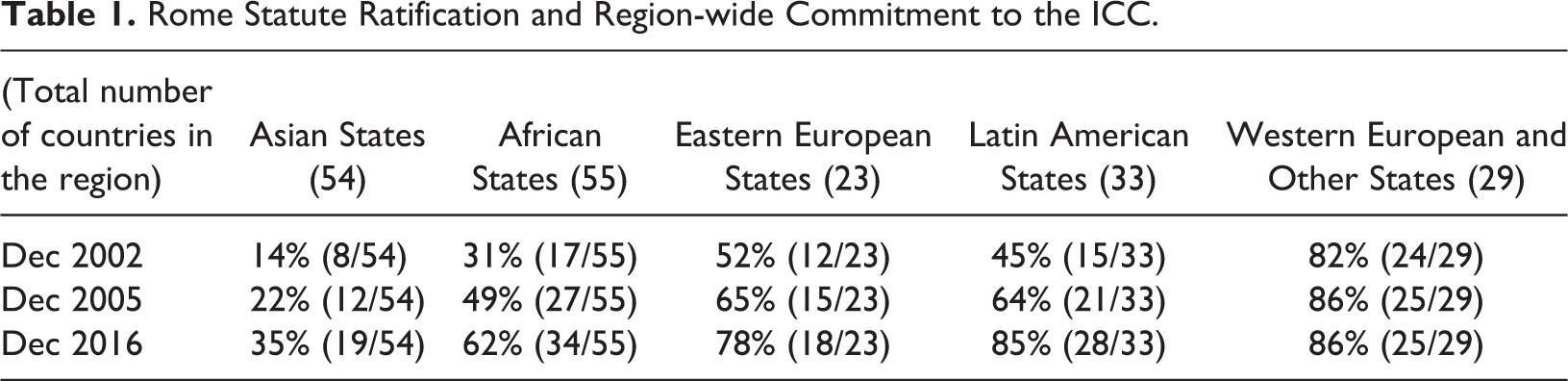
At the Court’s inception, region-wide enthusiasm for the ICC was minimal in Asia: 14 percent of countries in the region (8 out of 54) ratified the Rome Statute. Despite a gradual increase in the number of ratifications, the Asian group has consistently shown the lowest rate of region-wide commitment to accept and use the ICC process. To date, only 35 percent of countries in the region (19 out of 54) have joined the Court. The current situation is disappointing considering that the same level was already achieved by the African States group in 2002. The total numbers of countries in the Asian and African groups are almost identical, but the number of ICC Parties in Africa (34 out of 54) is nearly twice that of Asia.
3.2.3. Domestic implementation of the Rome Statute in Asia
Domestic implementation is another factor of consideration in evaluating States’ commitment to the ICC-centered judicialisation. The importance of implementation is most evident in the principle of complementarity enshrined in the Statute: national courts of States Parties have the primary responsibility to punish Rome Statute crimes. 38 For the effective adjudication of those crimes, ICC Parties need to incorporate Rome Statute substantive offences and certain procedural rules into their national criminal laws.
The main components of implementation are legal regimes of substantive complementarity and procedural cooperation. The former is a set of substantive rules of criminal law in line with their Rome Statute equivalents. States need to enable their national courts to exercise jurisdiction over the crimes stipulated in the Statute. Other legal principles to be codified include but are not limited to the principle of command responsibility, 39 the abolition of superior orders as a defense, 40 and the non-application of the statute of limitations to the Rome Statute crimes. 41 The latter requires States to adopt rules and procedures to facilitate cooperation with the ICC. 42 Without effective cooperation from the relevant national authorities, the ICC alone cannot execute warrants for arresting suspects, secure critical evidentiary materials, conduct searches and seizures on the sites where the alleged crimes have been committed, or protect and relocate its witnesses, among other things.
This paper identifies three modes of implementation practices. In the first type, States enact a separate legislation designed to incorporate the Rome Statute into their national legal orders. This model appears in the practices of Japan, 43 the Philippines, 44 the Republic of Korea, 45 and Samoa 46 . Except for the Philippines, 47 these countries legislated special laws covering both sides of domestic implementation, giving full effects to their obligations under the Statute. Regarding the second type, Bangladesh, Cambodia, and Fiji have opted to amend existing criminal law, partially implementing substantive rules of the Statute. 48 All core crimes and several Rome Statute legal principles are incorporated into their revised criminal laws. However, the wording of the amended or newly added provisions considerably differs from the corresponding Rome Statute language. For example, under Fiji’s criminal law, war crimes are not defined with the same degree of detail and precision as the two other core crimes. The category of war crimes is also deliberately omitted in the provision eliminating the superior orders defense. 49 Consequently, with regard to the commission of war crimes, obedience to superior orders may be permitted as a defense per se at the national courts of Fiji. The principle of command responsibility finds no expression in both Cambodia and Fiji. Finally, in the third type of implementation, States have neither enacted implementing legislations nor amended national criminal law to be compatible with the Statute. Domestic implementation is in a stalemate situation in most Asian Parties (such as Afghanistan, Cook Islands, Maldives, Marshall Islands, Mongolia, Nauru, Tajikistan, and Vanuatu), 50 which have not made sufficient administrative and legislative efforts to incorporate the Rome process. As in the second model, all States in this group have not yet fulfilled the cooperation component of complementarity. Their laws do not specify competent national authorities to receive the cooperation requests or to arrest the suspects and transfer them to the designated locations under the Court’s arrangement. It is unclear how they will work with the ICC in its investigation and prosecution of crimes that were committed in their territories, and which fall within the Court’s jurisdiction.
Despite their treaty obligations, the vast majority of Asian Parties have not taken necessary implementation measures at national level. This can potentially undermine the effectiveness of ICC’s judicial activities. Moreover, the significant incompatibility between national laws of State Parties and the Statute means that the ICC process may not have been properly known to the domestic audience in these countries.
4. Some possible explanations for longstanding reluctance towards and rejection of the Rome Statute system
Section 4 identifies three types of common experiences shared by the overwhelming majority of Asian countries. Exploring the decades of post-conflict and post-colonial period in Asia as well as the ICC’s formative years, this section investigates ways in which these three contexts have affected many Asian States’ ability and willingness to be part of the Rome Statute system.
4.1. Asian understanding of sovereignty and the emphasis on the non-interference principle across Asia
4.1.1. Various domestic situations involving political and military crises
The first common context developed against the backdrop of the recurring political and military crises that occurred during this period. First, the nationhood-consolidation process in Asia was painstaking and significantly delayed. 51 With the exception of a few countries, Asian States were under colonial rule at different points in time during the nineteenth and twentieth centuries. 52 China and Thailand were not formally colonised, but were subject to the extraterritorial jurisdiction of the Western States for many decades during this period. 53 Asian States strived to achieve independence, but only a small number of them succeeded in doing so in the immediate postwar years. Most Pacific States gained independence decades after the Second World War as in Samoa (1962), Fiji (1970), Papua New Guinea (1975), Solomon Islands (1978), Tuvalu (1978), and Vanuatu (1980); in the Southeast, Singapore, Bangladesh and Timor-Leste became independent respectively in 1965, 1971, and 2002; all Central Asian countries reemerged from the collapse of the Soviet Union in the early 1990s. Moreover, in the liberation efforts to expel foreign powers, tension between myriad stakeholders often erupted into conflicts. For example, in Bangladesh, almost three million people were killed and thousands of women were raped during the 1971 Liberation War. 54 Indonesia fiercely fought for independence against Dutch and Japanese colonial rule. 55 Approximately two-thirds of the population of East Timor died during the Indonesian occupation, within two decades. 56 Most dramatically, in 1999, following the release of the referendum result in favor of East Timor’s full independence, Indonesian security forces and the Timorese militias participated in arson, killings, and other violence in East Timor.
Second, many parts of Asia were ravaged by intra-state and inter-state conflicts, directly associated with prolonged ethnic and/or religious struggles in the region. 57 As the impact of conflicts can spill over borders easily, conflicts are effectively a bilateral and/or regional issue. The security conditions facing the Indochina region were devastating. In Cambodia, the Khmer Rouge regime was overthrown by Vietnam’s military intervention in the late 1970s. With foreign support, the Khmer Rouge continued fighting a guerrilla war against the newly established government for another decade. During the final months of Sri Lanka’s prolonged civil war, thousands of civilians were killed and forcibly displaced as a result of the military barrage conducted by both the government of Sri Lanka and the Liberation Tigers of Tamil Eelam. 58 Intense ethno-political tension in many Pacific States, such as Papua New Guinea 59 and Solomon Islands, 60 culminated in a series of decade-long internal conflicts during the 1990s and early 2000s. Moving upwards to Central Asia, in Tajikistan, intense civil wars between groups of militia representing different sub-regions and religions within the country took place from 1992 to 1997. 61 It was alleged that Uzbekistan, by supporting the opposition, played a key role in the escalation of internal conflicts in Tajikistan. Kyrgyzstan also experienced multiple ethnic conflicts after independence. 62
Under the military governments, political elites often resorted to violent measures to resolve political and social disagreements within their nations, and civilian persecution was prevalent. 63 Fiji went through a repeated cycle of military coups and constitutional crisis after independence. 64 In Cambodia, an estimated 1.7 million to 3 million people, representing more than 20 percent of its pre-conflict population, were executed or starved to death, or died from torture under the oppressive Khmer Rouge reign in the 1970s. 65 In the Philippines, the 21-year dictatorial rule of Marcos ended only in 1986. An estimated 70,000 people were arbitrarily imprisoned, disappeared, or killed under his rule. 66 Until its transition to parliamentary democracy in 1987, South Korea was under a military dictatorship for three decades. It is well documented that torture, killings, and other types of brutality were systematically committed against millions of Korean civilians by state agents. 67
4.1.2. The Asian vision of national sovereignty and the non-interference principle
During the recurring political and military crises explored above, Asian States constantly had to defend their regime legitimacy and territorial integrity against various stakeholders, from foreign nations to insurgency groups and domestic opposition leaders. Governments’ existential struggle for independence, recognition, and internal stability turned state sovereignty into a moral agenda in the post-conflict and post-colonial period. 68 Along with their conservative approach to sovereignty, the non-interference doctrine became a cornerstone principle in the areas of security and diplomatic relations. The Five Principles of Peaceful Coexistence (Five Principles) 69 were first proclaimed in the 1950s in reaction to the imperialist incursion in Asia. This laid the foundation for the rise of non-interference policy. 70 China and India adopted the Five Principles in the form of a bilateral treaty in 1954, and Burma agreed to include them in its treaty with China in the same year. 71 Many Asian State leaders reaffirmed the Five Principles as representing their understanding of sovereignty and non-interference for internal affairs. 72
The non-interference doctrine is codified in the key ASEAN instruments. 73 It imposes the following constraints on Member States: ‘(1) refraining from criticizing the actions of a member government towards its own people, (…); (2) criticizing the actions of states which were deemed to have breached the non-interference principle; (3) denying recognition, sanctuary, or other forms of support to any rebel group seeking to destabilize or overthrow the government of a neighboring state; (4) providing political support and material assistance to member states in their campaign against subversive and destabilizing activities’. 74 ASEAN States adhered (almost) religiously to this doctrine, and ASEAN understanding of non-interference has resonated in the security regulation and diplomatic practices in other sub-regions. 75 In East and Central Asia, the Shanghai Cooperation Organisation (SCO) is growing as an important institution for inter-state security cooperation. Established in 2001, the SCO is a regional forum comprising China, Russia, and four of the Central Asian States. 76 India and Pakistan signed the memorandum of obligations in June 2016, initiating the formal process of joining this institution. In laying down basic principles of regional security, the SCO Charter reflects the essence of the Five Principles. 77 The SCO members agree to jointly combat threats to security such as ‘terrorism, separatism, and extremism, illicit narcotics, and arms trafficking and other types of criminal activity of a transnational character’, 78 but they have not made any actual regional operations to this end. 79 Only the informal consultation project is ongoing to address drug trafficking and other cross-border crimes. Under the SCO, the ASEAN type of non-interference is maintained in establishing policies for regional peace and stability.
In strict adherence to non-interference, Asian States (in their relationships with one another) have avoided taking formal actions to address government-led civilian persecution and other human rights violations committed outside their national boundaries. 80 Regardless of the nature and the scale of suffering caused by those violations, it was not international intervention with a set of collective solutions, but rather non-interference that formed the core principle of their response. Asia’s international and regional regulatory landscape has been relatively more legalised in trade and investment, but, in most policy areas, Asian governments have preferred a loose form of cooperation and informal engagement. It is also the only region where States have not succeeded in creating regional human rights commission or court.
Considering this normative attitude strengthened in the past several decades, it should have come as no surprise that most Asian governments were hesitant to join the ICC, a highly legalised international institution with strong ramifications for security and diplomatic policy. For many, accepting the jurisdiction of a foreign accountability mechanism would not be compatible with their conservative sense of sovereignty. Thus, they often cast the expanding role of international criminal adjudication in a negative light, as an unacceptable intrusion into sovereignty. The same concerns have been strongly argued by non-party States such as China, India, Indonesia, Pakistan, and Sri Lanka since the Rome negotiations. 81 While they have showed rhetorical support for the ICC, their objection to the Rome Statute in its current form has been persistent. High-ranking public officials and prominent local scholars in these non-party States have made unfavorable comments about ratification, warning domestic audiences that the ICC process may be misused to interfere with national politics. 82 In their view, the direct involvement of the ICC in the investigation and prosecution of sensitive internal affairs would introduce unwanted foreign influence. Many other countries in Central and Southeast Asia, and the Pacific, are also critical of Rome process on similar grounds. 83 In light of their recent history of colonial rule and/or armed conflicts, nation leaders have reason to worry that the international intervention of this kind might put their hard-fought independence and internal stability at risk. Since 2002, no Central Asian State has initiated the official process to join the Court. ASEAN Countries such as Bangladesh and the Philippines (joined 2010 and 2011), as well as the Pacific States of Vanuatu (joined 2011), are now parties to the Rome Statute. However, it took a relatively longer time for them to clear misunderstandings about the ICC process and to develop formal, government-level discussion about ratification in these countries.
Several Asian countries actively engaged in the new experiment of international justice under the ICC. However, their individual efforts were not sufficient to develop a collective voice calling for region-wide recognition of the Rome Statute.
4.2. The domestic culture of impunity for serious atrocity crimes
Around the early 1990s, human rights advocates began to refer to the term ‘culture of impunity’.
84
The specific reference to culture implies that impunity is linked to ‘deeply entrenched attitudes’ that take a long time and much effort to change. Impunity arises from a failure of States to meet their obligations ‘to investigate violations; to take appropriate measures in respect to the perpetrators […] by ensuring that those suspected of criminal responsibility are prosecuted, tried, and duly punished; to provide victims with effective remedies and to ensure that they receive reparation for the injuries suffered; […] and to take other necessary steps to prevent a recurrence of violations’.
85
4.2.1. Failed criminal punishment at the national courts
Of the various policy options to ensure accountability for atrocity crimes, national prosecution, if conducted in a genuine, effective, and fair manner, may serve the myriad goals of justice better than any other measure. 86 However, according to the cross-regional analysis of post-conflict and transitioning countries, national courts in Asia have been the least likely to prosecute mass human rights violations of state agents – Asia accounts for only 17 percent of the total number of domestic human rights prosecutions from 1970 to 2009. 87 In principle, victims can contribute to resist impunity by filing actions in the courts against alleged perpetrators. However, their efforts may be stymied without having legal procedures to protect them and other witnesses, from intimidation and unfair treatment by any individual having interests in frustrating their participation in the relevant judicial process. 88
Perpetrators responsible for human rights atrocities too often escaped national prosecutions, or only became subject to accountability measures long after the actual perpetuation of their crimes. For example, it took more than three decades for Cambodia to take meaningful action to punish killings and other crimes attributed to the Khmer Rouge in the 1970s. 89 In the aftermaths of conflicts, some Asian States established special tribunals to punish atrocity crimes, drawing on local contexts and experiences. However, without sufficient support from the political leaders and law-enforcement agencies, the mere creation of special courts could not guarantee effective and timely punishment of atrocities. The process of creating and empowering the Bangladesh International Crimes Tribunal (ICT) provides an example of this. 90 The ICT, a special tribunal within the judicial system of Bangladesh is an entity of domestic law and ‘international’ only in name. The 1973 International War Crimes (Tribunal) Act was legislated to punish the former government leaders and militants responsible for violence and destruction committed during the liberation war in 1971. However, due to various political difficulties after independence, the proposed tribunal was initially aborted. Only in 2008 was the ICT reinstituted by the dominant political party’s initiative. After amending the old 1973 Act several times, the ICT began its investigation and prosecution in 2010 under the modified law. 91
In another case, Indonesia passed law 26/2000 creating the Ad Hoc Human Rights Court, 92 a special chamber within the national judiciary. This court was originally instituted to punish Indonesian perpetrators responsible for atrocities committed during the 1999 violence in East Timor. Leading commentators and human rights advocates, however, generally agree that the trials conducted by this special court did not provide credible accounting for what had happened during the violence. 93 Although the Ad Hoc Court was in full operation, not one senior officer directly involved in the commission of atrocities has been held responsible, as one commentator observed after examining seven cases of mass violence committed during this period. 94 Indonesia’s weak commitment to punishing those perpetrators undermined East Timor’s own efforts to deal with the atrocities inflicted on its people. Due to Indonesia’s refusal to cooperate with extradition requests, East Timor had immense difficulties in investigating and prosecuting responsible members of the Indonesian military and Timorese collaborators. 95 As the vast majority of the alleged perpetrators had already returned to Indonesia by that point, without Indonesia’s cooperation, East Timor was not able to obtain custody of the accused in many cases. This uncooperative situation led to a huge discrepancy between the number of people indicted and the number of suspects actually put on trial. 96
Some post-conflict States preferred softer accountability measures (non-prosecutorial investigative commissions) to criminal punishment at the courts. Sri Lanka created three Commissions of Inquiry in 1995 to investigate the involuntary removal or disappearance of persons during the 25 years of ethnic conflict. 97 More recently, in 2010, the Commission on Lessons Learnt and Reconciliation (LLRC) was established to provide some forms of accountability at the end of the civil war in 2009. 98 Another recent non-prosecutorial procedure designed to address past atrocities is the Truth and Reconciliation Commission of Solomon Islands (the Solomon Islands TRC) instituted against the backdrop of violent clashes between armed forces representing multiple ethnic groups in the country. 99 For victims and the affected societies, these commissions examined the proximate causes of the conflicts and provided a record of injustice perpetrated during its course. However, their efforts did not lead to successful punishment of responsible perpetrators. 100
4.2.2. Granting “blanket” amnesties
Impunity for atrocity crimes can also be maintained when States grant ‘blanket’ amnesties, unconditionally relieving almost all perpetrators of atrocities from responsibility. 101 At the end of armed conflicts or as part of a transition away from dictatorial rule, governments may adopt amnesty laws or executive decrees that prohibit the prosecution of alleged human rights abusers or pardon convicted military elites. 102 However, there is a growing consensus that granting domestic amnesties for serious atrocity crimes is not compatible with international law, and blanket amnesties for these crimes should not be acceptable. 103 Blanket amnesties conceal and suppress the truth about atrocities, at the cost of preventing victims from seeking accountability.
By imprudently granting blanket amnesties to those responsible for mass atrocities, many Asian States fostered a culture of impunity. In 1994, to resolve lingering concerns about the legacy of the Khmer Rouge, the Cambodian government passed a legislation granting amnesty to former Khmer Rouge guerrillas who defected to the government between 7 July 1994 and 7 January 1995. 104 An estimated 6,600 members of the former regime received amnesty pursuant to this law. In the case of the 1987 military coup in Fiji, the Governor General granted amnesties to all participants in the coup to quickly stabilise the regime. 105 The same practice was repeated multiple times. The aftermath of the 2006 coup led to the adoption of another executive decree that granted “full and unconditional immunity from all criminal or civil or legal or military or professional proceedings or consequences” to the members of the military who were involved in the coup and all persons under their command. 106 In 2015, Mongolia adopted a controversial amnesty law broadly exempting criminal liability of persons who had committed specific categories of crimes, such as armed rioting, human trafficking, illegal obtaining of human organs, and terrorism during the specified time period. 107
4.2.3. The impact of domestic impunity for serious atrocity crimes
For various reasons, many Asian courts have not been successful in adjudicating atrocity crimes, particularly those committed by the nations’ former or current political and military leaders. Responsible individuals easily evade accountability, and a significant number of them continue to stay in power in their countries, holding high-level administrative and military positions at the government.
Countries with a longstanding culture of impunity for atrocity crimes may be less willing to make a treaty commitment to the ICC, the accountability mechanism to be triggered to adjudicate exactly the same types of crimes in the (future) occurrence of atrocities in their territories. The standards of actions required under the Rome Statute are entirely different from the ways in which such countries have handled the aftermaths of atrocities pursuant to their national criminal laws. Political and military elites who were directly or indirectly involved in the past atrocities would resist joining the ICC, making it harder to reach an internal agreement for ratification. From their point of view, recognising the Court and the rules contained in the Statute may be self-condemning.
Even without having well-established domestic practices for adjudicating atrocity crimes, some States did join the ICC at certain points. However, the culture of impunity deeply rooted in their legislative and judicial experiences seems to have adversely affected their ‘post-ratification’ commitment to the Rome Statute. In fact, domestic implementation is in a stalemate situation in most Asian ICC Parties. 108 They have not made satisfactory efforts to enact implementing legislations and modify national rules that are incompatible with the Statute. The considerable gap between norm recognition and norm compliance in this region necessitates rigorous regional monitoring.
4.3. Limited financial, technical, and human resources
In making a decision to join the ICC and accept new treaty obligations arising from the Rome Statute, domestic policymakers assess internal costs associated with the ratification and implementation. They generally consider two aspects of available resources. First, States need adequate financial resources to perform international and national activities pursuant to their commitment to the ICC process. Second, a sufficient pool of local experts with expertise in international criminal law should be ensured. Law enforcement and judicial authorities also need the technical capacities to conduct complex investigations potentially involving a large number of perpetrators, victims, and witnesses. After ratification, the domestic availability of funds, infrastructure, and manpower remains to be the key factor facilitating or limiting States’ engagement as ICC Parties. Since political support for the ICC and the degrees of economic prosperity considerably vary among countries, some States are far more capable than others of spending, and being willing to spend, their resources to execute this global justice project. For example, Japan is the largest financial contributor to the Court - contributing approximately 17 percent of the Court’s budget. 109 However, most Asian States are not in Japan’s financial position. The serious resource constraints have weakened their capacity for effective participation.
At the preparatory phase of the negotiations, the issue of resource constraints was presented as a critical concern. As early as 1996, it had been noted that, due to the limited resources at their disposal, it was fundamentally difficult for many States to engage in the negotiations, and that these internal difficulties should first be resolved to bolster wider participation. With this in mind, the UN General Assembly adopted Resolution 51/207 to provide ‘financial assistance’ for delegates of the ‘least developed countries and developing states’ to participate in the work of the Preparatory Committee as well as the Rome Conference. 110 A trust fund was subsequently established in accordance with Resolution 51/207. Under this financial arrangement, 33 of the least developed and 19 developing countries, including Asian States, joined the Rome negotiations. 111 However, only a total of 54 delegates from 52 States participated under the trust fund scheme. It is questionable whether one or two representatives, in a highly limited amount of time, could thoroughly examine the 116 Articles in the draft statute, with 1,300 brackets identifying terms under disagreement. Working with such a lengthy text was difficult even for those who were involved in the Preparatory Committee meetings that took place between 1996 and 1998, let alone those delegates who were initially unfamiliar with it. 112 The sizes of the delegations from these countries were considerably smaller than those from States having more resource capacity. 113 Smaller delegations could not cover all concurrent meetings at the multilateral conference, and were therefore unable to make fully informed decisions on the matters that would have significant impacts on their national legal systems. The unavailability of simultaneous interpretation at the informal working groups also frustrated many of the non-English speaking delegations. 114 After all, temporary financial assistance cannot be the solution for States having chronic difficulties with securing resources for a complex legal project like the ICC.
Pacific States have had limited ability in terms of resources to actively participate in the Rome Statute system. 115 In light of his own experience during the negotiations and their aftermaths, the then Attorney General of Samoa highlighted insufficient resources as the most critical obstacle preventing Samoa from making more meaningful contribution. 116 Due to a shortage of staff in the government agencies, only about a dozen officials, including him, had to deal with various legal issues arising from Samoa’s international actions, as well as day-to-day internal affairs. Samoa was therefore unable to fully assess Rome Statute provisions and their implications for domestic legal order, at least not within a short period of time. Both the problems with limited funds for judicial infrastructure (e.g. courtrooms, prison facilities, and judicial library) and the severe personnel shortage (e.g. of judges, lawyers, and police officers) have been prevalent in many other countries that went through political and economic difficulties. 117 For example, only a total of 751 lawyers were registered in Cambodia as of 2009. 118 In addition, fewer than 100 lawyers were available in Timor-Leste up to the mid-2000s. 119
The resource constraints continue to be a factor limiting policy-making potentials of many Asian governments at the ASP. For the past two consecutive years, almost half of the Asian Parties were unable to send their representatives to the annual ASP session, the major platform for States Parties to conduct management oversight and legislative activities for the Court. 120 The ASP has encouraged more involvement of the developing countries in the Assembly’s activities. Since 2003, it has adopted a series of resolutions with attempts to assist delegations from those States Parties. 121 The Assembly has called upon States, international organisations, and other entities to contribute voluntarily to the ‘Trust Fund’. However, as noted in the letter of the ASP President in 2016, contributions to the Fund made for that year were able to support three delegates at best. 122
Other than financial assistance, suggestions are made to encourage more involvement of States (both ICC Parties and non-Parties) having serious resource constraints. One of the important strategies is to assist them to build the capacity of a wider group of local legal professionals and activists. 123 Efforts should also be made to staff a sufficient number of prosecutors and investigators who understand the specific challenges of pursuing accountability for international crimes. In this regard, the ASP Bureau on Complementarity stated that the ICC could first assist States to adjudicate atrocity crimes at their national courts. 124 The ASP, however, set a clear limit that the Court should not become ‘a development organisation or an implementing agency’, and should instead be ‘a catalyst of direct state-to-state assistance and indirect assistance through international and regional organisations’. 125
The ICRC, Organisation for Security and Co-operation in Europe (OSCE), United Nations Development Programme (UNDP), and United Nations Interregional Crime and Justice Research Institute (UNICRI) have also worked with the legal communities of developing countries to build adequate technical capacity for the effective (national) adjudication of international crimes. 126 According to the policy paper jointly submitted by the OSCE and the UNICRI, external training programs must be tailored to help local experts appropriately translate and apply relevant international legal rules to the domestic contexts. 127 Based on the field experiences with supporting national courts of post-conflict States, the joint report suggests ways in which the programs could be improved: ensuring the availability of materials in the language of the participants, arranging clerkships for local lawyers in international tribunals, and providing sufficient training to the defense, to name a few. Other co-partners of capacity building are the CICC and the PGA. The CICC has worked closely with local NGO representatives and academics by bringing them together at the sub-regional conferences. At the Asia-Pacific Parliamentary Consultation on the ICC facilitated by the PGA, interested lawmakers and other officials from the Ministry of Foreign Affairs and the Ministry of Justice (acting in their personal capacities) discussed ways to encourage ratification as well as to support implementation efforts. According to the PGA’s activity reports, the PGA currently sets some non-parties in the region (Indonesia, Malaysia, Nepal, Kiribati, Tonga, and Tuvalu) as its priority target countries. 128
4.4. Different regional experiences, variations in region-wide commitments to the Rome Statute system
Asia is not the only region where the three types of common contexts have been strongly present in the political, judicial, and socio-economic experiences of individual countries. To some extent, the African contexts are comparable to those of many Asian countries. In the early phase of the Cold War, Asian and African States sharing similar histories of colonialism, liberation wars, and other horrific human rights abuses, envisioned a new multilateral forum outside the UN. They sought to discuss and reflect on their own interests in international affairs as newly independent nations. Most prominently, at the 1955 Asian-African Conference (known as the Bandung Conference), States from both regions declared their vision of sovereignty and the principle of non-interference. The Bandung Conference became the inspiration for Third World solidarity in the struggle against colonialism. The anti-colonial sentiments also gave rise to the creation of the Organisation of African Unity (OAU) in 1963. 129 Regarding the culture of impunity, according to the cross-regional empirical study mentioned above, 130 Asian national courts have been least likely to prosecute mass human rights violations committed by state agents. However, compared with the Asian region, post-conflict and transitioning States in Africa were not distinctly more successful in adjudicating past atrocities committed in their territories.
One reasonable question would be why despite the two regions having similar aspects with respect to three common contexts, Africa’s participation in the Rome Statute system have been significantly higher than Asia’s. For instance, Africa has the largest representation at the ICC, whereas Asia is the least-engaged region. 131 Against the foregoing, the rest of this sub-section i) focuses on the critical decade that set out the background in the establishment and initial development of the ICC – that is from the mid-1990s to early 2000s, and ii) examines the key differences between the Asian and African regions that led to the substantially larger representation and greater participation of the latter.
First, in the aftermath of humanitarian crises such as the Rwandan Genocide in the 1990s, African governments had strong interests in combating mass human rights atrocities. 132 They generally accepted that their national legal systems had failed to hold perpetrators of atrocity crimes accountable. 133 Some of the essential Africa-originated mechanisms for dealing with those crimes and other major human rights violations were developed from this awareness of impunity and growing demand for accountability on the continent. For instance, in 1995, the Southern African Development Community (SADC) 134 launched the Southern African Regional Police Chiefs’ Cooperation Organisation (SARPCCO), for the management of all forms of cross-border crimes with regional implications. The SARPCCO facilitates exchanges of intelligence, ensures joint monitoring of relevant crimes, and promotes regional cooperation in the criminal proceedings. In 1998, the African community established the African Court on Human and Peoples’ Rights (ACtHPR) with the adoption of a Protocol to the African Charter on Human and Peoples’ Rights. 135 While the ACtHPR’s effectiveness is not without criticisms, the establishment of this court shows ‘a strong universalist mandate to ensure the protection of human rights for all persons’ in the continent. 136 Along with the development of these regional processes, African States have accommodated the value of more legalized and systematic inter-state cooperation for the region. Such familiarity with the institutionalised regional cooperation and lawmaking in the areas of security, crime punishment, and human rights may have increased their willingness to participate in the development of the possible global equivalent, like the ICC.
Second, even prior to the Diplomatic Conference, African countries made efforts to adopt a common position on the establishment of a permanent international criminal court. African stakeholders had high hopes about the ICC ‘to be a court created in part by Africans and ultimately for the benefit of African victims of serious crimes’. 137 At the first regional conference on the ICC held in 1997, SADC States agreed to take a common stance to support the creation of the long-awaited Court. 138 This meeting became the impetus for a continent-wide consultation process in preparation for the Rome negotiations. 139 In the following year, Senegal in West Africa hosted a conference in Dakar where 25 African States adopted a declaration, affirming their commitment to the establishment of the ICC. 140 At the 1998 OAU summit, heads of States adopted the OAU resolution calling on all members to support the creation of the Court. 141
Third, 47 African States were represented at the Rome Conference, and played an important role in crafting the text of the draft Statute. 142 Most remarkably, they spoke in one voice on many occasions during the negotiations, under the name of the SADC, supporters of the Dakar Declaration, or the OAU. For example, Ministers of Justice and Attorneys-General of the SADC countries had gathered to discuss various aspects of the draft Statute. 143 The South African delegation spoke on behalf of the SADC, regarding core issues such as the definition of Article 5 crimes and the jurisdiction mechanisms (particularly the Prosecutor’s proprio motu power). 144 Other member countries then followed up and endorsed comments made on behalf of the SADC. 145 Within the circle of the OAU, African States again emphasised the importance of having coordinated approaches to the highly contested matters in the draft Statute. 146 It seems that African delegates strategically chose this way to strengthen their bargaining power in the negotiations. The frequent exchanges of information and opinions between delegations enhanced their understanding of the substantive issues contained in the draft Statute. 147 This line of regional approach may also have been beneficial to many African participants lacking sufficient economic and human resources to prepare for the negotiations. The advocacy work of African activists and academics was equally crucial for increasing continent-wide support for the ICC. 148 The NGOs presence at the Rome Conference represented ‘an unprecedented level of participation by civil society in [international] lawmaking’, 149 and the African civil society was influential in this process. Almost 90 African organisations joined the NGO coalition mobilised by the CICC throughout the negotiations. 150 They made active engagements with their home state governments and lobbied for the adoption of the Rome Statute.
In the post-Rome phase, under the auspices of Africa-originated intergovernmental bodies, the Rome Statute ratification and implementation were repeatedly recognised as a policy priority of the region. At the SADC’s conference on the ICC held in 1999, the SADC governments unanimously declared the Pretoria Statement of Common Understanding on the ICC. The delegates recommended to the relevant domestic authorities for the ‘expeditious ratification’ and the use of the ‘Ratification Kit’, a model law designed to facilitate domestic implementation. 151 The Model Enabling Act adopted by the SADC addresses most aspects of the ICC rules that need to be incorporated into domestic law. 152 It is non-binding, but provides a useful starting point for States to draft their own implementing legislations. At the 2001 conference, the SADC prepared the Plan of Action with an emphasis on enacting implementing legislation. 153 The status report on ICC ratification and implementation was also compiled at this meeting. The African Commission on Human and Peoples’ Rights (ACHPR) is another regional body that explicitly supported the Rome Statute ratification and called for effective implementation of the Statute in the Member States’ legal systems. 154
The foregoing features positively affected African governments’ early decisions to join and participate in the Rome Statute system. In contrast, during the same decade, Asian States did not show much interest in cultivating region-wide support for the ICC. There was no proper regional focal point that could have played a similar leadership role of the SADC or the OAU during the negotiations. Therefore, the regional or sub-regional dialogue over the ICC mechanism was far more limited. Particularly in the areas of security and human rights protection, the Asian region did not have rich experiences with the substantially institutionalized, state-to-state cooperation and lawmaking. 155
5. A way forward
The Asian region has been home to many recent or continuing incidents of violence and armed conflicts. With attempts to establish accountability for atrocities committed in those situations, Cambodia and Timor-Leste agreed to introduce hybrid criminal courts; countries like Bangladesh and Indonesia created special tribunals as parts of homegrown initiatives to adjudicate international crimes. Many other post-conflict States in Asia pursued non-prosecutorial accountability measures. The region, therefore, is familiar with the imperative of international criminal law: perpetrators of mass atrocities should not go unpunished. The Rome Statute system embodies the same belief that individuals responsible for the most heinous international crimes should be brought to justice before international or national courts. However, more than two-thirds of countries in Asia have not joined the ICC. Asian States Parties, the remaining one-thirds, worked towards domestic implementation, but most of them have not adopted adequate implementation measures, undermining the essence of the Rome Statute process.
As discussed earlier, there are three types of common experiences shared by the overwhelming majority of Asian countries, and these three domestic contexts could possibly explain why States have not been centrally involved in the emergence and spread of the ICC-centered judicialisation. When domestic policymakers (legislators and government elites having ultimate decision-making authorities in their countries) evaluate the internal implications of participating in the Rome Statute system, the presence of one or a combination of these contexts may affect their decision whether to proceed further.
Expanding the role of Asian countries is highly important to building a truly international system of criminal justice. However, at least in the short run, the emphasis on the conservative understanding of sovereignty and non-interference principle, the domestic culture of impunity for atrocity crimes, and the serious resource constraints in many parts of Asia would likely persist, exerting negative impact on the already insignificant Asian involvement. It is also difficult to change the cautious attitude ingrained in the minds of many government elites, towards the ICC’s individual criminal accountability. What then can be done to bring about more active engagement from this region in the long run? At a state-to-state level, Asian ICC Parties can facilitate constructive regional or sub-regional dialogue with non-party States sharing similar legal traditions or having historical and cultural closeness, about a range of obstacles in ratifying the Rome Statute. Asian States Parties may also consider establishing a regional mechanism for monitoring the status of ratification and implementation in a regular basis. At a domestic level, this paper suggests that well-equipped legal professionals and human rights activists can be the agents of change. These local experts may appeal to government leaders to reconsider their dismissive stance against the ICC. They can lobby for ratification in collaboration with the interested parliamentary members. By referring to international rules for punishing atrocity crimes, they can denounce past situations in which the claims of victims affected by violence were not properly heard at the national proceedings. Finally, the law schools and research institutions in Asia can contribute to enhancing understanding of core Rome Statute instruments and ICC decisions. Since not many Asian States have witnessed vibrant local advocacy for this policy cause, the long-term solutions will require a significant commitment of time and resources.
Footnotes
Author note
I wish to thank Damian Chalmers, Matias Hellman, Nartnirun Junngam, W. Michael Reisman, James Silk, Bui Ngoc Son, and Kevin Tan for their advice and support in conducting this research. Views expressed and all errors in this paper are solely mine.
Declaration of conflicting interests
The author(s) declared no potential conflicts of interest with respect to the research, authorship, and/or publication of this article.
Funding
The author(s) received no financial support for the research, authorship, and/or publication of this article.