



Abstract
In states emerging from mass violence and human rights abuses, do individuals prefer retributive punishment of perpetrators through trials, or do they wish to be compensated with land or monetary reparations for their injuries? How does the concrete option of prosecutions by the International Criminal Court (ICC) moderate these preferences? Using unique survey data from 507 Kenyans collected in 2015, we build on and add nuance to the empirical literature that interrogates the link between exposure to mass violence and post-conflict justice preferences. We find that while some individuals prefer reparative justice, victims and witnesses generally want perpetrators to be prosecuted. Even for those who are co-ethnics of government leaders – who allegedly instigated widespread killing, sexual assaults and displacements – direct exposure to those acts leads to greater desire for prosecutions. We further find that one’s personal experience with violence also leads one to reject domestic justice in favor of international justice: victims and witnesses who favored retributive justice are highly likely to believe that the ICC is the best option for prosecuting perpetrators.
Introduction
What explains justice preferences of individuals emerging from mass atrocities? Do individuals favor retribution and punishment of their perpetrators through trials, such as those administered by the International Criminal Court (ICC), or do they prefer compensation?
The 1990s saw the rise of the retributive model of post-conflict justice, with supporters arguing that there can be no lasting peace unless perpetrators are held accountable (Akhavan, 1998; Clark, 2011; Mendeloff, 2009: 599). Operating within this framework, the international community established ad-hoc tribunals for the former Yugoslavia and Rwanda, a series of hybrid tribunals, and the ICC (Bosco, 2014; Leebaw, 2008: 96; Mallinder & McEvoy, 2011: 108–109). Leading into the 21st century, retributive justice through prosecutions was the consensus method for addressing past atrocities (Drumbl, 2007: 5, 35–41).
Commentators have challenged the retributive justice model, arguing that trials may not meet the complex needs of post-conflict societies (Gready & Robins, 2014: 342; Minow, 1998). For instance, scholars have found that Yazidi survivors of ISIL atrocities in Syria share an ‘understanding of justice principally focused on local issues, immediate concerns, agency, and prospects of a better future’ rather than a ‘narrow’ focus on ‘accountability through criminal trials’ (Akhavan et al., 2020: 2). In their call for localized alternatives, these authors echo lessons from work that emphasizes context-sensitive reparative measures like compensation or land restitution (Robins, 2011; Rombouts, 2002: 217).
Yet a reparative approach to post-conflict justice is also imperfect. One problem is that pursuing compensation has monetary, temporal, and other opportunity costs. A second problem is politicization. Nearly all post-conflict justice mechanisms become the focus of ever-changing political coalitions; one group favors prosecutions, while another advocates for truth commissions, reparations, or nothing at all. In Sri Lanka, for example, political leaders, who might have been complicit in atrocities, argue against criminal accountability, favoring economic development (Arudpragasam, 2019). Third, while post-conflict justice interventions are unlikely to be successful unless policy makers theorize and systematically assess local concerns in societies emerging from conflict (Millar, 2011: 532), the existing literature lacks a comprehensive theory for predicting and interpreting individuals’ justice preferences in various contexts.
We theorize that attitudes towards post-conflict justice mechanisms are primarily shaped by two factors: exposure to violence and group membership. 1 Using original survey data from 507 ordinary Kenyans in 2015 in five different regions of the country, we demonstrate that exposure to violence leads to a preference for retributive justice over reparative justice, irrespective of economic need. Other the other hand, membership in Kenya’s most politically powerful ethnic groups – Kikuyu and Kalenjin – is associated with the opposite preference: reparative over retributive justice. However, the effect of exposure to violence is present even among dominant ethnic groups: members who witnessed violence or were victimized are less likely than other co-ethnics to support reparations.
Building on important contributions of post-conflict justice preferences (Aguilar, Balcells & Cebolla-Boado, 2011; Dyrstad & Binningsbø, 2019; Tellez, 2020), this study of Kenya is innovative in two ways. First, we prompted respondents to indicate a preference between compensation or trials. Although those exposed to violence might favor prosecutions, some may prioritize material goods over retributive justice. Others might also prefer compensation if they do not think that national or international courts will deliver justice.
A second advantage of our survey is that it was conducted in Kenya when the ICC still had open cases, allowing us to investigate amid an external intervention. One criticism of the ICC is that it is unpopular in the eyes of the victims. Our data provide evidence for evaluating this claim. We asked respondents if the ICC was the best way to provide justice to victims of the violence following Kenya’s 2007 presidential elections. The ICC’s jurisdiction is complementary, meaning that it can only intervene to prosecute when the state in question is unwilling or unable to do so (Rome Statute, Art. 17). However, those responsible for crimes may view the ICC as a threat. Even those exposed to violence may reject the ICC as a post-conflict justice mechanism if they believe it is illegitimate or fear that it threatens state sovereignty (Meernik & King, 2014).
We find that experience with violence is a major driver of post-conflict justice preferences. Those exposed to violence are willing to forgo compensatory justice in favor of trials – even though this means that their own co-ethnics may be punished. Those exposed to violence also are most likely to support the ICC as the best option for prosecuting perpetrators. This is an important finding given the criticisms labeling the ICC as biased and imperialistic. The insights from these findings are not necessarily limited to Kenya. The country is a multiparty democracy that features extensive rights violations, and given its history of weak institutions and violent ethnic conflict, it is similar to other countries that receive attention from the ICC (Kersten, 2016). We expect that victims in these other countries will also prioritize retributive justice, and the ICC as a venue for justice.
Justice preferences in post-conflict societies
International justice and local needs
International criminal tribunals established in the early 1990s borrowed ideas from the emerging field of transitional justice, a collection of practices focused on countries trying to overcome years of authoritarian rule and civil war (Teitel, 2005). Terms like the ‘right to truth,’ ‘reparation,’ and ‘reconciliation’ became popular in global politics around the same time that the International Criminal Tribunal for the former Yugoslavia (ICTY) began issuing indictments for Balkan war criminals. 2 Thus, international criminal law (ICL) and transitional justice intertwined. But as opposed to transitional justice policies, which were often tailored to meet the demands of local political actors, ICL was criticized for its inattention to local populations. In seeking justice for the sake of international order, some argued that the ad hoc tribunals instrumentalized victims and witnesses and overlooked ethnic politicization in Rwanda and the Balkans (Humphrey, 2003).
The drafters of the Rome Statute included provisions to address the needs of local populations in situation countries. The treaty includes victim participation in proceedings, measures to protect victims and witnesses, recognition of a right to reparation, and a trust fund to support that right (Hoyle & Ullrich, 2014). Inclusion of victims’ concerns into the principles and operations of the ICC may be construed as part of a long evolution of victims’ rights in international law (Bassiouni, 2006), a ‘victims turn’ in the practice of transitional justice (Garcia-Godos, 2016), or as a corrective to the lack of victim sensitivity at the ad hoc criminal tribunals (Van den Wyngaert, 2011).
Nevertheless, critics of external justice interventions contend that they cannot adequately serve local needs. First, actors like the ICC are too distant from local politics, potentially exacerbating local tensions (Clark, 2018). Second, reparations, whether compensatory or symbolic, might be a superior approach to post-conflict justice (Laplante & Theidon, 2007: 240–245). Yet states and outside actors sometimes fail to assess local demands when evaluating, prioritizing, and implementing potential transitional justice mechanisms (Millar, 2011: 532; Viaene, 2010). When policies can respond to the preferences of these individuals, the likely outcome is a more successful transition to peaceful coexistence in the long term (Mallinder & McEvoy, 2011: 108; Andrieu, 2010: 538). Third, some claim there is a Western, retributivist bias in the human rights ‘industry’ (Drumbl, 2007; Nagy, 2008).
However, critics who make claims on behalf of local populations can fall prey to the same problem of representation they identify in hegemonic discourse. That is, how does one confidently speak for the interests or needs of a local community to which one does not belong?
Toward more systematic analysis
A central premise in the burgeoning literature on post-conflict societies is that the best way to assess the justice preferences of local populations is to survey them (Hall et al., 2018; Meernik & King, 2014; Nussio, Rettberg & Ugarriza, 2015; Pham, Weinstein & Longman, 2004; Samii, 2013). Survey researchers have drawn a few key inferences.
First, post-conflict justice preferences will in large part be shaped by group membership. Those aligned with leaders or groups considered responsible for human rights violations typically oppose retributive justice. Research on group attitudes focuses on the ways ‘prejudice toward, stereotypes about, and identification with social groups’ correlate strongly with public opinion (Clawson & Oxley, 2016). Particularly in situations where political conflict involves identity-based groups against one another, criminal accountability can aggravate divisions (Snyder & Vinjamuri, 2003). In-group members dislike the convictions of their fellow co-ethnics, while cheering convictions of out-group rivals. Research on the former Yugoslavia has repeatedly demonstrated as much (Arzt, 2006; Ford, 2012; Meernik, 2015; Milanovic, 2020; Steflja, 2018).
Second, post-conflict justice preferences might also be influenced by individuals’ exposure to violence, though the precise direction of that effect varies across studies. Meernik & King (2014: 13–14) discover, using survey data collected from 14,000 people in 10 war-torn countries, that individuals who personally experienced the ravages of war favored punishment of those they perceived as wrongdoers. Analysis of survey data collected in Bosnia similarly indicates that exposure to violence is a key determinant of one’s transitional justice preferences (Hall et al., 2018). Hall et al. (2018: 354–355) find that displaced individuals who returned to their prewar homes are more likely to embrace amnesty, rather than punishment, for the perpetrators with whom they must co-exist. They theorize that interdependence causes returnees to seek respect from perpetrators, rather than imposition of costs (Hall et al., 2018: 346–347). Nevertheless, displaced individuals (including those who never returned to their prewar homes) who were directly exposed to violence and other war-related losses prioritize retributive over restorative justice (Hall et al., 2018: 357). Aguilar, Balcells & Cebolla-Boado (2011: 1412–1413, 1419) also find that in Spain, older respondents who report that they or their family was victimized by the Franco regime favored trials to address past human rights abuses.
However, some studies report a less clear relationship between exposure to violence and support for retributive justice. Samii (2013) finds that many Burundians – both victims and non-victims – are willing to ‘forgive and forget’ rather than pursuing trials. He suggests that political gains from the war and the desire to avoid renewed violence likely drive these findings. Still Samii (2013: 230) shows that victims of rebels tend to favor retributive justice. Hazlett’s (2020: 857) study in Darfur, Sudan, reports that victims who suffered physical harm in conflict were about 10% less likely than non-victims to support execution of government perpetrators than those who did not suffer physical harm. Hazlett did not ask about the possibility of compensation, and his study did not focus on how victims or non-victims felt about other forms of retributive justice. Nussio, Rettberg & Ugarriza (2015: 252–353) conclude from their survey in Colombia that the preferences of victims and non-victims towards transitional justice do not significantly diverge. They suggest some factors unique to Colombia explain their findings: Colombians have endured so much conflict for so long that they would prefer to ‘forget;’ and the significant social proximity between victims and perpetrators has diluted extreme positions victims held towards their abusers. Similarly, from their study of Northern Ireland, Guatemala, and Nepal, Dyrstad & Binningsbø (2019: 170) conclude that victims generally are not more likely than participants to favor punishing wartime perpetrators of human rights violations. Victims, however, tended to support trials of the groups who share the identity with perpetrators.
A third inference from survey research is that marginalized individuals will be more supportive of international prosecutions. Elcheroth & Spini (2009: 191) posit that communities that have experienced the flouting of basic principles of law or morality exist in a climate of collective vulnerability, causing members to become critical towards local authorities and more supportive of international criminal institutions. In a survey of post-war societies in the former Yugoslavia, they find that support for international prosecutions is stronger within contexts that were heavily affected by the war (Bosnia-Herzegovina and Croatia) (Elcheroth & Spini, 2009: 207–208). Oppositely, those who favor ruling governments, and subscribe to chauvinistic nationalism and love of country, are less likely to support the ICC (Simmons, 2017).
We contribute to this literature by further testing what might be driving transitional justice preferences in an ethnically divided, post-conflict setting with the ongoing intervention of the ICC. To further situate the case, we next describe the Kenyan context. Next, we introduce our theory and set out our hypotheses. We then present the results.
The Kenyan conflict and context for transitional justice interventions
In December 2007, Kenya’s Electoral Commission announced that Mwai Kibaki (a Kikuyu) had become Kenya’s president. His opponent, Raila Odinga (a Luo), led in polls. After Kibaki hastily had himself sworn in, Odinga urged his supporters to protest. Interethnic violence erupted. Supporters of Odinga, who were mostly Luo and Kalenjin, attacked Kibaki’s supporters. The Kikuyu retaliated (Human Rights Watch, 2008). Escalating violence left 1,100 dead, more than 600,000 displaced, and innumerable victims of sexual assault (Amnesty International, 2014: 7).
Kofi Annan led international mediation efforts to address the violence. One outcome was a new coalition government, with Kibaki as President and Odinga as Prime Minister (Kenyan National Dialogue and Reconciliation, 2008). Also, a Commission of Inquiry began investigating the post-election violence and making recommendations. The Commission’s October 2008 report found the violence was based on ethnicity and political affiliations (Waki, 2008). The report recommended establishing a Special Tribunal in Kenya (Wanyeki, 2012). The Commission gave Kofi Annan a list of names to forward to the ICC if the Special Tribunal did not proceed (Okuta, 2009).
Because the Kenyan government never created the Special Tribunal, Kofi Annan forwarded the list to the ICC. The ICC prosecutor used his proprio motu powers for the first time to open a preliminary investigation. In 2010, the ICC’s prosecutor charged six Kenyans. According to the prosecution, William Ruto, a supporter of Odinga, instigated violence by rallying his Kalenjin co-ethnics to attack Kibaki’s Kikuyu supporters. Uhuru Kenyatta allegedly responded by mobilizing his co-ethnic Kikuyu supporters to attack those who purportedly backed Odinga (Office of the Prosecutor, 2010).
In response, Ruto and Kenyatta, former political and ethnical rivals, banded together, created the Jubilee Coalition, and ran for the country’s top leadership positions in the 2013 presidential elections (Mueller, 2014). One focal point for their campaign was the ICC, which they denounced as an imperialist institution that was biased against Africa (Dancy et al., 2019). In 2013, while still facing charges at the ICC, Kenyatta and Ruto became Kenya’s President and Deputy President.
In December 2014, the ICC’s Office of the Prosecutor (OTP) dropped its case against Kenyatta (Ojewska, 2014). In April 2016, the ICC Appeals Chamber vacated the OTP’s case against Ruto (Simons & Gettleman, 2016). The OTP blamed the dismissals on evidentiary difficulties due to the Kenyan government’s failure to cooperate in providing documentary evidence and its role in failing to protect witnesses, or even facilitating interference with them (Bensouda, 2016, 2014; Bowcott, 2014).
In March 2015, Kenyatta announced that Kenya’s Director of Public Prosecutions did not expect to successfully prosecute the approximately 6,000 alleged post-election crimes. Nevertheless, Kenyatta stated that because victims existed, the country would address their suffering with restorative, rather than retributive, measures (Ndungu, 2017). Kenyatta promised to create a 10-billion-shilling fund for victims (Ndungu, 2017).
As of October 2015, when our surveys were conducted, the ICC’s case against Ruto was still pending. At that time, Kenya had not created a victim compensation fund (Ndungu, 2017). Nor had it commenced prosecutions against any high-level individuals responsible for the violence (Moffett, 2015; Tinto, 2015). Victims still did not know what, if any, justice mechanism might be implemented.
Theory and hypotheses
We theorize that one’s exposure to violence creates a feeling of disruption so strong that it alters the usual determinants of political attitudes, especially concerning post-conflict justice. In prior research, Dancy et al. (2019) found that Kenyans who identify as witnesses or victims of the 2007 post-election violence are much less likely to agree that the ICC is biased against Africans. This result held for respondents who identified as co-ethnics of Kenyatta and Ruto, both of whom promoted this anti-Africa narrative. We expect that those exposed to violence will experience a psychological pull towards mechanisms that might hold abusers accountable.
Supporting our theory is research that interrogates the link between experience of violence and political views and behaviors. First, across countries as diverse as Sierra Leone and Guatemala, researchers find that victims of violence are more likely to vote and maintain high levels of political engagement (Bateson, 2012; Bellows & Miguel, 2009; Blattman, 2009). The experience of violence presumably drives individuals to participate politically in order to support peace and justice. Second, people exposed to war and mass violence exhibit more ‘prosocial behavior,’ meaning that they are more likely to cooperate with others in their in-group (Bauer et al., 2016; Beber, Roessler & Scacco, 2014; Gilligan, Pasquale & Samii, 2014; Rohner, Thoenig & Zilibotti, 2013; Whitt & Wilson, 2007). However, those directly affected by war violence also show greater hostility to rival groups. In Sudan for example, survivors were more likely to favor a negotiated solution to conflict, but one that meant partition and exclusion of former opponents (Beber, Roessler & Scacco, 2014). Similarly, in Israel, former soldiers were more inclined to vote for ‘hawkish parties’ that would enact policies tougher on Palestinians (Grossman, Manekin & Miodownik, 2015).
This literature does not suggest that individuals exposed to violence develop uniform preferences. After Egypt’s January 2011 revolution ousted former President Mubarak, Egyptians demanded not only trials, but also compensation for the families of the victims of state violence (Abou-El-Fadl, 2012: 324). However, the balance of evidence suggests not only that individuals are significantly impacted by their exposure to violence, but also that those exposed will prioritize their psychological over their material needs (Meernik & King, 2014). We aim to further test such theories on the case of Kenya. For example, one may find it difficult to trust a government to provide reparations when one perceives that government as unjust or responsible for violence. Based on this logic, we develop the first hypothesis.
Hypothesis 1a: Individuals exposed to post-election violence will be less likely to prefer compensation to prosecution.
It is ethically and empirically difficult to establish whether a survey respondent was directly harmed or only saw others harmed. Thus, for the purposes of Hypothesis 1a, we group those categories together. There are good reasons not to over-emphasize the distinction between victims and witnesses. For example, if one is present when a loved one or community member is attacked, that may justifiably qualify one as either a victim or a witness. Furthermore, the literature recognizes that not only victims, but also witnesses to human rights violations, can suffer trauma (Nickerson et al., 2014: 172, 174).
However, there are also valid arguments for separating victims and witnesses. As Meernik & King (2014: 10) suggest, traumatization by mass violence leads individuals to believe that justice and their own personal equilibrium has been violated – a situation that may necessitate seeing their perpetrators held accountable. Our survey asked respondents to self-identify as victims or witnesses, and they could answer ‘yes’ to both. One might expect those identifying as a victim to have distinct justice preferences.
Hypothesis 1b: Among individuals exposed to post-election violence, individuals who self-identify as victims will be less likely than those who self-identify only as witnesses to prefer compensation to prosecution.
Ethnicity is important in Kenyan politics. Voters typically support their own ethnic leader’s bid for the presidency, because presidents historically gain access to the state’s resources and share them with their co-ethnics (Jonyo, 2003; Wrong, 2009). In short, material self-interest (Chong, Citrin & Conley, 2003: 542) heavily influences political attitudes and behavior in Kenya.
We expect that those who identify as co-ethnics of the Kikuyu and Kalenjin leaders who were targeted as suspects by the ICC will be less likely to support retributive justice. Conversely, those who identify as Luo or another ethnic group will be more likely to support retributive justice. This hypothesis draws support from other literature finding that individuals who share an identity with their government leaders react negatively to their potential prosecution (Chapman & Chaudoin, 2020). Only the ICC brought charges against alleged high-level perpetrators. No national proceedings in Kenya sought to hold any high-level alleged perpetrators accountable for the post-election violence. Co-ethnics of Kenyatta and Ruto could worry that a conviction could cause those leaders to lose the government positions that permit them to share spoils and also result in public humiliation and shame.
Hypothesis 2a: Co-ethnics of those accused of crimes by the ICC (Kikuyu and Kalenjin) will be more likely to prefer compensation to prosecution.
Nevertheless, we expect that Kikuyu and Kalenjin respondents who were exposed to post-election violence will be more willing than their fellow co-ethnics to support retributive justice. In short, the exposure to violence will create a rupture in an individual’s baseline opposition to trials. Of our respondents, 70 of 507 (13.8%) identified as members of the Kikuyu or Kalenjin communities who were also victims of violence. For these individuals, their personal experience with violence and the resulting traumatization should be a significant determinant of attitudes towards post-conflict justice mechanisms. They will prioritize ‘righting that wrong’ and restoring their status vis-à-vis their abusers. Indeed, research shows that individuals will sometimes put aside their own material self-interest to punish wrongdoers (Clawson & Oxley, 2016). Thus, we expect that those exposed to violence will prefer retribution – even though in some instances expressing that preference means that their own co-ethnics may be punished.
Hypothesis 2b: Co-ethnics of those accused of crimes by the ICC (Kikuyu and Kalenjin) exposed to post-election violence will be less likely to prefer compensation than co-ethnics with no exposure.
This study is unique in permitting us to assess how the concrete option of ICC prosecutions moderates individuals’ post-conflict justice preferences. The ICC was created to provide justice when a country’s own government is unwilling or unable to hold perpetrators accountable. Thus, we expect that individuals and communities who suffered as a result of mass atrocities or human rights abuses would be most likely to support the ICC as a post-conflict justice mechanism. In this case, recall that Kenyans were repeatedly exposed to rhetoric from Kenyatta and Ruto that labeled the ICC as an imperialist and anti-Africa court. This matters because, as Meernik & King (2014: 4) note, if domestic publics believe that international courts are illegitimate, then they may demand other forms of post-conflict justice – even showing a preference for national courts.
Kenya’s government and courts do not reliably respect the rule of law. The World Bank’s Worldwide Governance Indicators Database shows that between 1996 and 2018, Kenya had relatively weak rule of law and high levels of corruption. A 2014 World Justice Project study ranks Kenya as having weak respect for the rule of law (Rule of Law Index, 2014: 195). A United Nations Special Rapporteur refers to the Kenyan criminal justice system as ‘terrible’ and ‘slow and corrupt’ (Alston, 2009: 16–17 para. 23). Human Rights Watch refers to Kenya’s ‘decades of impunity’ for political violence (Human Rights Watch, 2008: 17).
Evidence also indicates that some Kenyans do not trust their national courts (Gathu, 2014). A survey conducted in 2014 shows that only 19% of Kenyan respondents trusted their national courts ‘a lot’, while 38% trusted courts ‘somewhat’. Another 38% trusted their courts ‘just a little’ or ‘not at all’ (Afrobarometer, 2014: Question 52 J). Respondents also evaluated the fairness of Kenyan courts, with 66% stating their belief that the courts ‘always’ or ‘often’ treated people unequally. Indeed, 86% of respondents indicated that ordinary citizens ‘rarely’ or ‘never’ get away with breaking the law; 20% of respondents said the same of government officials (Lekalake & Buchanan-Clarke, 2015).
When they cannot obtain domestic accountability, victims look toward outside institutions: ‘When a government violates or refuses to recognize rights, individuals and domestic groups often have no recourse within domestic political or judicial arenas. They may seek international connections…’ (Keck & Sikkink, 1998: 12). Though originally fashioned to explain the rise of transnational advocacy networks including Amnesty International and other NGOs, this ‘boomerang’ pattern may also apply to the ICC.
Hypothesis 3: Among individuals who prefer prosecutions, those exposed to post-election violence will be more likely to conclude that the ICC is the best way to provide justice for victims.
Findings
We administered our face-to-face survey in five regions: Nairobi/Murang’a, Nakuru/Naivasha, Eldoret, Kisumu, and Mombasa. The regions, organized in a multistage cluster sample, cover 14 political districts chosen because they were hot zones for Kenya’s post-election violence. Our sampling methods were typical of those used in the developing world (Lupu & Michelitch, 2018). The survey was administered by Kenyan researchers sent in mixed-gender pairs of two, who followed a skip pattern to select respondents. Our sample achieves a fairly accurate representation of population characteristics, both at the national and regional levels, but slightly over-represents males (see Online appendix Section 1).
We use two dependent variables. The first is whether a Kenyan citizen prefers compensation to prosecuting perpetrators of the Kenyan post-election violence (
For this analysis, each of these variables was converted to a binary, where ‘1’ means agree and ‘0’ means does not agree. This is done, first, to provide for direct comparison of the two dependent variables, which have a different number of response options. But second, a series of diagnostic tests indicates that collapsing the variables into binaries, rather than modeling all responses, loses little information and does not alter the results (see Online appendix Section 2 for more detail). For instance, the number of ‘Don’t Know’ responses are quite few: only five to
Because our dependent variables are binary, we use Logit models to assess how different factors are associated with an individual’s likelihood to agree with either prompt. We aim to analyze how various observed factors predict the likelihood that a Kenyan will agree with
Frequency of responses
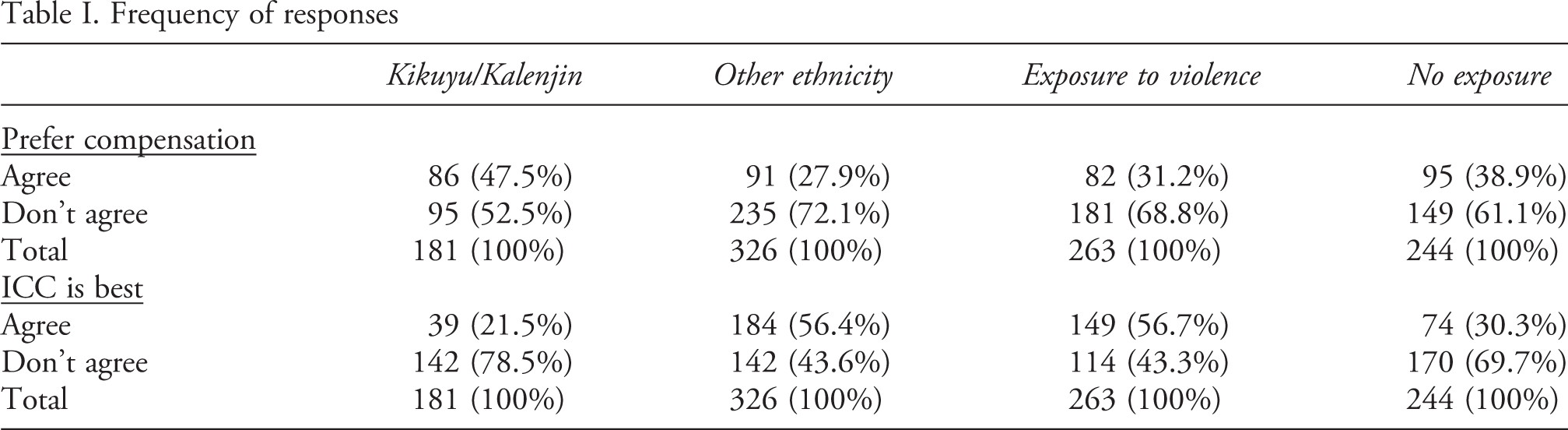
Table I shows the frequency of responses to
To test whether these relationships are statistically significant – and whether exposure to violence alters the effects of ruling ethnic-group membership – we conduct two Logit models. These models control for six additional observed variables, five demographic and one attitudinal. The demographic variables include a binary measure of gender (
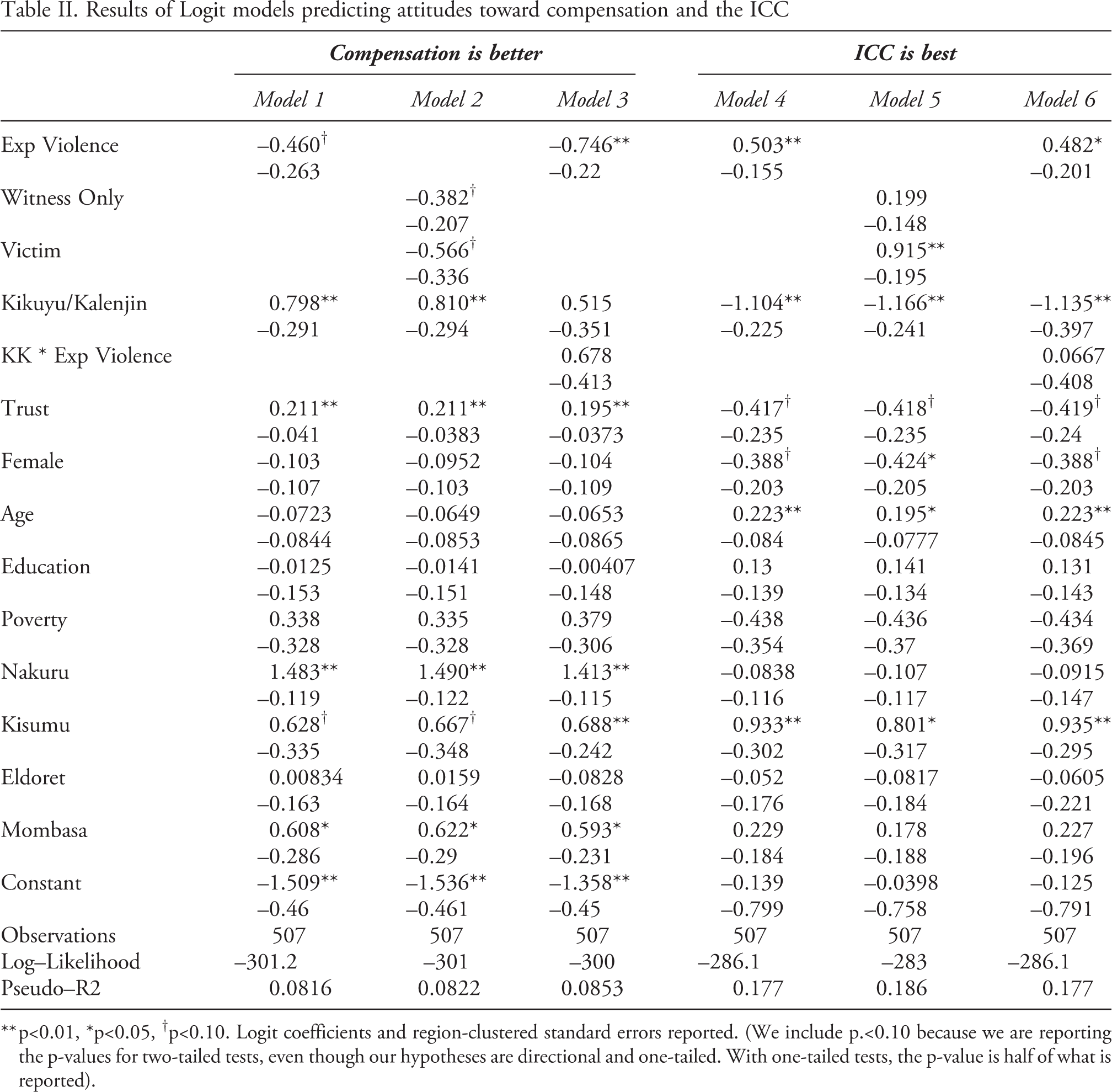
Table II presents the results of the six models. Grouped by each dependent variable, the first model represents our primary specification, the second model presents an alternative specification where type of exposure is disaggregated into self-identified witness or self-identified victim,
5
and the third model includes an additional interaction term between ethnicity and exposure (
Results of Logit models predicting attitudes toward compensation and the ICC
** p<0.01, *p<0.05, †p<0.10. Logit coefficients and region-clustered standard errors reported. (We include p.<0.10 because we are reporting the p-values for two-tailed tests, even though our hypotheses are directional and one-tailed. With one-tailed tests, the p-value is half of what is reported).
In Model 4, which analyzes whether respondents agree that the ICC is best, the E
Hypothesis 2a also receives a great deal of support from Models 1–2 and Models 4–5.
The analyses point to other relationships warranting further investigation. First, in Models 1–3, T
The analyses strongly support Hypotheses 1a, 1b, and 2a. Exposure to violence is the strongest predictor of negative attitudes toward compensation and positive attitudes toward the ICC. Co-ethnicity with the country’s leaders is the strongest predictor of the opposite: positive attitudes toward compensation and distaste for the ICC. But are Kikuyu and Kalenjin who were exposed to violence less likely to support compensation and more likely to support the ICC, compared to their own co-ethnics (Hypothesis 2b)?
The interaction terms included in Models 3 and 6 are designed to test Hypothesis 2b, but because these are maximum likelihood models, the sign and statistical significance of the coefficient on KK * E
As the panel on the right of Figure 1 demonstrates, the same is true for ICC support, though the relationship is reversed. Exposure to violence among Kikuyu/Kalenjin is associated with an 11.3 percentage point increase in support for the ICC. Among other ethnic groups, exposure to violence accounts for a 9.2 percentage point increase in support for the ICC. Taken together, this is strong support for Hypothesis 2b. When compared to other members of their own groups, Kikuyu and Kalenjin who were exposed to violence are less in favor of compensation and more in favor of the ICC.
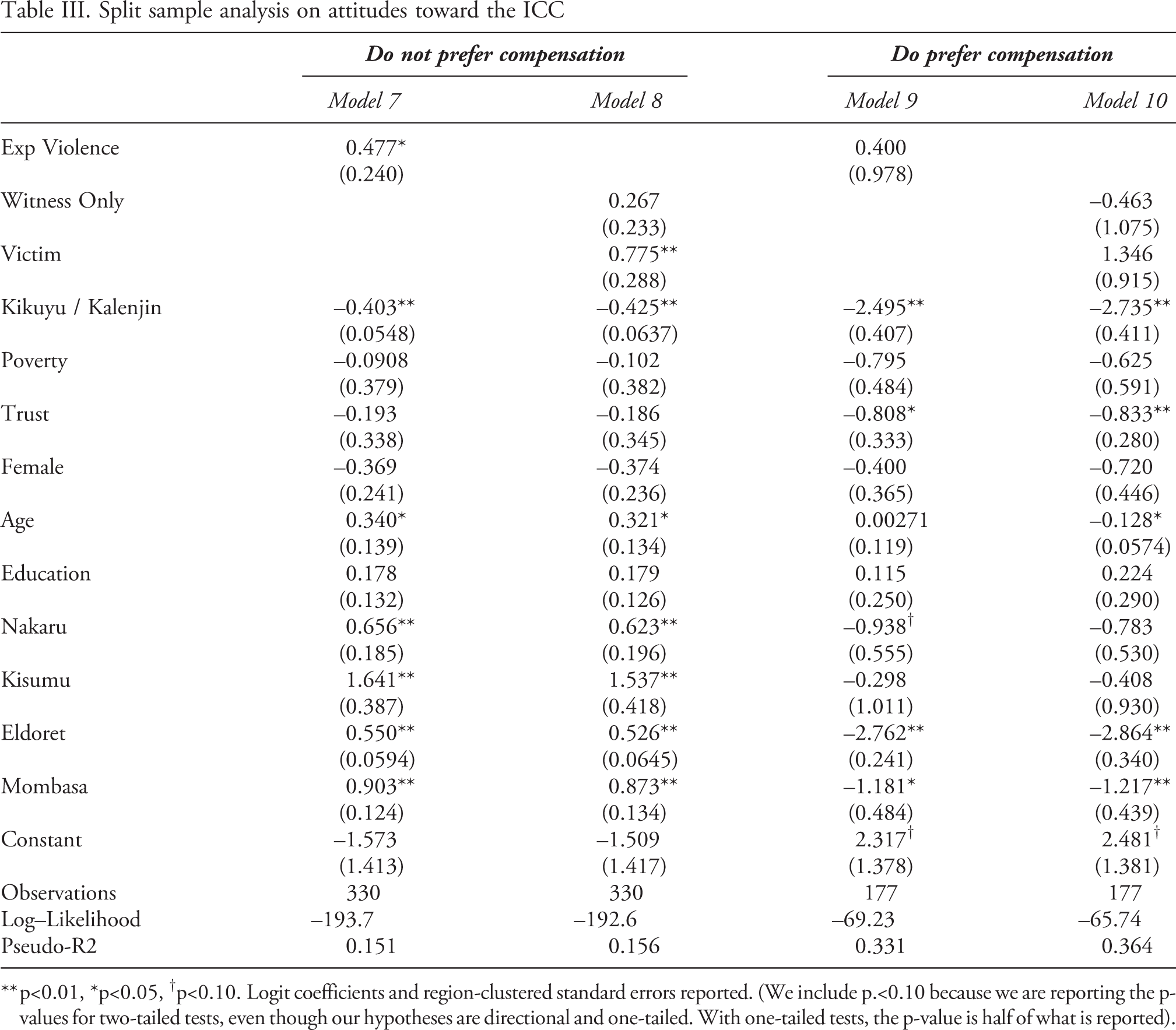
Our final expectation, Hypothesis 3, is that among those who do not favor reparative justice, respondents exposed to violence will be more likely to support the ICC as an alternative. This essentially means that victims who do not prefer compensation also prefer international justice over domestic trials. To test this hypothesis, we perform a split sample analysis using the same covariates and model specifications as before. The first subsample includes respondents who disagreed that compensation would be preferable (N = 330), and the second subsample includes respondents who agreed that compensation would be preferable (N = 177). If Hypothesis 3 holds, we should see that victims in the first group are more likely to support the ICC.
The results in Table III show support for the final hypothesis. Model 7 finds that among those who do not favor reparative justice – or compensation – respondents who were exposed to violence are around 10 percentage points more likely than other respondents to prefer the Effects of exposure to violence on Kikuyu/Kalenjin attitudes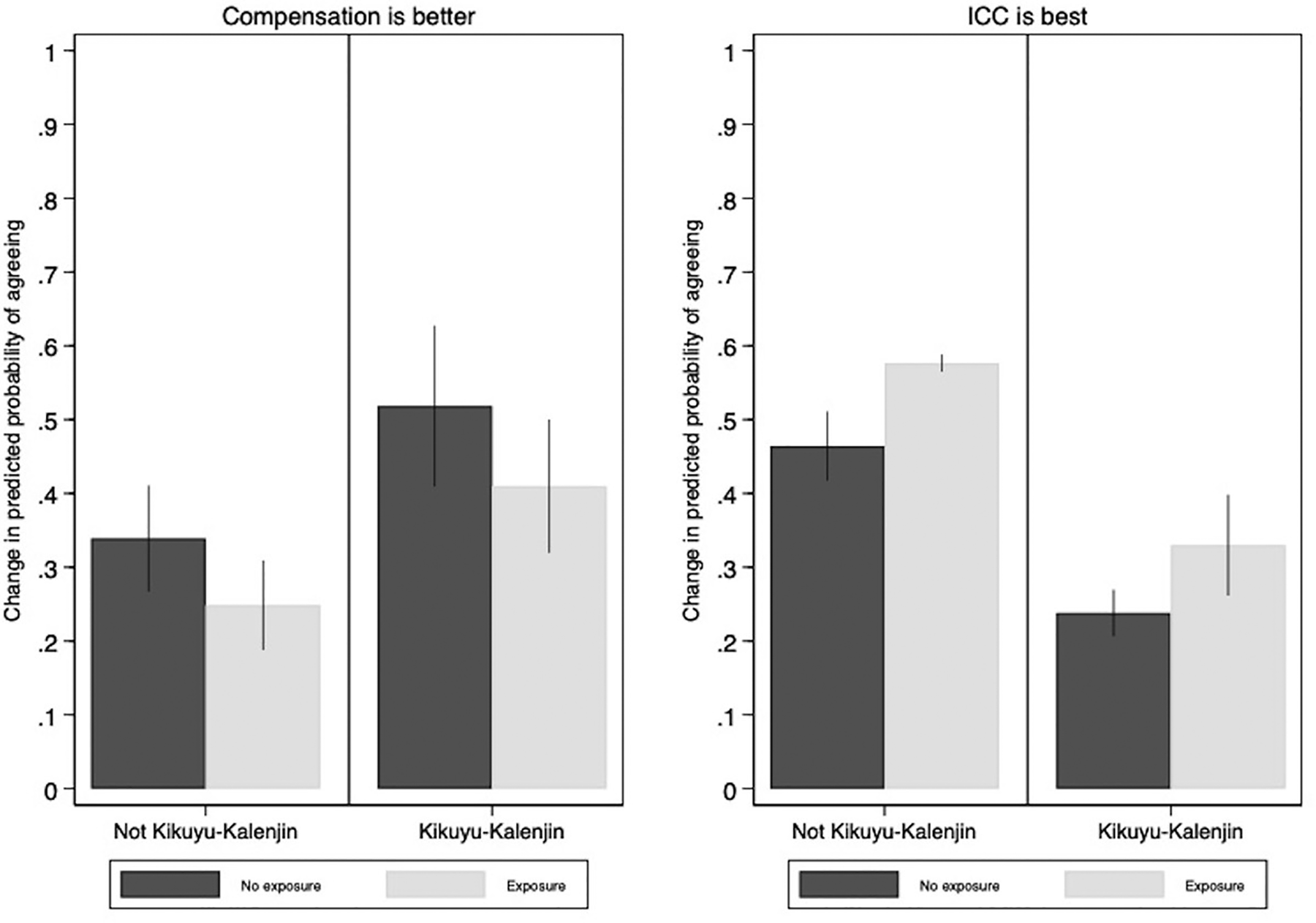
Discussion
What implications do these findings have for the study of post-conflict justice in Kenya and beyond? First, post-conflict justice preferences are not randomly distributed. Two major factors seem to drive attitudes about justice: group membership and exposure to violence. In the Kenyan sample we study, these factors are associated with oppositional viewpoints. Furthermore, robustness checks reported in the Online appendix show that the effects of group membership and exposure to violence are not conditional on income, education, or trust.
Second, those exposed to violence are less likely than other Kenyans to favor reparations over criminal accountability. Additionally, among all respondents favoring trials, those who experienced post-election violence in Kenya were more likely to support the ICC. We contend that this is evidence of a kind of boomerang effect, wherein those with little faith in national responses to human rights violations seek outside support in the form of criminal accountability (Keck & Sikkink, 1998). This may also be supported theoretically by the fact that older respondents tend to favor outside intervention.
Third, dominant group members in Kenya prefer reparations as a post-conflict justice option, not because these individuals are most in need, but because they prefer less accountability. This indicates that post-conflict preferences are shaped by political concerns.
Split sample analysis on attitudes toward the ICC
** p<0.01, *p<0.05, †p<0.10. Logit coefficients and region-clustered standard errors reported. (We include p.<0.10 because we are reporting the p-values for two-tailed tests, even though our hypotheses are directional and one-tailed. With one-tailed tests, the p-value is half of what is reported).
Fourth, post-conflict preferences are partially intersectional. Kikuyu and Kalenjin are far more likely to support compensation and far less likely to support the ICC – but these relationships weaken among co-ethnics who experienced violence. While still more likely than other ethnicities to disagree that the ICC is the best institution to try the accused, victimized Kikuyu and Kalenjin show significantly higher support for the ICC than their non-victimized ethnic group members. This demonstrates that personal experience disrupts the determinative effects of identity on attitudes.
Conclusion
This study adds to the growing literature on post-conflict and post-atrocity justice preferences (Aguilar, Balcells & Cebolla-Boado, 2011; Dyrstad & Binningsbø, 2019; Hall et al., 2018; Meernik & King, 2014; Nussio, Rettberg & Ugarriza, 2015; Pham, Weinstein & Longman, 2004; Samii, 2013; Tellez, 2020) by presenting evidence that supports the theory that victims and witnesses of mass atrocities in Kenya prefer retributive justice over reparative justice when called upon to choose between the two. This finding holds regardless of one’s income level. Victims and witnesses prioritize justice and the potential for the psychological benefits they expect should their abusers be held accountable. Victims might prefer a post-conflict intervention that comprised both retributive and compensatory justice. However, in most post-conflict situations, resources are limited, requiring the post-conflict state and the international community to choose certain interventions. These findings are consistent with a large body of evidence from diverse countries on multiple continents showing that victims prefer trials or punishment to other forms of post-conflict justice (Meernik & King, 2014). Further, our study displays the powerful pull that victimization has on one’s post-conflict justice preferences: victims prefer criminal accountability even when it means that their own co-ethnics may face punishment.
Additional research into the causal mechanisms we propose might turn to survey experiments in situation countries. Some scholars have begun to conduct such experiments in Kenya (Berge et al., 2020). Adopting these methods could help reveal the ways that individual post-conflict preferences are determined by certain observational factors or become altered under treatment conditions. Another way scholars might tease out potential causal mechanisms is by testing additional hypothesized drivers of justice preferences, such as a fear of renewed conflict, length of conflict, or a desire to move on (Samii, 2013).
This study also adds to the literature on post-conflict justice preferences by addressing the debate over the usefulness of the ICC as a post-conflict justice mechanism. As noted, many have called the ICC an imperialistic and biased institution. Others have complained about the yearly budget of approximately €150 million. Our evidence, however, shows at the very least that those exposed to violence support the Court. Political opposition to the ICC is more prevalent across an entire population than it is among the subpopulation of victims and witnesses, which our survey captures better than previous efforts. Victims and witnesses, having been denied justice domestically, seek justice from the ICC. If those directly affected by political violence deserve special consideration in post-conflict justice policy, then outside observers may be brash in dismissing the Court’s actions for being too expensive or too interventionist. Supporting the ICC may help defend local demands for justice, rather than crowding them out (Pham & Vinck, 2007: 232).
Footnotes
Acknowledgments
We thank the anonymous reviewers for their helpful feedback, which substantially improved the article, and Tessa Alleblas, Nahashon Kariuki, and the research assistants for help in conducting the surveys.
Replication data
The dataset, codebook, and do-files for the empirical analysis in this article, along with the Online appendix, are available at https://www.prio.org/jpr/datasets/ and at  . All analyses were conducted using STATA.
Funding
The authors thank The Hague Institute for Global Justice for funding the survey research.