




Abstract
Laïcité (i.e. secularism) has been increasingly and widely represented as a French exception. This study investigates such association by examining the cultural reality in which laïcité is embedded through the use of collective memories. Drawing on critical intercultural communication and aspects of a Foucauldian approach to discourse, this study explores collective memories that are associated with the concept of laïcité and how they contribute to the discursive association of laïcité with France. Qualitative content analysis was used to examine newspaper texts (N = 60) published in the French daily Le Monde between 2011 and 2014. Results reveal the salience of historical memories and indicate ways in which they can be used to normalize meanings, produce instances of disciplinary power, and present reified representations of collective identities and practices.
Introduction
The concept of secularism used in France, laïcité, incorporates numerous zones of tensions related, in part, to the pervasive association of laïcité with France. Baubérot and Milot (2011) argued that the way France and laïcité are tightly intertwined in both scientific and popular literature is problematic because it sustains representations of laïcité as being originally and exclusively French. Yet, as Baubérot (2007) points out, laïcité exists outside of France, and “foreign” models of secularism have informed its construction. The representation of laïcité as a French feature, therefore, raises questions regarding processes used to construct and maintain this association as seemingly natural and unproblematic. Using data from the national newspaper Le Monde, this study addresses this question by examining (1) which collective memories are associated with laïcité and (2) how they contribute to the discursive association of laïcité with France.
Collective memories play a significant role in constructing “imagined communities” (Anderson, 1991) using the past to articulate meanings relevant to today’s context, needs, and agenda (Tenenboim-Weinblatt and Baden, 2016). Thus, exploring collective memories offers insights into the construction of cultural realities and associated logics of inclusion and exclusion especially at the national level (Drzewiecka et al., 2016). Memory studies have largely been overlooked in intercultural communication (for exceptions see, for example, Drzewiecka, 2003; Owen and Ehrenhaus, 2010) despite their relevance to understand how cultural representations and cultural claims can be utilized. In order to investigate the use of collective memories to construct cultural realities, this study draws on critical intercultural communication and aspects of a Foucauldian approach to discourse. Within this framework, culture is regarded as a discursive construction and resource permeated with power.
This study explores collective memories mentioned in mass media which remains the main venue where meanings about the past are deployed to craft representations about the present (Hoskins, 2001; Tenenboim-Weinblatt and Baden, 2016). Newspaper discourse is especially relevant to investigate given the roles it plays in deploying national representations, collective memories, and constructing “imagined communities” (Anderson, 1991; Carey, 2009). This study focuses on the French context and uses articles (N = 60) published in the national newspaper Le Monde between January 2011 and December 2014. Le Monde was chosen in order to examine discourses specific to its position of power and that inform some of the representations that circulate throughout and about French society. The selected time frame enables an examination of recent discourses of laïcité and its discursive association with France in light of the several polemics and events of national relevance occurring during that time. Data were analyzed using qualitative content analysis (QCA). This method was used to generate an in-depth understanding of the collective memories deployed in data and their relations to statements about laïcité and the cultural reality in which it is embedded. The results of this study offer relevant insights into the use of memories as a discursive strategy in the selected articles from Le Monde. Specifically, this study underlines the salience of historical memories which refer to events from a distant past. Findings suggest that historical memories can be used to normalize dominant views of laïcité and Frenchness by evoking status quo representations of the national imagined community and constructing reified representations of national identity and values. Findings have relevant implications regarding (1) the use of historical memories as a discursive resource to normalize meanings and (2) the representations of laïcité and Frenchness that they construct in data.
Intersections between collective memories, media representations, and cultural realities
The term collective memory (sometimes also social or cultural memory) refers to the active process of remembering through which groups construct their sense of community and identity (Erll, 2008; Tenenboim-Weinblatt and Baden, 2016). Under the umbrella term of collective memory, historical memory refers to memories that are not experienced by individuals themselves but play a significant role in the cohesion and identity of the group (Olick, 2008). The difference between historical events and historical memories lies in the subjectivity and agency associated with the latter ones. Collective memories in general are far from objective recollections of the past. They are contingent, constructed, and utilized to construct a sense of togetherness and belonging (Mannik, 2013). Erll (2011) highlights memories as “subjective, highly selective reconstructions, dependent on the situation in which they are recalled” (p. 8). Collective memories are evoked to support specific representations of the present, which raises questions as regards who defines and profits from the memories that are made visible. Even though collective memories are artificially and purposefully articulated, they can be perceived as facts rather than interpretations (Tileagă, 2008). This can have problematic outcomes for events and individuals left out of remembrances and narratives. Collective memories can thus be utilized to reinforce perceptions communities (want to) have of themselves and display to others, while drawing the line between those who belong and those who do not (Erll, 2011).
Collective memories hint at the concept of “imagined communities” (Anderson, 1991), which points out the role played by newspapers in constructing nations, national identification, and sense of belonging. Media in general, and newspapers in particular, play a significant role in the construction of national identity, sense of belonging to a community, and representations we have of “us” and “others” (Carey, 2009; Hjarvard, 2011). Even in today’s media landscapes affected by technological innovations, knowledge put forth in traditional media such as newspapers continue to affect knowledge circulating in society as a whole (Taira, 2014). Thus, newspapers still stand as significant venues where meanings relevant to the construction of communities are established, negotiated, and conveyed (Schudson, 2003). The increasing construction of collective memories through the media (Hoskins, 2001; Meyers et al., 2009) underlines intersections between media representations and collective memories and with the construction of cultural realities. As an interdisciplinary field, intercultural communication offers relevant conceptual tools to explore the construction of cultural realities through mediated collective memories. The problematization of the notion of culture because of essentialist underpinning and conflation with the idea of nation are especially relevant. Yet, little attention has been paid to memories in the field of intercultural communication (Drzewiecka et al., 2016). In an attempt to fill this gap, this study investigates the shared representations (and associated tensions) that mediated collective memories help to construct.
Critical intercultural communication studies have drawn on Baumann (1996) to investigate the use of culture as an interactional and discursive resource as he argues, “culture is not a real thing but an abstract and purely analytical notion. It does not cause behavior, but summarizes an abstraction from it and is thus neither normative nor predictive” (p. 11). Following a culturalist turn at the end of the 20th century, the notion of culture has become a prominent one to address a variety of topics (Breidenbach and Nyíri, 2009) and has been pointed out as a widely problematic, misunderstood, and misused concept (Sommier, 2014; Wagener, 2012). In parallel with the increasing use of the term, cross-cultural studies drawing on essentialist views of culture have also grown in popularity. These approaches have been criticized for using static representations of culture, typically understood as “national culture,” and for focusing on differences between groups of individuals (Breidenbach and Nyíri, 2009; Dervin, 2011; Halualani et al., 2009). In their endeavor to bring back the notion of power and agency at the heart of intercultural communication, critical scholars highlight the importance of exploring the construction of cultural realities in light of historicized power tensions (Halualani et al., 2009). Exploring collective memories thus offers one way of looking at the relationship of pasts and presents by examining the way that pasts actively construct the present.
The premise that discourses of culture are permeated with power is informed by a Foucauldian approach. In his work, Foucault (1977, 1981) underlines the interplay between discourse, knowledge, and power through which impressions of reality, objectivity, and subject positions are constructed. Previous studies, including Said’s (1978) seminal work on Orientalism, have used a Foucauldian lens to investigate the construction of cultural realities as produced by and producing knowledge and power. Approaching meanings as contingent enables an investigation of which knowledge is put forth, by whom, and serving what or whose interests. Such questions are at the heart of critical intercultural communication research that sets out to investigate “who makes culture relevant to whom in what context and for which purpose” (Piller, 2011: 174). These questions offer a theoretical lens to explore the construction of cultural realities by challenging essentialist views and the pervasive understanding of culture as an existing and identifiable entity. Such an approach enables a “shift from reified and inescapable notions of cultural difference to a focus on discourses where ‘culture’ is actually made relevant and used as a communicative resource” (Piller, 2012: 14). Besides exploring the discursive construction of (cultural) realities, a Foucauldian lens pays attention to the normalization of meanings. When exploring cultural realities, the construction and normalization of similarities and differences are especially important. This approach is relevant in the case of collective memories that construct communities through the ostensibly shared articulation of similarities and differences (Mannik, 2013; Tenenboim-Weinblatt and Baden, 2016).
The national resonance of laïcité
On a broad level, the term “secularism” refers to the regulation of relations between the State and religions (Asad, 2003; Wohlrab-Sahr and Burchardt, 2012). Notions that are context specific or have different theoretical underpinnings are also used to discuss relations between the religious and nonreligious. Among them, the “secularization paradigm” refers to the decrease of religiosity in society and has been the target of many critiques because of its Eurocentric assumptions about religion, secularity, and modernity (Casanova, 2009; Wohlrab-Sahr and Burchardt, 2012). This study focuses on a context-specific notion by exploring laïcité, the French model of secularism. Laïcité refers to the separation of Churches and State as a means of ensuring equality and freedom of religion (Baubérot and Milot, 2011). The variety of meanings attached to laïcité and the controversies it stirred in relation to culture, religion, difference, and identity indicate the array of tensions that permeate the concept of secularism in France (Sommier, 2017).
A particular zone of tensions relates to the representation of laïcité as a French exception. Baubérot (2007) argues that this association of laïcité with France has spread since the 1990s and has become largely dominant in both France and abroad. The representation of laïcité as French exception seems to draw on the assumption that laïcité originates from France and that the French model is, if not the only one, the ideal one (Baubérot and Milot, 2011). However, several models of secularism exist worldwide, some of which were established earlier than laïcité in France (Baubérot, 2007). In addition, representations of laïcité as a French exception often hint at larger cultural, political, ideological, or structural differences. For instance, previous research has drawn attention to the opposition between laïcité as embedded in universal republicanism and particularist democracies underpinned by communitarianism (Baubérot, 2007; Gökariksel and Mitchell, 2005).
Assumptions about laïcité being unique have been conveyed through political discourses that nurtured representations of laïcité as a pillar of French society. The far-right discourse in particular has linked laïcité to themes of nation, identity, and community (Laoukili, 2005). Besides the political realm, laïcité has been increasingly constructed through the filter of national identity and the construction of a new enemy as the veiled Muslim figure (Baubérot, 2007). The passing of the 2004 law that banned conspicuous religious symbols in schools has increased perception of laïcité being used against religions, particularly Islam. Auslander (2000) discussed the way inherent contradictions of laïcité construct religious and national identities in opposition to one another by forcing “observant Muslims and Jews to make a choice. They can either be good French citizens and bad Muslims or bad Jews, or vice versa” (p. 288), namely, bad French citizens and good Muslims or Jews. Opposition between national and religious identities is also conveyed through the assumption that Muslims have high levels of religiosity, while French individuals and practices have been more or less secularized (Caeiro, 2004).
Exploring discourses of laïcité in media texts is of critical importance also since laïcité is increasingly constructed through media representations that tend to precede and supplant political discourses on the subject (Baubérot, 2013). Few studies have, however, examined discourses of laïcité in the media and most of them have focused on representations of Islam and Muslims (Brown, 2006; Byng, 2010) and debates about the Islamic veil (Gökariksel and Mitchell, 2005; Hamel, 2002). The majority of previous macro-level research on laïcité has been conducted from a theoretical viewpoint drawing mostly on sociology, political sciences, or religious studies. This study, therefore, sets out to bridge a gap using empirical data to analyze discourses of laïcité in recent French newspaper texts. Specifically, this study examines (1) which collective memories are evoked and (2) how they contribute to the discursive association of laïcité with France.
Exploring discourses from Le Monde
The 60 articles selected for this study were collected from the daily newspaper Le Monde and published between 2011 and 2014. This time frame was deemed relevant to explore the discursive association of laïcité with France for several reasons. First, two main events related to national discourses occurred during that time: the debate organized by the leading majority on “laïcité and the place of Islam in the Republic” (Cori and Auffray, 2011) and the presidential election in 2012. Second, several polemics arose in connection to laïcité and other societal themes such as school meals, religion at work, and religion at the university.
To reiterate, I used Le Monde because of its prominent and influential status within the French media landscape as well as its endeavors to propose new ideas and be a visible actor in the public sphere (Le, 2002, 2009; Thogmartin, 1998). Le Monde is widely characterized as the leading newspaper in France and a symbol of editorial and intellectual press (Eko and Berkowitz, 2009; Le, 2010). Thus, Le Monde’s active voice in the national public debate and highly regarded status make it a relevant venue to investigate prominent discourses and investigate ways in which those are constructed and potentially maintained as normal and unproblematic.
In general, news items used for this article were selected from a larger dataset related to discourses of laïcité and also collected by the author. The news items used in this study were inductively selected by reading through the dataset based on their relevance to the notion of collective memory. Following that first step, keywords based on the articles already collected (history (histoire), historical (historique), memory (mémoire), heritage (patrimoine), legacy (héritage), and tradition (tradition)) were used to gather as relevant a dataset as possible.
The data I used were all in French. Conducting research through different languages can be challenging and raise methodological questions (Nikander, 2008). Translation is especially important to discuss when exploring the construction and representations of culture since linguistic aspects such as idioms and writing style can lose their cultural resonance through translation. For this reason, I chose to use the term laïcité rather than its English equivalent secularism throughout this study. In addition, in the discussion part of this article, I systematically present both original data and their translations to ensure transparency.
I adopted QCA to closely examine the selected texts and conduct an inductive and rigorous analysis (Marsh and White, 2006). Continuously navigating between data, notes, and codes enabled to slowly progress with the analysis and constantly challenge my reading of the selected texts. All articles (N = 60) from data were repeatedly read through and progressively coded by the author using Atlas.ti. 1 Coding was conducted in order to identify what collective memories were evoked and progressively recognize the representations, values, and statements about France and laïcité associated with these memories.
The 1905 law as the essence of laïcité
The main historical landmark related to laïcité and evoked in data is the 1905 law on the Separation of the Churches and State (Loi de séparation des Églises et de l’État). Most statements about the 1905 law are positive and depict it as a founding moment and as the law that encapsulates the true meaning of laïcité. Table 1 compiles vocabulary used when positively discussing the 1905 law, its purposes, and/or its outcomes. Excerpts that explicitly associate laïcité with the nation are underlined. Notions of togetherness, nationhood, and even “destiny” emphasize the construction of the 1905 law as a significant collective memory of the French imagined community.
Vocabulary used to address the 1905 law in positive terms.
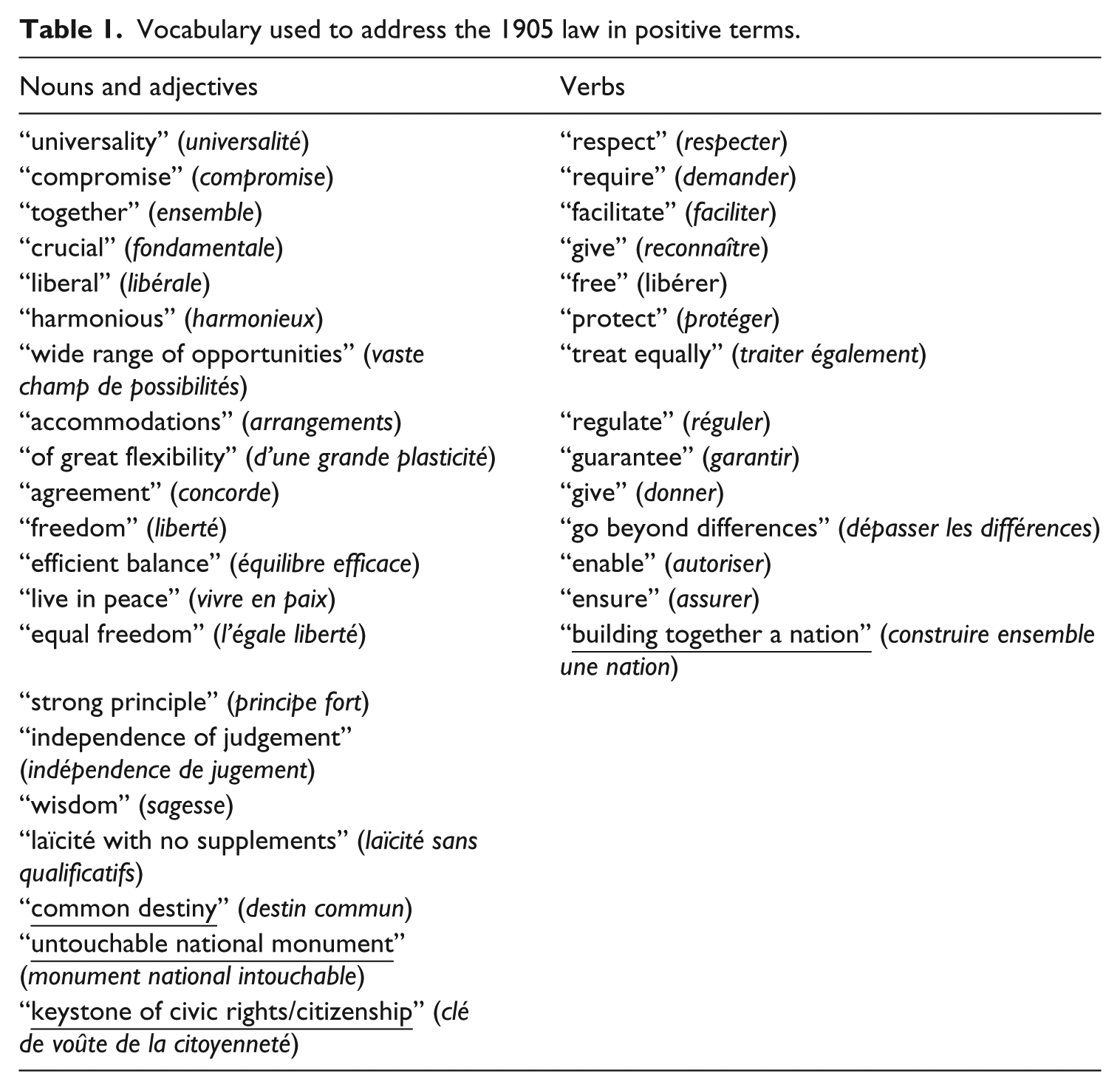
Qualities and purposes of the 1905 law mentioned in data tend to be inferred from the original text whose wording is regularly borrowed. The verbs “ensure” and “guarantee” (assurer and garantir) as well as the notion of “freedom” (of conscience, liberté de conscience and of practicing religion, libre exercice des cultes) are repeated throughout data and are repetitions of the 1905 law itself. This hints at Foucault’s (1981) notion of commentary, one of the internal procedures through which discourses are both restrained and redeployed. Foucault (1981) argues that most discourses do not provide new content but repeat what has been said before. One of the central purposes of commentaries is to “say at last what was silently articulated” in the primary document (Foucault, 1981: 58). Repetitions of the 1905 law text are used to reinforce its positive image by emphasizing it as enabling and protecting individuals as well as their practices. It also helps to contextualize the law into current times by associating it with values that are emphasized in contemporary discourses such as the notions of “universality” and “freedom” as well as ideals of “living in peace” and “go(ing) beyond differences.” Collective memories can, therefore, be seen as a form of commentary “that shapes the present through a selective appropriation of the past in order to support cultural identities and political goals” (Drzewiecka, 2003: 189).
The 1905 law is frequently characterized in data as the “founding text of laïcité” (texte fondateur de la laïcité) that represents a “laïcité with no supplements” (laïcité sans qualificatifs) and gave it “its entire consistence” (toute sa consistance). Positive representations of the 1905 law tend to be used throughout data to highlight from the past what appears to be blurry today: the meaning of laïcité. The overall stability of the meanings associated with the 1905 law differs from the variety of, sometimes contradictory, opinions regarding the meaning and mission of laïcité today. Results suggest that constructing the 1905 law as an overtly positive collective memory results in its use as a solution to today’s problems. That is, the 1905 law is presented in the data as the solution to reach consensus about the different meanings ascribed to laïcité today and to deal with the challenges related to its application. Statements presenting the 1905 law as intrinsically good and supposedly encompassing the true meaning of laïcité are used in data to support the idea that “plenty think that they know what the law says on the issue and are mistaken” (nombreux sont ceux qui croient savoir ce que dit le droit à ce sujet et se fourvoient; Kahn, 2013, 20 March) and that today laïcité is the object of “misunderstandings or misappropriation” (les malentendus ou les détournements dont il fait aujourd’hui l’objet; Le Bars, 2014a, 9 January). The main assumption that permeates data seems to be that if laïcité is misunderstood and/or misused today, going back to its founding text would more or less resolve current problems. The following quote illustrates the emphasis placed in data on the past to answer today’s problems: la laïcité a été tour à tour « positive », « restrictive », « falsifiée », « exigeante », « à la française », « de combat », « d’intégration », « stricte », « apaisée », ou encore « républicaine ». Cet enrichissement suspect est pour beaucoup la preuve que plus personne ne sait très bien en quoi consiste le « principe de laïcité » […] Un détour par l’Histoire s’impose donc. (Le Bars, 2014a, 9 January) laïcité has been successively “positive,” “restrictive,” “falsified,” “demanding,” “French,” “aggressive,” “promoting integration,” “strict,” “pacified,” or “republican.” For many, this suspicious accumulation of adjectives is the proof that nobody really knows what “the principle of laïcité” entails. […] A detour through history is therefore necessary.
Constructing laïcité as a feature of the modern society
Besides the 1905 law, the 1789 Revolution and Enlightenment period are the two other main collective memories associated with laïcité and mentioned in data. The 1789 Revolution and Enlightenment period are referenced explicitly only on few occasions. However, numerous references are made in the data to values typically related to those time periods such as human rights, universality, the republic, and its motto of liberty, equality, and fraternity. Both in France and abroad, these values are typically represented as embodying what France, and identifying with France, entail (Asad, 2003). Using these values and collective memories from the Revolution and Enlightenment period, therefore, embeds laïcité in a highly symbolic and national narrative. Laïcité is associated with historical events and values that are typically utilized to provide a common understanding of what the French national imagined community is, where it comes from, and what defines it. Laïcité is, therefore, represented through the lens of seemingly “stable, unchanging, and continuous frames of reference and meaning” (Hall, 2005: 444). Evoking such symbolic collective memories attaches laïcité to Frenchness using reified representations of French identity and values.
In addition, the values mentioned in data in relation to the French Revolution and Enlightenment period contribute to creating a sharp contrast between the religious past and the secular present. Laïcité, therefore, comes to embody the idea of rupture and progress. The following extract illustrates such discursive dynamic: Cependant, cette société n’est plus. Après la Révolution française, les révolutions industrielles, la fin de la civilisation paroissiale à la fin du XXe siècle, l’altérité divine interprétée par l’Eglise ne fonde plus les normes, ni ne justifie les principes du vivre-ensemble, ni ne détermine les châtiments. Exit l’âge catholique, où l’ordre social, hiérarchique et inégalitaire, reproduit selon la référence à Dieu, condamnait toute offense qui lui était faite. Bienvenue dans une société où les individus libres, égaux et souverains, après avoir considéré que la légitimité venait d’en haut, participent et élaborent une légitimité qui vient, à présent, d’en bas. (Bobineau, 2011, 8 December) However, this society no longer exists. Following the French Revolution, industrial revolutions, and the end of the parish civilization at the end of the 20th century, the divine alterity interpreted by the Church no longer sets norms, justifies principles of peaceful coexistence, nor determines punishments. Exit the Catholic era where the hierarchical and unequal social order that was based on God condemned any offence to the Lord. Welcome to a society in which individuals are free, equal and sovereign, who after considering that legitimacy came from high above, are now participating and elaborating a bottom-up legitimacy.
This excerpt presents a dichotomous view of past versus present underlined by the writing style (“this society no longer exists” … “[W]elcome to a society”) and the opposition between a negatively represented past and a positively depicted present. Strong value-statements are associated with both time periods: “hierarchical and unequal” (hiérarchique et inégalitaire) versus “free, equal and sovereign individuals” (libres, égaux et souverains). Collective memories seem to be used in data to embed laïcité in a narrative that presents the nation as moving from a dark past to an enlightened present. These collective memories construct laïcité as ensuing from the 1789 Revolution and the Enlightenment period and logically opposing anything that came before. Laïcité is represented as both constructed through historical memories and constructive of the ongoing narrative. Laïcité is, therefore, presented as a continuous and intrinsic feature of the current modern society. This representation hints at Western-centric views of modernity embedded in the “secularization paradigm” which assumes that being Western entails being modern which, in turn, entails being secular (Casanova, 2006, 2009).
Recent collective memories
Some more recent memories are also evoked in the data. Most of those deal with education bills related to the visibility of religious signs in school (i.e. loi Debré (1959), loi Carle (2009), Stasi Commission (2003), law banning conspicuous religious symbols in schools (2004) 2 ). Recent memories tend to be mostly represented through the controversies they have caused in relation to Islam, religious visibility in public spaces, and the ambiguity of laïcité to address current challenges. The 2004 law is sometimes addressed in that light but can also be referred to as a fact with no comment on its nature or on the processes through which it was passed. Overall, the 2004 law, which is regularly mentioned throughout data, seems to hold a more prominent status than other recent memories. On the whole, the main discursive difference between old and recent memories lies in the description of their purpose. While the 1905 law is emphasized as a law that is enabling and the Revolution and Enlightenment periods are associated with freedom and human rights, more recent laws are mostly depicted as forbidding and prohibiting laws (circulaire qui proscrit (Le Bars, 2014b, 15 March), loi d’interdiction (Le Bars, 2011, 5 April). Despite the use of recent memories, most of the elements through which laïcité is represented are older collective memories, some of which are associated with highly symbolic historical events. Other historical events that could be brought up such as the colonial past (Ognier, 1995) and the influence of foreign intellectuals and secular models from abroad (Baubérot, 2007) are omitted, which ultimately leaves the memories chosen as seemingly the only relevant ones. This may help to empower and legitimate the narrative and the object of which it speaks. Implications regarding the type of memories used in the data to address laïcité are discussed hereafter.
Representations of laïcité and Frenchness through historical memories
Previous studies have pointed out the pervasive discursive association between laïcité and France (Baubérot, 2007; Baubérot and Milot, 2011). Findings from this study bring further insights into this persistent association as it indicates that mostly historical memories were evoked in articles about laïcité from the newspaper Le Monde. Historical memories refer to past events that have not been experienced by contemporary individuals but retain important symbolic aspects for group identity. By evoking older events, historical memories tend to provide a sense of continuity about the symbols and values attached to a group. The status of historical memories is ambivalent as they weave together stories about the past and historical facts (Olick, 2008). The findings suggest that these characteristics enhance the capacity of historical memories to turn a narrative into the narrative and naturalize statements. References in the data to historical memories from the 18th and early 20th centuries represented laïcité as a seemingly stable element. This perception of continuity may have been used in the data to create a sense of security as a response to the threat seen in emergent sociocultural practices and beliefs. Historical memories were indeed often evoked to moderate current criticisms or challenges which recent memories tended to encapsulate more strongly. Representations of laïcité in data tended to focus on its essence (captured by the 1905 law) and origin (1789 Revolution) and to construct it as fixed and resistant to change. Using historical memories can, therefore, be a strategy to counter the emergence of new discourses and assert existing dominant representations.
The potential of historical memories to normalize meanings indicate the role they play in the discursive production of power. The historical memories referred to in the data hint at representations of a homogeneous past in which the values encompassed by secular republicanism are elevated as the norm. This is a central aspect of disciplinary power which relies on “the power of the norm” to establish homogeneity as the rule and construct difference as deviance (Foucault, 1977: 184). The construction of laïcité as a cornerstone of the national collective heritage reinforces its propensity to be accepted as a source of regulation and identification. I draw attention then to the way historical memories construct laïcité as a form of disciplinary power through references to seemingly fixed and stable representations. As an instance of disciplinary power, laïcité produces a secular cultural reality and corresponding subject positions. Taylor’s (1987: 79) discussion of disciplinary power in relation to sexuality can be adapted to laïcité: We may think we are gaining some freedom when we throw off [religious] prohibitions, but in fact we are dominated by certain images of what it is to be a full, healthy fulfilled [secular] being. And these images are in fact very powerful instruments of control.
3
My findings indicate that historical memories were used in data to represent laïcité as a pillar of modernity in society. Such discourse weaves together laïcité and assumptions from the secularization paradigm about modern societies and individuals being less religious (Casanova, 2006). The suggested embeddedness of laïcité into the secularization paradigm offers further insights into laicité’s relation to the very idea of France as a modern nation as it poses the moral premise that being French entails being modern and, therefore, secular. Laïcité is, therefore, elevated as a value that not only defines relations between the State and Church but also regulates individuals’ practices, identification, and values. Thus, the historical memories evoked in the data reinforce the perception not only of a secular state but also of a secular imagined community.
Constructing imagined communities is a key outcome of evoking collective memories. Historical memories are used to emphasize the idea of continuity by constructing communities, their values, and identities as stable identifiable objects (Olick, 2008). Historical memories can, therefore, contribute to reinforce essentialist views by presenting shared identity and practices as established facts rather than liquid and negotiated constructions. Historical memories associated with typical representations of France (i.e. 1905 law, 1789 Revolution, Enlightenment period, and associated republican values) were evoked in the data analyzed in this article. These historical memories may contribute to maintain the status quo as regards what Frenchness means and entails. The use of historical memories in data seemed to help turn artificial and partial representations of Frenchness into normal and complete ones by giving them historical foundations. The use of overtly positive historical memories also contributed to construct pleasing representations of the imagined community and its values. In line with Gunn’s (2004) observations, representations of laïcité through historical memories resemble “national myths and symbols: they are the receptacles that allow people to project onto them their idealized images of their values, cultures, histories, peoples, and lands” (p. 429).
The discursive association of laïcité and Frenchness through historical national memories and the essentialist undertone they convey highlights several zones of tensions. First, historical memories seem to be powerful tools to transform the arbitrary discursive mapping of what and who belongs in the imagined community into the logical product of history. Second, as in other communities, essentialist views seem to underpin national representations so that the plurality and fluidity of the notion of Frenchness are perfunctorily dismissed. As a result, Frenchness is only represented through the lens of republican secularism, which previous studies have argued is underpinned by a color-blind ideology (Jugé and Perez, 2006). Reified representation of Frenchness overlooks racial inequalities and hints at tensions underpinning religious and cultural categorizations. Previous studies have underlined ways in which racism derived from colonial times has resurfaced especially through tensions woven through religious identifications (Deltombe, 2005; Fellag, 2014; Schaffer, 2004). Fellag (2014) discusses the exclusionary outcomes of national and ethnic categories (e.g. Algerian, Arab, and Maghrebi) being regularly replaced by the religious label “Muslim” in public discourses in France. This study contributes to such discussion by suggesting the construction of a homogeneous secular cultural reality through historical memories, which raises issues about national representations and the notions of culture and religion. This preliminary study suggests that the association of historical memories with essentialist views is a critical aspect of representations of laïcité as something constructed by and for us and endangered by them. The findings, therefore, echo and complement Baubérot’s (2007) previous reflections about the construction of laïcité as a French exception which “risks turning laïcité into an identity property belonging to ‘ethnic French’ to which ‘new French’ immigrants should swear their allegiance to in order to become ‘true’ French” (p. 131). Findings suggest that processes of inclusion and exclusion were discursively constructed in the data around religion and culture rather than explicitly race or ethnicity.
Conclusion
This exploratory study examined the use of collective memories in order to understand how they may contribute to the pervasive association of laïcité with France. Our preliminary findings indicate that mostly historical memories were used in the data, which (1) constructed laïcité as a cornerstone of the national heritage and (2) associated it with representations of Frenchness underpinned by essentialist views of what French values and identity are.
I hope that the findings from this exploratory study on France could provide insightful pointers about the role of collective—especially historical—memories in associating dominant discourses of laïcité with narratives about the French national imagined community. The findings have implications for the field of intercultural communication by highlighting the relevance of exploring collective memories to cast light on the unproblematized use of culture as a synonym for nation and the power relations it dismisses. The most important and practical implications here concerns laïcité. The essentialist narrative in which laïcité is embedded suggests strong limitations as regards its potential to bring diverse multicultural people together. More important, the notion of Frenchness associated with historical memories and laïcité hints at a limited, and limiting, understanding of what and who the imagined community really includes.
Footnotes
Funding
The author(s) disclosed receipt of the following financial support for the research, authorship, and/or publication of this article: This study was part of the author’s doctoral research for which she received financial support from the Wolmar Schildt Institute, University of Jyväskylä, Finland.