




Abstract
This article investigates China’s efforts to develop the administrative capacity of its border agents to effectively provide border security. It does so by contextualizing national efforts in relevant multilateral cooperation on border and immigration management. Regional frameworks such as ASEAN and Greater Mekong Subregion follow a regional border management approach that challenges Beijing’s notion of sovereign border management. However, China and the border provinces selectively engage in cross-border cooperation. These cooperation projects include training programmes for immigrants, standardizing and facilitating immigration procedures at the border, joint efforts against human trafficking and illicit border mobilities, and enhancing local cross-border relations. Against this background, this article investigates how norms – such as administrative capacity and cooperation through border liaison mechanisms – are negotiated, adapted, and practised in the different regional organizations, as well as how they are implemented locally in national immigration laws and procedures in Yunnan Province. The analysis builds on a multi-method approach including fieldwork, policy, and institutional analysis. The article finds that while Chinese local and regional security interests are closely intertwined, norm dynamics are not.
Since 2012, Chinese border management has been subject to various reforms. The central government increasingly became aware of the porousness of its borders and the under-regulation of cross-border mobility. It subsequently asked for a response by local officials and tasked experts to monitor its borders in order to better understand informal cross-border mobility and illegal immigration. Based on these consultations, it was concluded that border management needed strengthening and professionalization. 1 The official reports showed that on China’s south-western border – especially in Yunnan Province – various (in the eyes of the state, illicit) activities that depend on informal cross-border mobility, including unregistered cross-border marriages, 2 timber and gem trade, 3 drug trafficking, 4 prostitution, 5 and gambling, 6 had become prominent. Accordingly, the central government reforms aimed at increasing administrative capacity to tackle these issues. These included various domestic measures such as new immigration legislation, a restructuring of organizational responsibilities, and military reform. Yet, the Chinese government has acknowledged that in order to strengthen its administrative capacity at the border, it would also have to strengthen cross-border cooperation. 7
However, despite Beijing’s efforts to harmonize border management procedures among the various administrative levels and to effectively control border mobility, the border remains porous. Besides the aforementioned ongoing informal mobility, human trafficking, and drug smuggling, recurring ‘imported’ cases of COVID-19 in the border areas during 2020 showed that it is difficult to close the border effectively. 8 While effectively closing the border might be impossible (and undesirable), 9 it still begs the question how border management is enforced and negotiated among the relevant actors. What role does the Chinese central government play in local officials’ decisions to manage the border? How do border guards prioritize certain security issues over others? Do they consider the strategies and norms discussed by transnational political organizations? As such, how synchronized is the governing of border management at local, national, and regional levels? Due to the cross-border nature of the issue, it does not suffice to look at China’s legal framework or how policies are implemented. Rather, analysing norm dynamics allows us to take a multiscalar perspective on the border regime’s actors, their priorities and strategies. Accordingly, this article seeks to explain how national norms of border management correspond with local practices of different Chinese border prefectures and their regional cooperation partners.
To answer the question of norm dynamics in Chinese border management enforcement, this article explores the congruence of border management approaches at different levels, namely Chinese central government, Chinese local governments, and relevant regional organizations. Taking China’s south-western border, with particular focus on the border in Yunnan Province, as a case study, this article investigates the administrative capacity of border management along the Sino-Myanmar and Sino-Laotian borders.
In this article, administrative capacity is considered a norm. It creates expectations for governments to develop the capacity of their border agencies, build necessary institutions, ensure proper training of border guards, and guarantee that border management standards can be enforced. Administrative capacity is normative because it suggests oughtness (to enforce border management responsibly and effectively) and it formulates expectations of appropriate behaviour in a given social environment. Writing capacity building into regional agreements on border management raises the expectation that the participating states will make a considerable effort to align national laws with regional standards. As such, China, its neighbouring countries, and the regional partners expect mutual compliance. This article shows how these norms evolve in regional cooperation frameworks and investigates how they are translated into local practices; how they are localized, adapted, and reshaped by local actors; and how the process of norm implementation is fragmented. 10
More specifically, administrative capacity is an organizing principle. Functioning on a meso-level between fundamental norms (meta-level) and standardized procedures (micro-level), organizing principles are usually contested, though only moderately. Norm contestation becomes visible in its diverging translations into domestic laws and varying local practices. 11 Moreover, administrative capacity can ‘vary widely with regard to their distinctiveness of their prescription or their scope (local, national, regional, societal, etc.) as well as the degree of importance attached to them’. 12 This study scrutinizes the various definitions, degrees of importance, practices, and potential norm conflicts of administrative capacity in border management at local, domestic and regional levels. Administrative capacity is one of many norms informing decisions on border management.
In analysing China’s multiscalar efforts to improve the effectiveness of its border management, this article contributes to the debate on China’s regional integration. Understanding regional integration as norm coherence, this analysis scrutinizes how integrated or fragmented regional border management in Southeast Asia is. If there is considerable congruence among local agents and how they reconstruct foreign norms at the various administrative levels, we can ascertain that a norm is accepted and presents a cooperative effort. 13 If, however, domestic or local actors resist an accepted regional norm, we can then establish a lack of integration. By highlighting the fragmented process of norm localization, this article makes a novel contribution to the study of norm implementation.
By applying a norm perspective to border management, this analysis further contributes to the border studies literature. In the last decade, the border studies literature has increasingly focused on how border practices are relocated away from the actual line of demarcation towards digital, mobile, multiplied, or extraterritorial spaces of control. 14 Although these perspectives make a valuable contribution to the spatial (re-)articulation of the border, the actual line of control continues to function as an important administrative institution that processes people and commodities at border ports every day. Although written off by parts of the academic community, border management remains a crucial administrative task. Thus, addressing administrative capacity revitalizes a neglected subject in border studies.
This article considers two aspects crucial to administrative capacity: information and ability. First, the better the government and border agents are informed about local realities of cross-border mobility, what kind of smuggling is typical of the area, and what kind of cross-border networks or informal markets exist, the better they can operate and enforce laws and regulations. Hence, the question of how border agents are trained – not only concerning their own border regulations, but specifically the regulations of the neighbouring states and international law – is part of the investigation. Second, building on George Gavrilis’s 15 idea that state security increases when delegated to local border authorities, this study assumes that administrative leeway – the ability to autonomously organize and build relations with cross-border counterparts – is crucial to their ability to manage the border. Hence, if there is a mechanism such as a border liaison system, local agents’ ability to effectively manage the border should be higher. Accordingly, the specific configurations of border liaison mechanisms are the second variable this article analyses. Against this backdrop, this study focuses on the various understandings and negotiations of how border liaison should be organized. In the case of China’s south-western border, this includes regional organizations such as the United Nations Office on Drugs and Crime (UNODC), the Greater Mekong Subregion (hereafter Greater Mekong), and the Association of Southeast Asian Nations (ASEAN), dealing with the question of how Chinese central and local authorities aim to shape or adapt existing regional norms of administrative capacity.
The analysis includes the various actors’ definitions of administrative capacity in border management and its implementation: how do the authorities provide border agents with information, resources, and equipment? Methodologically, the analysis builds on textual and institutional analysis of policy documents by the Chinese government, provincial governments, and the relevant regional organizations. It is further informed by several rounds of fieldwork conducted in various Chinese border areas between 2015 and 2017, during which government and academic experts on border and custom management were interviewed. I carried out conversational interviews with residents, border crossers and traders, as well as in-depth interviews with local officials. 16
The remainder of this article is organized as follows. The subsequent section introduces relevant literature on the role of border administration and institutional capacity of border management and the question of sovereignty, followed by an investigation of how the Chinese government implements and organizes border management, drawing on cases at the Yunnan border. This is followed by an examination of how regional and international organizations conceptualize and strategize border management and administrative capacity in the region. In the conclusion, I discuss the norm congruence of administrative capacity in border management among the various levels.
Theorizing administrative capacity of border management
The functions of borders and their checkpoints have been studied and conceptualized in various disciplines. For scholars of sovereignty and territoriality, the institutional meaning of borders has steadily decreased as ‘fixed’ territorial space continues to be considered as the spatial articulation of social practices; the ‘dwelling’ of the border has become more important than its official demarcations. As John Agnew puts it, ‘At an extreme, perhaps, existing borders are the result of processes in the past that are either no longer operative or are increasingly eclipsed by transnational or global pressures. In other words, borders are increasingly redundant.’ 17 According to this view, borders are artefacts of the infrastructural power of the state, and border checkpoints thus proliferate wherever bordering is practised. Border crossings – specifically in the form of checkpoints – are doors through the border; 18 they can be mobile and hidden, embedded in digital practices of mobility control, but they continue to depict the landscape of control at international borders. Despite increasing deregulation of border mobility around the world, border checkpoints remain architectural sluices that channel and organize border crossers and collect, save, and contextualize their identities against larger territorial narratives of wanted or unwanted mobility or danger. Ethnographic studies have understood border checkpoints as manifestations of militarization, 19 social hubs or markets, 20 or representations of connectedness. 21 A comparatively large body of literature addresses how border checks informationalize the bodies of border crossers by conducting identity checks and measuring or scanning their bodies. 22 Others consider border checkpoints as sites of infrastructural connectivity. 23 Differences aside, these studies share the belief that border checks pose an institutional challenge; while functioning as an organizing connection, they create friction and thus require administrative capacity.
To efficiently organize border checks, it is necessary to deploy both a capable bureaucracy and border security agents. The better these are equipped and capacitated, the better they can adapt to regional circumstances and resolve potential disputes locally before they escalate. As already mentioned, Gavrilis 24 argues that state security increases when delegated to local border authorities. In his discussion of potential border conflicts, he argues that states have a military and an administrative option. He finds that ‘institutional design trumps state strength’, because military operations can always have unintended consequences, whereas delegating authority to the borders is more effective. Border guards might ‘cooperate with their counterparts along the other side, pool resources to secure the border, and adopt innovative policing methods to cope with emerging security problems’. 25 Thus, the solution to border instability is to create legal room for local agents to build local cross-border relationships, formalize border liaison mechanisms for local officials, and grant them the capacity to manoeuvre and solve possible conflicts locally.
Similarly, this logic applies to everyday border management. The central government extends its reach into a supposedly underregulated, marginalized borderland through flexible local management. By giving leeway, they strengthen local actors’ ability to deal with conflicts. Local officials know about possible problems and how to develop strategies to prevent ‘illegal’ or informal cross-border mobility, how to identify major trafficking routes, or how to effectively police border communities. In doing so, the local officials interpret national laws and regulations according to local characteristics. To what extent this legal framework corresponds with regional interpretations of the norm for administrative capacity is discussed in the following sections. Accordingly, the next section introduces the multiscalar political and legal context of Chinese border management authorities and subsequently discusses the leeway that the Chinese central government gives to local authorities and border agencies.
Peeling the onion: Situating Yunnan within regional frameworks
In China’s political system, provincial and local governments play a crucial role in policy implementation. How different localities are financially equipped depends on their strategic importance for central government planning. Provincial governments hand down central directives, write interpretation guidelines, and distribute resources to the prefectural level adjusted to local circumstances. 26 Among other border provinces, Yunnan was subject to preferential financial treatment by the central government after being labelled a strategically important bridgehead in 2009. The bridgehead-provinces are an integral part of China’s Going Out Strategy, which aims to facilitate the regional and global integration of domestic and foreign capital, labour, and knowledge. China’s border areas had scarcely been touched by global capitalist forces and as such comprised a major development and investment opportunity. 27 Under the umbrella of the bridgehead strategy and the so-called Develop the West policy, the Yunnan provincial government received billions to invest in infrastructure development including railroads, streets, hydropower dams, and shipping routes. Within Yunnan Province, some prefectures were treated preferentially, receiving financial aid from the provincial government to develop pilot zones in order to integrate cross-border economies. The province increasingly focused on developing and opening its border region and accordingly formulated the ‘Plan for Developing and Opening up the Border Areas of Yunnan Province (2016–20)’. The strategy included the infrastructural and administrative development of key border areas, namely the prefectures of Baoshan, Honghe, Wenshan, Pu’er, Xishuangbanna, Dehong, Nujiang, and Lincang. While the plan generally encouraged these connection hubs to develop good cross-border networks and models for a ‘coordinated approach for economic and social development of the border areas’, the 2017 Regulations of Yunnan Province on Border Management spelled it out in more detail. The regulations specified that border agents (including both relevant local bureaucracies and border security actors) of all levels should establish regular joint meetings and joint military–police trainings, and integrate intelligence briefings to improve interdepartmental coordination (Article 5).
The aforementioned guidelines show how the central government aimed to establish local administrative capacity in border management through a top–down coordinated approach. This was complemented by an effort to encourage Yunnan Province to directly participate in regional initiatives such as the Greater Mekong, enabling it to engage in debates on cross-border infrastructure development and trade facilitation. Besides Guangxi, the Yunnan provincial government is directly involved in the regional meetings and has actively pushed the Greater Mekong cooperation forward. 28 Aside from the infrastructural development of cross-border economic corridors, the Cross-Border Transport Facilitation Agreement is the key component of the regional initiative. The Agreement determines measures for streamlining cross-border movement of goods, vehicles, and people within the subregion. Initiated in 1999, the Agreement was signed and ratified by Cambodia, China, Laos, Myanmar, Thailand, and Vietnam by 2003. It is accompanied by various Memoranda of Understanding and has 20 annexes in different stages of ratification. Overall, the Agreement aims to facilitate, simplify, and harmonize cross-border transport of goods and people as well as the relevant legislation, regulations, procedures, and requirements. 29
The Agreement document is key to understanding the regional articulation of administrative capacity as a norm. The Agreement regulates practical issues such as definitions and handling procedures for dangerous goods. In doing so, it produces technical norms. It further entails procedural norms such as how to settle disputes. Regarding border agents, the agreement states that border control posts should coordinate operating hours, types of inspections, and clearance procedures (Annex 4). It further aims to establish a single-window and single-stop approach that would require both sides of the border to coordinate and agree on every detail of border procedures, including language, immigration and custom formalities, priorities, and standards. While the Greater Mekong has had limited success in standardizing border procedures, 30 the Agreement institutionalizes consent on some issues, including locations of borders in Southeast Asia and the will of states to tackle issues of informal cross-border mobility. The Agreement shows that the signatory governments largely agree on the norms of territorial integrity, sovereignty, and open borders to secure the flow of labour migration as well as on the need for administrative capacity to fight illicit trafficking, smuggling, and irregular border mobility. This common ground facilitates specific agreements, but the strong emphasis on sovereignty also prohibits the region from developing a more integrated approach. Administrative capacity thus appears to be a transnational norm acting as a basis for regional border management.
Moreover, the norm is international since it is informed and supported by global actors. The International Organization for Migration assists states in organizing the voluntary return of migrants by providing resources. 31 Overall, this organization aims to increase the administrative capacity of its member countries. Although China became a member in 2016, the collaboration remains hesitant. 32 As for the cooperation with the United Nations, China participated within the ASEAN and China Cooperative Operation in Response to Dangerous Drugs, which was initiated in 2000 as part of the UNODC process and aimed at creating a ‘drug-free ASEAN and China’ by 2015, including strengthening capacity and cooperation of (border) law enforcement. 33 The UNODC organizes border liaison offices and mobile detection teams across various destinations in Asia to prevent drug trafficking across the borders, such as in Afghanistan. 34 In all these regional cooperation frameworks, local capacity building and training of border guards play a crucial role. The following section investigates the various articulations of the norm of administrative capacity and how it is locally implemented through capacity-building measures and training.
Local leeway in China’s border management
To understand the scope of local administrative capacity in China, this section scrutinizes how autonomous border agents and local governments of border prefectures execute measures, and how their decisions are informed by both the local situation (what are the risks and do they have the professional training to avert it?) and the organizational superstructure (do they have administrative leeway?). This section inspects how local officials apply their implementation leeway. Do they consider, struggle against, or comply with regional interpretations of the norm? Do they use their relative autonomy to strengthen the regional border management approach, or do they follow a non-integrative approach that focuses solely on domestic issues?
The central government’s border management approach is the result of several recent reforms that started in 2012 with the drafting of a new immigration law, namely the Exit and Entry Administration Law. Besides comprehensively regulating immigration procedures for the first time, this new law resulted in a considerable shift of responsibilities in border control. The reform was further institutionalized through the creation of the National Immigration Administration in 2018. This executive agency is responsible for developing further immigration policies and legislation, organizing implementation, coordinating the ‘three illegals’ policy, 35 and managing visas, permanent residency, refugee issues, and repatriation. 36 The Administration is subordinate to the Ministry of Public Security which also supplies most of the border security actors. At the ministerial level, responsibilities are shared among the Ministry of Public Security, Ministry of Foreign Affairs, and their respective sub-organizations (such as provincial exit and entry administrations and local public security bureaus 37 ), as well as the Ministry of Human Resources and Social Security, which controls social benefits for foreigners and whose local bureaus issue work permits for foreigners.
As far as the everyday enforcement of border security is concerned, administration is split between the People’s Liberation Army (PLA) and the People’s Armed Police. These security actors share jurisdiction depending on the administrative level of a given border gate, port, airport, or checkpoint. 38 All border defence actors are obligated to safeguard national territory against terrorist violence, (cross-border) riots, and illegal flows of immigration. In 2003, the Central Military Commission transferred control of the Sino-Myanmar border from the PLA to the Armed Police as part of a restructuring of the security forces. 39 This border area specifically was put under the authority of specialized border control groups that worked under the Armed Police. However, this administrative division of border agents was again adjusted as part of a comprehensive institutional reform in 2018. 40 Since then, securing cross-border mobility has become recentralized under the PLA’s responsibility. In the past, the border control groups constituted a highly professionalized border agency, well trained for specific risks such as human trafficking and drug smuggling. They were selectively deployed in certain border areas that were considered potentially vulnerable and specifically concerned with the ‘fight against the three evils’. 41 Along the Yunnan border, the PLA is currently responsible for checkpoints and airports, whereas – during the time they existed and during the author’s field engagement – border control groups controlled the roads leading to and from the border, creating a second line of control. Members of these groups underwent intensive training including a specialized training in martial arts, 42 a tradition that seems to have continued post-reform. 43 The 2018 reorganization relocated them into the military apparatus; their dissolution became effective in January 2019. The various reforms must be seen in context with each other, not only constituting an overall simplification of chains of command and institutional organization, but also strengthening the ideological control of the Chinese Communist Party over various spheres and state institutions including the military. 44
While the reforms tackle important issues, they present a theory that does not meet the practice. Enforcing mobility control at the Yunnan border has proven particularly difficult because large parts of the border are ‘green’ borders. They lie in the thick rainforest where people can easily cross without being detected. While Myanmar agents largely refrain from punishing illegal border crossings, Chinese authorities and local border agents are overwhelmed. Insufficient training, language skills, and legal education among local border enforcement agencies result in a ‘reluctance’ and ‘unwillingness’ to perform controls and acts of repatriation. 45 This likely factored into the reformation and re-militarization of border agents. According to Chinese experts, interagency communication is a key factor that should be further improved. 46 For the local agents, digitizing border surveillance could present one way of effectively controlling cross-border mobility. CCTV and drones are used in some areas to patrol the border but these have not yet been widely deployed. 47 For the most part, local authorities – both border agents and local governments – must accept the fact that they lack the resources to effectively prevent and control informal border mobility.
Besides developing digital means of control, one way of increasing border control capacity is the border liaison mechanism. As already mentioned, the Yunnan Regulations on Border Management state that border agents (including both relevant local bureaucracies and border security actors) of all levels should establish regular joint meetings and joint military–police training, and that border agents integrate intelligence briefings to improve interdepartmental coordination (Article 5). Accordingly, local governments are requested to establish cross-border relations, so-called liaison systems. In Dehong Dai and Jingpo Autonomous Prefecture, Chinese local security authorities meet regularly with their Myanmar counterparts to exchange information on illegal activities and enforcement strategies. According to Chinese sources, however, this exchange process is asymmetrical, with the Myanmar forces having rather limited expertise, equipment, and reach. 48
Often, the liaison system also takes place at an informal level. Chinese local officials try to establish good township-level relations with their cross-border counterparts. 49 To increase control, they further monitor mobilities that are typical of their localities such as cross-border marriage. In many of Yunnan’s border areas, cross-border marriage is a crucial issue because communities on both sides of the border are closely intertwined within family and kinship networks, making it arduous for local authorities to prevent informal mobilities. 50 During the interviews, one official from a township government stated, ‘In order to understand the local ethnic networks, we host religious festivities to learn about the customs and the people that are involved in our community. We also invite the other side’. 51 In doing so, the officials at the township and county level develop individual versions of border liaison mechanisms as part of the local cultural life. Other forms of local cross-border integration include issuing border residence permits. Border residency is a locally valid migration scheme that allows the local administration to identify and monitor border residents from both sides of the border, because they are eligible for preferential treatment at border crossings or for local working permits. 52 To know their local constituents, cadres monitor local demographics and communicate their observations to local public security bureaus which are in charge of issuing marriage and migration documents. 53
In addition, local cadres are required to establish relations with local entrepreneurs. 54 As part of the national border development agenda, private and state-owned companies have increasingly moved to border areas. To supply these new employers with a cheap and reliable workforce, local officials must manage labour availability, which in many cases involves cross-border migration. Local authorities are responsible for maintaining order while facing the manifold challenges of reconciling their own priorities with national policy directives and regional initiatives. They must simultaneously secure the borders while keeping them permeable, and must follow central directives while creating strategic opportunities within a dynamically changing regional order. Local border governments use creative solutions adjusted to the inherent local characteristics of various experimental zones in the form of open test areas, border towns, border economic cooperation zones, and border ports. 55 Located in Dehong at the Ruili-Muse border gate, the Ruili National Key Experimental Zone for Development and Opening up (瑞丽国家重点开发开放试验区, hereafter Ruili Experimental Zone) is the first of Yunnan’s special economic zones, 56 directly authorized by the State Council and granted ‘preferential policies’. Besides the economic and fiscal goals, the zone also aims to ‘deepen cooperation in border social affairs: strengthen inter-governmental consultations between China and Myanmar and promote cooperation in border city construction; expand cooperation in transnational education, culture, science and technology, human resources development, medical and health care, anti-drug and anti-AIDS programmes, gambling and counter-terrorism in border areas’. 57 To facilitate cross-border migration, the zone has established a registration office for cross-border marriages and the first foreigners’ service point for Myanmar citizens. 58
While the Ruili Experimental Zone does not include funding or cooperation mechanisms with regional or international institutions, Ruili City authorities have also established an ad-hoc Foreigner Service Centre that provides free training for Myanmar workers. 59 The service centre includes a job agency that operates in cooperation with the Yunnan Nationalities University in Kunming and is financially supported by ASEAN. Similarly, in Lincang Prefecture, the Asian Development Bank supports the municipal government in creating a cross-border trade zone. The project’s goal is to increase trade capacity, including administrative capacity building through technical and vocational education, as well as training for entrepreneurs and workers from Myanmar. 60 Often, government officials employed in the special border zones do not engage in direct contact with cross-border counterparts unlike prefectural or township officials. The cadres employed to govern the zone are civil servants, but their status is somewhat unclear within the administrative system. Their salary is less than that of other cadres and – in their own view – they often do not receive proper training. 61
The zone’s liminal position within the Chinese administration hierarchy produces uncertainties among cadres. To counter this uncertainty and further facilitate cooperation between cross-border counterparts, over 300 supporting policy regulations have been issued at the national and provincial levels. 62 During my interviews, I asked local officials whether they considered regional cooperation frameworks important for their work regarding immigration and border cooperation. They answered with a clear ‘no’. They were only marginally informed about these processes, and argued that under pressure from the regional and national governments to reach their own priority targets, the officials simply were unable to consider wider goals as well. 63 They clearly hierarchize national, local, and regional politics and thus only contribute to or contest norms on border management within the limits of their administrative boundaries. This means that they have leeway in establishing cross-border relations through local specific forms of cooperation, but that at the same time they lack the ability to develop relational approaches across the border. Cross-border relations are often formalized through liaison mechanisms, including regular meetings of both border administrations to discuss border affairs, informal activities (cultivating cross-border cultural integration or personal relations with cross-border counterparts), bureaucratic activities such as the implementation of a joint cross-border residency permit, and infrastructural mechanisms (development of cross-border zones). By choosing the form of cooperation, the local government plays a crucial role not only in local policy implementation, but also in shaping regional (border management) norms. However, the case of the Ruili Experimental Zone shows that its specific configuration, its border management, and its administrative capacity solely follow national prioritization. How disparate this approach is from regional initiatives is discussed in the subsequent section.
Building administrative capacity in regional organizations
In Southeast Asia, various regional initiatives aim to establish local administrative capacity at border gates and coordinate resources to comprehensively develop the region. The Greater Mekong, ASEAN, and UNODC are the main drivers aiming to integrate the different domestic approaches and develop common standards and norms on border management. However, these organizations follow different strategic approaches. As the only institution that includes Chinese provincial governments, the Greater Mekong focuses on infrastructure coordination. Its major tool is the aforementioned Cross-Border Transport Facilitation Agreement, which considers capacity building to be the successful implementation of its own regulatory process. Greater Mekong and ASEAN both regard national governments as key, but unlike Greater Mekong, ASEAN provides additional resources to assist local governments, consulting and providing platforms for transnational coordination. The most potent tool of UNODC is the organization of its border liaison office mechanism, which specifically aims to increase administrative capacity by training agents and providing information exchange platforms. The following section details these approaches and how the transnational norm has evolved.
In addition to migration and transportation issues, the Greater Mekong also facilitates cooperation within the realm of traditional security. For instance, the Greater Mekong organizes joint border control along the Mekong to fight organized crime, illegal trafficking, and drug smuggling. In a 1993 Memorandum of Understanding, Greater Mekong member states created a border liaison office mechanism that aimed to ease the sharing of information on illegal border activities in order to facilitate cooperative action. The mandate successively broadened its focus from illicit drugs and drug precursors to include migrant smuggling, human trafficking, and the illicit cross-border transport of wildlife, timber, hazardous waste, and ozone-depleting substances. In cooperation with the UNODC, this mechanism evolved into the ‘Partnership Against Transnational Crime Through Regional Organized Law Enforcement’. This mechanism organizes customized training for border security personnel 64 and conducts surveys among border personnel to ascertain what critical infrastructure (from office space to IT systems) and equipment (such as vehicles or hardware) is missing. 65 Training includes information on cash couriers, money laundering, wildlife crime, and forensic accounting. Information material for frontline officers on best practices against smuggling, human trafficking, and drug trafficking is provided in the relevant languages. 66 Moreover, the International Organization for Migration provides training for border agents on migration policies to strengthen local state capacity and enhance data collection, analysis, and dissemination. 67 This training is often the only formalized training border agents receive, especially in Southeast Asian countries where 70 per cent of border agents do not have any prior training. 68
The UNODC Border Liaison Office mechanism is designed to create a regional network of border agencies. The programme aims to create an ASEAN Single Window by establishing a single, centralized data hub that allows all related actors to share information on border and customs control. While the single-window approach is a long-term goal, more immediate measures include improving law enforcement cooperation along and across the border, enhancing capacity to share and disseminate information on cross-border crimes, and building knowledge and skills among border law enforcement agencies. 69 Undergirding these aims, the UNODC supports over 70 border liaison offices throughout Southeast Asia (Figure 1). This liaison mechanism has been in place since 1999 and is continuously being developed. It aims at improving communication and functionality of interagency relations across the border (Figure 2).
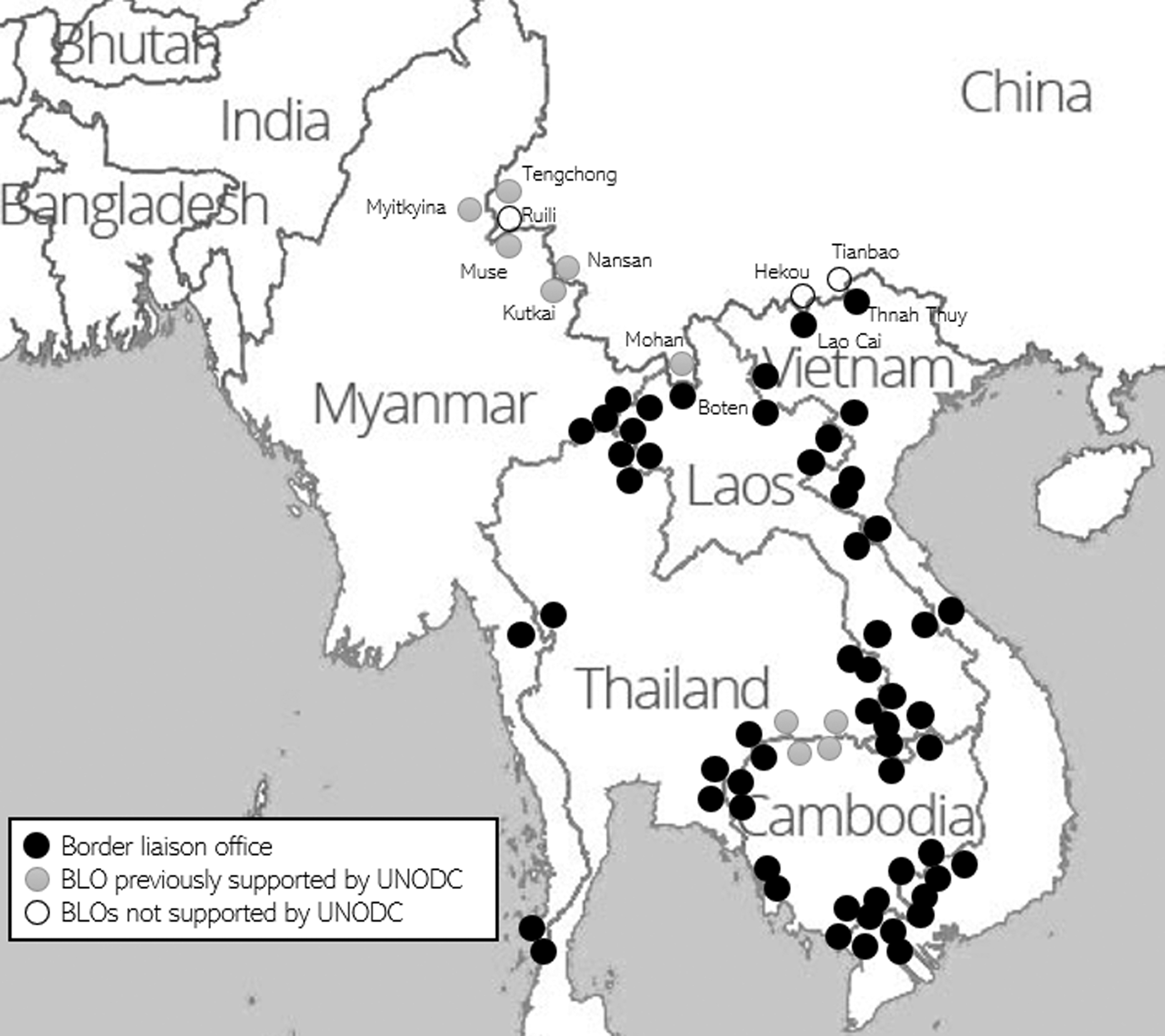
UNODC Border liaison office network in Southeast Asia.
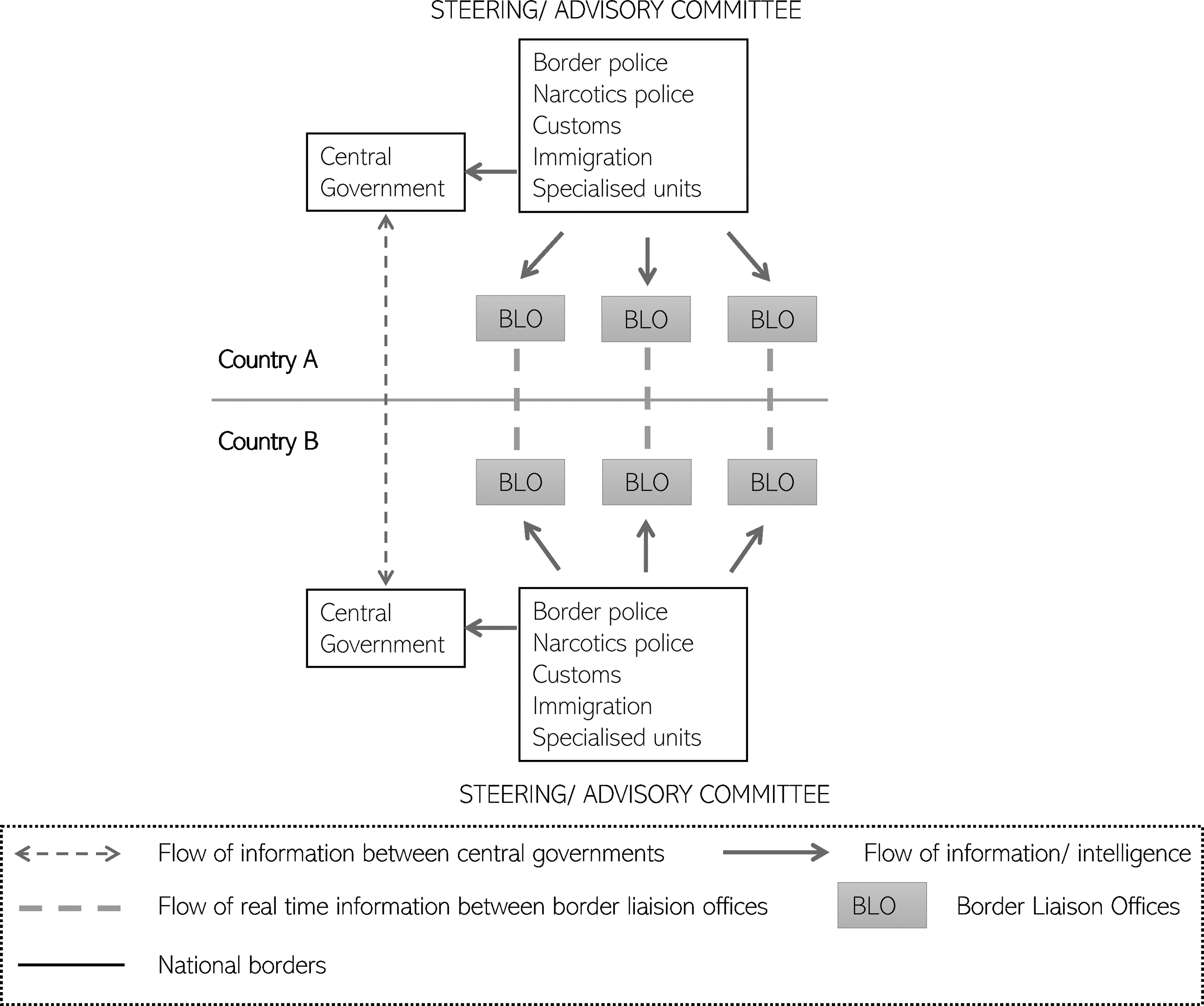
Border liaison office mechanism.
As part of the liaison process, the UNODC has reported a general lack of border security infrastructure as well as increased illegal trafficking of women across borders by highly professional trafficking organizations. China, Vietnam, Laos, and Myanmar hold regular meetings and event-based discussions with border inspection agencies regarding the facilitation of inspection procedures, expedited customs clearance, and joint crackdowns on illegal and criminal activities. While Cambodian and Laotian officials meet two to five times a year, UNODC reports that meetings with Chinese officials are significantly less frequent. 70 Moreover, Chinese authorities do not participate in information gathering nor report compilation under the framework of the Partnership Against Transnational Crime Through Regional Organized Law Enforcement or other UNODC monitoring efforts. While the support from Chinese agencies had been ‘operational’ until 2007, 71 the frequent rotation of Chinese local officials and shrinking engagement by upper-level government agencies have steadily reduced Chinese participation. This shows how disintegrated the Chinese efforts to establish standards for border management are. The evolution of the transnational norm for building administrative capacity seems to be separate from domestic efforts. While the norm is officially supported, it is not translated into action.
The picture in the Greater Mekong is different. Staffed by security personnel from all member countries, the Greater Mekong has initiated a joint border control unit that aims to curb illegal trafficking and drug smuggling along the Mekong. China is represented by both the PLA and People’s Armed Police, which together dispatch around 200 soldiers and police for these patrols. The Yunnan Police unit presides over the joint mission, functioning as a transnational coordinator. The Yunnan Police Academy cooperates with the UNODC by conducting training to which neighbouring countries’ security forces are invited. In January 2022, law enforcement authorities launched their 113th joint river patrol. 72 These raids have gained wide media attention in China since the 2011 incident known as the ‘October 5th Massacre’: 13 Chinese sailors were killed when drug traffickers hijacked their boat. In response, the traffickers were hunted down in a cooperative action initiated by the Ministry of Public Security. Since 2011, these joint patrols have become more institutionalized and are conducted regularly along the Mekong River from Yunnan’s Guanlei Port to Chiang Saen in Thailand, escorting cargo ships to deter hijackers and searching private boats for drugs. The operations involve China, Laos, Myanmar, and Thailand, with Cambodia and Vietnam observing. Since then, more than 70 operations have taken place and the project has been positively evaluated by Chinese authorities. Multilateral cooperation in the traditional security field is well coordinated.
This security cooperation framework brings Chinese threat perceptions to bear on regional issues, with international drug control cooperation serving the interests of China’s efforts to crack down on drug smugglers. To effectively conduct this crackdown, China draws on joint Greater Mekong resources. Though these operations are not under UN or UNODC mandate, they result from the joint security concerns of the Mekong riparian countries. China’s Armed Police contributes personnel to operations beyond the Chinese border in the Golden Triangle. These controls show the Chinese government’s ability to extend border management efforts across borders and to facilitate regional security. 73 However, the disassociation of the various border liaison mechanisms suggests the contrary. China’s domestic approach to border liaison mechanisms gives leeway to local governments, which results in them pulling away from regional integration. Greater Mekong, ASEAN, and UNODC all provide incentives to strengthen regional border liaison mechanisms, but Chinese representatives have increasingly withdrawn from these processes. Although Chinese authorities welcome foreign investments in their border zones, they are less willing to allow UNODC or other external reviewers to monitor local administrative capacity at the border. This shows how incoherent the approaches of various government levels to border management are. Norms evolve through dialogue, but they are also contested when the relevant stakeholders disagree on meaning or practice. In this case, the norm of administrative capacity shows how fragmented and incoherent regional border governance still is.
Conclusion
Considering the congruence of administrative capacity norms in border management among regional, national, and local levels, this analysis shows that while the Chinese government builds on regional cooperation regarding security enforcement, it remains unwilling to allow norm adaptation in its border management. While Chinese authorities appreciate the opportunity provided by regional initiatives to extend their own sphere of influence across China’s border, they are increasingly withdrawing from those integration projects that would require adapting their domestic border management approach. While all parties agree that a border liaison mechanism is a key element in effective border management, the recent history of regional operations shows that the various understandings – of how this mechanism should be designed and implemented – vary and are increasingly moving apart.
Despite the political will to develop regional border management approaches, the norm for administrative capacity is contested. At the transnational level – within UNODC, Greater Mekong, and ASEAN – the norm developed smoothly, without coming into conflict with other norms. In China’s border agencies, however, these norms are lost in translation. Local officials prioritize domestic policies over the transnational norm, training and military operations are only selectively conducted together, and border control procedures are yet to be standardized. Despite all efforts, border agents lack information on border procedures of the neighbouring countries. A considerable gap remains as to what local enforcement agents consider to be necessary training and equipment for implementing equivalent and meaningful cooperation with their cross-border counterparts. While there are some examples where regional organizations can support projects on Chinese territory – such as including ASEAN in the employment agency in Ruili or the Asian Development Bank in Lincang – the Chinese national government does not participate in the UNODC border liaison office framework, refusing to let their agents be trained by them, external reviewers to be hosted, or information exchanges to be organized. This refusal stands in contrast to various international organizations’ emphasis on the need for Chinese authorities to increase the effort to prevent human trafficking or timber trade. Amitav Acharya argues that in such cases, norm takers can localize norms by ‘build[ing] congruence between transnational norms (including previously institutionalized in a region) and local beliefs and practices’. 74 In this case, however, China’s domestic approach prevents room for localization and thus maintains a fragmented norm implementation.
Generally, cross-border or intraregional cooperation in ASEAN is hampered by the stark differences in border management capacity across the region. As ASEAN continues to reach consensus on economic integration, this issue will have to be addressed through common minimum border management standards. Despite regional efforts to increase regional cooperation and to commit to facilitating and standardizing border procedures, we can only find selective alignment of norms regarding administrative capacity building.
These findings speak to the debate about how norms evolve and particularly how norms are translated into local practices. Although the issue of border management affects all regional partners, this empirical research shows the significance of important stakeholders’ objections in preventing the effective implementation of a norm. Ironically, in this case, it is China – the regional hegemon – who refuses to engage in the constructive production or adaptation of the norm by pulling out of the regional mechanism without providing alternatives. Applying this norm approach to other regional security issues provides rich ground for further research. If we better understand the empirical basis of how non-traditional regional security issues – such as human trafficking or health issues – are locally practised, this will also enhance our understanding of regional connectivity.
