



Abstract
This article explores how children who have recently immigrated to Québec, Canada, represent the family. Using the child-centered approach, this qualitative study is based on semi-structured interviews with 43 immigrant children aged 6 to 14 years. The results reveal that children represent the family according to the different functions it plays in their lives, that is, to provide them with security, protection and support, and that their definition of the family is based on the affection and love that unites those who make up the family, shared time and lasting stable ties.
Introduction
While children are often seen as central to family life and essential to defining a group as a family (Dreby and Adkins, 2012), few studies have looked at children’s representations and understanding of this concept. Representations, understood as socially shared systems of opinions, information, values, and beliefs about a given object (Jodelet, 1989), have been extensively studied in adults but only rarely explored in children. The few studies that have investigated children’s representations of the family identify four key dimensions shaping their understanding of this concept: affectivity, cohabitation, biological ties, and legal recognition. According to the children interviewed in different studies, affection is an essential dimension of the family (Mason and Tipper, 2008), a dimension that they describe as the love, support, respect and care that are exchanged between the members of a family. It therefore seems that for children, the family is mainly conceptualized in terms of the emotional ties between members who make up the family. Indeed, according to Anyan and Pryor (2002), 80% of children identify the need for love, kindness and support to be at the heart of the relationships between the members of a group for it to be considered a family. Studies have also highlighted that living under the same roof is, especially for school-aged children, an additional element that distinguishes a family from another group of people (Borduin et al., 1990; Gilby and Pederson, 1982). Although less frequently mentioned by children, the biological dimension, that is, blood ties and genealogy, also defines the family, with this idea being more prevalent in older children (Gilby and Pederson, 1982). Finally, 2% of children mentioned, according to Rigg and Pryor (2007), that legal recognition defines family for them, especially in the case of parents who marry after the child’s birth and in cases of adoption.
The family plays a central role in the lives and well-being of children. It is widely recognized, however, that the family is not a permanent or universal organization; its structure and functioning evolve over time both according to the family system itself (e.g., age of children, transitions, state of health) and the macro-systems in which the family evolves (e.g., family policies, employment conditions, etc.). In Western societies, the dominant family model has undergone profound transformations over the past 50 years. Traditionally centered on a nuclear, heterosexual, and married structure, with a strict gender-based division of roles (Damon, 2015; Guislain, 2015), this normative model has been increasingly challenged since the 1960s. Rising divorce rates, the recognition of diverse family forms (such as blended, single-parent, or same-sex parent families), and the growing individualization of life trajectories have all contributed to its decline (De Singly, 2023). This evolution, analyzed by De Singly (2002, 2023) through the tension between the “I” and the “we,” reflects a broader shift toward individual autonomy, mutual recognition, and the pursuit of personal well-being as central purposes of family life.
In this context, Morgan (2013) offers a valuable perspective with his concept of “family practices.” Rather than viewing the family as a fixed structure or state, he emphasizes it as a set of repeated, affective, and meaningful practices that create and sustain the family bond. This process – what Morgan refers to as “doing family” – is relational and dynamic, involving the continuous construction, transformation, and sometimes deconstruction of family ties through everyday interactions. Such an approach moves beyond definitions based solely on biological or legal links, allowing us to understand the family as a space of practices, discourses, and emotions that generate a sense of belonging. It provides a particularly relevant framework for analyzing contemporary family forms, especially those shaped by migration, separation, or geographic distance.
Among the influential factors affecting the “doing family”, culture seems to be particularly important, affecting daily activities, but also family structure, ties and processes (James et al., 2018; Schneider, 2014), as well as migratory transitions, given the extent of the individual and family reorganization it requires (George, 2023).
Immigration brings about significant changes for families, who have to rethink how they operate in order to adapt to their new environment and the different norms and values of the host society (Ayika et al., 2018; Renzaho et al., 2011; Salami et al., 2017, 2020). According to Ayika et al. (2018) and Salami et al. (2020), the transition from a “collectivist” society, that is, a society where the dominant culture values family and ties with the community above all else, to an “individualistic” society, where individual freedoms, autonomy, quality of life and security are mainly valued, poses challenges for immigrant families. Indeed, in collectivist societies, parents often rely on their family, friends and community for physical, emotional, psychological and instrumental support in their role as parents (Morantz et al., 2013; Okeke-Ihejirika et al., 2018; Salami et al., 2020). This support is compromised by immigration, as family members usually remain in the country of origin (Kirmayer et al., 2011). Both the parents and children must then reinvent their way of relating to the members of their extended family (Gervais et al., 2021a), as the responsibility for the children’s well-being is assumed by fewer individuals than prior to immigration. These reconfigurations compel children to navigate new forms of bonding, which may be transnational, fragmented or precarious. The “doing family” approach offers a valuable lens for understanding the diversity of family bonds, particularly in migratory contexts, where the doing family extends beyond physical cohabitation and family ties are often sustained through long-distance communication practices, such as regular phone calls or video chats (Winkens et al., 2025).
Moreover, immigration also leads to changes in roles and the distribution of power within the family (Ayika et al., 2018; Klassen et al., 2022). The precariousness in which many families live as a result of immigration, the professional dequalification experienced by parents and the norms and values of the host country (Merry et al., 2017) require a redefinition of roles within the family (Beiser et al., 2002; Salami et al., 2020) and often a less gendered distribution of tasks (Ayika et al., 2018). This redefinition of family roles also affects the children, as the eldest in the family is often required to support their parents in several areas, by offering financial, practical, moral or instrumental support (Ayón and Naddy, 2013; McMichael et al., 2011), for example, by supervising siblings or acting as a translator for family members (Gonzalez and Ruiz-Casares, 2021; McMichael et al., 2011). This redefinition often entails considerable emotional labour for migrant children, who may need to care for themselves when they perceive their parents as preoccupied with their own adaptation, support their parents in moments of grief and loss, or cope with intense academic expectations as part of their contribution to the family’s migration project (Moskal and Tyrrell 2016; Orellana, 2009).
These changes in relationships with one’s entourage or within the family unit itself are demanding and can be a source of conflict. Indeed, the pace of the acculturation process, defined as the psychological and behavioral changes of the individual, who must negotiate on a daily basis the juxtaposition of the expectations and norms of more than one culture (Berry, 1997), differs between family members, which can contribute to distance or marital or intergenerational conflict (Ayika et al., 2018; Salami et al., 2020). A study by Sawrikar (2014) illustrates how some parents maintain a parenting style rooted in collectivism and the values of their culture of origin while their children adapt more quickly to the individualistic values of the host society, developing their independence and questioning the authority of their parents. This dissonance within the family is difficult to live with and can generate intra-family conflicts (Ayika et al., 2018; Renzaho et al., 2011), marital separation (Salami et al., 2020) and mistrust or rejection of the host country’s society (Klassen et al., 2022).
Beyond all the reconfigurations described above, it is also essential to consider the temporal dimension of family life in children’s representations. The concept of “family time” – understood not merely as a chronological unit but as a meaningful, shared time – offers a relevant lens to analyze how children perceive and build family ties. As Daly (2001) argues, family time is not a neutral or universal category: it is socially constructed, ideologically charged, and shaped by gender and class inequalities. It is also strongly affected by the everyday constraints of families, particularly those facing precarity or migratory disruption (Strazdins et al., 2006). Shared time, through activities such as meals, daily conversations, emotional support, or play, is closely linked to children’s well-being, as it nourishes intimacy and affection between family members by reaffirming their relationships (Gervais et al., 2025; Rees, 2017; Strazdins et al., 2006). In migrant families, constraints related to resettlement, atypical work hours, or geographical separation deeply reshape family dynamics, making these shared moments more fragmented or precarious, despite their fundamental importance for the construction and maintenance of family bonds (Mazzucato and Schans, 2011).
Ultimately, all this transformation has an impact on the way children conceptualize their families. However, this has been little studied to date, and how children understand the notion of family in this context remains largely unknown, even though their representations offer valuable insights into the concrete effects of migratory dynamics on family bonds (Mazzucato and Schans, 2011). According to Dreby and Adkins (2012), immigration influences children’s representations of the family by reinforcing their belonging to it. Their study highlights how children’s imaginations and the symbolic aspect of the family are activated by the context of migration. For example, children tend to draw their family in a physical place, such as a house, even when some of its members live overseas, mobilizing their imagination to strengthen their family ties and allow continuity in their representation of the family. Similarly, Pribilsky's study (2007) study describes the processes that allow transnational households to maintain meaningful relationships despite the distance between them.
Taken together, these data suggest that the family-related representations of children who have experienced immigration are different from those who have not experienced it. Indeed, if the definition of the family varies according to culture, the different family experiences the child has also structure their definition of the family (Dreby, 2010). These observations highlight the need to adopt a broader and more contextual understanding of the family. The concept of “doing family,” by accounting for the diversity of practices, forms, representations, and affective and social reconfigurations, offers a relevant framework for understanding the family experiences of migrant children. It is within this perspective that the present study is situated, aiming to explore the representations of family among recently immigrated children in Quebec (Canada).
The study and methods
This article mobilizes the qualitative data of a child-centered study realized in Québec (Canada). Participants were recruited through organizations that provide services to newcomers and their families. A total of 43 children aged between 6 and 14 years (
The participants came from 17 different countries (44.18% are from Africa, 23.26% from Europe, 16.28% from the Middle East and 16.28% from Central America). Although economic and class dimensions are not a central focus of analysis in this study, the data collected reveal a shift in the financial conditions of families. Prior to their arrival in Canada, most families perceived their income as sufficient (37.04%) or barely sufficient (37.04%), while 22.22% considered it insufficient. After settling, most families (51.85%) reported an annual income of less than $25,000 CAD, with 33.33% considering it insufficient and 40.74% barely sufficient. These figures point to a worsening of families’ economic situations following immigration. About half of the children have refugee status (53%), while 42% of them immigrated with economic immigrant status, and 5% through the family reunification program. Only 2.3% of the families in the sample experienced a family separation during the migration process, and 37.2% transited through one or more countries before arriving in Canada. Under the Canada–Quebec Accord, Quebec has a degree of autonomy in the selection, reception, and integration of immigrants, while remaining within the framework of Canadian federal legislation (Gouvernement Du Canada, 1991). Three categories of permanent immigration are recognized: economic immigration, family reunification, and humanitarian immigration (LégisQuébec, 2024a). Economic immigration includes skilled workers, investors, entrepreneurs, and self-employed individuals, who are selected based on specific program criteria, particularly their ability to contribute to Quebec’s economy (LégisQuébec, 2024b). Family reunification allows a foreign national to settle in Quebec, provided they are sponsored by a guarantor (LégisQuébec, 2024b). Lastly, humanitarian immigration primarily concerns individuals recognized as refugees under the 1951 Geneva Convention—that is, those who, owing to a well-founded fear of being persecuted for reasons of race, religion, nationality, membership in a particular social group, or political opinion, are outside their country and are unable or unwilling to return (UNHCR, 1951).
Data were collected through semi-structured interviews of about 45 minutes, conducted in French. Interviews used a narrative framework (Bensala, 2013; Horgan, 2017) as well as the circular mapping (Samuelsson et al., 1996), which, by giving children in the choice of vocabulary, makes it possible to better grasp semantic nuances (Côté et al., 2019). Narratives, defined as the contents and the way in which children talk about a certain event or situation, are effective tools to understand children’s representations (Waters et al., 1998). The circular mapping method used in this study is based on the Five Field Map developed by Samuelsson and colleagues (1996). In our adaptation, the map is structured into three thematic sectors (“my family,” “my friends,” and “other people”) and includes several concentric circles representing three levels of emotional closeness (“I like a lot,” “I like,” and “I like a little”), allowing the child to position significant people in their social environment. Originally designed to address certain limitations in research with children—particularly the difficulty of verbalizing abstract concepts such as family ties, and the adult–child power asymmetry that can make children uncomfortable; the Five Field Map was notably used by Sturgess et al. (2001) in a study involving children from various family backgrounds (stepfather, single-parent, stepmother/complex stepfamilies, and non-stepfamilies). More recently, circular mapping has been successfully adapted to explore the experiences of children growing up in diverse and non-normative family configurations, for instance, children growing up with polyamorous parents (Alarie et al., 2024) and children raised by lesbian mothers who had conceived using a known donor (Côté et al., 2019). Both studies conclude that circular mapping effectively concretizes abstract concepts such as family, belonging, or emotional closeness, while highlighting children’s perspectives in the production of knowledge.
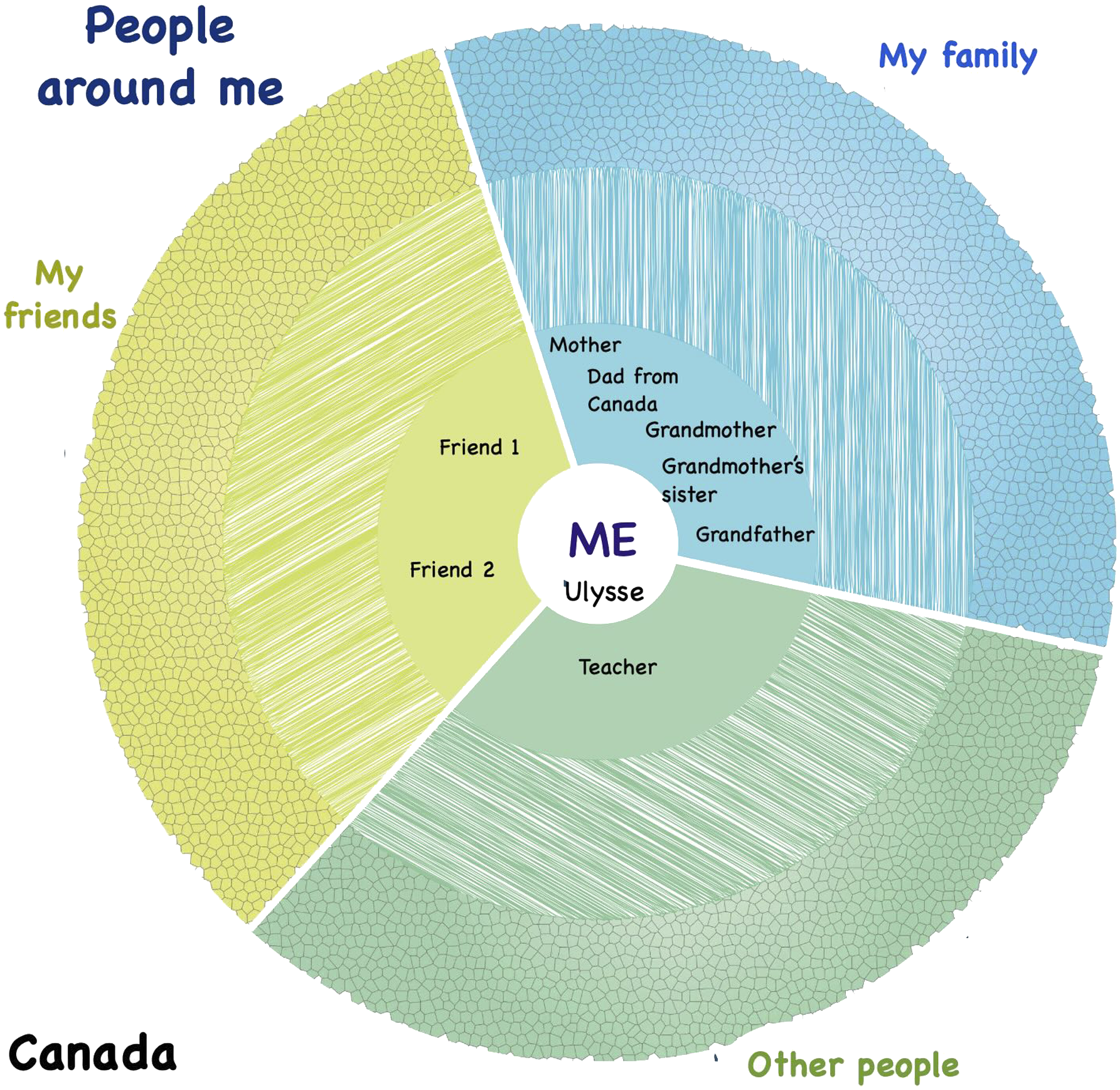
Specifically, each child was asked to develop two circular maps, one representing the important people in their life when they were in their country of origin, and one representing their current situation, situating each person according to whether they are part of their family, friends or other group, as well as according to their emotional closeness to them. Figures 1 and 2 present examples of circular maps created by ‘Ulysse’, a 9-year-old participant from Ukraine. In-depth questions made it possible to explore the characteristics of the people placed in the family section, to discuss differences between the two circular maps and to elicit the children’s representations of the family system. Interviews were conducted at the child’s home by two research assistants. Confidentiality was ensured by conducting the interview in a closed room, allowing the child to express themself freely without the presence of their parents and siblings. The interview was audiovisually recorded, with the camera positioned toward the ground to capture only the map developed by the child and to preserve the confidentiality of the participation. Consent to participate was obtained from the parent of each participating child, while the child’s assent was obtained using a form developed and validated by our team in previous studies (Côté et al., 2018). Circular map created by Ulysse as he recalled people that were important for him when he lived in Ukraine ■■■.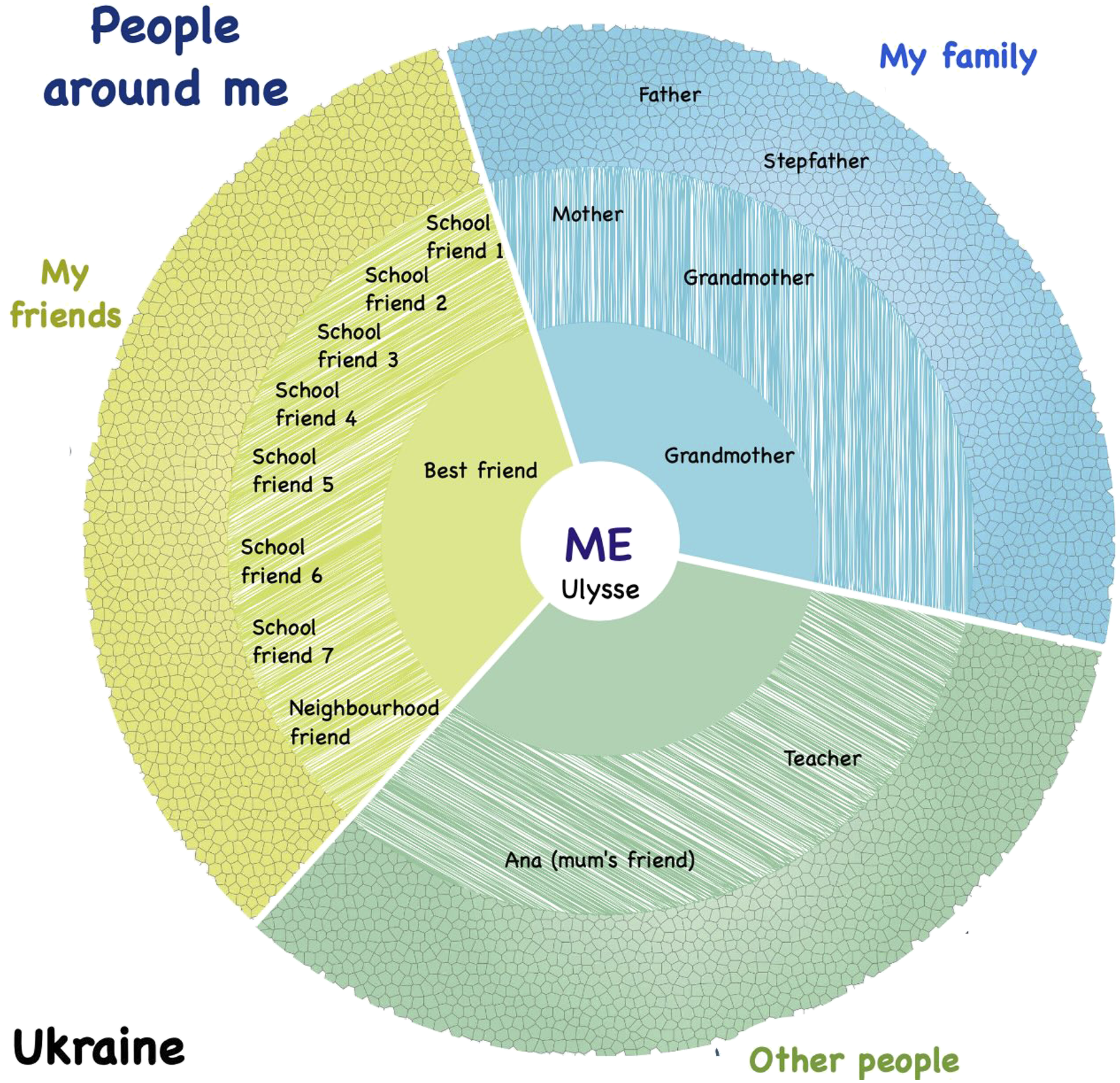
Interviews were transcribed for content analysis (Braun and Clarke, 2006). First, six interviews were independently coded by the principal investigator and a research assistant. An inter-rater audit ensured the fidelity and consistency of the codification, and a coding tree was developed. All the interviews were codified in a second step by the research assistant using the NVivo software.
Results
The circle maps completed by most participating children depict close family relationships that include immediate family members living under the same roof, as well as extended kin such as grandparents, cousins, aunts, and uncles—both before and after migration. These maps also illustrate that migration often reshapes children’s social worlds: for some, like Ulysse, they reveal a shrinking network of support, while for others, they point to changes in the sense of closeness felt toward certain family members following migration.
The circle maps thus served as a starting point for discussions with the children about their representations of family. During these conversations, children focused less on who belongs to their family—since these individuals were already identified on their maps—and more on what a family is and what distinguishes family relationships from other kinds of social ties. These reflections form the core of the results presented in this section.
Two themes emerged from the analysis of children narratives that capture complementary dimensions of their representations of family, namely children’s accounts of the functions of the family and their definitions of what a family is. The first theme reflects how children understand what family do: the roles it fulfills and the support it provides in everyday life. The second theme reveals how children conceptualize what the family is, emphasizing the emotional dimension of their ties with family members and the time spent together.
Family functions
When asked about their representations of the family, the participating children identified the people who are part of their family according to certain roles that they believe should be fulfilled by their family. They talked about family as a special place where they feel safe and supported, and where they can learn and grow. In their discourse, the term “place” is used in a symbolic sense. It does not refer to a physical space such as the home, but rather to an emotional/relational space constructed and developed through the functions of protection, love, and education that they identify as inherent to a family.
Family: A place where you feel safe
The first function of the family mentioned by the children is to make them feel protected and safe. Some children point out that their family members contribute to their safety by choosing immigration and by being with them during difficult times before, during and after migration and helping with the transition, as Jeanne (10 years old) explains: “Because your mother saved you in the Congo, it’s your mother who has helped you all your life and helped you to grow.” Many children mentioned that their families make them safe because the people in the family can be solicited when they face a problem. Some children, such as Naima (12 years old), mentioned the willingness of their family members to consistently help them: “Well, a family is people who are always there for me; whenever I have problems, they are there.” Amelia (7 years old) used an image instead to explain the protective function of the family: “A family is, um, an angel.”
Family: People to turn to when I’m struggling
The children also identified family as a resource when they are experiencing difficulties, with family members providing support, help and comfort: “For me, a family is people who are always there for you, people who are always there when you need them, people who help you.” (Alexa, 14 years old). Some children noted the availability, readiness, and consistency of their family members in offering help, as qualities that distinguished them from their friends and other people: “A family is people who I love and who are always with me, who always help me, who encourage me.” (Rebecca, 10 years old). This distinction was further emphasized by Xenia (13 years old), who explained: “I think it’s almost the same as a friend, but I trust my family a lot more than I trust a friend. Then also I feel like I’m more comfortable with my family”.
Family: A place where the structure allows me to learn and grow
The children described their families as providing structure, a place where they can learn and develop through established rules and the advice and guidance given by its members. For example, Mathis (11 years old), described the role of family members as providing for his basic needs and enforcing discipline: “Well, they punish you if you do something wrong. They are happy to see you. They make good food. They tell me if I’m doing the right thing. They tell me to play outside.” Education was also identified as a role of the family by some children: “They are the ones who taught me to be how I am.” (Ximena, 8 years old).
Definition of family
The children primarily defined family by focusing on the emotional dimension of their relationships with their family members, the time spent with them, and the longevity of their relationship, as Alexa (12 years old) explains: “For me, a family is people who are always there for you. People who are always there when you need them, people who help you when you have problems, people who won’t judge you, people who will accept what you do, people who have seen you grow up, who love you.”
Family: People who love each other
The love shared between family members is at the heart of most of the definitions of family formulated by the children, as explained by Beatrice (7 years old) and Mathilde (8 years old): “(A family member is) someone that I love so, so much and that I see very, very often.”; “A family is having a mother, sisters, brothers, and people who love us.” The participating children also explain how this affective dimension of the family must be present between each of the members, who must love each other equally. “I can’t love one person more than another. My mother says that she can’t love my brother more than me. And I can’t love my sister more than my brother.” (Alfonso, 12 years old). In addition, many children associated this love with kindness, describing their family members as caring and gentle: “You can sometimes, it happens to everyone, but you have to try to be as nice as possible to the people in your family” (Bastien, 7 years old); “For me, my family means that everyone in my family is nice. For example, if I, my grandfather, my grandmother and everyone in my family are all nice. That’s what I’ve noticed about my family” (Elina, 7 years old). Finally, other children explained that this affection shared within the family generates and is nourished by the sharing of what each one feels and thinks. “A family is people that you share everything, everything, everything with: secrets, joy, love, things like that. A family is very, very important in life.” (Hamdi, 11 years old). The majority of the children described the shared affection and love in the family as the central point that unites family members, allowing each one to relate and identify with the family of which they are a part of.
Family: People who spend time together
Daily interactions between members of the same family were also mentioned in some children’s definitions of family, as Victor (13 years old) and Bastien (7 years old) described: “.”; “A family is spending time together and sharing kind moments without saying bad things.” Spending time with family also allows everyone to get to know and understand each other: “I think that all children need to spend time with their family, so that their family understands them and so that children understand their parents.” (Yena, 13 years old).
In addition, some children pointed out that physical distance between certain members of the same family does not compromise family ties, as expressed by Zackary (13 years old) and Bbasma (13 years old): “You know, it never changed her […] at one point I didn’t go (in my country of origin) for 2 years […] Then you know every time we see each other, we’re happy to see each other, but you know we don’t talk as often as usual then, yeah. But you know, I still love her like I used to”; “For me they [him relationships] haven’t changed […] even if we’re far apart I still love them.” In fact, shared time becomes virtual, requiring adjustments in how interactions are maintained daily. As Katrina (8 years old) explained: “A family is when we are always together, but my family is not always together. Like my grandpa and my grandma live in their house, but we hear each other on the phone.” Phone calls and videoconferencing are frequently mentioned by children as ways to spend time with their family members living overseas: “I just have the Skype of just a grandmother and that way I talk to everyone about my family, my grandmothers and my grandfather.” (Rebecca, 10 years old); “Since we’ve been in Canada, we’ve seen each other three times I think, if not four, then every week on the phone.” (Sabrina, 12 years old).
The family: Relationships that are inscribed in time
Finally, the continuity of relationships and shared history was also addressed by the children in their definitions of family. The children distinguished family ties as bonds that are continuous, and enduring since birth: “Everyone who stays with me forever” (Larry, 8 years old); “My family is who I’m with. It’s my brother, my sister, my dad, my mom. I am with them all the time. They have seen me grow up. So they count the most.” (Alexa, 14 years old). Some children, like Alfonso (12 years old), also defined family in terms of the love they have towards their family members and the importance it plays in their lives: “It’s people that I love a lot, that I will never be able to leave. I will protect and defend them.” The emotional closeness that unites family members implies a sense of obligation and is not necessarily of the same intensity or continuity as that found in other social ties, as Yena (13 years old) expressed: “(People) who have to stay closest to you, because with friends, I think you can lose them, but our family will always be our family.”
Discussion and conclusion
The objective of this article was to explore the representations of the family by children who have recently settled in Québec. The elaboration of circular maps allowed the participating children to identify and discuss their relational ties and family representations quite easily despite the abstract quality of these concepts. Thus, this tool made it easier for young children to identify the people who make up their family, as well as to reflect on the functions of these people to ultimately formulate their definition of the family (Côté et al., 2019). Children described the family as a source of safety, protection and support, as well as a structured environment that allows them to learn and grow. Building on these family functions, the children formulated a definition of family based on the affection and love that unite those who constitute it, shared time, and lasting bonds. Together, these dimensions suggest that children’s representations of the family are shaped not only by what families do but by how they feel — as spaces of emotion, continuity, and everyday connection.
The affective dimension associated with the family, at the heart of the representations of the participating children, has also been mentioned by young children in several other studies and seems central to children’s understanding of “doing family.” Indeed, several authors report that love, support and caring are identified by children as criteria for defining what a family is (Anyan and Pryor, 2002; Newman et al., 1993; Rigg and Pryor, 2007). This affective dimension of the family was also identified by the children who participated in the Morrow (1998) study, regardless of their sex, gender and ethnic origin.
In addition, the participating children emphasized that the physical distance between some family members due to migration is not an obstacle to affection at the heart of the family. Indeed, as suggested by Dreby and Adkins (2012), immigration and physical separation from extended family do not seem to diminish the sense of belonging of the participating children in their families. Rather, children are required to adjust their interactions with family members in order to adapt to the post-migration context. This adjustment includes the use of alternative means of communication to maintain emotional closeness with extended family members, a practice that may be encouraged by parents and perceived as a familial obligation. This dynamic represents one of the distinctive features of immigrant children’s representations of the family.
Moreover, while in some studies children identify living under the same roof and sharing daily rituals in their conception of the family (Mason and Tipper, 2008; Nixon et al., 2012; Oliveira-Formosinho, 2009), the immigrant children in this study did not mention these elements-although this result should be interpreted with caution, as we did not specifically ask children about the importance of cohabitation in defining a family. Children did, however, emphasize the importance of interacting with family members, and described other activities that enabled them to “do family,” such as talking on the phone and videoconferencing with family members living overseas, like playing, eating and caring (Policarpo et al., 2023). In this regard, Dreby and Adkins (2012) found that children living in transnational households tend to be very inclusive in their definition of the people and activities that make up a family, including people with whom they are not in direct physical contact on a regular basis.
Moreover, the results of our study are distinct by the absence of references to biological or legal factors in the children’s representations or discourse on family, even though these dimensions have been mentioned in previous research (Dunn and Deater-Deckard, 2001; Dunn et al., 2002; Roe et al., 2006). Indeed, children define family primarily in terms of relational roles rather than biological ties, without ever explicitly mentioning blood ties or genetics. Their conception is based on the social functions of parental figures, which may be explained by the pre-migration experiences of the children in our study. Indeed, family structure and norms governing family functioning vary according to cultural groups (Schneider, 2014; Stack, 1974), and family and filial ties are social constructs defined by the individual or the family itself (Sanner et al., 2020). It is therefore plausible that the differences in the children’s representations are attributable to a different frame of reference. The fact that biological factors were not mentioned in the discourse of the participating children can also potentially be explained by their age, since biological factors are generally less significant for children and take on more importance in adolescence (Gilby and Pederson, 1982).
Finally, this study contributes to our understanding of children’s representations of the family by highlighting the importance attributed to continuity and enduring family connections, aspects that have been less evident or emphasized in previous research. This emphasis may be understood in light of the disruptions experienced during the migration process, which can heighten children’s awareness of the fragility of family and social relationships. In migration contexts, family is often defined in restrictive terms by migration policies, typically limited to parents and children who are authorized to migrate together. Such policy-driven definitions may reinforce the centrality of parents in children’s lives, while simultaneously marginalizing extended family members and other significant relationships. Moreover, the salience of continuity and permanence in children’s representations of family may reflect a strong need for security, consistency, and predictability in parent–child relationships, shaped by experiences of relational loss and by the structural violence of war, persecution, and forced displacement that many families have endured (George, 2023; Gervais et al., 2021b). Indeed, the circular maps developed by the children eloquently illustrated the loss of ties experienced by some children following immigration, with the maps representing their network in their country of origin being more extensive than the maps of their current network, which included far fewer people. The emphasis placed by the participating children on the cohesion and strength of family ties suggests that this sense of cohesion is what they need during the post-migration period to cope with the many stresses they experience and the loss of many points of reference (McMichael et al., 2011; Tardif-Grenier et al., 2023). The importance of stability and continuity of family ties was also named by foster children, who were interviewed in the study by Ie (2023), and who also experienced family disruption and struggled to make sense of the concept of family in foster care.
In conclusion, the testimonials of the children interviewed in this study suggest that immigration contributes to the development of certain family-related representations that are specific to children who experience this important transition. Indeed, beyond affection, care and daily sharing of activities, which seem to be quite universally at the heart of children’s representations of family, the participants in this study, like the children in foster care encountered by Ie (2023), insisted on the stability, cohesivness and continuity of relationships within a family. It therefore seems that important transitions, and the relational ruptures they often imply, permeate children’s family representations. Given the small size of our sample and its great diversity in terms of ethnocultural origin, it was not possible for us to identify the specific characteristics of different cultural groups in the children’s family representations, which is a limitation of our study and an interesting avenue for future work. Amid increasing immigration to Canada and other Western nations, characterized by diverse countries of origin and migration trajectories, it is important to continue research to further understand immigrant children’s perspectives about their family. This includes studies to better understand how activities, care relationships and mutually supportive practices contribute to children’s identity and sense of belonging following immigration.
Based on these findings, several recommendations can be made to better meet the needs of children. First, given the central role of family in the lives of migrant children, it is essential to preserve family unity by avoiding policies and practices that cause or prolong separation between children and their family members. Such separations can have long-lasting, detrimental effects on children’s emotional well-being (Cartwright and Chacon, 2021; Lu et al., 2020; Mazzucato and Schans, 2011; Suárez-Orozco et al., 2002), and family reunification is often complex, marked for many by feelings of disorientation and unfamiliarity between parents and children (Cartwright and Chacon, 2021). It is therefore crucial to facilitate and accelerate family reunification procedures by making them faster and more accessible, especially in a context where these processes are becoming increasingly difficult, costly, and time-consuming in most Western countries (Mazzucato and Schans, 2011). It is also necessary to broaden the legal recognition of chosen and extended family forms, as children often define family based on emotional bonds and the support received, rather than on biological or legal criteria (Dreby and Adkins, 2012). At the same time, incorporating children’s perspectives through a child-centered approach in the development of migration policies would help better protect them and acknowledge the importance of the relationships that structure their daily lives. In the school setting, it would be relevant to train teachers and school counselors on the realities faced by children separated from their families, by providing them with tools to offer appropriate support, and by creating spaces where children can express themselves (Gindling and Poggio, 2009).
Footnotes
Acknowledgement
We would like to thank the children who so openly and richly shared their thoughts and experience, and their parents who welcomed and generously collaborated with us.

Ethical considerations
The study protocol was approved by the Research Ethical Committee of the University of Québec en Outaouais. Parental consent was obtained for every child participant, and a form validated by our team in our previous work was used to obtain children’s assent. In compliance with the ethical recommendations of child-centred research about continuous assent, the latter was renewed with participants during the interview.
Author contributions
All the contributors to the study are designated as authors as they have made substantial contributions to (1) designing the study and interpreting the data; (2) critically reviewing the article for important intellectual content; and (3) granting final approval of the version to be published, bringing their own perspective and body of knowledge to bear.
Funding
The authors disclosed receipt of the following financial support for the research, authorship, and/or publication of this article: This study was funded by the Social Sciences and Humanities Research Council of Canada, Grant No. 430-2016-00468 award recipiend is the principal investigator Christine Gervais.
Declaration of conflicting interests
The authors declared no potential conflicts of interest with respect to the research, authorship, and/or publication of this article.
Data Availability Statement
The data that support the findings of this study are available from the corresponding author, CG, upon reasonable request.