



Abstract
Nearly one in five U.S. citizen children has an undocumented parent, putting many at risk of family separation due to deportation. To protect their children’s future, some parents assign legal guardians, yet limited research exists on this process. This study used a qualitative design with in-depth interviews with 27 Latina parents, all of whom had assigned guardians for their children. The results revealed parents’ prolonged exposure to trauma before, during, and after migration led to a persistent fear of deportation and family separation. Parents evaluated guardians based on trustworthiness, reliability, and ability to navigate complex systems. The findings highlight the need for social workers to educate families, collaborate with community organizations, and advocate for policies prioritizing family reunification and children’s well-being.
Keywords
Undocumented immigrant families are among the nation’s most vulnerable and disadvantaged populations. Nearly one out of five U.S. citizen children live with an undocumented parent (Capps et al., 2016). Between 2010 and 2018, more than 500,000 parents of U.S. citizen children were deported (Berger Cardoso et al., 2020). For many mixed-status families, the risk of family separation is imminent, given increasing immigration enforcement throughout the country (Chishti & Bush-Joseph, 2024). Recent policy shifts under the current U.S. federal administration have led to intensified immigration enforcement, with large-scale deportation efforts creating heightened uncertainty for mixed-status families. As enforcement actions increase, the urgency for preparedness planning becomes even more critical to safeguarding children’s well-being in the face of potential family separation. Discussions around increased immigration enforcement highlight the importance of addressing potential scenarios that could affect family unity.
U.S. citizen children living in these families are affected by the deportability of their parents and sometimes their siblings. For these children, parental deportation or detention is a serious threat and can affect their physical, emotional, and developmental well-being (Allen et al., 2015; Brabeck et al., 2016; Gallo, 2014; Gelatt, 2016; Gulbas & Zayas, 2017; Landale et al., 2015; Martínez et al., 2018; Patler & Laster Pirtle, 2018; Rojas-Flores et al., 2017; Vargas, 2015; Xu & Brabeck, 2012; Yoshikawa, 2011). The stability of the family would be at risk, and the family might endure economic hardship as a result of the removal of a working family member (Rugh & Hall, 2016). In some cases, when parents have been deported or detained, children may be placed in the foster care system (Wessler, 2011). Moreover, children’s education might be disrupted, hindering their developmental progression (Gallo, 2014; Shreffler et al., 2018; Yoshikawa, 2011).
When parents of U.S. citizen children are ordered to be removed, they often face a Solomon’s choice. If they retain custody, their U.S. citizen children will also be deported. The alternative is to remand custody and care of their children to a guardian with U.S. citizenship or residency and leave the children behind. As Luis Zayas (2015) puts it, these children become “immigration orphans or American exiles” (p. 27). Children who accompany their deported parents often return to impoverished or dangerous conditions that led their parents to flee to the United States. It also means they may not have access to the educational, social, and health care services they would have in the United States (Zayas & Bradlee, 2014). These children may also enter, what is to them, a foreign society where they have limited peer support, and can become socially isolated. These problems and educational challenges may be compounded if they do not have mastery of the language in their parents’ home country (González et al., 2016; Hernández-León et al., 2020). Zayas et al. (2015) documented that children who accompany their deported parents experience a high level of emotional distress.
Children who remain in the United States without their parents also experience psychological distress and sometimes trauma (Zayas, 2015). At best, they may live with relatives and friends. In many cases, however, they end up in the care of the child welfare system. In 2011, an estimated 5,100 U.S. citizen children lived in foster care after a parent’s detention or deportation (Wessler, 2011). Sometimes, a lack of coordination between child welfare and immigration enforcement systems leads to protracted separation or termination of parental rights (Xu, 2005). Moreover, deported parents are very unlikely to qualify to legally re-enter the United States. Thus, opportunities for even short-term reunification may be difficult or impossible for many families.
Parents who leave their U.S. citizen children in the United States face the likelihood of long or perpetual separation from their children, with the risks and uncertainties that accompany leaving their children in the care of others. The fact that parents can and do make this choice is an indication of how much risk they see for children who accompany them back to their countries of origin. Nevertheless, many undocumented parents decide to preemptively give the legal guardianship of their citizen children to another person, often a citizen relative (Cooke & Rosenberg, 2017; Generations United, 2018; Sacchetti, 2017). With the rise in deportations and family separations, many immigrant rights advocates and legal advisors recommend that mixed-status families be prepared for possible arrest and deportation of their undocumented family members and make arrangements for the care of their children (Baum, 2017; Otterstrom, n.d.).
Despite recommendations from advocacy groups for undocumented immigrants to appoint guardians for their children, many children remain at risk of living without parental care (Amuedo-Dorantes & Arenas-Arroyo, 2019; Chicago Volunteer Legal Services, 2017; Immigrant Defense Project, 2019). Nevertheless, child guardianship among undocumented immigrants has received little scholarly attention. This study aims to fill some of this gap by seeking to understand the experiences of undocumented parents from pre-immigration to post-immigration, exploring factors influencing guardianship decisions among undocumented parents, and highlighting how they use community resources to cope with potential immigration crises affecting their children.
Conceptual Framework
This study draws on theoretical perspectives that examine the systemic challenges and vulnerabilities experienced by undocumented and mixed-status families. Nicholas De Genova’s (2002) foundational work on undocumented migration and deportability provides a critical framework for understanding the lived experiences of undocumented immigrants. De Genova (2002) argues that the condition of being undocumented is not merely a legal designation but a sociopolitical construct created by immigration policies that place individuals in a state of constant vulnerability and uncertainty. This condition of deportability—the perpetual threat of removal—shapes the everyday lives of undocumented individuals and their families, reinforcing systems of marginalization and limited agency. De Genova’s (2002) framework highlights how immigration laws and enforcement practices affect not just the legal status of individuals but also their ability to navigate daily life and plan for the future. His work underscores the need to examine the ways systemic factors perpetuate insecurity and influence decision-making within immigrant communities.
Building on De Genova’s insights, Joanna Dreby (2012) adopts the “injury pyramid” framework from public health to present the “deportation pyramid,” which illustrates the layered and far-reaching effects of immigration enforcement policies on families. The pyramid demonstrates how parental deportation and the threat of deportation extend beyond immediate family separations to affect families and communities through various levels of pressure. At the base of the pyramid lies the burden of public misunderstanding about immigration, manifesting in daily microaggressions, insults, and discrimination. Above this, there is the pervasive fear of apprehension or deportation, fueled by policy changes or the uncertain legal status of family members. The middle levels represent the short-term consequences of deportation, such as disruptions in daily routines, while the higher levels capture the long-term effects, including economic instability and emotional trauma. At the top of the pyramid are the most severe outcomes: children either leaving the United States with deported parents or enduring the restructuring of their families. Dreby’s (2012) framework underscores that the impacts of deportation are not limited to those directly affected but ripple outward, creating an atmosphere of fear and insecurity that shapes the lives of millions.
This study is guided by these frameworks to examine the factors influencing the decisions undocumented parents make when assigning guardianship of their children to non-relative third parties. It highlights how systemic vulnerabilities shape these decisions, offering insights into the intersection of legal precarity and family-coping strategies.
Method
This study employs a qualitative design, using semi-structured interview data collected from undocumented parents who had chosen to assign a non-relative third party as the guardian of their children. The study was conducted in Miami, FL, USA, a city with one of the proportionally highest immigrant populations in the United States. Participants were recruited through a trusted community-based organization (CBO) with decades of advocacy experience and a mission focused on supporting children at risk of family separation due to immigration enforcement. The CBO’s deep roots in the immigrant community and extensive network made it an ideal partner for this study. To minimize the risk of exposure and build trust, the CBO facilitated the identification and recruitment of participants. The organization informed the community about the study through regular interactions with families, explaining its purpose to potential participants. These interactions often occurred during services, such as food and diaper distributions, clothing drives, and school supply giveaways. For those expressing interest, the CBO arranged the interview date and time. This collaborative process ensured that participants felt comfortable engaging with the research team and that the study aligned with the community’s lived realities. Those who participated in interviews received a US$20 compensation for their time.
Participants
Purposive sampling (Palinkas et al., 2015) and maximum variation sampling (Patton, 1987) were employed to select immigrant parents, primarily undocumented, who had at least one U.S. citizen child below the age of 18 years and who made arrangements for delegating guardianship of the children to a third party. To find patterns that cut across divergent participants, the research team tried to select participants who varied in sex, age, nationality of origin, and deportation/detention experience (Patton, 1987).
Data Collection
Data were collected through a series of in-depth interviews using a semi-structured interview schedule containing open-ended questions. Interviews were conducted face-to-face or over Skype and took place between October 2020 and September 2021. All interviews were conducted in Spanish by a bilingual master’s-level social worker who was trained in qualitative interviewing and was fluent in spoken and written Spanish and English.
The interview protocol was designed to delve into participants’ lived experiences and decision-making processes. It began with broad questions about life as an undocumented immigrant and gradually narrowed to focus on families’ responses to the heightened risk of separation. Targeted questions examined participants’ identification of risks, their exploration of guardianship options, and the final decision-making process for delegating guardianship of their children to a third party. One of the authors drafted and finalized the interview schedule after consulting with experts on the population under study and on qualitative interviewing. Furthermore, the interview schedule was reviewed by the CBO staff. This was particularly advantageous because these staff members were familiar with the participants and shared a similar cultural background.
All interviews were digitally recorded and transcribed verbatim in the original language (Spanish). The transcriptions were conducted by a Spanish speaker who was not involved in the interviewing process. Spanish transcripts were translated into English by a bilingual/biliterate translator. To ensure translation quality, another bilingual/biliterate individual, not involved in the transcription or translation process, reviewed the English translation.
Ethical Considerations
To protect participant confidentiality, no sensitive or identifying information was collected. Participants selected pseudonyms before interacting with the research team, ensuring that their real identities were not recorded. The research team received Institutional Review Board (IRB) approval for participants to provide verbal consent to participate, eliminating any paper trail that might expose their involvement in the study. All data, including audio recordings and transcripts, were stored on encrypted, password-protected devices. Access to the data was restricted to authorized personnel. The bilingual social worker conducting the interviews was trained in handling sensitive topics to minimize emotional distress.
Data Analysis
Computer-assisted qualitative data analysis software (ATLAS.ti) was used to organize and assist in analyzing the transcripts. The analysis involved iterative and systematic processes to ensure that findings were deeply rooted in the data (Strauss, 1987). Our analytical approach involved multiple stages: A priori and open coding, theoretical coding, generating themes, and developing theory. The researchers first generated a list of a priori codes based on the literature relevant to the research question. These codes were considered provisional until they “earned” their way into the analysis by being “grounded,” that is, by being attached to relevant quotations in transcripts (Strauss, 1987). A priori codes which could not be linked to actual quotations were dropped from the analysis. Open coding was used to break the data into discrete parts, identifying and labeling significant concepts and actions. Gerunds (e.g., “choosing,” “trusting”) were emphasized during this stage to capture participants’ decision-making processes dynamically and in action.
Axial coding was then employed to identify relationships among the codes, clustering them into broader categories and subcategories. This stage involved systematically linking concepts to explore causal relationships, conditions, and consequences. These connections helped to construct a coherent narrative about participants’ decision-making processes. The constant comparison method (Dye et al., 2000) was used by iteratively reviewing previous transcripts to ensure that codes were being used in a consistent way and that late emerging codes were added to earlier interviews. In later phases of the coding process, negative case analysis was employed to look for examples of findings running counter to observed patterns in the analysis (Patton, 1999).
The next step was to refine and organize the categories emerging from the open coding stage and elaborate on the emerging patterns and relationships among those categories (Flick, 2018). Once all transcripts had been coded to the point of theoretical saturation, the researchers began to cluster grounded codes and attach them to more abstract codes and to begin to define relationships between them. This iterative process allowed for the emergence of core themes and the construction of a central theoretical framework reflective of participants’ experiences. This coding process was used because of its comprehensiveness in identifying patterns and relationships within qualitative data, making it particularly useful for structuring complex narratives and capturing the depth of participants’ experiences.
The researchers kept memos of theoretical importance throughout the analysis (Strauss, 1987). Such memos were linked to codes, quotations, transcripts, and other elements of the analysis. In later phases of the analysis, major codes were reexamined, relationships between them were explored, and emerging themes were developed (Tie et al., 2019). The use of relationship maps facilitated the visualization of linkages between abstract codes, categories, and themes, providing a structured framework for the emergent theory (Flick, 2018). After creating each theme, the researchers reexamined the lower-level codes and quotations to ensure that the emergent theme accurately reflected the findings originating with respondents.
Limitations
Although this study offers valuable insights into how undocumented immigrant parents prepare for possible family separation, it has several limitations. First, participants were drawn from a convenience sample in Miami through a single community source, limiting generalizability due to potential self-selection bias. Second, the COVID-19 pandemic significantly affected data collection, preventing in-person interviews and posing challenges for virtual participation due to limited access and digital literacy among participants. Third, confidentiality concerns restricted follow-up interviews, limiting the opportunity for greater depth and member checks. To address this, interviews were coded immediately after collection, debriefing sessions were conducted to improve subsequent interviews, and additional participants were recruited to ensure sufficient data. Finally, there was a lack of male participants, as many families delegating guardianship were headed by women, with fathers often deported, detained, or absent, and the few men available declined to participate.
Results
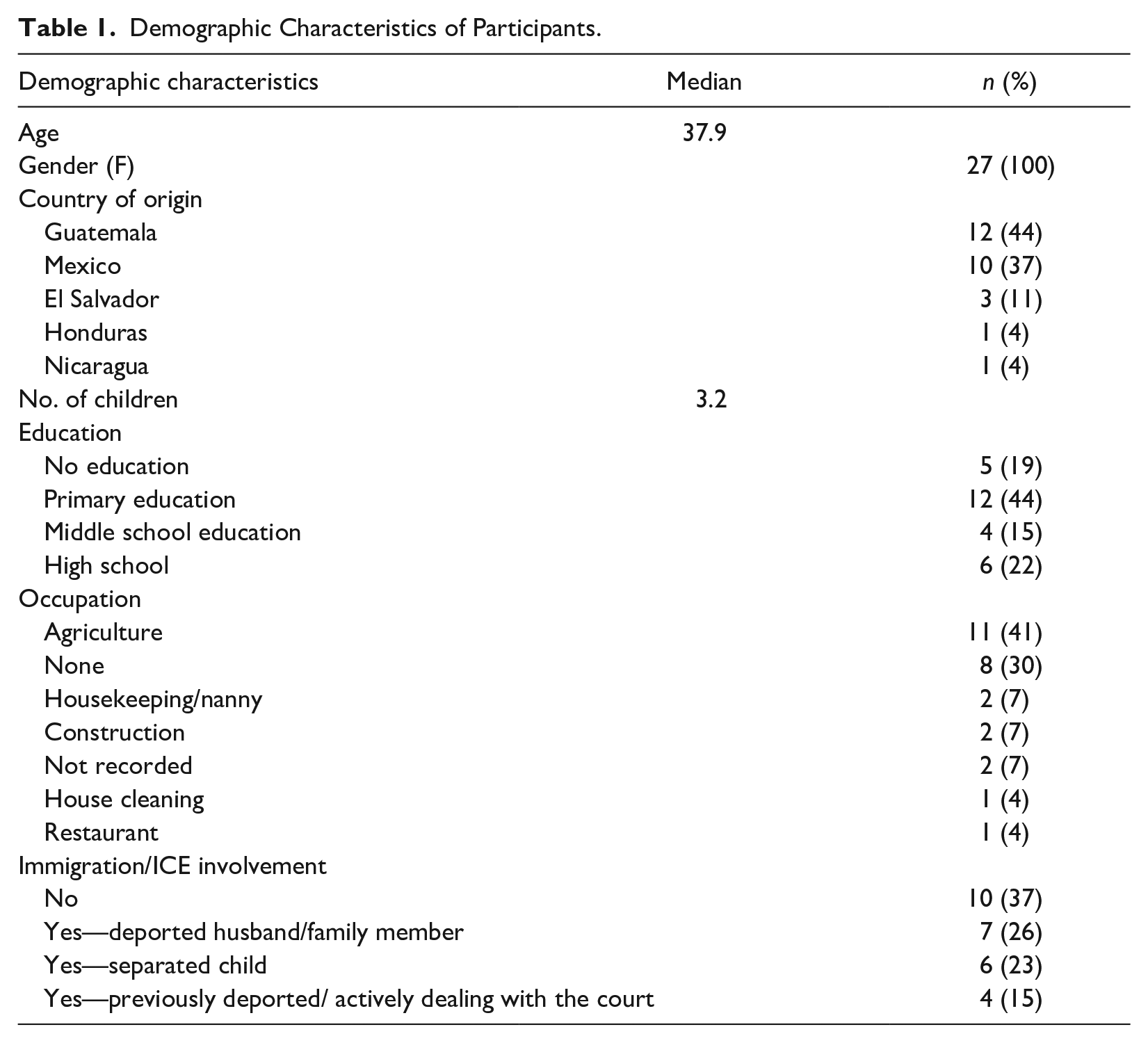
Overall, 27 participants were recruited, all of whom were women. The participants represented a diverse range of countries of origin and ages, ranging from 25 to 64, with a median age of 38 years. Their experiences with immigration enforcement varied significantly, highlighting the diverse levels of risk and exposure faced by undocumented families. Overall, 17 participants had experienced immigration enforcement, while 10 had no such experience. Seven participants reported the deportation of a family member (mostly husbands), six had experienced separations from their children, and four were either previously deported and came back or had an active case in an immigration court (see Table 1 for complete participant characteristics).
Demographic Characteristics of Participants.
To understand how undocumented parents decide to assign a non-relative guardian to their U.S. citizen children, it is essential to first examine the persistent fear and uncertainty that shape these critical decisions. Although many factors contribute to their choices, one of the most defining elements is the ever-present risk of deportation. This fear infiltrates their daily lives and decision-making, influencing how they plan for their children’s futures.
Deportability: “Todo el tiempo está con miedo”
Of all the challenges they had faced, one seemed paramount: that they could be deported at any time. Many had previously encountered immigration enforcement authorities, with several participants having experienced the deportation of their husbands. The participants talked about the persistent worry and anxiety they feel in their day-to-day lives due to their deportability. A 24-year-old mother of two children from El Salvador articulated this anxiety well:
We all worry. We go out and walk around the city, and we feel worried that we’ll get stopped by the police. We feel fear, fear of getting stopped. And, well, we have worry in our minds. I know that living that kind of life is not healthy. What’s healthy is to live in peace. I want to be able to lie down in bed and know that tomorrow I will be safe. Well, every day, we felt fear. Fear that we’d be found and taken.
This fear infiltrated their daily activities, especially where there was a risk of identification. Another participant, a 41-year-old from Mexico, described it as “living in fear. Fear of going out, of not being able to get a better job, of not being able to drive without a license and all of that.” Another respondent related: “The hardest part is the fear of whether we will come home that night.” Even those who had obtained legal papers remained anxious. One participant, 49 years old from El Salvador, shared, “Well, it wasn’t easy. Even when you have papers, life can be hard. Because you are always in fear that they could revoke your paper.” Another echoed this sentiment: “I am always worried about deportation. Even though I have papers, I am still not from here, and there are always things happening; you never know, and you never can be sure.”
Respondents described an inability to engage in everyday activities that others take for granted, such as traveling or running errands, due to the constant fear of encountering immigration enforcement. “Well, we live in insecurity here because anything can happen, or the police can get you, and the first thing they ask for is a permit, and we do not have it, and they can deport us, and those who remain here are the children without parents.”
Assigning a Guardian
With the ever-present risk of deportation, parents were compelled to make difficult choices to ensure the safety and well-being of their children. Central to these decisions was the process of assigning a guardian—a step they believed would secure their children’s future should the worst occur. All participants in this study had gone through the legal process of assigning an undeportable guardian for at least one of their children. The participants were asked how they learned about this individual, their decision-making process, and the factors that influenced their decisions.
If Immigration Suddenly Grabs Me and Deports Me, What Will Become of My Children?
In this sample, everyone knew someone who had been deported or detained. Most participants had encountered immigration enforcement authorities, with many experiencing the deportation of their husbands. During moments when they were most in fear of deportation, participants discovered the guardianship option:
ICE gave me two months, and that’s why I looked for a guardian because I am concerned about our children. . . I am scared. But when I’m deported, [the guardian] is here, and we have trust in her to provide care for the children and to be their guardian. (Woman from Guatemala)
For many of the participants, fear was most acute after their husbands were deported. A Mexican mother of six said:
I fear that I, too, will be deported and separated from my children—and what hurts me most is getting separated from my children. That I will get sent away and my children get stuck here. That is the most terrifying and difficult thought to have, that someday that may happen.
Finding a guardian provided them with “confidence that [the] children will be taken care of by a responsible person.”
Others were prompted by frequent ICE raids in their community or a political climate threatening an increase in deportations. The presence of ICE agents became a common and terrifying sight in their neighborhoods, with raids often occurring in the early morning hours, “banging on doors” and “showing guns.” A Guatemalan mother of two recounted that ICE raided her house at 5 in the morning while she and her two young children were asleep. Their presence terrified them, and even though the person they were looking for was not living there, they searched the entire house, “even in the closet” and “under the bed with a flashlight.” She explained, “We were very afraid; there were many of them, and all of them entered with guns. They were showing their guns.”
The political climate during this period exacerbated these fears. This created an environment where the threat of deportation felt imminent and unavoidable. A 34-year-old mother of six children from Mexico explained:
There were so many deportations going on that I was afraid that they’d end up coming for me and that my kids would have to come with me. I would do everything within my power to come back, but they needed to stay here with someone I could trust.
Several participants mentioned that they were already receiving different services from a CBO, such as food aid, financial help, housing support, children’s supplies, education and health referrals, computers, and legal support. When they needed help from an undeportable person—someone they could trust outside their circle of friends and family—they turned to that organization. This consistent support fostered a sense of trust and reliability in the organization. Many others were initially unaware of the guardianship option but found it potentially helpful once informed. They learned about the possibility of assigning a standby guardian through various channels, such as friends and family, neighbors, and church. Several participants mentioned that they started thinking about guardianship when they saw that other people in similar situations had chosen one. One participant shared that during frequent raids in the community, a friend who wanted to assign a guardian for her children informed her about where she could get help, prompting her to do the same. A Guatemalan participant noted that when they sought help from the church for their daughter, who was in a temporary governmental shelter after crossing the border, they learned about guardianship. In addition, some participants learned about choosing a guardian through TV and media, having seen programs about families in similar situations.
Important Factors
All participants recognized the vital need to assign a guardian, and their decision-making processes were influenced by several key factors, particularly the trustworthiness and resourcefulness of the prospective guardian.
Trustworthiness
The decision to assign a guardian was often a result of careful consideration and research within their trusted networks. As a 39-year-old Nicaraguan mother of four children explained about her decision to assign guardianship to an agency director where she had received services, “It wasn’t immediate; it was through time and after I researched them through the networks that knew them and all this because I was not like that fast and more than that because they have helped me.” One participant from Guatemala recounted that it took about a year of continuous interaction and support from the organization before she felt confident enough to grant guardianship. She emphasized that this “trust was earned slowly” over time through consistent help and support. Another participant from Mexico highlighted the widespread community trust:
Well, when I made the decision because, you know, that here it is difficult to find a trustworthy person and I heard a lot about her from people. I’ve heard a lot everywhere they talked about [this particular guardian], that she’s a good person and she’s always helped people too. It doesn’t matter what country you are from. She is going to help. She always treats our children as if they are her own children. . .I talked to the families and to the people who were in the same situations and going through the same thing.
Resourcefulness
Many participants described the prospective guardian as a resourceful individual who knew how to navigate governmental systems and provide the crucial support they and their children need. This stood in contrast to the capabilities of their families and friends, who were often unable to offer the same level of care and assistance. For example, a mother of three children from Mexico said, “I have brothers and sisters. But they are undocumented, just like me. So, I went to [the guardian]. Just in case, if anything were to happen to me, I would know that they’d be in good hands.” A few mentioned having other options, such as their adult child, that could not provide the same level of help. A participant from Mexico shared, “I have a daughter who’s 21, but she can’t have all that responsibility on her.” Another participant explained, “I have my brother, but we have not seen each other for a long time. . . . I don’t trust him much because I have not been in contact with him for more than 25 years.”
A 42-year-old Guatemalan mother, whose daughter was dealing with cancer, explained how the chosen guardian helped them navigate the medical system and found “a good doctor and helped with all the paperwork.” This support was essential during a challenging time for the family. Another participant described how their chosen guardian assisted with the immigration process, helped find a pro bono lawyer for her detained husband, and “helped us get him out.” Another participant from Mexico, who was reunited with her two daughters after being placed in a temporary shelter, described how the guardian helped move their stalled case forward: “When I talked to her, everything started moving again. The social worker had forgotten my document, but she reopened the case and got things moving.” These examples highlight the practical support and guidance the guardian provided, which was crucial in helping participants navigate complex systems and overcome significant challenges.
Guardian’s Role and Future Arrangements
Most participants generally viewed the guardian as a complete substitute for a parent who would provide the same level of care if they were to be deported. For example, one interviewee said, “I feel more confident that she stays with her because she’s going to give her a roof over her head, food, and maybe send her to a university.” Another participant spoke with a sense of reassurance and relief, saying, “I am sure that my children will be well here. Yes, she is going to look after my children, maybe she can even send them to me. I know that they will be fine with her.”
When asked about future arrangements with the guardian, most participants stated that they would want their children to live with the guardian if they were deported. A 55-year-old Mexican mother of three children shared that “everything is already in agreement. If, for some reason, immigration stops me, [the guardian] takes care of the children, and they will live with her.” However, a few participants preferred that if they were deported, the guardian would make arrangements to send the children to them. For instance, a 41-year-old mother of five said, “Whatever happens to me, [the guardian] would take care of my kids. And in any extreme case, she would help send them back to Mexico.” A 48-year-old mother of two from Guatemala elaborated, “From what we arranged, [the guardian] would give us the support to send our kids back to our country if the situation arises.” A few participants admitted they had not thought about future arrangements or whom the children would live with. A 42-year-old Guatemalan mother of four said, “We have not talked about that. But, if I am not here to care for our children, I trust [the guardian] will.”
Discussion
The findings of this study shed light on the complex and challenging decision-making process faced by undocumented immigrant parents in assigning guardianship for their U.S. citizen children. The cumulative disadvantages experienced by these parents, encompassing extreme poverty, violence, perilous migration, and systemic barriers in the United States, shape their decisions and underscore the need for effective policies and support systems that address the unique challenges of mixed-status families. Participants described multiple layers of disadvantage, from poverty and violence in their countries of origin to economic hardship, discrimination, and fear of deportation in the United States. This persistent cycle of stress is exacerbated by their undocumented status, which restricts their access to basic services such as health care, employment, and education. The ongoing fear of deportation and family separation creates a state of chronic anxiety that pervades every aspect of their lives, reinforcing their vulnerability and leading to difficult decisions regarding their children’s future.
The concept of deportability, as coined by De Genova (2002), is central to understanding the experiences of these parents. Deportability refers to the condition of being subject to deportation at any moment, a reality that deeply affects every aspect of undocumented parents’ and their children’s lives. Participants in this study described how every time they left the house, they were uncertain if they would be able to return to their children. This constant fear of being apprehended and deported places them in a state of perpetual vulnerability, making their already challenging situation even worse. The overwhelming fear of being separated from their children emerged as a significant motivator for parents to assign guardianship. This finding supports previous research documenting the psychological distress experienced by children in mixed-status families (e.g., Allen et al., 2015; Dreby, 2012; Gulbas & Zayas, 2017). These studies have highlighted how the pervasive fear of family separation negatively affects children’s mental health and well-being. The current study further extends this understanding by showing how this fear also shapes parents’ proactive strategies to protect their children. Having a guardianship plan in place appeared to ease this fear more than anything else, providing parents with a sense of security in knowing that their children would be cared for even if they were deported.
In response to the constant threat of deportation, undocumented parents in this study demonstrated resilience by preemptively assigning guardianship for their children. The decision-making process, as described by participants, was influenced by factors such as trust in the prospective guardian and their resourcefulness. The choice of guardians often involved careful consideration of the individual’s ability to navigate governmental systems, provide support, and offer a stable environment for their children. One crucial factor in parents’ decision-making and trust formation was observing that other families in similar situations had assigned guardianship successfully. Previous experimental studies on decision-making have shown that societal influences significantly affect individual decisions (Bruch & Feinberg, 2017; Chung et al., 2015; Mann, 2018). Chung et al. (2015) found that participants were more likely to make a choice if they saw others making the same decision, especially when it aligned with their own preferences. Similarly, Mann (2018) found that individual decisions were influenced by the number of others who had made similar choices. For undocumented parents, seeing other families assign guardianship and witnessing successful reunifications provided reassurance and reduced uncertainty, motivating them to take similar actions. Trust was a key theme in participants’ narratives, as parents took time to evaluate the trustworthiness of prospective guardians, often relying on recommendations from trusted networks, including community organizations, friends, and church groups. This extended evaluation process underscores the critical role that trust and community play in reducing legal vulnerability and uncertainty.
The reliance on CBOs is consistent with the previous findings that highlight their essential role in supporting immigrant families, particularly in addressing their unique vulnerabilities and providing access to critical services (Cordero-Guzmán, 2005; Kirsch et al., 2023). CBOs help bridge the gap in access to health care, education, legal assistance, and social support for immigrant families, who often face systemic barriers due to their undocumented status. Studies have shown that CBOs play a vital role in fostering resilience by providing a stable support network that immigrant families can trust (Denzongpa & Nichols, 2020; Kirsch et al., 2023; Vu et al., 2017). Participants in this study emphasized the value of having trusted organizations that understood their cultural context and could offer reliable assistance. This reliance underscores the importance of continued support and funding for CBOs, as they are instrumental in mitigating the impact of deportability and legal vulnerability, ultimately providing a foundation for stability within immigrant communities.
Implications for Research
This study paves the ground for future research on how the voluntary transfer of guardianship or joint guardianship affects children’s healthy growth and development. Parents make such decisions with the hope of serving the best interest of their children. Further research is needed to examine the implications of such decisions for parents and children in the long term, particularly in terms of children’s psychological well-being, educational achievements, and social integration. In addition, studies could explore the legal implications of assigning guardianship to non-relatives, including potential challenges in custody disputes, enforcement of guardianship agreements, and interactions with governmental systems (e.g., the child welfare system). The emotional burden on parents and children, including secondary trauma stemming from the fear of separation or the guardianship process itself, warrants deeper investigation. Moreover, research is needed to assess whether children in guardianship arrangements face heightened vulnerabilities to risks, such as human trafficking or exploitation, given the complexities of their legal and social standing.
Implications for Practice
This study informs future social work practice in schools and child welfare agencies. Service providers should understand how the families may have to determine a guardian for their children and how having third-person involvement at that level can affect the children. They need to be aware of the complex dynamics that transferring child custody might create to be able to provide appropriate support to the children and their families. Schools are one example of service agencies that could benefit from the knowledge of these children’s specific needs; in this case, to provide better educational services or contact the guardian in case of an immigration emergency. Since schools accept students regardless of the documentation status of their parents, they continue to interact with the students with undocumented parents even after their parents are deported. Schools, therefore, can benefit from obtaining the information on guardians, with whom they can collaborate on making decisions on the best interests of the children.
Appointing guardians is an organic, community-driven solution that allows mixed-status families to control their children’s future without child welfare involvement. The child advocates need to understand the reasoning and the process and plan for facilitating it. As a preventive measure, the child-serving organizations (such as schools) and child advocates can invest in partnering with immigrant-serving organizations to educate families on assigning a trusted legal guardian for their children. They can work to ensure that families are aware of different types of guardianship and available alternatives and that the “best interest of the child” is considered. This can be done via a partnership with community organizations that are trusted by and have access to these families. Child advocates should also provide training for grassroots community organizations that serve children and families to raise their awareness about children’s safety and well-being (Negi et al., 2018; Rafieifar et al., 2023; Rafieifar & Held, 2022).
Implications for Policy
The findings of this study could inform policy at broader system levels, such as the immigration and child welfare systems. Knowing about the strategies that undocumented parents have and the measures they take, especially with the help of their resources and networks, would potentially be beneficial for planning and implementing evidence-based programs. Child welfare systems have been called to increase the involvement of community members in identifying and developing services (Dettlaff & Rycraft, 2010). For example, the state child welfare system can partner with immigrant-serving organizations to recruit relative caregivers, remove systemic barriers preventing immigrant relatives from becoming licensed kinship caregivers, and provide equal financial support to kinship caregivers as non-kin caregivers. They can also reallocate resources to promote such community-driven initiatives and thus decrease the foster care caseload.
Families view the legal guardian as someone who temporarily provides care for their children and ensures the family gets reunited. The families do not trust governmental agencies because they fear they will permanently lose their children. Such fear is not unfounded. Previous studies on child welfare policies across different states show that child welfare agencies might not have adequate policies in place for reuniting children with their deported parents (Greenberg et al., 2019; Wessler, 2011). For example, to release a child to a parent or caregiver in a foreign country, a foreign consulate in the United States and a foreign child welfare agency should be involved. A memorandum of understanding or an agreement must be in place for such collaborations. State policies should be modified to include provisions for family reunifications. Greenberg et al. (2019) recommend that state child welfare agencies initiate formal partnerships with consulates with substantial service populations to facilitate the reunification of the children with their deported parents in the parents’ country of origin. To ensure family reunification is a priority goal, Smith et al. (2020) recommended a proactive action plan for child welfare agencies to reunify families that have been separated solely because of immigration policies. The action steps include the following: safeguarding the right of parental control through Memorandum of Understanding (MOUs) with the Immigration and Customs Enforcement (ICE) and creating internal protocols, expediting family reunification through completing a task force working on policies that need to be changed, facilitating timely communication between parents and children by providing training for the related staff, and promoting cultural competency among the staff.
The immigration system should also consider the unique needs of parents of U.S. citizen children. Keeping families together should be a priority because family separation can harm children’s health and well-being. Although an immigration policy change at the federal level seems a remote possibility, small-scale provisions could be made to ensure that children’s “best interest” is considered before a parent is detained or deported. For example, nonprofit community organizations could assist with services for children who face parental detention or deportation. Such organizations might also assist with the supervised release of a parent when possible. Involvement of nongovernmental organizations was also recommended in the work by Chaudry et al. (2010) as short-term methods focused on children’s best interests. They also suggested the availability of deportation defense lawyers, favoring supervised release of a parent over detention, ensuring access of children to undocumented parents during detention, and providing safe havens or school programs to assist children directly after parental arrest.
Conclusion
This study highlights the complex and emotionally charged decision-making processes faced by undocumented Latina parents in assigning guardianship for their U.S. citizen children. The findings underscore how cumulative disadvantages—stemming from socioeconomic challenges, legal constraints, and the pervasive fear of deportation—shape these decisions. Despite these hardships, parents demonstrated resilience by prioritizing their children’s well-being and seeking trusted guardians who could provide stability and care in case they are deported. These insights are crucial for social workers, service providers, and policymakers aiming to support mixed-status families facing the uncertainties of immigration enforcement. Future research should explore the long-term impacts of guardianship decisions on children’s development and the broader implications for social systems.
Footnotes
Acknowledgements
The authors thank the Nora Sandigo Children’s Foundation for their support and collaboration.
Disposition editor: Cristina Mogro-Wilson
Declaration of Conflicting Interests
The authors declared no potential conflicts of interest with respect to the research, authorship, and/or publication of this article.
Funding
The author(s) disclosed receipt of the following financial support for the research, authorship, and/or publication of this article: This research was funded by the American Association of University Women, the Society for the Psychological Study of Social Issues, and the Florida International University Graduate School.
