



Abstract
This article examines the biography of adolescents who emigrated from Venezuela with family members due to economic hardship. It aims to highlight how a common crisis produces a variety of experiences, but that resilience is a central aspect of all life courses. It analyzes the stages of the adolescents’ migratory trajectory: their departure, journey, and settlement in Peru. The results show that the crisis homogenises the living conditions and produces a heterogeneity of migration experiences in which resilience is ever-present.
Introduction
Since 2016 Latin America has witnessed the mass exodus of families from Venezuela as a result of the deteriorating living conditions in their home country. The collapse in the price of petrol; hyperinflation and the contraction of consumption; food and medication shortages; and deficiencies in the supply of public utilities such as water, gas, and electricity were the major components of a humanitarian crisis that precipitated emigration on a scale that the region had not previously experienced (Caraballo-Arias et al., 2018; Gandini et al., 2020; Mazuera-Arias et al., 2020; Posso et al., 2023; Rocha et al., 2022; Van Roekel and De Theije, 2020). In addition to an unprecedented increase in infant mortality during the 2013–2016 period (García et al., 2019), Venezuela’s Living Conditions Survey (Encuesta de Condiciones de Vida, ENCOVI) revealed that 91% of the population were below the poverty line in 2018. 1
The crisis has had a disproportionate impact on children and adolescents. There is evidence of a lack of access to basic care needs and services such as hygiene, health, and nutrition, as well as engagement in work at the expense of schooling (Pico et al., 2021; Pires et al., 2022). Family food insecurity has been considered the most severe manifestation of the crisis (Vargas-Machuca et al., 2019). Meanwhile, the lack of minimum levels of healthcare has motivated the departure of many women who are pregnant or have young children (Hawkins Rada, 2022). Hunger, violence, insecurity, and other human rights violations force the migration of children and families, who face experience that have a damaging impact on their mental health (Carroll et al., 2020; Clauss-Ehlers, 2019).
By August 2022, it was estimated that close to 6.81 million Venezuelans were living outside their home country, 5.75 million of them in Latin America and the Caribbean. Colombia was the main destination country for Venezuelans worldwide (accounting for 2.48 million people), followed by Peru (1.29 million), Ecuador (0.5 million), Chile (0.45 million) and Brazil (0.36 million). 2 Upper-middle class families with professional qualifications were the first to leave, primarily for European countries, the United States, or Brazil. Thereafter, the flows were characterised less by selective migration, encompassing some individuals with higher education and others without full secondary education, impoverished middle-class families, and those from popular sectors (Baeninger et al., 2021). This migrant population includes, variously, families who left Venezuela due to considerable economic hardship and conditions of bare survival, as well as people who sought refugee status in their country of destination.
In the Peruvian case, children and adolescents aged 6 to 17 account for 18.7% of all Venezuelan immigrants. Young people aged 18 to 29 make up a larger percentage (42%), followed by adults aged 30 to 44 (29.8%), and, in smaller numbers, older adults (9.6%) (INEI, 2019). In 2019, 45% of the adult Venezuelan migrant population surveyed stated that they were responsible for a child or adolescent in their travel group to Peru; of this group, half had two minors in their care (and 21%, three or more). These were parent–child relationships in 80% of cases, and entailed relationships between other family members in the remaining cases. Of the minors who migrated along with their families, 42% were children below the age of 5, 34% were between 6 and 11 years of age, and 24% were adolescents aged 12 to 17. In 33% of cases, the adolescents were accompanied by both parents within their travel group, whereas 28% travelled with one parent, primarily the mother, and met up with the other upon arrival; 35% travelled with one while the other remained in Venezuela; and 5% travelled without either parent (OIM and UNICEF, 2020).
The originality of this article lies in its use of a biographical approach to analyse the different stages in the life trajectories of Venezuelan adolescents who emigrated to Peru with family members, ranging from their living conditions and the crisis in Venezuela to their arrival and settlement in Peru. Based on the concept of survival migration, defined as a situation in which “people cannot access basic human rights in their own country [and] are entitled to run for their lives” (Betts, 2013: 1), the article aims to show that adolescents’ migration experiences and living conditions in the host country reveal a heterogeneity of trajectories in which survival can be attenuated or, conversely, sustained over time, but that the issue of resilience is ever-present. Crisis, survival migration, and resilience represent challenges for adolescents in their schooling, construction of identity, socialisation with peers, and personal quest for autonomy during the transition to youth. To discuss these aspects, we draw on the life course theory (Elder et al., 2003)—which is characterised mainly by the insertion of human lives into an historical and social context, the dimension of “linked lives,” and the agency of individuals. Thereby, we will examine the different stages in the migration trajectory of Venezuelan adolescents: their pre-departure living conditions, the journey itself, and their settlement in Peru. Finally, we will attempt to explain this heterogeneity of adolescents’ migratory experiences by proposing a typology of their trajectories and by observing the part that resilience plays in the life courses studied.
Adolescents in international survival migrations
Around 10 million children and adolescents around the world immigrate to a new country each year, and adolescents from refugee families are particularly vulnerable to the effects of the migration experience—largely due to the stress of the journey and their precarious conditions of well-being (Gervais et al., 2021). Nevertheless, these adolescents can often rely on strong family support and generally show great capacities of adaptation, notably through schooling and ambitious educational projects (De Vos, 2012). In circumstances of forced displacement, adolescents’ adaptation is based on resilience through family and community ties, and on agency expressed by working autonomously, performing at school, and participating in religious activities (Nagi et al., 2021; Sleijpen et al., 2017). These experiences develop the adolescents’ sense of responsibility and catalyse their transition to adulthood (Mondain and Lardoux, 2013). Resilience is a dynamic process linked to the ability and daily practices of adolescents to overcome the adverse elements of their new life context following migration. As well as depending in part on the waiting period for residence status, it involves their development of strategies to cope with the consequences of migration trauma, parental suffering and to regulate feelings of relational distress (Johansen and Varvin, 2019).
Otherwise, there is evidence of integration problems—particularly in the school environment, due to poor language skills, disagreements with teachers, and discrimination by peers (Stodolska, 2008)—that in some cases increase adolescents’ stress and susceptibility to substance use (Salas-Wright et al., 2020). Gender and identity shape school integrations, and girls often face stricter social controls than boys (Williams et al., 2002). Indeed, cultural affinity is fundamental to the formation of friendships and helps to unite refugee girls of the same national origins within the school space (Bergnehr et al., 2020).
Prior empirical research has mainly highlighted issues of adolescents’ adaptability and resilience in the host society. School integration is a key factor in this process, but may be countered by problems of discrimination that affect their development and autonomy. This paper differs by taking a biographical approach to studying the adolescents, running from their living conditions and the effects of the crisis in the country of origin to their settlement with family members in the host country. This perspective makes it possible to observe how crisis homogenises the living conditions of adolescents and subsequently creates, after the migration stage, differentiated trajectories. It also allows us to examine the role of resilience in these different personal experiences.
Materials and methods
Main information on the migration trajectory of the adolescents interviewed.
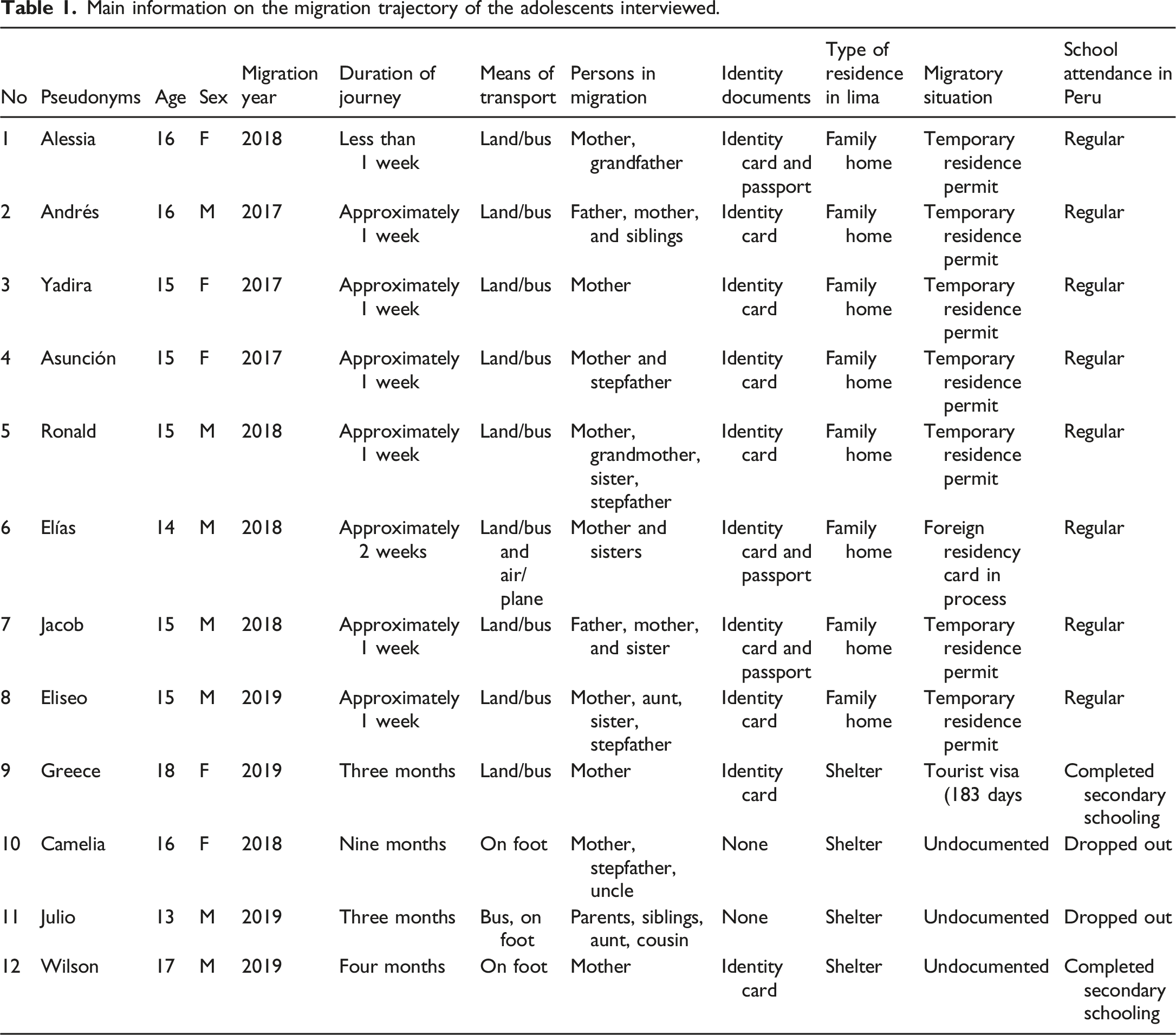
The interviews with adolescents served as a means of gathering empirical information about their migration and post-migration experiences, as well as the evolution of their everyday lives, the forms of vulnerability that affect them, and the livelihoods of their families in both countries. Based on the adolescents’ accounts and the reconstruction of their life courses, we analysed three main stages in the adolescents’ migration trajectories: the departure from their country of origin (the pre-migration stage), the journey from Venezuela to Peru (the migration stage), and their settlement in Lima, the Peruvian capital, where we carried out our fieldwork (the post-migration stage). Through purposive and snowball sampling, we randomly contacted a diverse group of adolescents in terms of sex, family structure, time since migration, and place of residence (family home or shelter). Although the sample size did not allow for inference, the findings do contribute to a representative approximation of the life course and the situation of Venezuelan adolescent migrants. It is worth adding that each of the participating adolescents were met at one of two schools or two shelters, and interviewed with the prior authorisation of the respective institutional authorities. Moreover, each adolescent and one of their parents expressed their consent by signing an informed consent document, and the names of the adolescents were changed to protect their anonymity.
Finally, it is worth stressing we understand “the family” as a residential group composed of the parent–children nucleus, and may be biparental or monoparental and may sometimes also include other relatives (such as an aunt and uncle, grandparents, cousins, and so on). Where applicable, the adolescents also refer to individuals in their trajectories who are not part of the residential group but are members of the family who stayed behind in Venezuela, or to other relatives who did migrate but live in another part of the destination country.
Results
As we have noted, the results are organised around the three main stages that have marked the life courses and, in particular, the migration trajectories of the adolescents and their family members: the pre-migration stage, corresponding to the context of crisis in Venezuela that prompted their departure from their home country; the migration stage, corresponding to their passage from there to the destination country; and the post-migration stage, which encompasses the conditions and circumstances related to their arrival and integration in Peru. For each of these stages, we seek to stress the similarities and the differences between the adolescents.
Pre-migration stage: crisis, survival and circumstances of departure from Venezuela
The first stage faced by all the adolescents is the experience of crisis in Venezuela. This was initially played out in material terms, through problems with the provision of food staples and the long lines involved in acquiring them. The deterioration in everyday living conditions, stemming from Venezuela's macro-economic situation and the devaluation in the national currency, intensified in 2015 and 2016. The constant increase in the price of food staples fuelled the emergence of a parallel economy in which “people bought and [then] sold on the most expensive things in the streets […]; there were no products left in the supermarkets and people bought because they had nothing” (Andrés, 16 years old; migrated in 2017 by bus with both parents and two sisters to join a father’s friend who had migrated 6 months earlier).
Thus, the economic crisis manifested itself, above all, as a food shortage, which threatened the very survival of the population. To confront this situation, some adolescents explained how their families resorted to reducing their number of daily meals—from three to two or from two to one—or, in some cases, to sacrificing other daily outgoings on the likes of transportation or clothing. “It was tough because we often had nothing to eat for days on end. We were hungry and there was nothing to eat. […] I also had to stand in line, all evening, all morning, or all day” (Julio, 13 years old; migrated in 2019 by bus and on foot for 3 months with both parents, siblings, an uncle and a cousin to join an aunt and cousin who had migrated 2 months earlier). The circumstances of food insecurity and instability meant profound changes in how families organised their spending, given increasingly limited household budgets due to the impacts of inflation and the rising costs of the basic daily food basket for each household member. Concerns about the cost of food affected not only poor or popular-sector families, but also those from the middle classes who had different or additional expenses. “Even though both my parents were well-paid, things began to get tough for them because there were three payment instalments for a private school on top of the food, and when the tuition fees went up, they decided to leave [the country]” (Andrés).
When it came to healthcare, the adolescents said that the lack of provision and medication were serious problems in Venezuela. They stated, on the one hand, that there were no hospitals with doctors available to treat them or a family member if they got sick; and on the other hand, that it was difficult or even impossible to access medication. Indeed, there was a large number of pregnant women and/or new mothers who decided to make the journey to Peru in order to access a healthcare system that guarantees antenatal, childbirth, and postnatal care, especially in cases of emergency. To illustrate this situation, it is worth citing the family history of Elías, whose mother was pregnant and had ended up in poor health due to the shortage of medication in Venezuela. “My mum got very sick when she was pregnant and my dad went off to look for medication in Colombia and he was given a month off work for that, but when they saw he wouldn't be back, they fired him” (Elías, 14 years old; migrated in 2018 by bus to Brazil and then by plane to Peru with his pregnant mother and sister to join the father who had migrated 3 months earlier). Some weeks later the family went to Peru, where Elías's mother was able to give birth in adequate sanitary conditions.
In turn, the adolescents stressed the connection between the crisis and prevailing insecurity in Venezuela, which was evident through acts of theft, vandalism, and even kidnapping. Many experienced violence in the months before leaving the country, witnessing roadblocks as well as “people going out to loot in the streets because there is no food and they go and vandalise everything […]” (Ronald, 15 years old; migrated in 2018 by bus for a week with his mother, grandmother, sister and stepfather to join two uncles who had migrated 7 months earlier). Others witnessed robberies: “My mum was in the colectivo [taxi pool] when two thugs appeared. They [the thugs] closed the windows, took out their guns, struck her, and stole everything she had” (Asunción, 15 years old; migrated in 2017 by bus for a week with her mother and stepfather). Some adolescents revealed that they had been victims of political persecution or other forms of pressure at school. “Being the spokesperson for students at the protests caused all sorts of problems with the principal, because she realised that I wasn’t her kind of person and stopped giving us lunch to give it to the [pro-government] armed civilians instead, and threatened not to let me study (Grecia, 18 years old; migrated in 2019 by bus with her mother). For many adolescents and their families, these situations of violence were a fundamental factor in the decision to emigrate and apply for political asylum in the destination country.
The adolescents’ conditions of departure were sometimes complicated by the haste with which their families made urgent decisions, at the expense of advance preparations which were often impossible. Some said that they began to pack their bags as soon as their parents informed them of their decision to leave Venezuela, taking only whatever clothing they needed for the journey and their subsequent settlement in Peru. The testimonies also reveal that the most painful part of the process was leaving behind friends and certain family members—especially grandparents, who would have been unfit for the days of travel by bus. The decision to migrate triggered feelings of loss, anxiety, and uncertainty over the family members remaining in Venezuela, accompanied by emotions such as sadness and melancholy that were all the more intense when these individuals had played a part in raising them. “It was very sad when it was time to say goodbye to my grandma because she is like my second mum and just imagine, my entire life with her and I still haven’t seen her [since moving to Peru]. That was a horrible day” (Alessia, 16 years old; migrated in 2018 by bus in 1 week with her mother and grandfather, to join an uncle, an aunt, and a cousin who had migrated 1 year earlier). However, the motivation to migrate and start a new life extended to a desire to help those family members who did not accompany them on the journey.
There are no significant differences in how the different adolescents in the sample evoked the context of crisis in Venezuela. Each of them cited material difficulties, which reached the level of emergency and critical need, as well as problems of access to health services that endangered the lives of infants, persons with comorbidity (such as cancer, cardiovascular problems, and diabetes), and elderly persons experiencing a loss of autonomy. The only significant differences between the adolescents concerned school attendance: Some were able to go to school regularly while others dropped out due to an inability to afford transport costs and/or school supplies or because teachers had stopped giving classes. “I gave up secondary school when I was 14; they asked me for lots of things like books or clean notebooks to write down new things, but I didn’t have any of that” (Camelia, 16 years old; migrated in 2018 on foot for 9 months without identity documents, with her mother, stepfather and uncle, to join a mother’s friend who had migrated 5 months earlier). Dropping out of school freed up more time for some of the adolescents to look for work to supplement the family budget.
Given the intensity of the social and economic crisis, emigration from Venezuela ultimately proved the most viable option by which the adolescents and their families could mitigate the conditions of material or dietary want and conditions of bare survival. This was made possible by the prior migration to Peru of a family member or a friend of the parents, who had attested to the availability of work and ready earning opportunities through which to improve family living conditions and send remittances to non-migrating relatives. “My grandma was the one who made the decision to leave Venezuela. My aunt was already in Peru, had work, and told us to come. My grandma spoke to my mum and dad, and they made this decision. We sold our house, our car and all our things there to get the ticket and travel to Peru (Alessia).
The migration stage: the journey from Venezuela to Peru
All the adolescents travelled by road, with at least one of their parents or a close family member. Almost of all of them took the main route from Venezuela to Peru, passing through the border posts of Cúcuta, between Venezuela and Colombia 3 ; Ibarra, between Colombia and Ecuador; and Tumbes, between Ecuador and Peru. Some of the adolescents travelled in advance with their mothers to explore the prospects of improving their living conditions in Peru before committing to migrate with other extended family members, while others left Venezuela with one parent to reunite with the other and their sibling(s) who had migrated previously. “First my dad went to Peru on his own [in 2015], worked a lot, saved money, and bought a ticket for my mum, my brother, and me.” A year later, the three of us came” (Yadira, 15 years old; migrated in 2017 by bus in 1 week with her mother to join her father who had migrated 1 year earlier).
A factor that differentiates the adolescents and their family members during this stage is the form of transport used for the journey to Lima. Although the majority travelled by bus—and sometimes colectivo taxis for certain stages— through Colombia and Ecuador, others could not afford transport for the entire journey and were compelled to walk for hundreds or even thousands of kilometres. Financial limitations obliged the families to prioritise spending on food despite the cold and the risks of theft; traveling by foot left the migrants exposed to adverse weather such as cold and rainy spells—especially while crossing the Cordillera de los Andes—and to theft by armed groups. “We got to Bogotá on foot and then to Cali, and there the robbery took place. My cousin and I got our bags stolen, we were assaulted at knifepoint” (Wilson, 17 years old; migrated in 2019 with his mother by bus and on foot for 4 months without identity documents to join his uncle and cousin who had migrated 4 months earlier). These difficulties were accompanied and compounded by the extreme fatigue that came of months spent walking on foot, to which the adolescents, not yet fully grown and without any kind of shelter, were particularly susceptible.
Some humanitarian organisations specialising in work with children and adolescents, such as Red Cross, Plan International, UNICEF, and World Vision, provide different kinds of dietary, leisure, and educational support in the border areas where families stay for several days before being admitted to the destination country. At CEBAF, located between Ecuador and Peru, these organisations offer support for adolescents while their family members wait to be processed by the administrative authorities. It is important to note that until December 2018 Venezuelan citizens only needed their identity card to enter Peru, after which point they could apply for a Temporary Residence Permit (PTP). After that date a passport was required for entry to Peru, while from June 2019 migrants needed to present a humanitarian visa. Thus, the restrictions for entry to Peru were steadily tightened over the period 2017–2019, significantly limiting the legal channels through which Venezuelans could pursue their migration projects. This precipitated an increase in illegal entry to the country through coastal routes or so-called trochas (“shortcuts”): parallel routes that evade border posts. This marks another distinction between the adolescents who entered the country legally with their family members, and those who did by circumventing the formal requirements for entry.
The adolescents who travelled on foot from Venezuela to Peru can belong to either one of these two groups. What sets them apart, besides the duration of their journey, is the different stop-off points involved—especially Colombia, where many of the adolescents have relatives. This source of support en route to Peru allowed the migrants to recover from the first part of their journey on foot, and contributed to a geographical staggering of some family members who had travelled directly followed by others who awaited the arrival and settlement of these forerunners before they themselves completed their journey. These extended stopovers in Colombia show that the migration of adolescents can be more like a form of mobility between Venezuela and Peru that is organised according to the circumstances of the journey and the presence of relatives in the different countries.
The final stage of the journey is the arrival in Lima or another city in Peru. For those adolescents who did not have access to a family residence or other accommodation, shelters provided food and space for sleeping. “My mum and I are alive thanks to the shelter, in truth. Here we get breakfast, lunch, food, and accommodation and we are living off that. To begin with they loaned us money to buy [bus] fares, write our résumés, get through interviews, and look for work” (Grecia). There are some 12 institutions of this kind in Peru, run by religious communities, which guarantee support for Venezuelan families who arrive in Peru with very limited means.
The post-migration stage: the conditions of settlement and integration in Peru
The third stage in the migration trajectory is that of post-migration, which corresponds to the establishment of the adolescents and their families in Peru and their integration into their new localities, primarily Lima. All the adolescents live with the same group of family members with whom they travelled to Peru, with the exception of those from groups that moved in with husbands/fathers who had migrated earlier. The recomposition of the family during the post-migration stage encompassed the same members as in Venezuela, except in some cases for aunts and uncles or grandparents who were unable to leave the country. In the case of the monoparental families, some mothers started relationships with Peruvian men, giving rise to multicultural recomposed families.
A key aspect of the post-migration stage is the entry into the job market of the parents and family members who accompanied or preceded the adolescents on their migration project. All adult family members in the sample were working, regardless of how long they had been in Peru—whether informally (as street vendors) or formally (as secretaries, nurses, domestic servants, or running a market stall or a shop unit). For the adolescents, their parents’ resumption of an economic activity that brings in regular and sufficient income to ensure the family’s needs represents the crystallisation of the migration projects and justifies the decision to leave Venezuela. “In Lima, my mother has a street stall and pays the rent and food, and my grandfather is a bricklayer and sends part of what he earns to my grandmother in Venezuela. My family’s economy is stable now because the three of us help each other.” (Alessia). Thus, no adult relative devoted themselves entirely to housework, prioritising income-generating activities to boost the household budget and, in some cases, send remittances back to family members, especially grandparents, left in Venezuela.
Moreover, some parents combined various jobs, taking advantage of the economic possibilities in Peru and the access to the job market available through the informal economy. Despite precariousness and under-employment, the parents were able to attain a degree of stability for their families, earning enough to finance food, clothes, school supplies, and transportation for their children. But regardless of the relative ease with which they found work, the adult migrants often encountered situations of exploitation and discrimination in the job market. They frequently had to change jobs to escape situations of long hours at a lower rate of pay than they had been promised, or even no pay at all. This labour instability gave rise to a lack of job satisfaction among the parents, which was compounded in cases where they were overqualified for the work they were doing. In addition, a significant proportion of the adolescents engaged in an economic activity regularly or seasonally to augment the household budget. This often entailed retail (such as clothing or food) or cleaning work. It should be stressed that, in most cases, this work was in parallel to their schooling. With the exception of the adolescents who travelled to Peru on foot amid circumstances of extreme precariousness, those who had been in the country for at least 6 months had managed to enrol at a school. This was a result of the care and efforts of their mothers, who left Venezuela with the documentation necessary (apostilled certificate of grades) to validate their children’s level of schooling with the Peruvian Ministry of Education. For some adolescents, school integration—expressed through daily attendance, socialisation with peers, and participation in all curricular and certain non-curricular activities—even opens up the perspective of higher education in the host country. “I quickly got used to the school in Lima; my classmates treat me well and I get on well with the whole student group […] I plan for a future that is not in Venezuela and I would like to study computer engineering here.” (Andrés)
On the other hand, a challenge for the adolescents and their families during the post-migration stage lay in obtaining the necessary residency documentation from the migration authorities. As noted earlier, the adolescents who arrived along with their families before October 31, 2018 were entitled to the PTP granted by the Peruvian state (before December 31, 2018). On the other hand, those who came after this date did not enjoy this special residential status, but had the option of applying for asylum—a process that can take between one and 2 years.
Finally, on the subjective level, most of the adolescents spoke of their homesickness for Venezuela, focused mainly on grandparents who did not travel and remained in the same precarious situation, as well as friends from their old school or neighbourhood with whom they kept in touch through social media. Some of the adolescents conceded that they were finding it difficult to adapt to their new everyday living conditions and to the marked cultural differences in Peru. “I miss life in Venezuela a lot because here it's very different. They're very respectful, but there’s not much trust. In Venezuela there’s more trust between people. They're very different cultures; here they use different language, there’s a lot of slang and words that are different that at times I don’t understand” (Alessia). They also complained about the humid climate and low temperatures at certain times of year in Lima, and more particularly about the negative attitudes and forms of discrimination expressed in the school space by Peruvian students and sometimes parents. “I am not getting on well with Peruvian girls because they are very complicated. That’s why all my friends here are Venezuelan. With them, things are easier. I don’t like how Peruvian girls al school treat me and talk about me” (Asunción, 15 years old; migrated in 2017 by bus for a week with her mother and stepfather). All these factors hampered the adolescents’ integration in Peru, although the overall level of satisfaction with their new lives during this post-migration stage varied from one case to the other.
Concluding discussion
This trajectories-based approach—in particular migratory, familial, and educational—allowed us to conduct a detailed analysis of the specificities of each stage of adolescents’ life course from Venezuela to Peru, as well as to highlight the similarities and differences between the actors in this migratory phenomenon. A first notable element is the accounts of extremely tough living conditions amid the crisis in Venezuela, manifested in long lines to obtain food in limited quantities, difficulties in feeding the entire family, and the impossibility of finding medication for any family members with serious illness. These aspects coincide with recent research on the crisis in this country (Caraballo-Arias et al., 2018; Mazuera-Arias et al., 2020; Posso et al., 2023; Rocha et al., 2022; Van Roekel and De Theije, 2020) and the disproportionate toll it takes on children, adolescents, and their families (Carroll et al., 2020; Clauss-Ehlers, 2019; Pico et al., 2021; Pires et al., 2022; Vargas-Machuca et al., 2019). There were some socioeconomic differences between the adolescents based on their parents’ socio-professional level and type of employment: between those whose parents worked as laborers or as domestic workers and pertained to the popular classes, and those who were entrepreneurs or executives and corresponded to the (upper-) middle class. However, a predominant feature of Venezuela's social and economic crisis was a kind of levelling of socioeconomic categories, reducing the adolescents and their families to relatively similar circumstances of survival. For all families, migration emerged as the only means by which to overcome these living conditions. The adolescents fulfilled the criteria applicable to the concept of survival migration (Betts, 2013
The issues of adolescents’ adaptation, agency, and resilience in the host society, widely highlighted in the literature (De Vos, 2012; Nagi et al., 2021; Sleijpen et al., 2017), can be observed in this case study through their access to education and in the care they take to ensure the continuity of their schooling and the completion of secondary education. This school integration allows the adolescents to set short- and medium-term educational objectives aimed at facilitating their inclusion into Peruvian society and providing opportunities for social mobility for themselves and their families. Nevertheless, problems of discrimination at the hands of Peruvian students, and even some teachers, coincide with previous findings on the obstacles faced by adolescents in integrating into the host country (Mondain and Lardoux, 2013; Salas-Wright et al., 2020). Therefore, it is also common for adolescents, especially girls, to socialise at school with other adolescent girls of the same national origin (Bergnehr et al., 2020). The agency and adaptation of Venezuelan adolescent migrants to Peru are also manifested in their participation in economic activities in parallel to schooling to supplement their household income and ensure stable living conditions in their new country. This strategy reflects the responsibility they assume and the support they provide within their families in facing the challenges inherent to the post-migration phase and their integration into the host country. The work the adolescents undertake, the economic role they adopt, and their reintegration into education are responses to their loss of agency in Venezuela due to the conditions of bare survival they endured there. These practices, identified as forms of resilience, help to improve their personal and family well-being and contribute to their transition into youth in a new society where they must rebuild their social network.
Moreover, our research highlights other elements that shape adolescent’s life courses but which have not previously been explored by the literature. Firstly, there is no single model of family migration that characterises the experiences of adolescents; rather, they and their family members present a multiplicity of forms of mobility. This stems not only from the family structure of the adolescents before undertaking the migration project but also from the decisions that the family make regarding the viability of traveling to and settling collectively in the destination country. If the migration is exploratory in form, the adolescents will have moved with one of their parents, and their level of integration in Peru will condition the subsequent reunification of the family through migration of other members. In addition, a key element in understanding the case of survival migration from Venezuela is the territorial dimension, involving transnational mobility that extends from each family’s place of origin in Venezuela to the final destination in Peru, usually Lima, and often also includes stop-off points in Colombia and Ecuador. Family migration is often staggered, drawing on the presence of other family members or friends in intermediate locations, who serve as sources of support for resting or exploring work options before continuing the journey. Once in Peru, the prior migrants often help with finding accommodation, providing information they have received first-hand about job offers, enrolling children and adolescents in school, and undertaking the application for PTP or asylum at the Migrations Office, depending on the date of entry. The existence and use of these family-based migration networks are extremely important to the migrants in their decision to leave Venezuela, and in the successful realisation of their migration and post-migration stages. Both throughout the journey from Venezuela to Peru and during the settlement process, these contacts provide decisive support to the families and help them develop survival skills for addressing key aspects of everyday life.
Our research found evidence of an initial context common to all adolescent migrants, characterised by factors of social, economic, and political crisis in Venezuela. This convergence toward hardship may convey an image of homogenising living conditions across all families, conditioning their ultimate recourse to a single form of survival migration. However, the migration trajectories reveal differences that attest to the heterogeneity of the migratory phenomenon amid crisis. Our results allow us to propose a typology of adolescent migration experiences that is made up of four groups and reflects the substance of the three stages of the migration trajectory (see Figure 1): - - - - Biographical stages of adolescents throughout the migration trajectory from Venezuela to Peru.
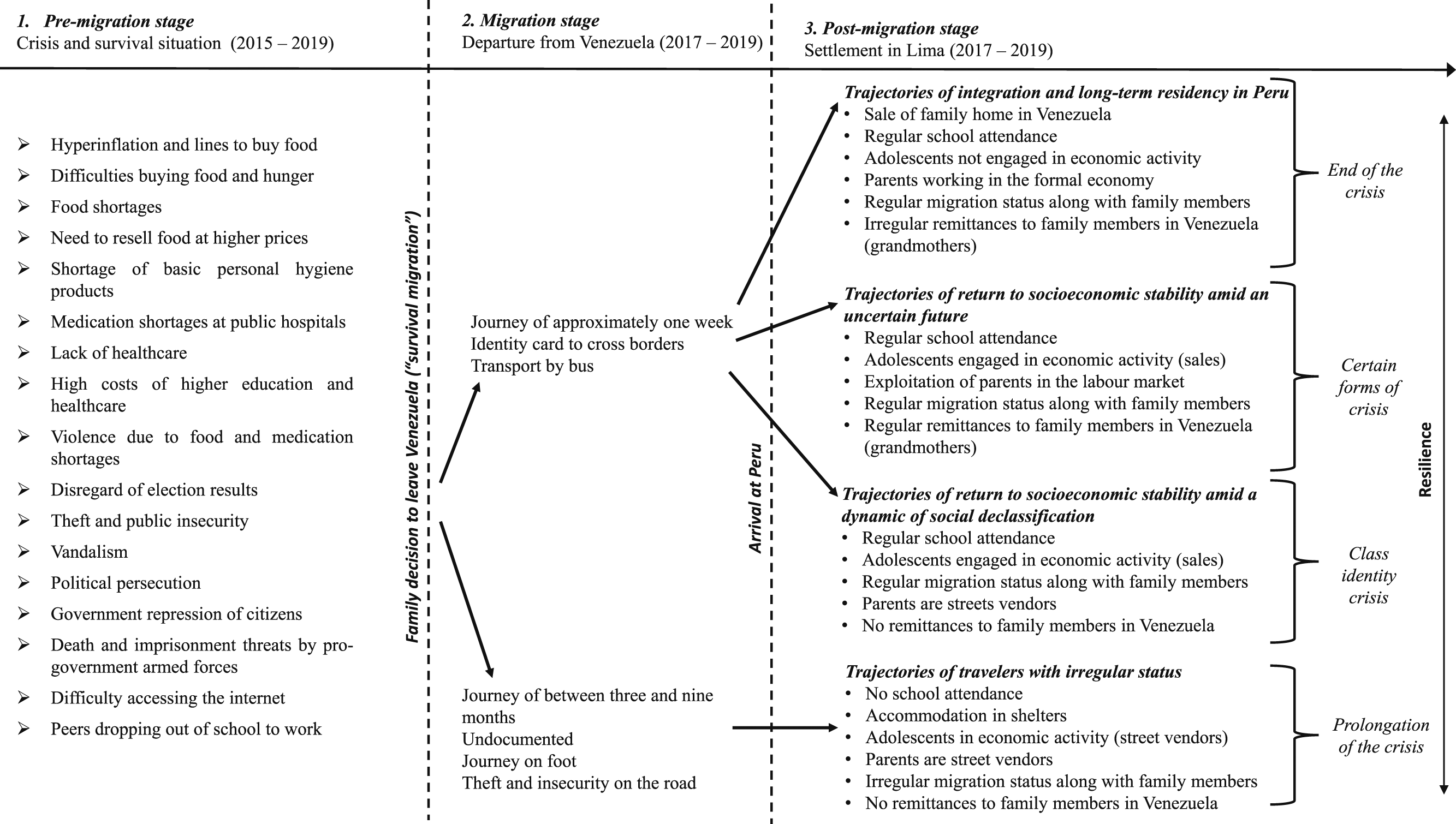
The theoretical and methodological basis of the biographical approach and the life-course paradigm highlights the active role of adolescents in the migration process as a survival strategy in response to the crisis in Venezuela. Their accounts and points of view thus recognise their own experience and subjectivity, comprised not only of anxieties and ordeals but also of hopes and projects that they expect to realise as a result of migration. Despite the differences in migration trajectories signalled by this typology, the emotional impacts of crisis and survival migration cut cross all adolescents. The suffering caused by leaving one’s country of origin in a hurry, the distance from family members (especially grandparents), from school friends, and the from the home neighbourhood, and the nostalgia for one’s culture of origin are aspects frequently recalled by the adolescents during interviews that prolong a sense of personal and family crisis. Although families may have integrated into Peru and may be more comfortable economically thanks to migration, the emotional trauma they have experienced will likely stay with the parents and their children for many years. That is, the crisis may have ended on a material level but it continues on the subjective level, attesting to how deeply situated this dimension is. These personal situations highlight how resilience following survival migration is essential to mitigating the vulnerabilities that arise from the change of residence as well as adverse factors such as discrimination or precarious living conditions. Resilience is crucial for the realisation of their personal and collective aspirations, through education on the one hand and the social mobility of their family on the other. As a result, its development remains an ongoing process throughout the adolescents' post-migration trajectory and life course and requires daily support from family members and school friends.
Finally, it is worth noting that this typology does not conform to any gender trend, given that both male and female adolescents are found variably across all groups. However, our sample is too small for extrapolations, and further research with a larger number of cases will be required to this end. Another future study could involve longitudinal follow-up of the group of students interviewed, observation of their resilience and integration processes in Peru, and, once they enter adulthood, possible future migration projects back to Venezuela or to other countries in the region.
Footnotes
Acknowledgements
This work was supported by the regional office for Latin America of the United Nations Children's Fund (UNICEF) and the Latin American Center for Social Sciences (CLACSO). The author wishes to thank in particular Pablo Vommaro (CLACSO) for the general direction of the project and Gioconda Herrera (FLACSO - Ecuador) for the coordination between the research teams in the four countries of the project (Colombia, Ecuador, Brazil and Peru) and the preparation of the final report.
Declaration of conflicting interests
The author(s) declared no potential conflicts of interest with respect to the research, authorship, and/or publication of this article.
Funding
The author(s) received no financial support for the research, authorship, and/or publication of this article.
