




Abstract
The purpose of this study is to illuminate how participatory methods over time in a research project with disabled children may contribute to an empowerment process. Findings indicate that appropriate use of participatory methods over time may contribute to an empowerment process with disabled children. Based on the UNCRC article 12, this paper calls for seizing the great potential that lies in building on disabled children’s inner strength and efforts to increase their own power in research processes.
Introduction
When conducting empirical research, ethics codes state that the research should have a positive outcome, not only for the group that the research aims for, but also for persons involved in the research process (Askheim et al., 2019; NCPHSBBR, 1978). That is, the methods used should be empowering for the participants (Kellett et al., 2004). While there is a growing field of studies and literature concerning children’s participation in research in general, studies with disabled children as participants are still rather limited (Bailey et al., 2015; Bradbury-Jones et al., 2018; Stafford, 2017; Ytterhus and Åmot, 2019). The UNCRC (United Nations Convention on the Rights of the Child) article 12 clearly states that children have a right to participate and to be listened to in all matters concerning themselves (Convention on the Rights of the Child, 1989) and this is broadly recognized today. At the same time, article 3 emphasizes that adults should protect the best interests of children and young people in general when making choices that affect them. Several studies show that disabled children are at risk of being overprotected and excluded, which can lead to isolation and low self-esteem (Bengtsson et al., 2011; Connors and Stalker, 2002; Grue, 2011; Kembhavi and Wirz, 2009; Tetzchner et al., 2008; Ytterhus et al., 2015). Arguments may be that disabled children are vulnerable as a group, and therefore adults should protect them. This assumption may however also hinder their involvement in research (Bradbury-Jones et al., 2018; Snipstad, 2021) and the UNCRC article 3 may unnecessarily stand in the way of article 12. There are few studies evaluating the experiences and views of disabled children when participating in research (Bailey et al., 2015; Kellett, 2010). Therefore, the rights of disabled children to participate and to have influence has great potential as a subject to be explored and further developed.
The aim of this study is to illuminate how participatory methods in a research project with disabled children may contribute to an empowerment process. To answer this question, the article will draw upon a research study where participatory methods were used over time with three disabled children aged 9 to 12 (Andersen et al., 2019). To be able to illustrate this process, Shier’s model of children’s participation in decision-making (2001) together with Asheim’s three-stage empowerment process (2010) will be used in the analysis of the data material. The key concepts participatory methods and the empowerment perspective, as well as Shier’s model, will now be presented, as well as how they are understood and implemented in this study. While the article has a relational understanding of disability, the term impairment is used when it comes to the participating children’s bodily physical challenges.
Conceptual framework of the study
Participatory research with children
Abma et al. (2019) define participatory research as “a relational process through which knowledge is produced collectively”. It means involving people whose lives are at the centre of research in making the key decisions of any research project. In this way, participation should include active involvement, beyond providing data. Participants could be involved in the development of the entire research design, the design of methods, data collection, data analysis, and the dissemination of findings (Bishop, 2014). However, Kindon et al. (2007) state that, in practice, the degree of participation will vary, and that participatory research should not necessarily imply that everyone participates in the same way or to the same extent. Fleming et al. (2014), Frankham (2009) and McLaughlin (2010) state that it would not be right to ask co-researchers to perform tasks for which they have neither skills nor qualifications. The justifications for participation in research include democratic arguments (the right to participate) and qualitative arguments (providing different knowledge). These are also main arguments for involving children in research. “Research with rather than about children recognises that given appropriate opportunities, they have and can express their own views, and these are often different from those of proxies such as parents or professionals who might previously have answered for them” (Wickenden et al., 2014: 401).
Particularly in literature about participation in research from marginalised groups, it is further argued that participation should contribute to empowerment (Beresford, 2005). This is especially emphasised in regard to participatory research with children and, even more, with disabled children. For Bradbury-Jones et al. (2018), a main argument is that participatory research provides an opportunity for empowerment and for the voices of children in general to be heard, and this is even more the case when it comes to disabled children, given their position as a potentially vulnerable group. The assumption that disabled children are a vulnerable group, and therefore adults should protect them, may act as a main hindrance for their involvement in research (Bradbury-Jones et al., 2018; Snipstad, 2021).
While there is a growing field of research in which disabled children’s voices are heard as informants (Andersen and Dolva, 2015; Rasmussen, 2004; Sutherland and Young, 2014; Wickenden et al., 2014; Ytterhus and Åmot, 2019), disabled children as active participants in the research process still represent a rather limited field in research (Benjamin-Thomas et al., 2019; Bradbury-Jones et al., 2018; Gray and Winter, 2011; Kellett, 2010). This may be due to a lack of recognition of disabled children as first and foremost children and prejudicial assumptions regarding the capacity of disabled children, as well as restrictive research methods (Snipstad, 2021; Stafford, 2017). Moreover, in the few studies made, the role of the disabled children and the methods used are often vaguely defined and reported (Benjamin-Thomas et al., 2019). The use of participatory methods may overcome these inhibiting factors when communication can take place in several different ways, as opposed to through the written or spoken word, which often is used more by adults. Also, by using multiple activities over time, a deeper understanding regarding a specific theme can be developed together with children (Stafford, 2017).
The empowerment perspective: critical awareness and a three-stage process
The empowerment perspective is a widely acknowledged and used term today. In this study, the concept of empowerment is inspired by the Brazilian educator Paulo Freire (2000) and the Norwegian professor Ole Petter Askheim (2010). According to Freire, a precondition for participation in decision-making is creating consciousness of one’s own situation and being able to act upon it. Freire speaks of a silent culture, where an oppressive reality becomes the “truth” for the oppressed people living in it. In this research study, Freire’s concept of awareness was used as inspiration in a research group with disabled children. Here, UNCRC article 12 was an overall theme that was important for the children to become aware of. By becoming aware of children’s rights, the disabled children could, for example, discuss the prerequisites for being able to speak one’s mind and be listened to. Askheim has worked with the empowerment perspective for decades and has provided a three-stage definition of the empowerment process (Figure 1):
Askheim speaks of empowerment as a process in which people who are in a powerless position mobilize power through gaining strength and building upon efforts to gain power and agency over their own lives. In this way, empowerment involves both the goal and the means of achieving it. As mentioned above, theory regarding the empowerment process is used in this study as a framework for analysing to which extent empowerment takes place in a research study with disabled children. In addition, the methods used in the present research study moved from activities building upon the disabled children’s self-confidence (strength) and inner power (effort) towards achieving external power and influence (power). This process was found to correspond well with Harry Shier’s model of children’s participation in decision-making, which also serves as an analytical framework in this study. This model will now be introduced. Illustration of Askheim’s three stages of an empowerment process (Author’s translation).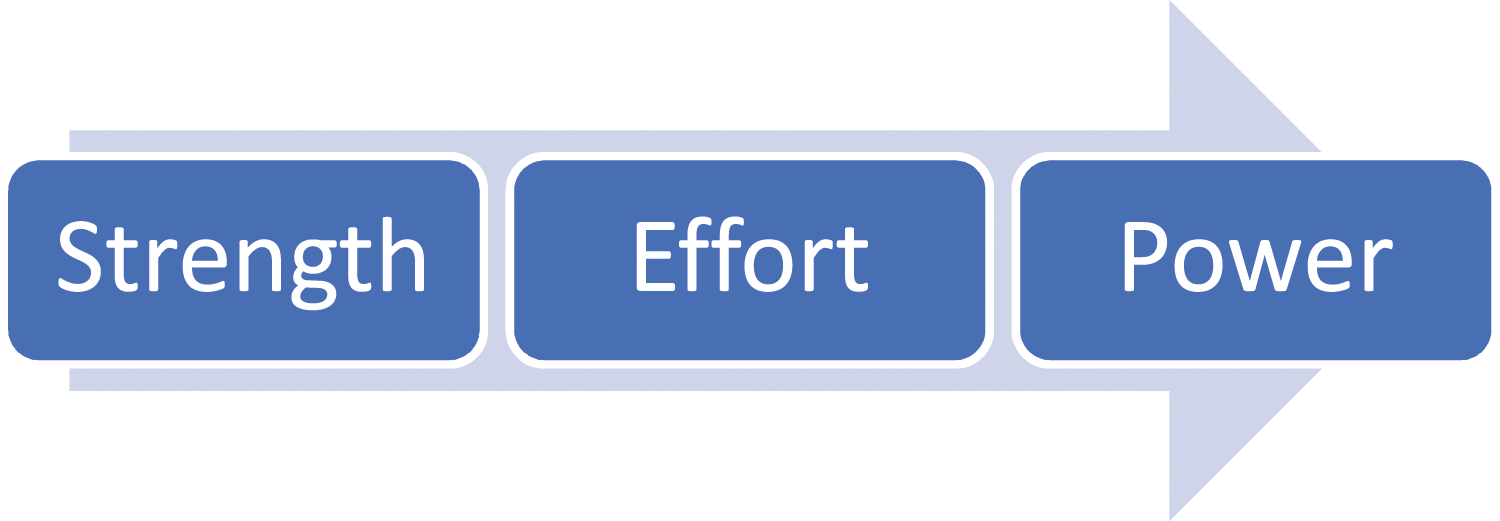
Model of children’s participation in decision-making as an analytical framework
Harry Shier’s model of children’s participation in decision-making (2001) concerns levels of participation through modes of interaction between child and adult and is used here to elucidate how the use of participatory methods may contribute to an empowerment process for the participating children. At each level, there are three stages of the adult’s commitment. These are openings, opportunities and obligations, as seen in Figure 2 below. Pathways to participation (Shier, 2001).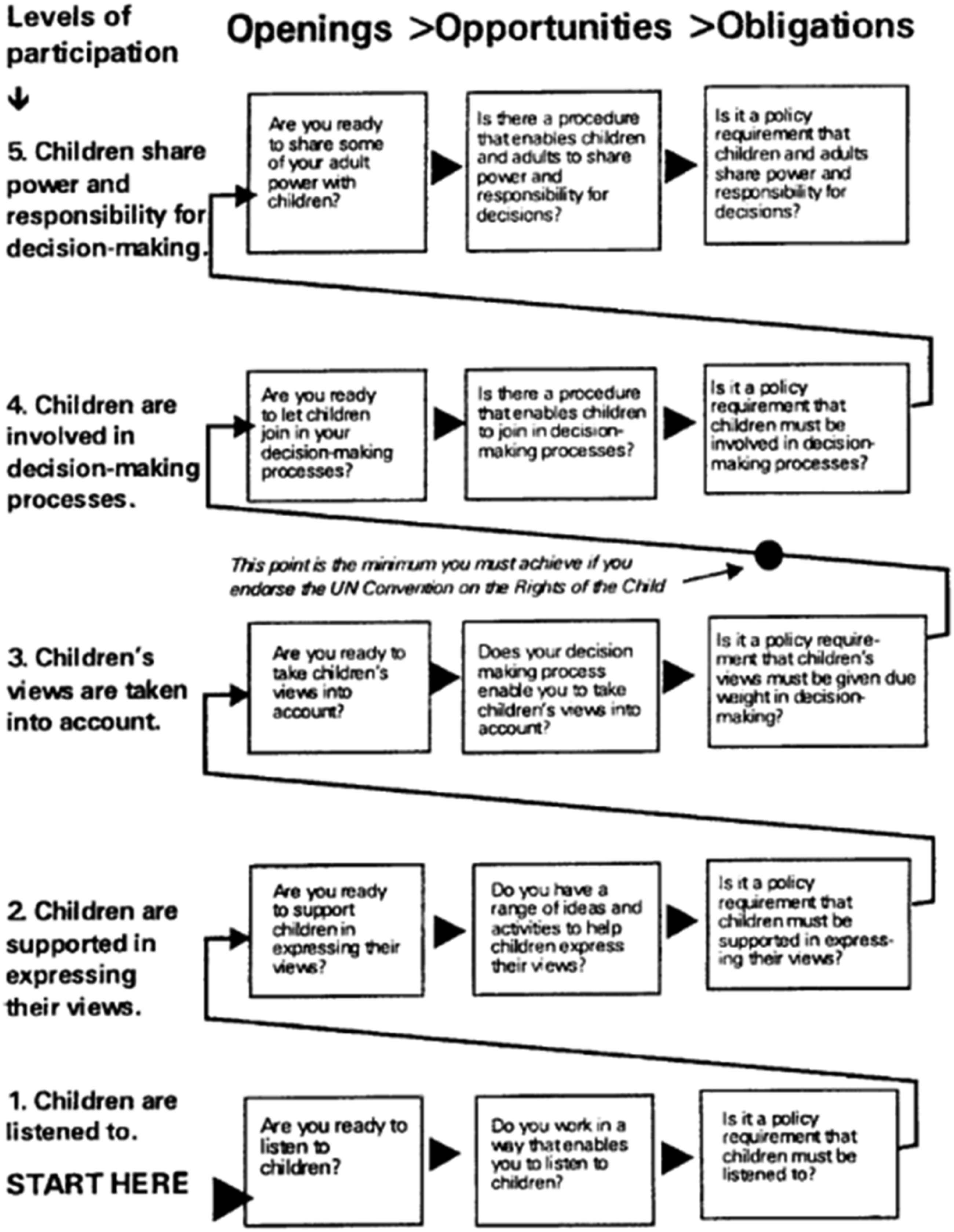
At the first two levels of Shier’s model, no organized efforts are made to ascertain children’s views on key decisions. If the children, however, take the initiative to speak their mind, the adult is ready to listen. At the second level, the adult takes positive action to support children in expressing their views (Shier, 2001).
Level 3 in Shier’s model fulfils the UNCRC article 12 by actively seeking the children’s views, supporting them in expressing their views and taking their views into account (Shier, 2001). However, at this level the children do not participate in decision-making, which is still done by adults. The children are seen as consultants, who provide their input into the adult decision-making process and therefore have no real power. “Thus, at the lower levels children can be said to be “empowered” only in the weaker sense meaning “strengthened” or “supported”, but not in the stronger sense meaning that those who hold power give up some of it in their favour. Decision-making remains the province of adults” (Shier, 2001: 114).
Where the previous levels in Shier’s model are concerned with consulting the children to different degrees, the role of the child at level 4 and 5 makes a transition to being an active participant in decision-making. At level 4, children are involved in decision-making processes, while at level 5, children share decision-making power as well as responsibility with adults (Shier, 2001). The benefits of participation at these levels may be: “..improving the quality of service provision (or research, author’s words), increasing children’s sense of ownership and belonging, increasing self-esteem, increasing empathy and responsibility, laying the groundwork for citizenship and democratic participation, and thus helping to safeguard and strengthen democracy” (Shier, 2001: 114).
The model will be used together with Askheim’s three-stage empowerment perspective as a theoretical framework to illustrate an empowerment process when using participatory methods. Since focus is on the methods used, level 1 and 2 in Shier’s model are irrelevant here. This means that methods at level 3 focus on developing the disabled children’s own strength, methods at level 4 aim to build upon the children’s efforts, and, finally, children at level 5 exert power by sharing power and responsibility with the researchers.
Methodology
The aim of the present study is to illuminate how participatory methods in a research project with disabled children contribute to an empowerment process. The present study partly builds upon data from a previously published research study (Andersen et al., 2019). The aim of the research study was to explore the children’s experiences of participation in their everyday lives based on article 12 in the convention on the Rights of the Child. Three disabled children, aged 9 to 12, participated in a group with two leaders for a year, the project leader, and a child psychologist from a habilitation centre. The research study used participatory methods over time and the children’s reflections were connected to the recognition theory of Axel Honneth (2006).
In the present study, data regarding the group process with the children and participatory methods used in the former research study will be reanalysed. Additional data for the purpose of this present study include parental experiences from the group process (gathered from the initial meeting and the closing group meeting) and reflection notes from the project leader. In addition to the analytical framework presented, a thematic analysis inspired by Braun and Clarke (2006) will be applied to identify how participatory methods used over time have affected the children and contributed to an empowerment process.
The project’s issues of privacy and ethics were approved by the Norwegian Centre for Research Data. The children’s names are anonymised by using pseudonyms.
Participants and data
First, we will give a brief description of the research study with its participants and participatory methods (Andersen et al., 2019). After this, a description of the data will be given
Three disabled children, Freja (9 years), Christian (12 years) and Nicolaj (10 years), participated in a group with two leaders for a year. The children were recruited through a habilitation centre based on the following criteria: age 9 to 12 years old, attending public school, having primarily a physical impairment, being able to speak one’s mind without help from others, and finally, wanting to participate. The reason for the criteria were to have a group of children who had a chance to relate to each other when it came to age, school situation and type of impairment. It was emphasized that the children were motivated to participate independently and not only motivated by others and that the children’s voices were influenced as little as possible from that of adults. The purpose of the research study was described in an information letter to the parents with a video link addressed to the children, explaining the purpose of the research study and what it would mean to participate. The two group leaders were known to each other beforehand. One of the children had previously had a few conversations with the child psychologist. The children were new to each other.
The group process was initiated by a meeting between the project leader, each child, and parents, followed by an individual interview with each child, in which some participatory activities were arranged. During the individual interviews the children were asked if they had any suggestions for themes or activities to the group. The children had talked with parents about this issue prior to the interview. Their suggestions were incorporated in the group leaders’ overall planning of the meetings. After this, the group met and participated in eight meetings over 4 months. The last two meetings were focus group interviews with the children, and, finally, a closing meeting of the group with participation of the children and their parents.
The participatory methods used in the research study were inspired in part by Claire O’Kane’s theory on how to develop participatory techniques (2008), Jungk’s Future Workshops (Jungk and Müllert, 1989; Kampmann et al., 2017), Rasmussen’s photo voice method (Rasmussen, 2004), experiences from child self-help groups in Copenhagen in Denmark (Kofoed, 2012), Children’s Council in Denmark (Eistrup et al., 2016), Digital storytelling (Lambert and Center for Digital Story, 2010), Decision-Making Pocket Chart (O’Kane, 2008) and, finally, methods developed by the group leaders. Methods and activities were purposefully used with the children to enhance their knowledge of and views on abstract concepts of participation and influence based on the UNCRC article 12. Besides deciding a few overall group rules, the group leaders chose the order in which methods were introduced. The activities made increasingly greater demands as to the children’s initiative, effort, consideration, and decision-making. The methods were: Making a compass (a drawing and writing activity telling about oneself), Cinema (watching two programmes about children’s rights and disability), Letter box (a repeated activity at the meetings with written dilemmas from other disabled children, where the children in the group played the role of expert panel) and Visit from a disabled youth (a talk about growing up with disability where the children had prepared questions for a disabled youth), Decision-making pocket chart (Chart filled out during the individual interviews), Mindmapping (writing promoting and inhibiting factors in regard to the UNCRC article 12 on a blackboard together), Diamond Ranking Exercise (ranking the degree of importance of children’s statements from the meetings about the UNCRC article 12) and Cartoons (making their own cartoon on the theme “having a say”).
The role of the group leaders began with being the primary decision-makers and facilitators, gradually providing the children with experiences and the capacity to make decisions, while acknowledging the children in speaking their minds through participatory and creative methods. In this way, methods were planned in a specific order that gradually challenged the disabled children regarding initiative, effort, consideration, and decision-making (see Figure 3). However, the group leaders had a variety of participatory methods from which they could choose so that the planning of the group meetings could be flexible and thereby meet the children’s level of participation. Midway through the group process, the children were introduced to the opportunity of leading a small-scale research project with the group leaders as facilitators and supporters. The children discussed and agreed on a research theme. They collected data with their smart phones, drew and made cartoons, analysed, and conveyed the conclusions through a digital story. Illustration of the researcher’s role in facilitating an empowerment process with the disabled children by using participatory methods reflecting the children’s next level of participation in the research group.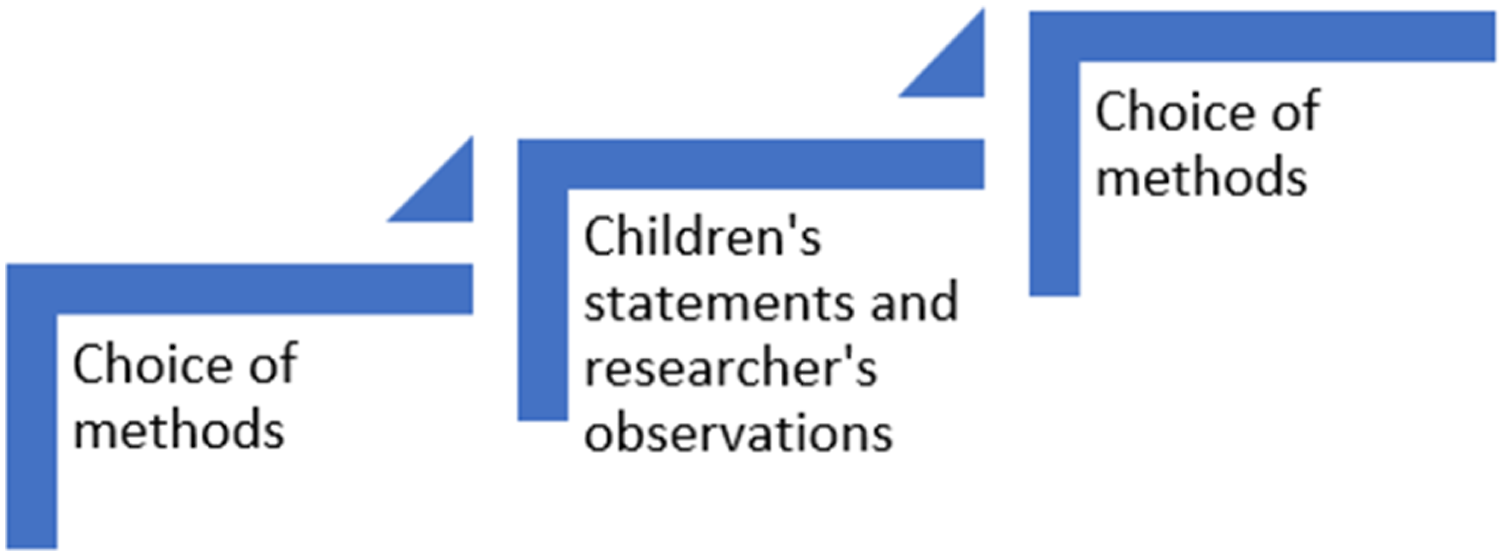
Data from the research study consists of video and audio recordings, as well as the reflection notes from the project leader.
Analysis
Process, analytical framework, participatory methods, and characteristics.
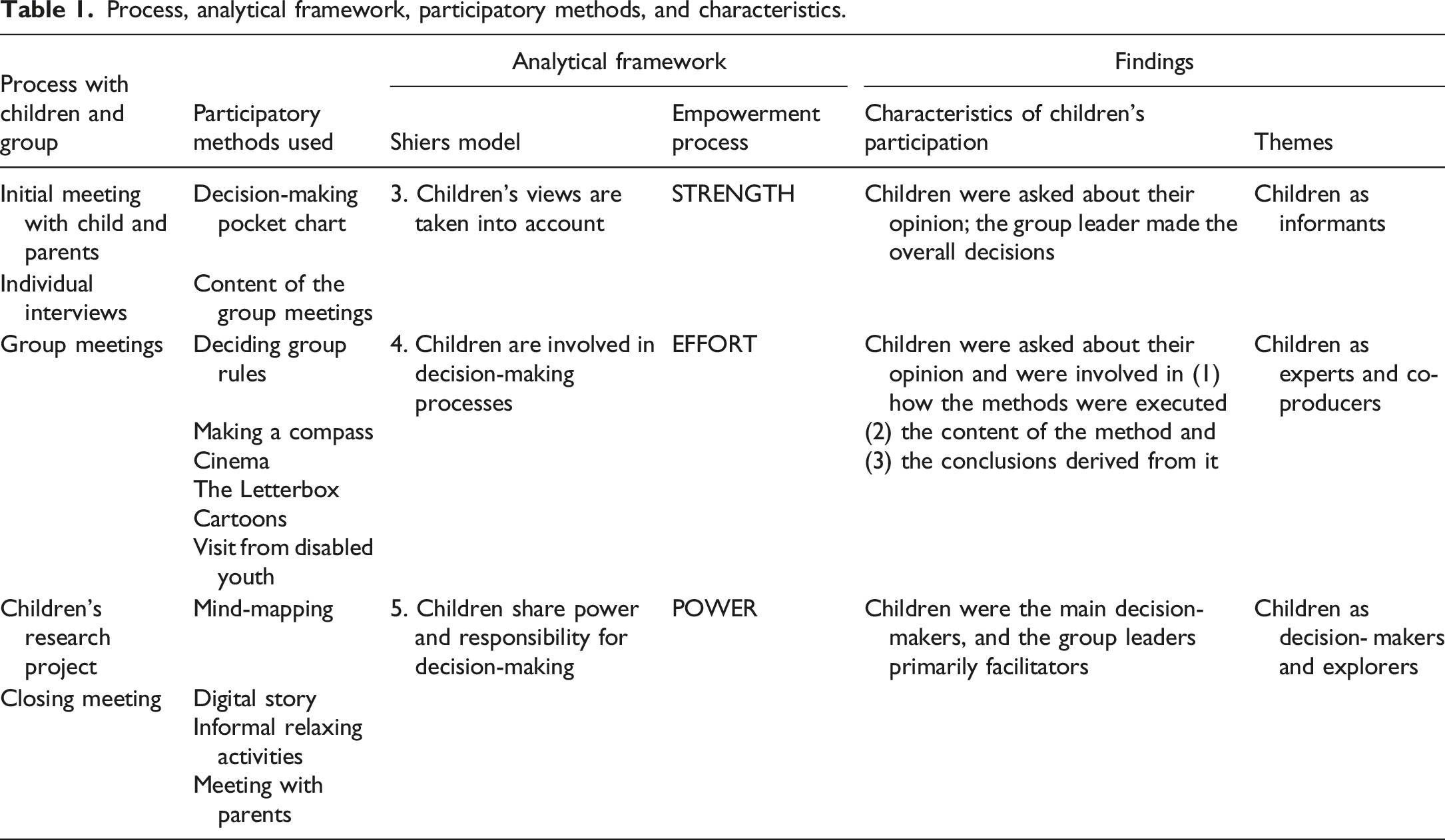
The disabled children’s actions and interactions during the different stages of the process were analysed. These characteristics were supported by field notes and parent’s statements. The children’s roles changed from primarily answering questions and doing what they were asked to do, to taking the initiative and taking responsibility and finally negotiating and taking leadership. Based on the three identified levels of participation in decision-making, the analysis ended up with the following themes to illuminate the research question: children as informants, children as experts and co-producers, and children as decision-makers and explorers. However, the children’s level of participation could change in the same session during the same activity, thus being fluid and moving back and forth, but with a forwarding tendency towards being freer and taking leadership.
Table 1 shows the analytical framework, the order of the process, participatory methods and themes identified.
The three levels identified were compared to Askheim’s three-joint empowerment process, strength – effort – power, leading to the overall themes as seen in Table 1 and in Figure 4 below: Illustration of Askheims three-stage empowerment process through the research group with disabled children.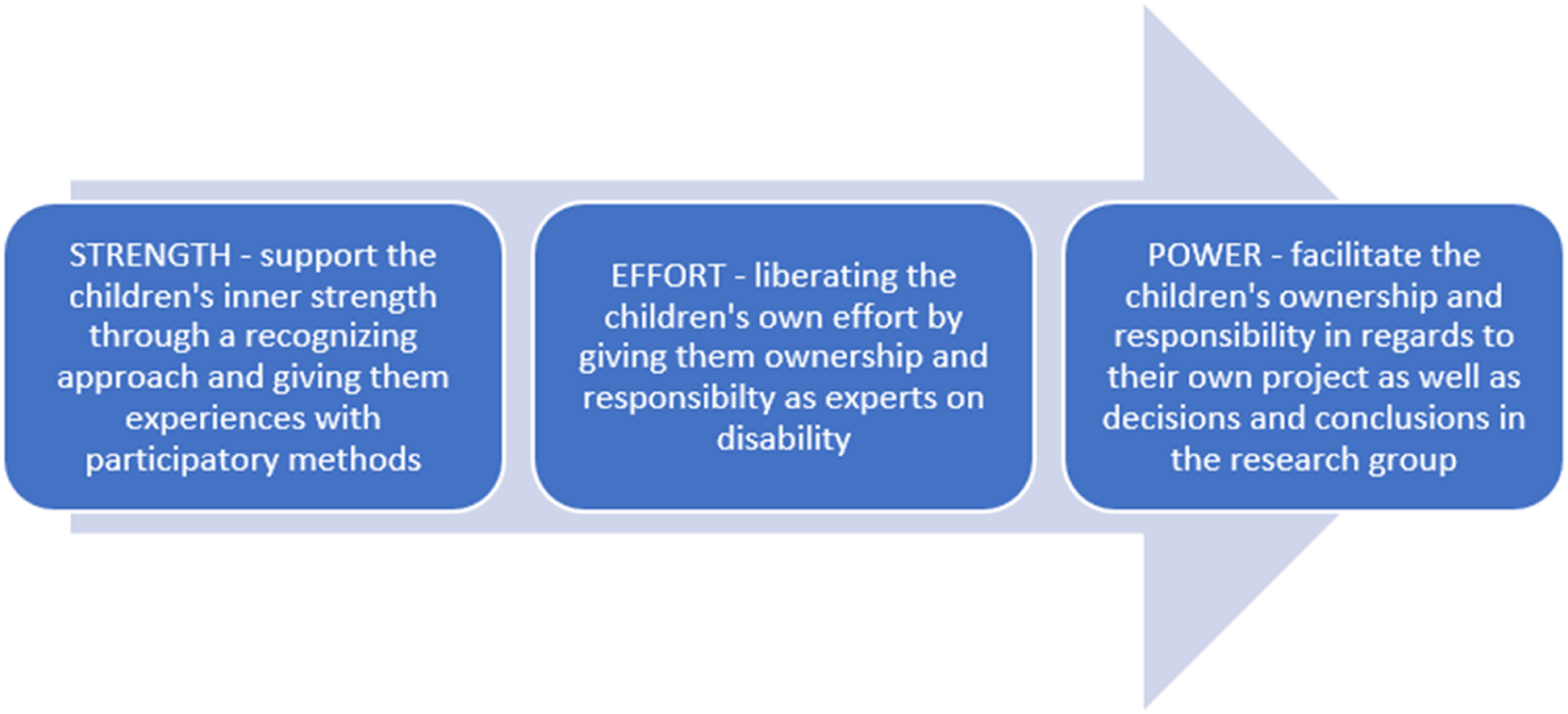
Findings
Children as informants
The participatory methods presented for the children in the first meeting made it possible for the children to present themselves and their personal likes and dislikes. They also had an opportunity to suggest activities for the group, but they were not involved in the final decision-making of planning the meetings. As the target group for the research project was children with impairments, and hence the “admission ticket” to participate in the group meetings, the impairment itself and limitations caused by it dominated in the children’s minds. For instance, during the individual interviews, the children’s suggested themes (supported by their parents) for the group were: feeling tired, having pain, being afraid and feeling different. That is, all the themes were seen as challenges related to the children’s impairments. Furthermore, when the children were asked why they had chosen to participate in the group, all three of them replied that they wanted to meet other disabled children. Freja said: “…it would be nice to meet others who also have an impairment. Because I mostly meet people who aren’t disabled. So, it could be nice to meet someone who was a bit like me in a way, in that way.
When the children were asked what they thought was unjust, they answered for example being excluded from classmates in school because of their disability, not being allowed to be themselves and being afraid. Christian says:” Yeah, so if Julia asks Mary – do you want to come? And then I ask – can I come too? And then they just say no. Then I get a bit annoyed”. Thus, in these initial individual interviews, the children primarily had the role of informant and they spoke mainly about things that were difficult because of their disability, which affected them negatively. That is, the focus was primarily on the children’s disability and how it was manifested in them, affecting their self-esteem, as well as their everyday lives, as a reason for being excluded in school and as something to be treated for.
The three children all participated in the interviews in an open and polite way, were cooperative, listened, answered questions, did what they were asked to and showed interest. Naturally, at this early stage, the children were hesitant at first, waiting for questions and directions on what to do. When they were invited to fill in the Decision-making Pocket Chart, they seemed engaged, and they completed the activity. When asked about ideas for the forthcoming meetings they all became hesitant. With support from their parents and the group leader, ideas and suggestions were considered. Themes and ideas were welcomed, and it was explained that they would be brought into the further planning.
Children as experts and co-producers
When the group first met, the children exchanged experiences about their impairments to each other:
Freja: I have club feet…I wear splints on my legs
Christian: I’ve also used splints
Freja: Okay
Christian:…what kind of splints do you use?
Freja: Well..you can see it a bit here (pulls up her trouser leg a little)
Christian and Nicolai look under the table
The example shows how the group at first could seem like a kind of self-help group, which also was the initial background for the children and their parents to participate, as the individual interviews showed. However, the focus gradually changed during the meetings. Though the children often referred to their own disability when talking about different topics, the centre of their attention moved from only being about themselves and their own personal challenges, to also contain a broader perspective on disabled children’s lives in general. An example of this was seen when conducting the activity Letter Box, an activity the children were engaged in and discussed. Here, the children used examples from their own lives to explain their advice given as the expert panel. Nicolaj had just read a letter about a girl being bullied at school because she is different than the other children. He said: “This is actually... a bit like me…my mom actually says: go away from the person who teases. Some (children at school) bully me just because I speak like this…they say I have a baby voice, that is so annoying…so - just skip it.”
Another example was found during Cinema where the group watched two TV programmes, one concerning children’s rights in general and one about the everyday life of a disabled girl who used a wheelchair:
Group leader: I was thinking, does she have the same rights as the other children?
Nicolaj: perhaps more…For example, having help with most things, that’s a right…
Freja: Well, she also misses out on some rights, that the others have…For instance, she can’t participate at soccer…because she sits in a wheelchair, one can’t do as much as the others
Christian: Only, we saw her playing soccer! So, you can’t just say that she can’t play soccer
Group leader: No, true, so you think that she can participate in her own way?
Christian: Yeah
Findings show that the children gained experiences through the different participatory methods. Through sharing and discussing different themes and dilemmas from their everyday lives, their focus seemed to change from personal experiences to becoming ‘experts on disability’. In that position, they discovered that they as a group could help or give advice to other disabled children with their challenges in everyday life, as experts on child disability.
Characteristically, during the group meetings, the children became more active and curious; they discussed and shared experiences and needs, and formulated suggestions. Through different participatory methods, the children gained experience in exerting their influence in decision-making. In this way, they increasingly took the role as co-producers of the content of the group meetings. This was seen, for example, when the group had a visit from a disabled youth. The children prepared some questions and thus influenced the content of themes the disabled youth should talk about. During the group meetings, the group leaders increasingly consulted the children about their ideas for the content of the research group. This was based on the argument that the children first needed the necessary prerequisites and experiences to eventually exert their influence and have an equal role in decision-making during the different methods and activities. The selection of methods however, had primarily been planned beforehand by the group leaders. Thus, the children did not have any real power in the overall decision-making processes.
Altogether, findings indicate that, through the group process with different participatory methods, the characteristics of the children’s role changed from being informants to acting as experts and co-producers. This also seemed to affect the children’s perceived self-image in the group. While the children sought confirmation and positive feedback in the beginning of the group meetings, this gradually shifted to working with the activities independently and speaking their minds freely. When offered help from the group leaders with, for instance, writing and gluing in their Compass or carrying a bag, the children refused the help and managed the challenges themselves.
Children as decision-makers and explorers
The children were presented with the opportunity of carrying out a small-scale research project under supervision. The methods suggested to them were Mind mapping, Taking videos/photos, Finding music and/or Making drawings, all of which could finally be made into a Digital story. At this point, findings show that the children took the initiative, were eager and responsible and took ownership for the process and results. When they brainstormed on a research topic, they agreed that the research topic should be about Feeling safe, using Mindmapping as a method. Freja explained: “Actually… (pointing to the children’s compasses) we should tell them what we like or something that is important”. They further decided that their research project should target children and adults and/or teachers. At this stage, the children took charge of the research process, showing initiative and leadership. The children also had ideas about how and where to do their research, and they planned and conducted their empirical research themselves, mainly by using their mobile phones. When the children met to share the data, they had collected on the subject, Feeling safe, they were eager to present to each other and seemed proud of their contributions. For example, Freja brought her drawing of her family in a ring binder, showing the importance of her drawing. Another example of the children’s agency was seen when Christian presented his data: Can I have it on full screen? (Christian takes over the computer and presents to the group) This is my family, which I have also drawn in my compass…this is actually how they look in real life…this is X factor (smiling) Friday evening with candy and cosiness!”.
All the contributions were collected, and the children made several suggestions as to the making of the digital story, from which the group leader made a draft. The children then edited the video, which was presented as the children’s digital story, of which they had ownership. Christian concluded: “When I first thought of us doing research, I thought: You research on the internet…that’s what real scientists do. But it was good that we didn’t just sit each of us with our own computer doing research and then handing it over to you (the group leader)”. By saying this, Christian showed that he was happy about these other possible ways of doing research through participatory and creative methods, which the other children confirmed.
Finally, when evaluating the whole process, Christian summed it all up, saying: “We surely are researchers now!” This statement was supported by the other two children, and all three children expressed that it had been fun and exciting to be child researchers.
Another important contribution to the children’s self-image and sense of power, besides the children’s own research project, was unforeseen; it was found in the informal and relaxing activities during the group meetings, such as playing cards or memory games. These activities were often initiated by the children themselves and had no other purpose than the activity itself. Here, the children relaxed more, speaking more freely, laughing, and interacting more with each other as a group. This also affected the children’s participation afterwards. For example, Freja, who most often spoke in a low voice and short sentences during the group meetings, sometimes spoke with a louder voice, being more verbal and initiating more after such an activity. Nicolaj, who in the research period sometimes seemed stressed and unfocused, with outbursts of yelling and talking about things out of context in the group, focused more during the relaxing activity and had fewer “explosions”, during and afterwards. Moreover, the power relationship in the group between adults and children was more aligned during these “un-purposeful” activities. An example of this was observed in the communication during Kim’s Game, where Nicolaj insisted that the adults participate, and the children joked with the group leader:
Nicolaj: we are ready
Group leader: ...no! I can’t remember a thing! (Everyone’s laughing). Can I get a hint?
Freja: it’s in a TV-series
Group leader: ah! Bok bok, Pingu
Freja: So, it doesn’t actually say “bok”, you know (everyone laughs)
Finally, the children themselves planned the content of the last meeting where their parents participated. Thus, the children gradually showed more initiative, ownership, and leadership, not only in regard to the presented participatory methods, but also when it came to the decision-making processes in the research group as a whole. The children’s experiences were elaborated by their parents, who after the research group reported back to the group leader. Nicolaj’s mom said:” Nicolaj has been very happy about participating and has needed someone to identify with, someone who isn’t living the perfect life…in his school there is a concept called bullying. The fastest or the strongest has the right to mock the others and Nicolaj never wins…Nicolaj needed to meet others who have their struggles just as he has his every day. Nicolai has gained more confidence after having participated in the group where he fit in better”. Nicolaj had also said to his mom that he wished he could go to the research group as a sort of weekly club. Freja’s mom also wrote in an e-mail after the group meetings: “Freja wants to show the video (the digital story) to her class and talk about the research - without me!”. Meanwhile, Freja’s mother expressed a possible dilemma regarding the balance between involvement and protection when creating awareness of being a disabled child. After a visit to the group by a disabled youth, the group had talked about potential vulnerable existential issues, and she reflected: “I think that it can be tough to hear him telling others…how rough his whole life has been (e.g. being bullied) and still is (e.g. having a lot of pain)…I mean, he says many good things, it isn’t that, but you might go home with a lot of thoughts.” Even though the group always began a meeting with talking about the previous meeting, this dilemma was discussed on the last meeting with the parents where the child psychologist suggested talking about it at home or together with her.
Discussion
The purpose of this study was to explore how participatory methods in a research project with disabled children may contribute to an empowerment process. In answering the research question, a research study was introduced, where three disabled children participated in a group using participatory methods over time.
The findings show that the children’s focus and self-image gradually shifted from being a child with an impairment, to being an expert on children and disability, and finally a decision-maker and an explorer, trying out their own research project. At the end of the study, the children showed initiative, independence, commitment, confidence, and joyfulness about being “child researchers”, which was supported by statements from their parents and not least the children themselves. Following Askheim’s three-stage empowerment process: strength – effort – power, the children’s presumed vulnerability, i.e., their disability, was turned into a strength that they could gain confidence from and build upon and become co-producers, decision-makers and explorers of both the content and the process of the research study.
During the process, the children became more familiar with the meaning of having the right to speak their minds, as stated in the UNCRC article 12. A main conclusion of the study is that participatory methods can be effective tools in an empowerment process, stimulating the children’s initiative, agency and self-confidence. A precondition for the success of the empowerment process is that the methods chosen gradually transfer initiative and responsibility from the group leaders to the children. Here, Shier’s model for participation works as a useful framework, but the process still presupposes sensitivity and consciousness of the group leaders. This is important when it comes to balancing protection of the children, as stated in the UNCRC article 3, with providing opportunities. The research study, therefore, calls for attention and sensitivity as to the selection of methods and degree of participation. Thus, when taking these considerations into account, involvement in participatory research may be beneficial for children. Nevertheless, the findings also indicate potential dilemmas regarding children’s participation and the best interest of the child when it comes to creating awareness of one’s own situation as a disabled child. Several studies conclude that disabled children in general struggle with isolation and low self-esteem (Bengtsson et al., 2011; Connors and Stalker, 2002; Grue, 2011; Kembhavi and Wirz, 2009; Tetzchner et al., 2008; Ytterhus et al., 2015). In the field of research, this argues for greater involvement, leading to a sense of empowerment and agency, as seen in the research study. On the other hand, child research should not be implemented as the new agenda without having negotiated expectations together with the child and parents, which is shown in the statement from Freja’s mother. Protection and influence can also be discussed when it comes to the motivation of the parents and the children. Where the parents, as gatekeepers, primarily saw the group meetings as a place for addressing specific problems and being able to reflect oneself in the other children, the children themselves were more motived by being experts and explorers. These different perspectives between child and parents are perhaps general but even more clear when it comes to disabled children and their families, as seen in other studies such as the study by Bengtsson et al. (2011). In the present study however, these different perspectives did not seem to affect the children’s participation and empowerment process, perhaps because the parents were not a part of the group.
A factor that might have inhibited the children’s empowerment process could be found in their impairments. For instance, 1 day Freja was very quiet until she explained that she was in pain and needed a break in the hall where her mother was. After 15 min, she came back to the group, was happy and participated. Another inhibitive factor was seen 1 day when Nicolaj was very upset and needed to lie in a sofa in the room several times for a time out. It turned out that his rabbit had died the same day, and when the group talked about it, he gradually calmed down and joined the group activities again. The episodes illustrate that the children’s situation might have influence on their motivation and participation in the project and that the group leaders have an important responsibility to be aware of this. Hence, the use of participatory methods as empowering tools cannot be isolated from the context in which they take place. Firstly, this study suggests an acknowledging approach. Secondly, it suggests that participatory methods over time could contribute to enhancing an empowering research process.
The findings of this study indicate that the participating children were active and engaged in creative and participatory methods over time. In addition, initiative and expressing one’s own opinion seemed to increase gradually, ending with the children’s own research project. Nevertheless, the question of what contributed to this process should be asked. Besides the group leader’s consideration of an appreciative approach, choice of methods and planning the order in which they were presented to the children, time itself may also be an important factor. The fact that the group meetings took place over a year’s time most likely also contributed to establishing a “safe space” in the group, building on the relationship between children and adults. In the previous study (Andersen et al., 2019), the disabled children stated that the conditions for expressing one’s own opinion were: feeling safe, believing in oneself, and being supported by the environment. Time and an appreciative approach may have been prerequisites for an empowerment process for the disabled children. However, the participatory methods also play a role, regarding the content of each method as well as when it was introduced. For example, the children’s attempt to develop their own research project would most likely not have progressed in the same way and had the same output if it had been introduced at the first meeting. This indicates that the time dimension is a factor to be aware of if participatory methods are to succeed as tools in the empowerment process.
Finally, even though the study was intended to be empowering, the roles of the group leaders and the interaction between them and the children calls for some critical thoughts. Since the group leaders made the overall planning of the meetings and activities and methods used, it can be questioned how much choice the children in fact did have, for instance on deciding to make their own research project. The study could perhaps be a first attempt on training and stimulating disabled children in research involvement. If the group had continued, the children’s achieved experiences and knowledge could create a new three-staged empowerment process where the power and agency of the children could be elaborated even more through the whole research process.
Limitations
The present study is limited to three participants and cannot be generalized. It can be questioned which backgrounds the children had, considering who choose to participate in a research project. Recruiting participants was challenging because of the busy everyday lives of the families which are filled up with treatment, besides school and leisure time. It may well be that the participating children and their families might not be representative for many other disabled children and their families. Another limitation could be the inclusion criteria of the study which make demands on verbal communication and being able to speak for oneself. However, other research studies support the conclusions concerning disabled children who want to have influence on and participate in decisions and, that participatory methods can be empowering, used properly. In that way, this article may be useful to research made with other groups of disabled children.
Concluding remarks
The main finding of this study is that appropriate use of participatory methods and activities over time may contribute to an empowerment process with disabled children. Choice of methods was based on Shiers model of participation and refers to a gradual transfer of initiative and responsibility to the participating children. Askheim’s three-stage empowerment process: strength – effort – power was used in identifying the process by which the children gradually increased their self-confidence and agency. The study shows what great potential that lies when it comes to involving disabled children in research. Disabled children, as well as children in general, overall want to be involved, have valuable perspectives and insights that could beneficially participate through the whole research process from formulating research questions to communicating the conclusions. Here, child friendly participatory and creative methods over time may be a useful way of practicing ethical empowering research. The process illuminated in this study, however, also recognizes both ethical dilemmas and other factors that call for sensitivity and awareness regarding involving disabled children in participatory research. Further discussion on protection versus involvement is therefore important when it comes to empowering research with disabled children.
Footnotes
Declaration of conflicting interests
The author(s) declared no potential conflicts of interest with respect to the research, authorship, and/or publication of this article.
Funding
The author(s) received no financial support for the research, authorship, and/or publication of this article.
