



Abstract
This article explores a child-led project of building a treehouse through the theory of practice architectures. It draws on video data collected by 13 children wearing microcameras (GoPro) in a multicultural Australian primary school. The data was co-analysed with the children. The article illuminates how play practices emerge, diffuse, persist and/or disappear with time. This knowledge is needed to understand the different facets of free play and build enabling conditions for its unfolding.
Introduction
An 8-year-old girl has taken a key from a secret spot. She opens a little pink, suitcase-shaped box, pulls out a piece of paper and starts calling out names. Her peers answer. After the child has gone through the list of names, the children discuss who is not there and if they have justified reasons to be absent. They agree that Tuesdays and Thursdays are their ‘days off’ and today is not one of those days. After the roll has been called, the group starts negotiating what to do. An hour-long work shift at their playground building site is about to start.
This 8-year-old girl is a participant in our Finnish-Australian study entitled Educational Success through the Eyes of a Refugee Child. The study was part of a larger research program focussing on the school experiences of refugee background children and youth (Kaukko and Wilkinson, 2018, 2020). As part of this program, our previous work has examined how practices of learning intersected with and were prefigured by children’s experiences of being a refugee. This paper takes a different direction, examining how children’s imaginary, free play can be analysed as a set of interlinked and changing practices. The aim of the study presented here is to analyse the lifespan of a particular project of play: how it emerged, persisted and in the end disappeared in collaborative, child-led play practices of a group of primary school children in Australia.
Research on children’s play is well-established (see, for example Patte and Sutterby, 2016) and its importance in children’s lives is rarely challenged (Alanen, 2014). There is also no shortage of research on the play of children who are in a vulnerable position. However existing research on marginalised children, for example those from migrant or refugee backgrounds, living in poverty, or who have different disabilities, tends to focus on the exceptional nature of play: how the player’s position shapes play (Macmillan et al., 2015), how play needs facilitating (Stagnitti, 2021), or how play heals (Chapman, 2005). Our approach is different. We look at play as a set of ordinary, mundane practices, deliberately aiming to redirect the gaze of our inquiry away from the social categories the children belong to. This is tricky, as play never exists in a vacuum. Play as a practice cannot be fully separated from arrangements that are made by adults, including permitted times for play, available resources and the design of the play spaces, or from who the players are, including their individual and social identities. In this article, we acknowledge this but choose to put our analytical focus on social practices that comprise play.
Shifting the focus away from the player’s social categories, such as the migration or refugee status of the children in our research, does not mean we wish to undermine or silence the differences that have real impact on children’s lives. The opposite is true: We think rendering differences visible is needed to address disadvantages caused by those differences, and we write about this elsewhere (Wilkinson and Kaukko, 2020). However, play seems to be a practice where some of these differences silence themselves, yet not all. Relations of power shape play, as our findings show, but play can also unite across differences.
This article draws on data collected by 13 students in an Australian primary school with a highly multicultural student cohort 1 . The students acted as voluntary ‘Play Agents’, wearing GoPro-cameras to document and analyse their school lives with us. Play was an important part of the school’s mission, so the Play Agents’ investigations served both research and practice. In this paper, we take a closer look at one multi-day play project in which a group of children built a play site which they called ‘Treehouse’. This project was chosen for two reasons. Firstly, the Treehouse was often mentioned in the participatory analysis phase with the Play Agents, indicating it was important to the children. Secondly, analysing the Treehouse enables us to see the lifespan of play practices: how they emerge, diffuse, persist and/or disappear with time. Before we take the reader to the Treehouse, we provide a short literature review on childhood research on play, and how it has been explored.
Research on play
The crucial importance of play for children’s lives, including their wellbeing, development and learning is rarely questioned. Article 31 of The United Nations Convention on the Rights of the Child (UN General Assembly, 1989) states that ‘[e]very child has the right to rest and leisure, to engage in play and recreational activities appropriate to the age of the child’. In childhood studies, research on play has been informed by multiple disciplines including psychology, sociology, philosophy, anthropology and education, all attempting to understand children’s dynamic playful activity from their particular points of view (Potter and Cowan, 2020). These studies have not come to an agreement about how play should be defined, but it is mostly agreed that play is multidimensional and has varying meanings across time, cultures, and contexts (Cohen, 2019), and all attempts to define it are tightly interwoven with changing theories of childhood (Cowan, 2020). Some say play should not be defined at all, because there is a risk that play becomes instrumentalised, colonised, or perhaps most often pedagogised, as shown in the oft-repeated perspective of ‘learning through play’ (Potter and Cowan, 2020; Cowan, 2020). When the focus is on marginalised children – for example children with refugee or minority ethnic backgrounds, with disabilities or from socio-economically disadvantaged families – attention is often given to the healing power of their play (Milteer and Ginsburg, 2012; Macmillan et al., 2015). This kind of progress rhetoric (Sutton-Smith, 1997) privileges some adults-approved forms of play and justifies play with specific aims in mind, but it rarely attempts to understand how the players themselves see or interpret their play (Cowan, 2020). Regardless of the viewpoint, play has received burgeoning academic interest in childhood studies (e.g. Alanen, 1988, 2014; Charles and Bellinson, 2019; James and Prout, 2015); in all of which play is positioned as a key feature of children’s lives and indeed, as a forgotten right (Cowan, 2020) worthy of more attention.
The fieldwork school staff shared our interest in understanding and documenting play as it happens, but we were all conscious that free play is exclusive in nature and thus hard to research. Perhaps the most significant methodological challenge is that any uninvited adult interference most likely disrupts or at least changes play. Long term ethnographic observations or participatory methods with familiar child-groups might minimise the disturbance (e.g. Fichtner and Trần, 2020; Lehto and Eskelinen, 2020; Yates and Oates, 2019), but these methods too have a significant epistemological problem: play is hard to understand from the ‘outside’, and if explored from the ‘inside’, the exploration itself may limit the extent to which the play continues to be ‘free’.
We do not claim that we can fully overcome these challenges, but we propose a theory-method combination that might come close to capturing play practices in real time from the point of view of the child. In this case, theories of practice are helpful.
Understanding play as a practice
It would be contradictory to the aim of this paper to put forward yet another adult-invented definition of play. We want to understand play as a practice, appreciating its fluidity and complexity without essentialising or reducing it to a fixed definition. However, we need to clarify what we mean by practices. The research presented in this paper is framed within theories of practice, specifically the theory of practice architectures (Kemmis and Grootenboer, 2008). Following Kemmis et al. (2014) and Schatzki (2010), we see a practice as A socially established cooperative human activity in which characteristic arrangements of actions and activities (doing) are comprehensible in terms of arrangements of relevant ideas in characteristic discourses (sayings), and when the people and objects involved are distributed in characteristic arrangements of relationships (relatings), and when this complex of sayings, doings and relatings ‘hangs together’ in a distinctive human social project (Kemmis et al., 2014: 13).
It may seem self-evident that practices always happen somewhere, at some time, but this notion highlights how and why practices occur as they do and how they relate to other practices also present in the sites. If we consider the practices comprising the building of the Treehouse, they transpire in a child-led, jointly built and managed part of the playground. This site is intrinsically part of the children’s play practices, and vice versa; they are interdependent. We may at first simply see a group of children immersed in the physical activities of building a treehouse: dragging branches, fixing chairs or arranging things in a seemingly disjointed manner. However, when considering the building of the Treehouse as the (shared) project of their practice we can analyse these practices more carefully to see that the speaking, acting and relating of each child in the group is oriented so that the project proceeds in at least partially mutually agreed directions. This differs from parallel play-situations where children happen to play in the same area, each doing their ‘own thing’. Finally, it is important to note that not everything is possible, even in imaginary play. Children’s play practices are enabled and constrained by cultural-discursive, material-economic and social-political arrangements that form historically constituted conditions for their enactment (Kemmis and Grootenboer, 2008; Kemmis et al., 2014). Analysing these arrangements requires that we pay attention to the tacit knowledge and shared language needed for play, the physical spaces and available materials used or created for play, as well as the less obvious rules, hierarchies and relations of power solidarity and belonging, within the group and more formally at the school level.
The project of the practice cannot be fully gleaned from mere verbal responses or observations. In play, the things taken for granted vary, because they may be imagined. This makes play an interesting yet challenging practice to analyse. Theories of practice typically explore more or less ‘real’ practices, and in particular, practices that have a logic and some kind of routine or reproduction (Shove et al., 2012). Except for Nick Hopwood’s (2017) research on simulation practices of higher education, practices of innovation or imagination are rarely touched on (Nicolini, 2017). Free play does not always have a clear logic, routine, or reproduction, and if it does, these are rarely easily understandable from the outside. Play consists of practices being imagined, practices being simulated, and practices of simulating, often all at once. Role playing, turning material into new objects, taking on the role of others, and relating in ways that uphold the play are examples of play practices that combine all these aspects at the same time (Hopwood, 2017). Moreover, in the unfolding of play, what happens for the participants opens new possibilities for interpretation, imagination, and narration; new directions for unfolding. The real and imaginary dimensions of play are constantly negotiated and renegotiated. It is this negotiation and the constant flux of play that calls for attention to the way the practices change (Shove et al., 2012).
The imaginary and exclusive nature of play makes it hard to understand as a whole and perhaps impossible to define. However, elements of play can be comprehensible from the outside. Helle Skovbjerk Karoff (2013) writes about the ‘commonness’ in play practices and how these practices consists of the ‘doing part of the playing activity, i.e., all types of behaviours, such as physical and mental activities, the use of objects, toys, ways of relating to feelings and motives for behaviour’ (Karoff, 2013: 78–79). Our focus is on how parts of play can change whilst the overall project stays the same. As we show in our analysis, play changes when new elements of practice are introduced, when existing elements are combined in new ways, or when elements disappear from practices. The meaning, materiality, and competence of practice (Shove et al., 2012) are generated and changed through moments of enactment. In children’s play, the meaning is revealed in the children’s words and actions, and it differs depending on what the project requires at any given moment. The meanings may change if the practice faces contradiction, or it can be affirmed by other practices that join it. Material objects link the play practices with the arrangements that support them, like the deliberate design of the playground with trees and bushes which children can freely play in and utilise for their play. The competence of the practitioners means that there is a certain level of predictability in play, that is the children know what to do. The elements of meaning, materiality and competence unfold in differing combinations of several practices. They might travel from one play practice to another if they still connect up in the minds of the practitioners. When the connections between practices are durable in a specific project, like the Treehouse that is the focus of study here, then the project survives in a recognisable form. (Shove et al., 2012) In play, as in all practices, the sayings, doings and relatings that compose the practice are reproduced, sometimes with little and sometimes with much variation, and sometimes they transform into new or emergent practices (Kemmis, 2021).
Method
This study is part of the first author’s Finnish-Australian postdoctoral research project entitled Educational Success through the Eyes of a Refugee Child. As part of this study, 13 children (aged 6–10, seven girls and six boys) were recruited from one of the participating Australian primary schools to act as ‘Play Agents’, helping us understand their play. Unlike in the larger study, the invitation was not limited to refugee students. Yet due to the school’s highly multicultural student cohort, all the Play Agents are from different migrant or refugee backgrounds. The focus on play was justified because a finding from the larger study indicated its crucial importance, and because play was part of the school’s motto and pedagogy.
Working with children and video data poses complex ethical challenges. The idea of documenting children’s play was developed with the teachers and the leadership of the school and negotiated with the parent community. Its implementation was designed to pay special attention to relational ethics with children in vulnerable situations (Kaukko, et al., 2017) and methodological challenges related to privacy when using video data in schools (Royakkers et al., 2018). The research plan was scrutinised and finally approved by the ethics boards of Monash University and the local department of education 2 . Informed consent was sought from the participants’ parents or guardians. Even more importantly, the participating children’s understanding and assent was reconfirmed continuously by discussing the study and the children’s role in it. It was highlighted that the children could discontinue their participation at any time without negative consequences, but none did so.
Prior to the filming, the first author had spent approximately 2 months at the school, getting to know the school and its students and staff and conducting praxiographic (Schmidt, 2017) observations. Like ethnography, praxiography aims at deconstructing and describing (graphy) the world. However, rather than looking at culture (ethno), the focus is on practices (praxeo), which are documented through a sequentially structured and more or less systematic manner as seen through a particular kind of frame – in this case the theory of practice architectures. The first author’s observation continued throughout the filming.
The video data was collected by the Play Agents who wore chest-mounted microcameras (GoPro) for approximately 90 min per day. Taking turns with the five available cameras, each Play Agent had a chance to film over the course of at least 5 days. The total period of filming was 3 weeks. As the children returned their cameras each day, either the researcher or a designated teacher asked them to discuss what they had done during the filming period, and if they would like to analyse some parts together with the researcher. This selection was the first step of the participatory analysis with the children. After the fieldwork, the first author skimmed and edited the audio-visual material, constructing a synoptic timeline and separating the moments mentioned by the students. The two Play Agents whose footage we use in this article, Leila and Mandi 3 , repeatedly mentioned the Treehouse in the participatory analysis, which directed our focus for this paper.
The video clips relating specifically to the Treehouse were then analysed in two further stages. Firstly, the first author watched the identified moments with Leila and Mandi individually, whilst the children elaborated on what had happened and why they chose those moments in the initial participatory analysis. The voices of Leila and Mandi were crucial in shedding light on the practices whose importance might have been left in the shadows when observed from the outside. Next, the three authors of this paper deconstructed the practices by looking carefully at all the evidence together: the video clips and their transcriptions, the transcribed analysis dialogues with Leila and Mandi, and the fieldnotes written by the first author. We then analysed them through the lens of the theory of practice architectures. In the end, we examined the continuum of these practices throughout the lifespan of the Treehouse project.
Leila and Mandi, together with a group of other children, were engaged in the Treehouse throughout the whole fieldwork period. The actual playing consisted of building, expanding, and using a specific area in the playground of their school. The duration of the project provided us with a sequence of events to analyse but given the notion of how practices ‘flow’, we know that all attempts to divide the play in any particular way are partial. Thus, we do not argue that the chosen episodes were representative of how play starts and ends, as time in play is fluid and rhizomatic. Yet we have chosen three episodes from the Treehouse to illustrate our findings, as they show how some practices within this project were started, maintained, ended and then picked up again, and how they sometimes supported and other times challenged one another.
Start: Roll call and the password rock
The first chosen episode elaborates on the description of the ‘roll call’ which commences this paper. Five children are gathered at their Treehouse site, located in an area in the playground of their school. Scraps of building materials and random objects are arranged into beds, seats, tables to simulate furniture needed in personal and communal spaces. The episode takes place during lunch time. Leila excitedly requests Mandi to do the roll call. Mandi opens a pink box (see Image 1) and takes out a piece of paper. She starts calling out student names. Children respond ‘here’ when called. When one child doesn’t answer, Mandi calls the name more loudly. When all the names are called, Mandi returns the list to the box. After the roll, Mandi takes out another object from the box, a beautifully coloured rock. Mandi explains to the others that the rock she is holding is a password, but the others seem unconvinced. ‘Well, you can’t read it’, they say, and Mandi gives up the attempt, admitting that it is ‘just a rock, painted’.
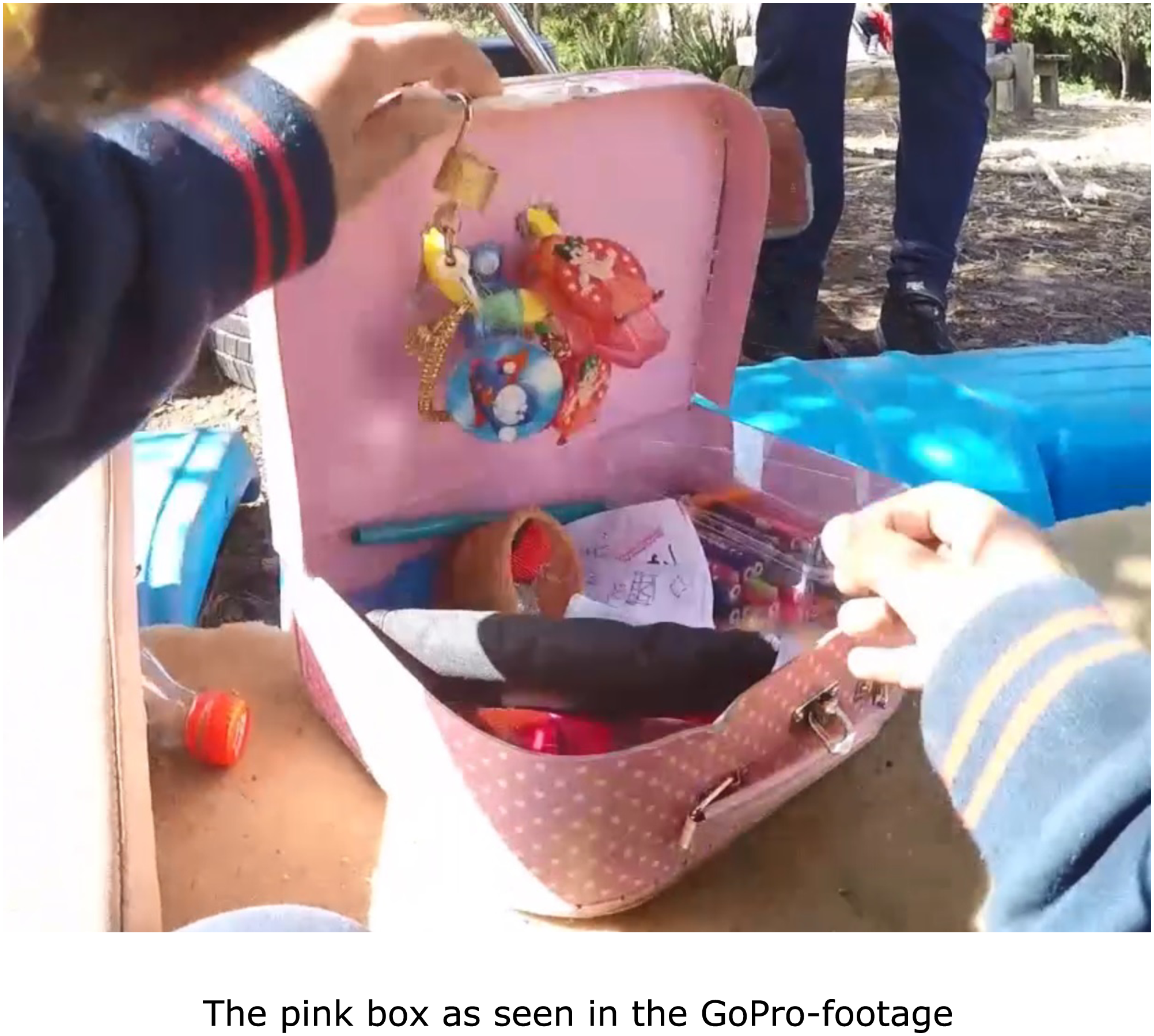
The roll call was repeated every time the children were playing in this area. Its purpose was to mark the commencement or reconvening of the play and control who belongs to the Treehouse. When observing or reading an episode like this, it is hard to avoid focussing merely on Leila, Mandi or the other players as individual children, or the sequence of events that is unfolding. Yet, shifting attention to the practices of this scene, we can identify routine practices (e.g. roll call) that need little negotiation, but also practices of imagination and innovation (the rock as a password) that need to be made understandable and meaningful for others. Zooming closer into these practices, we can hear sayings such as ‘What about [name], he’s playing?’ ‘Yeah, he’s in the roll’. ‘Where?’ ‘Right here’ and ‘This is a password’. We can also see concomitant doings such as children sitting on a mat as they listen or respond to the roll call or pointing at other children. The shared intention of the first practice of roll calling is to ensure common rules that all can play with.
One cultural-discursive arrangement enabling the unfolding of these practices is the English language, which is commonly understood yet not the first language for any of the players. Non-verbal means of communicating such as body language (e.g. hands waving to get attention) reinforce the sayings. Some relevant equipment for this episode is kept in the pink box, which forms a central material-economic arrangement for the doings. The players explore and discuss the contents of the box and the properties of those objects (‘not squishy, just foamy’). They imagine and assign certain functions to objects, and negotiate ownership (‘who did that, can I have that?’). All these practices centre around the box. It gives continuity to the play; when it recommences, the box prefigures what will happen (calling the roll, supported by the list of names), yet it does not predetermine practices. For example the password rock will still be in the box, but its meaning was not convincing, so its function as a password is not likely to survive. The practice connected to the password disappears and the object returns to being ‘just a rock, painted’.
To understand the relatings of this episode, we must turn to participatory analysis with the children. Relatings are hard to render visible but crucial in understanding practices. Rules, if understood as ‘explicit formulations, principles, precepts and instructions that enjoin, direct or remonstrate people to perform specific actions’ (Schatzki, 2010: 79) form part of these relatings and ensure that the Treehouse stays as a united project of a practice, carried by committed and competent practitioners. This is explained by Leila in the transcribed videoclip below. Leila: If you wanted, if you want to have a treehouse and you’re going to play here every day you should have a roll of your- Child: Why? Leila: That you know who’s not playing today.
In the participatory analysis discussion focussing on the roll call episode, Leila recounts that the children on the list have shown commitment to the practice and when it is not a day off, they are expected to participate. For example the caller of the role mimics a teacher’s positional authority in relation to the students who dutifully answer their names. Later in this episode, Leila secures the key to the pink box in her own pocket and explains that it was the only safe place where the children who were not part of this play would not find it. The relatings bundle together with the sayings (discussion about fair play) and doings (acts of monitoring, keeping the key) of the episode and become intelligible within the pre-existing set of social-political arrangements of fair play. Hiding the key or monitoring play includes the use of power, that is acting with effect (Watson, 2017), yet power seems not to be the aim but a means to keep the play going.
Many practice theorists have a posthumanist lens (Gherardi, 2017; Nicolini, 2017; Shove et al., 2012), seeing humans as ‘carriers’ of practice, but even these approaches do not overlook the role of the human. Carrying the practice of play is not an automatic or a mindless process but a joint effort requiring constant active choices from all practitioners. Kemmis and colleagues (e.g. Kemmis et al., 2014; Kaukko et al., 2021) take a more humanist view on practices, whilst still having a strong focus on the relationship between humans and the living and nonliving world that shape practices. No social practices exist without humans who engage in them. Mandi and Leila have agency, and their play practices arise from, recall, represent, anticipate, and return to their use (Kemmis and Edwards-Groves, 2018: 119) in play. The Treehouse as a site evokes a powerful practice memory: one that constitutes the Treehouse as an object of and for play. Children engaged in the Treehouse do the things and speak the language that are characteristic and supportive of this project. They also enter relationship building, drawing on the memory provided by the practice traditions of the Treehouse. (Kemmis et al., 2014; Nicolini, 2017). Children’s previously learnt practices connected to compromising, arguing and working together are seen in all the three episodes; they are practices that have kept the children’s shared play alive. This is how play leaves behind traces that in turn become part of the practice architectures of future play.
Middle: Imagining objects for different purposes
The next episode follows from one of the roll calls. We have chosen this episode to show how a project of a practice is negotiated and developed, and how imagination takes hold and makes this negotiation trickier. Leila tries to sit on a seat constructed from tyres and cushions. Mandi asks her not to sit on it, claiming the structure as her own and sits on it herself. A negotiation between them and another girl ensues, related to the ownership and the function of the object. Child: ‘isn’t the cushion part of Mandi’s sleeping? Leila: ‘yeah, but now it’s for my seat’ The conflict is left unresolved, resulting in a situation where the play cannot go on, as the players disagree on this central element. Mandi’s attention and camera are turned to children doing something else in the distance. Mandi gets off. Leila sits on the freed object to claim it. She stands again when Mandi notices that and says ‘no’, but then Leila adjusts the seat with her hands and sits on it again. A compromise is offered when Leila says that Mandi can sit on it afterwards. This gives Leila the opportunity to claim the seat for the present moment. After the disagreement, Leila draws attention to how cold she feels. Leila shivers, and we see a breeze in the video. This change leads to the birth of a new idea: building a tent from a blanket. The girls discuss how to build it, strengthening the others’ ideas by saying things like ‘that’s a great idea Mandi!’, while adjusting their plans according to perceived school rules (‘can’t take scissors, let’s use rocks then’). The tent idea becomes absorbed into the overall Treehouse project. The discussion is then turned to what other objects in the site are or could be.
As the play gets more imaginative, it also becomes more vulnerable to disagreements about the imagined reality. This can be seen in both the sayings and doings of the second episode, which comprise an interesting mix of simulating something, and adjusting one’s own simulations with those of others. Mandi: Hey … this can be, look this can be a little swing, if we tie it more. Leila: No, no it’s a cape. Mandi:… this can be something to sit on. Leila: Yeah another person can sit there and this can be my seat. Mandi: Yeah Child: Thanks but then I, I have no seat. Mandi: No wait, I’m the boss of it, because I made it. Leila: But can I, I’ll tell you the password for the seat, okay? Child: Okay
In this short discussion, the sayings travel from reality (swing, which is the more obvious interpretation of the hanging object) to imagined (cape). This discussion also addresses a practical issue that the player has no seat, but it then returns to the pre-existing role play (‘I’m the boss... I’ll tell you the password’). The practices are like those in the vignette, when Leila’s doing (sitting on the imagined seat) contradicts with the attempted pretend-sleeping of Mandi’s, using the same object. Contradictions can also be heard in the sayings (‘Isn’t this cushion for … sleeping?’ ‘Yeah, yeah but now it’s for my feet’ ‘No it’s not’). In both examples, the meaning of imagined practices and the power to decide are negotiated. Both situations end with a compromise, allowing the project of a practice to continue in a slightly changed manner.
This kind of play mixes reality with fantasy and is enabled by the cultural-discursive arrangements that are natural for many children: that imaginary play is taken seriously and valued. The material-economic arrangements include objects such as pieces of random scrap material, which the school had sourced as a resource for children’s play. Importantly, these objects are not readily something (like toys), but their usefulness must be imagined. Relatings are shown in the distraction from the argument as an opportunity to claim the seat in a compromise between Mandi and Leila. These relatings are enabled by the previously mentioned social-political arrangements of fair play. Fair play was on the one hand a school policy, but on the other, a necessity to keep the play alive.
In this episode, some of the individual practices contradict one another, but the children find a way to change those whilst keeping the play alive. New elements are integrated as the children adjust their practice to the limits of reality (‘can’t cut holes in the blanket’, ‘let’s use rocks then’) making use of the available resources. The simultaneous emergence of competing practices is possible because unlike in the first episode, the play at this stage has no firm function and the practices are flexible enough so that children can be convinced to play along. (Shove et al., 2012). The children try to recruit others to their play ideas by narrating their doings and simulating the use of objects with exaggerated moves. The narrative that holds the practice together is fluid and emergent, participatory and collaborative, partly reproducing whilst also reproducing variations on prior themes. The outcome, that is the shared understanding of what was going on, prefigures which practices survive and which disappear. When the children explain their play practices to one another, they make it comprehensible from the outside. In the little discussion below, Mandi explains an object to the researcher: Mandi: Mervi, wait, we have to show the thingy. You can sit down here. Researcher: Is that a, a-? Mandi: It’s a chair Researcher: It’s a chair, of course it is. Is it for me? Okay, can I try? (sits)
Having access to the child’s interpretation is needed to understand realities that only exist in their imagination but can be made accessible for researchers. Understanding imaginary sides of practices with this level of detail would have been significantly harder using other research tools than video and participatory analysis.
End: Competing invitations to dance, carry on, or have a day off
The last chosen episode flows on from the previous two sequences. It shows that playing rarely has a clear beginning or an end; it may slow down and then pick up again, still retaining the same project of a practice. Also, this play project has multiple endings, from which the next opportunity to continue the play could then pick up. Some temporary ends are marked by a school bell, others by a decision to do something else, as in the episode explained below. Leila talks to another player and invites her to play ‘funny dances’ for the camera. Leila invites others from the Treehouse to also dance for the camera. Not paying attention or being unaware of Leila’s practices, Mandi asks some players if they want a day off from the Treehouse. Some say yes and start getting ready to move to other activities. One girl misses or ignores the offer of a day off. She continues her simulated Treehouse play. The situation pauses for a few seconds. Realising there was not a unanimous decision of what the group will do, Mandi asks if they want to play Tiggy in another part of the playground. Several kids, including Leila, agree. Mandi locks the pink box, re-affirming to the remaining kids that Tuesdays and Thursdays are days off, connecting the Tiggy-idea with her original suggestion of a day off. The children then run off.
In this short episode, we can see a series of competing practices. There is a situation with three possible directions to continue, each requiring a change of action from the practitioners. These competing practices show in these sayings: Mandi: Okay let’s – guys do – who wants to have a day off? Child 1: Me. Child 2: Why? Child 1: But, but (name) isn’t here because…. Leila: … Who wants to do a dance for that camera? Child 1: ….and you have to … and you have to, you two have to build (name) a home and I’m living with her so you’d better build it big. Leila: Guys, do you want to play together on the green playground? Child 2: Yeah Child 3: Yeah Child 4: No, that’s why only the people who still have a house will come. Mandi: Yeah. Leila: Last one there’s it!
The group could accept Mandi’s offer of a day off, start dancing for Leila, or join the third girl’s continuing Treehouse play. If the Treehouse as a joint project is to survive, its practices need to recruit and retain children willing and able to keep it alive. The continuation of the project depends on whether the relationships between its practices are collaborative or competitive and weak or strong. In this case, the project comes to a confluence of distractions and invitations that are stronger than the shared will to keep the project going, which means that some of the practices disappear.
When analysing the episode just before the project ends, we can see that the sayings meet resistance and when they do, they are amplified with loud, excited voices and body language of large gestures, such as waving hands. Some of the doings accompanying the sayings seem to take root and diffuse; for a whilst, Mandi’s dance moves are matched by another child. When the practices of dancing, having a day off, or continuing the Treehouse play clash, a decision needs to be made about which direction to continue. Looking at the relatings of this episode reveals that although Leila and Mandi are both prominent and authoritative figures in this play, their practices are not automatically accepted as the norm.
When the project comes to a temporary close, its practices change or disappear. Previously connected practices disintegrate when links are no longer sustained (Shove et al., 2012). Likewise, some of the arrangements that have held them in place change. Cultural-discursive arrangements change as language gets first more assertive and then submissive, accepting the new ideas that are proposed. Social-political arrangements change along with whose ideas are accepted. The pink box, familiar from the first episode, remains as a crucial material-economic arrangement for this closing episode. Mandi secures the key into the box, closes the lid and affirms: ‘Tuesdays and Thursdays are days off. Definitely’. The box will remain ready to be picked up again for the next play shift at the Treehouse.
Concluding discussion
Key concepts associated with the theory of practice architectures and how they relate to play. (Kemmis et al., 2014; Mahon et al., 2018).
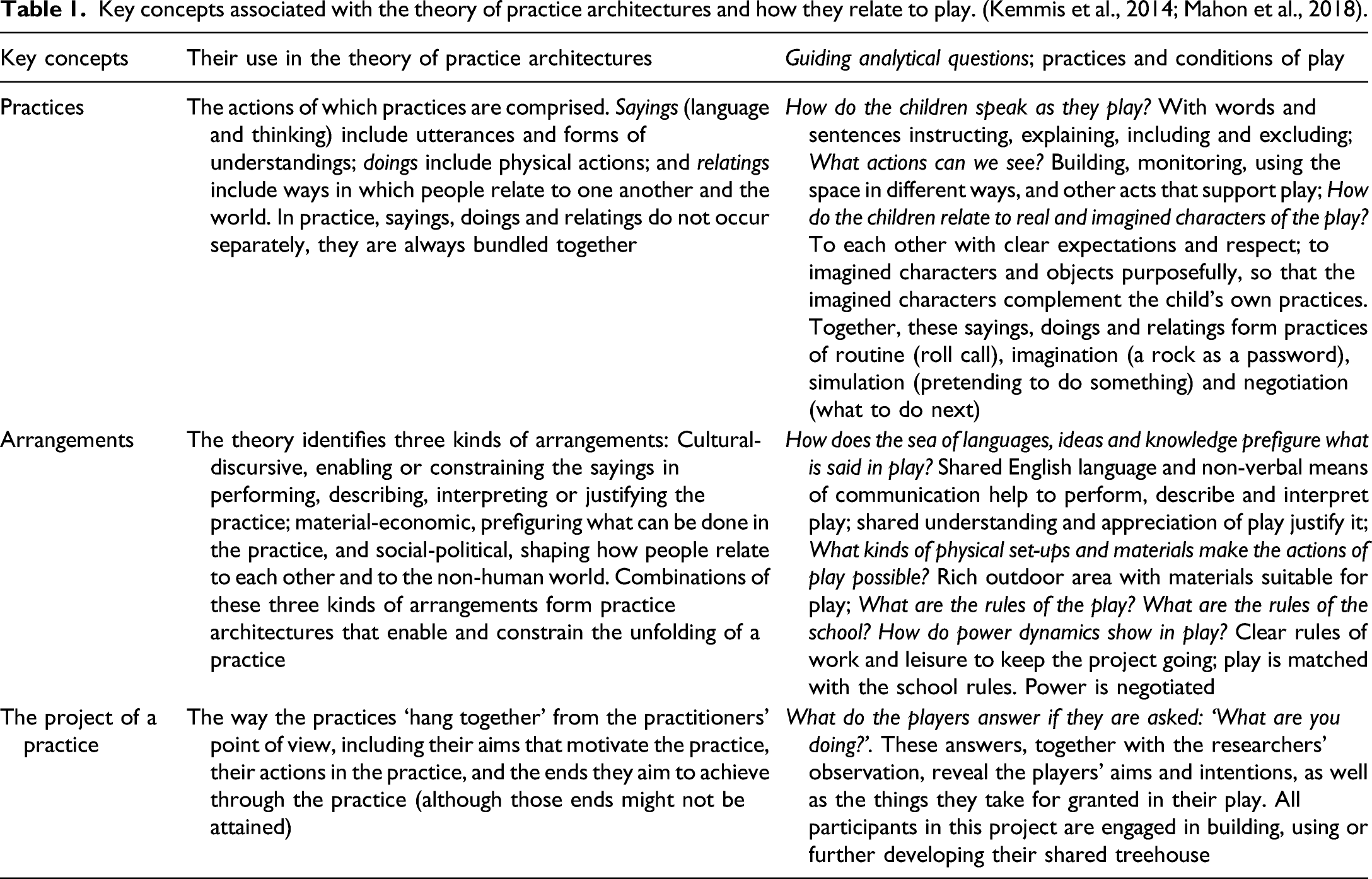
We have described these episodes of children’s play practices noting that, as they are imagined and fluid, they are hard to understand from the outside. With all this fluidity, does it then even make sense to speak of a project of a practice in children’s play as a recognisable entity? We think it does, because we can say something about the elements of these practices, and because some of them seem to be common across our chosen example. In all the episodes, the children used objects as something they were not and applied new functions to objects as needed. All episodes also included negotiating rules that other children could agree with. These may be common features of play, but they do not mean that playing would be consistent across sites and among different groups of children. Play can take many forms and it never happens in a vacuum. What the children do is prefigured by the broader arrangements and practice landscapes of their sites, in this case, the school culture and the histories that they bring to their play. Play is held in place on the one hand by arrangements created and imagined by the children, whilst at the same time, play is supported by real and tangible arrangements found in or brought to shared semantic, physical, and social spaces in this particular place as a site for this or that particular practice. When these arrangements are understood, children (and educators) can build and rebuild them to foster opportunities for play.
Theories of practice, especially those drawing on video data may fall into the trap of merely describing what happens. That, according to Nicolini (2017), results in a naïve quasi-praxeology, merely reporting what people do. Shallow descriptions of play leave both childhood researchers and practice theorists empty-handed. We have striven to explain children’s play practices acknowledging that they are complex, highly social happenings. We did this by representing the development of the Treehouse through a series of snapshots of practices, showing how each episode captures the children’s varied sayings, doings and relatings and how those dimensions become intelligible by uncovering the cultural-discursive, material-economic, and social-political arrangements that hold them in place. We have also shown how these practices change as the project develops. A contribution of this approach is that it turns children’s own practices into epistemic objects of inquiry that can then in turn, become part of the discourse of practice theories and childhood studies. This approach also sheds light on the more general reservoirs of children’s practices as they build, maintain, and develop a shared, child-led play project. With these findings, childhood researchers can understand what happens when children collaborate with little adult intervention, and how to create conditions that support play.
The play in the Treehouse was rich and insightful, but above all quite ordinary. This stands in stark contrast with the vast majority of play research conducted with players from a disadvantaged background, with a focus on the challenges of play. Further research on mundane play practices of children, including those in marginalised positions, is needed if we want to understand the different facets of play, in particular as seen by the players themselves.
Footnotes
Acknowledgements
We would like to thank Stephen Kemmis, whose insights and advice strengthened our thinking for this paper. We would also like to acknowledge the helpful comments made by the two anonymous reviewers.
Declaration of conflicting interests
The author(s) declared no potential conflicts of interest with respect to the research, authorship, and/or publication of this article.
Funding
The author(s) disclosed receipt of the following financial support for the research, authorship, and/or publication of this article: This work was supported by Academy of Finland 331029.
