




Abstract
Inspired by a 2020 collective awakening to societal inequalities, we introduce a conceptual framework to address systemic issues around employment for one of society’s vulnerable populations—people with autism. We do so as advocates, researchers, practitioners, a family member for one author, and an autistic individual for one author. We first draw upon ecological systems theory to develop a portrait of the complex ecosystem of employment for autistic individuals that reveals multilevel and interconnected influencing elements. We then apply learning from systems and resilience thinking to deepen understanding about how positive change can occur in such an ecosystem. Overall, we propose new paradigms, questions, and actions toward transformative change for this and other systemic challenges faced by vulnerable populations.
Keywords
Introduction
We were struck by the important and poignant piece published on May 26, 2020 by the editor of Families in Society (Fogel, 2020). Dr. Fogel aptly remarks that the COVID-19 crisis has starkly exposed and amplified many complex and deeply rooted societal weaknesses and inequalities, disproportionately harming our most vulnerable populations. She reminds readers that this moment of collective awakening to the existence and devastating impact of these frailties represents a unique window of opportunity for change. We could not agree more.
That said, we also know that constructively confronting highly institutionalized systems in society represents a formidable task. We have lived this in our own quest to address core issues of employment in Canada for one of society’s vulnerable populations—adults with autism. Regional and national statistics report a paucity of employment among autistic individuals relative to the general population (e.g., Bizier et al., 2015; Parikh, 2016; Roux et al., 2015). This is despite a growing volume of impressive interventions across many jurisdictions and countries. These include in-school vocational training, pre-employment readiness training, social skills development, programs to increase employment access, and initiatives to create supportive work environments (Keel et al., 1997; Schall et al., 2015). Even for the minority who are employed, there are reports of many autistic people in positions that under-utilize their skills (Hedley et al., 2017), and work situations that involve significant stress (Bury et al., 2021; Hedley et al., 2018a). This can compound over time and impose significant negative impacts, including mental health challenges (Hedley et al., 2018b; Nicholas et al., 2019).
We have worked, and often struggled with this situation, as advocates, researchers, and practitioners—one author as a social worker, one as a family member, and one as an autistic individual. We are now convinced that two things must happen in order for transformative change to occur. First, there is a need for a deep understanding and questioning of the drivers and weaknesses in existing systems among community stakeholders. Second, there is a need for multilevel and multipronged action toward pro-supportive employment policy and community contexts: Complex societal challenges such as this one belie any single practice or programmatic solution (Hedley et al., 2017; Nicholas & Klag, 2020; Wehman et al., 2014).
With these a priori tenets, the core social work aim of advancing social justice lies at the heart of this paper. Its purpose is to introduce a conceptual framework to address systemic issues around employment for autistic people. We use the example of the employment ecosystem for autistic adults to propose a different way of both “seeing” how pre-existing systems function, and of proactively intervening within them. In the first section, we draw from Bronfenbrenner’s (1979) ecological systems theory to offer a representation of the complex ecosystem in which autistic individuals live and work. In the second section, we apply learning from systems thinking and the related field of resilience thinking (Forrester, 1994; Meadows, 2008; Walker & Salt, 2006) to contribute to a path toward positive change.
This is a conceptual commentary that is informed by multiple bodies of literature and infused with views based on our own experiences (Langley & Klag, 2019). As a precursor to writing this paper, the first author spoke with the third author (‘SM’) about her life and employment-related experiences, to weave her voice of lived experience into this paper (see Supplemental Appendix 1 for the summary of the information she shared). As an autistic person, SM’s thoughts on her journey as well as her in situ perceptions about society and her future, breathe life into our conceptual arguments.
At the intersection of the theoretical approaches we introduce, we argue that new paradigms, assumptions, questions, and recommended actions emerge to spark different conversations on employment for autistic people. With humility and cautious optimism, we offer these perspectives with the hope of contributing to transformative change for many vulnerable populations facing obstacles and marginalization.
The Complex Web of Influencing Factors on Employment and Life
What is your wish in terms of your employment situation? If you were to be in your ideal employment situation, what would it look like?
That is the question that I am asking myself. I know that I have a need to learn . . . I need a flexible schedule . . . if I don’t have any more energy at 10:00 in the morning, well, then I stop. And if I feel better at 9 pm, I will work at 9 pm . . . I must work part-time . . . definitely . . . It’s certain that I will never be able to do 40 hours per week . . . My big difficulty is that in HR, there is no part-time. So I have to play the “adaptive measures” card . . . I am in a situation of “handicap.” That is not pleasant . . . It’s not fair. It emphasizes the fact that I am different. You don’t want to help me, but you are forced to help me. I don’t want to be in a position to have to force people to help me . . . [Third Author, personal communication, December 18, 2019].
The third author (‘SM’) is an autistic adult living in Montreal, Quebec, Canada at the time of writing this paper. She was diagnosed with autism at the age of 32. She has a master’s degree in Human Resources and an above average IQ. Since college, she has intermittently worked as an administrative agent and coordinator in multiple human resources departments of a local public health network for which she feels over-qualified. She has accepted these positions because she knows how to do the work with little or no training, and it has provided her with much-needed income and health insurance. This kind of work became her fallback early in her life whenever other potential jobs did not work out for her.
SM was working part-time at the moment of her conversation with the first author. She was also recovering from one of many bouts of clinical depression and the intense fatigue that accompanied these. Having ended a long-term relationship, she was living alone. She had always wanted and continued to want a career in which she could engage her experience and skills. She had encountered multiple periods of unemployment and changing employers. The reasons for this had ranged from health problems to the inability to fulfill the job schedule requirements, misalignment between task requirements and her preferences, and general dissatisfaction at work. In times of need, she had received government subsidies.
In the above excerpt, SM shared a “coming to terms” with her need for a flexible and less than full-time work schedule to stay healthy and have energy for work demands. At the same time, she felt discomfort with the label of “handicapped” and with being singled out when she had communicated her needs to previous employers. She spoke about many of her employment struggles that actually occurred before she was diagnosed with autism. She had long exhibited certain sensitivities to light and noise, experienced depression, and manifested certain behaviors that made her feel different from others. Most often, she felt excluded versus included.
Why had it been so difficult for SM to attain the conditions necessary to enjoy a stable employment situation—one which would sustain her financially, support her wellness, and fulfill her potential as a professional? Supplemental Appendix 1 reveals many events and factors that appear to have influenced her story—related both to herself and her context. Her mental health, as well as her accompanying thoughts, feelings, expectations, and behaviors, are all elements that seem to have marked her journey. Events and relationships in her personal and professional life were important. The presence or absence of employers willing to support her, the availability, continuity and nature of support services, and governmental subsidies at certain points in time, all seem to have affected her employment trajectory. Multiple influencing factors seemed to be interdependent. For example, the energy she needed to try to “fit in” during college likely had an effect on the energy remaining for studies or other daily demands. Her mental health status and fragile self-esteem at various points in time affected energy available for job searches. 1
Time also had an impact on her journey, with key transition points in her life, from high school to college and from college to the world of employment, igniting new kinds of needs, supports and challenges. Seminal events earlier in her life may have marked behaviors, emotions and expectations later in life. For instance, SM firmly believes that the lack of an autism diagnosis as a child had an impact on her later mental health challenges.
SM’s journey illustrates that single actions, people or programs to help at particular moments in time (e.g., a helpful social worker noted in Supplemental Appendix 1) are appreciated yet, in and of themselves, offer limited enduring impact. There appears to be a complex set of important considerations both within and around SM, which together have required calibration and recalibration over time. These include her family situation, social relationships, mental health status, work and employer support, and requirements for ancillary services. Even moments of relative equilibrium were fragile, collapsing with the onset of a setback in her mental health status or with a rupture in support services. These had ripple effects on her ability to work, her resulting ability to pay rent, and her overall well-being.
This example helps to illustrate why many programs that advance employment options for autistic adults seem to have yielded no to little sustained improvement in employment rates over time (Nicholas & Klag, 2020). SM’s story is unique, as is every individual’s life story. Yet the patterns of situational improvement and regression, struggles with key life transition points, pivotal events, and discontinuity in available supports, may all be familiar to many autistic individuals struggling with employment and life experiences.
Beyond the above-noted issues, we have reflected on how and to what extent additional unstated variables beneath the surface of the conversation may have influenced SM’s situation. For example, do some employers consider inclusion as “doing good” but also as “settling for less,” or do they genuinely recognize that each individual, autistic or not, brings unique strengths and areas for development to the job? What were her employers’ inclusion policies? To what extent were these enforced and/or authentically respected versus tokenistically applied? Even if employers truly want to “do good” and be more inclusive, can their aim of sustainability, profit or expansion co-exist with the desire to be inclusive? From a broader policy lens, do government policies support sustained employment for autistic individuals and are the policies enforced on the ground? As written by Lamontagne and Métayer (2019), “Inclusion of neurodiversity necessarily calls for a culture shift, to move from a culture of performance to a culture that is first and foremost centered on the human being” (Effects section, para. 1).
SM’s reported experiences and the questions that arise from them illustrate that to substantially advance employment for autistic individuals, we must understand and proactively address the complex portraits and patterns of individuals’ situations. This includes attention not only to the salient factors themselves, but also to their interconnectedness. Some influencing factors such as financial resources or particular health diagnoses may be easy to assess. However, others, such as organizational culture, industry norms, or underlying societal values may be substantively yet more insidiously at play. We maintain that any attempt to over-simplify the complexity surrounding the employment landscape will limit our capacity for change. That said, we need ways to articulate this complexity to create common understanding. To that end, we next introduce Figure 1 that conceptually depicts the employment ecosystem for autistic individuals.
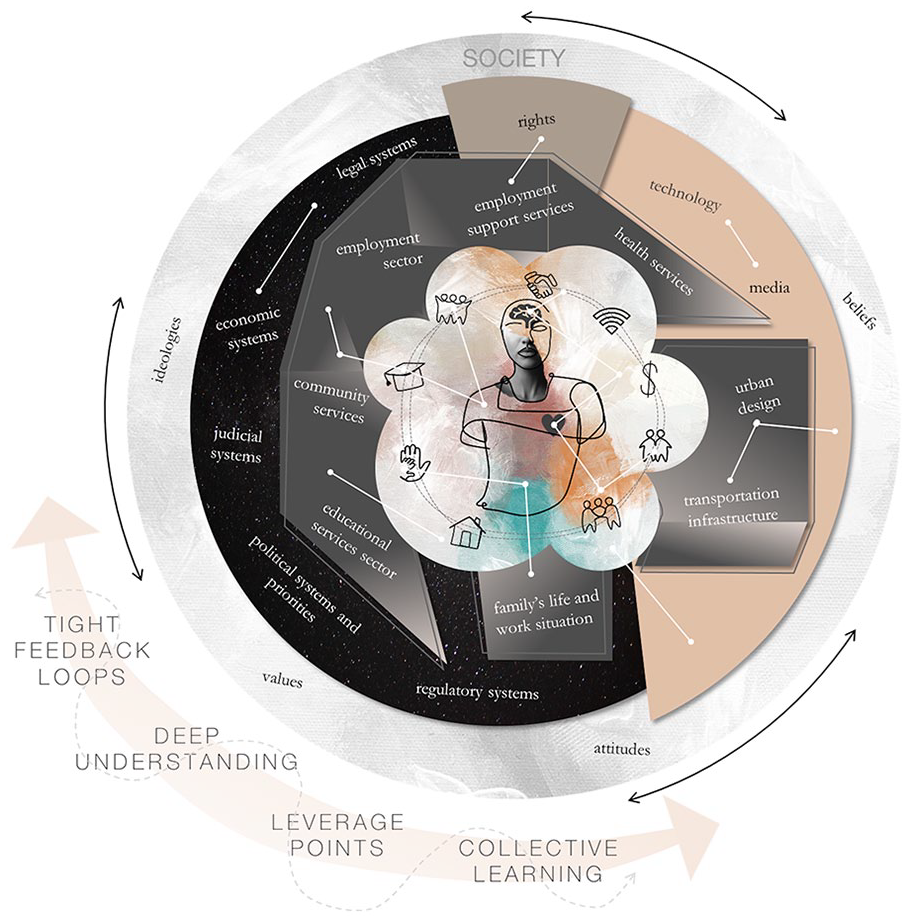
Ecosystem of employment for autistic individuals.
An Integrated Portrait of the Autism Employment Ecosystem
Figure 1 is adapted from ecological systems theory, that later became bioecological systems theory (Bronfenbrenner, 1979; Bronfenbrenner & Morris, 2006). We propose that Figure 1 offers a sense-making framework for the multi-layered, dynamic and “messy” employment ecosystem for autistic people that we have now illustrated. Importantly, this framework brings to the fore the interdependencies among elements and levels of the ecosystem. It thereby reveals how employment success cannot be seen in isolation of other structures, systems and relationships in life and in society. Below, we introduce its theoretical underpinnings and describe the ecosystem itself. This will be followed by an introduction to four orientations for action to advance the ecosystem, presented in the arrow at the bottom of Figure 1.
An ecological view of person-centered health and social service practices has long portrayed individuals as nested in family, community and physical environments. Communities are in turn nested in cultural contexts and relevant policy landscapes. Individual-level behaviors and wellness are influenced by many interconnected factors at all these levels, and these factors become critically important to understand and assess an individual’s situation and needs (Lewin, 1951; Sallis et al., 2008). Bronfenbrenner’s ecological systems theory is rooted in this person-in-environment approach to understanding human development that has guided the practice of social work. It highlights, for example, how social determinants of health (Filipe et al., 2020) such as socioeconomic status, are integral constructs that are rooted in the interface between individuals and the ecosystem around them. It also delineates multiple levels of relevant contextual elements affecting human development that inspired the creation of Figure 1. We next present the categories of elements and levels in Figure 1 that we posit constitute the particular ecosystem of employment for an autistic individual.
The Individual, Their Surrounding Microsystem and the Mesosystem
Individual thoughts, feelings, and behaviors at the center of the employment ecosystem impact and are impacted by their mental and physical health (Bronfenbrenner & Morris, 2006). The individual’s overall status is also influenced by that which Bronfenbrenner terms the “microsystem” immediately surrounding them, which is relevant in day-to-day life. We have portrayed the elements within the microsystem with visual icons. They include one’s home situation, finances, family, friends, doctors, support service providers and co-workers, as examples. We have included a Wi-Fi symbol to communicate the integral role of the internet today in an individual’s daily life. This has been acknowledged in later iterations of Bronfenbrenner’s model (e.g., Johnson & Puplampu, 2008). SM notes in Supplemental Appendix 1 that the internet has served as a source of refuge for her.
The interdependencies among elements in the immediate environment are portrayed via the line connecting them and have been termed by Bronfenbrenner as the “mesosystem.” For SM, positive experiences at a given point seem related not only to individual supports within her community, but also to the relationships among these supports; that is, how well they worked together in concert to assist her. This was evidenced, as an example, by an employment counselor who reached out to the local public health agency to ensure that SM rapidly received services that would meet her pressing needs—which she found to be extremely helpful. On the other hand, she encountered many frustrating situations in which a service provider did not seem to even be aware of other available services.
The Exosystem
As one moves toward the outer spheres of the ecosystem, influencing elements that constitute what Bronfenbrenner termed the “exosystem” may be less visible to an individual or their immediate day-to-day situation, yet they are no less important to the employment prospects and situation of the individual. They include the family’s life and work situations, which affect available time, energy, and financial resources (Sellmaier, 2019). The structures and relevant resources in one’s community are also relevant. These may include employment support, health services, educational services, and other resources that may be recreational, spiritual, or relational. Urban design and local transportation infrastructure impact physical proximity, accessibility to certain focal destinations, and community inclusion, whether one lives in an urban, suburban or rural setting. These structural elements affect access to employment options, employment supports, and other community resources.
The Macrosystem
The two outermost rings are adapted from the system that Bronfenbrenner terms the “macrosystem.” Bronfenbrenner’s original macrosystem was meant to reflect societal cultures and belief systems, or what Härkönen (2007) refers to as a “societal blueprint for a particular culture, subculture, or other broader social context” (p. 12). Its elements and the connections or disconnections among them, are critically important, as they “seep” into other levels of the system and, ultimately, an individual’s particular employment situation. The content and scope of the macrosystem, as specified by Bronfenbrenner, have since evolved with adaptations of the model by various scholars (Ashiabi & O’Neal, 2015). We have divided these macro-level factors into two categories to reflect the impact of both material and human elements (Pollack et al., 2013). The first category includes public political systems and priorities, and economic, regulatory and legal systems. These sub-systems drive the availability, nature, and flow of resources and services at community levels. They themselves may be multi-layered, with federal, state or provincial, and municipal levels, all of which are interdependent and have a role to play. Media channels and technology are also integrated at this level in Figure 1. Media and technology are global structural conduits that significantly affect how and with whom we communicate, organize, learn, think, and even feel (Katsikides, 1998).
The outermost ring includes human elements at the societal level: values, attitudes, beliefs, and ideologies that underpin other elements and levels of the ecosystem. Yet they are often so taken-for-granted that they are simply overlooked. This ring accounts for fundamental and often unconscious biases and attitudes that society may hold with respect to autistic individuals. For example, SM’s excerpt at the beginning of this paper regarding her discomfort using the “adaptive measures” card supports the argument that society labels disability, within a welfare model, as a problem that needs to be resolved. This, in turn, colors the policies, laws, and regulations we create. Can we envision a society in which disability is simply seen as different and equal (Bunbury, 2019)?
The Chronosystem
The incorporation of time is referred to as the “chronosystem” in Bronfenbrenner’s model. The dynamic nature of the ecosystem is demonstrated visually in Figure 1 in two ways. First, the visual metaphor of a kaleidoscope signifies the shifting of the entire portrait as any level or element within it shifts. Second, the arrows outside the ecosystem represent the notion of evolution over time. If we conceive of an autistic individual seeking employment through this lens of a multi-level system, these arrows remind us that events and transitions in earlier life affect the later life course.
Ecological Systems Theory and Systems Thinking
Overall, Bronfenbrenner’s model was inspired not only by an ecological perspective that situates an individual in their broader context, but also by a systems perspective (Siporin, 1980). “Thinking in systems” has a long and diverse lineage across multiple disciplines, including social work (Forrester, 1994; Hammond, 2002; Siporin, 1980). It is linked with the ontological notion of seeing the “whole” as a dynamic entity that is more than merely the sum of single variables, with interdependence among elements throughout the system. Systems thinking places a particular emphasis on the places “in between”; on the relationship among elements versus only on the elements themselves.
Figure 1 similarly represents a systems approach to considering the many actors and components, some proximal and others more distal, that surround and affect an individual. Whereas Bronfenbrenner’s application of his framework was to understand intra-individual evolution, our focus in this paper is on changing the employment ecosystem itself, so that many individuals can benefit. For this, we have been informed by scholars and policy leaders who are increasingly applying a systems approach to advance complex societal problems. These include health, public health, and socioecological issues at all scales, from local communities to the world (de Savigny & Adam, 2009; Forget & Lebel, 2001; Organisation for Economic Co-operation and Development [OECD], 2019; Sallis et al., 2008).
As we begin to see Figure 1 as an employment ecosystem in need of change, the comprehensive portrait of forces affecting an individual’s employment scenario lays bare a proverbial Pandora’s box. We are left with the daunting question of where to begin. Concern for possible paralysis that could arise from attempting to confront the enormity of the task led us to a search for plausible and resonant literature streams on positive action within complex systems. The result of that search is the integration of multi-disciplinary advances in systems thinking and the related stream of resilience thinking that we next introduce (Walker & Salt, 2006).
Systems and Resilience Thinking: A Step Toward Change
As the World Health Organization notes regarding health care systems, “ . . . we must know the system to strengthen it . . . ” (de Savigny & Adam, 2009, p. 19). We therefore begin with the presumption that researchers, advocates, policy makers, or practitioners wishing to enact positive change in this “messy” and multi-level ecosystem, must understand how the system operates and how shifts occur within it.
Systems thinking has likened complex societal systems to biological versus mechanistic entities. Through the lens of systems thinking, a portrait of the ecosystem in question as a whole unit of analysis begets a more nuanced understanding of the many interdependent actors and factors at play. This perspective rests on the notion that complex systems, such as the employment ecosystem for autistic adults, are constituted by many local networks of actors across multiple levels. Each of these networks operate with their own institutional and structural arrangements, and according to their own self-interests (Ostrom, 1999). Accordingly, there is not, nor can there be, central top-down control of the system (Zimmerman et al., 1998). However, actions of each network have impact elsewhere in the system. As an example, in a local community, a hospital might operate independently and therefore have the power to make a decision to eliminate autism assessments as a service. Yet that decision has an immediate impact on the rest of the community ecosystem as families will necessarily have to seek these services elsewhere and waitlists for other providers will necessarily increase. It may also lead to more people who remain undiagnosed until later in life, possibly requiring more and different kinds of services over time.
Resilience thinking, itself grounded in systems thinking, has an action orientation in influencing positive change within complex systems at any scale. Resilience thinking is focused on a system’s resourcefulness and adaptability to maintain strength in the face of strain or adversity (Walker & Salt, 2006). Its roots are in both ecological systems thinking related to healthy environments at a macro-level, and clinical psychology that is concerned with individual-level resilience (Berkes & Ross, 2016; Garmezy, 1991; Holling, 1973; Richardson, 2002). It has emerged more recently as an academic domain to address environmental challenges of socio-ecological systems. Importantly for the issue at hand, both systems and resilience thinking have since been applied more broadly to some of society’s pressing challenges in urban planning, disaster relief, housing, energy and health care (Dessie, 2018; Levin et al., 2012; Rouse, 2008; Zimmerman et al., 1998).
Drawing upon Pound and Campbell’s (2015) application of theory synthesis to the optimization of health care interventions, we have triangulated the conceptual foundations of the ecosystem in Figure 1 with learning from systems thinking and resilience thinking. The result is four emerging orientations for understanding and action to advance positive resilience of the employment ecosystem for autistic individuals. The four orientations appear below the ecosystem in Figure 1: (a) intentional change coalitions to enable tight feedback loops, (b) deep understanding of ecosystem drivers and root causes of issues, (c) the targeting of leverage points versus programs to influence change, and (d) evaluation mechanisms that enable collective learning and adaptation. These orientations can apply in the advancement of the employment ecosystem for autistic people with any geographic boundary, including a neighborhood, city, state/province or nation. Though we will next explain each of the four orientations sequentially, the dynamic and unpredictable nature of collective change efforts dictate that they be considered in tandem, with iteration and overlap over time.
Because of feedback delays within complex systems, by the time a problem becomes apparent it may be unnecessarily difficult to solve. — A stitch in time saves nine [Meadows, 2008, p. 3]
Scholars and practitioners working in complex systems change generally agree on the need for collective versus individual efforts (e.g., Sarasvathy & Ramesh, 2019; Westley et al., 2007). Emerging knowledge also points to the importance of intentionality and meta-strategy in how stakeholders are brought together to actively contribute to substantive and lasting change. Earlier notions of collaborative change such as collective impact (Kania & Kramer, 2011) and needle-moving collaboratives (Jolin et al., 2012) spoke to the importance of centralized backbone structures and common agendas. More recent practice-based experience with these structures provides nuanced guidance toward positioning these coalitions more organically as “containers for change,” with less structure and centralized decision-making. In some cases, such change coalitions may simply form a loosely coupled overlay that both partners with and supports existing networks working to enact change in their own local or sector-specific communities. This approach simultaneously enables agility on the ground, and bi-directional support through a larger change coalition (Sellberg et al., 2018).
Intentional Member Recruitment
In addition to the design and role of a coalition, we next summarize five considerations with respect to its membership. First, it is important to authentically embody the notion of nothing about us without us, ensuring that a change coalition is led by, or fully integrates, autistic people who seek to advance the employment ecosystem and who themselves are at its center (Charlton, 1998). Second, a diversity of experience, backgrounds, and interests provides for critical cross-functional thinking and perspective-taking, as well as a common language and understanding. A cross-sectoral approach (e.g., public, private, and community sectors) may also be helpful. Figure 1 may be instructive for identifying the many relevant systems and sectors within the ecosystem to consider in recruitment.
The third factor to consider is the important role of tight feedback loops in working to promote and coordinate change effectively and efficiently within and across sub-systems and/or system levels. This is particularly crucial given the impossibility of centralized direction and control within complex ecosystems. Herein lies the need to intentionally seek coalition participants who are willing and able to receive, transmit, advocate for, coordinate, and/or enact outcomes of the coalition by “fanning out” through their own relevant networks (Sellberg et al., 2018). Key members who are well positioned for tight feedback loops, given their positionality in their own networks, may or may not hold formal power or high-profile positions. In some cases, they may be unusual suspects who are only discovered through intentional on the ground networking (Westley et al., 2011).
The fourth consideration is the importance of a stakeholder group that is constituted by both change agents with an entrepreneurial orientation and other actors who deeply understand the administrative routines of pre-existing institutions and structures. The latter group is often the one that must ultimately accommodate any change (Sarasvathy & Ramesh, 2019; Uhl-Bien & Marion, 2009). Fifth and finally, learning within complex systems shows that a balance between a dynamic of cooperation and respectful conflict may be more conducive to transformational change than solely seeking those who tend to agree (Etmanski, 2015; Zimmerman et al., 1998).
Once we see the relationship between structure and behaviour, we can begin to understand how systems work, what makes them produce poor results, and how to shift them into better behaviour patterns . . . The system, to a large extent, causes its own behaviour! [Meadows, 2008, pp. 1–2] States Parties recognize the right of persons with disabilities to work, on an equal basis with others; this includes the right to the opportunity to gain a living by work freely chosen or accepted in a labour market and work environment that is open, inclusive and accessible to persons with disabilities. States Parties shall safeguard and promote the realization of the right to work . . . [United Nations, 2006, Article 27, p. 19]
It may seem intuitively appealing to assume that long-standing and highly institutionalized systems are well understood. However, many citizens and stakeholders within complex societal systems have limited comprehension of how they actually work or of the effects that these systems engender (Ostrom, 1999). Resilience thinking calls for questioning and for shared understanding of the history of underlying cultural and structural elements in the two outermost rings of Figure 1. We argue that many of these elements serve to exclude autistic people, and have contributed to the current state-of-being (Dessie, 2018).
Whereas non-human variables such as policies, technology and economic systems may be examined and challenged, deeply ingrained societal values and attitudes may be more difficult to uncover and contested among constituents. As Meadows (2008) notes using an example of tax laws, “Jay Forrester’s famous systems sayings goes: It doesn’t matter how the tax law of a country is written. There is a shared idea in the minds of the society about what a ‘fair’ distribution of the tax load is” (p. 162). In this regard, there are a number of existing tools to assist stakeholders in uncovering deeply held and often unconscious societal biases. Social cartography has emerged as a visual tool to provocatively question and engage in conversation around taken-for-granted worldviews, attitudes and beliefs (Andreotti et al., 2016). Causal loop diagrams (e.g., McGlashan et al., 2016) can be usefully applied to trace the history of important events, understand levels of the ecosystem at which these events have emerged, uncover patterns of behavior, and explain how the overall ecosystem structure has contributed to a particular critical issue.
Importantly, systems and resilience thinking highlight that the roots of vulnerabilities often lie far from their apparent markers such as unemployment rates. As a case in point, one might not consider the important impact of judicial systems on an individual’s employment trajectory. However, a study of a maximum-security prison in the United States found that over 4% of inmates were thought to meet the criteria for an autism diagnosis (Fazio et al., 2012). This is four times higher than the estimated prevalence of autism in the general population (Baio et al., 2018; Klag & Ouellette-Kuntz, 2018), suggesting that these individuals are disproportionately incarcerated. We must therefore ask the critical question of why this is the case. What are the hurtful effects of this reality and is it necessary?
In addition to many important life consequences of incarceration, a prison record exponentially diminishes employment access; there is indeed a connection between judicial systems and employment opportunity. To what extent are judicial and law enforcement representatives sufficiently knowledgeable to recognize the possible presence of a developmental disability and to intervene compassionately and constructively so as to avoid incarceration (Richman & Bidshahri, 2018)? One might also question the degree to which early childhood support, something that is lacking for so many autistic people worldwide, might reduce the likelihood of later incarceration. Further questions may relate to the quality of, access to, and connections among various support resources within and across levels and sectors of the ecosystem, as well as the underlying policies, laws and regulations at federal, provincial/state and municipal levels.
As an illustrative example of meta-policy, the United Nations (UN) Convention for the Rights of Persons with Disabilities was ratified internationally close to 15 years prior to the writing of this paper (see the second opening excerpt of this section relating to the right to work). It was ratified in Canada in 2010 (UN, 2020a), with an additional optional protocol ratified in 2018 (UN, 2020b) enabling Canadians to file a complaint to the UN for perceived rights violations. Yet despite this declaration and commitment, the majority of Canadian autistic adults remain unemployed! A compelling question for Canadian and other Convention signatories may include: Is this international Convention being upheld within provincial/state and federal jurisdictions? If not, where are the disconnections in the ecosystem from the international, federal, and provincial/state levels that bring us to this moment in which local community practices may be in breach of this Convention, despite the supposed legal imperative? Tracking and reflecting upon connections, or the lack thereof, between local situations and macro-level events and trends can be instrumental in systems change efforts (Westley et al., 2007).
There are two different types of change: one that occurs within a given system which itself remains unchanged, and one whose occurrence changes the system itself.
(Watzlawick et al., 1974, p. 10).
A synthesis of the literature on systems and resilience thinking has brought us to four key principles for a change coalition to consider in contemplating systems intervention. The first is to confront the impossibility of controlling an entire complex ecosystem in which many individuals and entities pursue varying ends. Therefore, committed stakeholders must find pathways to positive resilience via influence or “nudging” the system forward. The second principle is to look for and examine past examples of disruption and change processes within the employment system for autism or for a related issue, as these could potentially inform how to influence future change.
An emerging example in Canada began with a federally funded innovation called Ready, Willing and Able (https://readywillingable.ca). It seeks to increase the number of employers that hire individuals with developmental disabilities. There are 20 communities across the country partnering in this undertaking. Over time, much learning has emerged, including the need for ancillary supports for both employers and the employees once an individual is hired. Since inception, the number of individuals, self-advocates, and companies participating in this initiative nationwide has grown. The federal government, as the primary funder, has become a part of the conversation about employment needs. Civil society is fulfilling an implementation and advocacy role both within and outside the program. In short, multiple sectors, communities, and sub-systems across the country are connecting to advance employment situations for autistic individuals in multiple ways beyond one single program. While continued efforts are needed in broadening the systemic scope of impact, as we next address, learning from initiatives such as this can potentially inform other steps forward toward an improved employment ecosystem in Canada and elsewhere.
The third and central principle in this section, based on systems and resilience thinking, is to seek change via leverage points that trigger cascading and lasting systemic shifts versus single programs per se, as the opening excerpt for this section implies. This suggests that narrow aims or markers of “getting a job” or parametric outcomes such as employment rates, are not the most effective targets in promoting positive resilience; these, in isolation, ignore other connected factors in an individual’s world that affect the employment and life trajectory such as an individual’s health or housing sufficiency. Such a piecemeal focus may also obscure perverse outcomes of pre-existing incentive structures such as individuals worrying about losing welfare or disability benefits if they obtain employment.
Systems and resilience thinkers further argue that within complex systems, emphasis should be placed on creating desirable systemic conditions that facilitate or unblock positive resilience-building (Meadows, 2008). This seems particularly relevant to break the stasis of negative resilience, as we argue is the case in the seemingly intractable employment ecosystem for autistic people. An important leverage point might be, for example, better information flow, communication, synergies, and complementarity between the levels of federal and provincial/state governments in fulfilling their respective public employment mandates for autistic individuals. The same may apply for links among sectors. In fact, in many jurisdictions, there exists a serious rupture in support continuity for young adults when transitioning from the school to employment sector within the ecosystem (Schall et al., 2012). For this reason, some have argued that an autistic person’s transition to adulthood feels like “falling off a cliff” (Roux et al., 2015).
Overall, through the lens of systemic leverage points, preferred initiatives would somehow “attach” to the existing ecosystem and precipitate further change in that system. To illustrate this point, at the time of writing this paper, a team of social work and other researchers in Alberta, Canada is working on an initiative to improve university and college campus access and support services for autistic students to optimize their success in advanced education. In so doing, they seek to improve the likelihood of post-graduation career-building (Nicholas, 2020). Alongside this initiative, researchers in the same province are advocating with key stakeholders for continuity of support post-graduation to facilitate pathways into work for autistic employees and their employers.
Multi-faceted efforts such as the ones described above may strengthen positive ecosystem resilience if the system reorganizes to accommodate them on a long-standing basis. We argue that one must seek their integration into standard operations, policy and recurrent funding structures of colleges and universities, and related employment agencies. To increase the probability of lasting change, advocacy efforts and relationship-building at multiple levels would be required in schools, disability service agencies, and government. Without these efforts, the pre-existing system would likely return to its original state once short-term funding runs out, as champions for the cause come and go, or as political parties move in and out of power.
Timing Is Everything
The fourth and final principle suggests that powerful leverage points are often those that are most likely to face resistance within an intractable system (Meadows, 2008). Therefore, assessment of contextual readiness and openings for change is critically important (Kingdon, 1993). As windows of opportunity open, a group of dedicated stakeholders must stand ready to act. In that vein, a confluence of six seminal events in Canada over the past 2 years may have created such a window for ecosystem disruption nation-wide (at the time of writing this paper): (a) the 2018 signing onto the optional protocol of the 2006 UN Convention (CRPD) by Canada (UN, 2020b), as noted earlier; (b) the 2019 enforcement of the Accessible Canada Act to create a barrier-free Canada, across disabilities (Government of Canada, 2021); (c) the 2019 commitment by the federal government to a national autism strategy (Government of Canada, 2018); (d) a 2020 commitment in the Canadian Prime Minister’s throne speech to institute a Disability Inclusion Plan, including a disability benefit and a national employment strategy (Government of Canada, 2020a); (e) the 2020 initiation by the Public Health Agency of Canada of a nationwide study to identify important priorities for a National Autism Strategy (Government of Canada, 2020b); and (f) the 2020 emergence of the COVID-19 pandemic that has exposed many inequities in societal systems.
The time may be ripe for a mindfully constituted change coalition, with tight feedback loops across federal and provincial levels, that undertakes a multi-level advocacy effort to enshrine Article 27 of the UN CRPD in law related to the right to work. Such an effort could provide recourse for non-compliance of upholding individual human rights, and thus stimulate much-needed policy change, resources and resource flows within the system.
The COVID-19 pandemic may have also opened the door for another kind of positive disruption in many employment ecosystems for autistic workers worldwide. Some autistic individuals have long expressed preferences to work at home, with flexible schedules (as has been the case for SM), to have meetings recorded for later review, and to have a role exempt from customer-facing activities (Lindsay et al., 2021). In the past, these preferences have contravened many employment norms. The accelerated shift to remote work precipitated by the pandemic may stimulate longer-term change in this direction. The Overton window may therefore have shifted with respect to policies that could now be considered “mainstream.” This could pave the way for committed stakeholders to influence the ripple effects on attitudes, structures, and policies to favorably affect employment for autistic individuals.
The richness of a systems inquiry is not about detail but about value.
(Imam et al., 2006, p. 8).
The focus and length of this paper preclude extensive attention to evaluation. However, we would be remiss in not recognizing its critical importance for cumulative learning and sustained change. Whereas systems and resilience thinking are increasingly well described, research methods to apply and evaluate effects of change efforts are nascent (Sellberg et al., 2018). Scholars and others involved in complex systems advancement are beginning to actively grapple with both the need for, and difficulty in, evaluating progress in systemic change (Saïd Business School, 2020; Shulha et al., 2016). Traditional evaluation measures such as economic or accounting metrics may be of limited value in complex and dynamic systems for which goals are moving targets, as systems evolve and as windows of opportunity open and close (Antadze & Westley, 2012). We fundamentally believe that the focus of evaluation in systems change work should be based on learning as opposed to judgment, particularly given the complexity, lack of predictability, and long timeframes often involved. Moreover, we argue that methodological choices must be as much about relevance as they are about rigor (Mintzberg, 1977), and that methods must be understood by, and resonate with, interdisciplinary stakeholders (Imam et al., 2006).
Systems and resilience thinking invite collective and participatory evaluation approaches consistent with the notions of a living lab or a learning health system. In both of these approaches, the lines between research and practice blur, either because researchers are also actively working to advance the system they are studying or because evaluators are purposefully embedded in the action-oriented endeavor (Patton, 2011). Evaluation includes frequent review of progress that informs continued work (Lai et al., 2019). In such approaches, advocates, practitioners across social work and other disciplines, and/or researchers in a change coalition may together identify the most relevant research or evaluative questions. Data may be collected from storytelling, ethnographies, processual analysis over time, and/or multi-faceted case documentation. In the context of employment and autism, this may entail, as one example, a longitudinal study of changes in a local ecosystem over time.
Evaluation may also include longitudinal observation of individual experiences over time—in life and employment. To that end, journey mapping, often used in business and health care, is a potentially helpful approach to deepen understanding of an evolving ecosystem, its root issues and successes, and the upstream and/or downstream effects—all through the eyes of an individual as they journey, in this case, through employment and unemployment over time (e.g. McCarthy et al., 2016). Reviewing journey maps across individuals can reveal important patterns in an ecosystem to inform continued intervention priorities. Finally, appreciative inquiry into exemplars of positive resilience-building within subsystems or the overall ecosystem may be both instructive and celebratory (Cooperrider & Srivastva, 1987).
Closing Reflections: The Road Ahead
. . . I don’t know, it’s not necessarily up to others, just like it’s not up to us to make all the efforts, but we can join in a “just center”? (SM, personal communication, 2019). We always talk as a society about pressure, stress, etc . . . For us [as autistic individuals], it appears right away because we are more sensitive to that. We help amplify everything that is neurotypical . . . if we put things in place, everyone will benefit . . . we are often the “canaries in the coal mines.” (SM, personal communication, 2019)
We have presented an ecosystemic lens through which to understand and advance employment situations among autistic people. We hope that this paper may spark continuing conversations. Where readers take this line of thinking in their own work will vary, as there are many areas ripe for intervention at local, regional and/or national scales. In terms of how and where to begin change efforts, patterns from social change initiatives seem to indicate that beginning at any level where windows of opportunity exist may be helpful. Change can reverberate up, down or horizontally, within or beyond a single level and/or sector of the ecosystem (Sellberg et al., 2018).
Our principal challenge to readers is to think beyond a sole focus on single variables, or short-term programmatic and resource-based “fixes.” Instead, the unit of intervention becomes the ecosystem or sub-systems within it, with a deep emphasis on the intersections among its elements. We see employment as intricately woven into so many other aspects of life and society, and as contributing to the ultimate goal of a good life for autistic individuals on their terms. This applies regardless of the particular level or sub-system in which one chooses to intervene.
Long-standing attitudes and beliefs warrant acknowledgment and questioning, as SM suggests in the opening excerpts of this section. She reminds us that steps toward true inclusion may benefit everyone within and outside the autistic community, as we seek true and sustained change. Social work professionals have a role to play in changing societal attitudes and beliefs, whether it be in the context of consultation with or advocating for clients, teaching students, choosing research questions to answer, or participating in larger scale systems change efforts.
All the recommendations outlined thus far cannot detract from the scope and challenges of this kind of work. Even as we hope to provide space for innovation and change, the ecosystem’s complexity and complacency dictate that we can never predict with certainty the response to change efforts (Walker & Salt, 2006). Any intervention and the system within which it is applied are continually evolving and interacting. As Greenhalgh and Papoutsi (2018) remark, “The dancer and the dance are intertwined” (p. 2). Everything must therefore be considered an experiment (Ostrom, 1999), and committed stakeholder coalitions must nurture adaptability in the face of ongoing uncertainty. In fact, striving to approach versus achieve a well-functioning and resilient system must suffice because, as aptly noted by author and educator Tannarive Due (as cited in Brown, 2017), “there is no ‘there’” (p. 123) in such a complex and ever-changing socio-political ecosystem. This kind of work is a long game in which participants must become comfortable with discomfort, and significant shifts may take years, decades or even generations.
As a concluding reflection, this paper is about autism and employment. Yet it is not. This analysis of the employment ecosystem for autistic individuals might similarly apply to other issues related to autistic individuals or seemingly disparate groups of individuals. Many such long-standing and seemingly impenetrable socio-political ecosystems have a tendency to resist change if left unabated and unchallenged. Mintzberg and Azevedo (2012) present the compelling argument that actions initiated by cross-community coalitions of engaged people with a “why not” temperament, may offer the greatest hope for our world. Despite uncertainty and the imperative of long-term commitment, there is a need to “sign up” and engage with determination and optimism. After all, as they also note, “If we always do as we always did, we will always get what we always got” (p. 907).
Supplemental Material
sj-pdf-1-fis-10.1177_10443894211017397 – Supplemental material for Creating a Resilient Ecosystem for the Employment of Autistic Individuals: From Understanding to Action
Supplemental material, sj-pdf-1-fis-10.1177_10443894211017397 for Creating a Resilient Ecosystem for the Employment of Autistic Individuals: From Understanding to Action by Malvina Klag, David Nicholas and Solène Métayer in Families in Society: The Journal of Contemporary Social Services
Footnotes
Acknowledgements
We thank the autistic adults, family members, employment support personnel, employers, and researchers, who have all contributed to the ideas presented in this article. Thanks also to Christopher Kilmer who reviewed the article and offered helpful editorial and formatting support and to Elise Thompson for her artistic rendering of  . Finally, we thank Professors Frances Westley and Daniel McCarthy for introducing us to systems and resilience thinking.
Declaration of Conflicting Interests
The author(s) declared no potential conflicts of interest with respect to the research, authorship, and/or publication of this article.
Funding
The author(s) disclosed receipt of the following financial support for the research, authorship, and/or publication of this article: Malvina Klag received no financial support for the research, authorship, and/or publication of this article. David Nicholas acknowledges support from the Sinneave Family Foundation. Solène Métayer received no financial support for the research, authorship, and/or publication of this article.
Disposition editor: Sondra J. Fogel
Supplemental Material
Supplemental material for this article is available online.
Notes
References
Supplementary Material
Please find the following supplemental material available below.
For Open Access articles published under a Creative Commons License, all supplemental material carries the same license as the article it is associated with.
For non-Open Access articles published, all supplemental material carries a non-exclusive license, and permission requests for re-use of supplemental material or any part of supplemental material shall be sent directly to the copyright owner as specified in the copyright notice associated with the article.
