



Abstract
This qualitative research with UK primary school children reveals their own subjective perceptions of well-being. In an educational context, the development of a theoretical framework towards understanding well-being is provided by capturing the voices of children through creative and visual methods. The data enabled nine key themes to emerge which have been applied to the Capability Approach and Community Psychology. The flexible approach also provides a practical means for practitioners to further understand and support children in an educational context.
Introduction and background
The year 2004 was the last year that official UK statistics were drawn together to create a report in specific regards to the state of children’s mental health (Frith, 2016). The dated report (Green et al., 2005) revealed that 1 in 10 children aged between 5 and 16 years experiences a mental health problem, thus impacting the child and family in addition to longer term implications. It is likely, this has since increased. Linked to well-being, social support networks, resilience and empathy were targeted to identify preventive factors (Green et al., 2005). In the primary school context and where practitioners hold a key role, is it deemed imperative that children require support to experience positive well-being and develop such necessary skills to successfully function in this world (Ballet et al., 2011).
Despite the multitude of potential issues which will be outlined in this article, children are expected to conform to mostly traditional forms of education. This requires some reflection. Against the backdrop of recognising the steep growth in children’s mental health issues (Bethune, 2018), low levels of well-being, and in the context of multiple areas of concern for children, this article provides practitioners with methods to access children’s experiences in school as well as being able to apply a theoretical lens to further support them. The limited statistics and research available for children under 10 years old posits this study in a context deprived of contemporary evidence around children’s well-being in the primary school.
The article is organised as follows: initially, a background to children’s well-being is provided to contextualise the current status including policy and practice. Children’s educational needs are then considered as well as the theoretical perspectives of the Capability Approach and Community Psychology. Following this, the methodology and methods detail how the data came about before revealing the findings. The discussion brings together the data and theory to present a framework and deeper understanding of children’s perspectives of well-being in the context of the primary school. The concluding section highlights possibilities and implications for practitioners. The article is therefore twofold in that it provides a theoretical understanding of children’s well-being in the primary school context as well as a practical means for those working with children to understand and support their individual needs.
Well-being as a multidimensional concept (Main, 2014) is identified as an important health factor and states that children with low well-being are more likely to experience conflict in the family, have fewer friends, experience bullying and have fewer resources than their friends (Royal College of Paediatrics and Child Health (RCPCH), 2017). The longer term implications include possible poor physical and mental health and lower educational outcomes (Engle and Black, 2008; Morrison Gutman and Vorhaus, 2012). Suicide is named as the second most common cause of preventable death (following injury) in young people (10–19 years old) in the report; academic worries and bullying are among the key causes (RCPCH, 2017). The children included in the study felt concerned about their own and others’ mental health and how to access appropriate support. The children also identified the primary school as a key location for initially raising awareness and accessing support, situating this article as a key contribution towards possible intervention.
Poverty is evidently of serious concern to children’s well-being (Chaudry and Wimer, 2016; RCPCH, 2017). In the United Kingdom, one in four children live in poverty with some areas having as many as half of the child population living in poverty (Child Poverty Action Group (CPAG), 2018). Poverty leads to an array of negative issues for children and young people including lack of resources, limited experiences and poor physical and mental health. These aspects of well-being ultimately lead to reduced academic outcomes and lower income as adults. The relationship between poverty and subjective well-being understood by Main (2014) also indicates the reciprocal nature of the two phenomenon. It is not necessarily the financial issues that lower well-being but other elements such as poorer health and the perceptions of living in poverty, for example, can have that effect. Furthermore, having a lower level of well-being can in turn lead to lower outcomes and potential experiences of poverty. This dual relationship is complex and multidimensional loaded with serious consequences (Main, 2014; Samuel et al., 2017).
Further multidimensional issues face children beyond their control. For example, Messenger-Davies (2010) writes of children living in a global depression, experiencing terrorism and displacement. Other issues relate to children experiencing crime, having financial difficulties and inadequate support resulting in a decrease in overall happiness (Pople and Rees, 2017). Ever evolving technology and exposure to a broad array of media (Messenger-Davies, 2010) have led to demands on children’s daily lives that are fraught with tensions. Furthermore, the recent growth of cyber bullying (The Children’s Society and Young Minds, 2018) has had a significant impact on young people, not yet reflected in up to date statistics on mental health and well-being. The latter are most related to daily experiences in educational contexts yet all of these factors can have a significant impact on children’s overall well-being.
According to the children’s charity Childline (2018), children had contacted the counselling service for support in relation to a range of concerns. For under 11-year-olds, these include bullying/cyber bullying as the main concern as mirrored by the research above (The Children’s Society and Young Minds, 2018). Further issues included mental, emotional health and well-being issues; anxiety; suicidal thoughts; family relationships; and abuse. About 15% (354 children) of children who were referred to external agencies through Childline were under the age of 11, specifically related to suicidal thoughts. There has been a 137% increase in boys accessing support for suicidal thoughts since 2016 following a targeted campaign, further indicating its growth and significance.
Among many reports and evidence regarding children’s well-being, the UNICEF Office of Research (2016) delivered a report card which represents 41 countries in the European Union and the Organisation for Economic Co-operation and Development (OECD). While a substantial and informative report, it comes with critique regarding the reliance on existing data, having a negative focus and that it does not respond to local and individualised issues (Amerijckx and Humblet, 2014). The report card does, however, provide a comprehensive review of four areas of child well-being namely income, education, health and life satisfaction, placing the United Kingdom 14th out of 35 (not all countries were able to provide sufficient evidence to be included in the final rankings). It acknowledges not only the current status of the children included but also the broader implications for society as a whole, including the long-term consequences. For example, the World Health Organisation (2017) notes that one in four young adults will experience mental health issues by the age of 25, highlighting the need for early intervention.
A strong message of the UNICEF report card, echoed by Statham and Chase (2010) and Biggeri and Santi (2012), is that children’s voices should be heard within such research to represent their own experiences rather than adult imposed values. Recognising the relatively poor outcomes for UK children in international ‘league tables’, Statham and Chase (2010) understand well-being through objective and subjective measures. Well-being is identified as a multi-dimensional phenomenon to include physical, emotional and social well-being, not just in children’s current lives but also taking into account future implications. These can include longer term costly mental health issues, homelessness, incarceration and unemployment.
It is well documented that childhood well-being is a complex phenomenon that is interpreted in various ways from the perspectives of different disciplines (Ben-Arieh et al., 2014; Bradshaw and Richardson, 2009; Statham and Chase, 2010). In a relatively recent growth in the recognition of the value of children’s well-being, there have been developments in policy and research contributing to the field (Domínguez-Serrano and Del Moral-Espín, 2018; Thomas et al., 2016). As a concept, it remains much discussed yet still poorly defined due to its multidimensional and multilevel nature (Amerijckx and Humblet, 2014; Domínguez-Serrano et al., 2019).
In the context of education, there are a plethora of factors to take into account. Health and safeguarding concepts are embedded within this, but there are other factors to acknowledge. These include the effect of relationships, environment and pressure to succeed both personally and academically and all have a bearing on the well-being of children within the education system. Morrison Gutman and Vorhaus (2012) in their Report for the Department for Education consider educational well-being to be related to levels of enjoyment of school and engagement. The UNICEF Office of Research (2016) report, however, identifies educational well-being based on academic attainment. The report notes an overall narrowing in the relationship between attainment and inequality; broader multidimensional factors are not overlapped within this analysis.
The popularisation of the word well-being has led to difficulties in understanding what is meant by the term which can render it meaningless when used across a broad genre of disciplines such as health and education (Haley and Senior, 2007). Kagan and Kilroy (2007) outline the multifaceted nature of well-being identifying economic, demographic, environmental domains including educational opportunities, crime, health and happiness from a community perspective that is not only experienced by people, but created by them.
Two types of well-being are classified by Shah and Peck (2005) namely eudaimonic and hedonic. Eudaimonic well-being serves to fulfil personal development and is applied across the life time whereas hedonic well-being addresses satisfaction and happiness considered more present focused (Amerijckx and Humblet, 2014). Hand in hand, these two aspects of well-being are critical to the school experience. These elements are also identified in the Good Childhood Report (Pople and Rees, 2017: 8), where knowledge of subjective hedonic well-being through children’s own perspectives is deemed of significant value. In a further report, Rees et al. (2016) indicate specific components related to children’s subjective well-being in the context of education. This highlighted relationships with teachers and satisfaction with school life as particularly low in England in comparison with the other 16 countries in the study.
Aspects of educational well-being can also be aligned with the well-being indicators outlined by Ben-Arieh et al. (2014). These include respecting children’s perceptions, valuations and aspirations of their own (and other social actors relevant to them) and more objective measures. The context of children’s current lives (not future lives) and hedonic views is relevant to the understanding presented here although not pertaining to the objective indicators. In the context of this article, therefore, educational well-being is based on children’s subjective and hedonic perspectives in relation to their overall experience in the primary school that may impact their personal and academic success.
There are a number of existing and practical models of well-being that contribute to planning for well-being and school ethos outside of the formal curriculum. A few of such models will be acknowledged here to further contextualise the approach presented later on in this article. Models that reflect home and community include the School Well-being Model (Konu and Rimpelä, 2002) and the whole school framework for emotional well-being and mental health (Stirling and Emery, 2016). A New Zealand model, The Student Well-being Model (Soutter et al., 2014), similarly represents the notion of home, school, community and the broader environmental impact drawing upon the work of Bronfenbrenner (1979). Bronfenbrenner’s microsystem is often cited in well-being research with the wider community often being paid less attention (Amerijckx and Humblet, 2014). However, Domínguez-Serrano and Del Moral-Espín (2018) acknowledge the value of the broader impacts on children and the mutual influence of the wider environment leading to both subjective and objective well-being outcomes. The inter-relationships between these areas are considered in an ever evolving life experience and highlight the notion of non-static well-being.
The Wellbeing Framework for Schools (Etoile et al., 2012) grew out of perspectives of both staff and students linked to a whole school ethos and the experience of being in education. The experience of being in education needs to be positive, where children are supported to flourish. The school is noted by Pople and Rees (2017) as a valuable location in which to support children’s well-being; the practitioner being in a key position to influence well-being and provide access to necessary resources (Domínguez-Serrano and Del Moral-Espín, 2018). Other practices that embrace opportunities for enhancing well-being include positive psychology (Waters, 2011; White and Kern, 2018). Practitioner well-being is not to be ignored and should be reflected upon due to their substantial role (Mann, 2018; Stirling and Emery, 2016; Barnes, 2015); it is beyond the remit of this article.
So, what are classed as adequate resources or needs for children to realise positive well-being? Maslow’s Pyramid (Hill and Tisdall, 1997: 14) identifies six needs on the assumption the previous need is realised. The six areas are physiological, safety, social needs, esteem, knowledge and understanding and finally, self-actualisation. Pringle (1980) offers four principles of children’s needs, namely love and security, new experiences, praise and recognition and having responsibility. While these theories reflect key areas of need, the question of whose responsibility is it towards children receiving or experiencing them remains. Hill and Tisdall (1997) consider that education is part of the school’s responsibility, but what constitutes education? They also stipulate that children’s perspectives are largely unknown aside from the need for attention, respect, and understanding (Hill and Tisdall, 1997: 46).
Demands on practitioners and teachers are numerous including the academic success of students; Office for Standards in Education, Children’s Services and Skills (OFSTED 1 ) inspections; and pressures around absenteeism and retention (White and Kern, 2018). While these pressures exist, this article argues that without supporting children’s well-being, these issues will suffer as a result. Working towards positive well-being supports children to flourish in all aspects of their personal and academic success, on an appropriately personal level. Currently in the United Kingdom, there are possibilities within the education system to support well-being through curricular input, for example, the foundation subject Personal, Social and Health Education (PSHE) (Department for Education, 2018) which supports students in developing key skills and attributes for having healthy and safe lives currently and in the future for independent living and employment. Other optional programmes include nurture groups (Department for Education, 2017) and circle time (Mosley, 2005).
Acknowledging some refreshed interest in PSHE following recent reports on well-being, Barnes (2015) identified positive links between well-being, cross-curricular teaching and links to the community. Teacher well-being was also connected to positive children’s well-being along with the importance of teacher knowledge to deliver non-core subjects (Barnes, 2015). However, rapid changes in the national curriculum have led to the demise of coverage of foundation subjects such as PHSE (Barnes, 2015) along with reports of poor teaching of the subject (Palmer, 2018). In a study of secondary school children, Glover (2017) identifies that without engaging children successfully with PSHE, the value and intent become redundant. While learning opportunities such as PSHE exist, a more critical and individual perspective is required to understand the needs of all children in a more sustained manner. PSHE was also identified in the RCPCH Report 2017 as an area that children felt required more attention and time as well as being delivered in a more contemporary fashion.
A capability approach and community psychology perspective
In order to further understand the concepts of well-being in the primary school context, two theoretical perspectives are also here considered as particularly relevant. Capability Approach (Sen, 1985a, 1999), and Community Psychology (Orford, 1992) including Bronfenbrenner (1979, 1989) and Sociocultural Theory are discussed here. The Capability Approach focuses on positive freedoms and a person’s ability to be or do something with the capabilities that they have. It is considered that an individual’s freedom of agency is strongly linked to the social, political and economic opportunities that are available (Sen, 1999). Functionings are the outcome of capabilities, what someone has achieved to do with their set of capabilities. In essence, capabilities are a person’s ability to lead a life they have reason to value (Robeyns, 2003; Sen, 1999). The difference between capabilities and functionings is that functionings are the achieved outcome and a capability is the opportunity to achieve, thus the difference lies between the potential and the outcome (Walker and Unterhalter, 2007: 4). The role of education therefore is to provide the opportunities for functionings (Kellock and Lawthom, 2012; Walker, 2006). In terms of well-being, the opportunity to make decisions to lead a life deemed of value is critical. Noted by Biggeri (2007), the ability to convert capabilities to functionings is for children, largely dictated by adults, thus limiting their freedoms and therefore current and potential well-being. Through listening to children and understanding their values, practitioners can support children to become fulfilled in their present circumstances as well as having implications for their future well-being.
Kellock and Lawthom (2012) report on how the capabilities and functionings relate to the specific children’s perspectives as part of this study. The implications of children not being able to access their capabilities through, for example, limited resources or adult imposed restrictions are identified. Four key capabilities were drawn from the data as examples of how children face encouragement or barriers towards their functionings. The themes were derived at following thematic analysis of the data and were considered to be the most fundamental aspects of the children’s perspectives in regard to what affected their current well-being. The four areas are being a learner, being physically active, being creative and being social (Kellock and Lawthom, 2012). Appropriate resources, opportunities and environments can enable hedonic and eudaimonic well-being and academic success, whereas the lack of such opportunity results in, for example, children becoming unfulfilled, lacking in social skills and being bored. Other lists of children’s capabilities have been developed; definitive lists such as Nussbaum and non-definitive, for example, Biggeri et al. (Domínguez-Serrano et al., 2019). Some of these shall be compared with the findings in this study.
Developing on from this notion, the cultural worlds of children, here in the context of a primary school community, are now explored through a Community Psychology perspective. In understanding children’s social setting, a more holistic comprehension can be gained (Orford, 1992). The term community reflects the concepts of place and people (James and Prout, 1997; Sonn, 1995) which enables a closer scrutiny on the children’s perspectives on their well-being, reflecting a sense of belonging and emotional safety within boundaries. Recognising the school as an integral part of the community (Morrow, 2001), Pooley et al. (2002) identify children’s perceptions of community to include these same concepts of people and place.
Social connectedness is considered by Putnam (2000: 326) as one of the most powerful determinants of our well-being. Social capital has gains for members of the community which within positive social networks, children are able to flourish (Putnam, 2000: 296). Children are network members within a community who make contributions to their social world (Hill and Tisdall, 1997). Community psychology enables understanding of children in their natural setting (here, the school) (Orford, 1992) which in turn with recognising children as community beings (James and Prout, 1997) allows a window on their well-being.
Extending the notion of children as being part of a community, Bronfenbrenner’s (1979) model is also acknowledged here. The child’s concept of community develops with age with increasing participation (Bronfenbrenner, 1989; Pooley et al., 2002). The model is known as the nested doll system and represents different aspects of the child’s life, for example, home, school and wider influences such as policy makers. Amerijckx and Humblet (2014) note the negative application of this theory to understanding well-being rather than through a neutral lens. The influences within these micro and macro levels and the inter-relations between them support the understanding of a child from the various perspectives and how this evolves over time.
If one considers the societal and environmental influences, this relates directly to conversion factors (Ballet et al., 2011). In this light, the actions of others whether close to the child at a micro level or further afield such as policy makers on a macro level will play a significant role on a child’s well-being where the child has limited power to make alterations themselves. Indeed, Ballet et al. (2011) draw a positive example where having a well-educated parent will ameliorate a child’s health and educational outcomes. That said, value pluralism (Robeyns, 2017) has a bearing that while, in Biggeri et al.’s example, there is a positive influence of an educated parent, this does not mean that other aspects of the child’s experiences are mutually beneficial. Certainly, functionings can be understood as value-neutral whereby not all functionings are positive and some are of no value or of negative value (Robeyns, 2017).
Sociocultural theory stems from the work of Vygotsky who believed that family, community, socioeconomic status, education and culture shape the child (Mooney, 2000: 83). Sociocultural theory captures how minds and actions are shaped by opportunities for thinking and action available (Edwards, 2000: 195). This can be aligned to community members working together to construct ideas within the culture of the specific community (Berk, 2002). Vygotsky believed that by changing conditions, people can change themselves through their social activities (Shotter, 1993: 111). This goes hand in hand with the Capability Approach that is discussed above, highlighting that when adults control the environment, children have little power to initiate change but also indicates the value in working together. Biggeri et al. (2006) recognise the potential for children to have a role in changing conversion factors through such participation.
Methodology
It is evident that a contemporary view of children’s current experiences is required. While children are becoming adults and their futures significant, their present state is in need of scrutiny and respect (Domínguez-Serrano and Del Moral-Espín, 2018). Traditionally, research around children’s well-being has been quantitative (Ben-Arieh, 2005; UNICEF Office of Research, 2016). However, to understand these experiences of well-being in the school context, a participatory and creative approach was undertaken in order to engage the children and elicit meaningful data (see Christensen and James, 2008; Fattore and Mason, 2007; Hohti and Karlsson, 2014). Children’s views are imperative to building a clearer understanding of their well-being and to supporting their experiences at school both personally and academically. Without their input, the result is another adult led agenda.
Twelve children aged between 8 and 10 years took part; an equal gender mix. They were selected by their teachers as children who may benefit from using creative methods to express how they feel about their school experiences. The children were from two randomly selected low to middle socioeconomic status state primary schools in the north of England. While a small scale study, rich data were generated from the creative approach that has led to the findings and theory presented in this article. Granted ethical approval from gatekeepers, parents, and the child participants the study took place over several months in familiar surroundings to allow the children to feel comfortable working with the researcher (previously an experienced classroom teacher for this age group). Initial meetings were to get to know the children then the specific methods detailed below took place on a weekly basis. Regular consent/assent checks were made as well as the reminder of the right to withdraw.
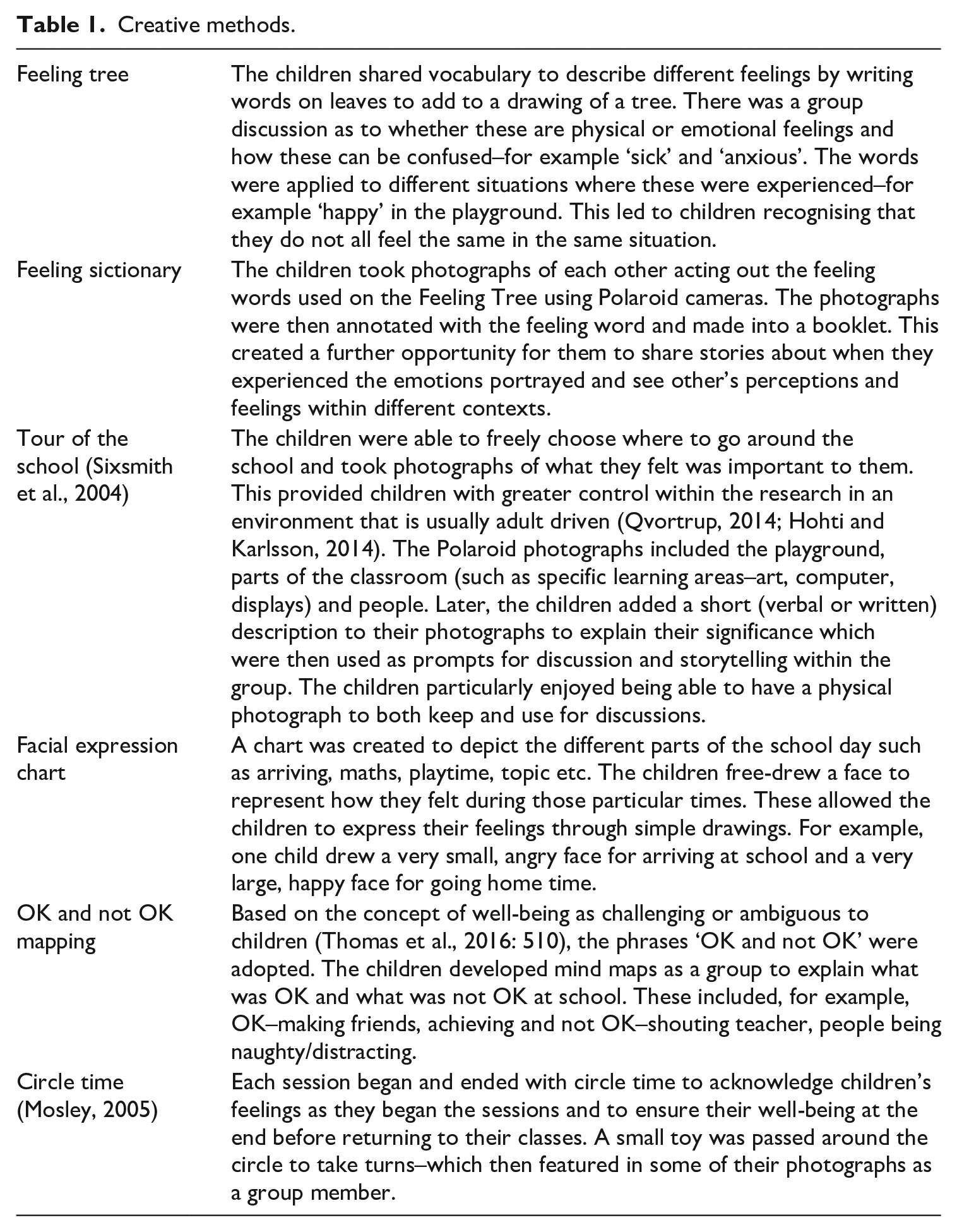
The methods involved were equal in both settings and deliberately chosen to engage the children in a number of different developmental activities to enable their stories to be told (Kellock, 2011; Kellock and Sexton, 2017). The activities were carried out in groups of three to enable the children an opportunity to be heard. In addition to promoting children’s voices in this research, the use of photography and creative methods utilised are considered as especially appropriate and empowering (Kinnunen and Puroila, 2016; Wang et al., 1998). Table 1 outlines the specific methods used in the study.
Creative methods.
In sum, the methods chosen reflect the position of the researcher and the respect for children’s voices. This has facilitated the generation of data that reflects the children’s current thoughts around their well-being status in the primary school and has been analysed and developed into the approach to understanding well-being below.
Findings
Following the range of creative activities carried out with the children, a wealth of data was generated in the form of drawings, maps, photographs, annotations and transcripts from discussions. The children individually selected their most significant photographs and shared these with the researcher, adding verbal narratives to explain their importance. There was then a small group scaffolding activity where the children shared their own selection of photographs before working together to identify overlapping themes between themselves. These were then combined into nine key themes from each of the small groups by the researcher. This collaborative and participatory method enabled the children to be part of the process in identifying a set of capabilities as encouraged by Sen (Biggeri et al., 2006; Robeyns, 2005). Namely, the themes in order of most relevance to the children are
People – relationships with friends, relatives, for example, my sister in year 1; members of staff (present teacher, last year’s teacher)
Place and environment – for example, parts of the playground, individual desk/seat, displays for learning or children’s work
Being physically active – for sports, playtimes, being outside of the classroom (this was more dominant for the male participants)
Being creative – opportunities for art, music usually associated with greater freedoms and as memories, for example, playing with water or dressing up in the first year at school
Play – free choice play with friends, play-based learning (also associated as a memory from earlier years at school)
Learning – value of learning, resources attached to learning to aid self-learning, learning spaces
Autonomy and choice – having independence and choice in own learning and school experience, having own space
Rules – breaking rules, rules making children feel safe
Needs – having lunch, water, toilets, being cared for
The most significant and common themes were the first two around people and place and environment; these demonstrate the key factors that influenced children’s subjective views on their own well-being in the context of an educational establishment. It is important to note that the themes here are not exhaustive and may differ when the methods are applied to a different group of children. Specifically, the list presented here is contextualised and non-definitive; the children’s voices dominate yet the broader influences on their lives cannot be removed such as, for example, parental influence or societal factors (Domínguez-Serrano et al., 2019).
There are considerable overlaps with other generated non-definitive lists including Kellock and Lawthom (2012) and; Biggeri et al; Biggeri and Anich; Anich et al; Gálvez-Muñoz et al.; and Dominguez-Serrano and del Moral Espin as cited in Domínguez-Serrano et al. (2019: 26). Concurring themes include people/love and care; learning, education and being literate; play and leisure; needs/protection, health; autonomy/participation.
In addition to the themes generated, the individual stories of the participants were considered as part of the overall analysis. The participative nature of the study and the enablement of voices being heard also led to enhanced well-being for the children involved. Such individual developments included increased emotional intelligence, for example, empathy, confidence to contribute in class, and appearing ‘happier’ as noted by the researcher as well as the children’s teachers. Taking part in the short activities allowed the children to develop opportunities for them to express themselves and understand other’s feelings, an important element of being community members. It is important to examine individual stories against the approach to understanding well-being presented to consider the unique experiences of those involved but also to consider what elements are addressed or not, for appropriate support to occur.
Discussion
With the two theories of the Capability Approach and Community Psychology in mind as a framework, there is now a discussion as to how the children’s themes form a means of understanding children’s well-being in the primary school. The themes are considered to be integral to the make-up of children’s well-being in the primary school from their perspective. Each of these themes can be understood as positive, neutral or negative experiences for children. For example, under the theme of people, this could be a positive experience and influence on well-being with appropriate, supportive relationships. Alternatively, negative relationships with teachers or peers, including the experience of bullying, can have a detrimental effect on a child’s well-being. Therefore, the positive, neutral and negative impacts of such conversion factors are often beyond the child’s control (Ballet et al., 2011).
In intertwining the Capability Approach and Community Psychology along with the nine themes, the holistic nature of children’s well-being can be understood. Part of the Capability Approach acknowledges agency (Robeyns, 2017; Sen, 1999) where an individual has the capacity to initiate change. For children, this is seen as limited, especially in a school setting where their ability to make their own decisions is restricted. The Capability Approach, here adult driven in terms of children being able to develop their capabilities, demonstrates the need for practitioners to both understand individual children’s experiences and create openings for further development. As such, the adults can facilitate capabilities through giving freedom and opportunity to children for them to achieve functioning (Robeyns, 2017).
If children are seen as active network members (as referred to by Green et al., 2005) with greater autonomy within their school community this can also further possibilities for their influence on their own well-being. The Capability Approach acknowledges that all children have a set of capabilities and functionings that allow them to learn, discover and potentially achieve in the school setting. The opposite is also true; this is where we can consider conversion factors. On a micro-level, a teacher’s decision or action can have an impact on capabilities becoming positive functionings through constraints they may impose (intentional or not) (Biggeri et al., 2006; Kellock and Lawthom, 2012; Robeyns, 2003). Therefore, learning that takes place is within a place or environment where people play a significant role, as described earlier by Sonn (1995) and James and Prout (1997). This is demonstrated within the Community Psychology element and highlights the importance of relationships within the children’s lives, pertinent to Bronfenbrenner’s (1979) seminal work.
Community Psychology offers an umbrella over the school environment and those within it. Under this lens, it is considered how this environment plays a role in children being able to function and therefore, achieve their capabilities. If the school environment is not conducive to learning or development, little positive functioning is likely to take place. The school environment includes a range of facilities including the playgrounds, school hall, classrooms, administration areas and in this case, technology suite and library. Such places were identified by the children where communal activities take place, such as the school hall and playground. The connections children had with the range of places reflected the importance of the school as a whole including places to be with friends, where to be looked after, where to celebrate and where to learn. The value of a sense of belonging and social relationships is also echoed by White and Kern (2018), noting the positive impact on well-being, academic and personal outcomes. In a positive environment such as this, functionings may occur and could be developed further where children are given more freedom to use their capabilities in a way they have reason to value (Robeyns, 2003; Sen, 1985b).
The nine themes are relevant to both the Capability Approach and Community Psychology. Through practitioners enabling functioning, for example, children have the opportunity to establish positive relationships with others. As network members, with the responsibility of being a citizen within the school and with the support of others, this capability can be realised. As in a community with laws and unofficial rules in place, schools also have a set of rules to follow. Rules were brought up by the children as they felt they contributed to being part of a safe community. In order to function positively, it was felt that rules were required in order for them to have a fair experience. Rules can be more empowering when developed alongside the children rather than being imposed and recognising children as community members, this can be achieved.
In bringing together the Capability Approach with Community Psychology along with the children’s themes key aspects of children’s well-being can be identified. In considering the capabilities and functionings that children experience along with the perspective of people and place, this allows opportunities for practitioners to acknowledge where children may need further support through hearing their voices. To enable an equitable school experience, individual needs are to be identified in order to help them thrive. This approach demonstrates that well-being is not a straight forward phenomenon but an intrinsic state of being that depends on a wide range of influences.
The children’s data demonstrate that there is room for new knowledge from the adult perspective on what children perceive as important in school. The heavy demands on teachers to get results and cover vast curricular areas is time constraining and stressful, but at the heart of school, the children are what it is really all about. The primary school experience as confirmed by the children can be fun and sociable. The blatant demands of desiring more time to be creative, active and to have choice that stemmed from the data are often ignored within the restrictions of school and seen as impossible to take on board. It is not intended here to convey that primary school should just be fun and free, but that the experience could be adapted and more suitable to individual needs. This could include time for children to spend out of the classroom in smaller groups, provide children with more opportunities to make their own choices and take greater ownership and responsibility for their learning. In addition, there could be a pedagogical shift to make learning more explorative and creative.
The relatively simple and short activities administered with the children can easily be facilitated within the school day. They enable an insight into individual experiences and preferences to ameliorate their well-being. An example of this is from one of the participants, here identified as Philip, aged 8.
Before each research session, Philip was ‘delivered’ to the workshops under threat to behave or be sent back to class by his class teacher. After a short time in the small group environment and being able to express his feelings, Philip became notably calmer and engaged. In drawing his facial expression chart, it was quickly evident that Philip disliked arriving at school and numeracy in particular (steam coming out of his ears). He drew his happiest face for home time, play time, friends and art. Philip identified the classroom as a noisy, unhappy space and as a result was distracting to others. He related more positively to smaller group activities or freer play spaces, such as the playground or hall for sports as evident through his Tour of the School images.
In understanding Philip’s contributions, discussions with Philip and understanding his perspective could considerably enhance his well-being and overall school experience. Philip’s clear unhappiness around being in busy, adult-led situations led to a lack of sense of belonging and disengagement. His changed state after being in the research group, that is, that of being calmer and more responsive was noted by this teacher. Bethune (2018) indicates the necessity for a tribal classroom where, mirroring my own philosophy, the primary classroom is one where children should feel they belong, are part of a family where needs are met. This article asks teachers to identify individual children’s needs through simple activities. Small changes to practice can produce greater and more appropriate experiences for the children. As a result, more autonomous community members will prosper.
The data have indeed provided a wealth of material to support the discussion in this article. That said, the research is not without its limitations and potential developments. The small scale nature of the research is acknowledged and the data must be considered in the context of the particular children involved at a specific time. It is also argued, however, that this is a strength of the article in that the same methods can be undertaken to investigate children’s well-being in multiple other contexts. In comparison to other lists of children’s capabilities, there are certainly overlaps as indicated. The specific children in this study were not concerned about broader health issues or economic exploitation as acknowledged in other studies (see Domínguez-Serrano et al., 2019) due to their own circumstances and possibly age. This reiterates the value, however, in children co-constructing their own list (Sen, 2004). Further understanding of the precise factors affecting functioning and a greater understanding of teacher well-being will support a future article.
Conclusion
In light of current trends and developments in research around children’s well-being and mental health, understanding the uniqueness of childhood is imperative in supporting their experiences and futures. Through applying the approach presented in this article, it can be seen how understandings can be developed and how this can be adapted to individuals. Well-being is of concern to particular marginalised groups of children and to all children. Social economic status, specific learning needs, looked after children and cultural differences will all have a bearing on children’s own state of well-being as is well documented. What is imperative to recognise is that on a personal level, which this study has helped reveal through the in-depth data collected and interpreted, that well-being is a personal construct and context specific to each individual. As such, while a set of themes have been shared in this article as an example, this will vary with different children making for a flexible and useful tool.
Practitioners and teachers have privileged positions in primary schools and hold close relationships with the children. The value of teachers knowing the children (Thomas et al., 2016: 512) is critical in children’s development, enabling them to identify how to support individual needs and those who would benefit from additional support. Each school community is unique and the complexities of each individual setting should be taken into account to deliver the appropriate support for the children who attend (White and Kern, 2018: 11). The well-being of practitioners is of course also imperative in their quest to supporting the children in their care (Mann, 2018).
The data generated has provided a clear understanding of the children’s perspectives as to their own well-being in the primary school context, leading to a theoretical discussion. The unique stories have delivered a fresh perspective on children’s well-being for an age group under-researched and in need of their voices being heard. Indeed, the dilemma around the status of children’s well-being and mental health only heighten the need to hear such voices and act upon what is said. If children’s well-being is taken seriously and acted upon, the wider benefits in both the short term and the long term are to be recognised as advantageous to children, their successes and their roles within society, now and in the future.
Footnotes
Declaration of conflicting interests
The author(s) declared no potential conflicts of interest with respect to the research, authorship, and/or publication of this article.
Funding
The author(s) received no financial support for the research, authorship, and/or publication of this article.
