




Abstract
Amid global disruptions, exacerbated by the current crisis, existing educational disparities, particularly affecting marginalized groups, have deepened. This study delves into the profound implications of disasters on existing education disparities, emphasizing the exacerbation of the digital divide during times of crisis, utilizing Amartya Sen’s and Martha Nussbaum’s capability approach as the theoretical framework. We investigate two key questions: (1) How does the digital divide affect children from various socioeconomic backgrounds during upheaval? (2) How do disaster-induced disruptions worsen existing social justice issues? Our robust case study, enriched by three comprehensive data collection phases, includes semi-structured interviews and open-ended-question with 41 participants over a 4-month period in 2020 to 2021. Our findings reveal that vulnerable groups experienced “digital alienation” during educational disruptions, prompting government actions to address the digital divide through measures like the Educational-Informatics-Network Connection Hubs and tablet distribution. In sum, the study underscores how disaster-induced disruptions, surpassing the scope of any specific event, serve as catalysts for deepening of educational inequities amongst already disadvantaged groups. It is recommended to revise the digital divide taxonomy, which is an indicator of participation in digital processes, determined under normal conditions, considering the human agency requirements specific to the profound failure of social justice during times of catastrophes such as COVID-19, Ukrainian-Russian war, and Feb. 6th Earthquakes in Türkiye.
Plain language summary
This study looks at how major crises, like the COVID-19 pandemic, deepen existing educational inequalities, especially for students from disadvantaged backgrounds. It focuses on how the “digital divide,” or the gap between students who have access to technology and those who don’t, widens during these times. The research explores two main questions: 1) How does the lack of technology impact students from different socioeconomic backgrounds during crises? 2) How do these disruptions make social justice problems worse? Using interviews with 41 participants, the study found that many vulnerable students experienced “digital alienation” during school closures. In response, governments attempted to bridge this gap through programs like internet access hubs and tablet distribution. The study highlights that these crises reveal a deeper failure of social justice, and calls for updating how we measure the digital divide, especially during times of disaster.
Introduction
Social justice has been a primary concern both in international and local cycles of governance which simply “meant fair and equitable distribution of resources” (Rawls, 2020). As a socially created reality, judgments about what is just, fair or deserved are at the heart of people’s feelings, attitudes and behaviors in their interactions with others in a social setting (Tyler & Smith, 1995, p. 1). Social justice is simply concerned with how we can establish a more equitable and just society for the good of all. Another important issue, in the provision of social justice could be finding the ways and means of reaching this common good. In fact, the search for finding these ways and means has some historical roots. Social justice can be traced back to Plato (427–347 BC) and his prominent book The Republic where justice is described among the four virtues on which an ideal state would rest. Later, Andulisian philosopher Ibn Khaldun (1332–1406) considered justice as a precondition for social order (Gule, 2015, p. 132); thus, making a connection between capabilities of social life and justice. Furthermore, he defined good governance which is based on his idea of “Ilm al’ Umran” (the science of civilization and welfare) as a tool for the implementation of law to assure social justice (El-Kholei, 2019). Similarly, Al Ghazali (1058–1111), an early medieval Muslim scholar, in his prominent work Dawlat (the State) suggested social justice as the major premise of good governance as well (Ozay, 1997, p. 1203). Later, Locke, Rousseau, Kant, Hobbes, and others developed “social contract” theories to formulate social justice as a primal fabric of well-ordered societies. As seen social justice is not a new concept. Rather than focusing on developmental background of this concept, this study examines how social justice intersects with educational equality, equity, preserving conversion factors and related functionings under the challenging conditions of the COVID-19 pandemic, with the goal of contributing to the maintenance of a just educational system.
Social justice is a difficult term to capture a sense out of it (Novak, 2000). Various definitions are common in the available literature, Ornstein (2017) in his scholarly article suggests 30 frameworks to view social justice issues in modern times and justifies the variability as such: “The fight for social justice is incremental and extends over centuries. The interpretation and judgment of social justice depends on who interprets it and who writes the laws of society” (p. 546). If we distil Ornstein’s main threads on social justice, the following insights emerge encompass its elusive and contentious definitions, especially in emergengies:
The COVID-19 pandemic magnified the existing disparities, underscoring the critical importance of social justice in education. Central to this is the principle of fair and equitable access to education, which asserts that all students, regardless of socioeconomic background, have opportunities to access quality education (Holtmann, 2016; Schleicher & Zoido, 2016; Shields & Satz, 2017). To bridge this divide, education systems must establish fluid pathways for mobility, providing programs and resources to empower underprivileged students to overcome structural barriers (Breen & Jonsson, 2005; Spaaij, 2013; Stephens et al., 2014). Highlighting individual rights in learning is essential, providing every student with the right to learn in safe, inclusive, and supportive environments unconditionally (De Waal & Grösser, 2014; Fobosi & Mkuzo, 2024). At the same time, legal protections for marginalized groups are crucial to address systemic inequities, enforcing anti-discrimination policies to safeguard students and educators against bias and inequity (Cea D’Ancona & Valles Martínez, 2021; Fredman & Campbell, 2018).
The pandemic has also highlighted the need to create opportunities for growth and success through systems that foster academic and personal development, particularly for the most vulnerable (Lisciandro et al., 2016; Yeager & Dweck, 2012). Addressing disparities in achievement and resources, including gaps in access to technology, teacher quality, and academic performance, is essential to ensure equal opportunities in digital learning environments (Memon & Memon, 2025; Rana, 2024; Tang et al., 2024). These efforts require government intervention to mitigate inequality, advocating for policies that reduce disparities in educational outcomes between demographics (Crow, 2022; Cruz, 2021). Furthermore, an ongoing reassessment of educational values is vital to adapt curricula and policies to reflect inclusivity and fairness in a rapidly changing landscape (Arnot, 1991; Moss & Schutz, 2001). In this context, updating Life Studies curricula, which prepares primary school students for life through skills and values education (Kalender & Baysal, 2021; Kalender et al., 2023), can play a key role in equipping children to cope with such unpredictable circumstances.
Social justice emphasizes a process rooted in respect, care, recognition, and empathy (Theoharis, 2007, p. 223). According to Goldfarb and Grinberg (2002), it involves actively reorganizing institutional and organizational architecture to reclaim, uphold, and promote the fundamental human rights of equity, equality, and fairness across social, economic, educational, and personal spheres (p. 162). Gewirtz (1998) suggests that social justice entails challenging and disrupting systems and structures that encourage marginalization and reinforce exclusionary processes, advocating for transformative actions to create more inclusive and equitable practices during and beyond emergencies.
Inclusive and equitable quality education has been one of the goals of nations for decades. In this realm, Brighouse (2002) suggests two aspects as the guiding principles of social justice in education; these are principles of personal autonomy and educational equality (p. 183). When integrated and utilized in line with equity concerns, technology can provide inclusive instructional practices (Edyburn, 2011) and help narrow the digital divide. At the same time technology continues to play a significant role in increasing access to education and opportunity for historically underserved populations such as international migrants, women with children and domestic obligations, and people living in rural and remote areas (Marx & Kim, 2019). However, this is not the case in emergency times, as painfully shown by COVID-19 period, technology aggravated pre-existing inequities, (Kimmons, 2019; Vehovar, 2001) pushing a huge population disadvantaged groups beyond marginal borders.
Because COVID-19 has clearly shown that most of social and economic inequalities, already existing in society are replicated in digital learning environments became the mainstream channel promptly. Long before the COVID-19 pandemic, access to technology and especially the Internet use remained disproportionately at lower levels for older adults, low-income households, students of color, and rural students (Perrin & Duggan, 2015) even in a high-income country, the USA. While struggling for social justice and equity in educational spheres all around the world, “…school closures due to COVID-19, at its peak in early April 2020 have left close to 1.6 billion children and youth out of school (Azevedo et al., 2021, p. 1). This means that virtual environments are good recipients of social justice patterns inherited from the “real world.” Moreover, virtual media can act as a magnifying glass of deprivation for vulnerable groups, especially in turbulent times. Under normal conditions, educational technology may appear to be supporting social justice in education. However, we need to look at carefully which social groups the technology serves most, what power structures are franchised and how they interact with a particular social strata (Marcovitz, 2022, p. 1); especially when it becomes the main utility artery in times of emergency. Therefore, digital divide should be addressed as a reflection of broader social problems rather than as a one-dimensional technical issue (Light, 2001). The aim of this research is to shed light on the newly emerging patterns of digital divide and how different SES communities were affected in terms of educational equity during the COVID-19 school closures. In this way, it is aimed to make inferences that will shed light on the digital divide in the context of social justice when faced with the necessity to switch to distance education due to different disaster situations in different parts of the world, such as the Ukrainian War, the Feb. 6 Earthquake in Turkey, the fires in Hawaii. This paper also helps understand the patterns of how low-resource and high-resource schools have been “digitally positioned” using Capability approach as the theoretical lens. This study is significant in that it leverages the Capability Approach to analyze the interplay between human agency, conversion factors, and achieved functionings, emphasizing how adaptive preferences can distort aspirations in under-resourced communities during crises. By foregrounding these theoretical aspects, the paper offers a nuanced framework for understanding the digital divide as a multidimensional construct, rooted in the systemic inequities that shape educational access and equity in times of emergency. Accordingly, the following sub-questions have been addressed in the context of school closures during the COVID-19 pandemic:
What experiences did primary school teachers have, and what challenges did they encounter during this period?
How did the digital divide manifest across different socioeconomic status (SES) groups in the context of social justice?
What changes occurred for different SES groups throughout the process?
Theoretical and Conceptual Frameworks
The social justice theory taken as the theoretical framework of this study is grounded in the combination of Rawls’“Theory of Justice” (1999) and Sen’s “The Idea of Justice” (2009). Rawls with his justice and fairness principles suggest that “… inequalities of wealth and authority, are just only if they result in compensating benefits for everyone, and in particular for the least advantaged members of society” (Rawls, 1999, p. 13). Therefore, the use of technology, that does not prioritize the compelling needs of the disadvantaged and the oppressed, will inevitably reproduce exclusive, inequitable, and unjust social and educational structures. This is what exactly has been happening in the case of digital divide so far. Digital divide is simply defined as the inequality between individuals, companies, or nations from differing classes in terms of access and use of information and communication technologies (OECD, 2001, p. 5).
Sen’s capability approach is about freedom and the development of a socio-cultural ecology suitable for human flourishing. Sen, in his capability approach refers centrally to the freedom of choice, among a range of options made available to a person and choosing what life to live (Drèze & Sen, 1998, p. 10). The capability approach prefers to follow a “human freedom” path to achieve wellbeing, human development, and justice (Sen, 1999) as opposed to “human capital” and utilitarian perspectives of the neoliberal policies, to “enlarge people’s choices” (UNDP, 1990, p. 1). In Sen’s capability approach, this enlarged choice(s) is conceptualized as human agency; potentially used in appropriation of opportunities to develop and exercise one’s capacities. Agency is the “pursuit of whatever goals or values a person regards as important… and relates to the view of persons as responsible agents” (Sen, 1985, pp. 203–204). Human agency also has deep going roots in the psychology of self-efficacy. As Bandura suggests, “belief in one’s efficacy is a key personal resource in personal development and change (Bandura, 1997). Bandura (2006) further asserts that belief in one’s efficacy is the foundation of human agency (p. 170) which involves the existence of rights, as well as options and the means to pursue the freedoms (p. 165).
In the Capability Approach, a capability represents the real freedom or opportunity a person has to choose from the set of functionings and achieve various valuable ways of living (van der Klink et al., 2016, p. 73). It is not just about what a person actually does but about the range of meaningful choices available to them, enabling them to lead the life they value and have reason to value (Kaushik & López-Calva, 2011). The Capability Approach, as outlined in the Stanford Encyclopedia of Philosophy (2023), emphasizes two key normative claims: the freedom to achieve well-being as a primary moral priority and the understanding of well-being through people’s capabilities and functionings. It highlights that the ability to convert resources and public goods into functionings—defined as capabilities—depends significantly on personal, sociopolitical, and environmental ‘conversion factors (p. 1).
Conversion factors refer to the personal, social, and environmental circumstances that influence an individual’s ability to convert resources or means into valuable functionings and capabilities. Personal factors include physical and mental characteristics such as health, skills, or education. Social factors encompass societal norms, cultural practices, power dynamics, and institutional structures that shape opportunities. Environmental factors involve the physical and material conditions, such as infrastructure and geographical accessibility. In the Capability Approach, these factors are critical in recognizing that individuals differ in their capacities (inter-individual differences) to convert the same resources into similar outcomes (Robeyns, 2017). Emphasizing the need to evaluate well-being based on the opportunities genuinely accessible to people rather than solely on the resources just made available to them. Emergencies often worsen inter-individual differences, disproportionately against disadvantaged groups by weakening their ability to convert resources into meaningful opportunities (Tseng & Stojadinović, 2024).
One of the key strands of the Capability Approach is adaptive preferences. Adaptive preferences, in broad terms, are those imposed by oppressive or restrictive circumstances, pressing individuals to accept choices misaligned with their true interests or potential (Gotoh, 2015, p. 23). Unlike the utilitarian focus on preference satisfaction and human capital formation, which emphasizes productivity and resource provision, the Capability Approach values the development of human agency—the autonomy and ability to make meaningful life choices (Gale & Molla, 2015). As Bridges (2006) and Nazarian (2024) argue, such preferences can become deeply rooted through socialization, culture, or habituation, but they are reversible through the removal of limitations, exposure to new experiences, and learning, enabling individuals to redefine aspirations and realize their authentic capabilities.
As instruction solely relies on digital systems, particularly during emergencies, adopting a justice-oriented, capabilities-based perspective is essential to ensuring that technology serves as a tool for empowerment and inclusion. Adaptive preferences may lead individuals to internalization of constraints imposed by their environment, such as poverty, social inequality, deprivation of connectivity of any kind or systemic discrimination, and adjust their aspirations downward to align with their limited realities. Avoidance from adaptive preferences-mandated by the highly restrictive conditions of the COVID-19 underscores that digital equity in education is not merely about access but also about enabling learners to realize their freedoms and authentic aspirations in a just and inclusive digital ecosystem.
Minimizing the digital divide and addressing social injustices are closely tied to compensating for these differences, enabling disadvantaged individuals to achieve essential capabilities and functionings. (Singh, 2010, p. 133).Could the primary reason why the Capability Approach regards education as a public good be that individuals’ ability to transform resources into meaningful functionings or valued lifestyles-using the mechanism of “conversion factors”- depends fundamentally on access to quality education and guidance? Education equips people with the tools, skills, and opportunities-by minimizing the inter-personal differences in favor of the oppressed- necessary to overcome barriers and realize their capabilities, making it indispensable for achieving justice and equity in human development.
The capability approach thus suggests “concentration on freedoms to achieve in general and the capabilities to function in particular” (Sen, 1995, p. 266). As primal concepts, there is a clear distinction between functionings and capabilities; “A functioning is an achievement, whereas a capability is the ability to achieve. Functionings are, in a sense, more directly related to living conditions, since they are different aspects of living conditions. Capabilities, in contrast, are notions of freedom, in the positive sense: what real opportunities you have regarding the life you may prefer to lead” (Sen, 1987, p. 36). Capability approach, as opposed to human capital and post-structuralist views, does not limit the evaluation of education to utilitarian perspectives and standardized assessments of cognitive learning as a measure of success; “recognizing variation in individual abilities and contextual constraints, it considers the connection between input and output by focusing on how resources are converted into abilities and then the abilities into functions” (Unterhalter et al., 2007).
In this particular study, we base our social justice perspective in education on the Capability Approach which aligns with the justice-based paradigm by emphasizing the intrinsic value of education (Walker, 2019), over its measurable and tangible economic effects-viewing it as a tool (instrument) for economic growth (Karaçay, 2010). In contrast to the instrumentalist view, the Capability Approach values education as a means of expanding opportunities and achieving equity (Unterhalter et al., 2007). It focuses on education’s role in enhancing individuals’ capabilities and freedoms (Otto & Ziegler, 2006, p. 271) and it is widely recognized as a public good (Gracia-Calandín & Tamarit-López, 2021); non-excludable and non-rivalrous, meaning they benefit society as a whole and are not governed by market mechanisms (Walker & Unterhalter, 2007).
Here, taking COVID-19 conditions into consideration, the critical question would be that “what will happen if a person is fully deprived of his/her capabilities due to an external factor out of his/her control?” We believe that this would push that person into the territories of oppression; beyond manageable limitations of freedoms and functionings. Young’s (1990b) classification justifies our belief that “the deprived capability to self-develop” is one of the “harmful effects and the core of oppression” (Chen, 2017, p. 421). In a sense, most of the Young’s (1990a) Five Faces of Oppression; namely exploitation, marginalization, powerlessness, cultural imperialism, and violence are pertinent to the consequences of the digital divide emergent during the COVID-19 school-closures where online learning has been the only mainstream option. In the same vein, “being disconnected from digital services pushes people into exclusion and poverty” (Meinrath et al., 2013, p. 26). In a crude sense, theoretical views on issues of access or non-access are not fully descriptive of the spectrum of digital divide under emergency circumstances where inequalities are deepened by the lack of capabilities and appropriation. Furthermore, in educational spheres “epistemological access” is also crucial to fully achieve individual learning outcomes. Epistemological access denotes something more than mere formal access to a learning environment where the learner’s agency is needed to become an active and functional participant of a responsive program, further, to achieve emancipatory ideals of education as well (Morrow, 1994). From the capability perspective, the situation can be analogous to that of a refugee family receiving food aid from a volunteer; let it be a watermelon (resource); a knife is needed to cut it (a conversion factor for a capability) and the human agency (and will) is a must for the delivery of watermelon slices to family members for benefiting from the nutrients (functioning). However, under normal conditions human agency incorporates having the opportunity to choose the food which serves best the interest of the family in question.
Roots of the Digital Divide and Social Justice Issue in the COVID-19 Pandemic Period
While 20 years ago, access to information technologies was seen as a supportive tool for learning and educational purposes, however, it became the dominant tool of online learning, especially after the COVID-19 pandemic. In this respect, access to the Internet and digital media have been a vital tool for inclusion in the digitally steered learning environments. In fact, long time ago, United Nations spotted that access to the Internet is one of the basic human rights in contemporary societies (United Nations, 2009). Because access to and utility of the Internet, improve diffusion of recent innovations, market efficiency, economic and educational opportunities, promote human skills and democratic participation (UNDP, 2001) by overcoming barriers of social and geographical isolation. In sum, deprivation from knowledge and other information sources would lead to diminished social power and exclusion from the social spheres where basic rights and freedoms are exercised.
In fact, the harsh reality showing the impact of “socioeconomic divide” (family background) on school achievement (Coleman et al., 1966) has been the signal flare of subsequent “potential divides” to cause further educational inequalities. Since Coleman report, it is obvious that the educational inequality gap (between the poor and the well-off families) is persistent and has changed in modality only. This situation is also well portrayed by the “Knowledge Gap Hypothesis” (Tichenor et al., 1970) which landmarked the onset of the digital divide long before. However, educational technologies and the digital media have never been independent of power and class relations readily ongoing in the society. Furthermore, “…technology does not on its own contribute to truly transformative goals or ideals of equity and social justice in education.” (Papendieck, 2018: p. 4). Studies focusing on “access” as the division criterion constitute a huge literature (Yu, 2006) of the first level digital divide. Digital skills and mastery in usage were the research concepts in the “second-level digital divide” (J. A. Van Dijk, 2005). Third level of the divide came with the shift to digital skills and use of the Internet not yielding beneficial consequences for all (van Deursen et al., 2016). Lythreatis et al. (2022) refer to type-of-internet access and algorithmic awareness as newly emerging digital divide issues. A further gap between the well off and the low-income groups in the uptake of technology showed dramatic differences especially in access to the Internet during the COVID-19 pandemic (Lai & Widmar, 2021). This new form of gap exposed and became evident with a kind of digital exile extending into oppression; going far beyond J. van Dijk’s (2006) four types of access gaps defined as “mental access, material access, skills access, and usage access.”
The Capability Approach, pioneered by Amartya Sen and Martha Nussbaum, suggests a compelling lens to examine the intersection of technology, education, and social justice, particularly during emergencies. Johnstone (2007) critiques traditional ethical models, proposing a value-based framework rooted in the Capability Approach to examine whether digital tools foster agency and participation, thus addressing systemic inequities. Wresch (2009) elaborates the moral dimensions of the digital divide, demonstrating how limited access to digital platforms deprives marginalized communities of essential resources like medical information and global visibility, underscoring the urgent need for equitable technological interventions in crises. Schejter et al. (2023) empirically apply the Capability Approach to ICT adoption in marginalized communities, revealing the critical role of context-sensitive policies in ensuring technology meets actual community needs during emergencies. Finally, Tseng and Stojadinović (2024) emphasize the capabilities of individuals as a linchpin for resilience, illustrating how digital systems can support education by adapting to the dynamic needs of learners and educators in disaster scenarios. Together, these studies underscore the transformative potential of the Capability Approach in bridging the digital divide and fostering inclusive education.
The capability approach provides a framework and a normative base for assessing human capabilities challenged by emergency remote education during the COVID-19 pandemic. With the advent of COVID-19 diversity of capabilities compromised to inhibit human development in all facets of social and economic life and identifying range of deprivations is of high value for spotting policy targets across all areas of life” (Anand et al., 2020, pp. 294–297). Venkatapuram (2020) asserts that “respect of the equal moral entitlements of every individual means social policies must aim for achieving equity of capabilities across individuals… capabilities are both the means and ends of social development and social justice.” (p. 281). Empirical evidence strongly suggests that capabilities in the adoption of ICT are mainly restricted due to income and wealth differences both between individuals and nations (Vicente & López, 2011). The most vulnerable learners are also among those who have poor digital skills and the least access to the hardware and connectivity required for distance learning solutions implemented during school closures (United Nations, 2020, p. 8). Almost no academic and policy attention addressed this exacerbated form of digital divide which turned pandemic-mandated online instruction into a nightmare for the already vulnerable groups. Therefore, it is necessary to understand that we are confronting a completely different situation in terms of the diminishing capabilities in education, both in discourse and practice.
Method
A theory-led single case study approach, as viewed from the transformative interpretive framework, was adopted in this study. The study was conducted spanning a 4-month period concurrent with the peak of the first wave COVID-19 pandemic-induced school closures (Sept.–Dec.2020). It aims at an in-depth understanding of a situation within the scope of a particular theory or topic (Stake, 1995). Therefore, the study has been conducted to gain insight into how different SES groups utilized educational opportunities in the context of COVID-19 school closures. This perspective which adopts, as a basic principle, to reflect the power and social relations in the society and to provide support to individuals for the advancement of their social participation (Mertens, 2003). It aims to reveal the situations of the groups, abstracted, separated from the society, and intimidated, to raise their awareness and develop them socially (Creswell, 2013). Moreover, the research, also, falls within the scope of explanatory case study since it attempts to understand a particular situation based on certain theoretical premises (Fisher & Ziviani, 2004; Simons, 2014). We call our approach as “multi-layered single case” since data were collected from three different SES school environments to understand the subunits of the case concurrently. This means that our single case study bears some embedded units (three SES levels) which give the advantage of looking at subunits residing within a larger case holistically (Yin, 2003). “The ability to engage in such rich analysis only serves to better illuminate the case” (Baxter & Jack, 2008, p. 550). Binding the case is also important to ensure the scope of operation in case studies. Miles and Huberman (1994) define case study as, “studying a phenomenon taking place in a bounded context; the case in effect is, your unit of analysis” (p. 25). We put the boundaries of our case by time, context, and the phenomenon; 4-month interval, basic education level representing different SES school communities and the emergency online instruction.
Participants and Data Collection Procedures
We approached the frontline educational actors (teachers) and collected three waves of data, adding somewhat a longitudinal edge, to portray a multi-layered panorama of the digital engagements of students from differing sociocultural backgrounds. Figure 1. Shows the data collection cycles in detail. Maximum diversity and criterion sampling methods were used (Neuman & Robson, 2014) in recruiting participants. The participants gave oral and written informed consent for all the cycles of interviews. Interviewees were assured of the anonymity of their identity and affiliation throughout the research as well.
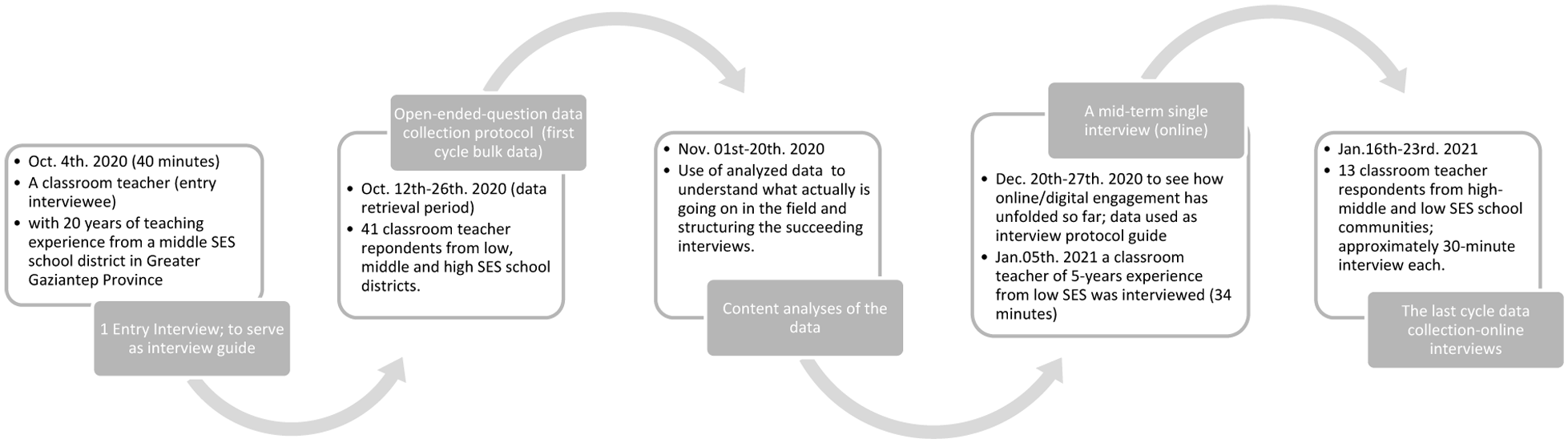
Data collection cycles; showing respondent characteristics, time intervals, and durations.
Data collection started with an entry, face-to-face, interview (an unstructured one) with a classroom teacher, from “low SES school” category to grasp the core issues and the other concerns going off at tangents. This was helpful in preparing the semi-structured data collection tool before entering the field. The second cycle participants were 41 primary school classroom teachers from three different school districts of lower, middle, and high resource communities, as categorized by the Provincial Directorate of Ministry of National Education. They were asked to answer open-ended questions in this protocol, which was delivered and collected via email, as file attachments, to comply with COVID-19 measures of physical distancing. This “grand-probing-tour” was intended to understand what actually was going on in the field during the emergency online instruction, from first-hand. It was also intended to serve as an interview guide by drawing a list of thematic prompts to be used in the design of semi-structured interview questions deductively. Moreover, it was possible to see boundaries concerning sampling and thematic saturation in the data at this phase of the study. Therefore 13 respondents out of 41 were chosen for the final cycle of data collection. These were identified as rich informants based on their ability to convey lived experiences in depth and width.
Participants who responded this open-ended-question data collection tool were also asked to manifest their consent (by adding their personal contact information) if they wanted to join the subsequent interview phase of the study. Complying with these ethical procedures, the participants who approved their voluntary participation and left their contact information were contacted by phone and their consent to participate in the semi-structured interview was reconfirmed; online interviews were scheduled on the date and time they preferred. Online interviews lasting between 30 and 40 min were conducted over Zoom (a video platform used for online communication) with seven basic questions. During the interview, both researchers were present, while one of the researchers was conducting the interview, the other took important notes during the interview and provided support to the other researcher in terms of questions to be asked when deemed necessary. Demographic characteristics of the second and the final cycle respondents is given in Table 1.
Participants’ Demographic Profiles Who Participated in the Second and Final Exit Data Collection Cycles.

The data were collected from participants working in schools with varying socio-economic, backgrounds, seniority and gender. To gain insight into all dimensions of this extraordinary case experienced by the public schools in the study group, an array of participants and sampling were assured for achieving the maximum variation in the sampling (Neuman & Robson, 2014). To ensure credibility, demographic characteristics of the participants are given explicitly (Johnson & Christensen, 2004), all aspects of the research were constantly examined and discussed by the researchers and scholarly advice was sought from an expert researcher who joined us as an external consultant and contributor. Necessary corrections were made by establishing a consensus (LeCompte & Goetz, 1982; Merriam & Tisdell, 2015). In addition, “researcher diversity” (Cohen et al., 2000); “data diversity” in terms of using two different data collection tools (Patton, 2002); working with different participants such as task type, work environment (i.e., low, medium and high SES schools), and education level shows that there is “participant diversity” (Denzin, 1978) which is thought to contribute to the credibility of the study.
Educational Context at the Study Site During COVID-19 Closures
During the COVID-19 pandemic, the site of this study, like the rest of Türkiye, faced significant educational disruptions following the government-mandated closure of schools in March 2020 (UNICEF). Education shifted to distance learning via platforms like TRT EBA TV, with additional support for vulnerable populations, including refugee children. However, challenges emerged, such as limited access to technology, reduced quality of learning, and psychosocial impacts on students (OECD). These issues were more pronounced among disadvantaged groups, highlighting educational inequalities (Language Magazine). Despite these obstacles, efforts at the study site helped sustain learning, but the pandemic underscored the need for better digital infrastructure, teacher training, and equitable education access for all.
Analysis of the Collected Data
Drawing from social justice theory, the study aims to understand the equality of educational opportunity in digital environments during the COVID-19 school closures. To this end the major findings of the study retrieved from the analyses of the interview transcripts obtained from 13 respondents in the final cycle of data collection. Remaining raw data, collected in different intervals (as shown in Figure 1) were also analyzed (descriptively) and used in achieving a somewhat longitudinal view of the digital engagement opportunities of the school communities under scrutiny. A complete picture of how the digital connection and attendance unfolded during the COVID-19 school closures is shown in Table 4.
All the interview transcripts were coded and analyzed in Turkish. Each transcript was read repeatedly by both researchers independently to achieve coding consistency. The raw data were split into chunks of coarse meaning units with reference to the research problem and the theoretical framework guiding the study. We assigned labels for the split units of meaning, taking the research objectives into consideration. Vertical and horizontal relationship of the major themes with other themes, sub-themes and categories were assessed inductively to clarify the data reduction process. This inductive approach is an analytic strategy that allowed the embedded themes and codes emerge through detailed readings to derive concepts, themes, or a data template through interpretations (Thomas, 2006). Availability of the participants, eased by arranged Zoom connections, made member checks (N = 8) possible and some minor corrections were made on the processed data.
Results
To answer the research question as to how the COVID-19 shock affected online schooling, thematic analysis was carried out on the qualitative data collected from three different SES school communities. The results are presented in the order of the research questions.
What Experiences Did Primary School Teachers Have, and What Challenges Did They Encounter During this Period?
The analyzed data yielded two overarching themes concerning the lived experiences of participants: emergent challenges and value-creating catalysis in remote learning.
The shift to online distance learning has posed enormous challenges to conventional school and education systems. Our thematic analysis shows that a renewed interest is needed to investigate digital divide after the COVID-19 experience with its implications in educational spheres and social justice practices. Pandemic-induced financial constraints may make it even harder for households of lower SES to send their children back to school after normalization. Table 2. clearly indicates emergent challenges faced during this improvised pandemic condition. Concerning the infrastructural and pedagogical adversities posed, participants narrated lived experiences as follows:
Participants’ Lived Experiences During the COVID-19 School Closures.

In the first phase of COVID-19, there was a quandary. Teachers were not given an adequate training by the by MoNE. Compared to face-to-face training, this process was more ineffective and inefficient. The workload has increased compared to the face-to-face period. Because it has become very difficult in distance education to reach the learning goals made according to the face-to-face period. A lot of effort was made, but not all learning objectives were achieved. Interviewee-4 (I-4) The Ministry of National Education did not provide enough information on the functioning of (newly introduced online) education. Also, at the beginning of the pandemic, the live (synchronous) lesson system could not be used efficiently, and the participation was quite low, 10-12 students out of 35. Written Reflection-34 (WR-34)
When the “the lack of preparedness and inadequate infrastructure” taken as the theme, regarding structural/systematic problems both Interviewee-4 and Written Reflection-34 express frustration with the MoNE’s inadequate preparation, which contributed to systemic inefficiencies in implementing online education. This reflects the structural conversion factor of the education system’s inability to facilitate meaningful learning opportunities due to logistical and institutional limitations.
Pedagogical challenges, on the other hand, were the restrictions mainly arising from the lack of minimum competence level (know-how and a skill set) immediately required by distance education modality. It became to the forefront that classroom management, student follow-up; assessment, rearrangement of the students’ learning outcomes, ensuring student motivation and continuity in participation have all become difficult tasks. Participants’ account of the lived experiences on this matter are given as follows: We were prepared for distance education processes. But we had difficulties in classroom management. In addition, it was sometimes difficult to motivate students. Therefore, there were times when we had difficulties in getting students to participate in the classes from time to time. I-3
This participant was interviewed toward the end of the first term (academic year 2020–2021 among the exit data interviewees) and has been in the distance education for some time. This experience may have given a feeling of confidence; thinking that they were prepared for the online delivery of course content.
We were caught unprepared, and we faltered. In this process, we were only able to provide some instruction, not education… we could not receive feedback on student learning, so we did not have the opportunity to measure and evaluate. WR-22
Interviewee-3 admits how they were unprepared for classroom management in the emergency online delivery of instruction and struggled to maintain student motivation, which hindered the conversion of their teaching efforts into effective learning outcomes. Similarly, WR-22′s statement about being able to provide only ‘some instruction, not education’ points out how the pedagogical conversion factors (teachers” skills, resources, and strategies) were hampered, leading to limited educational capabilities. The challenges with low student participation, as indicated by WR-34 (with only 10–12 students out of 35 attending), reflect the social conversion factors (such as family support, peer relationships, and social norms around education) that mainly determines how students can convert educational opportunities into actual participation. These factors seemed to have played a role in students’ ability and quality to engage in online learning. Furthermore, the lack of immediate feedback and interaction between teachers and students made it even harder to track progress and maintain engagement.
How Did the Digital Divide Manifest Across Different SES Groups in the Context of Social Justice?
Experiential perceptions of the participants, regarding digital engagement status of different SES groups in the COVID-19 lockdown period are presented in Table 3.
Participants’ Description of Their Students’ Digital Engagement/Exclusion.
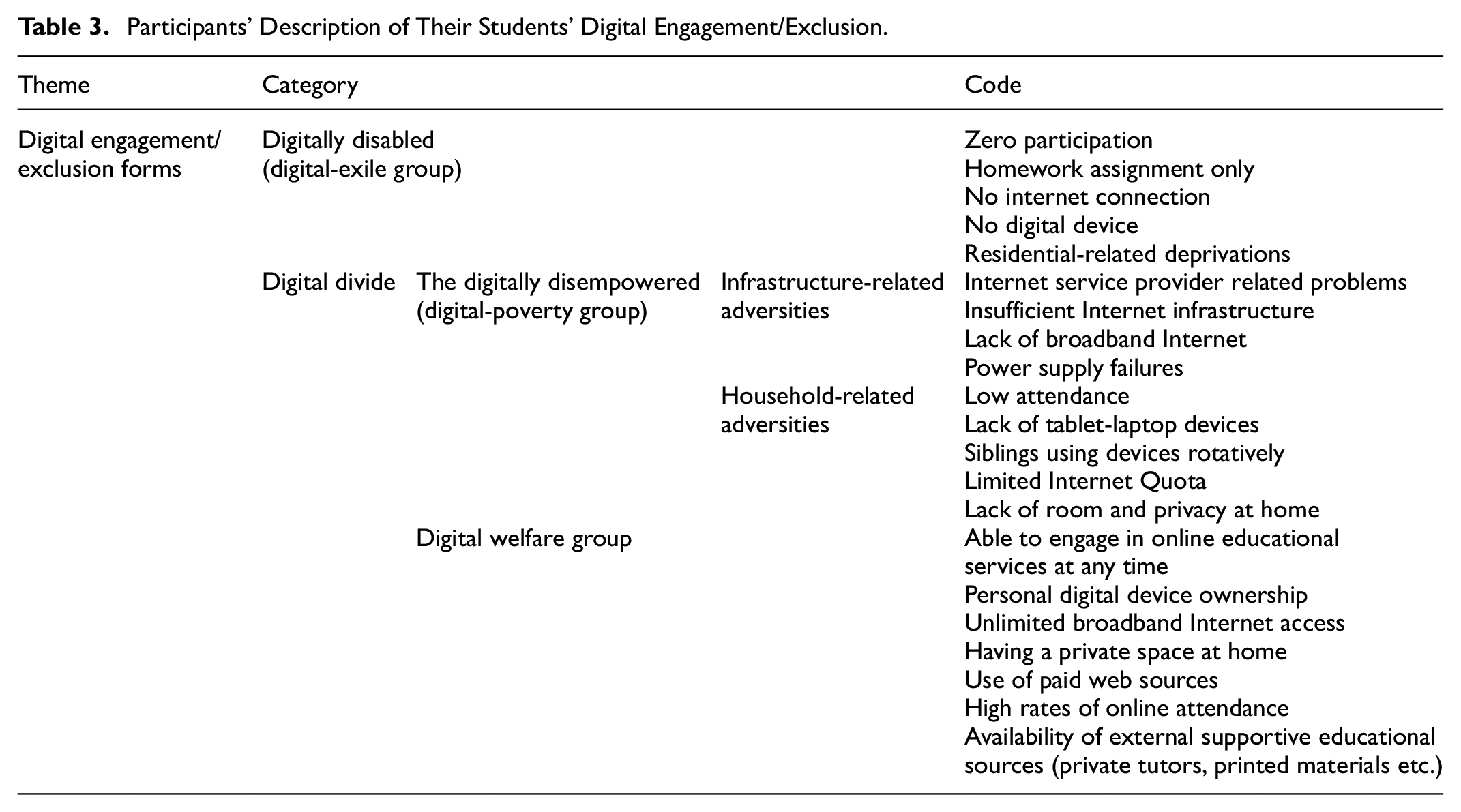
When Table 3 is examined regarding the level of participation of children in online distance instruction improvised by COVID-19 closures, it is obvious that there are two main groups and two subgroups. In simple terms, digital divide refers to two groups of potential users; those who are able to get access to digital environments (beneficiaries) and those who are not (disenfranchisers). While the terms “beneficiaries” and “disenfranchisers” may still apply in pre-pandemic contexts, they need to be reconsidered in light of the emergency circumstances of the COVID-19 pandemic. Findings of the study calls for a more nuanced and dynamic understanding of digital divide profiles, one that recognizes the complex interplay of socioeconomic, technological, and institutional factors, when digital media becomes the mainstream channel.
Based on the analyzed data we propose a new distinction for those who were unable to access online education exclusively due to socioeconomic factors, referring to them as the “digitally disabled.” This group, consisting primarily of low-SES children, faced a deepening of the digital gap—one that not only widened but also intensified during the pandemic. Rather than simply being excluded from the benefits of digital resources, these children were effectively rendered invisible in the landscape of digital education, as they fell beyond the reach of the digital gap altogether. This shift highlights a critical issue: the pandemic did not merely amplify existing inequalities but created new, more profound forms of exclusion that were not captured by traditional digital divide categorizations.
Participants gave an account of this “digital exile” group as follows: There was little participation in the live (synchronous) classes. In general, they do not have internet, computers, tablets, etc. The reason for not being able to participate was that there were not enough devices in the house or there were not enough devices for the number of siblings at a time. In case of digital equipment shortage, they had to make a choice between siblings. The attendance rate of Syrian (refugee) students, on the other hand, was much lower in this process; the average attendance was around 20%. Therefore, only the students who could not attend were given daily homework assignments. I-11. Most of the students -70%- do not have the technological means. There is no Internet… no technological tools, there are not enough devices, there is also an Internet infrastructure problem in this neglected residential area. WR-20
The second group is the so called “digital divide” group where “digitally disempowered” and “digital welfare” subgroups emerged within. Although the digitally disempowered group (middle or low SES communities living in the same residential areas) faced several infrastructural and household related adversities; yet they were able to appear in online classes at lower rates. These debilitating external factors were mainly insufficient Internet service, siblings using devices rotatively, lack of broadband internet or/and tablet, laptop.
These factors, which the Capability Approach identifies as critical environmental conversion factors, seemed to have hindered students’ ability to convert online instruction into meaningful participation and learning experience. Refugee status, as seen in the much lower attendance of Syrian students, reflecting systemic social justice barriers like marginalization and financial constraints. The “digital exile” group demonstrates paralyzed agency, as students were unable to attend online classes despite its availability due to structural inequities. Participant teachers gave their lived experiences with this group as such: In this process, some people (children) in rural areas could not participate in distance education due to household’s financial constraints, while some others could not attend distance classes due to insufficient internet infrastructure. I-7
Participant WR-39 shared this information from the field: The SES of families was not so visible before and did not draw our attention that much. But now it has become more visible. For example, I realised that most of my students live in a one-room house and attend online classes from this room. That’s why we had to witness families’ all kinds of home routines and internal affairs while delivering course content online.
In the same vein Interviewee-9 described his online experience with village-school (low-SES) kids as follows: I work in the village; families are crowded here. 70% of my students in face-to-face education were lost in this process, they could not participate. Some of them could not participate continuously due to number of siblings-attending schools- or lack of devices. Families’ preferences between siblings or subject matters destabilised participation. For example, if one of the kids is high school student, he is given the device priority; as opposed to his brother who is primary school student. If the two siblings need online connection at a time, say one of them is math and the other is English, parents make a decision on the course to be given priority, based on their attribution of subjective importance; choosing mathematics against English for example.
Participants’ lived experiences indicate that the digital-poverty group showed either low or intermittent online attendance, arising from household and infrastructural constraints. The subjective prioritization of subjects and siblings indicates that individual capacities are mediated by familial decision-making. The crowded living conditions within low-SES families further disrupt the ability to engage in productive learning. These groups exhibit intermittent or highly limited agency, as participation is restricted by external factors, pushing families to make trade-offs that undermine equitable access to education. Digital welfare group, however, showed the highest attendance rates and seemed to be exempt from all the infrastructure and household drawbacks. This high SES group was the real beneficiary of online schooling options during the school closures. In fact, this appears to be a digital spillover effect of social injustice and equity issues, inherited from onsite education.
This group benefits from enhanced agency, effectively utilizing online instruction to develop meaningful learning capabilities. In contrast, lower SES groups face inequities due to insufficient conversion factors, preventing resources from translating into capabilities. This underscores how pre-existing socioeconomic disparities, an environmental conversion factor, shape educational capabilities and perpetuate digital exclusion for disadvantaged groups. Participants gave some salient issues concerning their lived experiences with high SES students as follows: We saw that internet services differ according to SED circles in terms of infrastructure, bandwidth, internet speed and limit. We were a school with a high SED environment and “Our students have private rooms; they all have a personal technological device. Since the socioeconomic level of our students is high, families provided private tutors or paid digital resources when necessary. We rarely experienced Internet connection stability problems and power failures; but we did not have any problems in terms of personal devices and the connectivity on the part of students. WR-15
Another noteworthy finding was the changing attitudes of both parents and teachers toward the previously controlled-restricted digital engagements of students. Participants gave their understanding of this attitude change like this: While digital tools were mostly viewed as a means of entertainment and play, they are now seen as an educational tool. A mental transformation has taken place concerning the reassessment of parents’, teachers’ digital engagements of the students. WR-39 Teaching does not progress completely face-to-face, but I think that instructional technologies should be integrated into teaching activities right after the COVID period. Right now, these tools were seen as the savior of education. I myself even had a negative stance against tablets and cellular phones when used for gaming etc. I-13
This shift illustrates the potential for expanding students’ capabilities through improved attitudes toward instructional technologies, fostering long-term educational transformation.
What Changes Occurred for Different SES Groups Throughout the Process?
Table 4 shows a brief overview of the changing distance education landscape based on the comparison of entry and exit data. Some improvements, albeit negligible in the connectivity, access, and utility levels of online instruction.
An Overview of Change During the COVID-19 School Closures (Sept–Dec. 2020).

The summary of entry and exit data analyses points out some salient improvements in the uptake of digitally presented instructional media. The most important change was experienced in the lower SES group, with slightly improved access and online visibility. In fact, government’s effort to compensate the widening digital gap by delivering tablets (free of charge) and establishing EBA connection hubs (https://www.meb.gov.tr/ziya-ogretmen-eba-mobil-destek-aracinda-canli-derste/haber/22383/tr) help mitigate disadvantages in this sense.
Using the Capability Approach as a lens, the findings underscore the importance of addressing chronic injustices to ensure that all students, regardless of socioeconomic status or external factors, have the capability to convert available resources into meaningful educational achievements. To realize this vision, parents, teachers, school administrators, and community leaders must recognize their potential as unsung Human Agency Leaders. By fostering awareness and advocacy at every level—from households to schools and education-related government agencies—we can cultivate a collective understanding to bridging the digital divide and empowering all learners to achieve their full potential. Instilling such a thought would help individuals and institutions overcome capability barriers and show how individual agency can catalyze positive change in emergencies.
Discussion and Conclusions
In this article we attempted to examine emerging forms of the digital divide during the COVID-19 pandemic school closures in an urban setting. However, all the studies have limitations, our study is no exception. The salient limitation of the study is that the period experienced due to COVID-19 school closures is a unique historical time and setting where no verbatim replication is possible in the future. Yet, this uniqueness can be considered both the weakness and the strength at a time. What makes it a limitation is that any deficit in the method or the obtained data (variety) cannot be improved in the successive studies at all. It is the strength because such a critical study provides unique findings and contribution to point out a landmark in the education history. Another limitation is the lack of field observation data that would lead us to thick descriptions.
Now we will discuss how the digital divide, while utilizing remote learning has been shaped in informing capabilities social and educational spheres. The most prominent finding of the research is that the difference between the advantaged and disadvantaged groups in access to education showed an enormous increase. Moreover, the lowest SES group; the “digitally disabled,” experienced a total exclusion during the COVID-19 school closures. From the capability perspective, how to integrate digitally excluded children into remote learning environments has become a new policy challenge in inclusive education agenda. Here Young’s idea of oppression is highly concordant with our findings that “the deprived capability to self-develop” is the line extending from injustice to oppression (Chen, 2017, p. 421). In fact, this should be considered as the digital spillover effect of social injustices and broader equity problems, inherited from inequity patterns already existed. To restore the capabilities lost in the emergency remote education, a gradual transition to hybrid learning mode would save future losses on the part of the “digital exile groups” who have been deprived of their functionings due to COVID-19 measures.
Wresch's (2009) exploration of the moral dimensions of the digital divide aligns with the study’s identification of “digitally disabled” groups—children from low-SES backgrounds whose exclusion intensified during the pandemic. Wresch emphasizes the deprivation of basic human rights when marginalized communities are denied access to digital platforms, a finding mirrored in the systemic marginalization and invisibility of these children within online education. The concept of “digital exile” introduced here builds on Wresch’s insights by extending the scope of exclusion to highlight not only access issues but also the systemic inequities that paralyze agency, particularly for refugees and other vulnerable groups.
Schejter et al. (2023) emphasize the need for context-sensitive ICT policies to address the specific needs of marginalized communities during emergencies. This study’s findings align with and extend their work by providing an empirical lens into how pedagogical conversion factors—teachers’ skills, resources, and strategies—affect the delivery and reception of online education.
The emphasis of Tseng and Stojadinović (2024) on human capabilities as the critical interface between individuals and community resources is particularly resonant with this study’s findings. The identification of social conversion factors, such as family support, peer relationships, and social norms, provides new insights into how these factors mediate the extent to which students can participate in and benefit from online learning. For example, the familial trade-offs observed in this study illustrate how external pressures constrain individual capacities and foster adaptive preferences, perpetuating cycles of inequality. In overcoming such inequalities and social pressures, the Life Studies course in primary education plays a central role by developing students social and personal competencies. These skills enable children, regardless of their SES background, to identify their needs and adapt effectively during emergencies, contributing to resilience and equitable participation in learning.
The “digitally disabled” group became totally excluded and invisible in distance learning environments due to their inability to access ICT, and they seemed to experience a full learning deficit that is difficult to compensate. In spite of the intermittent connectivity, “the digitally disempowered” group did not seem to have the capability for an “epistemological access” which requires full achievement of the intended learning outcomes of a given program. On the other hand, it became evident that the advantaged groups, which we call “the digital welfare” community, maintained their online attendance regularly and seemed to have remained close to the targeted learning outcomes. To remedy the learning gaps and inequalities, the Capability Approach requires a paternalistic (governmental) intervention so that the least advantaged (excluded and disempowered) groups’ capabilities are promoted. The Capability Approach is concerned with “the role of education in promoting positive freedoms in the form of real opportunities rather than in simply guaranteeing a basic entitlement” (Tikly & Barrett, 2011, p. 7). Yet, this concern was dispersed with the COVID-19 crisis for the vulnerable groups.
The inequalities created by COVID-19 school closures should be directed to compensate gaps for improving conditions of the least advantaged members of society (Rawls, 1999). To comply with Sen’s (2009) capability approach, understanding the emerging forms of “digital disablement” beyond binary perspectives is extremely crucial in achieving functionings over capabilities. Externally driven “enabling-disabling” positionalities that we defined may remain in the “third-level digital divide” category and can be an insightful contribution to the “type-of-internet access and algorithmic awareness” forms of digital divide (Lythreatis et al., 2022). COVID-19 crisis has shown that granting some equality entitlements in the policy documents will not provide capabilities (freedom to choose a valued path). Capability is the possession of capacity to make effective choices and to be able to convert these choices into desired actions and outcomes (Alsop & Heinsohn, 2012, p. 6).
By this study we provide some valuable contributions which would lead researchers and policy makers to a modified taxonomy of digital divide. It has the capacity to inform a refined theoretical model that will advance our understanding of different forms of digital exclusion. Our findings provide individual researchers, practitioners and policy makers with new perspectives in developing a deeper insight into the educational injustice issues in times of crisis from the theoretical lenses of the Capability approach. The “Human Freedom” approach views human beings and education in a humanitarian relationship where individual wellbeing and development are valued beyond the instrumental value of education as highlighted in Human Capital perspectives. COVID-19 pandemic conditions clearly showed that human development and enlargement of capabilities require governmental or NGO intervention as a conversion factor for the vulnerable groups. The methodological approach (single case with embedded subcases) contributes to a more refined understanding of various SES groups’ digital capabilities and barriers. We came to understand that these barriers are in a dynamic interaction with other socioeconomic variables functioning as a legacy of a broader social context.
This study aimed at understanding the societal injustices arising from the transition of education to remote learning platforms due to the emergencies and disasters, which can be perceived as a catastrophic event, exacerbating the existing digital divide. However, findings of the study demonstrated that existing mainstream digital divide framework proved inadequate in classifying various groups emerging within such dire circumstances. There are several ways to understand that a mainstream protocol or taxonomy has fallen short due to rapidly changing environments such as disasters or emergencies like COVID-19, Ukraine-Russia war and the February 6th Earthquake in Türkiye. One way is to monitor the performance of these protocols or taxonomies in real-time and test their capacity to respond the changing needs in the midst of a disaster or emergency. Difficulty in allocating resources effectively, whether it’s medical supplies, digital connectivity, emergency aid personnel or financial aid, is another signal that the current protocols are not robust enough to handle the crisis. Similarly, quickly overwhelmed systems and misalignment with the real needs in the field under rapidly changing environments, are also strong indicators of inefficiency of mainstream protocols. In our case, all the above-mentioned shortages have been observed when taking current digital divide into consideration. Gathering feedback from the frontline responders who are directly involved in managing the crisis provided us valuable insights into the shortcomings of existing digital divide protocols. Finally, conclusions derived from the study led to the proposal of concrete recommendations for the enhancement of the mainstream digital divide framework. Tsatsou (2011) also asserts that inequalities stemming from specific social structures and events impact the digital divide and it is imperative to consider revising the existing taxonomy of the digital divide to make it more contextually relevant.
This revised digital divide framework, which aims at realignment of the real needs of school children where digitally steered educational services became overwhelmed, could serve as a valuable tool for delineating distinct student demographics and devising strategies in scenarios demanding compulsory remote education, such as emergencies, disasters, or conflicts like the aftermath of the Ukraine War following COVID-19, the earthquake in Turkey on February 6, 2023, the Japanese Tsunami of 2011, the California wildfires of 2018 and 2022, as well as the Canadian and Hawaiian fires of 2023, all of which have the potential to disrupt education on a substantial scale, rendering traditional and remote in-person learning impractical. Notably, Lava et al. (2022) underscored the educational gaps exposed by the Ukrainian War, whereas Sherman et al. (2022) emphasized the varied challenges faced by children during the conflict, advocating for the implementation of remote learning, even at the primary level. Tsekhmister (2022) highlighted the efficacy of remote education as a viable post-war solution for Ukraine. Thus, the insights derived from the COVID-19 pandemic offer a valuable perspective for effectively defining and addressing crises like disasters and conflicts. Overall, it’s important to continuously monitor and evaluate the performance of mainstream protocols and taxonomies in rapidly changing environments, and to be open to adopting new approaches if necessary. This can help ensure that these tools remain effective and efficient in addressing the challenges posed by disasters and emergencies.
This research contributes to the existing body of knowledge by proposing a nuanced typology of digital divide profiles that moves beyond the binary classifications of “beneficiaries” and “disenfranchisers.” The introduction of terms like “digitally disabled” and “digital exile” offers a dynamic understanding of how socioeconomic, institutional, and technological factors interact to deepen and reconfigure the digital divide in emergencies. Moreover, the identification of a “digital welfare group,” which effectively utilizes online education to enhance agency and develop meaningful learning capabilities, provides a counterpoint that underscores the transformative potential of addressing conversion factors at both systemic and individual levels.
By situating these findings within the broader framework of the Capability Approach, this study not only validates the framework’s applicability to understanding digital inequities in education but also extends it by demonstrating how emergencies magnify and reshape these inequities. The research highlights the urgent need for systemic reforms, including robust preparedness, equitable digital infrastructure, and policies that account for the complex interplay of structural, pedagogical, and social conversion factors.
This research contributes to the existing body of knowledge by proposing a nuanced typology of digital divide profiles that moves beyond the binary classifications of “beneficiaries” and “disenfranchisers.” The introduction of terms like “digitally disabled” and “digital exile” offers a dynamic understanding of how socioeconomic, institutional, and technological factors interact to deepen and reconfigure the digital divide in emergencies. Moreover, the identification of a “digital welfare group,” which effectively utilizes online education to enhance agency and develop meaningful learning capabilities, provides a counterpoint that underscores the transformative potential of addressing conversion factors at both systemic and individual levels.
By situating these findings within the broader framework of the Capability Approach, this study not only validates the framework’s applicability to understanding digital inequities in education but also extends it by demonstrating how emergencies magnify and reshape these inequities. The research highlights the urgent need for systemic reforms, including robust preparedness, equitable digital infrastructure, and policies that account for the complex interplay of structural, pedagogical, and social conversion factors. One concrete strategy to address these challenges would be the integration of the flipped learning approach into regular curricula. By embedding this approach as a routine component of regular curricula, school systems, students, and teaching staff can effectively conduct “online instruction drills” as part of their everyday learning processes. Implementing such small-scale flipped learning modules would give the chance to evaluate their feasibility and refining of strategies for broader adoption. This proactive alignment with the principles of transitional justice (Sen, 2009), as conceptualized by the Capability Approach, can help stakeholders build resilience and adaptability to digital learning environments and help mitigate the risk of adaptive preferences shaping capabilities and functionings during emergencies. These insights offer valuable implications for policymakers, educators, and researchers aiming to foster inclusive education in the face of future crises.
Limitations
This study aimed to explore, in-depth, the extent to which different SES groups benefited from education during the emergency closures caused by COVID-19, as well as the disparities among these groups within the context of social justice. To achieve a more comprehensive perspective, the study initially sought to include not only teachers but also parents and students. Engaging multiple stakeholders was expected to provide richer insights into the findings and the broader context.
However, the emergency school closures in Türkiye presented several challenges, including obtaining institutional permissions and securing parental consent. Attempts were made to reach parents and students through teachers, yet positive responses were received exclusively from the upper SES group. This limited participation raised concerns about presenting a restricted perspective and the potential risk of portraying the situation as better than it was. Consequently, it was deemed inappropriate to proceed with data collection solely from this group.
The study’s inability to conduct interviews with students and parents hindered its ability to examine findings concerning key factors such as urban-rural living conditions, family dynamics, home environment, parental education level, household size, and socio-cultural background, all of which could potentially influence remote learning processes. As a result, the lack of engagement with students and parents due to structural barriers limited the study’s capacity to provide a more comprehensive and nuanced understanding of the context.
Footnotes

Ethical Considerations
Yes.
Consent to Participate
This research included consent forms taken from the participants.
Consent for Publication
Human participants (Teachers).
Author Contributions
The authors contributed equally to planning, data collection, data analysis, evaluation, and reporting of the study.
Funding
The author(s) received no financial support for the research, authorship, and/or publication of this article.
Declaration of Conflicting Interests
The author(s) declared no potential conflicts of interest with respect to the research, authorship, and/or publication of this article.
Data Availability Statement
Digital data is not available. The data are stored physically.