




Abstract
Although legitimacy is critical when attempting to introduce new practices in the nonprofit charity sector, little is known about individual processes of legitimation within such organizations, and how legitimacy emerges and interacts with perceived external pressures. This article investigates how charity organizational actors (using rhetorical arguments) linguistically legitimate/delegitimate new practices as a means of facilitating internal and external legitimacy. The study explores, as an example of organizational change in its early stages, newly-introduced accountability and reporting practices emanating from the current Charity Statement of Recommended Practice in the United Kingdom and Republic of Ireland. The findings show that external regulative and cognitive pressures can be assessed and legitimated as something rational and reasonable in cases where organizational actors perceive the change as “exploitable.” Moreover, they provide evidence of how different interpretations can foster implementation and action (or trigger inaction) and affect the introduction of business-like practices in the nonprofit sector.
Introduction
The nonprofit charity sector 1 is socially and economically significant in many societies. Over time, the sector has evolved, and continues to evolve, in a variety of ways, including changes in its areas of activity, resources, increasing professionalization of staff, and embracing of a range of business-like “managerialist” tools that demand significant modifications to traditional approaches (Andersen & Tekula, 2022; Connolly et al., 2017). Repeated concerns have been raised about the effects of this progressive managerialism and the consequent potential for mission drift (Bode, 2003; Dart, 2004; Hyndman, 2018). Nevertheless, the expansion of the sector has been openly encouraged by governments, sometimes as a basis for moving activities out of the public sector (Charity Commission, 2012; Sykes, 2022). Studying change is particularly interesting in this context, given the sector’s extreme dependence on external legitimacy in order to operate and access funding. This often generates tensions between social mission, individual values, and new (business-oriented) management practices (Burt & Taylor, 2003). Research relating to nonprofits adopting business practices has been extensive; however, whether this has been “good” and has served society well remains a moot point. A key arena of debate has been the extent to which business-like approaches clash and undermine nonprofit operations, or whether they complement and reinforce their mission focus (Dees, 2012; Hind, 2017). Suykens et al. (2023) suggest that, if business-like practices are used wisely and with moderation, nonprofits can enter the “Goldilocks zone,” where they reap the benefits, while staying clear of the pitfalls.
The embracing of such approaches has a significant effect on a nonprofit’s legitimacy, with positive or negative reactions dependent on whether such changes fit the expectations of the institutional environment (Maier et al., 2016). In this sense, many have argued that high-quality accountability and reporting are vital in promoting transparency and underpinning legitimacy; this also being linked to reducing scandals and encouraging donations (Hyndman & McConville, 2016, 2018; Saxton & Guo, 2011). Nevertheless, processes of change within such organizations, and especially how these are legitimated by those directly involved in their operations, have, so far, been under-theorized. Although legitimation is critical during change, previous research in the sector has mainly focused on external pressures and external legitimation (Connolly et al., 2017; Jeong & Kim, 2019). Less is known about processes of legitimation within nonprofits and how they develop at the individual, micro level. Specifically, the interplay between individual assessments and legitimations of change, and external environmental pressures, is unclear (Petrella et al., 2022; Quinn et al., 2014).
From an individual perspective, existing practices embody ideas and symbols that legitimate them, which, in turn, can be expressed through the use of language and rhetoric (Patala et al., 2019). Different individual assessments of change can be articulated via different rhetorical legitimation/delegitimation strategies (Green et al., 2009; Schildt et al., 2011). Institutional and organization theorists have long recognized that there is a close connection between language and taken-for-granted institutions (Berger & Luckmann, 1967; Harmon, 2019), with institutions being embedded in the way people talk (Schutz, 1967), with some meanings becoming more legitimate than others. Calls have, therefore, been made to shed more light on the interaction between external environmental pressures and internal agency, especially in terms of the language in use (Hallett & Hawbaker, 2021; Hallett & Ventresca, 2006; Harmon, 2019). To bridge this gap, this research focuses on the implicit linguistic assessments of nonprofit charity actors directly involved in the process of change. Drawing on institutional theory, and, in particular, the rhetorical-legitimation strategies literature (Green, 2004; Vaara et al., 2006), the paper addresses two research questions:
As a case of change in its early stages, the paper considers the introduction of new accountability practices as a consequence of the most recent Charity Statement of Recommended Practice (SORP), 2 the FRS 102 Charity SORP, in the United Kingdom and the Republic of Ireland (RoI). In both the United Kingdom and RoI, an organization is viewed as a charity if its purposes are deemed “charitable” (as defined by law) and it fulfills a “public benefit.” The study shows that individual implicit interpretations can prevail over perceptions of external pressures; the way organizational actors speak and make sense of such pressures does not necessarily align with environmental demands. Moreover, it provides evidence of how different interpretations can foster implementation and action (or trigger inaction) and affect the introduction of business-like practices in this context.
Theoretical Background
The majority of nonprofit and charity studies investigating processes of legitimation have drawn on ideas proposed by legitimacy theory (Connolly et al., 2017; Liu et al., 2016; Suchman, 1995), according to which individuals and organizations strive to conform with and gain legitimacy from the external environment. Such an approach, however, plays down the role of the individuals interpreting external pressures and legitimating change. Although previous studies emphasize the importance of external regulative and cognitive pressures in driving change (e.g., Delbridge & Edwards, 2013; Liguori & Steccolini, 2012; Petrella et al., 2022), because of different (possibly competing) external requirements, organizational actors may perceive the introduction of some practices as inconsistent, and eventually fail to embrace them. How such practices are legitimated (or delegitimated) by individuals within an organization is important, as it will affect subsequent decisions and reactions. Organizations do not merely react to external environmental pressures but represent places where people make sense of, interpret, legitimate, and embed institutional vocabularies (Hallett & Hawbaker, 2021; Hallett & Ventresca, 2006). For instance, looking at housing organizations, Binder (2007) finds that responses to environmental pressures are significantly influenced by human agency, emerging especially from professional commitments and interactional, on-the-ground decision-making. With respect to external pressures encouraging the “NGO-ization” of women’s organizations, Nazneen and Sultan (2009) maintain that the responses of individual nonprofits were often based on internal legitimacy reflections related to autonomy and mission focus.
Based on institutional theory, legitimacy has been explored in a variety of ways, including (Suddaby et al., 2017): as property (a resource to be negotiated); as an interactive process (where it is produced and reproduced); and/or as a socio-cognitive perception (where actors form judgments on future action). This article explores legitimacy in terms of the latter, with a focus on how individual and environmental aspects interact to shape actors’ evaluations of what is reasonable and accepted. Adopting an individual perspective, this study draws on rhetorical analysis (Green, 2004; Green et al., 2008) as a powerful theoretical lens, proposing that actors’ interpretations can play an active role in legitimating (or delegitimating) change even before its introduction.
Rhetoric is often defined as a speaker’s means of linguistic persuasion to inspire action, although it is recognized that external factors can also affect language (Harmon et al., 2015). Organizational actors can use language as a form of symbolic action, which reflects their assumptions and beliefs (e.g., attitudes, values, etc.) and perceptions (Harmon, 2019; Hoefer & Green, 2016), suggesting that language operates in a performative way. Making sense of and defining legitimation/delegitimation of new practices can be supported by the use of (more or less conscious or implicit) rhetorical strategies. These are rhetorical linguistic forms available to the actors to exemplify their perceptions and assessments. If language per se represents an example of symbolic action, the rhetorical strategies reviewed later in this section provide the bases to legitimate such action at an individual level.
Once new practices become available from the external environment, organizational actors can interpret them differently, proposing different templates for future action. Hallett and Ventresca (2006) suggest seeing individuals within organizations as both locally and externally embedded in different meaning systems. In this sense, organizations represent “inhabited institutions,” where people, while subject to similar external pressures, can also create their own meanings. In a similar vein, this research posits that the arguments actors make during change, and the language they use, reflect individual assessments of what exogenous pressures and shocks mean.
Individual Legitimation of Change
During the implementation of new business-like practices, frequently rooted in rational decision-making ideas, actors can use different legitimation/delegitimation arguments to inform their evaluations. In this article, individual rhetorical legitimation/delegitimation refers to the linguistic strategies’ actors use and the way they implicitly assess and express actions, practices, and values. According to Vaara et al. (2006), new practices and ideas can be presented or criticized relying on five linguistic rhetorical strategies (or a combination of these): (a) authorization, concerned with legitimation/delegitimation via the authority of custom and/or law; (b) rationalization, related to legitimation/delegitimation on the basis of rational validity and cost-benefit reflections; (c) normalization, which legitimates/delegitimates by considering something as “normal” and professional; (d) moralization, which legitimates/delegitimates by stressing specific moral values; and (e) narrativization, which is legitimation/delegitimation using narratives that convey appropriate or inappropriate behaviors. These strategies broadly align with Aristotle’s (2012) rhetorical concepts of logos, ethos, and pathos, which have been subsequently applied to managerial practice by Green (2004). In particular, authorization, rationalization, and normalization strategies align with the notion of logos (legitimation through the adoption of rational arguments), while moralization strategies align with what Aristotle (2012) and Green (2004) call ethos (legitimation through credibility or moral authority). They also identify a form of legitimation/delegitimation via pathos (i.e., by appealing to emotions—Green et al., 2008; Green & Li, 2011), which does not necessarily coincide with Vaara et al.’s (2006) five strategies.
The use of legitimation/delegitimation strategies is not always conscious, and their employment is frequently found to wane over time as new ideas become accepted (Green, 2004). In addition, shifts from the status quo are often urged via emotional appeals to attract attention, with pathos arguments particularly embraced at the beginning of a process of change when a push is needed to overcome inertia. Often, this is subsequently replaced by more rational arguments (Green, 2004).
Legitimation strategies have been studied in a number of settings: for example, when acquisitions or investments are undertaken, or where organizational restructuring is proposed (Patala et al., 2019; Vaara et al., 2006). However, individual legitimation/delegitimation and language during change have rarely been explored in nonprofits, with work mainly focusing on organizational actors’ reactions (Finstad, 1998; Quinn et al., 2014). Liu et al. (2016) suggest that charities initially rely on financial resources, knowledge, charismatic leadership and social influence to gain legitimation. Afterwards, when change becomes more visible and credible, the emphasis shifts toward softer, including cultural, factors. With reference to accountability practices, previous research proposes that the acceptance of change by formal regulation may not be central to gain legitimation in the charity sector. Here, other factors, such as identity and mimicry, are critical to the embedding of different practices (Connolly et al., 2021). This suggests that cognitive pressures may be much more decisive than regulative pressures in encouraging and legitimating change. Moreover, although such practices are often meant to facilitate the introduction of “rational-management models,” they are often primarily legitimated via authority (Hyndman & Liguori, 2016, 2018).
Prior research has mainly examined legitimation/delegitimation strategies in isolation, without connecting them with change sources or origins, or the external environment (Green et al., 2008; Hyndman & Liguori, 2016, 2018; Vaara et al., 2006). This area remains little investigated, despite its potential to reveal important stages and patterns of interpretation during change. Legitimation/delegitimation strategies can create organizational conditions to support or destroy certain practices; it is therefore important to recognize that their emergence and development is subject to dynamic interactions with the environment in which organizational actors are embedded (Lefsrud & Meyer, 2012). Such interactions may eventually predict or explain different decisions and reactions to change.
Perceptions of External Pressures and Legitimation
Organizational actors frequently explain their actions in terms of responses to external pressures. Such pressures, identified by the new-institutional literature as both market and institutionally based, present demands that will need addressing to gain external acceptance and legitimacy (Schwarz & Huber, 2008; Scott, 2001). Market pressures are generally seen as more rational sources, or demands, for external legitimacy, based on such factors as competition and financial constraints (D’Aunno et al., 2000). Institutional forces, or pressures, consist of regulations, norms and cognitive models that influence both organizational and individual behaviors (Scott, 2001). Regulative pressures provide a source of legal legitimacy, identified in terms of both formal and informal pressures that an establishment (for instance, government or a regulatory body) exerts on others. Normative pressures provide a source of moral legitimacy and relate to professionalization, particularly through education, professional networks and standards (DiMaggio & Powell, 1983, 1991). Finally, cognitive pressures emphasize cultural and value-based legitimacy and draw on uncertainty as a force to encourage imitation. When individuals perceive uncertainty in the environment, they become keener to imitate others’ practices, especially those perceived as “right” or more legitimated (Greenwood et al., 2002).
Only a few studies have related external pressures to individual legitimation during change, albeit they fail to explain their connection. For instance, Drori and Honig (2013) investigate how internal and external legitimacy interact to shape organizational evolution. Their focus, however, is on the achievement of organizational, rather than individual, legitimacy. Other studies (e.g., O’Sullivan & O’Dwyer, 2009, with respect to non-governmental organizations), looking at how market pressures trigger change, show that legitimacy often comes from pushes for greater transparency in favor of particular stakeholders. Their focus is, again, largely on the achievement of external legitimation. Landau et al. (2014) and Harmon et al. (2015) also highlight that organizational actors can use multiple strategies in their legitimation efforts; however, they do not discuss the connection between external environment and individual legitimation. Finally, “inhabited institutions” studies propose that individuals create their own meanings when faced with external pressures (Hallett & Hawbaker, 2021). However, these studies tend to focus on the interaction among organizational actors, rather than the individual versus environment dichotomy, which is the focus of this paper.
Research Context: The Development of Charities’ Accountability Practices
The SORP, mandatory for all large U.K. charities and “best practice” for all large RoI charities, represents a framework of accountability requirements. It provides a template of how charities should produce their annual, statutorily-required financial statements and reports. It was initially developed in the United Kingdom in the 1980s, but was subsequently also adopted by RoI charities.
Until 1981, charity accounts and reports were extremely varied, often using approaches that were at odds with generally accepted accounting practice, containing numbers that were misleading (generated with the objective of encouraging further donations) and subject to limited monitoring and auditing (Bird & Morgan-Jones, 1981). This situation was perceived as problematic and, following a lengthy consultation process, in the late 1980s, the U.K. accounting standard-setting body issued the first Charity SORP (Accounting Standards Committee [ASC], 1988). This included requirements for both charities’ financial statements and their Trustees’ Annual Report (TAR). The TAR, in particular, focused on the disclosure of non-financial information (including material on governance and service performance). Since then, the SORP has evolved considerably, with it being regularly reviewed and “refreshed.” The current FRS 102 Charity SORP (Charity Commission & Office of the Scottish Charity Regulator [OSCR], 2014a) is the object of this study.
The FRS 102 Charity SORP changes became effective for accounting periods commencing on or after January 1, 2015. 3 With reference to large charities, the FRS 102 Charity SORP introduced a number of new external-reporting practices. These are meant to: strengthen charities’ transparency and accountability, as well as enhance sectoral comparability; and align charities further with private-sector financial-reporting standards (FRSs). For many charity managers and employees, these new practices affect both everyday work and skill sets. For example, additional information has to be collected, understood, and organized (this possibly being a particular challenge with respect to new non-financial information requirements). Moreover, additional training would be needed, especially with respect to the introduction of new private-sector practices as part of the SORP. Given that several of these aspects are mentioned in the interviewees’ quotations used later, a short overview of the main modifications introduced by the extant Charity SORP is provided in the Appendix.
Method
Data Collection
Thirty-one interviewees (16 chief accountants and 15 senior communication managers) represented the unit of analysis of the case under consideration and were selected from 15 charities (7 in the United Kingdom and 8 in RoI, with three interviewees selected from one charity). Interviews were progressively added, up to reaching the point of theoretical saturation (Patton, 2014). To ensure comparability, the interviewees were identified using intensity and criterion sampling (Patton, 2014). Expecting a different intensity of change between the United Kingdom, where the SORP is mandatory, and RoI, where it represents “best practice,” the interviewees were initially selected and classified in terms of these two jurisdictions. In addition, only those working in significant fundraising charities with incomes in excess of £5 million (or €6 million in RoI) were considered for the sample. 4 Upon contacting them, it was found that, regardless of jurisdiction, they were all aware of and intended to adopt the new SORP requirements, this increasing comparability across the different actors. Possibly as a consequence of this, no actual differences were subsequently found in the response patterns across the two jurisdictions, allowing the interview data to be consolidated and analyzed together. 5 Such were treated as part of an in-depth sectoral case study (Patton, 2014), strengthening the depth of analysis and the theorization power of the findings.
Semi-structured interviews, encouraging interviewees’ stories and narratives, were conducted with chief accountants and senior communication managers tasked with designing and implementing the new practices in their organization. For each identified change, specific questions were asked focusing on two main themes: (a) perceived origins and sources of the SORP change (either relating to the TAR, financial statements and/or SORP in its entirety), to operationalize external pressures (where is this coming from?); and (b) individual understanding of the change and assessments of personal rationales, actions and decisions; this being used to elicit rhetorical legitimation/delegitimation strategies. The main areas of change were identified from several sources, but primarily from official announcements of the forthcoming changes by the Charity Commission & Office of the Scottish Charity Regulator [OSCR] (2014b). Interviews were conducted between September 2015 and May 2016, at the start of the implementation process. Interviews, which were all recorded, lasted, on average, 1 hr each. A preliminary coding scheme was developed based on the literature; this was further adjusted at the analysis stage to ensure consistency.
Data Analysis
The analysis initially drew on the coding scheme developed by Hyndman and Liguori (2016) to operationalize individual legitimation/delegitimation strategies in relation to public-sector accounting changes. This, operationalizing the six legitimation/delegitimation strategies suggested by Green (2004) and Vaara et al. (2006), was adapted for use in a charity context (see Table 1). The coding process also aimed at highlighting any additional factors, language nuances and categories emerging from the data. This allowed the identification of additional characteristics and aspects, particularly with reference to the perception of the exploitability of change (see Table 1 and “Findings” section). Data coding was supported by the software Atlas.ti.
Coding Scheme, Operationalization, and Examples of Quotations.
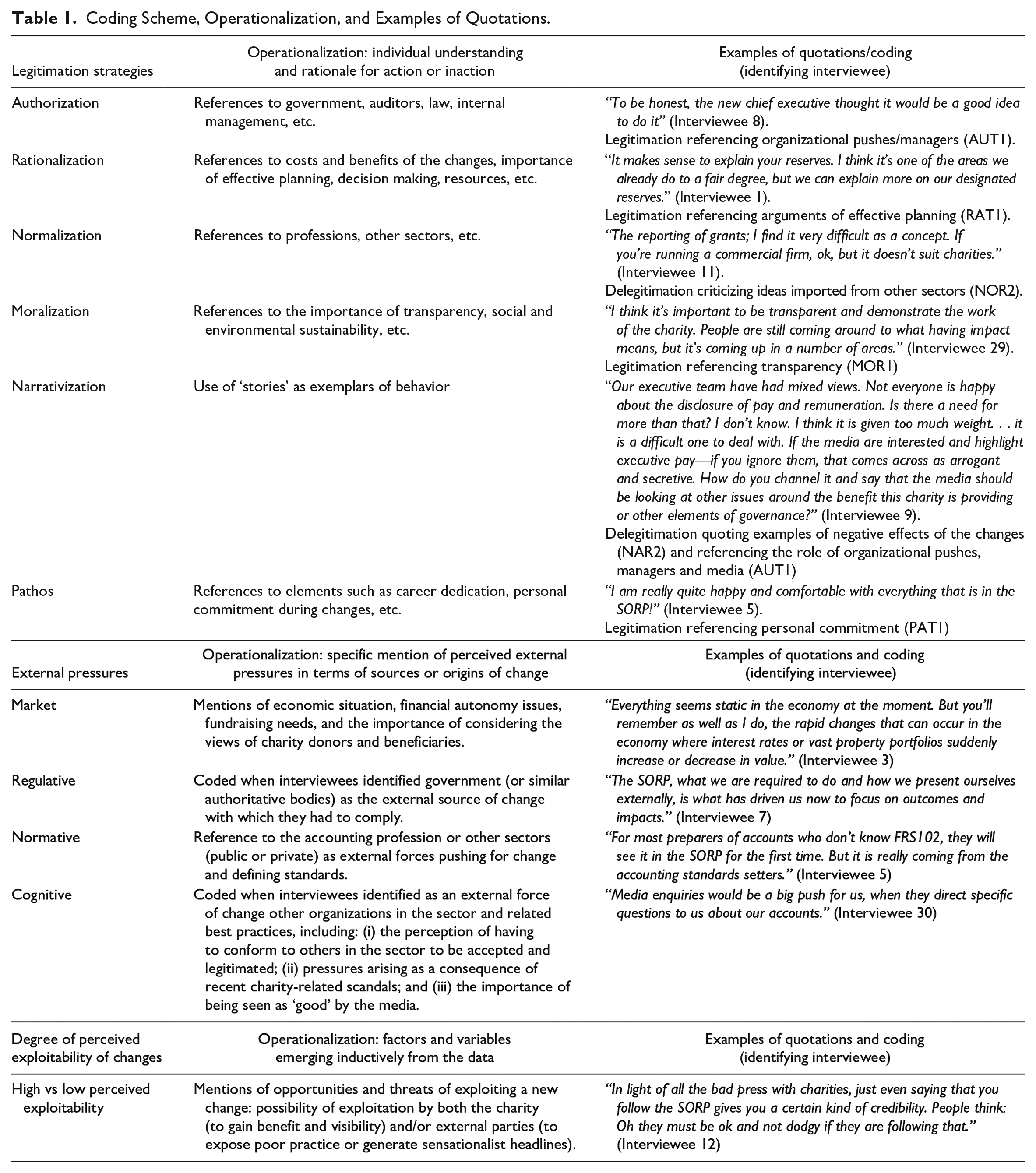
In the interview transcripts, for each interviewee unit of analysis, an argument was coded when a complete assessment or view was provided in relation to one or more of the three areas of change (i.e., the TAR, financial statements or SORP as a whole) that also included one or more (more or less implicit) legitimation/delegitimation strategies. Legitimation strategies were coded as “1,” with delegitimation strategies coded as “2.” A repetition of identical legitimation/delegitimation strategies within the same argument was only counted once. Notwithstanding this, several strategies could co-exist and be used at the same time within the same argument and in relation to the same area of change.
The interviewees were also asked to identify possible external pressures, here operationalized as the origin or source of specific changes being discussed. Taking a conservative approach, market and institutional (regulative, normative and cognitive) pressures were coded only when clearly identified as such in the answers to those questions. The interviewees’ answers often expanded beyond the original question, commenting on and offering assessments of such pressures and the effect they would have on them. This provided the basis to analyze and explore patterns between external pressures identified and (more or less conscious, or implicit) individual legitimation/delegitimation strategies used. As classifications of external pressures are not necessarily mutually exclusive, the code assigned to a certain pressure was relative to the dominant meaning attributed to that pressure in the specific context of the answer. The definition and operationalization of such pressures followed previous literature in other nonprofit contexts (Hinings & Greenwood, 1988; Liguori & Steccolini, 2012) and is summarized in Table 1, together with examples of quotations and coding.
Findings
Individual legitimation of change and external pressures
Table 2 provides an overview of the results of the empirical analysis in relation to individual legitimation/delegitimation strategies, and shows the number of times each was coded (and relative frequency in percentage terms).
6
The SORP changes were largely seen as acceptable and a wide range of legitimation strategies (much more prevalent than delegitimation ones) was used. Legitimation was mainly based on authorization, while delegitimation mainly relied on rationalization.
7
This is perhaps to be expected at the early stages of a change in accountability and reporting practices, which may be perceived as somewhat technical and mostly authoritative in nature, with limited discretionary “wriggle room.” Delegitimation based on normalization was relatively more present than its legitimating counterpart (Table 2), with the vast majority of the interviewees (both accountants and communication managers) being skeptical about bringing ill-fitting private-sector (FRS) principles into the charity sector. This was, by far, the most delegitimated area of change. For example, referencing delegitimation based on both rationalization and normalization, while commenting on the new requirement regarding when to count (or “recognize”) incoming resources with respect to a major source of income (legacies): The only real change is for legacies. Virtually certain or probable? Legacies is the most controversial area of income recognition in charities. It [the new SORP] is trying to apply an FRS made for commercial purposes to a charity; which does not make sense. And with an income source [legacies] that isn’t seen anywhere else. The problem is that the measures are judgemental. (Interviewee 15)
Individual (De)Legitimation Strategies Used.
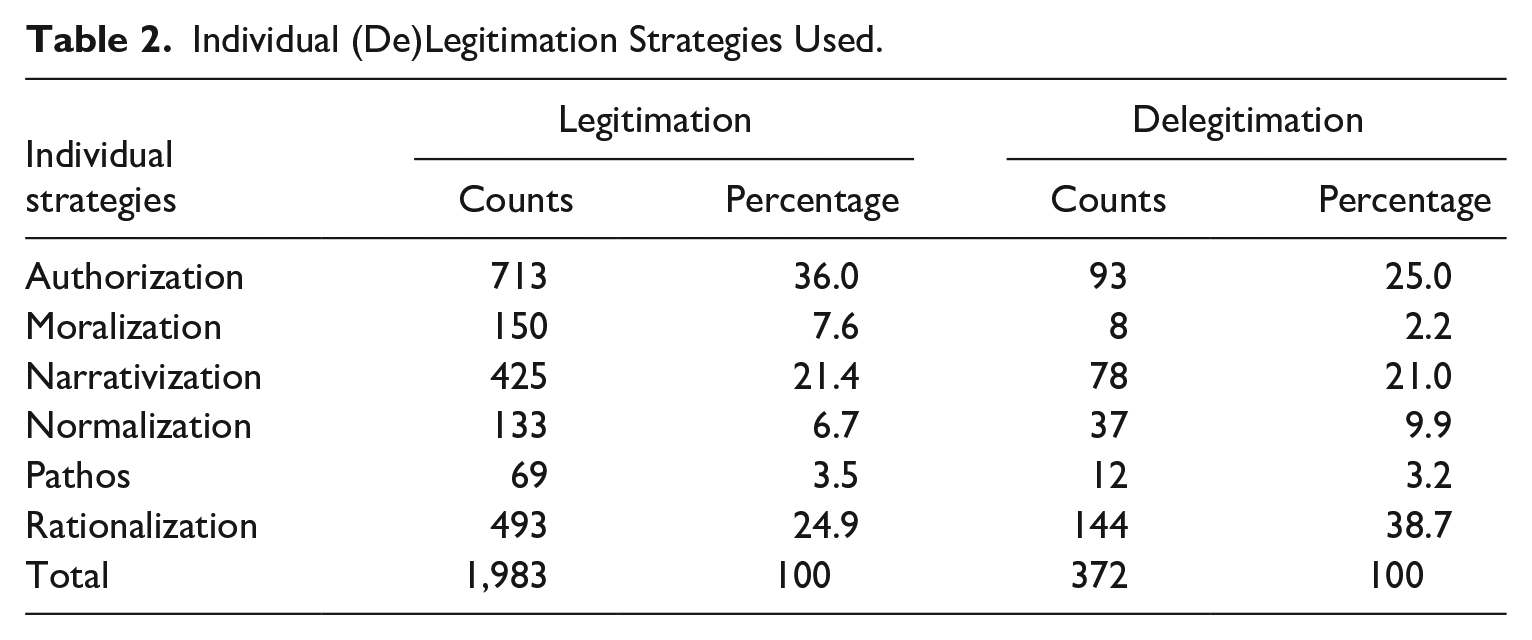
Surprisingly, given the charity setting, there was relatively limited use of pathos arguments in terms of either legitimating or delegitimating the new practices (Table 2). Those employed in charities are often characterized by a strong sense of sectoral belongingness (charities are expected to “do good” and “be good,” in terms that relate to both their stakeholders and society at large; Hyndman, 2018). On a personal level, however, the link between organizational mission and accountability practices may be weak, thus explaining the limited pathos and the interpretation of change as something that needed to be done because someone (or something) in authority required it.
The interviewees also referenced external pressures as sources of the adjustments they would have to introduce internally (see Table 3, which summarizes the frequency of mention of the different external pressures, as totals and percentages). These were perceived as both external forces and constraints to comply with (and gain legitimacy from) during the implementation of the new practices. They mainly sensed the presence of regulative (e.g., requirements with strength of regulation, external auditors, etc.) and cognitive pressures. Cognitive pressures were identified not only in relation to the need to respond to recent charity-focused scandals, but particularly in terms of appearing appropriate when compared with other charities. For instance, with reference to cognitive pressures: We put stories into our report because other charities tell the story of what they are doing too. It can be a fluffy notion until you read a case-study story and you think ‘ah, that’s what they’re doing!’ (Interviewee 6)
External Pressures and Sources of Change Perceived.
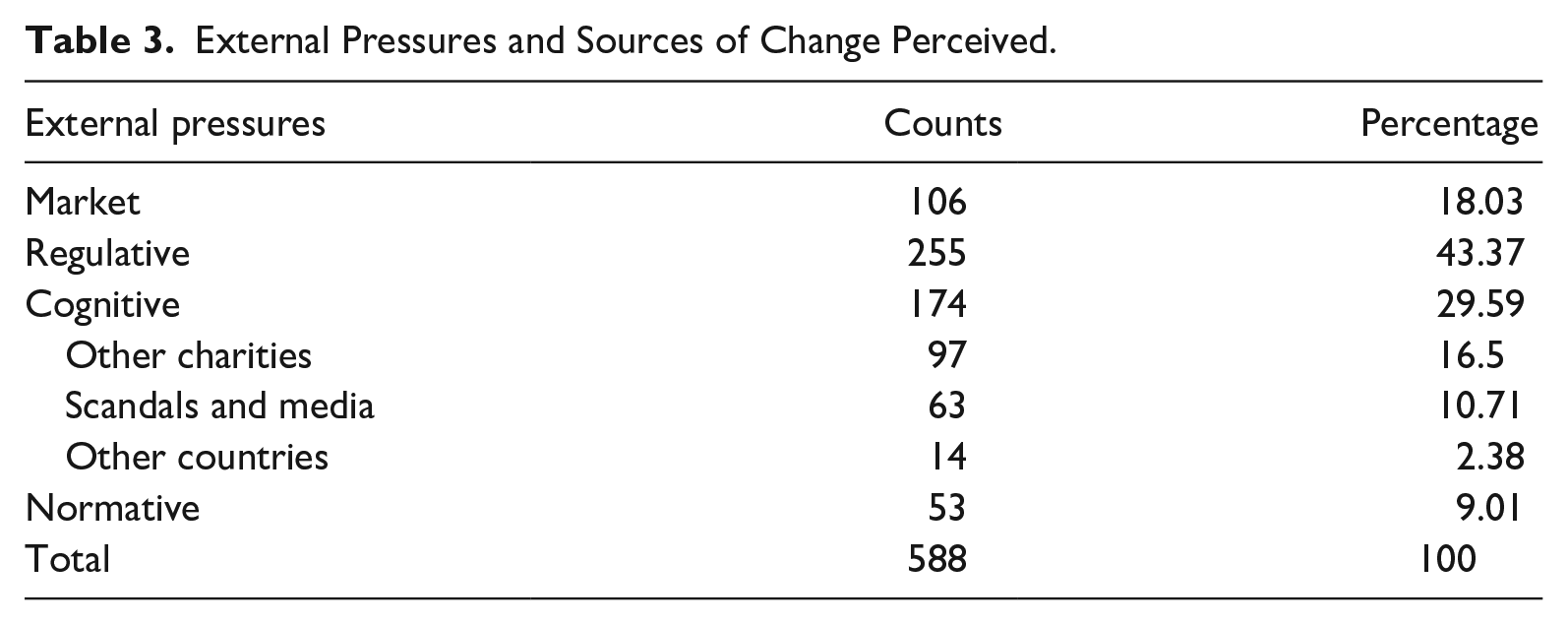
Normative and market (especially funder and donor) pressures, despite the business-like nature of the changes, were much less referenced (Table 3).
When exploring the connection between individual legitimation/delegitimation of change and external pressures perceived, these were generally aligned. For example, authorization strategies were often used when mentions of external regulative and cognitive pressures were made (see Table 4, which shows the co-occurrence of perceived external pressures as each legitimation strategy was used). References were made to government and regulation (or similar-strength requirements) both to legitimate (or delegitimate) the way changes were to be implemented within their organization and as the origin of the required change. A typical statement where authorization arguments were bound together with regulative pressures was: It is difficult to know where these things come from. . .The new SORP provisions reflect the changing mood in regulation and it reflects the journey that we are all on. And then we have professional leadership steering internally. You know, it is moving along this value chain both externally and internally. (Interviewee 5)
Perception of External Pressure Given a Certain (De)Legitimation Strategy (Co-Occurrence of Mentions as Percentage of Total Number of Strategy Used).
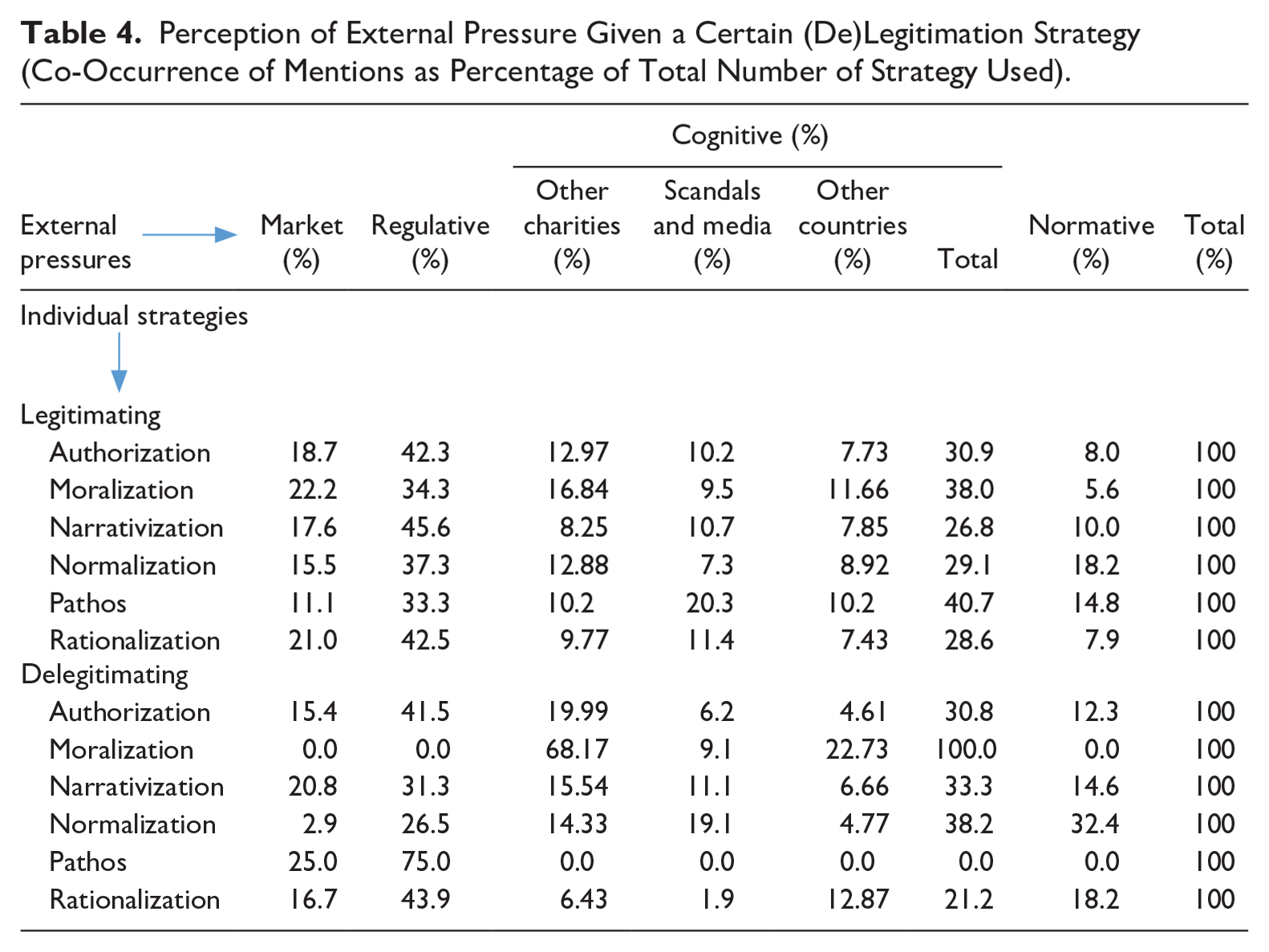

Similarly, normalization strategies were frequently used when regulative, normative and/or cognitive pressures were identified (Table 4), while moralization legitimation strategies were connected to the perception of regulative and cognitive pressures, often stressing the importance of transparency in terms of complying with regulation and benchmarking against other charities. References to scandals and media (among cognitive pressures) as external forces of change were also associated with personal assessments based on moralization.
However, considering the nature of the changes, the data highlighted a rather counterintuitive result as far as rationalization strategies (both to legitimate and delegitimate) were concerned. These showed much more connection to regulative and cognitive pressures than to any other, including market pressures (i.e., financial situation, funding, funders, etc.) (Table 4). Such external pressures were explained by some interviewees in rational terms when talking about why and how they would (or would not) seek to implement specific adjustments within their charity. An example of rationalization strategies used together with both regulative and cognitive pressures, in relation to the requirement for greater disclosure of senior management pay (see Appendix): I’ve been having this debate recently with our external auditors, they were asking for it—the rational presentation of the accounts and what accounts should tell. But external demands are contradictory. They say you must have good governance, but the public complains if you spend money on governance [as opposed to spending money on the delivery of direct services]. They say you must have fundraising, but you’re also paying for your fundraising! It’s all reasonable, but the most informative number required by these new changes is the disclosure of the CEO salary. (Interviewee 1)
This new and unexpected evidence is explored in more detail in the following subsection.
Re-Interpreting External Pressures: Exploiting Change to Legitimate It
When investigating the qualitative data, it emerged that 24 of the 31 interviewees explicitly mentioned (two or more times) the potential exploitability of the SORP’s new requirements to address what they perceived as key external pressures. They felt that the changes could be exploited by both the charity (often to gain benefit and visibility) and/or by external parties (such as the media, frequently to expose poor practice or generate sensationalist, unfair headlines).
8
For instance, one interviewee, who recognized the exploitable nature of the new practices, when referencing both authorization and rationalization strategies in connection with external regulative pressures, stated: Oh, yeah, it [the new SORP] makes sense and helps you focus action more. Obviously, everybody has got to be compliant. The external auditors are going to make sure we’re now complying. It will help how we are seen. . . our accounting policies will be under a fair amount of review to make sure we are compliant with what they want. (Interviewee 6)
Similarly, when highlighting rationalization strategies in light of cognitive pressures (while exploiting compliance with the SORP as a “badge”): Everybody in the sector is talking the same language; we have been on a thirty-year journey. . .. We are in this together. We are creating better value at the end and it becomes also a badge of honour for us. (Interviewee 5)
The new SORP practices were perceived as a means of gaining better external legitimation. In this sense, the changes were presented as both an opportunity and a risk, where too much disclosure could be damaging to an organization’s reputation if unfairly exploited by “unfriendly” parties. Such indications emerged consistently across the answers of the 24 interviewees mentioning exploitation. For instance, with reference to the disclosure of a charity’s risks now being a requirement in the TAR, potential third-party exploitation was often a concern: The thing is. . . There are risks you mightn’t want to disclose for all to see. Like, with our charity and the type of charities we are competing with, and the private companies. It makes it very confusing for those who read the TAR if you’re a charity and yet you have to sometimes think commercially. So to put your risks out there. . . I could say ‘Well, I don’t want to say that one, or we will just say that one.’ (Interviewee 12)
Such evidence contrasted with the other seven interviewees, who did not highlight the possibility of exploiting the changes. The presence of this “exploitation” factor seemed to act as a mediator between actors’ perceptions of external, environmental pressures and their assessment and legitimation of the new practices. Through their cognitive processes, this seemed to shape their judgments, effectively highlighting two different groups: those who perceived the possible exploitability of change (“exploitation” group), and those who did not (“non-exploitation” group). Reactions and perceptions were different for these two groups, showing different evaluations and rhetorical legitimations of change. Table 5 summarizes the main results and emerging patterns for these groups. The evidence shows that the perception of the possible exploitability of the changes turned external regulative demands and sectoral or cultural cognitive pressures into opportunities. These became acceptable and, in most cases, reasonable, explaining the stronger use of rationalization strategies by the exploitation group.
Emerging Patterns Between Individual Legitimation and External Pressures.
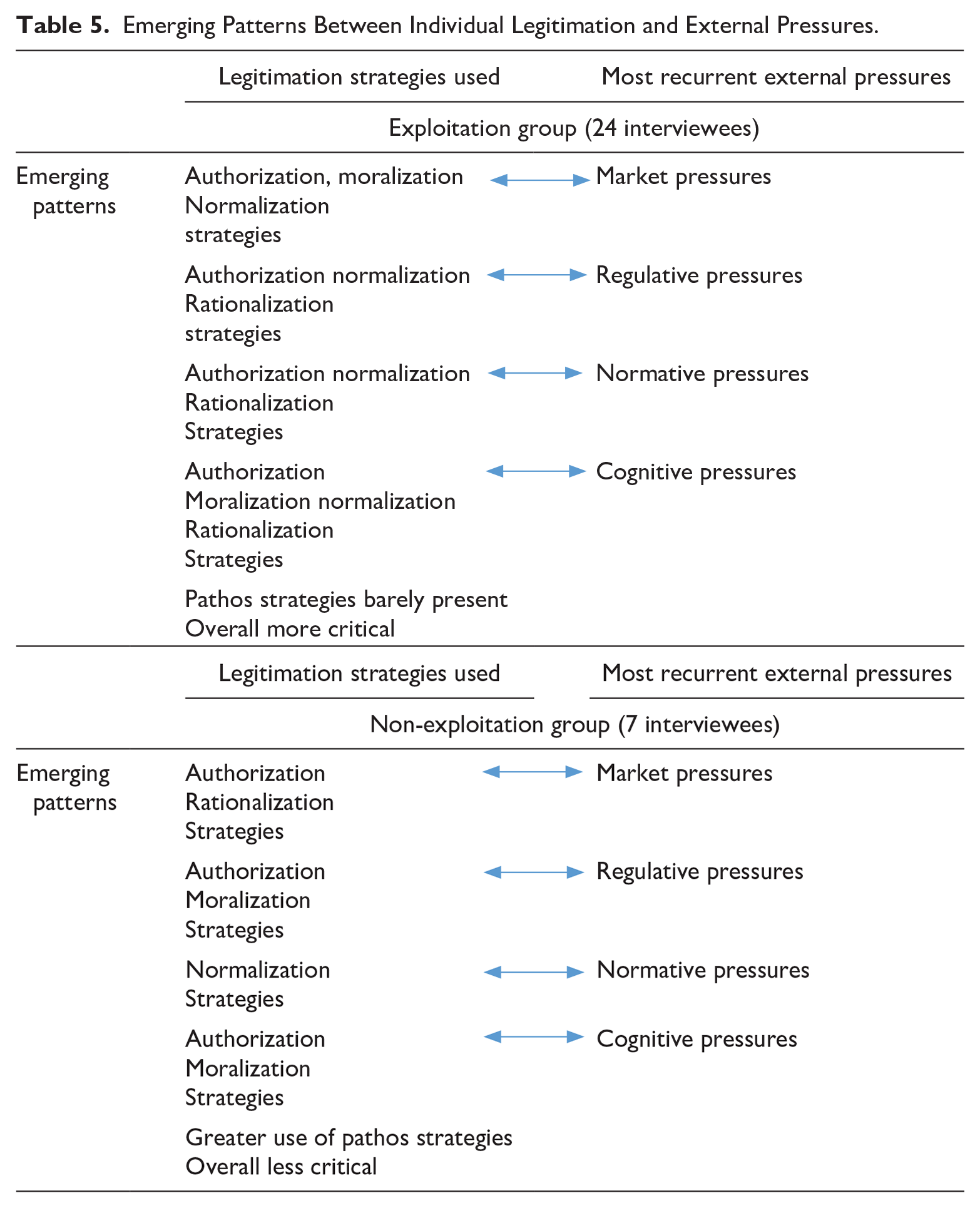
For the non-exploitation group, emerging patterns between legitimation/delegitimation strategies and perceived external pressures were mostly aligned. For example, as shown in Table 5: market pressures were often presented with rationalization and authorization strategies; regulative pressures were mainly presented together with authorization (and, in some cases, moralization) strategies; normative pressures were often legitimated or delegitimated through the use of normalization strategies; and cognitive pressures were more often mentioned together with references to authorization and moralization strategies. This contrasted with the exploitation group, where rationalization strategies (both to legitimate and delegitimate a certain change) were mainly used in connection with external regulative and cognitive pressures (Table 5). The exploitation group saw the new practices as instrumental in reacting to external sources of change; this eventually provided a legitimate and rational reason to implement the changes: Because of the new SORP, it means you now would have to do this [disclose additional information on reserves]. I think it is important to signal you are a well-run charity. I think you will find charities that aren’t as well financially run; they disclose less. So having a clear reserves policy becomes pretty vital, and it will make sure everyone does it and sees it. (Interviewee 11)
Such awareness, nevertheless, did not make individual legitimation strategies and rhetorical arguments any less “ethical.” Indeed, a change that makes sense and helps decision-making (legitimation via rationalization) can be exploited to increase external legitimation, while, at the same time, being fair and supporting transparency (legitimation via moralization). This was quite visible when moralization strategies were used together with references to market pressures (another differentiating pattern of the exploitation group; Table 5). Interviewees from the exploitation group saw it as convenient to be transparent and highlight ethical standards and actions to donors and funders (identified as the main source of market pressures); something that was much less apparent in the answers of the non-exploitation group. A typical comment of the exploitation group, combining market pressures with moralization arguments, was: Because the environment and society are changing, we are changing as well. We are public figures and everything we do is open to scrutiny from a wide range of stakeholders, especially donors. . . That stuff on governance, accountability, transparency, we take that very seriously. It’s the right thing to do. (Interviewee 1)
A relatively more rational interpretation of the new practices by the exploitation group is also suggested by the way normalization arguments emerged. Normalization strategies, both to legitimate and delegitimate, were frequently used together with references to regulative pressures (Table 5). While acknowledging that the source of change was external regulation (or requirements with perceived similar strength), they discussed some changes within their organization in terms of the increasing influence of private-sector professional standards (which they may, or may not, have endorsed). For instance, referencing regulative pressures and delegitimation via normalization and rationalization: As regulation, the SORP is what is imposing additional disclosure. . . But it puts a huge unfair burden on smaller charities. . . there are a few areas where there will be a clear uncomfortable response, maybe also unintended consequences, particularly in relation to fair value within the FRS requirements, like in the private sector. (Interviewee 15)
Those perceiving the possibility to exploit the new practices legitimated them in a more rational way overall, interpreting regulation in terms of benefits they could obtain (or lose) through it (rationalization strategies), and also what was normal and should (or should not) happen (normalization strategies). This group tended to be more critical, using delegitimation via normalization, not only in the presence of perceived inappropriate regulative pressures, but also with market and cognitive pressures. Moreover, they often defended the sector against unsuitable professional and private-sector norms that formed part of the new SORP, as well as against (especially cognitive) pressures that could critically damage charities and their mission. Those in the non-exploitation group, in contrast, were much less critical. For instance: The requirement coming from the professional accountaing standards is really helpful, it tries to address related FRS principles in thinking of reporting issues. It brings it up to date and brings charities in line [with the private sector]. (Interviewee 2)
Moreover, when actors were personally committed (or uncommitted) to the change, that is, they made more use of pathos legitimation/delegitimation strategies, exploitation was less mentioned. Similarly, pathos was rare in the interviews highlighting exploitation (Table 5). Being committed or emotionally attached to the changes decreased the emphasis put on the fact that change can or should be used (or manipulated) in someone’s favor. For instance, one of the non-exploitation interviewees who used pathos strategies to legitimate the new practices: My colleagues will probably balk when they hear the way I describe it and the ineloquence, but when you describe the work that we do, it’s all about impact. That is something that is always at the forefront. It’s not just about spending money and what you spent it on. We can all spend money and have no impact, but we make no difference for our beneficiaries. (Interviewee 13)
The non-exploitation group identified the external environment, and associated pressures, less frequently as sources of change. Overall, change was perceived as less rational, more based on personal judgment or cognitive pressures coming from the sector. For instance: Having best practice [referring to the SORP requirements] shown to you that you can follow and you can stand over is a good thing. I like the idea. It’s very important; it’s becoming more and more important. (Interviewee 28)
Discussion
This study provides evidence of how external pressures are filtered and made sense of by charity actors in their attempt to legitimate linguistically their plans and actions in the presence of new (often business-like) practices. Previous literature has frequently suggested alignment between external pressures and organizational actors’ behaviors (Binder, 2007). A general alignment between environmental pressures perceived and individual legitimation/delegitimation strategies was also found here, especially with respect to the non-exploitation group of actors. However, the results show that individuals can deviate from the initially perceived environmental pressures, using internal cognitive processes that allow them to re-interpret such pressures. Indeed, albeit change may be the result of external pressures (Delbridge & Edwards, 2013; Petrella et al., 2022), for a practice to be ultimately accepted, it must make sense (Green et al., 2009; Schildt et al., 2011). The paper demonstrates that external pressures can be assessed by organizational actors as something rational and reasonable when there is the perception that change can be exploited. The awareness of the potential exploitability of new practices to gain external legitimacy and visibility, or of them being exploited by third parties in a deleterious manner, contributes to shape the way individuals understand, assess and legitimate change. This has the potential to turn externally-driven change into something rational and functional, and, in doing so, provide legitimation for a particular course of action. The novel evidence indicates that external pressures are not simply something to comply with or abide by, but can be re-assessed on the basis of rationality. New practices can be unconsciously interpreted at the individual, micro level as instrumental means to gain legitimation (a particularly-valuable resource to secure future funding—Hyndman & McConville, 2018; Liu et al., 2016; Saxton & Guo, 2011) toward those same external pressures that first pushed for their introduction. Behaviors that previous literature has considered as irrational mimicry in response to cognitive pressures (Jeong & Kim, 2019) may, therefore, actually be the consequence of actors’ cognitive systems processing and rationally evaluating such pressures and related changes.
In this study, actors reinterpreted external sources of change into linguistic assessments that seemed reasonable to them. Such took form and became visible in the rhetorical strategies used to express plans and reasons for action or inaction. The perception of change as being functional and exploitable to someone’s purposes, in particular, can foster the emergence of common patterns (across jurisdictions, and organizational roles and positions) of linguistic and rhetorical strategies to make sense of such change in more rational ways. Alternatively, when change is seen as something fundamentally “good” and no conceptions of exploitability arise, this can engender stronger emotional commitment. This is linguistically expressed through the use of pathos strategies; this latter finding also being consistent with what Green (2004) argues in relation to the early stages of discretionary change.
Previous studies suggest that legitimacy can rely on different arguments to interpret the same practices to reconcile interpretations and meanings (Connolly et al., 2021; Landau et al., 2014), or endorse change by developing alternative narratives (Bartel & Garud, 2009). This article further elaborates on this by positing that change can be re-interpreted to construct a sense of reality that legitimates an actor’s behavior, making it appear more acceptable and rational to themselves and others. Contrary to what has been previously suggested in other contexts, where organizational actors deliberately and strategically deployed cognitive processes to create balanced rational arguments about change (Hoefer & Green, 2016), charity organizational actors legitimated the implementation of new accountability practices implicitly (perhaps unconsciously) through different perceptions of their exploitability. Such exploitability was not presumed from the start, but emerged as the changes were reflected upon. This also contributes to explain heterogeneity in individual reactions to change. Indeed, while the non-exploitation group could be seen as yet another example of “institutional dopes” (Hallett & Hawbaker, 2021), the evidence relative to the exploitation group shows that particular attributions of meaning, albeit unconscious and implicit, do affect individual reactions. The article delineates possible patterns through which individual actors can re-interpret external pressures, via an appreciation that change can be exploited.
Finally, from a sector perspective, it is notable that changes were primarily legitimated through means of authorization, possibly because of the more technical, prescriptive nature of accountability practices. Previous research in other nonprofit contexts shows that, as change beds down, other and more nuanced arguments of legitimation/delegitimation are likely to emerge, with authorization strategies becoming less pervasive (Hyndman & Liguori, 2018; Van Leeuwen & Wodak, 1999). A similar process may take place in charities, making future research in this area worthwhile. This study also contributes to the nonprofit litearture by identifying different individual and environmental factors that can promote or hamper change, particularly in relation to the promotion of business-like ideas (Dart, 2004; Maier et al., 2016). Literature has often highlighted a number of unintended and contradictory consequences of this process, such as the risk of mission drift triggered as a consequence of environmental compliance, although research has generated mixed results (Hyndman, 2018; Jäger & Beyes, 2010; Suykens et al., 2023). On the one hand, this study highlights how business-like practices can be reinterpreted in a rational way, even when potentially harmful to the organization. The very fact that changes (and related opportunities) are perceived as potentially exploitable may represent evidence of managerial ideas seeping in throughout the sector. The more or less conscious exploitation of business practices, and their embedding, has the potential to underpin questionable long-term patterns that undermine both mission and focus on beneficiaries. However, on the other hand, the results also stress the actors’ ability to discern between different types of managerial practices and subsequently differentiate their legitimation efforts. Consistent with this interpretation, the study shows that hard-core business-like practices, such as the introduction of International Financial Reporting Standards (IFRS), tend to be more delegitimated when compared with sector-specific practices (e.g., impact reporting). The acceptance of market and institutional pressures, therefore, weakens in the presence of changes that are perceived as being misaligned with the sector’s core values and purposes. By delving into organizational actors’ processes of legitimation and meaning attribution, as well as the mechanisms through which assessments of change are shaped into rational arguments, this research refines previous studies (Nazneen & Sultan, 2009; Suykens et al., 2023) that suggest, although not explaining its cause, the existence of exploitative and instrumental behaviors toward externally-driven change in the nonprofit sector.
Conclusion
The role of individual agency during change has been identified an area for further investigation by a number of authors (Green & Li, 2011; Hallett & Hawbaker, 2021; Harmon, 2019). This article contributes to this debate, adopting an original perspective that combines individual legitimations with individual perceptions of external pressures during change. The paper offers three main contributions. First, rather than focusing only on individual legitimation processes, as much previous research has (Connolly et al., 2021; Hoefer & Green, 2016), this study adopts a micro perspective to shed light on the connection between cognitive processes of legitimation/delegitimation and perceptions of the external context (Binder, 2007; Hallett & Ventresca, 2006). The way organizational actors implicitly make sense of external pressures, in their attempt to legitimate new practices and reasons for action or inaction, does not necessarily align with environmental demands. In particular, how the exploitability of a new practice is perceived influences different legitimations of change. This contributes to previous literature by showing that external pressures can be reinterpreted to facilitate the construction of rational arguments, and highlights that external pressures are filtered and evaluated even prior to actual change implementation. The study also addresses a shortcoming of traditional institutional theory, which often implies a dichotomy between institutional (especially mimetic) pressures and rational, technical aspects (Greenwood et al., 2002; Jeong & Kim, 2019). The evidence presented here contributes to show that such a dichotomy does not hold in reality (Friedland & Alford, 1991; Meyer, 2020) and requires further exploration and discussion. Moreover, while previous literature has mainly analyzed change during its unfolding or after its implementation (for an exception, see Lawrence & Callan, 2011), the evidence indicates that, even before new practices are introduced, actors form pre-determined ideas that will likely define, shape and constrain subsequent behaviors, especially during change implementation. Whether and how the configurations and patterns presented here can predict the development and final result of change in charities (or elsewhere) is an important aspect where future research is needed.
Second, the article focuses on legitimation strategies and arguments directly and implicitly deployed. This provides evidence of how organizational actors’ language (and the use of rhetorical legitimation strategies) can affect the change process via different interpretations. Legitimation/delegitimation arguments can be used as linguistic building blocks to construct acceptable narratives and actions. Language does not only indicate how change is interpreted, but also contributes to shaping future behaviors and actions (Nicolai & Dautwiz, 2010). The paper advances theory by showing that language and rhetoric are not merely based on assumptions and beliefs (Binder, 2007; Hoefer & Green, 2016) but represent a form of action as they contain implicit, even unconscious, legitimation/delegitimation ideas not visible in official documents and pronouncements. It highlights how individuals, in charities and elsewhere, can use language to explain, interpret and filter reality and, ultimately, legitimate their decisions and behaviors. Language enacts the way individuals understand and make sense of change, playing a constructive role in the assessment of external pressures and, ultimately, in shaping reactions to it. The article posits that such a process of interpretation is mediated by an individual’s perception of the possible exploitability of change. This also contributes to explain heterogeneity in individual reactions to change (Hallett & Hawbaker, 2021), suggesting possible patterns through which individual actors can re-interpret (and rationalize) external pressures.
Finally, different from many nonprofit studies (Burt & Taylor, 2003; Suykens et al., 2023), this research does not focus on drivers or consequences of business-like changes in the sector, but rather contributes to unpack and shed light on the language used and the cognitive processes that support legitimation/delegitimation of such changes within nonprofits themselves. This aspect has, so far, received limited attention. Such considerations, however, are especially important in this context, where legitimacy, both inside and outside of the organization, has been shown to contribute to the embedding of change (Hyndman & McConville, 2018; Liu et al., 2016). As discussed, the research highlights the actors’ ability to identify potential benefits and drawbacks of the adoption of specific business-like changes, thus differentiating their legitimation efforts (Nazneen & Sultan, 2009; Suykens et al., 2023).
The article also presents important implications for practice. At a time of change in the accountability requirements of charities, this research examines some of the aspects through which external pressures are evaluated by internal management. It provides evidence of a charity sector willing to defend its own systems and ideas as opposed to those imported from other sectors. The results suggest caution and encourage balance in the adoption of business-like practices. Charity managers and policy-makers should keep such findings in mind when designing and introducing future changes in the sector.
As in all studies, this research has its limitations. The article focused on the introduction of a particular type of change, which may affect some of the actors’ perceptions and related evidence. Moreover, the research took place in the artificial setting of interviews, rather than direct observation of the interaction between the interviewees and their colleagues. This might influence the rhetorical legitimation/delegitimation strategies highlighted. However, during the research, broad questions were asked that required the interviewees to discuss the views of both themselves and their colleagues and provide examples of reactions and events. The assessments provided are therefore likely to be similar to those the interviewees would have expressed in a different setting. As the interviews presented recollections of previous events, together with personal views, it is also important to highlight the possible existence of a more-or-less imagined audience, kept as reference by the interviewees at the moment of their answers (Harmon, 2019). Although this research focused on individual processes of legitimation, some social aspects were acknowledged in the paper through the interviewees’ references to stakeholders and colleagues. Further research may explore how different types of audiences and social interactions affect agency and rhetoric when legitimating common external pressures and changes (Hallett & Hawbaker, 2021; Harmon, 2019). Future studies could also explore what roles and characteristics of individual agency facilitate the perception of change as exploitable, and whether different understandings and definitions of exploitability affect behavior. Finally, the interviewees’ experience and views of earlier versions of the SORP may have influenced their legitimation of the new changes. Future research could shed light on the impact of such experiences.
Footnotes
Appendix
Declaration of Conflicting Interests
The author(s) declared no potential conflicts of interest with respect to the research, authorship, and/or publication of this article.
Funding
The author(s) received no financial support for the research, authorship, and/or publication of this article.
