




Abstract
Demographic shifts, economic restructuring, online-giving platforms, and growing competition threaten traditional models of community philanthropy. Responding to these pressures, philanthropy thought leaders have supported “a new way forward” for community foundations—community leadership. However, change is difficult, and little research examines organizational processes of moving toward community leadership. This study uses a simultaneous qualitative mixed methods design to describe organizational paths to community leadership while considering field-level aspiration toward such change. To confirm previous research, we examine community foundation mission descriptions from 2011 to 2016, finding limited evidence that the field is aspiring toward the community leadership model. Using interviews with leaders of organizations that have begun to shift toward community leadership, we unpack how such transformation occurs. We find that change, even amid field-level pressures, unfolds through localized improvisation and bricolage as community foundations adapt their work to demands in their community.
Keywords
Introduction
For two decades, thought leaders have cautioned that place-based philanthropy may be at a tipping point at which community philanthropic organizations must reshape themselves to remain viable (Bernholz et al., 2005; Richard, 2014). Demographic shifts, economic restructuring, the rise of online-giving platforms, and growing competition threaten traditional models of community philanthropy. Amid these contextual changes, Carson (2014, p. 43) suggests that community foundations (CFs) are “confronting the most significant external threats to their continued growth and future existence that they have ever faced.” In 2007, philanthropy leaders and dozens of CFs defined “community leadership” as a path forward for the field (Bernholz et al., 2005; Richard, 2014). Despite these sober warnings and pressure from field leaders and funders, empirical studies provide mixed support that the field has moved (or is moving) to community leadership. While some anecdotal case studies from the field profiled CFs that are embracing community leadership (Mazany & Perry, 2013), other academic studies found limited evidence of broad change (Graddy & Morgan, 2006; Millesen & Martin, 2014; Sloan, 2021). As one former CF leader (personal communication, December 3, 2020) observed, “We had expected a revolution and we got a slow burn.” The “slow burn” evident in earlier studies underscores recurrent practical and theoretical questions about how nonprofit field change occurs (Suárez, 2012).
This study addressed the research question: What is the process through which individual CFs move toward community leadership? We used a simultaneous qualitative mixed methods design (qual + QUAL) 1 to confirm previous research and contextualize our findings on organizational change processes. Specifically, we utilized a longitudinal data set of mission descriptions across the population of U.S. CFs to confirm the limited extent to which the field is aspiring toward community leadership. To understand change processes (Langley et al., 2013), in this case organizational paths to community leadership, we analyzed interviews with CF leaders that have begun to shift toward community leadership. Consistent with work on microfoundations of institutional change (Battliana & Dorado, 2010; Garud et al., 2007), we found that organizational change that may reshape the field emerges “from the mundane activities of practitioners struggling to accomplish their work” (Smets et al., 2012, p. 877).
Our work contributes to the study of nonprofit field change by illustrating how localized improvisation and bricolage drive organizational change. Findings from this study suggest that although field-level pressures have not spurred a “revolution” in the CF field, local change is occurring. Departing from the traditional macrofocus of institutional theory (Lawrence et al., 2011; Lawrence & Suddaby, 2006), we observed change that was not directed, guided, or pushed by field leaders. Rather, change efforts emerged as local leaders sought to adapt to stakeholders’ priorities, changing community conditions, and everyday operational needs. Our findings suggest that organizational change in disparate communities may reshape the field from the bottom up as more organizations shift toward community leadership.
Our article is structured as follows. We motivate our study by describing the CF context and the emergence of community leadership. We frame the theoretical contribution of our study by synthesizing research on the microfoundations of institutional change. Next, we describe the mission coding component of our study followed by the interview component. Our discussion integrates findings from both components and highlights implications for future research and practice.
Literature
The Context of CFs
CFs are a distinct subfield of organizations (Suárez, 2012; Yang et al., 2021) that raise and distribute resources within a defined geographic place. The first CF was established in Cleveland in 1914 (Hammack, 1989), and the organizational form has since spread worldwide (Sloan, 2021). In the United States, CFs are public charities.
To distinguish how the community leadership model promoted by thought leaders represents a shift for the field, it is important to understand CFs in the historical context. Traditionally, CFs were often described as “philanthropic banks for regional interests,” building permanent unrestricted endowments and spending money “for the benefit of the community” (Colinvaux, 2018, p. 2). CFs typically raised funds from “local leaders” (Colinvaux, 2018, p. 2), which one prominent practitioner described more succinctly as “relatively wealthy White Americans” (Carson, 1994, p. 34). The community members that decided how to identify and prioritize community needs in fund-allocation decisions often belonged to the same elite ranks of local leaders (Colinvaux, 2018; Ellwood, 2019; Hammack, 1989). Scholars and practitioners have described “donor relations, investment, grantmaking, and administration” (Easterling, 2011, p. 82) as the traditional focus of CFs (Ballard, 2007; Bernholz et al., 2005; Daly, 2008; Esposito & Besana, 2018; Graddy & Morgan, 2006; Hammack, 1989; Wu, 2021; Ylvisaker, 1989). Drawing on Easterling (2011), and Mazany and Perry (2013, p. 32), we refer to this traditional top-down approach to community betterment through fundraising and grantmaking as the stewardship model.
For decades, philanthropy leaders have advocated for balancing the stewardship model and the community leadership model. The community leadership model is rooted in the long-standing potential and realized capacity of CFs to lead the work of addressing community needs by convening and collaborating with local leaders (Carman, 2001; Colinvaux, 2018). In the 1980s and 1990s, the Charles Stewart Mott Foundation, Ford Foundation, Catherine T. MacArthur Foundation, and Lilly Foundation provided funding and support to build the capacity of CFs to become more active leaders in their communities by engaging a broader range of stakeholders (Lowe, 2004). The term “community leadership” first appeared in the literature around 1990 (Hammack, 1989). Despite their important historical legacy (Hammack, 1989), philanthropy thought leaders are increasingly challenging the sustainability of the stewardship model (Bernholz et al., 2005; Carson, 2014; CFLeads/Council on Foundations, 2009; Mazany & Perry, 2013). They suggested that the field was at a tipping point (Richard, 2014) as CFs confronted significant threats to their growth and legitimacy including demographic shifts, economic restructuring, and growing competition from commercial funds and other nonprofits. Ballard (2007, p. 1) went as far as to describe the need for field change as a “moral imperative.”
In 2009, CFLeads and the Council on Foundations published a community leadership toolkit that defined the community leadership model. The model emphasizes the need for CFs to serve as “a catalyzing force that creates a better future for all by . . . inclusively uniting people, institutions and resources, and producing significant, widely shared and lasting results” (CFLeads/Council on Foundations, 2009, p. 2). Ballard notes (2007, p. 4) notes that while CFs historically “engage[d] in community leadership from time to time. What is remarkable is the lack of acknowledgment of this activity on the part of CFs, almost as if community leadership were a subconscious reflex.” The community leadership model promoted by thought leaders is, therefore, “new” in that it intentionally prioritizes the leadership role of CFs and explicitly encompasses a more inclusive understanding of leadership as engaging a wide range of community stakeholders in identifying and addressing community issues.
Although well-positioned to lead community change, CFs may not rapidly adopt the community leadership model promoted by thought leaders. Empirical studies of community leadership suggest limited adoption (Graddy & Morgan, 2006; Millesen & Martin, 2014; Sloan, 2021). For instance, Graddy and Morgan’s study (2006) of 34 organizations belonging to the League of California Community Foundations found that by the early 2000s, only 29% were pursuing community leadership. Similarly, in a recent global study of CFs, Sloan (2021) found that less than half of the U.S.-based CFs had community leadership language in their mission statements. Drawing upon a sample of 45 CFs stratified by region and size, Millesen and Martin (2014) found that the choice to adopt community leadership was tempered by fear and tradition.
This mixed empirical evidence coupled with case studies that profile CFs shifting toward community leadership (Mazany & Perry, 2013), underscores the need to explore organizational change processes in the CF context (Langley et al., 2013). To frame the interview component of our study focused on change processes, we turn to the literature on microfoundations of institutional change.
Institutional Theory and the Challenge of Field Change
Institutional theory has often explained field change as emerging from a variety of macro pressures stemming from the legitimization of norms and cognitions, regulatory compliance, or environmental jolts (DiMaggio & Powell, 1983; Meyer, 1982; Moody, 2008; Reay & Hinings, 2009; Smets et al., 2015; Suárez, 2012). Suárez (2012), for instance, describes the 1969 Tax Reform Act that prohibited private foundations from lobbying as such a shock to the foundation field. Exogenous shocks allow actors to rethink “taken for granted” structures and act as entrepreneurs. These shocks may temporarily lead to “conflict and contestation” within the local field, pushing organizations to change (Garud & Rappa, 1994; Maguire & Hardy, 2006). This perspective is often critiqued because it implies isomorphism and fails to account for the diversity of responses that may emerge. In the CF context, mixed evidence of change in the face of field-level pressures (Graddy & Morgan, 2006; Millesen & Martin, 2014; Sloan, 2021) suggests that a macro perspective on institutional change may not be a suitable framing for our focus on change processes.
Moving away from such macro explanations, there is growing interest in the microfoundations of institutional change. This perspective holds that change in institutions may emerge from everyday work within organizations (Lawrence et al., 2011; Lawrence & Suddaby, 2006; Smets et al., 2012)—the “microfoundations” of institutionalization (Powell & Rerup, 2017). A focus on how organizational change emerges through routine work processes “. . . highlights how and why actors work to interpret, transpose, edit and recombine institutions, and how those actions lead to unintended adaptations, mutations, and other institutional consequences” (Lawrence et al., 2011, p. 55). A microfoundation approach describes change that occurs as organizational actors go about their daily work—responding to problems and making sense of the issues they are facing. Rather than emphasizing the “taken for granted nature of institutions,” a micro approach focuses on “competent actors with strong practical skills and sensibility who creatively navigate within their organizational fields” (Lawrence & Suddaby, 2006, p. 219).
For example, in a study of banking lawyers in a global law firm, Smets and colleagues (2012) describe how the “mundane activities of practitioners” led to field improvisation within the national laws and adaptive learning on how cross-border banking should be done. They describe situated improvisation, “localized attempts to cope practically with novel complexities and accomplish specific tasks” (Smets et al., 2012, p. 893), as a core mechanism of change. “Members of organizations go about their daily practices, discover puzzles or anomalies in their work, problematize these questions, posit theories, and develop answers to them, drawing on their existing stock of knowledge” (Powell & Rerup, 2017, p. 311). Through this everyday work, organizational actors shape their social structures (Smets et al., 2015).
Similarly, Powell and Reup (2017) illustrate how Minneapolis Public Radio (MPR) commercialized the popularity of Prairie Home Companion and created a for-profit subsidiary to sell commercial novelty products, such as coffee mugs and t-shirts. These new practices and structure were clearly aligned with the national trends of nonprofit commercialization. However, the MPR transformations were not driven by mimicry of successful nonprofit commercial ventures, nor were they a response to political or social imperatives to become “more business like.” Instead, they emerged from unexpected opportunity and an organizational financial crisis. As the authors describe, MPR “learned to perform as social entrepreneurs” as they sought to routinize and coordinate mundane activities (Powell & Rerup, 2017, p. 327). In this light, the development of the field of social entrepreneurship, and the diversity of forms it takes, can be understood as emerging from decisions made in response to the ongoing, everyday issues that organizations face.
In the face of enduring field-level pressures, anecdotal and empirical evidence suggests that while the extent of field change is limited (Graddy & Morgan, 2006; Millesen & Martin, 2014; Sloan, 2021), individual CFs are making transformational changes (Mazany & Perry, 2013). Attending to change processes in CFs moving toward community leadership through the lens of microfoundations of institutional change may help elucidate this seeming discrepancy.
Research Design
Our study uses a simultaneous qualitative mixed methods design (qual + QUAL). While some authors define mixed methods as the use of both quantitative and qualitative methods (e.g., Creswell), others agree (e.g., Morse & Greene) that mixed methods designs can use two qualitative or two quantitative methods (Leech et al., 2010). Following Morse (2010), we used a simultaneous qual + QUAL design to consider data from a different level of analysis and answer a subquestion with our complimentary component (qual) that cannot be addressed by our core component (QUAL). The complementary component of our study examines the extent to which the U.S. CF field aspires to community leadership based on mission language. Addressing this subquestion is necessary because extant studies on the adoption of community leadership at the field level tend to be dated, rely on cross-sectional data, or focus on specific geographical regions (Graddy & Morgan, 2006; Millesen & Martin, 2014; Sloan, 2021). The core component examines the paths individual organizations have taken toward community leadership based on analysis of interviews. In simultaneous qualitative mixed methods designs, analyses for the different components are conducted separately before findings are integrated (Morse, 2010). We, therefore, present the data, analytical approach, and findings from our mission coding and interview components separately before integrating findings in our “Discussion” section.
Mission Coding Component: Field-Level Aspiration Toward Community Leadership
Data and Analysis
The mission coding component of our study examined the degree to which mission descriptions across the population of U.S. CFs reflect an aspiration toward community leadership. CFs use mission descriptions to convey to the public the organizations’ priorities and institutional logics (Suárez et al., 2018). Recent work by Sloan (2021) found that the mission statements of a global sample of CFs contain language aligned with both stewardship and community leadership models—indicating that aspirations toward community leadership are reflected in CF mission descriptions. While Sloan’s work used a computer-assisted approach, we used hand-coding to consider the contextual meaning of words and phrases in mission descriptions, providing an important complement to Sloan’s study. Our mission data consisted of responses to the two mission prompts on 990 forms submitted to the Internal Revenue Service between 2011 and 2016 by the 1227 CFs operating in the United States. Our final data set contained 4,885 unique observations. More information on our data is provided in Online Appendix A.
We used a standardized iterative process to develop a structured codebook for team-based qualitative analysis (MacQueen et al., 1998) using structural and provisional coding. Structural coding helps to categorize the data corpus based on a research question to examine similarities and differences across comparable text segments (Saldaña, 2015). We categorized mission description segments based on content related to an organization’s value proposition and/or its business model (Guest & McLellan, 2003). A value proposition (“the why”) is a dimension of an organization’s mission that defines its purpose or “the value that the organization intends to produce for its stakeholders and for society at large” (Moore, 2000, p. 90). A second dimension of an organization’s mission is its business model (“the how”) that describes actions or practices that produce value. This may include key activities and/or the way the organization fits in and works with the broader “institutional” or community context to create value (Ebrahim, 2019). This approach allowed us to come to a consensus on language patterns distinguishing organizational purpose and practice and to consistently apply these across our sample.
Following provisional coding strategies and after reviewing the academic and practice literature cited in the Context section (also see Online Appendix B), we developed a list of value proposition and business model codes. We then individually applied these codes to a random sample of 200 missions, discussed coding discrepancies, revised the codebook, and recoded until we reached consensus. Our final codebook included three value proposition and three business model codes. Table 1 presents final codes and descriptions (see Online Appendix C for mission examples).
Mission Codes, Descriptions, and Model Alignment.
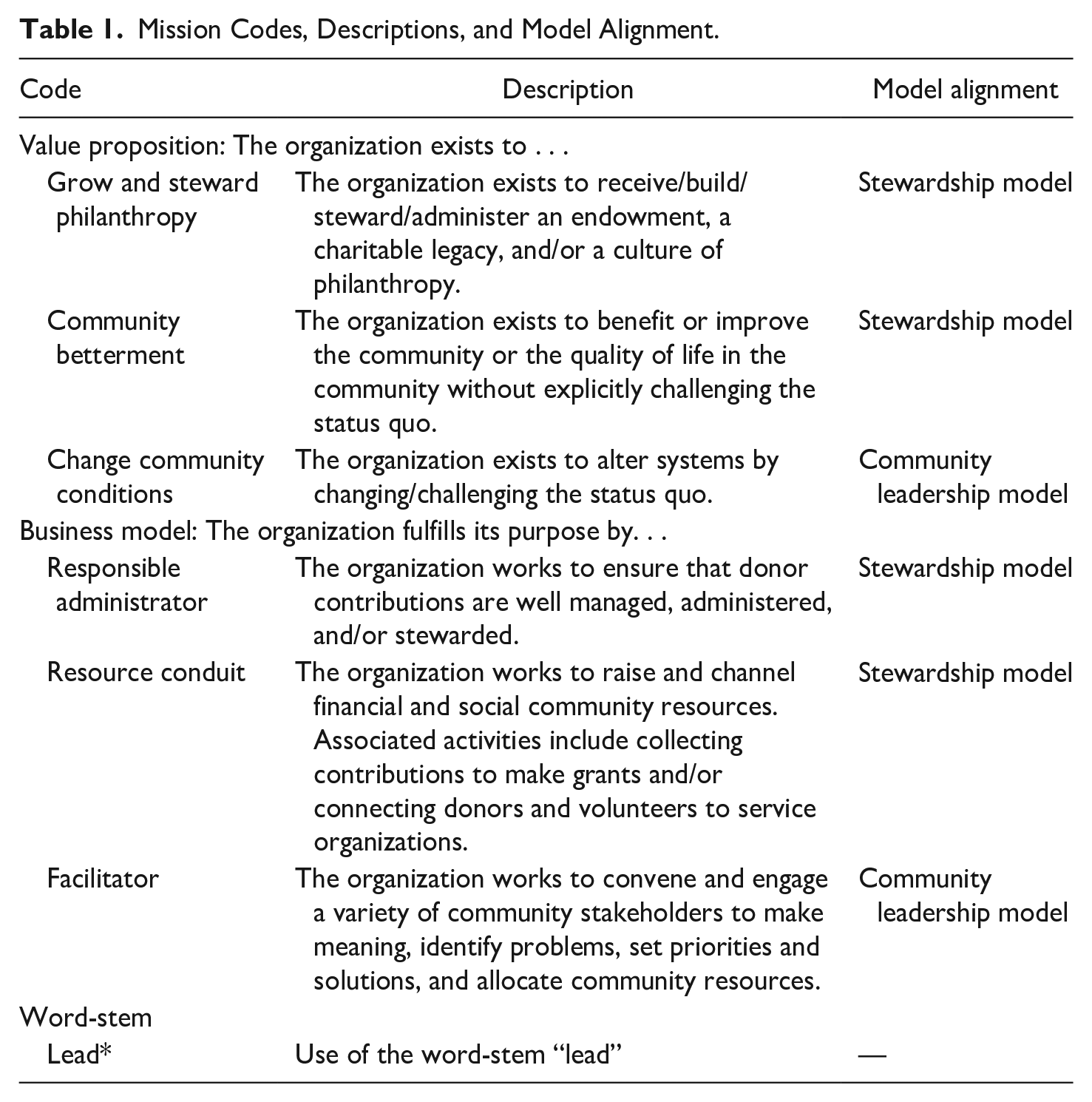
The team applied final codes to the full mission corpus, discussing and resolving all discrepancies. Final codes are not mutually exclusive. For example, the same mission description may have multiple business model codes. Also, every mission description may not have both a value proposition and a business model code.
Finally, following Guest and McLellan (2003) and Saldaña (2015), we examined code frequencies and code similarity using hierarchical cluster analysis. We examined the relationship between code frequencies and time using a chi-square test of independence for each code. We follow Guest and McLellan’s (2003) process for using hierarchical cluster analysis in qualitative research to reveal larger patterns beyond code frequencies and co-occurrences.
Findings from Mission Coding
We identified language that aligns with both the stewardship and community leadership models (see Table 1). CFs whose missions reflect the stewardship model prioritize building and administering endowments and making grants for community betterment based on donor priorities (Ballard, 2007; Bernholz et al., 2005; Daly, 2008; Easterling, 2008, 2011; Ellwood, 2019; Esposito & Besana, 2018; Graddy & Morgan, 2006; Hammack, 1989; Wu, 2021; Ylvisaker, 1989). Value proposition codes that aligned with the stewardship model include (1) growing and stewarding philanthropy and (2) promoting community betterment and quality of life. Business model codes that aligned with the stewardship model include (1) managing and administering endowments (2) acting as a resource conduit by making grants and serving as an intermediary between donors and grantees.
CFs whose missions aspire to community leadership seek to engage the broader community and explicitly prioritize long-term systems change (Ballard, 2007; Bernholz et al., 2005; CFLeads/Council on Foundations, 2009; Easterling, 2008, 2011; Ellwood, 2019; Graddy & Morgan, 2006; Millesen & Martin, 2014; Sloan, 2021; Suárez et al., 2018; Wu, 2021). The literature suggests that this involves facilitating inclusive discourse and action in ways that acknowledge diversity and pluralism of thought and experience (Noland & Newton, 2014). Codes that aligned with the community leadership model include the value proposition (3) change community conditions and business model (3). convening, facilitating, partnering, and collaborating across all sectors. Following the computer-assisted qualitative approach used by others (e.g., Sloan, 2021), we also developed a code to capture use of the word-stem “lead” in mission descriptions, which encompasses words such as “leading” and “leadership.”
We next examined changes in the frequency of codes over time. Table 2 presents the count and percent of missions that reflected each code from 2011 to 2016 and the results of a chi-square independence test for each code.
Code Counts and Frequencies by Year.
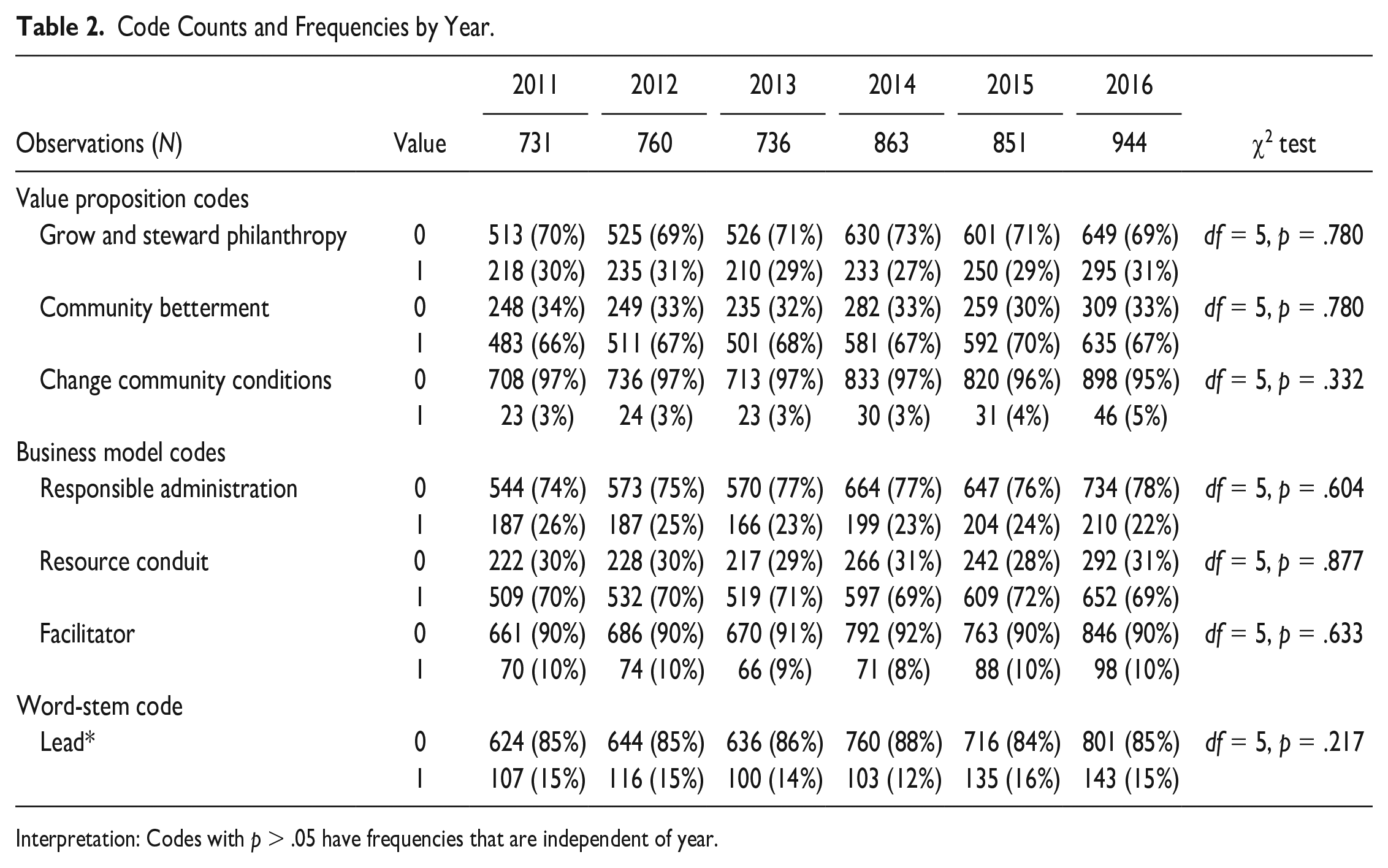
Interpretation: Codes with p > .05 have frequencies that are independent of year.
We found that the frequency of all codes is independent of year. Interestingly, the frequency of the word-stem “lead*” was higher than that of the community leadership codes across all years. While there was a slight increase in the frequency of the community leadership code changing community conditions and a slight decrease in the stewardship code responsible administrator, these results suggest that the community leadership model was not widely reflected in the mission descriptions.
Figure 1A to 1F is a series of dendograms that visualize the relative dissimilarity of stewardship and community leadership codes for each year of the study.
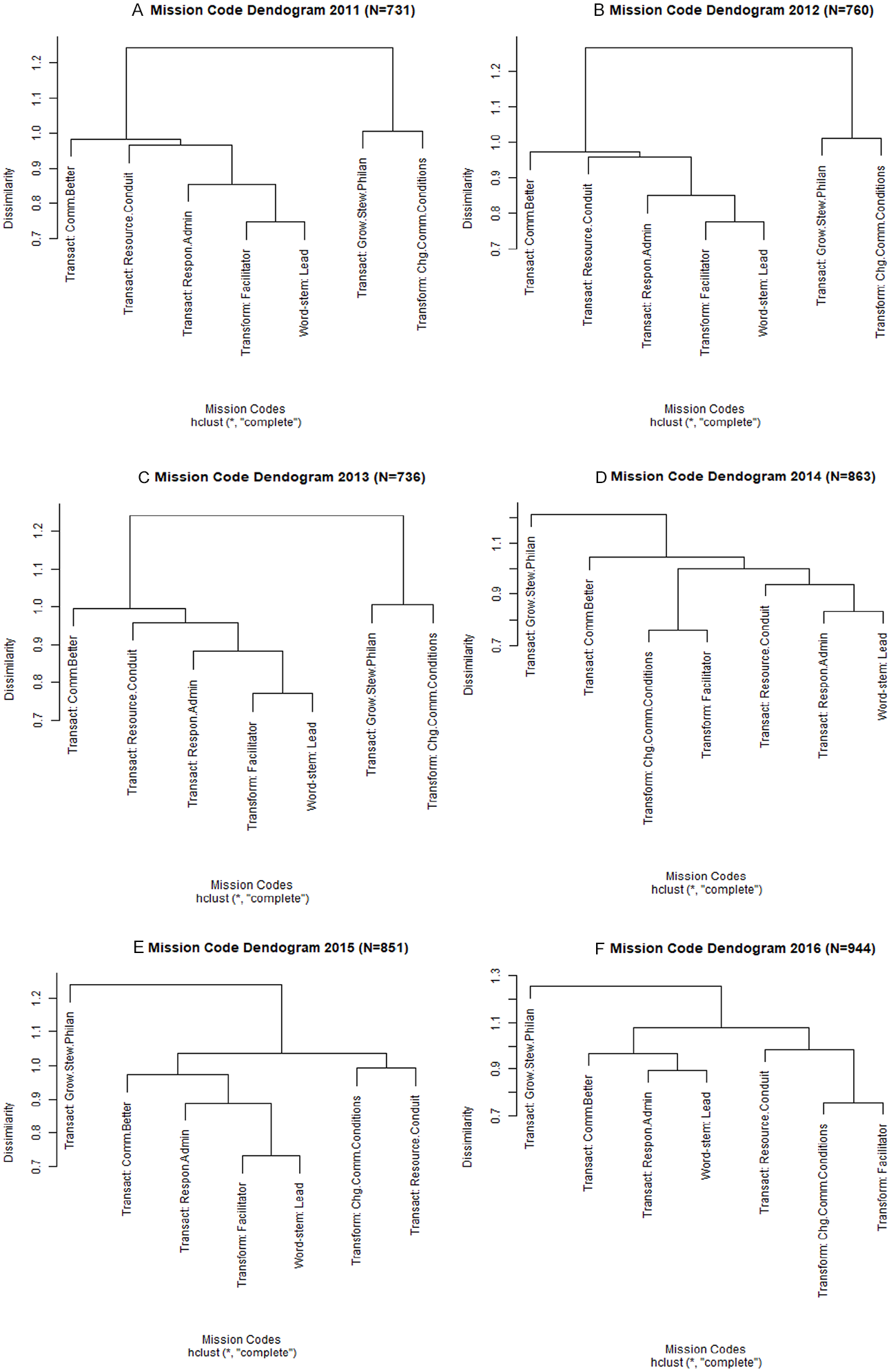
Code Dendograms by Year: (A) 2011, (B) 2012, (C) 2013, (D) 2014, (E) 2015, and (F) 2016.
Codes are graphed on the x-axis and code dissimilarity on the y-axis. Reading the dendogram from the bottom-up, the sooner that two codes cluster together (represented by a horizontal line between the two codes), the more similar they are.
From 2011 to 2013, the code clusters remain remarkably stable: several stewardship codes including community betterment and resource conduit clustered with the community leadership code facilitator and the word-stem lead, while the stewardship code grow and steward philanthropy clustered with the community leadership code change community conditions. Beginning in 2014, the clusters changed. The dissimilarity between the stewardship code grow and steward philanthropy and all the other codes increased. Between 2014 and 2016, the dissimilarity decreased between the community leadership codes change community conditions and facilitator and the stewardship code that most encapsulates CF operations, resource conduit. This suggests that a subtle change was reflected in missions across the CF field; the community leadership model became more coherent and integrated with elements of the stewardship model, while other elements of the stewardship model became peripheral to missions across the CF field.
Together, these findings indicate that change across the CF field captured in our mission analysis is indeed a “slow burn” rather than a revolution. The findings from our mission coding component confirm previous work and provide field-level context for the interview component of our study: an examination of individual organizational paths toward community leadership.
Interview Component: Microfoundations of Change Within CFs
Data and Analysis
We conducted the core component of our study with six CFs in small to mid-sized cities located in three states (New York [2], Kansas [2], and Michigan [2]). 2 The organizations ranged in asset size from just under US$25 million to just under US$175 million when they began the shift to community leadership. The chief executive officer (CEO) of CFLeads identified three of the organizations. A state association of CFs identified three additional organizations. While these additional CFs were recognized as moving toward community leadership and were aware of the work of CFLeads, they had not taken part in CFLeads workshops. In the fall of 2019, two researchers collected data through phone and video interviews with leaders (six CEOs, one program officer, two board members) of the six CFs. The CEOs had been in their positions for 3 to 15 years. For five out of six organizations, the move to community leadership coincided with the arrival of a new CEO. The other CEO had been at the organization for more than a decade before the shift began. In each case, the CEOs were fully involved in the transition to community leadership.
Each interview began with the prompt “identify the events and activities that led up to your organization assuming a greater role as a community leader.” Interviewees did so by completing a timeline, which alongside a semi-structured guide, was used to facilitate the interview. After each interview, the researchers met to reflect, compare notes, and discuss emerging themes. Data from interviews were supplemented with a review of the organizations’ websites and 990 reports.
All interviews were recorded and transcribed. Transcribed interviews and completed timelines were uploaded into Dedoose, a qualitative analysis software, for analysis. Data were coded inductively. The first round of coding was guided by the specific terminology that interviewees used, leading to first-order codes. In the second round of coding, we aggregated first-order codes to more abstract second-order codes (Gioia et al., 2013). For instance, the first-order codes “not just a charitable bank” and “it’s not about raising dollars” were aggregated into a second-order code “what leadership is not.” Third, we combined similar second-order codes into larger themes. For instance, the second-order codes “what leadership is not” and “leadership as community-driven purpose” were aggregated to the theme “community leadership as doing the community’s work” (see Figures 2–4). Our process was iterative, and we refined codes throughout the process. Timelines were coded in a similar fashion by highlighting text areas and assigning existing or new codes.
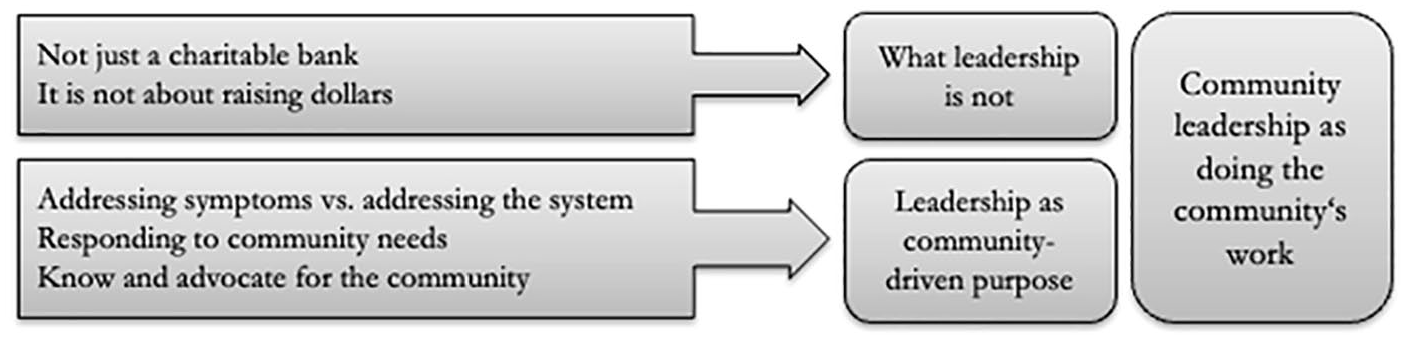
Community Leadership as Doing the Community’s Work.
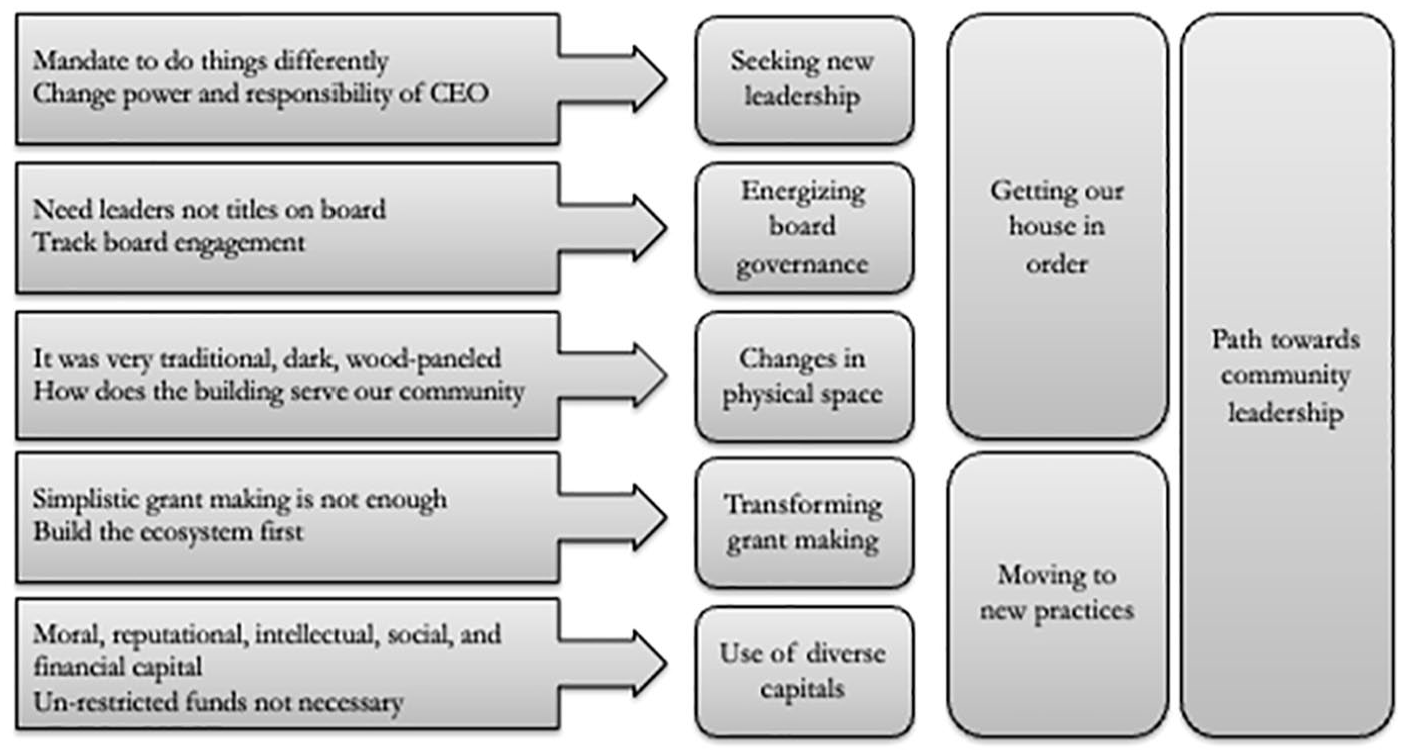
The Path Toward Community Leadership.
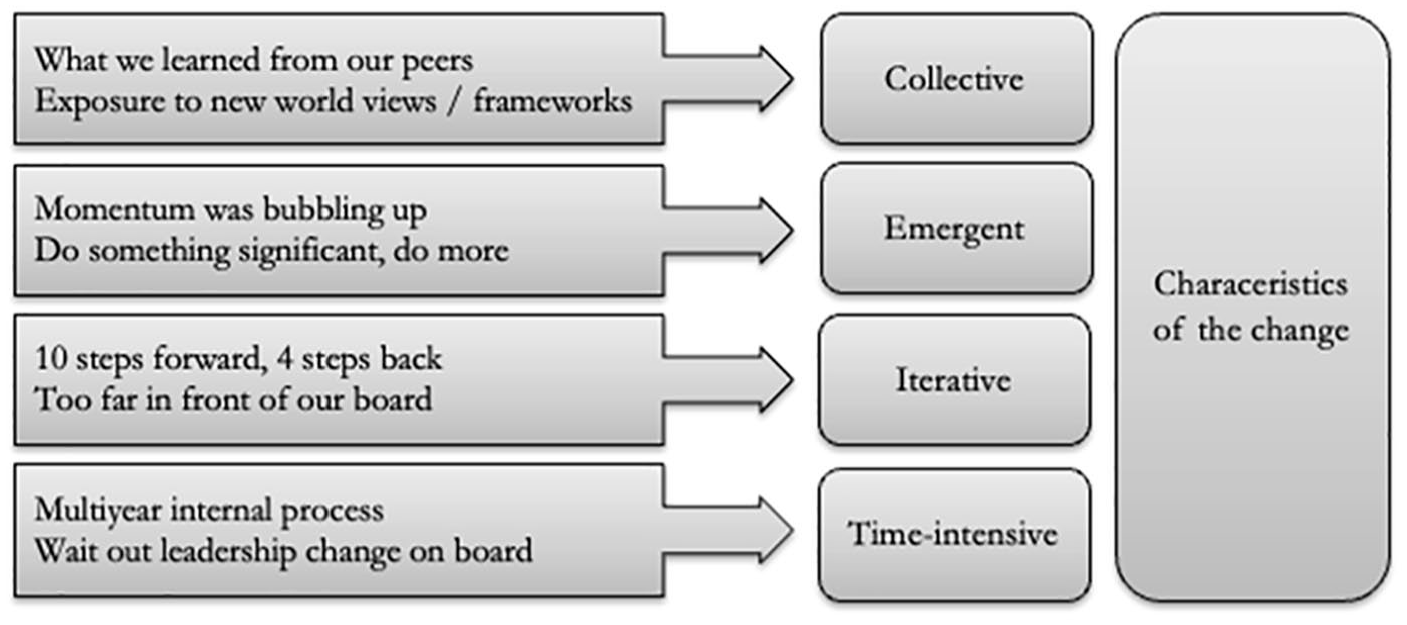
Characteristics of the Change.
Findings From Interviews
We distinguished three overarching aspects that capture: (a) the change content—community leadership as doing the community’s work, (b) the change process—paths toward community leadership, and (c) the nature of change—characteristics of the change.
Community Leadership as Doing the Community’s Work
In contrast to rather static field-level definitions of community leadership, our findings indicated that leadership is dynamic and emerges from “doing the work” in response to community needs. Two salient aspects include “what leadership is not” and “leadership as community-driven purpose.”
What Leadership Is Not
No consistent description emerged when we asked interviewees to define community leadership. Rather, they described what community leadership is not, especially related to traditional ways of working. For instance, challenging the stewardship model, one CEO indicated that “a community foundation is not just a charitable bank” (K1) and community leadership “is not about raising dollars and it’s not necessarily about just grantmaking [but] ultimately our goal is to improve the community” (M1). Similarly, another elaborated,
I’ll tell you what it’s not. Too many boards gather around the table and they say “we want to be leaders,” “we’re going to be leaders” and they adopt strategic plans that they will be leaders and then they leave the meeting. And they have no concept [of] what that means. (M2)
This interviewee hints that wanting the moniker of leader may not necessarily be related to specific actions of community leadership.
Leadership as Community-Driven Purpose
Rather than offering a standard definition of community leadership, interviewees provided examples of how their CFs were redefining their purpose in the community, creating value by responding to community needs. Consistent with field descriptions of community leadership, interviewees emphasized creating value through support for systemic change and being an issue advocate. While the stewardship model focuses on donor needs and priorities, community leadership necessitates constantly evaluating the CF’s position as an actor with privilege and “tremendous power” (K2). Interviewees understood themselves as acting “on behalf of the community” (N2) and “working in partnership with others to address the most challenging issues in our community” (N1).
Rather than knowing what role they should be filling in the community based on a standardized model of community leadership, interviewees “asked [community stakeholders] what role should we be considering playing in advancing those solutions?” (N1). As a result,
Our goals are based on the needs of our community that we’ve heard the community, we believe we can add value and we have a rationale for each of the goals [. . .] it’s really about what are the needs of this community which ones are we uniquely positioned to add value to through partnerships and coalitions and collaboration. (N1)
Despite field-level pressure for change, community leadership implies risk for local leaders. As one described, I “[was] nervous about alienating somebody or losing a donor, [but] we are getting to the point where we are comfortable losing some donors because what we’re doing is important and right” (K1). These risks may dampen external claims of community leadership.
The Path toward Community Leadership
Community leadership was loosely defined by the unique value it could create in local communities. Similarly, interviewees’ accounts of adopting new practices in their respective journeys toward community leadership were filled with stories of bricolage and improvisation as organizations aligned internal practices with new values and sought to find ways to simultaneously rethink traditional ways of working while building on existing organizational competencies and successful activities. Our analysis suggests that there were two overlapping and iterative phases of the change process.
Getting Our House in Order
Interviewees consistently reported that their organization’s path toward community leadership started long before public action due to the realization that “we really needed to look internally first. We needed to get our own house in order and figure out what [community leadership] meant to us” (M1). Community leadership emerged as CFs aligned their internal processes with external efforts to support community systems change.
Seeking New Leadership
Five of the six CFs began the change process by hiring a new CEO who was given a mandate to do “things differently” (N2). Boards made the hiring decisions considering that change was needed but without a mandate for what that change might be (including an explicit shift toward community leadership). Specifically, “the board knew there was going to be a lot of change and they figured if I could manage that at [former employer] that this would be something different” (K2). One organization converted the title and role of their new hire to increase the status given the planned changes.
[. . .] as a part of their realization that the foundation itself was a part of the problem they really wanted to change how the top staff person interacts and leads and so they went from an executive director position to a C.E.O. and board member position. [. . .] they had to lay the groundwork to literally change the functional responsibilities and power of the C.E.O. versus just an executive director who does not have a vote on the board. (M2)
Energizing Board Governance
Board governance emerged as a critical component of deep organizational change as the board is responsible for the mission, direction, and policies of the foundation (Council on Foundations, 2002). To become community leaders, CFs realized they needed board members who are actively engaged in the foundation’s work; thus, they focused on establishing “a better governance infrastructure” (N2) to facilitate the work of the board. One CF increased accountability by tracking board member engagement. (“Are they showing up? [. . .] if you don’t have time to read the materials and be informed [. . .] maybe you should rethink your service,” N2). As community leadership offers an inclusive vision of community, the board, ideally, should reflect the diversity seen in the community. Accordingly, two CFs emphasized changes in board nomination and onboarding practices to increase diversity (“we recruit the best board members possible [but] do not allow the hospital president or college president to be on our board because of their title; [. . .] we do not need one-dimensional board members,” M2).
Changes in Physical Space
CFs also engaged in outward-facing, changes to their physical space, which symbolically signaled a new approach to working.
It was just very traditional, I mean, we literally sat here and waited for people to come to us. We completely changed the model [to an] external focus. I think the feeling was we needed to be in the dark, wood-paneled office with like symphony music playing in the background or just this whole really quiet. [. . .] And that’s obviously not us anymore. (K1)
Similarly, one CF asked,
how does this building serve our community with community space? [By purchasing and renovating the building] they showed that they were serious about changing the organization, changing its future by taking this risk of investing in its own infrastructure. (N2)
Another interviewee elaborated that their offices “allow [them] to set the tone and the culture and invite people to [them] and it’s been a huge benefit to [have] a great place for very open-minded conversations” (K2). Changes in the physical space allowed CFs to act as conveners, building capacity in the community while also sending important signals to the community.
Moving to New Practices
Whereas community leadership work is different from stewardship work in many ways, it is built on existing strengths. Stewardship work such as endowment building through donor-advised funds or grantmaking is still important. These practices, hybridized to fit more transformative approaches, lay the foundation for community leadership.
We had this old line of business that was the donor-advised fund, our traditional work. And then we started the community leadership, and we couldn’t figure out a way to pull them together and then it like is becoming this D.N.A. strand and now that’s wound together [over time]. I really attribute a lot of our growth to that kind of work. (K2)
Below we highlight two such examples of hybridity: “new ways of grantmaking” and “investment in community through different capitals.”
Transforming Grantmaking
CFs rethought their grantmaking practices, indicating they had moved “from transactional to transformational grantmaking” (K2) aiming for “grantmaking to be more strategic and less competitive” (K1). For example, one interviewee noted that “I’m speaking to a city advisory board tonight that’s never anything we would have done, because we wrote checks, we weren’t at the table having a conversation” (K2), being a partner in conversations with other community partners allows community leaders to target their grantmaking to the specific needs emerging in the community. Furthermore, interviewees emphasized the importance of being “very thoughtful grant makers [. . . with] an unrelenting focus on impact” (N1). This new work involves reallocating resources to increase impact. This may involve moving away from multiple small grants to targeted support of community initiatives—such as large-scale cross-sectoral economic development projects. Being aware of the consequences of moving away from broad funding, CFs engaged in capacity-building initiatives for local organizations (e.g., professional development of nonprofit leaders, establishing emergency funds). This is rooted in the belief that community leadership cannot be done alone but requires community partners. The overarching driver here is to “build the ecosystem first” (K1), “to strengthen our community” (K2), and to “build new engines of change in the community, new capacity” (N1).
Use of Diverse Capitals
Community leaders supplemented their traditional role of grant maker by drawing upon a broader set of capitals to drive change in their communities. One interviewee referred to their capitals as “the three things we have full discretion over: our time, our influence, and our discretionary funding” (N1). Another CF framed their capitals as follows:
We were looking for a way to talk about our different roles and to explain to our board that our leadership is not just making a grant, it’s not just our staff time in the room. And then for the last 4 or 5 years, we started talking about our five forms of capital. The five are moral, reputational, intellectual, social, and financial. Our financial capital is just one way that we can make an impact on an issue that we care about. And oftentimes it’s the least of them because we still have very limited unrestricted grant dollars. (K1)
Financial capacity was important for some, but foundations without unrestricted funds did not see this as a barrier. Rather, those foundations used other forms of capital to leverage resources.
Only about 25 percent of our money is discretionary. However, we have a unique philosophy, which is when we get onto a track of a project that the community wants, we don’t worry about whether we have the money to make it happen. If we can bring a little bit of money to the table that’s fine but we will find partners and friends and donors and resources to make it happen if it’s truly a need. We have in mindset we don’t let lack of our own money stop us. (M2)
Some CFs “started doing community leadership work before we knew how to pay for it” (K2). Others used their convening power: “At that stage of development, we didn’t have a lot of money to give so we have used our convening power and other tools to make a difference” (K1).
Characteristics of Change to Community Leadership
The path toward community leadership was idiosyncratic with overlapping themes (see Figure 4). Yet, the characteristics of the change were strikingly similar across organizations and can be described as collective, emergent, time-intensive, and iterative. These characteristics are not independent, but rather tended to feed into and reinforce each other.
Collective
Change was a collective endeavor; local practice was greatly influenced by interactions with and site visits to other communities, participation in networks of community partners, and deep, collective exposure to new ways of thinking. To support the collective work toward community leadership, CFs exposed themselves to new models and frameworks such as systems thinking, human-centered design, or adaptive leadership. Applying those frameworks was critical in changing their thinking. This involved how boards and staff thought about community systems.
The ultimate shift in our understanding, which is going from donor-centered to community-centered is because of the work we’ve done around systems thinking and systems leadership [. . .] we’ve been trying to shift our board’s thinking and our community partners’ thinking that we’re not just here solve problems as they arise and react to events but we’re here to look at the bigger systems [. . .] All of that stuff together kind of led up to the board in this kind of innovative mindset to say we’re not just here to tell people “you need to collaborate” but we’re here to create this environment of progress and collective work toward a shared vision. (K1)
Often ideas were prototyped (and shared) with other community partners.
They were prototyping a way of connecting systems change and leadership to actually designing social systems by incorporating the voice and authentic engagement of people who are experiencing the problems and that training as you can imagine our community was gaining its collective impact muscle and our leadership abilities not just me or the Community Foundation but as a culture of growing that kind of collaboration by investing in all these different kinds of trainings and that has really helped fortify the way that we’re working in the community. (M1)
CFs shared a collective mind-set and were open to learning from and with others.
Emergent
Contrary to the notion of field-level change initiated by field thought leaders, the change to community leadership was not planned but rather emergent. As described earlier, momentum for change bubbled up through board members, donors, and other community groups. For instance, one CF conducted a board and donor survey where “the resoundingly answer was ‘do more.’” The interviewee continued: “[the responses were] very polite but said ‘you’ve given away a lot of US$1,000 to US$2,000 gifts, but you haven’t really made any change and haven’t really been asking the hard questions’” (K2). All the interviewees echoed that the desire for the organization to have greater impact originated with board members and donors, not field leaders. For instance, one interviewee attended meetings
where our nonprofit partners or other people who see what we can do are telling us outright “you need to be bold, you need to be a lightning bolt.” We have quoted them in part to our board, so we’ve got this literal vocal public call from some of these people who understand us to say you need to do more. (K1)
Change emerged slowly and often quietly from routine requests to “do more” from within the CFs or outside, instead of a top-down strategic planning process.
Iterative
Becoming community leaders is an iterative process that emerges from ongoing efforts to strengthen the organization and its community, some of which worked, some of which stalled, and some of which had to be “rethought.” Interviewees acknowledged that they took “ten steps forward and then [. . .] 3 or 4 steps back” (K1). The following example illustrates the importance of bringing the board members along.
What happened was unfortunate only a couple of board members and myself were educated about M.R.I.’s [mission-related investments] and when we brought them back to our board, we were too far in front of our board and our board said, “you can’t do that” and that was a huge step back. [. . .] My gosh, I really miscalculated here. That set us back two years, so we said, “wait a minute, we have to back up.” I can’t be in front of my board on this I’ve got to bring people along. So we embarked on a long process to educate our board about what mission-related investment was. (M2)
Other interviewees echoed those sentiments and indicated the importance to address board resistance through tough conversations.
We had some very challenging trustees; I had to wait out a chair until a new chair came in who I knew has the backbone to help me through some of those tough conversations. I had to wait through some leadership issues of our own that were baked in before I got here to make the change happen. (N2)
The iterative characteristic of the change was also indicative through the openness and ability to experiment and “to test some ideas” (M1). CFs are uniquely positioned to experiment, “because the CF unlike most other philanthropy is free to roam, free to address areas and unique roles across the philanthropic spectrum” (N1). One specific approach is to help start a project or initiative and support it through an emerging and start-up phase. Once the project is established, it is released and transitioned into the responsibility of the community.
Time-Intensive
Interviewees emphasized that becoming a community leader takes time. For most “it was a long process over several years” (M2). One new CEO discovered through the review of historical board meeting minutes that the board “had been talking about doing impact investing for 10 years and talking about how do we invest for the future [and] what those risks [are]” (N2). In another example, one board member promised a larger gift to the CF if the foundation changes, but it took 5 years “for them to get the courage to really make change to what they were doing and admit they were part of the problem” (M2). Another interviewee mentioned “it’s 10 years probably [during which] we learned a lot of ourselves and how we wanted it how we wanted to structure things. It was policies and procedures and things that just hadn’t been attended to beforehand” (K1). As indicated by these descriptions, community leadership unfolds over time as the organizations work in response to their community and involves ongoing work and intentional reflection.
In summary, while the CF field has emphasized the importance of moving toward community leadership for years, we found that the process of shifting to community leadership was locally driven and emerged from demands for something different. The decision to change was not directed or driven by funders, consultants, or thought leaders outside of the community; rather, community leadership was about doing leadership in response to the community. Furthermore, the path to community leadership was paved by organizational changes and guided by work that was different but built on previous strengths and activities of the CF.
Discussion
While a growing number of empirical studies define and document variance in CF adoption of community leadership, our simultaneous qualitative mixed methods study explored change at the field level and the change processes at the organizational level. Institutional scholars increasingly highlight the importance of multilevel studies that explore both field and organization-level change (Thornton & Ocasio, 2008). In this section, we integrate findings from the two components of our study (Morse, 2010) and discuss their contributions to our understanding of community leadership in the CF field and the microfoundations of institutional change.
The mission coding component of this study examined the extent of field-level change. Findings that the field-level shift toward community leadership is a “slow burn” rather than a revolution confirm previous research (Graddy & Morgan, 2006; Millesen & Martin, 2014; Sloan, 2021). Given the national scope and longitudinal nature of our data, capturing organizational mission descriptions from 2011 to 2016 across the population of U.S. CFs, our approach improved on previous studies that were cross-sectional or focused on specific geographic areas. By using hand-coding to consider the contextual meaning of mission descriptions, our study also complements recent work by Sloan (2021) that used automated coding to examine a global sample of CF mission statements for stewardship and community leadership language. A notable finding is that we empirically showed emergent disruption in the stewardship model that has traditionally dominated the CF field. The enduring significance of the stewardship model is reflected in the stability of code clusters from 2011 to 2013, while the disruption is apparent in changes to code clusters beginning in 2014. Our findings further suggest that elements of the stewardship and community leadership models are becoming slightly more integrated into mission language. Given the environmental and field-level pressures that have been pushing CFs toward community leadership for two decades, these findings do not align with the institutional theory that centers field-level conceptualizations of change (Smets et al., 2012). These findings underscored the need to examine processes of organizational change (Langley et al., 2013).
The core component focused on CFs that were moving toward community leadership to explore processes of organizational change and how they might explain more limited accounts of field-level change. We found change that is local, incremental, and seemingly loosely connected to field-level imperatives, a finding consistent with the microfoundations approach to institutional change. Organizational shifts toward community leadership were incremental and evolved from the work of doing in response to community needs rather than a response to field-level prescriptions. The move toward community leadership, therefore, was not preplanned nor prescripted but “an ongoing improvisation enacted by organizational actors trying to make sense of and act coherently in the world” (Orlikowski, 1996, p. 65). This improvised action is a rational response to the everyday issues facing an organization as they responded to community needs and general macro pressures.
Integrating findings from the two components further underscores that they are consistent with the microfoundations approach. For example, findings from our interviews suggest that CFs that are shifting toward community leadership may have good reasons not to declare it in their mission, including fear of pushback from donors. Such hesitancy may help explain why more CFs do not aspire toward community leadership in their mission language. This suggests that CFs are responding to local stakeholders rather than field thought leaders as their change process unfolds.
Furthermore, the integration of our findings further suggests why codes aligned with community leadership and stewardship models seem to become more intertwined over the period of study. Interviewees indicated that their grantmaking practice is evolving or, as one interviewee put it, moving “from transactional to transformational grantmaking” (K2). CFs are shifting toward community leadership by building on organizational practices that reflect existing strengths of the stewardship model. Again, CFs are shifting toward community leadership through bricolage rather than through wholesale adoption of an externally imposed model. A microfoundation perspective combines institutional theory with the “practice” literature to suggest that change occurs through routine work. A practice approach to institutional theory focuses on how social structure is shaped by people “doing their work” and the shared understanding of how and why work is done (Smets et al., 2012).
Although improvisation in daily practice may be described as “routine,” it is not “mindless” (Cardinale, 2018, p. 139). Changes in local CF practices that align with community leadership did not emerge in these cases as a normative or mimetic response to field-level expectations. Our findings indicate that actions taken by local leaders were strategic, involving reflection and effort, intentionally connecting ends and means (Powell & Rerup, 2017), but with a distinct focus on the local/community needs that may not have been purposefully implemented to align with broader field change. Although CFs were aware of shifts being advocated by field leaders, they innovated through local practice and used diverse frameworks to guide their actions, adapting them to fit the needs of community members and partners. Change was not driven by field-level pressures but bubbled from the ground up.
While institutional entrepreneurship has often focused on “muscular” actors that have the resources and capital (including networks) to drive change, institutional work situated in practice focuses on ordinary change agents whose “actions of those who affect, or attempt to affect, institutional processes” (Lawrence et al., 2011, p. 55). Consistent with Millesen and Martin’s (2014, p. 833) observation of “visionary leadership—being in the right place at the right time,” practitioners used their expertise and experience to leverage opportunities that arose in their daily work. Many of the interviewees were new to the CF field when their organizations began the path to community leadership. Their diverse professional experiences in private industry, education, and nonprofit leadership gave these CEOs and their staff “cosmopolitan” perspectives that created the space for future action (Cardinale, 2018). As professionals who were less tethered to a traditional way of work and had no preconceived expectations of “best practice,” these CEOs were more open to improvised and “negotiated approaches” (Battliana & Dorado, 2010; Smets et al., 2012). Their diverse professional experiences allowed for “transposition”—repurposing old tools or recombining past practices in an unusual manner (Powell & Rerup, 2017). Similarly, we observed change in small to mid-sized organizations that were not in the field spotlight, suggesting that change will continue to emerge quietly in unlikely places.
The result for organizations and the field is a “slow burn” change process that is subtle and perhaps easy to miss. Current research anticipates that organizations engage in sensemaking to filter field-level institutional pressures that conflict with their interests and values (Heinze et al., 2016; Smets et al., 2012), but our findings suggest that organizations also translate frameworks from outside the field to fit with local contexts as they adapt to local pressures. Such local change may eventually bubble up from communities, reshaping these frameworks and driving field-level change (Powell & Rerup, 2017; Smets et al., 2012). Like the diffusion of civil service reform at the turn of the 20th century, the adoption of community leadership may emerge from local response to contextual pressures (Tolbert & Zucker, 1983), and later be legitimized and normatively accepted as “good practice.”
Finally, considering community leadership as an outcome, we did not find an “end state of leadership” either in mission descriptions or interviews. Rather, our interviewees described making meaning of their organizational purpose and practice as they grapple with their daily work. Focusing on the process of change led us to see novel interpretations of community leadership. Such meaning-making through practice and translation, rather than diffusion, suggests that community leadership will take many forms in many communities, making it hard to measure an “outcome of community leadership” that is defined by an institutional actor. Scholarship focusing on leadership (or any other planned and directed change initiative) as a trait (outcome) versus a process may miss this phenomenon.
Our simultaneous qualitative mixed methods study suggests avenues for future research. First, although organizational missions are one way to capture field-level change in the CF field, there may be other approaches to trace whether institutional change is occurring. One approach, for instance, would be to look at changes in grantmaking over time to determine whether grant recipients and funded causes have changed and whether grantmaking aligns with the espoused mission. Other indicators of change may be found in practices, such as social media use, changes in physical infrastructure, or organizational records such as board meeting minutes (see Wu, 2021, for an example using annual reports). Similarly, our interest in change led us to focus on organizations that were already moving to “leadership,” raising questions about those cases that have not yet begun to move or have stalled.
Second, whereas we found that change toward community leadership is occurring locally and field-level change is limited, “little is known about how micro-level, day-to-day changes scale up and the trajectories through which ‘improvisations’ may aggregate, concatenate, accumulate, and/or escalate” (Micelotta et al., 2017, p. 1895). Future research, therefore, must investigate how those micro-level changes translate into field-level change for the CF field. Relatedly, although we asked interviewees to reconstruct a timeline of the change process because the field discourse on community leadership began a decade ago, we did not follow sites over time. As a result, interviews captured leaders’ current understanding and interpretation of events, possibly creating issues with recall and retrospective sensemaking. To fully uncover microprocesses of change, we need longitudinal, inductive study designs that incorporate a wide range of local stakeholders.
Despite the limitations and the need for continued research, our study extends our understanding of the process of field change. These findings have practical implications for CFs and other nonprofit fields undergoing transformation. Given our finding that field transformation is slow and loosely connected to national initiatives, questions emerge about how bottom-up transition can be facilitated and the cost of “slow burn” field-change. As bottom-up change processes are slow, uneven, and dependent on local context, some transformation processes will stall or fail. While the endowed revenue structure of CFs ensures that most will not die, a “slow burn” will continue to challenge the national identity and legitimacy of the CF field. The nonprofit sector is highly reliant upon field-level support organizations and the use of independent consultants that have pushed new practices. What role can such actors play in supporting field transformation? If the traditional top-down approach is not effective in moving to field change, those support organizations may have to rethink how they can unify nonprofit fields while supporting the needs of individual organizations.
Conclusion
This study contributes to the study of nonprofit field change by examining organizational paths toward community leadership through the lens of microfoundations of institutional change (Lawrence et al., 2011; Lawrence & Suddaby, 2006). Our findings suggest that bricolage and localized improvisation, rather than models of strategic change promoted by thought leaders, are driving organizational change in the CF field. Future research should examine whether the organizational change processes described in this study reshape the CF field as more organizations shift toward community leadership.
Research Data
sj-docx-1-nvs-10.1177_08997640231152240 – for “We Expected a Revolution and Got a Slow Burn”: Microfoundations of Institutional Change in the Community Foundation Field
sj-docx-1-nvs-10.1177_08997640231152240 for “We Expected a Revolution and Got a Slow Burn”: Microfoundations of Institutional Change in the Community Foundation Field by Megan LePere-Schloop, Marlene Walk and Laurie E. Paarlberg in Nonprofit and Voluntary Sector Quarterly
Footnotes
Declaration of Conflicting Interests
The author(s) declared no potential conflicts of interest with respect to the research, authorship, and/or publication of this article.
Funding
The author(s) received no financial support for the research, authorship, and/or publication of this article.

Supplemental Material
Supplemental material for this article is available online.
Notes
Author Biographies
References
Supplementary Material
Please find the following supplemental material available below.
For Open Access articles published under a Creative Commons License, all supplemental material carries the same license as the article it is associated with.
For non-Open Access articles published, all supplemental material carries a non-exclusive license, and permission requests for re-use of supplemental material or any part of supplemental material shall be sent directly to the copyright owner as specified in the copyright notice associated with the article.
