




Abstract
This article focuses on collective engagement through voluntary organizations to advance a theoretical understanding of the determinants of varying patterns of co-production, and we conduct an empirical investigation of how these determinants shape local-level co-productive relationships in Norwegian municipalities. We use a policy fields approach in which we compare four policy areas that each constitute an institutional field. The study uses a qualitative design, with data from 89 interviews in 12 municipalities. We find strong systematic differences between the fields, suggesting that the institutional space for local co-production is structured by national welfare policies and public management practices. We also identify feedback processes in co-production between the design and implementation stages of the policy process. We conclude that, unlike the often-prescriptive embrace of co-production in the literature and among policymakers, co-production is a more suitable organizational form in some service areas than others, depending on the institutional context.
A core focus of the literature on third-sector organizations is investigating the determinants that shape patterns of interaction between the public sector and civil society (Kim et al., 2021; Marwell & Brown, 2020). One form of such interaction is co-production in which public service organizations and citizens, individually or collectively, engage on an equal footing to produce some form of (public) value. Existing research on collective engagement through voluntary organizations is dominated by contributions that document the possible benefits of co-production (Loeffler & Bovaird, 2021), but there is also a large body of research that seeks to identify which factors facilitate successful co-production. In a review of this latter literature, Sicilia et al. (2019) found that almost all contributions identify organizational factors as important. However, studies on how these factors vary are in short supply, and we therefore need a better understanding of the institutional determinants that enable co-production to take place.
By focusing on collective engagement through voluntary organization, this article advances a theoretical understanding of the determinants of varying patterns of co-production and empirically investigates how these shape co-productive relationships at the local level in Norwegian municipalities. More precisely, we start with the framework developed by Stone and Sandfort (2009) and analyze how the (a) impact of laws and regulations, (b) formalization of interaction patterns, and (c) nature of financial and professional relationships interact to produce variations in the levels of co-production in different policy fields at the local level. Institutional feedback mechanisms may also help us to understand the relationship between co-production at different policy stages.
Our approach is grounded in a recognition that the organizational landscape is shaped by voluntary action and public policies that recognize the organizational form of formal voluntary organizations, regulate (parts of) their activities, and are often an important source of funding (Grønbjerg & Smith, 2021). By comparing different policy fields in one context—that of Norway—we can find conditions among policy fields that facilitate co-production in different ways. A policy field is characterized by an “identifiable set of elements in a specific environment that directly shape local public service provision” (Stone & Sandfort, 2009, p. 1056). These elements can include material aspects, such as national legislation and regulation, the local “market” of providers, local policy priorities, and cultural components like norms and traditions. In this way, different service areas—such as those serving education or the elderly—constitute different policy fields, which produce varying conditions for co-production.
Ever since Ostrom et al. (1978) put co-production on the research agenda, various definitions of the concept have been developed. All the definitions include some form of collaboration between citizens and public service organizations, but they vary in their approach to who the actors are, what activities they engage in, and when they do it (Nabatchi et al., 2017). One important distinction is whether the definition only includes the joint efforts of individual citizens with the public sector (Brandsen & Honingh, 2018) or whether they also include collaborations between voluntary organizations and public institutions (Alford, 2009; Bovaird, 2007). In this article, we adopt a definition of co-production consistent with the latter approach, and we exclusively examine co-production that involves a municipal actor and a formal volunteer organization. Regarding the “what” of co-production, we take a broad perspective and examine a comprehensive range of activities ranging from co-production in public welfare services—like nursing homes for the elderly—to a broader set of public values, like volunteers and local youth authorities coming together to provide after-school sports for immigrant girls. Regarding the “when,” we study the phases of co-production that involve policy design 1 and policy implementation. In this way, we can capture one of the defining features of Scandinavian society: the use of collective action through civil society to solve societal challenges.
Norway is a suitable case for studying local-level variations in co-production between policy fields because it has a combination of strong values of equal service quality across the country and adherence to local self-determination resulting in a tradition of autonomous municipalities with the ability to act independently of the national government (Kjølsrød, 2005; Loughlin et al., 2011). Norway also has a strong welfare state with broad responsibilities, coupled with an extensive civil society that has considerable autonomy, agency, and power (Enjolras & Strømsnes, 2018).
In Norway, municipalities are responsible for the implementation of a range of policies in areas in which voluntary organizations are involved to greater or lesser degrees, including primary education, welfare services (health care, child care, elderly care, poor relief, etc.), leisure and cultural activities, integration of migrants, and services to youths and adolescents. In some policy fields, municipalities, despite enjoying extensive autonomy, are required by law to follow national guidelines and requirements. The combination of central steering and local autonomy gives rise to both significant similarities and variations across municipalities and policy fields, enabling us to investigate how different determinants shape the conditions of co-production between public authorities and voluntary organizations.
We report the results from a comparative case study for which we conducted 89 interviews in 12 municipalities around the country. We systematically compare four policy areas: (a) services for children and adolescents, (b) integration of immigrants, (c) health and care, and (d) culture and leisure. These fields have the most extensive relationships between volunteer organizations and municipalities (Trætteberg et al., 2020), and we include traditional public services as well as other public goods that are co-produced by municipalities and voluntary organizations (Brudney & England, 1983; Rich, 1981). For each policy field, we examine two types of co-productive relationships between voluntary organizations and local public authorities: co-production in policy design and in policy implementation.
Policy Fields and Co-Production
By analyzing the four policy fields at two policy stages, we can expand our understanding of barriers to and possibilities for co-production. Indeed, comparing policy fields can reveal institutional features that determine the nature of co-production. Existing empirical reviews show that the public sector is the driving force and thus sets the conditions for most cases of co-production, and residents and civil society are often only included at a relatively late stage of the process (Bovaird & Loeffler, 2012; Voorberg et al., 2015). By comparing different service areas in the same state-friendly system, we can identify which institutional conditions promote this uneven distribution of roles and which do not. In the following, we develop operationalizations and hypotheses based on the current literature.
Based on Stone and Sandfort (2009), we find that the dynamics of the policy environment depend on (a) the concentration of authority, (b) the density of networks, and (c) the nature of financial and professional relationships. However, Stone and Sandfort’s (2009) framework is based on an analysis of the relationship between the public sector and professional non-profit service providers, while in the current study, we examine the relationship between local governments and local voluntary organizations, which typically do not have employees. To adapt the framework to our purposes, we have therefore developed three dimensions for analyzing the policy fields, which we apply in our empirical investigation: (a) laws and regulations, (b) formalization of interaction patterns, and (c) resource dependencies. In the following sections, we expand upon these three dimensions.
Laws and Regulations
In a multilevel governance system, central policies and regulations define and shape the “role” of local authorities—their degree of discretionary power, their resources, the scope of their obligations to provide a service, and in some cases, which policy instruments they might use. The concentration of authority is expected to vary according to whether the activity constitutes a core municipal service or whether it has a more complementary nature (Brandsen & Honingh, 2016), which means that municipalities need to impose their authority when the law mandates municipal responsibility, while activities of a less regulated nature can be approached with less municipal authority. Consequently, we contend that when a municipality has local discretion, authority can be shared with the community, while in policy fields in which a municipality has less room for maneuver, it is also less able to share authority.
Formalization of Interaction Patterns
The institutionalization of local networks in the form of formal platforms for interaction and information-sharing can improve the flow of information, adhesion to participatory approaches, and delimitation from other policy fields (Cabria & Magnier, 2022). In particular, the access to and flow of information is a crucial function of formal networks and can be the driver for deepened interactions and the development of shared values (Cristofoli et al., 2017). We therefore expect that formalized arenas for interaction will create opportunities for co-production and define the roles of the public sector vis-a-vis the various voluntary organizations (Mosley, 2020).
Resource Dependencies
The nature of financial and professional relationships depends on the distribution of critical resources. If voluntary organizations control a critical resource (from the viewpoint of a municipality), such as volunteers, knowledge, skills, or community trust, the municipality is likely to be inclined to collaborate. Conversely, if voluntary organizations are not in control of a critical resource and are dependent on public funding, there will likely be a low level of co-production. The distribution of resources and the level of competition over resources, therefore, constitute an important component of the policy field (Galaskiewicz & Bielefeld, 1998), which relates to how organizations may compete for users, funds, or other resources. Resource dependence theory (Pfeifer & Salancik, 1978) has, to a large degree, dominated the understanding of how voluntary organizations and non-profits depend on public funds and are thus subject to public steering. For co-production, in a given field, the resources that voluntary organizations control and that the public sector depends upon are just as instrumental for the nature of co-production (Marwell & Brown, 2020).
The framework developed by Stone and Sandfort (2009) describes the functioning of policy fields in public service provision. Here, we examine both policy implementation and policy design. To understand the dynamic between these policy phases, we rely on different institutional feedback mechanisms that may influence the role of voluntary organizations within and between the policy design and policy implementation phases. One such mechanism that influences the role of voluntary organizations is “policy feedback” (Pierson, 1993). In the design phase, “New policies affect the social identities, goals, and capabilities of groups that subsequently struggle or ally in politics” (Skocpol, 1992, p. 58). Policies thus contribute to shaping individuals’ interests and identities and provide economic incentives to advocate during and contribute to the design phase, so when municipalities have a high degree of discretionary power, the policy feedback mechanism makes it likely that voluntary organizations will organize and collaborate to influence them. When the degree of discretionary power is low, such organizations would be better off participating in a coalition at the national level that seeks to influence the national policy framework.
Local policy feedback thus depends on national laws, regulations, and programs. A government often employs a number of tools to shape both policies and the behavior of actors in a given policy field (Salamon, 2002), and a core steering tool is the regulatory environment that structures the forms of action that are available to all actors in a given field (Marwell & Brown, 2020). National regulations shape the scope of opportunities within which actors—both municipalities and volunteer organizations—can maneuver.
In addition, a civil society feedback mechanism may influence the degree of co-production, and the effectiveness of that mechanism depends on the distribution of critical resources. When a voluntary organization controls a critical resource, a municipality may want to engage in co-production in the implementation phase. This can, in turn, provide incentives for civil society to engage in the policy formulation phase. The two mechanisms thus interact and can strengthen the interest of each party in co-producing with the other.
Context and Research Design
Norway has an extensive public sector with a wide range of responsibilities for the well-being of its citizens. The state assumes responsibility for a high standard of services across the country, but because only a few welfare services are provided directly by state agencies, laws, regulation, supervision, and guidance are the primary tools employed by the state to secure an adequate level of services across the country.
At the same time, an important characteristic of Norwegian welfare is that “welfare municipalities” are in charge of important services that affect people’s lives (Kjølsrød, 2005; Loughlin et al., 2011). Municipalities are the most common gateway through which citizens engage with the public sector, and there is thus a tension between the national standards guaranteed by the state on one hand and local autonomy and the ability to adapt services to the local context on the contrary. The balance between these sometimes-conflicting values can differ across policy fields.
Norwegian civil society consists of non-profit service providers and voluntary organizations. The non-profit providers are professional providers of welfare that employ paid staff to provide services funded by the public sector and are part of the public sector’s responsibility. Such non-profits are not part of this study; here, we are examining the role of voluntary organizations that are dependent upon unpaid voluntary efforts. These organizations sometimes have a national administration with paid staff, but they are all fundamentally based on voluntary, unpaid work, and most of their activity takes place locally in the community.
In Scandinavian societies, the expressive function of civil society is, comparatively speaking, more important than the provision of welfare services (Henriksen et al., 2012). Norway is, together with Sweden, the country in Europe in which most people engage in voluntary action (Henriksen et al., 2019). The large number of volunteers parallels a dense set of voluntary organizations Indeed, we can observe what Selle et al. (2019, p. 33) refer to as the “‘organizational syndrome,’ that is, it is assumed that everything that is important should be—and actually is—organized.” The density of organizations does, however, vary across policy fields: we see more voluntary organizations in culture and leisure where the welfare state has not expanded and fewer in the traditional welfare areas in which the state is more dominant. Currently, across all policy fields, voluntary organizations engage actively with the state both to supplement public sector services and to co-produce with the state (Loga, 2018).
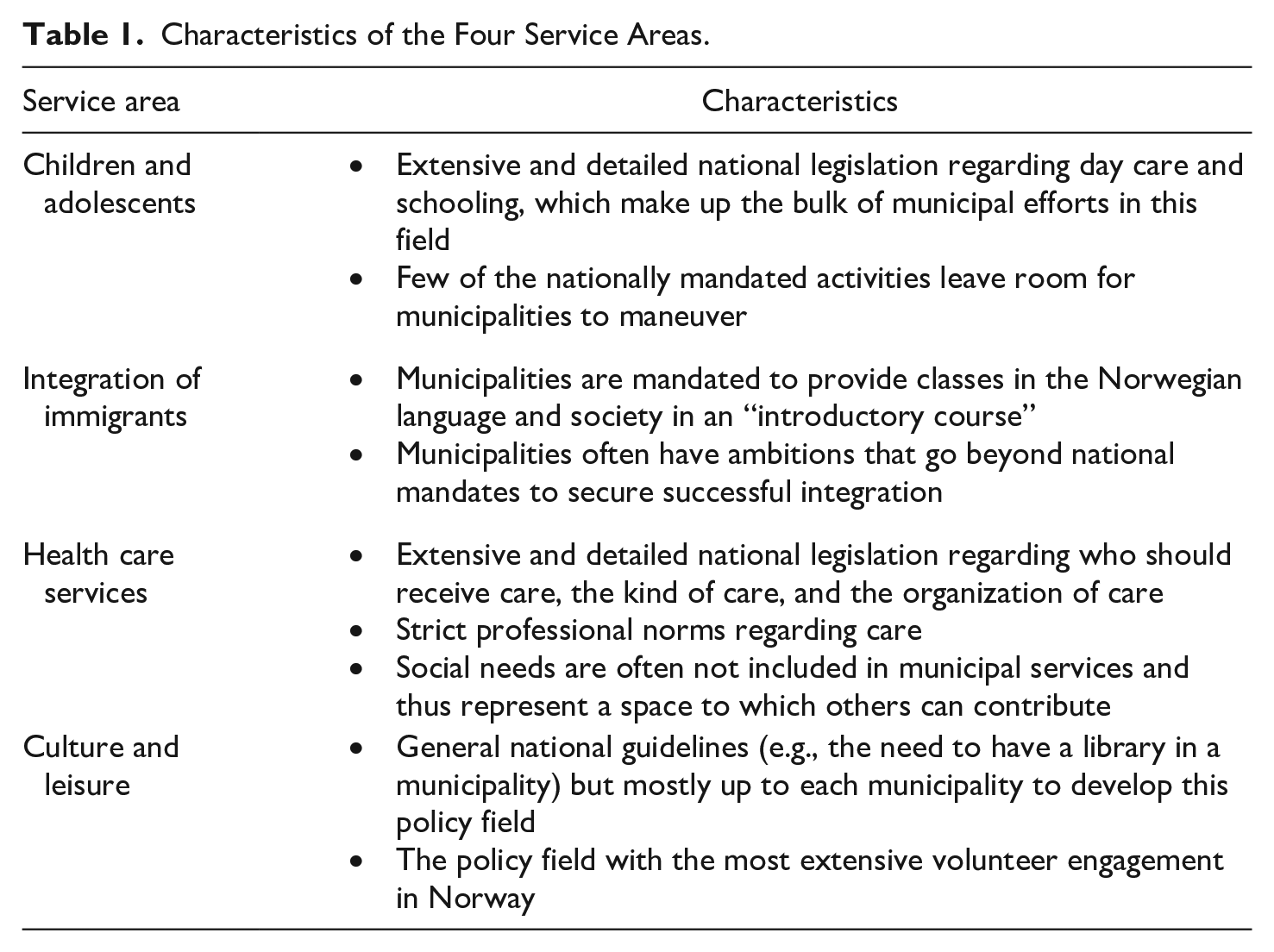
There are four service areas that constitute the institutional fields we compare in our study: (a) services to children and adolescents, (b) integration of immigrants, (c) health and care, and (d) culture and leisure. The scope of public responsibility varies across these fields, but they are all municipal services in which municipalities are supposed to adapt services to the local context and thus put their mark on the service. At the same time, the extensiveness and level of detail in the national regulatory frameworks vary, which influences the local room for maneuver. The characteristics of each field are presented in Table 1.
Characteristics of the Four Service Areas.
To understand the complexity of the interaction between the public sector and voluntary organizations in these four policy fields, we conducted a qualitative study in 12 municipalities, including two districts in Oslo—the capital and most populous city. The municipalities were chosen based on what Gerring (2008) describes as a diverse case selection strategy, which seeks to capture the full range of relevant dimensions. As always with a limited number of cases, we were forced to make some pragmatic choices, but the diversity of the municipalities gives robustness to the findings across dimensions (Flyvbjerg, 2006). Except for Oslo, where we include two districts that are part of the same city, all the municipalities are independent administrative districts. The municipalities vary in size, urbanization, location, and economic condition. In Table 2, we present core information about the municipalities and the number of interviews conducted in each. The variation in size is demonstrated by the numbers of residents. But in Norway, the geographic scope of municipalities varies greatly. So, a municipality may have a large number of residents spread over a large area but still have a rural context despite the population. Therefore, to represent the degree of urbanization, we include the municipalities’ scores on a centrality index developed by Statistics Norway (Høydahl, 2017), which ranges from 1 (most central) to 6 (least central) and is based on the number of jobs and service functions available within a 90-min drive. There is no suitable measure of the geographic locations and economic conditions of the municipalities that could be included in a table. Geographically, the municipalities are in all parts of the country, and we ensured diversity of the economic capacities of the municipalities using estimates from Statistics Norway (Kringlebotten & Langørgen, 2020). Our selection excluded the smallest municipalities, as these often do not have a sufficiently broad set of organized activities in all the four policy areas.
Characteristics of Municipalities and Numbers of Interviews Per Sector.
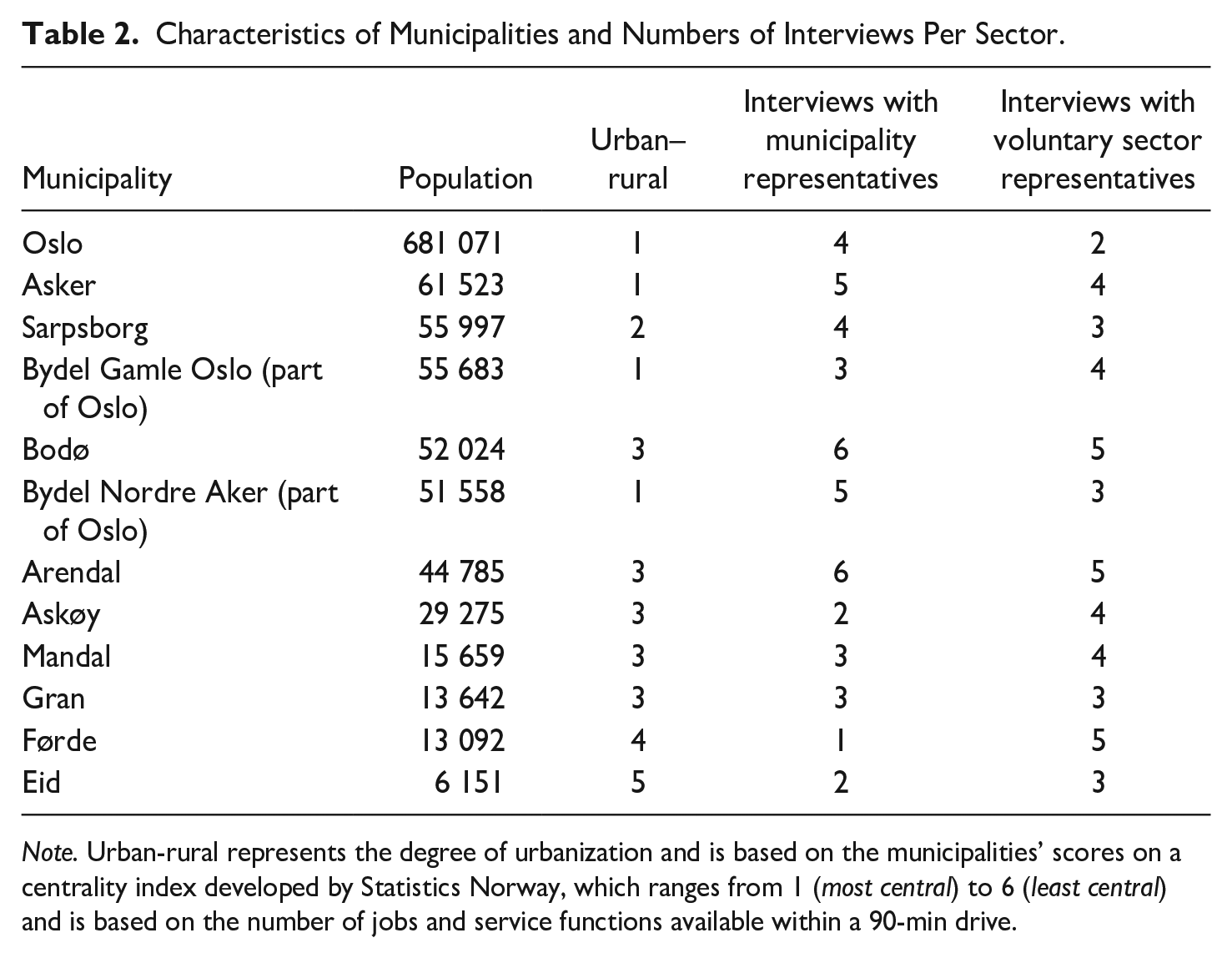
Note. Urban-rural represents the degree of urbanization and is based on the municipalities’ scores on a centrality index developed by Statistics Norway, which ranges from 1 (most central) to 6 (least central) and is based on the number of jobs and service functions available within a 90-min drive.
Within each municipality, we interviewed at least one representative of the municipality and one representative of a voluntary organization for each of the four policy areas—to the extent that we could identify them and that they agreed to participate in the study. In Oslo, we interviewed representatives with overarching responsibilities at the city level and with sector responsibilities in the two selected districts. Municipality interviewees were often leaders of the relevant policy areas, while various strategies were used to identify interviewees from the voluntary sector, including asking their municipal counterparts or simply searching the internet to identify likely organizations. When deemed relevant, we also interviewed a person in the municipality with overarching responsibility for the volunteer sector and/or local volunteer centers.
A team of researchers using a shared field guide conducted 89 semi-structured interviews. The field guide helped to structure data collection by establishing common questions and focusing on issues relevant to the research questions (George & Bennett, 2005). The interview protocol had the following main questions regarding both policy phases:
What is the overall relationship between the organizations and the municipalities?
Who are the important actors in policy design and policy implementation?
What are the issues for which the parties co-produce or would have liked to co-produce?
How is access to municipal decision-making structured?
What are the main facilitators and barriers for co-production?
What access do the voluntary organizations have to different kinds of resources, including their dependence on public funding?
What is the role of national and regional rules and legislation in framing the possible courses of action for the municipalities?
We asked about local practices in accordance with our understanding of co-production, but we did not ask the interviewees to assess co-production per se because they may not have been familiar with the concept or may have had different understandings of its meaning. All interviews were transcribed and coded with theme codes using the NVIVO software package (Sivesind, 2007). We also made short case reports from each municipality, creating a two-step analysis process.
Findings
In the following, we present our analysis of the empirical material in the four policy fields: services for children and adolescents, integration of immigrants, health and care, and culture and leisure. Based on the analytic approach described above, we center the analysis on the structure of the policy fields along the dimensions of (a) laws and regulations, (b) formalization of interaction patterns, and (c) resource dependency, first comparing the fields in policy implementation and then in policy design. The analysis illuminates how co-production characterizes a service area or is merely complementary to the autonomous activities of municipalities and voluntary organizations, and we explain these differences. At the same time, we have used the qualitative design to identify any alternative factors that may contribute to determining the level of co-production.
A striking finding across the municipalities is that there are certain consistent structural patterns between policy fields, regardless of the variation in size and geography of the municipalities (see Table 2). Thus, despite variations related to particular local contexts, the overall consistency of patterns suggests that there are institutional features that explain the differences between the policy fields.
Policy Implementation
Policy implementation is fundamental to local voluntary organizations. A universal finding is that, in all policy fields, voluntary organizations want to co-produce with municipalities. The variation is in how closely the municipalities meet this desire.
A significant number of the cultural activities that take place in communities are co-produced by voluntary organizations and municipal institutions. In all municipalities that we examined, cultural and leisure activities involve a form of co-production between themselves and voluntary organizations. The municipality makes the infrastructure (premises, facilities) available and contributes financial resources either to the organization’s operations or for specific events or projects. This volunteer from a marching band offers an example of the tight relationship:
The marching band was involved in establishing the cultural school [a municipal after-school service teaching music and arts to children]. Because [of the marching band], the municipality could sell lessons right away. The conductor of the marching bands became the principal of the cultural school. The marching band was a very important contributor to the creation of the cultural school and is probably the biggest customer too.
The municipality was obliged by law to establish a cultural school and had freedom in how it achieved this. But it could not do so without collaboration with the voluntary organizations that possessed the necessary resources, in the form of skills and access to potential users. At the same time, the marching band needed the services of the cultural school, and the existence of formalized networks smoothed this interaction.
In the field of immigrant integration, co-production in the delivery of services and activities is widespread, but not in the nationally mandated training classes in the Norwegian language and society. Co-production takes place within activities that are not tightly regulated by law. There is a mutual dependence, but the interaction is still somewhat informal. For example, most municipalities have examples of a scheme with “refugee guides” in which a volunteer introduces a refugee to the local community and the services available. All municipalities want this offered in their communities, but two municipalities that tried to establish it alone discovered that they needed a voluntary organization as a partner because the municipalities lacked the legitimacy to ask for such volunteer work from their residents. Indeed, immigrant integration involves establishing a bond among residents, which is something that voluntary organizations are better suited to facilitate than the public sector, leaving the municipality dependent on voluntary organizations to engage residents. Similarly, all municipalities consider areas of volunteering other than those explicitly working with integration—especially sports and culture—to nevertheless be an important part of integration work. Thus, the municipality becomes dependent on voluntary organizations.
We therefore see a field in which the municipality often depends on the resources of the voluntary sector. In principle, the municipality is the stronger party by virtue of its financial, skills, and information resources, but there are still a lot of volunteers, regardless of the municipality, and we see more cases in which the municipality is the party that wants to connect with autonomous volunteering.
The influx of refugees in 2015 and the consequent increase in interactions between the voluntary sector and municipalities is a common theme and was seen as a positive experience by both parties. This is generally viewed as a period of more co-production, when voluntary organizations were invited into the core of public responsibilities. There has been some disappointment, especially from the voluntary sector, that immigrant integration has since become a lower priority for municipalities, and the lack of formalization of the relationship may have contributed to a decline co-production after 2015. When there was no pressing need for action, there was no institutional mechanism to secure interaction.
In health and care, we find moderate levels of co-production in policy implementation. A challenge that interviewees from both the voluntary organizations and the municipalities mention is that a municipality’s activities in this area requires a high degree of professionalism and are regulated by national legislation and guidelines. We see some divergence among municipalities in terms of organizing their health and care services, but this is not reflected in any variation in the willingness to co-produce core services with the voluntary sector.
One way to overcome this challenge is a division of tasks in which municipalities provide care services while volunteers are involved in covering the service users’ social needs—something that has also been found in other studies of volunteers in Norwegian municipal health care (Skinner et al., 2019). The municipal services directed at social needs are not tightly regulated, and it is in providing those needs that we observe moderate levels of co-production. The users of such municipal services are of fragile health, and municipal staff need to provide them with clothing, food, and medicine to ensure they are ready to engage with the social needs volunteers at scheduled times. However, the municipality prioritizes the operation of its own care services, and volunteering merely contributes to the extent that it does not interfere with the priorities of the municipal services, reflecting that this is an area with clear hierarchies of power.
Interestingly, the interviewees from the municipalities report finding that there is no room, at least within their own resources, to address many of the social needs that volunteers cover and that volunteers thus can play a crucial role in the overall services. Furthermore, the representatives from the municipalities see volunteer contributions as a means of achieving the public goal of more elderly people living longer at home. However, this does not lead to a sense of interdependence or an increased use of co-production. In this field, the division between nationally mandated and non-mandated services is fundamental such that voluntary organizations’ resources are not critical because they are only important to non-mandated services.
Representatives from voluntary organizations share this view but believe the municipalities could benefit from recognizing the resources of the organizations and thus engage in more co-production. One representative of a voluntary organization describes an annoyance that was also mentioned to us in other places:
There are now nine of us on the board. Four or five of us have a health professional background and are more than sufficiently educated to be able to teach both in dementia-friendly communities and with activity friends [. . .] I think we could have done that, and then they could have stopped saying that they have little money, because they spend money on something that is, strictly speaking, not necessary because they have educated people to take the job [on a volunteer basis].
A lack of formalized arenas for interaction may explain some problems in communication that seem to be an obstacle to attempts to co-produce. We find that a pervasive theme is a relationship between volunteering and public responsibility, and we have examples of voluntary organizations noting that cooperating with a municipality can be demanding because the municipal staff are afraid that volunteers will take their jobs. Boundaries between public responsibilities and the territory of the voluntary organizations are important for both parties, and shared understanding here is paramount for successful co-production. Without formal arenas for interaction it is more difficult to develop necessary shared understandings.
In services for children and adolescents, there is generally a low level of co-production related to a municipality’s core tasks. School and day care are the main municipal services but are not a center for co-production. A municipal manager for educational services explains the limitations in the field: “In my field, there is not much [co-production]. When it comes to schools, kindergartens. . . Special education services are fairly regulated.”
Efforts from voluntary organizations are more prominent within services aimed at children from disadvantaged families and often involve voluntary organizations providing leisure-time activities for children and using municipal professional services to contact economically disadvantaged families. We uncover such co-production in several places; in one municipality, public employees are very enthusiastic about the results of a process initiated by a voluntary organization that established a “library for sports and outdoor equipment”:
We entered into a dialog with them [the Red Cross], and we went to Oslo and looked at different types of schemes. Then I wrote a proposal to the city council [. . .]. So we entered into an agreement with the Red Cross where we go in with operating assets, and they take care of the whole package. This is one fantastic example of how the municipality can use the voluntary sector and how the voluntary sector simply grows.
This is a typical example of co-production in services aimed at children and adolescents. It does not involve core municipal services, but municipalities provide funding and infrastructure. The law does not regulate the content of such services, but there is an expectation that municipalities will provide help to children from disadvantaged families. Generally, the lack of voluntary organizations solely committed to this group makes such formalization difficult—those organizations that do exist are mainly viewed as part of the culture and leisure field, in which formalization is stronger.
Overall, as we can see from Table 3, in policy implementation it is only within culture and leisure—and to a lesser extent immigrant integration—that we find high levels of co-production. Along the three analytic dimensions, we find that, for laws and regulations, co-production takes place within the aspects of each field in which regulations are most lenient; therefore, there is most space within culture and leisure because this is the policy area with the least regulation.
Overview of the Levels of Co-Production and Analytic Dimensions in Policy Implementation in the Four Policy Fields.
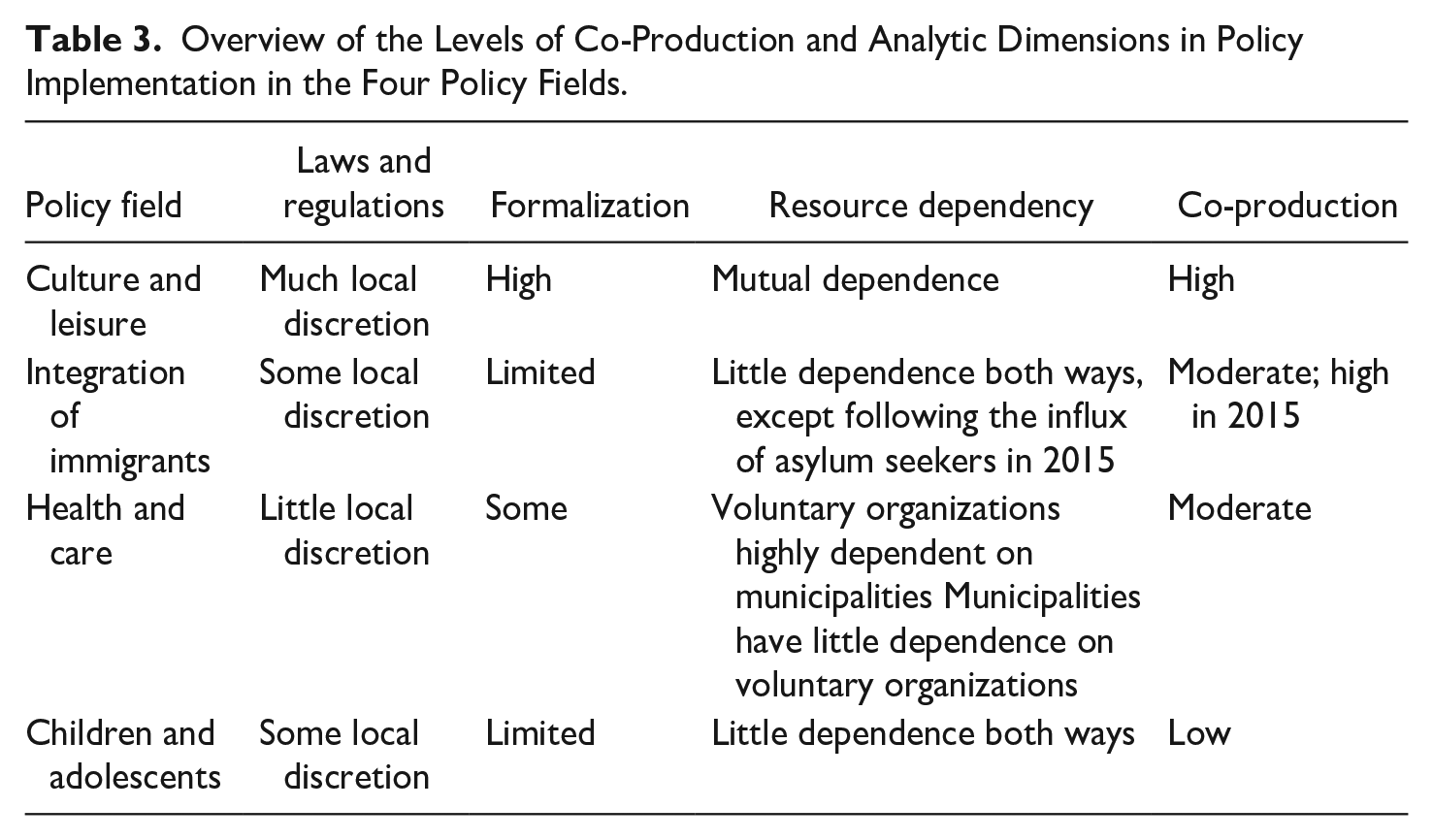
Formalization of interaction patterns is found in culture and leisure and to a lesser extent, in health and care services, but only in culture and leisure do the municipalities depend upon the resources of voluntary organizations. There also seems to be a hierarchy among the dimensions in predicting the level of co-production: laws and regulations are a strong predictor of co-production, formalization is less prominent in all service areas, but resource dependence is particularly important when it co-varies with laws and regulations. For example, in health and care, municipalities need volunteers to cover social needs that are not regulated by law, but this nevertheless does not lead to a municipal willingness to engage in co-production. Unlike what we will see regarding policy formulation, formalization does not follow from resource interdependence.
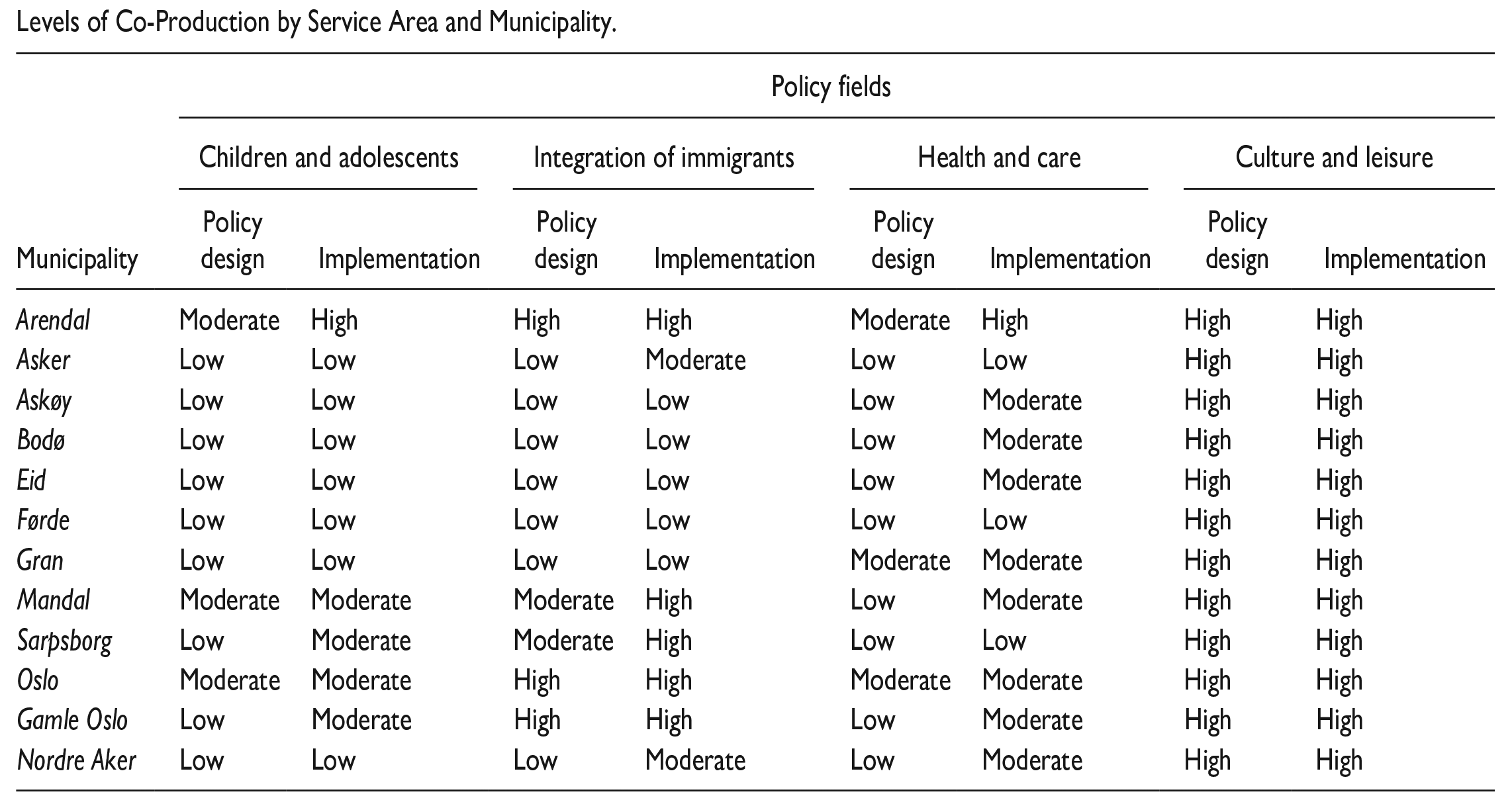
For documentation of the municipality-by-municipality variations, please refer to the Appendix.
Policy Design
In culture and leisure, voluntary organizations are at the heart of policy design. The interviewees from both the municipalities and the voluntary organizations describe how policies have been developed through a co-productive process and how arenas exist that constitute platforms for co-producing policy.
This is the field with the most voluntary organizations and the one in which municipalities spend the most resources on interacting with volunteers, and in every municipality, we find one or more arenas for communication and formal decision-making. Because of the wide range of organizations and the many resources invested by municipalities, formal arenas are needed for somewhat-transparent decision-making processes and to ease communication and relationships between the municipality and the dozens or even hundreds of organizations with a stake in the decisions being made. The result is a formal system dominated by the largest organizations. One representative from a municipality describes a typical scenario:
Those who are heard are the biggest; it’s the majority, and in a way, it’s right, but then you get the scheme that we have today, where you spend a lot of money in sports and sports arenas [and less on other forms of culture].
No other policy area has formalized the relationship between voluntary organizations and municipalities to the same extent, and this is consistent across all the municipalities.
An underlying theme in the interviews is that culture and leisure is a policy field with mutual resource dependence. Municipalities have resources upon which organizations depend, in the form of funds and access to public buildings and infrastructure, but they have limited activities of their own; for there to be services for residents, organizations are key, and their policy priorities must be acknowledged. In summary, this is a field with limited national regulation, in which the municipality needs the organizations and in which formal arenas for interaction have been established. Taken together, this creates high levels of co-production.
In the field of immigrant integration, we find little evidence of co-production in most of the municipalities, although there is one notable exception of a municipality that has gone further than most in promoting co-production in service development across the board. This is also corroborated by other studies that have found limited examples of co-production in policy design in this field in Norway (Espegren et al., 2019).
Integration is a field with some nationally determined policies, but most municipalities have initiatives that go beyond national demands, thus offering room for local stakeholders to co-produce policy design, although there is currently limited organizational willingness to do so. On this dimension, one might thus have expected there to be room for co-production.
Organizations working on integration are a mix of large established organizations, like the Red Cross, and newer organizations without established connections to the public sector and without the ambition for involvement in policy design. In municipalities in which large established organizations are present, those organizations will typically have access and opportunities to influence municipal processes, but in our data, we find little willingness to use this access. Thus, there has been no need to establish formal arenas for engagement between voluntary organizations and municipalities because there is no interest from the organizations to do so.
An interesting exception to this picture is in the municipalities’ uniform experience of the major arrival of refugees in 2015, which prompted them to reach out to organizations for help in integrating the refugees and that, with increased co-production in the implementation of policies, opened a space for voluntary organizations in policy formulation as well. In that situation, there was also more willingness from the organizations to engage in policy formulation, suggesting feedback processes between the phases. One interpretation of this finding is that the local room for maneuver is insufficient for co-production and that the division of resources and resulting dependencies between organizations and municipalities is important for the propensity to co-produce policy formulation. When the integration task at hand became bigger, the interdependence grew and thus also the co-production.
In health and care services, care for the elderly is at the heart of both municipal services and the efforts of voluntary organizations. On the municipality side, the dominant view is that national laws and regulations and professional standards offer little room for maneuver and thus limit the ability of voluntary organizations to take part in co-production of policy design. At the same time, there is variation among municipalities in how they develop their services, reflecting some room for local discretion. This implies that, although national regulation is central in our data, it might be understood as a local cultural feature more than an actual formal limitation on practices. One possible explanation for the widespread nature of this municipal approach to voluntary organization may be institutional isomorphism across municipalities in their understanding of care responsibilities and the room available to involve non-public actors.
At the same time, voluntary organizations have made few attempts to take an active part in policy design beyond financial support for themselves. Voluntary organizations often explicitly seek to stay out of municipal policy discussions, as this leader of a voluntary organization explains:
[The organization] cannot participate in politics and say which direction things should go, but we are allowed to come in and talk about our project, and we can apply for money from the municipality.
Despite these organizations often having activities directly related to municipal services, such as being “visiting friends” at nursing homes, they have no interest in influencing those services. This is a somewhat surprising finding because the other branch of civil society—the non-profit sector—has traditionally played an important role in providing ideological and professional direction to the development of welfare (Selle et al., 2018). Since there is a limited willingness for co-production, there is again no need to establish formal arenas for interaction. For health and care, we thus see little local room for maneuver, little formalization of relationships—and thus little co-dependence on each other’s resources—and an accordingly low level of co-production.
In the children and adolescents policy field, schools are the most important public service and are strictly regulated nationally. There are also few voluntary organizations in this field, once one excludes those dedicated to culture and leisure. One exception is in a district in an economically disadvantaged part of Oslo, where considerable public efforts are being made toward community development, and building and interacting with civil society organizations are a key part of these efforts. As one representative from a voluntary organization explains,
We have been invited to several councils. [. . .] There are many who say, “Hi, [various public agencies and volunteer umbrella organizations] want you to join a committee.” We are here to build our local community.
This exemplifies how the public sector engages in extensive community work in areas with a large proportion of residents who are immigrants. In this particular area, the public sector needs a voluntary organization to engage with and understand the local population, and it is thus an example of a municipality needing civil society resources. In this situation, the policy fields of youth and children, immigrant integration, and culture and leisure overlap, but the situation is limited to the specific context of a big city with a diverse and disadvantaged population. Other municipalities have a more traditional division of labor, with the municipality dominating the design of school and day care services while voluntary organizations dominate culture and leisure activities for adolescents. This demonstrates the importance of real resource interdependence in understanding the level of co-production.
In summary, we see from Table 4 that, of the three analytic dimensions, culture and leisure is the only field in which laws and regulations give local discretion, with identifiable formalized patterns of interaction and mutual dependence. Beyond culture and leisure, there is limited co-production in policy design, with low scores on all three dimensions. This tendency is also found in broader studies that have found that, among Norwegian voluntary organizations, local-level advocacy is in decline while national-level advocacy is growing (Sivesind et al., 2018).
Overview of the Levels of Co-Production and Analytic Dimensions in Policy Formulation in the Four Policy Fields.
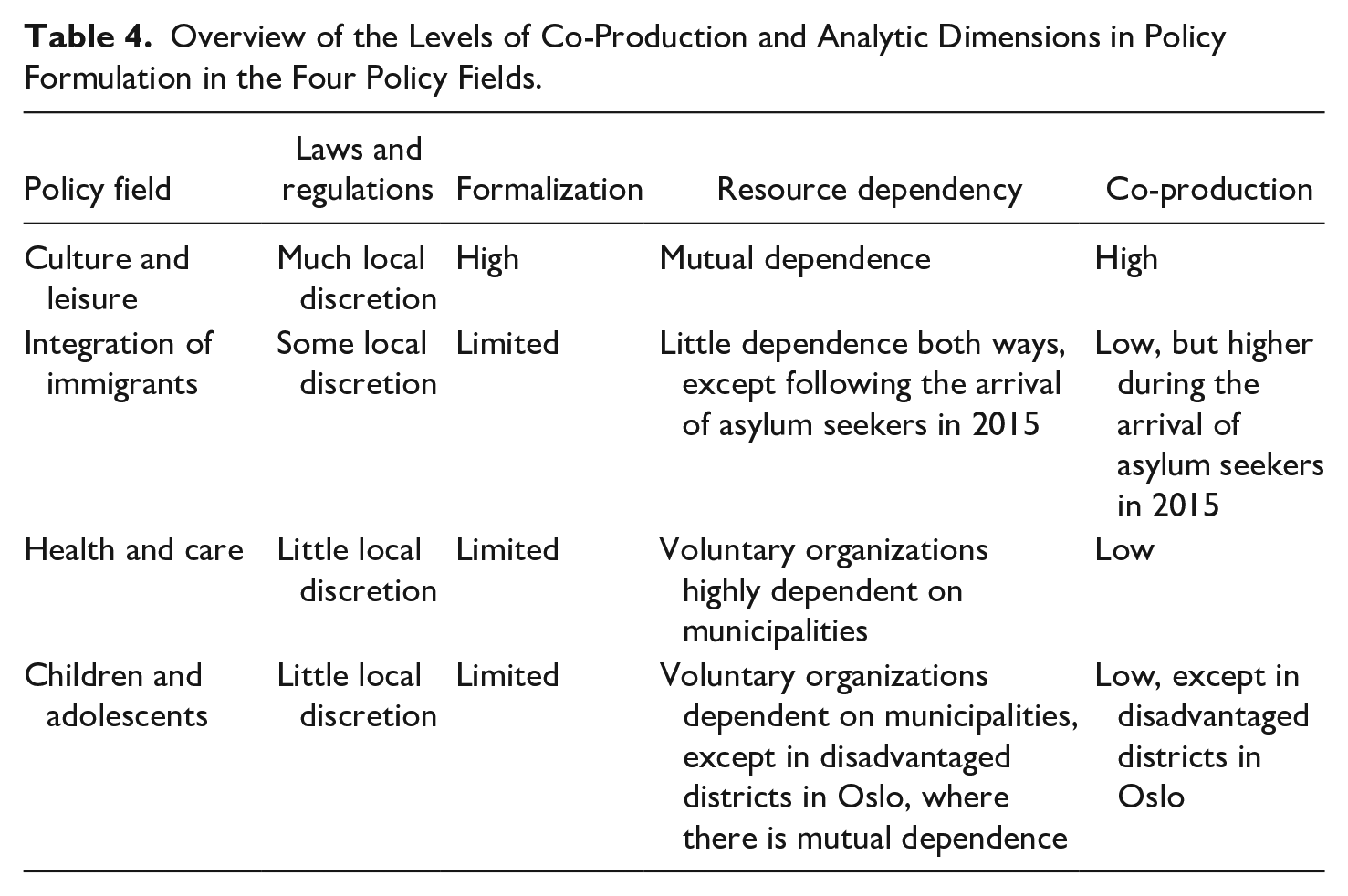
Interestingly, the exceptions to the general pattern underline the potentially crucial role of resource dependence and suggest how the three dimensions—and policy fields—are related. Notably, in the district of Oslo with a diverse population and socio-economic challenges, the municipality depends on the organizations for engagement with the minority population, which leads in turn to some level of formalized relationships and co-productive activities that expand to the parts of services for integration and for children and adolescents that are not tightly regulated by the national government. In this case, specific local circumstances lead to increased scores on all three analytic dimensions and a higher level of co-production. A similar pattern was seen across all municipalities in 2015, when a large number of immigrants arrived, which changed the dynamics in the field, producing higher scores on all dimensions and more co-production. This also underlines that the institutional structure is not entirely static but can be altered through external or internal shocks.
For documentation of the municipality-by-municipality variations, please refer to the Appendix.
Discussion
The findings confirm how different policy fields have different dynamics because of their institutional set-ups. Based on our analytic framework, with its three dimensions—(a) laws and regulations, (b) formalization, and (c) resource dependency—and two institutional feedback mechanisms, we developed hypotheses for the relationships between the institutional structure of the policy fields and the level of co-production.
We find that H1 is confirmed because co-production in implementation takes place at a high level in fields that are not core services mandated by law, particularly in culture and leisure. Moreover, we also find this dynamic in other fields; in immigrant integration, municipalities have more activities than nationally mandated, which creates room for co-production, while in services for children and adolescents, municipalities have less engagement beyond that stemming from the law and thus less co-production.
Somewhat surprisingly, we find limited backing for H2—that co-production is more likely to occur when the relationship between voluntary organizations and municipalities is formalized in cooperative agreements. In the implementation phase, interaction is fluid and less dependent on institutionalized meeting points between municipalities and voluntary organizations. Interestingly, we see that, in policy formulation, durable patterns of co-production require more formalization of networks, and the dimension is thus more prominent in policy formulation than in policy implementation.
We do find support for H3, that co-production takes place in areas in which voluntary organizations control critical resources. This is confirmed by the differences between the policy fields and by exceptions among the municipalities: the district of Oslo with a large minority population and low scores on socio-economic measures has more co-production because it needs resources possessed by voluntary organizations. Moreover, the resources available to municipalities correspond to the level of detail in the national regulations: more resources follow more detailed national regulations from the state, making contributions from non-public entities less relevant.
Regarding the role of policy feedback, we find that H4a is confirmed because co-production in policy formulation occurs when voluntary organizations are involved in policy implementation. We see this in the differences between the fields but also in the changing dynamic in the field of immigrant integration as the changing numbers of refugees arriving in the country alters the role of voluntary organizations in implementation and subsequently also in formulation.
We find that H4b is confirmed, as co-production in the policymaking phase is more likely to take place in fields in which the municipality has a high degree of discretionary power. In the culture field, a municipality has discretionary power to design its local policy, and it therefore depends on the critical resources of voluntary organizations. This dynamic creates a situation in which co-production is the natural form of interaction in the implementation of services.
Finally, H5 is confirmed: because of civil society feedback, municipalities are more likely to engage in co-production in the policymaking phase when voluntary organizations control critical resources.
In a context in which the idea of co-production between civil society and the public sector is increasingly promoted as a one-size-fits-all solution to the challenges confronting welfare policies (Sicilia et al., 2016), this article shows that co-production takes place in institutional spaces structured by existing welfare policies and public management practices that shape how those practices are implemented by local authorities. Consequently, before choosing to introduce co-production as a collaborative strategy, policymakers and practitioners must better understand and account for how the institutional features of the policy field create incentives, constraints, and feedback effects that enhance or impede co-productive relationships.
Furthermore, these findings should challenge us to think about how to interpret the literature on co-production that claims that the public sector sets the conditions for most cases of co-production and that residents and civil society are often included at a relatively late stage of the policy cycle. Given that reviews find welfare issues to be the most studied service areas (health care, education, and social care, according to Sicilia et al., 2019, p. 234), these claims may reflect a bias toward the policy areas that have received the most attention. We hope our article will inspire others to explore this further.
In this article, we analyze co-production between municipalities and voluntary organizations. In much of the scholarly debate, a clear distinction is not always made between voluntary organizations, like those we studied, and non-profits that rely on paid professional staff. The latter category tends to dominate the body of research, and while financial support from the public sector makes non-profits more responsive to citizens and more responsive to the ambitions of the public sector (Benjamin & Brudney, 2018), this is not the case in our data. Leisure and culture receive the largest sums of funding from municipalities, but they are not disciplined by this effect. An obvious important factor is the differences between the voluntary organizations that we studied and professional non-profit service providers, which suggests that future studies should delve into the role of voluntary organizations in co-production in general and how they are differentiated from non-profits in particular.
While we believe that the institutional environment of the policy fields in the form of laws and regulations, formalization of relations, and resource dependency can explain much of the observed differences between the policy fields, there are at least two other features to consider. First, the supply of organizations with which the municipalities can co-produce varies between the service areas. Second, besides the formal institutional framing of interaction, institutional isomorphism is also at play, through which both municipalities and voluntary organizations learn and adapt based on the practices of other municipalities and from previous experiences. The notable exceptions from general patterns—like the immigrant-dominated district in Oslo and the varying experiences in co-produced services for deprived children—suggest that, while formal frames for action play a role, informal mechanisms also regulate modes of interaction.
The Norwegian experience may have characteristics seldom found elsewhere, but our study demonstrates power balances in different fields within this context, and similar features can probably be found in other countries as well. The mechanisms may also be the same in other contexts, yet the outcomes may be different due to different institutional settings (e.g., the sizes of different fields), and this should be empirically investigated in future studies. Indeed, since we investigated only 12 out of more than 350 municipalities, the room for statistical generalizations even for Norway is limited, and further research is thus warranted.
Footnotes
Appendix
Levels of Co-Production by Service Area and Municipality.
| Municipality | Policy fields | |||||||
|---|---|---|---|---|---|---|---|---|
| Children and adolescents | Integration of immigrants | Health and care | Culture and leisure | |||||
| Policy design | Implementation | Policy design | Implementation | Policy design | Implementation | Policy design | Implementation | |
| Arendal | Moderate | High | High | High | Moderate | High | High | High |
| Asker | Low | Low | Low | Moderate | Low | Low | High | High |
| Askøy | Low | Low | Low | Low | Low | Moderate | High | High |
| Bodø | Low | Low | Low | Low | Low | Moderate | High | High |
| Eid | Low | Low | Low | Low | Low | Moderate | High | High |
| Førde | Low | Low | Low | Low | Low | Low | High | High |
| Gran | Low | Low | Low | Low | Moderate | Moderate | High | High |
| Mandal | Moderate | Moderate | Moderate | High | Low | Moderate | High | High |
| Sarpsborg | Low | Moderate | Moderate | High | Low | Low | High | High |
| Oslo | Moderate | Moderate | High | High | Moderate | Moderate | High | High |
| Gamle Oslo | Low | Moderate | High | High | Low | Moderate | High | High |
| Nordre Aker | Low | Low | Low | Moderate | Low | Moderate | High | High |
Declaration of Conflicting Interests
The author(s) declared no potential conflicts of interest with respect to the research, authorship, and/or publication of this article.
Funding
The author(s) disclosed receipt of the following financial support for the research, authorship, and/or publication of this article: The author(s) received financial support from the Norwegian Ministry of Culture through the Norwegian Centre for Research on Civil Society and Voluntary Sector.
