




Abstract
Public administration as a field of work and study offers a theoretically rich yet practical tool to enact student engagement and the ideal of students-as-partners: the principles of service co-creation. Public administration, as an interdisciplinary and applied field, promoting and reflecting democratic principles, is a good source of tools for practice. As such we expect it to be particularly suitable for curriculum co-design principles. Our research sets potential benefits and challenges in facilitating a co-designed curriculum for public administration programmes. In doing so we make the case for more co-design and co-production of teaching as a tool to achieve enhanced understanding of these concepts and greater student engagement.
Introduction
There have been many statements made on the nature of the public administration curriculum. Bodies such as the International Institute of Administrative Sciences (IIAS) have developed guidelines for MPA curriculum in line with the European Association for Public Administration Accreditation (EAPAA) requirements. National learned societies, such as the UK Joint University Council for Applied Social Sciences (JUC), have done similar. At the same time many scholars, including in this journal, have integrated theories pertaining to different pedagogical approaches into public administration. But it remains contested as to whether there is anything unique about public administration as a subject which lends itself to a particular pedagogical approach or approaches? This paper contributes to debates around the issue of a distinct pedagogy in public administration teaching.
In order to address this question this research will explore what teaching public administration is about and will touch on some key debates around the nature of the subject. We then zoom into co-production and how this concept has become a key feature of public administration teaching. Finally, we will outline one approach to integrating curriculum co-design within public administration programmes.
In doing so this article provides three key contributions: 1) it makes the case for a distinct public administration pedagogy; 2) it argues for curricular co-design as a key element of this distinct pedagogy as a way to build student engagement and reinforce public service values through teaching and learning practice, and 3) it provides an example of a co-design activity for use in public administration courses.
What’s in the name: Teaching public administration
Before addressing the relevance of curricular co-design to public administration it is perhaps best to consider what makes public administration a distinct subject. There have been many debates about what public administration is, how it differs from public management or public governance, and even whether such definitional debates even matter (Fenwick and McMillan, 2014). There have also, particularly within the UK tradition, been many debates surrounding the status of the subject (Boyne, 1996; Chandler, 1991, 2002; Diamond and Liddle, 2012; Elcock, 1991; Greenwood, 1999; Jones, 2012; Liddle, 2017; Miller, 2012; Rhodes, 1996; Rhodes et al., 1995). It has even been described as ‘the craft that dare not speak its name’ (Barberis, 2012: 76). So, what makes public administration a distinct subject, how is it distinct from associated subjects such as political science and business management and how does co-production fit within the wider public administration curriculum?
Public administration differs from, but is closely related to, political science, business management and public policy. In practice it is down to public administrators to ensure that public services are delivered in line with government priorities. Thus, public administration is primarily concerned with public-facing roles that are responsible for public service delivery and policy implementation. As an academic subject the origins of modern-day public administration are often linked to Woodrow Wilson (1887) and was defined by Leonard White as ‘the management of men [sic.] and materials in the accomplishment of the purpose of the state’ (1926/2004 as cited by Holzer and Schwester, 2011: 31). Public administration as practice exists within a political context but also involves the management of resources in order to realise political goals. Put simply, public administration is where political decisions meet real life.
The task of the public administration scholar is in exploring, understanding and critiquing how these political decisions are translated and implemented within real world settings. The way in which this process is conceptualised has evolved over time, from traditional public administration, to the New Public Management, and more recently to ideas around New Public Governance (Dickinson, 2016; Pierre and Peters, 2019; Pyper, 2015). This contemporary understanding of public service design and delivery includes inter alia a focus on distributed and boundary-spanning leadership (Dudau et al., 2018; Fenwick and Johnston, 2020; Mangan and Lawrence-Pietroni, 2019), collaboration and integrated services (Elliott et al., 2020; Sullivan and Skelcher, 2017), community empowerment and involvement (Elliott et al., 2018; Elstub and Escobar, 2019), networks and collaboration (Dudau et al., 2020; Greve and Hodge, 2013; Sørensen and Torfing, 2017) and co-production (Dudau et al., 2019; Löffler and Bovaid, 2016; Pestoff et al., 2013). Although the theoretical understanding of public administration continues to develop the precise nature of the public administration curriculum remains contested (Fenwick and McMillan, 2014; Greenwood and Robins, 1998) and for many these theoretical developments do not diminish the relevance of the traditional crafting skills of the public bureaucrat (Dickinson, 2014; Rhodes, 2016).
Although the nature of public administration may be contested, typically a public administration curriculum will include concepts and theories linked to street-level bureaucrats (Lipsky, 1980), public value (Moore, 1995), public service motivation (Perry, 2000), co-production (Bovaird, 2007; Löffler and Bovaird, 2016; Whitaker, 1980) and behavioural approaches (Grimmelikhuijsen et al., 2017; James et al., 2017; Tummers, 2020). Alongside concepts related to strategy and decision-making, public administration courses will also typically include alternative approaches to evaluating the impact of these decisions such as performance management (Boyne, 2010; Talbot, 2010), outcomes-based approaches and complexity or open systems approaches (Klijn, 2008; Lowe, 2013). Increasingly the public administration curriculum also reflects how public services affect different groups and communities in different ways including LGBTQ+ groups (Matthews, 2019; Matthews and Poyner, 2020) and women (Carey et al., 2019). Overall we can see how some of these issues may be present within political science programmes but that, taken together, they represent much of what makes a public administration curriculum distinct.
At the same time, we can see that aspects of business management, such as leadership, finance, and human resource management would also feature, given the importance of proper management of public resources. In other words, a public administration curriculum is likely to reflect aspects of traditional public administration alongside New Public Management and contemporary concepts of New Public Governance. Indeed it has been noted elsewhere that a generic business management education on its own is inadequate to developing a knowledge and understanding of the public administration context (Elliott, 2020). Furthermore, such an approach would be at odds with recent criticisms of New Public Management which have highlighted the importance of complexity to understanding public sector phenomena including decision-making and performance (Eppel and Rhodes, 2018; Lowe and Wilson, 2017; Rhodes et al., 2010; Teisman and Klijn, 2008). As noted elsewhere, ‘public administration has and continues to straddle the fields of study vis-à-vis political studies and that of business and management in an attempt to understand the business of government’ (Miller, 2012: 5).
In operationalising public administration courses within a programme of study, we ask whether there is a particular pedagogy that is distinct to supporting this learning. In other words what we teach may set us apart from neighbouring fields – but is how we teach also in any way distinctive? One aspect that we will focus on within this paper is the teaching of co-production. So, what is co-production and how might it influence a distinct public administration pedagogy?
Zooming in: Co-production and co-design in public administration
Public administration research is increasingly paying attention to the role of co-production and its benefits for the provision of public services (Alford, 2014; Bovaird and Loeffler, 2012; Jakobsen, 2013; Osborne et al., 2015; Pestoff, 2014; Van Eijk and Steen, 2014; Vamstad, 2012). This has been done to the point of fascination, leading some to argue for (constructive) disenchantment with the concept (Dudau et al., 2019). It is, indeed, intellectually appealing and conceptually democratic (Lewis et al., 2020) to involve the public in the delivery of public services. When it also contributes to better service outcomes, fulfil consumers’ expectations of enhanced power base and get public sector professionals out of their ivory towers and into durable conversations with their clients, it becomes little short of ‘magic’ (Voorberg, 2015).
Co-production is defined by Ostrom (1996: 1073) as ‘the process through which inputs used to produce a good or service are contributed by individuals who are not in the same organization’. It is not mere participation, but a superior level of engagement and collaboration between service providers and users (Pestoff et al., 2013). Alford defines co-production as being any behaviour by a party outside the government agency which ‘is cojoint with agency production, or is independent of it but prompted by some action of the agency; is at least partly voluntary; and either intentionally or unintentionally creates private and/or public value, in the form of either outputs or outcomes’ (2009: 23).
The concept was initially developed in America in the late 1960s to describe the involvement of ordinary citizens in the production of public services. It had a clear focus on the role of individuals or groups of citizens in the production of such services (Pestoff et al., 2006). Since then, co-production has played a significant role in public service delivery in many nations, in empirical research spanning continents and in levels of administrative development. Co-production is now accepted as a defining characteristic of public services (Alford, 2002, Osborne, 2010, Osborne and Strokosch, 2013), as most public sector outcomes cannot normally be achieved without the active and voluntary input of service users (e.g. police outcomes cannot be achieved without people reporting criminal or unusual behaviour; public health relies on patients’ honest histories, education relies on pupils’, families’ or students’ input, etc.). Therefore, the rationale for co-production in public services hardly requires justification.
When it comes to managing it, co-production entails meaningful and active consumer engagement in order to get to a sustainable delivery of services and products (Elliott et al., 2018; Osborne et al., 2015). This is where challenges begin, as co-production is a relationship where professionals and citizens share power to plan and deliver support together, recognising that both partners have vital contributions to make in order to improve quality of life for people and communities (Slay and Stephens, 2013: 3). This is not a straightforward task, as historically, professionalism and traditional administrative order meant a certain schism between public professionals (e.g. doctors, teachers, police officers, nurses, social workers) and their clients is to be expected. This is based on the divide between private and public value maximisation – one argument in this respect could be that professionals are stewards of public value and ought to resist private value maximisation by individual clients (as per proponents of stewardship theory – see Davis et al., 1997); another argument could be that professionals as agents try to maximise their own value by concealing their work inputs, processes and resource allocation criteria from their principals – their clients/the government (as suggested by agency theory supporters – see Eisenhardt, 1989).
Policy makers’ interest in co-production seems to be driven by a combination of low satisfactory experience of service delivery, on the one hand, and increasing budgetary stringency, on the other hand (Alford, 2014). And its effects do not disappoint: a study published by Speedling and Rose (1985) argues that allowing clients to participate in co-producing their health care leads to higher levels of satisfaction in relationships between professionals and their clients. More recently, Loeffler (e.g. Loeffler and Bovaird, 2019, 2020, Loeffler and Timm-Arnold, 2020) also revealed wider positive effects of co-production, including on public order, crime reduction, as well as offenders’ and victims’ quality of life.
Co-production starts with co-design. Some authors argued it to be a distinct, though related, phenomenon, but, like ourselves, many see it as the first phase of co-production, the first step towards co-opting service users to co-ideate about the best ways to deliver that service (Voorberg et al., 2014). The idea behind co-design is democratically sound (Fraser, 2005) but it also makes practical sense: a service can only be of value to users if service designers know the users, their needs, their experience, and the value they expect to extract from the service (Dudau et al., 2019); equally, input diversity mitigates cognitive biases, leading to likely better decision making (e.g. Trischler et al., 2019). Co-design is on the rise, as a policy-making and organisational decision-making tool. Indeed, following the social turn away from rational policy making and organising and towards empathy and curiosity (Torjman, 2012), collective and co-created wisdom has started to be certainly favoured to top-down decision-making, given the benefits at a symbolic, as well as practical, levels.
Given the extensive interest in co-production by public administration scholars and the clear practical relevance of co-production it might seem reasonable to assume that the concept is not only taught but also that it is practiced within the classroom. The next section will explore the burgeoning pedagogy literature on co-production.
Co-production and curriculum co-design
Within pedagogy, ideas of student engagement and participation have a long and well-established track record. The importance of engagement in the learning process has been recognised by many, such as Dewey (1916), Piaget (1977), Vygotsky (1978) and Papert (1993). Within this, the concept of curriculum co-design has become part of a wider shift towards seeing students as partners in learning and teaching (Healey et al., 2014). This has led to research on the nature of students as partners (Cliffe et al., 2017) and student engagement (e.g. Morgan-Thomas and Dudau, 2019) but we know significantly less about tools which can get us to such outcomes.
Curriculum co-design between academic faculty and students is a label covering a potentially diverse set of ideas and practices, connecting, in turn, to a complex set of considerations (Healey and Healey, 2018). However defined, it is a phenomenon emerging in prominence within the global Higher Education Sector (Bovill and Woolmer, 2019). Curriculum co-design is better understood when considered in relation to a set of economic, organisational, political and technical contexts for its development (Healy and Healy, 2018). For example, changing practical, economic and technical contexts continue to drive the need for Higher Education institutions (HEI) to find new ways to maintain currency (McEwen et al., 2019). Many HEI’s surely hope that co-design, especially with part time and professional students, is one solution to this challenge. Co-design has also grown alongside a greater emphasis on evidencing student consultation and achieving their satisfaction with programmes of study (McEwen et al., 2019; Hsieh and Nguyen, 2015). This is combined with a general trend towards more active collaboration, ongoing learning and active partnership with students in HEI’s generally (Bovill, 2014; Hsieh and Nguyen, 2015). In some settings, particular student groups, such as those from Black and Minority Ethnic backgrounds, experience lower attainment levels and as such are a concern for HEI’s who wish to address issues of access and equality (Jones-Devitt et al., 2017).
Therefore, a single set of motivations and drivers for increased efforts towards curriculum co-design do not exist, nor are all local sites for the practice of co-design identical, so generalisations about the topic are problematic. Co-design may be motivated by pedagogic and democratic ideas, or conversely by the need to improve student metrics for business purposes (Bovill and Woolmer, 2019). Such lack of thorough and coherent rationale may partly relate to the lack of debate about curriculum more generally in the HEI sector, as reported by Bovill and Woolmer (2019).
Historical activity and motivations for co-design of curriculum with students has been characterised as being orientated to perceived student deficits (Carey, 2013) – perhaps driven with concerns to address some lack of motivation and engagement on the part of students, their poor appreciation of curriculum, teaching and learning or assessment strategies, or even their lack of involvement in the governance of academic programmes. However, accounts of contemporary practice – at least in terms of rhetoric – talk about reinventing spaces for learning together (Rakrouki et al., 2017), in which increasingly authentic approaches to learning better consider students’ interests (Garcia et al., 2018). In such approaches, there is time to build collegiate relationships between faculty and students, and to allow students to build ownership of ideas and pedagogical tools (Garcia et al., 2018.). In terms of detail, a range of opportunities for curriculum co-design between faculty and students have been cited. They include opportunities presented by the design of entirely new programmes, desire to maintain co-design activity as programmes of study progress, or occasions afforded by HEI programme approval or committee processes (Bovill and Woolmer, 2019).
Resistance to the consideration and practice of forms of curriculum co-design between faculty and students is a common theme in Higher Education pedagogical literature. Co-design with students is viewed by some faculty as a risky activity (Bovill, 2014), resulting in a lack of willingness to go beyond dominant deficit discourses about students, to broker even small changes to current faculty-led practice, and has even been linked to the operation of ‘critical whiteness’ on the part of faculty (Goff and Knorr, 2018; Jones-Devitt et al., 2017). Where specific concerns are described, these include the risk of leaving agreement about curriculum negotiations to late stages in planning and delivery cycles (Bovill, 2014).
Encouragingly, curriculum co-design is frequently talked about in positive terms within Higher Education pedagogical literature. A key theme is the anecdotal reporting of increased confidence for those students participating in co-design (Jones-Dewitt et al., 2017). Elsewhere, faculty have reported as being more responsive, subsequent to participating in curriculum co-design, in adapting curriculum to students needs (Garcia et al., 2018). Individual studies report increased mutual understanding of roles between parties participating in curriculum co-design (Hsieh and Nguyen, 2015), and enhanced student understandings of the process of curriculum design (Kupatadze, 2018).
Success factors in enabling curriculum co-design reportedly include the need to redefine criteria for success itself, for example, focusing on faculty ‘readiness’ for change to a new way of working (Jones-Dewitt et al., 2017). A willingness to go beyond tokenism and to widen student engagement in the process is another theme (Goff and Knorr, 2018; Rakrouki et al., 2017), as is the diversification of the means of involvement and co-design, including provision of digital methods and support materials (Browne et al., 2017; Cecchinato and Foschi, 2017). Supporting curriculum co-design between faculty and students, ultimately, seems to rest less on novelty, but on a wiliness and ability to change cultures and processes of decision making (Carey, 2013). Willingness to work in new ways (Healey and Healey, 2018) and the ability to organise ‘early wins’ build confidence in student partners that their input is meaningful and leads to curriculum change (Bovill, 2014; Browne et al., 2017). Positive and open attitude of faculty (Bovill and Woolmer, 2019), goes hand in hand with practical efforts to close feedback loops (Carey, 2013) and find methods that engage (Saunders & Saunders, in McEwen et al., 2019).
In many ways the arguments surrounding use of curriculum co-design reflect those noted earlier about the use of co-production in public service design and delivery. In both instances there are issues of power imbalances, the role of the professional, issues of culture and readiness for change. But what is clear is that the literature on both co-production as a concept in public administration, and that on co-production as a concept in pedagogy, are well established, as are the use of these approaches in practice. Therefore, it might be reasonable to assume that it is ripe for becoming a fundamental pedagogical practice in public administration teaching. There are some examples of the use of co-design and co-production pedagogy in public administration courses (see for example Godwin and Meek, 2016) but anecdotal evidence suggests this practice is not widespread.
The following section will describe a practical case where curriculum co-design has been used within a public administration programme. This will provide a basic guide to any academics who may be considering using curriculum co-design. Specifically, this section will demonstrate why it is a particularly effective way to stimulate discussion around the concept of co-production.
Methodology
Our reflection on a case of curriculum co-design was prompted by discourse of co-production within public administration literature, previously summarised. We considered that mentions of co-production and co-design should be accompanied by critical reflections on actual cases but noted the lack of literature on such in the teaching of public administration (aside from Godwin and Meek, 2016 as noted above). In the light of this, it seemed to us that to speak of, or make claims about, co-production and co-design in the practice or teaching of public administration may be more straightforward than making it happen. We wished to challenge our own use of these labels, and to see how, and if, the practice of co-design supported the teaching and learning of public administration. Therefore, we reasoned that a critical examination of co-design required engaging with ‘doing’ – and inspired by the autoethnographic tradition, we set out to do that.
We define autoethnography in this context as the practice of self-reflection focusing on ‘how we come to know, name and interpret personal and cultural experience’ (Adams et al., 2015: 1). More specifically, this approach inspired the lead author to critically consider how their experience of teaching through co-design intersected with the responses of students. This was fitting, seeing that co-design is reliant on shared meaning and co-constructed practices (Higgins et al., 2019), so his reflective narratives were useful to the extent in which they exposed moments of connection, or situations of frustration. These could then be understood as sites of sensemaking (Weick, 1995). We acknowledge this produces a partial insight, but as it focuses on the details of ‘doing’, it is a starting point from which to explore what learning co-design through doing it taught us all.
Our method therefore focused on auto-ethnographic reflection on one case of co-design activity in teaching and learning, informed by teaching ‘through’ co-design in a number of class-based sessions on a number of public administration programmes, particularly in a Senior Leaders Master’s Degree Apprenticeship programme. We utilised this small-scale focus to open up a critical examination of the ethnography of co-design in the classroom, recognising that our insights are part of ‘opening up’ future shared reviews, with students, of this practice. In doing so, we argue for consideration of the details of the ‘how’, in addition to the ‘what’ of co-design. Practically, the lead author engaged in a cycle of critical reflection in one case of curriculum co-design, paying attention to the extent and the process by which aspirations to ‘teach through’ co-design supported students’ learning of the subject. His critical autoethnographic reflection involved reflective note taking on his experience of teaching. The other authors added their secondary reflections and contributed towards a process of sensemaking (Weick, 1995) in response to his original notes, so the voice in the next section is a shared one.
Findings and discussion: Annotations on an autoethnographic process
The case of co-design that was the subject of the lead author’s autoethnographic work, and our subsequent joint sensemaking, was structured around a four-step model of teaching through co-production and co-design: (a) support students to undertake a co-design activity, (b) structure shared reflection, (c) relate and discuss key co-production and co-design concepts, and (d) critically consider challenges, by relating theory and (classroom) experience. These stages are summarised in Table 1, along with the lead authors’ key reflections and our shared considerations for educators, which are expanded below.
Summary and key reflections on teaching through co-design.
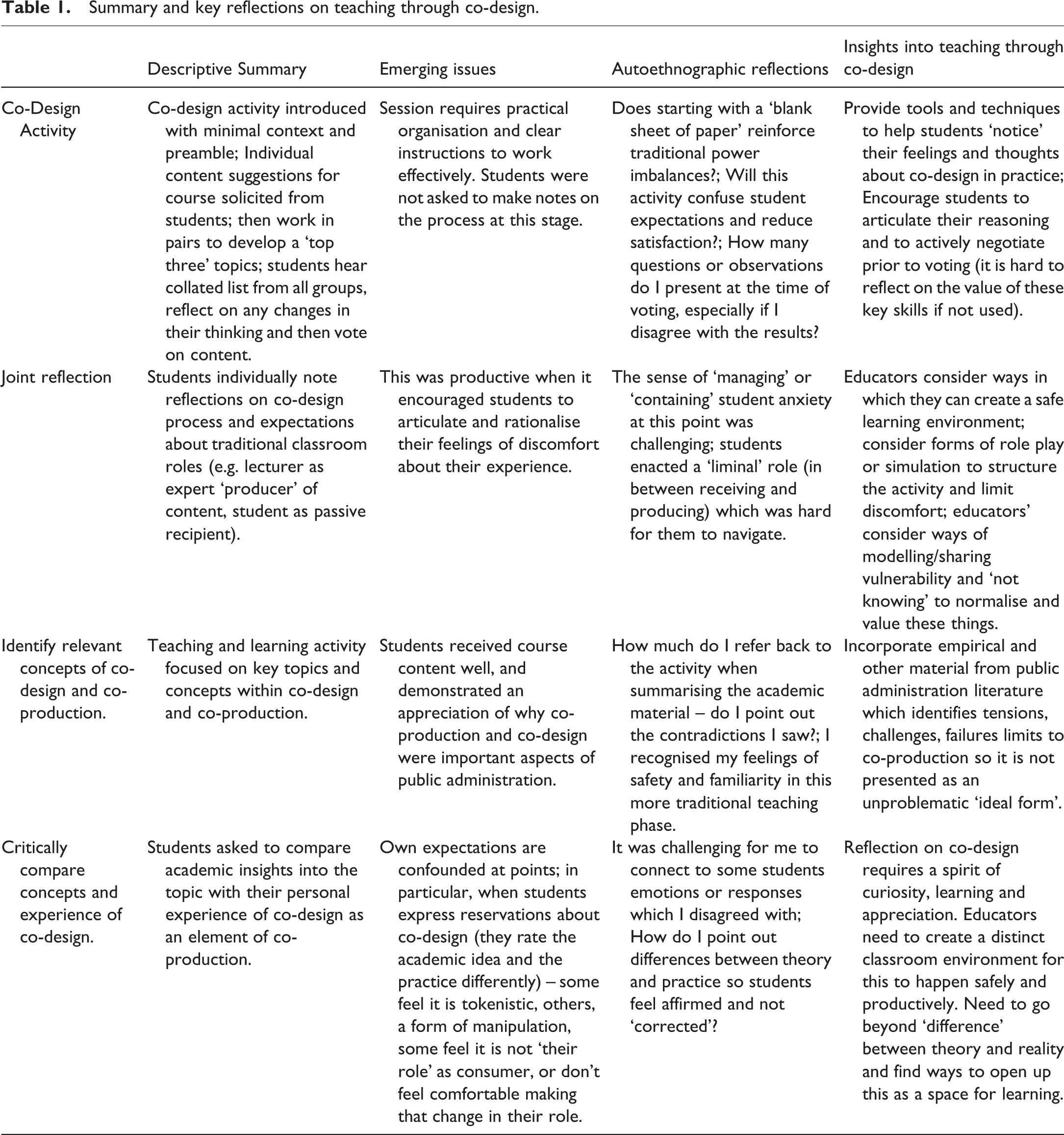
The model used was informed by the lead author’s prior experience. What was particularly interesting from the experience of conducting a co-design activity in the classroom was the extent to which the practice of co-design conflicted with students’ views on co-design and co-production as theoretical constructs. Students were generally receptive to the concept of co-production and all cited examples where it could be used within their own workplace. Yet perceptions of the practice of co-design in the classroom were much more varied. Many felt disillusioned with the process while others felt disorientated and confused. On reflection, conducting this activity in the class enabled students to experience the perspective of both a professional (in considering the use of co-production in their workplace setting) and as a service user (in experiencing the practice of curriculum co-design as a student in the classroom).
Towards teaching through co-design
We now offer a tentative set of insights as a way of opening up a pedagogical discussion around teaching through co-design. However, we avoid providing a general set of fixed ‘rules’ for teaching public administration through co-design, as we are mindful that co-production and co-design is a collective, emergent and situated practice (Pestoff, 2014). Instead, we offer a set of headline considerations (Table 1) for educators and students approaching teaching ‘through’ co-design, before discussing our shared reflections that led us to develop the list. Table 2 includes advice on process (how) as well as content (the teaching of public administration).
Our advice to educators considering teaching through co-design.
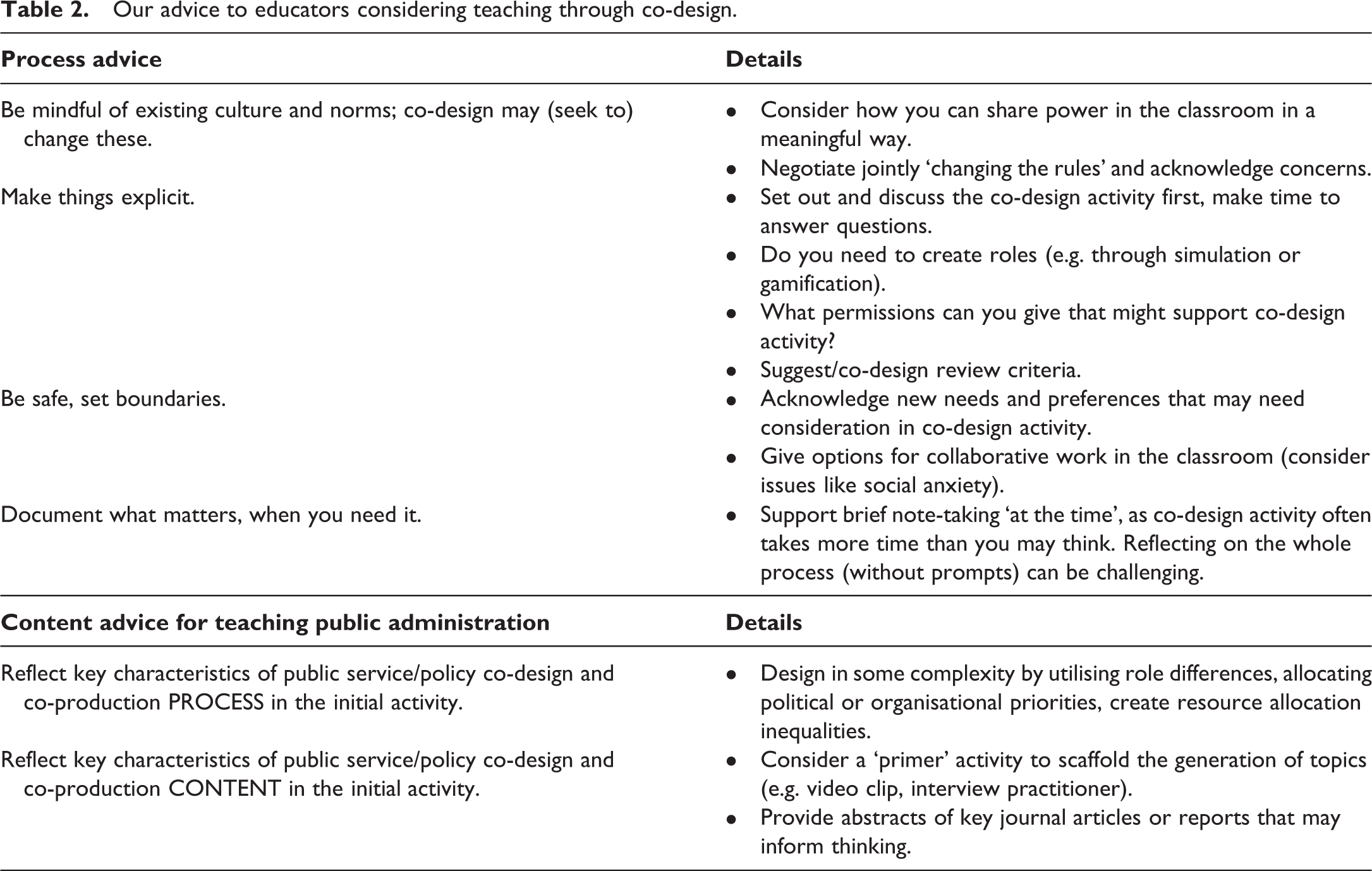
Following our insights and advice generated through our individual and collective reflection (Table 2), we invite you to consider with us the ways, and conditions under which co-design may be taught through ‘doing’. We began by sharing our view that making broad claims ‘about’ co-design and co-production may be easier than establishing it as a practice, and the lead author confirmed to us that this was the case. However, our process of critical reflection has begun to open up, from an educators’ perspective, areas for future research and discussion. Our summary insight to the question ‘can you teach co-design through doing it?’ is; yes, but ‘it depends’.
Like any method of teaching and learning, teaching through co-design needs to be supported, and meaningful. Our initial insights are that simply ‘dropping’ students into a co-design activity may be counterproductive. There is a balance to be struck: too little briefing and support, and students cannot hope to provide relevant content, but too much, and the educator removes any element of surprise, as students self-edit responses they perceive to be ‘wrong’. Enacting co-design in the classroom that does not reflect how it works in ‘the real world’ reduces the ability of the activity to speak to the topic and provides little complexity from which problematic dilemmas can be reflected upon. Our experience and reflection, which we need to add to that of students of public administration, is that teaching through co-design needs to contain both productive/successful and frustrating and problematic elements. Like co-production in public life, this requires careful planning, grounded in the establishment of explicitly negotiated and trusting relationships.
Some questions remain in terms of how curriculum co-design might be operationalised within public administration courses. Some of these are technical issues around the use of co-design. Others are more philosophical questions around power, rights and responsibilities. For example, how does the use of co-design affect the role of the academic, how might it affect the responsibilities of students and academics and how might this, in turn, affect student feedback? There is undoubtedly a case for more research here in how we use different pedagogical tools, such as curriculum co-design, to illustrate concepts such as co-production, in a meaningful way.
Conclusions
In the light of the literature and our case study review, we argue that building co-production and co-design into teaching of public administration is principally a matter of power, worked out through the practical negotiations of identities. Meaningful implementation of co-production and co-design in the teaching of public administration relies on the willingness to do this negotiation, and the means to do it; both must be addressed together. If public administration educators and students are willing to explore and negotiate their respective contributions, then a shared space for change is possible. Equally, they must be able to operationalise these intentions, and having space, time, support and tools to collaborate are required to achieve short- and longer-term shared successes. Good intentions for co-production and co-design are frustrated by a lack of means to make them happen; conversely, collaborative online tools, manageable timescales or even administrative support will be of little use if the motivation and permissions are not present to energise the process.
Specific issues, too, clearly matter in progressing co-production and co-design in the teaching of public administration. Exploring prerequisites such as permissions and trusting relationships for curriculum co-design open up questions about how ‘space can be made’ for new developments and avoid superficial attempts to change classroom practice. Additionally, addressing the issue of perceived risks, as we have previously pointed out, is particularly relevant. In these matters and more, how power is utilised, how risks are negotiated and how permissions are given requires a different approach. One cannot simply ‘do’ co-production and co-design: teacher and learner positionality and identity are both defined by power, status and (perceived) agency, so any attempts to move to co-design must recognise starting positions. Crucially, all these issues in relation to the pedagogy of co-design and co-production are not dissimilar from the issues documented in the literature regarding co-production in public service contexts. Our central argument therefore is that deeper learning can be realised through our own engagement with our students in curriculum co-design.
Following Lukes (1974), we must face, head on, the challenges of moving from a ‘two dimensional’ approach to the operation of power through teacher agenda setting. Neither teacher nor student can simply ‘flip’ from such a relationship to one conducive to co-design. A new space for co-production and co-design with its own shared language, tools and culture must be built in everyday practice. Fostering willingness to change, and agency for change both require a sense of permission and safety. Doing this can enable students and academics to gain new insights into the nature of power and positionality in relation to the operation of co-production as a participant and as a coordinator.
What does this mean for public administration education? The lessons outlined within Table 2 may extend to a wide range of professional degree subjects. Yet our argument is that, in terms of public administration, this remains a distinct subject area. This includes, most recently, the overarching conceptual framework of New Public Governance within which the concept of co-production is a key element. Following from the distinct content of the subject we argue for a distinct pedagogy for the subject. We make the case that such a pedagogy should reflect the practice of public administration itself, and increasingly operate on the basis of co-design, so that teachers and students of the subject can grapple with the complexities and negotiations inherent to its practice and to the realities of being a public service professional. In other words, as co-production has been described as representing a ‘shift from “public services FOR the public” towards “public services BY the public”’ (Bovaird and Loeffler, 2012), we argue for a shift from public administration education FOR public leaders to public administration education BY public leaders.
Footnotes
Declaration of conflicting interests
The author(s) declared no potential conflicts of interest with respect to the research, authorship, and/or publication of this article.
Funding
The author(s) received no financial support for the research, authorship, and/or publication of this article.
