




Abstract
Theory recognizes the need to account for the allocation of time across activities as a potential constraint on volunteering. Drawing on the British Household Panel Survey (BHPS), for the first time, this article examines the decision to volunteer by males and females accounting for their engagement in other leisure activities that also involve discretionary time. Instrumental variable panel-data estimates reveal that it is only for females that volunteering is influenced by the choice of other leisure activities. This implies that males have more autonomy over their volunteering decision relative to their other leisure behavior compared with females. For males, this greater autonomy suggests that volunteering is more closely linked to the concept of “serious leisure” and a form of work as it is more distinct from other leisure activities. These differences have implications for volunteer recruitment.
Introduction
Volunteering is an essential feature of society and cuts across many sectors including sport and leisure, health, education, and social care, with individuals volunteering in varied activities according to their age and life-stages (Lukka & Ellis Paine, 2001). For example, in 2014–2015 in the United Kingdom, 59% of the population volunteered informally and 42% formally, which reflects a stable if fluctuating feature of society (Cabinet Office, 2015). 1 Various policies have underpinned the need to promote volunteering in the United Kingdom. These range from initial piecemeal charitable activity from the end of the Second World War up to the 1970s, the consolidation of a wider institutionally based voluntary sector as part of social welfare reform from the mid-1970s up to 1997, through to the “Third-Way” of the New Labour Government from 1997 and the “Big Society” initiative of the former Conservative-Liberal Democrat government (Alcock et al., 2012). Although the “Third-Way” comprised explicit policy and government engagement with the voluntary sector to promote civic and democratic renewal, the “Big Society” initiative adopted a “bottom up” stance in which voluntary initiatives and activity could be viewed as potential replacements for “top-down” state initiatives, arguing of the need to regenerate civic engagement (Alcock et al., 2012; Civil Exchange, 2015). However, it has also been argued that that there is need for further enhancement of volunteering precisely because such wide and varied policy initiatives have failed (Civil Exchange, 2015). There is recognition that volunteering is now needed more than ever in a civic context to help to fill the gaps left by cuts to public services because of austerity (Lup & Booth, 2019).
The aim of this article, therefore, is to revisit the determinants of volunteering in the United Kingdom, through a key empirical contribution, to further inform volunteering recruitment and promotion in the light of the pressing generally accepted policy need for a greater volunteer base. There is a considerable literature exploring the motivations for volunteering (e.g., Cabrera et al., 2014; Chen & Chen, 2011; Clary & Snyder, 1999; Lockstone-Binney et al., 2015) and determinants of volunteering (e.g., Bauer et al., 2013; Dawson & Downward, 2013; Hallmann, 2015; Taylor et al., 2012; Ziemek, 2006). Surprisingly, however, while there is an important growing literature that examines how family and social-economic transitions influence volunteering in a longitudinal setting (Einolf, 2018; Lancee & Radl, 2014; Nesbit, 2012), there is no research that examines the longitudinal choice to volunteer specifically in connection with the opportunity to allocate leisure time. The research that exists, moreover, focuses on sports participation and volunteering only in a cross-sectional context (Dawson & Downward, 2013). Yet core theoretical perspectives directly acknowledge that volunteering requires both the desire and capacity to allocate nonobligatory time. This raises the possibility that potentially being part of the same choice sets over which individuals allocate their time as, for example, implied by theory discussed in the next section, other leisure could be either a substitute for volunteering by competing for time, or be complementary to it, if the leisure activities promote prosocial behavior. Previous theoretical and empirical research has also suggested that there are gender differences in prosocial behavior, becoming a volunteer or not (Bauer et al., 2013; Eagly, 2009; Eagly & Crowley, 1986; Einolf, 2011; Fyall & Gazley, 2015; Taylor et al., 2012) and subsequently allocating time to volunteering (Burgham & Downward, 2005; Einolf, 2011). Therefore, the two related research questions addressed in this article are “What is the relationship between volunteering and other leisure choices?” and “Are there significant differences in the relationship between volunteering and other leisure choices between males and females?” To answer these questions, the article makes use of longitudinal data from the British Household Panel Survey (BHPS) in a panel-data analysis of volunteering behavior in the light of choices to undertake other leisure activities.
Literature Review
Core Theories
Volunteering can be understood from a number of theoretical perspectives. A social-psychological approach, drawing upon social role theory, provides a strong argument for focusing on the different genders in volunteering (Eagly, 1987; Eagly et al., 2000; Fyall & Gazley, 2015; Switzer et al., 1999). Social role theory maintains that an individual’s volunteering activity might initially begin because of external stimulation, for example, stemming from familial or social norms (Eagly, 1987). In this context, it is argued that women are socialized to help through caring behavior (emotional support, physical care) often within the context of family, whereas men tend to be more task-oriented and also focus on activities for strangers (Eagly & Crowley, 1986). Consequently, repeated experience of these behaviors leads to the “internalization” of volunteering such that it becomes part of the identity of the individual, which in turn sustains the activity (Finkelstein et al., 2005). From a gerontological perspective, selectivity theory maintains that, across the lifespan, choices are made by individuals to select in and out of activities. Typically, less social interaction is chosen with aging, but this does not necessarily apply to volunteering, though its form might change. According to this perspective, change occurs across the life course because individuals re-evaluate the relevance of the goals of their social interactions, and also the means by which the form of interaction achieves their goals (Carstensen, 1992). This suggests that individuals might adapt the role that they play in a voluntary organization or change where they might choose to volunteer. Some of the life-course research discussed in the next section that explores life transitions can be understood from this perspective.
In this research, as the focus is upon the allocation of nonobligated time, two further theories are of specific relevance. These are the serious-leisure perspective of Stebbins (1982, 1992) and the economic time allocation model of Becker (1965, 1974). Both theories focus on the alternative uses of nonobligated time. For Stebbins (1996), formal volunteering involves serious leisure, in that the acquisition and expression of specialist skills, knowledge, and experience is involved. Importantly, this implies that volunteering involves both self-interest and career orientation as well as altruism. Arguably, moreover, self-interest could be the ultimate driver of such behavior even though altruism might have been the initial motive for volunteering and remains important to it. This is because obligations derived through volunteering are self-imposed. Consequently, volunteering then carries both personal rewards (e.g., self-interest and recreation) and social rewards (e.g., social interaction). Consequently, for Stebbins (1996), “true leisure, including career volunteering, contains a substantial degree of choice” (p. 218). It is important to note, therefore, that self-interest and altruism are not incompatible. This is because altruism in itself is rewarding (Stebbins, 1996).
The symbiosis of altruism and self-interest also lies at the heart of the economic time allocation model of behavior in which individuals maximize their own welfare. This model has been identified as relevant to understanding volunteering (Govekar & Govekar, 2002) and has been applied to analyze volunteer behavior (Dawson & Downward, 2013; Downward et al., 2009; Hallmann, 2015; Hallmann et al., 2018). In the seminal economic time allocation model, Becker (1965) argues that time and income are the central resources available to individuals to produce the commodities and activities that form part of their choice set, and which are subsequently consumed. Essentially, individuals balance the allocation of time and income required across commodities and activities to maximize their welfare which, similar to the socialization for males and females suggested in social role theory (Eagly, 1987), can vary between genders. Consequently, Becker (1974) indicates that such production-consumption behavior could imply investment in personal and social characteristics, that is human and social capital, that are found to be desirable by individuals. This means that there are potentially both complementarities and opportunity costs involved in allocating time to different leisure activities, of which volunteering could be one. Significantly, within this approach, Becker (1974, 1976) conceptualizes altruism as an activity which stems from an individual’s willingness to sacrifice their own consumption to increase the consumption of others, which clearly resonates with the serious-leisure perspective. Moreover, Stebbins (2013) has argued that both the economic and serious-leisure perspectives are not incompatible as a foundation on which to understand volunteering. This is because volunteering involves the allocation of time to nonobligatory and uncoerced activities that are intentionally productive but also altruistic. Intentionally productive here implies that there are “beneficial social consequences of volunteering” (Stebbins, 2013, p. 342). Consequently, although simply helping out or informally volunteering is not considered to be serious leisure, but which is naturally part of the economic approach to volunteering, it is nonetheless still a time allocation issue as recognized by Stebbins (1996).
The upshot of this brief discussion is that all of the theoretical perspectives on volunteering which are widespread in the literature, but particularly the serious leisure and time allocation approach, recognize the potential importance of leisure time to volunteering and this underpins the need to investigate the relationship between volunteering and leisure activities. Moreover, an important feature of all approaches, but particularly the time allocation and social role theories, is that they provide a direct rationale for expecting gender differences in volunteering. In the time allocation case, this is because of differences in the investment in relevant human and social capital and hence capacity for volunteering. In the social role case, this is because it is argued that people occupy different social and economic positions across their life course. As gender-specific roles develop in wider society, both of these perspectives indicate that this will affect volunteering (Einolf, 2018). Theoretically, therefore, it is to be expected that volunteering and other leisure behaviors will differ between the genders and this needs to be investigated (Eagly & Crowley, 1986).
Empirical Work
In general, the empirical work addressing volunteering focuses on individual-level correlates measuring the sociodemographic and economic status of volunteers. This is supported by research that also investigates psychological influences on behavior. In the latter case, research typically identifies motivations like prestige, making friends, sharing values, career and personal enhancement/job training, socializing, and being protective of others (Aydinli et al., 2016; Cabrera et al., 2014; Carpenter & Myers, 2010; Clary & Snyder, 1999; Handy et al., 2010; Ziemek, 2006). These factors resonate strongly with the personal and social rewards identified by Stebbins as noted above.
In contrast, the literature reveals variation in the relationships between sociodemographic correlates and volunteering. For instance, Nichols and Shepard (2006) suggest that volunteers are often middle aged, whereas Wymer (1998) notes that volunteers tend to be older. Moreover, the literature identifies that females tend to volunteer more than males, though males tend to volunteer more in sport than females and in more formal roles (Downward et al., 2005; Hallmann, 2015). Consequently, drawing on social role theory, Wymer (2011) indicates that males prefer positions which gives them authority while females prefer positions where they can develop relational ties.
More consistent results are evident for economic-based determinants of volunteering and which are congruent with the time allocation approach. One example is that income and time have been observed as substitutes in (the production of) volunteering. Consequently education—that is linked to income—and income typically have a positive correlation with volunteering (Janoski & Wilson, 1995; Taylor et al., 2012) but part-time employees volunteer significantly more than full-time employees (Einolf, 2011; Sundeen et al., 2009; Wymer & Samu, 2002). Individuals who are retired and unemployed also volunteer more than those who are employed (Taylor et al., 2012). These results are suggestive of greater free-time availability for those earning less.
The literature also suggests that these relationships could be quite complex. For example, it may be that more females are in part-time employment than males and this prompts the greater volunteering of females in general (Taniguchi, 2006). Moreover, males have also been identified as generally less likely to donate money compared with women (De Wit & Bekkers, 2016; Mesch et al., 2006; Ranganathan & Henley, 2008). In this regard, Andreoni and Vesterlund (2001) argue that females exercise more altruism in the light of rising opportunity costs, but males are more altruistic if opportunity costs are lower (see also Cappellari et al., 2011). This suggests that male altruism is more resource sensitive.
Moreover, in contrast to much of the above literature which has a cross-sectional emphasis, an important literature has developed to identify how sociodemographic transitions across the life-course influence volunteering. It has been shown that the birth of a child, divorce, and widowhood can reduce volunteering (Nesbit, 2012) but as a child ages volunteering can subsequently increase (Einolf, 2018) and particularly for female volunteering compared with males (Lancee & Radl, 2014). These results are consistent with both role selection and, consequently, a reallocation of resources such as time through the life course.
In the analysis that follows differences between male and female volunteering is investigated in a longitudinal setting as well, but with the novel feature of focusing on the links between volunteering and leisure-time activities, which theory suggests could be important because of their potential competing uses of time in leisure, and, furthermore, that the allocation of time will vary across males and females. As Downward and Rasciute (2010) show in a nonvolunteering context, individuals substitute their time across a range of leisure activities. Accounting for the other uses of leisure time by individuals is thus important for the analysis of volunteering. Separate models are thus estimated for males and females following (e.g., Taniguchi, 2006).
Data and Method
Measurement
In this research, longitudinal data from the BHPS are employed to provide a causal analysis of volunteer decisions in the light of alternative leisure choices and controlling for key individual and socio-economic circumstances. The BHPS began in 1991–1992 and was repeated annually in Waves 1 to 18 until the survey ceased as an independent entity and merged with “Understanding Society,” which is a new longitudinal study, in 2010–2011. 2 The survey involved a face-to-face interview with each household member older than 16 years of age. Approximately 5,000 households were surveyed in each wave of a nationally representative sample, with each wave then comprising approximately 10,000 cases. Surveying took place between September and the end of the following April each year. Some data appear on each wave of data as “core questions” with others appearing on selected waves as “rotating questions.”
Leisure activity including volunteering was a rotating question and appeared every 2 years since Wave 6 in 1996–1997. The volunteer question asks, “how frequently do you do unpaid voluntary work?” with responses (and values) given as: “at least once a week (4),” “at least once a month (3),” “several times a year (2),” “once a year or less (1),” and “never/almost never (0).” 3 This is a relatively narrow conception of volunteering and certainly does not capture the range of possibilities of activity that could be said to comprise volunteering, but it has been used in volunteering research before, in connection with impacts on employment, and clearly captures the sense of volunteering as indicated in the previous section (Paine et al., 2013). The questions on leisure changed with the onset of “Understanding Society.” Consequently, it is the question from the BHPS component of the data that forms the dependent variable for the current research (see also Lup & Booth, 2019). The other measures of leisure-time behavior that could influence the volunteering decision, with the same format of responses and the preceding clause “how frequently do you . . . ?” include the following 4 :
Play sport or go walking or swimming;
Go to watch live sport;
Go to the cinema;
Go to a concert, theater or other live performance;
Have a meal in a restaurant, café, or pub;
Go for a drink at a pub or club;
Work in the garden;
Do DIY, home maintenance, or car repairs;
Attend leisure activity groups;
Attend meetings for local groups.
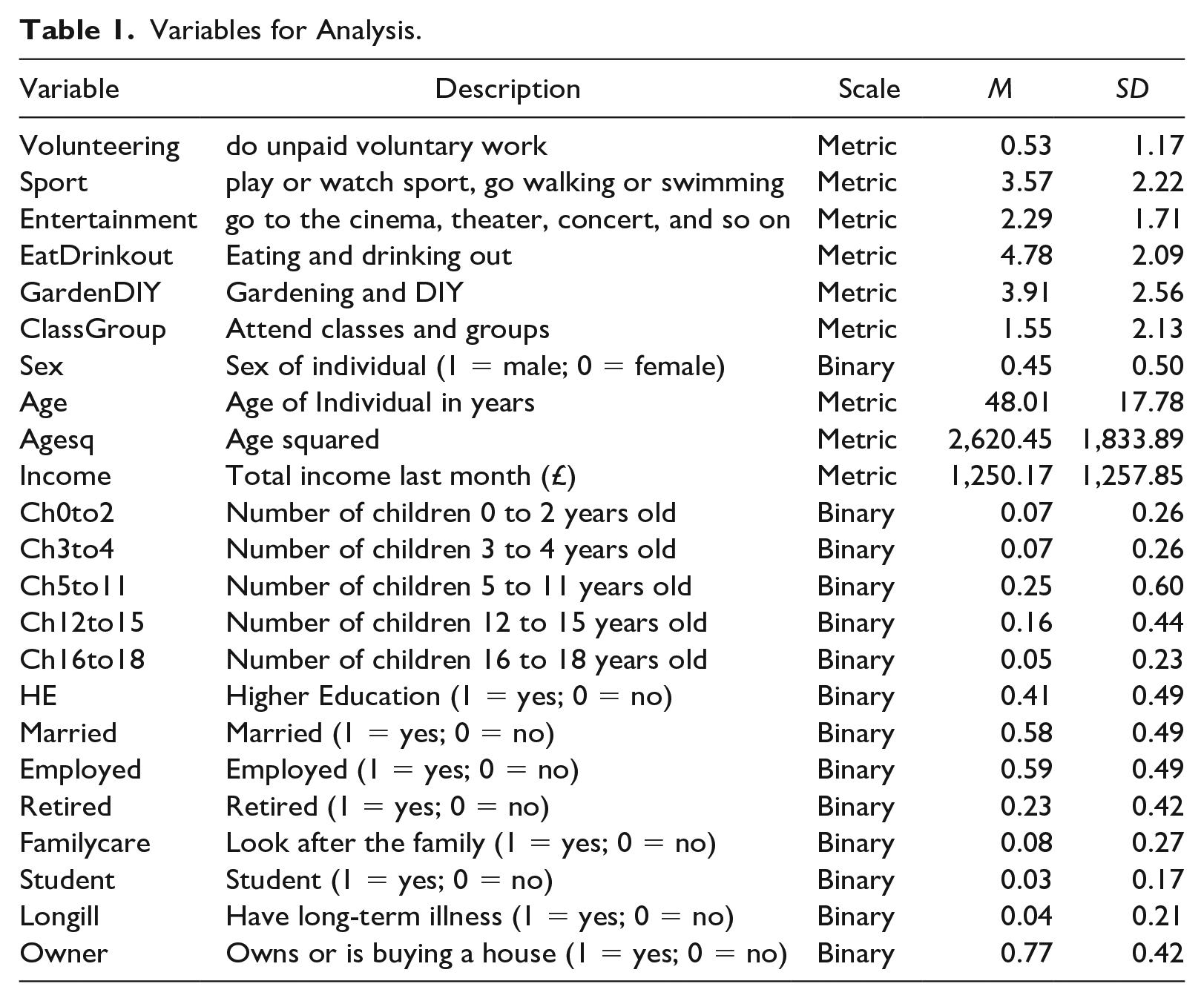
It proved necessary to eliminate the last wave of the data for 2008–2009. This is because of serious anomalies in the response to the frequency of “play sport or go walking or swimming” variable. 5 Table 1 includes the variables that are used to control for observed confounding effects in the analysis and comprise variables contained in the data set which, as identified in the literature review, are likely to be linked to volunteering. The sample statistics are based on the sample used in estimation which was n = 52,253. This reduction in sample size from the total available of 92,929 is due to the removal of the last wave of data, as indicated above, some missing values across the correlates, but also due to the necessary use of lagged variables in the analysis as discussed further below.
Variables for Analysis.
Participant Characteristics and Behavior
Table 1 reveals that volunteering is typically undertaken once a year or less, though there is a clear skew in behavior, which is consistent with having both regular and irregular volunteers in society. The other leisure variables were additively combined into more aggregate categories to capture distinct aspects of leisure time in the light of multicollinearity. Consequently, “Sport” captures the behavior from Activities 1 and 2; Entertainment Activities 3 and 4, EatDrinkout Activities 5 and 6, GardenDIY Activities 7 and 8; and, ClassGroup Activities 9 and 10. The minimum and maximum possible values of these variables, based on the sums of their values, are consequently 0 and 8, whereas it is 0 and 4 for volunteering. The results reveal that each of these activities is much more prevalent than volunteering even for the least prevalent leisure activity and allowing for the different scales of measurement.
The data show that 45% of the sample is male and the average age is approximately 48 years. Total monthly incomes are approximately £1,250 with the standard deviation showing an expected skew. Approximately 14% of households have children between the ages of birth and 4 years old. Approximately 25% of households have children aged between 5 and 11 years old, with 5% having children between 16 years and 18 years of age. Approximately 41% of the sample has higher education (i.e., of at least bachelor’s degree level or equivalent), and 58% of the households include married individuals (as opposed to being separated, divorced, or widowed). Households are also comprised of approximately 59% of individuals who are either self-employed, full or part-time employed, with approximately 23% retired, 8% looking after the family or home, and 3% students. Four percent of the sample has a long-term illness or disability.
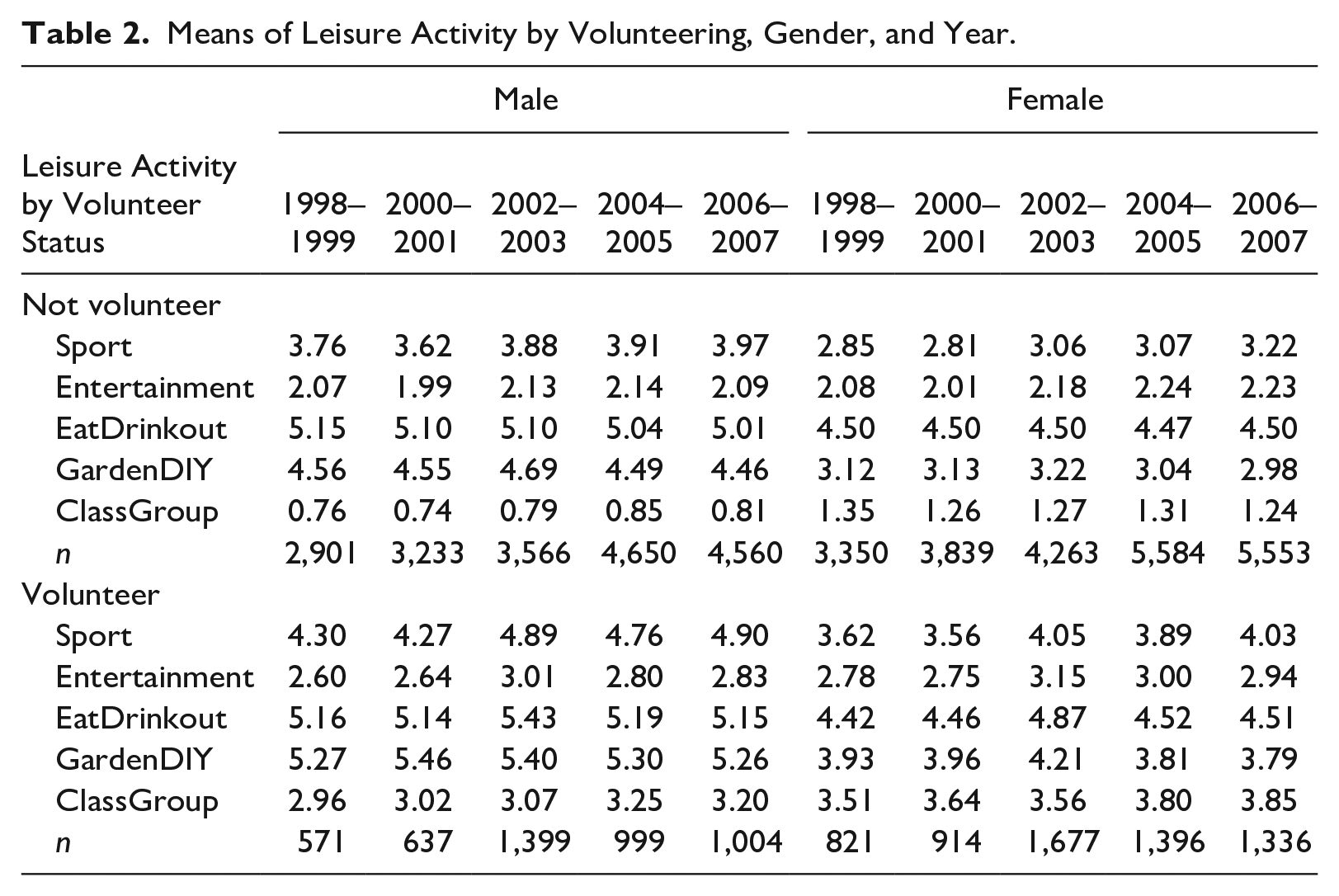
Table 2 presents the engagement in other leisure activities for both volunteers and nonvolunteers for males and females. The table reveals the temporal stability of engagement for both males and females, with few obvious differences other than there being some evidence that males participate more in sport and other leisure activities than females regardless of volunteering (Downward & Rasciute, 2015). An exception is the category ClassGroup in which females participate more than males regardless of volunteering or not. This suggests some relatively distinct aspect of this behavior, especially for females. It is also clear that volunteers also participate more in other leisure activities than nonvolunteers. Some research undertaking multivariate analysis has identified this in the case of sport (Dawson & Downward, 2013). Dawson and Downward (2013) argue that this could be due to the preferences of those who engage in the activities as well as access to resources. Consequently, income is positively related to increases in both activities and, moreover, there are clear gender differences, with males engaging more in both activities. 6 It is important, thus, to explore the relationships between volunteering and leisure generally.
Means of Leisure Activity by Volunteering, Gender, and Year.
Data Analysis
The following general regression model, in Equation 1, was used to model volunteer behavior:

Here, volunteering, V, is shown to depend on the observable individual characteristics “X” that might influence the behavior for individual “i” over time “t.” These influences would include income, education, the presence of children, marital status, and employment status, as indicated earlier, as well as the other leisure-time behavior of the individual. “Z,” in contrast, is gender which does not vary over time. µi is an unobserved person specific and time invariant effect on volunteering and ε it is an idiosyncratic disturbance term. As the data to be examined is longitudinal, ordinary least squares (OLS) estimation is inefficient relative to random or fixed effects panel estimators. The differences implied in the variance of the errors associated with repeated measures on the same individual, which reflects unobserved heterogeneity, are not accounted for in OLS. In such circumstances, for example, the random effects estimator would produce consistent estimates that are more efficient than OLS. However, both estimators also assume that that the unobserved heterogeneity is not correlated with the observed variables in the model. If there is correlation, the OLS estimator is biased and the random effects model is inconsistent. The fixed effects panel estimator is then preferred as it produces consistent estimates. The Hausman test can be used to choose between the random and fixed effects estimators and by implication OLS, by testing the difference between the coefficients on the time-varying variables in the random and fixed effects cases. Difference between them implies that the unobserved effects in the panel model are not exogenous otherwise the random and fixed effects models’ time-varying coefficients would be the same. The Hausman test, χ2(27) = 1,556.16 (p ≤ .001), rejects the equivalence of coefficients suggesting that the fixed effects estimator is preferred. This is the approach that has been adopted in the emergent longitudinal literature, noted above, to account for omitted variable bias to improve insight into volunteering from sociodemographic transitions (Einolf, 2018; Lancee & Radl, 2014).
However, as implied in the theoretical accounts of volunteering above, it is also to be expected that bias from endogeneity will be present when examining the impact of other leisure activities on volunteering, in comparison to the case of analyzing sociodemographic transitions. This is because both volunteering and other leisure could be directly related as examples of simultaneous discretionary time allocation. In contrast, it is much less likely that volunteering would influence socio-economic transitions. Hence, in the current context, because of the problem of endogeneity between the dependent variable and leisure correlates, instrumental variables estimation is used (Wooldridge, 2010).
Instrumental variables are linked to the endogenous correlates (i.e., other leisure activities) but only indirectly to the dependent variable (i.e., volunteering). Lagged values of the other leisure activities are used as instruments as they have statistically occurred prior to the current volunteering decision but remain likely to be connected to current other leisure activity through habit (as, for example, indicated in the stable behavior implied in Table 2). A variable measuring house ownership is also used as an instrument as it acts as a proxy variable for the general wealth resources available for leisure to an individual, that is emphasized in the time allocation approach (Downward & Rasciute, 2010) and is more likely to be linked to all leisure than just volunteering. Consequently, based on (auxiliary) regressions of each of the potentially endogenous correlates (i.e., leisure activities) on the other correlates and additional instrumental variables (i.e., the other lagged leisure activities and home ownership), the predicted values of the endogenous correlates are obtained. These are then used to replace the actual endogenous variables (i.e., leisure activities) in the original volunteering regressions.
The instrumental variables need to be both relevant and valid (Baum et al., 2003). To assess this, in regressions of each of the endogenous variables on the lags of all of the leisure activities and home ownership and the other correlates, the lagged leisure activities and home ownership variables need to be jointly significant. Moreover, these instrumental variables need to be independent of the error terms in the volunteering regression equation. This independence can be tested by the Sargan–Hansen test (Baum et al., 2003).
Results and Discussion
Table 3 provides estimates of the fixed effects model. The remaining columns are then instrumental variable fixed effects estimates for the whole sample and for males and females separately. For consistency of comparison, all analyses were undertaken on the sample from the preferred instrumental variable fixed effects estimation. Given the difficulty in establishing watertight theoretical arguments in the selection of instrumental variables, it is important to note from the bottom of Table 3 that the instruments are both relevant and valid. This is because a test of their collective removal from the first stage regressions for each of the (endogenous) leisure variables can be rejected. The Sargan–Hansen statistics for all the instrumental variable estimates are also insignificant, which means that the set of instrumental variables are orthogonal to the errors in the volunteering equations. Finally, because the dependent variable is not a strictly scaled variable, with likely impacts on heteroscedasticity, robust standard errors are used to construct inferences in all estimators, and to control for other potential heterogeneities in the idiosyncratic disturbances.
Fixed Effects Panel Estimates, Instrumental Variable Estimates of Volunteering for the Entire Sample and Separately for Males and Females.
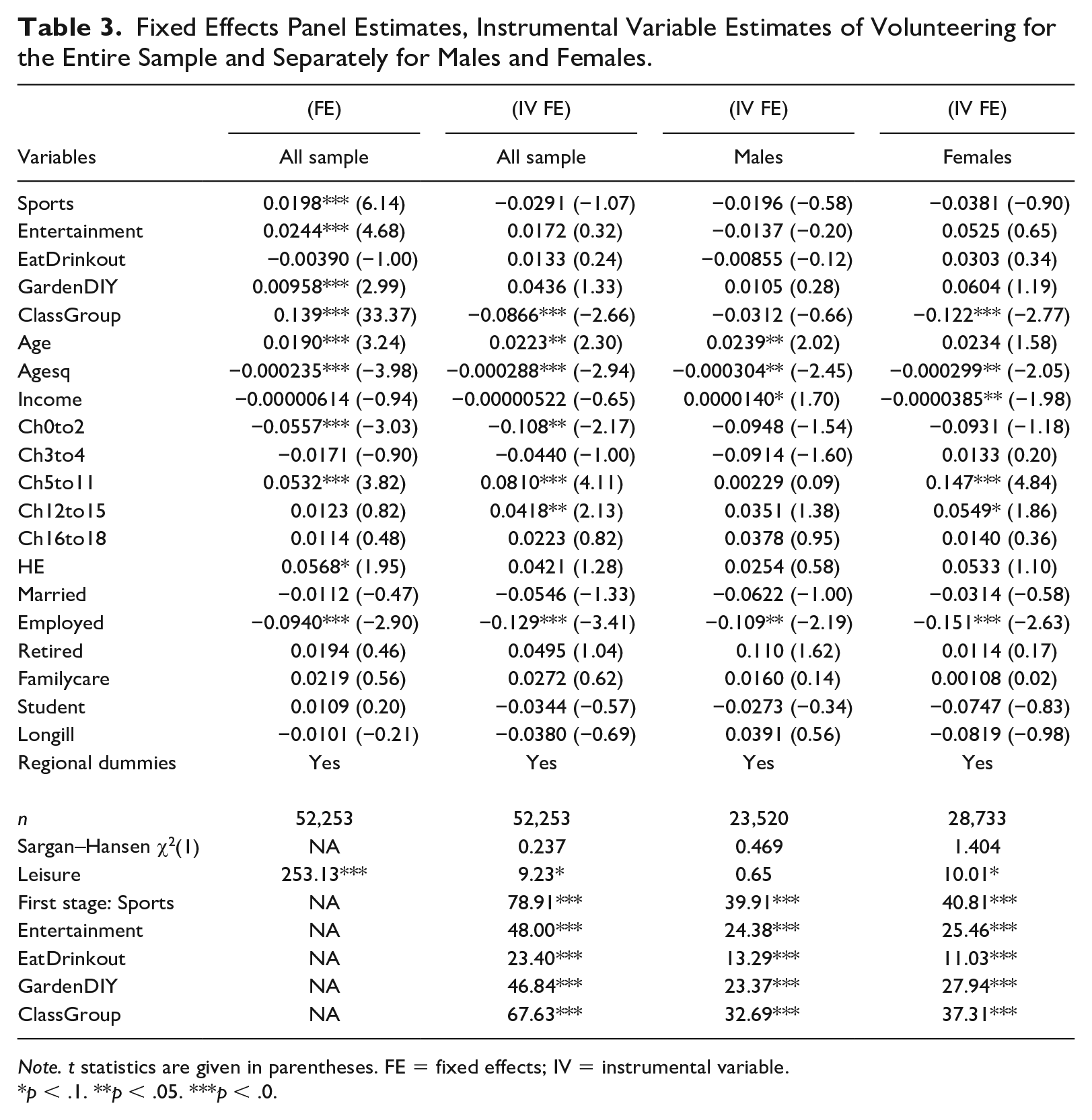
Note. t statistics are given in parentheses. FE = fixed effects; IV = instrumental variable.
p < .1. **p < .05. ***p < .0.
The significant sociodemographic variables across the estimates are to an extent consistent with the theoretical and empirical literature identified earlier and particularly the role that time might play in volunteering as indicated by the serious leisure and economic time allocation perspectives. Being employed, for example, consistently reduces the frequency of volunteering, across all the models, which could be linked to the availability of time. However, having a higher income is shown to have a negative effect on female volunteering only. This is suggestive of a trade-off between the use of leisure time and that allocated to earn money. In contrast, income has a positive effect in the male instrumental variable regression, which suggests, following the economic time allocation approach, that higher incomes can support the allocation of time to volunteering and that resource opportunity cost trade-offs are not as important for male volunteering in contrast to the literature (Janoski & Wilson, 1995; Taylor et al., 2012).
There is evidence of a quadratic effect of aging on volunteering for the whole sample and males and females. The implied effect is “U” shaped. This means that volunteering initially declines with age and then eventually rises again. This finding differs from previous cross-sectional findings that volunteers are more likely to be middle or older aged (Nichols & Shepard, 2006; Wymer, 1998) but, of most importance, is consistent with other longitudinal research on volunteering and aging (Nesbit, 2012). There is also evidence that having younger children can reduce the incidence of volunteering in the whole sample, regardless of estimator. However, the instrumental variable estimates show that this effect is contrasted by more volunteering being linked to the presence of older aged children and this is specifically the case for females. Collectively, these results are suggestive of general time constraints from familial activity associated with young children reducing volunteering. However, females might engage in volunteering as their children age. This is likely to reflect the children taking part in activities which are supported by females and congruent with Becker’s (1991) intra-family resource allocation model, and identified empirically in Burgham and Downward (2005) and Einolf (2018). These results are also consistent with social role theory, and the different family roles that develop through socialization between the genders. Moreover, overall these results suggest that for males a higher income can support increased volunteering, potentially through a higher wage rate and less work as might be implied in the time allocation approach. However, in contrast for females, there is a need to redirect time in employment and household time to support more volunteering. This mirrors to some extent the findings of Taniguchi (2006), who has found, for instance, that females working part-time have a positive relationship with volunteering and student and retired males and females are equally willing to volunteer. The lack of significance of not being employed or being retired on volunteering could be due to such individuals having less access to social networks through work which can support volunteer engagement (Musick & Wilson, 2008).
Focusing upon leisure activities, Table 3 reveals that in the absence of controlling for the endogeneity of leisure, the fixed effects model indicates that some leisure activities are complementary to volunteering. Taken at face value, these results (fixed effects, all samples) could suggest that all individuals who volunteer have other leisure activities as part of the same choice set. However, once the simultaneity of the activities is controlled for in the instrumental variable analysis, the only individual activity that is significant is ClassGroup, which switches sign to negative (Antonakis et al., 2010), and this is the case for females but not males, the distinctiveness of which is indicated in Table 2. 7 Significantly, moreover, a joint test of the omission of the leisure activities from the instrumental variable analyses of male and female volunteers, as indicated by the test for “leisure” at the bottom of Table 3, reveals that all of these variables are associated with volunteering for females, but this is not the case for males. In addition, examination of the correlations between these leisure activities shows that they are all positively correlated with ClassGroup for both males and females. For males, the correlations (significance levels) with ClassGroup are .277 (.000) for Sport; .2428 (.000) for Entertainment; .1035 (.000) for EatDrinkout; and .1063 (.000) for GardenDIY. For females, the correlations with ClassGroup are .2499 (.000) for Sport; .2774 (.000) for Entertainment; .1035 (.000) for EatDrinkout; and .1538 (.000) for GardenDIY. This joint correlation between the variables, but their only being jointlysignificant in the regression analysis for females, suggests that it is only for females that leisure-time activity and volunteering are related and part of the same choice set. Moreover, the negative relationship reveals potentially hidden constraints on the behavior of females compared with males for whom volunteering is more autonomous with respect to their other leisure choices and discretionary time. This result consequently extends the insights of Downward and Rasciute (2010) that leisure choices can be substitutable to include volunteering but, importantly, does so in a causal empirical design and shows that this extension applies only to females. Social role theory insights as well as the specialization of time allocation roles between genders are thus supported by the results. Finally, the relative autonomy of volunteering for males compared with females is suggestive of the greater degree of choice of the former as implied in the serious leisure perspective. This is because for males volunteering is not as conditional on access to other leisure activities as females.
Conclusion
The aim of this article is to revisit the determinants of volunteering in the United Kingdom, making use of large-scale longitudinal data to explore the role of leisure-time activities on the choice to volunteer. Using panel-data estimates that account for both unobserved heterogeneity as identified as important in the existent longitudinal literature, but also the endogeneity between volunteering and other leisure, which is strongly suggested by existing theoretical accounts of volunteering because of their likely simultaneous determination, the results show that males have more autonomy over their voluntary activity as part of their leisure time than females. It follows that initiatives that seek to raise volunteering need to recognize that females face additional constraints, as leisure time and volunteering are related. As leisure is not obligatory and likely reflects self-interest, this suggests that the promotion of volunteering might be better placed by also drawing on these distinctions in which the leisure role of volunteering is promoted to females as much as altruism and acting for the benefit of others as noted elsewhere in the literature, as reviewed above. For males, however, it seems that greater autonomy of volunteering might be more closely linked with the concept of serious leisure in the sense that there is a greater degree of choice in volunteering relative to leisure. In this case, status and career opportunity might be relevant recruitment levers for male volunteering. These results resonate with findings from volunteering at major sports events in which it has been shown that females seek to meet and make friends and socialize, whereas males seek extensions of their careers and labor market activity (Downward et al., 2005).
There are, of course, limitations to the above analysis. The type of volunteering explored cannot be distinguished, nor the actual time allocated, and moreover, the distinction between the forms of leisure activity needs further scrutiny. For example, in the first case, the measure of volunteering only captures frequency and not the actual time allocated to volunteering and engaging in the other leisure activities. To the extent that time is positively correlated with the frequency of engagement, in the sense that the latter will be influenced by the overall time budget available to individuals, this might not be problematic. However, it is possible that individuals might adjust the time allocated to their activities even though the frequency does not change. Data analysis of time budgets would help to clarify these issues in further research. In the second case, reflecting upon the distinction between the forms of leisure activity, as indicated by Dawson and Downward (2013), some leisure activities such as volunteering and participating in sport could be part of the same engagement and/or be symptomatic of an individual being more or less prosocial and more likely to be recruited to volunteer (Musick & Wilson, 2008). To the extent that links between activities or recruitment to them exist or that an individual’s psychological inclination toward prosocial behavior remains constant over time, the instrumental variable estimation and fixed effects should control for these influences, though they are worthy of further investigation. In addition, there are various other variables which could be included in the model. These include motives, specific benefits sought, perceived constraints/costs of volunteering, or actual working hours and time to commute to work. In as much that these might be relatively constant over time, they could also be controlled for in the fixed effects analysis. However, knowledge of actual work time and commute to work time could be of interest to estimate the available leisure time of individuals and how this has an impact on taking part in various leisure activities. Integrating these variables presents a lot of potential for future research. Nonetheless, the above analysis provides some unique insights into volunteering behavior that is different between the genders and needs to be recognized in strategies seeking to increase volunteering in society.
Footnotes
Declaration of Conflicting Interests
The author(s) declared no potential conflicts of interest with respect to the research, authorship, and/or publication of this article.
Funding
The author(s) received no financial support for the research, authorship, and/or publication of this article.
