




Abstract
This study analyzes the effect of opportunity costs on the decision to volunteer, the extent of volunteering, and how opportunity costs are related to competing volunteering activities. Our results reveal that opportunity costs operationalized as net wage per hour had the predicted negative effect on the extent of volunteering but a positive effect on the decision to volunteer. When the individual hourly net wage of the surveyed volunteers is applied, volunteering has average opportunity costs of about 14€/h. As volunteering competes with other activities, we assigned opportunity costs to different activities such as family, hobbies, paid work, or spending time with friends. Results show that, overall, opportunity costs of volunteering are especially related to family activities and less so to paid work. This implies that volunteering activities, in general, compete with family activities rather than with paid work or other activities.
Keywords
Volunteering is a highly relevant resource for nonprofit organizations and in multiple areas of society. Therefore, it is important to understand the influencing factors of volunteer labor supply. Many people spend a substantial amount of their time volunteering. In Germany, where this study took place, 32.6% of people aged more than 14 years volunteered formally (unpaid help to formally organized groups or clubs) and 6.7% informally (unpaid help as individuals to people who are not relatives) at least once in the last 12 months (Kausmann & Hagen, 2021) and spent an average of about 20 hr per month volunteering in 2019. The volunteer rates differ significantly across different countries (for European data, see Enjolras, 2021). For instance, in the United Kingdom, in 2020, 47% of people reported volunteering informally and 21% formally at least once in the last month (Cabinet Office, 2020). Concerning the influencing factors of volunteer labor supply, many studies focus on the benefits of volunteering. Nevertheless, costs could affect people’s decision to volunteer or the time spent on volunteering. Second, based on the idea that volunteering competes with many other types of activities, opportunity costs could be used to quantify the extent of competition between volunteering and other (leisure) activities, in particular, a competition between spending time volunteering or with family, that is, a volunteer work–family conflict (e.g., Kragt & Holtrop, 2019).
This article focus on the opportunity costs of volunteering by asking two questions. First, do opportunity costs influence the decision to volunteer and the extent of volunteering? Second, do opportunity costs occur more often with family activities, and are there other activities that compete with volunteering, and to what extent?
The rest of the article is organized accordingly. First, the relevant literature is referenced and used to derive three hypotheses. Next, the surveyed sample is described and the hypotheses are tested on this sample. The article concludes with a discussion, limitations, and implications for further research.
Literature Review
In its simplest form, volunteering can be defined as unpaid work. Based on several definitions, Cnaan et al. (1996) amalgamated four relevant dimensions: (a) voluntariness, (b) no or low pay (expense allowance), (c) formal or informal workplace structure, and (d) different intended beneficiaries. Some studies on volunteering emphasize beneficial effects of volunteering over the costs. For example, the volunteer function inventory (Clary et al., 1998) states that volunteers want to address six needs (functions): meeting personal values, social, protective, self-esteem, understanding (of service users), and career enhancement. Other models emphasize the well-being and health (Haski-Leventhal, 2009; Huang, 2019; Matthews & Nazroo, 2021), the motivation of volunteers (e.g., Randle & Dolnicar, 2009), or life quality (Krägeloh & Shepherd, 2015) and life satisfaction (Veerasamy et al., 2015). Often used models such as Omoto and Snyder’s (1995) process model or Penner’s (2002) volunteering process model do not directly mention costs. Mitchell and Clark (2020) provide a conceptual framework for supporters’ choice of nonprofit organizations, which incorporates personal needs, role, brand, cause, and availability, but they state that personal needs are weighed against the cost of volunteering. Handy and Mook (2011) propose a framework for benefit–cost analysis and take both the individual and organizational levels into consideration.
Dominant foci in recent research are resource theory and dominant-status theory. In resource theory, volunteering is a productive activity that requires resources (in other words “produces costs”) which people with higher social status are more likely to possess and which volunteering organizations seek (Wilson & Musick, 1997). The dominant-status theory predicts greater participation for individuals with a more dominant social status, higher socioeconomic status (SES), or involvement in a higher status religion (Smith, 1994).
Economic or rational choice approaches to volunteering generally consider both beneficial and cost aspects. In economic studies, benefits of volunteering can be of a direct monetary nature, for example, earning higher income through volunteering (Bruno & Fiorillo, 2016); of an indirect monetary nature, for example, advantages in the job application process (Wallrodt & Thieme, 2020); or of a nonmonetary nature, for example, reputation and appreciation (Erlinghagen, 2003).
Many economic approaches toward volunteering refer to one or more of the following three models (Ziemek, 2006): (a) the public goods model (PGM), (b) the private consumption model (PCM), and (c) the human capital model (HCM). All three models focus on different benefit aspects. The PGM (Bergstrom et al., 1986) assumes that the volunteer is interested in producing a public good, for example, health care, and, by volunteering, contributes toward the production of this good to increase the offer to the desired level. This means that the benefit is achieved by making the good available to the public. However, it does not benefit the volunteer and therefore could be considered as altruistic. The PCM focuses on the fact that volunteering presents a benefit in itself, for example, in the form of a “warm glow” (Andreoni, 1990), and therefore has egoistic aspects without monetary aspects. In the HCM, the benefit for the volunteer arises from an expected pay rise in the future derived from the human capital acquired through volunteering (Menchik & Weisbrod, 1987) and therefore considered as egoistic with monetary aspects. Although these three models focus on the beneficial aspects of volunteering, they do not exclude the aspect of costs. For example, Hackl et al. (2007) analyzed the influence of income (as opportunity cost) on volunteering in the PCM and HCM.
Another seminal approach is G. S. Becker’s (1965) time allocation model, which focuses on “a basic theoretical analysis of choice that includes the cost of time on the same footing as the cost of market goods” (p. 494). The two main aspects that Becker’s theory considers are the focus on households as producers and consumers of goods and the inclusion of indirect costs, that is, opportunity costs, when distributing time to different activities. Becker’s approach seems to be particularly suitable for explaining volunteering (as well as all other human behavior) as it consistently considers all elementary joys and immaterial aims, including altruistic behavior (G. S. Becker, 1965). Several studies aiming to explain the phenomenon of volunteering refer directly or indirectly to Becker’s time allocation theory (e.g., Hallmann et al., 2018 or Schlesinger & Nagel, 2013).
As in Becker’s approach, opportunity costs are a common economic concept and included in the introduction of many standard economics textbooks. Sowell (2015) notes that “costs are forgone opportunities” (p. 34). This understanding is also reflected in Buchanan’s (1969) seminal work “Cost and Choice,” where he notes, Cost is that which the decision-maker sacrifices or gives up when he selects one alternative rather than another. Cost consists, therefore, of his evaluation of the enjoyment or utility that he anticipates having to forego as a result of choice itself. (p. 41)
The fundamental economic idea of opportunity costs is that not all opportunities can be realized or selected if resources are scarce. If one alternative is chosen, the resources used for that option cannot be employed elsewhere. In this regard, Becker’s approach focuses on time as a scarce resource. The economic advantage of a given decision is calculated by subtracting the benefit of the second-best alternative from the benefit of the chosen option. If the benefit of the second-best alternative (the opportunity cost) increases, the economic advantage of the initial decision decreases, and different choices may be required to achieve the greatest benefit.
When it comes to volunteering, considering opportunity costs means placing volunteering in direct competition with all other activities that the individual could have carried out. Volunteering can be considered an example of serious leisure (Stebbins, 2017). The concept of “serious leisure” emphasizes that leisure activities can take on the character of serious activities to the extent of being treated as a career of sorts. In this context, time-consuming activities are in direct competition with volunteering when it comes to the use of time. In standard economics, all other activities can be represented as paid working time and the utility of this time as forgone earnings. Several volunteering studies posit that the opportunity cost of volunteering is (net) wage (e.g., Duerrenberger & Warning 2019; Duncan, 1999; Feldman, 2010; Menchik & Weisbrod, 1987; Schiff, 1990). As various studies have correctly specified, the opportunity costs of volunteering are, strictly speaking, not “net wage” but “net wage per hour” (or another time frame). Opportunity costs in volunteering were calculated by Kehl and Stahlschmidt (2016) in terms of caring for the household and non-household members. They concluded that volunteering could only be measured to a limited extent in monetary terms. Opportunity costs play another significant role in volunteering when a monetary estimate of the volunteer work—in the sense of a monetary equivalent—is made using the opportunity cost approach (Orlowski & Wicker, 2015; Salamon et al., 2011). Studies from other areas like public health care (Persson & Tinghög, 2020) or purchasing consumer goods (Frederick et al., 2009; Thaler, 1980) show that opportunity costs are sometimes neglected or totally ignored.
The theoretical prediction of rising opportunity costs is quite clear: If the utility of alternative use of time increases, individuals trying to maximize their utility will reduce their current activities to make more time for the alternative. A crucial aspect of Becker’s approach is that when net wage per hour increases, households shift from time-intensive commodities to consuming goods-intensive commodities. As volunteering is a very time-intensive commodity—for example, in contrast to donating—it can be assumed that higher opportunity costs reduce the time spent on volunteering.
However, the empirical results for the general influence of income/opportunity costs on volunteering are contradictory. In one of the first studies that modeled net wages alongside other variables, Mueller (1975) revealed based on considerations about human capital the predicted negative effect of opportunity costs. Schiff (1990) found no significant net wage effect, and in a special model, found a positive effect. Other findings exist, all with mixed results. For example, positive results were presented by Brown and Lankford (1992) and Detollenaere et al. (2017), whereas negative results were presented by Andreoni et al. (1996) and Freeman (1997). Duerrenberger and Warning (2019) show that there is a stronger positive relation between wages and informal volunteering in collectivistic countries. Mixed results were found by Hallmann (2015). A more recent study by Qvist (2021) found a significant negative effect of hours of paid work on the extent of volunteering. Qvist (2021) thus refers to the time constraint theory, which, in contrast to the opportunity cost theory, however, does not consider the level of net wages per hour. Piatak (2016) reports a positive effect of unemployment (low opportunity costs) on the probability of volunteering as well as on the extent of volunteering and sees this as confirming the opportunity costs theory.
More economically orientated studies on volunteering refer to this distinction between the probability of volunteering and the extent of volunteering using the terms “extensive margin” and “intensive margin” (e.g., Holt, 2020). In more sociologically orientated studies, it is generally referred to as “volunteer proclivity” and “intensity of volunteering” (e.g., Greenfield & Marks, 2004; McDougle et al., 2015; Qvist & Munk, 2018; Son & Wilson, 2011). Due to the focus on opportunity costs as an economic construct in this study, “extensive margin” refers to the number of people who have decided to actively engage in volunteering and “intensive margin” indicates the extent of their voluntary commitment.
Instead of measuring the opportunity cost of volunteering in classical terms of “forgone earnings” and assuming paid work as an alternative use of time spent volunteering, some studies use proxy variables to capture intangible factors for the utility of other alternative time usages. Possible proxy variables for high (intangible) opportunity cost in certain areas are “having (young) children” or “taking care of family members.” One problem in measuring these variables as opportunity costs of volunteering is that it is possible that these activities are not substitutional but complementary. This means that having a child can lead to volunteering activities, which include the child. In a review of multiple studies Southby et al. (2019) found several barriers to volunteering but noted positive effects of having (school aged) children with formal and informal volunteering. This was also observed by Schlesinger et al. (2013) who reported that having children in a sport club reduces the opportunity costs if one parent is volunteering in that sport club, as, for example, a coach for the children. This is one reason why, instead of forgone earnings of paid work, the theoretical prediction for these measurements is not clear.
Hypotheses
The Influence of Modeling
The mixed results about the influence of opportunity costs on volunteering may result from different modeling decisions, especially whether volunteering is modeled as a dependent variable in one time-based model (where “0 hours” indicates “not volunteering”), or in two models, where the decision to volunteer is differentiated from the extent of volunteering. This differentiation is often used in labor economics and is quite common in volunteering research as well.
Theoretically, the decision to apply two models may be reasonable because the decision to volunteer at all (extensive margin) is a low-cost situation. The low-cost hypothesis states that the impact of attitudes, norms, and social circumstances on a given decision is higher in situations with low (opportunity) costs (see Diekmann & Preisendörfer (2003) for the basic idea of the low-cost hypothesis). Applied to volunteering engagement, it means that in contrast to employment contracts, in which a certain amount of time is agreed upon, the commitment to volunteering is not initially tied to the provision of a certain amount of time. Some of the beneficial components of volunteer work (e.g., reputation) become apparent after taking on the position and are largely unrelated to the time actually invested. Empirical findings, according to which the strongest predictor for the decision to volunteer is whether one has been asked to (Freeman, 1997), argue in favor of such an interpretation.
Hypothesis 1 is defined based on the idea that the decision to volunteer (extensive margin) is not a decision concerning use of time:
As previously explained, according to G. S. Becker’s (1965) theory, the extent of volunteering (intensive margin) would be negatively influenced by increasing opportunity costs. Therefore, Hypothesis 2 proposes:
Hypotheses 1 and 2 could be considered standard economic hypotheses related to opportunity costs and volunteering. To check for other measurements of opportunity cost (e.g., children, caretaking), proxy variables will be included in the model.
Opportunity Cost for Different Leisure Activities and the Work–Family Conflict
Opportunity costs are measured in forgone earnings and directly related to the wage of the activity “paid work.” But the next best alternative is not necessarily paid work. All kinds of (leisure) activities could be “the next best alternative.” Overgaard (2019) argues that there is often no choice at all between paid and unpaid work because of the lack of opportunities for (more) paid work. This, in turn, argues for focusing on other activities. For practical and theoretical reasons, it is important to reveal the leisure activities for which opportunity costs occur. If opportunity costs are more strongly related to specific leisure activities, these activities are more relevant for volunteering because they compete more strongly with volunteering than other activities.
The work–family conflict is a well-known example of how two activities compete with each other. Greenhaus and Beutell (1985) state that the work–family conflict occurs if time that is devoted to work demands makes it difficult to meet family demands or vice versa. For volunteer work, Cowlishaw et al. (2010, 2014) have addressed the (volunteer) work–family conflict among emergency services volunteers. Malinen and Mankkinen (2018) reported also conflicts of volunteering with family commitments. Kragt and Holtrop (2019) reviewed 152 studies on volunteering conducted in Australia and found that the work–family conflict leads to volunteer withdrawal. Therefore, we presume that family related opportunity costs are higher than opportunity costs of other leisure activities. Hypothesis 3 proposes:
Data
Sample
We collected a data set from an online questionnaire to capture specific aspects of volunteers in Germany. The main reason for collecting a new specific data set was the limited questions regarding income, opportunity costs, and other leisure activities in other data sets. In Germany, the largest data set about volunteers is the Freiwilligensurvey (Simonson et al., 2022), a panel survey with about 28,000 participants conducted every 5 years. Although it covers many questions, it only has a small number related to opportunity costs, for example, household income on a scale of 5. The data set in the present study (N = 2,000) was compiled in autumn 2018 to test the postulated hypotheses. Our questionnaire expands on the basic questions of the Freiwilligensurvey by asking specific questions about income and opportunity cost. The assessment was conducted using online questionnaires in German. It was arranged to represent the German population (and the Freiwilligensurvey) with a quota for age, sex, and educational level.
A research panel with more than 50,000 participants was used to compile the data set. The participants were selected by quotas with regard to age, sex, and educational level and invited via email. That means age, sex, and educational levels are nearly the same percentage in the sample as in the German population; the income is also comparable with the German population. Each participant who finished the questionnaire received a fee of 4.5€. There were multiple types of volunteering activities in the sample. Most respondents were volunteering in the social area (21.6%), sport (17.4%), and religion (10.3%). For more details of the characteristics of the respondents, see Table 1.
Description and Descriptive Statistics for the Main Variables (N = 2,000).
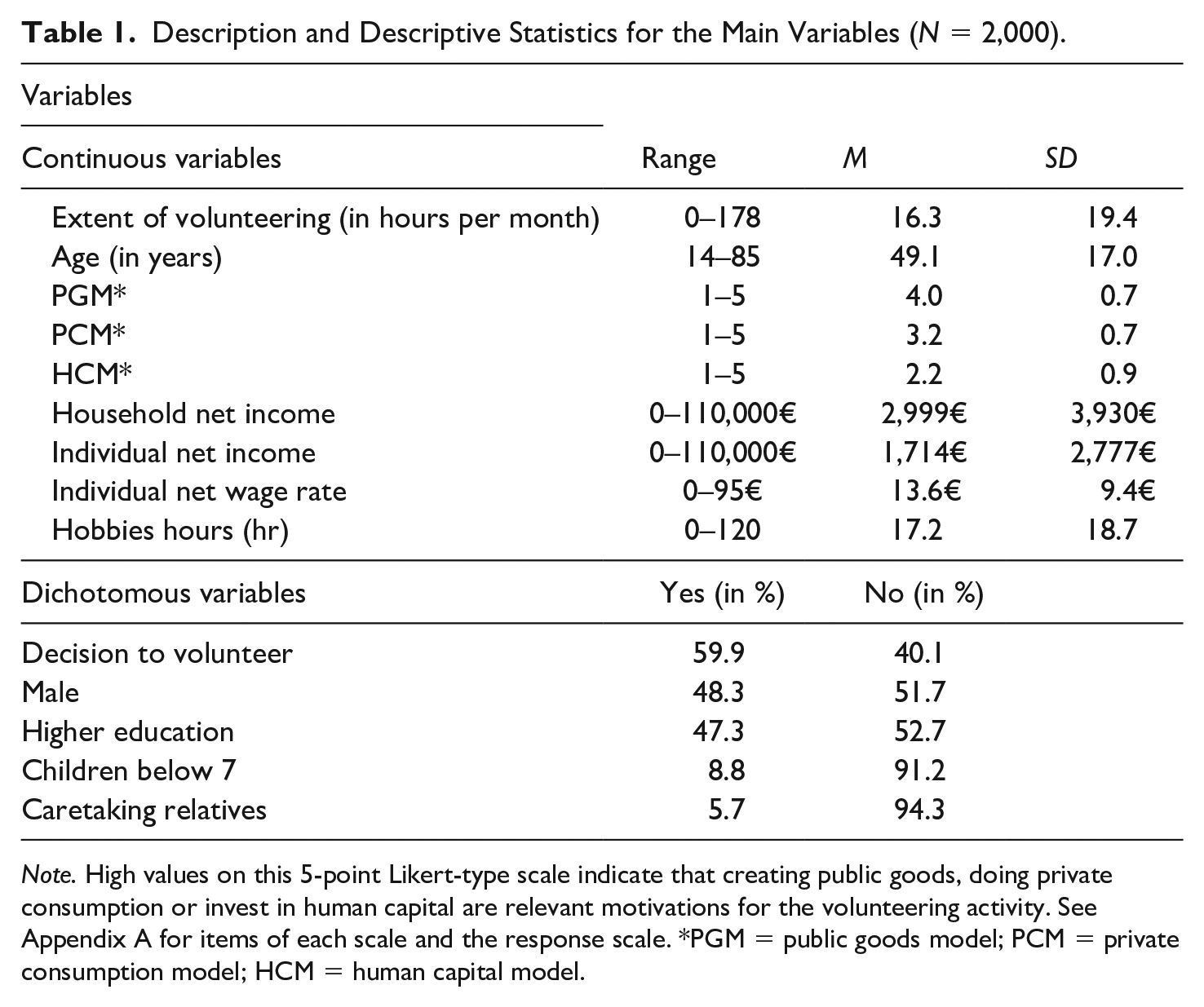
Note. High values on this 5-point Likert-type scale indicate that creating public goods, doing private consumption or invest in human capital are relevant motivations for the volunteering activity. See Appendix A for items of each scale and the response scale. *PGM = public goods model; PCM = private consumption model; HCM = human capital model.
Dependent and Independent Variables
There are two dependent variables: “Decision to volunteer,” which was collected for all 2,000 participants, and “Extent of volunteering,” which was collected for all of the 1,184 participants who had volunteered within the last 12 months. Participants were asked about their household net income, their individual net income, individual income as a proportion of household income, and individual income resulting from paid employment (all in euros per month) as well as their contractual and actual amount of work (in hours per week).
To explain the use of control variables, in accordance with T. E. Becker (2005), in many previous studies, sex, age, and education had different effects on volunteering depending on the studies’ settings (Wilson, 2000, 2012). Therefore, the models included age, sex, and education. The questionnaire has three motive categories based on the main economic models of volunteering as described above: PGM, PCM, and HCM. The items used for the motive categories were extracted from Emrich and Pierdzioch (2015) and are listed in Appendix A. The three motive categories were tested for reliability, and had good Cronbach’s alpha values (.77 < α < .88). The motive categories PGM, PCM, and HCM were included because motives are a common way to explain volunteering and represent the kind of benefits sought by volunteers (in contrast to costs of volunteering). The variables Children_under_7, Caretaking_relatives, and hours_hobbies are (proxy) variables for other possible measurements of opportunity costs. The cutoff for children’s age (below 7) was applied because in Germany it is not obligatory for children below 7 to be enrolled in a nonfamilial institution such as a kindergarten; it can therefore be presumed that caretaking takes more of parents’ time (and therefore counts as an opportunity cost). The motive categories and the other control variables were included to consider relevant aspects in the models and should reduce the problem of omitted variables in regression analysis. Table 1 provides a descriptive overview of the variables used.
The answers regarding the extent of volunteering were comparable to the abovementioned Freiwilligensurvey, in which the average time committed to volunteering in 2014 was 20.9 hr per month compared with 16.3 in the present study’s sample.
An explanation for the mixed and sometimes conflicting results of the influence of opportunity costs/income could be the varying ways of operationalizing income, and thus “forgone earnings,” in terms of household net income, individual net income, and net wage per hour. As household net income may include multiple people, this operationalization has two disadvantages. First, opportunity costs cannot be clearly attributed to the individual concerned, and second, it includes different types of income that are not time and employment related. The second disadvantage also applies to individual net income. Therefore, net wage per hour is regarded as a better operationalization of opportunity cost than individual net income, which is better than household net income. We tested all three operationalizations as household net income, individual net income, and individual net wage rate in the models related to the extent of volunteering (Hypothesis 2).
Concerning Hypothesis 3, for which leisure activities opportunities occur, the “alternative time-use option with the next highest marginal utility” is relevant. For this purpose, we asked participants how they would distribute a period of 1 hr across eight time-use options if a day were to have a 25th hour. This question represents opportunity costs as the answer refers to the time-use option with the next highest marginal utility. Each respondent could distribute 60 min over eight (leisure) activities. To evaluate each activity’s opportunity cost, the minutes of each activity were multiplied by the individual net wage per hour divided by 60. As a result, the net wage per hour is distributed over the leisure activities with the highest marginal utilities. In addition, the respondents ranked the eight (leisure) activities, which they would like to do more.
Models and Data Analysis
To test Hypothesis 1 concerning extensive margin, we used a binomial logistic regression because the dependent variable is dichotomous (decision to volunteer: yes/no). The following model was used:

where the response variable Yi represents the (binary) information for individual i, if he or she had decided to volunteer in the last 12 months, and Sex, Age, Edu, Children_under_7, Caretaking_relatives, hours_hobbies, and Income represent the explanatory variables according to Table 1.
We used an ordinary least squares (OLS) regression model 1 to test Hypothesis 2, concerning the extent of volunteering (intensive margin). OLS regression has the potential shortcoming of being biased by the independent variables’ endogeneity. This could be the case if, for example, income and volunteering are simultaneously influencing each other or are influenced by omitted variables. It is especially hard to test and control nonpanel data for endogeneity due to a lack of suitable instrumental variables. As such, the results of our study should be considered with caution, and the focus should be on the signs and significance of the estimated coefficients rather than on the exact magnitude. To test Hypothesis 2, the following model was used:
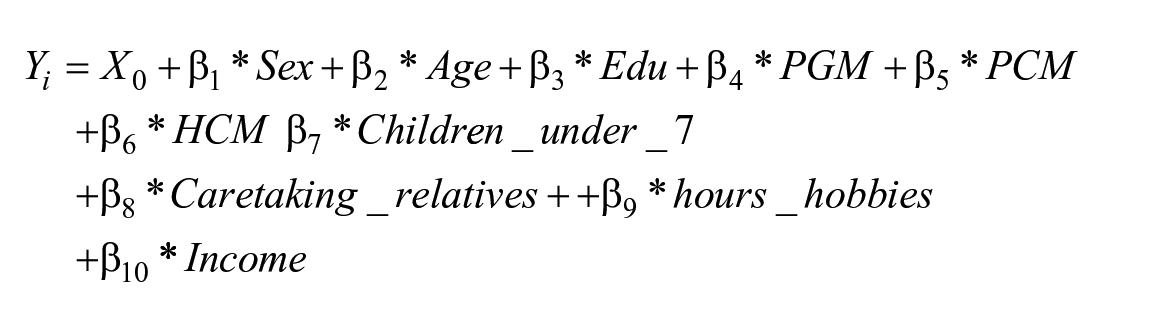
where the response variable Yi represents the mean hours per month spent on volunteering for individual i in the last 12 months. Sex, Age, Edu, Income, the three motive categories (PGM, PCM, and HCM), Children_under_7, Caretaking_relatives, and hours_hobbies are explanatory variables according to Table 1.
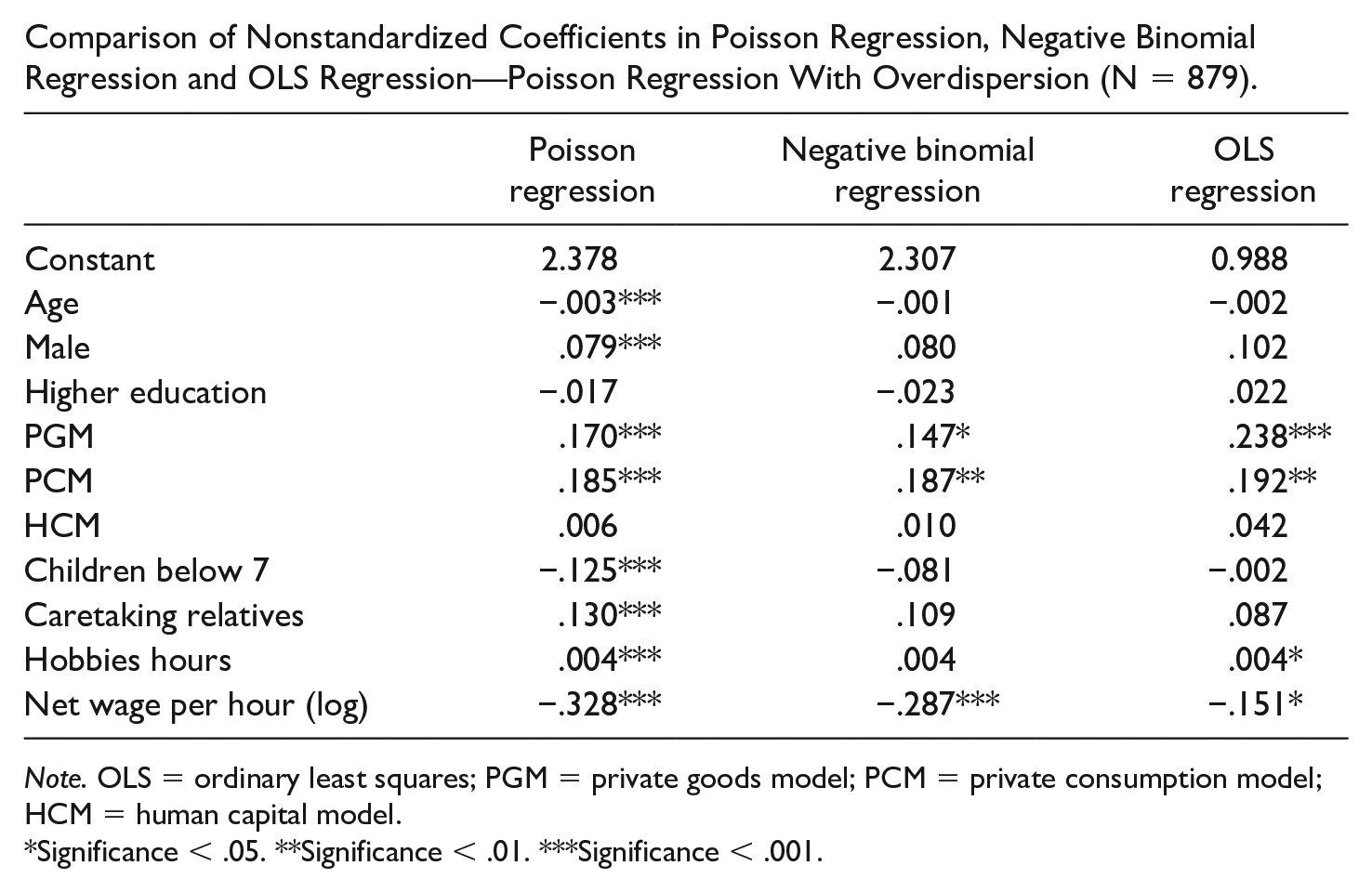
In this context, both the dependent variable “extent of volunteering” and the independent income variables are logarithmized and so that they represent the income elasticity of volunteering. This means that the coefficient of the income variables represents the average percentage change in the extent of volunteering that occurs with a 1% change in income. Due to ambiguity if the non-logarithmized extent of volunteering (“hours volunteering”) is count data and their skewness, we also run a Poisson regression (with high overdispersion) and Negative Binomial, which leads to similar results as the logarithmized OLS regression. See Appendix B for the table of nonstandardized coefficients of the Poisson and Negative Binomial regression.
To test Hypotheses 1 and 2, only participants with valid values above zero for all types of income were included in the analysis because this is the only case in which income can represent opportunity costs and the models are comparable because they refer to the same sample. In addition, we assumed that people below 18 years of age could not always report their (household) income valid and excluded them from this sample. To test the robustness of the results (in particular, to test whether the opportunity cost coefficient changes when excluding different control variables), different models were compared. The results showed that omitting variables did not relevantly change the size of the coefficients.
Results
Hypothesis 1
Table 2 illustrates the results of the binomial logistic regression with the dependent variable “decision to volunteer (in the last 12 months)” (extensive margin).
Overview of Three Logistic Regression Models Comparing Different Operationalizations of Opportunity Costs on Decision to Volunteer.
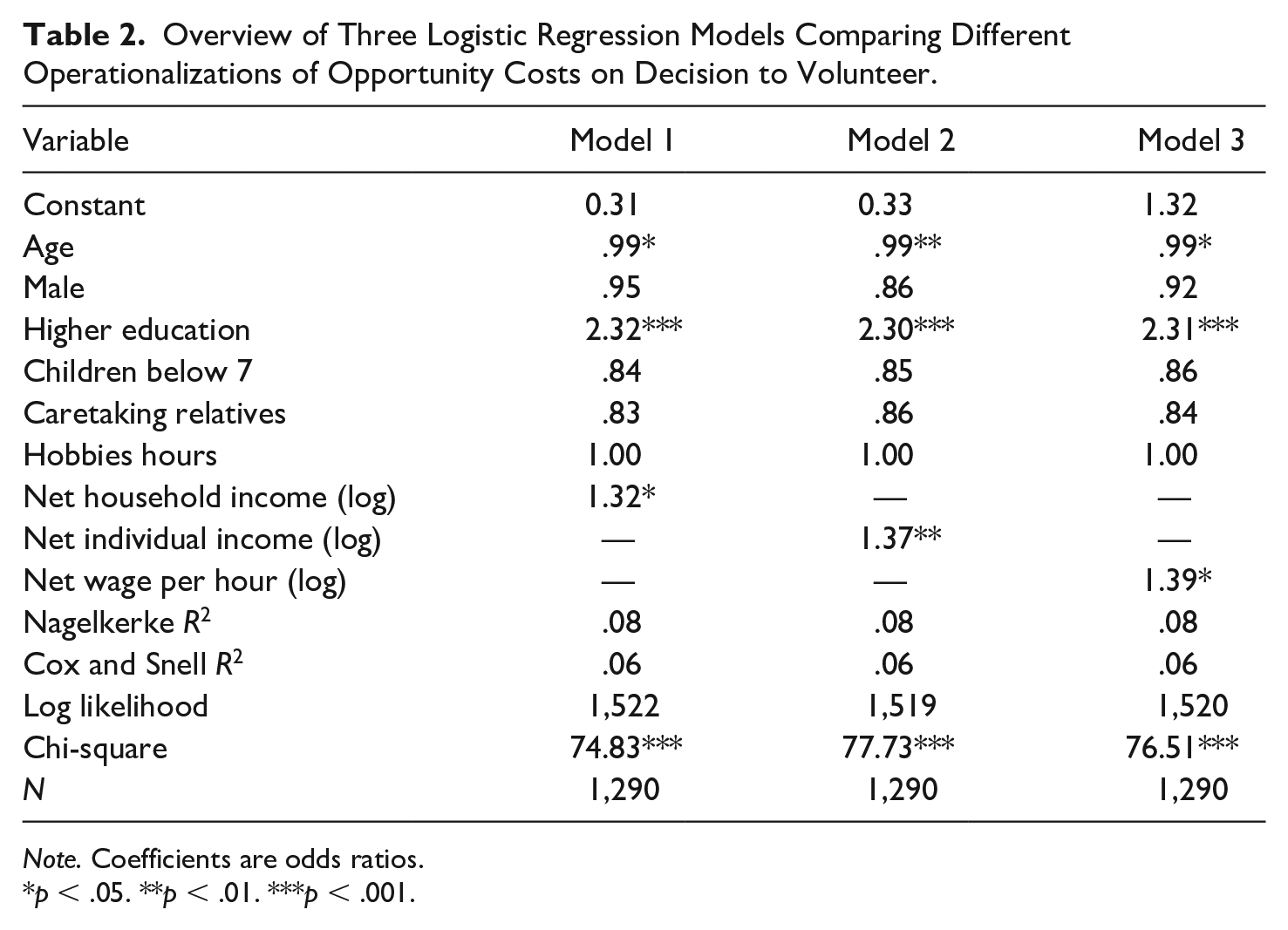
Note. Coefficients are odds ratios.
p < .05. **p < .01. ***p < .001.
Regarding Hypothesis 1 (opportunity costs operationalized as “forgone earnings” are unrelated to the decision to volunteer), it is obvious that all three kinds of income (opportunity costs) are positively related to the decision to volunteer with relatively similar effects (1.32–1.39). Therefore, Hypothesis 1 must be rejected as the positive relation between income and decision to volunteer is contrary to the prediction.
Nevertheless, it is important to emphasize that the effect of opportunity costs operationalized as “forgone earnings” is positive, not negative: People with high opportunity cost are more likely to do volunteer work.
As this definition of opportunity cost could not be applied to people with work-related income of zero and because we excluded people below 18 years of age, the number of cases reduced to 1,290. Although there are more people (out of the sample of 2,000) with some kind of household income, we used the cases where all three kinds of income were available to ensure the models’ comparability.
Hypothesis 2
In the model to test Hypothesis 2, the number of cases was reduced to 879 because the OLS regression models only apply for people who are volunteering. The results of testing the hypotheses with an OLS regression model are presented in Table 3.
Overview of Three OLS Regression Models Comparing Different Operationalizations of Opportunity Costs on Extent of Volunteering.
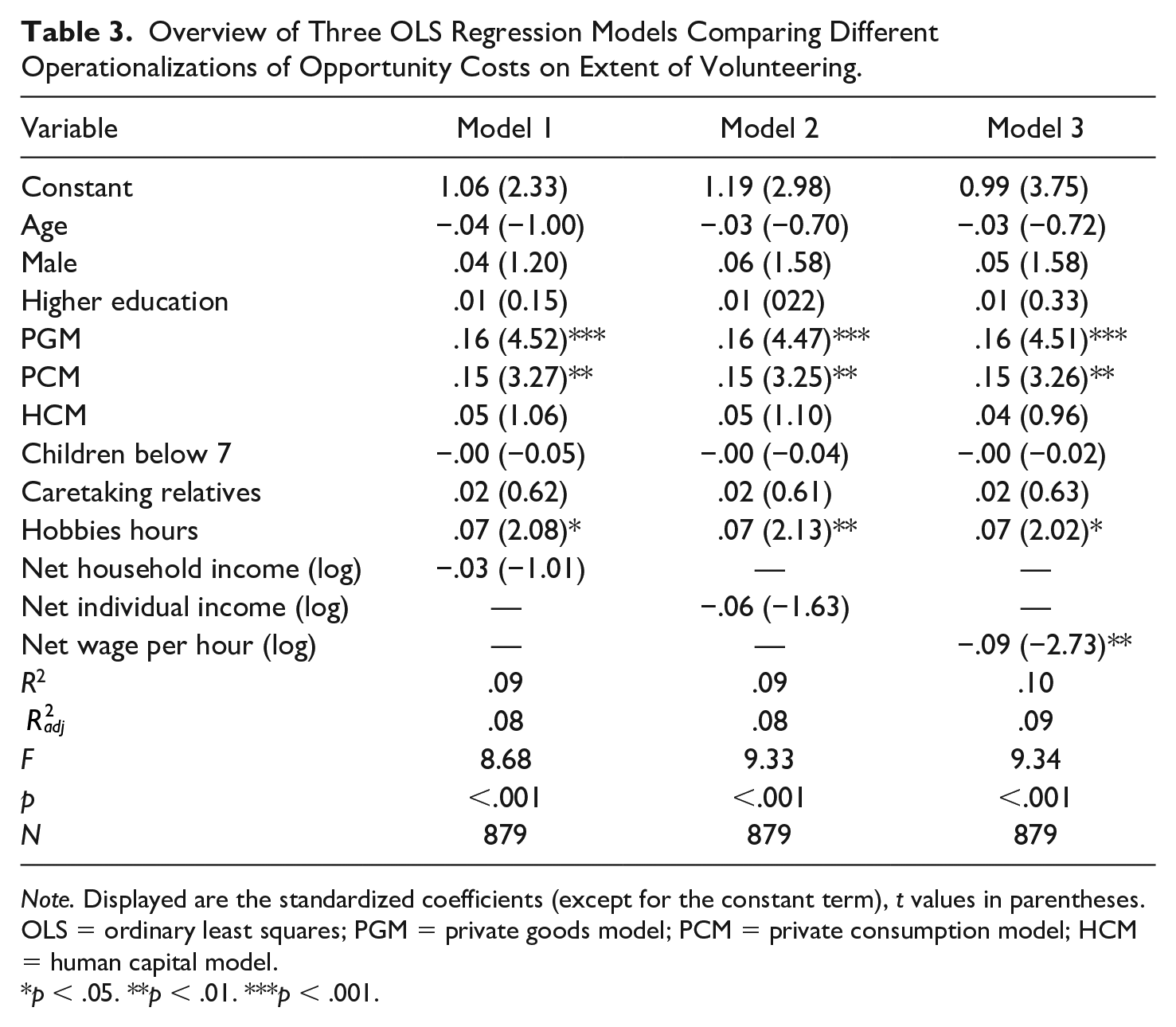
Note. Displayed are the standardized coefficients (except for the constant term), t values in parentheses. OLS = ordinary least squares; PGM = private goods model; PCM = private consumption model; HCM = human capital model.
p < .05. **p < .01. ***p < .001.
In contrast to the other two types of operationalization, net wage per hour is significant (Model 3), which is promoting Hypothesis 2 that higher opportunity cost has a negative effect on the extent of volunteering. The standardized regression coefficient is −.09, and the unstandardized regression coefficient is −.15 (not shown in the table). Because both variables (net wage per hour and extent of volunteering) are logarithmic, a 1% increase in net wage per hour reduces the extent of volunteering by 0.15%. Besides the net wage per hour, public-good and private-consumption motives and hours spent for hobbies have a significant positive effect on the extent of volunteering. That means respondents with high motivation to provide public goods (e.g., help others or contribute to a common good) or private consumption (e.g., having fun or providing balance from everyday life) do a high number of volunteer work. Respondents who spend more hours on hobbies do more likely to spend more hours volunteering.
Hypothesis 3
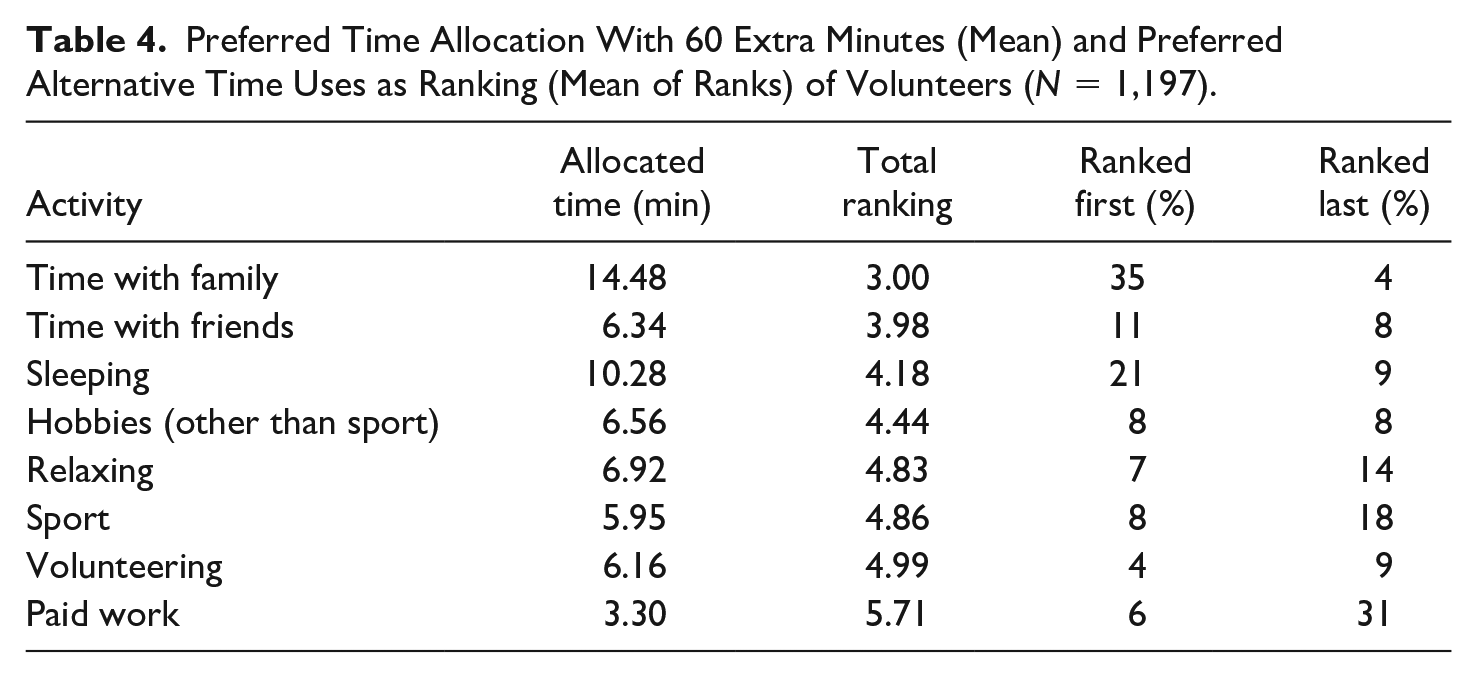
To determine the next best alternative use of time, participants were first asked which activities they would spending their time on if they had one additional hour of free time, and second, to rank activities they would prefer to do if they had more additional time. Table 4 shows that “time with family” has the highest allocated time with 14.48 min per hour and also ranked highest and most often in the ranking. That means the average volunteer would spend around 15 min of an hour with their family if he had more time. Because we presume that the amount of time is an indicator for marginal utility of the next best time use (which is the definition of opportunity costs), we weighted the minutes with the individual net wage per hours.
Preferred Time Allocation With 60 Extra Minutes (Mean) and Preferred Alternative Time Uses as Ranking (Mean of Ranks) of Volunteers (N = 1,197).
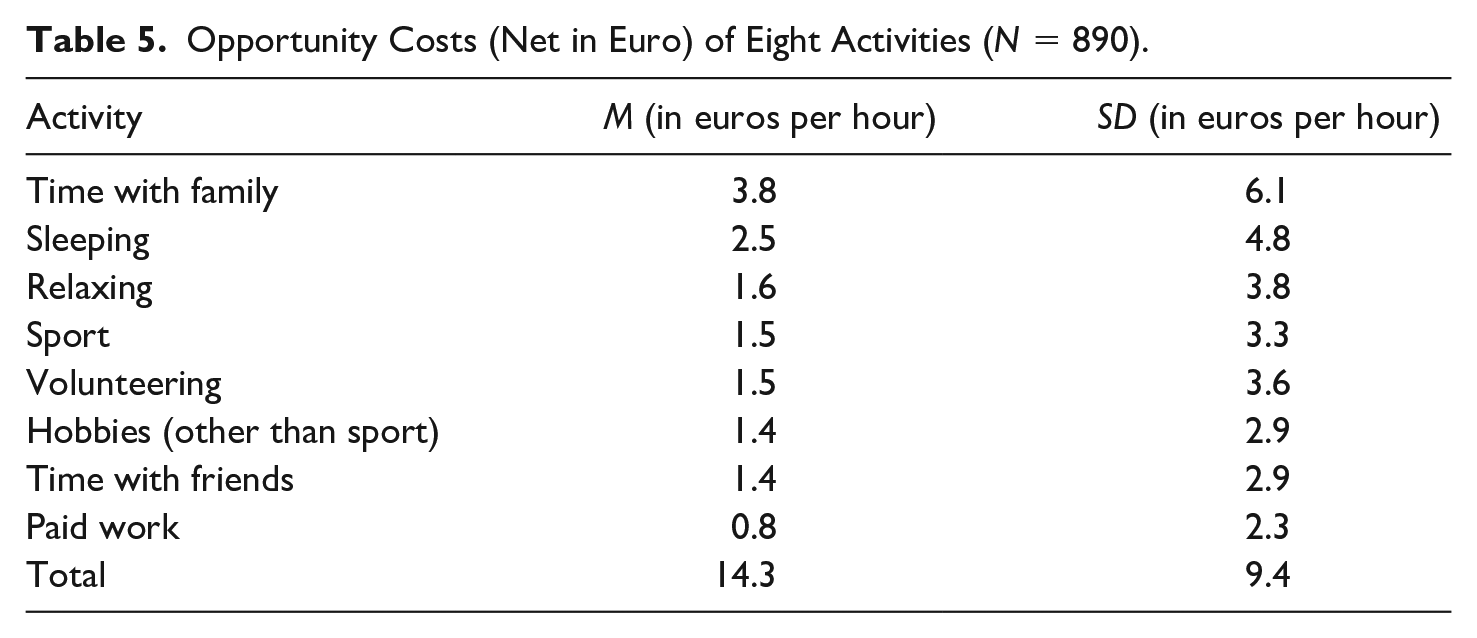
Overall, each person has 14.3€/h as net opportunity costs. These 14.3€/h are distributed across different leisure activities. To test Hypothesis 3, we used a repeated-measures analysis of variance (ANOVA). The ANOVA shows that the eight (leisure) activities significantly (F = 48.90, p < .001) differ with respect to their assigned opportunity costs per hour. Post hoc tests with Bonferroni correction reveals that “spending time with family,” “sleeping,” and “paid work” differ significantly (p < .001) from each other and among each other. In line with Hypothesis 3, “spending time with family” (3.8€/h) differed with higher opportunity costs, as well as “sleeping” (2.5€/h). “Paid work” (0.8€/h) differed significantly with lower opportunity costs from the other activities (1.4–1.6€/h). Table 5 illustrates these results in detail. It shows that “family” and “sleeping” are overall more relevant than other activities, and “paid work” is less relevant to competing volunteering.
Opportunity Costs (Net in Euro) of Eight Activities (N = 890).
Discussion
This study shows that opportunity costs have a positive influence on the likelihood to be a volunteer, but have a negative influence of the extent of volunteering. The negative effect on the extent of volunteering is only significant if opportunity costs, as theories require, are operationalized as net wage per hour and not if operationalized as net household income or individual income. Income has to be generated by work to be considered an opportunity cost, and it only has a negative effect on the extent of volunteering under this condition. Each participant in this study has opportunity costs (foregone net wages), with about 14€/h on average. Opportunity costs could be associated with different leisure activities. This study reveals that these costs occur primarily in the area of the family, which points to the significance of a work–family conflict in the area of volunteer engagement. This is especially relevant for managers of nonprofit organizations, because avoiding costs and conflicts for volunteers may require different actions than those used to generate benefits.
Higher opportunity costs may also lead to a higher probability of volunteering due to a selection effect. Dean (2016) shows in a study in the United Kingdom focused on students that volunteer recruiters focus more on students of higher social and economic class. It is likely that these individuals also receive higher net wages due to higher social, cultural, and finally human capital. That would also be in line with Freeman’s (1997) findings that one of the main reasons that individuals volunteer is being asked. Individuals with higher human capital may also be more likely to be asked to volunteer by recruiters because their human capital itself is useful to the recruiting organization or the intended beneficiary. This argument is also supported by the fact that “higher education” has a positive effect in the present sample.
It could also have far-reaching practical implications if the opportunity costs of volunteering are mainly incurred in the context of spending time with family. This would mean that opportunity costs generally arise only if the time-use option is an “either-or” (substitutional) situation. If, for example, the value of family time increases due to the birth of a child, this would only be an opportunity cost if family and volunteering could not be combined. A volunteer work–family conflict would arise.
Due to the high opportunity costs of volunteering with regard to family, it can be argued that one must be able to afford to volunteer and that it is more difficult or even impossible to volunteer if one lacks the resources to forgo paid work or lacks opportunities (Overgaard, 2019). This reasoning can also be related to recent approaches to research on inequality in volunteering (Hustinx et al., 2022): Opportunity costs may be an important reason for inequality in volunteering.
If managers of nonprofit organizations can make volunteer work more family-friendly or find a way to reduce the work–family conflict, the costs for volunteers shall reduce. In childcare or child-related services, the birth of a child does not necessarily constitute opportunity costs; instead, it is a complementary (i.e., additive) benefit. Hobbies are often not substitutional to volunteering but are complementary. This is also supported by Downward et al.’s (2020) results showing that certain leisure activities are complementary to volunteering and could be part “of the same choice set” (p. 769). That could also explain why the two proxy variables for opportunity costs “Children below 7 years” and “Taking care of relatives” have no influence on volunteering in the presented models because they are, at least partly, complementary to some volunteer activities. It is likely that two effects are simultaneously at work here: having (young) children could generate more volunteer work because of greater opportunities and incentives; on the contrary, children compete with volunteer work with regard to time, if the compatibility between family and volunteer work is insufficient.
In many countries, a large amount of volunteer work is carried out in sports. In Germany, for example, sports and exercise have the largest number of volunteers, with 13.5% of all people above 14 years (Kausmann & Hagen, 2021, p. 89). This could be because it is easy to integrate friends and family into this type of volunteering and make new friends when doing it. This reduces opportunity costs due to its complementary nature.
Randle and Dolnicar (2009) showed that different organizations compete for the same volunteers. Following this idea, it could be relevant how organizations design the volunteer activity. For people with high opportunity costs related to family activities, it could be more relevant that family is integrated into the volunteering activity or that the time of the day is compatible with family issues.
To summarize, the results of Hypotheses 1 and 2 show that opportunity costs are relevant for the decision to volunteer and the extent of volunteering but with an opposite effect. High opportunity costs increase the likelihood to volunteer but reduces the extent of volunteering. The high opportunity costs of volunteering for family activities could indicate that it is advisable to make volunteering activities more family-friendly to avoid volunteer work–family conflicts. An example would be having children and partners integrated into a sports club where the volunteer is a coach or chairman. Also, if a political party comprises a person’s family and friends, one might expect to see this person spending a considerable amount of time volunteering in politics. Accordingly, nonprofit organizations should pay attention to ensuring compatibility between family and volunteer work.
Limitations
As mentioned earlier, one limitation of the study is the potential problem of endogeneity in the regression models. This is a common issue in social science research, and if no strong instrumental variable is available, the “cure” of using weak instruments is sometimes worse (Semadeni et al., 2014). Nonetheless, endogeneity could have affected the results of our models. Another limitation is the restriction of the data set to Germany and the discontinuation rate of about 50% in the questionnaire, which could lead to a bias as the decision for prosocial behavior likely correlates with the willingness to participate in a survey (Abraham et al., 2009).
Another limitation is that it took 8,185 invitations to fill all these three quotas of age, sex and education resulting in a response rate of 26%. It is important to emphasize that the response rate of 26% is quite low because people were rejected when a quota was already full, for example, when enough people between 20 and 30 years had answered the questionnaire, no more people of this age were allowed to participate. The percentage of people who fulfilled the quota but canceled the questionnaire was about 49.2%. The use of a quota system might have caused the behavior of the initial respondents to differ from that of the later ones. However, when checking for the dependent variable of “extent of volunteering,” no significant differences were found between early and late respondents.
Future Research
It seems promising to focus on the (opportunity) cost aspects of volunteering in future research, especially with regard to the compatibility between family life and volunteering—this is analogous to discussion and research on “work–family conflict” (French et al., 2018), wherein research on the compatibility between family and volunteer work is inadequate. Examining substitutional and complementary aspects of volunteers’ time use seems promising, that is, in which fields of volunteering are other leisure activities substitutional, and in which fields are they complementary? How should volunteering be structured for compatibility with family and other leisure activities? What exactly should nonprofits do to avoid volunteer work–family conflict and thus reduce opportunity costs?
Future research should also target the endogeneity problem and, therefore, the question of causality in detail, although there are some volunteering studies, which have already applied some instrumental variables to deal with this issue (e.g., Downward et al., 2020; Hackl et al., 2007).
Footnotes
Appendix A
Appendix B
Comparison of Nonstandardized Coefficients in Poisson Regression, Negative Binomial Regression and OLS Regression—Poisson Regression With Overdispersion (N = 879).
| Poisson regression | Negative binomial regression | OLS regression | |
|---|---|---|---|
| Constant | 2.378 | 2.307 | 0.988 |
| Age | −.003*** | −.001 | −.002 |
| Male | .079*** | .080 | .102 |
| Higher education | −.017 | −.023 | .022 |
| PGM | .170*** | .147* | .238*** |
| PCM | .185*** | .187** | .192** |
| HCM | .006 | .010 | .042 |
| Children below 7 | −.125*** | −.081 | −.002 |
| Caretaking relatives | .130*** | .109 | .087 |
| Hobbies hours | .004*** | .004 | .004* |
| Net wage per hour (log) | −.328*** | −.287*** | −.151* |
Note. OLS = ordinary least squares; PGM = private goods model; PCM = private consumption model; HCM = human capital model.
Significance < .05. **Significance < .01. ***Significance < .001.
Declaration of Conflicting Interests
The author(s) declared no potential conflicts of interest with respect to the research, authorship, and/or publication of this article.
Funding
The author(s) received no financial support for the research, authorship, and/or publication of this article.
