




Abstract
The spread of non-standard employment (NSE) is widely considered to have contributed to the deterioration of labor standards. Yet, in the United States, there is no definitive roster of non-standard work arrangements and no reliable estimate of the size of the non-standard workforce. For over 25 years, the US Bureau of Labor Statistics (BLS) has produced artificially low estimates of employers’ use of ‘alternative employment arrangements’. Its 2018 Contingent Work Supplement (CWS) reported that since 1995 the proportion of US workers in these arrangements had declined. This article proposes a more systematic framework for understanding NSE in the United States and fleshes out a more comprehensive typology better suited toward addressing the needs of policymakers and labor activists. It fundamentally reorients the study of NSE by recognizing that so-called ‘alternative’ arrangements are abusive and more aptly understood as degraded work arrangements (DWAs). The article then explores the key categories of DWAs and provides a deeper analysis of one group, dissociative arrangements, that enable the flourishing use of ‘non-employee’ workers. Concluding sections address the undertheorized state of this subject area and the challenge of union organizing in fractured labor markets.
Keywords
Introduction
In recent years, the ubiquitous reference to ‘gig work’ has dominated academic and popular discourse on the restructuring of work. The phenomenon is variously defined, but generally understood as digitally mediated work, in which employers use mobile apps and despotic algorithms to muster and manage a casual workforce (Wolf, 2021; Wood et al., 2019). For many journalists, policy groups, and government agencies focused on labor and employment, the spread of gig work has become the central concern, over other forms of non-standard employment (NSE), or a stand-in for all of them. Symptomatically, the US Bureau of Labor Statistics (BLS) ‘has recently prioritized the measurement of web platform work’ over temp agency work and contract company work (National Academies of Sciences Engineering Medicine, 2020: 8, 74). Given the super-exploitative conditions associated with gig or platform work in the United States, it is indeed deserving of the intense scrutiny and organized resistance it has spawned.
The problem with ‘gig work’ as shorthand for the sweeping changes occurring in the world of work is that this pernicious arrangement – generically, an example of misclassification or bogus self-employment (ILO, 2016: 21, 39; Prassl and Risak, 2016) – is just one of an extensive array of abusive employment arrangements characterizing today’s US labor regime. Repeated and isolated attention to gig work hinders our apprehension of the full scope of the problem, the numerous distinct schemes used by US employers to evade their legal responsibilities, deny workers their rights, and rachet up the rate of exploitation. This myopic vision neglects the integrated constellation of NSE arrangements as a whole and grossly under-represents the population of deprived and disenfranchised workers in the United States. 1
Over the last half-century, corporate employers and neoliberal policy have brought about a ‘deep transformation’ in the world of work (Eichhorst and Marx, 2015: 1).
2
The most striking development has been the growing prominence of what are variously called non-standard, contingent, or precarious arrangements, as measured against the real and imagined standard employment relationship
3
of the post-World War II era (Barker and Christensen, 1998; Carré et al., 2000; Vosko, 2006). Throughout the neoliberal era, Peck and Theodore (2012: 742) explain,
the low-wage labor market has been a site of intensive regulatory experimentation and reinvention. The adoption of contingent [i.e., non-standard] work strategies has been central to employers’ efforts to reduce labor costs, to evade the legal liabilities (not to mention the ethical responsibilities) associated with employing ‘regular’ workers, and to undermine the foundations of collective action in the workplace.
Gottfried (2008: 179), for example, ‘chronicles [neoliberal] regulatory reform aimed at stimulating the growth of nonstandard employment’ in Japan.
A huge body of literature, both academic and journalistic, has addressed this restructuring and the trials of workers in one or more types of ‘non-traditional’ or alternative work arrangements (AWAs). Based on a comprehensive round-up of research, the International Labor Organization (ILO, 2016) has produced a practicable taxonomy of the forms of NSE and an overview of the range of national policies designed to address the related negative worker outcomes. As the ILO survey makes clear, the particular pattern and prevalence of the various forms of NSE is country-specific, driven by changes in labor market regulations and other institutional variables (Gottfried, 2008; Hipp et al., 2015; ILO, 2016: 217–218). In the United States, however, exactly what types of AWAs comprise the non-standard workforce, or what specific groups of workers it encompasses, remain unresolved questions. As explained below, despite decades of academic discourse, there is still no systematic and comprehensive typology of AWAs in the United States and, moreover, no reliable estimates of the number of workers in the different categories of NSE. While the popular media have often been hyperbolic about the specter of gig work and the growth of AWAs (Noguchi, 2018; Weber, 2017a), the BLS, in its Contingent Work Supplement (CWS), has for over 25 years minimized employers’ use of AWAs and downplayed their significance in US labor markets. 4 The CWS has supported the common assumption that NSE in the United States is a marginal and aberrant phenomenon, rather than a pervasive reality in virtually all industries and occupations, integral to the capitalist mode of production, and the domestic ‘lever’ of massive capital accumulation (Marx, 1975 [1867]: 632; Bernards, 2018). 5 The result is a striking disconnect of CWS with both the needs of policymakers and the vast experience of workers and organizers on the ground (Bernhardt, 2014: 2; National Academies of Sciences Engineering Medicine, 2020: 3; US Government Accounting Office (USGAO), 2023).
This article proposes a more systematic framework for understanding AWAs than that designed by the BLS, and on that basis, develops a more comprehensive typology of AWAs common in US labor markets. In so doing, the article reorients the study of NSE by recognizing that the overwhelming proportion of NSE is abusive and circumscribes workers’ rights, that is, results in deprived forms of employment that are more aptly understood as degraded work arrangements (DWAs). The article then presents the three main categories of DWAs, along with the organizational mechanisms that facilitate them. It then provides a deeper analysis of one group, what are called dissociative arrangements, a type of NSE especially characteristic of the current era of restructuring. With respect to each DWA, the article points to potential sources of a current undercount or miscount in official statistics, revealing a portrait of the non-standard or degraded workforce far different in composition and size from the mainstream conception. The concluding sections address the undertheorized state of NSE research in the United States, and the challenge of organizing in labor markets fractured by the widespread use of DWAs.
The 2018 CWS: ‘Seriously Confused’
In June, 2018 amid much fuss and alarm in the US media over the apparent surge in ‘gig’ and ‘contract’ work, the US BLS (2018) released a new CWS, a survey first conducted in 1995 purporting to estimate the size of the contingent and alternative workforce in the United States. The CWS is the most widely used and cited profile of NSE in both the popular media and social science (e.g. Kalleberg, 2011: 90–91; Nelson, 2015: 249), ‘the key instrument within the portfolio of federal economic statistical programs’ (National Academies of Sciences Engineering Medicine, 2020: 53). Despite doubts about its reliability, 6 Howell and Kalleberg (2019: 17) assert that the CWS surveys ‘provide the most extensive estimates of non-standard work arrangements in the United States’. The impetus for the new CWS was a concern that certain AWAs – particularly so-called ‘gig’ jobs – ‘were growing at the expense of the traditional employee-employer relationship and lowering the quality of the jobs held by American workers’ (Abraham and Houseman, 2020: 1). This was the first CWS conducted since 2005, when the series was discontinued by the George W. Bush administration. 7 Given the elevated expectations connected with the apparent spread of gig work, anticipation was high.
But when the new CWS was released in June 2018 (based on data collected in 2017), the survey had registered a drop in the percentage of US workers in ‘alternative employment arrangements’ since 2005. Incredibly, to many observers, the new CWS reported that the proportion of the employed who were independent contractors, including gig workers, was lower in May 2017 (6.9%) than in 2005 (7.4%), while the proportions employed in the other three alternative arrangements studied by the CWS had slightly declined: on-call workers, 1.7%; temp agency workers 0.9%; and contract workers 0.6%. Overall, according to the new CWS, the proportion of the US workforce now employed in NSE arrangements was just 10.1%, down from 10.7% in 2005 (US BLS, 2005, 2018).
Many researchers were ‘seriously confused’, Bernhardt (2018) reported. ‘Given the endless coverage of Uber and freelancing as paradigmatic of the 21st century labor market, expectations were that the new data would show significant increases.’ 8 Using a less-restrictive definition of just one of CWS’s categories of alternative employment (‘contract workers’), Katz and Krueger (2016) had earlier estimated that the share of workers in AWAs had increased by nearly 50% from 2005 to 2015, to 15.8% of US employment. The temporary staffing industry also noted that the new CWS put the size of the contingent workforce ‘at much lower levels’ than its own research unit (Staffing Industry Analysts, 2018). With such ‘raised concerns’ circulating about the CWS’s accuracy, the US Government Accounting Office (US GAO, 2019) was asked to review the BLS’s measurements.
Alternative or Degraded Employment Arrangements?
Since its release in 2018, experts have pointed out numerous ‘limitations’ and ‘shortcomings’ in the CWS (Abraham and Houseman, 2020, 2021). 9 A prominent panel convened by the National Academies of Sciences Engineering Medicine (2020: 53) ‘to help guide future iterations’ of the CWS focused primarily on improving the survey instrument. Its major recommendations included adding or modifying questions to capture ‘secondary work activities’ (such as ‘side’ or gig jobs) and unpredictable work hours and earnings (National Academies of Sciences Engineering Medicine, 2020: 61–64, 76–80). Once again, the US GAO (2023: 15–16) was asked to revisit the survey, and expressed impatience with the varying definitions of AWAs and the wide range of estimates among different federal agencies. Its report ‘recommended . . . increasing collaboration among federal agencies—such as by establishing a working group—to improve data about these workers’ (US GAO, 2023).
The most serious problems with the CWS, however, are conceptual. As discussed below, its typology of AWAs lacks an underlying principle of organization and a consistent definition of AWA. Most glaring is that a number of important AWAs are not considered at all. The CWS identifies and collects data on just four kinds of AWAs, the same four surveyed since the first CWS in 1995—independent contractors, on-call workers, temporary agency workers, and workers employed by contract companies. 10 Such groups as workfare participants, adjunct professors, workers in franchised outlets, guest workers, or incarcerated (and ex-incarcerated) workers are not included. Other US researchers of NSE have also stayed within the confines of CWS’s short roster of AWAs. 11 The critical assessments have not ventured beyond this typology either. 12
There is a deeper problem as well. The AWAs, or forms of NSE, are not merely alternative employment arrangements, as understood by BLS. Together, they comprise a set of specialized and politically sanctioned work arrangements by which employers can escape from full accountability to existing laws and social norms protecting workers. Although some AWAs have legitimate uses, so-called ‘alternative’ arrangements are utilized primarily to form abusive, super-exploitative, and often fraudulent employment relationships. Accordingly, our object of study should be reconceptualized as DWAs. 13 Not all workers in every AWA occupy degraded employment statuses. It is only when AWAs strip workers of established rights and protections, and increase workers’ precarity and the rate of exploitation, that they merit scrutiny in the study of NSE (de Vries and Wolbers, 2005).
For example, the CWS counts all workers identified as independent contractors as part of the non-standard workforce (10.6 million in 2017, or 6.9% of total employment, by far the survey’s largest category). Yet the majority of these are bona fide independent contractors with a higher median income and greater job satisfaction than traditional employees in the same occupations (Abraham and Houseman, 2020: 56). Accordingly, the ILO (2016: 7, 16–17) does not consider genuine self-employment a non-standard arrangement and excludes this group from the study of NSE. The BLS’s inclusion of millions of legitimate independent contractors in the count of workers in alternative arrangements is a major source of the difficulty US researchers have in linking NSE with substandard conditions (see Bernhardt, 2014: 2; National Academies of Sciences Engineering Medicine, 2020: 47). Thus, in this article, the DWA referred to as bogus self-employment contains only those workers who are fraudulently misclassified by employers as independent contractors.
A Typology of DWAs
DWAs comprise the currently available (but ever being modified) roster of normalized or politically supported social and legal frameworks used by employers to disenfranchise specified groups of workers; they are, in other words, institutionalized tools for exclusion. DWAs enable employers to circumvent established labor regulations and collective bargaining agreements, affording them some measure of relief from the normal obligations and constraints, and a shield against legal liability, or even moral consequences. DWAs offer employers social legitimacy for super-exploitation, a pretext for denying groups of workers the rights and material benefits otherwise associated with employee status, and a rationalization for extreme inequality in the distribution of revenues.
To elaborate a full typology, the major DWAs can be grouped around the three organizational mechanisms on which they operate – dissociation, labeling, and state mediation. This generates the array shown in Figure 1. 14 Below, each of these three groups of DWAs are briefly discussed. Following that, the group based on the dissociative mechanism is given more extensive treatment, with each separate DWA receiving closer inspection.
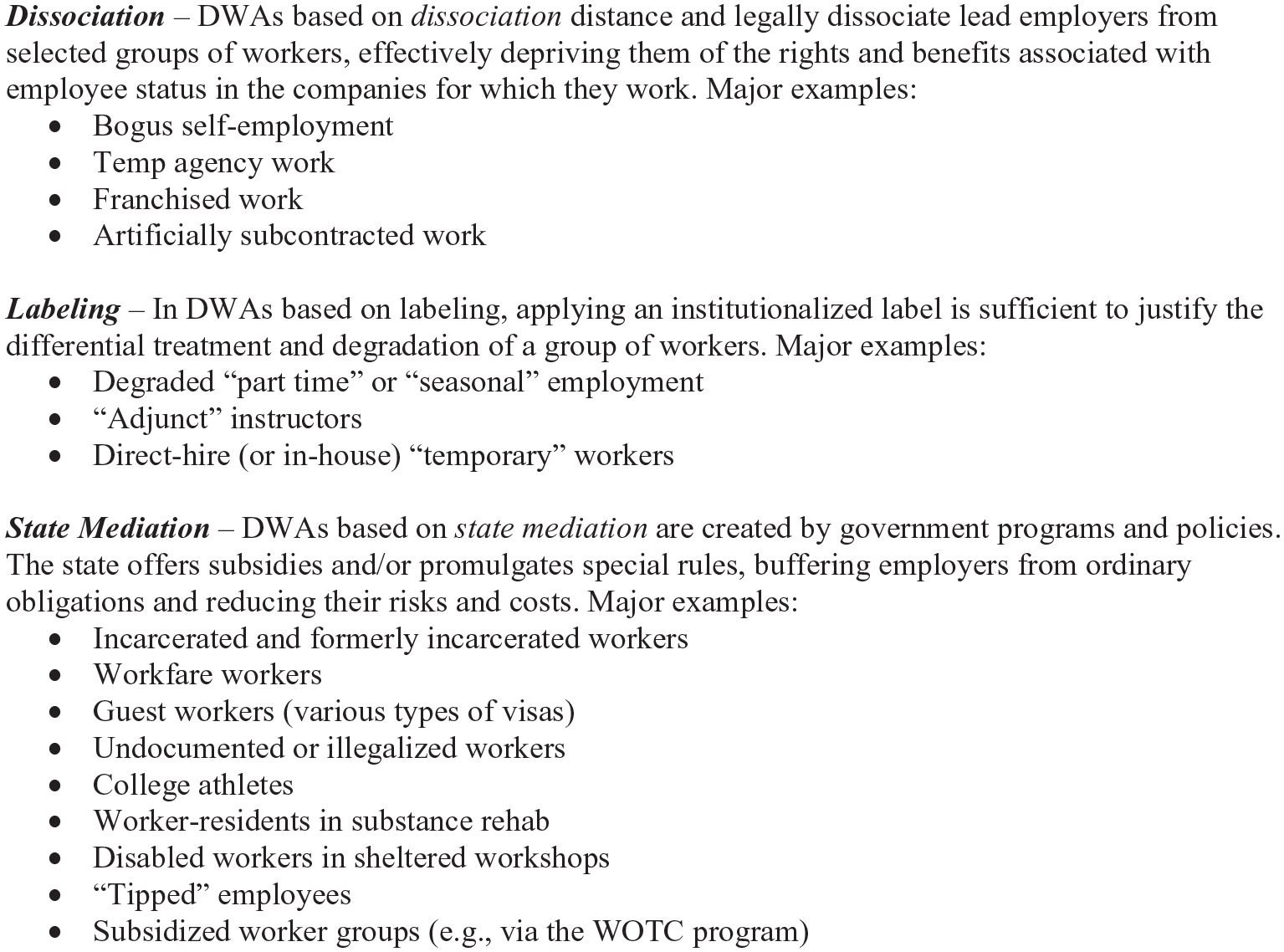
Major Degraded Work Arrangements (DWAs) in the United States and the organizational mechanisms producing them.
Dissociative DWAs
These are employment arrangements that weaken, or sever completely, the primary employer’s legal and social relationship with selected groups of workers. This is accomplished by shifting the legal identity of the employer to a sham or dummy employer such as a temp agency, franchise outlet, or faux subcontractor – or, in the case of bogus self-employment, to the individual workers themselves. 15 Under prevailing US policy, this scheme effectively turns workers into ‘non-employees’ of the companies for which they work and create value. The dissociative mechanism enables four major DWAs: bogus self-employment, temp agency work, franchised work, and artificial subcontracting. 16
DWAs Based on Labeling
In these DWAs, merely attaching institutionalized labels like ‘part time’, ‘adjunct’, or ‘seasonal’ to groups of workers provides sufficient justification for their differential and debased treatment. Such labels commonly reinforce, and intensify, existing racial, ethnic, and gender discrimination. The workers remain legally the direct employees of the establishments they work for. No intermediary or shadow state presence is needed. Apparently because such arrangements do not involve an intermediary, the CWS does not recognize the work arrangements in this group as AWAs.
Nearly one in five workers in the United States, about 27 million, are labeled by employers as part time. When they voluntarily choose this arrangement, retain standard rights and protections, and are compensated at parity with full-timers doing the same jobs, this is not a DWA. But this is seldom the case in the United States. Most part time workers perform work comparable with that of full-timers, and yet experience a substantial wage penalty, fewer benefits, irregular hours, and less protection from employment laws and labor unions (Golden, 2016; ILO, 2016: 26–28, 160). When these serious inequities are present, part-time work becomes a DWA. 17 Since labor law contains no legal threshold defining part time work, employers’ use of it is completely discretionary (e.g., part-timers often work full-time hours). 18 Thus, employers have in recent years been shifting workers into part-time status at an accelerated rate (Golden, 2016). The CWS’s omission of millions of degraded part-time workers from the count of workers in AWAs is a departure from the ILO’s (2016) classification of NSE, and some US studies (e.g. US GAO, 2015, 2023). 19 It is another major source of the difficulty that US researchers have in estimating the size of the non-standard workforce and in linking it empirically with substandard conditions. 20
So-called ‘adjunct’ professors, numbering over half a million (about half of a larger group holding ‘contingent appointments’), represent another DWA based on labeling. Legitimate adjuncts, hired to supplement the university’s offerings in an area of special expertise, are today rare exceptions. Hired on a mass scale for the purpose of drastically reducing labor costs, adjuncts suffer steep reductions in pay and benefits, heavy workloads, and numerous other penalties denoting their degraded status, such as lack of access to tenure, appropriate office space, or support for professional development (Childress, 2020; Hurlburt and McGarrah, 2016; Welsh, 2020). Yet these instructors are not included in the CWS count of workers in AWAs. ‘Direct-hire temporaries’ are another example of the labeling mechanism, when an employer maintains a separate pool of ‘temporary’ or ‘seasonal’ employees without full compensation or benefits, or an expectation of ongoing employment. Cappelli and Keller (2013a: 882) found their use was surprisingly high (averaging 2.8% of all on-site workers).
State-Mediated DWAs
The state regulates all employment in some manner. What are here called state-mediated DWAs are created by specific government policies and programs, whether explicitly or not. Typically, the state offers subsidies and promulgates special rules for employers of specified groups, reducing their risks and costs, and buffering them from certain ordinary constraints and obligations. When these policies depress wages, constrain mobility, weaken rights, and/or increase precarity for a specific group of workers, they fit the definition of DWAs (Duvisac, 2019). The list of state-mediated DWAs is expansive because legislative provisions and judicial rulings have produced an unwieldy catalog of such special arrangements. Non-coercive examples include tipped employees, college athletes, and the numerous groups of workers for which tax credits and subsidies are available to employers, for instance, under the federal Work Opportunity Tax Credits programs (Corwin, 2022).
The largest and most consequential state-mediated DWAs are coercive in nature and involve the threat of serious punishment. These include incarcerated and formerly incarcerated labor, workfare participants, guest workers, undocumented (or illegalized) workers, 21 and worker-residents in rehab facilities and sheltered workshops. In these DWAs, the employers’ authority is backed by the shadow presence of the state, an ‘implicit third party’ in the employment relationship (ILO, 2016: 11; Zatz, 2020). Workers are defined as clients, recipients, trainees, inmates, students, or foreign guests rather than employees, and their work is officially viewed as ‘noneconomic’ activity (Hatton, 2020: 9, 208). Hence, they are generally left out of discussions of NSE and go unmentioned in both the CWS and the ILO’s classification of NSE. 22 Yet, these groups are implicated in the operation of labor markets and, as Hatton (2020: 211) notes, ‘whatever else they are doing and whatever else they are gaining, they are performing labor for someone else’s benefit’. 23 If recognized, workers in state-mediated DWAs potentially add a stunning number (over 20 million) to the non-standard or degraded workforce in the United States. 24
These are the three basic organizational mechanisms underlying DWAs. Granted, work arrangements often do not fit neatly into fixed categories; DWAs combine and overlap, compounding workers problems (ILO, 2016: 9–10, 41). (Ex-incarcerated workers, for instance, face state discipline for violations of probation in addition to the strictures imposed by temp agency work.). While not perfect, however, this proposed typology moves us closer to apprehending the full scope and multiformity of non-standard or degraded work in the United States. 25 It also helps highlight several essential dimensions of these phenomena often missing in mainstream discussion, for example, the origins of DWAs in the processes of capital accumulation; the fierce political contestation over the differentiation, boundaries, and regulation of degraded forms; the pervasive bending and breaking of law involved in the use of DWAs; and the intensification of race, gender and nationality discrimination, and economic inequality, engendered by DWAs. The re-orientation proposed here would help align research on non-standard or degraded employment 26 with the needs of social policy and labor advocacy, from which the CWS has often seemed divorced and irrelevant (National Academies of Sciences Engineering Medicine, 2020: 10).
The Dissociative DWAs: Employers Escape from Accountability
The dissociative DWAs operate by masking the controlling role, and sometimes the identity of, the workers’ primary employer, that is, the principal, parent, lead or ‘client’ firm, or franchisor. They enable the flourishing use of workers as ‘non-employees’ that has become the signature characteristic of the recent era of expanded degradation. These DWAs flaunt long-established legal doctrine holding that employer liability is determined by the facts of what entity or entities control the essential terms and conditions of work (Davidov, 2004). As D’Amours et al. (2022: 16) say, ‘there is a decoupling of the . . . control and responsibility that characterized the standard employment relationship’.
Promoters of dissociative DWAs claim, and it is now widely accepted, that workers in these arrangements are employed outside the legal boundaries of the parent firms, that is ‘externalized’. The dissociative DWAs thus offer employers a sanctioned means of creating a second-tier workforce with substantially lower labor costs. For workers, the efficacy of protective legislation diminishes and the violation of fundamental rights, such as collective bargaining, is endemic, since these rights are restricted in practice to direct employees (Befort, 2003; ILO, 2016: xxiv, 39). Presumably, the sham employers – temp agencies, franchise outlets, or faux subcontractors – comply with labor laws and guarantee worker protections. But these are intentionally dependent, undercapitalized shell entities that give workers no chance of gaining fair treatment (Deakin, 2001: 80). As workers lose protection, their primary employers – the companies that invest capital, accumulate profit, and exercise the greatest share of control over the work – escape from accountability. Dissociative DWAs shield these so-called ‘third parties’, the users or ‘buyers’ of degraded labor, from a wide range of legal and social obligations associated with employer status. While management consultants caution lead firms that they can face serious risks as joint employers for noncompliance with workplace laws, they have been emboldened by the general lack of negative consequences as the practice of exploiting non-employee workers has spread. 27 As shown below, dissociative DWAs also present serious difficulties to those attempting to track the extent of their use (Weil, 2014: 272–274, 368fn11). Following are summary treatments of each.
Bogus Self-Employment
Consistent with the ILO’s (2016: 16–17) framework, this DWA includes not all independent contractors but primarily those who are misclassified as such. In bogus self-employment, the status of independent contractor is fraudulently and involuntarily foisted on workers by unscrupulous employers who want to evade taxes and workplace laws, reduce workers’ wages, and nullify their rights (ILO, 2016: 9, 21). 28 Although these employers control the work and the terms of compensation, workers are forced to sign declarations of self-employed status as a condition of employment, or they are simply treated as self-employed without their consent. This description of bogus self-employment generally applies to gig or platform work (ILO, 2016: 39), 29 as well as more traditional examples of this inherently abusive arrangement in construction, farm work, trucking, janitorial services, home health care, and so on.
As with other dissociative arrangements, employers’ use of bogus self-employment has ‘spiked’ since the 1980s in both low-wage occupations and technical and professional fields (Alexander, 2017: 918-919; Slone et al., 2021). Statistics are spotty, however, and the overall number of workers affected in the United States is not known (Abraham and Houseman, 2021: 33). Our best knowledge of the prevalence of bogus self-employment comes from close research of specific sectors (e.g. Juravich et al., 2021). 30 In regard to gig workers, in particular, the BLS estimated in 2017 that only about 1.0% of total employment was accounted for by ‘on-demand, platform-intermediated work’ (National Academies of Sciences Engineering Medicine, 2020: 41), less than BLS’s count of temp agency workers. Other estimates are extremely wide-ranging (Bernhardt et al., 2019: 5).
The shifting boundaries of what is accepted as legal independent contracting are politically constructed. Linder (1999: 214) has provided an especially detailed explication of how the US congress, government agencies, and courts have encouraged generations of employers to ‘adopt the independent contractor scam’. Although the battle surrounding the determination of independent contractor status goes back more than a century, at no time has it been more fierce or constant than during the current fight over the legal status of gig workers (see, e.g. Abraham and Houseman, 2021; Wolf, 2021, 2022: 32–33).
Temp Agency Work
Temp agency workers are treated as legal employees – though not of the company that uses and directs their labor power. ‘Generally, there is considered to be no employment relationship between the temporary agency worker and the user firm’ (ILO, 2016: 9). For most purposes (e.g. wage and hour law, collective bargaining, unemployment insurance), the temp agencies’ claim to operate as the sole legal employers of the workers they ‘assign’ to other businesses has held up well, even as the temps perform their work at, and under the supervision of, the user firms (ILO, 2016: 30). 31 Remarkably, in the prevailing regulatory regime, simply ‘payrolling’ workers, that is, issuing paychecks through a staffing agency, effectively turns them into non-employees in the companies where they work. This has enabled user firms to escape a wide range of legal and contractual obligations with respect to these workers, including collective bargaining in the unionized shops in which they work.
But the widely accepted status of temp staffing agencies as bona fide employers amounts to a ‘legal fiction’ (Stone, 2006: 259). User firms ‘directly manage [temps’] working activities as if they were its own employees’ (ILO, 2016: 30), while temp agencies exercise little or no control over the means and manner of work, the core criterion that traditionally defines employer in US law (Carlson, 2001; Glynn, 2011). The major commercial temp agencies initially won acceptance as statutory employers not through judicial deliberation or open policy debate but through a stealthy blitz of state legislatures during the 1960s, and continuous lobbying ever since (Forde, 2008; Gonos, 1997, 2001). If temp agencies handling only certain administrative duties have any rightful claim as employers – rather than as state-regulated employment agencies – then they are at best joint employers, along with the user firms that direct the temps’ work.
Yet, based on the precarious premise that temp agencies are bona fide employers, the bargaining rights of agency workers have been effectively squelched (Freeman and Gonos, 2009, 340–343; Gonos and Martino, 2011; ILO, 2016: 209–210). 32 Splitting the workforce by ‘permatemping’ job clusters in both blue-collar and white-collar shops has been an effective tactic in suppressing labor unions and holding down wages (Hatton, 2014; Mishel, 2018). 33 The temp arrangement is also pernicious in spreading and intensifying racial, ethnic, and gender discrimination (Peck and Theodore, 2001), and in vastly increasing temp workers’ risk of death or serious injury (Grabell, 2013). Recently, the harshly coercive aspects of agency work – non-compete contracts, wage-fixing, and even debt peonage – have received greater attention (Black and Caporale, 2020; Flanagan, 2020; Fudge and Strauss, 2014; Purser, 2019). 34
The US BLS (2018: 7) acknowledges that the number of agency workers reported in the 2017 CWS – 1.4 million, less than 1% of the workforce – was too low by half (Abraham and Houseman, 2020: 57; National Academies of Sciences Engineering Medicine, 2020: 74). According to the BLS’s own Current Employment Statistics (CES), based on employer payrolls, over three million temp agency workers are on the job each day, just over 2% of total employment. But this figure also represents a significant undercount. One important source of the problem is industry misclassification. Fisher et al. (2005: 7–8) found that temp firms often reported to BLS under different NAICS codes, resulting in an estimated undercount of 20%. Searches of well-known business databases for this article found that large temp staffing agencies specializing in a particular sector, for example, health care or IT, are not infrequently identified with those sectors rather than the NAICS code for temporary help services. 35
The reported number of temp workers is further reduced by at least 400,000 by the creation of a separate industry code for professional employer organizations (PEOs; formerly known as employee leasing firms), businesses virtually indistinguishable from temp staffing. 36 Although the employment arrangement is similarly intermediated, PEO employment is not counted by the CWS as non-standard. There appears also to be a systematic undercount of PEO employment itself (Dey et al., 2009).
Franchised Work
This term refers to the legions of employees of franchised business outlets that work in fast food restaurants, beauty salons, janitorial services, convenience stores, hotels, fitness centers, and so on. 37 The franchising model is used in scores of different kinds of businesses, creating an estimated half a million small workplaces across the country. Franchised workers number around 9.0 million, 3.3 million in fast food outlets alone (US Census Bureau, 2021). But the CWS does not count these degraded workers as part of the non-standard workforce.
This represents inconsistent reasoning. The BLS considers temp agency work an AWA on the basis that it is a ‘mediated’ employment relationship, and because the jobs it offers are (presumably) temporary. Yet, much of the franchised sector exhibits these same characteristics (Baber, 2023). Conditions vary, and further research throughout the world of franchising is needed, yet jobs in franchised outlets appear as precarious as temp agency jobs (Mayhew and Quinlan, 2002: 268). Like temp agencies, franchise outlets, or franchisees, function as the sole legal employers of their workers, shielding the corporate franchisors (i.e. parent employers) from accountability, despite their heavy hand in controlling numerous aspects of work in their outlets (Royle, 2000; Weil, 2014). Accordingly, Weil (2014: 9) views franchising as an ‘unrecognized form of fissured employment’, that is, as an AWA, though its workers are misleadingly taken as having a standard employment relationship, thereby contributing to the undercount of NSE (Weil, 2014: 273–274). Based on its structure as a multi-party employment relationship and because wage repression and substandard working conditions are built into the arrangement, franchising should be understood as a DWA. In ‘format franchising’, the franchisor sells its system and products to the franchisee and dictates the precise rules and operational procedures that must be followed. The stringent pricing schemes and exorbitant fees imposed on franchisees leave very limited revenues for franchise owners to share with workers. Franchisees are compelled to cut labor costs and skirt labor standards (Weil, 2014: 126–158, 198).
Like temp agency work, the franchising arrangement is a ‘legal creation’ (Callaci, 2021). Through decades of political lobbying (promulgating the sentimental idea that franchised outlets are small independent businesses), major corporate franchisors have eluded designation as joint employers (Elmore, 2018). This has not only insulated them from liability for labor standards violations in their subsidiary outlets. 38 It has meant the ‘exclusion of workers at franchised establishments from access to collective bargaining and other rights’ (Callaci, 2021: 157). In recent years, workers and unions have forced significant changes in the fast food sector in certain states (Pietsch, 2022). Yet, overall, the degraded status of franchised workers remains fundamentally unchanged.
Faux Subcontracting
This DWA encompasses the employees of subcontractors, or subcontracted workers for short (who are not independent contractors themselves). Not all subcontracting, however, results in the degradation of jobs. Following the ILO (2016: 32–34), the typology of DWAs in this article distinguishes genuine from artificial subcontractors. Genuine or bona fide subcontractors execute work that provides a product or service ‘which is distinct from merely employing workers and making them available to a principal’, in the manner of a temp agency (ILO, 2016: 34). They own technical proficiency and means of production and manage their own workforce (ILO, 2016: 32–34). Genuine subcontractors can provide ‘good’ jobs, Bernhardt (2014: 11) says, when they ‘have multiple clients, a large degree of independence, and provide relatively secure, full-time employment to their employees’.
What are here called artificial or faux subcontractors are dominated by lead firms (or principals) that retain effective control over production and the labor process, while disclaiming legal or moral accountability to the subcontractors’ employees. Under neoliberal policy, such ‘arms-length’ relationships with subcontractors have proliferated, shifting responsibility for worker protections onto entities with few resources (D’Amours, 2022: 14; Smith, 2016, 68–69, 79–84). Along with temp agency work, artificial subcontracting is used throughout the economy to assist employers in creating one or more tiers of insecure, lower cost workers (Weil, 2014: Chap. 5). 39 In ‘multi-layered labor contracting’ each added tier further distances workers from the centers where capital accumulates, and results in higher returns to lead firms and an additional reduction in relative wages (Cox, 2019; Rho, 2019).
Effective protection for workers in this DWA requires their reclassification as employees of the lead firm ‘as a way of preventing abuses and the shedding of labour obligation and responsibilities’ (ILO, 2016: 34–35). Major labor law legislation passed in the New Deal period provided subcontracted workers a legal avenue to bring claims against the firms that controlled their work (Goldstein et al., 1999). But these instruments of worker power were assaulted by corporate employers and ultimately undermined by legislative amendments and the anti-worker rulings of federal courts and the NLRB (Dannin, 2006). By the 1980s, corporate employers were taking advantage of the looser norms and farming out operations at an accelerated pace. ‘Domestic outsourcing’ has grown substantially in recent decades and is associated with lower wages, fewer benefits, and declining rates of unionization (Dube and Kaplan, 2010; Milkman, 2008). The ‘multifactor test’ of liability currently in wide use leaves courts ‘a great deal of room for interpretation’, and their rulings have generally not been friendly to workers (Weil, 2014: 190–192).
No estimates exist for the size of the subcontracted workforce or for workers caught in artificial subcontracting arrangements. ‘[R]epresentative data on the number of subcontracted jobs or workers in the US are almost nonexistent’, Bernhardt (2014: 10) says, ‘or else deeply flawed’. The CWS includes only one specific type, what it calls ‘contract company workers’: those who are ‘usually assigned to only one customer and usually work at the customer’s worksite’ (US BLS, 2018: 3; Abraham and Houseman, 2021: 67–68). The 2017 CWS counted less than a million such workers, making it the ‘smallest of the four alternative arrangements’ (US BLS, 2018: 7). But ‘[t]his narrow definition misses a lot of contract work that is relevant for policy’ (National Academies of Sciences Engineering Medicine, 2020: 74). Adding those who work on-site for more than one client, Katz and Krueger (2016: 7) show, would make the number of contract workers over five times greater than the CWS estimate—and this still does not include the contracted workforce that is offsite (Bernhardt, 2018; Weber, 2017b). 40
Estimating the number of workers in artificial subcontracting arrangements would require us to ‘identify different models of subcontracting in order to pinpoint the ones that undermine labor standards’ (Bernhardt, 2014: 14). This is probably not feasible in a national survey like the CWS. Yet, disregarding the flourishing growth of artificial contracting in recent decades does not change the reality. The proper inclusion of this DWA significantly enlarges the currently accepted profile of the non-standard or degraded workforce in the United States.
Discussion: Theorizing NSE
In its review of the CWS, the National Academies (2020, 37) panel draws the conclusion that independent contracting, including platform work, is ‘more prominent from the point of view of policy’ and ‘more salient’ in ‘todays’ society’ than temp agency work. ‘The independent contractor group is critical for policy’, the report continues, ‘as these individuals typically cannot rely on employing organizations for benefits and security, and they are not covered by employment and labor laws that provide basic protections’. This assertion of the pre-eminence of gig work in the study of NSE is misguided, however. It suggests that the remedy for workers in the ‘gig economy’ is simply their recognition as legal employees. Yet, as the above analysis makes clear, a greater portion of the overall workforce in DWAs is comprised of workers who presently do have recognized legal employers, and yet cannot rely on those employers for benefits, nor are they effectively covered by protective legislation. 41 In the dissociative DWAs, this is because their designated employers – for example, temp staffing agencies, faux subcontractors, franchise outlets – are not the principal businesses behind the super-exploitative terms of their employment. The prevailing policy treating these intermediaries as the workers’ primary legal employers allows those principals to escape from accountability. Ultimately, the problems experienced by gig workers and other bogus independent contractors are not different in scale from the myriad intractable problems faced by workers across the entire spectrum of DWAs (ILO, 2016: 227).
Considering workers across the full range of DWAs, the actual size of the non-standard or degraded workforce in the United States is clearly far larger and more multifaceted than what many have assumed on the basis of the CWS and research using it. As shown above, millions of workers go unrecognized and uncounted by CWS in each of the categories of DWAs: in the labeling category, those in part time and direct-hire temp work, and adjunct teaching; in state-mediated DWAs, they include workfare participants, incarcerated and formerly incarcerated workers, guest workers, and undocumented workers; and in the category of dissociative DWAs, they include franchised and subcontracted workers. But the analysis above also points to pockets of uncounted workers in DWAs that are currently recognized and counted by the CWS, such as temp agency work. As for gig workers, the BLS is yet without an accepted definition or measurement tool (McEntarfer, 2019).
Despite all this, based on the CWS, some leading researchers continue to question whether NSE has increased in the United States (Howell and Kalleberg, 2019: 2), and ‘whether changes in workers’ employment arrangements account for the growth in earnings inequality’ or ‘the decline in job quality’ (National Academies of Sciences Engineering Medicine, 2020: 47; Bernhardt, 2014: 2). Answering these questions, obviously, necessitates having a valid conception and comprehensive typology of AWAs as well as reliable data collection methods. 42 The CWS clearly falls short on these points. As Standing (1999: 103) says, ‘the statistics needed to analyse such phenomena are not available, partly because the concepts used for census and labor force surveys have been designed for single, “rigid” labour status categories’. Historically, the BLS counts workers by occupation and industry, not by the nature of their employment relationship. A survey of workers in DWAs requires different concepts and methodology, a different toolset.
This article has attempted to develop a conceptual framework with the capacity to discern the full range of DWAs in the United States, and a lens to capture the deterioration of labor standards associated with their utilization. Currently, the subject of NSE in the United States is undertheorized, and it is important to begin with fundamentals. In well-known passages, Marx, (1975 [1867]: 632; Bernards, 2018: 17–25) discussed the ‘surplus labouring population’ as both ‘a necessary product of accumulation’ and ‘the lever of capitalistic accumulation’. Based on mid-19th-century information, he described the distinct subgroupings that form a ‘disposable industrial reserve army, . . . a mass of human material always ready for exploitation’ (Marx 1975 [1867]: 632, 640–645, 663–667). Bernards (2018: 3) observes that the normative status of ‘free wage labor’ (or ‘standard’ employment) during the post–World War II period was ‘brief, [and] geographically narrow’, and stresses that the process of capital accumulation has in all historical periods produced ‘a variety of different forms’ of super-exploitative or degraded work arrangements. At any time, the available DWAs, or ‘irregular’ forms, are of a ‘political character’, differentiated through contestation and often reinforced by state regulation (Bernards, 2018: 2–4, 17–18).
The pervasive use of DWAs in our era epitomizes the historical process that Brass (2011: 11, 60–74, 191–198, 273) identifies as deproletarianization, in which widening bands of working class strata are deprived of previously established rights, most fundamentally their capacity to commodify and recommodify their labor power, the key characteristic of ‘free labor’. Replacing groups of enfranchised proletarians with degraded equivalents stripped of bargaining rights, or converting the former into the latter, has been a principal weapon utilized by capital to discipline and cheapen labor, pre-empt working class agency, and fend off economic crisis (Brass 2011: 64–74, 104). Rapid capital accumulation is not merely compatible with such degraded and unfree work arrangements but thrives on them (Brass, 2011: 8, 109–110; Smith, 2016). Over the past half-century, US capitalism has both intensified its use of some older variants of degraded labor, for example, migrant labor and convict leasing (Brass 2011: 183–192), and invented a more nuanced array of less-than-free DWAs, as outlined above. Broad sections of the American working class have been pushed out from under the umbrella of protective legislation, while younger generations and immigrant groups experience only the emergent reality in which employment in DWAs has been normalized. For both groups, the New Deal framework has been virtually ‘eclipsed’ (Milkman, 2020).
As Jonna and Foster (2016: 21–23) and others (Bernards, 2018: 6fn2; Moody, 2018: 13) caution, the term deproletarianization should not suggest that workers in degraded statuses constitute a distinct and separate ‘precariat’ or ‘new class’ (Jonna and Foster, 2016: 21–22). 43 Rather, they recognize these groupings as the ‘industrial reserve army’, an indispensable segment of the proletariat in ‘constant formation’ and ‘re-formation’ for the ‘varying phases of the industrial cycle’ (Marx, 1975 [1867]: 633). 44 Like many observers, Jonna and Foster (2016: 36, 26–38) posit the ‘rapid growth’ of these strata in recent decades. Their effort to delineate the ‘layers of the reserve army’ and estimate the size of this workforce using ILO data (for 2013) concludes that these groups constitute about 27% of total employment in the developed countries (Jonna and Foster, 2016: 37–40). Not surprisingly, though, the analysis suffers from a weak correspondence of existing data with Marx’s original classification scheme. The typology introduced in this article is proposed as more suitable for the analysis of DWA utilization within the US national context and for engaging in current labor struggles.
Conclusion: ‘Extending Solidarity’
In the current union revival in the United States, labor organizers face a highly ‘fragmented landscape of labor relations’ (Holst, 2014: 11; Marchington et al., 2005). Temp industry gurus continue to push the expansion of corporate ‘contingent work programs’ that rely heavily on ‘non-employee labor’ (Dwyer, 2017). The expanded spectrum of DWAs empowers employers to create and exploit new labor divisions. Workers in all DWAs are deployed to undermine union organizing and are restricted in their own exercise of that right (Hatton, 2014; ILO, 2016; Kenny and Webster, 2010: 209). In this contemporary version of divide-and-rule, workers are corralled into opaque employment arrangements, often with legally dubious foundations. Google, for instance, lumps together the fabricated segments of its non-employee workforce with the acronym ‘TVCs’ – temps, vendors, and contractors (Wong, 2018). Effectively disconnected from their primary employers, workers in DWAs are often unable even to identify them, no less press their just demands on the firms that control their economic circumstances. This situation differs sharply from what workers faced during the US labor revolts of the 1930s and 1960s-70s, when Fordist organization prevailed, and a direct bilateral employment relationship was the rule in the core industries.
Sustaining the uprising in today’s labor markets requires that workers ‘extend solidarity’ (Benassi, 2016) beyond their employers’ spurious classifications, to combine with groups who are differently ‘badged’, and to assert collective power against their common law employers, as the Alphabet Workers Union (2023) is doing at Google’s workplaces. Increasingly, forward-thinking labor unions seek to represent workers in DWAs along with direct employees, ‘both to protect their members from low-cost competition and following from broader commitments to equity and social justice’ (Doellgast et al., 2018: 1; Benassi et al., 2019). 45 The legacy of the neoliberal drive for ‘flexibility’ is a working class splintered by capital’s deployment of multiple DWAs in virtually every industry, occupation and firm. Those who inspire us to ‘defend the idea of the working class as the principal agent of radical change’ (Moody, 2017) cannot evade the reality of those fissures. As Paret (2016: 179) says, ‘If collective struggles are going to . . . have any success in transforming social relations, it will certainly require building solidarity across these various divisions’. Contesting the apocryphal boundaries separating workers with different employment statuses, so intertwined with the older divisions by race, nationality, gender, and sexuality, are ‘struggles through which working classes are constituted as political actors’ (Bernards, 2018: 4, 34; Doellgast et al., 2016). The overriding aim of labor action in the battles ahead will be overcoming the ‘labor divides’ and rebuilding cultures of solidarity and a unitary front in arenas where the working class ranks have been torn apart (Benassi et al., 2019; Fantasia, 1988; Paret, 2016). 46
Returning to the matter of surveys mapping and estimating the size of the non-standard workforce, this article proposes that such research be re-focused at the regional level of the productive configuration (D’Amours et al., 2022). Such rescaling increases the feasibility of correctly classifying groups of workers, as well as tracing the web of relationships beyond the legal boundaries of the single firm to identify all the entities that control or structure the conditions of work. 47 Identifying their de facto employers assists workers in ‘reconnect[ing] control and responsibility’, as D’Amours et al. (2022: 15–16) aptly put it. Moreover, research projects focused on the regional level may be effectively aligned with labor organizing campaigns (Paret, 2015), where such a survey may be purposed for identifying and joining with natural allies as well as for merely counting workers in DWAs. ‘Organizing at the margins’, as Chun (2009, 1) emphasizes, ‘is not only possible but pivotal to the future of workers and their collective organizations in the twenty-first century’ (emphasis in original). Accordingly, an accurate mapping of DWAs in targeted arenas has become imperative.
Footnotes
Acknowledgements
The author wishes to thank the anonymous reviewers of CS for their constructive comments on earlier drafts of this article.
Funding
The author received no financial support for the research, authorship, and/or publication of this article.
Consent to participate
Not applicable.
Consent for publication
Not applicable.
Ethical considerations
Ethical approval was not required.
