




Abstract
While social distancing measures are essential in limiting the impact of a pandemic, such measures are often less feasible for low-income groups such as precarious workers who continue to travel on public transit and are less able to practice social distancing measures. In this paper, based on in-depth remote interviews conducted from April 2020 through June 2020, with more than 130 gig and precarious workers in New York City, we find that precarious workers experience three main hurdles in regard to accessing unemployment assistance that can be broadly categorized as knowledge, sociological, and temporal/financial barriers. Drawing on worker interview responses, we have named these responses: (1) Didn’t Know, (2) Didn’t Want, and (3) Can’t Wait. These challenges have led workers to turn to gig and precarious work, further highlighting the inequities of the pandemic. As a result, for some workers, so-called “side hustles” have become their primary social safety net.
Keywords
Introduction
Precarious work continues to grow as labor market risks are increasingly shifted from employers and governments to workers (Beck 1992, 2000; Hacker 2006; Kalleberg 2009). Precarious work, which includes temporary, contract-based, and involuntary part-time work, is often insecure, provides limited economic and social benefits, and is covered by few labor law or regulatory protections (Kalleberg 2018). Gig work, often conducted through platforms such as Uber, TaskRabbit, Instacart, and Rover, is the epitome of precarious work: the work is so temporary that a “gig” may last only a few minutes, and workers—usually classified as independent contractors—are outside the social safety net of workers’ compensation, social security contributions, paid leave, or health insurance (Ravenelle 2019). As a result, these workers have been especially vulnerable during the COVID-19 pandemic.
The United States last experienced an epidemiological natural disaster of this magnitude over one hundred years ago, with the Spanish Flu of 1918. While social distancing measures are essential in limiting the impact of a pandemic, such measures are often less feasible for low-income groups such as precarious workers who continue to utilize public transit during the outbreak to get to work, and are less able to practice social distancing measures in crowded homes and neighborhoods (Valentino-DeVries, Lu, and Dance 2020). In addition, the economic impact of social distancing will not end with the current outbreak; economists fear the global downturn may exceed the Great Recession and rival the Great Depression (Goodman 2020). Traditionally, Americans with fewer resources are less prepared for natural disasters and have a harder time recovering (Fothergill and Peek 2004), yet little is known about the impact of a one-two punch of a worldwide pandemic, followed by a severe recession, on precarious workers.
Although the federal Coronavirus Aid, Relief, and Economic Security (CARES) Act Pandemic Unemployment Assistance (PUA) program provided access to unemployment funds to independent contractors, and a supplemental $600 a week benefit through July 2020, states faced an unprecedented number of claims, and workers experienced extensive delays in processing payments. This paper is part of a larger study that addresses how—and to what extent—COVID-19 exacerbated the existing vulnerability of precarious and gig workers. In this article we ask, how are precarious workers weighing, and addressing, the health risks of working in readily available gig jobs versus the economic repercussions of unemployment? And why are some workers turning to gig work instead of accessing unemployment insurance?
In this paper, based on in-depth remote interviews and surveys conducted from April 2020 through June 2020, with more than 130 precarious or gig-based workers in New York City, 1 we find that for many workers, frustration with the bureaucracy surrounding unemployment insurance, partnered with uncertainty about their eligibility, has dissuaded them from applying for benefits and led them into gig employment or other precarious work during the pandemic. Rather than safely socially distancing at home where they can avoid the health risk of the coronavirus, many workers have turned to gig work providing deliveries and shopping for groceries for white collar peers who are sheltering at home, further highlighting the inequities of the pandemic. After years of gig platform advertising noting that the work is readily available and provides entrepreneurship opportunities (Barratt, Goods, and Veen 2020; Dunn 2020; Ravenelle 2017, 2019; Sutherland et al. 2020), we find that workers are turning to gig work and other informal work to make ends meet or as an alternative to unemployment (Rubery et al. 2018). We find that precarious workers experience three main barriers in regard to accessing unemployment assistance that can be broadly categorized as knowledge, sociological, and temporal/financial hurdles. Drawing on worker interview responses, we have named these responses: (1) Didn’t Know, workers who didn’t know they were eligible, or didn’t know how to apply; (2) Didn’t Want, workers who didn’t want unemployment benefits because they felt the assistance was stigmatized; and (3) Can’t Wait, workers who couldn’t continue waiting for assistance. As a result, for some workers, so-called “side hustles” have become their primary pandemic social safety net.
The pandemic—as a state of exception—presents the possibility of a rupture with the ideological tenets of a risk society and the individualization of risk. In this vein, investigating precarious workers’ perception of economic relief presents a generative site to answer this question empirically. Rather than showing a rupture with the “risk ideology” that is further exacerbated by the entrepreneurial ideology embedded in gig work, our data demonstrates that the crisis serves to reinforce a risk society. As a result, our paper deepens the sociological literature on risk by addressing how precarious workers navigate and understand the heightened health risks of the current pandemic. In doing so, we contribute to knowledge of how workers perceive and navigate the pandemic, specifically in regard to their reception to—and perception of—unemployment benefits. In the following section, we outline the theoretical premise of our paper by drawing on literature on the risk shift and risk society, precarious work, and stigma, especially as related to governmental assistance.
Theoretical Background
Risk Society
In The Great Risk Shift, Jacob S. Hacker (2006:21) described the risk shift as a situation whereby “a myriad of risks that were once managed and pooled by government and private corporations shifted onto individuals and families.” Under the risk shift, a growing number of workers assume workplace risk through high deductible insurance plans and the transformation from pensions to 401ks, which pushes the financial risk of health problems and bad investments onto the workers (Hacker 2006). While this casualization of the workplace and increasing transfer of risk to workers were once defining characteristics of the secondary labor market (Kalleberg 2009, 2011), they have become more pervasive and generalized since the 1980s thanks to a growing perception that companies needed to control costs down to the pennies (Kalleberg and Vallas 2018). The move to increased labor market flexibility has provided financial benefits to corporations (Ono 2009), even as it has raised concerns about its effect on workers (Greenhouse 2008), and contributed to a precarious workforce.
The decreasing role of stable employment leads to a “risk society” in which “social institutions provide less ‘insurance’ against the vicissitudes of life, such as job loss or loss of one’s health, and individuals are expected to assume responsibility to navigate these risks” (Marshall and Bengtson 2011:24). The spread of job and relationship insecurity further gives rise to an “insecurity culture” (Pugh 2015). Rather than stable positions and futures, workers are constantly competing for jobs in a “spot market” that resembles a trading floor (Hacker 2006). Workers are told that they are responsible for their own careers and urged to improve their value and marketability through such activities as personal branding (Gershon 2017; Vallas and Cummins 2015). This spread of insecurity leads to workers following a “one-way honor system” in which they comply with the expectations and needs of employers and expect little beyond wages in return (Pugh 2015).
In many ways, gig platforms are the epitome of the risk society. Gig platforms market themselves as offering entrepreneurship, increased autonomy through the ability to pick one’s schedule, and the potential security of income diversification (Goods, Veen, and Barratt 2019; Vallas and Schor 2020; Wood, Lehdonvirta, and Graham 2018). At the same time, gig platforms have especially contributed to the rise of worker insecurity by offering low wages, risky workplaces, and employment that may last only a few minutes (Kaine and Josserand 2019; Ravenelle 2019; Vallas and Schor 2020). Corporations typically classify gig workers as independent contractors to prevent workers from accessing workers’ compensation, paid time off, unemployment benefits, protections against discrimination and sexual harassment, and access to health insurance and retirement savings (Dubal 2017, 2020; Ravenelle 2019; Rosenblatt 2018; Schor 2020; Wood et al. 2019). In addition, many contingent workers, a category that includes gig workers, face high risk of physical injury and are unlikely to have reliable access to health insurance, even during normal economic circumstances (Cummings and Kreiss 2008). As noted by Ravenelle (2019), the risks of gig work include sexual harassment, inadvertent involvement in criminally questionable activity, the risk of physical injury with no redress, and financial risks. Actively traveling throughout the city to engage in gig work during the pandemic—instead of socially distancing at home—further adds to the risks of gig work by increasing a worker’s likelihood of being exposed to the novel coronavirus.
Managing Risk in a State of Exception
Examining experiences during “unsettled times” (Swidler 1986), especially in the midst of unfolding crises, clarifies the taken-for-granted assumptions that normally underly the operation of economic and social institutions (Fligstein, Brundage, and Schultz 2017; Wagner-Pacifici 2017). Crisis moments are states of exception that present rare opportunities to question and potentially reconfigure institutional arrangements. As Pierre Bourdieu (1977) observed, “Crisis is a necessary condition for a questioning of doxa,” or the received wisdom about social circumstances (p. 169). Within these periods of extreme uncertainty, crystallized attitudes and routines are liable to become destabilized, creating possibilities for social change (Geertz 1973).
The current pandemic represents a state of exception both in terms of the unprecedented economic and public health fallout, as well as the federal policy response. Rising unemployment is an especially concerning consequence of the pandemic, particularly since it is unknown when employment may approach pre-pandemic levels. Long-term unemployment is associated with a range of negative consequences, including lower wages upon reemployment and an observable decline in the well-being of dependent children (Nichols, Mitchell, and Lindner 2013). Young adults comprise a large portion of precarious workers and face especially acute challenges from bouts of unemployment. Earnings can be negatively affected for up to 10 years (Mroz and Savage 2006), and incidence of mental health diagnoses increases dramatically among young adults (Thern et al. 2017). In general, frayed social safety nets, low wages, and few benefits mean that precarious workers require robust public and private support networks to endure long periods of unemployment (Mogaji 2020).
Navigating a Novel Crisis with an Enduring Welfare Ideology
Many researchers and policy analysts believed that the pandemic, accompanied by a rare federal government expansion of public assistance, could prompt reflection in the United States about its lackluster social safety net, ultimately stimulating a durable increase in support for welfare services (see Bush 2020; Curtice 2020; Kleider and Sandher 2020). General opinion about welfare has remained stable and unfavorable over time, with more than two-thirds of Americans believing these programs breed dependency and complacency (Soss and Schram 2007). The expectation that the pandemic could undermine these attitudes is predicated on widespread access to PUA benefits. Previous research has shown that general attitudes toward public assistance are based in part on the quality of personal experiences with social services (Kumlin 2004; Taylor 2007), while distribution of benefits to a broad recipient base typically creates “feedback effects” that win over public opinion (Jordan 2013).
Yet, contrary to these expectations, our research suggests the search for stability amid uncertain conditions has led some workers to embrace—rather than question—the prevailing common sense about government assistance. Neoliberal welfare ideology employs a “semiology of catastrophe” to cast welfare dependency as both a personal failing and a social epidemic (Culpitt 1999). This framing of public assistance is made more convincing by the depoliticization of economic circumstances (Burnham 2001; Krippner 2011). The ideology of individual responsibility, like other ideologies, both describes reality and prescribes action within it (Martin and Desmond 2010). Therefore, common sense understandings of issues like welfare provision draw from widely available ideological conceptions to reduce the complexity and cognitive burden of decision-making (Jost, Federico, and Napier 2009).
In addition, the stigma associated with public assistance can influence decisions to apply. Cultural stigma can affect welfare recipients’ own perceptions of these programs as benefiting lazy would-be workers at the expense of needy people unable to participate in the labor force (Hunt and Bullock 2016; Tach and Edin 2017). Stigma around government assistance may also dissuade people who had been financially stable from applying for or accepting support, particularly in the wake of natural disasters and economic crises, like the Great Recession (Fothergill 2003; Sherman 2013).
The discouraging effects of stigma may particularly impact gig and precarious workers because of narrowing popular beliefs about welfare deservingness. Public opinion and policy in the United States have long divided the “deserving poor” from those who exploit government largesse without legitimate need (Katz 2013; Will 1993). The undeserving are racialized in the figure of the welfare queen and criminalized as members of an urban underclass (Rank 1994; Seccombe, James, and Walters 1998), but it is increasingly young, childless, and able-bodied adults who are conceived as undeserving. Since the 1970s, welfare reforms have sought in many cases to restrict prime-age potential workers without work-limiting disabilities from drawing benefits (Bell and Gallagher 2001; Moffitt 2015). These efforts to limit access were buoyed by a market fundamentalist framing of welfare as creating “perverse incentives” that steer capable people away from work (Somers and Block 2005). Gig workers are likely to be construed as undeserving of government support because they are typically young (U.S. Bureau of Labor Statistics 2018) and able to withstand work.
Unemployment insurance, while part of the social safety net, is distinct from welfare. Access to unemployment funds is limited to the individuals who were previously working, who worked a sufficient number of hours or weeks, earning over a specific amount, and who lost their job through no fault of their own. In addition, to receive unemployment assistance, workers usually must certify weekly that they are actively searching for work and have not declined employment offers. Workers are also expected to maintain detailed records of their job search progress, and present those records on demand. Yet, even when they meet eligibility requirements, typically over half of workers do not file for unemployment benefits (Wandner and Stettner 2000). Potential recipients may anticipate that stigma associated with drawing benefits will adversely impact their reemployment prospects (Contini and Richiardi 2012). Workers with low income and less education are especially unlikely to apply because they mistakenly believe they are ineligible (Gould-Werth and Shaefer 2012).
The CARES Act, signed into law March 27, 2020, included several unemployment benefit programs (Isaacs and Whittaker 2020) that were widely hailed as a success. Pandemic Unemployment Assistance (PUA) expanded eligibility for individuals who have traditionally been ineligible for unemployment compensation benefits (e.g., self-employed workers, independent contractors and gig workers) and provided half of the usual unemployment funds available to employees. The Federal Pandemic Unemployment Compensation (FPUC) provided unemployed workers with an additional $600 a week supplement to encourage them to stay home and not look for work. For many low-wage workers, the CARES Act meant they were making more on unemployment assistance than they had been making previously (Ganong, Noel, and Vavra 2020), an intentional step to injecting “countercyclical stimulus into a declining economy” and encouraging workers to stay at home (Burtless 2020). Yet, in our in-depth interviews with precarious and gig workers during the coronavirus pandemic, we found that precarious workers experience three main barriers related to accessing unemployment assistance that can be broadly categorized as knowledge, sociological, and temporal/financial hurdles. Drawing on their interview responses, we group workers into three main categories: Didn’t Know, Didn’t Want, or Can’t Wait. In the following section, we describe our research methodology and analysis before outlining the three main categories of precarious workers who did not seek unemployment funds or relied on gig work during the lockdown.
Methodology
The data for this mixed-methods study were collected from April through June 2020, a period that coincided with the first peak of the outbreak in the New York Metropolitan area, and when half the world was under a stay-at-home order (Sandford 2020). Interviews and surveys were conducted remotely with 134 precarious or gig-based workers. Forty-eight of the interviews were conducted with gig platform workers (e.g., dog walkers, food delivery workers, grocery shoppers, TaskRabbit assistants, and ride-share drivers). The sample also included freelance workers in creative fields, low-wage workers, restaurant workers, trucking and warehouse workers, and workers who performed off-platform gig-based work, such as projects found on Craigslist.
A full description of worker affiliations is available in Table 1. Workers were recruited through advertisements on Craigslist, worker groups on Facebook, postings on worker discussion boards, and snowball sampling. Workers who were currently earning money via the platforms, or who had been working until business dried up due to social distancing, were eligible to participate in the study.
Worker Affiliations and Classifications.
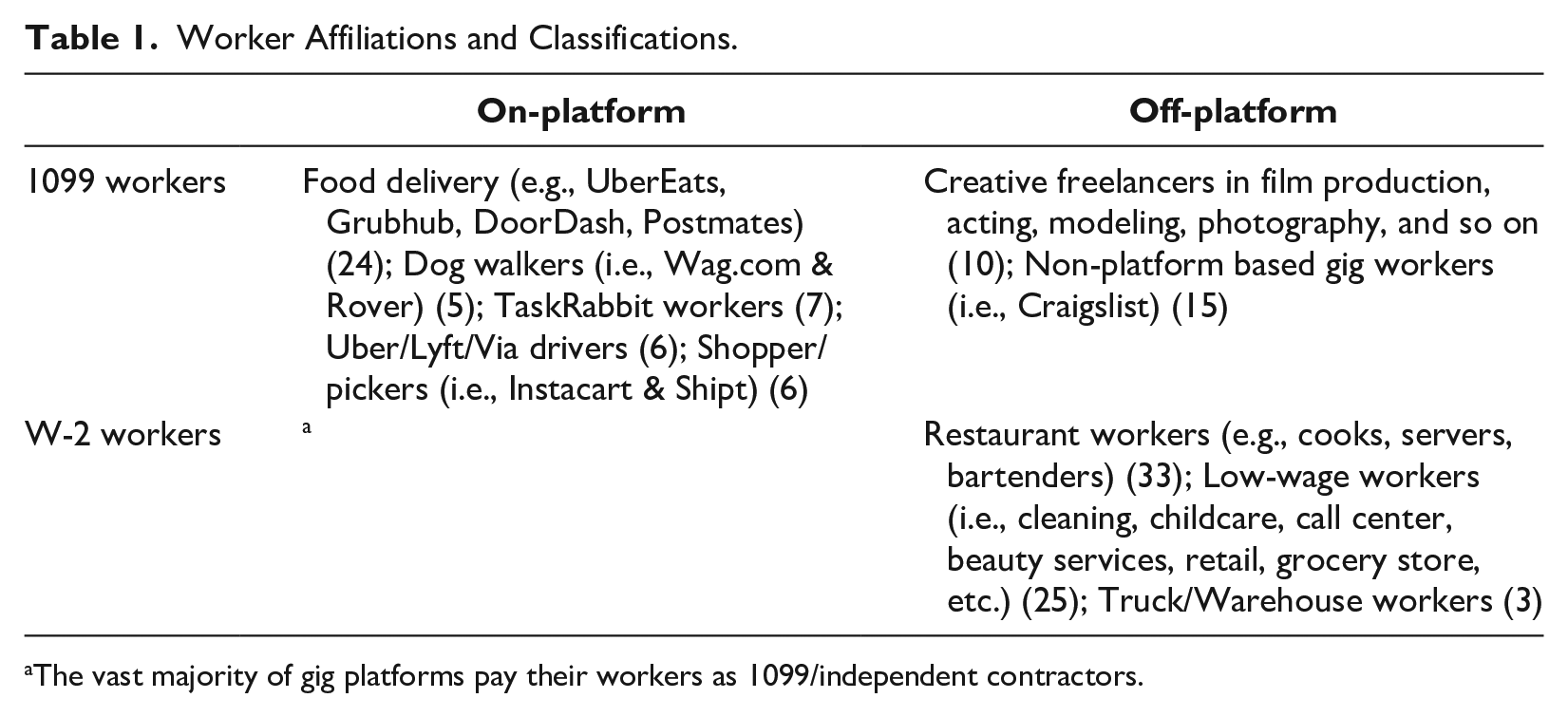
The vast majority of gig platforms pay their workers as 1099/independent contractors.
Each participant was asked to complete a demographic survey and was interviewed using Robert Weiss’ (1994) interview matrix for a participant-directed interview. The interviews focused on open-ended questions: what workers were doing before COVID-19 and what they were doing for income during the pandemic; how they became involved with precarious work and the challenges that have arisen during COVID-19; their perceptions of gig work and their experience (if any) in applying and receiving unemployment or governmental aid; their access to, and use of, personal protective equipment (PPE); and their perceptions of how platforms and employers were handling the pandemic. Workers who joined gig platforms during the COVID-19 outbreak were also asked about their decision-making process.
Interviews were audio-recorded, transcribed, and analyzed using flexible coding (Deterding and Waters 2018), an iterative coding method that is ideal for collaborative analysis of in-depth interviews. In the first round of coding, an undergraduate research assistant “indexed” the interviews at a broad level by “anchoring content to the interview protocol” (Deterding and Waters 2018:15). In the second stage of the analysis, members of the research team conducted a detailed analysis of the interview transcripts, grouped into respondent categories, by developing and applying fine-grained codes. To preserve confidentiality, all respondents were assigned pseudonyms based on the Social Security Administration’s list of popular baby names for their birth year. To encourage participation, workers were given a $25 gift card incentive.
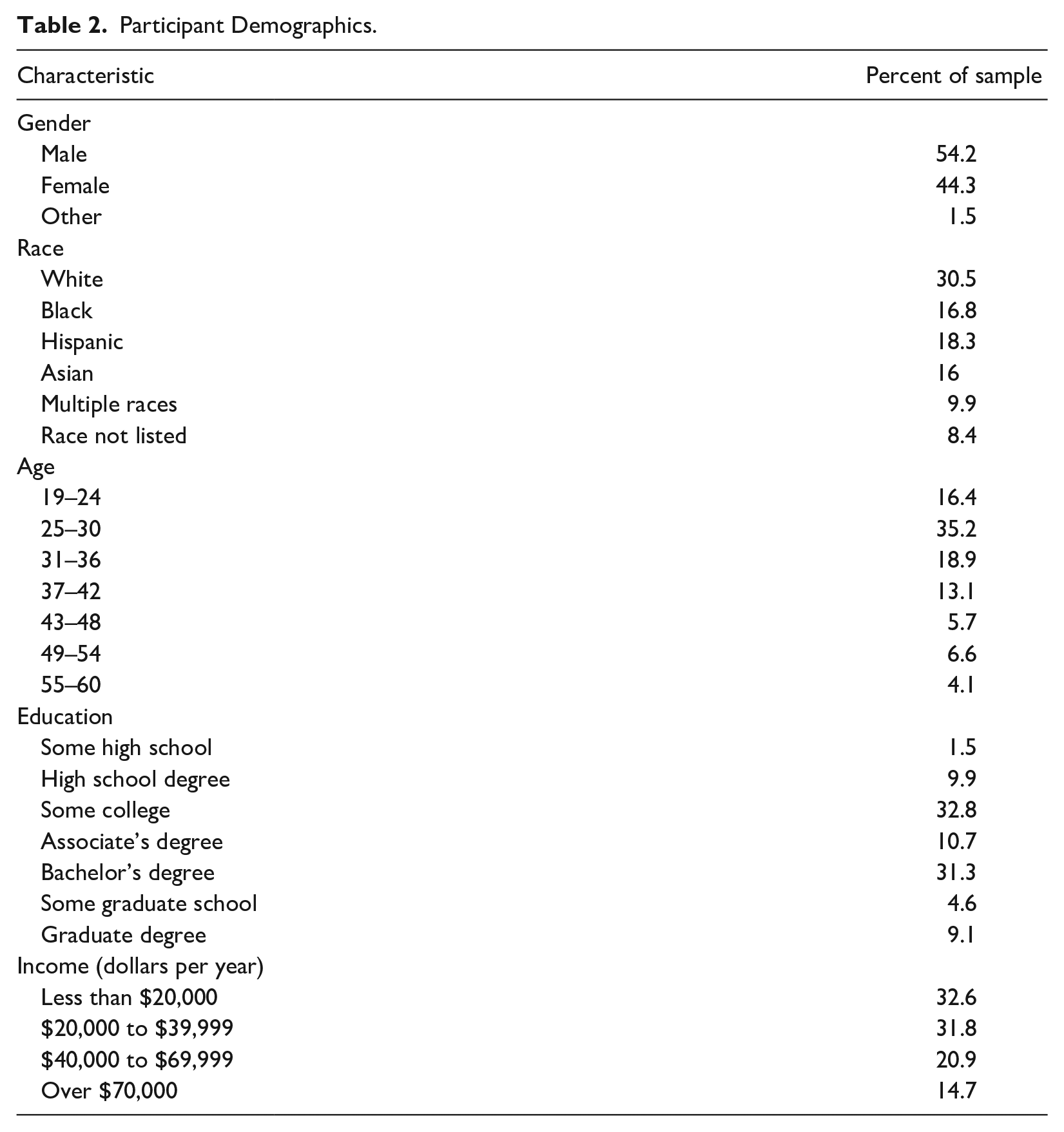
Participants included 71 males, 58 females, one gender-nonconforming person, and one non-binary person. These interviewees ranged in age from 19- to 60-years-old with an average age of 33. Slightly less than a third of the participants (30.5 percent) identified as White, 16.0 percent as Asian, 18.3 percent as Hispanic, 9.9 percent as multiple races, and 8.4 percent as a race not listed. Nearly two-thirds of respondents (64.3 percent) of respondents made less than $40,000 per year, with 42 of those workers making less than $20,000 per year. Slightly under a third of the sample (31.3 percent) had a Bachelor’s degree, 32.8 percent had some college experience, and 13.7 percent had a graduate degree or some graduate school experience. Participant demographic information is available in Table 2.
Participant Demographics.
Findings
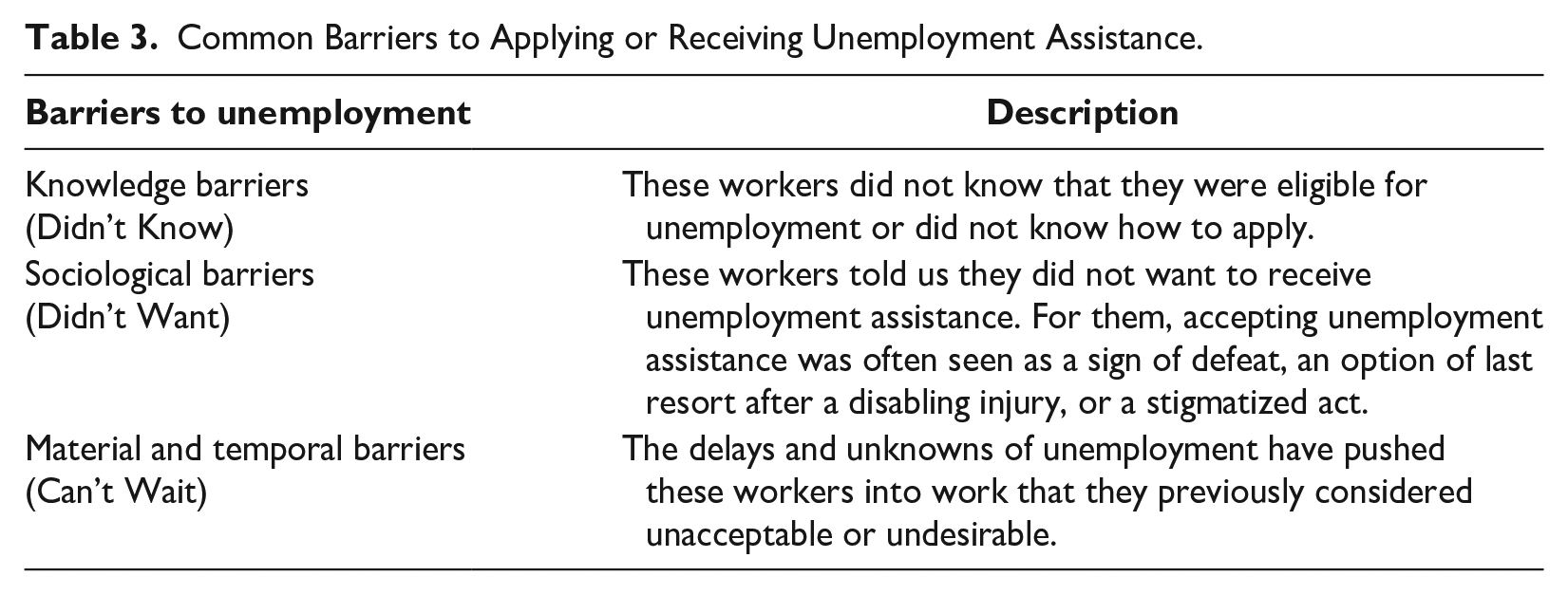
While media accounts of the novel coronavirus pandemic have often focused on the unemployment rate, in our interviews conducted during the height of the pandemic, we found that while a number of workers applied for unemployment benefits, many others didn’t know that they were eligible, didn’t want to apply, or were unable to wait for assistance. In the following section, we outline these three patterns of response to unemployment. The common barriers to applying or receiving unemployment assistance are outlined in Table 3.
Common Barriers to Applying or Receiving Unemployment Assistance.
Didn’t Know: “They Say You Can’t Get Blood from a Stone”
Although much attention has been paid to the CARES Act and PUA, which allowed gig workers and independent contractors to apply for and receive unemployment benefits, many precarious workers still believed they were ineligible. Workers in the “Didn’t Know” category experienced a knowledge barrier where they didn’t know that they were eligible for unemployment funds or didn’t know how to apply. In general, workers believed that they were ineligible for unemployment insurance for three main reasons: their work was less than full-time, stable employment; they were paid in cash; or they were immigrants.
First and foremost, workers often believed that they were ineligible if they worked part-time or were temps or independent contractors. While independent contractors were not typically eligible for unemployment until the PUA, in New York State, “all services an employee performs for a liable employer” are covered by unemployment assistance including part-time, temporary, seasonal, and casual work (New York State Department of Labor 2021) I did not qualify for any unemployment [funds] . . . I didn’t try applying because I haven’t had full-time work in about three years. So I figured why waste the phone call and waste someone’s time to try and apply when I haven’t had any full-time work. I felt applying would be a waste of time . . . Sad, but I didn’t want to waste someone’s time on the phone or go through the process of applying to be turned down because they say you can’t get blood from a stone? (Scott, 53, Bouncer and server, now unemployed) I saw that the unemployment numbers are really big. I also don’t know how it works for adjuncts or graduate students over the summer. I don’t know if that’s a legitimate thing. (Spencer, 29, Graduate student and adjunct college instructor, turned Instacart/Shipt worker) Basically with unemployment [insurance], they’ll go by whatever job you have on record underneath your social security number. But if you’re 1099, unfortunately there’s no record of it. Yeah, so it looks as if you didn’t work, even though you filled out a W-9 and the 1099. You’re not able to get it, which is something that I never thought in a million years that would happen, so I was never concerned about having a job on the books. (Jessica, 30, brand ambassador with an off-the-books waxing business)
For instance, Brandon, 28, returned to New York in February after working on the West Coast and spending eight months traveling. When he arrived in New York, he began doing food delivery via UberEats and working as a temporary office worker, until his office job ended due to the pandemic. Since his job was temporary, and he wasn’t officially, “fired or furloughed or anything,” he didn’t view himself as eligible for unemployment assistance. Terrell, 33, a food delivery worker, watched his requested deliveries drop from nearly 20 to only 2 or 3 per day. But the pay he received from UberEats was so minimal that he didn’t think he was eligible for unemployment benefits.
An additional challenge for many precarious workers is their status as informal workers who are often paid in cash or “under the table.” Such payments, while often seen as especially desirable when salaries are low, can bring added challenges when attempting to access services such as Social Security or unemployment insurance. Workers often believed that if any portion of their pay was in cash, they were ineligible for unemployment funds, or would receive too little to bother applying. For instance, both Alya, 28, an unemployed grocery clerk, and Carlos, 43, an unemployed restaurant server noted that since their money was “off the books” that they didn’t qualify for unemployment, a view echoed by Hannah.
I couldn’t really claim unemployment [benefits] because to the best of my knowledge, you can only claim that if you have all your salary on the record. So, that’s not something I really could do. So, I’ve just been working since. I have a car, like I mentioned before, where I’ve been driving to work. So I use the car to do the UberEats deliveries. (Hannah, 21, Furloughed restaurant server, turned food delivery worker)
These workers are not unique in their reliance on being paid “off the books.” Although the scope of the informal economy is difficult to measure, most estimates fall within 5 to 10 percent of U.S. GDP (Nightingale and Wandner 2011). A nationally-representative survey found that about 44 percent of respondents participated in some form of informal work between 2011 and 2013, with the majority indicating this work took place online or with use of the Internet (Federal Reserve Bank of Boston 2014). An audit by the Treasury Inspector General for Tax Administration (2018) concluded that as much as $23 billion in tip income went unreported in 2006.
Especially concerning were the situations of immigrant workers, many of whom incorrectly believed that they were ineligible for unemployment benefits and were instead turning to public assistance programs. For instance, twenty-something Kayla turned to food stamps, Medicaid, and Temporary Assistance for Needy Families (TANF) cash assistance after being laid off from her job working for a third-party energy and gas company. As she explained, I’m not an immigrant. I’m allowed to work. If I were to send you my social security card picture, and it says not something-something unless you have the employment authorization card. I’m allowed to work, it’s just that I don’t qualify for unemployment [funds], because I’m not a citizen.
Likewise, Monika, 41, and her husband, both laid-off restaurant workers, didn’t apply for unemployment insurance, believing that permanent residents didn’t qualify. As she explained, We’re not supposed to yet. I guess when you get just the green card, you can’t do that . . . I was able to apply for the food stamps for the kids. That’s the only thing that I really applied for help. Oh, there is also . . . I don’t know. Organization. I applied for that, because I received an email from school that they’re giving . . . They are collecting money and then they’re buying groceries for families that need. So I get once a week, I had vegetable delivery, milk, eggs. Such a help.
Generally workers seeking to immigrate to the United States must show that they have a source of income and won’t be a public charge, broadly defined as receiving a public benefit program such as Temporary Assistance for Needy Families, Social Security, Section 8 housing assistance or public housing, and Supplemental Nutrition Assistance Program (SNAP, previously known as food stamps) (U.S. Citizen and Immigration Services 2020). While many immigrants cannot access such programs until they have been in the United States for a period of time, and workers cannot be deported for accessing programs legally, the Trump administration has tried to make it easier to deport workers for using assistance programs (Torbati 2019). There’s also a concern that accessing such programs may impact workers’ efforts to return to the United States if they leave for more than 180 days and must be re-evaluated for admission (U.S. Citizen and Immigration Services, Department of Homeland Security 2019).
The lack of clarity around what was acceptable for immigrants and visa holders meant that some workers decided to err on the side of caution. For instance, Aanya, 34, an unemployed photographer, cobbled together remote photography work and teaching classes over Zoom rather than apply for unemployment insurance.
Unemployment is unclear . . . I think in good times, it would definitely be an issue. Right now, the USCIS guidance on that is definitely gray. My lawyers think that I probably could get away with it, because few things. It would affect my employment status in the US, if I’m telling the US authorities that I am unemployed, well, for visa purposes, it could potentially cancel out my visa. But if I keep working a little but use unemployment [benefits] to supplement my income, maybe I can maintain my visa status so then when I reapply, I may be locked in a position where I have to explain to someone what this was . . . But I don’t know, I figured it’s probably not that much money, and for not that much money, I don’t want to jeopardize my future work opportunities by jeopardizing my visa. So for now, I’m not applying.
One additional challenge, especially for younger workers, is that the low unemployment rates of the five years before the pandemic (U.S. Bureau of Labor Statistics 2020) partnered with messaging of gig work as an alternative to unemployment meant that many were unfamiliar with unemployment insurance. As a result, while the PUA provided gig workers with access to unemployment funds for the first time, some workers continued working on gig platforms because they did not understand unemployment benefits. For instance, Adira, 23, continued to work on the food delivery platform Caviar through the height of the pandemic, admitting that she’s “just never really thought about it.”
I don’t know, it just never really crossed my mind. So I’ve been doing the delivery for a little while and before that in high school I was working at Popeye’s. Then out of high school, I was doing the delivery. So unemployment [assistance] never really crossed my mind. I never really understood it really exactly either . . . What are the requirements? I don’t get it. You just sign up, say I don’t have a job and the government gives you money? What is that about? If it was that easy, wouldn’t everybody do it? I don’t get it.
For Adira, who was a pre-teen during the Great Recession, and had spent most of her adulthood in a time of low unemployment, the idea that the government would pay people when they were not working seemed outlandish. Yet she was not alone in not knowing about eligibility or how to access unemployment assistance. This knowledge barrier reflects a larger failing in the dissemination of reliable information and instructions on how to apply for unemployment insurance. As a result of this information failure, unemployed workers turned to gig work to pay their bills, to public assistance programs such as Supplemental Nutrition Assistance Program (SNAP) and Medicaid to provide food and medical care for their families, or simply to their savings.
Didn’t Want: “ I Don’t Believe in Free Rides. I Believe in Hard Work”
The second category of workers are those who did not want to apply for unemployment benefits due to sociological barriers. For these workers, unemployment assistance remains stigmatized, in spite of Depression-level unemployment numbers (Seccombe et al. 1998; Will 1993). These workers would rather be working, reasoning that a job is a job, even if it pays less than unemployment insurance. For these workers, gig work provides a sense of destiny control and an escape valve from being “trapped at home,” even though financial stability continues to elude them.
Traditionally, unemployment benefits are a fraction of a worker’s usual pay, serving as a safety net to keep workers financially afloat until they are able to secure a new job. In New York, unemployment assistance maxes out at $504 a week. Workers are required to actively search for jobs, and this requirement, along with the low rates, is seen as a useful strategy to reduce lollygagging (Ross 2000; Somers and Block 2005). Yet, the pandemic upended traditional thinking and strategies. To encourage workers to stay home, unemployment insurance was expanded to include independent contractors and gig workers, workers were told that COVID-19 was an exemption from usual job search expectations, and an additional $600 was added to weekly unemployment payments. All together, this led to many workers making more than their usual wages, and being paid a premium to stay home (Ganong et al. 2020). Yet, a number of workers noted their reluctance to accept unemployment funds. Accepting unemployment assistance was often seen as a sign of defeat, an option of last resort after a disabling injury, or as a stigmatized act that was more commonly associated with people who were “low income.” For instance, Dev, a food delivery worker noted that “only way I’ll go on unemployment [insurance] is if I was injured,” while Mateo, 28, a private investigator turned food delivery worker, explained that unemployment insurance “doesn’t really benefit people like me or people who work, and stuff like that.” He further elaborated, “I feel like it always has benefited people who are low-income, or people who are trying to get over on the system.” The us and them divide between working folks and those taking advantage of the “system” was further emphasized by Sean, 20.
So yeah, I don’t really want to be one of them people, unless I really absolutely need it. I rather just continue making my income. Me and my wife, we just put together what money we have. Just try to pay this rent on time, because after this, I don’t want to have any outstanding balances. I don’t want to owe anything. I don’t want to get kicked out of my apartment. It’s just a lot of fear . . . I’d rather just try to pay my bills on time, the right way, with whatever income I can make. And if I have to, then I’ll go on unemployment . . . But if I can earn the money then, I mean like, why not? Like as a last resort. So maybe. Maybe in the future, but you can’t never say never. But as of right now, I’m not really looking forward to that. (Sean, Food delivery worker, 20)
This reluctance to apply for unemployment insurance can have far reaching consequences. For Daayini, an unemployed TaskRabbit worker and dog walker, 52, her reluctance to “depend on the government or anybody” meant that she was turning to a local food pantry where she sometimes had to be “in the line for six to eight hours.” She also reduced her eating to just breakfast and dinner, explaining, “I eat some vegetables and rice in the dinnertime, and in the breakfast, I just have a yogurt and a fruit or something like that with a glass of milk.” To reduce hunger pangs, she drank a lot of water, noting, “Water fills you too.” As she explained, “I’m a firm believer in self reliance. So, if I can go without it, I would fight to the very end to go without it . . . I don’t believe in free rides. I believe in hard work.”
Workers also professed a desire to work, often describing work as a solution to feeling trapped at home, or feeling bored. Rather than applying for unemployment assistance, workers turned to gig work and the essential jobs that were hiring such as grocery stores and fast food restaurants. Work is integral to people’s social identity (Hughes 1958), and periods of unemployment are tied to negative mental health outcomes in part due to the void in purpose that a lack of work leaves in people’s lives (Jahoda 1982; Warr 1987). Indeed, many of our respondents wanted to be working. When faced with sudden unemployment at the start of the pandemic, these workers chose to forgo government assistance and instead pursue work through other means. As Tyler, 29, an unemployed dog walker turned Shipt shopper, explained, “I kind of would just be bored just being at home anyway so I’m kind of glad that I get to go out.”
Other workers suggested that staying at home would cause psychological distress: I’m the type of person that cannot sit at home and just stare at the four walls anyway. I would get distressed, or I would go cuckoo. I went out to look for a job. I went online, actually, to look for a job, and then, just so happened, a lot of places weren’t hiring because they were closed, but some places were open and they were hiring. And so, that’s where I landed. (Angelo, Unemployed high-end restaurant worker turned essential worker, 53) I feel I would get more money with [unemployment insurance], but no because even though I would like the idea of just staying home and doing nothing, I wouldn’t want to do that for more than two days. I feel like a weekend of it, great. But if I have to do one more day, I’ll just lose my mind. I’m like okay, you know what? I got to look for a job. I got to look for something to do. I’ve got to get out of the house. I’m just weird that way. I don’t know if it’s because of my culture or what, but I don’t know. I feel like I really can’t be lazy for more than two days. (Juan, Unemployed childcare worker turned bodega worker, 29)
Even when workers did not overtly express the common forms of stigma associated with unemployment assistance (Baumberg Geiger 2015), they went to great measures to avoid applying for assistance to, “sit at home and just stare at the four walls.” In her study of unemployed low-income workers in the wake of the Great Recession, Jennifer Sherman (2013:412) found that many individuals often went without aid, “as it meant trading their identities as workers for that of stigmatized dependents” The pandemic increased demand for high-risk platform-based and essential work at the start of the first wave, providing our respondents an opportunity to bolster their sense of self while rejecting the stigma of accepting unemployment funds. Consistent with evidence that out-of-work individuals who stigmatize unemployment benefits are highly motivated to find work (Krug, Drasch, and Jungbauer-Gans 2019), these workers turned to high-risk jobs before accepting government support.
Can’t Wait: “The Government Is Flaking on Me and They’re Not Really Helping Me Out Here”
While our “Didn’t Want” workers pursued gig and essential jobs to avoid accepting unemployment insurance, our third category of workers, “Can’t Wait,” pursued these jobs when they felt unable to wait for unemployment benefits. These workers experienced a temporal/financial barrier whereby the delays and unknowns of unemployment assistance pushed them into work that they previously considered unacceptable or undesirable. Desperate to feed their families and pay their rent, these workers turned to an occupation of last resort. Amir, 26, owner of an entertainment-focused small business, turned food delivery worker, was one such worker. He and his wife applied for unemployment assistance without response. Left with few options, he turned to food delivery.
The reason why I’ve taken Grubhub so seriously, is unemployment [insurance] has not come through. It has not responded; it has been MIA in New York City, and we’ve been reaching out to them every single day. Literally calling them. Obviously their response is “we’re going to call you back, so don’t worry.” It’s been two, three, four weeks . . . Because I live in New York, there were times where there were like 900 people, maybe even 1000 people dying every single day. It’s just a scary thing. Then me being a delivery driver, driving around hospitals and stuff, I can see these huge white trucks full of dead bodies being put in. That really scares me. I’m like, “Wow, this is real. People cannot say that this is not real.” During that time I really honestly was like, “I am not going to do . . . ” I am fearing for my own life.
Amir stopped doing food delivery for a month, viewing it as a financial hurdle that would have to be overcome later. But though he described himself as one of the first people to apply for unemployment benefits, he was still without response from the unemployment office at the end of April, and his rent was due. He returned to food delivery.
The government is flaking on me and they’re not really helping me out here, and they’re not even reaching out to me. I had to take it upon myself to be like, even if I have to sacrifice my life right now, I have to make sure that everyone else is in good standing. That’s why I do what I do. I have to. Do I want to do delivery every day? No, not at all. But I know that when the landlord asks for his money . . . I want to be able to tell him, “Hey look, listen, I really worked my butt off and here’s, I couldn’t give you the whole thing, but here’s something that can potentially assist you.” Right? I just wish the government thought like me.
Amir held out hope that his unemployment assistance would come though, but other workers described themselves as giving up. In some cases, workers were told that they had to apply, be rejected via postal mail, re-apply, and then they might be successful. Needing to feed their families and pay rent, workers overwhelmingly turned to gig work as a de facto social safety net. Simon, 35, a former construction worker, had his unemployment insurance claim denied for “miscommunication,” and he was unable to get additional answers.
I gave up. None of my friends got unemployment [funds], and we got more important things to worry about than trying to live off the government, so we’re just trying to find out alternatives and all. I tried to file for disability a couple of years ago. It got rejected and all. I didn’t have time to wait, to sit here and battle the government and whatnot. I’ve got a few friends that are trying to communicate back and forth, but I’m not trying to stay at home communicating, getting everything coordinated and then go from there. I’m going to weigh out my options and look at the alternatives out there . . .
Deciding he had better things to do than “harass the unemployment people,” Simon turned to UberEats where he was able to make roughly $500 a week, a far cry from the $1100 a week he would have made between unemployment assistance and the PUA, and less than half of what he was making each week doing construction before the pandemic.
Similarly, Diamond, 27, who turned to UberEats, Instacart, and Craigslist after having her hours slashed in her physical therapist job, entered gig work as a result of delays in securing unemployment assistance. As she put it, I can’t just sit here like a lame duck and not . . . I could be making money doing something else in the time that I’m waiting to apply for unemployment or wait for the website to be up and running. So I just decided to do Instacart and I really haven’t had any time to file for unemployment since then.
Diamond’s description of herself as a potential lame duck, a term referring to an elected official in the final period of office after a successor has been elected, feels especially striking. Lame ducks are seen as ineffectual or unsuccessful, but waiting for unemployment assistance is not a measure of success or failure.
Gig work’s low barriers to entry made it an attractive pathway to take responsibility for one’s own financial security when disillusioned by the social safety net. Mateo, 28, illustrates this trend, describing unemployment assistance as something that workers pursue when they don’t know about gig work. “If you don’t know about UberEats, or you don’t know about these little gig jobs that you can do, you’re just sitting there, waiting until you get in contact with unemployment [insurance], or you’re just waiting until something happens. All that time, you’re not having any kind of income coming in,” he said. “And then worst case scenario, they say no or they deny you, then you wasted all this time waiting, and then you still got nothing, at the end of the day, and now you’re playing catch up.”
Also part of this focus on individualism, once workers secured gig work, they reported less interest in unemployment insurance. As Manuel offered, “Honestly, at this point, I really don’t care about the unemployment issue anymore, because I started working part-time.”
As noted earlier, platforms have long marketed gig work as an option when workers experience job loss or increased expenses (Huang et al. 2020; Ravenelle 2017, 2019). Workers who had previously turned to gig work seemed especially open to returning to the platforms. Derek had previously joined Postmates when he was unemployed in the early 2010s, using it, “here and there when I needed some extra money.” But after losing his job, he returned to Postmates, “I did it a few days but I would be on the app for hours and I would literally get no deliveries or if I did, it was like, so out of the way, it wouldn’t even be worth it for me.” As he explained, I stopped working when this started, about March 1st. So I was out of work for about maybe four or five weeks before I got approved for UberEATS. And I’ve been doing that for like the past two weeks about.
Workers often saw gig work as a solution when they were let down by the unemployment office or aspects of the social safety net, consistent with past research that shows when employees are laid off they are less likely to apply for unemployment assistance when they have access to working for Uber (Fos et al. 2019) and that when unemployment rises so does the percentage of workers actively working through online platforms (Huang et al. 2020). This is an internalization of the risk society whereby workers believe that they—and capitalism—are their best option in times of need, further highlighting the rise of a risk society that individualizes social problems and requires a “biographical solution [to] systemic contradictions” (Beck 1992:137). As public services shrink, market activity displaces governance, and individuals view personal capacity as the sole determinant of life outcomes (Bauman 2000). This “responsibilization” (Shamir 2008) of economic circumstances legitimizes risk society in part by meeting a psychological need: during periods of instability, individuals willingly responsibilize their hardships to compensate for the distressing unpredictability of external conditions (Pyysiäinen, Halpin, and Guilfoyle 2017). The low barrier to entry and promise of autonomy can make gig work particularly reassuring.
Applying for Unemployment Assistance: Unanticipated Complexities and Challenges
Workers experienced two additional challenges in applying for unemployment benefits: missing pay stub information and forgotten passwords and PINs. These two challenges are unanticipated consequences of advances in the name of cost-savings, identity theft prevention, and environmental protections. In recent years, many workplaces have moved to electronic payroll records and mandating direct deposit. While such policies can reduce paper waste and the possibility of a misplaced paper check, this lack of a paper trail can cause issues when applying for unemployment insurance. To apply for New York state unemployment assistance, workers need their employer’s federal employer identification number, their New York state employer registration number, their employer’s full name and address, and their wage details. These items are listed on a pay stub or W2 statement, but are challenging to find without paper copies of these documents. Even if workers are provided with links to electronic repositories of their paystubs, they often lose access to electronic records systems when they are laid-off.
For instance, Kareem, 22, a customer service representative turned bagel shop clerk, was unable to apply for unemployment benefits because of a lack of paperwork. As he explained, I don’t actually know if my employer was paying for unemployment insurance. Like, I didn’t have a W-2. I didn’t have any tax records from them. I asked them for my documentation after I was laid off, like, at the time of being laid off, and they effectively refused to give me anything. Like, they promised they would send it in the mail, but . . . it has been several weeks . . . So I don’t know if I would be able to legally show I was employed by them.
Workers also experienced challenges with misplaced passwords and personal identification numbers, and forgotten answers to security questions. While this is a challenge that all workers can experience, the pandemic magnified these challenges as workers faced delays reaching unemployment representatives who could help workers confirm their identities. As Leslie, 35, explained, I had so much trouble applying for unemployment insurance, and then when I tried to call them, they needed my social . . . and I don’t know my four digit pin to call, in person to call over the phone as well as applying online. It’s not easy.
Michael, a 25-year-old musician, was unable to navigate the PUA system for unemployment insurance and found that a paperwork error prevented him from even receiving a stimulus check. “Last year, I went and filed taxes, and I put in the wrong . . . I put in the date of the day I filed, instead of my birth date. So, I’m still waiting on that, but we’ll see,” he explained. “So, they keep saying, the irs.gov, they’re like, ‘Oh, we are unable to give you any information about your application.’”
While certain mechanisms are needed to ensure that workers don’t have their identities or their unemployment assistance stolen by others (Federal Bureau of Investigation 2020; Gressin 2020), for precarious workers these security measures often become another barrier to access.
Conclusion
The United States last experienced an epidemiological natural disaster similar to the coronavirus pandemic over one hundred years ago with the Spanish Flu of 1918. While social distancing measures are essential in limiting the impact of a pandemic, such measures are often less feasible for low-income groups such as precarious workers. While many low-income workers were deemed “essential” and were required to continue working, the CARES Act, FPUC, and PUA were intended to support unemployed workers in sheltering at home.
However, states faced an unprecedented number of claims, and workers experienced extensive delays in processing payments. As a result, in this paper, we ask, how are precarious workers weighing, and addressing, the health risks of working in readily available gig jobs versus the economic repercussions of unemployment? And why are some workers turning to gig work instead of accessing unemployment insurance?
Utilizing in-depth remote interviews and surveys conducted with 134 workers in the New York Metropolitan area during the height of the pandemic in early 2020, we find that precarious workers experience three main barriers related to accessing unemployment assistance that can be broadly categorized as knowledge, sociological, and temporal/financial challenges. Drawing on literature regarding the barriers to obtaining or leaving social programs (Contini and Richiardi 2012; Gould-Werth and Shaefer 2012; Wandner and Stettner 2000), we named these categories based on the participants’ interview responses: (1) Didn’t Know, workers who didn’t know they were eligible, or didn’t know how to apply; (2) Didn’t Want, workers who didn’t want unemployment insurance because they felt it was stigmatized; and (3) Can’t Wait, workers who couldn’t continue to wait for unemployment benefits and turned to an occupation of last resort. Rather than safely socially distancing at home, we find that many workers have turned to gig work providing deliveries and shopping for groceries for white-collar peers, further highlighting the inequities of the pandemic. Others have resorted to short-term and often informal work found on Craigslist or other online forums. As a result, for some workers, so-called “side hustles” have become their primary pandemic social safety net.
We find that workers often saw gig work as a solution after being let down by the unemployment office or aspects of the social safety net, consistent with past research that shows when employees are laid off they are less likely to apply for unemployment assistance when they have access to gig work, and that when unemployment rises so does the percentage of workers actively working through online platforms (Fos et al. 2019; Huang et al. 2020). As a result, instead of offering a rupture with the tenets of risk society or the neoliberal welfare ideology, the pandemic served to reinforce the risk society and ideology of individual responsibility. This paper contributes to research on the rise of the risk society and highlights worker internalization of a risk society that individualizes social problems, which further legitimizes risk society as worker hardships are responsibilized to compensate for the distressing unpredictability of external conditions (Pyysiäinen et al. 2017). Gig work can be particularly reassuring because of the low barriers to entry and the promise of autonomy in scheduling and choosing work, compared with the knowledge, sociological, and financial/temporal barriers to receiving unemployment benefits.
This paper has also touched on two unanticipated consequences of electronic payroll records, whereby workers may experience challenges in obtaining necessary employer information and relying on passwords and PINs that can be easily forgotten. One easy, low-cost solution would be for workplaces to be required to e-mail paystubs to a worker’s personal e-mail address on a regular basis, and to confirm at least annually that the e-mail address was accurate. This would reduce one challenge that workers experienced with attempting to file for unemployment benefits. Error-checking systems, such as those that confirm that entries match a pre-set format, could catch issues such as the current date being inputted, while pop-up screens reminding workers to write down their password in a safe location, could be utilized by state unemployment websites.
This research also suggests that while increasing unemployment insurance funding may be helpful for a number of workers, it may not be the most useful strategy. Instead, efforts such as universal basic income might help reduce the stigma associated with receiving funds from the government. While outside the bounds of this paper, it is interesting to note that the respondents were widely accepting of the CARES Act Economic Impact Payments (widely known as the $1200 stimulus checks) that were distributed to households nationwide in the spring of 2020, and indeed, many hoped for additional stimulus checks in the future. Part of the stigma associated with welfare and unemployment may be that in applying for unemployment benefits, one must publicly admit a lack of current gainful employment (Calnitsky 2016).
These findings are the first phase of a longitudinal study examining the impact of the COVID-19 crisis on gig and precarious workers. One limitation of this research was that the data collection timeframe (April through June 2020) meant that many interviews were conducted while state unemployment systems were overwhelmed by the influx of claims. Workers who were unable to wait for unemployment assistance in April or May, and who turned to gig work at that time, may have been able to secure unemployment assistance later in the summer of 2020 and may have changed their perspective as a result. Follow-up interviews with these workers in early 2021 will address this issue.
Further research is needed to look at the longer term impacts on workers and their families of not being able, or willing, to access unemployment benefits, especially if workers join the long-term unemployed. Most research examining the impact of long-term unemployment focuses on workers who were in the middle class or who were in relatively stable positions (such as unionized factory worker) before losing their jobs (Chen 2015; Sharone 2013). Service economy work is generally seen as a solution when workers are unable to secure positions in their desired fields (Newman 1999; Ravenelle 2020). While not entirely recession-proof, service jobs are often considered to be widely available and easily obtained, yet, during the pandemic, many service jobs have disappeared, leading to a “service economy meltdown” (Porter 2020) with unknown impacts on precarious workers. Additional research is needed on the impact of long-term unemployment on workers who were already precarious and the impact of receiving unemployment assistance on worker perceptions regarding the potential stigma of such funds.
Footnotes
Acknowledgements
We thank Savannah Newton for her work in index coding this data.
Declaration of Conflicting Interests
The author(s) declared no potential conflicts of interest with respect to the research, authorship, and/or publication of this article.
Funding
The author(s) disclosed receipt of the following financial support for research, authorship, and/or publication of this article: This material is based upon work supported by the National Science Foundation under Grant No. 2029924.
