




Abstract
This paper contributes to the social theoretical foundations of a sociology of media and communication by making use of the cultural–historical school in psychology. Such perspective gains relevance in digital capitalism and the blurring of production and Internet usage. The paper first revisits Habermas’s influential notion of communicative action and agency. Second, it uses activity theory as an alternative, more promising way of theorising because it links communication closer to work. A model of communicative action is introduced and a conceptual link between media and human tool use is established. Third, the paper elaborates on the notion of activity in the digital world and posits that digitalisation can be understood as a ‘machinisation’ of mental and communicative-coordinative work. The developed perspective, the paper concludes, allows critical media and communication sociology to operate with meaningful concepts of communicative expropriation, exploitation and alienation.
Keywords
Introduction
Critical media and communication sociology can take many forms. This contribution proposes elaborating on a critical materialist sociology of media and communication in the Marxian tradition by providing social and communication theoretical underpinnings of studying ‘particular, real historical, concrete-societal modes of communication’ (Holzer, 2017: 709). In this context, Holzer identifies the contested relationship between work and communication as one of the most crucial conceptual challenges in this tradition (cf. Sandoval and Sevignani, 2020).
Critical materialist theory often sets labour and production central. 1 Media and communication are usually, if any, thematised as ‘superstructural’ phenomena above and beyond labour, that is, as places and agents of the ideological, as the terrain in which either domination resulting from labour relations can be stabilised or challenged in preparation for a counter-hegemony. This approach has led to the communicative turn, argued for by critical theorists, such as Jürgen Habermas, that attributes reverse primacy – to communication instead of labour. Alternatively, communication is sometimes addressed within the materialist tradition by recognising it as an organising and regulating aspect of labour and production processes. Here, communication in labour is the field of study.
A more heterodox position within critical theory, closer to my own, thematises communication as labour. This perspective gains new importance under the current conditions of digital capitalism because, for example, the boundary between production and labour on one hand and the sphere of circulation and communication on the other hand blurs. In this vein, it is argued that: human production is social and therefore a communicative relation (communication at work). Communication is itself productive and therefore a specific form of work (the work of communication). Work is the productive aspect of human activity, whereas communication is human activity’s aspect of meaning-making in social relations. Meaning and social relations are themselves particular forms of production–symbolic and social production. They do not simply exist but need to be created and reproduced (Fuchs, 2016: 198–199).
Providing further elaborations here, the paper outlines a concept of communication as a productive force that takes shape within specific social-communicative relations. The latter are critically addressed by such diverse and important approaches as the critical political economy of media and communication, cultural studies, critical discourse analysis and investigations of the structural transformation of the public sphere. I aim to provide, compatible with these approaches, basic categories for critical media and communication research that are drawn from activity theory, a school of thought following the cultural–historical approach in psychology, represented by figures such as Vygotsky, Luria and Leontev. They and the subsequent works in this tradition are rarely, and I think unjustly so, referred to in media and communication studies (for an overview: Foot, 2016).
The contribution has two methodological goals. First, it clarifies basic communication and media theoretical categories. While it is true that we cannot examine the productive or communicative forces beyond social relations (e.g. ideological constellations, hegemony struggles and capitalist media systems), this does not mean that we do not have to imagine their possibilities of development. Concepts such as power, domination, exploitation and alienation are significant for any critical diagnosis of the relations of communication. However, their critical content, I believe, can only be convincingly argued against the background of communication-, media- and public sphere-theoretical clarifications; one must know what the content is to be able to determine its problematic (i.e. authoritative, exploitative, alienating) manifestations in specific communication relations.
Second, an activity theory approach may also fill the action theoretical gap of many of the above-named approaches within the critical materialist tradition. These approaches gravitate between the macro- and the micro-level of social analysis, for example, by referring to the concept of hegemony. Mosco (2009) argues that the political economy approach is concerned with making processes comprehensible ‘by which social structures are constituted out of human agency’ (p. 20). For him, the actors are not individual subjects, but ‘communities of (class, gender, race) interest’ or social movements that are constructed by structural discrimination and affectedness within the framework of capitalist relations of production and communication. ‘Hegemony’ serves here (cf. Mosco, 2009: 206ff.) and in other critical approaches as a mediating concept between actors with similar interests and social structures: In state and civil society institutions, there are struggles for influence over what the rules and values, that is, the structures of living together, should look like; in the process, communities of interest must repeatedly enter alliances and thereby transforming their original interests. Within the political economy and cultural studies framework, hegemony analyses are key to understanding how – directly or refracted – social interests assert themselves in and through the media. Such studies consider different resources and opportunities of interest groups, as well as structural constraints in the struggle for positions of power but leave it to others to shed light on communicative actions, out of which ‘communities of interest’ may form.
The remainder of this paper proceeds in four steps, it first briefly revisits and discusses an influential, social theoretical underpinning, namely Habermas’s notion of communicative action and agency (in the section ‘Revisiting Habermas’ Theory of Communicative Action’). It argues that while Habermas framework adds to critical theory, it also excludes mediating ‘objects’ and artefacts from communication, which renders (artefact-centred) categories such as expropriation, exploitation, and alienation inapplicable to the analysis of communicative relations. In the section ‘Activity – Theoretical Foundations for Media and Communication Sociology’, activity theory is used as an alternative, more promising way of theorising communication and media, which binds social theory closer to the mentioned critical terms. This tradition starts with a humanist notion of concrete species being of humans (section ‘The Starting Point: Concrete Species Being (Marx)’) but pays particular attention to the use of cultural tools for human development (section ‘Activity: Cultural Tools and Working, Communicating and Thinking’). While the general approach of activity theory is being continuously developed, issues of communication and media are not at the centre of this effort. It is here, where the paper adds. It provides an activity theory-inspired model of communicative action and conceptually links media to the activity-theoretical key category of tools (section ‘Media Operations’). Building on this, the paper elaborates on the notion of activity in the digital world (section ‘Activity in the Digital World: The ‘Machinisation’ of Mental and Communicative-Coordinative Work’). It argues that we must first understand processes of informatisation, which, roughly speaking, reverses the emergence of language and re-attaches the sign skin to material objects, to approach digital information and communication technology (ICT) from an activity-theoretical stance. Accordingly, ICT and digitalisation can be understood as a ‘machinisation’ of mental and communicative-coordinative work. Finally, it is argued (in the concluding section ‘Conclusion: Prospects for Critical Materialist Media and Communication Sociology’), re-connecting to this introduction, that the previous elaborations provide suitable social, action, communication and media theoretical underpinnings for critical materialist media and communication sociology to operate with meaningful concepts of communicative expropriation, exploitation and alienation.
Revisiting Habermas’ Theory of Communicative Action
Habermas has developed an impressive theory of communicative action and seems to be an excellent starting point for a social theoretical foundation of critical materialist sociology of media and communication. In this section, I briefly reconstruct some elements of Habermas’ theory and argue which elements are, in my view, worth preserving for a critical materialist theory of communication, and which are not.
Habermas first distinguishes between different forms of action, whereby every action from a subjective point of view is characterised by a teleological anticipation of a possible goal. For him, there are fundamentally social, that is, linguistically mediated, relations between subjects and non-social subject–object relations (cf. Habermas, 1984: 284ff.). The latter constitutes a realm of instrumental action that is not capable of social coordination. However, success-oriented action, that is, the use of means to achieve an end, can also be socially and linguistically mediated. This is understood as strategic social action to communicatively influence other’s behaviour. Habermas, in turn, distinguishes understanding-oriented action from success-oriented action as alternative modes of social coordination.
In every linguistic action, Habermas elaborates, claims of validity are implicitly or explicitly made about the (propositional) truth, the (normative) correctness and the (subjective) truthfulness of a linguistic utterance. Behind this is the idea that linguistic utterances can only coordinate actions if they refer to a shared world. What is addressed as common in language can refer to legitimately considered orders, social rules and agreements (claim to the validity of normative correctness); various facts in the world (claim to the validity of objective truth); and the self-representation of a subjectively significant world (claim to the validity of subjective truthfulness; cf. Habermas, 1984: 308ff.). In making these claims to a shared life world, the actors are connected, even if they criticise each other by making competing claims of validity.
But any use of language, as Habermas sees it, then presupposes a fundamental orientation towards understanding. Even strategic communication, for example, with the aim of manipulation, is dependent on the reference to correctness, truth and veracity of communication. It can only be successful if the claims of validity are regarded as intact by those being manipulated (Habermas, 1984: 332f.). An orientation towards understanding, although not intentional, is confirmed performatively. To pursue goals, one must have reasons, and these can be problematised communicatively regarding their truth, correctness and veracity. Switching to a mode of justifying rival claims to validity is therefore intrinsically embedded within the structure of our language. Learning processes among the participants, leading to compromise or even consensus are possible in these discourses and socially coordinated acting can be sustained. Linguistic communication makes mutual understanding possible not by anticipating the results of such understanding, but by the fact that in it we must refer to a shared objective, normative and subjectively comprehensible world and that at least the very reference can produce something agreeable to all.
From this, Habermas derives the notion of an ideal speech situation, within which ‘the silent compulsion of the better argument’ can best assert itself. This situation is one of free access, equal rights, absence of coercion and truthfulness on the side of the participants (as this cannot be decided upon in discourse directly). The social institution of a (democratic) public sphere is supposed to provide the framework for this shift towards understanding and the realisation of communicative reason. Habermas (1989, 1996, 2022) prominently outlined the rise and fall of this institution, then expanded it in terms of institutional and legal theory, and most recently he updated it under the conditions of digital communication. Ideally, actors can either participate in an understanding-oriented way or behave strategically towards various publics, that is, only use them as a resonance space for their own goals or extract knowledge, information and data from them (Habermas, 1996: 369–370). The disintegration of the public sphere is for him, pushed forward by an increasing entanglement of state and society and the growing relevance of strategic forms of communication, for example, in the context of lobbying aimed at mobilising followers.
Having laid out such anthropological and action theoretical foundations for a critical theory as well as elaborating on distorted communication conditions are both important achievements of the Habermasian approach that certainly have influenced critical media and communication sociology. Fuchs (2021: 209ff.) points to the problems of non-democratic, private forms of property in the media, censorship, missing plurality, unequal distributed producing capacities and attention and access to media, independence of media reporting and quality of communication in terms of truth, accuracy and comprehensibility.
However, for Habermas, only the conditions of communication tend to be problematic, not communication itself. Communication is kept free of problems to use the rationality inherent in it as a critical standard of empirical reality. In contrast, empirical research and hegemony as well as ideology theory suggest that communication, public discourse and its claims to validity themselves contribute to shielding power relations from their discursive and practical critique (cf., Sevignani, 2022a). Moreover, Habermas neglects the concreteness of communication when he strictly opposes it to labour (first in Habermas, 1968: 9ff.). This strict separation and the privileging of the latter, leading to the ‘communicative turn’, is based on his fundamental doubts that social unity can be produced through work, that no sufficient critical potentials are inherent in work and that work is no longer central for understanding contemporary societies. This is, however, at odds with more recent developments in the Frankfurt School tradition (cf. Fraser and Jaeggi, 2018; Honneth, 2023).
In summary, it can be stated that labour within the Habermasian framework tends to be reduced to instrumental and delimited from communicative action; this strong separation is accompanied by the exclusion of mediating ‘objects’ and artefacts from communication. This then makes (artefact-centred) categories such as expropriation, exploitation and alienation inapplicable to the analysis of communicative relations; instead, new problems are exposed, which Habermas names, for example, ‘communication displacement’ and ‘communication distortion’. 2 In contrast, I am concerned with bringing problem definitions of communication closer to the conceptualisations of exploitation and expropriation and granting them an important role in diagnoses of alienation. In doing so, I share Habermas’ strategy of identifying criteria on the level of social theory that specifies and makes plausible the critical content of social pathologies; I also adhere to the idea that human capacities are to be identified that can be critically brought to bear against social realities. However, I maintain media and communication sociology must critically consider the extra-communicative conditions and the inner workings of communication. Against this background, I turn in the following section to the cultural–historical school in psychology or activity theory.
Activity – Theoretical Foundations for Media and Communication Sociology
It is striking that Habermas – as well as the later Frankfurt School – despite his impressive project of synthetic theorising, never engaged in depth with the school of thought of so-called activity theory following Vygotsky, Luria and Leontev. 3 In the following, I will sketch out a concept of communicative action and activity that borrows from this exact tradition.
Compared to Habermas’ approach, this also denotes a shift in the unit of analyses or the answer where to start with theorising: from communicative action of subjects to activity as a category that subsumes work and communication. Habermas, in developing his theory of communicative action, refers to language competencies inside actors, which enable them to participate in language establishing a bond between them. Activity theory starts theorising with an already cooperative situation, which brings it – in language theoretical terms – closer to approaches, that give primacy to the praxis of communication instead of language as a system or schema before its use (cf. Krämer, 2010). As Blunden (2003: n.p.) puts it, ‘only to the extent that two actors are already involved in some joint project, can an utterance by one serve to coordinate the other’s action; it cannot create that effect ex nihilo’.
For Leontev (1981 (1978)), activities are hierarchically structured. The entire activity refers to the question of why something is done, to a motive. In the case of complicated motives, the activity is divided into different actions that have different goals. For example, if the activity is hunting, different goals of the participants can be to startle or to kill the prey. Actions are driven by the question, what should be achieved? However, the realisation of the goals or the fulfilment of motives also requires an answer to the question of how the respective goal/motive can be achieved. The objective and unquestioned conditions (e.g. the nature of the landscape, which could be mountainous) must be considered by the actors, these conditions refer to the operational level of objectified instructions. The distinction between activity, action and operation is meant to be a dynamic hierarchisation, that is, activities can, for example, become actions of larger activities, actions can sink to the operative level and operations can become intentional actions. This is why action (and operation) is included in the notion of activity.
Although, the exact definition of the unit of analysis is itself contested in activity theory (Blunden, 2012: 212), for example, joint artefact-mediated action with Vygotsky or the three-tiered concept of activity with Leontev, communication and communicative action must be thought of as embedded in and referring to praxis. It is, however, clear that the concept of activity still needs to be enriched in terms of its (communicative) content, which is the aim of the following sections.
The Starting Point: Concrete Species Being (Marx)
The starting point of the activity theory is the Marxian expressionist–perfectionist anthropology of a concrete species being, who develops dynamically through simultaneous processes of appropriation, objectification and subject formation. Work, as a setting in motion of a system of productive forces, ‘is here understood as a prototype of practice, a creative transformation of the environment resulting in the development of new human capabilities’ (Miettinen and Paavola, 2018: 148). Subjects appropriate objects and objectify their abilities in a product or an artefact. Both the peculiarities of the object in its original properties and the social affordances that may be objectified in it influence its future appropriation, but without determining it. We are dealing here with a model that does not abandon the subject–object distinction, including its humanistic implications for the possibility of humans shaping the world (Arievitch and Stetsenko, 2014), but dynamicises it and pays attention to the mediating role of artefacts used as tools.
Dynamisis ‘is ontologically primary, whereas stability and static forms, structures, and patterns are derivative of what is the primary reality comprised of ubiquitous and ceaseless changes and transformations in the ever unfolding and dynamic communal praxis’ (Stetsenko, 2013: 13). The mediation of subject–object relations by other objects that become tools, is crucial to understand the development of higher mental functions necessary to work, such as deliberate attention, voluntary memory, verbal thinking and others (Vygotsky, 1997). Tool mediation starts a ‘ratchet effect’ (Tennie et al., 2009) for human development, which is a mechanism by which cultural achievements can be constantly improved or piled up through social learning and teaching. By weaving social bonds, tool use then enables other people in the same or other places or of the same or subsequent generations to draw on the knowledge acquired and constantly improve it without having to start again ‘from scratch’ as they ‘represent the actions of others and thus carry in themselves the history of human activities’ (Arievitch and Stetsenko, 2014: 237). Tools thereby push themselves between human beings and the world, allowing for the rise of societies thereby setting subjects in a relation of possibility to the world (Holzkamp, 2013: 35ff; cf. Tolman, 2013).
A major problem with the representation of concrete species being, as it occurs, for example, within the framework of the labour process in Marx’s (1976 [1867): 283ff.) first volume of Capital, is that all the social, communicative and cognitive regulative aspects are left out, which are, however, decisive for the formation of a subject capable of labour. This is where the activity theory provides further underpinning.
Activity: Cultural Tools and Working, Communicating and Thinking
Activity theory relies on two basic assumptions. First, there is broad agreement that inner-psychological developments, such as the rise of higher mental functions, can only have emerged from inter-psychological coordination processes of ‘embodied joint activities’ (Arievitch, 2008; Arievitch and Stetsenko, 2014: 229; cf. Vygotsky, 1978: 57). As Vygotsky famously has researched, complex thinking capabilities rise from the internalisation (appropriation) of communicative-coordinative activities, first as the egocentric speech in child development.
Second, it extends the notion of cultural tools, which do not only include material tools but also semiotic ones (cf. Friedrich, 2014). In this sense, ‘signs’, that is, images, symbols and language, including words, grammar and genres, are means of regulation. Work on signs mediates thinking and communication; from the result, it is so to say work into one’s head or the heads of others. These means have the specific ability ‘to turn external activities into mental activities and then work as “amplifiers” for all psychological processes’ that help to solve coordination problems (Arievitch and Stetsenko, 2014: 234). However, it is not that signs and tools have (stable) meanings or functions. They are results of previous and need to be appropriated in concrete activity. The process of appropriation–objectification–formation cannot be reduced to work or ‘handling things’ and then distinguished from symbolically mediated or linguistic actions; rather concreteness in activity means acting with ‘counter-processes’ that are characterised by some resistance, and such counter-processes emerge in work and communication alike (Hildebrand-Nilshon, 2004; Raeithel, 1998).
From both convictions (from the external to the internal and the extension of the concept of tools) follows at least that the elements of working, communicating and thinking, must be thought of in their relation (within the activity) and not separated. Figure 1 presents a more complete picture of concrete species being. This integrative view, however, does not rule out the case that thinking and communication both can be independent objects/goals of the activity. Focussing on activity (as the unit of analysis) refers to the question of why I do something, to a motive behind the goals, and therefore forces us as researchers not only to dwell on directly observable actions (and their goals) but also to consider their embedding in social contexts (such as the satisfaction of basic needs, reproductive requirements and so on).
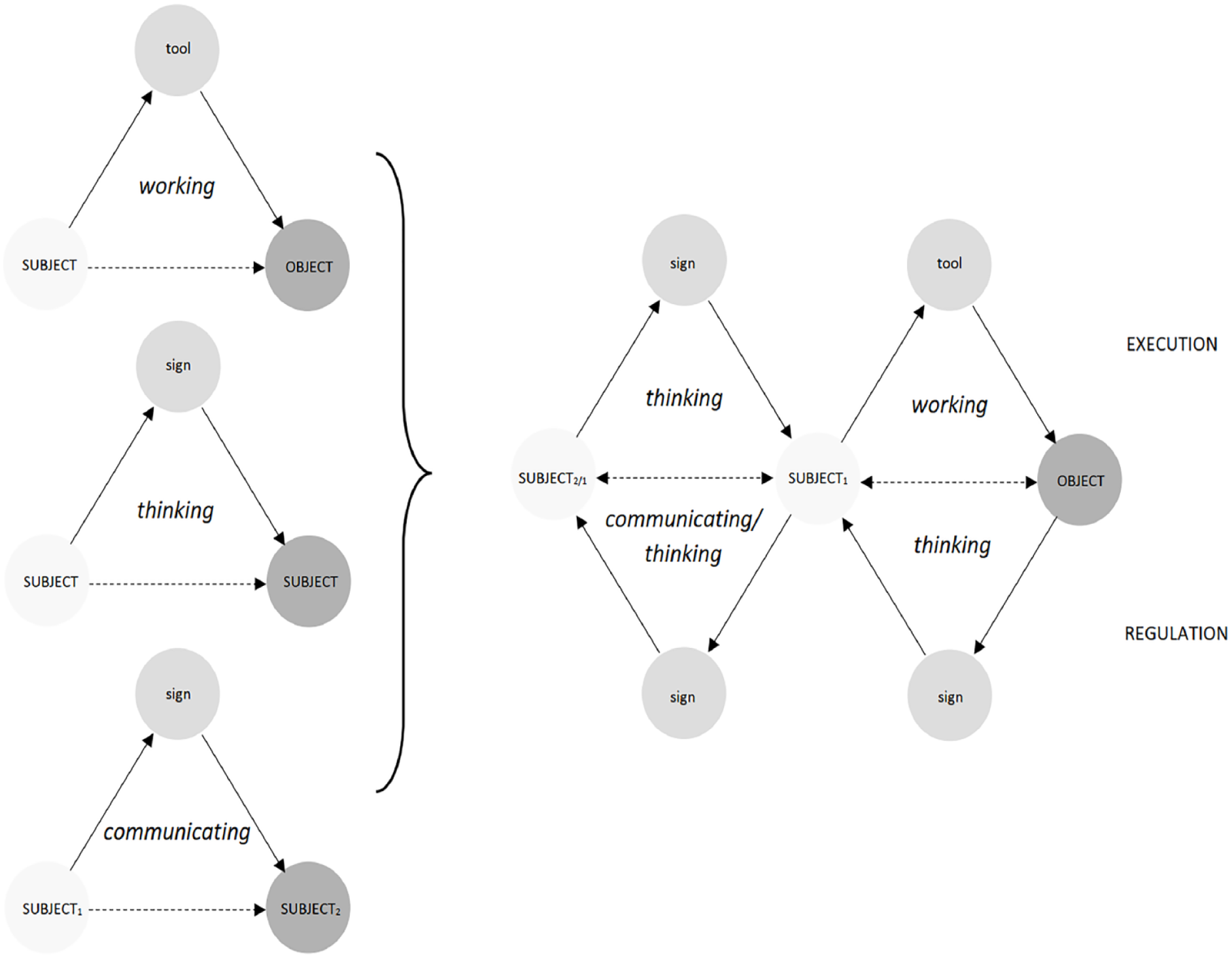
Material and semiotic dimensions of activity: the working, communicating, and thinking concrete species being.
In line with these two assumptions and the notion of species being found in activity theory, Raeithel (1994, 1998) provides a model of the phylogenetical emergence of language in three stages, which takes into account the interplay of thinking, working, and communicating or material and semiotic dimensions of activity. 4 Due to external reproductive requirements, certain dispositions became dominant for developing human beings at certain points in time and then determined their further development. Gradually, the direct determination of early humans in terms of time and place was pushed back by environmental requirements and a mimetic-dramatic sign-mediated reference to the world emerged as a proto-language. At this stage, communication can only be achieved ‘by deliberately acting out the intended action or a situation to be visualised’ (Raeithel, 1998: 246). 5 This mode of communication is closely bound to the event intended by the communication in terms of content, time and place, due to its characteristic corporeality.
The discursive-mythical mode of communication subsequently makes possible for the first time an ‘independent system of knowledge clearly divorced from everyday life practices’ (Raeithel, 1998: 248). Communication now no longer must ‘take place through the practices’ (Raeithel, 1998: 248) and is replaced by bodily movements. This is the stage of (sound) language proper. However, here the signs of speech ‘are not themselves objectively present, but continually refer to things, practices and the presumed intentions of natural and social actors’ (Raeithel, 1998: 250). As Jones (2008) assists: ‘Utterances are initially rooted action-related relations between participants. Some utterances, like the instruction, initiate and shape action in relation to a goal, whereas others register and confirm or reject the results of action initiated or prompted verbally’ (p. 96).
In the third stage, language becomes representational and is characterised by the fact that the signs created acquire a more extensive autonomy. In the previous modes of communication, things successively received a ‘sign-skin’, but what is now new after language development ‘consists in the separability of material signs from the things themselves, in the “peeling off of the sign-skin” and the viewing of the inner structure of the “map” of a realm of reality thus created’ (Raeithel, 1998: 252). The grammatical structures of language are thus nothing other than the objectified form of the dramatic social relations of the previous, second stage, cast in general rules, just as the words are the objectification of the contents that constitute these relations (Hildebrand-Nilshon, 2004: 131).
If language develops from activity, then it is as a development of activity: in language, human activity acquires a new form, expressed not only in physical actions, in the production of useful objects, but also in the production of meaningful symbols. The architect is engaged in building a house, but building it in ‘ideal’ or symbolic form (Jones, 2008: 83).
Although activity always entails semiotic and material aspects, it can have very different degrees of communicative aspects. In this section, I would like to zoom in on specific communicative actions within an activity (cf. the respective triangle in Figure 2). Communicative action is mediated by signs; even in immediate interaction of interlocutors, it is always mediated by this realm of a ‘symbolic-objective world’. In this sense, it can be understood as ‘work on the signs’, that is the joint intervention of ‘taking out and putting in, appropriating and objectifying’ in this symbolic realm (Raeithel, 1998: 116). In contrast to work, communication does not bring about a direct change in the external conditions of action (execution); rather, it brings about a twofold change ‘inwards’ (regulation): First, to a certain extent, into one’s head, whereby thinking, perception and self-regulation are changed but, second, also into the heads of others. In this way, the cooperative relationships, that is, the socially shared ways of thinking, the culturally trained forms of perceiving the world and the culturally typical habitual patterns of action change.
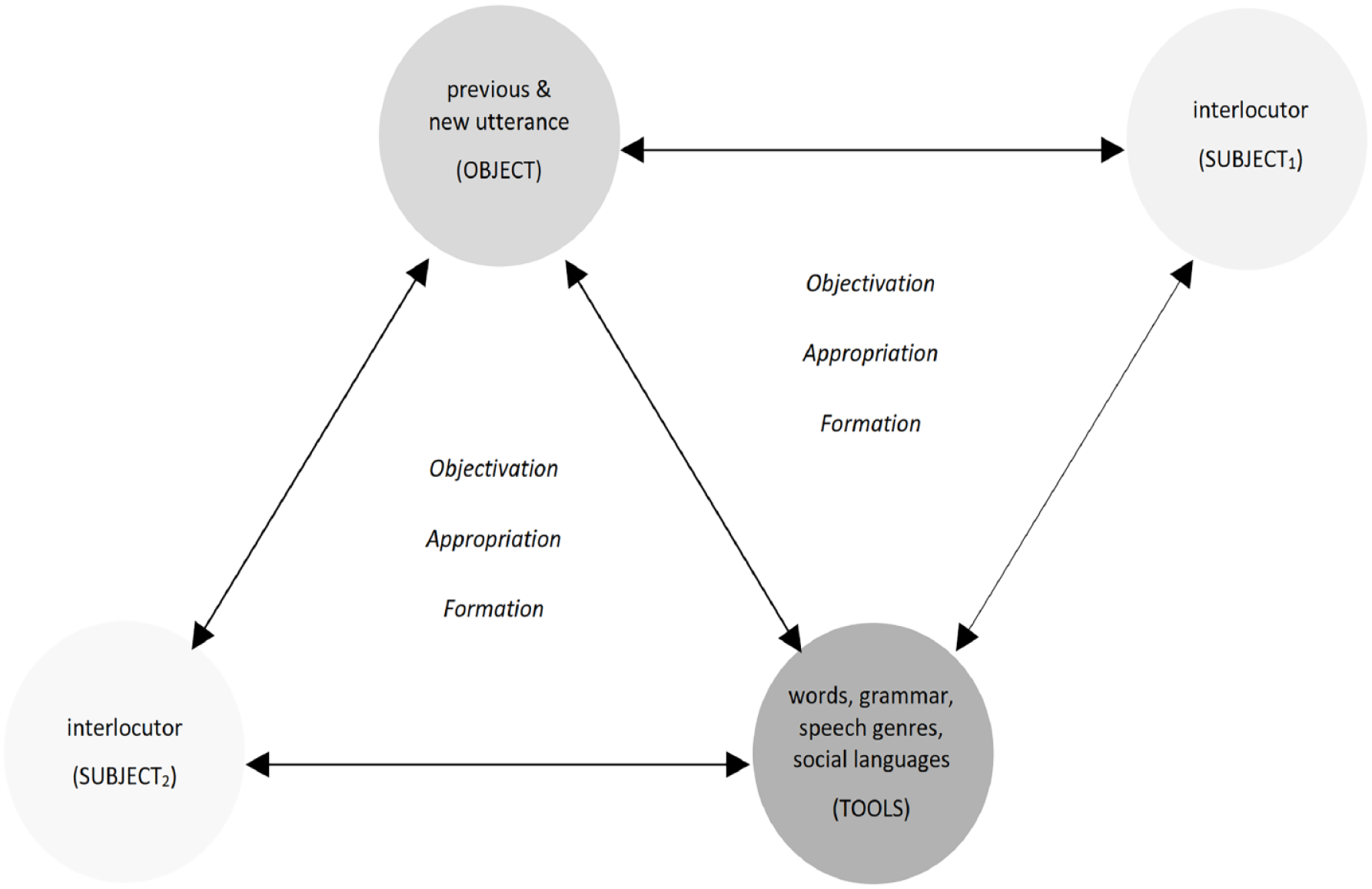
An activity-theoretical model of communicative action.
Here again, it is crucial to point to a common misunderstanding (in the context of the presented triangular representations). Signs mediating language should not be understood that these entities already have meaning. Such telementation or the mentalist fallacy of theorising language and communication assumes that previously stable cognitive capabilities and contents within one subject are expressed and then transported to another subject. Contrary to this ‘linguistic meaning starts life in the meaningful material of social intercourse’ (Jones, 2008: 86), and develops constantly with linguistic capabilities; thus ‘meaning is not the property of a thing but a way for the acting subject to “take” things or make things in relation to what he or she is doing and is about to do’ (Jones, 2009: 76). Communicative meaning-making takes place within concrete activities, which connects activity theory to pragmatist approaches to language in use (cf. Sawyer and Stetsenko, 2018: 146). However, this pragmatist approach has to deal with the ‘fact that some worldly objects are better suited than others to be tools, or have been made so through certain social and cultural uses or conventions’ (Friedrich, 2014: 61). They enter the interactional space and bring in some form of objectified knowledge, extra to the situation, which can nevertheless be actualised in concrete interaction (Wells, 2007: 174).
Integrating these insights, Ritva Engeström provides a model of linguistic communication in activity-theoretical terms, thereby elaborating on Bahktin’s ideas. She conceptualises ‘utterance as mediated action’ (Engeström, 1995: 200) and instead of the sign, she posits the word as the mediating tool: One interlocuter uses words to raise voice, thereby working on a previous utterance, previously constructed from words by another interlocuter’s voice in a practical context. The product is a new (hearable) utterance in the same context and, if it is heard, it contributes to a social language. Social language is a pool of words constituting a discourse peculiar to a specific stratum of society (professional, age group, and so on) within a given social system at a given time, which is specific to various activities.
In Figure 2, I modified and simplified Rita Engeström’s model by depicting two interlocuters in joint semiotic work and by extending language tools not only to words but also to the more operationalised rules of linguistic communication, such as grammar, speech genres and entire social languages, which all can regain the status of an intentional object of communicative action. The rationale behind Figure 2 and the preceding sections is to show that activity theory can provide social-theoretical foundations for critical communication studies.
Media Operations
Georg Rückriem (2009) draws attention to the problem that most activity theory, although dealing extensively with mediation, neglects media. While tools (material and symbolic) establish the connection between subjects or between subjects and objects, media open a space in which such connections and thus the development of abilities are possible in the first place. This is also the conclusion reached by media-theoretical considerations following Marshall McLuhan. They can be summarised as the modality hypothesis, the mentality hypothesis and the mediality hypothesis (cf. Brockmeier, 1998: 211ff.). The modality hypothesis states that a medium is associated with the activation and formation of a specific sensory channel and that our perception and construction of meaning are thus structured from this channel. Instead of signs being constructed in time, as in the case of spoken language, for example, written language is based on signs that are organised in space. The mentality hypothesis associates a specific mental quality or form of consciousness with a medium. It can be seen, for example, that what is considered reason par excellence today is a specific form of reasonableness that could only emerge with written language. The mediality hypothesis brings together the assumptions regarding modality and mentality, expands their sphere of influence to the maximum and thus emphasises the structuring properties of a medium for all areas of life and entire societies.
How can we do justice to media theory and some of its foundational hypotheses from the perspective of activity theory? This question translates in my view to arguments that relate the emergence of media to tool-mediated activity and the following considerations are intended to indicate a direction in which a critical materialist concept of media can be developed starting from the concept of tools. To this end, I refer in the following, to Leontev’s previously introduced distinction between activity, action, and operation and parallel it to the distinction, elaborated on by Holzkamp (1996; cf. also Marvakis and Schraube, 2019: 437ff.) between intentional (level of actions) and incidental learning (level of operations).
In the case of a crisis, that is, when something does not work as expected or desired (e.g. a boulder suddenly blocks the prospect of prey and the activity including partial actions cannot be carried out due to objective conditions), the operations must be raised to the intentional action level (e.g. to roll away the boulder). What was previously (in the situation without the boulder) a mere incidental co-learning in the adaptation to the objective conditions in the accomplishment of the goal or motive fulfilment now becomes an independent goal. This action can then (if, for example, boulders regularly block the prospect of prey) sink back to the operational level and become an objective condition of actions and activities. Since operations can take place without their goal-determining process, they always have the potential to become automated. In contrast to tools, media have background quality, that is, invisibility, transparency and unobtrusiveness. We usually move in media like fish in water. Only when working, communicating, and thinking no longer function within a medium, does the medium become thematic and conscious. From what has been sketched so far, there is a kinship between operations, incidental learning and media, and between actions, intentional learning and tools.
Media’s function, to relieve from work and intentional goal formation, only comes to media because communication and work are already objectified in them. This is because they were material and semiotic tools at some point. In a medium, information processes mediated by signs can take place, that is, the process of objectification and appropriation of possible meanings. This is the semiotic side, which is, however, permanently dependent on material arrangements (e.g. the formation of the larynx in the case of spoken language, paper in the case of writing, and so on). We may say that discarded, operationalised semiotic tools become the medium of language and material tools become technical media, such as books and the Internet.
Information transfer via a medium works until a problem arises, that is, the information processes are disturbed and thus the participants’ agency is endangered. Then the medium itself, experienced as an operative condition, becomes the object of action. It is lifted out of the operative level and (again) becomes an intentional tool for solving the problem that has arisen; thereby, the medium may need to be improved. A new medium is established and loses its tool character when it sinks back to the operational level; this is tantamount to de-thematising the generalised use of tools. The tool/medium (in this example, writing) recedes into the background and becomes transparent and unobtrusive. Dealing with the (new) medium is then opened through incidental learning. New media thus overhaul old media (or sublate them in the Hegelian sense). They allow previous possibilities to be used in new ways and enable entirely new functions and world references.
Activity in the Digital World: The ‘Machinisation’ of Mental and Communicative-Coordinative Work
In recent years, activity theory has – albeit hesitantly – been applied to understand digital ICT (cf. Chimirri and Schraube, 2019; Dahme and Raeithel, 1997; Karanasios et al., 2013, 2021; Nardi, 1995; Rückriem, 2009). It is obvious that ICT ‘can support and penetrate activities at all levels’ (Kuutti, 1995: 34); it is less clear, what a distinct activity-theoretical notion of digital technology might be. Prepared by the foregoing media and communication theoretical elaborations, this section deals with the question of how activity theory adds to our understanding of ongoing processes of digitalisation. Further elaborations of this perspective, for example, regarding big data and machine learning, must remain a desideratum here. Nevertheless, I believe this is possible on the conceptual basis laid out for the time being. Here, I will first outline the process of social informatisation (cf. Boes et al., 2020), which is here understood as a technical process, within which the use of signs is materialised, and which forms the background for an activity-theoretical understanding of digitalisation as the mechanisation of mental and communicative-cooperative work.
In a way, informatisation describes the reverse process of the emergence of language, the detachment of the sign skin from material objects. The Latin meaning of ‘in-formare’ has this double reference to objectification (bringing something into a form) and communication (informing someone). Thus, ‘informing’ is not only an objectification but, on the part of a recipient, also an appropriation process in which information must be re-contextualised against the background of subjective experiences and historical conditions. The first objectification of intellectual and communicative tools was the invention of writing (cf. also Sevignani, 2019).
In the critical materialist tradition, the process of informatisation (of labour) is often very closely tied to the systemic imperatives of capitalist societies (e.g. Mattelart, 2000; Schmiede, 2006). Informatisation as such aims at the separation of (communicative and cognitive) skills or knowledge from the workers and their integration and monopolisation in complex information systems that cannot be controlled by the workers. Such information systems are then used to structure and control labour processes in the interests of capital. This is plausible whenever it can be shown that information and communication technologies have been purposefully developed to secure the extended reproduction of the capital relation. In its generality, however, this approach is overdrawn because it short-circuits anthropological objectification with society-specific capitalist alienation and exploitation.
In the ‘machinisation’ of mental and coordination work, informational parts of the activity are transferred to a machine; computers are generally referred to as symbol-processing machines. In the development of software, life world phenomena are abstracted into application-specific concepts through semiotic work; these are then, in turn, modelled into formal (mathematical) concepts (algorithms) and concretised or objectified in software (and hardware; cf. Dahme and Raeithel, 1997: 9; Wolff et al., 1999: 298ff.). Regulative and coordinative actions must already be decomposed and operationalised before they can be transferred to computers, as Frieder Nake (2021) argues: ‘To realise mental processes, which always possess an essentially formal side but have not yet been materially expressed, outside of the subjects, is the central task of the computer’ (p. 226). 6 Activities and actions that are not computable in their entirety, but in which computable operations are embedded as parts, can be organised as interactive use of the computer (Nake, 1992: 196). Depending, on the context and the specificity of technology, the effect of information technology concerning action can be substitutive or supportive, simulative or performative, reactive or interactive. The activity of producing software and hardware is, in this perspective, ‘intellectual work on the mental work of others to reify the latter in machine form and later to be able to liquefy it again’ (Nake, 2021: 230).
Computers and digital technologies are machines that receive informational input from the world and deliver informational output to it. In between, however, the data can be combined and processed at will, ignoring ‘real’ conditions and meanings. Facts and contexts can thus be understood from the outset as modulable data images and processed at this level before it comes to executive activities, such as the re-organisation of actions or the production of technology. Through the interconnection and interoperability, that is, the networking of computers, there is an immense compression of place and time, and it becomes possible to integrate and standardise previously separate information stocks. A new space for action, the Internet, emerges, which, almost like language itself, enables an infinity of potential references and possible uses. It integrates codified (e.g. algorithms, software) and non-codified information (such as text, images, music and video), allowing – for the first time in human history – human information use to be unified in one medium. There is a tendency to make software programming (the objectification of codified information) ‘vivid’, that is, to dock programming to our sensory experience using visual icons and the recreation of already familiar practices such as clicking, dragging and scrolling. In addition, the Internet also allows the integration of different modes of relating to the world (Fuchs et al., 2010): Web 1.0 is a tool of thinking, that is, even objectified information can be (re)appropriated. Web 2.0 is a tool for communication, it allows the simultaneous objectification and appropriation of information between different subjects and integrates mass and individual communication. Web 3.0 is a tool for cooperation, that is, thought and communication processes are used to bring about a change in the symbolic or material world based on the division of labour. Here, ICT has a supporting (rather than replacing), performative (rather than simulative), and interactive (rather than reactive) effect on human action.
Conclusion: Prospects for Critical Materialist Media and Communication Sociology
Critical materialist media and communication sociology is primarily interested, as I have argued in the introduction, with the macro- and meso-level of economic structures in combination with discourse dominance and hegemony building. In this conclusion, I quickly illustrate how to connect the previous social, communication and media theoretical elaborations to this (familiar) level of critical analysis, for example, in critical political economy, cultural studies and discourse analysis.
Cognitive and communicative activities, although as aspects always occur in concrete activities (cf. the section ‘Activity: Cultural Tools and Working, Communicating, and Thinking’), can be socially distributed among different groups of people and classes (e.g. the separation of execution and planning, managers vs workers, communicators vs recipients). Discoursing as an activity in its own right within the social division of labour, communication as work, is frequently neglected in standard approaches of activity theory (Wells, 2007: 160), which may explain why this rich school of thought is rarely applied in media and communication sociology. Discoursing as an activity relies on (professional) capacities and media tools that – as several analyses informed by the critical political economy have made clear – are unequally distributed among social groups. Discoursing produces new words, interpretations and entire meaning structures that are used in other activities and communicative action as semiotic objects and tools, thereby exerting influence on the perception and solution of practical problems. While some produce media and meanings intentionally, others rely on them as operational influences for their (communicative) actions, in the sense of self-evident and non-reflective conditions. Although none of these discourse products exert direct influence, since in meaning-making (selective) appropriation processes are constitutive, as has been made clear above, we nevertheless may draw a conceptual distinction between authoritative takeover and dialogical negotiations of meaning a difference, ‘one may “recite by heart” or ‘retell it in one’s own words’’ (Emerson, 1983: 255). The power involved in ‘reciting’ is that problems, as well as solutions, are given, ‘to change a word in a recitation is to make a mistake. The power of this kind of language, however, has its corresponding cost: once discredited, it becomes a relic, a dead thing’ (Emerson, 1983: 255). Thus, discoursing remains dependent on consensus and is part of cultural guidance, as Gramsci’s concept of hegemony makes clear (cf. for a recent application to public sphere theory:, Sevignani, 2022a).
Mosco (2009) argues that ‘the process of structuration constructs hegemony, defined as the taken-for-granted, commonsense, naturalized ways of thinking about the world’ (p. 188). Connecting to the political economy tradition, but integrating cultural, semiotic work, into a structuration approach, Jessop and Sum argue that it is important to consider economic and semiotic structures or path-dependencies in their interdependence and suggest that ‘semiosis becomes more important in path-shaping when crises disrupt taken-for-granted discourses and generate unstructured complexity, provoking multiple crisis interpretations’. In these critical situations, ‘prevailing meta-narratives, theoretical frameworks, policy paradigms and/or everyday life’ are disturbed and this opens a ‘space for proliferation (variation) in crisis interpretations, only some of which get selected as the basis for “imagined case, recoveries” that are translated into economic strategies and policies – and, of these, only some prove effective and are retained’ (Sum and Jessop, 2013: 402f.). From variation to selection to retention, the sedimented discourse structures within a specific cultural political economy are getting tendentially more determining influence on semiosis.
In informatisation (cf., the section ‘Activity in the Digital World: The ‘Machinisation’ of Mental and Communicative-Coordinative Work’), semiotic tools become material objects; in digitalisation, semiotic tools are coded into computers. The proposed approach and the activity theoretical integration of work and communication, I claim, particularly fits the age of social media and digital communication, when user-generated content and (data) ‘prosumption’ gain in relevance (cf., Sevignani, 2022b). It is here, where the control of semiotic tools, for example, data, become particularly relevant because digital capitalism increasingly relies on the expropriation of its lifeworld – its social, natural, political and epistemic background conditions (cf. Elder-Vass, 2019; Fraser, 2023 (2022); Jessop, 2007). This is in line with the immaterial labour thesis on the current transformations of capitalist societies put forward by post-operaist thinkers (cf. Hard and Negri 2000; Lazzarato, 1996; Terranova, 2000). However, it is also important to recognise that capital increasingly tries and manages to structure and even subsume these life worlds (cf. Dean, 2009; Rikap, 2021; Zuboff, 2019). It does so by gaining control over the means and tools of communicative coordination to sustain the ongoing expropriation and exploitation of communicative activity, for example, by increasingly controlling not single knots within the web of the public sphere but the entire knowledge and media infrastructure (cf. Sevignani et al., forthcoming).
In capitalist societies, the means of communication (digital or not) are tremendously unequally distributed. Something which we are now able to reframe through the activity theoretical approach as a tearing apart of the system of communicative forces, where some concentrate the means of communication, which all communication relies on. It was said (in the section ‘The Starting Point: Concrete Species Being (Marx)’) that the possibility of freedom and learning development lies in the representational, object-oriented nature of the activity. Human tool use at the same time, however, provides a serious gateway to domination, if the material and semiotic-communicative tools are unequally distributed and non-democratically controlled. This allows for the expropriation of the means and products of activity and even exploitation if it leads to interdependence between classes, whereby the happiness of the strong correlates to the suffering of the weak. Such inequalities then contribute to the unequal development of skills and ultimately hinder or distort the free and equal developing capabilities of concrete species beings. Generalised communicative activity, that is the free and equal development of species being, means not only interpreting or decoding given (hegemonic) meanings, but also using semiotic tools to create new structures of meaning that determine the range of what can have meaning for a subject. This involves creating our own or appropriate means of communication and organising media (institutions) to cooperatively change social structures of meaning and alter the (communicative) conditions in which we live. In public learning processes, we should not only become competent recipients but also communicators and media owners.
Questions that immediately arise from the proposed conceptual framework include: who has control over the material and semiotic tools and uses them for what? How do the expropriation and interest-led design of the means of communication affect the development of communicative skills (of different classes) and political learning? How and for what purpose are algorithms designed? How are they objectified in programming languages, programmes, software, smart things and communicative robots? These are all important topics of a critical analysis of social communication relations, which can and should be encountered now from the background of the social and action theoretical foundations of a materialist media and communication sociology that have been outlined in this article.
