




Abstract
This article explores how the western concept of “organic agriculture” has been applied in the traditional Chinese tea industry and how it has been tested during the COVID-19 pandemic. Using in-depth interviews and observations made during 2017–2020, we analyzed different meanings of organic agriculture and values that were given by Chinese farmers who are certified organic producers. Although organic agriculture, particular certified by international certification standards, is a foreign concept, producers invested efforts that go beyond the commercial pursuit for profit. Most importantly, the combination of the reiterated cultural meaning and health benefits of the certified organic tea with the visionary strategy has allowed these producers to shift in a timely manner from export to domestic markets and adapt to the pandemic’s barriers presented to the global trade.
Introduction
The COVID-19 crisis has brought many unseen changes to food systems around the world, which are yet to be fully understood and experienced. Old links has been disrupted and old meanings have to be revisited.
In this paper, we would like to discuss how western concepts, such as organic agriculture and sustainability, can survive and evolve in modern Chinese society under the new challenges, among those COVID-19, through individual experiences of organic tea farmers. The methodological approach is socio-ethnographic: the research is based on the observations and interviews conducted in the two organic farming enterprises over a 3-year period (2017–2020) in the Anhui Province.
Race, gender, and religion continue to play their roles in how different nations are addressing the COVID-19 crisis, and global recovery will be a mixture of universal solidarity based on similarity of being human and national peculiarities. It is going to be a test of rootedness of many ideological and socioeconomic patterns. Those which are foreign may be rejected. In this instance, we would like to understand whether “organic agriculture” has developed deeper local meanings or it is still a foreign concept that might be swept away by the new, unexpected crisis.
Also, in our analysis, we recognize that organic agriculture in China faces numerous internal and external challenges, such as limited access to land resources, high inputs, and climate change, that continue to affect its productivity and thus also should be taken into account. We have studied two different organic tea farming companies: Songgu, which is located on a rented plot at the northern gate of the Huangshan Mountain and is privately owned; and Xinanyuan, located in the Liukou area, the Xiuning County, run as a farmers’ cooperative. Both companies have their organic tea certified: Songgu, since 2012; and Xinanyuan, since 1998.
These primary data reveal two major motivations (economic, ideological) to maintain organic tea production, and current challenges (institutional, market-based, climatic, and COVID-19) to expand production and its profitability and coping strategies addressing these challenges. After the period of dominance of the European perspective (orientalism) on what is organic, Xinanyuan’s new strategy shows the change; now the local market is preferred, and traditional Chinese culture is praised. This implies orientalism in reverse.
To explain this finding, we will explore the context in detail and then move to the experiences of the Chinese organic producers: first their motivations to apply organic methods of cultivation and then the current challenges and adaptive challenges.
Orientalist Roots of the Chinese Organic Agriculture
Tracing back to earlier times before Green Revolution, it is apparent that all historical agriculture was organic, without modern pesticides; farmers cultivated land and did not call such methods organic. Organic agriculture in its modern sense has been predominantly developed and promoted by western practitioners and activists, but of course, it is interesting to determine from where they took their inspiration to develop such ideas of organic farming and studying materials. The development of organic agricultural practices, particularly composting, can be traced back to colonial agricultural scientists who rediscovered traditional agriculture in Asia and Africa. Among them was Franklin H King, an American scientist who traveled to China, Korea, and Japan. King praised Far Eastern farmers for practicing organic methods of agriculture to endure soil fertility. He described how the Chinese farmers used canal mud and manure of all kinds as “home-made fertilizers” and how these practices allowed them “to adopt a system of multiple cropping which otherwise was not possible” (King, 1933: 22–23). A famous book by James Hilton titled Lost Shangri-La also presented Tibet as an organic paradise and contributed to shaping “green orientalism” (Chou, 2013: 109).
The way the western colonial agricultural scientists, including King, looked at agriculture in the nonwestern countries was orientalist. Orientalism, as defined by Edward Said, is the western style of “dominating, restructuring and having authority over the Orient” (Said, 1979: 3). This “positional superiority” has been supported by the corresponding relation of political, cultural, and intellectual power (Said, 1979: 6–12). A narrative of the exotic lands and underdeveloped indigenous people was present in the colonial discourse. One can argue that promotion of modern organic agriculture is orientalist. Organic agriculture in the Global South is promoted by international developmental agencies and the largest western NGOs, such as Greenpeace and the Friends of the Earth.
Chinese tea, the first organically certified food item for export, is the orientalist product that was a confined secret of the East until the 17th century, when, through sea and land routes, it made its way to Europe (Grigg, 2002; Tong, 2012). King (1933: 283–284) explained tea popularity in China with “the need of something to render boiled water palatable for drinking purposes” “against the class of deadly disease germs which it has been almost impossible to exclude for drinking water of any densely people country” and with “great industrial and commercial purpose.”
Modern medical research proves that tea can be used as a part of a healthy lifestyle strategy to prevent cancer (Nagle et al., 2010; Yu et al., 1995). In China, the medicinal properties of tea were discovered long time before modern western scientists. It was a legendary Chinese doctor named Shen Nong Shi (神农氏) (Liu, 2008) who mentioned tea as medicine for the first time in his herbal medical catalogue Shen Nong Ben Cao Jing (神农本草经) (Shang, 2014). Drinking tea has become one of the essentials of everyday life in China. As the Chinese saying goes, one needs firewood, rice, oil, salt, sauce, vinegar, and tea (柴米油盐酱醋茶) in daily life.
While tea has become a popular drink and common habit for nutritional and medical purposes, it was embedded in local religion: with its bitter taste and sweeter aftertaste, it is said to ‘resonate with the Buddhist aspiration for happiness and peace after troubles’ (Tong, 2012). Tea is important in Chinese hospitality. The tea ceremony, based on the concept of Tea Dao, the art of making and serving tea, is the highest ceremony when meeting guests. Serving tea means showing respect and replacing alcohol with tea (以茶代酒).
Chinese organic agriculture has existed for centuries very much unchanged, until the post-famine state reforms, which were based on the wide use of agro-technology and chemical fertilizers. In contrast, the modern concept of “organic” arrived from outside China and is arguably an orientalist construct. Modern organic agriculture is based on the knowledge of soil management taken from the Orient and assimilated by the West and then exported back China in the form of standards for certification and labeling by the western experts.
The western founding fathers of organic agriculture were Rudolf Steiner and his students in Germany, Sir Albert Howard, the founders of Soil Association, and Anglo-Saxon agricultural scientists like Franklin H King who traveled to China and praised farmers for practicing organic methods of agriculture for enduring soil fertility with “home-made fertilizers” and cultivating multiple crops (King, 1933: 22–23). For early scholars on organic agriculture, such as Lord Northbourne, King, and Sir Albert Howard, organic was very much about soil conservation and fertility enhancing; the acknowledgment of cultural practices and environmental values came later. In a broad sense, agricultural practices without synthetic inputs around the world, including China, have been organic for centuries.
The first organic certification in China was introduced in 1989 by the Rural Ecological Research Centre of the Nanjing Institute of Environmental Sciences, a branch of the State Environmental Protection Agency, which became the first member from China to join the International Federation of Organic Agriculture Movements (IFOAM). The first organic inspectors came from Europe and the United States (Gould, 2017).
A milestone in Chinese organic agriculture took place in 1990 with the first export of a certified organic product, tea, from Lin’an county of Zhejiang province. In the 1990s, the government started limiting chemical inputs into food production and then moved to the “closer to zero” policy, which was exemplified in “green food” and “hazard-free food” labeling programs and which focused on residue testing and inspections. Based on the “path to zero” policy, which particularly aimed at its agricultural export, China developed its own national organic food product standards and started to align them with the international standards (Chuqin and Fang, 2018).
In the early 2000s, the Chinese government started to regulate the new standards by releasing the Organic Food Certification Regulation, followed by the Organic Product Certification Regulations and the Organic Product Certification Implementation Rules. These acts provided guidance on organic certification and organic production; set standards for organic certification bodies and certifiers, organic labels, import requirements, international cooperation and regulatory initiatives; and specified goals of organic certification, scope of applications, standards of certification, procedures of certification, post-certification management, credentials, certification labels and certification fees (Xie et al., 2015).
A decade later, China started to experience “an organic agriculture revolution.” From 2000 to 2006, the country moved from the 45th position to the second position in the world in number of hectares under organic management. By 2006, China added 12% to the world’s organic area, which accounted for 63% of the world’s annual increase in organic land (Paull, 2008). In 2017, China became the third largest organic area and the fourth organic market in the world (FiBL, 2019).
Such rapid growth in certified organic food was fueled by foreign and national demand. International markets (Europe, USA) were offering high premium (minimum 30%). In 2008, the melamine scandal, when baby formula was found to be poisonous, led even more Chinese consumers to choose certified organic products, and this has remained a recorded trend. According to the Certification and Accreditation Administration of the People’s Republic of China (CNCA), the number of issued organic certificates has increased from 2688 in 2008 to 9957 by the end of 2013 (Certification and Accreditation Administration of the People’s Republic of China, 2014). China now has more land under organic horticulture than any other country (Willer and Sahota, 2020). In March 2012, CNCA revised its organic standards and introduced stricter regulations to address the national demand for accountable food safety standards. In 2019, the third revision of organic standards was issued.
Producers’ Motivations to Choose Organic Agricultural Practices and Certification
When organic agriculture is certified and labeled, it means that there is a clear definition of what is organic; however, it appears that everyone does not follow the same definition.
The Food and Agriculture Organization (FAO) defined organic agriculture in a number of ways: it is “one of several approaches to sustainable agriculture,” “a holistic production management system which promotes and enhances agro-ecosystem health, including biodiversity, biological cycles, and it is “one of several approaches to sustainable agriculture,” and “it is opposed to using synthetic inputs, such as synthetic fertilizers and pesticides, veterinary drugs, genetically modified seeds and breeds, preservatives, additives and irradiation” (FAO, 1999). The IFOAM broadened the definition of organic agriculture by adding another aspect, the anthropological aspect, since they argued that “history, culture and community values are embedded in agriculture”: Organic Agriculture is a production system that sustains the health of soils, ecosystems and people. It relies on ecological processes, biodiversity and cycles adapted to local conditions, rather than the use of inputs with adverse effects. Organic Agriculture combines tradition, innovation and science to benefit the shared environment and promote fair relationships and a good quality of life for all involved. (IFOAM, 2005a, 2005b)
The IFOAM has formulated four principles of organic agriculture: the principle of health refers to preserving health of soil, plant, animal, human and planet as a whole; the principle of ecology promotes respect of living ecological systems and cycles; the principle of fair is about social justice and food sovereignty; and the principle of care is the main principle of sustainability promoting responsibility toward current and future generations (IFOAM, 2005b).
Since organic agriculture is a western concept, it is difficult to translate the word “organic” in Chinese (有机), and it can be interpreted in different ways: The concept of organic food comes from abroad and it is translated into ‘有机’. It is a confusing word in Chinese. You can say it is ecological, natural and so on. But some people compare it to inorganic substance, a mineral (无机物). . . .Last but not the least, the Chinese often use sentence like ‘形成一个有机整体’, which means a system or an institution that works well just like a human body, as a natural system. So, when consumers read the word organic, they often struggle to understand what is organic. (Huang, 2017, personal communication)
This case of being lost in translation “when an obscure and vague meaning leads to the situation when organic product is not completely recognized by consumers in a commodity market” (Huang, 2017, personal communication).
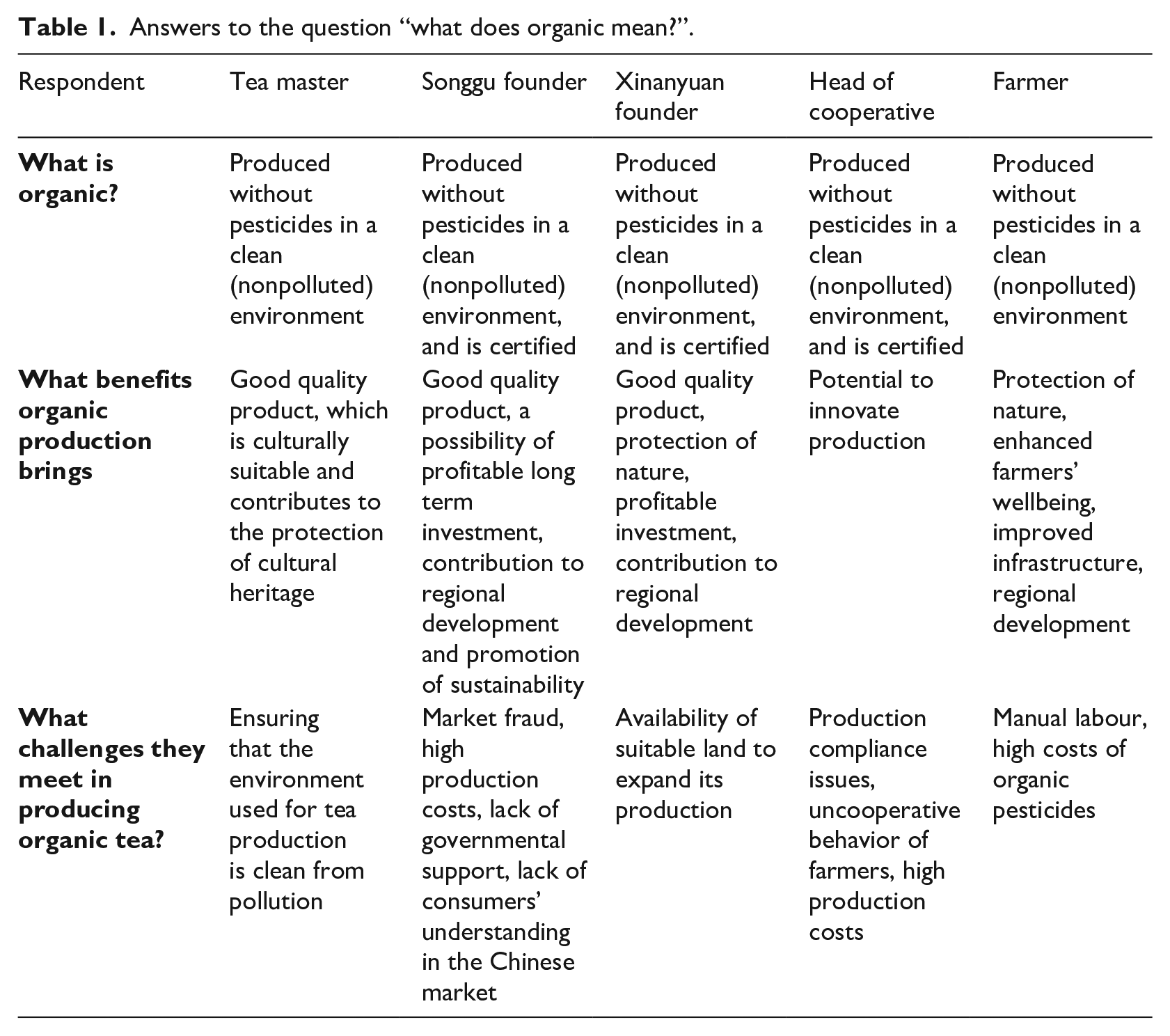
Even people who work with organic green tea on a daily basis understand differently what organic means and emphasized different benefits; all of them are compliant with the international definitions of organic agriculture. Below are short extracts from our initial interviews with members of two companies conducted in May 2017.
Tea Master
In central Beijing, there is Hui Shang Gu Li (徽商故里), a tea house that belongs to Songgu company, where we arranged to have dinner and were invited for a tea ceremony beforehand.
Our tea master, Guo Sun Lin (郭孙林), brings us tea and explains about “before dinner tea” as a special feature of Chinese hospitality. This pre-meal tea-making can be done in three ways: in a glass, in a cup, or in a teapot. The function of the tea is to clean the mouth and intestines and clear the mind. Tea drinking is based on the philosophy of tea dao: hot water, which is used for tea-making, takes the yin out and brings the yang instead, which is used to increase appetite. The same is associated with tea: natural bitterness is followed by a sweet aftertaste. The taste difference is important and even just for that, the tea master thinks that organic tea is better: “pesticides can affect the natural taste of tea, which is so important” (Guo, 2017, personal communication).
He proudly spoke about the tea base from the Huangshan mountainous area, as a result of which the tea is not only organic, but because of its location it “absorbs a cloud spirit” and “makes people high.” According to him, organic tea has a flowery taste, because tea plant is surrounded by “flowers” and it is separated from conventional tea plantations by a buffer zone. Mountainous areas are good for growing tea, and they also suit the philosophy of Tea Dao: “Earth and Heaven come together to produce tea” (Guo, 2017, personal communication).
Mr Guo graduated from the Huangshan Tea School in 2006 with a degree in tea making. It took him 3 years to learn about tea culture. He also learnt about soil management, selection of leaves, and rituals of serving tea, while meeting with farmers to learn about selecting the best quality tea. In fact, there is a short period of time in spring, when tea leaves have their best qualities; the quality of leaves collected later is considered to be of lower quality. A good expert can distinguish different tea leaves. The most expensive leaves can be collected only in three days in spring. The summer tea is also collected, but the price is different.
Mr Guo is very proud of his profession and tea; tea represents for him a connection of modern China with ancient China: ancient tea was “organic,” so he “loves organic tea,” as it is “a part of the long history of my homeland.” He also laments the loss of traditional tea: traditional tea used to be grown under a 700-meter altitude. Since air pollution can reach tea plantations, it made sense to relocate the tea garden higher, in mountainous areas. For him, organic means “natural,” “good for health,” and “free from pollution made by humans” (Li, 2017, personal communication).
Founder of the Songgu Tea Company
Mr Huang Zhisheng (黄志胜) is the man who founded the Songgu tea company. The tea base of Songgu is located at the northern gate of the Huangshan Mountain. From the beginning, the company’s vision was conceived as an organic tea producing company. Mr Huang is a local resident, who grew up in this area. In fact, his parents’ old house is located at the foot of the mountain. He always dreamt of building his own tea base at the top of the mountain. The altitude of the tea base is about 800 miles high (Huang Zhisheng, 2017, personal communication).
Mr Huang explains that tea from his tea base is organic because it is certificated as organic and comes from “a safe environment”: “Tai Ping Hou Kui (太平猴魁), one of the top ten teas in China, is the main product of Songgu and the Huangshan Mountain is the unique area to grow it. There is no pollution here at all. The environment is so clean here.” Songgu has rented 2000 Chinese mu or 329.5 acres at the top of the mountain for 30 years and hires 10 laborers among local farmers. As a result, “the organization turned to be simple and easy to manage, so to make sure that tea produced here is really organic” (Huang Zhisheng, 2017, personal communication).
Mr Huang claimed that in tea production, his company “never used any chemical fertilizer, pesticide or any other artificial materials.” Mr Huang applied for organic certification in 2012. After the 3-year transition period, Songgu finally received its organic certificate in 2015. He argued that the year 2012 was a good time to apply for organic certification as “the market started to get more and more regulated and recognized by consumers.” According to him, earlier, in the 2000s, when the central government of China introduced its national organic food standards, the certification market was not developed. This was the time when “consumers did not know what was organic and couldn’t discern the difference among different certifications.” He complained of fake products prevalent in those days and welcomed “the determination of the government to govern this market and stop fake production” (Huang Zhisheng, 2017, personal communication).
During our first discussion in May 2017, he spoke of connecting organic agriculture with the concept of sustainability. He claimed that his “tea base has been managed in a sustainable and natural way,” and that “organic agriculture has been a way forward to sustainable development”—“the ultimate goal” of organic agriculture (Huang Zhisheng, 2017, personal communication).
CEO of the Xinanyuan Tea Company
Mr Fang Guoqiang (方国强), the founder of Xinanyuan, decided to produce the best tea in China in the early 1990s. He met Mr Li, a local business celebrity who used to trade tea in Hangzhuo, the Zhejiang province. Mr Li was the first to identify high-quality tea in China and to export it abroad.
Mr Fang learnt about the concept of organic agriculture from Mr Li and his foreign trade. Mr Li told him to take advantage of his home area and to produce organic tea to win the tea business. Mr Fang remembered that his first knowledge of organic was about “good environment, no pesticide and chemical fertilizer” and “the best taste of among all kinds of teas” (Fang Guoqiang, 2017, personal communication).
In 1998, Xinanyuan got its first organic certification. 1 In the reception area, he proudly displays the numerous certificates and awards. The company was recognized as “the best example” of agricultural dragon head enterprises (DHE) by the Ministry of Agriculture (MOA) in 2010 and as “the first and best organic base in China” in 2017. We were also shown photos of several delegations that visited the company. Among them were Dutch and German organic certifiers. Mr Fang pointed out to a photo of Wolfgang, a German tea buyer, who used to come and buy tea in the 2000s until his sudden death. He paid a premium to reward farmers for their work in avoiding pesticides. These links to Europe allowed Xinanyuan to send most of its processed tea the European buyers, at a high price—up to £120 per tea box.
In May 2017, Mr Fang had ambitious plans to turn certified organic production into a driver for local development, by exploring international tourism: Organic tea is the beginning of the development of an organic food value chain. In the future, we try to exploit an organic certificated area in the Liukou area as a whole. If this aim is achieved, other agricultural products besides green tea will also get organic certificates. More and more tourists will come here to enjoy the beautiful scenery and healthy food. We will build more facilities to meet the tourists’ increasing demands. By then, the concept of organic will become a new kind of life. (Fang Guoqiang, 2017, personal communication)
Organic Farmer
Then we met the farmer who has grown the Xinanyuan organic tea. Huang Guoqiang (黄国强) is in his sixties and has spent most of his life farming. He is also a member of the cooperative and has been an advocate of organic agriculture. To the question what he understood as organic, he answered: Organic is a type of production. We produced organic tea in the early times. We did not use chemical fertilizer, only farmyard manure, before the year of 1949. Also, when producing organic tea, we can only pick up tea leaves manually, not by machines. Because people can distinguish a size of a tea leaf, keep the integrity of the tea leaf, and classify them according to size. Machines can’t complete this work. Sometimes they even damage a good tea leaf. From the year of 1970, we started to use chemical fertilizers and pesticides to control pests. However, a chemical fertilizer deteriorated the soil and made it harder. Now we return to traditional way and turn the soil up, using the leaf of tea tree as the fertilizer. Then old tea leaf becomes a kind of long- lasting fertilizer. It is a natural pattern and is good for protecting the soil and the environment. (Huang Guoqiang, 2017, personal communication)
Mr Huang Guoqiang felt very protective of the wild flora and fauna. As he showed us around, he pointed out at spiders, rose bugs, and a mantis and spoke about the importance of keeping wildlife for the future generations.
He originally planned to produce organic tea in the early 1990s, alongside Mr Fang Guoqiang, but started to produce organic tea only in 2000, and in a small quantity. He eventually increased his production. He explained why farmers like him have chosen to join the cooperative: It is because they can get considerable economic benefits and protect the environment in the meantime. Furthermore, Xinanyuan invests in building roads which give us more comfort. For example, we can ride electric motorcycle here. Before that, it is not allowed to ride on a rugged road. We had to walk miles to buy goods. (Huang Guoqiang, 2017, personal communication)
He has been concerned about long-term well-being of the ecosystem in his plot and was hopeful toward applying more conservation techniques in the future.
Current Challenges and Ways Forward
Throughout the conducted interviews, we identified two major challenges that Chinese organic farmers face—limited access to land and climate change.
Access to Land
An important factor that is influencing the development of the Chinese organic market is access to agricultural land. The ownership of land, both in urban and rural areas, in China is public. It also has specific implications for organic enterprises in the area of control of pesticides, which is the foundation of organic farming.
Land in urban areas is owned by the state, and rural land is owned by the rural community organized in villages. To provide a brief historic remark, in 1978 China developed the so-called Household Responsibility System in rural areas. In this system, members in the community have the right to contract the land in the community for a fixed period of 30 years, while the land is still owned by the community. Cheung (2000) argues that such a contract responsibility for 30 years is equivalent to the function of a private property (Cheung, 2000).
China has recently experienced more circulation of rural land and a further division of land rights. In this transformation, members in the community have the right to rent their land to people outside this community by their own will and gain income in the form of rent. So, the collective ownership of the community, the contract right of the community members, and the management right outside of the community form three levels of rural land rights in China. As most Chinese farms are small holds (less than 2 hectares; Fan and Gulati, 2008), the Chinese government’s market reforms had to address the issue of increasing the scale of agro-industry in its attempts to industrialize agriculture. In 2000, the MOA set up a policy aimed at supporting the so-called DHEs and started to discuss the status of rural associations (Ras; Lingohr, 2007). In 2007, the government approved the Bill of Cooperative Law. The exact status of RAs is not very defined, and both Chinese and western scholars (Lingohr, 2007; Wen, 2013) have argued that it is difficult sometimes to distinguish “true” RAs from ‘fake’ cooperatives, which are registered in order to get subsidies from the government, other enterprises, and governmental agencies.
Both the companies, Xinanyuan and Songgu, do not own the lands that they use for organic tea production. They are rented, but from different sources: from rural communities and directly from farmers.
Xinanyuan is a DHE and its cooperative is an RA of 820 farmers’ households. The relationship between the two entities is complex, and the main driver for cooperation is access to agricultural land at a cheaper rate.
Such complexity in land ownership and agricultural management presents a serious challenge to organic producers. In general, the Chinese organic agricultural producers can choose from three options to address access to land and compliance issues they face in producing organic products: to work with the farmers and control their use of pesticides via a cooperative as Xinanyuan has chosen; to follow Songgu’s example and switch to a single rent; and to establish a reputation in the market and give up organic certification altogether. We found such examples in the Chinese milk industry (Zhao et al., 2019). These choices are intuitive and adapted to their context.
Access to land, despite working relations with the authorities, still remains the issue. Both CEOs complained: We now get a lot of support from government. But we don’t have much support to get access to land. (Huang Zhisheng, 2018, personal communication; Fang Guoqiang, 2018, personal communication)
Xinanyuan rents quite a large amount of rural land of 6800 mu, equivalent to 1120.3 acres, from the local rural community and the rent costs are high. The tea from this base is certified as organic. But they also work with local farmers from whom they buy tea leaves and produce tea. Thus, when it comes to the matter of land ownership and production management, it is more complex. This complexity is explained to us in detail by Mr Fang’s assistant—General Manager Mr Huang Yisheng (黄益胜) who has worked for Xinanyuan for the last 19 years. With a growing demand in organic tea, he suggested in 2003 to find an innovative way to enlarge the scale of organic tea production by organizing a cooperative of Xinanyuan: We try to build a rural land stock cooperative. The farmers invest their lands into the cooperative and join the cooperative as a member. As owners they can get the residual benefit from the sale. (Huang Yisheng, 2018, personal communication)
Mr Huang Yisheng expected farmers upon joining the cooperative to obey the rules of the cooperative, and that it should have lowered the costs from renting farmers’ land. However, the problems arose as the owners also have to share the risks: “It is the dream of Mr Fang [the CEO] to produce organic tea, not theirs.” Not everyone wanted to join under the strict rule of avoiding use of chemical pesticides. He mostly complained of farmers who are difficult to persuade to give up chemical pesticides: It is hard to produce organic tea. Good natural environment is the prerequisite of anything. But it is harder to face thousands of farmers and prohibit the use of pesticide and chemical fertilizer among them. (Huang Yisheng, 2018, personal communication)
Xinanyuan cooperates with local farmers to grow tea on their land, which consists of 30,000 mu (4942.3 acres). Under this system, farmers, who are members of a village community, can make joint decisions how to use their land, that is, they have the right to contract their land and they do not need to pay rent to the community. The scale of each contracted farm is very small. In total, 820 farmer households form the cooperative (Fang Guoqiang, 2018, personal communication).
As a result, the company faces high costs to monitor such a high number of farmers. Xinanyuan prohibits the use of pesticides like glyphosate. However, farmers still continue to use glyphosate. The reason is the price of a conventional and biological pesticide. For example, glyphosate costs 16 RMB/kg, while glufosinate, a bio-pesticide, costs 60 RMB/kg (Huang Yisheng, 2018, personal communication).
In 2017, the central government of China put forward agricultural supply-side structural reform to encourage the supply of environment-friendly agricultural products, like organic food, and to upgrade the food value chain in rural areas. Mr Huang Yisheng commented on the reform as a positive event in persuading farmers to appreciate organic production in 2018: After this reform, Xinanyuan has been used as a good example and the story of Xinanyuan has become more and more popular with the advertisement of the central government. In the meantime, the sales of Xinanyuan tea have grown rapidly. The farmers in the area started to recognize the value and importance of the effort of Xinanyuan. I think more and more farmers in this area will join into our cooperative as the future of Xinanyuan is bright and the farmers will get much more benefit. (Huang Yisheng, 2019, personal communication)
As a result of such a policy, Xinanyuan received a special grant associated with the reform.
The MOA started a trial program of integration of primary, secondary, and tertiary industries in a tea value chain”(茶产业三产融合发展试点项目) in 2017 and the company received about 10,000,000 yuan in (£1,110,000) financial support from the MOA. This program invested in building an organic tea base, a processing plant, and tourism (Huang Yisheng, 2018, personal communication).
Under the new crisis of COVID-19, both enterprises did not expand their land for production. Fortunately, there were no cases of confirmed COVID-19 among the local farmers. The government closed down regional borders: no one was allowed to enter or leave their villages. Within the village itself, the restrictions were less strict: farmers were allowed to freely move on their plots and work. Both tea enterprises, Songgu and Xinanyuan, did not cultivate any new tea in 2020, but their workers were able to collect tea leaves without any restrictions.
It was also considered unsuitable timing for further expansion of the cooperative’s members and total acreage of the tea plantation: No, we absorb no more farmers in recent period. First, the scale is already big enough for us to manage. Second, we think our main duty now is to improve the quality of our product, instead of absorbing more farmers to produce more.
The ambitious plans of the Xinanyuan cooperative to develop their local area have been put on hold. The 3-year local government’s grant, which Xinanyuan won in 2017, expired in 2020. The grant was mostly spent not in expanding the tea base but in providing income support of individual cooperative members, farmers from low-income households. In total, 391 farmers received support. In the final interview, leaders of the cooperative lamented that they had spent the grant and would not be able to apply for government support to alleviate the socioeconomic damages of COVID-19 (Huang Yisheng, 2020, personal communication).
Songgu also focused on maintaining the same production rates as those of the previous year, but the major issue were climatic disruptions (Huang Zhisheng, 2020, personal communication).
Climate Change
The Stern Review has projected that without climate alleviation action taken, concentrations of greenhouse gases in the atmosphere could reach 2 ºC higher than their pre-industrial levels by 2035–2050. The consequences of such a 2 ºC temperature rise present serious threats to global populations through physical harm and dislocation from flooding, fire and disease, and reduced agricultural yields. In China, the concern over climate change has been raised since 1991 (Li et al., 2011).
For tea production, temperature change has a direct effect on the quantity and quality of tea leaves: The low weather in January will influence the rate of survival. February is sprouting period. In March, people begin to collect spring tea, or in other word tender leaf. April is busy collecting season. May is time to collect bigger leaf. People seldom collect in June. The price is low for tea collected in June. (Huang Guoqiang, 2017, personal communication)
Temperature fluctuations usually lead to crop loss or poor-quality crop and income loss for farmers. The 3-year period temperature review in the Huangshan area shows a trend of fluctuating temperatures (Figure 1). If the trend continues, farmers will struggle to yield same amount of tea from the existing acreage.
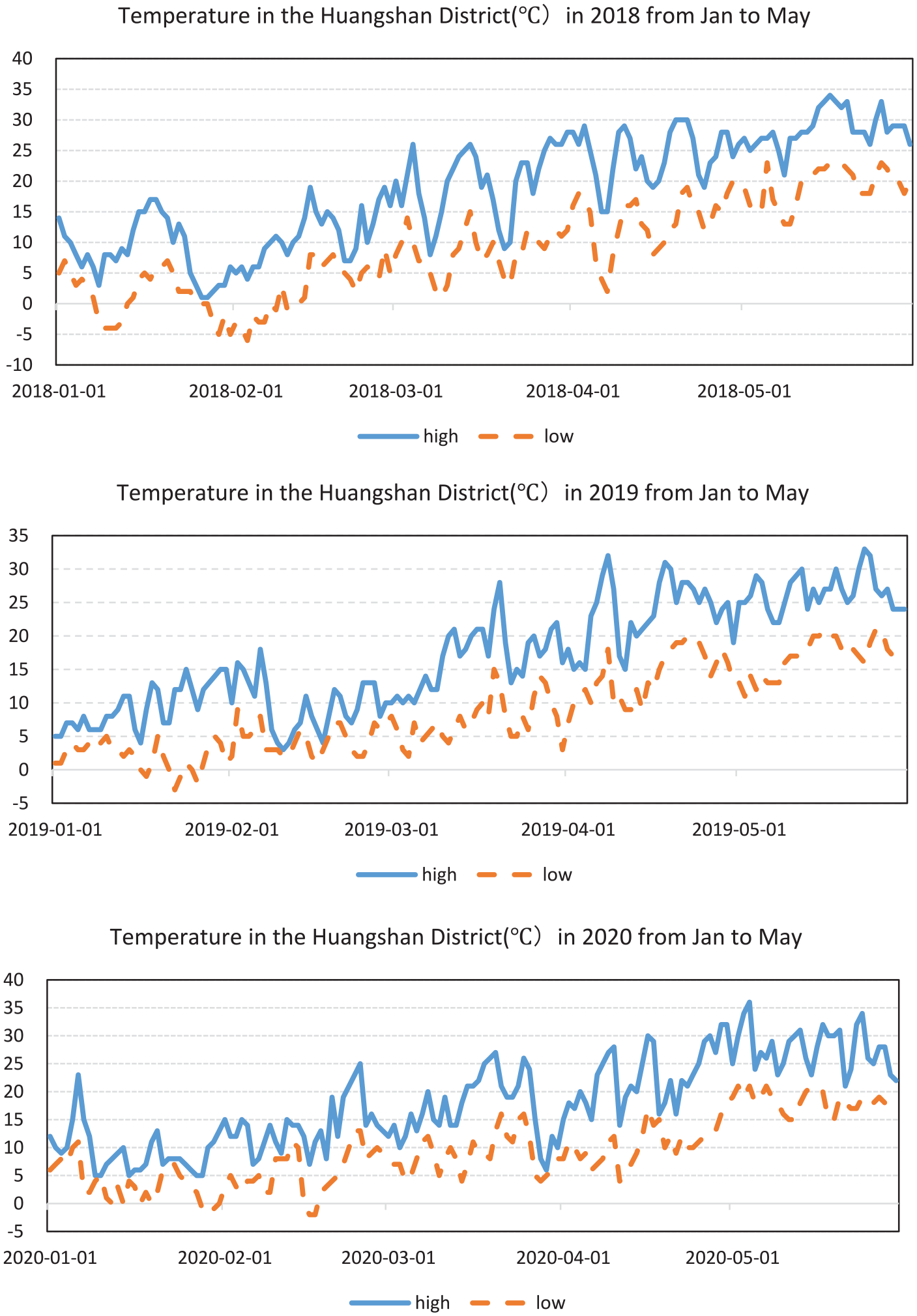
Temperature in the Huangshan district.
Another consequence of climatic anomaly is strong winds and rain, which for the organic industry is even more damaging: We have come across continuous rain since January in 2019. We cannot input organic fertilizer anymore. As a result, the output quantity and quality will both be influenced seriously. What’s more, the continuous rain has caused landslide. It has already brought big loss for our tea base in high altitude. (Huang Zhisheng, 2019, personal communication)
2020, in addition to COVID-19, has brought even more serious climatic disruptions: This year in 2020, it is colder than previous year, and this causes the output very low. Last year in 2019, we came across continuous rain and harvest less than previous year. However, the effect of climate change on output this year is more serious than last year. What’s more, the cold weather prolonged the mature period of tea. (Huang Zhisheng, 2020, personal communication)
The only feasible solution to climate change alleviation is crop insurance, and the leadership of both enterprises have to consider higher costs for such a safety net (Fang Guoqiang, 2020, personal communication).
New Strategy and Adapting to the Post-COVID Era
As a result of the global lockdown during the COVID-19 crisis, 460,000 Chinese firms were shut in the first quarter of 2020. Many food retailers closed their factories and stores in China, among them were McDonalds, Smithfields, and Pepsi (Global Times, 2020).
In this background, the achievement of organic tea producers in Huangshan is even more impressive, considering that organic production has higher labour and investment inputs: As an employee of Xinanyuan, we know the bitter to produce in an organic way. Even though everybody knows the organic production style is good for environment protection and has other positive impact. But it is not economic sustainable. Usually, we cannot obtain the expected return from this kind of hard work and more expensive input. As I know, many enterprises have given up production in organic way for economic reasons. (Fang Guoqiang, 2020, personal communication)
Both enterprises, despite the challenges, declared their willingness to continue to produce organic tea. The reason for such a commitment is the ideology behind organic agriculture and personal motivation, which has not changed in the studied period: We insist to produce organic tea and our attitude will not change. Our principle is “立足新安江源头流口地区,坚持生态环境保护与有机茶同步发展”. Which means, based in the origin of the Xinan river, we will insist to protect the ecological environment and exploit organic tea in the meantime. . .We will not give up no matter how hard it is. We sincerely hope that the society should know our effort to produce organic tea and we hope that the government can give us more support. (Fang Guoqiang, 2020, personal communication)
In 2018, the prices of Chinese tea in the international market were “the highest price in the history in this area [Huangshan].” Raw tea leaf cost was at 300 yuan/kg (about £33.3/kg) on average. This allowed Xinanyuan to keep the cooperative running and produce stable profit for its members: We buy about 90,000 kg raw tea from the farmers and this bring 36,000,000 yuan (4,000,000 GBP) for local farmers. There are about 8000 households (among them there are 265 household living in poverty) and 24000 persons, so we bring about 1500 yuan (166.67 GBP) for each person. (Huang Yisheng, 2020, personal communication)
As a result, in 2018, the company reached a 10% increase of its sales and profits in comparison to the previous year. At that moment, the CEO made a visionary decision: despite the heavy reliance on international markets from the beginning, the CEO chose to cultivate a new variety of tea that is even more expensive and brand it to the local instead of the international markets (Fang Guoqiang, 2019, personal communication).
It was decided to cultivate Youcha tea (油茶), a tea with more seeds to produce tea oil (a kind of high functional oil with more than 90% of unsaturated fatty acid), which is appreciated only by the Chinese (Huang Yisheng, 2020).
With such a reversed orientalist perspective, in 2019, Xinanyuan teamed up with a famous marketing company, Xiaoguancha (小罐茶), and established a joint venture to market their new product in the national market only. Xiaoguancha is famous for its design and marketing abilities, with at least 5000 employees on the sales team. In response to the anti-corruption policy and decrease in popularity of expensive gifts, the packaging of the new tea was rather simple and smaller. Exploiting another popular trend of aspiring a healthier lifestyle, which obviously continued in the COVID-19 period, the new tea was promoted as an alternative to smoking: ‘One teacup cost as two cigarettes, but is healthier and cooler’ (Huang Yisheng, 2020, personal communication).
To address the environmental concern and the trend of affordable cheap packaging, the new tea was packed in a reusable box, which works in a similar way to the milk bottle scheme in the West. The shift from the export to the domestic market is also culturally embedded: Only Chinese understand the quality of tea, they can make the difference. But the Europeans cannot, they cannot differentiate good quality tea based on flavor, foreigners really cannot distinguish. (Fang Guoqiang, 2020)
This joint venture with Xiaoguancha payed off for Xinanyuan; it has allowed them to survive the economic crisis of COVID-19. The cooperative was able to get more returns on their investment from sales due to the continued price increase in tea in 2020: “Xiaoguancha, they can purchase good quality tea. For us, we benefit from the stale and higher price” (Fang Guoqiang, 2020, personal communication).
COVID-19 has significantly changed the distribution of export and sales for internal markets: The covid-19 brings very big burden and challenges for us. The sales structure of Xinanyuan can be divided into 2 parts. One is export to EU and Africa. The other is sales in domestic market in China. In previous years, the sales and income from export accounted for almost 60% of the total income of Xinanyuan. However, the covid-19 hit the market of EU and our sales to EU stopped. We meet big losses. Our export to the EU accounted for 80% of our total export sales. The remaining 20% is export to Africa and this part experiences less loss. (Fang Guoqiang, 2020, personal communication)
To compensate the temporary loss of the European market, Xinanyuan reoriented toward the domestic market and, in addition to the new partnership with Xiaoguancha, they “put a lot of effort this year to exploit new retail model online” and “those effort and hard work in a downstream value chain made Xinanyuan more competitive.” The new measures included sales through the Alibaba network of online selling platforms: Our sales in domestic market are still stable, thanks to the growing sales online. We put a lot of effort this year to exploit new retail model online, cooperating with Internet company including Jingdong(京东), Taobao(淘宝), and Tik Tok(抖音). The traditional sales mode like exhibition fair is prohibited by the government for coping with Covid-19. Luckily, the loss from this kind of distribution channel is compensated by the growing sales online. (Huang Yisheng, 2020, personal communication)
Conclusion
Numerous debates have been held on defining sustainable agriculture and have created different streams, such as ecological agriculture, conservation agriculture, precision agriculture, and organic agriculture. The initial spread of the modern concept of organic agriculture in China has been fueled by the western demand in organic food and the western institutions that have also brought another concept—sustainability.
Food industry consultants have been currently predicting the upcoming boom in organic food production in China in the immediate post-COVID19 period (Ecovia, 2020). However, this article shows that the relationship is not so straightforward. Indeed, while the epidemic could have created an opportunity for organic food producers to appeal to wider groups of consumers, considering the nutritional and health benefits of organic food, organic food systems face the same systemic disruptions from the COVID-19 crisis, such as interrupted export, temporary loss of major trading venues, and transport.
Many food producing companies, including international giants, have closed their factories. The two studied enterprises are tough players, resisting to give up their efforts and visions. Arguably, it is a combination of commitment to the organic agriculture ideology, which can be described as the aspiration to achieve three-dimensional sustainability (economic, environmental, and social); a visionary business strategy based on high sensitivity to changing consumers’ needs; clever marketing; and a bit of good luck (growing demand in tea). A comparative advantage of being small has allowed them to stay in control of its local supply chain under the quarantine measures. This, in fact, might be a useful lesson that could be considered among the arguments that, post-COVID, world business will have more regional rather than global supply chains. In this regard, tea is a unique product—with a cultural meaning, as well as a new meaning of organic food has allowed to balance off the higher price elasticity demand and provide alternatives to temporary lost market.
It is a positive answer to the main question: whether organic agriculture has enough rootedness in the national context to survive the hard times.
Chinese farmers and enterprisers have a variety of arguments why they choose to grow organic crops and each interviewee from this study offered a slightly different definition of what organic means. But all of them are in compliance with the diversity of definitions of organic offered by international organizations (Table 1). Altogether they have addressed all pillars of sustainability: ecology, social development, economic development, and culture.
Answers to the question “what does organic mean?”.
Thus, we argue that Chinese green tea is, on one hand, a classic orientalist product; on the other, it has an important meaning in the local context that can be a game changer for preserving the organic ideology in difficult times. China is an outstanding example of “organic orientalism” that went reverse. The main motivation to switch to organic tea production among Chinese farmers was to export to Europe because of the higher prices offered by European buyers under the paternalistic influence of the western experts setting the international standards. At the same time, a Chinese farmer from our study who remembers how tea was produced before 1949, when chemical fertilizers were introduced, makes a valid point that the Chinese were already producing organic tea, just that it was not certified. This correlates with the ethnographic findings made by Franklin H King at the beginning of the 20th century.
In the modern period after 1949, those Chinese producers who intended to export their products as organic to the West have to follow the international standards of organic agriculture and pay for certification to label their products as organic. For that, they refer to the European and American consultants and follow the standards set up by the western experts, and not their own pre-1949 experience. In this sense, China still embraces the modern discourse of organic orientalism. They need to follow the western standards and certification to be able to export to the western markets.
The COVID-19 crisis, however, uncovered an early trend —that in China, and probably elsewhere, businesses will have to find domestic alternatives to foreign market and more appeal to local meanings will be made. In this case, cultural defiance to unrefined European consumers has been applied as an argument. At this moment, the strategy of investing more in addressing the national demand of healthy food products with deep historic, cultural, and religious meanings is paying off. At the same time, other significant challenges such as limited access to land, complex land ownership, and climate change remain untacked and most likely these factors will negatively influence organic tea production in the long run.
Footnotes
Acknowledgements
We acknowledge the informational support of Xinanyuan and Songgu companies. The National Natural Science Foundation of China (71633005) and National Key R&D Program of China (2018YFC1603300) has provided kind support to organize fieldworks during the project.
Declaration of Conflicting Interest
The author(s) declares that there is no conflict of interest.
Funding
The author(s) disclosed receipt of the following financial support for the research, authorship, and/or publication of this article: This study was supported from The National Natural Science Foundation of China (71633005) and National Key R&D Program of China (2018YFC1603300) has provided kind support to organize fieldworks during the project.
