



Abstract
The Covid-19 pandemic caused widespread closures of early care and education (ECE) facilities that negatively impacted children’s socioemotional, behavioral, and academic development. Policies permitting child care centers to remain open by obtaining waivers from closure directives involved varying levels of administrative burden. This study examined administrative burden within waiver policies and its association with ECE stability, as measured by children’s enrollment in waiver-obtaining child care centers. I found Black children were significantly less likely than White children to be enrolled in a waiver-obtaining center, and also far less likely to have a center that obtained a waiver very early on in the pandemic. Analyses showed rates of enrollment in waiver-obtaining centers were far lower among children whose centers experienced more administrative burden, and suggested racial disparities in ECE stability were driven by Black children’s concentrated residence in communities where the waiver application process was more burdensome.
Background
Participation in quality, stable early care and education (ECE) 1 leads to a range of positive academic and social outcomes for children (Gray-Lobe et al., 2023; Meloy et al., 2019). In contrast, instability in ECE is associated with negative outcomes for children, including fewer gains in academic skills (Ansari & Winsler, 2013; Loeb et al., 2004), higher levels of internalizing and externalizing behavior problems (Morrissey, 2009; Pilarz & Hill, 2014), and poorer social adjustment in pre-K and elementary school (Bratsch-Hines et al., 2015; Love et al., 2003; Youngblade, 2003). The link between ECE instability and poor child outcomes results from how disruptions in ECE obstruct the development of secure attachments with caregivers, interrupt continuity of learning, and impede the formation of healthy routines (Sandstrom & Huerta, 2013). Instabilities that result from unplanned, abrupt, and undesired changes in ECE arrangements have particularly negative impacts on child wellbeing, especially when they occur alongside other instabilities (e.g., parental job loss; Adams, 2010; Pilarz et al., 2022).
The Covid-19 pandemic had a devastating impact on ECE providers, severely disrupting the stability of young children’s education and care. A leading cause of ECE instability during the early months of the pandemic was the temporary closure of ECE facilities. Estimates suggest two-thirds of U.S. child care centers were closed in April 2020 (Lee & Parolin, 2021), and by June 2020 three-quarters of young children in the U.S. had lost access to their ECE providers due to closures (Barnett et al., 2020). Given their sudden and forced nature, and the myriad other stressors of that time period (e.g., mass unemployment, health emergencies, fear), these closures were highly disruptive and contributed to an overwhelming sense of instability among young children and families (Vasileva et al., 2021; Weiland et al., 2021). Children who lost access to their ECE providers during the pandemic experienced declines in healthy dietary and sleep routines, more negative mood and loneliness, and increases in externalizing and internalizing behavior problems (Clarke et al., 2021; Gassman-Pines et al., 2022; Hanno et al., 2022; Jarvers et al., 2023; Linnavalli & Kalland, 2021). Many young children also received minimal academic support at home (Barnett & Jung, 2020; Nores, 2020), which may have negatively affected their language and literacy development and kindergarten readiness (Deoni et al., 2022; McGinty et al., 2021).
Policy Context
ECE closures were more prevalent in certain states. In 16 states plus the District of Columbia, governments mandated the closure of ECE facilities unless they served children of essential workers, while the remaining 33 states permitted ECE providers to remain open and serve children at their discretion (Grimm, 2020). While mandatory closure directives were intended to reduce the spread of the Covid-19 virus, they resulted in the closure of significantly more ECE providers compared to states that did not mandate closures (Russell & Sun, 2022). Pennsylvania was one of the states that mandated ECE facility closures, and rates of closure were severe. Estimates suggest 97% of child care centers closed at some point during spring 2020, with 57% closing for a month or more (Sirinides, 2020). Given the detrimental effects of ECE closures, Pennsylvania’s policy approach may have unintentionally increased the likelihood of its children experiencing adverse outcomes associated with ECE instability.
Importantly, Pennsylvania policy permitted some ECE providers to remain open even under closure directives. Child care centers could apply for waivers from state and local governing agencies that exempted them from mandatory closure so long as they attested to serving children of essential workers. Because waiver obtainment was the only means by which child care centers in Pennsylvania could remain open, children’s access to waiver-obtaining centers was a critical pathway to ECE stability during the early and tumultuous months of the pandemic.
However, the waiver application process was not uniform across the state. In Philadelphia County, the most populous county in Pennsylvania with the largest number of children of color (Pennsylvania State Data Center, 2022), the waiver application process involved more administrative burden. Administrative burdens are the learning, compliance, and psychological costs people experience when interacting with government (Herd & Moynihan, 2018). These “frictions” are an innate part of any policy that requires people to engage with the state, and the ways that policies are designed and implemented can lead to variation in the level of administrative burden people experience (Herd & Moynihan, 2018, p. 22). A growing body of evidence suggests administrative burdens—and how they are variably distributed across groups—affect policy effectiveness and outcomes, often in ways that perpetuate existing inequalities (Herd et al., 2023). In Philadelphia, ECE providers had to apply for waivers from both the state’s Office of Child Development and Early Learning (OCDEL) as well as the city’s Mayor’s Office, a process that involved multiple forms and wait times. In contrast, outside of Philadelphia, ECE providers had to submit a single form to OCDEL and were permitted to reopen upon application submission. The additional burdens associated with the waiver application process in Philadelphia may have delayed the reopening of ECE facilities, increasing the instability children in Philadelphia experienced, a disproportionate share of whom were Black.
The Current Study
This study examined associations between administrative burden and ECE instability during the Covid-19 pandemic in a state where child care center closures were mandatory. Using administrative data from Pennsylvania’s OCDEL, I estimated differences in children’s enrollment in waiver-obtaining centers as a function of the level of administrative burden their centers experienced. Given the racial diversity of Philadelphia County, as well as evidence from other states showing Black and Hispanic families lived in communities where the prevalence of ECE closures was greater (Bipartisan Policy Center, 2020; Cascio, 2021; Delap et al., 2021; Lee & Parolin, 2021), I focused my analysis on disparities by child race/ethnicity. My research questions were:
Were there differences in children’s enrollment in waiver-obtaining child care centers by child race/ethnicity and center administrative burden level?
Did administrative burden level predict center waiver obtainment?
This study operated with four key assumptions. First, pandemic reopening decisions were stressful, complicated, and ethically-charged, as ECE providers grappled with the conflict between providing a necessary service to essential workers and keeping themselves and their families safe (Mahon, 2020; Quick et al., 2020). Low wages and profit margins and low rates of access to health insurance—results of longstanding insufficient investment in the ECE sector by state and federal governments—further complicated reopening decisions for ECE providers (Hanno et al., 2020; Weiland et al., 2021). This study in no way criticizes the ECE providers who chose not to apply for waivers. Rather, I sought to understand how waiver obtainment and the policies surrounding that process shaped children’s ECE stability during a time when family and provider resources were highly constrained.
Second, unlike “red tape” that fails to serve a legitimate purpose (Bozeman, 2000), administrative burden is not inherently bad. As scholars have argued, administrative burdens often serve valid purposes that advance legitimate interests of the state (Connolly et al., 2021; Herd & Moynihan, 2018). Indeed, keeping residents safe is arguably the most fundamental job of the state, as Pennsylvania and others did through closure directives and stay-at-home orders during the Covid-19 pandemic. Thus, the purpose of this study was not to suggest administrative burdens in the waiver application process were wrong, but rather to explore the potential distributive effects when such burdens were present at different levels.
Third, while extant literature has generally defined administrative burden as interactions between individual citizens and the state, I assumed key concepts of administrative burden theory also extend to the experiences of ECE providers, which are technically business or non-profit entities. ECE providers inhabit a unique space at the intersection of the private market and social and educational service provision, as the majority are funded through public dollars, often in the form of child care vouchers or state-run pre-kindergarten programs. This status positions them in many ways as third-party brokers of government services, a recognized yet understudied group of actors within administrative burden frameworks (Duer & Jenkins, 2022; Herd & Moynihan, 2018; Yu, 2023).
Lastly, I assumed ECE is a public good (Lawrence & Sharrock, 2021). Access to stable ECE is necessary for parent/caregiver workforce participation and the health and functioning of our economy. And, like K-12 schools, ECE plays a critical role in the academic and social development of future generations of citizens. Under this view, ECE is as much an entitlement or right as access to food stamps or voting, areas that have been richly covered by the administrative burden literature (e.g., Herd & Moynihan, 2018).
Overall, my study found significant differences by child race/ethnicity in the distribution of administrative burden and waiver obtainment. Black children were significantly less likely than White children to be enrolled in a waiver-obtaining child care center. Children enrolled in centers that experienced less administrative burden in the waiver application process were significantly more likely to have a waiver-obtaining center, a trend that persisted across racial groups. Regression models showed greater administrative burden was associated with a reduced likelihood of waiver obtainment among centers, as well as a significant delay in waiver receipt among centers that obtained waivers. Put together, my findings indicate racial disparities in enrollment in waiver-obtaining centers were driven by Black children’s concentrated residence in Philadelphia, where application policies were constructed with greater administrative burden. These results raise the concern that Black children in Pennsylvania may have experienced greater ECE instability during the early months of the pandemic.
The rest of this article is organized as follows. The next section reviews literature on ECE closures during the pandemic and their associations with child, family, and provider outcomes. I then define administration burden as a conceptual framework and review evidence of the scope and effects of administration burden on social and educational policy outcomes, highlighting the particular role administrative burden can play in mediating resource access in times of crisis. Next, I describe the policy context surrounding ECE closure directives and the waiver application process in Pennsylvania. I then outline my empirical approach and present findings for each research question. I close with a discussion of the implications of my analysis for research and policy.
Literature Review
Prevalence of ECE Provider Closures
The United States experienced massive declines in ECE supply during the early months of the pandemic. The federal Department of Health and Human Services estimated 74,399 of 117,327 child care centers nationwide, or 63%, were closed as of April 30, 2020 (Grimm, 2020). In seven states, including Pennsylvania, more than 75% of ECE facilities reported closures (Grimm, 2020). Several studies conducted in the early months of the pandemic documented severe financial hardship as a result of lost revenue from these temporary closures, with many ECE providers reporting fear that budget shortfalls would lead to permanent closure (e.g., Bassok et al., 2020; Daro & Gallagher, 2020; Sharp & Mason, 2020; Sonnier-Netto et al., 2020). In response to losses in revenue, ECE providers reported spending their own money, taking on personal credit card debt, missing rent payments, not paying salaries to directors and/or teachers, and furloughing employees (Bassok et al., 2020; Doocy et al., 2021; Markowitz et al., 2020; Sirinides, 2020). Notably, the majority of ECE providers across states did not collect tuition from families during periods of closure (Sharp & Mason, 2020; Sirinides, 2020; Sonnier-Netto et al., 2020; Wallace et al., 2023).
ECE closures were significantly more prevalent in states where closures were mandatory, like Pennsylvania. According to a study by Russell and Sun (2022), when mandatory closures were in effect (i.e., March-June), closure rates were eight percentage points higher in closure states, on average, than in states without closure directives. These elevated closure rates persisted even after closure directives were lifted, a gap that may have been driven by the substantial financial stress mandatory closures imposed on child care businesses, which forced some to downsize or close permanently (Russell & Sun, 2022; Zhang et al., 2023). Thus, short-term disruptions to children’s ECE stability due to temporary closures may have contributed to long-term disruptions in children’s ECE stability in the form of extended or permanent closures, a trend that was likely worse in closure states (Babbs Hollett, 2023).
ECE facility closures disproportionately affected children of color. Lee and Parolin (2021) found Black, Latino, and Asian families were exposed to child care closures at greater rates than White families, in part because a large share of closed centers were located in densely-populated metropolitan areas. According to the authors’ estimates, 28% of White families were exposed to child care center closures, compared to 38% of Black families, 40% of Hispanic families, and 42% of Asian families. Cascio (2021) also estimated trends in ECE closure over time, and found that while Black children nationwide were less exposed to center closures in April 2020, that trend reversed in 2021. Indeed, by June 2021, the gap in ECE closure exposure between Black and non-Black children was the largest of any racial/ethnic group examined. Latino children’s communities also faced steep declines in ECE capacity, with Latino children experiencing greater exposure to ECE closures than non-Latino children in all months from May 2020 onward. Particularly relevant to this study, Cascio conducted state-level comparisons of ECE capacity from the first 6 months of 2019 to the first 6 months of 2021, with results showing Pennsylvania experienced some of the largest increases in ECE inequality of any state, particularly for Black and Hispanic children. This evidence suggests the strain of short-term closures may have disproportionately burdened ECE providers serving Black and Hispanic children, putting them at greater risk of permanent capacity reductions and closures (Babbs Hollett, 2023).
Impacts of ECE Closures on Children and Families
Pandemic-related shutdowns and closures caused substantial disruptions that negatively impacted young children and families. ECE closures were associated with reductions in parents’ workforce participation, with Black and Hispanic parents disproportionately at risk of unemployment when closure rates were high (Feyman et al. 2021; Garcia & Cowan, 2022; Russell & Sun, 2022). In a study of 3- and 4-year-olds, Hanno et al. (2022) observed significant increases in externalizing, internalizing, and dysregulated behaviors after a period of statewide shutdown, along with increases in parental mental health issues, parental stress, and parent-child relationship conflict. Findings of negative associations between ECE closures and children’s behavioral health and psychological wellbeing were documented in other studies (Gassman-Pines et al., 2020; 2022; Jarvers et al., 2023; Linnavalli & Kalland, 2021). Yet, evidence suggests greater ECE stability—that is, the ability to maintain participation in ECE programs—buffered these negative effects. Linnavalli and Kalland (2021) found children who remained in their ECE programs were less lonely than those who were at home, and their parents were significantly less likely to report a decline in the quality of parent-child relationships. Similarly, Jarvers et al. (2023) found an increase in the number of hours children attended preschool was associated with a decrease in both internalizing and externalizing behavior problems.
ECE closures may also have negatively impacted children’s development of academic skills. According to a national survey of households with children ages 3 to 5, only 47% of families received learning supports from their ECE providers while facilities were closed, and resources were rarely provided more than once per week. The same survey found that during the pandemic, parents with children at home spent significantly less time teaching their children about letters, words, and numbers than before the pandemic, and did not increase the amount of time they read aloud to children (Barnett & Jung, 2020). A separate study found children whose preschools were closed spent less than 2 hr each day engaged in school-related activities, with fewer than half participating in language, literacy, or math activities (Nores, 2020). Reduced exposure to academic content may have impacted children’s kindergarten readiness, with one study finding a significant increase in the share of children scoring below benchmark on measures of early literacy skills upon kindergarten entry from 2019 to 2020, with gaps most pronounced among Black and Hispanic kindergartners (McGinty et al., 2021). Some studies also documented significant reductions in verbal and cognitive performance among infants and toddlers born during the pandemic, declines researchers attributed in part to reductions in attendance in ECE programs with teachers trained to foster language development (Deoni et al., 2022; Sparks, 2022).
Conceptual Framework: Administrative Burden
Learning, Compliance, and Psychological Costs
Administrative burdens are the costs people encounter when interacting with government policies, regulations, and bureaucracies (Burden et al., 2012; Herd & Moynihan, 2018). Scholars have organized these costs into three categories: learning, compliance, and psychological (Herd & Moynihan, 2018). People experience learning costs when they search for information about a government policy or service, assess whether they’re eligible, and figure out how to apply. Compliance costs are the costs associated with fulfilling the requirements of policy, including the time and effort spent completing forms and procuring and submitting documentation, as well as monetary expenses such as application fees (Herd & Moynihan, 2018). Recently, Pierce and Moulton (2023) distinguished between active and passive compliance costs based on the level of agency involved in a given step of the application process. Active compliance costs arise when the individual applicant is responsible for an application action, like completing a form. Passive compliance costs, which often depend on states’ administrative capacity, are incurred when the applicant must wait for the state to take an application action, like processing a form. Psychological costs are the stresses and frustrations that come from interacting with government. They can include the stigma of applying for or participating in a program that is perceived negatively by the public, the sense of loss of autonomy when interacting with the state around a policy or program, and the hassle of dealing with administrative processes (Herd & Moynihan, 2018).
Administrative burdens are constructed. That is, learning, compliance, and psychological costs are a result of deliberate state choices that occur within political processes (Herd & Moynihan, 2018). In some cases, burdens are constructed with the express intent of exclusion. For example, scholars have argued that efforts by the Trump administration to reduce the number of legal and undocumented immigrants entering the country, such as by expanding the naturalization test for citizenship and reinstating the public charge rule, deliberately and disproportionately burdened immigrants of color (Ray et al., 2023). Likewise, researchers have contested that recent laws mandating voter ID requirements and the purging of voter rolls, along with limitations imposed on early and absentee voting, represent direct efforts by state actors to reduce Black voter turnout (Ray et al., 2023). Even when learning, compliance, and psychological costs are viewed as accidental—or even well-intended—the administrative burdens associated with facially neutral policies have still been found to consistently produce racially disparate outcomes (Bell et al., 2023a; Blume, 2023; Herd et al., 2023; Raker & Woods, 2023). These inequities have led Bell et al. (2023a) to call for “equity-enhancing” policies that, through their design and implementation, close equity gaps in access to public services by reducing burdens for minoritized groups.
Administrative Burden in Education Policy
The majority of administrative burden research has examined social service programs (e.g., SNAP, WIC, Medicaid), with evidence overwhelmingly showing both that administrative burdens can impede program participation (Aiken et al., 2023; Brodkin & Majmundar, 2010; Heinrich, 2016; Herd, 2015; Kaye et al., 2013), and that efforts to reduce it are associated with improvements in program take-up (Bansak & Raphael, 2007; Heflin et al., 2023; Herd et al., 2013; Jenkins & Nguyen, 2022). Evidence of the scope and effects of administrative burden within educational policy, however, is far less developed. While several studies in education have recognized the ways that burdensome administrative requirements can get in the way of effective policy implementation (e.g., Bell & Gándara, 2021; Bettinger et al., 2022; Duer & Jenkins, 2022; Guzman-Alvarez & Page, 2021; Shapiro & Bassok, 2022), very few have used administrative burden as a conceptual framework to help explain how and why policy implementation and effectiveness varies, particularly in ways that contribute to inequitable outcomes for minoritized students. Notable exceptions include Furquim et al. (2022) application of the framework to help explain patterns in higher education student loan repayment; Briceno Mosquera’s (2023) use of administrative burden theories to qualitatively explore the learning, compliance, and psychological costs experienced by undocumented youth when attempting to access in-state resident tuition policies at postsecondary institutions; and Bell et al. (2023b) analysis of how institutions disbursed funding from the federal Higher Education Emergency Relief Fund. This gap in the education policy literature may be attributable in part to the relative newness of the administrative burden conceptual framework (i.e., Moynihan et al., 2015) or because of its origination in a different field (i.e., public administration). Regardless, PK-postsecondary policy is a promising site for the conceptual expansion of administrative burden, as the current study helps to do.
Administrative Burden in the Context of the Pandemic
Learning, compliance, and psychological costs became more onerous and consequential during the pandemic. Learning costs increased because policies and programs designed to provide relief were new and unfamiliar (Barnes & Riel, 2022; Herd et al., 2023). Information availability and clarity were also affected because existing infrastructures were compromised and bureaucrats had to rush to coordinate relief efforts across agencies and service providers (Aiken et al., 2023; Herd & Moynihan, 2018). For example, after finding many SNAP and WIC participants failed to benefit from policies designed to reduce compliance costs during the pandemic because of the high learning costs associated with understanding the new policies, Barnes and Riel (2022) concluded, “the volume and nature of Covid-19 policy changes may have outpaced bureaucrats’ capacity to both implement policy changes and inform recipients of policy changes” (p. 1922). Active compliance costs also became more burdensome because required documentation was challenging to procure or because access to it was lost, as many institutions holding such records closed temporarily (Aiken et al., 2023; Raker & Woods, 2023). And passive compliance costs were exacerbated as agencies’ administrative capacity was stretched by the rapid ramping up of programs, and as bureaucrats had to deal with office closures and the shift to remote work while experiencing the stress of the pandemic themselves (Pierce & Moulton, 2023). Psychological burdens compounded as citizens experienced concurrent stress from pandemic-related loss and trauma (Raker & Woods, 2023). While some agencies sought to minimize administrative burden under the unprecedented constraints of the pandemic, burdens remained unrecognized or underestimated by many (Aiken et al., 2023; Heflin et al., 2023). Moreover, program administrators experienced tension between disbursing aid efficiently and ensuring it was distributed equitably, a tradeoff that was particularly challenging for institutions with lower administrative capacity (Aiken et al., 2023; Bell et al., 2023a; Bell et al., 2023b). In short, the conditions of the pandemic created new burdens on top of already-burdensome administrative processes.
Pandemic Context and the Waiver Application Process in Pennsylvania
The Covid-19 pandemic hit Pennsylvania in March 2020. To reduce the risk of virus transmission, the governor issued a temporary closure directive for all ECE providers, along with K-12 schools, beginning March 17. The initial closure period was ordered to last 14 days; however, on March 30, the closure directive was extended indefinitely. During that time, all non-essential businesses were ordered to close. To understand what information government agencies shared with ECE providers during the closure period, I reviewed archived announcements and e-newsletters from Pennsylvania’s Department of Human Services (PDHS) and Office of Child Development and Early Learning (OCDEL) and their affiliated regional resource centers. I also reviewed archived communications from the Office of Children and Families for the City of Philadelphia, the Pennsylvania Child Care Association, and The Pennsylvania Key (a nonprofit organization created by OCDEL that supports policy implementation). To better understand how ECE providers experienced closures in real time, I conducted searches of a geographically-representative set of state and local news media for the time period of March-June 2020 using common search terms (McCulloch, 2004).
On March 16, PDHS announced the process by which ECE providers could obtain waivers to continue operation under the closure directive. ECE providers seeking waivers were initially instructed to email OCDEL with their waiver request, and then, on March 18, an official application form was posted. The state’s waiver application process required minimal active compliance costs. The brief one-page application form asked for six pieces of identifying information (e.g., facility address), the reason for the exemption request, and a signature certifying exemption criteria had been met (i.e., the provider served children of essential workers; see Office of Child Development and Early Learning [OCDEL], 2020a). Notably, OCDEL’s waiver process included no passive compliance costs. The application form stated that “exemption to the directive to temporarily close may be requested and documented by completing and signing the form below” (Office of Child Development and Early Learning [OCDEL], 2020b). That is, submission of the form stood as documentation of exemption. As stated in a communication released by OCDEL on March 22, “If a provider submitted a waiver to OCDEL, the organization can operate under the assumption of approval” (Office of Child Development and Early Learning [OCDEL], 2020b).
Philadelphia County, the most populous county in Pennsylvania, chose to implement its own separate waiver application process. Philadelphia
2
had higher case rates than most areas in the state, and the Mayor’s Office issued its own emergency declaration and regulations for reducing virus transmission,
3
factors that may have contributed to the choice to handle waivers locally. From the outset, learning costs associated with Philadelphia’s waiver application process were higher, and in part a result of conflicting information from city and state offices. A bulletin sent by a director of the state’s regional ECE agency located in Philadelphia on March 17 highlighted this tension: “I realize that there is a great deal of confusion about the Governor having mandated the closure of [child care] centers. . .and Philadelphia having deemed child care an essential service. OCDEL is aware of this conflict and will be issuing a clarification” (Early Learning Resource Center [ELRC 18], 2020a). Stories from local news media also reported feelings of “frustration” and “confusion” on the part of ECE providers around whether or not they were considered essential businesses and, in turn, subject to mandatory closure (Mahon, 2020). Shortly thereafter, ECE providers in Philadelphia received updated guidance clarifying they were required to close, “unless they obtain a waiver to operate from the Commonwealth of Pennsylvania or the City of Philadelphia” (emphasis added; Early Learning Resource Center [ELRC] 18, 2020b). This communication suggested child care centers could receive a waiver from either the state or the city. Then, on March 18, ECE providers were notified that “in Philadelphia County, there is a two-step approval process to be granted a waiver” that involved obtaining waivers from both OCDEL and the Mayor’s Office (Early Learning Resource Center (ELRC) 18, 2020c). As subsequently explained in a March 22 communication from OCDEL: The City of Philadelphia and the Philadelphia Department of Health have developed a separate additional process, requirements, and approval system for facilities operating in Philadelphia. Child care centers. . .seeking to remain open in Philadelphia must complete both the OCDEL waiver request. . .and the Philadelphia waiver form. . .Future closure instructions may be made to child care operators in Philadelphia and only those providers with both an OCDEL and Mayor’s office waiver will be permitted to remain open. (Office of Child Development and Early Learning [OCDEL], 2020b)
Inconsistent information about whether or not child care centers in Philadelphia needed to obtain a waiver, along with the need to locate and interpret application information from two different agencies (i.e., OCDEL and the Mayor’s Office), heightened learning costs for ECE providers operating in Philadelphia (Herd et al., 2023).
ECE providers seeking waivers in Philadelphia also experienced markedly greater compliance costs. To obtain a waiver, Philadelphia-based child care centers first had to submit an application to the state, which OCDEL then sent to the Mayor’s Office upon review and approval. Next, the Mayor’s Office sent waiver-seeking centers a digital form requesting additional information, such as operation opening and closing times and the number of children served (Emergency Childcare in Philadelphia, 2020). The Mayor’s Office reviewed these forms and contacted centers when they were approved. As noted in a government communication, centers “must wait for approval from the Mayor’s Office before reopening” (Early Learning Resource Center [ELRC] 18, 2020c). Thus, both active and passive compliance costs were greater for Philadelphia-based child care centers, as they had to complete two forms instead of one and had to wait for multiple offices to process applications multiple times.
ECE providers experienced unique psychological costs when choosing whether or not to apply for a waiver. As essential service providers, they had to navigate a stressful ethical dilemma—staying open allowed them to serve families desperate for stable ECE, but it also meant putting families and staff at risk of exposure to a deadly virus. As an ECE provider quoted in a news report agonized, “what’s right and what’s wrong right now?” (Hangley, 2020). Moreover, ECE providers feared liability if a child or staff member contracted the virus from their facility (Hangley, 2020). Philadelphia-based ECE providers may have experienced these stresses more acutely since virus transmission rates were higher there than in most other counties in the state.
Both the state of Pennsylvania and the city of Philadelphia had legitimate interests in keeping children and families safe during the pandemic, and some level of administrative burden in the waiver application process was likely necessary to achieve this purpose. Yet, my policy analysis suggests Philadelphia-based child care centers experienced a substantively more burdensome application process compared to those located in other counties in the state (see Table 1 for a summary of key differences). Given ample evidence that administrative burden is distributive (Herd & Moynihan, 2018; Herd et al., 2023), I hypothesized that higher levels of administrative burden would be associated with fewer children in Philadelphia being enrolled in waiver-obtaining centers. Because the population of children in Philadelphia is far more racially diverse than the rest of the state, and includes high counts of Black children, I expected differences in enrollment in waiver-obtaining centers by child race/ethnicity would be significant, a result with substantial implications for children’s ECE stability.
Description of Administrative Burdens for Waiver Obtainment.

Data and Methods
Data
This study used de-identified child- and child care center-level data from Pennsylvania’s Office of Child Development and Early Learning (OCDEL). The sample included children ages birth-5 enrolled in Child Care Works (CCW), Pennsylvania’s child care subsidy program, and Pre-K Counts (PKC), its state-funded pre-kindergarten program, in March 2020. Both programs are means-tested, enrolling children from families with incomes below 200% and 300% of the federal poverty level, respectively. Child care center data came from the universe of licensed child care providers in Pennsylvania, and were linked to child-level data. Data related to community characteristics (e.g., community poverty level) came from the American Community Survey 5-year estimates for 2019. Covid-19 case rate data came from Pennsylvania’s open data portal. A small percentage of child care centers had missing data (1.3%) and were subsequently excluded from the sample. Importantly, my data reflected child enrollment, not child attendance. That is, while a child’s center may have obtained a waiver and remained open during closure directives, the child may or may not have actually attended, even if the option to was available.
Because of my interest in administrative burden, I excluded any child enrolled in a family child care home or group child care home, as child care providers operating in residential buildings were exempt from the closure directive. 4 The state cited child care homes’ low enrollment counts (i.e., 6–12 children) and strong family relationships, and in turn their ability to assess children and families’ health status prior to home entry, as reasons for permitting their ongoing operation. The shares of child care homes that reported being open were low during the first few weeks of the closure directive. However, beginning the week of April 16, 55% of family child care homes reported being open, compared to 11% of child care centers. While meaningful differences in the size and structure of child care centers and child care homes likely accounted for some of this variation in opening rate, these data also suggest an absence of burdensome waiver application requirements may have facilitated child care operation during the pandemic.
Data on child care centers’ operating status (i.e., open or temporarily closed) were self-reported by providers to OCDEL weekly, beginning the week of March 26, 2020. A limitation of these data is that the timing of data reporting did not align with the lifting of closure directives. Providers’ weekly operating status was typically reported on Thursdays, while closure directives were typically lifted on Fridays. The data show some providers reported being open the week their closure directive was lifted, making it unclear whether they reported being open because they’d obtained a waiver or because they were anticipating the end of their closure period. In these cases, to maintain cautious estimates of waiver obtainment, I assumed any center that reported being open the same week as their closure directive was lifted had not obtained a waiver. This conservative approach to waiver estimation may have inadvertently excluded centers that obtained waivers and reopened just prior to the termination of their closure directive.
Measures
I measured waiver obtainment in terms of whether or not a child care center reported being open one or more weeks prior to the date their county’s closure directive was lifted, as only centers with waivers were legally permitted to operate under closure directives. It is possible some child care centers went through the process of obtaining a waiver and then chose to remain closed for one or more additional weeks; in these cases, they would not be recognized in my analysis as having obtained a waiver until their first week of reported operation.
Given my interest in ECE stability, I also examined children’s enrollment in centers that obtained early waivers. I defined early waiver obtainers as centers that reported being open the week of March 26, the first time point at which the state began reporting ECE providers’ operating status and just ten days after the governor announced the statewide closure directive. Differences in early waiver obtainment are particularly significant, as this waiver type indicates the possibility enrolled children experienced minimal, or even no, disruption to their early care and education during the early stages of the pandemic.
Analytic Approach
This study included both child-level and center-level analyses. To explore differences in children’s enrollment in waiver-obtaining centers by child race/ethnicity and center administrative burden level, I compared differences in proportions using z-tests and chi-square tests. I used binary logistic regression to determine the likelihood of a child care center obtaining versus not obtaining a waiver, controlling for relevant center characteristics, including administrative burden level.
The sample of child care centers in my provider-level regression analyses included only those that enrolled one or more children from my child sample (i.e., children who participated in either CCW or PKC). This inclusion criterion ensured continuity across analyses, as centers that served children who participated in CCW or PKC may have been meaningfully different from those that didn’t. Moreover, from an equity standpoint, it ensured results reflected the experiences of the centers that served the families most negatively impacted by the pandemic.
Child care center covariates included administrative burden level, quality rating, licensed capacity, community poverty, community racial composition, and Covid-19 case rate. Administrative burden was a binary variable, representing whether or not the child care center experienced relatively more administrative burden (i.e., was located in Philadelphia County). Community poverty was measured as the percentage of residents within a child care center’s facility zip code with incomes below 200% of the federal poverty level. Community racial composition was measured as the percentage of residents within a center’s facility zip code who identified as White. Virus case rate was measured in terms of county-level cumulative case rates (i.e., cases per 100,000 residents) for the month of March 2020. Licensed capacity was the maximum number of children a center was permitted to enroll, based on the square footage of the facility and the age of children served. Licensed capacity is determined by the state agency and does not necessarily reflect the number of children a center chooses to enroll. 5 Child care center quality ratings came from the state’s quality rating and improvement system and were measured on a 1–4 scale. A limitation of my analysis is that I treated center quality rating as a continuous variable in my regression model, though it is better characterized as an ordinal one. While statistical literature supports this approach (e.g., Williams, 2020), in practice the amount of resources it takes for a child care center to advance from one quality rating to the next may not be even between ratings. The assumption of multicollinearity was met for all predictor variables based on variance inflation factors.
Findings
Findings are organized by research question. First, I descriptively explored differences in children’s enrollment in waiver-obtaining child care centers by child race/ethnicity and center administrative burden level, where “more burden” represented centers in Philadelphia and “less burden” those in other counties. To explore the robustness of associations between waiver obtainment and administrative burden, I also compared measures between children living in Philadelphia and those in locales with like characteristics where administrative burden was less. These results are reported at the child level. Next, I examined the extent to which administrative burden level was associated with child care centers’ likelihood of waiver obtainment. These results are reported at the center level.
Children’s Enrollment in Waiver-Obtaining Child Care Centers
Differences by Child Race/Ethnicity
Of the 65,271 children in the sample, 13,745 (21.1%) were enrolled in a waiver-obtaining (WO) child care center (Table 2). Among children enrolled in WO centers, the majority (69.8%) were in centers that obtained early waivers. This finding suggests centers made nimble decisions about whether or not to apply for waivers, and most were able to obtain them quickly.
Children’s Enrollment in Waiver-obtaining Child Care Centers, by Race/Ethnicity.

Note. Rows are ordered by frequency. AIAN refers to American Indian and Alaskan Native, and NHPI refers to Native Hawaiian and Other Pacific Islander. Results for NHPI are excluded due to data suppression.
The proportions of children enrolled in WO centers differed significantly by race, χ2(7) = 2,461.03, p < .001. Among White children, 31.9% (n = 6,176) were in a WO center, a significantly higher share than any other racial group. Only 9.8% (n = 140) of Asian children were enrolled in a WO center, a significantly lower share than any other racial group. While Black children were a plurality of the sample, only 13.4% (n = 3,677) were enrolled in WO centers. Shares for American Indian and Alaskan Native (AIAN; 21.7%), Hispanic (21.5%), Other race children (20.1%), and children whose race was unreported (23.7%) were relatively comparable.
Stark differences between racial groups persisted when examining early waiver obtainment, χ2(7) = 2,484.79, p < .001. Among children enrolled in WO centers, AIAN (80.0%), Asian (78.6%), and White (76.5%) children were the most likely to be in centers that obtained early waivers, while Black (60.6%) and Hispanic (64.8%) children were the least likely. This finding suggests waiver-seeking centers that served Black and Hispanic children may have encountered greater barriers to obtaining them early. The combination of low enrollment in WO centers to begin with, and then low rates of early waiver access among those in WO centers, meant very few Black children were enrolled in early WO centers—just 2,228, or 8.1%.
Differences by Child Race/Ethnicity and Administrative Burden Level
Differences in children’s enrollment in WO centers by center administrative burden level were staggering. Of the 45,032 children whose centers experienced less burden, 26.9% (n = 12,108) were enrolled in WO centers (Figure 1). In contrast, among the 19,992 children whose centers experienced more burden, only 7.0% (n = 1,390) were in WO centers. This trend persisted across racial groups. For example, while 6.8% (n = 903) of Black children whose centers experienced more administrative burden were in WO centers, 19.3% (n = 2,704) of Black children whose centers experienced less burden were. These rate differences were similar for Hispanic children (9.0% vs. 25.3%), Other race children (4.8% vs. 23.9%), White children (6.2% vs. 33.5%), and children whose race was unreported (7.0% vs. 29.3%).
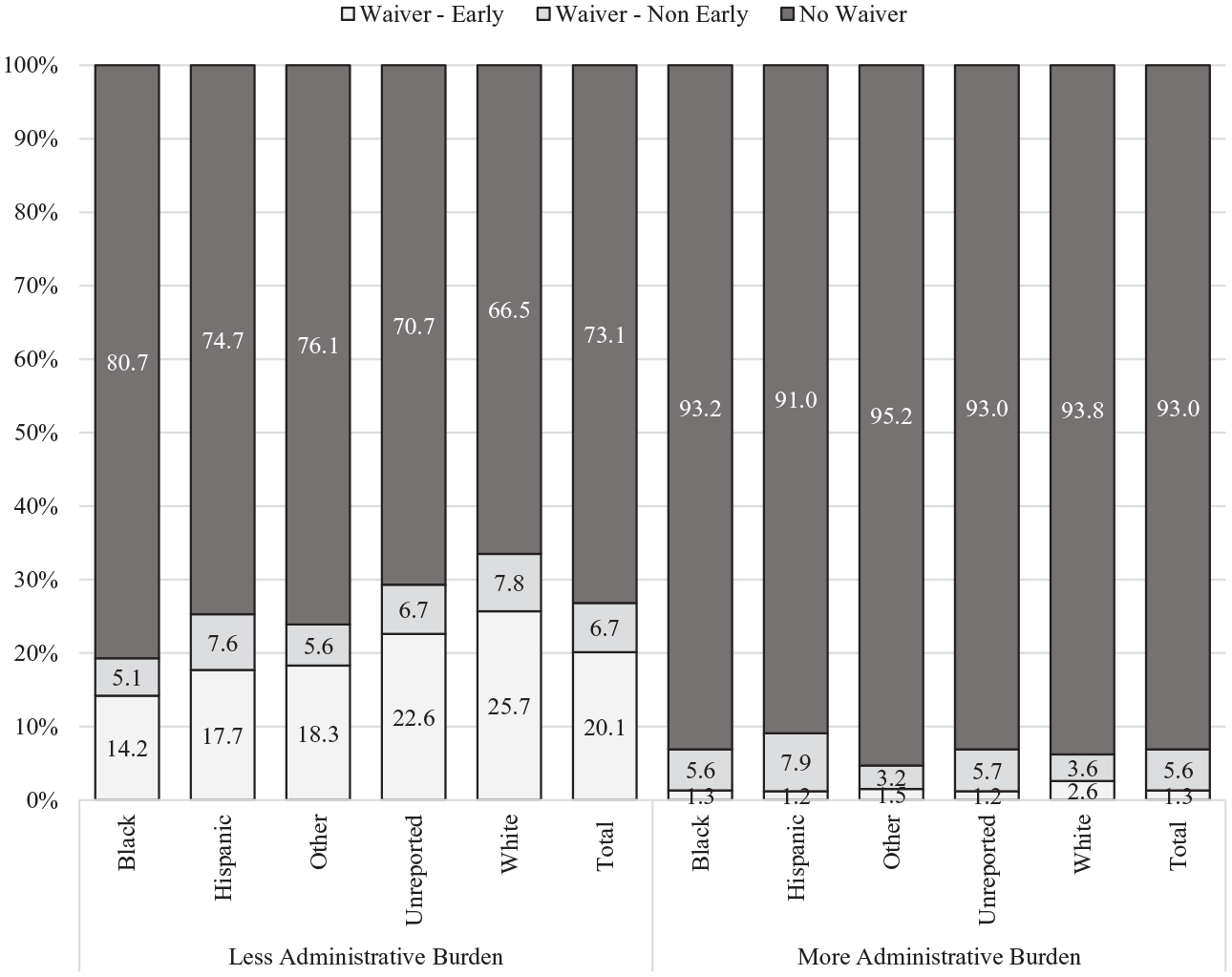
Shares of children enrolled in waiver-obtaining child care centers, by Race/Ethnicity and administrative burden level.
For children enrolled in WO centers, differences by administrative burden level in early waiver access were stark. Among children whose centers experienced more administrative burden, only 1.3% (n = 269) were enrolled in early WO centers. By comparison, 20.1% (n = 9,072) of children whose centers experienced less burden were in early WO centers. This finding suggests the additional learning and compliance costs Philadelphia-based centers experienced may have significantly delayed their waiver receipt. This pattern in early waiver obtainment extended across racial groups. For example, only 1.2% (n = 35) of Hispanic children whose centers experienced more burden were in early WO centers, compared to 17.7% (n = 1,438) of Hispanic children whose centers experienced less burden.
Within administrative burden groups, differences between racial groups were significant. Among children whose centers experienced less burden (χ2(4) = 839.57, p < .001), White children were the most likely to be enrolled in a WO center (33.5%; n = 6,037), while Black children were the least likely (19.3%; n = 2,704). And, a significantly greater share of White children (25.7%; n = 4,638) were in early WO centers, compared to Black (14.2%; n = 1,992) and Hispanic (17.7%; n = 1,438) children. Among children whose centers experienced more administrative burden (χ2(4) = 32.45, p < .001), Hispanic children (9.0%; n = 270) were significantly more likely than Black (6.8%; n = 903) and White children (6.2%; n = 78) to be in a WO center. In terms of early waiver obtainment, White children (2.6%; n = 33) were significantly more likely than Black (1.3%; n = 166) and Hispanic children (1.2%; n = 35) to be enrolled in a WO center that reopened early. These descriptive estimates of waiver obtainment show Black children were less likely than White children to be enrolled in a WO center, regardless of the level of administrative burden their center experienced.
Examining these data in terms of enrollment counts, in addition to percentages, shows that Black children composed an overwhelmingly large share of the children whose centers experienced more administrative burden. Of the 19,992 children whose centers experienced more administrative burden, 13,269 (66.4%) were Black, 1,264 (6.3%) were White, and 2,993 (15.0%) were Hispanic. By comparison, of the 45,032 children whose centers experienced less burden, 14,008 (31.1%) were Black, 8,138 (18.1%) were Hispanic, and 18,020 (40.0%) were White. Put another way, 48.5% of all Black children in the sample were enrolled in centers that experienced more administrative burden, compared to 6.5% of all White children and 26.7% of all Hispanic children.
Variation Between and Within Locales
To better understand whether differences in children’s enrollment in WO centers by administrative burden level were driven by factors unique to Philadelphia, I compared measures between children living in Philadelphia and those in locales with like characteristics where administrative burden was less. Specifically, I examined WO and early WO enrollments among children living in urban zip codes outside of Philadelphia and those living in counties where closure directives were lifted on the same date as Philadelphia. Counties that experienced the same duration of mandatory closure as Philadelphia had comparable virus transmission rates and similar levels of resources related to virus mitigation, factors that may have influenced providers’ reopening decisions. 6 Structural and demographic factors related to urbanicity (e.g., poverty concentration, political affiliation) may also have influenced providers’ ability and/or interest in reopening early.
Among children of all races, the rate of enrollment in WO centers in Philadelphia (7.4%) was far lower than the rates among children in other urban zip codes (21.3%) and other counties with the same mandatory closure duration (21.2%; see Table 3). Likewise, a far lower share of children enrolled in WO centers in Philadelphia were in early WO centers (25.5%), compared to children in other urban zip codes (79.5%) and counties with the same closure duration (79.5%). This strikingly large gap in enrollment in early WO centers strongly suggests conditions unique to Philadelphia—such as additional administrative burden in the waiver application process—contributed to substantial delays in waiver obtainment.
Children’s Enrollment in Waiver-obtaining Child Care Centers, by Child Race/ethnicity and Locale.
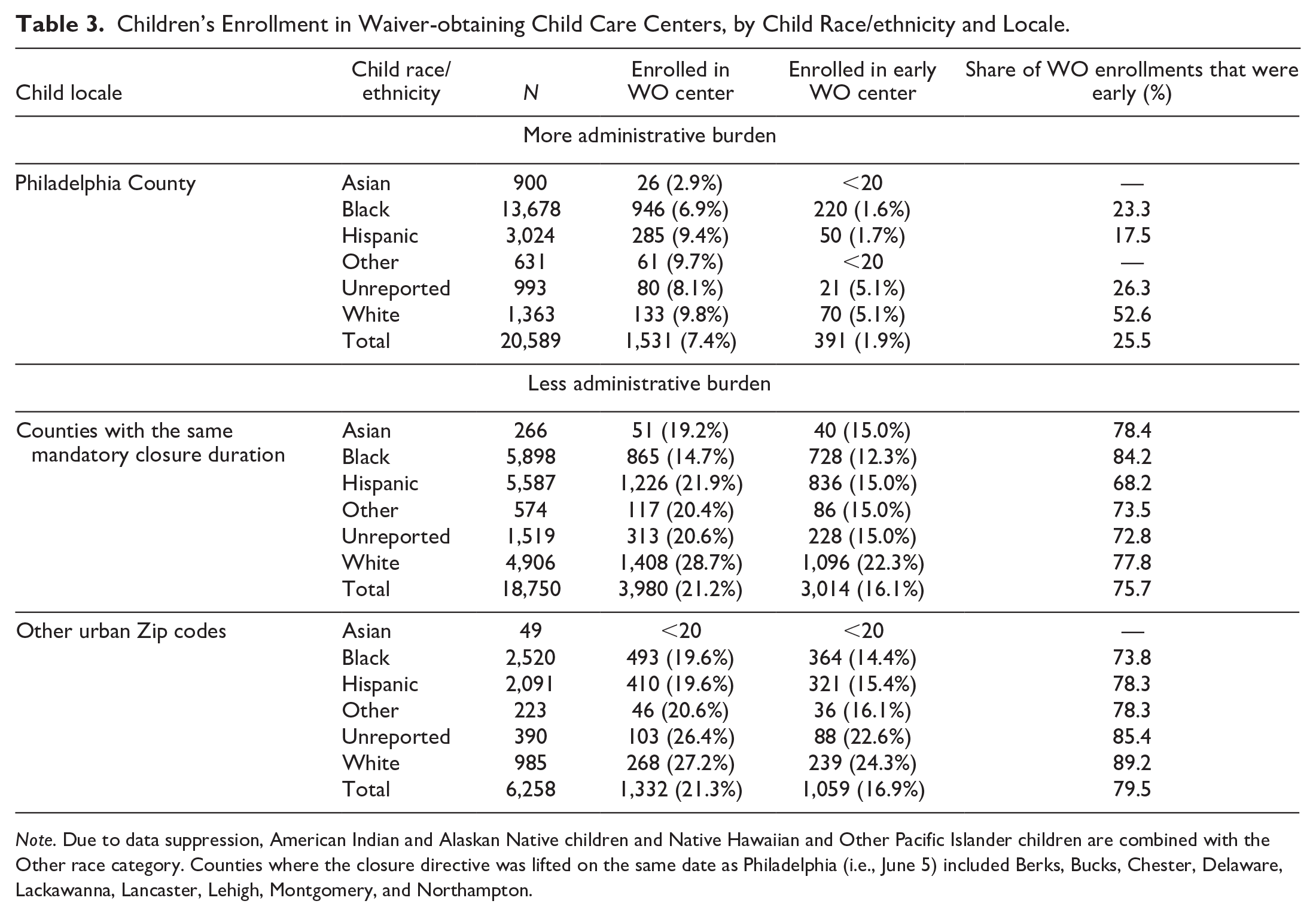
Note. Due to data suppression, American Indian and Alaskan Native children and Native Hawaiian and Other Pacific Islander children are combined with the Other race category. Counties where the closure directive was lifted on the same date as Philadelphia (i.e., June 5) included Berks, Bucks, Chester, Delaware, Lackawanna, Lancaster, Lehigh, Montgomery, and Northampton.
Looking at racial differences within groups, Black children in urban zip codes outside of Philadelphia were less likely than White children in those same locales to be enrolled in a WO center (19.6% vs. 27.2%). Black children in counties with the same mandatory closure duration also experienced a significantly lower rate of enrollment in WO centers (14.7%) compared to all children (21.2%), and especially when compared to White children (28.7%). However, Black children experienced the highest rate of enrollment in early WO centers (84.2%) of any racial/ethnic group among children in those counties. These findings suggest child care centers serving Black children may have been more cautious in seeking waivers, 7 but those that did were largely able to obtain them early, especially in communities where viral spread was high. These relatively high rates of enrollment in early WO centers in counties with the same closure duration as Philadelphia—among all children, and among Black children in particular—further underscore the starkly low rates of enrollment in early WO centers in Philadelphia, again implicating the potential delaying effect of additional administrative burden.
Associations Between Waiver Obtainment and Child Care Center Characteristics
Descriptive results showed Black children and children whose centers experienced more administrative burden were significantly less likely to be enrolled in a WO center. Through center-level analyses, I tested whether these observed differences were explained by other factors that could have influenced centers’ waiver obtainment and that differed between Philadelphia County and other counties in Pennsylvania. These factors included child care centers’ community poverty level, community racial composition (% White residents), Covid-19 case rate, quality rating, and capacity.
Access to resources that supported safe reopening (e.g., lower teacher-child ratios, administrative support, teachers’ access to health insurance), may have impacted child care centers’ decision-making around whether to apply for a waiver, as well as their ability to navigate the application process successfully (Herd & Moynihan, 2018). Evidence suggests child care centers located in high-poverty communities and in communities with greater shares of residents of color have access to fewer resources than centers located in communities with less poverty and more White residents (Bassok & Galdo, 2016; LoCasale-Crouch et al., 2007; Wright, 2011). A center’s quality rating can also be understood as an indicator of resource access (Cannon et al., 2017; Tarrant & Huerta, 2015). Safety guidelines related to social distancing and quarantining may have been easier to meet for larger centers with greater capacity, potentially increasing the likelihood that such centers would apply for a waiver. Local case rates may also have been a factor in whether or not centers chose to apply for a waiver, with centers located in counties with lower transmission rates potentially feeling safer opening their facilities.
Mean differences in these variables between child care centers in Philadelphia and those in other counties were significant. Centers in Philadelphia were located in communities with significantly higher shares of concentrated poverty and significantly lower shares of White residents than centers located in other counties (Table 4). Centers in Philadelphia County also had significantly less capacity and earned significantly lower quality rating scores, on average, compared to centers in other counties. Moreover, the Covid-19 case rate in Philadelphia County was significantly higher than the average case rate in other counties.
Mean Comparisons of Child Care Center Characteristics and Their Contexts.

***p < .001.
I estimated two binary logistic regression models to determine whether administrative burden level was associated with the likelihood of (1) waiver obtainment and (2) early waiver obtainment when controlling for relevant center characteristics. As shown in Table 5, administrative burden level contributed significantly to the first model. Child care centers that experienced relatively more administrative burden were less likely to obtain a waiver than centers that experienced less burden, with an odds ratio of 0.668. This represents a 33% decrease in the odds of a center obtaining a waiver when they experienced more versus less administrative burden, and suggests the presence of greater administrative burden may have deterred some centers from attempting to reopen prior to the lifting of closure directives.
Logistic Regression Models Predicting Child Care Centers’ Waiver Obtainment.

p < .05. **p < .01. ***p < .001.
Administrative burden level also significantly predicted early waiver obtainment. Child care centers that experienced more administrative burden were less likely to obtain an early waiver than centers that experienced less burden, with an odds ratio of 0.147. This result means there was an 85% decrease in the odds of a center obtaining an early waiver when they experienced more versus less administrative burden, controlling for other inputs. The sizeable difference in odds ratios between models suggests administrative burden had a greater effect on early waiver obtainment than overall waiver obtainment, further supporting the conclusion that additional learning and compliance costs contributed to significant delays in waiver obtainment for Philadelphia-based centers.
Notably, community racial composition (% White residents) significantly predicted both waiver obtainment and early waiver obtainment, even with administrative burden in the models. This result provides further suggestive evidence that centers serving children of color, both inside and outside of Philadelphia, were more cautious in their reopening plans and/or experienced greater barriers to reopening early.
In sum, these regression results show being located in Philadelphia County was significantly associated with lower odds of child care centers’ waiver and early waiver obtainment, above and beyond covarying factors like poverty and virus transmission. I posit this association was driven by the greater administrative burden Philadelphia-based centers experienced when applying for waivers. Put together with earlier descriptive findings, my results show Black children in Pennsylvania were less likely than their other-race peers to be enrolled in WO centers regardless of where they lived, and their concentrated residence in Philadelphia—where administrative burden was particularly high and access to WO centers particularly low—exacerbated these gaps.
Discussion
Summary and Interpretation of Findings
Stability in early care and education is critical to children’s healthy development and school success (Sandstrom & Huerta, 2013). The pandemic caused massive disruptions to children’s ECE, resulting in widespread facility closures that negatively impacted children’s socioemotional, behavioral, and academic development (Grimm, 2020; Hanno et al., 2022; Gassman-Pines et al., 2022; McGinty et al., 2021), outcomes that may have been disproportionately experienced by Black and Hispanic children (Cascio, 2021; Lee & Parolin, 2021). In Pennsylvania, waiver policies that permitted child care centers to remain open under closure directives were crucial for enabling greater ECE stability during a time of extreme stress and hardship. Because temporary facility closures resulted in revenue losses that threatened ECE providers’ long-term viability, waiver obtainment may have been a key lever for both short- and long-term ECE stability (Babbs Hollett, 2023; Bassok et al., 2020; Russell & Sun, 2022). However, the waiver application process was not uniform across the state, and was substantively more burdensome for ECE providers in Philadelphia, the most populous county in Pennsylvania with the largest number of children of color.
I found Black children were significantly less likely than White children to be enrolled in a waiver-obtaining (WO) center, and also far less likely to have a center that obtained a waiver soon after the application process was announced (i.e., an early waiver). Between- and within-group analyses showed rates of enrollment in WO and early WO centers were far lower among children whose centers experienced greater administrative burden (i.e., were located in Philadelphia), even when compared to children in locales with similar salient characteristics. Moreover, regression models showed administrative burden level significantly predicted center waiver obtainment, with odds ratios suggesting administrative burden had a particularly strong effect on early waiver obtainment. Altogether, I found Black children in Pennsylvania were significantly less likely than their other-race peers (and especially White children) to have access to WO and early WO centers regardless of where they lived, and disparities were driven by Black children’s concentrated residence in Philadelphia County, where the waiver application process was more burdensome.
My findings raise concern that as the frequency of disasters increases due to climate change and globalization, Black students may experience greater disruptions to their education due to their concentrated and segregated residence in communities where the risk of disaster exposure is greater (Rothstein, 2017; Tierney, 2019). Racial disparities in access to schools with functioning heating, ventilation, and air conditioning systems (U.S. Commission on Civil Rights, 2018), as well as other school-based resources like trauma counselors and school nurses (Gratz et al., 2021; Weber, 2022), underscore the existing vulnerability of many of the schools that disproportionately serve Black children to withstand future crises. These vulnerabilities mean such schools may have to rely more upon government programs and policies to provide the resources necessary to avoid educational disruptions. Yet, as evidenced by this study and others, these resource gaps can be exacerbated by social and educational policies that, even when well-intended, are disproportionately burdensome for Black families and the schools, organizations, and communities that serve them (Duffy & Shaefer, 2022; Herd et al., 2023; Raker & Woods, 2023; Raker et al., 2020).
Contributions to the Literature
This study makes several contributes to the administrative burden literature. First, it adds to the growing body of work documenting associations between administrative burden and policy outcomes. It provides additional evidence of the distributive effects of administrative burdens, and their negative impact on racially-minoritized people and communities in particular. By examining an application process in the context of the pandemic, it adds to our understanding of how crises can exacerbate learning, compliance, and psychological costs and pose additional challenges for government agencies that must balance competing interests. This study also advances our nascent understanding of active versus passive compliance costs, as conceptualized by Pierce and Moulton (2023). In particular, the stark differences by administrative burden level in early waiver obtainment documented here underscore the consequential role passive compliance costs can play in the distribution and timely receipt of government resources.
My finding of the potential delaying effect of administrative burden on waiver receipt, combined with evidence that protracted closures resulted in lost revenue that negatively impacted centers’ business viability (e.g., Babbs Hollett, 2023; Bassok et al. 2020), introduces a new concept to the administrative burden literature—opportunity compliance costs. Borrowing from the economic theory of opportunity costs, which represent the potential benefit that is lost as a result of one alternative versus another, I define opportunity compliance costs as the benefits that are foregone as a result of compliance costs. In this study, opportunity compliance costs were the lost revenue and stress incurred while child care centers experienced compliance costs related to the Philadelphia Mayor’s Office approving their waiver application, costs that would not have been so great had the application process been less burdensome, as it was in other counties. The concept of opportunity compliance costs could be extended to other areas of the administrative burden literature, particularly in cases where government agencies have flexibility or alternatives in their approaches to administrative processes.
Additionally, this study joins other early care and education researchers in calling out the ways administrative burdens can affect ECE providers and, in turn, shape young children’s access to educational resources (Adams & Pratt, 2021; Bouek, 2023). In doing so, it helps advance our conception of ECE providers as valuable third-party brokers in the distribution of early care and education services. Understanding how third-party actors experience administrative burden is critical in processes that rely on these brokers for access to government resources (Yu, 2023), a topic that educational researchers may need to investigate further in areas where educational agencies are increasingly relying upon private contractors for service distribution.
Importantly, by examining pandemic safety policies, this study reinforces the concept that administrative burden can be both well-intended and differentially burdensome. Many policies investigated in the administrative burden literature have been criticized as being intentionally burdensome in order to exclude citizens from public assistance (e.g., Herd et al., 2023); such policies make it easy to apply the concept that administrative burden is designed. Yet, crucial to our understanding of administrative burden is the concept that, regardless of intent or evenness of outcome, administrative burden is a function of state choices (Herd & Moynihan, 2018). Even though policies implemented by the Mayor’s Office of Philadelphia were logical, well-intended, and designed to protect citizens, my findings suggest they significantly delayed waiver receipt, which resulted in longer periods of ECE closure for children in the city. Some may argue that was a reasonable tradeoff, yet, whether or not it was, the presence and impact of administrative burden remained. Recognizing that administrative burden can be well-intended, valid, necessary, and still burdensome and racially unequal is a key theoretical conception this study helps to reinforce.
Beyond administrative burden, by intentionally including child care subsidy recipients and licensed child care providers in my sample, I make an argument for the inclusion of child care within our conceptualization of education and for recognizing ECE providers as the educational professionals they are. Indeed, as many early childhood researchers and advocates have already argued (e.g., Haspel, 2021; National Scientific Council on the Developing Child, 2007), care is education and education is care, and educational outcomes will improve if and when that understanding is reified through educational research and policy.
Implications for Research and Policy
Results from this study underscore the importance of state efforts to reduce learning and compliance costs when possible, especially during times of crisis when resources are both highly constrained and urgently needed. They also suggest passive compliance costs (i.e., wait times) may be an especially important area for future policy attention and innovation. OCDEL’s waiver application process—with its minimal active compliance costs and no passive compliance costs—is an example of an application approach that may be especially effective when rapid rollout is necessary.
Simultaneously, this study highlights the tensions and tradeoffs policymakers face when their interests necessitate interactions between citizens and the state that involve administrative burden. Resources that support policymakers in recognizing and calculating the potential costs and benefits of these tradeoffs may be particularly useful, especially given evidence showing program administrators often underestimate the extent to which administrative requirements are experienced as burdensome (Aiken et al., 2023; Herd & Moynihan, 2018; Heflin et al., 2023). Education researchers can play a part in helping policymakers understand how administrative requirements shape children and families’ experiences of educational policies, as well as the effectiveness of those policies, especially within the context of institutional racism. To this end, more research is needed in the field of educational policy on the presence, scope, and impact of administrative burdens on access to educational opportunities at all levels PK-postsecondary. Studies that examine the interacting roles of local, state, and federal agencies in administering educational resources and programs—and the frictions that occur among agencies in addition to those that occur between agencies and students—may be especially salient to the United States’ educational policy context.
Footnotes
Declaration of Conflicting Interests
The author declared no potential conflicts of interest with respect to the research, authorship, and/or publication of this article.
Funding
The author received no financial support for the research, authorship, and/or publication of this article.
