




Abstract
Just as illness can sometimes heal us, some have speculated an unexpected silver lining of COVID-19 may be an invigoration of a prosocial vision as the ‘new normal’ necessitates new ways of thinking and doing things differently across society and in preschool. This article explores this and reports survey research completed with preschool practitioners post-lockdown across several locations in England and the USA. This repeated a previous survey we did in 2014 which found notable levels of ‘social distancing’ – that is restrictions in social connection between preschool practitioners and children and their parents in poverty. Yet, since 2014 with austerity and then COVID-19, the pressure, and need, for prosocial preschool systems to work flexibly and inclusively with children and families in poverty has never been greater. We report findings from our 2021 survey and raise some concerns in the context of COVID-19 recovery policies emerging across both countries post-lockdown.
Introduction
Preschool is identified as key across many countries to remediating the negative effects of child poverty. In early 2020 the emergence of the virus COVID-19 led to a global pandemic and widespread lockdown restrictions based on the idea of ‘social [physical] distancing’ to curb the spread of the virus and to prevent it overwhelming health systems. Closures and reduced access to early childhood education and care (ECEC) settings meant children experienced reduced physical and social contact and there is an emerging consensus this impacted disproportionately upon children in poverty. Within the early part of this article we discuss the pre-COVID ECEC context and argue an issue around ‘social distancing’ existed even before COVID. Throughout the article we refer to ‘social distancing’ to mean restriction in social connection between preschool practitioners and children and their parents/carers in poverty; rather than as a marker of physical distance. We completed a survey and interviewing in 2014 exploring ECEC practitioners’ views about the causes of poverty and how these related to their self-reported responses to poverty across England and the USA (Simpson et al., 2017, 2021). Below we briefly discuss this research and the issue of social distancing. We discuss how since 2014 deteriorating socioeconomic contexts, including austerity measures, have meant preschool has increasingly been obliged to take on a greater social focus alongside early education. As the COVID-19 pandemic has followed, we note speculation this will add further to ‘social consciousness’ within preschool.
We then move on to discuss our repeated survey in locations across England and the USA, completed in 2021 in the post-lockdown context. Details of our methodology are given below, findings are reported and discussed, before conclusions are drawn. We gathered preschool practitioners’ beliefs about the causes of poverty and compared what we found in 2021 to our earlier study. We explored measures of poverty belief and poverty sensitivity as two main predictors of interest. Based on our previous research, we hypothesised that across English and US contexts a higher level of belief that poverty is caused by situational factors, as opposed to individual, factors and higher levels of poverty sensitivity, would both correspond with a greater awareness of the struggles experienced by children exposed to poverty. We also predicted that both of these variables would be associated with more sensitivity to the special challenges posed by the COVID-19 pandemic for children living in poverty, as well as a greater desire to keep children in ECEC settings during the crisis, promoting social inclusion rather than social distancing.
Preschool – pre-COVID
During the opening decades of the new millennium the context in both England and the USA was one in which neoliberal polity, ideas and governance strongly shaped preschool policy and practice, particularly around response to poverty. Framed by a dominant deficit discourse of poverty as resulting from the negative behaviours of individuals and families (Owen, 2019; Wilinski and Morley, 2021), across both countries successive federal and state level governments prioritised ECEC as key to remediating the negative effects of poverty and as a means of achieving ‘high returns’ (Moss, 2014: 2–3) via preschool practitioners working with both children and parents in poverty. This has centred upon eliminating the poor’s alleged deficiencies and what they lack to build their human capital (particularly emergent literacy and numeracy (Penn, 2011: 108)), support their performance-centred school readiness and ultimately produce ‘homo economicus’ (Roberts-Holmes and Moss, 2021: 96). The way ECEC responds in this way has been powerfully controlled and there was a shaping of what ECEC is delivered, how it is delivered and the timing and pace at which it is delivered. There was also an attempt to cement deeper notions about what knowledge is valuable in this process, ‘what works’ and why – for example via Education Endowment Foundation’s Early Years Toolkit in England and via early intervention programmes across the USA (Wilinski and Morley, 2021: 5).
It was within the above context we consulted preschool practitioners in 2014 across England and the USA about their work with poverty. We found a heavy emphasis on the ‘what works’ agenda prioritising performance-related school readiness, ‘reducing the attainment gap’ and ‘helping parents to parent’ via ‘doing to’ pedagogical approaches. Moreover, we found in pursuing this agenda preschool practitioners downplayed the everyday influence of socio-economic factors in children’s immediate lives. There was an organising out of ‘the social’ in practice. A minority of practitioners we consulted in 2014 expressed confliction about this situation. But many did not question the central overarching emphasis upon ‘what works’. This included its influence upon issue prioritisation attached to the overarching focus upon performance and attainment, and its obscuring of the everyday socioeconomic realities in impoverished children’s lives which make raising their attainment extremely difficult. We also found evidence of deficit-based discourse, othering and some practitioners disassociating and socially distancing themselves from parents in poverty. This negative thinking presented a threat to the important parent-child-practitioner triangle in the early years.
Preschool and ‘the social’
What we observed in our earlier research linked to what others were finding at the time (e.g. Ang, 2014) and is part of a trend acknowledeged across education systems. Neoliberal polity’s influence upon the overall direction of education policies in many countries has been to standardise and restrict pedagogical repertoires (Lupton and Hayes, 2021: 95). The concern is how in responding to poverty this means preschool settings have become ‘places first and foremost, for technical practice: places where society can apply powerful human technologies to children to produce predetermined outcomes’ (Moss, 2007: 7). Such neoliberal logics have stymied the professional judgement of early educators meaning they can make less of a difference, not more when responding to poverty, as relationship-based practice is restricted and any notion of a ‘social pedagogy’ is reduced. In 2014, as preschool was ‘drawn into the gravitational field of a powerful force. . . the ideology of neoliberalism’ (Roberts-Holmes and Moss, 2021: 1), we found a resulting blind spot in practice was the influence of ‘the social’ and evident was an increasing social distancing via practices focused upon attainment which organise out the voice of children in poverty and push ‘doing to’ rather than ‘doing with’ parental engagement.
There is evidence, however, that the social role of preschool settings in supporting children and families through the experiences of poverty and hardship has become increasingly necessary as a result of collapsing welfare systems, and austerity policies across both England and the United States. In both countries there have been reforms to welfare systems which have made life bleak for those facing poverty. There have been rises in working poverty and in food bank use and loss of supportive services in areas of high poverty (Alston, 2017, 2018). Preschool settings have increasingly been asked to adopt a more prosocial role to fill gaps in the ‘safety nets’ across both countries and to help children and parents struggling to remain resilient in challenging circumstances.
Consequently, it is claimed ‘social consciousness’ as a quality marker has become more prevalent across ECEC settings in the US as they are said to be increasingly addressing social problems and the ‘particularities of inequity’ while performing a key social role (Hernández, 2022: 797). Similarly, in England, ECEC settings were before COVID being identified as ‘community hubs’ and ‘front-line services’ (Hoskins et al., 2021) as they were increasingly being asked to step in and stop families in poverty falling through the cracks in the disintegrating welfare state (Early Education, 2020: ONLINE). Austerity and closure of specialist services in preschool designed to work with disadvantaged families also added to pressure on more general ECEC provision (e.g. see Smith et al., 2018). In both countries this work takes place in neoliberal polity and is a ‘bounded articulation of equity’ (Hernández, 2022: 797) with practices remaining controlled and ideas of a social pedagogy not relating ‘readily to the narrower concept of education currently dominant in the Anglophone world's discourse’ (Cameron and Moss, 2011: 13).
COVID-19 lockdowns and preschool
With COVID-19 the social role of preschool became even more necessary. Throughout lockdowns some preschool providers remained open and staff within them risked their lives each day to provide an essential social role and services beyond education to the children of essential/key workers and vulnerable children that attended (some vulnerable children didn’t attend, although they could). During this extremely difficult and stressful time ECEC practitioners were helping hold together society’s social fabric, performing essential nurturing care, mobilising local responses, supporting local networking, dealing with bereavements, addressing mental illness and calming anxieties of disadvantaged children and parents while also supplying food in local neighbourhoods to those most in need etc. This role was identified across the various locations from where practitioners were consulted for this research in 2021 (The North East, East Midlands and South East of England and Florida and the Mid-West (Ohio, Indiana and Kentucky) in the USA).
In England a first COVID lockdown occurred on March 23rd 2020, but from 20th March preschool settings were closed to most children, except children of key workers and vulnerable children. Although figures are not definite, it appears around half of nurseries in England remained open during this lockdown – for instance, across Staffordshire ‘55% of providers were open in the first lockdown from March to June 2020’ (Staffordshire County Council, 2021: 6). All preschool settings in England were exempt from a second lockdown imposed in January 2021, but levels of attendance reflected a caution amongst parents (Hobbs and Bernard, 2021: ONLINE). Across the US, the response to COVID-19 (e.g. ‘stay-at-home orders’ (SAHOs)), mask mandates and states of emergency) and closure of ECEC settings were determined by state, county and even city and could vary. Within Ohio, Kentucky and Indiana all SAHO started towards end of March 2020 and had ended by June 15th 2020, with some child care providers allowed to stay open for parents working on the frontlines of the crisis in each state. (Indiana Early Years Advisory Committee, 2020). In Florida the SAHO started on April 3rd 2020 ending 30th April, with childcare facilities exempt from it as long as Centre for Disease and Control guidelines were followed alongside a small number of mandatory actions (The Children’s Movement of Florida, 2022; ONLINE).
Emerging evidence reveals these lockdowns and changes in access to ECEC have impacted many children in a number of ways, with a social divide evident. Areas where impact has been noted include children’s social, emotional and behavioural development, their mental health, physical development, learning loss and reduced school readiness. It is reported how children in England have experienced the pandemic differently, with acknowledgement ‘negative impacts on children’s development and mental health from changes in access to ECEC are more likely for disadvantaged children’ (Hobbs and Bernard, 2021; ONLINE). A similar social divide has been observed in the USA, with concerns the pandemic exacerbated already existing inequalities between social classes, intersecting with race (Fortuna et al., 2021: 443). These lockdowns have also impacted the ECEC sector meaning financial difficulties, permanent closures of settings and reduced numbers etc.
Emergence into a ‘new normal’?
Despite these unprecedented challenges and negative impacts, there has been speculation that responses to the virus will lead to a wider reassessment of the social contract across contemporary societies and a better future may be a silver lining. There is conjecture that the COVID-19 crisis will allow societies and their populations to step away from what has been accepted dogma and to see social problems in a wider context. Humans are social beings, and as the virus restricted our instinct to be social it brought into clearer focus inequality and equity issues. This, it is argued, had the potential to instil a new neighbourliness and greater recognition of our connections to one another and the need to break down social division and social distancing. For instance, Howard (2020: 21) contends, ‘alongside the suffering and dislocation’ of COVID, ‘a huge window of opportunity has opened to leverage the best of the present into a future that works for all’ – with a particular ‘centre around care which has been irrupting back into the mainstream of public and political life’. In a similar vein it is argued ‘the pandemic has been an opportunity for both learning and unlocking potentialities toward innovative solutions’ and will act as ‘a springboard for the coming together of school communities and educational stakeholders to achieve commonly upheld targets’ (Themelis and Tuck, 2022: 156), thus reducing othering and social distancing.
As COVID restrictions eased and lockdowns lifted, the 'new normal' has certainly witnessed intensified challenges facing ECEC practitioners responding to poverty. Preschool has been placed as central to the COVID recovery arrangements emerging in both England and across the USA. The Office for Standards in Education has described the English ECEC sector as a ‘specific strategic focus’ in responding to ongoing issues resulting from COVID (OFSTED, 2022: ONLINE). The Department for Education has committed resources to an Early Years Recovery Package designed ‘to deliver high quality teaching and address the impact of the pandemic on the youngest children, with a focus on the most disadvantaged areas’. In March 2021, the American Rescue Plan (ARP) Act, a $1.9 trillion COVID-19 relief package, was launched. This included $39 billion dedicated child care relief funding designed to help stabilise the child care sector across the US. As preschool became key to recovery, our survey sought to explore evidence for a ‘new normal’ and realignment in ECEC practitioner thinking, particularly in regard to prosocial attitudes and responses to poverty.
Methodology
Our 2021 study involves a quantitative survey strand and findings from this are reported below. In general, our 2021 survey and data collection was a fairly direct replication of our previous 2014 survey (Simpson et al., 2017). As the 2021 data collection occurred in the context of the COVID-19 pandemic, though, we added some related items mentioned below.
Participants
Participants were pre-school/pre-K educators from England and the USA. Initially, 153 US respondents and 148 respondents from England participated in the study. However, 12 US participants and 29 English participants were excluded for either (a) failing to complete a substantial portion of the survey or (b) providing no demographic information. These exclusions yielded a final sample size of 260 (US = 141; England = 119). Across England the respondents were drawn from local authorities from the South East (Hampshire, East Sussex and West Sussex), the East Midlands (Northamptonshire, Derbyshire and Leicestershire) and the North East (Tees Valley, Durham, Tyne and Wear and Northumberland). The English-based respondents were not differentiated by region as part of the analysis. The US respondents were drawn from two locales: Florida (n = 43) and the Midwest (Ohio, Kentucky and Indiana; n = 80). In addition, 18 US respondents did not indicate their geographical region.
Participants across the combined sample were overwhelmingly female (n = 250). The mean participant age was 42.43 years (SD = 11.31; range = 19-68). On average, respondents reported 14.75 years (SD = 9.34) of experience working within ECEC, including an average of 7.26 years (SD = 6.58) at their current ECEC setting. Participants also reported their educational background. In the US the following pattern was observed (expressed in percentages of the sample: High School = 3.4%; Some College = 7.1%; Associates = 29.8%; Bachelors = 38.3%; Masters = 14.9%; Ph.D. = 0.7%; Did Not Respond = 5.7%. In England, the results were as follows: GCSE = 4.2%; A-Level or equivalent = 12.6%; Foundation Degree = 17.6%; Bachelors = 41.2%; Masters = 15.1%; Ph.D. = 4.2%; Did Not Respond = 5.1%.
Data collection
The data collection took place during 2021, and ethical approval for the data collection was gained from all participating institutions. The COVID-19 pandemic was a dominant societal phenomenon during the entire data collection period, but as indicated earlier, initial lockdowns were eased for ECEC in all the areas from where data were drawn in both countries by the time the survey was completed. During this time, although some settings across areas were in session (in person), others were not. This situation made data collection challenging and resulted in a more flexible approach to participant recruiting than is common, as documented below. Prospective participants were informed of our study involving preschool educators’ beliefs and opinions regarding poverty. Participants were reached via emails to individual school administrators, general social media network postings and through personal networks of educators. Although these methods do not allow a meaningful calculation of response rates, our intent was not to collect a representative sample. Instead, we hoped to achieve a reasonably diverse sample of a sufficient size to explore our research question. We believe that our final sample met both conditions adequately.
Participants completed the survey via Qualtrics. All participants first provided informed consent. They were assured that their responses would remain private and were also informed that they were free to skip items if they chose. Participants then completed the battery of scales described in the following section.
Data analysis
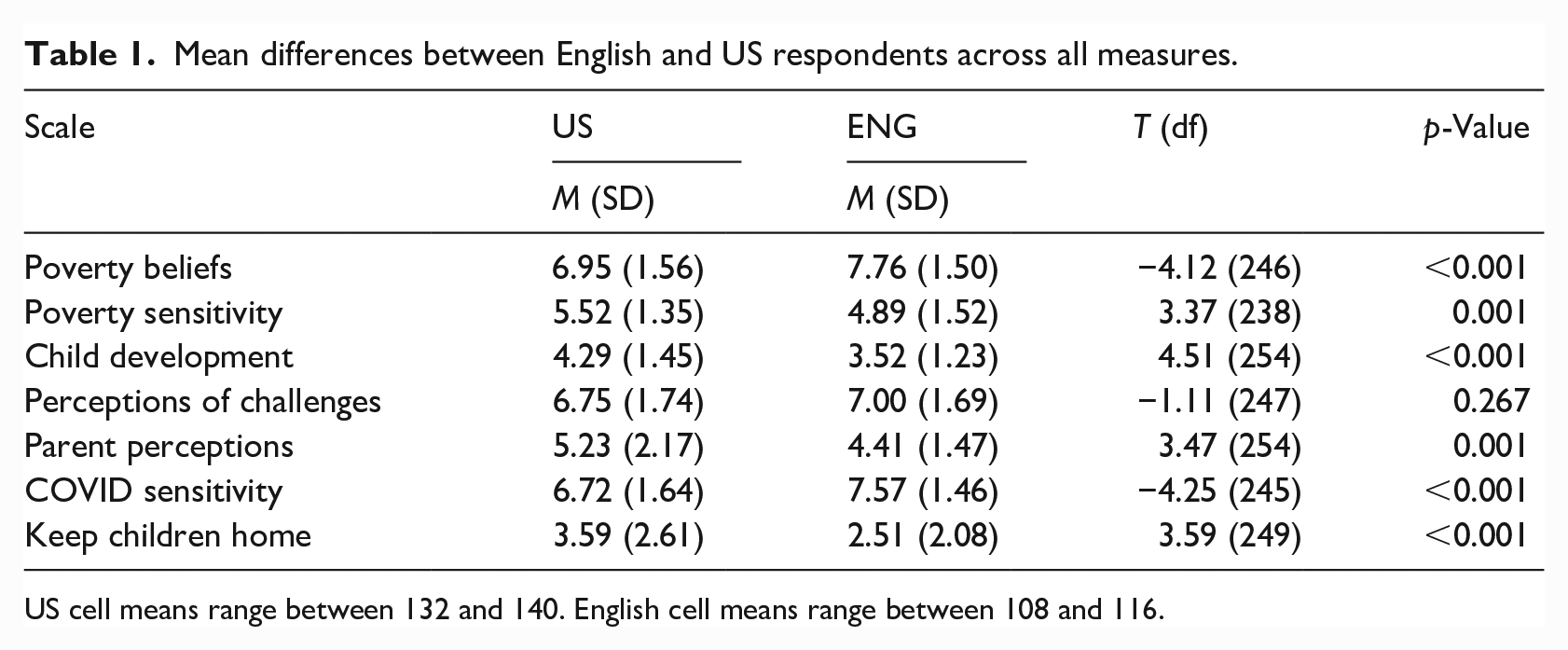
The quantitative questionnaire was constructed with several blocks covering seven themes of interest. It started with a block considering the theme beliefs about the causes of poverty and moved on to other themes listed in Table 1. These included: Child development; Perceptions of challenges connected to children in poverty; Poverty insensitivity; and Practitioners’ perceptions of parents. All these five themes were included in our 2014 survey. We than added two further themes to the 2021 survey – a theme we are calling COVID sensitivity and another called Keep children home. Each is explained a little more below. Each theme contained several statements and respondents were asked to indicate the extent to which they disagreed or agreed with these statements on a scale from 1 to 10. For purposes of the analysis, the statements under each theme were then combined and averaged into a composite measure under each theme. The reliability coefficient (α) indicated a good level of inter-item consistency across statements under each of the seven themes. A series of t-tests were then undertaken to determine US/US differences and interconnections between the different scales – particularly, between the Poverty Belief Scale and the Poverty Insensitivity Scale and the others.
Mean differences between English and US respondents across all measures.
US cell means range between 132 and 140. English cell means range between 108 and 116.
Findings and discussion
US/English differences 1
As the results in Table 1 depict, we began with t-tests to examine and describe possible differences between English and US respondents across each of the seven composite scales of interest. Significant differences between the two countries were obtained for each composite scale with the exception of the Perceptions of Childhood Challenges scale. US participants were significantly more likely to view the root causes of poverty as dispositional (individual) than English participants. US participants also appeared to (a) perceive more positive child development among impoverished children, (b) be less sensitive to the challenges posed by poverty in general and (c) by the challenges posed by the COVID-19 pandemic to children living in poverty. US participants also tended to have more positive perceptions of the parents of these children and were more likely to agree with keeping children home during COVID. Although US participants also appeared to perceive challenges often associated with impoverished children to be less serious, this trend was not a statistically significant difference (p = 0.267).
Poverty Belief Scale
This 9-item scale included statements that attributed poverty to dispositional factors (e.g. ‘People who are exposed to chronic/generational poverty generally only have themselves to blame’.), as well as items that attributed poverty to situational factors (‘People living in poverty are typically not personally to blame for their situation’.). Participants responded to these items on a 10-point Likert scale (1 = strongly agree, 10 = strongly disagree). These statements were scored appropriately and then averaged into a composite such that higher composite scores indicated the belief that poverty is more due to circumstance and situation than individual/dispositional factors indicated by a low score on the scale (α = 0.83). The sample mean score on this scale was 7.31 (SD = 1.58). As indicated above, though, English respondents were more likely to indicate the root causes of poverty were rooted in situational factors and this was not something which had happened by chance.
When considering the qualitative responses from participants scoring more highly on the Poverty Belief Scale for situational causes of poverty in 2014 we had noted complexity – there was little mention of inequality attached to economic structural factors. Rather, open responses to the survey questionnaire and via interviews revealed how chief among situational factors were poor parenting and family/home environments. (Simpson et al., 2017). With our 2021 survey, again the open responses mentioned poor choices, decisions and behaviours of parents and even a suggestion poverty in countries such as England is not real:
US 9 - The children of parents that are living in poverty have to experience the economic consequences of their parents' shortcomings.
ENG 186 - If we compare poverty in other real poor countries, and disadvantages those children have, with the level of “poverty” in countries like UK; children here have more support and do not really know what real poverty is.
Within our 2021 survey, though, the open responses also contained noticeably more reference to financial issues (economic capital), labour market issues and access to support structures and opportunities:
US 51 - Since the pandemic families are focusing on how they will be able to pay their rent and feed their children. They do want their children to have an education but it is not their first priority at this time. Parents have to go to work so they are not able to stay at home and help their children with their schoolwork.
ENG 155 - The impact of COVID has been greater on those families living in poverty, they generally. . . have less access to support, are more likely to lose their job.
Indeed, there was recognition of how financial poverty is connected to a digital divide which during remote-learning contexts exacerbated existing problems and inequalities – and resulted in any attempts to get around social distancing via these technologies being thwarted:
US 111 - families in poverty can't afford extra things for their home (internet, T.V., Cable and so forth) how can we expect a family to get on a do virtual learning?
ENG – 54 - It has been an immense time of challenge for many families. . . Many have been unable to keep up with “online learning” due to lack of equipment.
COVID-19 recovery policies in both England and the USA are prioritising preschool and its work supporting disadvantaged children. As we conclude below, ongoing focus of these recovery policies upon economic imperatives means reinforcing pre-COVID alignment of early years with school to ultimately produce homo economicus and this raises issues. We return to this issue later. Post COVID lockdowns, however, there has never been a more urgent time for preschool systems to work flexibly and inclusively with children and parents in poverty. Practitioners’ who blame poverty upon the perceived negative values and behaviours of the poor are potentially creating barriers to this goal. Personal belief systems of practitioners, including those around poverty beliefs, are important to practice in the early years. Existing research reveals how families in poverty are often considered ‘hard to reach’ and research argues potential barriers in ‘how to reach’ are ‘alienating attitudes’ (Boag-Munroe and Evangelou, 2012: 214) and negative ‘deficit-based discourse’ (Owen, 2019).
Poverty Sensitivity Scale
These eight statements assessed sensitivity to childhood poverty in terms of perceptions of actions required on the part of the practitioner to meet the needs of children in poverty. Items either related to sensitivity (e.g. ‘I provide extra support to children living in poverty’.) or insensitivity (e.g. ‘I try to treat children living in poverty identically to other children’.). We considered not accommodating children with a stronger likelihood of higher needs a form of harmful insensitivity. Participants responded to these items on a 10-point Likert scale (1 = strongly agree, 10 = strongly disagree). The items were scored appropriately and then averaged into a composite such that higher composite values indicated higher levels of poverty insensitivity (more poverty blindness; α = 0.60). The overall sample mean score on this scale was 5.24 (SD = 1.46). Although there was a significant difference across the US and English respondents, the average scores for both countries were close to the central scale point, indicating a level of neutrality when it came to agreeing, or not, with actions required. Indeed, there were some interesting responses to the open question which highlighted a notion of treating all children ‘the same’ – a similar discourse was evident in our 2014 survey responses:
US 48 - Teach and treat children with the same care and motivation. They are all important and the same.
ENG 46 - I don’t feel the pandemic has effected these families more than before, as the parents of those families tend to be at home anyway and the children in these types of families tend to be low attenders
Clearly some practitioners in the sample downplayed the importance of poverty and its potential impact upon children. These practitioners failed to grasp what is evident in the aftermath of the COVID-19 pandemic, namely its impact has hit the poorest hardest and is characterised by a social divide. This stance demonstrates complexity reduction, a potential shortcoming in responding to COVID’s impact.
Child Development Scale
Seven items assessed our ECEC participants’ perceptions of child development among children living in poverty in comparison to those not in poverty (e.g. relating to emotional development, motor skills, ability to stay on task, etc.). Participants responded to these items on a 10-point Likert scale (1 = below average, 10 = above average). These items were averaged into a composite where higher composite scores indicated perceptions of more positive development in children dealing with poverty (α = 0.87). The sample mean score on this scale was 3.94 (SD = 1.41), meaning that participants as a whole tended to be pessimistic about the development of children in poverty with recognition poverty is a risk factor in impeding their optimal development relative to their peers not facing poverty. This made comments about treating children in poverty ‘the same’ as their peers more concerning.
We know children in poverty are more likely to have additional needs requiring extra support in several areas including socioemotional development, education, health, security – certainly in the post-lockdown context (Fortuna et al., 2021; Hobbs and Bernard, 2021). Being insensitive to this while suggesting children are ‘the same’ is therefore problematic for policies responding to a pandemic which has impacted most significantly on poorer children and families. Such a view raises a need for sensitivity training as part of recovery policies.
Perceptions of Childhood Challenges Scale
These seven items involved asking practitioners the extent to which they agreed various challenges might be associated with pre-school children living in poverty (e.g. ‘Behaviour Problems’, ‘Absences from Preschool’ and ‘Difficult Home Environments’). Participants were asked to consider children in poverty when responding to these items and responded on 10-point Likert scales (1 = Less than a typical child, 10 = More than a typical child). These items were averaged into a composite such that higher scores indicated greater struggle/need for children in poverty (α = 0.86). The sample mean score on this scale was 6.87 (SD = 1.72) and, as noted above, it was the only scale upon which there was not a significant difference between respondents across the two countries. Practitioners generally seemed to agree children in poverty present challenges compared to their more advantaged peers. The quite neutral response on the poverty sensitivity scale above is more surprising given the overall average under this scale. In policy terms it raises the ongoing necessity for development of reflexive preschool practitioners within the post-lockdown context.
Parent Perceptions Scale
These five items measured practitioners’ perceptions of the parents of children living in poverty (e.g. ‘Are responsive to communications’ and ‘Are engaged in child’s learning/development’). Participants responded to these items on a 10-point Likert scale (1 = strongly agree, 10 = strongly disagree). When responses to statements were averaged into a composite (α = 0.81) higher composite values indicated more positive perceptions regarding the parents of impoverished children. The combined sample mean score on this scale was 4.85 (SD = 1.92), with the English sample mean being 4.41, both on the more negative side of the scale. We have noted elsewhere how negative thinking of staff and ‘parent blame’ is a threat to the child, parent, practitioner triangle when working with the poor (Simpson et al., 2021), and can create and perpetuate social distancing:
US 20 - The only way poverty makes a difference in the classroom is the mindset of the parents.
ENG 53 - Parents seem to undervalue education and don't see it as a priority. Since the Covid19 pandemic parents were offered support through the availability of technology, materials and contact but those who could be classed as living in poverty engaged less than their peers. It has confirmed my views.
ECEC practitioners having ‘positive attitudes’ increases their levels of engagement with children and parents (Knopf and Swick, 2007; Ward, 2013: 13). While these negative views remained evident in our 2021 survey, though, it was interesting in the open responses how a small number of practitioners in both countries felt the COVID lockdown had actually helped them form closer relations with children and parents in poverty. This included the opportunity to devote more time to developing closer relationship-based practice, one-to-one, with disadvantaged children and also more frequent contact with parents reducing social distancing:
ENG 19 - We were calling to make sure they [parents and carers] had food and would drop it off if needed.
ENG 121 - Having vulnerable children in school has meant they have had more one to one support which has benefited their learning and confidence.
US 113 – Going online improved [things]. I was also to able to create a bond/ trust with the parents as we meet regularly.
COVID Sensitivity Scale
This final five-item scale assessed sensitivity to the challenges that COVID faced to children living in poverty (e.g. ‘Children living in poverty have experienced more negative impacts due to the COVID-19 pandemic’ and ‘I worry that children living in poverty will be especially at risk if they are not able to physically attend pre-school’.). Participants responded to these items on a 10-point Likert scale. When averaged into a composite (α = 0.56) a higher score indicated greater sensitivity to the impacts of COVID-19 on children living in poverty. The sample mean score on this scale was 7.11 (SD = 1.61), indicating many practitioners agreed with emerging evidence mentioned earlier that COVID has impacted children and families in poverty particularly negatively. There were, though, some responses which questioned this evidence:
US 130 - The effects of COVID-19 will effect children of poverty and children living above poverty. Children are resilient and when given a chance, opportunity with all needed resources and consistency they will thrive.
Two additional items were included along with this scale that assessed teacher’s preferences to keep children at home during the COVID-19 pandemic, or to continue with in person classes. These two items were highly correlated (r = −0.71), and hence combined into a composite with higher scores indicating a desire to keep children in poverty at home during the pandemic. As Table 1 indicates, in both countries there was mostly agreement amongst practitioners that children, wherever possible, should attend their settings during COVID.
Correlations across scales
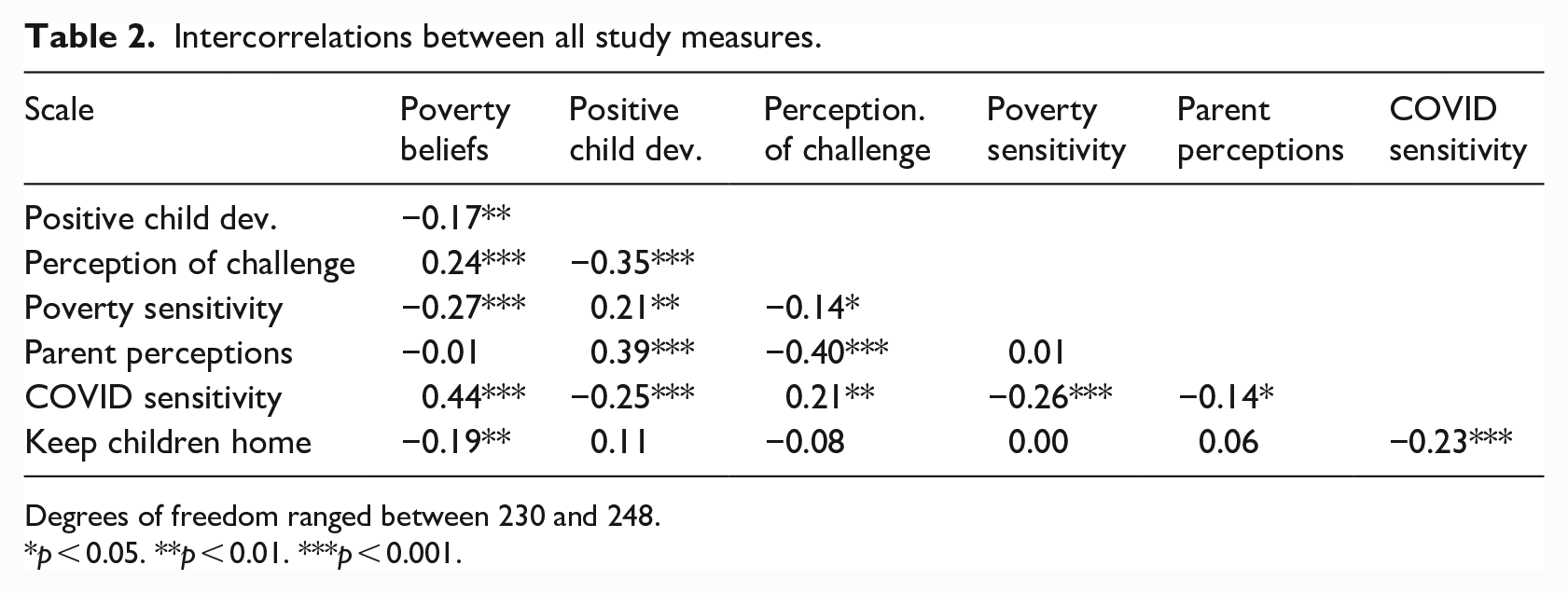
As Table 2 reveals, our key predictions mentioned in the introduction were confirmed via the data analysis and further testing.
Intercorrelations between all study measures.
Degrees of freedom ranged between 230 and 248.
p < 0.05. **p < 0.01. ***p < 0.001.
Correlation between the Poverty Beliefs Scale and all others 2
Correlational tests between the Poverty Beliefs Scale and all other variable were computed (see Table 2). In all cases but one—the Parent Perceptions Scale—significant correlations were observed. To summarise, those more likely to view poverty as situational or circumstantial in nature (a) had more negative perceptions of childhood development among impoverished children; (b) were more likely to agree childhood struggles associated with poverty are important; (c) were less likely to exhibit poverty insensitivity; (d) were more sensitive to the special challenges to children of poverty presented by the COVID-19 pandemic; and (e) were more likely to prefer that children kept going to school during the pandemic. All of these correlations were consistent with our a priori predictions.
Correlation between the Poverty Sensitivity Scale and all others
We also compared scores on the poverty sensitivity scale with all remaining measures (see Table 2). In a manner equivalent to that observed vis a vis the Poverty Beliefs Scale above, those with higher scores on the poverty sensitivity scale indicating greater poverty insensitivity: (a) had more positive perceptions of childhood development among impoverished children, thus downplaying poverty’s potential impact upon development; (b) were less likely to perceive childhood struggles associated with poverty; and (c) were less sensitive to, and in agreement about, particular challenges to children in poverty presented by the COVID-19 pandemic. All remaining correlations were nonsignificant (all p’s > 0.20)
These correlations and earlier data are interesting in the post-lockdown context. Although we, and others, refer to COVID-19 as a pandemic, it is also a ‘syndemic’ (Horton, 2020: ONLINE). A syndemic recognises a biological and social interaction and how COVID’s negative effects have clustered within social groups based upon patterns of inequality deeply embedded in our societies. The aggregation of these diseases (COVID and poverty) on a background of socioeconomic disparity across England and the USA has exacerbated the adverse effects of each separate disease – evidenced by the impacts of COVID upon the poor being more significant. This syndemic nature of COVID means post-lockdown policy responses in preschool need a nuanced approach which recognises the full importance of the social – particularly poverty and socioeconomic inequalities – if they are to have greater effect. It suggests those demonstrating greater recognition of poverty as caused by socioeconomic inequalities, while possessing greater sensitivity around the impact of these inequalities upon children’s lives, are better placed to meet the challenges faced by ECEC in the post-lockdown context. Our findings raise the importance for social leadership, bespoke sensitivity training and ongoing professional development of reflexive practitioners, resources including funding and pedagogical space.
Conclusions
Just as illness can sometimes heal us, some have speculated how an unexpected silver lining of COVID-19 and its syndemic nature may be the exposure of social inequalities and divisions leading to an invigoration of a prosocial vision as the ‘new normal’ necessitates new ways of thinking and doing things differently in preschool and beyond. There is conjecture this will lead to a greater determination to reduce social division, othering and social distancing. Comparing our survey in post-lockdown England and the USA during 2021 to our earlier 2014 survey, responses did reveal more support for poverty being situational and there were more references in open responses to socioeconomic (distal) issues attached to poverty and inequality and their influence on children and their families. These included income, working poverty, labour market issues such a unemployment, lack of opportunity structures and work insecurity which barely got a mention in 2014. Again in 2021 we found a belief causes of poverty are more situational (as opposed to individual), and levels of higher poverty sensitivity, were significant predictors of the extent to which practitioners recognised the struggles experienced by children exposed to poverty. We also found these two variables predicted participants’ sensitivity to the challenges posed by the COVID-19 pandemic for children coping with poverty.
But there is some way to go if a ‘new normal’ is to emerge. In 2021, as in 2014, poverty insensitivity among some respondents featured alongside some negative deficit thinking about parents in poverty. As noted, given that COVID is a syndemic, this will potentially hamper recovery efforts in the post-lockdown context via othering and social distancing. Some practitioners in our recent survey also advocated a ‘one size fits all’ response to poverty as they mentioned the importance of practice being ‘the same’ for all children. In meeting the needs of children in poverty post-lockdown, though, all children receiving ‘the same’ will be inappropriate if their needs are to be met – ‘fair is not always equal’ (Odegarrd, 2017: 6).
Tackling alienating attitudes and deficit-based discourses appropriately requires a nuanced policy focus, long-term funding and professional development support with time and space (Owen, 2019). But concerns about the focus of recovery policies are raised. It has become clear, practitioners engaged in recovery are expected to continue to place their focus in responding to poverty upon the ‘what works’ approach to building a form of school readiness (human capital) which prioritises attainment of certain key skills and the meeting of performance targets across England and the USA. As in pre-COVID years, children in poverty will continue to be positioned as atomised and datafied individuals who can be fixed via the appliance of science. Recovery policy in both countries also involves training provision, but prioritised is delivering the constant drive towards readiness for school, certainly not poverty sensitivity. As pre-COVID, a social model of the child will be downplayed. Practitioners’ power to influence this direction of travel by creating space to reorientate to a societal focus is questionable. Our findings support those championing a focus upon ‘social leadership’ (O’Sullivan and Sakr, 2022) and social pedagogy in the early years (Cameron and Moss 2011), both of which prioritise relationship-based practice while considering the whole child, the socially situated nature of their development and their present needs. However, the extent to which preschool through current recovery policies is going to prioritise the holistic needs of disadvantaged children – for instance, socioemotionally – is questioned (see Cooper, 2022: ONLINE).
Additionally, there is frustration around funding of ECEC delivery post-pandemic, as it is undertaken by a preschool sector described in England as ‘’shamelessly’ and ‘knowingly’ underfunded’ (Nursery World, 2021: ONLINE) and ‘at breaking point’ (Early Years Alliance, 2021; ONLINE). In 2021 Education Recovery Commissioner Sir Kevan Collins resigned from his post in England mentioning his frustration about inadequate funding being provided for recovery and a lack of attention being given to the early years, despite official rhetoric. Similarly, in the USA there is disquiet around recovery where ECEC is said to have been ‘navigating structural cracks and financial cliffs for decades’ (NAEYC, 2020: ONLINE). Financial limitations have meant reductions in practitioner-child ratios are being mooted. Rather than reducing the time adults have to spend with children, though, required is sufficient investment in children’s holistic development and sustained support for the preschool workforce allowing them to do more in completing this vital task.
Footnotes
Funding
The authors disclosed receipt of the following financial support for the research, authorship, and/or publication of this article: A British Academy/Leverhulme Trust Grant was received by Dr Donald Simpson to support the research reported in this article (Application SRG20\200451).
