




Abstract
Racially and ethnically minoritized (REM) children continue to face inequitable access and experiences to high-quality early care and education (ECE). However, there is a need to systematically examine whether REM children benefit from ECE, to what extent, and for what outcomes. A rigorous review process was used to systematically identify and review research studies aimed at improving outcomes for Black or other REM children. The screening process resulted in 89 articles deemed relevant for review. Results suggest significant outcomes with some differences in outcomes based on the primary racial/ethnic group. The implications for practice and policy are further discussed.
Vast evidence exists about the positive effects of early care and education (ECE), especially for children living in poverty; however, the evidence of impact is mixed from null to moderate findings (Karoly, 2016; Karoly et al., 2005; National Academies of Sciences, 2023). Most of the long-term effects of ECE have primarily been based on two seminal studies—the HighScope Perry Preschool Program and the Carolina Abecedarian Study—focused on predominantly Black participants living in poor households. The results of these two seminal studies show both short- and long-term effects, including college graduation, employment, stable household, and healthy adulthood (Belfield et al., 2006; Campbell et al., 2001, 2012; Campbell & Ramey, 1994; Heckman et al., 2010; Ramey & Campbell, 1991; Schweinhart et al., 2005; Schweinhart & Weikart, 1997). Furthermore, economic figures estimate the benefits of 10% to 20% return on investment based on every $1 invested (Heckman, 2006, 2011; Heckman et al., 2013).
With the growing racial diversity of the United States, with non-Hispanic, White children decreasing from 65.3% in 2010 to 53.0% in 2020 and children from racially and ethnically minoritized (REM) populations making up the majority of children in public schools (Jones et al., 2021) coupled with continued racial achievement gaps (e.g., K-12 academic performance, income inequality, and health disparities), it is urgent to attend to the impact of the ECE as a positive strategy for these groups of children. However, scholars using a critical race lens urge us not to “gap gaze” (Humphries & Iruka, 2017) but rather to attend to the role of opportunity gap in the achievement gap, among other things (Gardner-Neblett et al., 2023). The 2023 National Academic of Sciences, Engineering, and Medicine report, Closing the Opportunity Gap for Young Children, defines the opportunity gap as “the unequal and inequitable distribution of resources and experiences based on race, ethnicity, socioeconomic status, English proficiency, disability, immigration status, community wealth, familial situations, geography, or other factors that contribute to or perpetuate inequities in well-being across groups of young children in health, social-emotional development, and education. The achievement gap refers to the effect of the opportunity gap—disparities in academic outcomes and well-being among different groups of children” (p. Summary-5). Access, experiences, and outcomes stemming from ECE participation are viewed as potential remedies to the racial achievement gap (Iruka, Gardner-Neblett, et al., 2022; Khetani et al., 2017; Meek et al., 2020; Shonkoff et al., 2021). Thus, there is a need to explicitly examine if and how REM children benefit from participation in ECE interventions and programs, to what extent, and for what outcomes.
Literature Review
Countless pieces of evidence point to the short- and long-term benefit of high-quality ECE for young children, especially in environments with well-trained, supported, and compensated workforce that offer child-centered and enriching learning opportunities (Schoch et al., 2023). For example, Nobel Laureate James Heckman notes a 7% to 10% per annum return on every dollar invested in early childhood, primarily based on the HighScope Perry Preschool Study (Heckman et al., 2010). Beyond the seminal studies—Perry and Carolina Abecedarian—other local and national studies have generally shown positive effects for cognitive, language, socio-emotional, and executive function outcomes, albeit in the small to moderate range (Conti et al., 2016). However, small to null findings have been found in other studies, such as those involving pre-K and Head Start programs (e.g., Whitaker et al., 2023). For instance, in their review of the current state of pre-K effects, Phillips and colleagues (2017) state the following: “The evidence that does exist often shows that pre-k-induced improvements in learning are detectable during elementary school, but studies also reveal null or negative longer-term impacts for some programs…Studies that used research designs generally recognized as capable of generating valid effect estimates by conventional methodological standards have reported more variable findings” (pp. 26-27). Relatedly, evidence from the Head Start Impact Study found that children saw some boost in their academic skills at the end of the Head Start year, but the initials gains disappeared once the children started school, though varied based on program features and participant characteristics such as home language (Administration for Children and Families, 2010). Questions also abound about the fade-out effect (i.e., convergence or catch-up) (Bailey et al., 2020; McCormick et al., 2021). Several meta-analyses have been conducted looking at the impact of ECE on child outcomes (McCoy et al., 2017; van Huizen & Plantenga, 2018), with several showing specific benefits for some subgroups, such as children with two or fewer adverse childhood experiences (Hughes et al., 2017) and emergent bilinguals (Lowe et al., 2021). However, it is unclear the extent to which REM children are benefiting from ECE rather than a comparative lens examining racial differences in ECE or examining the “average” effect.
Theoretical Framework
Following the movement for racial equity in society stemming from the murder of George Floyd and other unarmed Black people, highlighting the racial injustice to this community and other REM communities, several industries, including the scientific community, called for more attention to the bias in the research enterprise (Iruka, Durden, et al., 2021, Iruka, Lewis, et al., 2021; Zulauf-McCurdy et al., 2024). There was a concern that much of the literature on children’s development was deficit-framed and devoid of context, especially the context of racism (Valencia, 2010; Zulauf-McCurdy et al., 2024). Within the early childhood realm, there was the recognition of the lack of attention to issues of equitable access, experiences, and outcomes with Black, Native, and Latine children not only less likely to have access to high-quality, culturally affirming practices (Allen & Hutton, 2023) but also least likely to benefit from these programs, maintaining the achievement gap (Zulauf-McCurdy et al., 2024).
In this paper, we leverage the tenets of critical race theory (CRT), which highlights the systemic nature of racism and the role of social institutions, such as the science enterprise, in creating and maintaining racial inequities (Crenshaw et al., 1995; Delgado & Stefancic, 2001). The tenants of CRT offer a framework for our paper by first focusing on rigorous studies on the impact of ECE where most children in the studies are from REM populations (i.e., Black, Native, Latine, and Asian), and second by taking a critical analysis of outcomes that emerged and for whom. For example, given the pervasive focus on the racial achievement gap, will most of the outcomes for Black and Latine children focus on reading and math, or a focus on language for Latine children who are likely to be and assumed to be emergent bilinguals (Allen & Hutton, 2023; Lowe et al., 2021). Using a criticality lens will allow us to uncover whether biases about what certain groups of children need may be implicated in the outcomes and benefits we attend to or find.
This study aims to conduct a rigorous review process, modeled after the stringent guidelines of the U.S. Department of Education’s What Works Clearinghouse (WWC), to examine whether ECE interventions yield benefits in outcomes for Black children and other REM children. REM populations are defined as historically and contemporarily REM populations, including those who identify as Black/African, Hispanic/Latine, Native American, Asian, and Native Hawaiian and Pacific Islander. Specifically, we examined the type, duration, and significant outcomes of ECE interventions targeted toward REM children. Furthermore, rather than looking at the REM population as a monolith, we examine whether and how each group, where they make up most of the sample (i.e., 65% or higher), benefitted from ECE. We will be using the terms intervention and program synonymously throughout this review.
Method
A rigorous review process modeled after the stringent guidelines of the U.S. Department of Education, Institute of Education Sciences (2023), What Works Clearinghouse (WWC) was used to systematically review literature from the last 30 years in the United States (i.e., 1991-2021). This allowed us to analyze the extent to which various interventions are effective specifically for Black children and other REM children rather than comparison to White children.
The study team worked with library specialists at the University of North Carolina at Chapel Hill, who specialize in systematic reviews, to identify rigorous research whose outcomes are disaggregated to provide results for REM children and where the study sample is at least 65% REM children. A search from eight databases resulted in 1405 studies. Immediately, 514 studies were removed as duplicates; 887 remained for title and abstract screening. We then utilized an innovative process of machine learning artificial intelligence (AI) developed by the Evidence for Policy and Practice Information Centre (EPPI-Centre) to assist in the review process of academic studies. An initial 110 studies’ titles and abstracts were reviewed by one research team member for relevancy and served as seeds for scoring the identified pool of studies. The criteria for determining relevance included focusing on research studies that examine approaches aimed at improving outcomes for Black or other REM children, published within the last 30 years, with samples and outcome categories aligned with the specified populations and available in English. Study design criteria included experimental and quasi-experimental methods, such as randomized control trials, quasi-experimental designs (with baseline equivalence), single-case designs, and regression discontinuity with random assignment. Exclusions included studies on intervention implementation, literature reviews, meta-analyses, unimplemented study protocols, and studies with confounding factors. The AI machine learning model was applied to the remaining 777 articles, predicting the relevance of each article with scores ranging from 0 = not relevant to 6 = very relevant. This approach is supported by previous research on active learning algorithms and their efficacy in streamlining screening processes (Miwa et al., 2014). One reviewer then screened all 887 studies, beginning with the most relevant and progressing to the least relevant. From this review, 510 articles were found to be irrelevant, resulting in 377 articles progressing to full-text review. To conduct the full-text review, at least two reviewers reviewed each of the 377 articles. All conflicts between reviewers were resolved by the senior researcher. This process resulted in 89 articles being selected as highly relevant for inclusion in this study (see Figure 1, PRISMA flow diagram for the process that led from the initial search yield to the final articles identified as meeting criteria for full extraction). PRISMA flow diagram.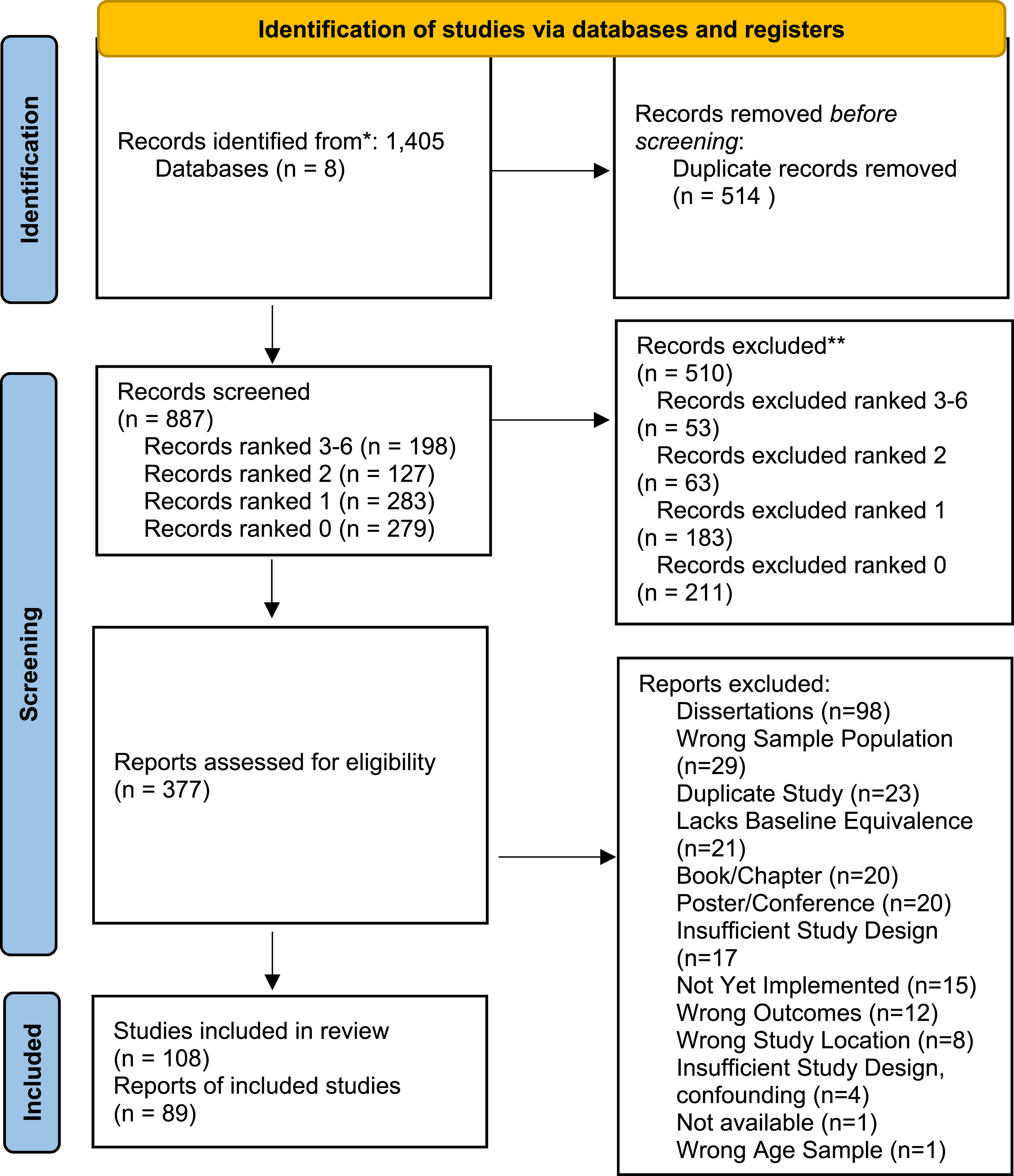
Data Extraction and Coding
We used Microsoft Excel to organize the following variables of interest and to conduct the coding. The coding protocol summarized the following for each study: (a) year of publication, (b) study purpose, (c) study design, (d) content domain of the intervention, (e) race and ethnicity of participants, (f) gender of participants, (g) age of participants, (h) income level, (i) education level of participants’ parents, (j) inclusion criteria, (k) method of recruitment, (l) categories of outcomes measured, and (m) measures used. Two graduate research assistants independently coded the data from each article. 20% of the articles included were double-coded. When there were conflicts between coders, a senior researcher, the first author of this paper, was the decider.
Findings
Description and Percentage of What Works Clearing House Intervention Types
Summary of Articles for Systematic Review.

Note. NA = Not Available.
Description and Percentage of What Works Clearinghouse Intervention Types Across Reviewed Studies.
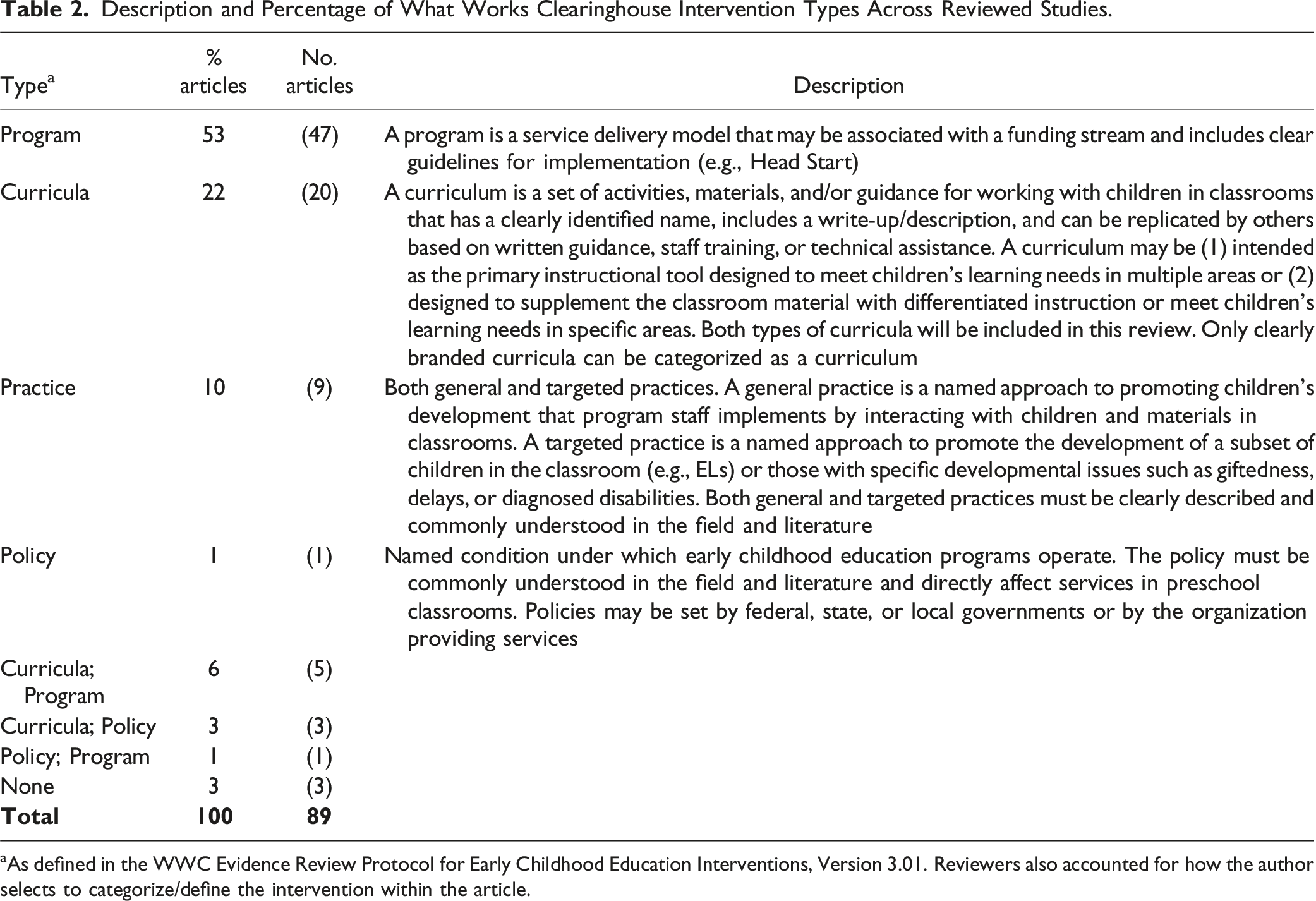
aAs defined in the WWC Evidence Review Protocol for Early Childhood Education Interventions, Version 3.01. Reviewers also accounted for how the author selects to categorize/define the intervention within the article.
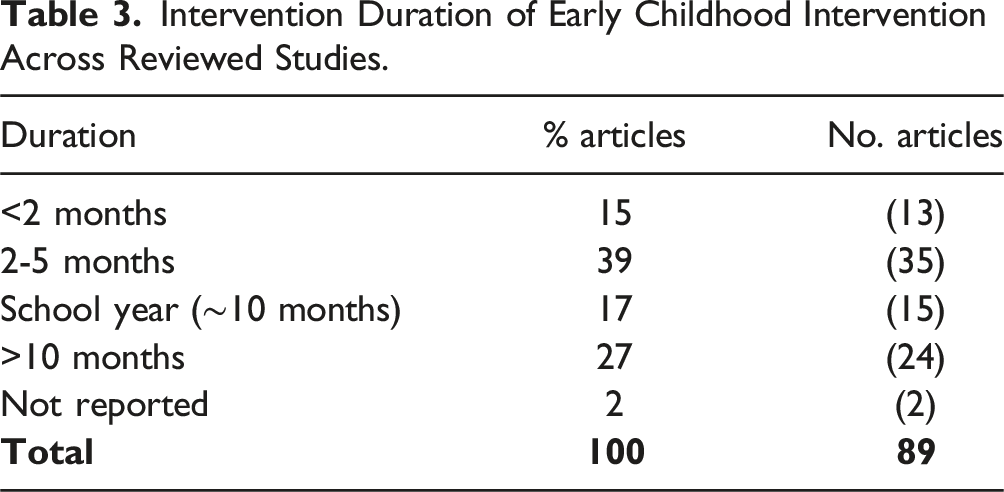
Intervention Duration of Early Childhood Intervention Across Reviewed Studies.
Overall Outcome Findings
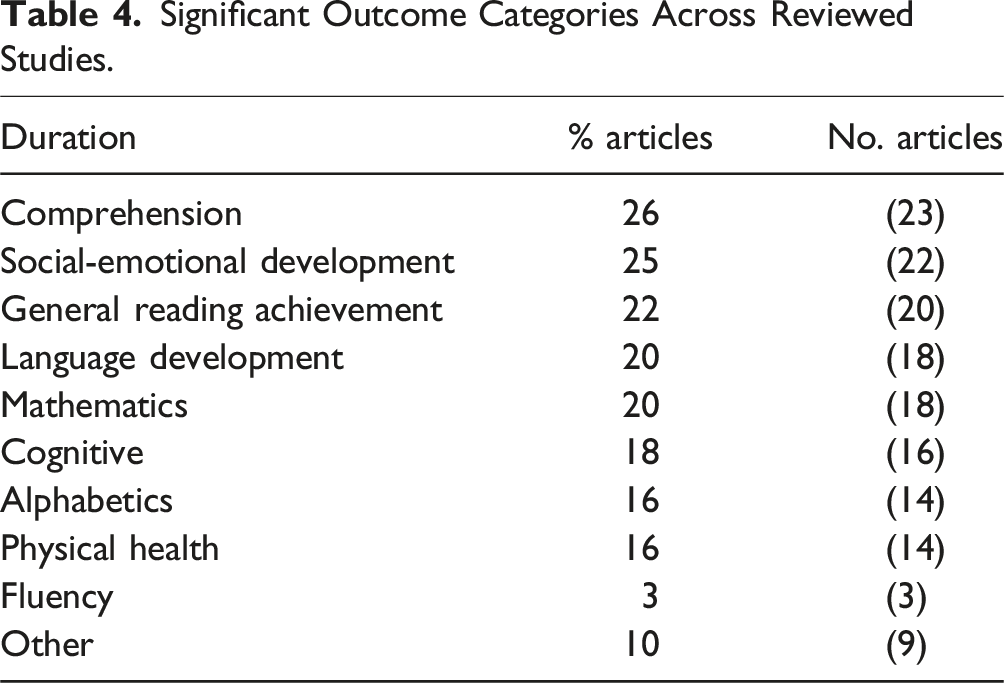
Significant Outcome Categories Across Reviewed Studies.
Patterns in Outcomes Based on Race and Ethnicity
Studies with Significant Outcomes by Race/Ethnicity Primary Status.
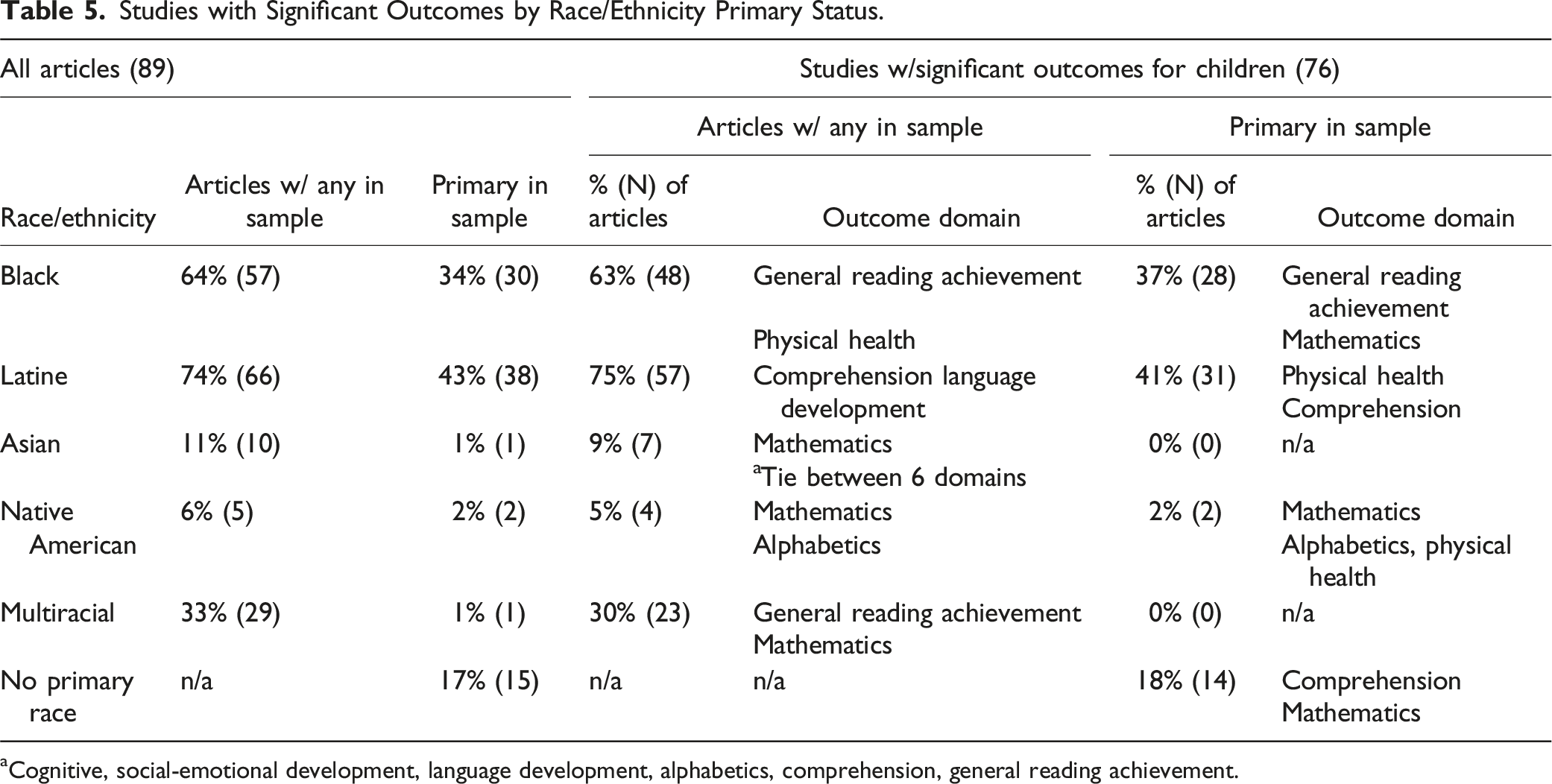
aCognitive, social-emotional development, language development, alphabetics, comprehension, general reading achievement.
Studies with Significant Outcomes by Primary Race/Ethnicity.
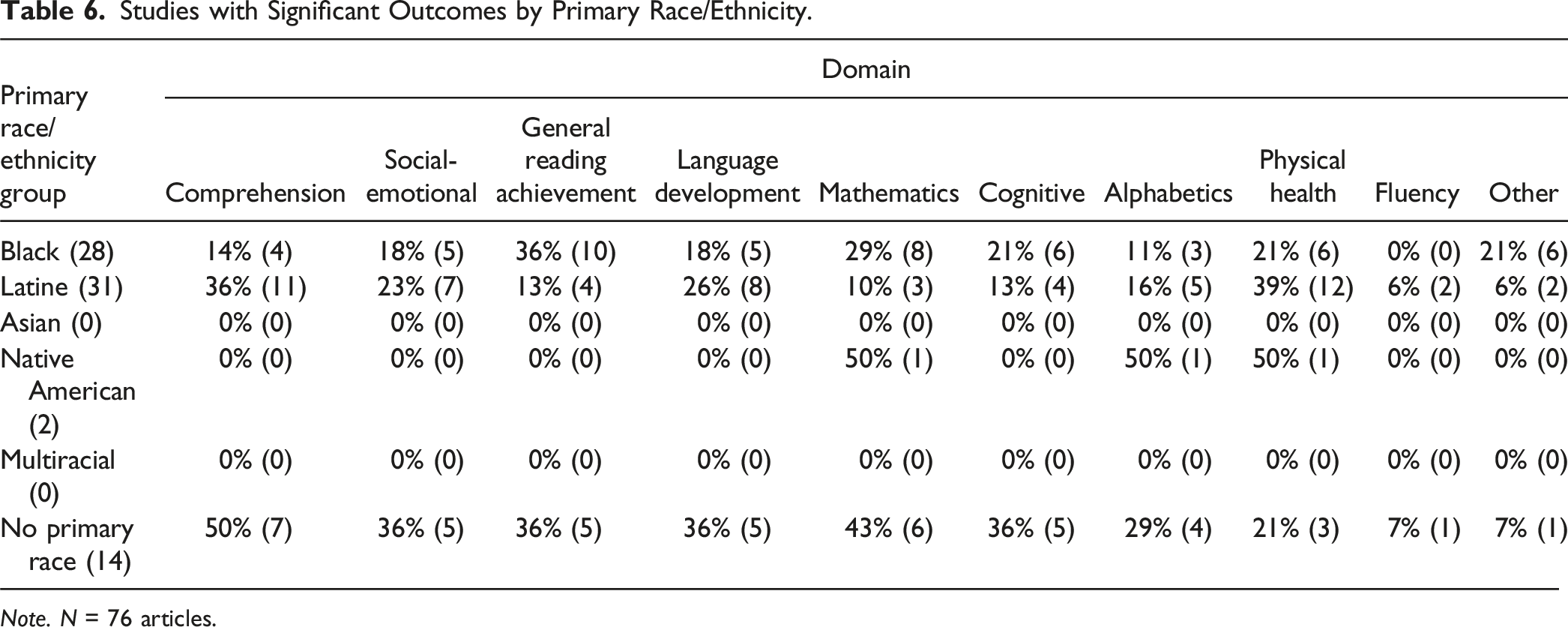
Note. N = 76 articles.
When Latine children were the primary sample, Comprehension and Physical Health domains were the most noted significant outcomes compared to Comprehension and Language Development domains when they were not the primary participant group. For the 31 studies where Latine children were the primary participant group, statistical significance ranged from 39% (Physical Health) and 36% (Comprehension) to 6% (Fluency).
While the number of studies on Native American/Alaska Native children was limited, the significant outcomes were generally the same regardless of whether they were primary or not—Mathematics and Alphabetic, except for Physical Health. While there were no findings for Asian and multiracial children as primary study participants, Asian children saw significant outcomes in almost all the domains, especially in Mathematics, and multiracial children saw significant effects in General Reading Achievement and Mathematics. When there was no primary racial/ethnic group, the main outcomes were in Comprehension and Mathematics. In the 14 studies with no primary REM participant group, the statistical significance ranged from 50% in the Comprehension domain to 7% in Fluency; over a third of the articles had significant outcomes for the other areas, such as Social-emotional Development and Mathematics.
Discussion
While there are many systemic and scoping reviews of the effects of ECE on children’s short- and long-term outcomes (Perlman et al., 2016; Zaslow et al., 2016), there has not been explicit attention to the outcomes of the different racial/ethnic groups in the United States. Given the growing racial diversity of the U.S. child population and their varied opportunities and experiences, it is critical to attend to what outcomes and for whom ECE interventions have benefitted.
Unsurprisingly, given the explosion of publicly funded ECE programs and initiatives over the past 50 years, most ECE interventions where REM children were the predominant participants were programs and curricula likely to be either 2 to 5 months or greater than 10 months in duration. For instance, federal programs, like Head Start, are full year. Specific ECE interventions, such as supplemental curriculum interventions, last a few months to reduce the burden on teachers and programs. Nevertheless, over 85% of the programs included in this review lasted over 2 months. These findings align with the evidence regarding the importance of duration and dosage (Burchinal et al., 2010, 2014; Hatfield et al., 2016; Zaslow et al., 2010, 2016). For example, in their examination of the Educare programs, high-quality early childhood programs, researchers found that duration (and age of entry) was positively associated with receptive language outcomes, with stronger effect sizes for dual language learners (DLLs) compared to monolingual English speakers (Yazejian et al., 2015).
Except for the Fluency domain, which was not a focus of many studies, there were significant outcomes in all relevant areas deemed critical in the U.S. Department of Education WWC. Significant outcomes were likely found for Comprehension and Socio-emotional Development, followed by General Reading Achievement, Language Development, and Mathematics. Given the focus on the whole child rather than strictly reading and math in ECE, it is also not surprising to see significant outcomes in socio-emotional as well as academic domains. Further, while the WWC does not consider physical health, this domain is a critical area for ECE, given its positive link to school and life outcomes (Hahn et al., 2016; NASEM, 2019). Access to healthy, nutritious food and safe, non-toxic environments in the early years is associated with early health outcomes, including better sleep, which is positively associated with better cognitive and regulatory outcomes (Black et al., 2017; Currie, 2005; Mehta et al., 2013).
Differential Outcomes due to ECE Based on Race and Ethnicity
In examining the significant outcomes through a CRT lens, we note that many of the studies in the past 30 years in ECE are still primarily focused on Black and Latine children, with very few on Asian, Native American/Alaska Native, and multiracial children. Given their large percentage in the United States coupled with their likelihood of living in poverty, it is unsurprising that Black and Latine children make up the larger share of ECE studies. The rates of child poverty are 31% for Black children, 28% for Native American/Alaska Native children, 23% for Latine children, 19% for children with two or more races, and 11% for Asian and White children (U.S. Census Bureau, 2020). Nevertheless, with the high poverty rate in Native American/Alaska Native households, off and on reservations, and some segments of the Asian community, there is a need to ensure that these REM groups are primary participants in future studies to ensure programs and policies adequately and equitably address their needs.
There was an indication that specific outcomes were likely to be significant based on the primary population. It is unclear why specific outcomes were seen based on the primary program participants, such as studies with primarily Black participants seeing significant outcomes in academic—reading and math—and those primarily Latine seeing significant outcomes in physical health and comprehension. It could be that the programs focus on academic-based inputs, such as the Carolina Abecedarian Study with mainly Black participants focused on improving children’s academic skills before school entry, or focused on Comprehension as in the case of the Small Group Enrichment Program due to continued attention to the Black-White reading achievement gap (Cottrell et al., 2015; Gardner-Neblett et al., 2023; Haskins & Rouse, 2005; Iruka, 2011; Kao & Thompson, 2003; Orr, 2003; Reardon, 2016; Rothstein, 2015; West, 2017; Yeung & Conley, 2008). Given evidence indicating that the majority of DLLs are Latine (Williams et al., 2023), it may be a function of ECE intervention targeting their vocabulary and comprehension as part of the program or an outcome to measure (Ascenzi-Moreno & Seltzer, 2021; Ballantyne et al., 2008; Downer et al., 2012; Howes et al., 2011; Souto-Manning, 2007; Winsler et al., 2014). Similarly, data from the CDC Pediatric Nutrition Surveillance System shows obesity prevalence was highest among American Indian/Alaska Native (21.2%) and Hispanic (18.5%) children (Anderson & Whitaker, 2009; Ball et al., 2019; Pan et al., 2012; Sharma et al., 2009); it is encouraging to see significant effects for physical health when Native American and Latine children were the primary participant group. Finally, studies that explicitly focus on REM children see significant outcomes across many domains, from Comprehension to Fluency, providing evidence that ECE interventions have some benefit for all children, especially REM children.
Limitations and Directions for Future Research
Some caution should be taken when interpreting these findings. First, these studies primarily focused on rigorously designed studies that meet WWC rigid standards for randomized control trials and baseline equivalence. These stringent criteria likely miss many ECE intervention studies that may be more beneficial for REM children that do not meet these criteria. Given the concerns with randomized control trial for REM populations, such as high attrition rates (De Las Nueces et al., 2012; Salihu et al., 2015), there is a need for future studies to relax some of these standards to ensure an inclusive review, especially given the few studies that did not have Asian and Native American children as primary participants. This review is also limited in precisely stating the type of intervention (i.e., program, curricula, and practice) and duration necessary to see specific outcomes for specific REM groups. There is a need for more attention to how the intervention types meet the sociocultural and linguistic needs of REM children, given the evidence of systemic racism and linguistic bias on their learning and life outcomes (Ascenzi-Moreno & Seltzer, 2021; National Academies of Sciences, 2023). Nevertheless, the evidence from this review shows that holistic programming with more than 2 months of duration is likely to see some significant improvements for Black children in reading and math, and Latine children in comprehension and physical health.
Future research should also focus on who is designing ECE for REM children and how the families and communities of the targeted population are involved—or excluded—in the design of interventions, including the desired outcomes and the strategies and methods employed (Brown & Ault, 2015; García & Ortiz, 2008; Iruka, Cabrera, & Páez, 2022; Muir et al., 2024).
Implications for Practice and Policy
ECE interventions have been found to have positive short- and long-term outcomes for children, albeit small to moderate effect sizes. The findings from the studies reviewed show that many ECE interventions with large REM participant groups also show positive outcomes, confirming the importance of these interventions as one strategy to support REM children’s learning while recognizing that many studies also showed null effects for REM children. Some of the interventions and strategies our review revealed as being beneficial for REM children included the use of small groups with dialogic reading instructions focused on phonological awareness and letter knowledge (for Black children) and a suite of professional development learning activities to support educators in their classroom accommodation for DLLs (for Latine children) that included using visual cues and props to introduce new vocabulary, the dramatization of story narratives, teaching in small groups, and obtaining assistance from bilingual teaching assistants or classroom volunteers in implementing instructional strategies to maintain DLL student engagement. Thus, there is a need for culturally grounded approaches for children and educators to support REM children’s learning. Furthermore, there is a need to ensure that the practices and approaches most beneficial for REM children are integrated into standards for early childhood programs and the workforce.
Conclusion
For too long, much of the attention has focused on how ECE benefits children writ large or REM children compared to their White peers. This systematic review shows that while many ECE interventions are programs that last for more than 2 months or, in many instances, go longer than 10 months, they benefit REM children’s academic, social, and physical health. ECE can improve children’s development and counteract some of the adversities experienced by REM children. Given the racialized context that REM children live in, there is a need to critically examine whether these interventions have attended to the underlying research frameworks and methodology, which are likely to drive the outcomes and subsequent policy responses. This study provides evidence that based on the racial or ethnic category of the primary population, specific outcomes are likely to be found due to the underlying conceptual framework of what research designers believe children need rather than a more holistic view of their needs and assets.
Footnotes
Declaration of Conflicting Interests
The author(s) declared no potential conflicts of interest with respect to the research, authorship, and/or publication of this article.
Funding
The author(s) disclosed receipt of the following financial support for the research, authorship, and/or publication of this article: This study is supported by W. K. Kellogg Foundation.
