



Abstract
A relevant, well-crafted emergency plan can help schools most optimally return to normal following a disaster. During this time, educators find themselves facing unintended responsibilities like operating on the front lines of providing social-emotional support for their students. Researchers conducted 115 interviews with educators impacted by Hurricanes Harvey and Matthew in Texas and North Carolina to assess their mental health and their school’s role in returning to normal. Findings suggest that emergency plans often did not take into account the social-emotional factors of recovery. This paper seeks to provide insight into the experiences of educators following a disaster and propose elements to consider in revising school emergency plans.
Keywords
Educators often find themselves operating as a first line of defense when schools recover from disasters (Godschalk et al., 1999), even though educators experience similar traumas as their students. As schools reopen, educators are faced with the challenge of restarting educational efforts and providing social-emotional support for students while simultaneously managing their recovery, which can contribute to burnout. Though disasters present significant disruptions to resuming education efforts, disaster preparedness and recovery training are sparse. Disaster training is often excluded from long-term educator training efforts, though disaster-specific training sometimes occurs after a significant event (United States Government Accountability Office, 2007). Such efforts may help the educators respond to a disaster, but they do not address the reality of disasters as a recurring phenomenon. Effective school emergency plans can help mitigate barriers to resuming education and combat burnout following a disaster by more comprehensively considering educator needs in terms of training and social-emotional support.
Disasters occur when an event disrupts life and causes damages beyond what a community can address using its resources (Godschalk et al., 1998). Since natural hazard events interact with the structures of society in predictable ways, it is possible to mitigate the damages from these events before they occur. Examples of these hazards include hurricanes, fires, tornadoes, and even the recent pandemic. While natural hazards are outside of a school’s control, school emergency plans should address the disasters that are most likely to occur in their community (Pepper et al., 2010; Stuart et al., 2013).
This paper aims to provide insight into how an emergency response plan can help mitigate teacher burnout following a disaster, further assisting schools to recover faster from a detrimental event. This paper presents our analysis of 115 interviews with North Carolina and Texas educators impacted by Hurricanes Matthew (2016) and Harvey (2017). Here, we specifically analyzed interview responses related to the mental health of staff and used the Job Demands-Resources (JD-R) model to understand educator experiences of burnout as they recovered from two storms. The following three research questions guide our work, (1) How, if at all, have Hurricanes Matthew and Harvey impacted educators’ mental health? (2) How are educators responded to the needs of their students and communities following the events? (3) How can the JD-R model be used to create an effective emergency response plan for educators to face future disasters?
Our analysis uncovered three themes from educators, the emotional toll educators’ faced outside of school following the event, the unexpected demands of educators brought on by the storms, and the lack of resources educators faced through recovery. A through-line between these themes led us to recommend essential comments for a comprehensive emergency response plan used by school and district personnel. Based on responses from educators, we gathered insight on vital attributes to bolster emergency plans to assist schooling communities with recovery following a disaster.
Emergency plans would better account for social and behavioral disruptions that impede recovery efforts within an education context. This paper centers on hurricanes, which are expected to increase in intensity (Knutson et al., 2020). The insights and recommendations resulting from this study also have general applications for other natural hazards, including the COVID-19 pandemic. COVID-19 has caused significant disruptions, with the move to online and remote learning leading to “test pollution,” students’ learning is impacted by stress and anxiety accompanying both the pandemic and adjusting to a new learning modality, and a variety of impacts on classroom assessment, teaching and learning, and measurement of student growth (Middleton, 2020). The pandemic has also sparked creativity in meeting the challenges of a shifting education landscape, leading to specific professional development and calls for research around remote education (Hartshorne et al., 2020). We hope that this paper reminds school administrators of the personal aspects that are intertwined with the professional challenges educators face and the need to build systems to support teachers’ social-emotional needs after a disaster.
Relevant Literature and Theoretical Framework
Schools as a Location to Deliver Post-Disaster Care
Schools are a convenient location for post-disaster care for students and their families. They are already central locations where children spend regular parts of their day and are part of the routine of everyday life (Berger et al., 2007; Fondren et al., 2020; Graham et al., 2017; Taylor et al., 2012; Wolmer et al., 2003, 2005). This means they are a point of access for professionals to use comprehensive screening to monitor students’ mental health, even if there is no immediate apparent problem after a disaster (Lai et al., 2013, 2018). Teachers and school staff regularly have close interactions with students and are thus positioned to notice symptoms such as mood changes, behavior problems, or problems concentrating (Pfefferbaum et al., 2014; Wolmer et al., 2003). Furthermore, the grade structure of schools means that interventions can be delivered at a developmentally appropriate level (Wolmer et al., 2005).
Prior research has found that trained teachers can implement clinically informed mental health interventions that reduce students’ symptoms after experiencing traumatic events or disasters (Baum et al., 2013; Berger et al., 2007; Wolmer et al., 2005). However, researchers have expressed concern about the escalating demands on educators and acknowledge that training teachers to deliver interventions could be an additional burden (Berger et al., 2007; Mutch & Gawith, 2014). Additionally, meta-analysis has found that interventions delivered by teachers have smaller effect sizes than interventions delivered by mental health care professionals (Brown et al., 2017). While the research on teachers delivering mental health interventions has found positive results for students, it is generally presented as a make-do solution when there is a shortage of licensed mental health professionals (Pfefferbaum et al., 2014).
Risk of Burnout
It is generally understood that caring professionals are at risk of burnout because of the continual demands to interact with others and emotional depletion of the work (Maslach, 2003; Skovholt et al., 2001). Like other caring professionals, educators have long been advised to balance their work caring for others with the need to care for themselves (Skovholt et al., 2001). The expectation is that it is helpful to both be aware of the hazards that exacerbate the difficulties of the work and strategies of support that can sustain professionals.
Teachers who work with traumatized students are at increased risk of experiencing secondary trauma and stress (Lemke et al., 2021; Thomas et al., 2019). Also known as compassion fatigue, experiences of secondary trauma, vicarious trauma, and burnout result from exposure to and internalization of overwhelming and emotional “client” experiences while under already demanding workloads (Jenkins & Baird, 2002; McCann & Pearlman, 1990); these experiences are exacerbated when professionals disregard their self-care to focus on the needs of those they serve (Figley, 2002). In therapist, a salient coping strategy to combat compassion fatigue and vicarious trauma include tapping into professional support networks (avoiding professional isolation) to work through their vicarious traumatization. More specific to education, administrators have identified the need to have more training in strategies to support traumatized students (Lemke et al., 2021), and trauma-informed education resources advise educators to notice their secondary trauma symptoms and encourage them to practice self-care (Thomas et al., 2019).
The literature that identifies self-care as a preventative for burnout at the personal level further calls for schools and districts to create environments that encourage self-care for all adults in schools (Substance Abuse and Mental Health Services Administration [SAMHSA], 2014; Thomas et al., 2019). Under normal circumstances, school leaders contribute to improving teachers’ morale, improving their confidence, and reducing stress levels through actions like acknowledging teachers’ contributions, listening to teachers, and being a visible presence in a school (Haydon et al., 2018; Howard & Johnson, 2004; Lambersky, 2016; Sass et al., 2011). Leadership has been shown to impact educator motivation and plays an essential role in promoting a thriving climate, especially during a crisis (Cansoy, 2019; Finnigan, 2010; Khumalo, 2019; Marks & Printy, 2003; Ozeren, 2020; Sehgal et al., 2017). Leadership promoting a healthy balance between caring for others and caring for self is one strategy to reduce long-term burnout (Skovholt et al., 2001). Studies suggest that school leaders who could self-adjust their work pace and work strain had lower levels of work stress, exhaustion, and burnout (Pietarinen et al., 2013; Tikkanen et al., 2017). Several of the working definitions of trauma-informed care explicitly identify the importance of addressing secondary traumatic stress among staff; however, child-serving professionals have reported that these strategies were not as commonly implemented in their agencies (Hanson & Lang, 2016).
A significant complication for educators delivering care in the aftermath of a disaster is that they may be traumatized (Taylor et al., 2012; Wolmer et al., 2003). In addition to being exposed to secondary trauma while learning about students’ experiences, they may be suffering from their own experiences during the disaster. Moreover, dealing with the aftermath of a disaster in their personal lives, absorbing secondary trauma in their professional lives, and continuing the typical responsibilities of teaching leaves little time or energy for self-care practices. This suggests that educators are at increased risk for burnout after a disaster. Despite the likelihood of this occurring, few studies consider the impact of disasters on school staff.
Job Demands-Resource Model
The Job Demands-Resources (JD-R) model conceptualizes the inputs and buffers to job-related burnout. Within the JD-R model, aspects of work can be classified into one of two categories: job demands and job resources. Job demands are associated with physical and psychological costs, contributing to burnout (primarily through exhaustion), while job resources, which assist with achieving goals and can stimulate employee growth and development, provide a buffer by contributing to employee engagement (Bakker & Demerouti, 2017; Demerouti et al., 2001). Just as job resources can buffer job demands, a lack of resources can exacerbate employee burnout and disengagement. In turn, burnout and engagement impact individual and organizational outcomes such as job satisfaction, commitment, performance, and turnover.
Applying this comparative lens of job demands and resources has been key to understanding how school leaders such as principals experience stress, secondary traumas, and worsened well-being when job demands outweigh job resources (DeMatthews et al., 2019; Mahfouz, 2020; Mahfouz & Richardson, 2020). Similarly, teacher experiences of burnout and stress are demonstrated to influence job satisfaction, self-efficacy assessments, classroom practices, and student outcomes (Bottiani et al., 2019; Herman et al., 2018; Nathaniel et al., 2016). The JD-R model has been previously deployed in education research, finding that emotional exhaustion, depersonalization, non-teaching workloads, and lack of perceived organizational support contribute to burnout amongst educators—including early childhood education teachers, high school teachers, and school counselors (Bardhoshi & Um, 2021; Lawrence et al., 2019; Schaack et al., 2020). Recent work around the impact of COVID-19 and student adaptability has also deployed the JD-R model, finding that adaptability was associated with higher levels of online learning self-efficacy and achievement gains, that online learning self-efficacy was associated with achievement gains, and that online self-efficacy acted as a mediator in the relationship between adaptability and achievement (Martin et al., 2021). Other work in this area has helpfully adjusted the JD-R model to reflect relevant-to-education job demands and their influences on burnout, engagement, and outcomes. These include the influence of job resources such as supportive leadership and social support, personal resources such as adaptability and mental/emotional competencies, and job demands such as role stress and workload on outcomes such as job performance, organizational commitment, and turnover intentions (Granziera et al., 2021).
The JD-R model also provides a valuable lens to examine post-disaster burnout and job satisfaction. Prior work involving hurricanes, university employees, and job satisfaction found that post-hurricane stress was most harmful when perceived resources were lower than job demands (Hochwarter et al., 2008). Findings also showed that varied organizations in the study offered limited actionable recommendations around disaster preparedness. A study of post-disaster teacher burnout following the Christchurch earthquake of 2010 found an association between increased levels of burnout and ineffective disaster planning and perceptions of role overload (Kuntz et al., 2013). While this study identifies some actionable steps to improve disaster preparedness (such as clear lines of authority, involving teachers in goal-setting and recovery strategies, and training), a lack of qualitative data prevents more nuanced examples of what this should look like in practice. Our paper extends the prior applications of the JD-R model to education settings by using qualitative analysis to identify such nuances in both demands and resources that might not be captured in quantitative analyses.
The Importance of Emergency Management Plans
One resource that can help resume education and mitigate burnout is an emergency management plan appropriate to the local natural hazard risks. Existing work in this area has included several efforts to standardize effective crisis response in schools. The California state-mandated emergency management system, for example, aligns closely with the National Incident Management System (NIMS), which is intended as a model for all U.S. schools to follow (FEMA, n.d.).
The Department of Education (U.S. DOE, 2019) has also crafted a guide for school districts outlining their role in developing high-quality school emergency operations plans (EOPs). The PREPaRE model for crisis intervention, designed for school-employed mental health professionals and other educators, pulls from the U.S. DOE guide on EOP development and the DOE’s Readiness and Emergency Management for Schools guidance alongside NIMS’ Incident Command System. The PREPaRE model culminates in a series of recommendations to prevent and prepare for crises, reaffirm physical health and welfare, evaluate psychological trauma risk, provide appropriate interventions, respond to mental health needs, and examine the effectiveness of crisis preparedness (Brock et al., 2016). Altogether, these systems and sets of guidance provide for multi-tiered support, providing professional mental health services to students in a highly individualized manner. When these best practices are in place, students and teachers are supported when they experience a crisis.
Existing evidence, however, suggests that school emergency plans frequently do not incorporate lessons from experts. For example, a survey of school nurses found that schools reported having fewer than half of the preparedness indicators for a biological event (Rebmann et al., 2015). It should be noted that research showed that schools in Los Angeles, California were more likely to comply with state-mandated standardized emergency management systems since they were routinely impacted by disasters (Kano et al., 2007). A recent systematic review of research on school-based crisis intervention models found that, while PREPaRE was the most frequently named model, there was a lack of evaluation studies outside of training evaluations, indicating that interventions are utilized post-crisis without an evaluation component to measure effectiveness of intervention implementation (Sokol et al., 2021). The authors note that intervention implementation is time and resource-intensive, requiring involvement from multiple stakeholders within a school community.
Though the implementation of appropriate emergency plans is deficient in some school systems, there is existing research on specific disaster recovery strategies for schools to include in their emergency plans. Studies of schools recovering from a disaster consistently emphasize the value of reopening schools as part of a community’s return to normalcy (Notman, 2015; Ward & Shelley, 2008). Emergency plans can address potential barriers to the process of reopening. For instance, studies have found that breakdowns in communication during a disaster can increase tensions amongst school leaders, teachers, and families (Bishop et al., 2015; Howat et al., 2012; Pepper et al., 2010; Stuart et al., 2013). This research demonstrates the need for emergency plans to incorporate elements of solid communication between stakeholder groups.
To frame the discussion of how an effective emergency plan can account for educators’ social-emotional needs, we looked to the literature on motivational strategies leaders use in and outside of schools—regardless of a crisis. While it is important to note that motivational strategies are not a one-size-fits-all approach, focusing on an employee’s efforts, such as public praise, are likely to be more effective motivators than monetary rewards (Handgraaf et al., 2013). Research on corporate philanthropy, during which employees seek out support from their employer following a disaster, found that employers’ support helped reduce the emotional strain caused by an adverse event and improved personal well-being (Watkins et al., 2015).
This article seeks to add to the body of knowledge in three main ways. First, the literature points to the significance of schools as a place to deliver post-disaster care, the importance of burnout as a factor for educators both pre- and post-disaster, and the responsibility of school leadership in creating a sustainable work environment. However, less attention is paid to educators’ social and emotional responses following a disaster event. Our research has demonstrated this to be a significant factor in successfully returning to normal following a disaster. Second, prior research highlights designing a practical and relevant emergency plan in schools. This article builds on these efforts by pulling together responses from affected educators about what might have helped them more effectively resume education efforts and address their social-emotional responses to recovery efforts. Third, previous research on natural hazards focuses on a single event with a smaller sample size of respondents. This study examines the aftermath of two hurricanes in 20 school districts in two states, thus making the findings more transferable to other schools than previous work. Both hurricanes resulted in significant disruption for communities across states and countries. Therefore, the extent of the damage caused and the required recovery efforts provide a salient opportunity to examine the difficulties educators face as they resume education efforts.
In the following sections, we outline the critical context for each hurricane, our data collection and analysis approach, and our results and recommendations to educators for bolstering emergency plans in preparation for future disasters.
Methods
To gain a sense of how the hurricanes disrupted schooling for educators, it is vital to understand how both storms disrupted North Carolina and Texas residents. Hurricane Matthew arrived on the coast of North and South Carolina on October 8, 2016. This storm significantly affected five states, but it also severely impacted Haiti, the Dominican Republic, and Saint Vincent. Specific to the United States, the National Oceanic and Atmospheric Administration (NOAA, 2017) estimated that Matthew produced roughly $10 billion in damage and destroyed over 100,000 structures (Stewart, 2017). Additionally, Matthew generated a maximum of 18.95 inches of rain with a 7.70-foot storm surge (NOAA, 2017). Hurricane Matthew exhibited high mortality numbers with 585 direct deaths, where 34 were located in the US. Findings show that North Carolina had the highest fatalities at 25 compared to neighboring states. An estimated 3.5 million people between Florida and Virginia lost power from Hurricane Matthew, with around a quarter of those residents in North Carolina. Additionally, US federal agencies evacuated roughly 3 million residents from coastal communities.
Hurricane Harvey made landfall as a Category 4 hurricane in Texas on August 25, 2017. The storm would later severely affect seven additional states across the mainland US. NOAA defined Hurricane Harvey as the second-costliest US tropical cyclone to hit the US, with an estimated $125 billion in damage (Blake & Zelinsky, 2018). While costly, Harvey also released the most tropical cyclone rainfall throughout US history by dumping 50 to 60 inches of rain. Harvey is also the second-deadliest storm to hit Texas, with at least 68 direct deaths and approximately 35 indirect deaths (e.g., deaths resulting from being disconnected from medical support or weather-related car crashes).
Like Hurricane Matthew, Harvey disrupted thousands of US residents, where roughly 336,000 people lost electricity, 40,000 people were evacuated, and agencies aided in 30,000 water rescues (Blake & Zelinsky, 2018). Accounts indicate that floodwaters from Harvey destroyed 300,000 structures and 500,000 cars. To combat the devastation of Hurricane Harvey, the Federal Emergency Management Agency (FEMA, 2018) constructed about 4,500 trailers and mobile homes and provided nearly 700 emergency shelters for residents impacted by the storm.
Both storms devastated communities across the coastal United States and in other countries. These storms killed numerous people and disrupted businesses throughout the affected areas. Understanding these experiences is an essential aspect of the impact of hurricanes on schools. This article concentrates on how these storms affected North Carolina and Texas educators. This geographical focus is a limitation of our research. Still, it is not meant to ignore or minimize the effect of hurricanes on other communities, especially those underrepresented.
Data Collection Process
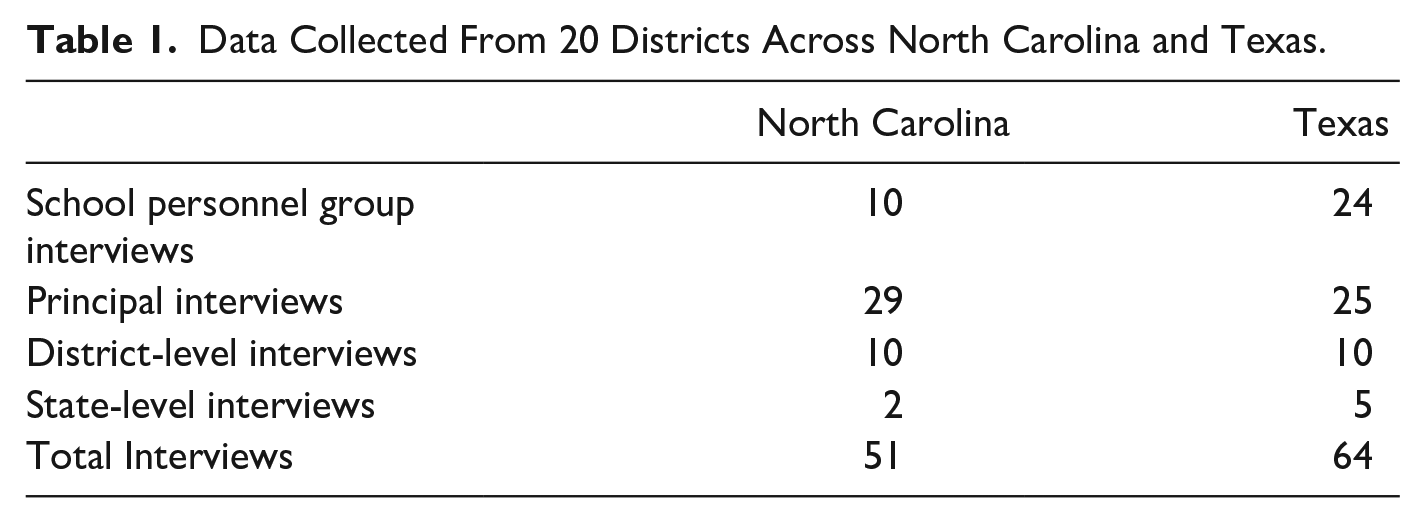
This paper pulls data from a large mixed-methods study centered on the extent to which schools recovered after Hurricanes Matthew and Harvey. We collected 81 individual interviews with principals, superintendent-level administrators, and regional or state education personnel. The research team conducted an additional 34 group interviews with teachers and other school staff. These interviews were conducted in districts across Texas and North Carolina between March 2018 and October 2018 in communities heavily impacted by Hurricane Matthew or Harvey (Table 1).
Data Collected From 20 Districts Across North Carolina and Texas.
This paper defines school administrators as individuals who hold positions at the principal or superintendent level. We follow the National Association of Elementary School Principals’ (n.d.) definition of a school leader as an educator who is “responsible for the daily instructional leadership and managerial operations in the elementary school or secondary school building” (p. 1). Within our study, we interviewed principals representing the elementary (N = 18), middle (N = 20), and high school (N = 18) levels.
There were some critical differences in how data were collected in both states. First, North Carolina interviews occurred 18 months after Hurricane Matthew, while interviews were 6 to 13 months after Hurricane Harvey landed in Texas. Second, there was one teacher group interview in each participating district in North Carolina, while in Texas, each participating school had a teacher group interview.
District Characteristics
In both states, the research team recruited districts heavily affected by hurricanes. Factors influencing recruitment included when schools reopened after their respective storm, school demographic characteristics, and FEMA’s damage estimates. We then asked interested superintendents to identify three elementary, middle, and high schools to participate in the study. It was imperative to give each superintendent full autonomy in selecting school sites for data collection to ensure that educators saw the research opportunity as a collaboration instead of an obligation. We were aware of potential selection biases posed by superintendents and that these administrators may have exerted their power to pressure educators into participating in this study. Recognizing these potential internal biases and burdens, we still felt it vital for the educators to choose whom to interview.
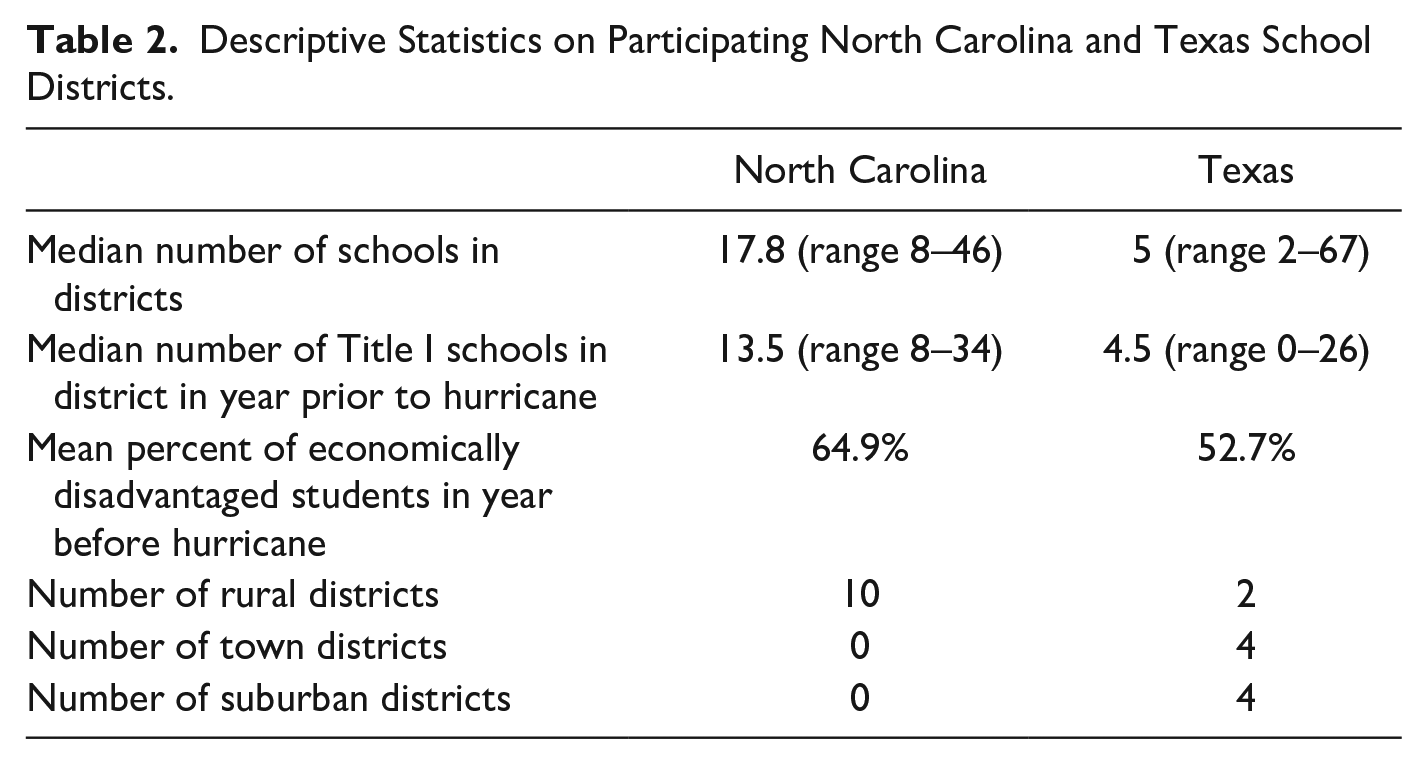
Selection sites in both Texas and North Carolina represented differences in district characteristics. First, all participating school districts in North Carolina were classified as rural (Table 2). In contrast, Texas school districts were classified as rural, townships, or suburban. Secondly, school districts in North Carolina had a greater median number of schools in each district. North Carolina school districts were generally large countywide districts, while Texas school districts were smaller, with each county containing many districts. Lastly, participating districts in North Carolina had more economically disadvantaged students than those in Texas. Both states had an average of over 50% of their students classified as economically disadvantaged in the year before being hit by Hurricanes Matthew or Harvey.
Descriptive Statistics on Participating North Carolina and Texas School Districts.
Protocol Design and Data Analysis
Protocol design
The team reviewed relevant literature and sought advice from field experts as a foundation for constructing the protocols. Protocol questions addressed (a) the effects of the hurricane on school operations and infrastructure, (b) the degree of hurricane impact on students and staff, and (c) participants’ perception of recovery. The team organized questions under the following categories; background, immediate and long-term impact of the hurricane, accommodations, supports, communication, and recovery. The methods used in this study follow those used by Howat et al. (2012), Gowens and Lander (2008), Ward and Shelley (2008), and Provenzo and Fradd (1995), all to assist in understanding school recovery following hurricanes.
Data analysis
The team transcribed all transcripts and coded content to a consensus using NVivo Qualitative Analysis software. A team of qualitatively trained researchers used open coding to identify commonalities across the data. We organized the protocol into five categories and coded our responses based on the sections; (1) Demographics of participants, (2) Impacts of the storm, (3) Outcomes, (4) Future plans, and (5) Extra. Qualitative documents underwent numerous reviews in their entirety and then coded at the smallest level of meaning.
Since this study coincided in Texas and North Carolina, researchers used inter-rater reliability strategies, a codebook, and triangulation to maintain validity throughout the project. Inter-rater reliability checks are a reliability method used by qualitative researchers to ensure that coding and data analysis is consistent across a given project. The team started with open-coding two interviews in isolation—one North Carolina educator interview and one Texas educator interview. Then the team met to discuss the codes to assess the extent our coding matched and discussed creating new or merging old codes. Next, the team took the list of codes and coded another four interviews—one North Carolina educator interview, one Texas educator interview, one Texas state-level interview, and one North Carolina group interview. The research team discussed differences at length until consensus was met. In two instances, the team determined the differences were due to state and regional variances. Here, the team created two different codes to account for the distinctions based on the locations of respondents. The researchers administered reliability checks more frequently at the beginning of data analysis and decreased the frequency of checks as codes became more synchronized. Within a few weeks of data analysis, most codes matched across sites.
The team also generated a codebook from the open codes initially created at the beginning of the data analysis. Qualitative researchers use codebooks to house code names and definitions for team members to reference while analyzing data. The team frequently met at the beginning of data analysis to discuss definitions of codes and themes. We shared a document through a university cloud storage system so that all researchers had real-time access to the codebook. Using this system, we provided timely and consistent feedback on ways to strengthen definitions, delete items that were not relevant, and merge codes that contained similar data. We initially coded a small sample of interviews from both states separately and then interchanged transcripts so that researchers across both states could review the data. Significant differences did not emerge between the two states. Our final list of codes amounted to 208. The number of codes may have been higher than expected since the team coded text within the protocol’s categories.
In addition to using inter-rater reliability strategies and a codebook, the team used triangulation to establish validation across multiple data collection points. This study used data from individual and group interviews as a form of corroboration. This strategy allowed us to confirm consistencies from participants across states, districts, and schools, by analyzing data sources. We grouped interviews and notes by state and district, which allowed us to assess commonalities and differences within and across school sites. The team reviewed interview notes to gauge how school administrators and personnel responded to questions. We saw variations in district-and state-wide responses. We assumed that these differences were more likely based on the trajectory of the storm instead of district-wide school culture differences.
Results
Our analysis of interview data revealed that both hurricanes resulted in significant disruptions in social-emotional wellbeing for educators. Unfortunately, our results showed that most schools were unprepared to address these needs following the disaster. Educators overwhelmingly addressed the following three themes as reasons for being overburdened and emotionally taxed; (1) the emotional toil they faced outside of school, (2) the unexpected demands from students and the community, and (3) the lack of resources to assist with recovery. We provide a description of each theme in the remainder of the paper. These themes raise a salient question regarding the identification and impact of educators’ social-emotional needs following a hurricane and how schools could better prepare for these needs in future disaster scenarios. We also provided a through-line between the themes and suggested valuable components for a comprehensive emergency response plan for schools and districts to use following an event.
The Emotional Toil Educators’ Faced Outside of School
Throughout our interviews in North Carolina and Texas, educators described the ways their mental health was affected by the hurricane. When coding the interview data, the research team noted consistent examples of stress that occurred beyond their schools’ settings. Trauma outside of school encompassed those experiences that influenced an educators’ day-to-day life, including weather-related anxiety, stress, or depression.
Living through a natural hazard is a traumatic experience, and educators frequently identified traumas that they and their colleagues experienced due to the storms. Educators who lived through the storm’s arrival named PTSD (post-traumatic stress disorder) as one of the ways they were continuing to be affected by the storm. Teachers associated PTSD with increased anxiety around storms, both among students and themselves. One North Carolina educator said, “It might be something as small as a storm. The hint of a storm coming that causes us to go back to that place that we’re thinking about, to bring up those memories.” This trauma was also associated with increased depression, as when one Texas teacher said, “Personally, I was depressed looking at the piles of debris on the highway, the bypass. I would just go back home or whatever and cry.”
Our results showed that even educators whose homes were undamaged experienced the emotional impacts of the storm. These teachers identified themselves as “lucky” before describing the guilt they felt. One Texas teacher said, “I kind of always said ‘Survivor’s guilt, really? Does that exist?’ And after having gone through that and my house didn’t flood, I know what they’re talking about now.” Although it was rare to have people whose homes were unaffected by the storm, teachers in three districts raised the feeling of guilt, expressing that it was an issue that was not talked about.
While few educators saw themselves as lucky, most respondents mentioned being impacted or knowing someone close who was affected by the storm. A North Carolina educator stated, “Some of our staff lost their homes. Ninety-nine percent of them were affected in some form or fashion.” Respondents also spoke about losing personal artifacts such as clothing, food, toilettes, and pets. A North Carolina principal described how educators faced personal obstacles to arrive and be prepared to support students. They stated: There was an added dimension of stress to the actual staff members. . .getting to school because they were without water or because they had been flooded, they were without electricity, just the essentials that they needed to feel prepared to come to work, it was difficult on them as well.
During recovery, school staff—and teachers in particular—found themselves on the frontlines in the struggle to return to normalcy in the classroom. While educators spoke of the mental stress and trauma related to their experiences outside of school, they also highlighted other tensions involved in recovery efforts at the school level. Here, educators indicated how they found themselves with increased workloads by putting their students’ and community needs above their own.
The Heightened Demands on Educators
The JD-R model shows that increased job demands relate to heightened stress amongst employers. Our results showed that increased workloads after the storm intensified job demands and, thus, influenced burnout and social-emotional stress. Educators took on additional responsibilities by supporting students’ academic needs and responding to community needs. Interviewees shared how being on the frontline of recovery resulted in many staff placing student’s emotional well-being ahead of their own or otherwise doing whatever was needed, even at the expense of their own needs. Additionally, respondents described the after-effects of meeting communal needs.
Prioritizing student over self
Attending to the social-emotional needs of students was a prominent source of stress for teachers as schools reopened, with teachers primarily finding themselves as first responders for students’ needs daily. Many teachers were similarly impacted by the hurricanes—experiencing damage to homes, needing to relocate, and losing personal and professional possessions—but were tasked with providing a sense of normalcy for their students. In many schools, the role of teachers and staff had to be re-examined, with focus and training placed on addressing social-emotional needs in a caring and supportive way. For some schools, this resulted in a period in which social-emotional concerns were addressed before a formal resumption of education or otherwise providing adequate space to address social-emotional issues.
Prioritizing students’ social-emotional needs meant that staff often did not have space to address their trauma adequately during the school day. A Texas teacher shared their experience in putting their students first while elaborating that, for some, their traumas were ignored: Something that was also really challenging . . . from the human and emotional standpoint, was seeing our students in the position that they were in, but also, we were going through similar situations and trying to keep going for our students. We had a teacher whose house was in a ditch . . . [they’re] literally homeless and still coming to work trying to provide education for [their students] . . . That is something that honestly was never addressed for staff. . . . There needs to be a wellness thing addressed for your people who are trying to take care of children. I feel like there was a lot of emphasis on the wellness of students, which was very important, but I really do think we had some shock and some trauma, and we kept plugging away.
Another consequence of putting student needs ahead of their own was that teachers did not feel they were effectively focused on demands at home. A Texas teacher said, What you needed to do at home or what you needed to do for your family or your kids kind of got put on the back burner. . . . I really felt like I was not taking care of what I needed to take care of with my family.
While there was a desire to make the school a safe environment for students, teachers felt guilty for not juggling work and personal demands equally. An educator from North Carolina stated: Some of them were displaced or had to take in family members who were displaced, so they became caretakers as well, so a lot of them were stressed because they were taking care of their family’s needs as well as trying to be there for the students. It’s like taking care of people at home and trying to take care of myself, as well as take care of my students.
This stress resulted in teachers having difficulty focusing on work when dealing with significant issues at home. One Texas principal said they had many staff who struggled “emotionally throughout the year to keep up with their jobs.” Principals in both states agreed that this kind of stress caused them to worry about the social-emotional state of their staff and identified them as first responders for students while trying to handle their crises.
Stepping in to support the community
Some school staff endeavored to actively support students and their families following the hurricanes, including driving to students’ houses to check on them or make sure they had food and water, helping with shelters or supply drives, or helping neighbors tear down trees. Educators recognized that the storm forced students and their families to depend on their schools. Besides being the learning hubs in the community, before reopening for education, schools were also the place for individuals to collect supplies, meet FEMA and Red Cross agents, and receive emotional support. Once schools reopened, educators were often on the frontline of providing social-emotional support for their students. One Texas educator described their awareness in being a constant support for students and the community given the challenging environment: [Students] had to rely on their school, in a way that none of us saw coming. We’ve had to be this stable force for many of them. We have kids that aren’t living with their family and with other people. It’s just been an incredible challenge.
One North Carolina principal described how helping deliver food to students after the hurricane had a tremendous impact on some staff “because they didn’t know how some of the children lived. . . . I had several teachers call me crying because they didn’t realize what an impact it would make on that child.” However, it is vital to recognize that the process of stepping in to help others, while potentially rewarding, also proved to be taxing to varying degrees. One Texas teacher stated that “It was emotionally, physically, financially, taxing, but we had to be here and supporting the whole county.” Another Texas teacher echoed: We’ll do whatever it is that we have to do; we’ll help our neighbors or tear down trees. After an extended day, everyone is exhausted. It’s not just the physical exhaustion; you have emotional exhaustion, the fatigue.
The heightened demands on educators following the hurricane proved to stretch teachers and staff emotionally. As demands intensified, educators were left supporting students and community members while having little space to recover from the disaster. Next, we see examples of a lack of resources to help fill the gap and support school-wide recovery.
A Lack of Resources
The JD-R model explains that as job demands related to stress increase, the likelihood of burnout increases. Further, job resources and personal resources can alleviate the effects of job demands; however, we found that the trauma of the storm reduced educators’ access to resources preventing them from adequately doing their job. Interview results showed that educators needed resources to adjust the curriculum, support displaced students, and provide adequate space for everyone in the building.
Resources to adjust for missing instructional time
Hurricanes Matthew and Harvey created significant disruptions to school attendance resulting in students missing critical instructional days. Our results show that each district indicated having at least one school per district closed for a period. Overall, 41 of 54 school sites (76%) reported closing between 3 and 45 instructional days. North Carolina administrators across 20 schools stated that Hurricane Matthew caused school closures from 3 days to 3 weeks. Meanwhile, Texas administrators from 21 schools reported that Hurricane Harvey forced schools to close for 1 to 9 weeks.
In addition to missing instructional time, our findings revealed that at least two schools per district reported having displaced students. Overwhelmingly, educators at 50 of 54 school sites (93%) stated that the storms caused students to be displaced. Respondents across 25 schools in Texas reported displaced students, with 1 school citing about 1,500 students displaced because of Hurricane Harvey. Similarly, 25 schools in North Carolina reported student displacement from Hurricane Matthew, ranging from a small group of students to about 225.
With missing instructional days and students, educators were unsure how to adjust the curriculum to ensure their students covered relevant content for standardized testing. Respondents were clear about the regrettable focus on standardized testing. Educators agreed that standardized tests generated stress in normal circumstances; however, the hurricane disrupting the academic year heightened existing anxiety. Teachers expressed being worried about being held accountable even through a disaster. One North Carolina teacher remarked, When you work at a public school, you’ve got tests that are going to give you a school performance grade, so where you have kids outside of school for a week and then potentially upwards of 50 kids that may have been impacted by the storm, they might be out much longer, but you’re still going to be evaluated as if that didn’t happen. So that adds a lot of stress on educators.
This concern of whether students needed to pass the test was amplified since school leaders were uncertain whether the schools would be held to accountability standards. Schools already concerned about accountability tests worried whether they were more likely to fail after a hurricane. School administrators voiced concerns about not knowing whether there would be a grace year. In an interview the spring after Hurricane Harvey, one Texas district superintendent said: Yet, at this point in time, my campuses are preparing to get high stakes accountability next week, and you’ve never seen people so stressed out in your life because they care about the community and they care about their children. They don’t want them to fail after such a crisis but yet no one has told me if my accountability will be weighed yet, when they should have told us already, but they don’t want us to stop teaching.
Not enough space or supplies for everyone
Educators also reported increased stress at school around a lack of physical space and professional supplies. Reopening schools quickly meant some teachers were working in alternative areas. Sometimes these spaces were found within their school building, repurposing the computer lab as a standard classroom. Other times, educators were relocated to other campuses in the district. One Texas district superintendent summarized the stress experienced when campuses shared space: We had some people who at home they would double it up with family members and they would come to work and it would be overcrowded at work and so you had people who would never have that space. . .the way they typically have. It’s amazing how that plays a role in people’s psyche.
We found examples where hurricanes flooded schools, forcing educators to share school buildings and supplies and creating additional stress. One Texas educator recalled the moment when flooded facilities were an emotional trigger for educators, reminding them of their recently destroyed homes: We’re getting portable buildings set up, so that’s relieving some of the faculty issues, but that was a pretty big strain on the teachers. To know that their home was taken away from them and that their workspace was taken away from them as well. That was a pretty big challenge.
Interview results also showed that educators lost their teaching supplies. Items signified teaching strategies, notes from lessons, student incentives, and even personal mementos, where some expressed great sorrow in the loss of personal keepsakes that represented their journey in education. One North Carolina educator reflected: The teachers lost classrooms and personal teaching supplies that they had collected their whole careers. They were dealing with their own personal loss in their classroom plus knowing they had students who you didn’t know where they were.
Overall, North Carolina and Texas respondents addressed how Hurricanes Matthew and Harvey disrupted their social-emotional health. Educators described the emotional toll they faced outside of their schools, the unexpected demands placed on them to support students and community members, and addressed the lack of resources they received to assist with recovery. By combining the voices of educators with the JD-R model, the team was able to assess the necessary components of a comprehensive emergency plan for schools and districts to use following a disaster.
A Comprehensive Emergency Plan
The JD-R model states that job resources can help alleviate the burdens of job demands. Although recovering from a disaster is inherently a stressful situation, people will take on additional roles, ensuring that available resources may help people cope with the situation. However, we found that a lack of a comprehensive emergency plan created spaces for heightened stress and anxiety.
Recognizing a need for a plan
Across the 20 participating districts, respondents requested an emergency plan to expedite disaster recovery for educators, students, and their families. Few indicated having an emergency plan that addressed educator and student needs within both states once the hurricane passed. Most did not have a district- or school-wide strategy that addressed hurricanes and other natural hazards. A few educators mentioned conversations within their districts around creating an active shooter drill, though this would seem to handle such a scenario in situ rather than addressing the aftermath. Educators who spoke of an emergency plan agreed that they saw a benefit to recovery when plans included mental health. In one instance, a foundation provided counselors for students and staff in a Texas high school following Hurricane Harvey. The organization returned during the spring season following the storm to develop a plan that would support future students and personnel during upcoming disasters. The principal appreciated the preemptive discussions on preparation for future storms.
Educators collectively agreed that the storms forced them to address their missing emergency plan or see value in something they once viewed as useless. On one occasion, a North Carolina principal described the district-wide confusion after the main office closed directly following Hurricane Matthew: “What I think I was disappointed in was that when central office [went] down, it shut down [over 20 schools]. There was no backup.” The principal described a lack of communication from district administrators and felt isolated as they contacted their educators and parents. Others remarked, taking a more honest look at their existing emergency plans and seeing their value. A Texas principal stated, “That outgoing plan that we have. . .we’re taking it a little bit more serious now that we know it can happen. It’s not just [an] exercise in futility; it’s real.” Another principal in North Carolina stated, “I think this puts you into a more of a proactive planning mode. To really pay attention, to never think it can’t happen to you.”
Suggestions for developing an emergency plan
As it was, affected schools found themselves attempting to address needs as they seemed relevant. One North Carolina principal recalled, “At some point, our focus went from just teachers and learning to more emotional support and survival to taking care of everyday needs.” One Texas principal argued, “It’s important definitely to have counselors available. Somebody to be able to help a person to be able to get through a traumatic experience, or to be able to deal with it.” According to interviewed educators, a more effective emergency plan should address the effects of a disaster on mental health, consider support to assist educators as they push to return the schooling environment to normalcy, and plan for immediate and long-term effects.
Components of a plan
Interview findings showed that a comprehensive emergency plan should focus on mental health, especially for the educators. We identified functional components based on the major themes identified across interviews. First, an emergency plan could include items that describe how to support themselves and their colleagues through an event. Respondents defined support as anything from receiving personal items like toiletries to mental-health breaks from school. Educators were amazed at how their peers, who lost their items, still managed to return to work and be active in the classroom. One Texas teacher cautioned, “Make sure you provide support to your employees . . . Students are our number one concern, but we forget to take care of the caretakers.”
Secondly, the emergency plan could include items that address the increased demands of educators, such as meeting communal needs and getting them back to normalcy. Educators cited the following as methods to assist communities in need: delivering medicine, distributing food, and providing coursework to parents and students. Educators also described traveling around their neighborhoods while their communities lay in ruins. One North Carolina educator recalled, “During the storm, some of the teachers and myself drove around to kids’ houses to check on them and make sure that they didn’t need anything, make sure that they had food and water.”
Thirdly, emergency plans could also include professional development training that provides educators with resources to support their instructional content and recognize when students need additional emotional support. In some cases, educators shared that their schools saw increased behavior issues among students following the storms, and others described an inability to focus on academics. One North Carolina principal recalled a decision to deprioritize lessons and create a space for emotional learning: Our teachers’ first line of defense became emotional support and then just trying to educate so kids would have the words to say what they were upset about. In middle school or any adolescents, what frustration looks like or sadness or disappointment or fear [or] it can manifest as anger. And so, just trying to be proactive in terms of naming our emotions with kids to say although you may feel angry, what you actually feel is you’re scared and sad and that’s an appropriate emotion and we feel it too.
Training could also assist educators with addressing triggers for themselves and their students throughout an event; however, training should not supplement mental health professionals’ support. Educators indicated that anything from future hurricane seasons to minor weather occurrences, like rainstorms, would trigger. One Texas educator stated, “The trauma, all of that that comes up every hurricane season or every time somebody mentions a hurricane in the gulf. It doesn’t matter if it’s going to New Orleans. It’s still a hurricane in the gulf.”
Overall, the emergency plan could present strategies for dealing with educator and student needs during the immediate and extended recovery period. Interviewees in Texas and North Carolina said that the hurricane would likely lead to long-term effects on educators and students. One Texas principal stated, “It's going to take a lifetime for some people to rebuild after the storm, the emotional effect of the hurricane, not to mention the financial parts.” Interviewees in both states also shared that less severe storms following the hurricanes increased anxiety, especially for students already showing difficulty functioning in the classroom.
Discussion
Standardized models for emergency plans are readily available for school leaders and emergency managers to adapt to their local settings (i.e., Brock et al., 2016; SAMHSA, 2014; U.S. DOE, 2013, 2019). However, many of the educators we interviewed indicated that their system did not have adequate emergency plans, especially ones that incorporate a strategy for assessing and improving mental health. In a time of increased demands at home and at work, many schools lacked this resource that could help educators recover.
To address the potential for disaster in an emergency plan, schools and school districts must anticipate likely needs after a natural hazard. Prior literature has emphasized that individual school leaders may not have many opportunities to learn to address natural hazards through personal experience because some natural hazard events infrequently occur in any specific location (Stuart et al., 2013; U.S. DOE, 2013, 2019). Therefore, it is crucial for school leaders and emergency managers to learn practical strategies from studies of schools recovering from disasters to incorporate them into their emergency plans.
The JD-R model states that increased job demands increase burnout and reduce job performance. Educators often struggle with burnout even outside of a disaster (Pietarinen et al., 2013; Tikkanen et al., 2017), and natural hazards only further increase job demands. Consistent with prior research, schools took on a central role after the storms as they enabled a return to normalcy (Bishop et al., 2015; Mutch & Gawith, 2014; Wolmer et al., 2005). We build on the prior literature by considering educator responses during the post-disaster period. During hurricane recovery, educators adopted an attitude of, “We’re here to help.” They took on duties ranging from delivering food to providing social-emotional support for students. These additional duties increased the job demands, and educators reported feeling exhausted from work. Although this study did not attempt to measure mental health, such exhaustion is a classic symptom of burnout (Maslach, 2003).
When developing a school’s emergency plan, it should be considered how the plan mitigates the increased job demands during a disaster. If emergency plans acknowledge that educators will take on additional work during a disaster, then the plans can be designed to limit the amount for which any individual volunteers. Plans can identify work that may arise around a disaster and designate staff for these roles. Such plans should identify multiple people and build redundancies if they cannot serve in their capacity. Before a disaster, people should be trained for these roles. Research has found that pre-disaster training increases staff confidence in their ability to perform during a disaster (Brooks et al., 2018). While much of the work for emergency plans need to be done locally, we envision a space for support from regional, state, and federal emergency plans. Having plans detailing when and how testing requirements are waived may reduce the stress for teachers. In general, being prepared for the threat can result in fewer issues for educators to figure out how to address at the moment and potentially reduce their exhaustion.
The JD-R model also states that increased job and personal resources will increase engagement and job performance. Living through a disaster reduced both job resources and personal resources for educators. Coping with the trauma at home and school increased stress and decreased the resources teachers had to draw on. This is consistent with a large body of research demonstrating that many adults and children experience post-traumatic stress disorder after experiencing a disaster (Brown et al., 2017; Dogan-Ates, 2010; Kilmer & Gil-Rivas, 2010; Neria et al., 2008; Osofsky et al., 2009; Ward & Shelley, 2008). Moreover, the demands of work further increase educators’ likelihood of burnout. We found a pattern of educators prioritizing students over self, which is at odds with the suggested self-care practice to reduce burnout (SAMHSA, 2014; Skovholt et al., 2001; Thomas et al., 2019). Some educators highlighted the reality that emotional impacts from hurricanes might take anywhere from months to years for individuals to recover fully.
Knowing this, the emergency plan should also supply educators with job and personal resources to assist with recovery. One possibility at the local level is to create a mental task force responsible for assessing and treating the emotional needs of educators and students. A mental health task force would be vital in identifying and meeting all educators’ and students’ needs and providing short-term support. A task force would also depend on mental health professionals, like counselors and social workers, to identify the needs of educators, students, and their families. These individuals would also be responsible for funneling information about existing gaps in resources that support the social-emotional well-being of the schooling community. Annual reviews of emergency plans should maintain established relationships with mental health professionals. Emergency plans should also provide essentials to staff in crisis, ensuring that schools can “take care of the caretakers.”
Some educators experienced a stronger sense of purpose as they became more involved in the community and exposed to students’ lives. Similarly, other guidance for schools says that school staff may suppress their reactions while focusing on helping students (Brymer et al., 2012). While these job resources were explicitly identified as positives by many educators we interviewed, they are not nearly enough to address the exhaustion that teachers felt at the end of the year. However, it might be more beneficial to include aspects within the emergency plan that address safe and sustainable ways for an educator to interact with students and their community.
This study adds to prior research findings that educators prioritize helping students process their emotions over everyday academic pursuits when schools reopen after a disaster (Bishop et al., 2015; Ward & Shelley, 2008). While prior research has found that teachers trained in trauma-informed care can deliver interventions to students’ benefit (Baum et al., 2013; Berger et al., 2007; Wolmer et al., 2005), we were not studying a specific intervention, nor did we collect data on whether teachers had been trained to work with traumatized students. Indeed, other studies have found that teachers are not trained in working with children who have experienced trauma (Alisic, 2012; Barrett & Berger, 2021), suggesting that this training could be an additional job resource to help educators. Emergency plans should incorporate strategies to help teachers address students’ emotional issues appropriately while restarting education efforts. The National Child Traumatic Stress Network developed a Psychological First Aid for Schools Guide that teaches promising practices for providing mental health support at schools after an emergency incident (Brymer et al., 2012). This guide addresses how schools can respond to events, including the following aspects; attending to basic needs, discouraging excessive viewing of media coverage, using student referrals, teaching students about common reactions to traumatic experiences, and discussing adaptive coping strategies. Training educators in advance reduces their workload during the actual disaster when possible. As an added benefit, such training may be applicable when dealing with more minor personal tragedies students might experience during the school year.
A few limitations to note: first, our study is limited in that we selected two states based on the geographic convenience of the authors and the quality of data provided by state education agencies. North Carolina and Texas are national leaders in developing state-led school systems that assess and track academic outcome data. Such information may indicate that schools in both states are likely to receive greater resources from their state education agencies than in other states. Future research could look to state education agencies with fewer resources to determine how schools employ an emergency plan in preparation for a hazard event.
Second, this study was limited by the questions asked in the data collection process. The project was not originally designed to investigate educators’ personal experiences of the storm. Rather the questions we asked teachers focused on the experiences of their students and their school during the storm and recovery period. Surprisingly, many educators responded with stories of their trauma and the trauma of their colleagues. These examples provided the team with evidence of the overwhelming impact of the hurricanes. Future projects studying how disasters affect schools should ask specifically about how educators were impacted and the students they serve.
Similarly, although we asked which resources helped educators during recovery and which resources were lacking, we did not explicitly ask about the presence of emergency plans. It is possible that more schools or districts had emergency plans that were not referenced in the interviews. However, plans are not helpful if educators are not trained in their contents. Additional work is needed to assess better what schools have emergency plans, the quality of the plans, who is trained in the plans, and how the plans are implemented when an emergency occurs.
A third limitation is the timing of interviews. Although we conducted interviews in both states simultaneously, educators provided reflections of going through their storms based on different periods. We interviewed North Carolina educators an academic year after Hurricane Matthew, while Texas educators were interviewed months after Hurricane Harvey. It is possible that Texas educators could easily retrieve memories of Hurricane Harvey since it was more recent compared to North Carolina educators. It is also possible that time allowed North Carolina educators to fully flesh out their perspectives around Hurricane Matthew, compared to Texas educators who may have needed more time. Either way, our findings showed similarities among educators in both states.
Our final limitation relates to our strategy for identifying principals to be interviewed. We asked superintendents to select principals for interviews, leaving the potential for district leadership to choose preferred individuals for the project instead of having the researchers determine who was best. Although we intended to build a trusting relationship with district leadership, we also recognize that superintendents may have used selection bias in selecting appropriate individuals. They may have chosen individuals based on their personal preferences and not necessarily those most impacted by a hurricane. The final study population does reflect a range of disaster experiences among educators, reducing potential deleterious impacts of selection bias.
Conclusion
This study considered recovery after hurricanes, but every area is at risk for natural hazards like earthquakes, fires, floods, tornados, or winter storms. Preparing for these risks now should help ease the burden on teachers when those hazards do occur. Being prepared helps prevent a natural hazard from becoming a disaster and can reduce the severity of a disaster. Though theory suggests that it is necessary to limit job demands and amplify job resources to combat educator burnout, further research is needed to study which strategies schools can successfully prepare for before a disaster.
Existing research on emergency plans has found that schools lack detailed disaster plans (Bishop et al., 2015; Kibble, 1999; Pepper et al., 2010; Rebmann et al., 2015). This finding does not suggest many opportunities to compare the strengths of different planned recovery efforts. However, future research could compare the disaster recovery experience of educators at schools with emergency plans to those without emergency plans.
Natural hazards are both external to schools’ control, and their broader effects can be unpredictable. Nevertheless, a self-audit of a school’s emergency plan is necessary to address better the disasters most likely to threaten a school’s community (Pepper et al., 2010) and more effectively consider a broader range of educational and personal impacts of the disaster. Our findings show that educators are up for supporting their students and colleagues after an event; however, an emergency disaster plan can further protect them and reduce their burden as they navigate recovery. School leaders have a significant influence over the attitudes and motivations of their staff, and they need to be equipped with such strategies in advance of a disaster. Once revised, these updated emergency plans should be regularly shared with staff so that they too are prepared in advance of a disaster. Such an approach better prepares schooling communities to return to normal more quickly while adequately addressing the social-emotional traumas of both educators and students. The result is a more substantial chance to mitigate impacts that could otherwise adversely affect both staff and students for years following a disaster.
Footnotes
Acknowledgements
We wish to thank the district and school personnel from regions impacted by Hurricanes Matthew and Harvey, and state education agencies, for providing their time and insight to inform the contents of this paper. Members at the local, regional, state, and federal levels graciously shared their stories and provided us with relevant information that may help to address the needs of schools and students after a hurricane. We are thankful for the support from the North Carolina Department of Public Instruction, the Texas Education Agency, the North Carolina Governor’s Office, the North Carolina Emergency Management, and the Federal Emergency Management Agency. Lastly, we are wish to thank the National Science Foundation for funding this work.
Declaration of Conflicting Interests
The author(s) declared no potential conflicts of interest with respect to the research, authorship, and/or publication of this article.
Funding
The author(s) disclosed receipt of the following financial support for the research, authorship, and/or publication of this article: This work was supported by the National Science Foundation—#1760584. Please email Cassandra R. Davis for a copy of the protocols used in this project. The interdisciplinary team was brought together and funded by the National Science Foundation
