




Abstract
In this study, the relationship was investigated between attachment avoidance and attachment anxiety on the one hand, and job search intention, job search self-efficacy, job search self-esteem, and job search attitude on the other hand. Our sample consisted of 180 employees from an international industrial organization in the Netherlands. Results showed that attachment avoidance had a larger impact on the job search process than attachment anxiety. More avoidantly attached people had lower job search intentions, lower job search self-efficacy, and more negative job search attitudes. Attachment avoidance had an effect on job search intentions through job search self-efficacy and job search attitude but not through job search self-esteem. Attachment anxiety had no effect on job search intention through job search self-efficacy, job search self-esteem, and job search attitude. Attachment style is discussed as individual characteristic that impacts the job search process.
Because of the economic crisis, since 2008, many people in the Netherlands have lost their jobs due to downsizing the organization or closing the company. Currently, the amount of unemployed people is 469.000 (=6% of the Dutch labor force; Central Office for Statistics (CBS), 2016). Many people in today’s labor market also experience work insecurity. Nowadays, it is hard to get a permanent contract, and many people have temporary contracts that may last for a maximum of 2 years. After that period, they have to apply for a new job again. Although the law changed in July 2016 to encourage employers to offer their personnel a permanent contract after 2 years, the opposite seems to happen. Many employers are afraid to hire employees for a permanent period and do not extend the contract. Consequently, people have to apply for a job more often than ever before. This might be a problem for those who experience a low job search self-efficacy and a low job search self-esteem when they have to apply.
Most research on job search focuses on topics such as the impact of unemployment, interventions to speed up reemployment, and the identification of variables associated with job search intensity, reemployment, quality of the new job, and employability (Kanfer, Wanberg, & Krantowitz, 2001; Wanberg, Zhu, & Van Hooft, 2010b; Zikic & Saks, 2009). The existing literature demonstrates the importance of individual differences in the job search process. The purpose of this study was to investigate attachment style as a basic individual characteristic affecting the job search process. Attachment styles have been associated with many important aspects of human health and human functioning in diverse domains. Particularly relevant in the present context, recent research seems to support that secure adult attachment is associated with increased personal competence (DiTomasso, Brannen-McNulty, Ross, & Burgess, 2003; Jenkins-Guarnieri, Wright, & Johnson, 2013; Ross & Fuertes, 2010). Personal competence, including social skills and support networks, is an important determinant of successfully finding reemployment (Brouwer, Bakker, & Schellekens, 2015). Attachment theory distinguishes between secure and insecure attachment styles (Ainsworth, Blehar, Waters, & Wall, 1978). A regularity of interaction with a primary caregiver provides a child with a sense of security (Bartholomew & Horowitz, 1991; Schirmer & Lopez, 2001). For the insecure attachment style, a distinction is usually made between avoidant and anxious attachment. Avoidantly attached people were rejected or dismissed by earlier attachment figures and learned not to trust other people. These individuals tend to distance themselves emotionally from others by suppressing their need for closeness and intimacy. Anxious attachment develops when earlier attachment figures provided care that was mixed or inconsistent (Simpson & Overall, 2014). Anxiously attached people fear being rejected by others and have a strong desire for closeness and protection (Bowlby, 1969/1982; Mikulincer & Shaver, 2010).
Individual attachment orientations may increase or decrease confidence in the acceptability and usefulness of one’s personality and skills. Secure attachment allows an individual to maintain a sense of trust in one self even under threatening situations (Mikulincer & Shaver, 2010). Activation of the attachment system in times of stress and the exploration of new situations lead to deactivation or inhibition of other behavioral systems. Exploration of new situations occurs throughout an individual’s life span, for example, when confronted with new social interactions or unfamiliar social roles (Bowlby, 1969/1982). Indeed, attachment styles have been found to be related to a range of variables such as openness to intellectual experiences, achievement motivation, and orientation to work (Elliot & Rice, 2003; Geller & Bamberger, 2009; Hazan & Shaver, 1990; Richards & Schat, 2011).
In the current study on employees of a technical company in the Netherlands, we extended research on attachment to a previously unaddressed domain, namely, the case of losing one’s job. Numerous studies have shown that the actual or potential loss of a job is a stressful event that evokes much uncertainty, lowers one’s psychological and physical well-being, and may lead to depression, anxiety, and lower self-esteem (McKee-Ryan, Song, Wanberg, & Kinicki, 2005; Paul & Moser, 2009). High core self-evaluations, including self-esteem and optimism, internal locus of control, and self-regulatory variables including self-efficacy, tend to be protective resources for those facing job loss and unemployment (Liu, Wang, Liao, & Shi, 2014; McKee-Ryan et al., 2005). According to attachment theory, interactions with available, loving, and caring attachment figures contribute to a positive sense of self-worth, to the enhancement of personal knowledge and skills, and to a feeling of being able to adapt flexibly to new situations (Mikulincer & Shaver, 2010).
To apply for a job is a dynamic and complex process in which people have to explore new environments, to learn new skills and attitudes, and to inoculate themselves against disappointments when rejected for an application. Investigating psychological precursors of job search behavior may enhance our understanding of inter- and intrapersonal characteristics of this process.
Attachment and Job Search
Attachment styles may have consequences for the way individuals respond to job loss. Bowlby (1969/1982) viewed the attachment system as a self-regulatory mechanism in which people organize their intentions and behaviors to set and achieve goals. Applying for a job is a goal-oriented and dynamic process in which self-regulation is an important aspect of success (Kanfer et al., 2001). In the Netherlands, employees who lose their job are often offered an “outplacement trajectory” in order to prevent (long-term) unemployment. In these trajectories, professional career counselors help employees to find reemployment by teaching them job search skills. In order to obtain a new job, most people need to develop new proficiencies, such as the ability to inquire about job openings, or to convince decision-makers that they are the best candidates for a job (Knaus, Klarreich, Grieger, & Knaus, 2010; Leenders & Sanders, 2014). However, even with support from professionals, the job search process remains difficult and demanding. Some people seem to encounter few problems to adapt to these demands while others fear or reject them (Mikulincer & Shaver, 2010).
Studies of the job search process are often based on general models, for instance, the theory of planned behavior (i.e., Song, Wanberg, Niu, & Xie, 2006; Van Hooft, Born, Taris, & Van der Flier, 2004a) or social cognitive theory (Zikic & Saks, 2009). In these models, it is assumed that situational variables such as perceived financial need and social support, as well as individual differences such as job search self-efficacy and job search self-esteem, predict job search behavior and employment outcomes (i.e., Eden & Aviram, 1993; Kanfer et al., 2001; Van Hooft et al., 2004a; Wanberg, Kanfer, & Rotundo, 1999; Wanberg et al., 2010b; Zikic & Saks, 2009). Also, personality constructs of the Big Five factor model such as openness and conscientiousness have been examined in this context (i.e., Kanfer et al., 2001; Lay & Brokenshire, 1997; Van Vianen, Feij, Krausz, & Taris, 2003; Wanberg, Kanfer, & Banas, 2000). However, we like to suggest that attachment avoidance and attachment anxiety are additional individual characteristics that could affect job search behavior. In the present research, we focus on four important job search variables—job search intention, job search self-efficacy, job search self-esteem, and job search attitude—all of which have been shown to be predictors of job search outcomes (i.e., Van Hooft et al., 2004a; Wanberg et al., 1999).
Attachment and Job Search Variables
Azjen (1991) defines “intention” in terms of the extent to which people are willing and planning to behave in a certain way; intention thus serves as a motivational factor that influences behavior. Job search intention can be considered as a person’s motivation to show certain job search behaviors and has been found to predict reemployment success (Kanfer et al., 2001; Van Hoye & Saks, 2008). We assume that job search intentions may be influenced by attachment because the attachment system becomes particularly active in times of stress. The activation of the system can lead to hyperactivation or deactivation of other behavioral systems, such as those that control the acquisition of self-regulation skills (Mikulincer & Shaver, 2010).
Career development and applying for a new job are novel settings in which people have to explore and interact with their environment to acquire new knowledge and skills and to develop cognitive abilities (Bowlby, 1969/1982; Green & Campbell, 2000; Kidney, 2013). Individuals have to initiate new relationships and tasks, make difficult decisions, and take risks (Blustein, Prezioso, & Palladino Schultheiss, 1995). For instance, in the job search process, people have to set goals, planning their job search activities and evaluating the progress toward the goal (Van Hooft, Wanberg, & Van Hoye, 2012). However, both avoidantly and anxiously attached people tend to fear changes and find it difficult to adapt to new situations (Blustein et al., 1995; Krausz, Bizman, & Braslavsky, 2001). Therefore, we expected attachment avoidance (Hypothesis 1a) and attachment anxiety (Hypothesis 1b) to be negatively related to job search intention.
Job search self-efficacy relates to an individual’s belief that he or she can successfully perform job search behavior (Saks & Asforth, 1999; Wanberg, Glomb, Song, & Sorenson, 2005; Zikic & Saks, 2009). Studies examining the relationship between attachment and self-efficacy have shown attachment anxiety to be associated with relatively negative evaluations of competences across all life domains. For example, Ryan, Scott Solberg, and Brown (1996) investigated whether family dysfunction and parental attachment were associated with career self-efficacy in a sample of 220 community college students. In their study, career search self-efficacy consisted of (1) job exploration efficacy, (2) interviewing efficacy, (3) network efficacy, and (4) personal exploration efficacy. These four variables correspond to different job search variables of job seekers. The results showed that a combination of family dysfunction and parental attachment predicted career self-efficacy, although the effect differed between male and female students. For men, attachment to the mother was a significant predictor of career self-efficacy. For women, attachment to the mother and family dysfunction were significant predictors of career self-efficacy. Furthermore, more securely attached students experienced higher levels of career self-efficacy. We therefore expected both attachment avoidance (Hypothesis 2a) and attachment anxiety (Hypothesis 2b) to be negatively related to job search self-efficacy.
Self-esteem is another relevant factor in the job search process. Global self-esteem is related to feelings of well-being and self-worth (Creed, Bloxsome, & Johnston, 2001; Wanberg et al., 2005). Whereas there is evidence that anxiously attached people have lower self-esteem than their secure counterparts, for attachment avoidance, results are less consistent. These inconsistencies may stem from the defensive tendencies that avoidantly attached people deploy in order to avoid feelings of vulnerability and protect their self-esteem, despite the fact that these strategies may not always be successful (Mikulincer & Shaver, 2010). As far as we know, there are no studies of the relationship between attachment styles and self-esteem in specific relation to the job search process. Based on the literature on general self-esteem, we hypothesized that both attachment avoidance (Hypothesis 3a) and attachment anxiety (Hypothesis 3b) would be negatively related to job search self-esteem.
Job search attitude is the positive or negative evaluation of the job search process (Azjen, 1991; Fort, Pacaud, & Gilles, 2015). Insecure attachment might influence job search attitude. According to attachment theory, people develop internal working models through repeated interactions and experiences with an attachment figure (Bowlby, 1969/1982). These intern-working models are presumed to act as a filter for later experiences and implicit action strategies for responding to security-related threats and violations (Lopez & Brennan, 2000). Both avoidantly and anxiously attached people exclude certain information from awareness in ways that are consistent with past experiences of care or security (Crowell & Treboux, 1995; Fransson, 2014). Avoidantly attached people tend to deny their attachment needs, distance themselves from negative emotions, and try to maintain a positive self-image. They may feel uncomfortable with the job search process and may block these negative feelings as a way to avoid thoughts of vulnerability and deficiency. Anxiously attached people have a negative image of themselves. They fear being rejected by other people and tend to derive self-worth from the reactions of others (Mikulincer & Shaver, 2010). Therefore, we expected both attachment avoidance (Hypothesis 4a) and attachment anxiety (Hypothesis 4b) to be negatively related to job search attitude.
Attachment and Job Search Intention: Direct and Indirect Effects
Attachment theory assumes that both attachment avoidance and attachment anxiety have an impact on specific core self-evaluations such as self-efficacy and self-esteem (Dewitte, De Houwer, & Ann Buysse, 2008). A decreased belief in one’s ability to perform job search behavior or a destructive view of the self may negatively influence the movement of individuals into new environments and may therefore have an adverse effect on job search intentions. People who report less self-efficacy, who experience less self-esteem, and who have lower positive job search attitudes may fear the job search process and in turn feel less motivated to invest in job search activities. In several studies, it has been demonstrated that job search self-efficacy, job search self-esteem, and job search attitude are significantly related to job search intention (Van Hooft, Born, Taris, & Van der Flier 2005; Van Hooft, Born, Taris, & Van der Flier, 2006; Zikic & Saks, 2009). In another study, Song et al. (2006) found a significant relationship between job search attitude and job search intention.
Identifying indirect effects on the relationship between attachment avoidance and attachment anxiety and job search intention could further enhance our understanding of the job search process. Therefore, we investigated whether attachment avoidance and attachment anxiety have an indirect influence on job search intention through job search self-efficacy, job search self-esteem, and job search attitude. Based on previous research and theory, we expected both attachment avoidance (Hypothesis 5a) and attachment anxiety (Hypothesis 5b) to be negatively related to job search self-efficacy, job search self-esteem, and job search attitude. In turn, we expected that lower levels of self-efficacy, self-esteem, and attitude would result in a lower degree of job search intention.
Method
Participants
Participants were employees of an industrial company who lost their job as a result of closing a part of one of their plants. The company offered them an outplacement trajectory for 6 months. All respondents were registered at the same reemployment-counseling organization in the Netherlands. Totally, 357 laid-off people were approached by e-mail and asked to fill out a questionnaire 1 or 2 weeks after their first introductory meeting with their outplacement consultant. After 2 weeks, all participants received a reminder by e-mail to participate in the study. Time of assessment was 1–3 weeks before or after the lay-off date. A few respondents received the questionnaire about 1 month before their lay-off date. Consequently, the exact time of assessment of the layoff date could not be assessed.
Some of the employees were not native Dutch speakers. They received an English version of the survey. In total, 180 (=50.4%) people participated in this study (77% men, 12% women, and 11% missing). People were asked about demographic variables, attachment styles in different relationship domains (mother, father, and partner), and different job search variables (job search intention, job search self-efficacy, job search self-esteem, and job search attitude). The mean age was 49.13 years (SD = 6.14).
Attachment Styles
Attachment styles were measured using the Relationship Structures (ECR-RS) Questionnaire (Fraley, n.d.). This questionnaire is based on the assumption that during their life people develop relationship-specific attachment representations (Fraley, Heffernan, Vicary, & Brumbaugh, 2011). The questionnaire was professionally translated from English into Dutch. The ECR-RS consists of nine questions underlying two attachment dimensions (avoidance and anxiety). People were asked to answer these nine questions thinking about the relationship with (1) their mother at the age of 15, (2) their father at the age of 15, and (3) their partner (or if they were single their most recent partner). For each relationship, respondents had to answer the same 9 items separately. In the ECR-RS Questionnaire, the avoidance scale consists of 6 items. Four items were reverse scored. Examples of items were “I usually discuss my problems and concerns with this person (mother, father or partner)” and “I don’t feel comfortable opening up to this person.” The anxiety scale consists of 3 items. An example of one of these items is “I often worry that this person (mother, father or partner) doesn’t really care for me.” Participants were allowed to miss 1 item for the avoidance scale and none for the anxiety scale. Missing 1 item in the anxiety scale could have influenced reliability. The mean for the avoidance scale was created with the remaining items. Answer categories for both scales were as follows: 1 = totally disagree to 7 = totally agree. If a participant did not have a father or a mother, their scores on attachment were treated as missing. As a result, mean avoidance and anxiety were measured by attachment to one parent and the partner or only to the partner. It is important to note that only very few respondents had missing values for their parental attachment (totally, 14 people missed one or both parental attachment scores). Mean scores of attachment avoidance and attachment anxiety and analyses without these respondents revealed no differences.
Attachment avoidance was the mean score of avoidance with respect to the mother at the age of 15, to the father at the age of 15, and to the partner (M = 3.19, SD = .89). Cronbach’s α was .87. Similarly, the attachment anxiety score was the mean score of attachment anxiety with respect to the mother at the age of 15, the father at the age of 15, and the partner (M = 2.15, SD = .92). Cronbach’s α was .86. Higher scores on attachment avoidance and attachment anxiety signaled more avoidance attachment and more anxiety attachment, respectively. There is evidence that attachment avoidance and attachment anxiety predicted significantly instrumental support seeking (Richards & Schat, 2011). In addition, we carried out a confirmatory factor analyses. The information criteria of the two-factor model were obtained (Akaike information criterion [AIC] = 13054, Bayesian information criterion [BIC] = 13300). An alternative one-factor model was also specified by loading all items on the same latent factor (AIC = 13473, BIC = 13716). Since both information criteria of the two-factor model are smaller than those of the one-factor model, the former model shows the better fit, and therefore a two-factor measure indicating attachment anxiety and attachment avoidance were used for further analysis.
We deliberately chose the age of 15 because this is an important age during which adolescents develop feelings of self-worth (Doyle & Markiewicz, 2005; Erol & Orth, 2011; Moretti & Peled, 2004). Mallinckrodt (2000) assumed that people are capable of estimating their early relationship with their parents accurately, despite a host of possible confounds. An instrument that measures the relationship between parents and child by investigating subjective experience of being parented to the age of 16 is the Parental Bonding Instrument (PBI). People are asked whether they perceived their parents to that age as caring or overprotecting. Wilhelm, Niven, Parker, and Hadzi-Pavlovic (2005) investigated the stability of the PBI over a 20-year period. They found no differences in PBI scores even when controlling for the influence of state mood and life experiences, suggesting that recollections of earlier parental environment seem to be rather stable. Besides, our research encompasses people who have been in the labor market for a long time and have an average age of almost 50 years. If we had chosen people’s current relationships with their parents we would have lost many respondents, as they might have passed away.
Job Search Intention
Respondents filled out 13 items designed to measure job search intention (Van Hooft, Born, Taris, & Van der Flier, 2002, 2004a, 2005; Van Hooft, Born, Taris, Van der Flier, & Blonk, 2004b; Wanberg, Zhang, & Diehn, 2010a). Participants were asked how much time they intended to spend in the first 3 months of their outplacement trajectory on job search activities, for instance: “How much time do you intend to spend on gathering important information that is needed to apply for a job or preparing for job interviews?” On a 5-point Likert-type scale, they could answer (1) no time at all to (5) very much time. Participants were allowed to miss 3 items. Higher scores meant a greater degree of intention to undertake job search activities (M = 3.07, SD = .63). Cronbach’s α was .87. There is evidence that job search intention predicted job search behavior (β = .44; Van Hooft et al., 2004a).
Job Search Self-Efficacy
Job search self-efficacy was measured using an 8-item scale (Van Hooft et al., 2002; 2004a; 2005; Van Hooft et al., 2004b). Sample items included “I have a good idea of my strengths and weaknesses and their importance in searching for a (new) job” and “In general, I find it difficult to impress prospective employers with what I can do and what I know.” The answer categories ranged from 1 = totally disagree to 5 = totally agree. Respondents were allowed to miss 2 items. A higher score meant more job search self-efficacy (M = 3.33, SD = .55). Cronbach’s α was .78. There is evidence that job search self-efficacy predicted job search intention (β = .24; Zikic & Saks, 2009).
Job Search Self-esteem
The scale that measured job search self-esteem consisted of 8 items (Van Hooft et al., 2002, 2004a, 2005; Van Hooft et al., 2004b). “Finding a (new) job is determined by factors I have no control over,” “I have enough time to thoroughly look for a (other) position,” and “I have few social contacts that can help me find a (other) job” were some of the items in this scale. Answer categories ranged from 1 = totally disagree to 5 = totally agree. Participants were allowed to miss 2 items. A higher score meant more job search self-esteem (M = 3.56, SD = .44). Cronbach’s α was .64.
Job Search Attitude
In general, an attitude consists of an instrumental and an affective component (cf. Azjen & Driver, 1992). In this study, only the affective component was measured. People were asked to indicate whether they thought the process of searching for a job was interesting, enjoyable, and frightening (Van Hooft et al., 2002, 2004a, 2005; Van Hooft et al., 2004b). The scale consisted of 6 items. Four items were reverse scored. Items were: “I find applying for a job frightening” and “I find it scary to call people to enquire for jobs.” Participants were allowed to miss 1 item. Answers were scored on a 5-point scale ranging from 1 = fully disagree to 5 = totally agree. People with higher scores hold more positive job search attitudes than people with lower scores (M = 3.20, SD = .69). Cronbach’s α was .81. There is evidence that job search attitude predicted job search intention (β = .11; Van Hooft et al., 2004a).
Descriptive Results
All correlations between attachment avoidance, attachment anxiety, and the job search variables are presented in Table 1. Attachment avoidance and attachment anxiety were significantly correlated with each other. The t-tests were performed to compare gender differences on attachment avoidance, attachment anxiety, and each job search variable. For neither of the variables significant gender differences were found.
Correlations Among Six Observed Variables.
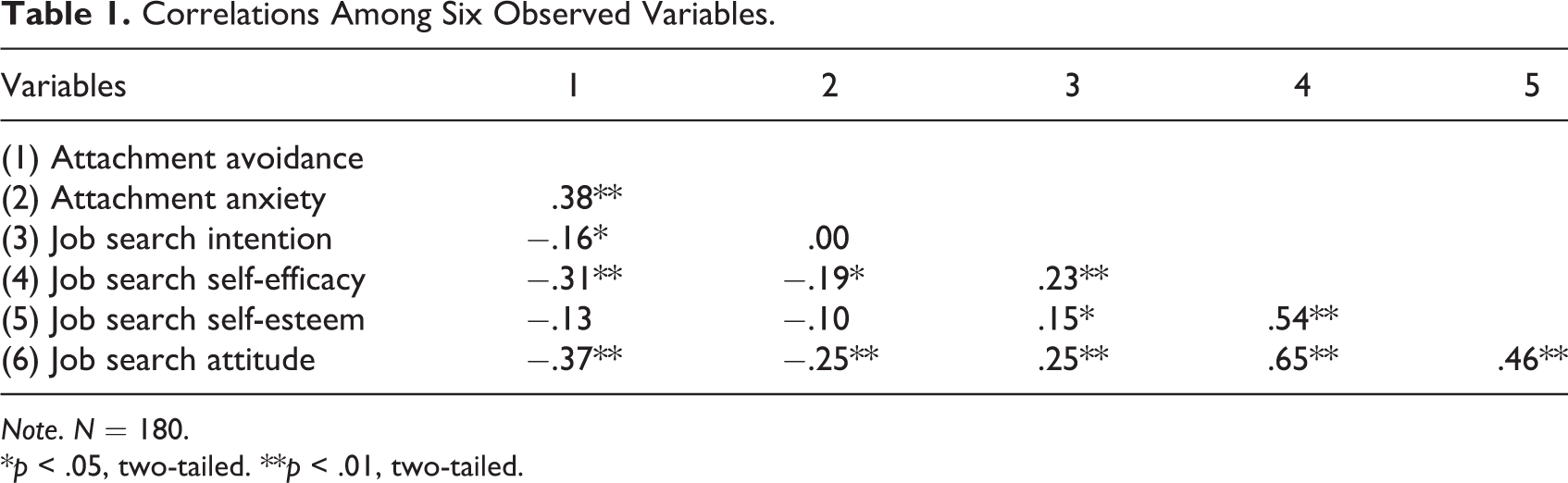
Note. N = 180.
*p < .05, two-tailed. **p < .01, two-tailed.
Main Analyses
Regression Analyses
To test Hypotheses 1–4, stating that attachment avoidance and attachment anxiety have negative relationships with job search intention, job search self-efficacy, job search self-esteem, and job search attitude, we conducted a regression analysis for each job search variable (Table 2). In this analysis, attachment avoidance and attachment anxiety were the independent variables. Job search intention, job search self-efficacy, job search self-esteem, and job search attitude were the dependent variables. Results showed that attachment avoidance had a significant effect on job search intention, job search self-efficacy, and job search attitude. In other words, more avoidantly attached people had a lower job search intention and a lower job search self-efficacy and more negative job search attitudes, supporting Hypotheses 1a, 2a, and 4a. Hypothesis 3a that attachment avoidance should be negatively related to job search self-esteem was not confirmed. Attachment anxiety had no significant effect on the job search variables, thus Hypotheses 1b, 2b, 3b, and 4b were not supported.
Regression Analysis to Test the Relationships Between Attachment Avoidance and Attachment Anxiety and Job Search Intention, Job Search Self-Efficacy, Job Search Self-Esteem, and Job Search Attitude.
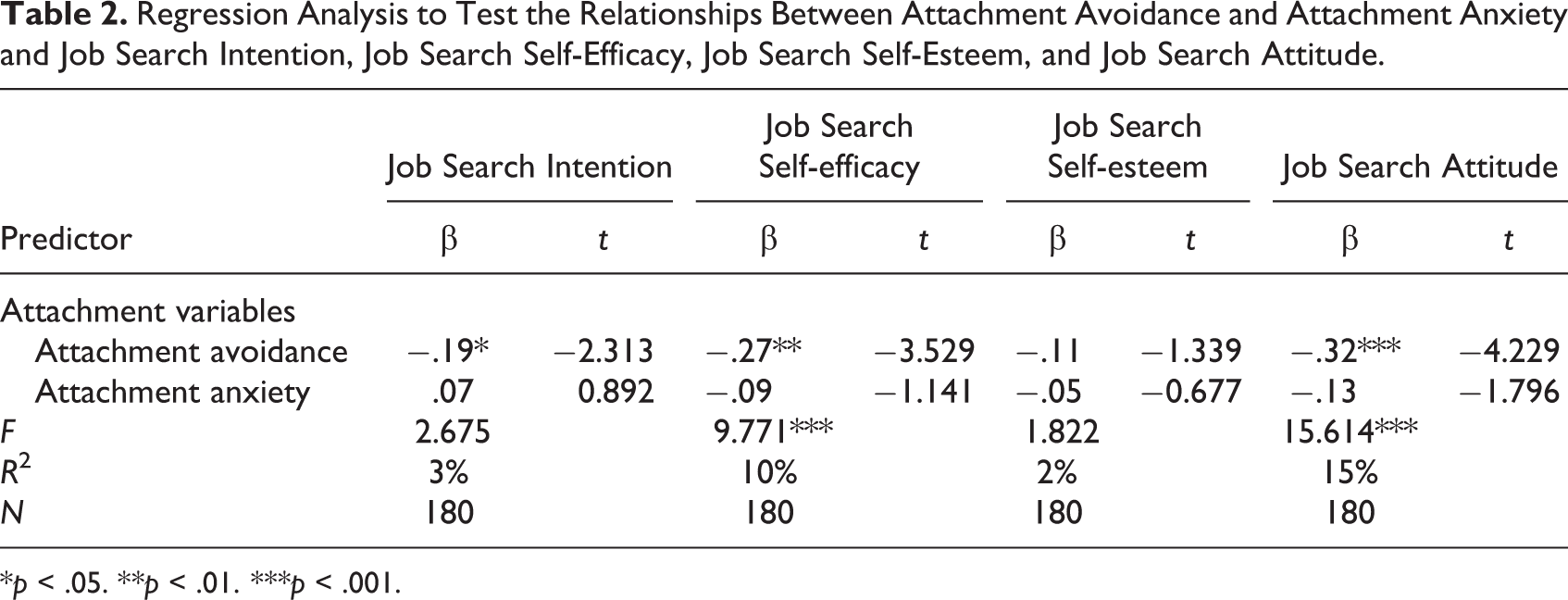
*p < .05. **p < .01. ***p < .001.
Testing Indirect Effects
To test Hypothesis 5a and b, suggesting that job search self-efficacy, job search self-esteem, and job search attitude mediate the relationship of attachment avoidance and attachment anxiety on the one hand and job search intention on the other, we performed a separate regression for each variable. In this analysis, the indirect effect was measured of either attachment avoidance or attachment anxiety as independent variable and job search intention as dependent variable through job search self-efficacy, job search self-esteem, or job search attitude. In the next step, the predictor variables job search self-efficacy, job search self-esteem, and job search attitude were added together to the equation to test whether these variables mediate the relationship of attachment avoidance with job search intention. Data were analyzed using Hayes'(2013) PROCESS procedure.
Results of the analyses of the indirect effects for attachment avoidance are shown in Table 3. In all of the analyses, we controlled for attachment anxiety due to the high correlations between attachment anxiety and attachment avoidance (r = .38, p < .01). By examining avoidance as an Independent Variable (IV), we included anxiety in the model as a covariate. There was a significant indirect effect of attachment avoidance on job search intention through job search self-efficacy (b = −0.04, BCa CI (Bias-corrected and accelerated bootstrap interval) = [−0.084, −0.012]) and job search attitude (b = −0.05, BCa CI [−0.105, −0.018]). Thus, support was found for an indirect effect of job search self-efficacy and job search attitude, but not of job search self-esteem, largely confirming Hypothesis 5a. Specifically, attachment avoidance has a significant effect on job search intention through both job search self-efficacy and job search attitude. In the model, examining the indirect effects of the three job search variables together, none of the variables was significant.
Indirect Effects of Job Search Self-Efficacy, Job Search Self-Esteem, and Job Search Attitude on the Relationship Between Attachment Avoidance and Job Search Intention Controlled for Attachment Anxiety.
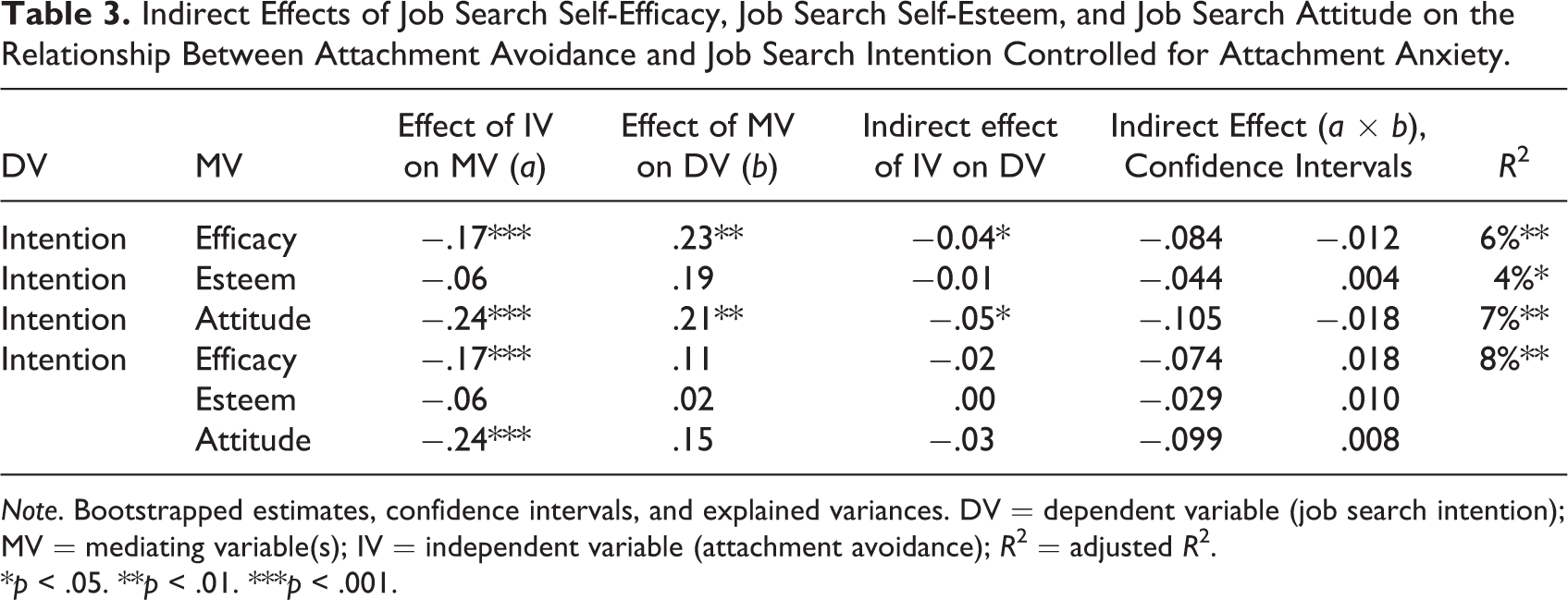
Note. Bootstrapped estimates, confidence intervals, and explained variances. DV = dependent variable (job search intention); MV = mediating variable(s); IV = independent variable (attachment avoidance); R 2 = adjusted R 2.
*p < .05. **p < .01. ***p < .001.
For attachment anxiety, we performed the same analyses. In all of the analyses, we controlled for attachment avoidance due to the high correlation between attachment avoidance and attachment anxiety (r = .38, p < .01). By examining anxiety as an IV, we included avoidance in the model as a covariate. The results of these analyses are shown in Table 4. There was no significant indirect effect of attachment anxiety on job search intention through job search self-efficacy, job search self-esteem, and job search attitude. Thus, no support was found for Hypotheses 5b. In the model, in which we examined the indirect effects of the three job search variables together, none of the variables was significant.
Indirect Effects of Job Search Self-efficacy, Job Search Self-Esteem, and Job Search Attitude on the Relationship Between Attachment Anxiety and Job Search Intention controlled for Attachment Avoidance.
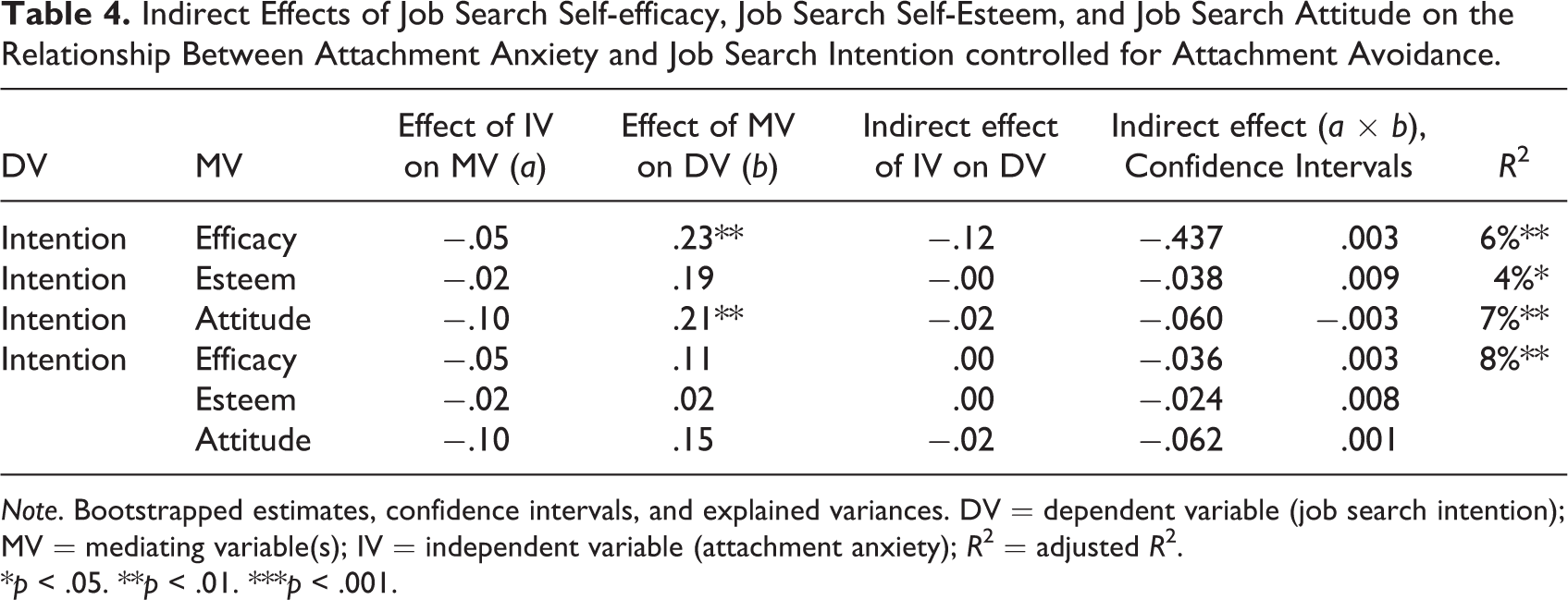
Note. Bootstrapped estimates, confidence intervals, and explained variances. DV = dependent variable (job search intention); MV = mediating variable(s); IV = independent variable (attachment anxiety); R 2 = adjusted R 2.
*p < .05. **p < .01. ***p < .001.
Discussion
In this study, we investigated the relationships between attachment avoidance and attachment anxiety and job search variables in a sample of 180 employees who had lost their job because of the closure of part of a plant. It was hypothesized that both attachment avoidance and attachment anxiety would be negatively related to job search intention, job search self-efficacy, job search self-esteem, and job search attitude. Finally, we hypothesized that job search self-efficacy, job search self-esteem, and job search attitude would mediate the relationship of attachment avoidance and attachment anxiety with job search intention.
We found support for our hypotheses that attachment avoidance is negatively related to job search intention, job search self-efficacy, and job search attitude but not to job search self-esteem. No support was found for the relationships between attachment anxiety and the job search variables. Thus, attachment avoidance seems to play a more important role in the job search process than attachment anxiety. Job seekers who were more avoidantly attached reported lower job search intentions, experienced lower job search self-efficacy, and had more negative job search attitudes. Moreover, job search self-efficacy and job search attitude mediated the relationship of attachment avoidance with job search intention. In other words, it was the lower level of job search self-efficacy and the more negative job search attitudes of avoidantly attached people that resulted in a lower degree of job search intention. These results largely support our hypotheses and are in line with models of attachment avoidance which suggest that attachment avoidance is associated with dysfunctional attitudes. However, these attitudes might protect avoidantly attached people from feeling vulnerable and might help them to maintain a positive self-image dealing with stressful situations (Mikulincer & Shaver, 2010).
Unexpectedly, we did not find support for our hypotheses that attachment anxiety is negatively related to the four job search variables. In most research, attachment anxiety is associated with lower levels of self-esteem and self-efficacy (Mikulincer & Shaver, 2010). This might imply that attachment anxiety has no effect on work domain-specific self-esteem and self-efficacy. However, avoidantly attached people seem to experience to a greater extent problems in the job search process than anxiously attached people. An interpretation for these findings is difficult to find because according to the literature both avoidant and anxiously attached people fear new situations. Probably, avoidantly attached people minimize distress by avoiding social situations more than anxiously attached people do (Leiter, Day, & Price, 2015). Anxiously attached people might distract themselves from a negative mood by avoiding being isolated from other people by trying to find another job as soon as possible (Mikulincer & Shaver, 2010). Future studies should further examine the difference between attachment avoidance and attachment anxiety in the job search process.
An explanation for the mediating effect of job search variables between attachment avoidance and job search intention might be that people withdraw from challenging, demanding activities in order to avoid feeling threatened and consequently have lower intentions to search for a job. In contrast to mediating effects as to attachment avoidance, we did not find mediating effects between attachment anxiety and job search intention through the different job search variables. Possibly, anxiously attached people evaluate themselves as relatively helpless and incompetent and have pessimistic expectations about their ability to attain goals (Mikulincer & Shaver, 2010). In line with this explanation, Vrticka, Sander, and Vuilleumier (2012) found that anxiously attached people tend to have a cognitive–affective ambivalence in emotion regulation strategies, leading to a mixture of desire for security and sensitivity to rejection. Future research is needed to further explore the mediating roles of the job search variables between attachment avoidance and attachment anxiety and job search intention.
Implications
Practical implications for career counselors to support job seekers might be for instance by making people more conscious of their attachment styles and the possible consequences of their attachment style for interpersonal relationships or exploring new situations (Richards & Schat, 2011). Career counselors and vocational psychologists may benefit from a greater knowledge of attachment theory. It may help them to identify more accurately any signals of problems of employees’ functioning or the impact on the process of applying for another job. Also, they may benefit from recognizing their own attachment style, which may help them in creating a secure attachment relationship between themselves and the employee. A secure relationship may contribute to foster employees’ attachment security, thereby enhancing their power to explore new situations and to deal with stressful situations at work.
Strengths and Limitations of the Present Research
This study has a number of noteworthy strengths. It is, to the best of our knowledge, the first examination of the relationships between attachment avoidance and attachment anxiety and various job search variables, expanding the research on adult attachment into the work place, especially to the situation of losing one’s job. Our study addressed attachment style as a basic, and previously overlooked, personality characteristic in the job search process. In future research, it would be interesting to investigate both the joint and the independent influence of attachment styles and other individual characteristics, including different facets of the Big Five. This is important because understanding these interrelationships can provide professional career counselors with greater knowledge of the factors that impact the job search process of individuals allowing them to support job seekers better in the potentially stressful situation of looking for a new job.
The results of our study also show that attachment avoidance and attachment anxiety that assumedly develop at a young age can continue into one’s adult life, affecting individual functioning and self-regulation and influencing people’s feelings of self-worth. To be successful in the job search process, people need to be confident about themselves and to trust that they are worthy of a new position. Our results suggest that an outplacement trajectory might be advantageous particularly for avoidantly attached people, to support them to move successfully through the job search process. Professional career counselors can provide a safe space in which the unemployed are able to develop the skills needed to master new situations and prevent long-term unemployment. In one study, Littman-Ovadia (2008) found that the perception of social comfort and personal security that the counselor creates during and after counseling enhanced the range and effectiveness of respondents’ career explorations. This effect may also apply to people in an outplacement situation. The results of our study suggest that it would be useful to further investigate these relationships.
There were also some limitations of the present research. First, all respondents were employees from a single Dutch international industrial organization. Most of them were men and held technical jobs. This might limit the generalizability of our findings. Generalizability might also be a problem for employees who have lost their job but who are not offered an outplacement trajectory because this group lacks support from professional career counselors to help them move through the job search process. Second, respondents filled out the questionnaire within 2 weeks after their first meeting with career counselors. However, some of them started their formal outplacement trajectory only 1–6 months later, after they received the invitation to participate in the study. It is possible that the impact of attachment styles is even greater once respondents have started to search for a job directly. For example, one might think they feel confident enough to apply for a new job when their layoff date is in the far future, but when this moment is more imminent, it can negatively influence mood and lead to a decline in feelings of self-worth. Third, our research is cross-sectional, so we are not able to draw conclusions about causality. Longitudinal research examining relationships between attachment avoidance and attachment anxiety and job search behavior may increase our understanding of the influence of attachment styles on this process. Fourth, attachment to the mother and attachment to the father were assessed retrospectively. This may have introduced recall bias and biases as a result of relationship experiences later in the life course. Hazan and Shaver (1987) found securely attached people to recall secure childhood relationships with primary caregivers. However, there is an ongoing debate whether attachment style is rather stable or not across the life span. Attachment styles are supposed to resist changes; however, critical incidents might change attachment styles in either a positive or a negative way (Kidney, 2013). Fifth, the degree of explained variance was in general relatively low. This means that attachment avoidance and attachment anxiety are weakly related to the job search variables. Possibly, other psychological characteristics, such as neuroticism and consciousness, play a more important role in the job search process. Finally, reliability of the scale job search self-esteem was low.
Conclusions
In sum, our results indicate that there is a relationship between attachment avoidance and job search intention, job search self-efficacy, job search self-esteem, and job search attitude. The results demonstrate that attachment is an additional personality characteristic that, along with other personality traits, should be considered in research on job search. An understanding of the influence of attachment on the individual job search process may help career counselors to support the improvement in clients’ self-efficacy, self-esteem, and attitude when applying for new jobs.
Footnotes
Declaration of Conflicting Interests
The author(s) declared no potential conflicts of interest with respect to the research, authorship, and/or publication of this article.
Funding
The author(s) received no financial support for the research, authorship, and/or publication of this article.