




Abstract
Previous research attempted to identify personal resources that promote employability, that is, an individual’s chance to find and maintain employment. This has resulted in a large number of different personal resources, which are not always clearly differentiated from one another and often seem to—at least partially—overlap conceptually and/or empirically. In response, we aim at conceptual clarification and integration of what we coin “employability capital”. Based on a literature review, we developed a conceptual framework that integrates the various facets. Two types of distinctions were found: (a) an employability distinction, which differentiates between job-related, career-related, and development-related employability capital, and (b) a capital distinction, which differentiates between human capital (more specifically knowledge, skills, and attitudes) and social capital. We performed a Q-sorting study in which items of existing measurements were mapped onto the conceptual framework by subject matter experts. Overall, we found support for the conceptual framework.
There is general agreement among both policy makers and researchers that it is important for individuals to be employable, that is, to safeguard their chance to find and maintain a job (Hillage & Pollard, 1998). Employability is important since it maximizes an individual’s likelihood of attaining personal goals, ambitions, and aspirations (Rothwell & Arnold, 2007; Van der Heijden, de Lange, Demerouti, & Van der Heijde, 2009) and reduces the threat of job loss and the negative consequences associated with job insecurity (De Cuyper, De Witte, Kinnunen, & Nätti, 2010). These benefits associated with employability have stimulated researchers to examine both personal and contextual factors that can promote individuals’ employability (Forrier & Sels, 2003). Most research attention has focused on personal resources, probably because these are tied to the individual and generally more easily adaptable while the context is often beyond the individual’s control. Accordingly, in this study, we focus on these personal resources.
To refer to the various personal resources which promote an individual’s employability, we introduce the notion of “employability capital”. Employability capital is a variation on the term “movement capital”, which has been used in earlier research (see Forrier, Sels, & Stynen, 2009, for an overview). Yet, the term movement capital has been introduced in the context of career mobility and thus hints at personal resources which help people to successfully change jobs. Hence, it focuses on one feature of employability, that is, the likelihood to find a new job and does not adequately capture the second employability feature, that is the likelihood to keep a job. Accordingly, the term employability capital is more accurate to capture the combination of obtaining and retaining employment.
The relevance of personal resources for peoples’ employability has not only been discussed in the employability literature; it is also a central idea in many career theories (e.g., Blustein, Kenna, Gill, & DeVoy, 2008). Career development literature emphasizes the importance of personal resources for individuals (1) to perform and function at their best within their occupation (e.g., Super, 1957, 1980), (2) to enhance the likelihood of obtaining new employment (e.g., Duffy, Blustein, Diemer, & Autin, 2016; Lent, Brown, & Hackett, 1994; Savickas, 1997), and (3) to develop themselves over a longer period of time (Savickas, 1997; Super, 1957). Several specific personal resources have been identified, for example, career decision-making self-efficacy (e.g., Lent et al., 1994), occupational expertise (Van der Heijde & Van der Heijden, 2006), attitudes and dispositions such as career openness to change (Fugate & Kinicki, 2008), identity (Nazar & van der Heijden, 2012), adaptability (Eby, Butts, & Lockwood, 2003), job-related skills (Eby et al., 2003), employability orientation or attitudes (Kluytmans & Ott, 1999; van Dam, 2004), opportunity awareness (Wittekind, Raeder, & Grote, 2010), and social capital (Eby et al., 2003; Fugate, Kinicki, & Ashforth, 2004). Accordingly, personal resources are also very central in career counseling. Indeed, an important aspect of career counseling is to identify person-related resources in order to guide individuals through career steps (Blustein et al., 2008).
Given the widespread acknowledgment that personal resources matter for people’s employability, an attempt to clarify which dimensions of personal resources can be distinguished and which of these types are covered by existing measurements seems highly important for both academics and practitioners. This is particularly relevant because literature on this topic is scattered, which inhibits our overall understanding of employability capital. This is signaled by different authors having identified many and different personal characteristics and, accordingly, by the multitude of measurements that exist which has led to a proliferation of the literature, for example, different measurements exist for concepts that appear similar and similar measurements exist for concepts that appear distinct. As an example of different measurements for similar concepts, we refer to the notion of work and career resilience: Fugate and Kinicki (2008) developed a scale with items such as “I feel I am a valuable employee”, implying job-related attitudes, and London (1993) developed a scale with items such as “I welcome job and organizational changes”, implying career-related attitudes. An example of similar measurements for different concepts concerns Eby, Butts, and Lockwood’s (2003) measure of “job-related skills” (sample item: “I follow developments in the field of industry and employment regularly”) and Wittekind, Raeder, and Grote’s (2010) measure for “opportunity awareness” measure (sample item: “I remain current on the trends and developments in my profession”). In this study, we first review the employability literature and examine which dimensions of employability capital are identified in this literature. Although several research streams acknowledge the importance of personal resources for people’s employability, we focus on the employability literature since this is already an extensive literature stream and since employability capital can be best situated in this stream of literature. We then test to which extent these theoretically distinguished facets of employability capital are covered by existing measurements of employability capital. To this end, we performed a Q-sorting study with 29 subject matter experts.
Our overall aim is conceptual clarification of employability capital along two objectives: (1) to develop a conceptual framework that identifies different facets of employability capital (conceptual objective) and (2) to map measurements onto the conceptual framework in order to detect potential gaps in the conceptual framework or overlap between specific dimensions that constitute employability capital (measurement objective).
Literature Review
Employability capital refers to the set of personal resources—or capital—that may impact individuals’ employability (Trevor, 2001). To this definition, there are two key aspects. First, capital or personal resources are characteristics that help individuals to attain their goals. These resources lead to positive outcomes and can be nourished (Hobfoll, 2001). More specific, capital can take the form of knowledge, skills, and attitudes (KSA) or of social networks that are critical for one’s position on the labor market (e.g., Eby et al., 2003; Fugate et al., 2004; McArdle, Waters, Briscoe, & Hall, 2007; Van der Heijden et al., 2009). Second, employability refers to the likelihood of obtaining and retaining a job (e.g., Forrier et al., 2009).
Several researchers have reflected on categorizations to order the various personal resources that may be relevant for a person’s employability. Two types of categorizations can be distinguished: (1) categorizations which focus on different challenges to remain employable—thus to safeguard one’s chance to obtain and retain employment—and (2) categorizations which focus on different types of capital—that is, types of resources that promote an individual’s chance to obtain and retain employment. Below, we first discuss and integrate the most dominant views within these categorizations and then combine these two types of categorizations into an employability capital matrix.
Employability
Individuals face a number of challenges when their aim is to strengthen their labor market position. These challenges have been described in the 1990s by leading authors such as Arthur, Inkson, and Pringle (1999) and Hall and Mirvis (1995) but are relevant still today. For example, they have particular resonance in the Europe 2020 strategy to optimize employment rates (European Commission, 2015). The first challenge relates to the need to develop both job-specific and generic competencies (Thijssen, 2001; Van der Heijde & Van der Heijden, 2006). The second challenge relates to the need to develop competencies that help to shape a career (Eby et al., 2003; Fugate & Kinicki, 2008; Kuijpers & Scheerens, 2006; Wittekind et al., 2010): Employees need to manage job transitions, vertical and horizontal, and within and between organizations. The third challenge relates to the need for continuous learning and development: In response to required flexibility, employees need to possess the ability to learn new competencies and adapt to changing circumstances (Fugate et al., 2004, Van der Heijde & Van der Heijden, 2006).
The competencies needed to address these three challenges are tied to employability: Job-related (specific and generic) competencies guarantee the present job, career-related competencies are important in view of potential other jobs in the near future, and development-related competencies in view of shaping a long-term career. We therefore advance them as separate classes within the employability component of employability capital, integrating existing classifications. For example, Thijssen (2001) distinguished professional, mobility, and learning competencies, and Clarke and Patrickson’s (2008; Clarke, 2008) professional employability, transitional employability, and a focus upon lifelong learning.
Job-related competencies concern the set of personal resources that enable individuals to perform a job, including job-specific and more generic resources (King, Burke, & Pemberton, 2005; Thijssen, 2001; Van der Heijde & Van der Heijden, 2006). Job-specific resources relate to the idea of professional employability advanced by Clarke and Patrickson (2008): It concerns the ability of employees to perform well in their current job and to comply with the current organizational needs and expectations and is thus a critical aspect of employability in terms of retaining the current job. Examples are possessing occupational expertise and technical competencies (Van der Heijde & Van der Heijden, 2006). Generic competencies refer to transferable job-related competencies which are needed to make lateral job transitions, both within and across organizations, and thus critical to employability in terms of obtaining new employment (Becker, 1975; Thijssen, Van der Heijden, & Rocco, 2008; Van der Heijde & Van der Heijden, 2006). Examples are communication, problem-solving, interactional skills, initiative, and efficiency (Clarke, 2008; Garavan & McGuire, 2001; McQuaid & Lindsay, 2005).
Career-related competencies are personal resources that enable individuals to make transitions between jobs and organizations and to acquire a new labor market position. They are similar to Thijssen’s (2001) mobility competencies and to Clarke and Patrickson’s (2008) transitional employability. Examples are career development ability, career control, career-related skills, and career identity (DeFillippi & Arthur, 1994; Eby et al., 2003; Kuijpers & Scheerens, 2006).
Development-related competencies are personal resources that enable growth over time. They are similar to the “learning competencies” defined by Thijssen (2001) and the need to engage in lifelong learning (Clarke, 2008). The focus is on long-term career development through continuous learning (Berntson, Sverke, & Marklund, 2006; Clarke, 2008; Fugate & Kinicki, 2008; Thijssen, 2001; Van der Heijde & Van der Heijden, 2006). Development-related resources are important to engage in different types of developmental activities and to gain new professional competencies (Thijssen, 2001), so that individuals can easily adapt to all kinds of changes (Clarke, 2008; Fugate & Kinicki, 2008; Van der Heijde & Van der Heijden, 2006).
Capital
Two dominant types of “capital” are distinguished in the literature (cf. Smith, 2010): human capital and social capital. While both are tied to the person, human capital finds its source in the individual, whereas social capital originates from relationships with others.
Human capital concerns KSA (e.g., Baartman & De Bruijn, 2011). Knowledge (I know) and skills (I can) relate to the “knowing-how” competencies advanced by DeFillippi and Arthur (1994), namely, career relevant knowledge and skills. Knowledge and skills have been advanced under different labels, for example, occupational expertise (Van der Heijde & Van der Heijden, 2006) and job-related skills (Eby et al., 2003). Attitudes relate to the knowing-why competencies from DeFillippi and Arthur (1994), which entail different motivational components in particular aspects of willingness and individual preferences. Examples are the willingness to change jobs and to adapt to changing circumstances or the more general concept of employability orientation (Clarke, 2008; Gaspersz, 1999; Savickas, 1997; van Dam, 2004) and career expectations and aspirations (DeFillippi & Arthur, 1994; Eby et al., 2003; Forrier & Sels, 2003; Gaspersz, 1999).
Social capital refers to capital derived from work- and career-related networks and relationships (Arthur, Inkson, & Pringle, 1999; DeFillippi & Arthur, 1994; Eby et al., 2003) and is similar to the “knowing-whom” competencies from DeFillippi and Arthur (1994). Social capital provides information about and access to job leads and is thus critical in terms of employability. This has strong implications in terms of the ability of individuals to find employment opportunities. Examples are formal (e.g., colleagues) and informal (e.g., friends) networks (Steel & Griffeth, 1989) from within and outside the organization (Eby, Butts, & Lockwood, 2003), which can be described in terms of depth and breadth (Furstenberg & Hughes, 1995; Pettit, Erath, Lansford, Dodge, & Bates, 2011) and in view of instrumental and social support (e.g., Adler & Kwon, 2002).
The Employability Capital Matrix
The employability categories address the purpose of personal resources (i.e., to perform job(s), to make career transitions, or develop), whereas the capital categories specify the nature of these resources (KSA and social capital). In combination, they identify a specific aspect within employability capital. For example, “the knowledge (capital aspect) needed to keep a job or to make a career transition (employability aspect).” Accordingly, the employability capital classes can be combined into 12 (4 Capital Classes × 3 Employability Classes) or 14 categories when accounting for the difference between specific and generic job-related knowledge and skills as listed in Table 1.
Definitions Related to the Different Categories of Employability Capital Matrix.
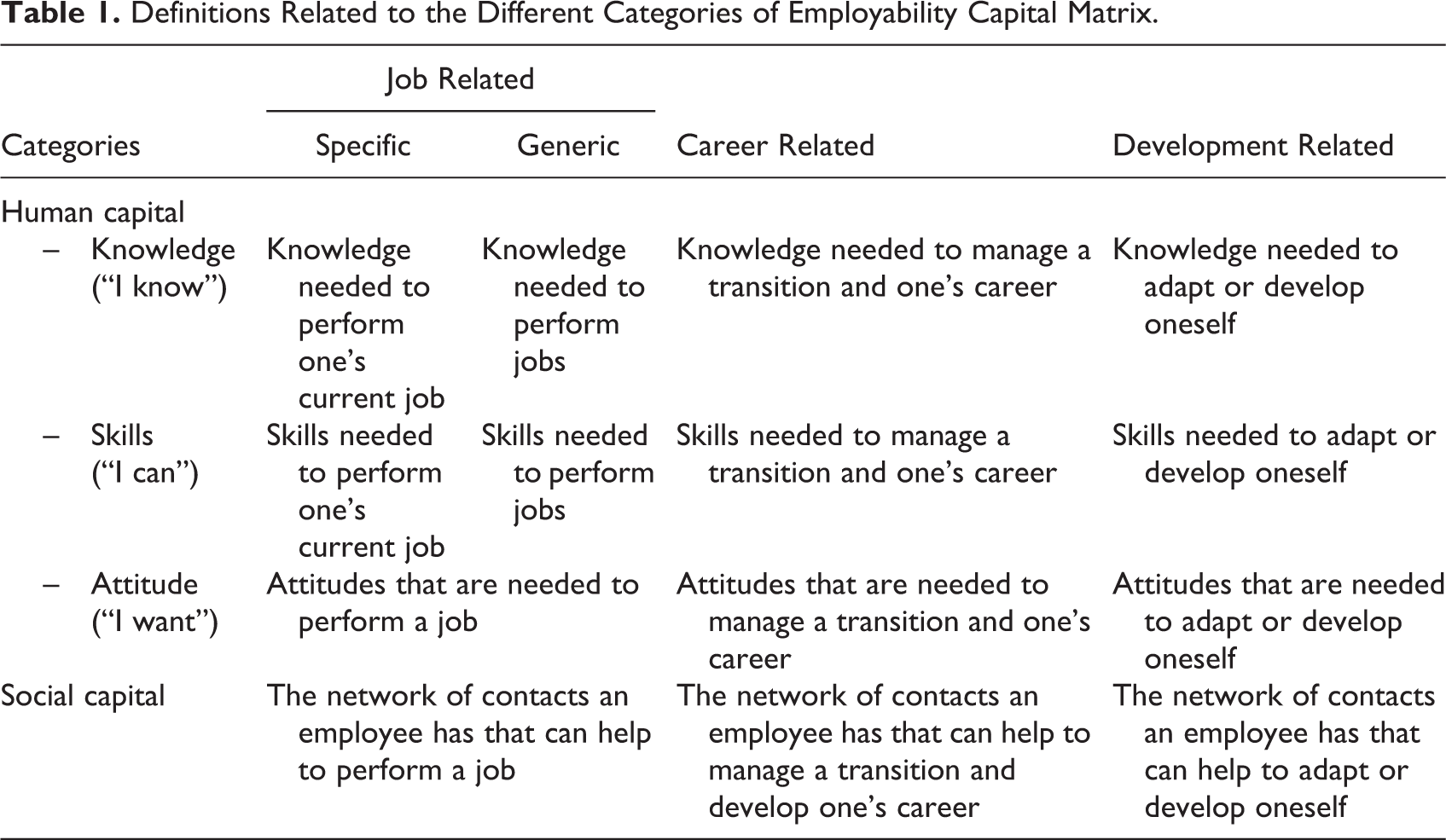
The categories are distinct, yet related. For example, the category “job-related attitudes” is defined as the employability capital that measures attitudes that are needed to perform a job. An example of this category might be the measurement “I feel I am a valuable employee” by Fugate and Kinicki (2008). Whereas the “development-related attitudes” refers to attitudes that are needed to adapt or develop oneself. An example of this category might be “I remain current on the trends and developments in my profession” by Wittekind et al. (2010).
This framework focuses on personal resources and hence does not include career development activities, which may help individuals to develop these personal resources. However, this distinction is not clear cut. For example, the measurement by Wittekind et al. (2010) focusses on trends, which may also hint toward activities; however, since it relates to an attitude, it can be associated with the development-related attitude category. Similarly, we did not focus on “perceived employability”, since this incorporates external influences and is a more generic concept which is sometimes labeled as the “output” of employability capital because it can be seen as the result of both personal resources and the environment (Vanhercke, De Cuyper, Peeters, & De Witte, 2014)
Method
In the following, we examine how the conceptual dimensions and categories of employability capital which can be distinguished in the employability literature are covered by existing empirical measurements. To this end, we performed a Q-sorting study with subject matter experts.
Participants
The participants in this study were academic experts in the field of work and organizational psychology, human resources, and/or organizational studies. The participants were chosen because of their expertise in employability research or organizational research in general, their experience with the use of measurements and items, and their diverse backgrounds (management and psychological perspective). In total, 29 participants were involved in this study. Of these participants, 11 were experts in employability research. The participants lived in 10 different countries and were affiliated to 10 universities. Through this diverse set of respondents, we aimed at facilitating diversity in the answers which is considered important in this type of research (cf. Stainton Rogers, 1995).
Procedure
We conducted a Q-sorting study in which the participants were asked to map items of existing employability capital measurements onto the conceptual framework. Q-sorting is a classification technique with high face validity: Participants are asked to sort “cards” into mutually exclusive “piles” (e.g., Hinkin & Schriesheim, 1989; MacKenzie, Podsakoff, & Fetter, 1991; Stainton Rogers, 1995). The basic principle is that participants sort cards which they consider to be more similar in the same pile and cards which, to them, seem different in different piles (Parker, 2006). This results in a specific allocation of the cards for each participant.
The cards in this study were items of existing measurements and the piles were the 14 categories from the employability capital matrix. The respondents were asked to sort each item into the category in which it, in their view, fitted best. To avoid bias due to a different interpretation of the categories, we provided the respondents with the construct definition of each category (e.g., Schriesheim, Powers, Scandura, Gardiner, & Lankau, 1993). For each row and for each column in the employability capital matrix, we added an “unspecified” category. In that way, respondents could sort an item in a specific column (i.e., job-related, career-related, or development-related employability capital), while leaving the row (i.e., KSA or social capital) unspecified or vice versa. In case the respondent did not perceive any fit with a category, column, or row, the respondent could also choose a rest category or add and label a new category. In total, the participants had to allocate items to 1 of the 14 categories or to 1 of the 9 unspecified categories.
We used an online tool in which items were presented in a random order to all participants. The respondent was able to move items to another category at all times (cf. Stainton Rogers, 1995).
Measurements Used
To select the items, we followed a two-step procedure. First, we searched for studies including measurements regarding personal resources that are expected to influence an individual’s chances of obtaining and retaining employment (i.e., employability capital). As a starting point for our search, we screened references and citations of key publications concerning employability (e.g., DeFillippi & Arthur, 1994; Eby et al., 2003; Forrier et al., 2009; Fugate & Kinicki, 2008; Van der Heijde & Van der Heijden, 2006).
Second, we investigated the measurements and items used in these studies in greater detail, which led to exclusion of some studies (1) due to duplicates or (2) when all items from a scale tapped into activities, perceived employability, and/or contextual or situational aspects (e.g., hindrances that disable an individual to find another job). When at least 1 item reflected employability capital, we included the full scale. We opted to do it this way since different items from the same scale are indicators of the same underlying construct and may therefore be all relevant. This resulted in 31 scales, containing 222 items, from 15 studies indicated in the reference list by an asterisk.
Due to the high total number of items and associated concerns about workload for the participants, we decided to reduce the number of items presented to each participant by creating three sets of items. The number of items per set ranged from 146 to 159. Nine participants allocated the first set of items. The two other sets of items were each allocated by 10 participants. We included highly cited scales in all three sets. Less often-cited scales and Dutch items were included in one of the three sets. Dutch items were categorized by Dutch-speaking participants.
Analyses
The input for the analyses consisted of allocations of items to the categories from the conceptual matrix by the participants. Results emerge as a combination of statistical and interpretational analyses.
Through statistical analyses, the input is reduced to “dimensions” which collect items with a similar content. This reduction provides insight in potential gaps or overlap between categories of the framework. Conceptual gaps arise when participants create new categories and measurement gaps arise when no items were allocated to a specific category. Overlap exists when categories from the original framework blend.
The statistical reduction into dimensions was done by multidimensional scaling (MDS) analyses (cf. Derous, De Witte, & Stroobants, 2003; Dries, Pepermans, and Carlier, 2008). MDS is a statistical technique that helps researchers determine underlying dimensions or clusters of categories. Categories clustered into the same dimension when (the majority of) participants allocated a single item into different categories, while a category has its own dimension when items were allocated only to that category and not to another one by (the majority of) the participants. As a result, categories in one cluster are more similar (in some sense or another) to each other than to categories in different clusters.
In order to uncover dimensions, dissimilarities between categories are projected or mapped in a fictitious n-dimensional space. Therefore, the data of the Q-sorting needed to be transformed into dissimilarity matrices that represent dissimilarity between categories. For each of the 222 items, we computed this dissimilarity matrix (cf. Derous et al., 2003; Dries et al., 2008). Dissimilarity was calculated by the frequency with which an item was categorized into a specific category relative to another category. For example, a high grade of dissimilarity for Category A relative to Category B is observed, when item x was never allocated to Category A and multiple times to Category B. All these 222 matrices were used as input for the MDS analyses. The analyses reduced the proposed 23 (14 + 9) categories into each imposed number of dimensions. We performed the MDS analyses through Alternating Least Squares approach to sCALing (ALSCAL) in SAS.
The results of ALSCAL are similar to factor analysis: It provides results of each number of retained dimensions and the loadings of the categories on a dimension and it also provides results of the loadings of the items on the dimensions. Items with an equally high loading on two or more dimensions were excluded from the results.
Through interpretational analyses, different dimensionalities are interpreted and compared. We interpreted and labeled the dimensions based on the content of the items that loaded on the dimensions. If there were similar items in different dimensions, it was concluded that it was not an unambiguous result and that the number of dimensions did not fit the measurements.
Multidimensional statistical and interpretational analyses should be considered together and as part of an iterative process (cf. Dries et al., 2008). This is illustrated in how the number of retained dimensions is chosen, namely, based on statistical fit criteria, parsimony, and interpretability. When allowing more dimensions, the fit of the categories on the dimensions improves. Since a lower number of dimensions is preferred because of reasons of parsimony and interpretability, the focus is thus on the “badness” of fit (Dries et al., 2008; Kruskal & Wish, 1984). Arabie, Carroll, and DeSarbo (1987) believe that .40 can be used as a cutoff for the badness of fit but that interpretability is preferred over a low badness of fit. In sum, the fit scores can be used as an indicator, but interpretability is the single most important criterion.
Results
In the following, results are discussed in a stepwise manner starting with 22 dimensions (i.e., all possible categories), next 14 dimensions (i.e., the hypothesized conceptual framework), and finally 4 dimensions (i.e., the most parsimonious framework). These solutions were chosen based on the statistical and interpretational analyses which resemble factor analyses.
The solution with 22 dimensions had a badness of fit of .03 (R 2 = 1). There were no items that belonged to a dimension that had no corresponding predefined category and all categories corresponded to a separate dimension. Overall, these results support the conceptual framework and do not indicate conceptual gaps.
The solution with 14 dimensions had a badness of fit of .15 (R 2 = .98). All 14 categories of the conceptual matrix were identified as separate dimensions, except for the “career-related skills” and “career-related attitudes” categories which clustered into one dimension and the “unspecified: career-related” category which was identified as a separate category. Overall, this structure supports the conceptual framework. The majority of items belonged to career-related and attitude dimensions. In terms of measurement gaps, few items belonged to the general and specific job-related dimensions and to dimensions that focus on knowledge and skills, and no items belonged to specific job-related skills category.
Although the 14-dimensional solution reflected the categories of the conceptual framework in the dimensions and provides support for the conceptual framework, the results were ambiguous and different dimensions contained similar items. To reduce overlap between dimensions and improve interpretability of the results, we therefore opted for a solution with less dimensions. To this end, we carefully inspected all solutions between the 14-dimension and the 1-dimension solution and assessed their interpretability and badness of fit. After carefully inspecting all solutions, the result with four dimensions was selected because this solution combined a reasonable level of interpretability and no overlap of similar items between categories with an acceptable badness of fit (.40; R 2 = .84). Based on the underlying categories and the items that belonged to the new dimensions, we formulated labels for each dimension.
Dimension 1 consisted of the following categories: “generic job-related skills”, job-related attitudes, “job-related social capital”, unspecified, “unspecified: attitudes”, and “unspecified: knowledge”. Thirty-four items loaded on the first dimension, for example, “I define myself by the work that I do’ (work identity; Fugate & Kinicki, 2008) or “I do that extra bit for my organization/department over and above my direct responsibilities” (corporate sense; Van der Heijde & Van der Heijden, 2006). We labeled this dimension job-related attitudes.
Dimension 2 consisted of the following categories: “generic job-related knowledge”, “specific job-related knowledge”, “specific job-related skills”, “career-related social capital”, “development-related social capital”, “unspecified: generic job-related”, “unspecified: skills”, “unspecified: social capital”, and “unspecified: specific job-related”. Fifteen items loaded on this dimension, for example, “I consider myself competent to be of practical assistance to colleagues with questions about the approach to work” (occupational expertise; Van der Heijde & Van der Heijden, 2006) or “An employer would be impressed with my qualifications” (current level of job-related skills; Wittekind et al., 2010). We labeled this dimension “job-related expertise”.
Dimension 3 consisted of the following categories: “career-related attitudes”, “career-related knowledge”, “career-related skills”, and “unspecified: career-related”. Thirty-nine items loaded on this dimension, for example, “I have specific career goals and plans” (knowing why/career insight; Eby et al., 2003; Maurer & Tarulli, 1994) or “I have a specific plan for achieving my career goals” (career motivation; Fugate & Kinicki, 2008). We labeled this dimension “career-related employability capital”.
Dimension 4 consisted of the following categories: “development-related attitudes”, “development-related knowledge”, “development-related skills”, and “unspecified: development-related”. Twenty-six items loaded on this dimension, for example, “I am willing to devote time and energy to education in order to develop myself for a future job” (willingness to be flexible; Van den Berg & Van der Velde, 2005) or “I am actively trying to develop my knowledge and work experiences” (employability activities—van Dam, 2004). We labeled this dimension “development-related employability capital”.
Three items loaded on two or more dimensions, for example, “What proportion of your work would you say you brought to a successful conclusion in the past year?” (occupational expertise; Van der Heijde & Van der Heijden, 2006), loaded on the dimension of career-related employability capital and the dimension of development-related employability capital.
In total, 105 items did not have a satisfactory fit since they did not meet the cutoff of .40. These items loaded on all four dimensions. Most of these items were about social capital (e.g., “co-workers say that I know a lot of people outside the organization”, Eby et al., 2003; “I have contacts in other companies who might help me line up a new job”, Griffeth, Steel, Allen, & Bryan, 2005) and adaptability to changes in the current job (e.g., “I adapt to developments within my organization”, Van der Heijde & Van der Heijden, 2006; “I am able to adapt to changing circumstances at work”, Fugate & Kinicki, 2008).
Discussion
The aim of this study was to advance research on employability capital, that is, on personal resources which enhance people’s likelihood to keep their job or find a new job. We identified two dimensions which are in the employability literature to distinguish and categorize these personal resources: (1) an “employability” dimension which differentiates between job-related, career-related, and development-related resource categories and (2) a “capital” dimension with categories concerning human capital in terms of KSA and social capital. We then tested to which extent existing measurements of employability capital match with this theoretical framework formed by these two dimensions. We did this through a Q-sorting study with 29 subject matter experts who mapped measurements onto the conceptual framework in order to detect potential gaps and/or overlap. Overall, the results of this Q-sorting study showed support for the conceptual framework: The categories were largely replicated and no further categories were added. This strengthens the belief that this conceptual framework is suitable to study employability capital, yet with some warnings.
First, there were no items that belonged to the specific job-related skills category of the initial conceptual framework, which caused the collision of this category with the generic category. This highlights a measurement gap: While specific job-related skills are considered conceptually, few measurement may be available. Measurements for specific job-related skills may, however, be available in more specialized literature on unique groups of job incumbents.
Second, there was considerable overlap between categories of the conceptual framework, namely, between career-related categories, between development-related categories, between knowledge and skills categories, and between skills and attitudes categories. This overlap suggests that the initial model may be too complex. This led to a more parsimonious framework that consisted of following four dimensions: job-related attitudes, job-related expertise, career-related employability capital, and development-related capital. It appears that capital-related categories (human capital aspects like KSA and social capital) are more difficult to differentiate compared to employability-related categories (job-related, career-related, and development-related). The four dimensions may inspire future research, particularly when it comes to measurement construction: Ideally, measurements should tap into the four dimensions when the aim is to provide a rich account of personal resources tied to employability. A challenge is to develop measurements in which overlap between the dimension is minimal: The scales of the measurements that were used in the Q-sorting study often loaded on multiple dimensions because some items loaded on Dimension 1 and other items from the same scale loaded on Dimension 2, for example. Scales thus seem to incorporate several items that are actually distinct from each other, which hampers reliability and validity of scales.
Specific attention should go to social capital and adaptability: They loaded on all dimensions and, thus, were not identified as separate dimensions. Items on social capital could be placed under different categories. For example, social capital may help individuals to find a new job which might hint to the career-related employability capital category (e.g., “I know people in my type of work who might help me get a job”, Wanberg, Song, & Hough, 2002), while other items may also tap into job-related attitudes (e.g., “I find working with new people ___. 1 (very unpleasant) to 6 (very pleasant)”; Van der Heijde & Van der Heijden, 2006). Both social capital and adaptability appear to be key elements of employability capital, but, rather paradoxically, they did not emerge as separate dimensions. A potential explanation is that these aspects are more difficult to allocate to an employability category.
Limitations
Some limitations of this study come to the fore. First, we did not ask the participants to rate the representativeness of the items. This is often recommended in Q-sorting studies because it enables exclusion of “bad” items. We did not include this option in our study due to the large effort we already asked of participants. This information would have been informative in view of instrument development. Second, we started the Q-sorting study with a conceptual framework based on an extensive literature review. However, some researchers recommend to ask participants to create categories and label these categories in Q-sorting studies (e.g., Hinkin & Schriesheim, 1989). In this study, participants were asked to change labels of categories if necessary, to use unspecified categories when other categories did not match with the item, and to create new categories if necessary. However, the use of predefined categories limits our results; we did not receive suggestions for different labels of dimensions. Third, we limited our Q-sorting exercise to measurements of employability capital which have been used in the employability literature. Also, other constructs which are mainly used in other domain, such as career decision-making self-efficacy, may also considered to be employability capital. It could be interesting for future research to examine potential overlap in employability capital measurements used in different research streams, such as vocational psychology, organizational psychology, and the employability literature.
Contributions
The general contribution of this study is threefold. First, the conceptual framework provides a clear structure which can be used to position and compare existing studies on employability capital, and it provides a guide for future employability studies to make conscious, informed, and specific choices about which constructs and measurements to include or which facets of employability capital to focus on. Second, since employability capital is relevant for attaining one’s personal career goals and for reducing the threat of job loss, the framework can be applied to situations in which individuals have to make a school-to-work, unemployment-to-work, or a work-to-work transitions as well as to situations in which individuals want to keep their job and/or who are potentially interested in training and development. Career practitioners and public policy makers often refer to the psychology of working theory as a framework for counseling practice and to build public policy (Blustein et al., 2008; Duffy et al., 2016). However, practitioners and policy makers may “get lost in translation”. By providing an inclusive framework for employability capital, we hope we can encourage counselors to think systematically about individuals and their capital at different levels (job-related, career-related, etc.). The use of our framework may also encourage counselors and policy makers to reflect on which facets of employability capital they take into account and which facets may perhaps get less attention. The conceptual framework may also aspire career practitioners and help them to reflect on the facets of employability capital discussed in the career intervention. Third, our conceptual framework and the results may also inspire career development and vocational psychology researchers. Although there is large overlap in the interests and ideas in this research domain and the employability literature, these two domains remain largely distinct. Our framework could help to identify similar areas of interest (e.g., career adaptability) and may shed light on areas where each domain can be inspired by the other.
Conclusion
This study aimed toward conceptual clarity for the concept employability capital. We developed a conceptual framework and tested dimensionality through a Q-sorting study. The Q-sorting study confirmed the structure of the conceptual framework that consisted of (a) an employability distinction: job-related, career-related, and development-related employability capital and (b) a capital distinction: human capital (more specifically KSA) and social capital. Based on the results, we could narrow the framework down to four dimensions: job-related attitudes, job-related expertise, career-related employability capital, and development-related employability capital. We hope our framework can inspire employability researchers, other researchers, and practitioners to make deliberate and informed choices about which employability capital dimensions to include in their future studies and interventions.
Footnotes
Acknowledgment
We would like to thank Dr. Diane Smedts of KU Leuven for her assistance and support during the analyses of the Q-sorting study.
Declaration of Conflicting Interests
The author(s) declared no potential conflicts of interest with respect to the research, authorship, and/or publication of this article.
Funding
The author(s) disclosed receipt of the following financial support for the research, authorship, and/or publication of this article: This work was supported by Fonds Wetenschappelijk Onderzoek (FWO) under Grant G.0987.12; and KU Leuven under Grant OT/11/010.