




Abstract
This study examines to what extent the four aspects of movement capital (i.e., human capital, adaptability, self-awareness, and social capital) contribute to individuals’ perceived employability. Building on the model of career mobility, we expected positive effects of all movement capital aspects on perceived employability over time. Hypotheses were tested by means of longitudinal structural equation models in two samples of Belgian respondents from the private (N = 409, 6 months between measurements) and the public (N = 718, 8 months between measurements) sector. We established a reciprocal relationship between self-awareness and perceived employability. The other associations of human capital, adaptability, and social capital were surprisingly small and inconsistent. There appears to be a disconnect between conceptualizations and measurements of employability; whereas conceptualizations of perceived employability focus on obtaining and retaining employment, measurements only tap into the former. At the same time, movement capital conceptualizations focus on obtaining employment, whereas their measurements tap into obtaining and retaining employment.
Keywords
Over the last decades, the flexibility and dynamics in the labor market have brought the topic of employability to the fore in research on careers (e.g., Akkermans & Kubasch, 2017). Employability concerns the individual’s chance in the labor market (Forrier et al., 2009). The perception of being employable, coined perceived employability, has particular resonance for individuals: It is increasingly advanced as the new employment security mechanism (Dries et al., 2014) through increased career control (De Cuyper et al., 2008). Although the construct of perceived employability and its outcomes have been well established in recent years, much less is known about its antecedents (for an exception, see Cheung et al., 2016). In all, the question of how perceived employability can be enhanced therefore remains largely unanswered, while the importance for individuals in the volatile labor market remains.
Antecedents of perceived employability, often referred to as movement capital (Forrier et al., 2009), concern the set of personal characteristics that determine the extent to which an employee is able to move within the labor market (Forrier et al., 2009). Existing empirical studies have selected a seemingly random set of potential antecedents (e.g., knowledge of foreign languages), resulting in a fragmented collection of empirical evidence. In this study, we will differentiate between different aspects of movement capital and take a more systematic approach. In so doing, we add to existing research with empirical evidence on antecedents of perceived employability, and also provide an empirical test of the factors proposed by the career mobility model of Forrier et al. (2009). The career mobility model (Forrier et al., 2009) proposes that personal factors increase perceptions of being employable, yet this is conditional upon the match with labor market demand (i.e., structural factors). Such matching is likely linked to sector (cf. Berntson et al., 2006). Hence, to also address the importance of structural factors, we test the relationship between movement capital and perceived employability in two different samples: one from the private (N = 409) and one from the public (N = 718) sector in Belgium. In sum, we contribute to the literature by (1) testing theoretically embedded aspects of movement capital in relation to perceived employability, (2) performing these tests in different contexts, and (3) empirically testing the model presented by Forrier et al. (2009).
Theoretical Background and Hypotheses
The model of career mobility mapped the main factors determining transitions in careers and advanced “movement capital” as the set of critical antecedents of perceived employability (Forrier et al., 2009). In doing so, the model builds on two assumptions. The first assumption is that personal strengths increase an individual’s chance of dealing with challenges within the labor market (Clarke, 2008), in particular the need to embrace (challenging) mobility and thus to feel employable. The second assumption is that personal strengths enable employees to optimize their own employability radius (Thijssen et al., 2008) and, consequently, perceived employability (cf. Forrier et al., 2018).
Dimensions of Movement Capital
The model of Forrier et al. (2009) conceptualizes “movement capital” as the umbrella term for antecedents of perceived employability that are tied to the individual. The four dimensions—human capital, adaptability, self-awareness, and social capital—cover earlier conceptualizations of personal strengths in the field of career research. Based on Forrier et al.’s (2009) study, we argue that these four dimensions of movement capital are likely to be important building blocks for enhancing employability. In the following, each of the dimensions and their relevance for employability is discussed.
Human capital refers to the set of knowledge, skills, and abilities that are needed to perform a job (Forrier et al., 2009), and has mostly been operationalized in terms of educational background. The disadvantage is that this is fairly static (Forrier et al., 2015). In response, recent studies recommend to focus on more malleable indicators of human capital, such as occupational expertise (Forrier et al., 2015). Occupational expertise is considered to be a central attribute individuals need to have because it helps them to stay attractive in a knowledge-driven economy that requires deep-level expertise (McArdle et al., 2007) and enables them to cope with ongoing technological innovation and internationalization (Van der Heijde & Van der Heijden, 2006). Therefore, we argue that employees who possess high levels of occupational expertise likely perceive themselves as being more employable.
Adaptability refers to attitudes and abilities that are needed to perform a job and meet environmental demands at work (Forrier et al., 2009). Since many changes occur at work, openness to change at work is crucial for being adaptable (Fugate & Kinicki, 2008). Being open to changes at work is a critical aspect in perceiving alternative employment opportunities because it enables individuals to appraise a situation as a challenge rather than a threat and, as such, perceive changes in a positive way (DeFillippi & Arthur, 1994). Consequently, employees’ openness to change at work is a valuable asset because it allows a higher tolerance for uncertainty, comfort with changing situations (McArdle et al., 2007), and an increased ability to cope with the challenges related to horizontal changes (Akkermans et al., 2013) or with jobs that undergo a wider range or a more frequent occurrence of potential changes. Hence, we expect that adaptability at work enhances employees’ employability perceptions.
Self-awareness has been defined as the set of personal characteristics that enable individuals to develop throughout one’s career (Forrier et al., 2009). The model of career mobility relates this to career identity of Fugate et al. (2004) and the knowing-why competencies of DeFillippi and Arthur (1994). This facet of movement capital can be seen as a self-regulation competence that enables individuals to shape their career according to their own wishes and preferences. An operationalization of this facet can be found within the concept of career motivation (London, 1993). Specifically, we focus on “career resilience,” which is one of the core aspects of career motivation (London, 1993). The added value of career resilience lies in its motivational potential as it enables individuals to pursue career goals which may guide like a compass to future employment directions and opportunities (McArdle et al., 2007), also when faced with setbacks or adversities (e.g., Blokker et al., 2019). To clarify, there is a key difference between adaptability at work (as described in the previous paragraph) and career resilience. This difference is that individuals with high resilience embrace change as part of their career and also proactively shape their career based on their personal preferences and goals, whereas adaptability is predominantly reactive and at the level of the job (cf. Hall, 2004). Being self-aware, and thus being able to proactively shape one’s career, is essential when such a career is characterized by pursuing ambitions and seeking employment opportunities that fit individual desires (Allvin, 2004). Not surprisingly then, individuals who proactively invest in their career may subsequently experience enhanced levels of perceived employability (e.g., Akkermans & Tims, 2017; Berntson et al., 2008). Therefore, self-awareness is likely positively related to enhanced perceptions of employability.
Social capital can be characterized as the set of personal factors that enable individuals to change jobs or as a resource derived from social structures and used to pursue peoples’ interests’ (Baker, 1990). Because social connections are an important factor that enable individuals to change jobs—for example, in case of unsolicited application—it is considered an important building block of employability (Smith, 2010). More specifically, social capital can be considered to be the result or the output of social networks, most notably in terms of social support received by colleagues at work (cf. Baker, 1990; Ryan et al., 2008). This social component can help employees to find new employment because it provides information about job opportunities firsthand (Eby et al., 2003). Furthermore, because it can offer information about or provide access to future employment opportunities (Arthur, 1994), it is likely that employees who receive social support will also perceive their chances of actually finding such employment to be higher. For example, Akkermans and Tims (2017) found a positive effect of increasing social resources on perceived employability. Relatedly, Ng and Feldman (2014) showed that social support and social integration are related to career success, and Seibert et al. (2001) established a positive relationship between social resources and career success. Thus, we hypothesize the following:
Taken together, following the career mobility model (Forrier et al., 2009), the four dimensions of movement capital (i.e., human capital, adaptability, self-awareness, and social capital) are all hypothesized to be antecedents of perceived employability. We expect that this “normal causation” path (movement capital → perceived employability or, in other words, input → output, Vanhercke et al., 2014) will be dominant over a reversed causation. Reversed causation would occur when perceived employability would affect human capital, adaptability, self-awareness, or social capital. This is not implausible: Workers who see many options may gain confidence and thus rate their own capital higher.
The Backdrop of a Structure of Risks and Opportunities
The notion of movement capital is inspired by the idea of individual agency: The employee carries primary responsibility over career issues. However, in the model of career mobility, Forrier et al. (2009) highlight that agency should be seen against a specific structure of risks and opportunities. Structural factors may determine employees’ career opportunities, for example, by setting the difficulty of entry, permeability, and rigidity of careers in a system (Feldman & Ng, 2007). To account for such a structure of risks and opportunities, we will test our hypotheses in both the public and private sector and explore potential differences in the relationship between specific types of movement capital and perceived employability across samples. Below, we will elaborate briefly on the labor market situation in Belgium.
The private sector in Belgium is rather permeable and lenient. The hiring process is often flexible, for example, because application deadlines appear to be less strict. Furthermore, risks in terms of dismissal are substantially higher in the private sector because organizations of the private sector are more prone to turbulence in the market (Vlaamse Dienst voor Arbeidsbemiddeling en Beroeps-opleiding, 2012a). In comparison, the public sector is traditionally seen as difficult to enter and rather rigid in terms of career systems. Concerning difficulty of entry, the selection procedure is characterized by several hurdles, and there are strict criteria concerning educational degrees. With regard to rigidity, many employees in the public sector have a permanent position that provides more stability and security than the traditional open-ended contract, which binds employees to their sector (Vlaamse Dienst voor Arbeidsbemiddeling en Beroepsopleiding, 2012b).
Although the model of Forrier et al. (2009) argues that structural factors matter, it can be questioned to what extent that would be the case. Furthermore, to the best of our knowledge, empirical tests of such structural factors are rare, thus making it difficult to formulate specific hypotheses about potentially different relations across sectors. For this reason, we perform an explorative empirical test of differences between the public and private sector samples (i.e., constructive replication). When similar results are obtained in the two settings, this may strengthen the agentic idea that movement capital is tied to the individual rather than the situation, and it would allow stronger conclusions in terms of generalizability of research results. Conversely, when different results emerge, this would call for a stronger and more detailed account of structural factors as a determinant of employees’ perceived employability.
Method
Procedure and Data Collection
A call for participation in a study on employability was launched through email and during a series of presentations for HR practitioners; 144 organizations were contacted through email and about 60 organizational representatives were present at presentations at network meetings. In line with the model of career mobility, we aimed at employees with gainful employment. Once organizations agreed to participate, employees were invited to fill out an online survey, or in case they did not have computer and/or internet access, a paper and pencil questionnaire. These questionnaires were distributed along with a prestamped envelope in order to safeguard confidentiality.
Private sector
Seven Flemish organizations responded to the call. Time 1 (T1) data were collected in October 2013 and Time 2 (T2) in April 2014. There was a 6-month time lag between the measurements. At T1, 1,585 employees were invited to participate, and the majority received an online invitation (N = 1,305; 82.3%); 917 employees filled out the questionnaire at T1 (57.9% response rate), and 687 (43.3% response rate) at T2. From this pool of respondents, a selection of Dutch-speaking employees was made, hence excluding 240 French-speaking respondents at T1 and 169 French-speaking respondents at T2. The reason for exclusion lies in potential language effects (e.g., Choi et al., 2009), and the results of multigroup confirmatory factor analyses indicated differences between both language groups. Final sample size at T2 and after listwise deletion of missing values was 409 participants who responded both at T1 and T2. There were no data points imputed since missing data occurred in a small amount of data points (<10%); respondents with missing values for the study variables were left out of the analyses.
Public sector
Five Flemish organizations participated. All employees within these organizations were Dutch-speaking. Time 1 data were collected in January 2013 (T1) and Time 2 data in September 2013 (T2). There was an 8-month time lag between the measurements. In total, 4,614 employees were invited, the majority online (N = 3,741; 81%). In total, 1,331 respondents at T1 (28.9% response rate) and 822 respondents at T2 filled out the entire survey (17.8% response rate). Final sample size at T2 and after listwise deletion of missing values was 718 participants who responded both at T1 and T2. There were no data points imputed since missing data occurred in a small amount of data points (<10%); respondents with missing values for the study variables were left out of the analyses.
Participants
Private sector
The sample consisted of 86 laborers/manual workers (21.0%), 114 (27.9%) office workers/clerks, 170 (41.6%) supervisors/managers, and 38 (9.3%) senior managers/executives. Most participants worked full time (N = 327; 80%) and had a permanent position (N = 400; 97.8%). Age ranged from 22 to 63 years (M = 40.88, SD = 9.98). A small majority was male (N = 226; 55.3%) and was highly educated (i.e., higher vocational education and university-level education, N = 240; 58.7%).
Public sector
The sample consisted of 65 (9.1%) maintenance workers, 171 (23.8%) office workers or clerks, 437 supervisors or managers (60.9%), and 43 (6.0%) senior managers or executives. Most participants worked full time (N = 540; 75.2%) and had a permanent position (N = 581; 80.9%). Age ranged from 22 to 64 years (M = 41.45, SD = 10.27). A majority was female (N = 457; 63.6%) and was highly educated (N = 549; 76.5%).
Measures
In this study, the same scales were used at T1 and T2 and in both samples. Human capital was operationalized by occupational expertise. Occupational expertise was measured with 9 items selected from the 15-item scale from Van der Heijde and Van der Heijden (2006). This selection of items was made based on a poor fit of the initial 15 items. 1 Five of these items had a different response scale and different scale anchors, which may explain their weak factor loadings. In the new short version of this scale, which was recently published after our study had been conducted, only items with the same scale anchors are used (Van der Heijden et al., 2018), supporting our decision to leave out the items with different anchors. Also, before we removed the items, we tested correlations of the scales with other study variables, and the results were virtually identical, further indicating that the changes we made did not alter the construct that we assessed in a significant way. A sample item is “I consider myself competent to engage in in-depth, specialist discussions in my job domain” (1 = not at all to 6 = extremely; αT1 = .880 at T1 and αT2 = .893 in the public sector and αT1 = .904 and αT2 = .913 in the private sector). This operationalization is in line with the suggestion by Forrier et al. (2015), to incorporate occupational expertise and content-specific human capital as a measurement. A recent study by Van der Heijden (2018) also used this scale and obtained an α = .95 in a sample of 303 respondents.
Adaptability was operationalized by openness to change at work. Openness to change at work was measured with 5 items developed by Fugate and Kinicki (2008). A sample item of this scale is “I am able to adapt to changing circumstances at work” (1 = strongly disagree to 5 = strongly agree; αT1 = .870 and αT2 = .877 in the private sector and αT1 = .854 and αT2 = .846 in the public sector). A recent study by Torrent-Sellens et al. (2016) also used this scale and obtained an α = .76 in a sample of 833 employees.
Self-awareness was operationalized through career resilience since the definition for this aspect of movement capital is focused on growth across jobs (cf. infra). Career resilience was measured with 5 items developed by London (1993). A sample item is: “To what extent do you welcome job and organizational changes (e.g., new assignments)?” (1 = not or barely to 5 = to great extent; αT1 = .815 and αT2 = .815 in the private sector and αT1 = .809 and αT2 = .813 in the public sector). A study by Grzeda and Prince (1997) discusses the validity of this scale more in depth. A recent study by Ferraro et al. (2018) obtained a similar reliability result for this scale (α = .88) in a sample of 206 respondents.
Social capital was operationalized by social support at work. Social support at work was measured with a 4-item scale which is part of the SIMPH Questionnaire by Notelaers et al. (2007). A sample item is: “If necessary, can you ask your colleagues for help?” (1 = never to 4 = always; αT1 = .791 and αT2 = .795 in the private sector and αT1 = .768 and αT2 = .794 in the public sector). A recent study by Vander Elst et al. (2019) obtained a similar reliability result for this scale (α = .78) in a sample of 1,019 employees.
Perceived employability was measured with the 4-item perceived (external) employability scale by De Cuyper and De Witte (2008). A sample item is “I am optimistic that I would find another job elsewhere, if I looked for one” (1 = strongly disagree to 5 = strongly agree; αT1 = .959 and αT2 = .951 in the private sector and αT1 = .944 and αT2 = .951 in the public sector). A recent study by Nelissen et al. (2017) found a similar reliability result for this scale (α = .95) in a sample of 588 employees.
Control Variables
Spector and Brannick (2011) recommend excluding control variables that closely tie in or are theoretically too entangled with study variables. Age is strongly related to perceived employability (Van der Heijden et al., 2009) and may potentially tap into age-related stereotypes with regard to employability, and is thus left out of the analyses. Next to age, other demographic variables like gender, educational level, contract type, and job level were also considered as control variables in the analyses. The hypotheses were tested with and without the control variables, and the pattern of results was not significantly different. In line with recommendations by Carlson and Wu (2012), the results are therefore reported without control variables.
Analyses
Dropout
First, the pattern of dropout of respondents between T1 and T2 was inspected in order to check whether this might have affected the results. A logistic regression was performed in which demographic variables were added (age, gender, educational level, contract type, job level, and paper and pencil vs. online participation) in a first step, and the study variables (i.e., occupational expertise, openness to change, career resilience, social capital, and perceived employability) in the second step as independent variables.
Private sector
From the 677 Flemish respondents who participated at T1, 211 had incomplete data or dropped out at T2. χ2 values for Steps 1 and 2 were not significant, χ2(6) = 7.73, p = .172, χ2(5) = 5.60, p = .347. This suggests that dropout was not significantly predicted by the demographic variables or the study variables.
Public sector
From the 1,331 respondents who participated at T1, 805 provided incomplete data or dropped out at T2. χ2 for Step 1 was significant, χ2(6) = 16.07, p < .05. Dropout was higher among employees who filled out the questionnaire by paper and pencil (OR = 0.44, p < .05). χ2 for Step 2 was also significant χ2(5) = 17.24, p < .05. Dropout was higher among employees with high perceived employability (OR = 1.22, p < .05). However, differences in means and standard deviations were rather small.
Measurement models
Next, in order to inspect the factorial structure, measurement models were tested separately at T1 and T2 with the R Studio v1.1 software package. The measurement models were tested with confirmatory factor analysis. The following fit indices of the models were evaluated: Comparative Fit Index (CFI), Tucker Lewis Index (TLI), Standardized Root Mean Square Residual (SRMR), and Root Mean Square Error of Approximation (RMSEA). CFI and TLI values of >.90 and >.95, and RMSEA values of <.08 and <.05 represent adequate and good fit, respectively (Marsh et al., 2004). The hypothesized five-factor model (i.e., human capital, adaptability, self-awareness, social capital, and perceived employability; MM1) was compared with four alternatives: (i) a four-factor model in which the items (i.e., observed indicators) for adaptability and self-awareness loaded on one latent factor since these seem conceptually closest (MM2), (ii) a three-factor model in which items for human capital, adaptability, and self-awareness loaded on one latent factor since these seem conceptually closest compared to social capital (MM3), (iii) a two-factor model in which human capital, adaptability, self-awareness, and social capital loaded on one factor (MM4), and (iv) a model in which all items loaded on one latent factor. Alternative models are compared by using the χ2-difference test and factor loadings were inspected (i.e., factor loadings needed to be higher than .50; cf. Matsunaga, 2010).
Then, the models of T1 and T2 were combined, and factorial invariance over time was inspected by comparing a freely estimated or unconstrained model with a restricted model in which corresponding latent factor loadings were set to be equal. The unconstrained model consisted of the best fitting models of T1 and T2 and synchronous correlations by allowing the latent factors to covary and the errors of each indicator to covary with the corresponding errors (cf. Hakanen et al., 2008). A nonsignificant χ2-difference test of the fit indices of these models implies that the factor structures of both time points are the same and that measures are similar over time.
Structural equation models
Structural models were tested through structural equation modeling with the Lavaan package (Rosseel, 2012) for R Studio software. The default estimation procedure in Lavaan is maximum likelihood (Rosseel, 2012). In order to meet the normal distribution assumption, we inspected boxplots, frequencies, and histograms and tested skewness and kurtosis indicators; these were all below .60 for each variable. In order to test causal pathways, four structural models were tested: (i) a stability model (i.e., synchronous correlations on T1 and auto-regression paths for each construct from T1 to T2), (ii) a normal causation model (i.e., adding all direct paths between T1 and T2), (iii) a reversed causation model (i.e., adding all reversed paths between T1 and T2 while removing the direct paths between T1 and T2), and (iv) a reciprocal causation model (i.e., adding all direct and reversed paths between T1 and T2). The stability model was compared with the other structural models by the χ2-difference test. The following fit indices of the models were evaluated: CFI, TLI, and RMSEA. CFI and TLI values of >.90, and RMSEA values of <.08 represent good fit (Marsh et al., 2004).
Results
Descriptive Results
The correlations between the study variables are shown in Table 1. In both samples, rank-order stability of the study variables appeared to be relatively high (ranged from r = .58, p < .01, to r = .79, p < .01). Perceived employability was, within and across time, positively related to the other study variables except with social support, which showed no significance across time correlation with perceived employability.
Means, Standard Deviations, and Correlations Between the Study Variables (Private Sector below diagonal, Public Sector above diagonal).
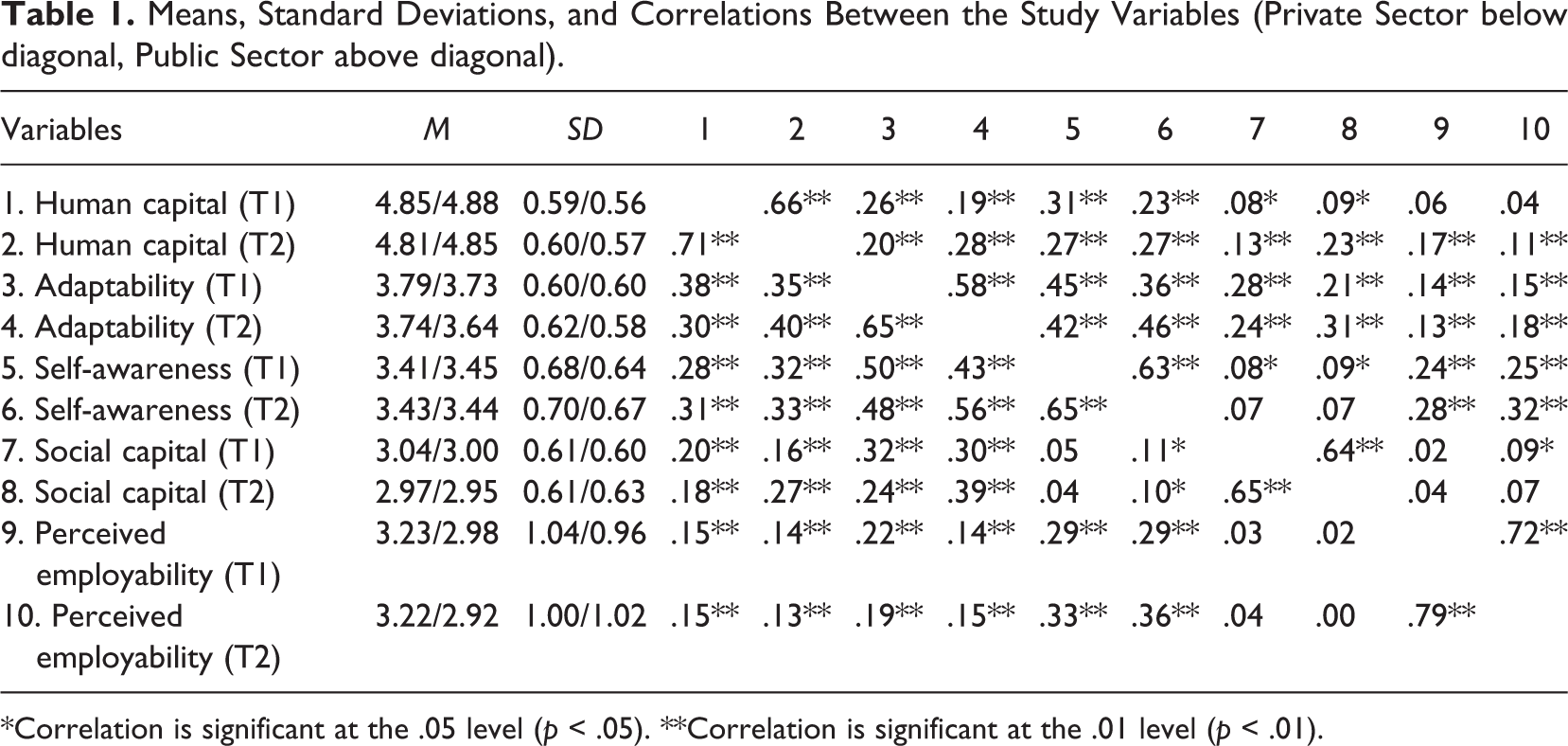
*Correlation is significant at the .05 level (p < .05). **Correlation is significant at the .01 level (p < .01).
Measurement Models
Tables 2 and 3 present the fit statistics of the measurement models and structural equation models for the private and public sector sample. The hypothesized measurement model (MM1) provided a good fit with the data at both T1 and T2, and for both the private and the public sector sample. The hypothesized five-factor model had a significantly better fit than the alternative models. All items loaded significantly on their respective latent factor in both samples and at T1 and T2 of above .50. Results also indicated factorial invariance over time for both samples. Modification indices also did not indicate potential risks with regard to multicollinearity.
Fit Statistics of the Models in the Private Sector.
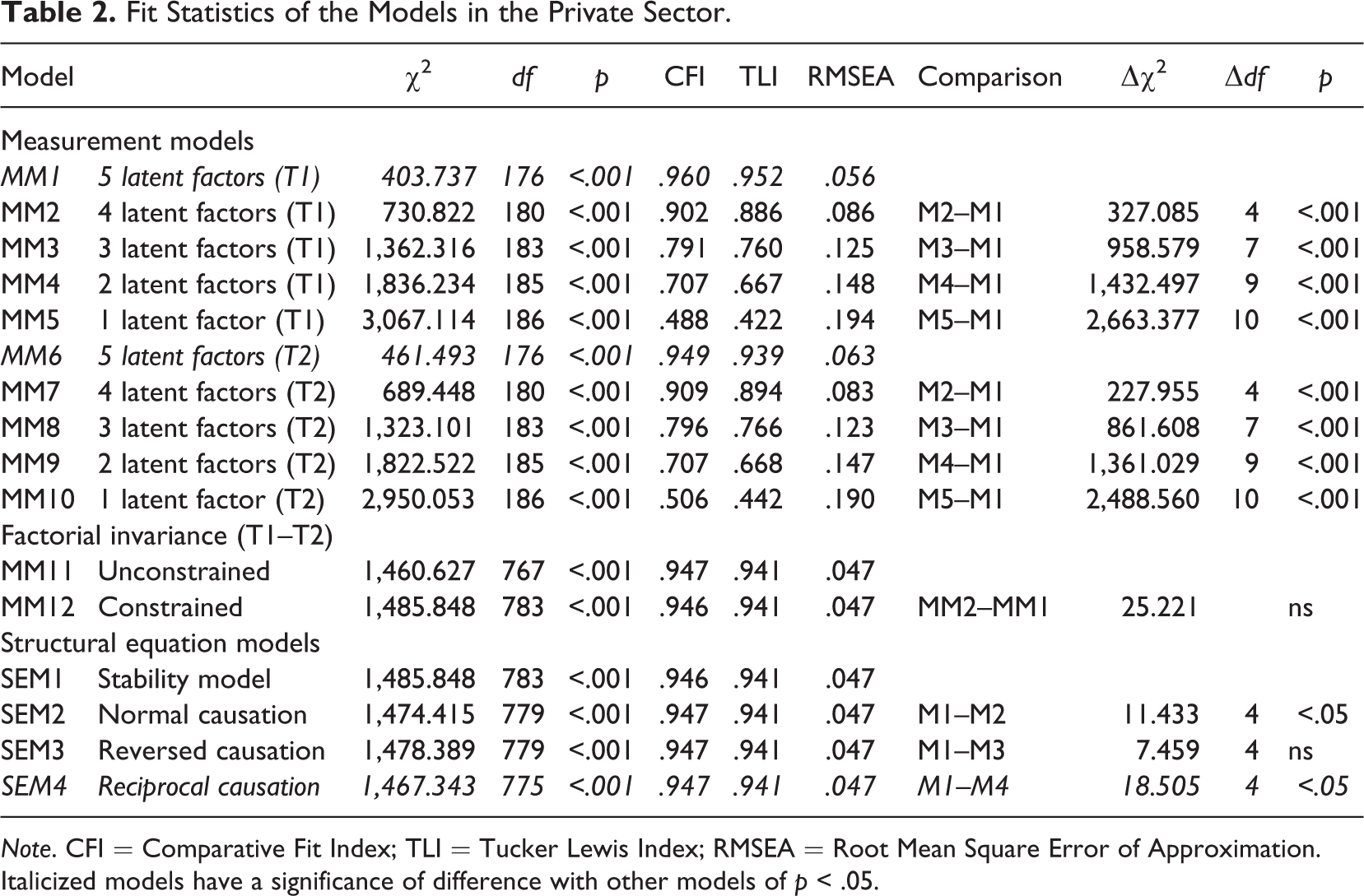
Note. CFI = Comparative Fit Index; TLI = Tucker Lewis Index; RMSEA = Root Mean Square Error of Approximation.
Italicized models have a significance of difference with other models of p < .05.
Fit Statistics of the Models in the Public Sector.
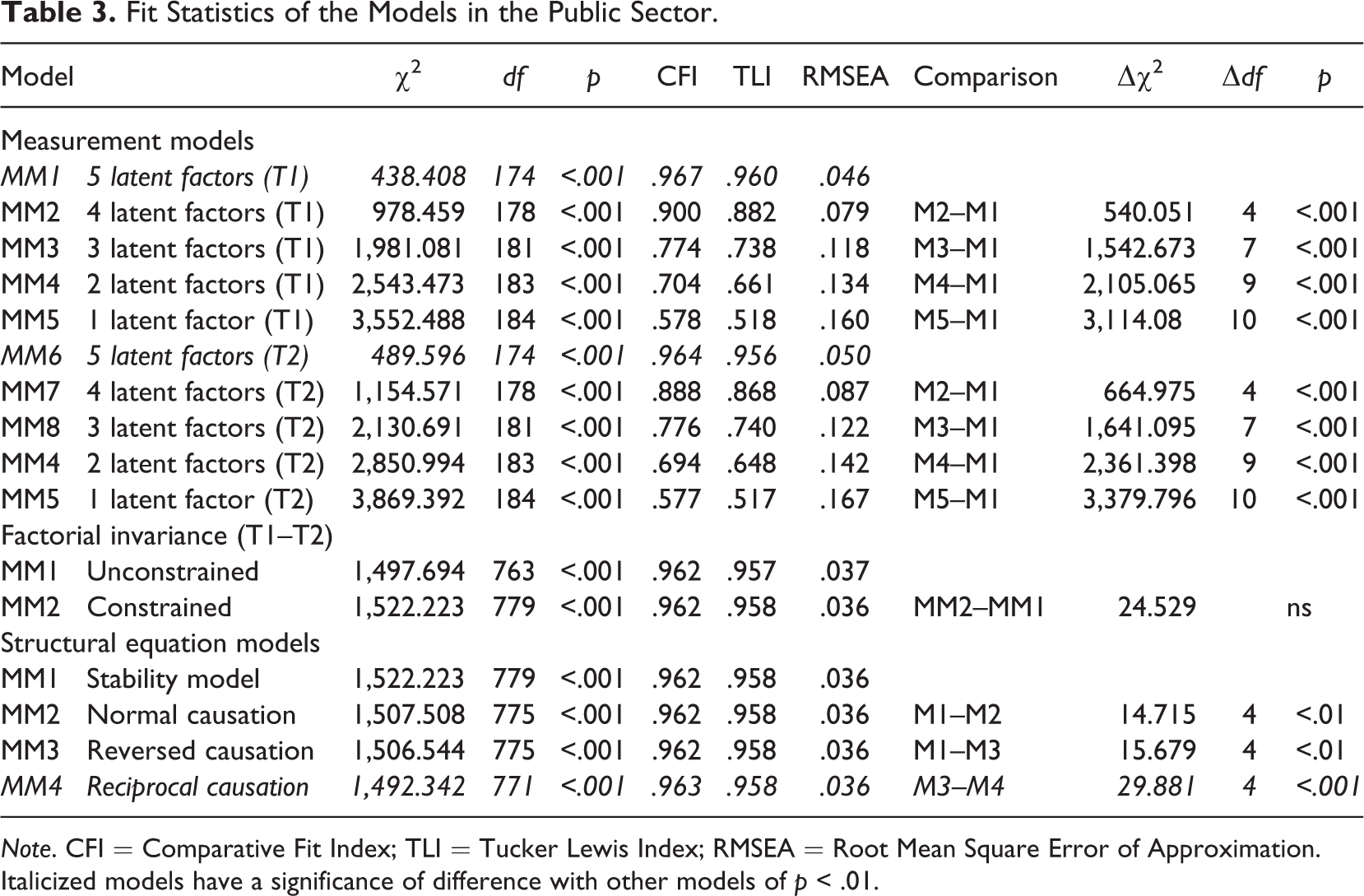
Note. CFI = Comparative Fit Index; TLI = Tucker Lewis Index; RMSEA = Root Mean Square Error of Approximation.
Italicized models have a significance of difference with other models of p < .01.
Structural Equation Models
The χ2-difference tests of the structural equation models showed that the reciprocal causation model fit the data best in both samples (see Tables 3 and 4). Fit indices of these final models were good (CFI = .93, TLI = .93, RMSEA = .05, SRMR = .07 for the private sector, and CFI = .96, TLI = .96, RMSEA = .04, SRMR = .05 for the public sector). Figure 1 shows the final models in the private and public sector.
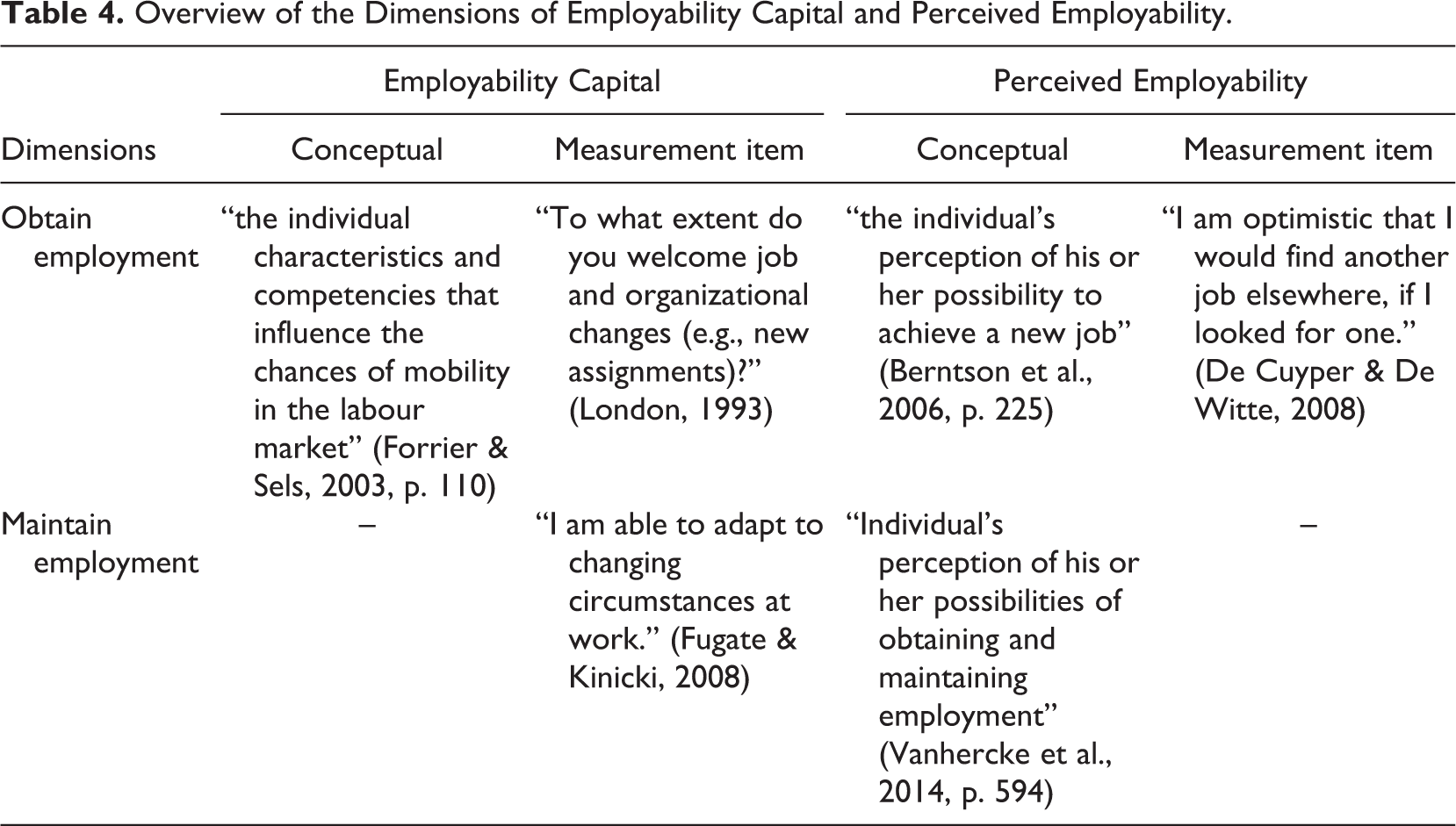
Overview of the Dimensions of Employability Capital and Perceived Employability.
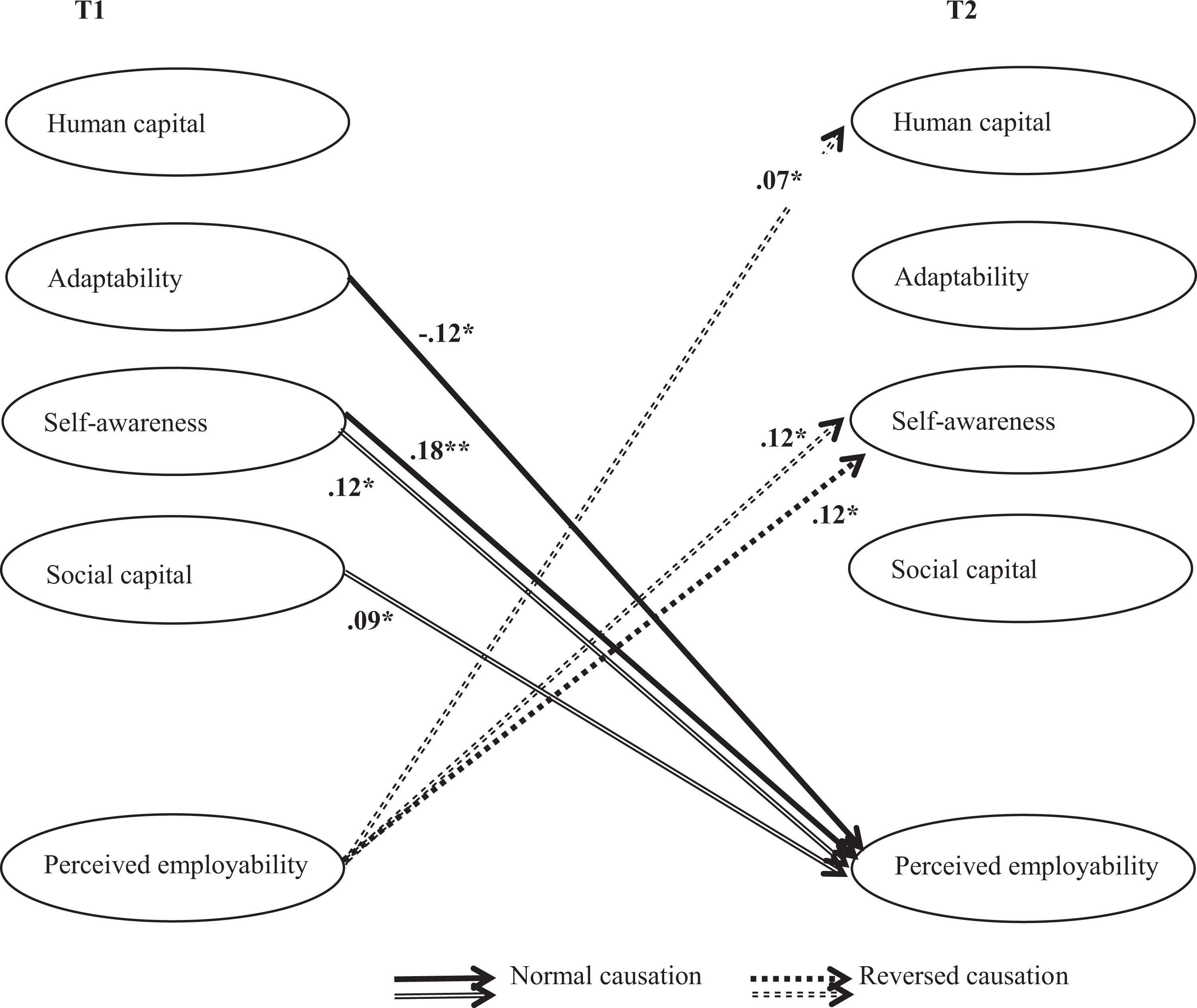
Regression weights of the reciprocal structural equation models. Note. Structural equation models for the private sector represented by a single line and the public sector by a double line. *p < .05. **p < .01.
Private sector
Self-awareness at T1 was positively associated with perceived employability at T2, while controlling for perceived employability at T1 (“normal causation,” γ = .18, p < .01), and adaptability at T1 was negatively related to perceived employability at T2, while controlling for perceived employability at T1 (“reversed causation,” γ = −.12, p < .01). Perceived employability at T1 was positively associated with self-awareness at T2, while controlling for self-awareness T1 (“reversed causation,” γ = .12, p < .05). These results imply that Hypothesis 3 was supported, whereas Hypotheses 1, 2, and 4 were rejected.
Public sector
Self-awareness and social capital at T1 were positively associated with perceived employability at T2, while controlling for perceived employability T1 (“normal causation,” γ = .12, p < .05 and γ = .09, p < .05, respectively), and perceived employability at T1 was positively related with self-awareness, while controlling for self-awareness T1 (“reversed causation,” γ = .12, p < .05) and human capital at T2, while controlling for human capital T1 (“reversed causation,” γ = .07, p < .05). Hypotheses 3 and 4 were therefore supported, whereas Hypotheses 1 and 2 were rejected.
Discussion
The aim of this study was to provide a theoretically embedded set of antecedents of perceived employability by testing the relationship between movement capital and perceived employability in samples from the private and public sector in Belgium. Following the career mobility model of Forrier and colleagues (2009), movement capital was defined in terms of human capital, adaptability, self-awareness, and social capital. Based on the assumptions of this model, we hypothesized that the four aspects of movement capital would relate to perceived employability over time.
Main Findings
The overall conclusion is that the relationship between the four aspects of movement capital and perceived employability was less consistent than assumed in the model of career mobility. In the following, we will elaborate on four significant associations, after which we will reflect in more detail about the inconsistent findings of our study.
First, self-awareness and perceived employability were reciprocally related in both samples: Employees who aim to shape their careers in a proactive fashion will perceive more labor market opportunities, and their perceived employability will reinforce self-awareness. The “normal causation” is in line with the model of career mobility (Forrier et al., 2009) and more specifically the agentic idea within this model. Proactive and agentic investments of individuals in their capital results in more (perceived) opportunities in the labor market. The “reversed effect” implies that individuals adapt and grow from perceived employability. Individuals who feel employable will be better able to cope with challenges and become more resilient. By withstanding challenges within the labor market (Clarke, 2008) and growing through these challenges, their employability radius can be optimized (Thijssen et al., 2008). The results suggest a feedback loop from perceived employability to self-awareness. Individuals might be stimulated to reassess their movement capital, for example, when an individual perceives more employment opportunities, they might reinterpret their abilities to develop throughout their career. These theoretical implications are particularly important because these findings were replicated both in the private and public sector sample, suggesting that they can be generalized across contexts.
Second, in the private sector only, adaptability negatively related to perceived employability. This finding implies that, contrary to our expectations, employees who are willing and able to adapt to changes at work will subsequently feel less employable. A possible explanation could be that employees who easily adapt to changes at work do not feel the need to proactively look for jobs elsewhere because they can adapt to changes internally and hence do not perceive employment opportunities externally. In sum, employees high in openness to change may be more reactive with regard to change instead of having a proactive view focused on the labor market. Thus, while self-awareness in terms of proactive career shaping would lead to higher perceptions of employability, adaptability might actually lead to lower perceptions of external job opportunities. By extension, we could speculate that individuals who focus predominantly on their current job might have lower perceptions of external employability, whereas those who focus on their future career might see more opportunities.
Third, there was a positive reversed relationship between perceived employability and human capital in the public sector: Civil servants who feel employable will subsequently rate their occupational expertise higher. This suggests that in the relatively stable, noncompetitive public sector, perceptions of having labor market opportunities can affect the attitudes at a job level and reinforce employees’ confidence in their expertise: “I see other employment opportunities, so I must be good at my job” (example of the train of thought in the public sector). This finding again stresses the importance to take a feedback loop into account. A potential explanation why these results were not found in the private sector is that the relationship between perceived employability and job-related expertise might be relatively more strongly affected by economic conditions and the overall labor market situation: “I see other employment opportunities because those organizations are growing or making investments” (example of the train of thought in the private sector). In general, careers might be more stable in the public sector compared to the private sector, and it seems likely that individuals might change jobs less often. Consequently, perceived employability might affect perceived occupational expertise over time among public sector workers because they would tend to remain in the same occupation for a longer period of time. Contrarily, careers are more flexible in the private sector, for example, considering current trends of more flexible contracts and project workers, and thus individuals might change jobs more often. Changing jobs and, potentially, occupational fields more often makes it less evident that perceived employability would be related to occupational expertise as the specific skills required for high performance would change over time. However, we should be cautious interpreting this reversed effect of perceived employability on job-related attitudes, as the effect size was rather small.
Finally, social capital positively related to perceived employability in the public sector: Civil servants who experience social support at work feel more employable over time. In line with the career mobility model (Forrier et al., 2009), it would seem that the social capital is a predictor of perceived employability for employees working in the public sector where politics may play a more important role, while the private sector may be more driven by competencies. Again, though, this effect was small so strong conclusions cannot be inferred.
Next to these four findings, we did not find strong associations between the hypothesized movement capital factors and perceived employability over time. This rather limited support for the career mobility model of Forrier and colleagues (2009)—incorporating the systematic construction of movement capital and its premises about the link between movement capital and perceived employability—led us to critically reflect on the implications of these findings for research on employability. These implications also need to account for the rather high stability of perceived employability. We would like to stress three points. First, it is not clear what would be an appropriate time lag for studying changes in perceived employability; perceived employment opportunities might need more time to grow or change, or changes may be conditional upon the career phase, for example, with some phases being more dynamic than others. Second, the findings undermine the idea that perceived employability can be constructed or is a cognitive idea or image individuals have as a result of personal agency (e.g., Forrier et al., 2018): If so, relationships between movement capital and perceived employability would be stronger and similar across sectors. Third, the career mobility model aims to map the main factors determining transitions in careers (Forrier et al., 2009), but perhaps the focus of this model is on maintaining and preserving an acceptable level of employability rather than actively building or enhancing it. Taken together, we conclude that the concept of perceived employability needs conceptual and measurement refinement, which incorporates both obtaining and maintaining employment. We provide more details in the next paragraph.
Implications for Employability Research: Conceptual and Methodological Refinement
Our inconsistent and at times unexpected findings raise questions with regard to theory, conceptualizations, and measurements for employability and its antecedents. The lacunae seem to lie at different levels (see Table 4), and we reflect on these below.
First, at the conceptual level, perceived employability has been defined as the “individual’s perception of his or her possibilities of obtaining and maintaining employment” (Vanhercke et al., 2014, p. 594). The focus is both on retaining employment and on obtaining (new) employment. At the measurement level, however, perceived employability mainly concerns the latter. As an illustration, a sample item from this study is “I am optimistic that I would find another job elsewhere, if I looked for one” (De Cuyper & De Witte, 2008), and from other studies in the field: “How easy would it be for you to acquire new and comparable employment without moving?” (Berntson et al., 2006). There were no measurements available that consider a maintaining or “retaining” component for perceived employability. Thus, there seems to be a disconnection between the conceptualization and measurement of employability. By expanding the measurement and the inclusion of retaining items, the measurement may also become more susceptible to capture change over time (infra: stability of perceived employability).
Second, the antecedents of perceived employability have been conceptualized as the set of personal characteristics that determine the extent to which an employee is able to move within the labor market (Forrier et al., 2009). This notion of “movement capital” implies a conceptual focus upon obtaining employment. However, movement capital is typically measured with reference to both obtaining and retaining employment. Examples are “I am able to adapt to changing circumstances at work” (Fugate & Kinicki, 2008) for retaining and “to what extent do you welcome job and organizational changes (e.g., new assignments)?” (London, 1993) for obtaining employment. The tension also appears between the original theory-driven (top-down) model by Forrier et al. (2009) and the combination with empirical work (inclusion of bottom-up) by Peeters et al. (2017), which advanced the concept of “employability capital” instead of “movement capital.” Because the concept of movement capital covers a multitude of aspects, a conceptual study using Q-sorting analysis was carried out by Peeters et al. (2017), with the aim of reducing the number of different concepts and labels. They identified four dimensions: job-related expertise, job-related attitudes, career-related employability capital, and development-related employability capital. Together, the authors labeled this as “employability capital.” To clarify, the key difference between career-related employability capital and development-related capital is that career-related employability enables individuals to make one transition, whereas development-related employability capital transcends multiple transitions and is thus oriented toward development and growth over time (Peeters et al., 2017).
Taken together, employability capital originates from a conceptual focus on obtaining employment but is measured in terms of both obtaining and retaining employment, whereas perceived employability is conceptually meant to probe both obtaining and retaining employment, yet measured only in terms of obtaining employment. We realize that in highlighting this mismatch between conceptualization and measurement, we are also critiquing our own study, as we used the same established measurement instruments that other studies have used. However, we do believe that our rather puzzling observation in the literature may explain why we found such inconsistent findings in this study with regard to the associations between movement capital and perceived employability and, by extension, in other prior studies in the field. We are not saying our and other studies have not been valuable, yet we are saying that they may have been incomplete. A critical question, for example, is whether studies so far may have underestimated the relationship between employability capital and perceived employability due to a lack of congruence between the conceptualization and measurement of employability capital and perceived employability. This incongruence provokes a debate that may inspire future employability research. Specifically, to develop a deeper understanding of their interrelations, and to further extend and empirically test the career mobility model (Forrier et al., 2009), an element of retaining employment would need to be added to the conceptualization of employability capital, or retaining measurements may be deleted, and an element of retaining would need to be added to the measurement of perceived employability (e.g., “I am optimistic that I can keep this job if I want to”), or it needs to be removed from the definition.
Besides needing to develop more conceptual clarity about employability capital and perceived employability, we also urge scholars to develop more conceptual clarity in terms of the exact career-related resources (cf. Hirschi, 2012) that individuals can gain to enhance their employability. In our study, we applied movement capital as antecedent of perceived employability, following the model from Forrier et al. (2009). However, there are other types of career-related resources that may enhance perceived employability. Research thus far has rarely conceptually and theoretically explored the similarities and differences between these types of career resources, yet this would be a crucial step forward in gaining a better understanding of the types of resources/capital that can shape individual’s employability. Doing so would also offer a bridge between the disciplines of vocational psychology and industrial-organizational psychology, which have developed mostly in isolation in recent years (cf. Fouad & Kozlowski, 2019).
Strengths and Limitations
This study has three main strengths. First, it tested the career mobility model in a two-wave longitudinal design with valid indicators grounded in the literature for each construct. We argue that further refinement of both employability capital and perceived employability is needed in order to gain more insight in the dynamics of employability. Second, the two distinct samples indicated potential differences related to their structure of risks and opportunities. This strengthens generalizability of the results of self-awareness but at the same time shows that contextual factors are important when examining employability-related issues (e.g., when studying social capital). Third, this study uncovers a discrepancy between the conceptual and the measurement level of analysis concerning employability capital and perceived employability. This discrepancy may cause an underestimation of the relationships, and it needs further thought in future studies.
Four main limitations are identified that may affect the interpretation of the results. First, self-reports questionnaires may evoke socially desirable answers, for example, ratings of job-related expertise may result in an overestimation of one’s true competencies. However, to reduce this effect and following Podsakoff et al. (2003), only validated scales were used, and we tested the relationships over time. Future research may address this issue by incorporating different sources, for example, supervisor ratings of employability capital and/or perceived employability rated by others. Second, the dropout over time may raise some concerns; however, no demographic variables predicted dropout in the private sector sample. Therefore, even though the dropout rates were relatively large, they did not seem to significantly impact the results of this study. In the public sector sample, perceived employability seemed to predict dropout; however, differences with regard to the mean and standard deviations of perceived employability were rather small. Third, because this study was performed with only Flemish individuals with gainful employment in Belgium, findings are limited to this context. We invite researchers to study employability capital in different target groups, for example, (a) those without any gainful work experience, for example, recent graduates, (b) interns or newcomers (first encounters) or volunteers, and (c) unemployed individuals. A plausible assumption here could be that employability capital is important for all those groups, yet that specific aspects are weighted differently. For example, diploma and certificates and social network may be comparatively more important for recent graduates (e.g., Tomlinson, 2012). Fourth, time lags between measurement points differ between samples. Although this indicates that different time lags (i.e., six vs. eight) yield similar results, we are not able to infer conclusions with regard to time lags.
Implications and Suggestions for Practice
The implications of this study can be subsumed in two main aspects. First, the findings suggest that an increase in self-awareness or development-related employability capital will help employees to feel employable. This proactive way of dealing with development has positive career outcomes. Feeling employable, perceiving potential alternative employment opportunities, makes employees feel more secure in their career because they can pursue other job opportunities if necessary or when it is desired by the employee himself or herself and provides a sense of control. This is in line with the agency approach and may enable career counselors and career coaches in advising clients (e.g., in terms of stimulation of personal growth).
Second, future career-related counseling may want to keep the difference between different (labor) markets into account. We found some difference between the private sector and the public sector in terms of employability antecedents, which implies that these sectors demand a different approach. Career counseling and coaching may be customized and tailored keeping potential differences in mind and, moreover, keeping the different beliefs of individuals in mind (e.g., in terms of “in the private sector, there may be other sources that have an influence on my potential on the labor market like the conjuncture of the market”).
Conclusion
In this study, we tested whether different types of movement capital would enhance perceptions of employability over time in two different samples. Surprisingly, we found only limited and inconsistent support for the career mobility model of Forrier et al. (2009). We explain these inconsistencies by pointing toward a mismatch between conceptualization and measurement in employability research: Employability is conceptualized in terms of retaining and obtaining employment, yet typically measured only in terms of obtaining employment; employability antecedents are conceptualized in terms of obtaining employment, yet measured in terms of both obtaining and retaining employment. This conclusion might have implication for prior employability research in the sense that certain associations may have been under- or overestimated. Reconciling this mismatch—either by adapting the conceptualizations or measurements—would be a promising way forward for research in the area of employability.
Footnotes
Declaration of Conflicting Interests
The author(s) declared no potential conflicts of interest with respect to the research, authorship, and/or publication of this article.
Funding
The author(s) disclosed receipt of the following financial support for the research, authorship, and/or publication of this article: This research was partially supported by grants from KU Leuven (Project No. OT/11/010).
