



Abstract
Despite the importance of family ownership in family business, limited attention has been given to the interplay between evolving family contexts, unpredictable life courses, and ownership transfer choices. Based on a study of ownership transfer narratives of 27 members of business families, we investigate how shifts in family life precipitate different types of intrafamily ownership transfers. Drawing on life course theory, we find that changing family lives and events precipitate three types of ownership transfers: symbolic, protectionist, and rebalancing. We advance a theoretical framework which contributes more nuanced insights into processual and temporal aspects of ownership transfer embedded in family dynamics.
Introduction
Succession in family businesses, that includes both ownership and management transfer, remains an important topic in family business literature (Dawson, 2024; Sharma, 2004). Indeed, some family business scholars argue that “passing on of a business from one generation to the next is the most important issue facing family businesses” (Rodriguez et al., 1999, p. 460). For small- and medium-sized family-owned businesses especially, succession is one of the most crucial events in their life cycles (Bertschi-Michel et al., 2021). The ownership aspects of succession have been surprisingly neglected in the family business literature (Nordqvist et al., 2013). However, ownership transfer is not without conflicts and challenges. The distribution of equity among family members has been a long-standing and critical concern in family business research (Gersick et al., 1997). Changing ownership configurations can weaken social cohesion (Wiklund et al., 2013), spur conflicts (Schulze et al., 2003a), shape decision-making (DeTienne & Chirico, 2013; Martin & Gomez-Mejia, 2016), impact performance (Bennedsen et al., 2007; Wennberg et al., 2011), and affect the future prosperity of both families and family businesses (Westhead et al., 2001). Moreover, family firms often struggle to transfer ownership to second-generation family owners, with few making it to third generation, affecting the survival prospects of family businesses (Howorth et al., 2010). Understanding family business longevity from a historical perspective reveals the complex temporal dynamics that influence these survival challenges (Haag et al., 2023).
Despite the importance of intrafamily ownership transfers (IOTs) to family businesses, little systematic attention has been given to the interplay between changing family contexts (Aldrich et al., 2021) and ownership transfer choices (Haag et al., 2024). Gersick et al.’s (1997) life cycle model of intergenerational transfer, which is still widely used in the literature, conceives IOTs as a relatively linear progression of older generations “passing the baton” to younger generations and family firms moving through the ownership stages of sibling partnerships and cousin consortiums portraying a unified succession process that all family businesses undergo. While such life cycle models provide important precepts, they also mask how heterogeneous family systems (Jaskiewicz & Dyer, 2017), unpredictable life courses (Elder et al., 2003), and changing family dynamics (Aldrich et al., 2021) can precipitate different IOT pathways, making existing accounts potentially incomplete and misleading (Jaskiewicz & Dyer, 2017). The widespread focus on life cycle stages, also encourages scholars to focus on “watershed” episodes of intergenerational transfer where the management “baton is passed” to successors (Gersick et al., 1997). Consequently, the literature is replete with studies of management succession (Bennedsen et al., 2007; Brockhaus, 2004; Le Breton-Miller et al., 2004; Richards et al., 2019; Umans et al., 2021), while the process of IOT lurks in the background as “a residual unimportant legal problem” (Nordqvist et al., 2013, p. 1110). This theoretical lacuna exists, in part, because scholars prioritize management over ownership (Decker et al., 2017; De Massis et al., 2008) and typically assume that IOTs and management succession always “go hand in hand” (Nordqvist et al., 2013; Sund et al., 2015; Wiklund et al., 2013). While this is sometimes true, failing to draw a clear theoretical distinction between IOTs and management succession may potentially miss a host of other IOTs that occur outside management succession episodes, leaving the relationship between management succession processes and IOTs processes only partially understood and significantly undertheorized. Our study, therefore, seeks to answer two important research questions: How do changing family lives and events precipitate different types of IOTs? And how are such IOTs intertwined with management succession processes?
To address these challenges, we propose an alternative approach, life course theory, to ownership transfer in family businesses. We employ a life course perspective (Elder et al., 2003) to investigate IOTs and develop a finer-grained understanding of how IOTs and management succession processes are intertwined in family firm settings. Life course theory is a theoretical orientation and framework for studying the progression of human lives (Elder et al., 2003). It focuses on how individuals construct interlocking life courses within a historical and unfolding context of changing family relations, life events, and social, economic and cultural circumstances that create opportunities and constraints. A life course perspective takes “a contextual, processual, and dynamic approach” to understand how social meanings associated with unfolding family events, co-evolving life courses, and historical relations impact what family members do (Bengtson & Allen, 1993, p. 469) and, by extension, how they make decisions about IOTs. We adopt a narrative approach (Hamilton et al., 2017) to explore how changing family lives precipitate IOTs in twelve business-owning families. Narrative inquiry is particularly well-suited to the study of life courses (Josselson, 2011). Using in-depth interviews, an established method in life course studies, we examine family members’ narratives about IOTs in their own words.
We found that changing family lives and events precipitate three types of IOTs: symbolic transfers, protectionist transfers and rebalancing transfers. We explain how these IOTs have distinct temporalities (Hitlin & Elder, 2007), which we organize into a theoretical framework that illuminates how and why ownership transfers often unfold nonlinearly in family firms. These insights make three key contributions. First, they advance the literature on ownership transfer by developing a typology of IOTs that complement those directly related to management succession. Second, they extend the family business literature by demonstrating the importance of seeing IOTs as a separate process that only sometimes intertwines with family business leadership processes across different temporal horizons. Finally, they illuminate how family embeddedness, tangled life courses and a logic of appropriateness (Olsen & March, 2004) are principal drivers of IOTs in family businesses.
Theoretical Background
IOTs and Management Succession
From a legal perspective, ownership is something one has, which in the business context is equated with shareholding, and focuses on how an ownership position is acquired (e.g., via inheritance), and what the owner is thereby entitled to do (e.g., sell; Sund et al., 2015). In psychology, ownership can be viewed as a “state of mind” in which a person feels a sense of possession and psychological ties to an object, which has implications for their identity, behavior, and emotions (Pierce et al., 2001).
Family business research is increasingly incorporating both legal and psychological ownership to understand family business behavior, most notably by considering both pecuniary and “socio-emotional wealth” (SEW; Gómez-Mejía et al., 2007) and “emotional ownership,” which is orthogonal to actual ownership but strongly influences a family member’s bond to the family business (Björnberg & Nicholson, 2012). These developments teach us that ownership of shares in family business is a unique type of ownership because it is intertwined with the owner’s identity and bond to the family business. We also know that passing the business to the next generation is a top priority for family business owners (Bertschi-Michel et al., 2021; Rodriguez et al., 1999). The next generation is more likely to take over if they are intrinsically motivated, which in turn depends on autonomy, support from parents, self-confidence, and self-efficacy (Gagné et al., 2019; Lyons et al., 2024). The strong attachment to the business furthermore makes transfers within the family the preferred choice with great emphasis on finding just and fair solutions (Kidwell et al., 2012). Business families only choose to exit as a last resort (Chirico et al., 2019). Therefore, how such ownership is transferred among family members should not be taken lightly.
We define IOTs as distinct social-legal processes through which owners transfer ownership rights to family members. In contrast to prior studies that define IOT as ownership passed to a successor (Wennberg et al., 2011), we broaden our definition to recognize that ownership can be passed to any member of a family for any number of reasons and that recipients of ownership rights may or may not play leadership roles in a family business. Focusing on the full spectrum of IOTs is crucial to address “substantial gaps in our understanding of transition of ownership in family firms” and their implications (Wiklund et al., 2013, p. 1320). As Gersick et al. (1997) note, small ownership changes can have significant “ripple effects.” Altered ownership configurations can complicate decision-making among family members (DeTienne & Chirico, 2013), impact social cohesion (Wiklund et al., 2013), influence management succession (Nordqvist et al., 2013), and alter survival rates (Wennberg et al., 2011). For owners, IOT choices are central to their ability to sustain the family dynasty (DeTienne & Chirico, 2013) and positively influence the life courses of future generations (Carr et al., 2016). In this regard, IOTs can be conceived as the engine that propels the life cycle of family businesses across generations.
Gersick et al.’s (1997) life cycle model of ownership trajectories is central to prior theorizing about IOTs. It delineates the stages of ownership transition across generations, detailing how ownership becomes dispersed as “the baton is passed” from first-generation owners (“controlling owners”) to second-generation owners (“sibling partnerships”) to third-generation owners (“cousin consortiums”). This life cycle model has informed numerous studies of ownership in family firms (Howorth et al., 2010; Schulze et al., 2003a; Westhead & Howorth, 2006). Scholars have examined, for instance, how greater ownership dispersion impacts owners’ exit decisions (DeTienne & Chirico, 2013) or decreases the probability of IOTs. Yet, these studies have produced surprising and inconsistent results, indicating a need for more in-depth research on IOTs. For example, Wiklund et al. (2013) expected that greater ownership dispersion would decrease IOTs, but were puzzled to find the opposite—a positive relationship between ownership dispersion and IOTs. Such findings cast doubt on the efficacy of general life cycle models that provide few insights into the family contexts and decisions underpinning ownership trajectories. IOTs involve complicated value judgments where owners must balance business and family interests, weighing various duties, entitlements, and obligations (Gersick et al., 1997). Consequently, IOT trajectories may follow nonlinear paths tethered to complex family life courses, multiple events, and pluralistic motives. As Gersick et al. (1997, p. 26) themselves note, the sequence of stages “is not inalterably determined along a fixed path”—ownership can “move back and forth among individual, sibling, and cousin control.”
Later developments incorporate more dynamics and contextualization into the models. An open systems view considers a family business as a collection of subsystems that allow for multi-level analysis, incorporating both the human element and interactions with the surrounding environment (Pieper & Klein, 2007). Michael-Tsabari et al. (2014) point to the limits of the three-circle model to go beyond a family owning one business and suggest a cluster model that accounts for an entrepreneurial family’s portfolio of businesses. The coexistence of both commercial and family logics in the family business is a well-known characteristic, but a more in-depth understanding is needed regarding how this influences the succession process (Jaskiewicz et al., 2016). A strong family focus, drawing on family science theories, is emerging (Jaskiewicz et al., 2017), and there is increased interest in acknowledging family business heterogeneity (Dibrell & Memili, 2019; Rovelli et al., 2022), alongside calls to develop a more contextualized understanding of family business (Amato et al., 2021). For instance, a shift from “family business” to “business families” is advised for research that emphasize the family and its dynamics, especially with interest for long-term perspectives (Dielman, 2024), which we adhere to in our discussion of IOT.
Despite these advances, prior family business studies rarely focus attention on what drives complex, unfolding, and irregular IOT pathways, preferring instead to examine simpler life cycle stages (Franks et al., 2012), overt management transitions (Nordqvist et al., 2013), and the performance implications of IOTs and other ownership transfers (Wennberg et al., 2011). Consequently, prior literature provides many insights into why firms are reluctant to sell equity to outsiders (Westhead et al., 2001) and the various factors—such as firm age (Franks et al., 2012), capital taxes (Westhead et al., 2001), family norms (Zellweger et al., 2016), identities (Akhter et al., 2016), socioemotional wealth (DeTienne & Chirico, 2013), the presence of heirs (Wiklund et al., 2013)—involved with IOTs. Yet, prior studies remain relatively silent about the complex contextual decision-making processes family members go through when determining which family members receive, or do not receive, ownership rights, to what extent, and at which points in time.
We contend that current theoretical accounts present a somewhat stylized view of IOTs that would benefit from more attention to the messy life experiences, variegated motives, twists and turns, and temporal progressions that produce and shape IOTs over time (cf. Langley et al., 2013). As Brockhaus (2004) notes, family firm owners confront challenging circumstances where they must decide between what is suitable for the business, their families, and their futures; yet, we lack theory about how business owners navigate these dilemmas in practice when making IOT decisions.
A lack of theoretical attention to IOTs arises, in part, because of a tendency in the literature to conflate ownership transfer and management succession (Le Breton-Miller et al., 2004). As business succession usually involves transferring ownership and management control (Carr et al., 2016), it is often assumed that management succession and IOTs are always tightly coupled (De Massis et al., 2008). The tendency to see management succession and ownership change as conjoined leads to two blind spots in the literature.
First, it leads scholars to privilege management succession and neglect IOTs as an essential object of study (Brockhaus, 2004). As Nordqvist et al. (2013, p. 1109) found, “studies dealing with ownership during a succession remain scarce, unlike the bounty of studies dealing with management during a succession.” Second, it encourages scholars to assume that IOTs and management succession always go hand in hand (Nordqvist et al., 2013) rather than seeing IOTs as separate processes that may only sometimes be intertwined with business leadership processes. These blind spots are significant because they leave prior theoretical accounts unable to adequately explain the nuanced interrelations between IOTs and management successions, which is crucial to family business research. To address these blind spots and understand the full spectrum of IOTs and their interrelations with management succession processes, we focus on IOTs that unfold between watershed successions, sensitive to the possibility that concerns about business ownership, family, and business leadership will ebb and flow with unfolding life courses.
We assert that ownership transfers rarely move neatly through linear life cycle stages. Intergenerational transfer—what Gersick and colleagues (1997) term “passing the baton”—is becoming increasingly complicated by the growing heterogeneity of families across societies (Daspit et al., 2021; Jaskiewicz & Dyer, 2017), with more diverse family structures, norms, attitudes, and values (Aldrich et al., 2021).
This is important for two reasons. First, IOTs that are not explicitly connected to management succession are more likely to be motivated by family lives and events, which requires more attention to how changing family contexts trigger, shape, and prevent IOTs (Daspit et al., 2021; Dyer & Dyer, 2009; Howorth et al., 2010). Without attending to changing family contexts and heterogeneity, findings and theories may be incomplete and misleading (Decker et al., 2017; Jaskiewicz & Dyer, 2017). Second, cumulative IOTs outside management succession events may have long-term repercussions and lag effects (Gersick et al., 1997) that may (or may not) intertwine with business leadership processes in the future. Thus, the question of temporal depth—“the temporal distances into the past and future that individuals and collectivities typically consider when contemplating events that have happened, may have happened, or may happen” (Bluedorn, 2002, p. 114)—becomes theoretically important to consider.
To address these issues, we investigate how co-evolving family lives and events precipitate, shape, and reconfigure ownership structures that only sometimes intertwine with management succession. We argue that IOTs cannot be fully understood without investigating how interlocking family life course trajectories (Elder, 1998) produce different kinds of IOTs. In the next section, we describe the family embeddedness perspective that informs our study.
Family Embeddedness and Life Course Theory
A family embeddedness perspective focuses on how family member life courses and relationships underpin IOT decisions (Aldrich & Cliff, 2003). While a few studies have drawn an embeddedness perspective to theorize ownership transitions (Wiklund et al., 2013), Aldrich et al. (2021) lament that very few studies place families at the center of their research or embrace the life course principles at the heart of family embeddedness. As Dyer Jr and Dyer (2009) note, research on family businesses frequently neglects what is most important to family business owners, their families. Due to their kinship ties and prolonged interaction since childhood, family members are more likely to develop psychological safety in an organization (Hadjielias, 2024). Yet, while business families share many core characteristics, it is the inherent heterogeneity of families that simultaneously makes each of them unique. Important sources of family heterogeneity are “family dynamics” in combination with “psychological aspects”: Family dynamics varies with family size, generation, geographical dispersion, and family compositions (nuclear, blended, same-sex marriages), while family psychology concerns aspects such as attachment patterns, parenting styles, birth order, sibling rivalry, family climate, and conflict patterns (von Schlippe, 2024). This has sparked calls for scholars to draw on family science to account for the complex character and impact of alternative families (Jaskiewicz & Dyer, 2017), as well as to consider entrepreneurial families across generations, inseparable from context and time (Discua Cruz & Basco, 2018; James et al., 2021). Life course theory (Elder et al., 2003) provides a promising theoretical lens in this regard.
When Aldrich and Cliff (2003, p. 579) introduced the family embeddedness concept, they drew on life course principles, encouraging researchers to “focus on the timing of events, within the life course of individuals and their families.” Elo and Dana (2019) highlight the context-bound and multilayered nature of embeddedness, exemplified with how diasporic family businesses nurture their entrepreneurial culture across generations. Thus, studying family embeddedness directs attention to family histories, connected lives, cultural norms and values (Aldrich et al., 2021), and the many “turning points” that alter the direction of lives, for example, childbirth, death, marriage, divorce, remarriage (Mortimer & Shanahan, 2003). Such insights can be accessed through narrated family histories (Ge et al., 2022) that illuminate unfolding life courses and “give sense” to past events, intersubjective relations, and situated choices (Hamilton et al., 2017).
Life course theory is a theoretical orientation and framework for studying the progression of human lives (Elder et al., 2003). This theoretical perspective draws on history, sociology, and psychology and “emphasizes the importance of time, context, process, and meaning on human development and family life” (Bengtson & Allen, 1993, p. 471). It focuses on how individuals construct interlocking life courses within a historical and unfolding context of changing family relations, life events, and social, economic and cultural circumstances that create opportunities and constraints. Thus, it is rooted in a process ontology (Langley et al., 2013), focusing on embedded “lives in motion” (Elder, 1998, p. 8). This process ontological perspective views families and organizations as “sites of continuously evolving human action” (Tsoukas & Chia, 2002, p. 567), where “experiences grow out of earlier experiences, interactions, and anticipations” (Langley et al., 2013, p. 5).
Life course theory emphasizes five core principles: life-span development, time and place, timing, linked lives, and human agency (Elder et al., 2003). While the life course perspective treats the individual as the elementary unit, family science also applies life course principles to study family change dynamics (Bengtson & Allen, 1993) and multigenerational relationships (Gilligan et al., 2018; Luscher, 2005). Life course theory, therefore, provides an excellent conceptual basis for studying the process of IOTs and advancing theory about the profound influence of family embeddedness.
The first two principles—“life-span development” and “time and place”—stress the need for a long-term perspective when studying life courses, changing relations and decisions in their historical context (cf. Vaara & Lamberg, 2016). This means being sensitive to how historical events leave lasting imprints and generate cumulative chains of events and actions (Elder, 1998). IOTs can occur at different stages of family members’ lives and unfold in the context of evolving family, generational, and cultural relations. Thus, these principles align well with our contention that more attention must be given to how understandings of the past and future, and varying temporal depths, are implicated in IOTs (Bluedorn, 2002).
The third principle of “timing” draws attention to how the experience and consequences of life transitions—expected and unexpected—are contingent on when they occur (Elder, 1998). Families are constituted by multiple intersecting temporalities: the unfolding biographies of individuals (ontogenetic time), people situated at different stages of the family developmental cycle (generational time), and unfolding events and changes in society (historical time) that will conspire to impact the timing of IOT choices (see Bengtson & Allen, 1993; Hareven, 1977) and subsequent life trajectories of individuals, with the potential for both positive and negative consequences for individuals and families.
The fourth principle of “linked lives” captures how “lives are lived interdependently” (Elder et al., 2003, p. 13), how the fates of family members are inextricable intertwined (Elder, 1998), and how the formation of new relationships can precipitate dramatic “turning points” (Elder et al., 2003) in the trajectories of family members across generations (Gilligan et al., 2018). In the context of IOTs, the requirement for one child to take over the family business will necessarily affect the life course of their siblings, their spouse, and their children, for example. Currently, what constitutes “linked lives” and which family members are interdependent remains unclear in the family business literature (Combs et al., 2020). Family business researchers have implicitly assumed a nuclear family structure, yet this is declining (Girardin et al., 2018). Greater recognition of the plurality of family structures and what constitutes family member interdependence is therefore vital for understanding who is considered a family member, what forms family interdependence, and what implications this has for the transfer of ownership in business-owning families.
Finally, the principle of human agency states that “individuals construct their life course through the choices and actions they take within the opportunities and constraints of history and social circumstances” (Elder, 1998, p. 4). This is important for IOT choices which will include temporal horizons (Bluedorn, 2002) as actors attend to present problems, make choices based on identity commitments, and utilize different temporal orientations to make long-term life choices, including formulating future life plans (Hitlin & Elder, 2007).
To conclude, life course theory’s contextual and processual approach to studying lives and families aligns with our goal of examining the process of IOTs. Prior research has yet to adequately explain how family life trajectories and unpredictable family life events influence IOTs, although the significant influence of family on the family business is well established (Chirico & Baù, 2014; Eddleston & Kellermanns, 2007), and important insights have been derived from studying specific life course events in relation to business performance. For example, a first-born son is more likely to become the family business CEO than a first-born daughter (Bennedsen et al., 2007). The divorce of a business leader negatively impacts performance (Kleindienst et al., 2022). Similarly, both divorce and death are life events that can force unwanted ownership transfers of shares in a family business (Sund et al., 2010; Sund et al., 2015), and the death of a family business leader can significantly impact the entrepreneurial actions of the surviving members (Discua Cruz & Hamilton, 2022). Examining IOTs through a life course lens can help unpack the variable patterns of ownership dispersion and IOTs that scholars sometimes struggle to explain (e.g., Eddleston & Kellermanns, 2007; Wiklund et al., 2013). As Elder (1985) notes, families that pass through a similar sequence of stages can vary markedly in their respective life courses because of “variable timing, order, and duration of family events” (p. 40). If IOTs are linked to unpredictable family life trajectories and events, we should expect to see more varied IOT patterns than linear life cycle models suggest. In the next section, we introduce our narrative approach.
Method
Research Design
Family business scholars have advocated using qualitative methodologies to study the complex dynamics of family firms (Nordqvist et al., 2009; Reay & Zhang, 2014). A renewed interest in narratives as a social construction of family business history is burgeoning (Suddaby et al., 2023). Ge et al. (2022) show how the life stories of family members constitute a rhetorical history of the family business, further confirming the connection between family and business narratives within the family business context.
To study how family lives and events precipitate, shape, and reconfigure ownership structures, we undertook a narrative study of business-owning families’ IOTs. Rooted in process ontology (Langley et al., 2013) and a social constructionist epistemology (Berger & Luckmann, 1967), our research design requires an approach that allows us to generate an understanding of the contextualized lived experiences of family business owners (Konopaski et al., 2015). As a form of phenomenological inquiry (Hamilton et al., 2017), narratives provide a window into owners’ subjectivities (Knight & Jarzabkowski, 2023) and temporal constructions (Valikangas & Vaara, 2021). A narrative methodology thereby contrasts and complements the more common objective approach to ownership as firm shareholding (Sund et al., 2015), by emphasizing its temporal and social dimensions. Each respondent’s lived experience is socially constructed and constitutes their practical reality, which is a fundamental input to our theorizing (Shotter & Tsoukas, 2011).
Narrative inquiry is well-suited to life course theory because it illuminates how people’s self-understandings and the “intersecting plotlines” of their lives (Josselson, 2011, p. 224) are understood in storied forms. This approach allows researchers to “bring the voice of family into family business research” (Short & Payne, 2020, p. 348), explore how complex family histories infuse decisions (Aldrich et al., 2021), and cast new light on how owners “organize meanings, thoughts, motivations, memories and life experiences” (Hamilton et al., 2017, p. 4).
This form of naturalistic inquiry (Lincoln & Guba, 1985) cannot convey its full meaning through summaries and tables in isolation because it “carries its meaning in its entire text” (Richardson & St Pierre, 2005, p. 960). Abstractions and summarizing tables will be used to convey our interpretation, but these are presented with caution, as “the narrative in itself is the answer” offered to the reader for engagement (Flyvbjerg, 2001, p. 86). This approach enables a reflective form of theorizing (in contrast to representational theory), offering a means to re-articulate through engagement, generate new ways of seeing, and provide reflections and reorientation, rather than offering objective explanations (Shotter & Tsoukas, 2011).
Data Collection
To explore owners’ narratives about IOTs in their own words, we relied on in-depth interviews, which are widely used in discourse studies (Josselson, 2011; Knight & Jarzabkowski, 2023). Based on the premise that “people live and/or understand their lives in storied forms” (Josselson, 2011, p. 224), interviews provide space for events considered important by participants to be “selected, organized, connected, and evaluated” (Riessman, 2008, p. 189). This allows incidents, family lives, and decisions to be ordered into plots with a temporal structure. As Josselson (2011) notes, narrative accounts are “constructed accounts of experience, not a factual record” (p. 225). Such accounts provide deep insights into personal subjectivities (Knight & Jarzabkowski, 2023) and experiences, enabling scholars to delve into how participant’s understand historical events, decisions, and relationships between family members across generations (Hamilton et al., 2017).
Given our purpose, our sample selection criteria rely on Berent-Braun & Uhlaner’s (2012, p. 104) description of business-owning families as those where two or more family members jointly own a firm. Data were collected in the United Kingdom, where we have deep familiarity with the context and access to networks of family businesses. The United Kingdom is a highly relevant context, as business-owning families account for around two thirds of the privately held businesses and provide more than 50% of employment (Kemp, 2019). Since context influences family firm behavior (Wright et al., 2014), we selected all our cases within the same national setting to focus on the influence of family life courses rather than changes in institutional conditions across cases. Key characteristics of the U.K. context include its common law system with strong shareholder protection (Requejo et al., 2018), a predominantly Christian Anglican religious background, and centralized power in the state (Colli et al., 2003). These aspects of the U.K. context should be considered when making transferability judgments regarding to which extent our findings apply in other contexts (Lincoln & Guba, 1985).
Identifying and accessing business-owning families, especially those undergoing ownership transfer, is methodologically challenging (Westhead & Howorth, 2006). As Evert et al. (2016) note, business-owning families are difficult to recruit for research projects. Therefore, various recruitment routes were used, including gaining access through trusted advisors and organizations such as the Family Business Network.
We collected data on 12 business-owning families, 24 owners, and three involved next gen individuals that offered the highest potential to develop theory on IOTs (Locke, 2001; Yin, 2009). Each case offered an appropriate family firm context that had undertaken ownership transfers. These included intergenerational co-founder IOTs (x2), founder to second generation IOTs (x6), second to third generation IOTs (x2), and post third generation IOTs (x2). Ten family firms (pseudonyms Sun, Earth, Saturn, Neptune, Mercury, Jupiter, Mars, Pluto, Titan, Europa and Io) were Small and Medium Size Enterprises (SMEs), and two were large family businesses (Saturn and Callisto). Sun, Mercury, Neptune, and Europa were in services; Pluto, Earth, and Callisto were in manufacturing; Titan was a food manufacturer and retailer/wholesaler; Jupiter was in catering wholesale distribution; Io in property development and management; and Mars was in construction. Saturn operates across multiple sectors. Thus, the firms operated in various sectors in the United Kingdom and had all undertaken ownership transfers, providing an ideal research setting to explore how changing family lives precipitate different types of IOTs (Langley et al., 2013).
We sought to gather different family member accounts within the same family business contexts to compare their experiences and narratives and go beyond single family member informants, who are often assumed to provide a whole family perspective (Daspit et al., 2016; Daspit et al., 2024; Nordqvist et al., 2009). Multiple family interviews were carried out in nine business-owning families, with single key informant interviews in three business-owning families. Our data collection was directed by theoretical sampling (Charmaz, 2006; Locke, 2001). That is, we undertook interviews to elaborate and refine emerging conceptual categories, stopping when we reached theoretical saturation, that is, subsequent data and analysis yielded no additional elucidation of categories, we saw themes repeating, and we became clear about the theoretical story (Locke, 2001). In total, we conducted 27 in-depth family member interviews with members of 12 business-owning families. The names of each family business and the participant profiles (pseudonyms to protect anonymity) are listed in Table 1.
Profile of Family Business Participants.
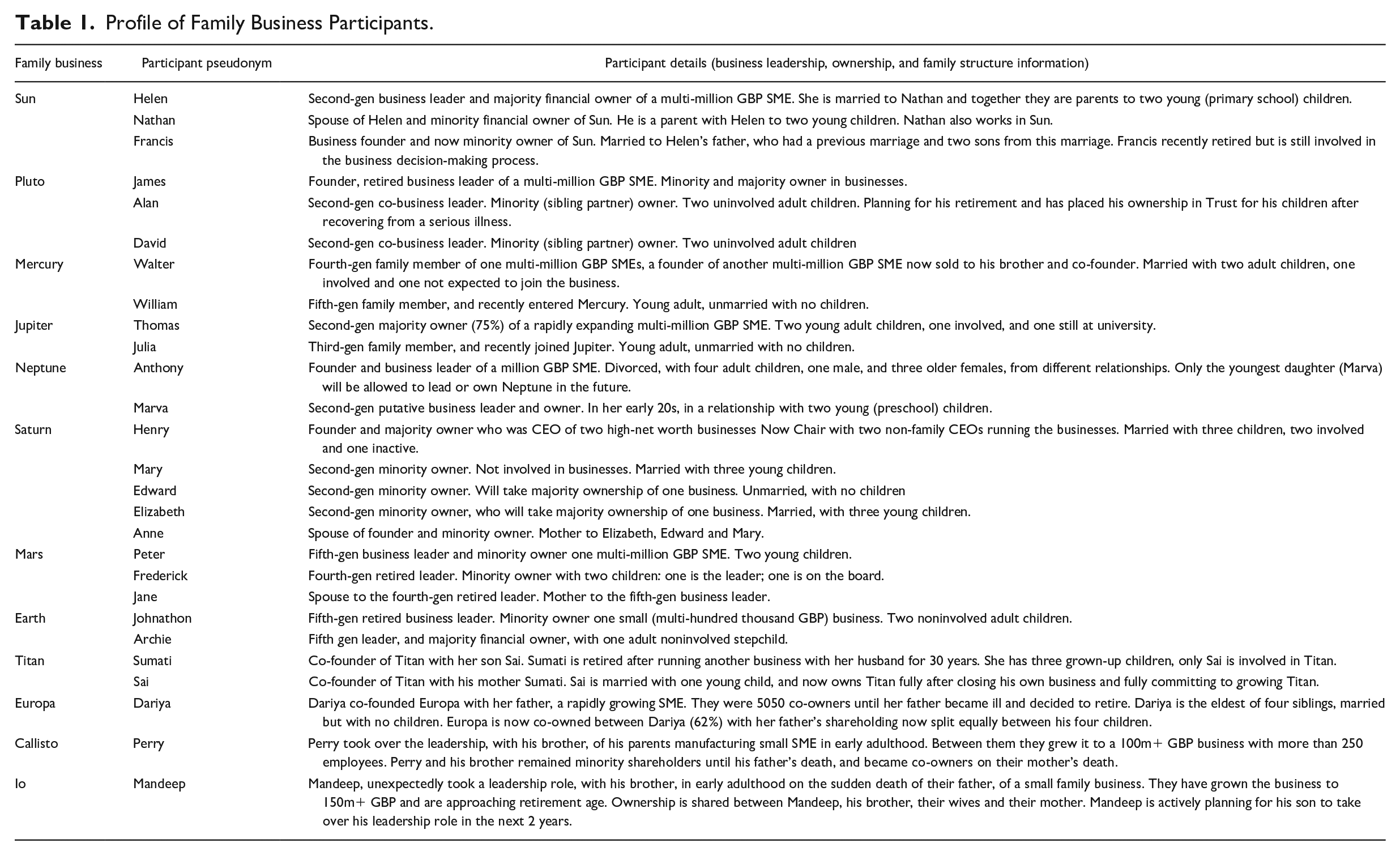
The interviews were loosely structured to provide informants with the space and time to recount the story of their interlinked lives and the IOTs that had unfolded (see Hamilton, 2013). An interview guide supported this storytelling approach, focusing on the history, structure, and impact of IOTs in family businesses (see the appendix). Following Riessman (2008, p. 23), interviews were regarded as “narrative occasions” for theoretically oriented conversations, where “one story can lead to another,” and informants were encouraged to “generate detailed accounts rather than brief answers or general statements.” As a result, most interviews lasted 1.5 hours, with several extending beyond 2 hours. All interviews were audio-recorded and transcribed, generating 1,223 pages of text. Each transcript was sent to the participant for review and clarification. In addition, contemporaneous field notes captured impressions of each interviewee and the interview process.
These interviews generated rich narrative accounts, where participants reflected on interrelated events, decisions and family dynamics that underpinned IOTs. Like any data collection technique, interviews have weaknesses insofar as people may have faulty memories, and their oral accounts may not “truly describe what has happened in time” (Hamilton et al., 2017, p. 4) or what they have done or would do (Nordqvist et al., 2009). Yet, these are highly emotional events that last long in memory. Inquiring into significant past events has the advantage that people have had time to process them, enabling them to describe and explain their significance (Morse & Clark, 2019). More importantly, the notion that an actor or text can “truly describe” what happened assumes an objective reality inconsistent with the ontology and epistemology of interpretive research (Leitch et al., 2010), which seeks to illuminate the interpretations, meanings and understandings actors subjectively ascribe to phenomena (Johnson et al., 2006).
Narrative Analysis
Following the tenets of narrative analysis, we focused on how participants rhetorically assembled and sequenced events and actions related to IOTs, and how they described individual agencies and intentions in plots that ordered events (Riessman, 2008). This section describes the journey from life course stories of owners to new theorizing on ownership transfer processes through a systematic narrative analysis. Narrative analysis is especially suited to studying family business phenomena that involve multiple actors across various time space arrangements (Dawson & Hjorth, 2012; Hjorth & Dawson, 2016; Short & Payne, 2020).
We followed three typical steps for narrative analysis: first, constructing the overall story (explication); second, interpreting its meanings and identifying patterns within and across stories (explanation); and finally, third, exploring emerging themes and offering theorization (exploration; Czarniawska, 2004; Dawson & Hjorth, 2012). Unlike grounded theory, which begins with line-by-line coding, narrative analysis moves from the whole to the specific (e.g., Bloom et al., 2021). Following Josselson (2011), we first read transcripts multiple times to understand the family trajectories, life events, and subject positions within narrative accounts of IOTs. In this explication step, we focused on what the story says and transformed the interview transcripts into thick narratives. This constitutes a first-level analysis that serves as a case database to which we repeatedly returned in the sense-making process.
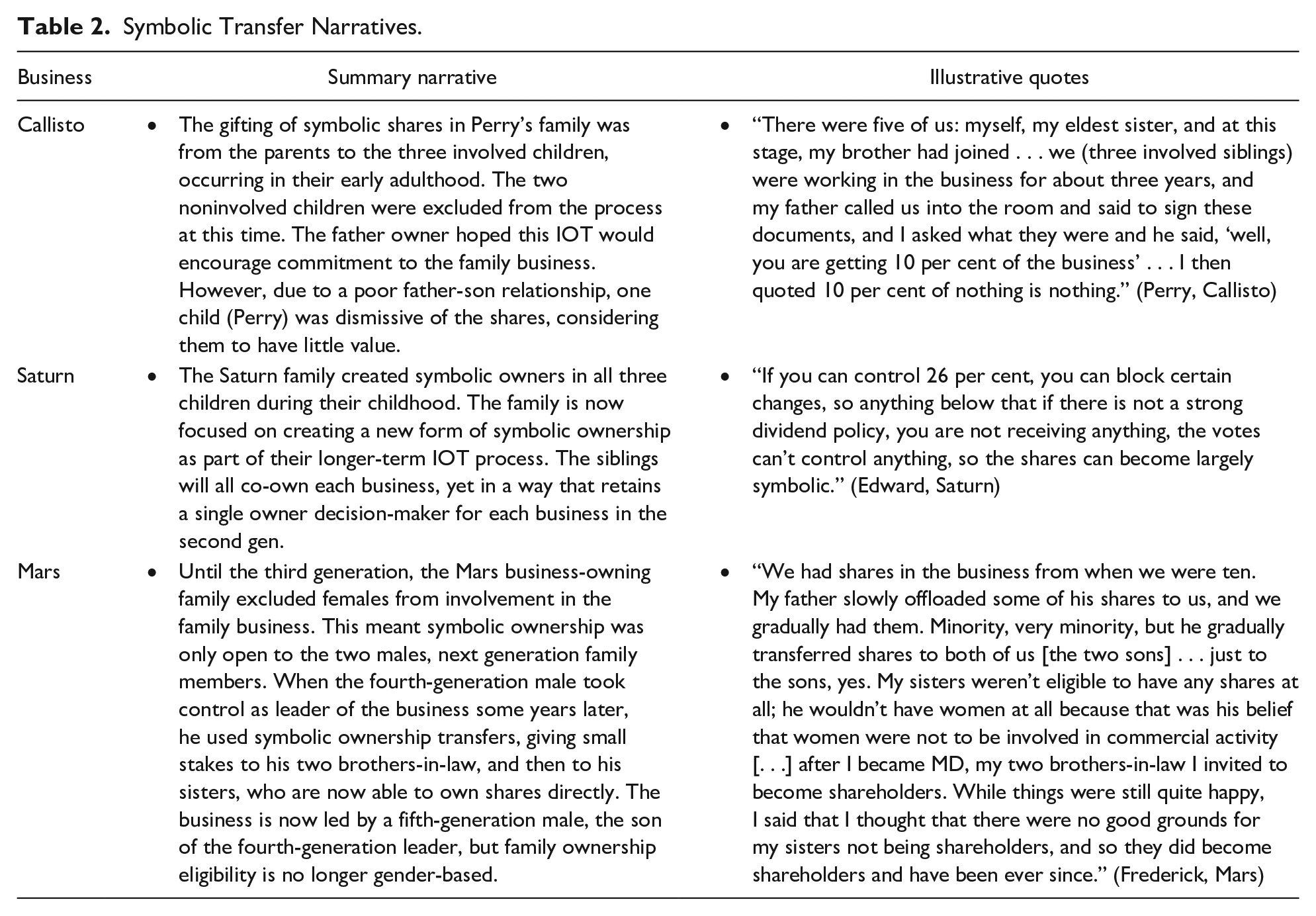
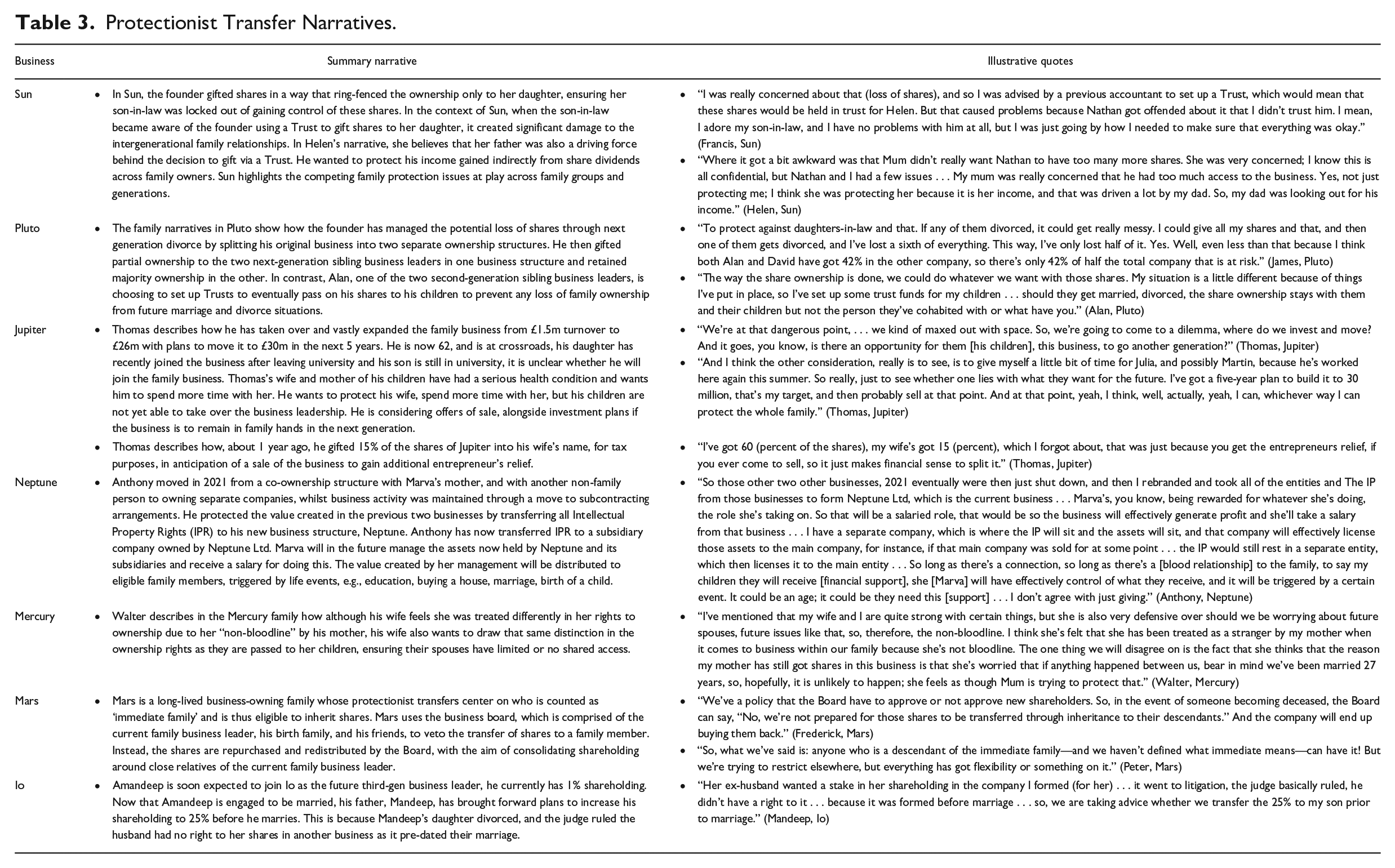
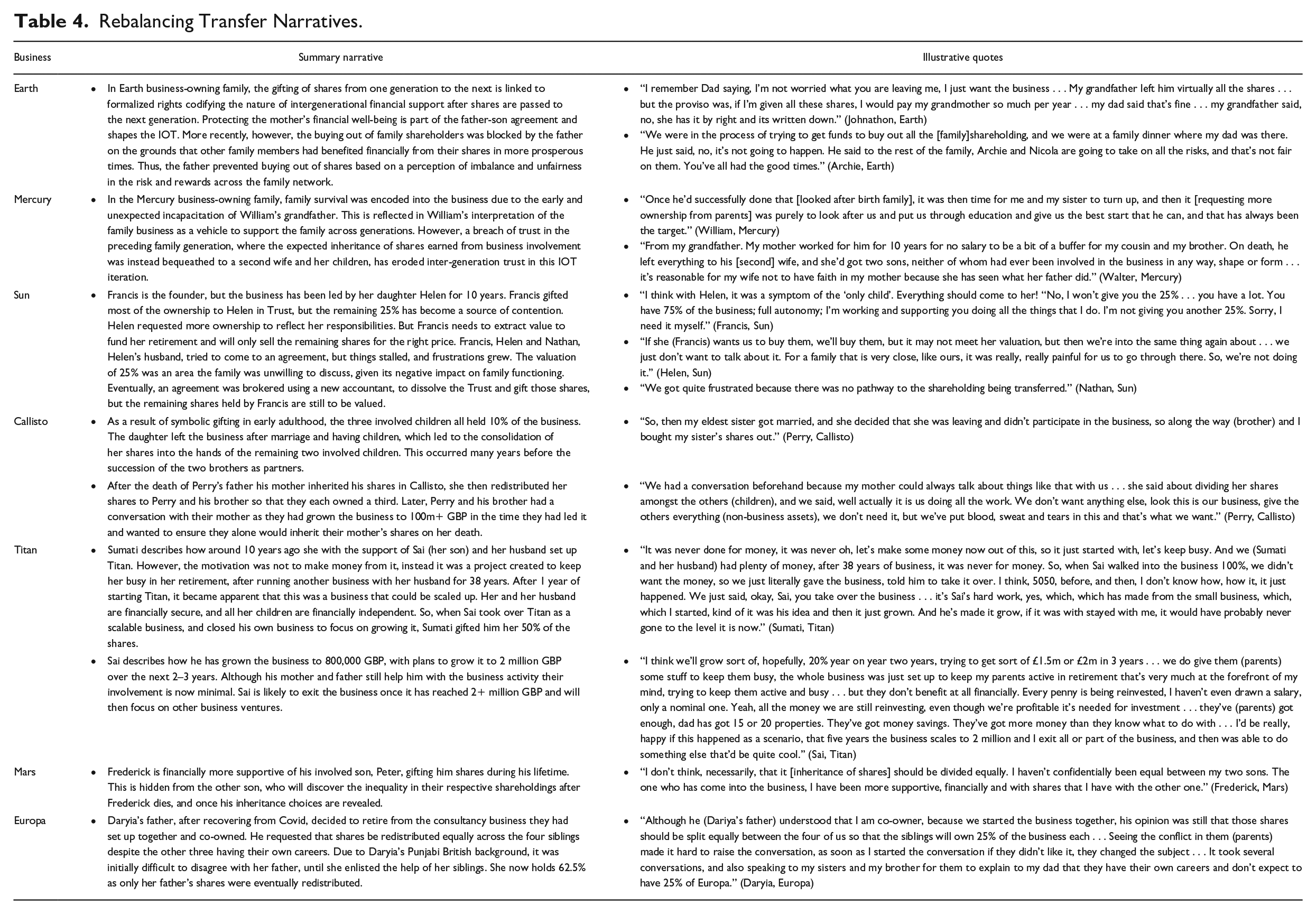
As a second-level analysis, guided by Czarniawska (2004), we asked ourselves, “How and why is it said?” This step focused on comparing the experiences of the owners. To strengthen reliability, the authors jointly coded the narratives to identify categories, conduct comparative analysis, and settle on plausible interpretations of the textual data (Charmaz, 2006). By marking and interrogating passages that seemed significant to different IOTs, we became sensitized to the importance of evolving family contexts and trajectories, noting how family life events often triggered new transitions. Patterns of dynamic interaction between life course events and ownership transfers eventually crystallized into three recurring narrative plots. These plots form the three types of ownership transfer processes around which our findings are structured. To enhance the transparency of the analytical move from data to conceptual categories, we illustrate each of the three IOT types with additional quotes in Tables 2 to 4 (Pratt, 2009).
Symbolic Transfer Narratives.
Protectionist Transfer Narratives.
Rebalancing Transfer Narratives.
Third, we explored the findings by asking what the narrative meant to us (Czarniawska, 2004; Dawson & Hjorth, 2012). This was an iterative process of engaging in conversation with field stories and theoretical concepts (Dawson & Hjorth, 2012). To make sense of emerging themes, we turned to life course theory (Elder, 1985, 1994)—an abductive move (Charmaz, 2006) consistent with reflective theory building—which aligned with our inductive observations and helped us explain and theorize emerging insights related to the family embeddedness of IOTs. This step formed the basis of our discussion, where we offer our typology of family embedded IOTs (see Discussion). In the next section, we present our findings, describing the features of these three IOT narratives and showing how they are only sometimes related to business management succession processes.
Findings
As we scrutinized storied instances of IOTs, we identified three recurring narrative plots (conceptual categories) associated with these transfers. We labeled these: symbolic ownership transfers, which aimed to symbolize that new family members were brought into ownership; protectionist ownership transfers, which sought to lock certain family members into ownership while locking others out; and rebalancing ownership transfers, which aimed to rectify and appropriately reapportion ownership rights.
Although our primary focus is on IOTs, four participants recounted narratives of succession in which ownership and leadership changes coincided, so that IOTs were closely intertwined with management succession. For example, Johnathon at Earth Ltd recounted how he became Managing Director (management succession), and his father stayed on as Chairman until retiring and then splitting his shareholding: He got 35,000 shares. He gave some to all of us because my brother had some shares; my sister got shares; so, he’d given us all some shares, but I ended up having 2,000 more shares; I got the majority of shares because I was going to be Managing Director. (Johnathon, Earth)
Yet, most participants recounted narratives of IOTs that unfolded between watershed successions due to changing family circumstances.
Symbolic Ownership Transfers: Creating New Family Business Connections
During interviews, informants provided detailed accounts of symbolic ownership transfers, where parents initiate ownership relationships with the next generation of family members, “bringing them into the fold.” While symbolic ownership transfers were ostensibly acts of altruism (Schulze et al., 2003b), they were also influenced by dynastic motives (Gómez-Mejía et al., 2007) and a sense that the “time was right,” based on the owner’s life situation (e.g., approaching retirement, declining health, new life goals), as well as siblings’ life courses (e.g., coming of age, finishing education), and involvement in the family business. In one case (Mars), the entry of a fourth-generation family leader created a symbolic ownership transfer where previous generational exclusion of female family members has revoked, first by the inclusion of their husbands, and then in their own right, as minority owners.
When the timing was right, owners typically gifted shares, often using Trusts, which in the United Kingdom are a convenient way for parents (or a chosen Trustee) to retain control over shares until the next generation reached adulthood, at which point they held the shares and had full control. Interviewees also reported that different share classes were used to create differential ownership rights within new family ownership structures. Thus, new minority family owners were created in the next generation, signaling future involvement in the family business, but without delegating any powers. As one sibling said, “it is just a nod that you’re involved.” Thus, new minority shareholders were not involved in business decision-making, nor did they gain financial rights or see any change in financial resource sharing across family members.
Yet, symbolic ownership transfers were considered essential to cultivate a financial and emotional connection with the family business. For owners, symbolic transfers set in motion a long-term horizon for the family business. Most harbored a desire to “bring family members in” and increase their business involvement. They hoped, one day, to pass the family business(es) to their children. For siblings, these IOTs were seen as “symbolic” and “tokenistic” because they carried little material value. Still, historical narrative accounts suggest they helped to nurture an attachment to the family firm. For example, in Saturn, siblings who received symbolic ownership transfers as children became managers and leaders in the family business. Siblings in other cases were similar; some replicated the practice in later years, suggesting that symbolic transfers have significant meaning for them. For example, the narratives of seven participants in Jupiter, Saturn, and Mars families referred to receiving a small number of shares when they were young and choosing to pass on a minority of their shares to the next generation of owners when they were also young (see Table 2).
Saturn provides a good illustration of how symbolic ownership transfers unfold in practice. Saturn was a founder-led, high-net-worth, business-owning family, with two businesses expected to move into a sibling partnership stage in the next 10 to 15 years. All the next generation of owners were gifted 10% of shares in childhood: We have been shareholders for years; we all own 10 per cent. We were given it in the mid-90s, but it was held in Trust, and then when we turned 25, it became our own personal shares, but they are B shares, so they don’t give the owner the same rights as A shares. (Edward, Saturn)
These next generation participants, who are now adults, described the gifted shares as symbolic, despite now directly holding the minority shares, two of them becoming senior managers, and all actively involved in the family’s ownership transfer planning.
We have 10% shareholding each, Mum has 20%, and Dad has 50%. Something like that . . . But it doesn’t really mean anything . . . We don’t get money out of it, and we don’t get any decisions out of it. (Elizabeth, Saturn)
Saturn family narratives chronicled how the family worked together to resolve questions surrounding IOTs, particularly the timing and chosen sibling ownership structure. Initially, Henry (founder) had planned to leave his two involved children one business each and his noninvolved child an investment portfolio. Following several rounds of family negotiations, he was persuaded to create minority shareholders in each business, responding to his children’s request to continue their shareholding relationship. He explains, I thought I was right, “you’re going to have 100%, you’re going to have 100%, and you’re going to have 100%.” But we ended up saying let’s go with 76%, 12% and 12%, so that addressed their emotional ties to each other and commitment to each other. (Henry, Saturn)
Edward, one of the next generation siblings, described why this ownership-specific split had been decided upon: “anything below 25 per cent where it is a family business, and they control the dividend policy [then] shares are symbolic anyway.” The creation of symbolic family owners thus formed a vital part of the family narratives in Saturn, revealing how ownership transfer ensured the future of business by taking symbolic actions and cultivating bonds to the business. Discussions focused on creating an ownership structure wholly held within the next generation of family owners but with one majority owner decision-maker. The narrated motivations for creating intragenerational symbolic owners reflected the founder’s desire to continue with single-ownership control in the next generation of family owners and his desire that his children have autonomy in their life choices: I don’t want to be God, dictating what the grandchildren should do, which is why I believe the model where my children have complete control of the destiny of their decisions, then they can make the best decisions for their children. (Henry, Saturn)
The decision to create symbolic owners in the sibling partnership ownership structure was also driven by the siblings’ desire to remain connected to the business over the long term while avoiding future conflicts down the line: So, Dad’s plan going in was I get one, Edward gets one, and Mary gets some kind of carving out of another. My problem with that has always been that I think it sets us up for rivalry—Edward running one business, we’re going to be in competition—whose business is bigger? Like we’re trying to outdo each other, which I don’t like. (Elizabeth, Saturn)
As can be seen, symbolic ownership transfers in Saturn and other family businesses were often labyrinthine tales, complicated by sibling relations, parent–child relationships, unequal involvement, traditional beliefs about gender, and more besides (see Table 2). Yet, these symbolic transfers were essential vehicles owners leveraged to “bring family members in” and build stronger connections with the family business. By taking symbolic actions in the present (e.g., gifting shares), owners often took a first tentative step toward dynastic succession, symbolically encouraging next-generation involvement years before any formal succession planning. Of course, at the point of ownership transfer, dreams of greater sibling involvement and management succession in the future could never be known, but they were often hoped-for.
Protectionist Ownership Transfers: Safeguarding Family Ownership
We identified protectionist ownership transfers as another vital type of IOT. Protectionist transfers are defined as IOTs that directly respond to a perceived risk to the close family shareholding, compelling family business owners to take mitigating actions to protect ownership rights, prevent loss, and ensure the continuity of the family ownership structure. Interviewees narrated various family issues and triggers for protectionist IOTs, mostly stemming from perceived or imagined threats to family ownership in the future. For instance, interviewees described owners’ worrying about shifting family relationships and roles: new relationships, the growing involvement of in-laws, the impact of future marriages, and possible divorce situations (Table 3). Sometimes these concerns were based on deleterious past experiences (a messy divorce or blatant act of opportunism). Still, they mainly arose from an innate desire to protect the family legacy and safeguard their children’s interests. This should not be equated with stewardship behavior, as stewardship refers to leaders who selflessly act for the benefit of the organization and its stakeholders (Miller & Le Breton-Miller, 2006), while our protectionist type focuses on safeguarding ownership control within the family. This protectionist aspiration may or may not align with being a steward for the business.
Our owners did, for example, reflect on what might unfold “if anything happened between us” or “we got ill?” These concerns were particularly acute when they reached a point in life when they planned to transfer their remaining shares to the next generation of family members. They dwelled on the potential for a new family member to act opportunistically once ownership had been passed, provoking a protectionist impulse.
Hence, interviewees described owners (often parents) as motivated to reduce these risks and ensure ownership stayed with the intended recipients for their lifetime. Indeed, the narratives of 21 participants, in all cases, except for Saturn, Jupiter, and Titan, featured perceptions of actual or potential ownership loss, prompting owner actions to protect intergenerational family members and often their ownership in future generations (Table 3). Thus, owners transferred shares in ways that shielded equity, ring-fencing ownership to siblings to ensure in-laws were locked out of gaining control of the shares, setting up Trusts to protect income from share dividends, bringing forward share transfers before marriages, splitting the business into separate ownership structures, using boards to consolidate shareholding around close relatives of the current family business leader, and establishing a new business to only benefit designated siblings.
The Neptune case exemplifies how protectionist ownership transfers are often complex and intertwined with gender issues and the increasing complexities of family structure. Neptune is an SME technology innovator and venture capitalist business, founded and currently led by a minority ethnic male. Anthony established the business 12 years ago, after a successful corporate career, but at 60 he is now beginning the process of management succession, citing “the life trigger that you’ve talked about . . . for me is my age.” His youngest daughter, Marva (aged 21 with two young children), is expected to take over his role within 7 years: Between now and 67 . . . we’ve got to manage her life events she’s got, you know, two young children, . . . so Marva will effectively transition over those seven years to a full-time role. By the seven years this should be optimum time for me to effectively become a chairman, no longer CEO. That’s what I intend to do. And I kind of expect to be chair for the rest of my life. (Anthony, Neptune)
Anthony comes from a large, blended Afro-Caribbean family and has also created his own blended family, he has four children from three mothers: I’ve got 10 brothers and nine brothers and sisters. Both my parents had different other marriages and other children. And so, my family has mirrored that in some ways. So, John and Marva’s mother has remarried and has one other child, but also her husband has two other two brilliant children. So, yes, very much, a blended family. (Anthony, Neptune)
Until recently, Anthony believed he had one other child from a previous relationship. However, around 10 years ago, he discovered that he has another child from a relationship in his early adulthood, who is now 38 and has children of her own: “So I thought I only had one more child, and then found out late in life, I had a daughter from when I was much younger.”
In addition to passing on the leadership of the business to Marva, Anthony aims to structure the business for inheritance, ensuring a fair distribution of his total assets and providing for his children (and future generations) after his death, without causing conflict. As he explains, Initially I was going to set up a living trust to be able to give, provide my children and my family, whatever money I was going to leave, but I don’t want there to be any disputes. I don’t want there to be any fighting. (Anthony, Neptune)
After consultation with a trusted friend and lawyer, Anthony is now planning to transfer all his assets into the business ownership structure, with his daughter Marva, both the prospective business leader and custodian of his wealth on his death: So, the trust would be set up . . . effectively, Anthony himself would cease to exist as legal entity, everything, my pension, my car, anything [of value] would go into the Trust. He actually said it was the other way around. He said the business is the right vehicle for that. (Anthony, Neptune)
Upon his retirement, Anthony expects to rely minimally on the business: “So my plan is, effectively to then be, my reliance on the business is it should be minimal . . . I don’t need any, I’ve got no costs, really. I just need to live.” Upon his death, Marva will inherit controlling ownership of the business, with all his assets transferred to the business. However, oversight (via the Board) and legal restrictions will be placed on the business: Marva and my brother and then a lawyer or accountant will decide what triggers an asset transfer or revenue or money to grandchildren, to my siblings, to anyone in my family that is I deem . . . or the advisory team would deem as to be eligible to receive that asset. I want to codify what triggers that money. I’m not going to be just giving them a chunk of money. I just don’t agree with that. (Anthony, Neptune) I think as well with my siblings, I know my dad was telling me and my older sisters don’t really get along. And I think in terms of doing that, and in terms of all of us working together, he knows that I will be fair. (Marva, Neptune)
Anthony describes the types of parameters that will likely be part of the consideration process for the transfer of any assets or revenue: If you want to deposit for house here’s the money, but it’s got to be something you own. Got to be your name, so on and so on. So, you describe the parameters, so long as those four things, five things are met, you would then receive the money, and there would be some kind of monitoring. And it might be that the that the company still holds a charge on that entity (i.e., house) to protect it from someone else [i.e., life partners and spouses]. (Anthony, Neptune)
Only Anthony and Marva, along with the uncle and legal advisors, will be fully aware of this approach to his estate planning. Marva explains that this is due to different levels of closeness and trust between family members.
I said that I think that my dad gives away [information] what he wants to give away. He will never, ever give away everything. I think, to my little brother (aged 18), there’s enough [information], because my brother and my mum are really close, whereas me and my dad are really close. So, my mum, my dad, will give away a little bit to my brother, enough to keep him informed. My older sister, I think my dad confides in her in periods . . . then my oldest sister, I don’t think that she’ll probably know anything until it happens. We don’t speak to her at all, not by choice, but we don’t have communication with her. (Marva, Neptune)
As can be seen, protectionist ownership transfers are embedded within complex family lives, messy relationships, and a strong desire to ensure that family business ownership and family assets remain within a preferred family network, usually close blood relatives, and that they do not inadvertently pass to spouses, in-laws, or those deemed less deserving in the future. While these IOTs were often triggered by prospective family life events on the horizon, their consequences often stretched much further into the future, restricting future pathways for ownership transfers and dispersion. The consequences of protectionist transfers were also felt. Protectionist IOTs can signal distrust, cause offense, and damage intergenerational family relationships. As seen in Table 3, those outside the bloodline often resent being discriminated against and treated as outsiders in the family business. Thus, protectionist transfers sometimes come with a cost.
Rebalancing Ownership Transfers: Pursuing Fairer Distributions
Our analysis reveals that many IOTs were about restoring perceptions of balance in the ownership configuration and sharing of dividends: we call these rebalancing ownership transfers. Unlike symbolic and protectionist ownership transfers, which are heavily oriented toward the future, rebalancing transfers have a stronger historical focus, sometimes stretching back many years to bygone family events and dramas (e.g., the incapacitation of grandfathers, informal father-son agreements, breaches of trust in the preceding family generation, lingering unresolved conflicts between family members), which live on in the memories and practices of family members (Table 4). Participants in the study explained how a mix of family and business factors triggered rebalancing transfers. On the family side, owners retiring and needing to secure income, changing family priorities of offspring toward supporting their own families, and siblings getting married and wanting to sell shares were typical plots. On the business side, rebalancing transfers were often tied to a long-standing contribution to the family firm, which family members felt should now be recognized and rewarded with more ownership, often prompting them to ask for more equity (Table 4). Thus, rebalancing transfers were not linked to management succession directly. Still, they were sometimes a reaction to historical changes and altered business responsibilities that had not been reflected in the ownership structure.
The Mercury case provides a good illustration. Mercury is a fourth-generation business-owning family with two businesses, each turning over around three million GBP per year. The second business was started by Walter, who brought one of his brothers in to run and co-own it. Until the third generation, the original business had been a micro-business, passing on specialist skills from one generation to the next. Over 30 years ago, Walter, the eldest of three brothers, unexpectedly took over the business at 19 due to his father becoming suddenly and chronically ill. He then faced a life-changing decision to take over financial responsibility for his birth family by running (and growing) the family business: My mother always had me as the figurehead since my dad had a stroke when I was 19. I’m the eldest of the three sons, so I’ve always had to be the replacement father really for the other two. (Walter, Mercury)
Walter recalls that he was in his twenties when his parents gave him 20% of the shareholding: I was 19 when I started running the business, and the shareholding in the business at that time. I think it was 75% for my dad and 25% for my mother. At some stage, probably when I was in my mid-twenties, they gave me 20% of the business. (Walter, Mercury)
Despite growing the business from a micro-size to a medium-sized business with significant (multi-million) annual turnover, Walter did not request any additional shareholding from his parents until he was 40. After, he was married and had two children. He recalled how his family obligations and priorities were changing toward supporting his own family and wanted more financial rights (through dividend sharing) to send his children to private school: So, I’m 40 at this stage. But I’m still funding their lifestyle (parents) and also trying to bring up my own family. So, I requested more shareholding in the business because I felt that I needed to change my priorities onto my children. (Walter, Mercury)
Although Walter increased his shareholding to 40%, his mother was initially resistant to Walter’s request, and this has had a lasting impact on how Walter views his family obligations toward his mother: It became a bone of contention within my relationship with my mother . . . All that matters is us four [his nuclear family]. I’m pretty adamant about that because I feel I have done my job. (Walter, Mercury)
As can be seen in this case, and those in Table 4, rebalancing transfers were often tales of family members seeking what they considered an appropriate and fair ownership stake according to past business involvement and family obligations. Thus, rebalancing transfers often involve more wide-ranging conversations and negotiations between family members than symbolic and protectionist transfers. Where there is consensus between family members, rebalancing transfers were described as uncontentious and straightforward. In such cases, participants talked about how rebalancing ownership transfers restored perceptions of balance and fairness in the resource sharing and responsibilities linked to a family member’s business ownership.
However, judgments about fairness and appropriateness were often misaligned and contested, and informants recounted emotive tales of frustrations, growing frictions, and family politics, particularly when perceptions of imbalance and unfairness were raised in conversations. Thus, issues and feelings were often repressed. For instance, the Mercury and Sun cases illustrate how frictions arise due to different generational perceptions of how ownership should be redistributed, often surfacing misaligned parent-child expectations and contested valuations (Table 4). In the case of Sun, this bred frustration and thwarted progress on the IOT until an external party, a new accountant, managed to broker a deal. In other cases, rebalancing IOTs were accompanied by political moves, often to protect family interests. For example, in the Earth case, the father blocked siblings from buying out family shareholders because it was deemed unfair to other family members (Table 4). In the Mars case, Frederick secretly transferred ownership, disproportionately rewarding one son and keeping it hidden from the other to prevent resentment, at least until the son finds out! Thus, rebalancing transfers were often an ongoing negotiated accomplishment, waxing and waning with linked family life courses and business activities.
In summary, three theoretical insights were revealed in these categories of IOTs. First, family lives, events, turning points, and perceived obligations precipitated most IOTs, often with no direct link to business leadership, business goals, or management succession. It was clear that family members viewed IOTs as a distinct process that often had little to do with business management or leadership. Second, each type of IOT was driven by distinct motives, from using protectionist transfers to mitigate risks (Gómez-Mejía et al., 2007), to using rebalancing transfers to purse fairness (Lubatkin et al., 2007), to using symbolic transfers to cultivate psychological ownership (Sund et al., 2015). Third, we observed that IOTs had distinct temporal characteristics from our informant’s perspective. Narratives organize time (Josselson, 2011; Ricoeur, 1988). Stories about symbolic transfers stretched out into distant temporal horizons, and links to management succession were rare, tenuous, uncertain and future-oriented. Protectionist transfers, by contrast, had shorter temporal horizons with links to business leadership typically framed as urgent corrective measures to protect kin. Rebalancing transfers had historical temporal horizons, looking back over time to (re)negotiate the allocation of ownership rights. A summary overview is displayed in Table 5.
Summary of Findings.
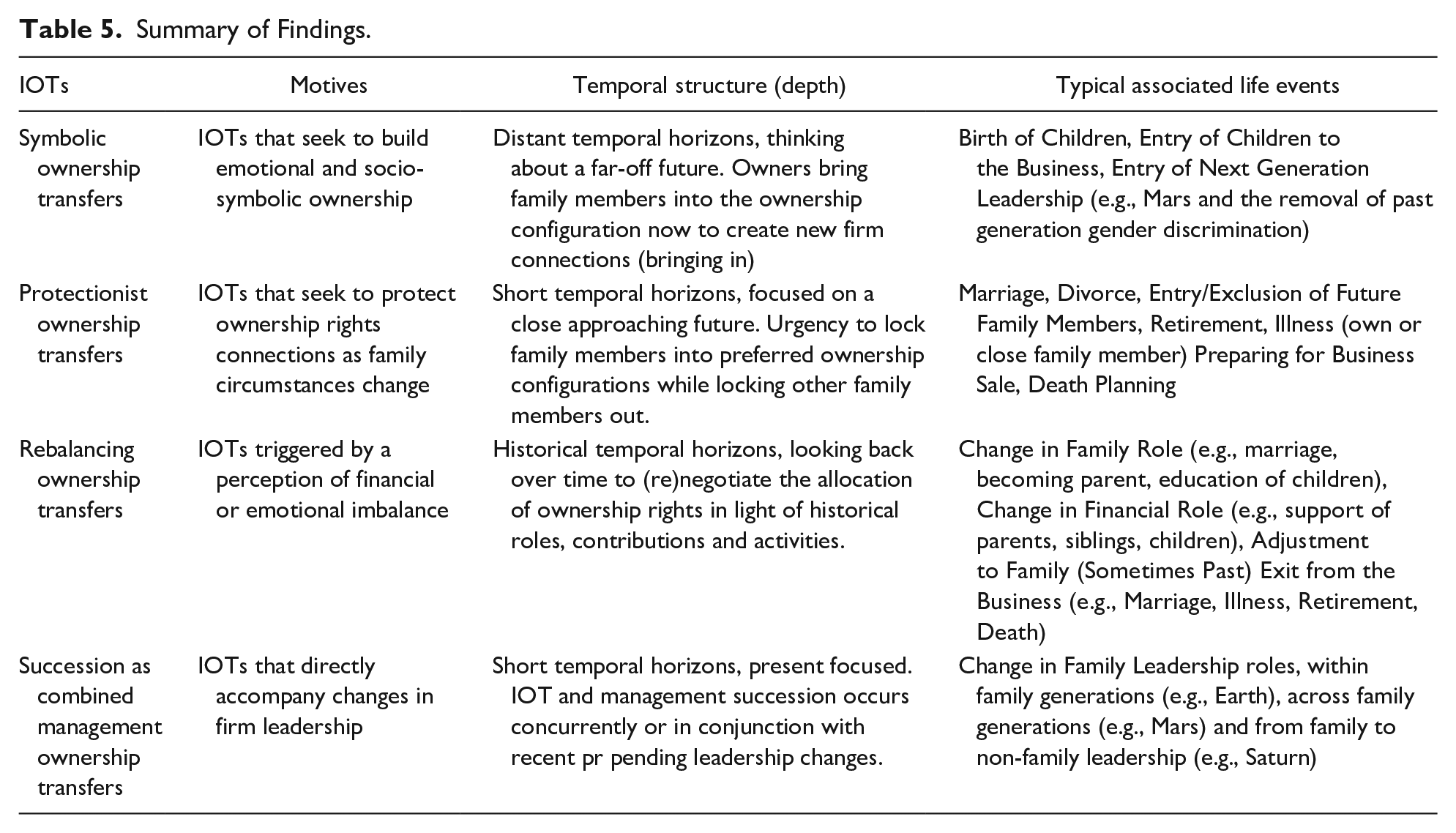
Next we discuss the three IOT narratives more holistically, to develop a theoretical storyline (Locke, 2001), summarized in a theoretical framework that helps explain how IOTs are separate processes that only sometimes coincide with management succession processes.
Discussion
A Processual Life Course Theory of Ownership Transfer in Business-Owning Families
IOTs are foundational events in family business research (Wiklund et al., 2013). However, few studies have examined the dynamic interplay between interlinked family life courses (Aldrich et al., 2021; Elder et al., 2003), ownership transfer decisions (Haag et al., 2024), and management succession processes (Nordqvist et al., 2013). To address this gap, we asked two research questions: How do the messy, unpredictable, and evolving trajectories of family life (Aldrich et al., 2021; Bengtson & Allen, 1993) precipitate different types of IOTs? And how are these IOTs intertwined with management succession? We explored these questions by analyzing ownership transfer narratives in 12 business-owning families, drawing on life course theory to develop a more embedded theoretical understanding of ownership transfer dynamics.
Our main finding is that co-evolving and anticipated family life courses, trajectories, and events precipitate three distinct types of IOTs, which we label symbolic transfers, protectionist transfers and rebalancing transfers. While all three are shaped by family considerations (Aldrich et al., 2021), they differ in their core features, underlying drivers, and temporal horizons (Hitlin & Elder, 2007). Moreover, while these IOTs are recursively related to evolving family life courses, events, and trajectories, we find that they only occasionally coincide with management succession processes. Drawing on these grounded findings, we advance a process theoretical framework that illustrates the motives, temporal dimensions of these embedded ownership transfers, and their partial links with management succession (see Figure 1).
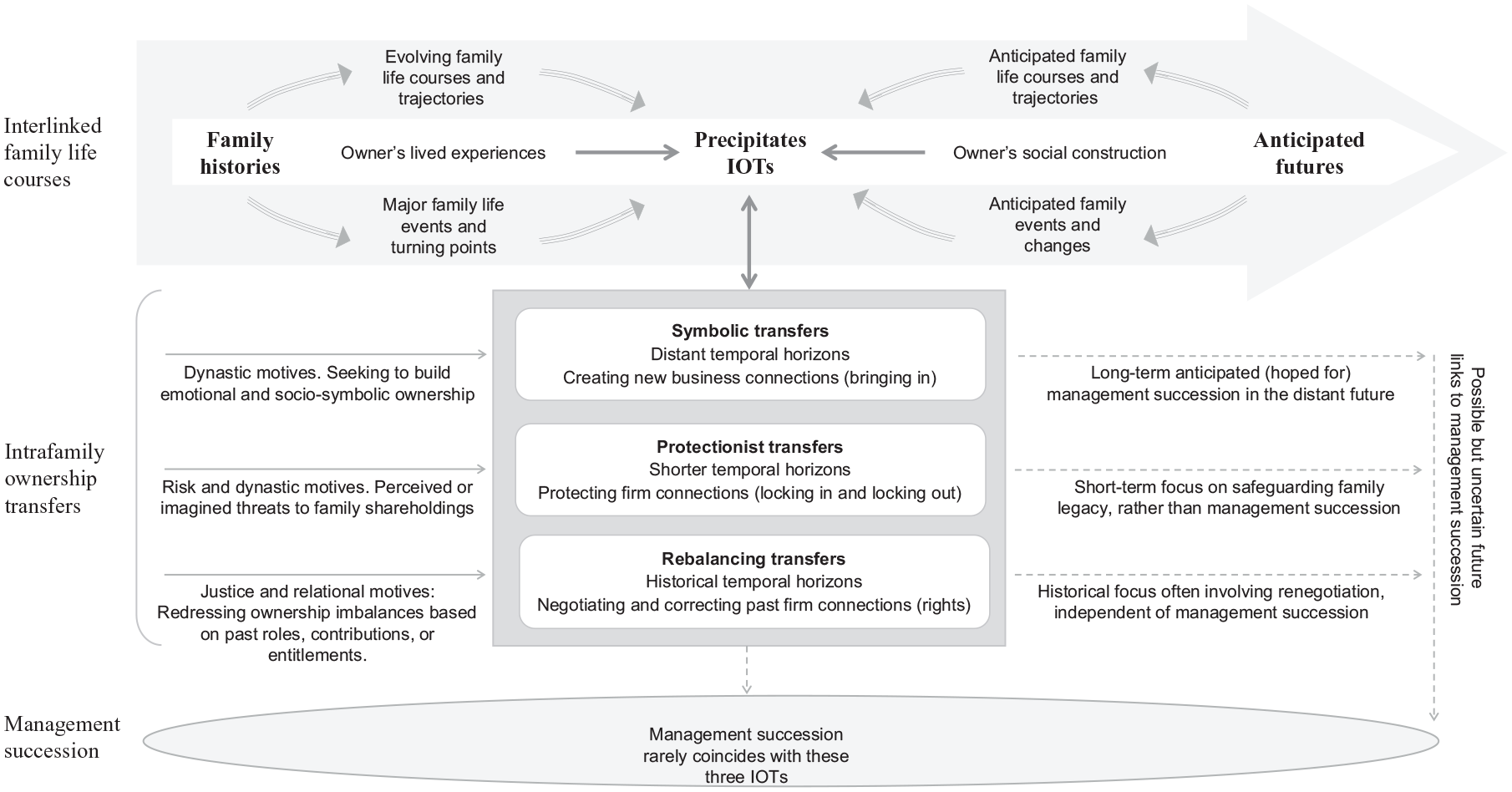
A Processual Life Course Theory of Ownership Transfer in Business-Owning Families.
In the top layer of our framework, labeled interlinked family life courses—for example, evolving family trajectories, expected and unexpected life events and turning points, and anticipated futures (Elder et al., 2003)—conspire to precipitate three types of IOT processes: symbolic transfers, protectionist transfers, and rebalancing transfers. In all cases, ownership transfer and family change are understood as distinct but recursively related processes, shaped by the owner’s lived experience and socially constructed understandings of family, family history, and anticipated events and trajectories within an expanding web of interconnected life courses. Critically, these family-embedded IOTs are rarely induced by isolated events or single factors. Consistent with the family embeddedness perspective (Aldrich et al., 2021), they are rooted in complex and evolving family histories, connected lives, family branches, turning points, and cultural norms (Elder, 1998) that jointly precipitate IOT choices. Yet, each IOT has characteristic motives and temporal dimensions, with links to scholarly debates about dynastic motives, risk, and SEW (Gómez-Mejía et al., 2007), as well as the relationship between IOTs and management succession (Nordqvist et al., 2013; Sund et al., 2015; Wiklund et al., 2013). These are captured in the second layer of the model, labeled intrafamily ownership transfers (see Figure 1).
In symbolic ownership transfers, family business owners act altruistically (Schulze et al., 2003b) to bring new owners into the business, typically by gifting minority stakes to the next generation family members. Their objective is to signal or symbolize future intent; hence, these transfers are often small in size with little or no decision power. The timing of symbolic transfers varies, with key triggers including life course stages (e.g., children “coming of age,” parents “planning for retirement”), business activity (e.g., “siblings working in the business”), and family inducements (e.g., “children’s requests”). Although symbolic transfers are often gifted, they can be complicated by sibling rivalries (e.g., disputes over who gets what), cultural values (e.g., beliefs about gender roles), norms of appropriateness (e.g., what is seen as fair or fitting), and strained family relations (e.g., poor father–son relations).
Another key feature of symbolic transfers is that owners adopt a “forward looking” (Bluedorn, 2002), long-term time horizon (Nason et al., 2019; Wennberg et al., 2011). Without any certitude about what the future holds, owners use symbolic ownership transfers with the hope that subsequent generation recipients will develop a psychological attachment to the family business (Nordqvist, 2016; Pierce et al., 2001). Thus, symbolic transfers chime with theoretical discussions about the importance of psychological ownership (Sund et al., 2015) and emotional ownership (Björnberg & Nicholson, 2012). As Carr et al. (2016) note, cultivating psychological ownership through wealth transfer is a compelling and understudied topic. Our findings lend support to the idea that transferring minority stakes through symbolic transfers can generate emotional bonds and identification with a family firm (Björnberg & Nicholson, 2012), potentially setting the stage for future family business involvement.
In protectionist ownership transfers, family business owners are motivated to lock preferred blood relatives into ownership configurations while locking out less immediate or less deserving family members. The antecedents of protectionist IOTs are complex and multifaceted, involving factors such as the owner’s life course (e.g., aging, ill health), spousal circumstances (e.g., income), imagined futures (e.g., marriages, divorces, relationships), and family norms (e.g., family care values). The main driver is a perceived risk to continued family shareholding and a desire to protect socioemotional wealth (Gómez-Mejía et al., 2007). Parents have low risk-tolerance when protecting their children (Chaulk et al., 2003). Prior research also shows that when owners frame situations as potentially leading to SEW losses, they tend to choose risky actions to protect family wealth (DeTienne & Chirico, 2013; Gómez-Mejía et al., 2007).
In protectionist transfers, owners have a forward-looking horizon (Nason et al., 2019). They imagine futures (Bluedorn, 2002) and potential risks to family shareholdings (e.g., opportunism by sons-in-law, daughters-in-law, spouses of future owners) and this perceived threat to SEW—for example, threats to the welfare of family members, family influence, family legacy (Gómez-Mejía & Herrero, 2022) compels them to transfer ownership to safeguard ownership rights, secure financial needs and protect the interests of offspring. Yet, these protectionist ownership transfers are not risk free. As our findings showed, a desire to preserve SEW can inadvertently damage SEW by signaling distrust, generating family conflict, and harming relations within family groups—each a critical dimension of SEW (Gómez-Mejía et al., 2007). Thus, IOTs reverberate across time, setting new paths in motion within the family. These changed family conditions—along with other family changes, life events, and turning points—co-create the conditions for future IOTs. The recursive relationship between interlinked family life courses and ownership transfer choices is represented by the double arrow at the center of Figure 1.
Rebalancing ownership transfers, by contrast, have a largely historical temporal focus (Nason et al., 2019). As Gomez-Mejia et al. (2011, p. 654) note, families have “long histories and enduring memories.” During rebalancing, owners and family members (re)negotiate the allocation of ownership in light of historical roles, contributions, events, and perceived imbalances. Such transfers are triggered by life course events (e.g., transitions to marriage), shifting priorities of family members (e.g., parenthood), changing business demands (e.g., struggling), or in recognition of some contribution made or expected (Lansberg, 1988). As the findings showed, rebalancing transfers are about restoring perceptions of balance in holding ownership and sharing dividends among family members. Thus, family members are ostensibly concerned with what is fair (Kidwell et al., 2012; Lubatkin et al., 2007) and appropriate, given the status, identity, and historical contributions of family members (see Olsen & March, 2004). These IOTs can be straightforward. However, judgments about fairness and appropriateness can also be contested and complicated by family tensions, misaligned expectations, repressed family issues, and historical grievances. As the findings showed, rebalancing transfers can spiral into family conflict, potentially damaging SEW (Gómez-Mejía et al., 2007). This echoes Gersick et al.’s (1997, p. 33) observation that an unfair distribution of shares can “stir up jealousies and encourage rival offspring to vie for power.” Thus, rebalancing transfers can be associated with political maneuvering—for example, blocking perceived unfair IOTs, using concealed ownership transfers—to limit family conflict and preserve family harmony, to some degree. More optimistically, rebalancing transfers can, if managed well, alleviate conflicts and resentments if the new ownership configuration is considered by family members to be fair and appropriate.
Indeed, each of the IOTs in our framework has a loose, contingent, and potential link to management succession. As shown by the dotted arrows on the right side of Figure 1, links between ownership transfers and succession are tenuous. In practice, succession rarely coincides with these three IOTs, and while future connections are possible, they remain uncertain, as IOTs largely unfold independently of succession decisions. For example, symbolic ownership transfers may intertwine with the management succession process in the course of time. Founding owners often prefer to see what they have built continue (Bertschi-Michel et al., 2021; Gersick et al., 1997; Haag et al., 2023), with dreams of dynastic succession (Gómez-Mejía & Herrero, 2022). Yet, research finds that dynastic succession is often not realized (Wennberg et al., 2011). Symbolic ownership transfers can potentially lay the groundwork for dynastic succession by cultivating socioemotional attachments. However, our study shows that the link to management succession, at the time of transfer, is uncertain, tenuous and hopeful.
An equally tenuous link exists between rebalancing and protectionist ownership transfers, though the nature of these linkages differs. Management succession is not the primary concern during rebalancing transfers, and many do not coincide with management changes. However, rebalancing can respond to prior management transitions (a historical link) or anticipate future successions (a forward-looking link), as families—particularly across branches—seek to “pass the baton” (Gersick et al., 1999). Protectionist transfers also maintain a tenuous connection to management succession, though overlap is possible. For instance, they may become entangled with succession when owners are concerned about in-laws or distant relatives using managerial roles to opportunistically capture family shareholding.
Implicit in our process model is the assumption that ongoing life course dynamics will grow and proliferate over time with each generation, potentially precipitating additional IOTs as intrafamily ownership continues. Returning to the top layer of the model, IOTs are likely to ebb and flow nonlinearly across types and occasions over generations, always shaped by shifting and multiplying family life courses. Critically, each discrete IOT event is nested within the larger IOT process, with past transfers influencing future ones (as depicted by the double arrow at the center of Figure 1). Thus, our model represents a state of flux (Langley et al., 2013), without predetermined paths or fixed causal links between specific family life course events and particular IOT types. Nonetheless, understanding prior IOT dynamics and the nonlinear sequencing of IOT types within a given business family offers valuable insight into how life course events may shape current and future ownership transfer developments.
Theoretical Contributions and Implications for Research
Together, our insights help advance family business scholarship in three areas. First, we advance the literature on ownership transfer by developing a novel typology of IOT processes that complement those directly related to management succession. Our study thus responds to calls for research that delves further into the conditions, motives, and challenges of IOTs (Nordqvist et al., 2013; Wiklund et al., 2013) and advances the family business literature by providing a new understanding of how and when ownership is passed between family members and across family generations (Sund et al., 2015; Zellweger et al., 2012). Prior research has stressed how IOTs are vital to family firm performance (Schulze et al., 2003a; Westhead & Howorth, 2006) and long-term survival (Wennberg et al., 2011).
Drawing on life course theory (Elder et al., 2003) and approaching IOTs with a narrative methodology (Hamilton et al., 2017), we cast new light on how evolving family dynamics and motives —for example, protecting kin, rebalancing shareholdings, cultivating psychological ownership—precipitate different types of IOTs, with different temporalities, challenges and tensions. Thus, we provide a processual understanding of IOTs, complementary to seeing IOTs as independent variables (Wennberg et al., 2011) or legal issues (Nordqvist et al., 2013; Sund et al., 2015). Our theoretical framework helps to explain how ownership can move back and forth within and between family branches through symbolic, protectionist, and rebalancing IOTs. Thus, our study advances a fluid conception of IOTs that encourages scholars to rethink how patterns of ownership dispersion unfold, bringing to the fore what Gersick et al. (1997) themselves always acknowledged but which often gets lost; namely, that ownership transfer rarely follows a fixed path and that complicated family lives (e.g., divorce, remarriage, illness, death) create infinite variations for nonlinear ownership trajectories.
Second, we extend the family business literature by casting light on how IOTs and family business leadership processes are partially and indeterminately related across different temporal horizons (Bluedorn, 2002). Prior studies in the family business literature often treat IOTs as inextricably intertwined with management succession events, such that the processes are often conflated in theoretical discussions (see Le Breton-Miller et al., 2004; Nordqvist et al., 2013; Sund et al., 2015; Wiklund et al., 2013; Zellweger et al., 2016). Our findings suggest rethinking how IOTs and management succession processes interrelate in family businesses. In our study, only four participants recounted narratives of ownership transfers, where ownership transfer was directly and temporally linked to a family member leadership transition. Most IOTs were loosely connected to management succession, sometimes not at all.
Echoing recent discussions about temporal focus and forward-looking and backward-looking reference points (Nason et al., 2019), our insights call for greater attention to how IOTs and family business leadership processes connect over broader temporal horizons and life cycles, both in owner’s temporal imaginations (Bluedorn & Standifer, 2006) and in what comes to pass longitudinally. Concepts of time, both the historical context of a person’s life and the timing of events in life courses, are fundamental to life course theory (Elder, 1994). As we showed, historical embeddedness matters (Vaara & Lamberg, 2016) and linked lives of family members were differently influenced by the shadow of the past—recall how Neptune seeks to transition its businesses in the second generation, as both a new wealth creator and a vehicle to control family wealth distribution to eligible family members based on rules and Board oversight, due to the highly complex family relationships and blended family structure created by the founder. When we expand our temporal lens, as researchers, we see new connections and previously hidden associations. For example, how symbolic IOTs are sometimes connected to leadership processes over long periods and may play a crucial preparatory role at the beginning of a succession journey, long before formal succession planning takes place.
Third, our study advances family embeddedness scholarship (Aldrich & Cliff, 2003) by illuminating how family life courses underpin IOTs in family businesses. The lack of family theories in the family business field (James et al., 2012) has prompted calls to investigate how complex family relations affect IOT (Nordqvist et al., 2013; Wiklund et al., 2013). Drawing on a branch of family science, we elucidate how family embeddedness underpins ownership choices and transitions over time. We demonstrate how life course theory enables researchers to explore the dynamic relations that unfold within relatively static notions of “life stages” and “family structures.” Life course theory, we argue, can help family business researchers to better appreciate how family trajectories are becoming less linear and predictable in a changing world of ambiguous moralities, cultural pluralism, and demographic change, where family members have more choices to “pick ‘n mix lifestyles” (Hunt, 2005).
Our study also encourages family business research to rethink how family relations, priorities, identities, and obligations drive IOT decisions. The concept of SEW highlights how nonfinancial endowments, including affective needs and family obligations, influence decision-making in family firms (e.g., Gómez-Mejía et al., 2007). Yet, the narratives we studied were shot through with normative rules associated with gender, family norms, customs, and obligations that decision-makers referenced when determining what IOTs were (were not) appropriate. Family members rarely mentioned calculated trade-offs with business imperatives. Thus, we draw attention to how a “logic of appropriateness” (Olsen & March, 2004) is a crucial yet underexplored factor influencing ownership transfer choices in business-owning families.
Limitations and Future Directions
While our narrative approach illuminates how changing family lives precipitate IOTs in business-owning families, our case study design and ontological position prevent us from making generalization claims beyond those that can be made within the temporal and contextual factors described (Whetten, 1989). Following the principles of naturalistic inquiry (Lincoln & Guba, 1985) and narrative inquiry (Riessman, 2008), we have drawn attention to the lived experiences, subjective accounts and narrative plots of the family members involved in IOTs and pursued analytic generalization by linking insights to life course theory and other concepts in the family business literature. Through description of the context in question, our findings allow consideration of the boundary conditions by reflecting on the “who where and when” our theory of IOT apply (Busse et al., 2017; Whetten, 1989). We suspect that our typology can account for most IOTs, even if the family contexts differ, but more research is needed to support such a claim. It would also be interesting to study the relationship between family differences and IOTs (Jaskiewicz & Dyer, 2017), including family differences in different cultures, countries, and societies.
We encourage future research to further investigate how pluralistic family systems (Aldrich et al., 2021; Barban & Sironi, 2019), interlinked life courses (Elder, 1998; Jaskiewicz & Dyer, 2017), and various family factors—for example, ambivalent family ties (Luscher, 2005), norms of reciprocity (Hanson et al., 2019), and justice conflicts (Blondel et al., 2001)—shape and produce different ownership configurations. We furthermore encourage future research to investigate how logics of appropriateness (Olsen & March, 2004) drive decision-making within business families to complement and extend SEW drivers of priorities (Gómez-Mejía et al., 2007). In addition, in terms of methodology, we suggest that a more widespread use of narrative approaches (see Dawson & Hjorth, 2012; Hamilton et al., 2017; Short & Payne, 2020), could bring new insights to other family business phenomenon by highlighting their temporal and socially constructed aspects.
A potential limitation is our study is based in the United Kingdom. On the one hand, the United Kingdom is an important context. Over the next 30 years, around £5.5 trillion of wealth is expected to be transferred, termed “The Great Wealth Transfer” (Nolan et al., 2020), as “Baby Boomers” retire and die (CEBR, 2018). Understanding how U.K. business-owning families navigate complex family concerns when passing wealth across generations is essential. On the other hand, the insights we advance are embedded in the U.K. political, cultural, and economic landscape. As we have emphasized, life courses are socially constructed, and these constructions partly reflect the societal context in which people and families make sense of their unfolding lives (Bengtson & Allen, 1993). As Hunt (2005) notes, differences in life courses may be found in contrasting societies where cultural differences about, for example, family roles, how age is perceived, or rules of appropriateness shape identities, meanings, and behaviors. Therefore, we encourage future scholarship that takes a comparative approach to understand better how life courses in different societies shape IOT.
Conclusion
How family firm equity is distributed among family members is a critical issue for family business research. Our study unpacks the ownership transfer process in family firms. Drawing on life course theory and analyzing ownership transfer narratives, we show how changing family life courses and events precipitate three types of ownership transfers, that is, symbolic, protectionist, and rebalancing. We illustrate differences in motives behind the IOT types and their respective temporal characteristics. This study thus provides a nuanced understanding of IOT dynamics, including how ownership transfer processes only sometimes coincide with management succession processes.
Footnotes
Appendix
Declaration of Conflicting Interests
The author(s) declared no potential conflicts of interest with respect to the research, authorship, and/or publication of this article.
Funding
The author(s) received no financial support for the research, authorship, and/or publication of this article.
