



Abstract
Business families directly participating in political roles have considerable influence in various countries. We explore political business families’ unique economic and social characteristics through a social embeddedness lens. We build a comprehensive dataset of Chilean business families and identify their direct political participation from 1989 to 2020. We find limited support for economic features tied to political participation, whereas social characteristics, such as nationally rooted origins, religious affiliations, and family generation, are shared features of political business families. We extend the literature by analyzing how business families with greater social embeddedness act as legitimate representatives of the big business class in the state.
Introduction
Political business families—business families with members either running, elected, or appointed to political office—are powerful economic and political actors in many countries whose decision-making and vision of society impact public policy agendas (Bunkanwanicha & Wiwattanakantang, 2009; James, 2009; Schneider, 2013). The Berlusconi family in Italy, the Dassault family in France, and the Matte family in Chile are some examples of influential political business families. In the case of Chile, the context of this study, business families have had a historically intertwined relationship with political institutions, enjoying distinct access to political positions and exerting direct influence on policy-making while maintaining control of their businesses. Due to its broad socio-political and economic significance, scholars have been intrigued about the underlying factors behind the political participation of some business families. An established economic view suggests that resource or rent-seeking motives encourage business actors to participate in politics (Shleifer & Vishny, 1998; Tihanyi et al., 2019). Political participation can secure better access to government resources (Fisman, 2001; Peng & Luo, 2000) and offers a valuable source of political capital to preserve business families’ economic wealth and power (Fogel, 2006; Morck et al., 2005).
However, the unbalanced attention to economic motives may overlook the risks of business families’ political participation. One source of risk stems from political patrons who seek to extract substantial resources from their business family clients, well beyond the family’s initial expectation (Dieleman & Sachs, 2008; Shleifer & Vishny, 1998). Furthermore, political patrons may unexpectedly lose their political power, devaluing the family’s political investment (Sun et al., 2012). Political participation can also expose a business family to political scandals, damaging a family’s reputation and social status (Song et al., 2021). Moreover, business families value privacy and are unlikely to disclose their motives and outcomes from political participation in a reliable manner. Indeed, much of the literature on business participation in politics reflects parochial economic theoretical assumptions, such as transaction costs or agency theory, which may overlook the complexities of political participation (Ghoshal & Moran, 1996). Thus, given the benefits and risks of business families’ political participation, the motives of business families who choose to enter or shun politics remain open.
We shed light on this open question by rebalancing the prominence of the rent-seeking view by integrating a social embeddedness perspective (e.g., Aldrich & Cliff, 2003; Baù et al., 2019; Le Breton-Miller & Miller, 2009; Steier et al., 2009) to provide an overarching framework on political businesses families. In addition to economic interest, socially embedded business families may include social considerations for political participation to align with social obligations derived from their elite social class status (Domhoff, 1975; Khan, 2012), representing the class-wide interests of business (Useem, 1982), and the moral imperatives of their espoused values (de Groot et al., 2022; Du, 2017). Elite social status is maintained by conforming to the expected norms of their communities (Khan, 2012). Indeed, status is often more valuable than financial gain for the business elite (Chung et al., 2021). In contrast, self-serving behavior leads to censure and negative social evaluations, harming the family’s legitimacy and elite class status (Piazza & Castellucci, 2014). Importantly, our social embeddedness perspective does not imply altruistic or disinterested motives; instead, class-wide rationality refers to non-parochial support for the “broader needs of big business” rather than for the whole society (Useem, 1982, p. 202). Thus, we argue that socially embedded business families in politics can act as an “inner circle” representing the interests of the business class (Useem, 1984), facilitating the coordination and communication between a concentrated political domain and a fragmented business community.
Empirically, we evaluate whether political business families differ from other business families in their economic interests and social embeddedness. We assembled a comprehensive database of 170 business families, 53,526 political candidacies, and 528 heads of state’s close collaborators from Chile since the country’s return to democracy (1989–2020). Remarkably, we find scant support for business families’ economic interests associated with direct political participation—specifically, family wealth, family investment in politically sensitive sectors, family wealth diversification, and family business financial performance (Bortolotti & Faccio, 2009; Bunkanwanicha & Wiwattanakantang, 2009; Faccio et al., 2006; Hacker & Pierson, 2010; Mills et al., 2013). Conversely, business families’ social embeddedness is significantly associated with direct political participation. In particular, national origins (Givens, 2007), espoused religious affiliation (Jones-Correa & Leal, 2001; McClendon & Riedl, 2015), and family generation (Marcus & Hall, 1992; Palmer & Barber, 2001) are significant sources of social embeddedness shared by political business families. These findings reveal some cultural elements shared by this inner circle of business families that intermediate between political and business elite.
With the business family as the unit of analysis, we make two contributions. First, we contribute to the family business political strategy literature (Dieleman & Sachs, 2008; Du, 2017; Fogel, 2006; Ge et al., 2019) by identifying political business families’ economic interests and social embeddedness compared with non-political business families. Our findings challenge the rent-seeking view by accentuating the social embeddedness of business families’ political participation, which suggests socialized interests, a blend of economic and socialized motives. Second, although much of the family business political strategy concerns a firm’s political participation, our unit of analysis is the family behind the firm and, in particular, the role of the political actors within the business family. Thus, we respond to calls for greater attention to the distinctive roles of non-managerial family members in business families (Carney & Dieleman, 2023).
Theory and Hypotheses
Much family business research rests on single-family, single-firm assumptions and is frequently inattentive to the family behind the firm. We define business families as multi-household, multi-generational, extended families connected through kinship (Koning & Verver, 2023) and marriage (Chung et al., 2021) with diversified business interests and holding wealth beyond the firm (Kammerlander & Bertschi-Michel, 2023). Furthermore, elite business families are concerned with wealth accumulation and maintaining their elevated social status, a valued form of socioemotional wealth (Gomez-Mejia et al., 2011). Interestingly, upholding a family’s elite social status can be prioritized over economic gain (Chung et al., 2021). The inattention to the family behind the firm is problematic because family members can play varied roles and activities in the family and firm(s). Although some family members play governance and managerial roles in the firms, others play roles in philanthropy (Ostrower, 1997), wealth management (Beckert, 2022), next-gen socialization (Kuusela, 2018), and diverse community and civil society roles (Lumpkin & Bacq, 2022). The selection of business family members into roles in the broader society reflects business families’ elite status and provides opportunities to augment a family’s status (Khan, 2012).
Political Business Families
Political business families have family members in both business and politics, where the political participant can serve as a communication channel or linking pin, facilitating coordination between government, politics, and business. Given this strategic position, developing a better understanding of the characteristics underlying political business families is essential. Political business families have several theoretical distinctions relative to other political strategies, such as recruiting politicians to the board or political campaign donations. First, families are independent actors in the business family system, seeking to coordinate interrelated social and economic activities (Browning et al., 2014). For wealthy business families, controlling multiple firms (Duran & Ortiz, 2020) and often holding substantial wealth beyond the firm (Carney & Nason, 2018), the roles and coordination of family members across social and economic activities might lead some to enter politics, without a formal role in the family businesses. Importantly, family ties through a political representative provide a potentially stable link to the political elite and are less prone to agency conflicts than hired politicians.
Second, often understated in the literature is the potential for business families to contribute to broader social objectives beyond their parochial economic interests. However, business families are heterogeneous. For example, families differ in their espoused values (Barbera et al., 2020; Bhatnagar et al., 2020), ethnicity (Nordstrom & Jennings, 2018), and social ties (Nason et al., 2019). Not all business families become involved in politics, yet such social heterogeneity may be associated with participation in the political process, an underexplored topic. Furthermore, in some democratic societies, family members cannot directly exploit firm-level benefits from political ties since media coverage and solid legal institutions constrain the economic gains from political links (Gehlbach et al., 2010). Indeed, in such contexts, the state may vigorously limit business influence in politics (Shapiro et al., 2023).
The Economic Interests Perspective of Political Business Families
The prevailing view of political business families’ rent-seeking ambitions originates from economics (Bunkanwanicha et al., 2013; Faccio, 2006). The rent-seeking theory is an economic concept that focuses on an agent’s pursuit of financial gains through non-productive activities, such as lobbying, manipulating regulations, or seeking material privileges from the government (Krueger, 1974; Morck & Yeung, 2004). The idea is that firms may seek economic rents, which are excess profits or benefits beyond what they would receive in a competitive market. According to this perspective, business families engage in political activity to expand and safeguard their economic interests (Fogel, 2006; Tihanyi et al., 2019). Direct political participation may provide significant and economic advantages, including exclusive licenses and contracts from the state, preferential access to loans, bailouts, subsidies, and lenient legal consequences, which are hard to imitate by non-politically embedded actors (Dinh & Calabro, 2019; Faccio et al., 2006). Furthermore, the economic perspective often identifies adverse macroeconomic outcomes, such as sluggish economic growth or weak national innovation performance (Faccio, 2006; Fogel, 2006; Morck & Yeung, 2004).
We identify four firm-level indicators as proxies of business family economic interests. These include family firm assets (Bunkanwanicha & Wiwattanakantang, 2009), investment in politically sensitive sectors (Bortolotti & Faccio, 2009; Mills et al., 2013), diversification (Hacker & Pierson, 2010), and business performance (Faccio et al., 2006). These factors exemplify potential business families’ pursuit of economic benefits that surpass those typically earned in a competitive market. Moreover, these characteristics align with fundamental business families’ objectives, prioritizing long-term financial well-being for their businesses and family members (Beckert, 2022).
Family Wealth
Business families must provide material and financial resources to the entire family group across generations (Carr et al., 2016). However, their external political environment significantly risks their objectives (Doh & Ramamurti, 2003; Hadani, 2007). Government initiatives addressing wealth concentration and social inequalities, such as wealth taxes and asset confiscation policies, can threaten the long-term wealth of business families (Berrios et al., 2011; Ortiz et al., 2021). As active participants in the political system, business families, however, may resist adverse political forces against their economic interests and shape policy-making (Dieleman & Sachs, 2008; Dinh & Calabro, 2019). Additionally, given the trade-off between family-centric goals and other shareholders’ wealth (Anderson & Reeb, 2003; Villalonga & Amit, 2006), engaging in politics can shield business families from litigation (Chung & Zhu, 2021). Moreover, we argue that affluent business families are more likely to engage in politics due to their favorable financial capital, which enables them to fund election campaigns (Arregle et al., 2007; Querubin, 2016). Consequently, we hypothesize that:
Family Investment in Politically Sensitive Sectors
Political-sensitive sectors such as finance, transportation, energy, telecommunication, utilities, and media are highly susceptible to political change (Bortolotti & Faccio, 2009), potentially impacting companies’ profitability and viability (Sun et al., 2012). Assets in these sectors are subject to the risk of contingent value, particularly asset seizure and lost opportunities due to regime change (Lu & Ma, 2008; Siegel, 2007). Business families face heightened vulnerability to political changes as politicians’ perspectives on their societal role vary based on their ideologies (Duran et al., 2017). In cases where a significant portion of business families’ wealth originates from politically sensitive sectors, politicians with differing interests may seek to modify the regulatory framework (Amore & Minichilli, 2018). Engaging in politics may offset these legal threats by exerting direct influence and decision-making power over policies and regulations (Steier et al., 2009). Therefore, we hypothesize that:
Family Wealth Diversification
Generally, business families are encouraged to diversify wealth, enabling growth, reducing business-specific risks, increasing firm survival, and providing employment opportunities for family members (Hafner & Pidun, 2022). However, much research indicates that wealthy families tend to concentrate their wealth on a single firm or small group of businesses to maintain direct control and influence over their investments (Anderson & Reeb, 2003; Jones et al., 2008). Perilously, business concentration exposes the family wealth to economic risks, many arising from politics, such as adverse fiscal policies, regulatory changes, and geopolitical events (Burkart et al., 2003). Indeed, business families’ unwillingness to dilute ownership may encounter financial constraints that limit their ability to exploit opportunities and ultimately lower firm value (Li & Ryan, 2022). Consequently, business families with undiversified ownership may acquire de jure political power to safeguard their business performance and profitability (Bunkanwanicha & Wiwattanakantang, 2009; Song et al., 2021). Political business families with concentrated ownership can improve their political environment by advocating for favorable government treatment and regulatory stability. However, diversified wealth mitigates these motives behind political participation. Therefore, we hypothesize that:
Family Business Financial Performance
We have emphasized the importance of wealth generation and protection for business families across current and future generations (Beckert, 2022; Tait, 2019). Robust firms’ financial performance typically underpins business family longevity (Corbetta & Salvato, 2012; Le Breton-Miller & Miller, 2018). However, flagging financial performance may trigger restructuring and strategic change. For instance, product and geographic diversification can help reach new customer segments and capitalize on market trends (van Essen et al., 2015). However, business families often hesitate to rely on external to the family managerial expertise (Arregle et al., 2017). They also tend to adopt a conservative strategic approach, prioritizing stability and risk aversion over rapid expansion or disruptive strategies (Duran et al., 2016). In our context, business families running underperforming firms may see political power as an alternative path to protect their business and continue operating even though this would not be feasible in market-based competition (Cingano & Pinotti, 2013; Li et al., 2008). By engaging in politics, they can avoid tighter regulations and entry threats that could hamper their underperforming business (Bertrand & Schoar, 2006; Bird & Zellweger, 2018). Consequently, we hypothesize that:
A constraint of the rent-seeking view of political business families is its limited understanding of the social dynamics of their political participation. By focusing solely on economic interests and the pursuit of exclusive benefits, this perspective overlooks the multifaceted nature of their involvement in the political sphere. Therefore, we adopt a social embeddedness perspective on political business families to offer an overarching view of this phenomenon.
The Social Embeddedness Perspective of Political Business Families
The social embeddedness perspective of business families accentuates the role of status, relationships, norms, and trust in shaping their economic behavior. The family business literature views economic transactions as embedded in social contexts, providing access to information, resources, and opportunities (Aldrich & Cliff, 2003; Le Breton-Miller & Miller, 2009). However, many social embeddedness studies are limited by focusing on embeddedness in local communities and rural areas or small- and medium-sized firms (Baù et al., 2019; Bailey & Lumpkin, 2023; Lester & Cannella, 2006). These communities can provide SME business families with valuable resources but offer limited access to political elites. To avoid the limitations of locally based social embeddedness, we primarily focus on embeddedness at the national level, drawing upon literature from organizational sociology on elite business families’ social status and the inner circle of government–business relations (Khan, 2012; Mizruchi, 1992).
In political business families, social embeddedness facilitates entry into the policy process, which is enabled by their strong connections with business and society (Steier et al., 2009). The values, norms, and traditions upheld within the family can affect family members’ involvement in political activities, policy consultations, and formation (Aldrich & Cliff, 2003). Contrary to the economic perspective, much historical evidence shows that business families can profoundly promote industrial and economic development (Amsden, 1989; Fisman & Khanna, 2004; James, 2009). Moreover, and somewhat parochially, political business families can accumulate social esteem through their pro-social contributions to national development (Collin, 1998; Evans, 1995).
We reason that social embeddedness diminishes business families’ self-interested behavior. In this context, the naked pursuit of parochial private rents may tarnish a family’s social status. Business families value elite social status, conferred through social evaluations and judgments (Bitektine, 2011). Consistent with elite theory (Khan, 2012), social status can be more important than money for elites (Chung et al., 2021), and business families risk status erosion if they deviate from socially prescribed normative expectations of members of the political community (Piazza & Castellucci, 2014). Thus, the social embeddedness of elite political business families, their public exposure in politics, and deviant behavior, such as private rent-seeking, will attract censure and negative social evaluations, leading to status loss. Contrarily, although political business family representation of class-wide interests is legitimate in the policy process, alignment with normative expectations of political representation preserves and may enhance political business families’ elite social status. This dynamic creates a “socialized interest,” leading to a nuanced interplay between political business families’ pursuit of wealth and normative expectations about serving the public interest and preserving their privileged social status.
In democratic societies, political actors possess power sources that can constrain business families’ interests, including economic sanctions. Equally, political decision-makers require information about the economy and business issues. Thus, the business community must articulate their concerns within the policy process. However, the imbalance between the concentrated political domain and the fragmented business community raises concerns about communication and coordination (Evans, 1995; Lazzarini, 2015). Without coordination, business and politics can become a negative-sum contest.
To bridge this gap, an “inner circle” of business families or family business groups may emerge as intermediaries to represent and coordinate intertwined interests of business and politics (Chu & Davis, 2016; Collin, 1998; Useem, 1982). We reason family heterogeneity in terms of social embeddedness helps explain why some families engage directly in politics and serve as communications channels between business and politics. We do not suggest that political business families are benevolent or altruistic in this regard. Indeed, class-wide rationality suggests that such business families actively represent the broader interests of the business family community rather than the whole society (Useem, 1982). However, social embeddedness suggests structural constraints on self-centered rent-seeking. It creates expectations to exhibit a communal orientation and recognize the legitimate interests of other parties, a phenomenon described as embedded autonomy (Evans, 1995). Furthermore, business family participation in the policy process provides opportunities to enhance the business families’ elite social status.
We combine elite social status (Khan, 2012) and class-wide rationality (Useem, 1982) to theorize business families’ social embeddedness for political business families. Khan (2012, p. 362) suggested elites “occupy a dominant position within social relations” and leverage their wealth to ensure dominance. Useem (1982) indicated that wealthy families’ attachment to a particular and cohesive social group induces them to search for political office. However, the specific cultural elements that such social groups share are unknown. We consider three social correlates associated with political participation: national identity (Givens, 2007), religion (Jones-Correa & Leal, 2001; McClendon & Riedl, 2015), and elite multigenerational business families (Marcus & Hall, 1992; Palmer & Barber, 2001). Altogether, these social features are key factors shaping families’ incentives for directly engaging in the sociopolitical system.
National Identity
Social embeddedness suggests a strong attachment to national culture, history, and other societal institutions (Bloom, 1990). On the other hand, immigrants and their descendants may be ambiguous about their national identity relative to locals despite living in the host societies for years or generations (Bloemraad et al., 2008; Rumbaut, 1994). Moreover, research suggests a strong link between national attachment and civic involvement (Huddy & Khatib, 2007); as a result, immigrant-origin families would lack the willingness and ability for political participation. Accordingly, studies indicate that immigrants restrict their participation in broader public service, preferring to serve in initiatives more closely related to their cultural group (Givens, 2007; Jensen, 2008). Additionally, social distance from the local elites impedes immigrants from building the social capital needed to enter politics (La Due Lake & Huckfeldt, 1998; McClurg, 2003; Siegel, 2009). Therefore, we hypothesize that:
Religion
Business families’ religious affiliation represents another source of social embeddedness affecting business families’ direct political participation. Religious affiliation fosters a positive self-image for influencing political affairs and encourages civic association (Jones-Correa & Leal, 2001; McClendon & Riedl, 2015). Church attendance, for example, provides spaces for religious individuals to “share political resources, political information, and the chance of political participation” (Du, 2017, p. 389). Besides, religious business families can see political participation as a moral imperative to promote social and economic ideologies aligned with their spiritual beliefs (Thumala, 2010). Moreover, religious affiliation can foster broad social legitimacy and political unity (Mizruchi, 1992) by cutting across social class identity and reducing social conflict based on economic differences. Indeed, some religious business elites have publicly endorsed political attitudes favoring traditional family values and the free market (Duran et al., 2017; Wald & Calhoun-Brown, 2014). We thus hypothesize that:
Multigenerational Business Families
Some business families achieve elite social status by making notable contributions to social and economic development over several generations (Ostrower, 1997). Moreover, the schooling of such family members in prestigious educational institutions and socialization into an elite class encourage an ethic of responsible ownership (Kuusela, 2018). Such families may embellish their elite status, with family members pursuing careers in multiple domains beyond business (Zellweger & Kammerlander, 2015). Accordingly, multigenerational business families have stable and better political access than new entrepreneurs (Davis et al., 2003; Zeitlin, 1974). Politically active members of business families among the dominant segment tended to be a distinct social type who are prone to be involved as both directors in multiple business firms but also public service, service in elite policy organizations, high-level government positions, and business groups such as the Business Roundtable (Useem, 1984). Political business families’ established legitimacy within their respective political and business spheres can be inherited by successors, providing them with a foundation of credibility and acceptance in their leadership roles (Chung & Luo, 2013). Recent research frames these tendencies regarding business families’ significant contributions to civil society (Lumpkin & Bacq, 2022), contributing to the continuity of the family’s business and social status over time. Therefore, we hypothesize that:
Methodology
Research Context
We explore political business families in Chile, which is ideal due to its family-based economy and the prevalence of wealthy business families controlling large corporations (Berrone et al., 2022; Duran & Ortiz, 2020; Schneider, 2013). Chilean history has observed a mutual and reciprocal influence between political institutions and business families. Chile’s independence from the Spanish crown (1818) opened unprecedented opportunities for local business families to flourish and succeed (Nazer & Llorca-Jaña, 2022). Voting rights and political participation were exclusive for free, educated men with property or professions; as a result, wealthy business families enjoyed unique access to political positions while maintaining control of their businesses. Amid local and international economic crises in the 1920s, Chile reformed its electoral system, favoring the political representation of communist and socialist movements. Chile’s new constitution of 1925 formally established the separation of Church and State, offering space to secular political parties (Verdugo, 2021). As a result, business families reduced their direct political participation, but they continued influencing policy-making through trade associations to counterbalance the influence of the rising labor movements (Schneider, 2005).
Three decades later, a new generation of liberal business leaders aimed to become central political actors. Relying on the University of Chicago’s academic support, the renovated Chilean business elite campaigned for a free market and a smaller state (Ortega, 2019), achieving political power with Jorge Alessandri as president of Chile (1958). However, amid increasing unemployment and social discontent in 1970, Salvador Allende, a pro-Marxist politician, was elected president. During Allende’s government, business families’ political influence deteriorated, and industry nationalization policies damaged their economic power (Bucheli, 2019). A military coup led by General Augusto Pinochet overthrew Allende’s government in 1973, resuming and deepening the liberal reforms initiated decades ago by the business elite (Aldunate et al., 2020). Pinochet’s pro-market reforms enabled business families to acquire state-owned companies and facilitate international trade (Barbero, 2019). After Pinochet’s dictatorship in 1990, new democratic governments began a project to strengthen the country’s market-supporting institutions with a neoliberal economic system (Duran et al., 2017).
In sum, business families’ political participation in Chile has swung between direct involvement in political affairs through elected offices and indirect influence through trade associations, think tanks, and educational institutions, according to the opportunities and constraints faced in the environment. We empirically observe the business families’ political participation in Chile’s post-military era from 1990 to 2020, known for its institutional development and low corruption (Hoskisson et al., 2013), and normalized business families’ political participation (Ortega, 2019).
Construction of the Database
We performed three steps to build a sample of political business families in Chile. Figure 1 summarizes the process—the first step aimed to identify the universe of publicly traded family-controlled firms in Chile. Using data from the Santiago Stock Exchange, the Supervision of Securities and Insurance, also known as Superintendencia de Valores y Seguros (SVS), and Economatica, a dataset covering listed firms in Latin America (Duran et al., 2017), we extract information about the ultimate controller(s) of Chilean publicly listed firms between 2010 and 2020. Since 2010, the SVS has required publicly traded firms’ annual reports to disclose information on the top controllers’ identity and ownership; if the firm’s ultimate controller is another company, the annual reports must indicate the names of individuals owning the holding firm and whether they are family-related. Based on this information, we classified all publicly traded firms into two categories—non-family-controlled and family-controlled. Non-family-controlled firms include state-owned enterprises, foreign-owned, institutional-owned, and widely held companies. Family-controlled firms are those in which the ultimate controllers are family members related by blood or marriage, having the power to elect the majority of the board seats and influence the firm’s management (Duran et al., 2017). Finally, we confirmed the family ties using official certificates of birth and marriage provided by Chile’s Civil Registration and Identification (Duran & Ortiz, 2020). As a result, we identified 150 out of 243 publicly traded firms in Chile as family-controlled ones.
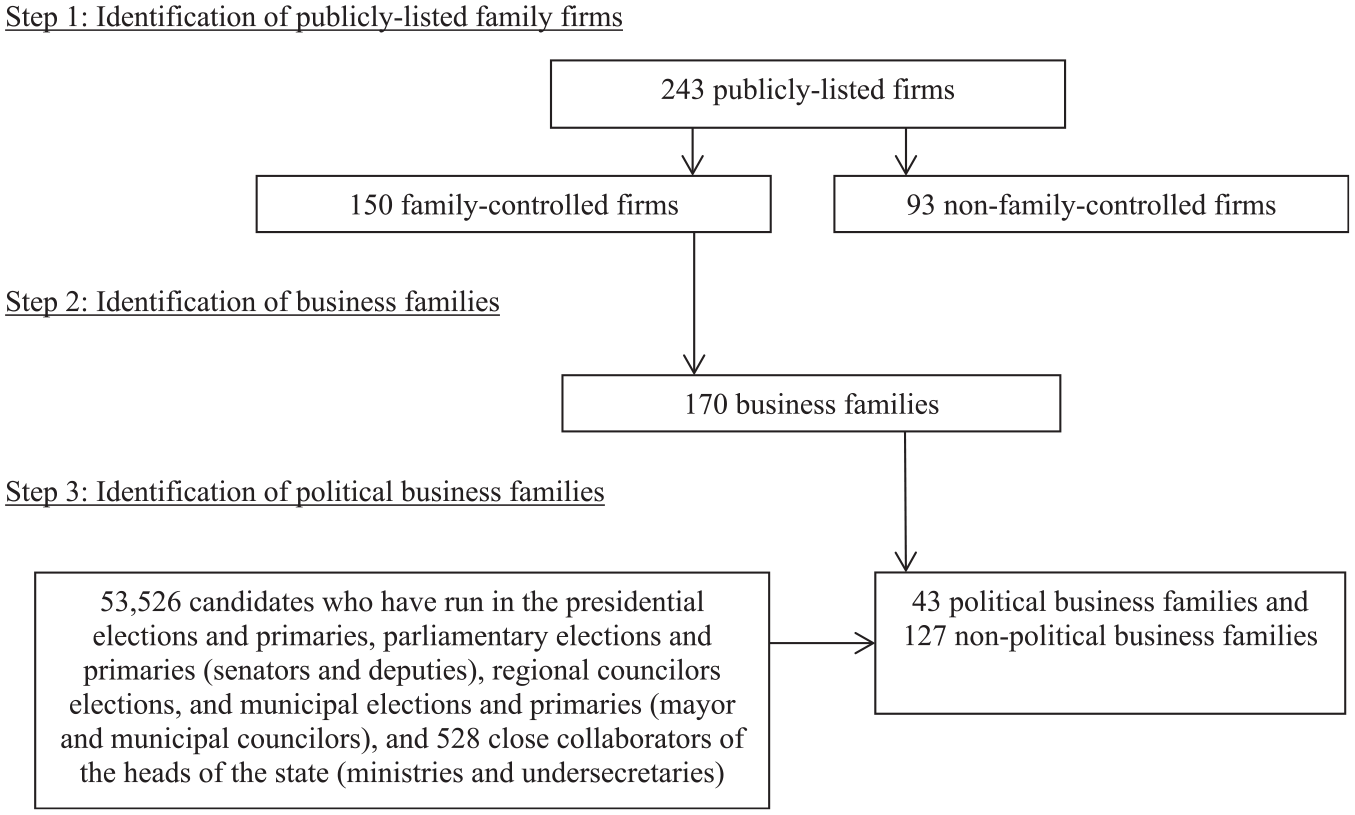
Steps to build the sample of political business families.
The second step identified the business families behind the family-controlled firms. To construct a business family tree, we collected data about the husband’s, wife’s, and parent’s names and national identification numbers of each family owner. Also, we extracted the names and national identification numbers of all the family-controlled firms’ boards of directors to track potential blood or marriage ties with family controllers. Based on this information, we grouped family-controlled firms’ owners, directors, and their respective spouses and parents into specific business families and built their family tree from its founders; therefore, each business family includes founders, descendants, and spouses. As a result, we identified 170 business families.
The third step sought to identify subgroups of political business families. To this end, we mapped business families’ political participation in both “national” and “local” positions since both groups of officers share a significant role in policy-making and enforcement (El Nayal et al., 2021; Werner, 2017). In addition, we include both successful (candidates who have run and won popular elections) and unsuccessful political candidates (candidates who have run but lost popular elections) because, despite losing elections, politicians continue to be connected with their political parties and participate in the political network. To build the list of politicians, we first identified all 53,526 candidates who have run in the different popular elections in Chile from 1989 to 2020 based on the Electoral Service of Chile (SERVEL). 1 These include presidential elections and primaries, parliamentary elections and primaries (senators and deputies), regional councilors elections, and municipal elections and primaries to elect mayors and municipal councilors. Additionally, we identified 528 heads of the state’s closest collaborators from 1990 to 2020, including ministries and undersecretaries. As a result, we built a list of 54,054 politicians spanning 3 decades.
In two ways, we cross-matched the dataset of family members who are part of the 170 business families identified above with the list of 54,054 politicians. First, we matched the politician’s national identification number with business family members’ identification numbers to determine whether the politician is also a business family member. Secondly, we matched each politician’s father and mother surnames to each business family member’s father and mother surnames to identify whether the politician relates by blood or marriage to a business family member. We then confirmed family ties through official certificates of birth and marriages. As a result, about 25%, or 43 out of 170 business families, had at least one family member participating in politics between 1989 and 2020. Among the sample of political business families, about 67% had at least two political roles during our sample period, consistent with having a stable pin with political power. Figure 2 reflects the historical background discussed in the research context section by illustrating a regular group of business families directly engaged in political affairs. The size of this group increases sporadically every 4 years, given unsuccessful political campaigns, suggesting a constant intention of political business families to be part of political power. Even during significant economic downturns like the Asian crisis in 1999 and the 2008 financial crisis, their presence in Chilean politics remained steady.
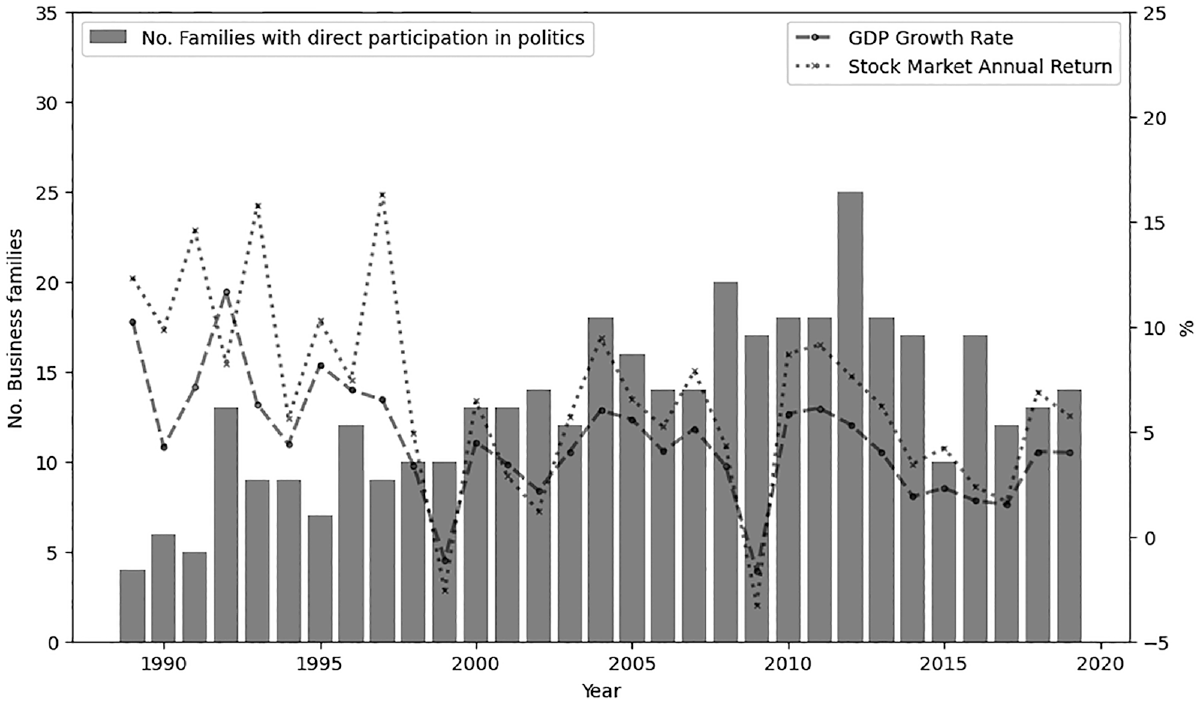
Direct political participation of business families.
Dependent Variable: Political Business Family
Unlike prior studies that view political connections at the corporate level (e.g., Boubakri et al., 2010; Dinh et al., 2022; Faccio, 2006), we focus exclusively on the political participation of business family members, who may or may not have a formal role in the family businesses but still may have identification with the family firms (Berrone et al., 2012). 2 Thus, we define a business family as a “political business family” when at least one family member (1) has ever run for elected office (elected or not) or (2) has ever been named head of the state’s minister or undersecretary. Accordingly, we operationalized Political business family as a dummy equal to one if the business family complies with the above definition and zero otherwise. As robustness, our models also included alternative measures of dependent variables discussed below.
Independent Variables
We employed four measures for the business family’s economic conditions to test the hypotheses related to economic characteristics. (1) Assets proxy the business family’s wealth (Hypothesis 1) (Bunkanwanicha & Wiwattanakantang, 2009). To compute it, we calculated each family-controlled firm’s average total (unconsolidated) assets between 2010 and 2020. The 2010 to 2020 time-average aggregation captures the cross-sectional variation of wealth among business families and reduces the risk of economic shocks affecting the results. We summed up the average total assets at the family level because some families control multiple firms. Business families’ total assets range from USD 10 million to USD 103 billion, with an average of USD 4 billion. (2) Politically sensitive sectors refer to the number of publicly traded corporations owned by the business family in energy, finance, telecommunication, transportation, and utilities. This measure accounts for the family’s wealth exposure to regulatory and political policies (Hypothesis 2) (Bortolotti & Faccio, 2009). Business families’ ownership stake in political-sensitive firms ranges from 0 to 9, with an average of 1. (3) Diversification, computed as the number of industries in which each business family has ownership stakes, measures how diversified the family’s wealth is (Hypothesis 3) (Bunkanwanicha & Wiwattanakantang, 2009). Over our sample period, business families’ number of sectors ranged from 1 to 13, with an average of 2. (4) Performance accounts for the economic returns of the business families’ publicly listed firms (Hypothesis 4) (Amore & Bennedsen, 2013). We calculated it as the mean return over assets (ROA) for each family-controlled firm over the 2010 to 2020 period. Then, we associate this data with their respective business families. If a business family owns multiple companies, we computed performance as the average ROA of all firms. The average ROA for the business families in our sample is 4.09%. We collected data for business families’ economic variables from the respective firms’ annual reports and Economatica.
We compute three indicators to test the hypothesis linked to the social embeddedness characteristics of business families. We followed Faccio’s (2006) and Bertrand et al. (2008) approach to gather information on such factors and hand-collected family data from alternative data sources described below. (1) Immigrant business family, a dummy equal to one when the business family’s founder is foreign-born and zero otherwise (Hypothesis 5). To build it, we reviewed firms’ history, biographies, and press to track the founders’ countries of origin. About 22% of the business families in our sample are immigrants from Italy, Spain, Croatia, and Japan. (2) Religious business family is a dummy equal to one if at least one business family member has publicly expressed religious beliefs and zero otherwise (Hypothesis 6). To compute it, we searched for evidence from organizations’ websites and press articles on business families’ participation as founders, financial supporters, or directors of religious-related organizations, such as educational organizations, churches, and religious NGOs. About 25% of the business families have expressed their beliefs and affiliation to Catholicism or Judaism. (3) Generations, computed as the number of generations counting from the founder of the business family (Hypothesis 7). We extracted the generation from each business family tree included in our sample (see above). The values range between 1 and 5 generations with a mean of 2.
Control Variables
We controlled for three variables that might also influence business families’ political participation. (1) Business families may focus on philanthropy as a complementary channel to holding political office to achieve their social objectives (Useem, 1982; Wang & Qian, 2011). Therefore, we include the variable Non-political donations, computed as one plus the sum (across firms and years) of the number of family-controlled firms’ donations to non-political organizations (in logarithm). We then linked these donations to the business families controlling the family-controlled firms. Business families incurred, on average, 15 non-political donations, ranging from 0 to 122. (2) Political donations account for alternative channels through which business families may execute their corporate political activity (Combs et al., 2020). We measured it as one plus the sum (across firms and years) of the number of family-controlled firms’ donations to political organizations (in logarithm). Then, we linked these political donations to the respective business families. To compute the above two philanthropic variables, we obtained the information from the Chilean Internal Revenue Service through a legal request to the Chilean Transparency Council. As a response, we received information on corporate gifts with favorable tax treatment between 2010 and 2014. 3 Very few business families own family-controlled firms contributing to politics; about 7 out of 170 business families have made at least one political contribution. (3) Hired politicians, a dummy variable equals one if at least one former politician has occupied a seat on a family-controlled firm’s board of directors. This measure accounts for the business families’ direct employment of politicians through their firms (Faccio, 2006). To identify whether a family-controlled firm includes hired politicians, we cross-matched the national identification number of all non-family members of the board of directors with the national identification number of the list of politicians described above (see Figure 1). About 49% of the business families in our sample own family-controlled firms whose board of directors includes at least one politician.
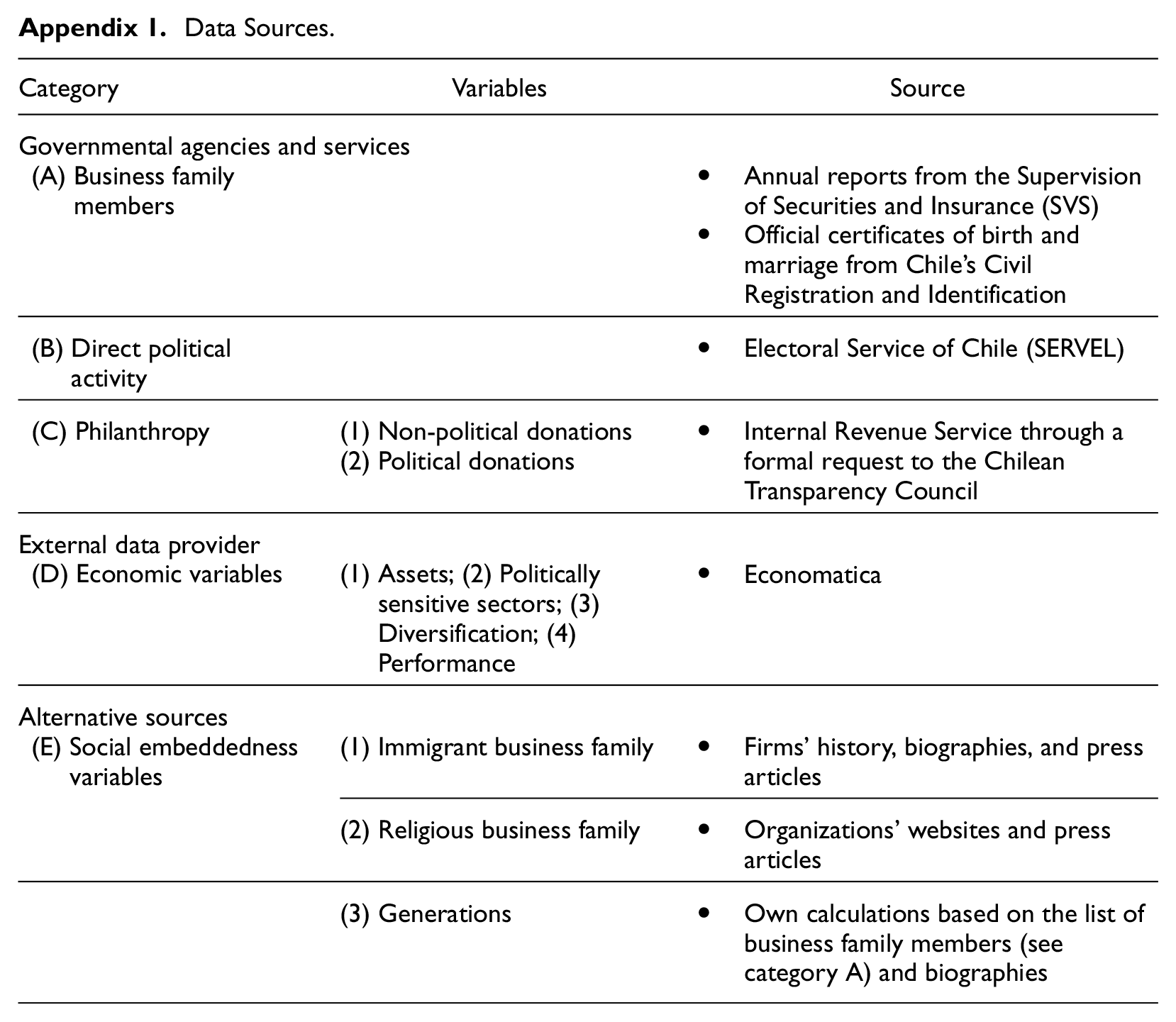
Appendix 1 lists the data sources used to develop our family-level database.
Method
As discussed, political business families represent the dominant segment with close and stable ties with political power across time. This temporal stickiness of our dependent variable prompts us to use a cross-sectional approach (in contrast to a panel approach) at the business family level. In particular, we employ Probit estimations to assess the economic and social embeddedness characteristics associated with political business families without aiming to establish causality. Thus, our research is limited to describing political business families’ shared features that differentiate them from other business families. In our analyses, we set the threshold for significance level at p-value = .05 (Brinkerink, 2023).
Results
Table 1 presents descriptive statistics. As some economic and social embeddedness characteristics of business families are correlated (see Table 1), we conducted stepwise procedures, adding each characteristic individually (Faccio, 2006). Table 2 presents the outcomes of Models 1 to 7, which reflect the procedure results. Furthermore, Model 8 in Table 2 includes all the variables. The individual effects of each variable remain consistent when tested together in Model 8, indicating that the correlation across business families’ characteristics does not significantly bias the estimates. This conclusion is further supported by evaluating the mean-variance inflation factor (VIF), which reveals that all VIFs are well below 10, with an average VIF of 2.46. Therefore, for simplicity, we refer to the estimates of Model 8 in Table 2.
Descriptive Statistics.
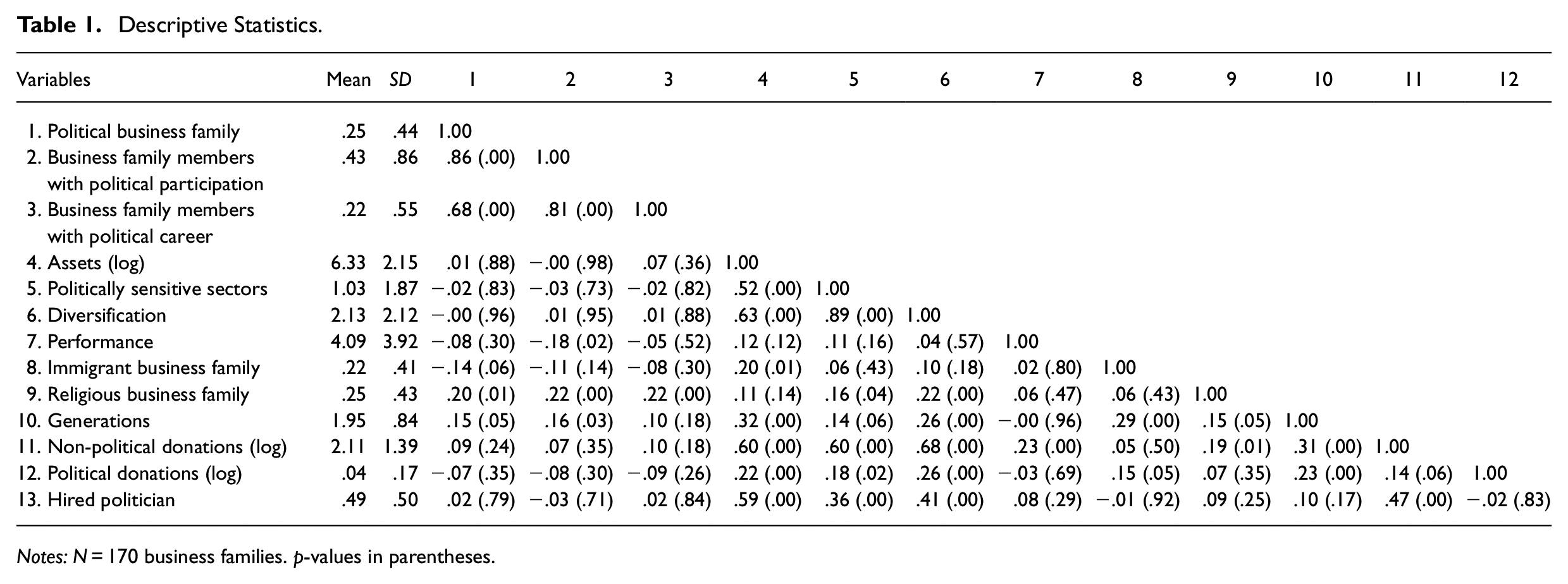
Notes: N = 170 business families. p-values in parentheses.
Political Business Families’ Characteristics.
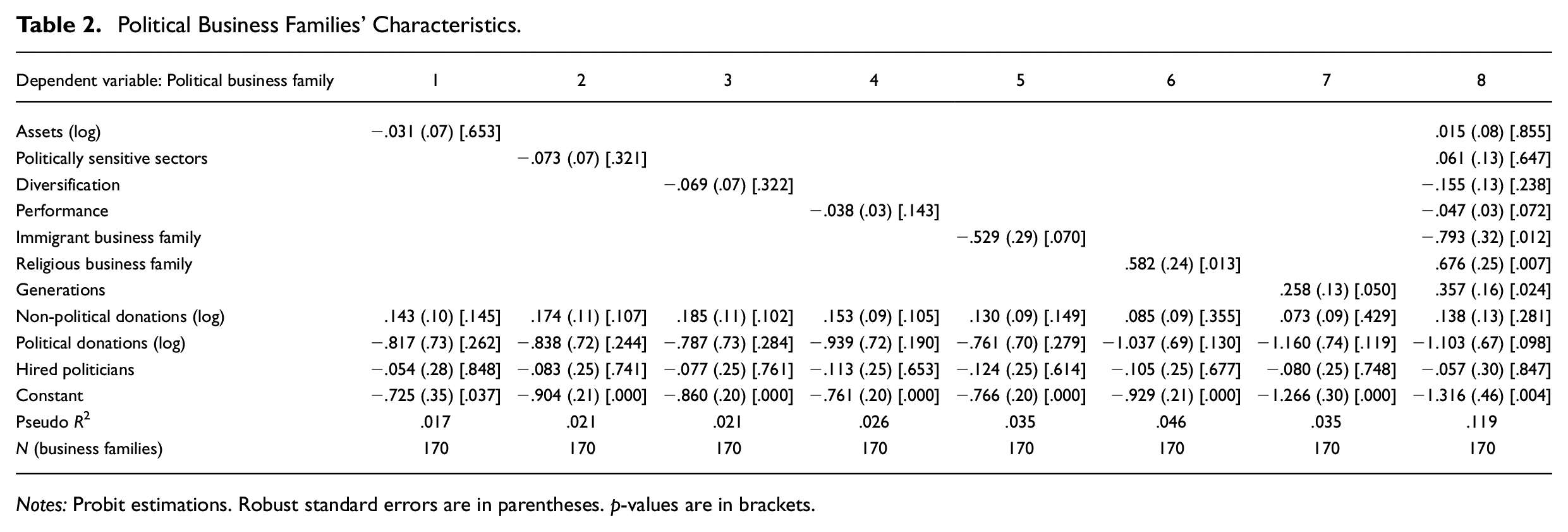
Notes: Probit estimations. Robust standard errors are in parentheses. p-values are in brackets.
Concerning the economic characteristics of business families, in Model 8 of Table 2, we find statistically insignificant associations for Assets (β = .015, p = .855), Politically sensitive sectors (β = 0.061, p = .647), and Diversification (β = −.155, p = .238), thus rejecting Hypotheses 1, 2, and 3. Furthermore, although the negative estimate for Performance has a statistical significance level relatively better than the other three economic characteristics, it falls above the p = .05 cutoff (β = −.047, p = .072), leading us to reject Hypothesis 4.
Conversely, Model 8 of Table 2 reports that all the estimates of the social embeddedness characteristics are statistically significant. In line with Hypothesis 5, being an Immigrant business family is negatively associated with the likelihood of being a political business family (β = −.793, p = .012). Moreover, consistent with Hypothesis 6, a Religious business family is more likely to be a political business family (β = .676, p = .007). Finally, the generational longevity of a business family positively associates with the likelihood of being a political business family (Generations: β = .357, p = .024), supporting Hypothesis 7. Among the control variables, the results of Model 8 of Table 2 indicate statistically insignificant associations for Political donations (β = −1.103, p = .098), Non-political donations (β = .138, p = .281), and Hired politicians (β = −.057, p = .847).
In summary, the results in Table 2 indicate a significant correlation between social embeddedness indicators and direct political participation among business families. Conversely, there is limited support for the influence of economic characteristics in this context. It is worth mentioning that not all social embeddedness characteristics yield the same effect size. In Model 8, the estimates reveal that the predicted probability of political activity is 10.6% for immigrant business families, whereas for local business families, this figure stands at 29.6%. This means that local business families are nearly three times more likely to participate in politics directly. Similarly, the predicted probability of being a political business family is 41% for religious families and 20% for non-religious families. Lastly, when comparing first-generation and third-generation business families, the expected probability for the former is almost one-third of that for the latter. Specifically, the predicted probability for first-generation business families is 9.5%, whereas for third-generation families, it is 25.5%.
Robustness Tests
As part of the robustness analysis, Table 3 introduces alternative dependent variables. Model 1 includes Business family members with political participation. This numeric variable counts the number of business family members who have (a) ever run or been elected to office or (2) ever been named head of the state’s minister or undersecretary. Model 2 uses the dependent variable Business family members with a political career, which measures the number of business family members with at least two instances of direct political participation. We employed negative binomial models to estimate the results.
Robustness Tests.
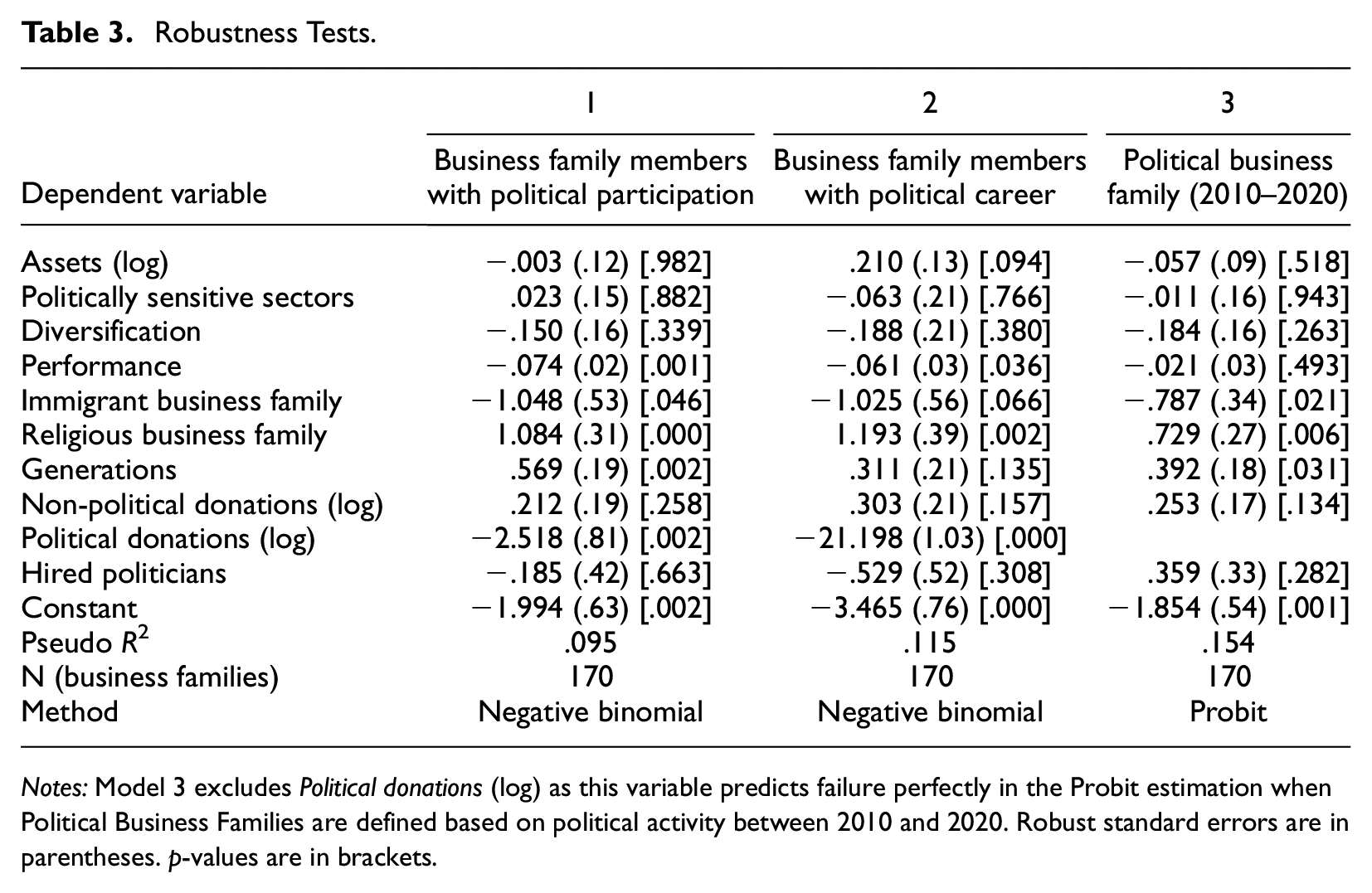
Notes: Model 3 excludes Political donations (log) as this variable predicts failure perfectly in the Probit estimation when Political Business Families are defined based on political activity between 2010 and 2020. Robust standard errors are in parentheses. p-values are in brackets.
Comparing these results to our main findings (Model 8 in Table 2), the estimates of Models 1 and 2 in Table 3 reveal that Performance is negatively associated with the intensity of political participation, thus supporting Hypothesis 4 (Model 1: β = −.074, p = .001; Model 2: β = −.061, p = .036). This suggests that although economic performance may not distinguish a political business family from other families concerning the extent of political activity (the extensive margin of political activity among business families), it does describe the degree of direct political involvement (the intensive margin) well. Regarding the social embeddedness characteristics, the estimates of Model 1 in Table 3 are consistent with our main results, supporting Hypotheses 5, 6, and 7. In Model 2 of Table 3, the estimates of the social embeddedness characteristics maintain the same sign. However, the significance level for Immigrant business family is just above the significance cutoff (β = −1.025, p = .066), and the estimate for Generations is statistically non-significant (β = .311, p = .135), thus rejecting Hypotheses 5 and 6.
Finally, although direct political participation among political business families remains stable over time (as shown in Figure 2), there is a possibility that early political participation (e.g., during the mid-90s) preceded significant changes in the economic conditions of these families between 2010 and 2020. To address this concern, in Model 3 of Table 3, we redefine Political business family by considering only political activity between 2010 and 2020, which aligns with the period we measure the economic characteristics at the business family level. Similar to the results in Model 8 of Table 2, none of the economic variables exhibit statistically significant associations with political business families. Conversely, the social embeddedness variables show statistically significant associations with political business families. Despite these results, we acknowledge that we cannot entirely rule out the temporal separation issue and, therefore, refrain from interpreting our findings as causal evidence.
Discussion
The prevailing economic interest perspective in the political strategy literature views business families’ incentives for holding political office as protecting and increasing the family’s wealth. Family members serving in politics can defend a business family’s economic interests or gain access to government-mediated resources (Fisman, 2001; Fogel, 2006). However, political participation also subjects business families to risks and liabilities. A parallel but less explored social embeddedness approach stresses the mutually productive potential of political participation in information sharing, contributions to policy formation, and commitments to policy settlements by a communally oriented inner circle (Collin, 1998; Mizruchi, 1992; Useem, 1982).
Our hand-collected data, comprising 170 prominent Chilean business families, shows that in the years following democratization, political business families are a stable subset of the population of prominent business families (see Figure 2). We find that 43 of 170 Chilean business families are political, approximately 25% of Chile’s foremost business families. Consistent with an inner circle, or dominant segment (Mizruchi, 1992; Useem, 1984), we suggest that some business families with greater social embeddedness and elite social status are better placed to serve as communications channels between businesses and the state. Our empirical analyses are broadly consistent with the role of social embeddedness but offer limited support for the economic characteristics as distinguishable factors of political business families.
Thus, we contribute to the business family political strategy literature with a balanced overarching multi-theoretical framework to identify the shared features of political business families. Hypothesizing both the economic interests and social correlates of these political business families, we expect that their economic interests explain the family’s self-interest in generating and preserving wealth. In contrast, based on our theorization of class-wide rationality and status preservation, we argue that social embeddedness characteristics provide a socialized interest explanation for political business families.
The implications for policymakers are clear: Our emphasis on the inner circle of political business families suggests that the communication efficiency of business–politics collaboration works better through concentrated representation of a segment of the capitalist class (Collin, 1998; Evans, 1995; Puente & Schneider, 2020). With the business family as the unit of analysis, we see a specific business family member serving as a linking pin who may establish extensive communication channels with business family executives and their social networks to multiple political actors in decision-making, legislative and administrative bodies, and governing and opposition parties. Research in organizational sociology finds that a capitalist class constitutes a committed and socially embedded elite that may enjoy broad social legitimacy (Chu & Davis, 2016; Mizruchi, 1992). Furthermore, because the elected family member is part of an elite, high-status business family that controls substantial assets and business expertise, they will likely be eligible targets for various political actors. Equally, a business family may derive lasting value from their accumulated social status (Khan, 2012). Yet, preserving elite social status constrains their behavior through the mechanics of social judgment (Bitektine, 2011; Piazza & Castellucci, 2014). Thus, the motives of political business families reflect a nuanced combination of socialized interests, namely, family self-interest, class-wide representation of big business interests, and the preservation and enhancement of the business families’ elite social status.
Finally, our study responds to calls for greater scholarly attention to the family behind the business (Carney & Dieleman, 2023; Nason et al., 2019). By addressing multiple sources of family heterogeneity explaining business families’ political participation (Chua et al., 2012; Jaskiewicz et al., 2019), we contribute to recent studies that bring business families to the forefront of analysis (Bloemen-Bekx et al., 2021; Calabrò et al., 2021; Ortiz et al., 2021). The business family focus also carries empirical advantages for the political embeddedness literature. In particular, our method of capturing the extended business family members minimizes false negatives in capturing the reality of business families’ political participation, thus uncovering political relations that are not commonly observable in traditional firm-level studies. Moreover, our empirical approach allows for assessing sources of heterogeneity (Chua et al., 2012; Jaskiewicz & Dyer, 2017) beyond usual metrics of family contingencies, such as ownership and involvement in the business that, although relevant, may be insufficient to capture the rich diversity of family backgrounds (Bertrand & Schoar, 2006; Bertrand et al., 2008; Jiang et al., 2015).
Contextualization
Moreover, we suggest that the lack of support for the economic correlates of political business families is a solid contribution to the literature as it rejects the prevailing view of political participation as exclusively motivated by business family economic self-interest (Fogel, 2006; Morck & Yeung, 2004). However, we do not represent our social embeddedness findings as fully generalizable. To contextualize our contribution, we identify boundary conditions for our findings. In particular, we reason that the communal and efficient relationship between politics and an inner circle of political business families may be a function of national institutional configurations concerning political change and economic transitions (Chung et al., 2021; Fainshmidt et al., 2018).
First, authoritarian institutional configurations produce other forms of business–family–political relations. Political scientists suggest that political clientelism and patronage relationship reflects a business client’s subordination to a political patron in exchange for material rewards or personal favors toward the patron (Fox, 1994; Goh et al., 2014; Sharif et al., 2015)—represent another form of rent-seeking for business families. In exchange for allegiance to bureaucrats in power, business families obtain political safeguards of their wealth against predation from lower-order political or regulatory actors (McWatters et al., 2016). Patronage is particularly valuable for business families in authoritarian “crony regimes” and kleptocratic states, where public authorities have opportunities to expropriate private wealth (Birhanu & Wezel, 2022; Shleifer & Vishny, 1998). Although rent-seeking and patronage stress self-serving business families’ motives to engage in politics, recent literature offers alternative viewpoints. For example, Ge et al. (2019) highlighted the critical role of political networks for business families in filling institutional failures and facilitating transactions in emerging markets.
Second, rather than pure rent-seeking motives, business families’ political embeddedness can also respond to a systematic and long-term joint effort between wealthy families and the state to build national industry (Amsden, 1989; James, 2009; Puente & Schneider, 2020). For example, James (2009) depicted a “European model” of capitalism in late 19th century France, Germany, and Italy, where elite business families closely intertwined with political establishments played a pivotal “catch-up” role (to the United Kingdom and the United States) in developing national industrial capacities. Similarly, in the early 1960s, several authoritarian East Asian economies adopted a similar strategy, leading to industrial catch-up with the West and eventually becoming democratic states (Vogel, 1991). These business families accumulated elite social status for their contributions to social and economic development. Subsequent generations seek to maintain elite status through multiple mechanisms, such as intra-elite marriage (Chung et al., 2021), philanthropy (Ostrower, 1997), civil society roles (Lumpkin & Bacq, 2022), and political participation.
Third, we conjecture that a communally oriented inner circle of socialized interests may be transitory. Studies of the inner circle were conducted in the United States and the United Kingdom during the 1960s and 1970s (Domhoff, 1975; Useem, 1982; Zeitlin, 1974). However, recent research indicates a de facto fracturing and disappearance of the inner circle in the United States (Chu & Davis, 2016; Mizruchi, 2013; Westphal & Zajac, 1997) and a general “falling away of sociological research about class, power and wealth” (Gilding, 2005, p. 32). Concurrently, research identifies the legal and wealth management devices high-net-worth families use to preserve family wealth (Beckert, 2022; Tait, 2019). Thus, in the present-day institutional configuration of democratic societies with solid protection for property rights, business families can be reasonably assured of durable wealth across generations (Beckert, 2022). Indeed, Khan (2012) suggested that growing inequality in mature Western economies reflects the lasting achievements of the inner circle, where the emergent policy processes are “structured to the advantage of the already advantaged and, requiring little subsequent intervention” (p. 366).
Democratic societies, such as Chile’s relatively robust institutional development and parliamentary oversight, checks, and balances, the separation of political decision-making and administrative implementation can inhibit business families’ rent-seeking and political protection motivations to hold office (Amore & Bennedsen, 2013; Li & Liang, 2015). Consistent with Khan (2012), we conjecture that the economic incentives for holding office might dissipate once business families’ property rights are protected. Our sample of wealthy business families from Chile, with an average wealth of US$4 billion, may already enjoy de facto political power (Bunkanwanicha & Wiwattanakantang, 2009) required to protect their interests without directly participating in politics. We see opportunities for future research to explore other forms of business–family–state relationships in different institutional configurations (Fainshmidt et al., 2018).
Limitations and Future Research
Our study has some limitations that provide opportunities for future research. First, although the economic and social factors included in the models represent important patterns among political business families, these are not intended to be comprehensive. Future studies could explore other proxies and correlates for political business families. For example, business families may shun political participation because they are concerned with protecting their elite social status (Kang & Kim, 2020). Elite families may view politics as too risky for their social status, thus disincentivizing their direct involvement in public affairs. For example, the 2019 social outburst in Chile amid political and corporate scandals (New York Times, 2019) suggests that family members in politics are likely to encounter disapproving social censure. Alternatively, socially questioned business families could engage in politics to increase their social legitimacy (DiMaggio & Powell, 1983). Political business families could choose areas that allow them to allocate resources with high visibility from communities, such as health, environment, and poverty reduction (Ostrower, 1997), thus promoting favorable social endorsement (Baum & Oliver, 1991). We call for future research to examine political business families from a status accumulation approach.
Second, in line with evidence from Useem (1982) for the United Kingdom and the United States suggesting the inner circle typically resides in a country’s leading metropolitan cities, we find that 90% of the political business families in our sample have their headquarters in the capital city, which agglomerates most of the political offices, financial districts, international transportation, and the highest living standards in the country (Roberts, 2005). This combination of political and economic power and geographical proximity may indicate that these business families constitute the dominant group influencing the country’s affairs (Useem, 1982). In this line, although our study informs some sources of the shared culture that political business families exhibit (national and religious identities), we do not provide evidence of social cohesion practices among these families. Nor do we observe whether political business families constitute a cohesive “inner circle” capable of attaining common social class objectives (Useem, 1984). Moreover, we cannot rule out that some political business families exclusively pursue individual parochial economic interests. We call for future research to further distinguish the heterogeneity of political business families and their effects on in-group and out-group stakeholders.
Finally, Figure 2 highlights the enduring nature of elite business families’ direct political participation over time and across generations (Geys & Smith, 2017). Additionally, the socio-economic traits of these families—religiosity, the number of generations, and industry diversification—remain stable throughout the sample period. However, the stability of these features in our study necessitates using a cross-sectional empirical design, constraining our ability to establish causal interpretations. To overcome this limitation, researchers should explore contexts with substantial fluctuations in family characteristics and incorporate exogenous forces influencing these changes. We encourage future research to address this empirical constraint.
Footnotes
Appendix
Data Sources.
| Category | Variables | Source |
|---|---|---|
| Governmental agencies and services | ||
| (A) Business family members | • Annual reports from the Supervision of Securities and Insurance (SVS) | |
| • Official certificates of birth and marriage from Chile’s Civil Registration and Identification | ||
| (B) Direct political activity | • Electoral Service of Chile (SERVEL) | |
| (C) Philanthropy | (1) Non-political donations |
• Internal Revenue Service through a formal request to the Chilean Transparency Council |
| External data provider | ||
| (D) Economic variables | (1) Assets; (2) Politically sensitive sectors; (3) Diversification; (4) Performance | • Economatica |
| Alternative sources | ||
| (E) Social embeddedness variables | (1) Immigrant business family | • Firms’ history, biographies, and press articles |
| (2) Religious business family | • Organizations’ websites and press articles | |
| (3) Generations | • Own calculations based on the list of business family members (see category A) and biographies | |
Acknowledgements
The authors thank Editor Alfredo De Massis and anonymous reviewers for their guidance and constructive feedback during the review process.
Declaration of Conflicting Interests
The author(s) declared no potential conflicts of interest with respect to the research, authorship, and/or publication of this article.
Funding
The author(s) disclosed receipt of the following financial support for the research, authorship, and/or publication of this article: Marcelo Ortiz acknowledges financial support from the Spanish Ministry of Economy and Competitiveness, through the project PID2020-115660GB-I00, and the Severo Ochoa Programme for Centres of Excellence in R&D (CEX2019-000915-S).
