




Abstract
The aim of the current study is to investigate which major life events are associated with transitions into and out of volunteering over the life course and, especially, why these associations exist. Social Production Function theory is used to derive hypotheses, which are tested using longitudinal data (adult subsample) from Lifelines. Associations between major life events and (a) volunteer take-up, nonvolunteer sample (N = 59,773) and (b) volunteer cessation, volunteer sample (N = 32,143) are studied by applying Linear Probability Modeling. Results show clear associations between specific major life events and starting and quitting volunteering. The influence on the latter is stronger than on the former. Most findings are in line with our theory-based expectations indicating that (a) voluntary work contributes especially to the fulfillment of the needs for status, stimulation, and behavioral confirmation and (2) life events causing losses (gains) in these needs are associated with a higher likelihood to take-up (quit) volunteering.
Keywords
Introduction
Volunteering is a dynamic activity, with individuals transitioning into and out of volunteering. In previous research, several factors, such as individual resources and volunteer motivations, have consistently been associated with volunteering over the life course (Wilson, 2000). The likelihood to volunteer changes gradually over the individual’s life course (Musick & Wilson, 2008), and major life events could abruptly influence volunteering behavior (Nesbit, 2012). Although research has been conducted on the associations between life events and volunteer dynamics, to date, we still need a better understanding of the reasons why individuals change their volunteering behavior over time. In the current study, therefore, the potential mechanisms underlying the association between major life events and changes in volunteering are studied.
Volunteering is a dynamic process, as individuals transition into and out of volunteering (Butrica et al., 2009; Morrow-Howell, 2010; Rotolo, 2000). Most research on determinants of participation in voluntary work focuses on static characteristics (Butrica et al., 2009; Morrow-Howell, 2010; Rotolo, 2000). Niebuur et al. (2018) showed in their meta-analysis that higher socioeconomic status, being married, larger social network size, church attendance, and previous volunteer experiences are positively related to volunteering and age, transitions into parenthood, and functional limitations are inversely related to volunteering. The importance of a dynamic perspective is underscored by research, which showed that participation in voluntary work varies over the life course because of fluctuations in the availability of free time and changing preferences for time allocation (Nesbit, 2012). Life course transitions alter an individual’s priorities, as well as opportunities, in terms of obligations, resources, and social networks (Musick & Wilson, 2008). Over the life course, the rate of volunteering generally has an inverted U-shape (Musick & Wilson, 2008), peaking in middle-age, when individuals usually have settled down in terms of work, family, and living environment (Salamon et al., 2018). For the specific case of the Netherlands, in 2020, volunteer rates were highest for the age group 35 to 55 and were lower in all other age groups (Bekkers et al., 2020). As individuals progress to and through later life, the rate of volunteering usually declines around the time that children leave the household and further and more steeply declines in old age when resources needed for volunteering diminish (Musick & Wilson, 2008; Salamon et al., 2018). So, trends in volunteering seem to be closely related to the individuals’ life course (Salamon et al., 2018). Specifically, major life events faced by individuals can impact their volunteering behavior (Butrica et al., 2009; Hank & Erlinghagen, 2010; Nesbit, 2012).
Several authors have studied the relation between life events and volunteering. Variability in volunteering has been shown to be attributable to family-related (Broese Van Groenou & Van Tilburg, 2012; Butrica et al., 2009; Lancee & Radl, 2014; Nesbit, 2012; Rotolo, 2000; Voorpostel & Coffé, 2012), health-related (Broese Van Groenou & Van Tilburg, 2012; Butrica et al., 2009; Hank & Erlinghagen, 2010), and work-related (Broese Van Groenou & Van Tilburg, 2012; Butrica et al., 2009; Hank & Erlinghagen, 2010; Lancee & Radl, 2014; Mutchler et al., 2003; Van Den Bogaard et al., 2014) life events. However, most studies focused on life events within a single domain (Mutchler et al., 2003; Nesbit, 2012; Rotolo, 2000; Van Den Bogaard et al., 2014; Voorpostel & Coffé, 2012) and usually only including a small set of events. Moreover, studies often did not distinguish between transitions into and out of volunteering but rather employed a single outcome measure (e.g., the likelihood to volunteer; Broese Van Groenou & Van Tilburg, 2012; Lancee & Radl, 2014; Mutchler et al., 2003; Nesbit, 2012; Van Den Bogaard et al., 2014; Voorpostel & Coffé, 2012). Although starting and quitting voluntary work are conceptually related, they are distinct events (Rotolo, 2000), and studies on volunteer dynamics distinguishing between transitions into and out of volunteering have shown differences between factors associated with starting and quitting voluntary work (Butrica et al., 2009; Hank & Erlinghagen, 2010; Morrow-Howell, 2010; Rotolo, 2000). There is also a need to improve our understanding of why and how life events are related to transitions in volunteering. Several scholars have addressed volunteer dynamics in a multifaceted manner. Hustinx et al. (2010) proposed a theoretical map, organizing the fragmented field of volunteering research. Einolf and Chambré (2011) theoretically expanded upon earlier attempts to unify theories on volunteering and showed that integrating social theories, individual characteristic theories, and resource theories improves our understanding of volunteer dynamics. In the current study, a more specific approach is adopted in which we aim at deepening our understanding of the mechanisms underlying the association between major life events and volunteering. Therefore, the Social Production Function (SPF) theory is applied (Lindenberg, 1996; Ormel et al., 1999; Steverink & Lindenberg, 2006). SPF theory is also a multifaceted theory, that, when applied to the context of volunteer dynamics, allows us to better understand the link between the experience of life events and changes in volunteer motives, and, subsequently, in volunteering behavior. By making use of a theoretical framework based on SPF theory, we can formulate expectations regarding the association between life events and the likelihood to start with or withdraw from volunteering.
The contribution of the current study to the literature is threefold. First, by making use of the Lifelines Cohort Study (Scholtens et al., 2015), we are able to test the association between a large set of life events, covering all relevant domains in life (e.g., the family, health, and work domain) and volunteering, in a large longitudinal Dutch sample. Second, we differentiate between transitions into and out of volunteering by including two separate outcome measures: starting and quitting volunteering. Third, by using Social Production Function Theory, we enhance our understanding of the potential mechanisms underlying the link between major life events and transitions in volunteering.
Given that this study is conducted in the Netherlands, some context about the Dutch setting is warranted. Not only volunteering rates (Salamon et al., 2018) but also volunteer dynamics have been shown to differ substantially between countries (Hank & Erlinghagen, 2010). Within Europe, the highest rates of volunteering have been found in the Northern European countries, including the Netherlands (Salamon et al., 2018). In the Netherlands, in 2015, the total full-time equivalents volunteering as a percentage of the adult (15+) population was 3.5%. This is comparable to rates in other Northern European countries including Sweden (3.7%) and Norway (3.3%), but higher than in, for example, Germany (2.0%) or the United Kingdom (2.1%), and substantially higher than in Southern European countries including Italy (1.1%) and Spain (0.6%). The likelihood of transitioning into and out of volunteering in Northern European countries is largely comparable to the likelihood in the United States (Butrica et al., 2009; Hank & Erlinghagen, 2010). For the specific case of the Netherlands, estimates for starting and quitting voluntary work vary from 12.4% (Hank & Erlinghagen, 2010) to 22.7% (Bekkers, 2012) for transitions into volunteering and from 14.2% (Bekkers, 2012) to 32.3% (Hank & Erlinghagen, 2010) for transitions out of volunteering.
Theoretical Background
A number of different theories have been applied to improve our understanding of volunteer engagement and cessation from a life course perspective. Knoke and Thomson (1977) already observed that an individual’s position in the family life course affects participation in formal volunteering, and Rotolo (2000) was among the first to assess this observation by using dynamic data. The reasoning applied by Rotolo (2000) is based on the observation by Knoke and Thomson (1977) and assumes that life course transitions result in changes in terms of social circumstances and obligations, affecting volunteering behavior. Several studies reasoning from a role theory approach (Mutchler et al., 2003; Rotolo, 2000; Wilson, 2000) have shown that life transitions generate shifts in individuals’ roles, which in turn alter demands and constraints on the individual, resulting in changes in volunteering behavior (Rotolo, 2000). Specifically, role overload theory assumes that (productive) activities are substitutes (Markham & Bonjean, 1996; Mutchler et al., 2003; Wilson, 2000). In the context of life events and volunteering, this theory predicts that life events increasing the burden on individuals in terms of roles and time demands are associated with a reduced likelihood to volunteer. In contrast, role extension theory assumes that (productive) activities complement each other (Mutchler et al., 2003) and, in the context of life events and volunteering, this theory predicts that life events that increase participation in activities, such as paid work, increase the likelihood to volunteer as well. Butrica et al. (2009) took a different approach by applying the theory of economic welfare maximization which states that individuals are rational actors, weighing costs and benefits in decision-making. In the context of life events and volunteering, changes in volunteering behavior originate in changes in the costs and benefits of volunteering as a result of experiencing life events (Butrica et al., 2009).
These theoretical applications are valuable to the field of volunteer dynamics and can, at least partially, explain transitions into and out of volunteering. However, although all aforementioned theories assume that the decision to volunteer is a rational decision, they do not theorize the kind of arguments or motives that people have to start or quit volunteering (Wilson, 2000). To enhance our understanding of the association between the experience of major life events and transitions into and out of volunteering, we suggest that it is useful to incorporate the underlying factors that motivate people to volunteer.
Our general approach is that life events can influence decisions to start or stop volunteering by two—sometimes related—mechanisms. First, life events can change the opportunities individuals have to be involved in volunteering. Second, life events can change the motivation to be involved in volunteering. Given that most attention in the literature has been given to the first of these mechanisms (Butrica et al., 2009; Knoke & Thomson, 1977; Markham & Bonjean, 1996; Mutchler et al., 2003; Rotolo, 2000; Wilson, 2000), we start by discussing the second mechanism. We will return to the first mechanism at the end of our theoretical discussion. To examine how life events can change the motivation to volunteer, we use Social Production Function (SPF) theory. SPF theory offers a theoretical perspective that allows linking the experience of life events to changes in volunteer motives and in turn to volunteering behavior. Following Steverink et al. (2011), life events can be viewed as potential threats or contributors to the fulfillment of basic human needs, which in turn could alter the motives to volunteer. In SPF theory, five basic human needs are distinguished, including the need for comfort, stimulation, affection, behavioral confirmation, and status. Comfort refers to the fulfillment of basic physical needs, such as food, drink, warmth, and the absence of physiological discomfort such as pain. Stimulation is the need for a pleasant range of mental and physical activation and the absence of boredom. Affection is the feeling that you are loved, empathized with, and that others care for you. Behavioral confirmation is the feeling of doing the “right” things in the eyes of relevant others and yourself, feeling useful, and contributing to a common goal. Status is the feeling that you are being treated with respect, and being known for your achievements, skills, or assets. Each of these needs contributes to overall subjective well-being (Lindenberg, 1996; Nieboer et al., 2005; Ormel et al., 1999; Steverink & Lindenberg, 2006). Life events can alter the fulfillment of these needs. Activities such as volunteering can contribute to the fulfillment of basic human needs, and thereby the experience of life events could induce changes in volunteering behavior.
Major life events could cause either gains or losses in basic human needs fulfillment, depending on the nature of the event. According to SPF theory, individuals aim to maximize their own well-being (Ormel et al., 1999). If losses in needs fulfillment occur, individuals will try to compensate for this loss to keep overall well-being stable. In SPF theory, individuals are assumed to first try to compensate for losses in the fulfillment of a need by substitution within that specific need. If this turns out not to be possible, substitution between needs will take place (Nieboer & Lindenberg, 2002). For example, if an individual loses his or her job, this will result in a loss in status. To maintain well-being, the individual will first try to restore the previous level of status, for example, by acquiring a new job. If restoring the level of status turns out not to be possible, the individual will try to increase the level of one of the other basic human needs to maintain well-being. For example, the individual could decide to enroll in education to increase the level of stimulation and thereby restoring well-being. To formulate expectations regarding when life events altering the level of basic human needs fulfillment results in changes in volunteering behavior, we need to turn to the contribution of voluntary work to the fulfillment of basic human needs.
Participation in voluntary work can be viewed as a multifunctional source of well-being (Nieboer & Lindenberg, 2002) that contributes mainly to the production of status, stimulation, and behavioral confirmation. Volunteering can contribute to the production of status because volunteers can take up a specific volunteer role that makes them special, as compared with other volunteers or other people with whom they compare themselves. Volunteering can contribute to the level of stimulation because it generally requires either physical or mental effort or both, produces enjoyment, and often aligns with one’s personal interests. Volunteering is in general seen as an altruistic activity as it is performed for others, is carried out freely without payment, and can therefore contribute to the production of behavioral confirmation.
Because individuals are assumed to first try to compensate for a loss within the deprived need, and because voluntary work mainly contributes to the level of status, stimulation, and behavioral confirmation, individuals who experience life events that could lead to losses in the fulfillment of one (or more) of these specific needs are expected to be more likely to start volunteering and less likely to stop volunteering. Specifically, transitions out of work (e.g., unemployment, retirement, and disability) and transitions out of marriage (i.e., divorce) are expected to result in losses in status, stimulation, and behavioral confirmation. Paid work contributes to the level of (a) status because paid work increases an individuals’ responsibilities and skills, (b) stimulation because performing a job generally promotes mental and/or physical activation, and (c) behavioral confirmation because paid work is a productive activity that contributes to society and promotes individuals’ financial independence. Being married (or having a marriage-like relationship) contributes to the level of (a) status because it contributes to an individuals’ relative social position, (b) stimulation because sharing life with a partner increases daily social contacts and therefore contributes to mental and physical activation, and (c) behavioral confirmation because being married or cohabiting with a partner is norm-conforming in Western societies.
Based on these arguments, our first hypothesis is:
Clearly, major life events could also produce gains rather than losses in basic human need fulfillment. According to SPF theory, individuals form buffers in the fulfillment of basic needs as long as the marginal revenues to do so exceed the marginal costs. If a life event creates a gain in the fulfillment of a certain need, the overall level of fulfillment of that specific need increases. As a result, the marginal revenue from performing activities contributing to that specific need decreases. Because of this and because voluntary work mainly contributes to the level of status, stimulation, and behavioral confirmation, individuals who experience life events that lead to gains in the fulfillment of one or more of these specific needs are expected to be less likely to volunteer. Specifically, transitions into paid work, marriage (or a marriage-like relationship), and parenthood are expected to result in gains in status, stimulation, and behavioral confirmation. Parenthood contributes to the level of (a) status because raising children requires skills and increases responsibilities, (b) stimulation because child-raising is mentally challenging and promotes physical activity, and (c) behavioral confirmation because having children, in general, conforms to societal expectations. Our second hypothesis is:
Not all life events have direct consequences for the fulfillment of status, stimulation, or behavioral confirmation. For example, in the case of delinquency or loss of valuables, no direct impact is expected on the fulfillment of status, stimulation, or behavioral confirmation and thus also not on the motive to volunteer. Furthermore, experiencing serious illnesses and losing a loved one will mainly affect the fulfillment of affection and comfort. It is less clear how such life events will influence the likelihood of volunteering. On the one hand, individuals could try to compensate for these losses by inducing changes in activities contributing to affection and comfort, rather than by engaging in volunteering activities. Specifically, experiencing serious illness and substantial financial problems are expected to decrease the level of comfort. The events of losing loved ones and termination of friendship are expected to decrease the level of affection. Individuals experiencing such events will direct their behavior toward restoring their levels of comfort or affection by performing activities contributing to the levels of comfort (i.e., self-care and lifestyle changes to improve health, or finding paid work to solve financial problems) or affection (e.g., investing in current or new social ties). On the contrary, when major life events cause gains in either affection or comfort, the marginal revenue of performing activities contributing to affection and comfort will change but not the marginal revenue of volunteering and therefore no change in volunteering is expected. So, generally, we expect that life events that do not affect individuals’ fulfillment of the needs for status, stimulation, or behavioral confirmation will not affect their volunteering behavior. Thus, our third hypothesis is:
Note that we do not formulate a hypothesis on the life event of moving house because this life event might have all kinds of consequences, both neutral and positive and negative for all basic need fulfillments, which makes it difficult to formulate an expectation regarding this life event.
The hypotheses formulated thus far concentrate on the consequences of life events for the fulfillment of, especially, the needs for status, stimulation, and behavioral confirmation. However, as we emphasized earlier, life events will also influence the opportunities for volunteering. If an individual is motivated to volunteer, actual volunteering will still depend upon the availability of resources (or the presence of constraints, i.e., a lack of resources). For example, major life events can put serious restrictions on the availability of free time, as in the case of having close relatives who experience serious illness and may need care. However, events can also restrict the mental resources that individuals have available, making it less likely that they participate in volunteering, for example, in cases such as experiencing serious illness, losing close friends or family members, and facing severe financial problems. Thus, to understand the consequences of specific life events on volunteering, one should take both their effect on the fulfillment of needs and on opportunities for volunteering (resource availability) into account.
Method
Data
Data from the adult subsample of the Lifelines Cohort Study were used. Lifelines is a multidisciplinary prospective population-based cohort study examining the health and health-related behaviors of 167,729 persons living in the North of the Netherlands. The study profile of Lifelines is described elsewhere (Klijs et al., 2015; Scholtens et al., 2015). Briefly, participants were recruited between 2006 and 2013. Inhabitants (aged 25–50 years) of the three Northern provinces of the Netherlands were invited by their General Practitioners (GPs) if they met eligibility criteria. Subsequently, respondents’ family members (children and parents) were invited, leading to a unique three-generation design and including participants in all age groups. In addition, inhabitants of the Northern provinces of the Netherlands could also self-register via the Lifelines website. Baseline assessment (T1) including self-report questionnaires was conducted between 2006 and 2013. Follow-up questionnaires were approximately 1.5 years (T2) and 3 years (T3) after the baseline assessment was conducted. The Lifelines Cohort Study is approved by the medical ethical committee of the University Medical Center Groningen, the Netherlands. All participants signed an informed consent form. Lifelines is a facility that is open for all researchers. Information on the application and data access procedure is summarized on www.lifelines.nl.
For our study, we include (a) all adults aged 18 and older at baseline (T1) from the Lifelines cohort study, who (b) participated in both the baseline (T1) and the second follow-up (T3), and who (c) filled out information on participation on voluntary work in both the T1 and the T3 questionnaires.
Variables
Dependent variables
The outcome variables of this study are volunteer take-up (starting) and volunteer cessation (quitting). Volunteering was measured at T1 and T3 by means of the following question: How many hours, on average, do you spend on organized voluntary work?. If the number of hours was zero, the respondent was coded as a nonvolunteer (volunteer status = 0) at that specific time point. If the number of hours was positive, the respondents’ volunteer status was coded as volunteer (volunteer status = 1) at that specific time point. The baseline sample is divided into two samples: a volunteer sample and a nonvolunteer sample, based on respondents’ volunteer status at baseline. Volunteer take-up is the outcome variable for the nonvolunteer sample (within the baseline nonvolunteer sample: volunteer take-up = 1 if volunteer status at T3 = 1; volunteer take-up = 0 if volunteer status at T3 = 0) and volunteer cessation is the outcome variable for the volunteer sample (within the baseline volunteer sample: volunteer cessation = 1 if volunteer status at T3 = 0; volunteer cessation = 0 if volunteer status at T3 = 1).
Life events
Information on life events is collected using a Dutch version of the List of Threatening Experiences (LTE; Brugha & Cragg, 1990). The LTE consists of 12 items, evaluating recent stressful life events in several domains. For each event, participants were asked to indicate whether or not it occurred in the past year (yes/no). The following 9 items were used in the current study: illness, illness family, death of close friend or relative, end of friendship, relational problems (friends), fired, financial difficulties, delinquency, and loss of valuables. The responses on the LTE items at T2 and T3 are combined and used to assess whether the respondent experienced the life event between T1 and T3.
Three LTE items are not included (death close relative, separation, and unemployment) in our analysis, as more specific information on these topics could be derived from the questionnaires. At both T2 and T3, respondents were asked whether a close relative had died since filling out the previous questionnaire, and this question differentiates between parent(s), partner, child(ren), and sibling(s). The following dummy variables were derived: widowed, death child(ren), death father, death mother, and death sibling(s), representing the loss of a partner, child, parent, or sibling in the period between T1 and T3. Moreover, at both T1 and T3, respondents provided information on their marital, parental, and employment status, allowing us to create dummy variables for measuring transitions between T1 and T3: newly married/cohabiting, newly separated, birth child, newly unemployed, newly retired, newly disabled from work, and newly employed. Finally, at both T2 and T3, respondents were also asked whether they had moved house since filling out the previous questionnaire. The dummy variable moved house represents whether the respondent moved house in the period between T1 and T3.
Based on SPF theory, all life events are categorized into categories based on their expected influence on basic human needs fulfillment (see Table 1).
Categories of Life Events.
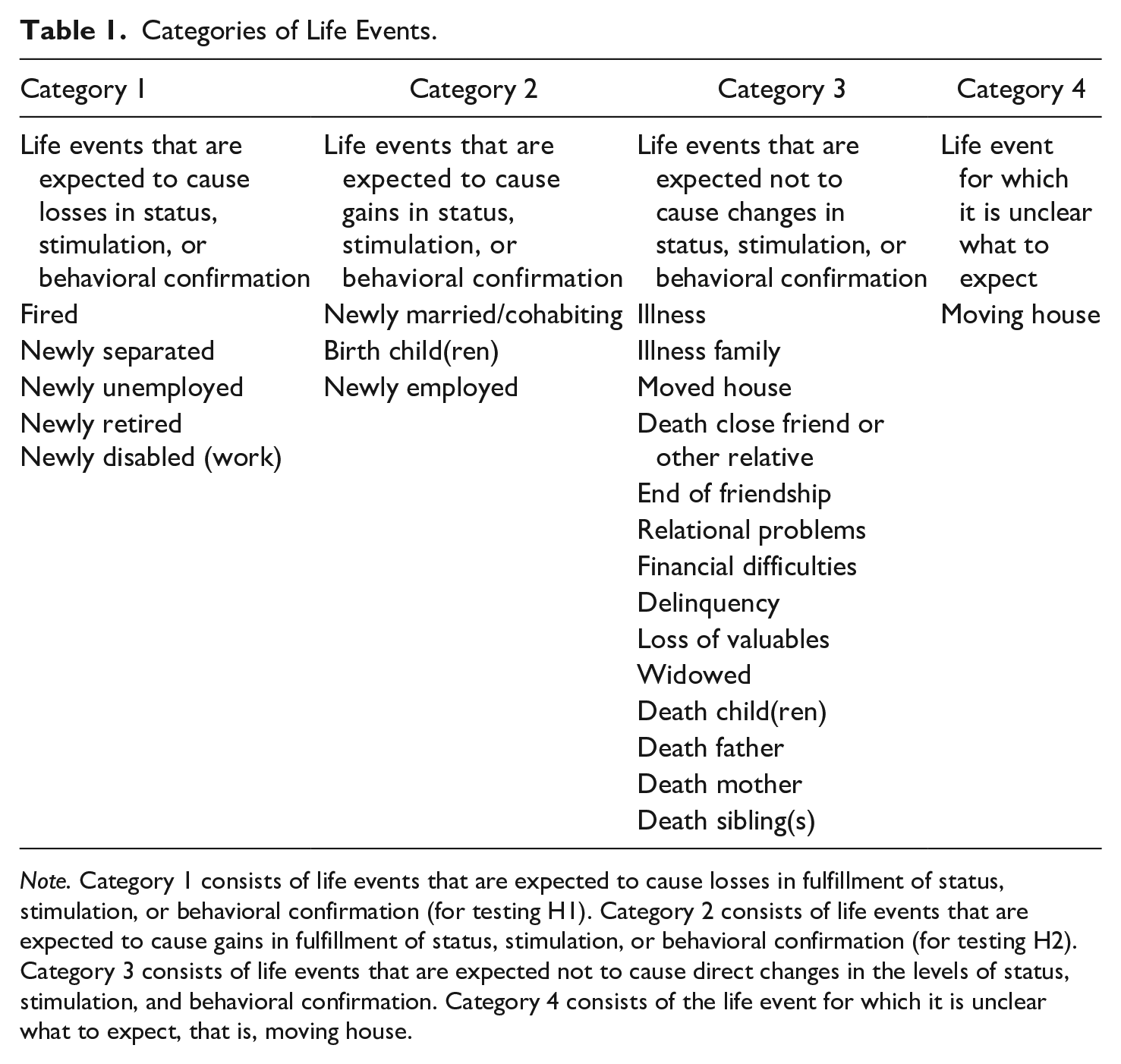
Note. Category 1 consists of life events that are expected to cause losses in fulfillment of status, stimulation, or behavioral confirmation (for testing H1). Category 2 consists of life events that are expected to cause gains in fulfillment of status, stimulation, or behavioral confirmation (for testing H2). Category 3 consists of life events that are expected not to cause direct changes in the levels of status, stimulation, and behavioral confirmation. Category 4 consists of the life event for which it is unclear what to expect, that is, moving house.
Potential confounding variables
The following potential confounders are added to the models: age, gender, educational attainment, marital status, employment status, subjective health, children in the household (all T1), and informal caregiver status (T3). Subjective health was measured by the question “How would you rate your health, generally speakin” (1 = excellent to 5 = poor) from the health-related quality of life measurement (RAND-36; Hays & Morales, 2001).
Statistical Methods
Missing data on all predictor and confounding variables are imputed using multiple imputation analysis according to the methods described by White et al. (2011). Baseline characteristics and the prevalence of major life events in the volunteer sample and nonvolunteer sample are compared by means of chi-square tests for categorical variables and independent t tests for continuous variables. To assess the association between major life events and starting and quitting voluntary work, both logistic regression and linear probability modeling (LPM) are applied. The linear probability model is the application of linear regression techniques in which the dichotomous outcome variables are regressed on the predictor variables (Karlson et al., 2012). In our regression analyses, we run two separate models. In Model 1, the outcome volunteer take-up is assessed, and in Model 2, we assess the outcome volunteer cessation. IBM SPSS statistics software version 22 is used for all statistical analyses.
Results
Sample Characteristics
The Lifelines adult subsample consists of N = 152,427 persons. We selected respondents who provided information on volunteering at T1 and T3, resulting in a study sample of N = 91,938 participants.
Characteristics of both the volunteer and the nonvolunteer samples are described in Table 2. The percentages of volunteers at T1 and T3 were 35.0% and 30.9%, respectively. Of the respondents who volunteered at T1, 66.9% continued participation at T3. Of the respondents who did not volunteer at T1, 11.5% started volunteering at T3 (see Figure 1).
Baseline Characteristics for the Full Sample (N = 91,938), the Volunteer Sample (N = 32,143), and the Nonvolunteer Sample (N = 59,773).
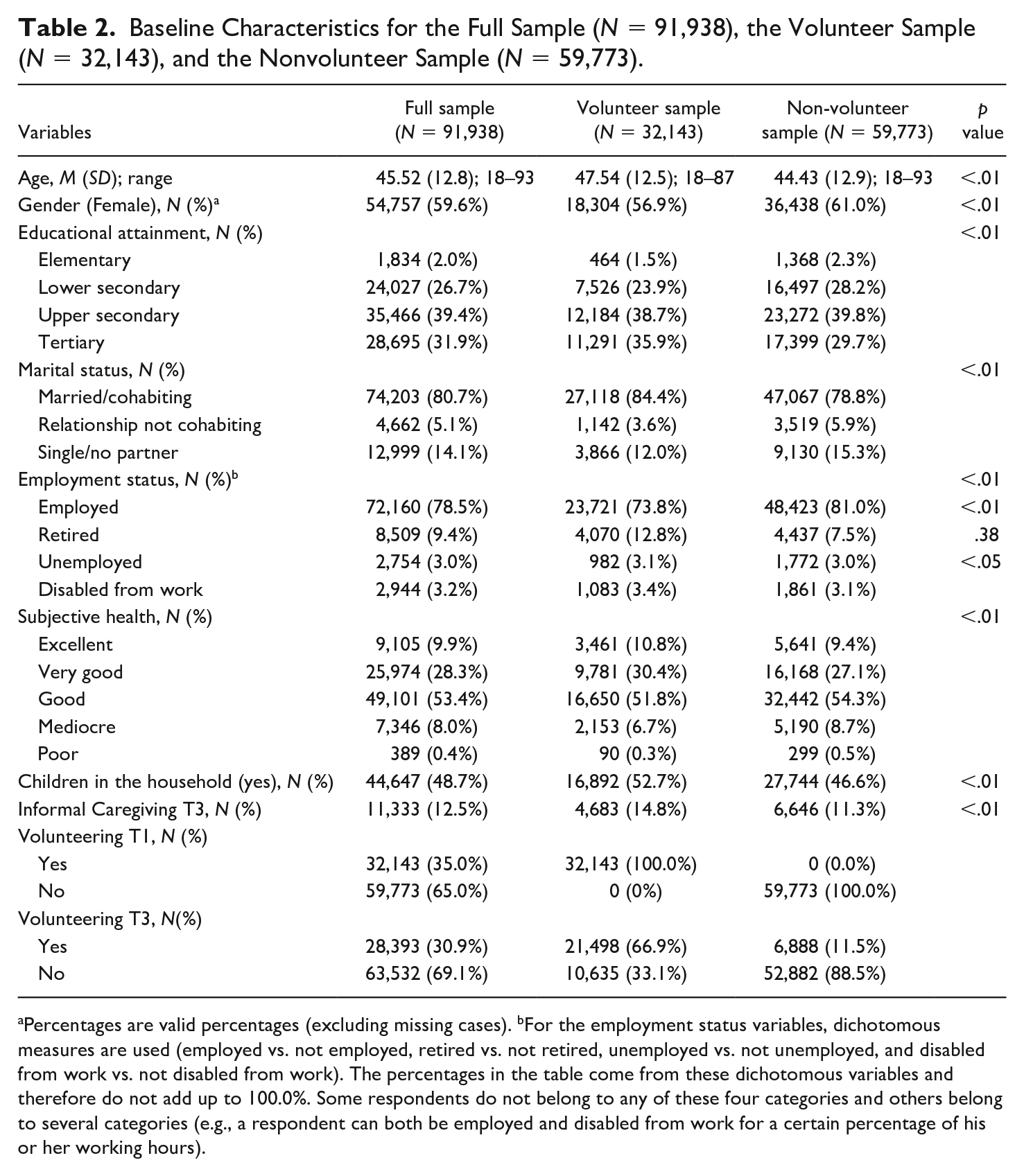
Percentages are valid percentages (excluding missing cases). bFor the employment status variables, dichotomous measures are used (employed vs. not employed, retired vs. not retired, unemployed vs. not unemployed, and disabled from work vs. not disabled from work). The percentages in the table come from these dichotomous variables and therefore do not add up to 100.0%. Some respondents do not belong to any of these four categories and others belong to several categories (e.g., a respondent can both be employed and disabled from work for a certain percentage of his or her working hours).
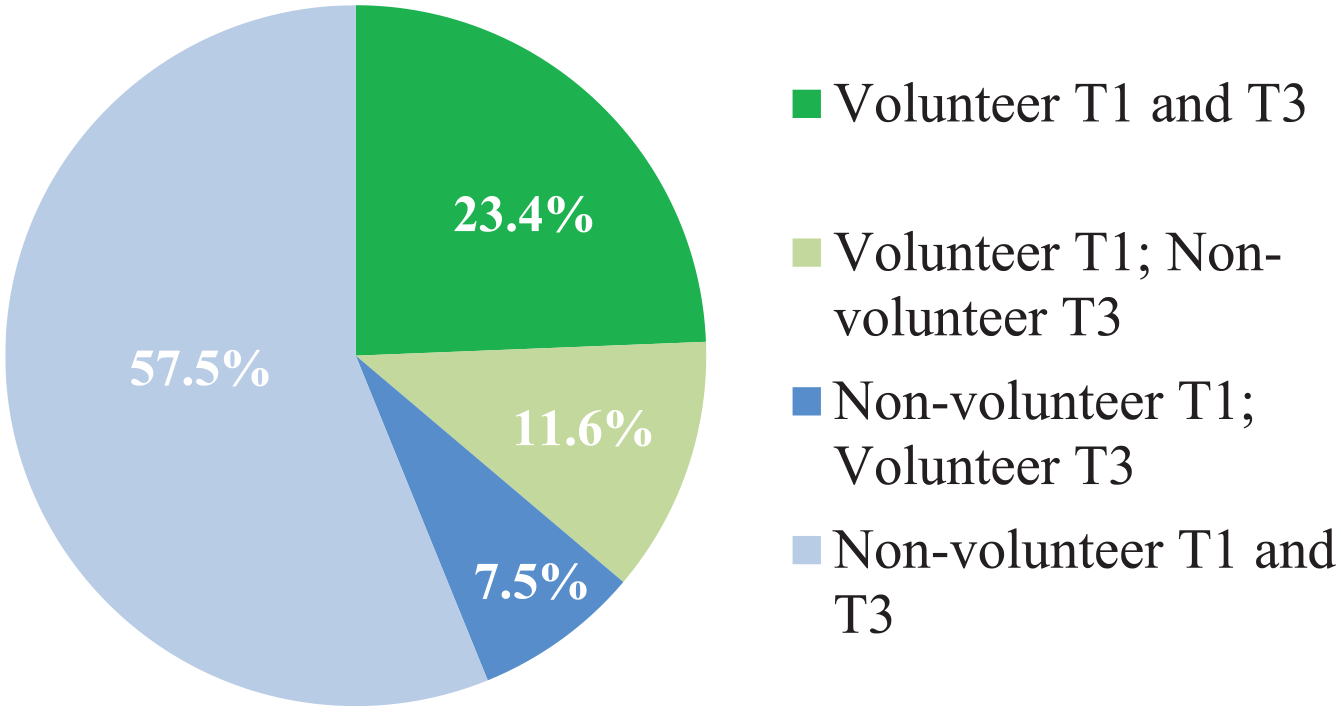
Continuation and change in participation in voluntary work at T1 and T3.
Individuals who were volunteering at T1 were on average older, higher educated, less often female or employed, more often married/cohabiting or retired, rated their own health better, had more often children living in the household, and provided more often informal care than their nonvolunteering counterparts (see Table 2).
Table 3 shows the prevalence of all life events that occurred between T1 and T3. Overall, having lost a close friend or relative other than a partner, child, parent or sibling was the most prevalent life event (32.7%), followed by illness, injury, or assault among close relatives (29.3%). Small differences (<2.0%) were found between the prevalence of most life events in the volunteer and nonvolunteer sample (see Table 3).
Prevalence of Life Events (in the Period T1-T3).
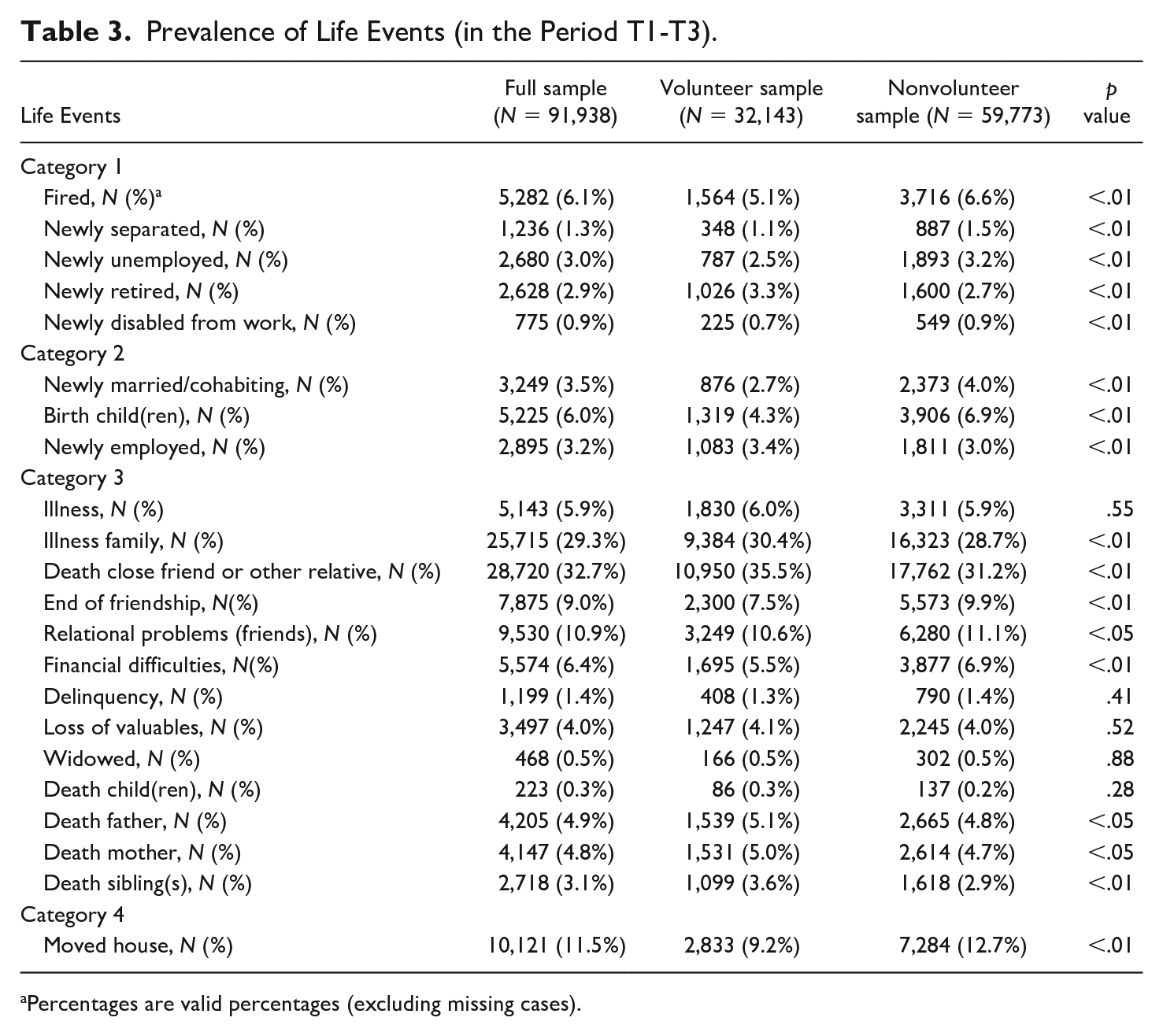
Percentages are valid percentages (excluding missing cases).
Attrition
Loss to follow-up was 33.0% in the volunteer sample and 37.5% in the nonvolunteer sample. Attrition analysis showed that small but significant differences exist between completers and noncompleters (respondents who were lost to follow-up) on the baseline characteristics (see Tables 4 and 5). Although differences in baseline characteristics between completers and noncompleters exist, they were rather small in absolute terms. Moreover, there are no indications that the associations between major life events and the likelihood to quit or start volunteering differ between individuals with different characteristics. Therefore, we do not expect that these differences bias our results (i.e., multivariable regression analyses).
Attrition Analysis Volunteer Sample (N = 48,045).
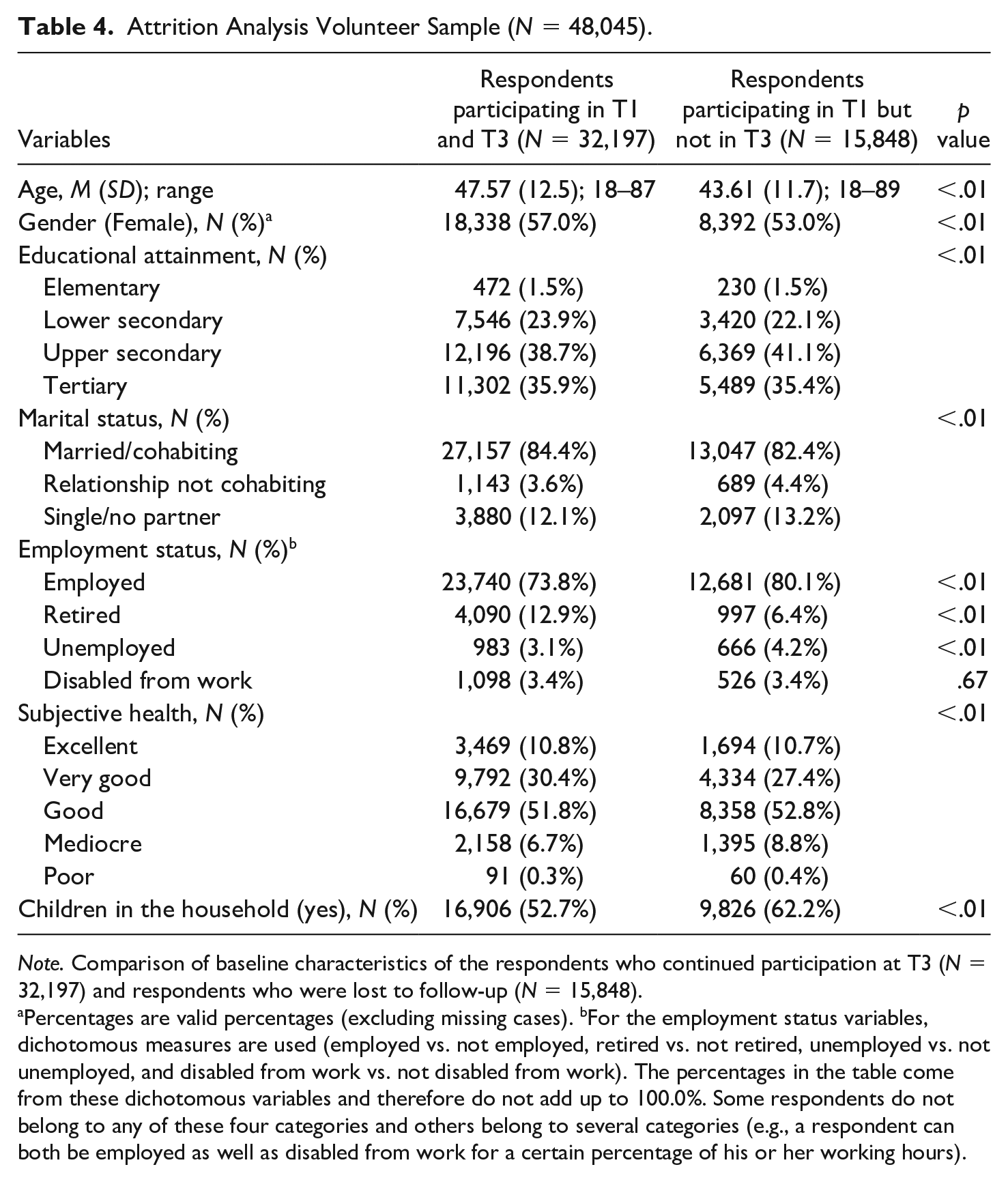
Note. Comparison of baseline characteristics of the respondents who continued participation at T3 (N = 32,197) and respondents who were lost to follow-up (N = 15,848).
Percentages are valid percentages (excluding missing cases). bFor the employment status variables, dichotomous measures are used (employed vs. not employed, retired vs. not retired, unemployed vs. not unemployed, and disabled from work vs. not disabled from work). The percentages in the table come from these dichotomous variables and therefore do not add up to 100.0%. Some respondents do not belong to any of these four categories and others belong to several categories (e.g., a respondent can both be employed as well as disabled from work for a certain percentage of his or her working hours).
Attrition Analysis Nonvolunteer Sample (N = 95,845).
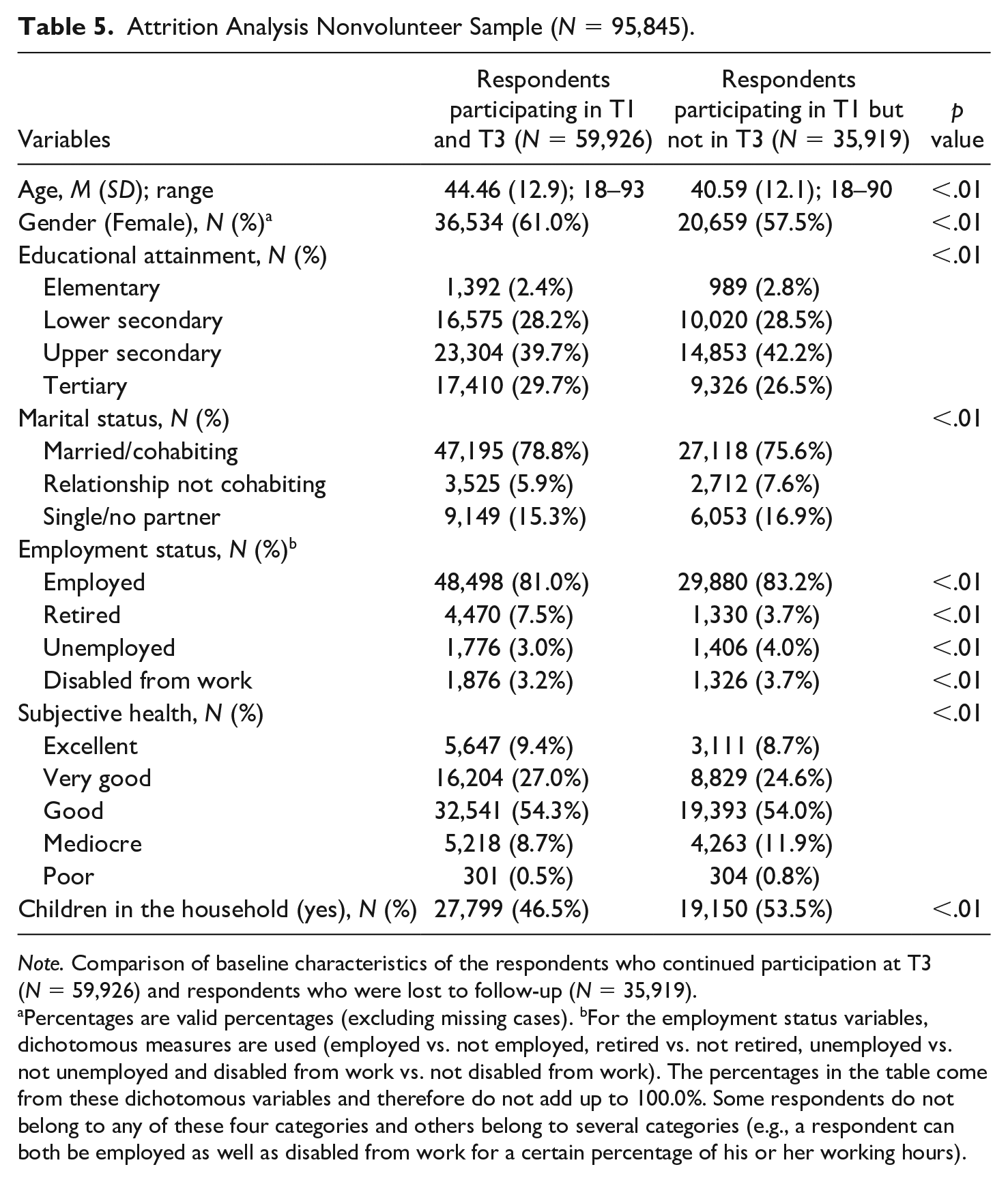
Note. Comparison of baseline characteristics of the respondents who continued participation at T3 (N = 59,926) and respondents who were lost to follow-up (N = 35,919).
Percentages are valid percentages (excluding missing cases). bFor the employment status variables, dichotomous measures are used (employed vs. not employed, retired vs. not retired, unemployed vs. not unemployed and disabled from work vs. not disabled from work). The percentages in the table come from these dichotomous variables and therefore do not add up to 100.0%. Some respondents do not belong to any of these four categories and others belong to several categories (e.g., a respondent can both be employed as well as disabled from work for a certain percentage of his or her working hours).
Multivariable Regression Analyses
Tables 6 and 7 present the results of the multivariable regression analyses examining the associations between experiencing major life events and the outcomes of volunteer take-up (Table 6) and volunteer cessation (Table 7). Given that both logistic regression and linear probability modelling led to the same conclusions, we decided to present the results of the linear probability model because coefficients from LPM are much easier interpretable compared with coefficients from logistic regression analysis (Mood, 2010).
Linear Probability Models (LPM) for Volunteer Take-Up (N = 59,773).
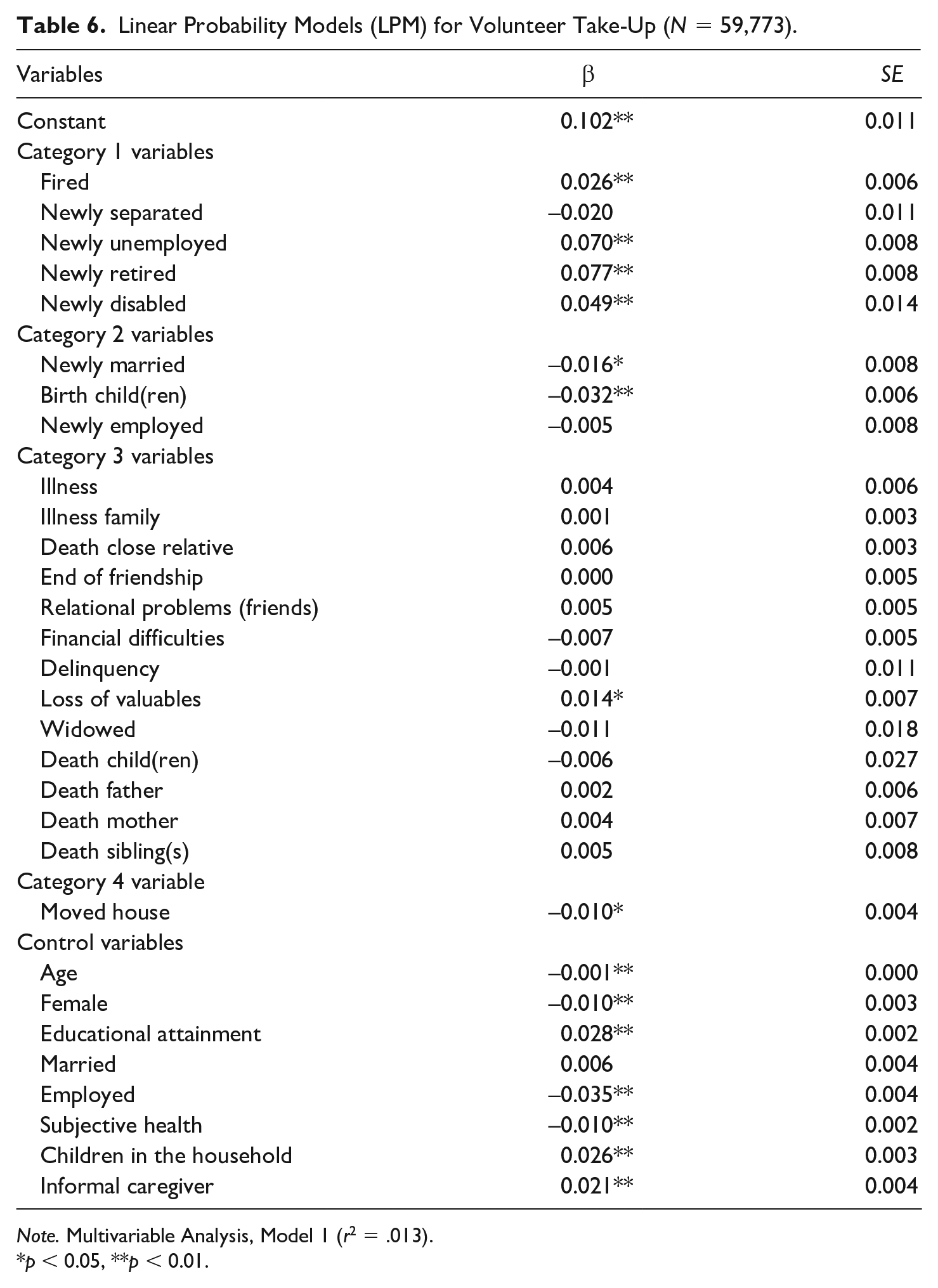
Note. Multivariable Analysis, Model 1 (r2 = .013).
p < 0.05, **p < 0.01.
Linear Probability Models (LPM) for Volunteer Cessation (N = 32,143).
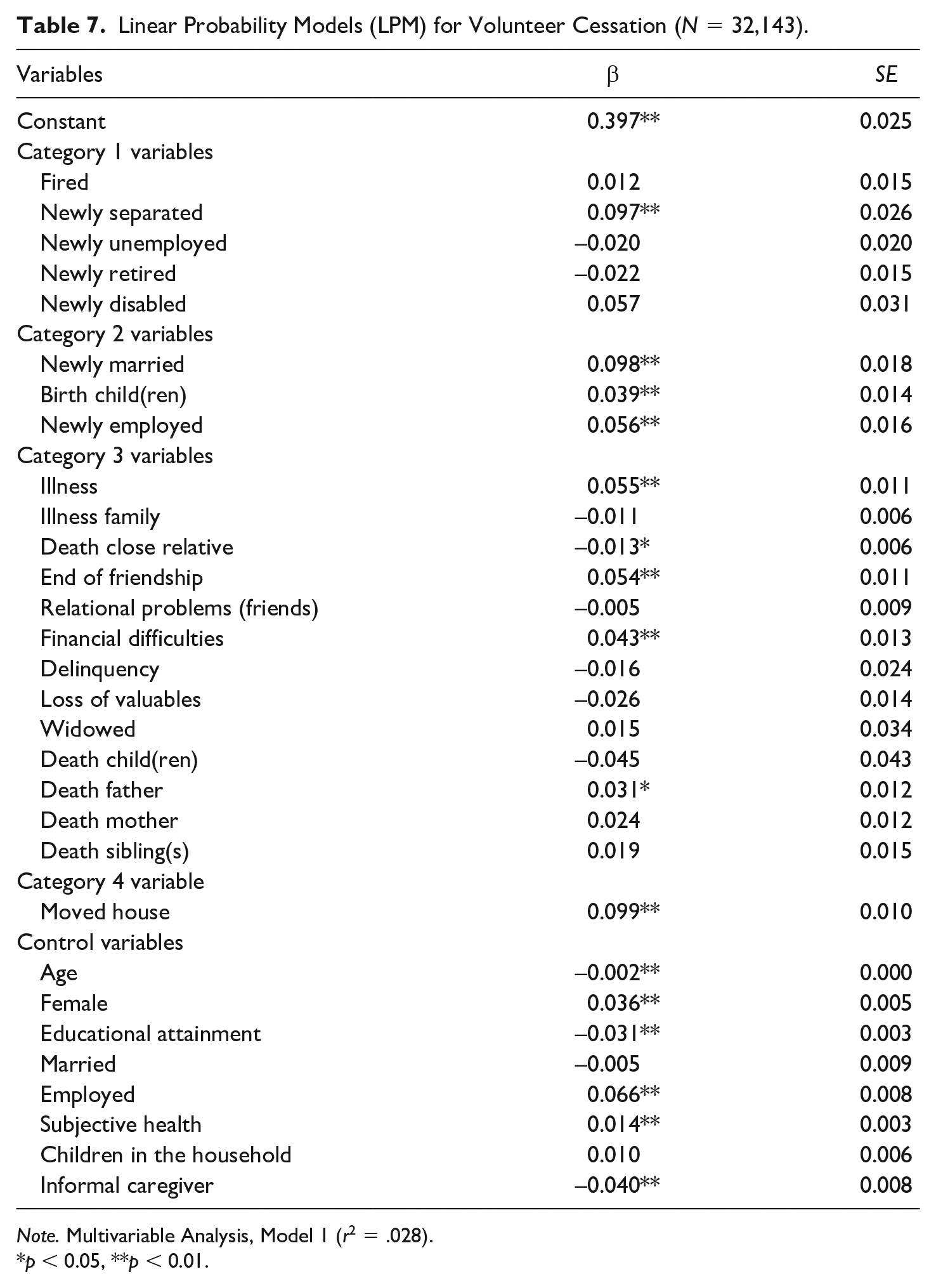
Note. Multivariable Analysis, Model 1 (r2 = .028).
p < 0.05, **p < 0.01.
Major life events and volunteer take-up
Our results show that several life events are associated with starting volunteering (see Table 6). First, we expected that individuals experiencing life events resulting in a loss in status, stimulation, or behavioral confirmation would have a higher likelihood to take up volunteering (H1a). Indeed, our results show that individuals who recently transitioned out of paid work were more likely to take up volunteering. However, no association between recent separation and starting volunteering was found. Second, we expected that individuals experiencing life events resulting in an increase in status, stimulation, or behavioral confirmation would have a lower likelihood to take up volunteering (H2a). Indeed, individuals who recently married or had a child were less likely to start volunteering. We did not find an association between transition into a new job and taking up volunteering. Third, we expected that individuals experiencing major life events that are unlikely to change the levels of status, stimulation, and behavior confirmation would have no different likelihood to start volunteering (H3). With the exception of the life event “loss of valuables,” we did not find any association between life events in this category and taking up of volunteering. Finally, we found that individuals who recently moved house were less likely to start volunteering.
Major life events and volunteer cessation
Our results show that many major life events were associated with volunteer cessation (see Table 7). First, we expected that individuals experiencing life events resulting in a loss in status, stimulation, or behavioral confirmation would have a lower likelihood to quit volunteering (H1b). In contrast to our expectations, individuals who recently separated were more likely to quit volunteering. No associations were found between transitions out of paid work and volunteer cessation. Second, we expected that individuals experiencing life events resulting in an increase in status, stimulation, or behavioral confirmation would have a higher likelihood to quit volunteering (H2b). Our findings are fully in line with our expectations, showing that individuals who recently transitioned into marriage, had a child, or started a new job were more likely to quit volunteering. Third, we expected that individuals experiencing major life events that are unlikely to change the levels of status, stimulation, and behavior confirmation would have no different likelihood to quit volunteering (H3). Contrary to our expectations, individuals who experienced serious illness, who ended a long-term friendship with a good friend, relative, or neighbor, who experienced financial difficulties, or who lost their father were more likely to quit volunteering. Moreover, we found that individuals experiencing the death of a close friend or relative were less likely to quit volunteering. No association between experiencing illness among close relatives and volunteer cessation was found. Finally, individuals who moved house were more likely to quit volunteering.
Discussion
The current study aimed at enhancing our understanding of the association between major life events and volunteer dynamics by using SPF theory. Based on the expected influence of major life events on the fulfillment of basic human needs, in terms of either causing losses or causing gains in these fulfillments, hypotheses were formulated about the association between major life events and starting and quitting voluntary work.
We hypothesized that individuals experiencing life events that could cause losses in the level of status, stimulation, or behavioral confirmation have a higher likelihood to take up (H1a) and a lower likelihood to quit (H1b) volunteering. Our results confirmed H1a, as individuals who recently experienced a transition out of work had a higher likelihood to take up volunteering. Our results did not confirm H1b. First, and contrary to our expectations, individuals who recently got separated had a higher likelihood to quit volunteering. A potential explanation could be that, although separation may be associated with losses in status and behavioral confirmation, it may not be related to losses in stimulation but rather cause excess “stimulation” in terms of time and energy. Newly separated individuals are likely busy arranging practical consequences of the divorce, such as finding a new house, adopting a new financial situation, and rearranging their routines as a single individual (Amato, 2010). Moreover, separation affects an individuals’ mental health (Amato, 2010), consuming a lot of energy. Because separation takes both time and energy—and thus in fact lowers the need for stimulation—it could make people more likely to quit volunteering. Second, transitions out of work were not associated with volunteer cessation. Thus, life events that may cause losses in status, stimulation, and behavioral confirmation appeared to be more important for the likelihood to take up volunteering than for the likelihood to quit volunteering. This is an indication that individuals seem to search for substitute activities such as volunteering to assure that need fulfillment returns to its previous level.
Moreover, we hypothesized that individuals experiencing life events, which may cause gains in the level of status, stimulation, or behavioral confirmation, have a lower likelihood to take up (H2a) and a higher likelihood to quit (H2b) volunteering. Our results almost fully confirmed our expectations, showing that individuals who recently got married or had a child were less likely to start volunteering and that individuals who recently transitioned into marriage (or a marriage-like relationship), had a child, or transitioned into employment were more likely to quit volunteering. So, individuals who experience life events that are assumed to contribute to the status, stimulation, and behavioral confirmation are indeed less likely to take up volunteering and more likely to quit. On top of that, the results showed that these events were more important for volunteer cessation than for volunteer take up. No association was found between transitions into employment and the likelihood to start volunteering. Moreover, associations between life events that were assumed to contribute to the levels of status, stimulation, and behavioral confirmation and quitting volunteering were stronger than the associations between these events and starting volunteering. Time could be a relevant factor in explaining the higher importance of these events for quitting than for starting voluntary work. Transitions into marriage or employment and having children may increase an individual’s levels of status, stimulation, and behavioral confirmation but are time-consuming at the same time. In earlier research, it was also concluded that gains from transitioning into parenthood seem to be canceled out by the substantial reduction in free time, explaining the lower likelihood to volunteer for parents of young children (Einolf & Chambré, 2011) is also time-consuming, and because of its relatively little obligatory character, quitting voluntary work seems to make sense when reductions in time-demanding activities are desirable.
Finally, we hypothesized that individuals experiencing life events that are unlikely to cause changes in the levels of status, stimulation, and behavioral confirmation do not have a different likelihood to start or quit volunteering than individuals who do not experience these life events (H3). Our results partially confirmed this expectation. Although several major life events in this group are indeed not associated with a different likelihood to either start or quit volunteering, some others are indicating that other mechanisms are at work. Individuals who got seriously ill, who experienced financial difficulties, who ended a long-term relationship with a good friend or relative, or who lost a close relative were more likely to quit voluntary work. It seems plausible, as was argued before, that volunteering is determined not only by the motivation to fulfill, especially, the needs for status, stimulation, and behavioral confirmation but also by the availability of resources. Although life events such as experiencing serious illness or financial difficulties may not result in a change in the motive to volunteer, their overall impact on life could be substantial and might impact one’s resources in terms of the availability of “mental space,” energy, or time, resulting in changing volunteering behavior. When individuals experience such major life events and feel the need to reduce participation in activities, it makes sense to quit voluntary work first because it is less obligatory than paid work or taking care of family members. Finally, we did not formulate a hypothesis on moving house, but we found that individuals who moved house were less likely to take up volunteering and more likely to quit.
Our results show that on the group level, it is difficult to predict who will take up voluntary work and who will quit. Explained variance of our models is low: The variables in our models explain only 1.3% of the variation in taking up voluntary work and 2.8% of the variation in volunteer cessation. At the same time, however, our results show clear associations between specific major life events and the likelihood to either start or quit volunteering. For example, individuals who transition into retirement are 7.7% more likely to start volunteering than individuals who do not transition into retirement, and individuals who transition into marriage are even 9.8% more likely to quit volunteering than those who do not. These results thus show that life events clearly matter for volunteer take up and cessation but that there is still much to learn about additional factors that may influence these decisions about volunteering.
In the current study, within-individual changes in volunteering have been related to major life events by applying the needs-based approach of SPF theory. As a result of experiencing major life events influencing the fulfillment of the needs for status, stimulation, and behavioral confirmation, we expected changes in the motivation to volunteer and therefore in volunteering behavior. Overall, the current study confirmed our hypotheses, and it can be concluded that major life events are indeed associated with changes in volunteer motivation. SPF theory, therefore, seems a useful theory for understanding changes in volunteering related to life course transitions. Established theories on volunteering from a life course perspective, which have added valuable contributions to the state of research, including resource theory (Wilson & Musick, 1997), role theories (role extension theory; Mutchler et al., 2003), and role overload theory (Markham & Bonjean, 1996; Mutchler et al., 2003; Wilson, 2000), the dominant status theory (Smith, 1994; Smith & Wang, 2016), and rational choice theories (Butrica et al., 2009), have been applied in a rather static way. Various studies have compared different life stages in relation to volunteering by applying a between-individual approach. By, for example, comparing nonmarried with (recently) married individuals or individuals without children living in the household with individuals with children in the household, a resource-based approach is applied. By applying SPF theory to study within-individual transitions, such as the transition into parenthood, we were able to derive hypotheses regarding changes in basic human need fulfillments as a result of major life events and thereby gain a deeper understanding of changes in volunteer motivation and subsequent changes in volunteer behavior. Applying SPF theory to this research field, therefore, improves our understanding of why individuals change volunteering behavior after experiencing major life events.
Study Limitations
The current study has some limitations. First, information on volunteering was only available at baseline (T1) and the second follow-up (T3). Individuals who volunteered at both T1 and T3 could possibly have transitioned out of and into volunteering again between measurements, for example, as a response to life events occurring between T1 and T3. Second, the exact timing of life events could not be taken into account. For individuals who experienced an event shortly before T3, the effect on volunteering may not be visible yet. Altering behavior takes time in general, potentially leading to an underestimation of transitions into volunteering. Likewise, for individuals who experienced an event shortly after T1, the effect on volunteering could have been flattened out already by the time of T3, again potentially leading to an underestimation of volunteer transitions. Third, the current study did not investigate how the associations assessed are shaped over the life course. In general, the life events included are unevenly distributed over the life course. Some of the life events assessed are more likely to occur in early adult life (transitions into employment, marriage, and parenthood), and others are more typical for mid- or later life (loss of parents, transitions into retirement, experiencing serious illness, and loss of the partner). Although unevenly distributed over the life course, many of the included life events can occur in every stage of life. The impact of these events on volunteering behavior may be very different across distinct life stages (Baer et al., 2016). In different life stages, not only individual resources change but also their preferences for time allocation (Nesbit, 2012). Also, the types of life tasks individuals pursue and their resulting difference in volunteer motivations as well as the way individuals perceive the volunteer role will change (Haski-Leventhal et al., 2016). Therefore, associations between major life events and changing volunteering behavior may be shaped differently over the life course. For example, job loss may have very different consequences for adults close to retirement than for younger adults. Moreover, the specific situation within a certain life stage may be related to varying consequences of life events for volunteering. For example, job loss and separation may have differential effects for parents as compared with individuals without children.
Recommendations for Future Research
Future research should test whether the associations between major life events and take up and cessation of voluntary work that were found in the current study are indeed mediated by changes in the fulfillment of the needs for status, stimulation, and behavioral confirmation. Furthermore, in future research, it should be studied whether the associations assessed in the current study differ across life stages.
In conclusion, the current study provides important insights into the underlying mechanisms linking major life events and volunteer dynamics. This study shows, moreover, that experiencing major life events seems to be much more important for quitting than for starting voluntary work, showing that the decisions to start or quit voluntary work are subject to different underlying processes. By taking a needs-based theoretical approach to underlying motives to volunteer, we added to the understanding of why certain life events are related to starting or quitting voluntary work.
Footnotes
Declaration of Conflicting Interests
The author(s) declared no potential conflicts of interest with respect to the research, authorship, and/or publication of this article.
Funding
The author(s) received no financial support for the research, authorship, and/or publication of this article.
