




Abstract
Scholars and practitioners increasingly call for a more nuanced understanding of why and when family firm branding is more versus less effective. Across three studies, we find that, in general, communicating family ownership enhances consumer responses because it humanizes the company. Importantly, however, the effectiveness of this communication strategy depends on (a) the presence and (b) the source of positive corporate social responsibility (CSR) news. Specifically, we demonstrate that family firm branding is less effective when an external source informs consumers about the company’s CSR. It does offer a strong competitive advantage, however, when the company self-reports its CSR activities.
Keywords
Introduction
A favorable reputation constitutes one of the most valuable intangible resources a firm can possess providing it a competitive advantage (Barney, 1991; Rindova et al., 2010), such that, well-reputed firms receive more job applications and evoke stronger consumer preferences (Fombrun & Shanley, 1990). Determining how to develop a favorable reputation is a central issue, particularly for unknown brands and entrepreneurs starting a new business or seeking to keep their firms viable (Fischer & Reuber, 2007). A potentially reputation-enhancing resource is a company’s family firm status. This resource is interesting because it is considered inimitable and inherently available to most firms, as the vast majority of firms are family firms (Astrachan & Shanker, 2003). Thus, not surprisingly, there has been a growing interest in understanding reputational effects of family business branding—that is, the resulting effects of communicating the family firm status to external stakeholders (Binz Astrachan et al., 2018; Jaufenthaler et al., 2023). Anecdotal (Andreini et al., 2020; Sageder et al., 2018) and empirical (e.g., Beck & Prügl, 2018; Schellong et al., 2019) evidence suggests positive consumer responses. More specifically, Beck and Prügl (2018) demonstrate that family business branding enhances purchase intention because doing so leads to a more human perception of the firm.
However, despite these positive effects, only a small fraction of family firms explicitly highlight family firm status (Botero et al., 2013), and managers also express their doubts about the generalizable relevancy of this communication strategy (Binz Astrachan & Botero, 2018). Are these concerns justified, considering the existing empirical evidence? One explanation for these seemingly conflicting positions is that family business branding is contingent and, thus, not always beneficial to the same extent. Indeed, scholars have repeatedly called for a contingency approach—that is, the need for research to highlight the conditions in which family business branding is more versus less beneficial (Binz Astrachan et al., 2018, 2019; Neubaum, 2018) and, recently, research has started to uncover when family firm branding is more versus less effective. For example, recent findings show that emphasizing family firm status positively impacts brand reputation in Western industrialized countries, while it provides little value in other geographical settings (e.g., India; Jaufenthaler et al., 2023). Another study indicates that the positive effects of this communication strategy are influenced by individual attitudes toward family (Rauschendorfer et al., 2022). A better understanding of these conditions is not only important for advancing theory but also allows for the formulation of more concrete managerial guidelines on whether, when, and where to engage in family firm branding.
Advancing this novel area of research, we investigate how a family business’ socially responsible activities (i.e., corporate social responsibility [CSR] behavior) influence the effect of family firm branding. Understanding how CSR behavior influences the effectiveness of family business branding is important for several reasons. First, CSR news increasingly affects consumer decision-making (Becker-Olsen et al., 2006; Habel et al., 2016; Robinson et al., 2012), which is why companies’ CSR behaviors likely have a strong influence on reputational outcomes, including family business branding. Second, research on family firms has often emphasized the distinctiveness of family firms in terms of CSR (e.g., see Mariani et al., 2023 for a recent literature review) and their tendency to engage in pro-social behaviors (Berrone et al., 2010), which underscores the relevance of understanding how such behaviors influence reputational effects in the context of family firm branding. Third, CSR has become increasingly important for family and non-family businesses in recent decades (Malik, 2015), with companies increasingly devoting significant resources to social initiatives (Du et al., 2010).
The current research addresses this gap. Drawing from knowledge activation theory (Higgins, 1996), we demonstrate across a series of experiments that when consumers possess additional knowledge about a company’s positive CSR behavior, the positive impact of communicating family ownership is less pronounced because both positive CSR behavior and family firm branding signal a sense of humanness, which makes them redundant to some extent. Specifically, the “family” element in family firm branding (e.g., “We are a family-owned company”) activates human knowledge structures about families, which are then used to evaluate and form a more human impression of the company. Pro-social corporate behavior involves morality (Aguilera et al., 2007) and empathy or caring toward stakeholders (Blodgett et al., 2011), representing key human traits that should make a company appear more human as well.
This does not mean, however, that family firm branding is obsolete, given positive CSR news. We additionally theorize that the extent to which family firm branding enhances consumer responses also depends on the source of the positive CSR news. Our results show that when the firm self-reports positive CSR behavior (vs. when the information comes from an external, uninvolved source), family firm branding is especially effective. Stakeholders increasingly question firms’ own CSR claims in the face of greenwashing activities (Sekerci et al., 2022). As the present research reveals, family firm branding is particularly beneficial in such cases because the humanized image of the family company enhances the credibility of the CSR claim.
Doing so, the current research makes several important contributions to the family business literature. Most importantly, our work enhances the emerging debate on relevant boundary conditions under which promoting family firm status is more versus less effective (Binz Astrachan et al., 2019; Block et al., 2019; Jaufenthaler, 2023; Jaufenthaler et al., 2023). Our findings show that communicating family ownership indeed does not always offer the same reputational benefits, as positive CSR behavior can render the effect of family ownership communication less pronounced. However, family ownership communication increases the credibility of a firm’s self-reported CSR claims, thus, offering a particularly valuable competitive advantage in such cases. These findings contain important insights for practitioners and may represent an important step in reconciling research evidence of positive effects (Beck & Prügl, 2018) with practical concerns (Binz Astrachan & Botero, 2018) regarding the generalizable relevance of this communication strategy. Moreover, we respond to recent calls for novel theoretical perspectives (Binz Astrachan et al., 2019; Neubaum & Micelotta, 2021) by proposing a theoretical framework based on knowledge activation theory as a complementary theoretical foundation to commonly used signaling theory. This perspective allows us to place greater emphasis on the underlying rationales of consumers and supports our argument that the cue “family” activates stored knowledge structures about families that humanize the firm and influence downstream responses. We also contribute to CSR research in general (Homburg et al., 2013; Lock & Seele, 2016), showing, for example, that humanization strategies serve as effective levers to increase the credibility of CSR claims.
Theoretical Background
Definitions of family firms often require that members of the same family hold a majority interest and/or predominantly influence strategic decisions (Chua et al., 1999). Even if various ownership thresholds have been used to distinguish family-owned versus non–family-owned companies (e.g., 10% ownership, La Porta et al., 1999; 50%, Arzubiaga et al., 2018), the specific thresholds are not central to our research. We seek to understand how perceived family ownership affects consumer response. Therefore, we define family ownership according to an identity approach (Zellweger et al., 2010, 2012), which relies on the company’s self-attribution. Thus, any company that claims to be family-owned is family-owned, for the purposes of our research.
Communicating Family Ownership
Consumers likely respond differently to family-owned versus non–family-owned companies. Existing research consistently reveals that consumers respond positively. For example, Carrigan and Buckley (2008) identify positive attitudes among Irish and British women toward family-owned grocery stores. With experimental designs, Lude and Prügl (2018), Beck and Prügl (2018), and Jaufenthaler et al. (2024) found that communicating family firm status increased purchase intentions among consumers from Germany, Austria, Switzerland, the United Kingdom, and the United States.
Scholars, however, increasingly address boundary conditions, warning that communicating family firm status might have different effects in different circumstances (Binz Astrachan et al., 2018, 2019; Block et al., 2019). Initial studies that consider potential boundary conditions show that the positive effects of family business branding are stronger for country-of-origin products (Dos Santos et al., 2020), are more prevalent in the Western hemisphere (Jaufenthaler et al., 2023), are moderated by additional information about company size (Shen & Tikoo, 2020), and can be influenced by individual attitudes toward family (Rauschendorfer et al., 2022).
To date, however, we are still at the beginning of comprehensively understanding the effects of family firm branding activities (Rauschendorfer et al., 2022). Scholars need to better understand its underlying rationales and consequences across different conditions that are relevant for family businesses (Jaufenthaler, 2023; Neubaum, 2018). The present study proposes a framework that considers previous research on family business branding (Beck & Prügl, 2018) and CSR research (Berrone et al., 2010), predicting an overall positive effect of communicating family ownership through a cognitive humanization process while introducing positive news about CSR behavior as an influencing factor with regard to the effectiveness of its positive effect. Integrating knowledge activation theory into the ongoing discourse on family business branding, we next describe our underlying theoretical framework.
Family Ownership, Humanization, and Benevolence
The existing body of research on family firm branding has often relied on signaling theory (Spence, 1973) to explain the signaling mechanism between the company (i.e., the sender of the family firm signal) and the external stakeholders (i.e., the informationally disadvantaged receiver) who use the signal to draw inferences about the company’s unobservable qualities and intentions. In doing so, signaling theory has proven instrumental in evaluating whether the family firm signal qualifies as an effective reputation-shaping tool. Scholars have illustrated that the family firm signal meets the basic requirements of this theory, including observability (e.g., visibility through active promotions), relevance (e.g., significance for receivers’ decision-making), and being costly/difficult to imitate (e.g., exclusive to family firms vs. non-family firms; Spence, 1973; see Jaufenthaler, 2023 for a recent discussion). In addition, signal credibility, which refers to the signal’s honesty (i.e., “extent to which the signaler actually has the unobservable quality being signaled”) and fit (i.e., “extent to which the signal is correlated with unobservable quality”; Connelly et al., 2011, p. 52), has been employed as a related determinant to assess the effectiveness of signals in the family firm branding context (Sekerci et al., 2022; von Bieberstein et al., 2020). For example, research has argued that an owner family membership signal should be considered credible since “a manager’s membership in the owner family cannot be faked (or at least the deceit will be detected easily)” (von Bieberstein et al., 2020, pp. 268–269).
Broadening the theoretical foundation of family business research, we propose knowledge activation theory (Higgins, 1996) as an additional theoretical lens for family firm branding. This theoretical perspective complements signaling theory because it places more emphasis on how a signal influences the cognitive process in consumers’ minds. Knowledge activation theory has been widely utilized in marketing (Schroll et al., 2018) and psychology research (Förster & Liberman, 2007) to explain how simple cues activate stored knowledge structures, which then influence consumer behavior. For example, smelling gingerbread cookies might activate stored knowledge about Christmas, or hearing the U.S. anthem might activate stored knowledge about sports events among U.S. consumers.
We propose that family firm branding activates consumers’ stored knowledge about families or a stereotyped image of families in general and, consequently, humanizes the family firm. Knowledge activation theory lays out the three stages of the humanization process: (1) acquisition of human knowledge, (2) activation of stored human knowledge, and (3) application of activated human knowledge (Higgins, 1996). As individuals tend to already have knowledge about human entities (meaning of being human), the humanization of a nonhuman entity usually is a question of whether they activate and apply their existing homocentric knowledge to nonhuman entities. Research has shown that many consumer decisions involve quick, intuitive judgments with little or no effort of conscious thinking (Evans, 2008; Kahneman, 2011). The inclusion of the term “family” in firm branding efforts (e.g., “We are a family-owned company”) offers a simple but obvious distinction for consumers, identifying the firm as family-owned (Krappe et al., 2011; Rauschendorfer et al., 2022). The concept of “family” is deeply related to humanness, representing the “most important and enduring of all human social groupings” (Smith et al., 2008, p. 5). This theoretical argument is supported by initial empirical evidence suggesting that family firm branding humanizes the firm (Beck & Prügl, 2018) and recent insights indicating that positive (vs. negative) experiences with their own family influence consumer responses toward family firm branding activities (Rauschendorfer et al., 2022).
When applying this activated human knowledge about families, consumers might attribute greater benevolence to a company that they perceive as human. As part of the multidimensional trustworthiness construct, benevolence is “the extent to which a trustee is believed to want to do good to the trustor, aside from an egocentric profit motive” (Mayer et al., 1995, p. 718). 1 Such a desire to do good is an innately human characteristic that differentiates human beings from nonhuman entities (e.g., machines; Haslam, 2006), but if consumers humanize the firm, they create frame that would enable them to attribute benevolence to this nonhuman company. The concept of “family,” in particular, holds a very high and positive status in our societies, serving as the primary social unit where individuals learn and experience empathy and morals (Smith et al., 2008) through caring and concern for the well-being of others (i.e., benevolence). Furthermore, research indicates that perceived benevolence enhances various outcomes for the firm; for example, when importers appear to exhibit benevolence toward export suppliers, the financial outcomes of the business relationship improve (Lee et al., 2004). Similarly, stakeholders show increased willingness to commit resources to a benevolent company (Kramer, 1999; Whitener et al., 1998). Consumer and marketing research also shows that expectations of such emotional qualities of relationship partners (e.g., a firm or brand) can play a crucial role in consumers’ purchase decisions (Lude & Prügl, 2021; Yang & Aggarwal, 2019). Thus, we expect that perceived benevolence will increase consumer responses (e.g., purchase intention).
In sum, if a company communicates that it is family-owned, consumers should respond more favorably to such companies. Specifically, we expect that this positive effect arises because communicating family ownership humanizes the company, which evokes greater perceived benevolence (ownership → humanization → benevolence → consumer responses). Formally:
The Moderating Role of CSR News
According to knowledge activation theory, cues have a certain potential to activate stored knowledge (Higgins, 1996). This means that when a potent cue has activated a certain knowledge structure, the activating effect of similar subsequent cues is limited because the stored knowledge is already activated. In the current research, we examine to what extent positive CSR news (alongside family firm branding) activates human knowledge structures and influences downstream consequences. CSR pertains to firms integrating and addressing social and environmental issues into their business models and operations, thereby considering the interests of different stakeholders (e.g., employees, consumers, community, shareholder, environment; Blodgett et al., 2011; Kotler & Lee, 2005).
We focus on positive news about CSR behavior in recognition of the high relevance CSR enjoys in the context of family firms (Berrone et al., 2010; Gomez-Mejia et al., 2011; Mariani et al., 2023). Relatedly, recent research highlights the importance of studying not only the actual behavior of family firms but also the reactions of external stakeholders when they receive information about CSR activities (Sekerci et al., 2022). Moreover, consumers today pay increasing attention to companies’ CSR behavior and consider it in their decision-making (Habel et al., 2016).
Existing literature shows different conclusions regarding family firms’ corporate social (ir)responsibility, which is unsurprising given the heterogeneity of this most widespread form of organization in the world (Miller & Le Breton-Miller, 2021). Without addressing the nuanced reasons and differences in these variations, in the context of our ongoing investigation, it is most relevant to note that several studies have indicated family-owned companies’ tendencies to target their positive CSR behaviors toward different stakeholders than do non–family-owned companies (Cennamo et al., 2012; Dyer & Whetten, 2006; Gomez-Mejia et al., 2011; Van Gils et al., 2014). For example, research has shown that family firms often strive to meet social norms (Naldi et al., 2013), attend to the needs of the local community (Cennamo et al., 2012), develop and preserve trusting relationships with customers and suppliers (Zellweger et al., 2013), avoid downsizing of employees (Block, 2010; Chrisman et al., 2014), and display environmentally conscious behavior (Berrone et al., 2010) more than their non–family firm counterparts. Such CSR behaviors might be explained by the interaction of family and business interests (Habbershon et al., 2003), such that, family firms are not guided solely by economic profit motives (Naldi et al., 2013; Zellweger et al., 2013). Instead, they adopt normative motives and behave ethically because it is the right thing to do; they also tend to embrace instrumental motives that imply that exhibiting caring for stakeholders can produce socio-emotional wealth benefits, such as preservation of the firm for intergenerational transfers or enhanced images and reputation for the family (Cennamo et al., 2012; Hauswald & Hack, 2013; Van Gils et al., 2014).
We argue that both family firm branding and positive CSR news are cues that activate human knowledge structures. Thus, these cues are redundant to a certain extent. Positive CSR news should make a company appear more human for several reasons. First, demonstrating empathy and caring for others are key human traits (Haslam, 2006); thus, we expect that a company that demonstrates empathy and caring (e.g., for the environment) should appear more human. Second, prior research shows that engaging in positive CSR behavior is often motivated by moral reasons (Aguilera et al., 2007). Morality is a trait that is uniquely human (Gray et al., 2007; Waytz et al., 2010), which is why we propose that a company that demonstrates such moral behaviors will be perceived as more human than a company that does not. As such, positive news about CSR behavior should already activate perceptions of a firm’s humanness, and consequently, communicating about family ownership is less effective in further enhancing humanness perceptions and consumer responses compared with when consumers are not aware of positive CSR behavior. For companies that are not perceived as family-owned businesses, this might, in turn, mean that they can compensate to a certain degree for their reputational disadvantage by demonstrating their humanness through positive CSR behavior. Based on these considerations, we hypothesize more formally:
The Moderating Role of CSR News Source
Consumers, however, may learn about a company’s CSR activities from different sources, which can provide information that differs in the degree of perceived credibility (Appelman & Sundar, 2015; Perloff, 2010). For example, consumers can receive such information from an external and uninvolved newspaper or from companies’ own advertising communications. Might this make a difference regarding the benefits of family ownership communication? We argue that family-owned companies possess a strong competitive advantage when they self-report positive CSR news, compared when positive CSR news comes from an already trusted external source.
Signaling theory suggests that honesty and fit (discussed above) are important determinants of the credibility and, ultimately, the effectiveness of a signal (Connelly et al., 2011). In general, information credibility, defined as stakeholders’ “judgment of the veracity of the content of communication” (Appelman & Sundar, 2015, p. 53), can be influenced by various factors, such as the level of trust and benevolence placed in the information source (Perloff, 2010; Stutz et al., 2022). While CSR news certified or disseminated by external, uninvolved parties has shown to appear more credible (Ackers & Eccles, 2015; Hsueh, 2018), stakeholders increasingly question the credibility of CSR news released by companies themselves due to greenwashing activities and the growing number of companies claiming to be particularly socially responsible (Connors et al., 2017; Lock & Seele, 2016; Sekerci et al., 2022). Put differently, when the company claims positive CSR behavior itself, CSR news is typically perceived as less credible than when it comes from an external source. Credibility is particularly crucial for companies in marketing communications to ensure that the information can unfold its positive effect on consumer responses (Balaji et al., 2021).
We argue that when companies self-report CSR news, actively promoting family ownership should enhance consumer responses because doing so enhances the credibility of the CSR claim. Humanization research has shown that the more we humanize a nonhuman entity, the more likely we are to trust it (Waytz et al., 2010). For example, Waytz et al. (2014) found that passengers trusted a self-driving car more when it was humanized compared with when it was not humanized. Similarly, the perceived benevolence associated with a humanized family firm implies the company’s honest intentions. Relatedly, the activated human knowledge about families and their caring nature strongly fits positive CSR behavior and should, thus, make the CSR claim more credible. In support of this reasoning, Agrawal et al. (2021) recently showed that humanization cues in advertising enhance message credibility.
A complementary explanation in the family firm context may be existing knowledge regarding family firms’ tendencies toward less greenwashing (Kim et al., 2017), which reinforces consumers’ belief that such a company genuinely engages in the claimed behavior. Family firms, driven by the desire to protect socio-emotional wealth, may cultivate perceptions that they are less likely to make false claims (Combs et al., 2023), considering the potential reputational risks to both the family and the business if their greenwashing practices were exposed (Bothello et al., 2023; Kim et al., 2017). However, when positive CSR news comes from an external, trusted source, as discussed earlier, the CSR news should be perceived as credible (Ackers & Eccles, 2015; Hsueh, 2018), even without family ownership communication. Consequently, we expect that family firm branding will be more effective when positive CSR news is disseminated by the company itself rather than when positive CSR news is disseminated by an external source. More formally:
Methodology and Overview of Studies
We take an experimental approach to test our predictions for several reasons. First, we seek to establish cause-and-effect relationships regarding the effectiveness of communicating family ownership on consumer responses. An experimental design seems most appropriate for achieving this objective. Second, experimental studies are still scarce in family business research, as noted in recent calls for more such studies (Lude & Prügl, 2021; Neubaum, 2018).
In all our studies, we embedded instructed-response items, which are popular attention-check methods (Meade & Craig, 2012; Oppenheimer et al., 2009). Such items ask participants to respond in a certain way (e.g., “Select number 4,” “Do not respond to this question”). Participants who failed this attention check were excluded.
Study 1: Communicating Family Ownership
With this first study, we provide evidence for the suggested positive effect of communicating family ownership as well as the proposed underlying mechanism. We predicted that communicating family ownership humanizes the company, which, subsequently, increases purchase intention due to increased benevolence (ownership → humanization → benevolence → purchase intention).
Method
In this study, 142 U.S. consumers were recruited using Amazon Mechanical Turk (MTurk), 28 of whom were excluded because they failed an attention check, leaving a final sample of 114 (Mage = 33 years, SD = 10.14; 33% women). These participants were randomly assigned to one of two conditions (ownership: publicly owned vs. family-owned). We manipulated family ownership via a company description. That is, participants read a short text about a brewery that referred to the brewery as either family-owned or publicly owned (see Online Appendix A for details). In contrast to Beck and Prügl (2018), we include ownership information in the control condition to rule out the possibility that any positive effect results from providing more information in the family-owned condition. After reading the company description, participants indicated their purchase intention, humanization (α = .92) and benevolence (α = .90) perceptions, responded to a manipulation check, and provided demographic information (age and gender). Online Appendix C lists all constructs with their operationalization, factor loadings, and reliabilities.
Results
Manipulation Check
An analysis of variance (ANOVA) on perceived family ownership showed that our ownership manipulation worked as planned. That is, the company described as family-owned was perceived as more family-owned (M = 6.37, SD = .85) than the publicly owned company, M = 3.80, SD = 2.24; F(1, 112) = 188.43, p < .001;
Purchase Intention
An ANOVA on purchase intention revealed the expected effect of ownership, F(1, 112) = 11.81, p = .001,
Mediation Analysis
We conducted a serial mediation analysis (Hayes, 2018, Model 6, n = 5,000) to test the proposed pathway (ownership → humanization → benevolence → purchase intention). As expected, we found a significant indirect effect (.14, standard error [SE] = .09; 95% confidence interval [CI95] [.01, .37]). Specifically, family ownership increased humanization (.80, SE = .31; CI95 [.19, 1.41]), humanization increased perceived benevolence (.53, SE = .06; CI95 [.42, .64]), and benevolence enhanced purchase intentions (.33, SE = .11; CI95 [.12, .54]).
Discussion
This first study demonstrates that family businesses can benefit from communicating about their family ownership. In doing so, it conceptually replicates the results of prior research (Beck & Prügl, 2018). Replications are scarce in family business research, a gap that motivated our effort to increase confidence in the positive effect and its underlying mechanism. Having established the positive effect and uncovered the underlying mechanism, we now turn to our main research question: To what extent and how are consumers’ positive responses to family firms affected by the presence of positive news about CSR behavior?
Study 2: The Presence of Positive CSR News
Study 2 examines the extent to which the identified family firm branding effects depend on the presence of positive CSR news. Engaging in positive CSR behavior demonstrates caring for the interests of different stakeholders and is often motivated by moral reasons. Both caring and morality are human traits, which is why we believe that news about positive CSR behavior already makes the company appear more human, and the additional humanizing effect of family firm branding is less pronounced.
Method
Study 2 used a 2 (ownership: publicly owned vs. family-owned) × 2 (CSR news: control vs. positive) between-subjects design. Participants were 440 consumers from the United Kingdom recruited via Prolific Academic of which two were excluded because they failed an attention check, leaving a final sample of 438 (Mage = 41 years, SD = 13.26; 60% female; three participants did not provide demographic information). Compared with Study 1, we use a different consumer population (consumers from the United Kingdom instead of the United Sates) to demonstrate the generalizability of our effect. To manipulate family ownership, participants read a company description about a brewery in which the brewery was described as either family-owned or publicly owned. In both conditions, participants were informed that the brewery offers 30 different beers, sells 4.1 million barrels, and has 300 employees to keep company size constant across conditions. Next, participants in the positive CSR news condition saw a newspaper article informing them that the brewery was among the industry leaders in environmental protection (see Online Appendix A for details). In the control condition, no newspaper article was shown. Next, all participants indicated their purchase intention, humanization (α = .89) and benevolence (α = .75) 2 . Finally, participants responded to a manipulation check and provided demographic information (age and gender). We also measured two control variables: perceived company size and experience with family-owned companies. Online Appendix C lists all constructs with their operationalization, factor loadings, and reliabilities.
Results
Manipulation Check
A 2 × 2 ANOVA on perceived family ownership produced only a significant main effect of ownership, F(1, 434) = 1,040.49, p < .001;
Purchase Intention
A 2 × 2 ANOVA on purchase intention produced a significant main effect of ownership, F(1, 434) = 15.38, p < .001;
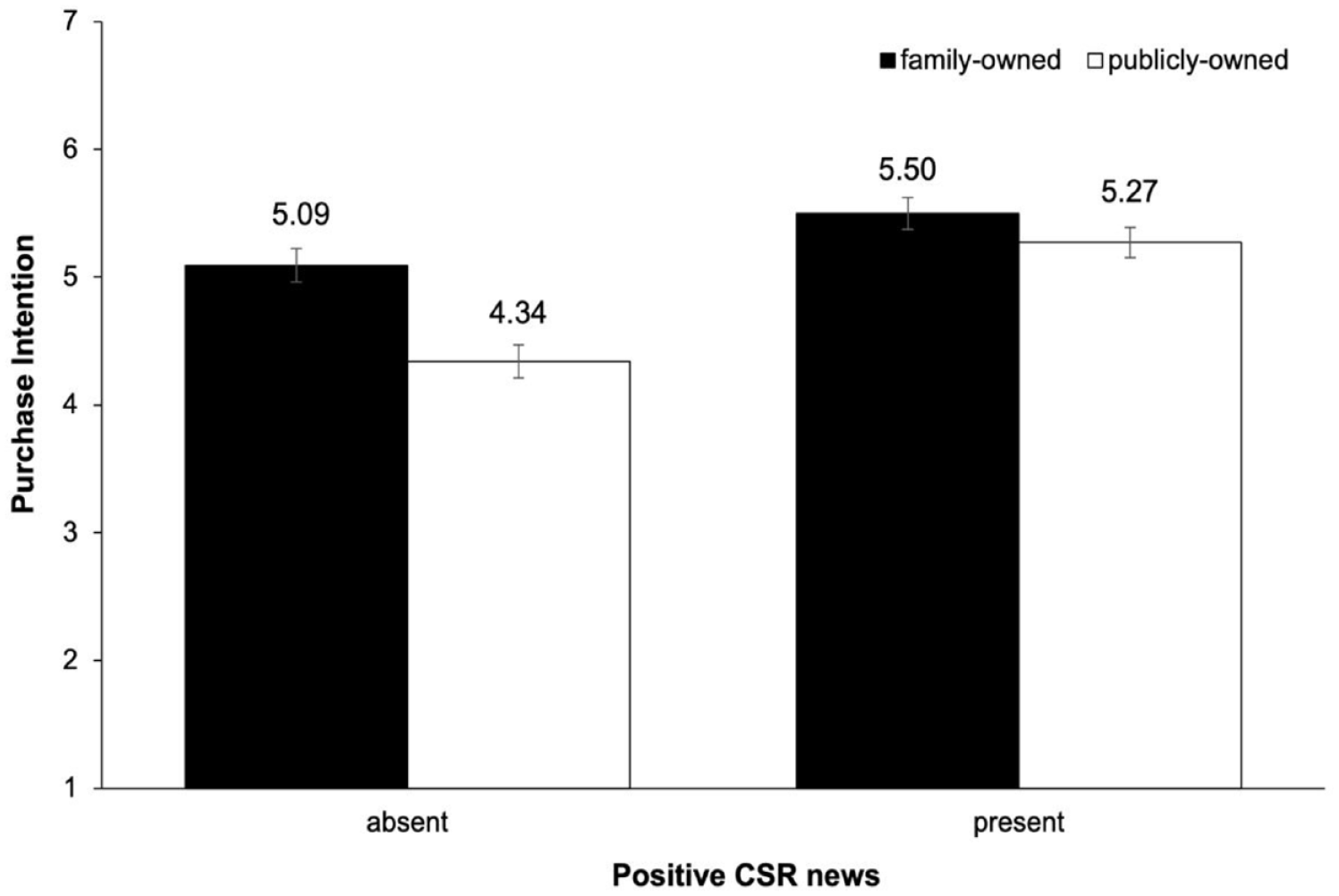
Effect of Ownership and Positive News About CSR Behavior on Purchase Intention (Study 2).
Humanization
A 2 × 2 ANOVA on perceived humanization of the company produced a significant main effect of ownership, F(1, 434) = 15.83, p < .001;
Moderated Mediation Analyses
We conducted a moderated mediation analysis (Hayes, 2018, Model 83, n = 5,000) to test whether the effect of ownership on purchase intention was mediated by humanization and benevolence and to what extent this effect differed for participants who received versus did not receive positive CSR news. Ownership was entered as the independent variable (0 = public; 1 = family), humanization served as the first mediator (M1), benevolence was the second mediator (M2), CSR news served as the moderator (0 = control; 1 = positive), and purchase intention was the dependent variable. In this model, ownership and CSR news interact to influence humanization, and humanization influences benevolence and, ultimately, benevolence affects purchase intention. We expect that when no CSR news is available, the results should replicate our findings from Study 1. When information about positive CSR news is present, however, the positive effect of communicating family ownership should vanish. The results reveal the expected effects, showing that humanization and benevolence mediated the effect of ownership on purchase intention when no CSR news was provided (.11 SE = .03; CI95 [.05, .18]) but not when positive CSR news was provided (.03, SE = .02; CI95 [–.01, .08]).
Discussion
Study 2 enhances our understanding of how CSR behavior affects family-owned companies in several ways. First, this study sheds light on how the presence of positive news about CSR behavior influences consumers’ responses to family-owned and publicly owned companies. Our results show that although both companies benefit from the CSR news, family-owned companies benefit less than publicly owned companies. This is a managerially relevant insight, especially for those family-owned companies that already tend to behave better than others (Gomez-Mejia et al., 2011). In doing so, our results both affirm and challenge managers’ sense that communicating about family ownership might not always be equally relevant. Second, the underlying process uncovers why this differential effect occurs. When no information about CSR behavior is present, our results show that consumers are more likely to purchase from a family-owned company because communicating family ownership humanizes the company, which increases perceived benevolence. Importantly, however, because positive news about CSR behavior already signals a sense of humanness, communicating family ownership has little additional effect on humanness perceptions and purchase intentions. In Online Appendix D, we demonstrate the robustness of the identified main effect and report the results of a conceptual replication that uses a different ownership manipulation (family ownership vs. no ownership information), CSR scenario (participants were informed that the company is an industry leader in providing employment health care benefits), and dependent variable (incentive-compatible choice). With our latest study, we examine the extent to which it matters whether consumers acquire knowledge of CSR behavior from an external source or directly from the company itself.
Study 3: The Source of CSR News
Study 2 showed that the impact of signaling family ownership can depend on CSR behavior, so that when positive news about CSR is present, its reputational advantages are less pronounced. In Study 3, we dig deeper into the effectiveness of family firm branding when positive news about CSR is available by examining the extent to which the source of the CSR news matters. We expect that when CSR behavior is reported in a newspaper article (i.e., an external, uninvolved source), communicating family ownership offers little additional benefit because the external source makes the CSR behavior credible. When the company claims CSR behavior, however, we expect family-owned firms to have a strong competitive advantage—meaning that their ownership status enhances the credibility of this claim and, ultimately, consumer responses.
Method
Participants were 326 German consumers recruited via Clickworker, of which 24 were excluded because they failed an attention check, leaving a final sample of 302 (Mage = 42 years, SD = 12.44; 34% female). We recruited German consumers for this study to further demonstrate the generalizability of our effect. These participants were randomly assigned to one of four conditions of a 2 (ownership: no ownership cue vs. family-owned) × 2 (source: external vs. internal) between-subjects design. In this study, we added no ownership information in the control condition to ensure that the humanization effect is indeed driven by consumers’ positive responses to family-owned companies instead of consumers’ negative responses to publicly owned companies. To manipulate ownership, participants saw a logo and read a company description about the fictitious company Ledix that was described as either family-owned (family-owned condition) or just company (no ownership cue condition).
After reading the company description, all participants were informed about CSR behavior by this company. That is, participants learned that the company was among the top 20% of companies in that industry regarding environmental protection (see Online Appendix A for details). Between participants, we manipulated the source of the CSR news. In the external source condition, we told participants to imagine that they read this information in a newspaper (as in Study 2). In the internal source condition, we told participants to imagine that the company claimed CSR behavior itself. Next, all participant indicated their purchase intention and indicated the perceived humanness of the company (r = .76) 3 . In addition, we asked participants to rate the credibility of the CSR claim (r = .78). Finally, participants responded to an attention check and provided demographic information (age and gender). Online Appendix C lists all constructs with their operationalization, factor loadings, and reliabilities.
Results
Purchase Intention
As before, planned contrasts showed that when consumers learned about CSR behavior from a newspaper, consumers were similarly likely to purchase from the company that communicated its family ownership (M = 4.01, SD = 1.56) and the company with no family ownership cue, M = 3.85, SD = 1.61; F(1, 298) < 1, p = .505;
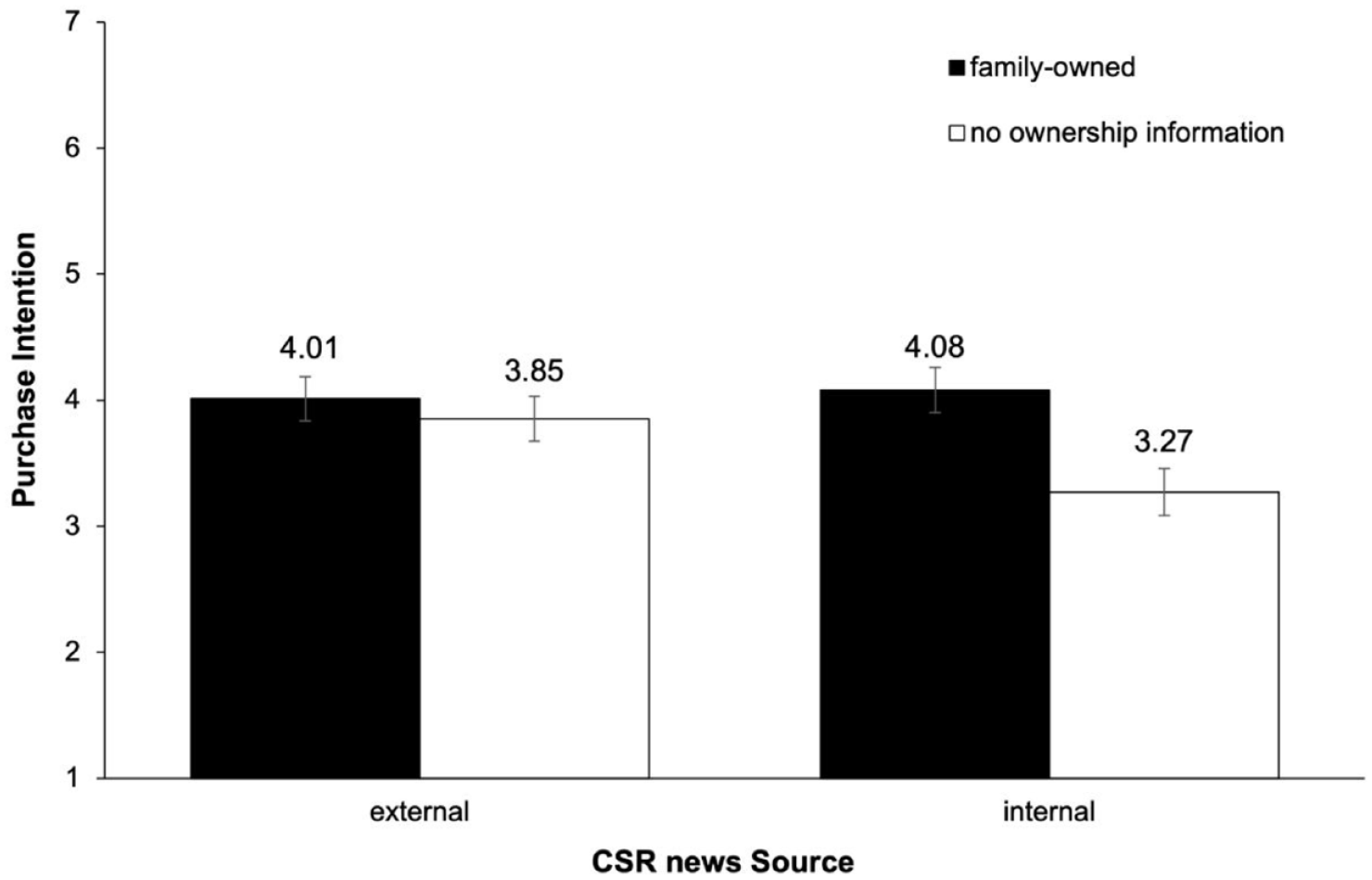
Effect of Ownership and CSR News Source on Purchase Intention (Study 3).
Moderated Mediation Analyses
We again conducted a moderated mediation analysis (Hayes, 2018, Model 91, n = 5,000) to examine how the source of the CSR news affects responses to family-owned and non-family-owned firms differently. Ownership was entered as the independent variable (0 = no ownership information; 1 = family-owned), humanization served as the first mediator (M1), message credibility was the second mediator (M2), source of the CSR news was the moderator (0 = external; 1 = internal), and purchase intention was the dependent variable. The results show that family ownership enhanced humanization (.66 SE = .18; CI95 [.32, 1.01]) and humanization and CSR news source interacted to influence message credibility (.18 SE = .09; CI95 [.01, .35]). Specifically, the positive effect of humanization on message credibility was stronger when CSR news came from an internal source (.65 SE = .06; CI95 [.52, .77]) compared with when it came from an external source (.46 SE = .06; CI95 [.35, .58]). This makes sense because the external source (newspaper) is already perceived as credible, which is why the effect of family ownership (via humanization) is weaker compared with when the company itself claims CSR behavior. Finally, message credibility enhanced purchase intention (.34 SE = .06; CI95 [.22, .46]).
Discussion
Study 3 further extends our understanding of how CSR news influences consumers’ responses to family-owned companies. Aside from replicating the results of Study 2, we find that it matters from which source consumers hear about CSR behavior. Specifically, our results suggest that when firms claim CSR behavior, family firms have a valuable advantage over non-family firms. Because consumers humanize family firms, they seem to perceive a claim about CSR behavior from that company as more credible, which positively influences purchase intention. This insight is not only of high practical relevance but also helps us to understand the results of recent research better (Sekerci et al., 2022; Stutz et al., 2022 further discussed below).
General Discussion
With a systematic investigation of the effects of communicating family ownership on consumer responses, spanning several experimental studies, we consistently find that communicating family ownership generally enhances consumer responses. In line with both knowledge activation theory (Higgins, 1996) and prior research (Beck & Prügl, 2018), we demonstrate that this positive effect occurs because communicating family ownership humanizes the company, which increases its perceived benevolence. Most importantly, we show that this positive effect is conditional to a certain extent so that the positive impact of communicating family ownership can depend on CSR behavior. More specifically, this research demonstrates that the positive effect of family ownership communication is less pronounced when consumers are additionally aware of the positive CSR behavior of that firm. However, we further show that the source of the CSR news matters. In the case of a company’s own CSR claims, family ownership communication offers a particularly valuable competitive advantage because it increases message credibility and, ultimately, consumer responses.
Theoretical Contributions
Our work makes several important contributions to the literature. First, the present findings enhance our understanding of the effects of family business branding. Early research in this important domain has focused on isolating the effect of promoting the family firm status (e.g., Beck & Prügl, 2018; Lude & Prügl, 2018). More recently, scholars have started to adopt a more nuanced perspective on the effects of family business branding, uncovering when this strategy is more or less beneficial (Block et al., 2019; Jaufenthaler, 2022, 2023; Jaufenthaler et al., 2023; Rauschendorfer et al., 2022). Our work enlarges this stream of research by examining how consumers integrate positive news about CSR behavior in their response to family business branding. Specifically, we show that in the presence of CSR news, communicating family ownership does not always enhance consumer responses equally. We argue that CSR behavior and family ownership both refer to humanness, so they are redundant in a sense and “neutralize” each other to a certain extent. Doing so, our work also speaks to managers’ comments that communicating about family ownership might not always be equally relevant. However, by additionally considering the source of the CSR news, we additionally demonstrate that family firm branding offers a particularly valuable competitive advantage when a company claims CSR behavior itself. This insight is relevant considering increased skepticism about corporate greenwashing practices. In such a case, family firm branding proves particularly beneficial because the family firm signal can help to make claims about CSR behavior more credible.
Second, the present research contributes to CSR research in the family business context. Previous research has often concentrated on an organizational perspective and on the question of how and to what extent family businesses engage in CSR activities compared with non-family firms (Mariani et al., 2023). Although important, studies adopting a receiver’s perspective and investigating how external stakeholders react to CSR news are scarce. A notable exception is research by Sekerci et al. (2022) examining how CSR information affects investors’ responses to family firms. Interestingly, while Sekerci et al. (2022) find that investors react more favorably to family firms (vs. non-family firms) even given positive CSR news, our results show that family firm branding may offer little additional value for consumers’ responses if they are aware of a company’s CSR behavior. Similarly, in a recent publication, Stutz et al. (2022) indicate that family firm branding enhances the positive effects of companies’ sustainability reporting. These apparently conflicting findings can be reconciled by considering the source of the information and the credibility of the news. More specifically, these recent studies have focused on companies’ own sustainability reporting. In this vein, our present results also show that family business branding can be very useful when the firm itself communicates CSR news. However, when this information comes from an external, impartial source whose credibility is less questionable, the beneficial impact of family business branding on reputational outcomes appears to diminish. Thus, the present framework substantially improves our understanding of the effectiveness of family firm branding with regard to CSR news, indicating that if the sending source conveys information with greater (lower) credibility, an additional family firm signal yields lower (higher) additional benefits for stakeholder responses.
Our research also contributes to CSR research more generally. For example, Homburg et al. (2013) show that business practice CSR activities increase perceived trustworthiness and subsequent responses. Our research provides one explanation for why this positive effect occurs: humanization. The results of our studies demonstrate that companies that engage in CSR activities are perceived as more human, and a more human perception of the company enhances consumer responses. Moreover, Homburg et al. (2013) identified several moderating variables of this effect, including market-, competitive-, and product-related factors. Our research extends this domain by suggesting that this positive effect can also depend on corporate characteristics, such as the ownership structure of the firm. Since a company’s family status already reinforces perceptions of humanness and benevolence, our results indicate that information about CSR activities (from trusted sources) may lead to smaller additional positive effects. Importantly, however, a more human perception of the company proves valuable when the company claims CSR behavior, an insight that enhances the growing literature on the credibility of CSR claims (Connors et al., 2017; Lock & Seele, 2016).
Finally, our work enriches the theoretical underpinnings of family business branding research by introducing a novel theoretical basis from another field (Binz Astrachan et al., 2019; Neubaum & Micelotta, 2021): knowledge activation theory (Higgins, 1996). Knowledge activation theory complements signaling theory because it clarifies what cognitive processes the family signal triggers in consumers’ minds instead of focusing on what criteria make a signal more or less effective. Understanding what goes on in consumers’ minds is important. Research has shown that many consumer decisions involve quick, intuitive judgments with little effort of conscious thinking (Evans, 2008; Kahneman, 2011). Our framework posits that family business branding (e.g., the cue “family”) activates stored and accessible knowledge structures about families in consumers’ minds that lead to a more humanized perceptions of the firm. By placing particular emphasis on the underlying cognitive activation process in individuals’ minds, knowledge activation theory can help clarify stakeholders’ reactions to family firm branding, in addition to insights obtained in prior research that argue that category-based beliefs about family firms affect stakeholders’ perceptions of their benevolence (Hauswald & Hack, 2013). For example, stakeholders might have experienced benevolent behaviors while working for a family firm (i.e., firsthand information) or heard about benevolent behaviors of family firms in the news (i.e., secondhand information), but, as we argue, stakeholders may also develop perceptions of family firms as benevolent through a humanization process, prompted by the cue “family” in family firm branding. In this process, consumers’ knowledge about families, not just family businesses, leads to perceptions of benevolence and informs their responses. Thus, our framework fits recent theorizing (Rauschendorfer et al., 2022), is able to explain recent findings (Beck & Prügl, 2018), and implies that even if stakeholders have no prior knowledge about family firms, they can develop perceptions of its benevolence in response to family firm branding efforts. By introducing this theoretical perspective into the existing discourse on family business branding, we bridge psychology and marketing research with family business research, providing an important step toward a more comprehensive understanding of consumers’ underlying rationales and responses to family business branding activities.
Managerial Implications
Beyond theoretical contributions, our study offers important managerial implications. First, our research allows us to better understand why owners and managers of family firms remain cautious regarding the benefits of promoting their ownership status (Binz Astrachan & Botero, 2018) but it also offers reassurance that this strategy can be beneficial. As we show, family firms generally benefit from actively communicating family ownership in the consumer context. The consumer often has limited information about companies and their products. In such situations, family business branding represents an effective lever for family firms to benefit from their ownership status. Nevertheless, as our results also indicate, the beneficial effects of communicating family ownership can depend on additional available information about CSR behavior. When consumers know about a firm’s pro-social behavior, family business branding offers comparably little additional benefit because both effects move through consumers’ perceptions regarding the human nature of the company. This finding holds important implications for family firm owners and managers who are reluctant to disclose their company’s family nature to external stakeholders. If family firms prefer not to communicate their family firm status, they can glean similar benefits and positive consumer responses from positive CSR behaviors. Notably, though, it might be relatively less expensive and easier for owners and managers to talk about family ownership than to engage sustainably in and then successfully publicize CSR behaviors. This is particularly relevant considering our findings on the importance of the source of CSR news. While CSR news certified or disseminated by external, unrelated parties typically enjoy higher credibility (Ackers & Eccles, 2015; Hsueh, 2018), they are also costlier or not in the control of the company at all. Importantly, however, the current research demonstrates that the human perceptions triggered by family ownership communication render companies’ own CSR claims more credible, which, in light of the greenwashing activities of many industry players, represents a valuable competitive advantage for family firms.
Limitations and Further Research
There are several fruitful avenues for future research. For example, while we focused on companies’ socially responsible behaviors, future research should test how information about corporate social irresponsibility impacts family business brands. While research has shown family firms’ tendencies toward pro-social activities, different tendencies have also been identified (Miroshnychenko et al., 2022). Furthermore, we also focus on consumers, though firms enter exchange relationships with multiple stakeholder groups. For example, prior research has shown that communicating about family ownership influences jobseekers’ (Jaufenthaler, 2023) and investors’ (Lude & Prügl, 2019) responses to the firm. We encourage future research to test the uncovered effects for other stakeholders, who may engage in more conscious cognitive decision-making processes compared with consumers in fast-moving consumer goods (FMCG) markets. Related considerations might differentiate the responses by stakeholders with longer or shorter relationships with the family firm. Continued research could examine how information about CSR behaviors influences people’s responses if they already have a very long relationship with the firm (or the owner family), which may be particularly relevant in B2B markets as well (Homburg et al., 2013). Furthermore, in line with previous research (e.g., Lude & Prügl, 2018), we relied on an experimental approach to examine the effects of CSR news in the context of family business branding. Future studies might consider other methodological approaches (see Sekerci et al., 2022). Also, future studies could test the identified effect in other industries. Although we used different industries in our experiments, all refer to the FMCG market, limiting their generalizability. Beyond information about the firm’s CSR behavior, consumers gather other types of information, so continued research might adapt the present research framework to explore and predict other information-based boundary conditions on the reputational outcomes of family business branding. For example, does communicating family firm status enhance consumer responses more or less for young versus older firms, local versus global firms, and small versus large firms (Shen & Tikoo, 2020)? Another path for further research might extend the assessments beyond Western settings to determine whether similar patterns of results emerge in cultures that ascribe different meanings and values to the notion of “family” (Jaufenthaler et al., 2023).
Conclusion
The current research examines how positive news about CSR behavior affects consumers’ responses to family firm branding. The results of several experimental studies show that, in general, communicating family ownership enhances consumer responses. Challenging assumptions that family firm branding is always equally beneficial, we find that this positive effect is less pronounced when consumers are additionally informed about companies’ CSR behavior. Importantly, however, this effect depends on the source that conveys this information. As we show, when a company self-reports CSR behavior, family firm branding is particularly valuable in enhancing consumer responses because it makes the CSR claim more credible. In sum, the current research places family business branding research on a broader theoretical basis, offers a nuanced understanding of the positive effects of family ownership communication, and provides insights that can improve managerial decision-making in this domain.
Supplemental Material
sj-docx-1-fbr-10.1177_08944865241285488 – Supplemental material for Consumer Responses to CSR News of Family Business Brands: An Experimental Approach
Supplemental material, sj-docx-1-fbr-10.1177_08944865241285488 for Consumer Responses to CSR News of Family Business Brands: An Experimental Approach by Philipp Jaufenthaler, Roland Schroll and Dhruv Grewal in Family Business Review
Footnotes
Declaration of Conflicting Interests
The author(s) declared no potential conflicts of interest with respect to the research, authorship, and/or publication of this article.
Funding
The author(s) disclosed receipt of the following financial support for the research, authorship, and/or publication of this article: This research was supported by funding from D. Swarovski KG.

Supplemental Material
Supplemental material for this article is available online.
Notes
Author Biographies
References
Supplementary Material
Please find the following supplemental material available below.
For Open Access articles published under a Creative Commons License, all supplemental material carries the same license as the article it is associated with.
For non-Open Access articles published, all supplemental material carries a non-exclusive license, and permission requests for re-use of supplemental material or any part of supplemental material shall be sent directly to the copyright owner as specified in the copyright notice associated with the article.
