



Abstract
In his invited essay for Business & Society’s 60th anniversary, Archie B. Carroll (2021, p. 16) refers to human rights as “a topic that holds considerable promise for CSR [corporate social responsibility] researchers in the future.” The objective of this article is to unpack this promise. We (a) discuss the momentum of business and human rights (BHR) in international policy, national regulation, and corporate practice, (b) review how and why BHR scholarship has been thriving, (c) provide a conceptual framework to analyze how BHR and corporate social responsibility (CSR) relate to each other, and (d) provide a research agenda outlining how BHR can expand business and society scholarship in general and one of its foundational constructs, CSR, in particular, beyond the current confines of the business and society field.
The past three decades have heralded a new and particularly relevant research perspective for business and society scholars: business and human rights (BHR). BHR examines the human rights responsibilities of business, which include (a) the respect and protection of human rights along corporate value chains, (b) the avoidance of causing or contributing to human rights violations through business activities and conduct, and (c) the provision of remedy to those whose rights have been violated by business (Bernaz, 2017; Ramasastry, 2015; Santoro, 2015).
However, the BHR perspective has evolved largely outside the business and society field. Of course, business and society scholarship has addressed certain human rights issues and associated behaviors by firms, such as labor rights (Dawkins, 2016; Soundararajan et al., 2018), child labor (Ballet et al., 2014), modern slavery (Caruana et al., 2019; Monciardini, Bernaz, & Andhov, 2021), physical integrity abuses (Olsen et al., 2021), or businesses operating in or collaborating with oppressive regimes (Brenkert, 2009; Schrempf, 2011). However, it has done so predominantly from an issue-centered perspective, that is, with a specific interest in clarifying the narrow problem or challenge at hand. Accordingly, in most of these and other intellectual contributions, human rights issues have been mainly addressed through extant business and society rationales and perspectives, most prominently through corporate social responsibility (CSR) or stakeholder theory (Schrempf-Stirling & Palazzo, 2016; Wettstein, 2012). However, BHR as a foundational perspective explores the systematic relationship between business and human rights, including the respective shifting roles of the state and business in respecting and protecting human rights.
Our claim that the BHR perspective has evolved largely outside of the business and society field means that the evolution and development of a systematic human rights-based perspective to dealing with business responsibility has occurred largely beyond business and society scholarship. Engaging more systematically with the BHR perspective strikes us as important, if not essential, for the business and society field, not because it adds one more “issue” or “construct” to existing business and society research but because it poses an opportunity to expand existing business and society scholarship beyond its current confines. Accordingly, in his invited essay for Business & Society’s 60th anniversary, Carroll (2021, p. 16) also noted this lack of integration of human rights into CSR theory and practice, referring to human rights as “a topic that holds considerable promise for CSR researchers in the future.” The objective of this article is to unpack this promise.
Both BHR and CSR emerged in particular historical moments. CSR emerged from the perceived need of prosperous businesses to “give back” to and share their wealth with society (Carroll et al., 2012). BHR, in contrast, emerged at a time in which the drawbacks of prosperous businesses—as experienced by victims of human rights violations—became increasingly evident, which in turn shifted the focus to the need for businesses not to inflict harm on people and the environment. BHR therefore emerged as a perspective responding to human rights crises with a nexus to business, seeking to find ways to end those violations and to provide remedy for those who had already been harmed (Ramasastry, 2015).
As we will discuss in this article, a BHR perspective moves beyond voluntary and business-led responses to human rights violations. Furthermore, BHR is also shaping momentous developments in international policy, national regulation, and corporate practice (Cossart et al., 2017; De Schutter, 2016; Weissbrodt & Kruger, 2003). Capturing and making sense of such developments has always been at the core of the scholarly agenda of the business and society field as well (Bueno & Bright, 2020; Wood & Logsdon, 2019). Given that business and society is essentially about explicating “the origin, nature, and content of corporate responsibilities” (Schrempf-Stirling & Van Buren III, 2020, p. 30; see also Epstein, 2019; Wood & Logsdon, 2019), it is thus surprising that the BHR perspective has not yet systematically entered business and society scholarship. There have been a variety of articles published in the past few years that have sought to analyze the relationship between BHR and CSR (see, for example, Obara & Peattie, 2018; Ramasastry, 2015; Wettstein, 2012). Ramasastry (2015), however, has noted that despite the commonalities of BHR and CSR that have been identified and emphasized by earlier contributions, it is the differences between them that shape their trajectories, leading to the current divergence of the two. Our motivation is to offer a perspective that can set BHR and CSR scholarship on a converging path.
In the first part of the article, we (a) discuss the momentum of BHR in international policy, national regulation, and corporate practice and then (b) review how and why BHR scholarship has been thriving. In the second part of the article, we provide a conceptual analysis of how a BHR perspective can be included in the business and society field. We do so by analyzing and comparing the foundational assumptions and perspectives of BHR and CSR. Discussions about CSR are at the heart of business and society scholarship because any conceptualization of business within its social contexts must necessarily include or imply a notion of and justification for responsibility (Carroll, 2019). As a result, CSR has traditionally shaped the business and society field—both in practice and in academia—and it therefore makes sense to look at how BHR relates to CSR, a foundational perspective in business and society scholarship. 1
Our conceptual analysis is based on a core theme in business and society scholarship: the social control of business (Jones, 1980; Stone, 1975). We have chosen social control as a unifying rationale underneath the surface-level differences between the two fields (Jones, 1980; Stone, 1975). Social control is defined in terms of why and how society makes business act responsibly and channels business behaviors toward socially desirable ends. We adopt the social control theme because it best encompasses the various frameworks found within business and society scholarship—CSR, corporate citizenship, corporate social performance, and sustainability, to name but four—and further, because it also helps to describe the goals of social movements and activist groups that have sought over time to change the behavior of business. We show how BHR and CSR share the same fundamental dimensions related to the social control of business: rationales for social control, types of social control, and implementation of social control.
BHR and CSR, we argue, are at opposite ends of the social control spectrum. This constellation of shared fundamental dimensions with opposing interpretations, as we argue, offers a promising possibility of cross-fertilization between the two fields. In this article, we are first and foremost interested in assessing and outlining the potential of BHR for business and society scholarship, rather than the other way around. 2 Hence, in the spirit of the business and society field, whose members “continue to bring new ideas, knowledge bases, and ‘outside’ scholars” into its domain (Wood & Logsdon, 2019, p. 1337), we conclude by considering how BHR can expand business and society scholarship by outlining a research agenda for BHR-informed CSR.
The Rise and Momentum of the BHR Movement and Scholarship
Human rights refer to basic rights and freedoms that everyone is entitled to as a human being (Griffin, 2008). Human rights range from general rights, such as the right to life, to more specific rights necessary to live a respectful and worthy life, such as rights to education, work, health, or food. While human rights have traditionally been understood as the responsibility of states, the extension of human rights responsibilities to business has long been espoused by a variety of actors and lately has gained momentum in both international policy discussions as well as human rights scholarship. The growing momentum of BHR manifests itself in (a) the introduction of business guidelines by multilateral institutions such as the United Nations, (b) the creation of domestic corporate human rights regulation, (c) corporate responses to human rights guidelines and regulations, and finally (d) the acceleration of BHR scholarship.
The BHR Momentum in the International Policy Arena
Scholars commonly discuss a series of events unfolding in the 1990s in the Niger Delta, involving the oil company Shell, as the beginning of the modern BHR discussion (Cragg et al., 2012; Ramasastry, 2015; Wettstein et al., 2019). Starting in the 1970s, the local Ogoni population began protesting against the exploitation of natural resources by the dictatorial Nigerian government that was abetted by the participation of Shell and other oil companies. The situation intensified when the Ogoni movement leader Ken Saro-Wiwa and eight other activists were arrested, sentenced to death, and executed in 1995. International human rights groups called upon oil companies, including Shell, to speak up against the execution, arguing they were complicit in these international crimes (Chandler, 1998). These events raised general questions about the role and accountability of business in relation to human rights and sparked a number of policy initiatives with an explicit focus on business responsibility for human rights.
For the past several decades, the United Nations has played a key role in promoting BHR through such initiatives. In 1998, a working group of the UN Subcommission on Human Rights started drafting the so-called UN Draft Norms, which were an attempt to introduce mandatory human rights obligations for business (Weissbrodt & Kruger, 2003). However, they faced harsh criticism from the private sector and Western governments and were eventually abandoned in 2003. More successful was then-Secretary-General Kofi Annan’s initiative to launch the UN Global Compact on corporate responsibility, consisting of initially nine and later 10 broad principles, which companies could adopt on a voluntary basis. The UN Global Compact’s first two principles [businesses should (a) support and respect the protection of internationally proclaimed human rights and (b) make sure that they are not complicit in human rights abuses] address human rights explicitly. However, Principles c to f ([businesses should uphold the freedom of association and the effective recognition of the right to collective bargaining; (d) the elimination of all forms of forced and compulsory labor; (e) the effective abolition of child labor and; (f) the elimination of discrimination in respect of employment and occupation), are also relevant for human rights as they focus on specific contexts of labor rights, such as the elimination of forced and child labor. Thus, the UN Global Compact was the first global initiative that put BHR center stage.
In 2005, Harvard professor John Ruggie was appointed as the UN special representative on BHR and asked to lead an initiative to clarify corporate responsibilities for human rights. Ruggie’s mandate lasted six years and resulted in the publication of the UN Guiding Principles on Business and Human Rights (UNGPs). The UNGPs consist of three pillars: (a) the state duty to protect human rights, (b) the corporate responsibility to respect human rights, and (c) a joint responsibility of governments and businesses to provide remedy to victims of corporate human rights abuses. For each of the three pillars, the UNGPs provide a set of concrete guidelines that operationalize associated responsibilities (United Nations, 2011). The UNGPs were adopted unanimously by the UN Human Rights Council and were pathbreaking in establishing broad consensus on the existence of a corporate responsibility to respect human rights.
Ruggie’s mandate expired after the publication of the UNGPs in 2011. Subsequently, a UN Working Group on BHR, consisting of five human rights experts representing five different geographic regions, was installed to promote and oversee worldwide dissemination and implementation of the UNGPs. Furthermore, in 2014, the UN Human Rights Council adopted a resolution to restart negotiations on a binding international BHR treaty. The deliberations commenced in 2015 and are currently ongoing (Cassell & Ramasastry, 2016; De Schutter, 2016; Deva & Bilchitz, 2017; Kirkebø & Langford, 2020). While there has been considerable momentum at the international policy level, the UNGPs and the subsequent discussions on a BHR treaty have led to a proliferation of domestic initiatives, which will be discussed in the following subsection.
The BHR Momentum in the Domestic Regulatory Arena
Shortly after the publication of the UNGPs, the European Commission called on EU member states to enact so-called National Action Plans on BHR (NAPs). NAPs are policy instruments aimed at outlining a general commitment to BHR as well as the specific instruments and means with which governments seek to implement the UNGPs (Methven O’Brien & Ford, 2019; Methven O’Brien et al., 2016; Rivera, 2019). The European Union’s call was reinforced by the UN Human Rights Council at the global level in 2014. As a consequence, NAPs quickly became the focal point of states’ BHR implementation efforts. To date, two dozen countries have enacted NAPs, and many more are in the process of doing so.
The momentum generated by NAPs was used by civil society movements and advocacy groups to press for mandatory BHR legislation in an increasing number of, predominantly Western European, countries (Rivera, 2019). Various such initiatives have succeeded, leading to a growing web of domestic BHR regulation (Bueno & Bright, 2020). Most of this regulation is characterized by two specific elements. First, it entails a corporate obligation either to implement a human rights due diligence process or to report on how business addresses human rights challenges (Methven O’Brien & Ford, 2019). Second, it aims at unfolding extraterritorial impacts. Domestic BHR regulation intends to regulate business conduct abroad (Bernaz, 2013; De Schutter, 2016). More precisely, some BHR regulation aims at holding business accountable for negative human rights impacts along their global supply chains (Krajewski et al., 2021).
Examples of reporting-oriented legislation include Modern Slavery Acts in the UK and Australia. These acts require companies to state what actions they are taking to eradicate modern slavery in their supply chains (Monciardini et al., 2021). Recently, the Netherlands introduced a Child Labor Due Diligence Act, which requires companies selling products or services in the Netherlands to identify and prevent child labor in their supply chains. More comprehensive human rights due diligence legislation was adopted in 2017 in France; the French Duty of Vigilance Law requires companies headquartered in France and foreign companies with subsidiaries that employ more than 5,000 people in France to publish and implement a vigilance plan outlining how they identify human rights risks and prevent negative impacts on human rights linked to their operations along their supply chains (Savourey & Brabant, 2021). These measures are closely linked to the human rights due diligence mechanisms outlined in the UNGPs.
The French law quickly became a global reference point for similar initiatives in other countries. The Netherlands is currently in the process of drafting more comprehensive human rights due diligence legislation in addition to its child labor law. Both Norway and Germany have adopted respective legislation recently (Krajewski et al., 2021). However, most notably the European Union has announced the introduction of comprehensive human rights due diligence legislation in 2021, which will increase BHR’s regulatory momentum even further. A recent symposium on soft and hard law on BHR in the American Journal of International Law Unbound nicely illustrated how BHR “has moved from the periphery to center stage in just a few decades” in the policy and regulatory arenas (Ratner, 2020, p. 163; see also Kirkebø & Langford, 2020; Parella, 2020). These developments have prompted businesses to engage—albeit slowly—with human rights.
The BHR Momentum in the Corporate Arena
Two years after the publication of the UNGPs, in 2013, John Ruggie (2013, p. 76) observed “encouraging” trends with regard to corporate implementation of the UNGPs. A survey he conducted revealed a rapid uptake of the BHR agenda and an expansion of voluntary initiatives with a human rights focus among companies. However, the study also showed significant shortcomings of such initiatives, which were still not sufficiently integrated with companies’ core operations and strategies (Ruggie, 2013). Other research has shown a certain reluctance among companies to engage with human rights, which are often perceived as overly abstract or politicized (Obara, 2017). A study conducted in the context of the German NAP confirmed this view, showing that not even one-fifth of large German companies had implemented the UNGPs in a satisfactory manner (BHRRC, 2020). As a result, the German government introduced legislation in 2021 that will mandate human rights due diligence for German companies (Krajewski et al., 2021). The trajectory of BHR toward binding legislation both nationally and internationally has become increasingly clear in the past few years (Choudhury, 2017).
In addition, litigation risk for human rights-violating companies has been increasing steadily over the past two or three decades (Meeran, 2021a, 2021b). Accordingly, businesses have increased their efforts in implementing the UNGPs or parts thereof. They have started in recent years to adopt human rights policies (Preuss & Brown, 2012; Schrempf-Stirling & Wettstein, 2017), publish human rights-specific reports instead of CSR reports, and conduct human rights impact assessments or implement more comprehensive human rights due diligence processes (Götzmann, 2017). While progress has been slow, large companies are increasingly forced to engage with human rights due to the rapidly evolving BHR policy landscape previously discussed. In addition, civil society and human rights organizations, such as the Business & Human Rights Resource Centre and the Corporate Human Rights Benchmark, frequently document and evaluate corporate human rights performance (Kamminga, 2016). These BHR policy developments, as well as the increasing efforts of civil society organizations, have been raising awareness of such expectations among businesses.
Of course, the momentum of BHR cannot be isolated completely from other business and society research domains such as CSR and sustainability (Maon et al., 2010; Phillips, 2010), which established the precedent that businesses seeking to maintain their legitimacy and good relations with stakeholders need to respond to expectations for responsible performance. In parallel, the call for equipping future managers with the necessary tools to respond to human rights challenges is also getting louder in higher education, where a proliferation of BHR courses can be observed at both law schools and business schools as a consequence (Bauer, 2017; Ewing, 2021).
The BHR Momentum in the Academic Arena
In parallel to the developments in international policy, national regulation, and business practice, scholarship on BHR, which has been evolving since the 1980s, accelerated after the publication of the UNGP’s (Schrempf-Stirling & Van Buren III, 2020). BHR scholarship “addresses whether corporations have human rights responsibilities and if so, what such responsibilities mean for corporate behavior” (Schrempf-Stirling & Van Buren III, 2020, p. 28). Furthermore, it engages with various legal and nonlegal mechanisms to hold business accountable for such responsibilities (Wettstein, 2022). The accountability aspect has been researched prominently by legal scholars, who have dominated BHR scholarship since its beginnings (Ramasastry, 2015; Schrempf-Stirling & Van Buren III, 2020). Thus, BHR has its roots outside the business and society field in legal scholarship (Ramasastry, 2015). Yet, BHR has been gradually expanding to other disciplines such as accounting (McPhail & Adams, 2016), economics (Giuliani & Macchi, 2014), international business (Wettstein et al., 2019), management (Crane, 2013), and international relations (Karp, 2014).
BHR scholarship has been processing the accelerating developments described above from an academic stance, providing conceptual foundations (Fasterling, 2017; Fasterling & Demuijnck, 2013) and clarity to the developments previously noted in practice, such as the role of domestic human rights due diligence legislation (Cassell, 2016), human rights litigation (Palombo, 2019; Schrempf-Stirling & Wettstein, 2017), or policy instruments with extraterritorial effects such as BHR clauses in procurement contracts or export guarantees (Martin-Ortega, 2018). BHR scholarship has also been developing new constructs to make sense of what protecting and respecting human rights obligations for business looks like with regard to specific issues such as modern slavery (LeBaron, 2021; Van Buren III, Schrempf-Stirling, & Westermann-Behaylo, 2021) and for specific industries such as extractives, finance, or private security (Davitti, 2019; Kinley, 2018; Meyersfeld, 2017; Olsen et al., 2021; Park, 2018), as well as what company-level operational grievance mechanisms would look like (Knuckey & Jenkin, 2015; Thompson, 2017).
In addition, scholars have provided reviews on the development of BHR scholarship (Arnold, 2016; Brenkert, 2016; Schrempf-Stirling & Van Buren III, 2020; Werhane, 2016; Wettstein, 2020; Wettstein et al., 2020) illustrating its breadth and depth but also its acceleration. Wettstein (2015, p. 162) described BHR as “one of the most dynamic, relevant, and perhaps even most influential debates concerning corporate responsibility.” All of the factors that have led to BHR’s rapid rise as a forum to conceptualize business responsibility, we suggest, are likely to hold for the foreseeable future. Activism around human rights is likely going to continue to be an important contributor to the discourse around business responsibility. The UN continues to play a prominent role in BHR, as is evident with the revived discussion on a BHR treaty (Intergovernmental Working Group, 2020). Concurrently, national-level regulation is likely to be introduced in more countries, with initiatives in various countries under way. As a consequence, businesses will continue to implement human rights due diligence measures in response to demands from stakeholders and governments.
Despite this momentum in BHR, business and society scholarship has hardly engaged with the BHR perspective writ large. Several BHR scholars have argued how one of the foundational perspectives of business and society scholarship, CSR, is “insufficient to bring about the integration of human rights into company policy” (Frankental, 2002, p. 132). One reason for this is that CSR is seen by them as driven (and captured) by managerial goals, preventing a strong perspective and emphasis on corporate accountability, which in turn is one of the core concerns of the more legally attuned BHR discussion (Ramasastry, 2015). It is therefore not surprising that “discussions from the CSR and business ethics perspectives [have] rarely adopt[ed] a specific human rights lens” (Wettstein, 2020, p. 34). Thus, we share Carroll’s (2021) view that a closer engagement with human rights holds significant promise for future CSR research and for business and society scholarship more broadly.
To unpack this promise, we present a conceptual framework to analyze how BHR and CSR relate to each other, and further how BHR can expand the scope of the business and society field in general and CSR in particular. To do so, we return to a core theme in the business and society field: the social control of business. As we will show, BHR and CSR share the fundamental dimensions of social control of business (rationales for social control, types of social control, and implementation of social control), but are at opposite ends of these dimensions. It is these opposing ends of the dimensions where there is an opportunity for CSR to broaden its boundaries, rather than close and limit its thinking and scholarship. Figure 1 presents our conceptual framework and will guide the reader through the subsequent section.
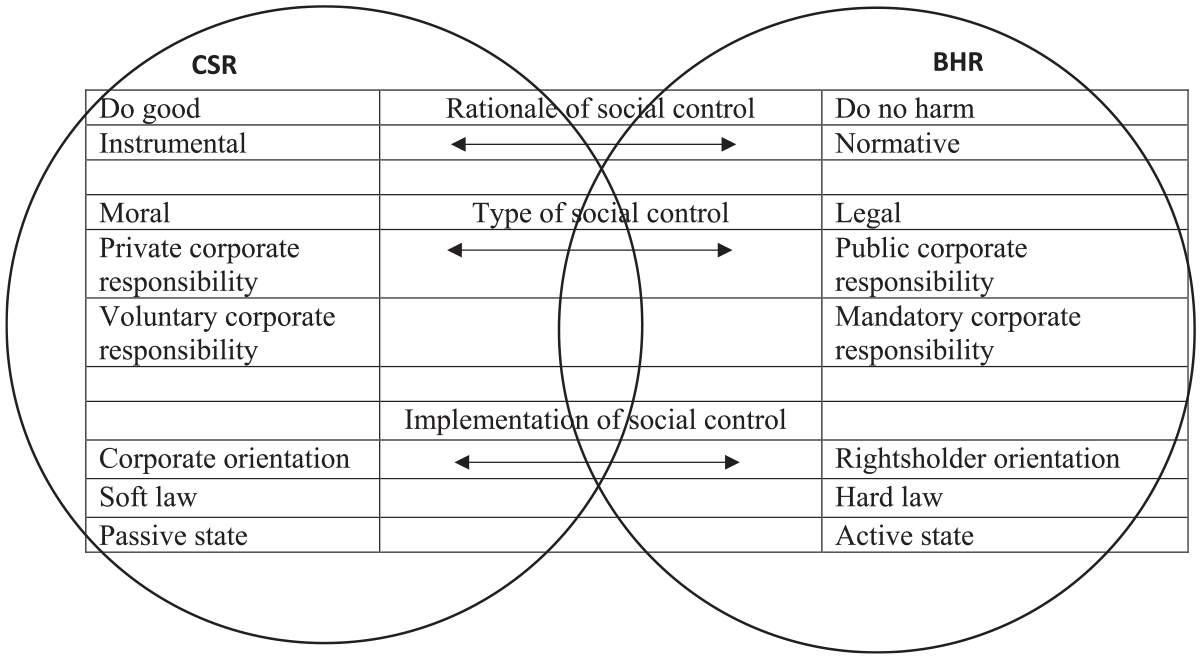
The social control of business spectrum characterizing the differences between corporate social responsibility and business and human rights.
Analyzing the Relationship Between BHR and CSR
Business and society, as a broad research field, addresses the economic, social, and political roles of business in relationship to various stakeholder groups and different dimensions of society (Berman & Johnson-Cramer, 2019; Wood & Logsdon, 2019). Discussions related to the responsibility of for-profit organizations of all types and sizes are central to the business and society field and are approached through normative, conceptual, and empirical methodologies. Over time, different conceptions of and frameworks for corporate responsibility have been developed, all seeking to specify the nature, content, and source of business obligations as well as their institutionalization and implementation in practice.
While there are myriad ways of charting the terrain of business and society scholarship, we center our analysis around the theme of the social control of business, which has a long provenance within the field (Jones, 1980; Stone, 1975). It is defined in terms of why and how society makes business act responsibly and channels business behaviors toward socially desirable ends. We adopt the social control theme because it best encompasses the various frameworks found within business and society scholarship—CSR, corporate citizenship, corporate social performance, and sustainability, to name but four—and furthermore, because it also helps to describe the goals of social movements and activist groups that have sought over time to change the behavior of business. As such, it provides a coherent rationale to make sense of both BHR and CSR, and thus based upon which outlining a common research agenda becomes possible. Jones (1983, p. 560) proposed that “[i]n essence, the social control of business is at the core of the business and society field,” and further argued (ibid.) that there were two general questions underpinning research in the field:
“How compatible are the outputs and processes of the economic system with the values of the cultural and political system? [. . .]
How can the outputs and processes of the economic system be made more compatible with the values of the cultural and political system?”
Put another way, if business activity on its own, in all times and places, brought about wholly positive outcomes for stakeholders and society as defined by stakeholders and society, there would be no need for any social control of business. CSR, in this line of analysis, can be understood as a reaction to business behavior that is not perceived to be consonant with the values of cultural and political systems that are affected by business actions. Environmental degradation, executive remuneration, or increasing social inequality are but a few contexts in which such deviations between the conventional mode of doing business and shifting societal perceptions can be observed. More generally, CSR scholarship has been informed by analyses of negative externalities experienced by various stakeholders (Braouezec & Joliet, 2019; Johnston et al., 2021).
The compatibility between corporate activity and the broader expectations of society is increasingly being questioned, making a renewed scholarly focus on the social control of business particularly relevant. Such skepticism manifests itself in the growing social and political pressures facing business. Domains of business and society research, such as social movements or private governance and multistakeholder initiatives, have studied mechanisms of social control that are led by stakeholders and civil society (den Hond & de Bakker, 2007; King, 2008). In turn, domains for business and society research, such as corporate political strategy, have engaged with business efforts to resist or to change such attempts at social control (Schuler & Rehbein, 1997). Defining the social control of business as an organizing principle of the business and society field allows us to sort research in the field, and BHR and CSR research in particular, along three dimensions: rationales for social control, types of social control, and implementation of social control. Each dimension answers a key question in terms of social control: why, what, and how respectively. The rationales for social control refer to why such controls are needed in the first place; this dimension refers to the motivations for social control as understood by those parties that are seeking social control over business. The types of social control refer to what the controls look like; that is, their descriptive features. Finally, the implementation of social control refers to how social controls are implemented: the mechanisms and operationalization of the social control of business.
In the following subsections, we elaborate on each of the three social control dimensions and illustrate how BHR and CSR are at opposing ends of each (see Figure 1). The circles in Figure 1 illustrate the currently existing boundaries of BHR and CSR that have emerged as a result of how the two developed. However, this Venn diagram also illustrates that BHR and CSR share some common ground, and ultimately our analysis seeks to surface ways how insights from BHR can be useful to future CSR scholarship and, thereby, business and society scholarship in general.
Rationales for Social Control
To the extent that social control of business is deemed to be necessary—whether by stakeholders, governments, or society—there should be a rationale for why this is so. BHR and CSR originate from different, albeit related, perspectives regarding the rationales for social control. Both BHR and CSR start with the general proposition that business behavior needs to change in some sort of way to be consonant with ethical obligations and social expectations. However, the rationales for social control for BHR and CSR diverge in important ways.
The relative fuzziness and indeterminacy of CSR has been one of the main and most consistent points of critique leveled against CSR since its early days (Votaw, 1972): CSR has been referred to as an “umbrella term” (Scherer & Palazzo, 2007, p. 1096) or a “sensitizing concept” (Jonker, 2005, p. 20) that includes different social issues. Grounding these issues in a consistent normative foundation has proven difficult if not impossible. Thus, CSR has always been driven by those issues themselves, rather than by an underlying and consistent normative narrative (Frederick, 1978/1994 and 1986; Mitnick et al., 2021). Accordingly, criticism of positivism and instrumentalism undermining a coherent normative frame has always loomed large against CSR (Scherer & Palazzo, 2007). Beyond such instrumentalism and positivism, normative scholarship on CSR has largely been idiosyncratic, encompassing normative frameworks as disparate as utilitarianism, Kantian ethics, and virtue ethics (Bowie, 2017; Chakrabarty & Bass, 2015; Renouard, 2011), which has contributed to a certain perceived arbitrariness underlying CSR.
This is not to say that normative thinking has been entirely absent in CSR but rather than being driven by the issues themselves, analyses of normative obligations have often taken a back seat to instrumental firm-level outcomes (Banerjee, 2008). The influential role that instrumental business-case thinking has traditionally played within the CSR discourse is symptomatic both of this normative void and the dominance of the corporate perspective on the issues to be addressed within CSR. Management scholarship has identified this problem as well, calling for a stronger incorporation of a normative dimension in CSR (Donaldson & Walsh, 2015; Wang et al., 2020). In a related fashion, some scholars have called out CSR for its “do good” rationale and a respective neglect of engaging with the negative side-effects of business activities (Bakan, 2004; Banerjee, 2008; Ulrich, 2008). Rationales for the creation of good can be found, for example, in the roles of business for sustainable development (Verbeke et al., 2014), the creation of shared value (Porter & Kramer, 2011), or poverty alleviation (Prahalad & Hammond, 2002; Prahalad & Hart, 2002; Yunus, 2010).
In contrast, BHR has strong normative foundations with a focus on harm avoidance and moral minimums that center the concerns of rightsholders. Exploring and clarifying the normative question about whether or not, or to what extent, or to whom business owes human rights obligations was the key research agenda in BHR’s early years, addressed both by legal (Cassell, 1996; Frey, 1997; Ratner, 2001) and nonlegal BHR scholars (Arnold, 2003; Cragg, 2000; Donaldson, 1992; Donaldson & Dunfee, 1999). The normative foundation of BHR is also related to the fact that BHR is about (moral) rights and associated remedies that are binding and pre-existing, whether or not they are protected by states or respected by businesses. Human rights are moral rights that “exist prior to, or independently of, any legal or institutional rules” (Feinberg, 1973, p. 84). They are independent of any laws or regulations, as well as local cultures and practices. Human rights are the basis of an individual’s freedom, autonomy, and dignity (Nussbaum, 2002). Violations of such fundamental rights are a “form of humiliation, that is, a form of disregard of a human being’s human quality” (Wettstein, 2012, p. 741). Thus, human rights violations are closely linked to a quest for remedy to undo the victim’s humiliation and restore the victim’s dignity and freedom.
Linked to this normative foundation is BHR’s focus on harm avoidance when it comes to the rationale of social control. Ramasastry’s (2015, p. 240, emphasis added) description of the objective of BHR is a case in point when she describes corporate responsibility as “a core obligation of companies to respect human rights wherever they operate, to do no harm and when harm is caused to provide a meaningful remedy to victims.” Given this foundation, BHR can be understood as having developed out of a crisis with increasing cases of human rights violations resulting in a search for mechanisms to remedy existing harms and avoiding future harms (Drimmer & Laplante, 2015; George & Laplante, 2017; Knuckey & Jenkin, 2015; Stephens, 2017; Thompson, 2017). To summarize, we view CSR research as mainly (yet not entirely) characterized by an instrumental rationale with a focus on doing good (Verbeke et al., 2014), while BHR has strong normative foundations with a focus on avoiding harm (Bilchitz, 2010; Wettstein, 2015).
Types of Social Control
The second dimension of the social control of business is concerned with the types of social control. There are three questions to consider: what does the control look like, how is the control effected, and who brings about the social control? BHR and CSR differ in how they conceptualize the type of social control.
From its early days, CSR has been conceptualized as a voluntary, discretionary responsibility (Carroll, 1979). One of the most foundational conceptualizations of CSR, Carroll’s 1979 pyramid, is a case in point. He divided CSR into four elements: economic and legal, which are required, ethical, which is expected (i.e., voluntary), and philanthropic, which is desired (i.e., again, voluntary). This voluntary dimension of CSR has continued in CSR research, including one of its latest contributions, political CSR, which addresses the role of companies in governance and the provision of public goods in domains traditionally associated with the state (Matten & Crane, 2005; Scherer & Palazzo, 2007). While political CSR focuses on the rising political responsibilities of business, it is at best ambiguous about the normativity of those responsibilities.
Linked to voluntary types of social control is that corporate responsibility tends to be considered as a private responsibility (Wettstein, 2020). That is, social expectations of business responsibility are internalized by business and thereby occur in the private space of the company that the company organizes, constitutes, and invites participants into. Following rising responsibility demands companies have introduced (voluntary) employee and supplier codes of conduct, signed up for (voluntary, private) multistakeholder initiatives and engaged in other practices that CSR scholars examine, among others, for their effectiveness (Scherer & Palazzo, 2011; Scherer et al., 2016). Thus, CSR is rather about moral social control.
Moral social control encompasses societal and stakeholder expectations of business responsibility that are not enacted into law. As a domain of private social control, moral social control relates to voluntary relationships between businesses and various stakeholders meant to change the behavior of businesses toward more responsible ends. Moral and private social control can be brought about in myriad ways, including social auditing and reporting, voluntary standards, and multistakeholder initiatives. The private space for business responsibility is characterized by voluntary adoption and large discretion in terms of discharging responsibility (Carroll, 1991). CSR (Carroll, 1991) and stakeholder management (Berman & Johnson-Cramer, 2019) are positioned toward the private space, whereas more recent conceptualizations on the political role of business actually do shift corporate responsibility toward the public space (Matten & Crane, 2005; Scherer & Palazzo, 2007).
In contrast, BHR is at the opposite end of the social control type dimension. BHR conceptualizes corporate responsibility as a public corporate responsibility (Wettstein, 2020). As mentioned previously, BHR developed out of a crisis—human rights violations kept occurring and businesses were involved—and yet victims of those violations were left empty-handed and without redress under normal regimes of business responsibility (Ramasastry, 2015). From this crisis mode, BHR tends to see corporate responsibility for human rights as a mandatory obligation, thereby taking it out of the private, voluntary sphere into the public sphere as the private sphere does not generally work to make victims of rights abuses whole. Put another way, we perceive CSR to be built on voluntary and private structures in which businesses play the leading role, while BHR posits that changes in business behavior come from public control in fora not controlled by businesses. Thus, BHR has approached social control through tighter business controls by governments and therefore through calls for mandatory corporate responsibility (Deva & Bilchitz, 2017).
With their focus on negative responsibility, legal BHR scholars set the course of the BHR perspective early on toward questions of enforcement and accountability. Some high-profile foreign direct liability cases in American courts inspired early academic contributions on civil liability and corporate human rights litigation (Boyd, 1999; Everett, 1998; Tzeutschler, 1999; Zerk, 2006), which evolved into one of the main areas of legal scholarship in BHR in subsequent years (Baughen, 2015; Meeran, 2021b; Palombo, 2019). Legal BHR scholars have been examining how far existing law, both national and international, can be applied to hold business accountable for human rights violations or evaluating alternative options for mandatory human rights obligations (Bernaz, 2017; Bilchitz, 2016; Rivera, 2019). Therefore, BHR has mainly relied on legal social control.
Implementation of Social Control
Finally, depending on the type of social control, the implementation of social control varies and therefore affects the role and actions of business, state, and society differently. This third dimension refers to how social control is implemented by different actors and how business adopts the types of social control in ways that are institutionalized as a matter of practice. More specifically, this dimension is about the orientation that business takes when implementing its responsibilities, the conceptualization of the role of the state, and—linked to the previous dimension—the role of soft and hard law.
The theorization of CSR has been largely corporate-centric from its early beginnings. What initially triggered interest in this domain was the development of the modern corporation with widely dispersed ownership that was becoming a “powerful corporate machine, which so successfully grinds out the goods we want, [that] seems to be running without any discernible controls” (Mason, 1959, p. 3). This rise in corporate power sparked business scholars, economists, and executives to evaluate the role of business in society (Drucker, 1946). Unsurprisingly, early views on the responsibility of business people (Bowen, 1953) were framed with a view of the company as the center of analysis. This largely did not change even with the advent of stakeholder theory and its focus on stakeholder relationships (Berman & Johnson-Cramer, 2019). The corporate view on the maintenance and management of such stakeholder relations, or of the management of CSR more generally, is predominantly the center of attention. In other words, notwithstanding the thematic breadth of CSR research, what unifies such scholarship at its core is that it is predominantly formulated with a view and impact on the company at the center of analysis (Burke & Logsdon, 1996; Davis & Blomstrom, 1975; Griffin & Mahon, 1997; McAdam, 1973; Sethi, 1979; Waddock & Graves, 1997). With its corporate orientation, CSR tends to isolate corporate responsibility from the responsibility of other actors—particularly from state responsibility. In this line of analysis, the state is therefore conceptualized as a largely passive provider of the necessary background institutions, such as rules and regulation (Schrempf-Stirling, 2014).
We note here that political CSR has been challenging the adequacy of this traditional view of the strong state, particularly in the context of governance gaps in the global space (Scherer & Palazzo, 2007). Even though later contributions to political CSR have acknowledged the role of the state (Scherer et al., 2016), political CSR scholarship in the main still locates the state more in the background (Schrempf-Stirling, 2018; Whelan, 2012); that is, as context rather than as an agent that interacts with business in various ways and capacities, and thus actively shapes not only the space in which corporate responsibility takes place but also the contours of such responsibility itself. With the state being a rather passive actor in the background, social control is mainly implemented by nonbusiness and nonstate actors through nonbinding standards or so-called soft laws. Thus, within CSR, there is considerable research on the role of civil society organizations or multistakeholder initiatives and how they can successfully function and develop standards for business to follow (de Bakker et al., 2019).
Given that BHR developed out of a crisis in which individuals’ human rights were being violated without remedies, BHR in contrast to CSR has a strong rightsholder orientation. BHR is about preventing and remedying human rights violations. Consequently, BHR scholars have been addressing the question of access to remedy both with regard to state-based approaches (Drimmer & Laplante, 2015; George & Laplante, 2017; Stephens, 2017) and corporate-level operational grievance mechanisms (Knuckey & Jenkin, 2015; Thompson, 2017). Contrasting with the passive role of the state in defining and enforcing a particular CSR agenda as a private matter, a view on rightsholders can no longer ignore the relationship between business and government for the conceptualization of corporate responsibility. It has been the very raison d’être of BHR to challenge the view of states as exclusive bearers of human rights responsibility. As such, BHR assigns the state an active role in not only defining what human rights responsibility of business ought to entail but also in implementing social control through which such responsibility is directly enforced. CSR, on the other hand, is largely left to the discretion of businesses, both in terms of its content and its direct enforcement.
Accordingly, in BHR, the law has traditionally played a much stronger, more “interventionist” and dynamic role than in CSR (Wettstein, 2016). The implementation of the UNGPs at the state level led many governments to enact NAPs on BHR, which inspired subsequent research on this particular policy tool (Bordignon, 2016; Rivera, 2019). More broadly, home-state solutions—regulatory, legislative, and adjudicative measures with extraterritorial effects in home states of multinationals—have become one of the key research areas in BHR (Bernaz, 2017; Palombo, 2019; Simons & Macklin, 2014).
Our analysis highlights how BHR and CSR differ with regard to the rationale, type, and implementation of social control. However, as illustrated in Figure 1, we see the three dimensions along a spectrum. Even though BHR and CSR are at opposing ends of the spectrum, it does not mean that BHR and CSR are static. To the contrary, as Wood and Logsdon (2019, p. 1353) state, the objective of business and society scholarship “is not to solidify its own knowledge base and professional structures into a definable, distinct discipline with high boundaries but to continually point the way toward the next big set of issues, problems, experiments, and solutions in business-society relationships.” It is in this “boundary spanning” spirit (Wood & Logsdon, 2019, p. 1340) that we outline a research agenda for BHR-informed CSR in the following section and where our article contributes to existing reviews of BHR and CSR. While existing contributions compared BHR and CSR and noted how the two are diverging, our aim is to offer a perspective for setting BHR and CSR on a converging path.
A Research Agenda for BHR-Informed CSR
Based on our discussion in the previous section, we see the promise of human rights for business and society scholarship in general and CSR more specifically. CSR scholarship has traditionally focused more on “good” business conduct and voluntary corporate responsibility, and it tends to adopt a corporate-centered outlook that often manifests in instrumental approaches to corporate responsibility. However, it seems that a certain preoccupation of CSR with voluntary, desirable, and praiseworthy activities and projects has led it to lose touch with the responsibility essentials—what must be done as a moral minimum—that ought to underlie any such engagement (Wettstein, 2012). It has put little emphasis on harm avoidance and remediation, the role of the state and regulation, and on putting rightsholders at the center of attention. In fact, the lack of focus on such underlying basic requirements has been one of the reasons for why the critiques of “greenwashing,” “window dressing” or of CSR as a “smokescreen” have persistently accompanied CSR scholarship (Banerjee, 2014; Connors et al., 2017). More to the point, a focus on “doing good” cannot make up for a perceived failure not to cause harm or to take responsibility for harm that may have occurred. This is particularly true when there is a mismatch between those for whom a business is doing good—who are often either powerful stakeholders or recipients of voluntary philanthropy—and those who are being harmed, such as victims of human rights abuses. Thus, a rightsholder-orientation can go a long way in providing a normative anchor and a respective re-centering of priorities.
In this vein, BHR, with its rightsholder orientation and its strong focus on public accountability, has first and foremost been about the nonviolation of human rights and the respective remediation in cases where human rights violations have occurred. Based on BHR’s focus on avoiding harm, protecting rightsholders, and holding business accountable for human rights violations, we propose four future research avenues for a BHR-informed CSR research agenda: (a) rightsholder-centered business strategies, (b) re-introduction of compliance orientation, (c) accountability for harm, and (d) remedy for corporate human rights violations. Table 1 provides an overview of the research agenda.
A Research Agenda for Business and Human Rights (BHR)-Informed Corporate Social Responsibility (CSR).
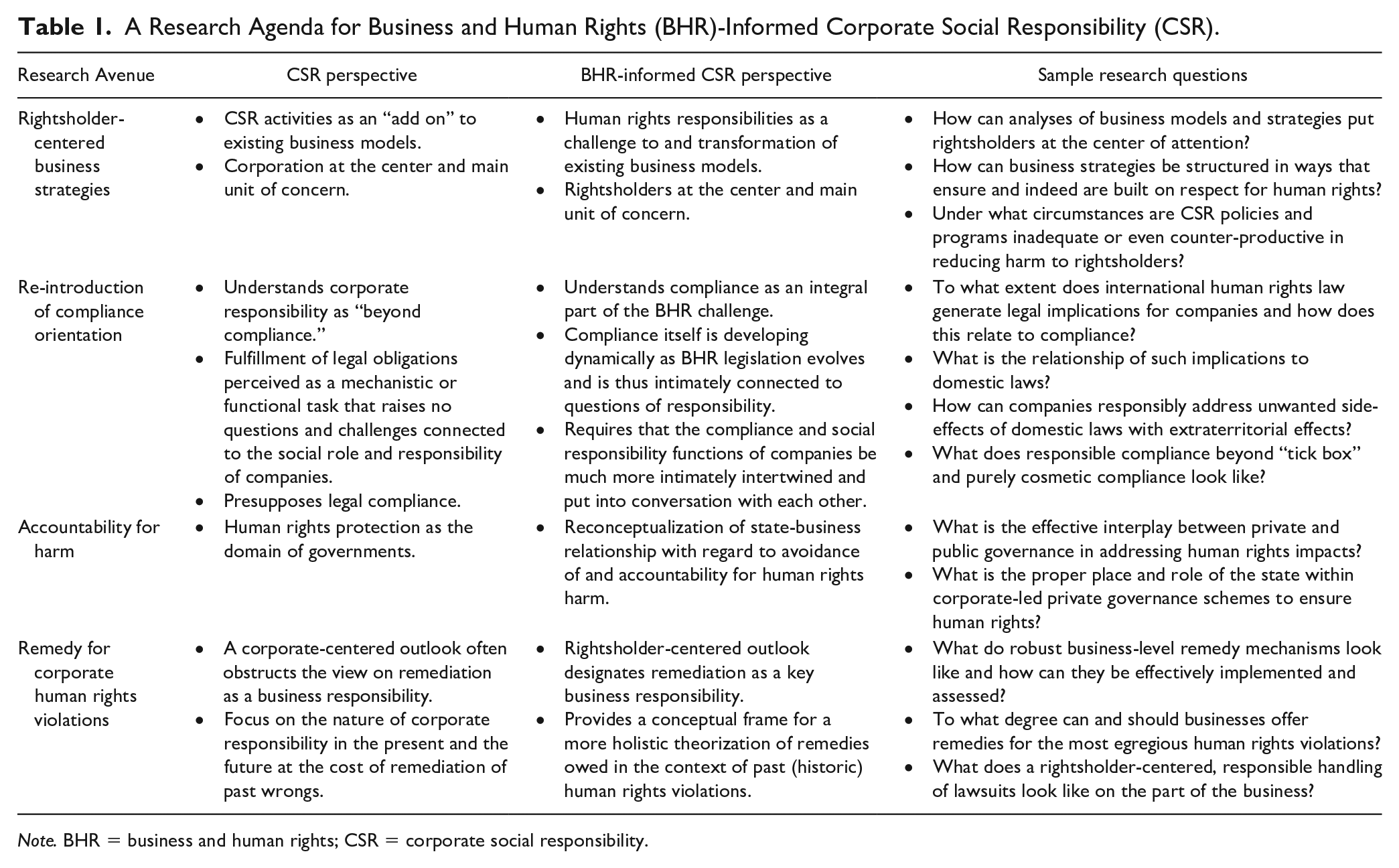
Note. BHR = business and human rights; CSR = corporate social responsibility.
Rightsholder-Centered Business Strategies
First, we propose a rethinking of CSR in terms of whether and how business strategies not only account for, but indeed put rightsholders at the very center of attention. A BHR perspective on CSR centers on the position of rightsholders, seeking to analyze whether business strategies are structured in ways that ensure and indeed are built on respect for human rights.
CSR scholarship, we submit, seeks to integrate concerns about responsible behavior onto existing business models with the goal of making those models and associated business practices more “ethical.” Thus, it is often treated as an “add on” to existing, potentially inherently unsustainable business models, rather than as a challenge to or even transformation of them (Ulrich, 2008). As a result, CSR as it has developed is limited in its ability to ask critical questions about whether business strategies are so fundamentally flawed that they cannot truly be responsible because they are highly likely to violate human rights (Banerjee, 2008; Fleming & Jones, 2013). The key difference between BHR and CSR is what and who is placed at the center of the analysis (Wettstein, 2020).
We perceive this as a decisive differentiator of CSR models or traditional stakeholder thinking because for such approaches, the business tends to remain the main unit of concern, which manages and controls the relationships with its environment. In these lines of analysis, stakeholder relations are interpreted, managed, and controlled from the perspective of business, even if the emphasis is on providing benefit to and meeting the needs of stakeholders. However, rights are fundamentally about empowerment as an intrinsic normative good. Their very purpose is to shift control in the relationship between rightsholders and corresponding duty bearers. In this respect, human rights give rise to stronger duties for business than do CSR or parallel concepts such as stakeholder theory. And, they also reduce the significance of potentially opposing corporate interests that are at play. CSR, as noted earlier, seeks to specify obligations for business to behave differently in ways that are consistent with social values and goals (cf. our previous discussion of social control). However, rights are different than more generalized, CSR-centric expectations to avoid harm and to do good in both degree and kind: the violation of human rights represents a genuine crisis and a moral wrong that must be remedied (degree), and further the human right itself that is being violated is a stronger and pre-existing obligation that supersedes business goals (kind). Furthermore, the duty of a business not to violate human rights is a stronger duty than one to provide resources for a community in which it has operations; the former is fundamentally about respecting the integrity and autonomy of those affected by business operations and thus about making their rights relevant for core business decisions.
BHR-informed CSR, we propose, allows for new avenues to be opened up in terms of specifying CSR through analyses of business-level strategies as they affect human rights. For example, BHR scholarship has sought to interrogate whether businesses violate the rights of employees, either directly in their own operations or indirectly through value chain relationships that seek to reduce costs but that often lead to rights violations (Van Buren et al., 2021). CSR analyses might seek to set minimum standards for employee treatment or for the labor practices of companies in the value chain, along with auditing and reporting. And to be fair, such efforts have made some difference at the margin. But rightsholder-centered analyses start with the rights of all employees, and then ask whether business strategies that seek to steadily reduce costs inevitably lead to violations of employees’ rights.
If the problem of BHR vis-à-vis employees is embedded in cost-reduction strategies, then the solution to such rights violations also has to be found in restructuring the strategies of firms to ensure that they do not occur. Firms may need to vertically integrate activities in which human rights abuses are rife or to work cooperatively with other firms on common sets of enforceable standards in which human rights are the central focus; on this point, Van Buren, Schrempf-Stirling, and Westermann-Behaylo (2021) recently elaborated on the implications for business strategies when eradicating modern slavery in their operations.
A key advantage of a BHR perspective is that human rights provide a coherent framework that makes such focused assessments possible. Indeed, as mentioned earlier, one of the key criticisms expressed toward CSR is that precisely such an overarching normative frame is missing and that CSR, as a consequence, has often come across as a loose and sometimes incoherent collection of voluntary activities chosen by businesses. As Ramasastry (2015, p. 238) notes, “BHR, while linked to CSR, and in some cases mistaken by newcomers as being identical, is a distinct field with expectations that measure company actions in light of key universal human rights concepts not simply voluntary codes or principles.” We note here that a BHR-informed CSR ought to ask deeper questions about whether the strategies of particular businesses are so likely to violate human rights that standard CSR policies and programs are inadequate or even counter-productive for reducing harm to rightsholders. For example, community development programs may produce collective benefit, but can also lead to further divisions and marginalization within communities if different groups are not adequately represented and their rights are not appropriately considered. More to the point, however, such activities cannot be substitutes for failing to prevent and remedy human rights violations toward employees or communities. Linking this to the discussion on the rationale of social control, BHR-informed CSR ought to move beyond the “do good” rationale or using CSR as an instrument to achieve a certain business-defined end. It is not the corporate perspective, but rather the rightsholder perspective, that ought to provide normative orientation for legitimate business practice.
BHR-informed CSR ought to question the fundamental assumptions of business models and strategies, focusing on questions such as “how can businesses operate without violating human rights?,” “what do rights-respecting business strategies look like?,” or related to specific practices: “what does a responsible outsourcing model look like where the rightsholders are front and center?”
The garment industry, for example, was one of the first industries singled out by activist groups (Ballinger, 1997) and prominently discussed in CSR scholarship (Epstein, 1987; Wokutch, 2001). The responses to child labor and inhuman working conditions in garment supply chains have traditionally been voluntary supplier codes of conduct, voluntary supply chain auditing, and voluntary reporting on the results to stakeholders (White, Neilsen, & Valentini, 2017). Yet, these CSR responses address only the symptoms of the issues—such as observable labor abuses—whereas the root cause of labor abuses lies in the way that the garment industry operates: the short-term contracts, rush orders, and piece-rate compensation, to name a few business practices emanating from strategic choices (Taplin, 2014). In addition, CSR responses such as supplier codes of conduct or audits shift responsibility and pressure to suppliers to conform, leading yet to other unintended side effects, such as double-bookkeeping and subcontracting. In sum, BHR-informed CSR ought to turn to the fundamental issue and root causes of irresponsible business behavior—violations of human rights that are the likely result of cost-oriented business models—and question the business model of outsourcing and other practices (Hess, 2019; Nolan, 2017).
Re-introduction of Compliance Orientation
While legal responsibilities have once been viewed as an integral part of CSR (Carroll, 1979), they have, over time, come to be viewed as external to it. Today, CSR is generally understood as corporate responsibility “beyond compliance,” as if the fulfillment of legal obligations were a purely mechanistic or functional task that raises no questions or challenges connected to the social role and responsibility of companies. Compliance refers to respecting and obeying laws and regulations. Compliance with the law tends to be presupposed and looked at as a given in CSR; the tricky normative challenges therein are perceived to only occur beyond compliance. The same observation has been made (and criticized) with regard to “creating shared value” approaches (Porter & Kramer, 2011); critics have argued that it is naïve to presume compliance simply as a given in a world in which “the absence of compliance. . . is a key problem of multinational companies” (Crane et al., 2014, p. 140). Thus, as they sum up:
Taking compliance with such standards as “presumed,” the CSV concept ignores the most pressing social problems corporations are facing along their globally stretched value chains, and it motivates corporations to focus on the low hanging fruits of easy win-win projects instead of solving systemic social and environmental problems to which they are connected (Crane et al., 2014, p. 140).
However, it is clear that CSR has been buttressed by regimes of regulation and legal compliance (Gond et al., 2011; Steurer, 2010)—and further, CSR itself is becoming the subject of more and more regulation (Jackson et al., 2020). In this respect, a BHR-informed CSR can be useful to CSR scholars seeking to unpack the relationships among business, society, and government. For example, it is unclear to what extent international human rights law generates legal implications for companies and what the relationship of such implications would be to domestic laws. Symptomatically, in Principle 23, the UNGPs call upon business to look at human rights risk as a legal compliance issue. They do so despite making expressly clear that the responsibility to respect human rights is not a legal responsibility of business, but one deriving from social expectations.
Furthermore, the legal BHR landscape is constantly shifting, with new laws being enacted at the domestic level in numerous countries. Particularly where such laws yield extraterritorial effects in the Global South, compliance must be coupled with social responsibility because it is still unclear what the potential unintended effects of such laws may be. Thus, businesses should approach their compliance with such laws from a broader human rights perspective and make sure that potential consequences, such as withdrawing from an area that is deemed too risky from a compliance perspective (Wettstein, 2021, p. 321), are assessed holistically. Bringing compliance back under the umbrella of BHR-informed CSR, from an organizational point of view, would mean strengthening the interface between what has traditionally been viewed within companies as the compliance domain on the one side and the CSR domain on the other. Here we observe that the two domains tend to have little interaction in business practice, following their own, often conflicting agendas. Understanding the compliance function as an integral part of dealing with corporate human rights responsibility inevitably raises the question of coherence between the two corporate domains.
BHR-informed CSR ought to take yet a step further and unpack the conceptualization, purpose, and implementation of compliance. For example, recent research in BHR describes corporate supply chain compliance programs as “risk management tools” with a “tick box mentality” leading to “cosmetic compliance” (Nolan & Bott, 2018, p. 3). Future research can therefore usefully examine the root causes of compliance challenges. One fundamental challenge is that business can claim compliance because they subcontract so much that human rights violations occur in distant places, enabling those businesses to engage in “willful blindness” (Pierce, 2010, p. 598). A rightsholder and human rights perspective would place responsibilities of businesses throughout the complete supply chain to ensure that rights are respected, and in so doing would treat efforts at decoupling as emblematic of complicity in human rights violations in their own right.
Accountability for Harm
Traditionally, human rights have been perceived as the exclusive domain of government. Thus, extending corporate responsibility into the human rights realm inevitably means rethinking state responsibility, particularly the contemporaneous relationship between state and business responsibility. It is simply impossible to conceptualize corporate human rights accountability without simultaneously addressing the respective responsibilities of the state, because defining one necessarily defines the other. This is why BHR has always been essentially about the reconceptualization of both governmental and corporate responsibility for human rights. A case in point for this insight are the UNGPs, which address the responsibility both states and business in one unified standard. It is one of the key strengths of the UNGPs, particularly from an accountability perspective, that both corporate and state responsibility for human rights are addressed in the same coherent framework.
Hence, BHR is not merely about adding human rights responsibilities to the portfolio of business responsibilities; rather, at a more fundamental level, it implies nothing less than a reconfiguration of the state-business relationship more generally, on one hand, to hold business accountable for past harm and, on the other hand, also to contribute to harm avoidance. Thus, our view is that BHR can nudge CSR to re-engage with those two central actors (Schrempf-Stirling, 2018), particularly with regard to the interface and interaction between them.
Focusing on human rights responsibility, the interaction and intersection between state and business turns into an increasingly interesting ground for future research in CSR. For example, it requires redrawing the line between public and private responsibility and thus raises the more general question about adequate accountability regimes in CSR. Theorizing the state-business relationship from the perspective of accountability regimes raises the question about the effective interplay between private and public governance in CSR. Private governance refers to standard-setting schemes primarily created and maintained by and for nonstate, private actors such as businesses, nongovernmental organizations (NGOs), or international institutions (Reinecke et al., 2012). This also raises the question about the proper place and role of the state within corporate-led private governance schemes as well as leveraging the state’s role to create enhanced accountability within such initiatives. For instance, the state’s role can range from supporting and endorsing such private governance schemes to opposing and developing alternative schemes (Mills, 2016; Schrempf-Stirling, 2018). Several recent studies emphasize the interplay between public and private governance (Eberlein, 2019; Hamann, 2019; Schneider & Scherer, 2019). Expanding the focus to the human rights context can contribute to developing such conceptualizations further. As discussed earlier in the article, there is significant momentum in BHR policy and regulation, with private governance schemes developing in addition to new mandatory regulation. This is a fruitful context to examine the role of and interaction between state and business in formulating such governance schemes and their content (Schrempf-Stirling & Wettstein, 2021). This point is confirmed by a recent literature review by Rasche and Waddock (2021, p. 14), who conclude that the
NGPs will play an important role in the future development of the institutional infrastructure underlying CSR, because they provide a clear and widely acknowledged reference point for defining the roles and responsibilities of different groups of actors that are involved in closing some of the omnipresent global governance gaps that surround all of us.
Thus, BHR-informed CSR ought to ask deeper questions about the fundamental roles and responsibilities of the state and business in accounting for past human rights violations. Analyzing and (re)defining the roles and responsibilities of state and business, we posit, will ultimately have an impact on harm avoidance.
Remedy for Corporate Human Rights Violations
Remedying past harm is not generally something with which a business can attract positive stakeholder attention or which bears inherent business risks if done badly. Thus, from the perspective of construing a business case for harm remediation, remedy seems to be a rather unattractive responsibility. This may be one reason for why remediation has been a relative blind spot in CSR research and practice: the corporate-centric outlook of CSR has not designated remediation as a priority issue.
From a rightsholder-centered perspective, however, remediation turns into one of the most important, if not the most important element, of corporate responsibility because it addresses the plight of those who have already suffered harm. Whose claims, if not those, when human rights have been violated should be addressed with the utmost urgency? Thus, BHR-informed CSR can broaden the spectrum of taking responsibility to include and indeed prioritize remedy for harms experienced by rightsholders.
We suggest that CSR has addressed the nature of corporate responsibility in the present and the future at the cost of developing frameworks for remedying past wrongs that have concrete, negative, and ongoing effects on stakeholders. BHR offers an important retrospective perspective, useful to CSR research, on stakeholder harm and the ethical obligations of business to ameliorate those harms. However, it also seems that BHR-informed CSR scholarship would have much to offer when it comes to conceptualizing adequate remedy for human rights harms. BHR has put much of its attention on the conceptualization of judicial pathways to remediation. Nonjudicial avenues, such as the conceptualization of operational-level grievance mechanisms, have remained relatively underdeveloped and often inadequate (Thompson, 2017).
BHR-informed CSR scholarship on remediation ought to create more robust conceptualizations of business-level remedy mechanisms as well as their implementation, including ongoing assessment. Furthermore, building on current managerial and business ethics research regarding the restoration of relationships in the aftermath of moral transgressions (Wenzel & Okimoto, 2015), such research could expand to include alternative forms of remedy provisions, such as apologies (Koehn, 2013) and other forms of symbolic remedies (Vives et al., 2019). Similarly, recent scholarship on historic CSR (Schrempf-Stirling et al., 2016) can provide a conceptual frame for a more holistic theorization of remedies owed in the context of past (historic) human rights violations. The interplay between access to judicial remedy and nonjudicial—particularly business-level—remedy mechanisms has long needed further research.
Judicial remedy refers to how a right is enforced and victims receive remedy by a court, whereas nonjudicial remedy refers to processes related to providing remedy to victims of human rights violations that do not involve legal institutions, such as court orders. Examples of non-judicial remedy mechanisms include OECD National Contact Points or business-level grievance mechanisms. It is, for example, unclear to what degree business should be offering remedies for the most egregious human rights violations or if such transgressions should per se be adjudicated in courts. This point is intertwined with our previous discussion on the accountability for harm as well as the respective roles of and relationship between state and business when it comes to human rights violations. Future research on the role and relationship between state and business is not only needed with regard to harm avoidance in general, but also with regard to providing remedy. While we have discussed these research streams separately, there is considerable overlap between harm and remedy by the very nature of human rights.
Furthermore, the role of corporate lawyers in defending corporate interests against allegations of rightsholders has frequently been problematic (Ruggie, 2013, pp. 196-197), which evokes further important questions: What does a rightsholder-centered, responsible handling of lawsuits by businesses look like? That is, what if corporate interests cease to be the absolute benchmark for a corporate defense in court and the broader social responsibilities of business are taken into consideration (Ruggie, 2012)? It seems that BHR-informed CSR would have much to contribute to such a reconceptualization of legitimate corporate legal defense strategies and their relationship to access to remedy for those who have suffered rights violations.
Concluding Remarks
BHR has become more prominent in policy and corporate practice. As a result, BHR scholarship has been thriving. Yet, its thriving has been occurring largely outside the business and society field—a field that has much in common with BHR. In his invited essay for the 60th anniversary of Business & Society, Carroll (2021) acknowledged that work in human rights holds significant promise for CSR. In this article, we have unpacked this promise and offered different pathways for how BHR can expand business and society scholarship in general and its foundational construct, CSR, in particular. We have shown how BHR and CSR share a common foundation in terms of the rationale, type, and implementation of social control, but are mainly at opposing ends of these dimensions. We therefore have proposed several avenues for future research on BHR-informed CSR. Business and society is a dynamic field of study that prides itself on addressing the next big issues at the intersection of business and society. We hope that our article provides an impetus for expanding business and society’s scholarship by outlining promising as well as necessary avenues for future research to address fully the role and responsibilities of business in society.
Footnotes
Acknowledgements
The authors thank special issue co-editor Kathleen Rehbein for her exceptional guidance and three anonymous reviewers for their constructive comments.
Declaration of Conflicting Interests
The author(s) declared no potential conflicts of interest with respect to the research, authorship, and/or publication of this article.
Funding
The author(s) received no financial support for the research, authorship, and/or publication of this article.
