




Abstract
While most studies on family firm branding report positive reputational consequences, we lack empirical evidence to which degree these benefits vary across different geographical contexts. This study explores associations elicited by the term family business in Germany, India, and the United States and discusses reasons for the varying differentiation power of the family firm signal. Our large-scale association study (n = 1,383) reveals that prototypical family firm perceptions are prevalent in the United States and Germany, but less in India. Through qualitative insights and an experimental study, we investigate why the power of the family firm signal to enhance reputation varies across countries.
Keywords
Research Questions
To what extent do perceptions of and associations with family businesses differ across countries?
Why do perceptions of and associations with family businesses differ across countries?
Implications
Practitioners should consider the country-specific context of different markets when deciding whether to emphasize the family business nature of an organization. This study indicates that while highlighting family business status positively impacts brand reputation in the United States and Germany, it provides little value in India.
To effectively utilize the family firm signal, it is crucial to consider the context-dependent uniqueness it triggers. In Germany and the United States, the family firm signal sets an organization apart from its (non-family) peers, evoking associations of trust and localness, whereas in India, the family firm signal lacks differentiation, making it difficult to activate such associations, as it aligns with the widely perceived organizational form in the country.
Introduction
Family firms make up the vast majority of businesses around the globe. Family firms account for approximately 80% to 90% of all businesses in the United States, employ around 60% of the total U.S. work force, and are responsible for 30% to 60% of the domestic gross domestic product (GDP) (Astrachan & Shanker, 2003; Pieper et al., 2021). 1 In other parts of the world, such as Europe or Asia, family firms typically account for 95% of all businesses (De Vries & Carlock, 2010; Zellweger, 2017). Despite their omnipresence, communicating the family nature of a firm seems to be an effective signal to enhance corporate reputation (Lude & Prügl, 2019; Schellong et al., 2019), that is, how external stakeholders perceive an organization (Brown et al., 2006). Notwithstanding the obvious heterogeneity of family firms, external stakeholders regularly describe those companies as a “unique entity within the business environment” (Carrigan & Buckley, 2008, p. 664) with specific characteristics and associations, such as small, local, traditional, or trustworthy (Jaufenthaler, 2022).
Lately, scholars increasingly address contexts where the signal “family firm” may be risky (Binz Astrachan et al., 2019; Block et al., 2019; Jaufenthaler, 2022, 2023). Within this debate, researchers have repeatedly claimed that the signal “family firm” might be interpreted differently across different cultural contexts and that positive consequences of this signal thus may not accrue globally (Beck et al., 2020; Binz Astrachan & Botero, 2017; Binz Astrachan et al., 2018, 2019; Block et al., 2016, 2019; Botero, 2014; Botero et al., 2018; Dos Santos et al., 2020; Jaufenthaler, 2022, 2023; Lude & Prügl, 2018; Neubaum, 2018; Shen & Tikoo, 2020). To date, however, we have little knowledge regarding possible differences in perceptions of and associations with family firms across different cultural settings, which may be one reason why few global brands emphasize their family background (Beck et al., 2020). Given the importance of family businesses across the globe and the well-known concern of family owners for the reputation of their companies, we see a significant research gap calling for a better understanding of family business perceptions and associations in different cultural contexts and the resulting theoretical and managerial implications (Binz Astrachan et al., 2018; Block et al., 2019; Neubaum, 2018).
Drawing upon the idea of context embeddedness (cf. Bronfenbrenner, 1979; Szapocznik & Kurtines, 1993), we speculate that institutions shape the perception of family and family firms in a country. To illuminate those speculations, we collect associations elicited by the concept “family business” in Germany, India, and the United States to understand what this concept triggers, respectively. We choose these countries because they show high heterogeneity regarding the three institutions family, economy, and national culture, which we propose to shape the perceptions of and associations with family firms in a country. We employ a recently developed analytical tool to provide a graphic illustration of “meaning clusters” linked to the signal “family business” and identify particularly intriguing differences between the two Western countries (Germany and the United States) and India. To shed light on potential reasons for these findings, we follow a common practice in scientific research and conduct two follow-up studies (Lude & Prügl, 2019).
By empirically exploring the meaning inherent in “family business” across different cultural contexts, this research makes several contributions to family business literature. Most significantly, this study’s findings contribute to the field of family firm branding and signaling (e.g., Beck & Prügl, 2018) in general and to the emerging debate on the context-sensitivity of family firm perception (e.g., Jaufenthaler, 2023) in particular. We thereby also contribute to the literature on brand reputation (e.g., Keller, 2021) and the value of brand associations to diagnose brand strength (Andreini et al., 2020). To the best of our knowledge, this is the first study to explore in depth the similarities and differences associated with family firms in different geographies. We extend existing literature by applying the lens of context embeddedness to discuss important country-specific institutional layers (family, economy, and culture) and their possible impact on individuals’ interpretation of the concept family firm. Moreover, by investigating family firm reputation in India, this study contributes to the important yet still understudied area of family business research in developing countries (e.g., Manikutty, 2000; Soluk et al., 2021). Based on our findings, we provide theoretical reasons, input from domain and cultural experts as well as a follow-up experiment, to gain insights into the question why family firms in India are perceived differently than their peers in Germany and the United States. Building on the emergent explanation that family firms vary in terms of perceived uniqueness across cultural contexts, we propose that the family firm signal shapes a specific perception of companies (relative to those not employing it) only where family firms are perceived as unique entities. Based on these learnings, we furthermore offer meaningful managerial recommendations on where to best leverage the family nature of an organization. In addition, this research also offers methodological contributions by introducing semantic network analysis (Caliandro & Gandini, 2016) into the research domain of family firms as a tool to provide graphic illustrations of association clusters linked to the family firm signal. The unique combination of semantic network analysis with qualitative methods and experimental research designs represents a new way of theoretically and empirically capturing this phenomenon and its underlying rationale.
Theoretical Background
The Family Firm Signal and Its Reputational Consequences
A company’s reputation (i.e., what people associate with the company) is a valuable intangible resource and a source for competitive advantage (Fischer & Reuber, 2007; Zellweger et al., 2012). For example, reputation can increase consumers’ preferences for a brand, facilitate access to talented applicants, or make it easier to attract investors (Fombrun & Shanley, 1990). One important component of a positive (corporate) brand reputation is differentiation or distinctiveness (Aaker, 2003; Sharp, 2018; Zaichkowsky et al., 2010), a specific quality of the company that allows it to stand out among its peers. Past research has shown that sources of differentiation are broad and range from associations directly linked to the offered product or service (e.g., its quality, ingredients, production process, or packaging) to non-product-related associations (e.g., country-of-origin, leadership style, heritage, or company culture) (Keller, 1993). The latter, often referred to as brand intangibles, plays an increasingly important role for brand building (Keller, 2021). To foster a desired brand reputation, organizations must choose which of many possible elements to emphasize in their communication. Signaling the family nature of a company, a brand intangible available to many organizations, has been shown to enhance brand reputation because it entails numerous elements that stakeholders may value (Jaufenthaler, 2022).
Synthesizing previous work on important perceptions of family businesses uncovers a broad spectrum of associations ranging from small and local (Orth & Green, 2009), traditional (Botero et al., 2018), socially responsible (Binz et al., 2013; Schellong et al., 2019), customer- (Jaufenthaler, 2022) and quality-oriented (Blodgett et al., 2011), secure and stable (Tabor et al., 2018), authentic (Lude & Prügl, 2018; Zanon et al., 2019) to having a long-term orientation (Botero et al., 2018), or being particularly trustworthy (Binz et al., 2013; Lude & Prügl, 2018). However, a few studies have revealed that family business reputation can also contain negative associations, for example, secretive (Othman et al., 2011), stagnant (Krappe et al., 2011), inefficient and unprofessional (Botero et al., 2018), or offering a limited product variety (Orth & Green, 2009).
Prior research on the effects of the family firm signal on important organizational outcome variables shows reputation-enhancing potential for the relationship with numerous stakeholders. For instance, jobseekers who appreciate conservation are particularly attracted by family businesses based on a person–organization fit and associations of security and stability (Hauswald et al., 2016). Nonprofessional investors tend to accept more risk when exposed to an investment option that signals a family firm background (Lude & Prügl, 2019). Lower risk-aversion likely results from associations like trust and longevity linked with family businesses (Lude & Prügl, 2019). Regarding the stakeholder consumer, prior studies report preferences for products signaling a family firm background (Binz et al., 2013; Lude & Prügl, 2018; Rauschendorfer et al., 2022), again triggered by higher trustworthiness and authenticity ascribed to family firms. Also, retailers who are perceived as a family business achieve greater new product acceptance than non-family retailers because they appear more trustworthy (Beck & Kenning, 2015). Based on these studies, one might conclude that the signal “family business” is a holistic and fundamentally effective building stone for organizational reputation. However, all of the aforementioned studies are set in Western Europe or the United States, and the reputational consequences of the family business signal may well depend on the context where the family firm is located. If the country context matters, local family companies need to understand the value of using the family firm signal and global family companies would have to carefully evaluate which touchpoints (e.g., global versus local communication) should emphasize this specific signal.
Cross-Country Variations in Family Firm Reputation
In this section, we discuss why family firm reputation may differ across countries, one of many possible contexts (e.g., industry, company size, company heritage) affecting the appeal of family firms. For example, research suggests that the appeal of family firms for jobseekers differs across markets because of labor market characteristics (Block et al., 2019) and that the trust advantage of family businesses over non-family businesses might not be universal (Edelman Trust Barometer, 2019).
We apply the notion of context embeddedness (cf. Bronfenbrenner, 1979; Szapocznik & Kurtines, 1993) to theorize how the three institutional layers family, economy, and culture may shape an individual’s perception of family firms in a specific country. The idea that individuals’ attitudes and behaviors form through the interplay of a complex set of nested structures (Bronfenbrenner, 1979) has first been adopted in the field of childhood development research, and also in business research for studying managerial mindsets (Mason & Harris, 2005) or organizational strategy formation (Menon & Menon, 1997).
We posit that the country context can affect individuals’ perceptions of family businesses because of the specific configuration of three embedded institutional layers that jointly shape the country-specific reputation of family firms: for example, (1) the perception of the institution family is likely to inform the content and, consequently, the valence of what people associate with family firms that may enhance or weaken the reputation of family businesses; (2) the perceived prevalence of family firms in a country’s economy impacts whether the family firm signal stands out and can contribute to a reputation that is distinct from firms that are not perceived as family firms; and (3) the cultural values that dominate in a specific country can impact the reputation of family firms by furthering the appeal of certain qualities associated with family firms.
We are aware that each of these layers individually consists of multiple factors shaping the reputation of family firms and that these factors will combine into a plethora of country-specific configurations. A comprehensive discussion how all these factors, let alone their combinations, may contribute to the perception of family firms in a country would therefore be illusionary. Rather, we aim at laying out the foundation for further inquiry and use these layers to structure our exploratory reasoning why family firms might be perceived differently in different countries, and whether the family firm signal stands out more in some countries than others. Hence, depending on the cultural and institutional context, family firms may find themselves in a more advantageous situation to exploit the family firm signal in their efforts to create a strong reputation.
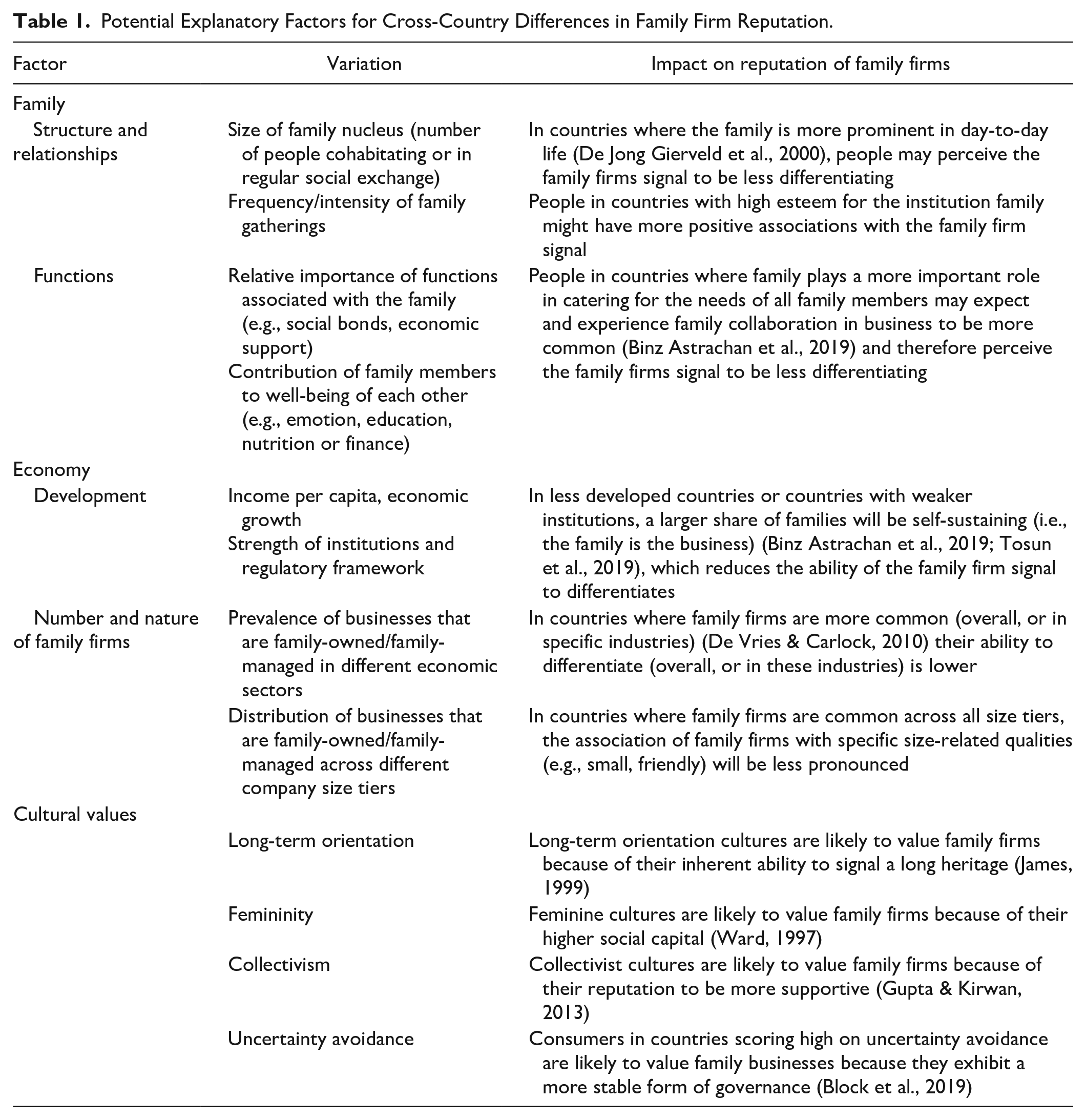
Table 1 shows a set of factors, structured by the three institutions, such as family, economy, and culture, which may be responsible for country differences in family firm reputations. For each of these, we discuss why variations across countries may influence how family businesses are perceived. Given the limited research on this topic, we do not forward formal hypotheses regarding the relationship between levels in any of these factors and the resulting family business reputation. However, the factors shown in the table justify our goal to more thoroughly investigate whether family businesses are perceived differently across countries.
Potential Explanatory Factors for Cross-Country Differences in Family Firm Reputation.
Institution 1: Family
The family is said to be the “most important and enduring of all human social groupings” (Smith et al., 2009, p. 5). How we perceive the world around us and enact with others is subject to strong imprinting effects from growing up in families. Baxter and Braithwaite (2006) define families as groups “of two or more persons, characterized by ongoing interdependence with long-term commitments that stem from blood, law, or affection” (p. 3).
The structure of the typical family varies considerably across countries. Household size is a startling example. The average size of households in Germany is the lowest globally with 2.1 members, less than a quarter of the size of households in some Asian and African countries (UN.org, 2017). One main determinant of household size is the number of children, and also the extent to which different generations cohabitate. The average age when children leave their parental household differs a lot, even within regions. For example, in the EU, Croatian children on average move out of their parents’ homes at age 32, compared with Swedes who move out when they are 18 (Eurostat, 2019). A study by CBRE shows that 60% of 22- to 29-year old Chinese still live with their parents, compared with 35% in Australia and 80% in India. In Africa and Asia, one in seven households includes a child below 15 and a person above 60. Only 1 in 50 households in Europe or the United States features such an age gap within one household. It is not difficult to imagine that these substantial cross-country differences influence the number and nature of experiences that individuals have in the institution family (e.g., frequency of joint activities, intensity of interaction within and across generations). In addition, these structural differences impact the importance of families in providing emotional, financial, or physical support. Education, income, or employment systematically affect the time spent on child care (Guryan et al., 2008), the likelihood of both parents to be employed (Thevenon, 2011), or the percentage of elderly people living in two- or three-generation households (De Jong Gierveld et al., 2000).
Such practices differ vastly across countries and will affect the associations people link with the institution family. The setting, frequency, and valence of experiences with one’s own (or another) family might thus also result in a more or less favorable reaction triggered by the family firm signal. On one hand, it appears reasonable that in countries with a particularly high esteem for the institution family, the perception of family firms might be particularly positive. Rauschendorfer et al. (2022) recently showed that positive family business brand effects can be traced back to a positive perception of one’s own family. On the other hand, in countries where family plays a prominent role in catering for the needs of all family members, people may experience family collaboration in a business to be the norm and therefore perceive a family firm signal less differentiating.
Institution 2: The Economy
We propose two specific variations within the institution economy to affect the perception of family businesses across countries. First, a country’s economic development influences, for example, the growth of the secondary and tertiary sector, the access to education and the sophistication of legal regulations governing economic behavior. Each of these factors affects job opportunities and the appeal of seeking employment outside of self-sufficient small family-run businesses (Le Breton-Miller & Miller, 2018), or the ability to gain access to external financial resources to start or grow a business. In less developed countries, where a higher share of the population works in agriculture and has less access to education, more economic activity will take place within family-owned/family-run enterprises and fewer opportunities for family members to find work elsewhere exist (Chandy, 2016). One would expect that working for or buying from a family firm in such countries is quite self-evident. As a result, potential relationship partners will be less likely to regard the family firm status as an outstanding and remarkable attribute eliciting distinct perceptions.
Besides their economic development, countries also differ with respect to important industries and the make-up of companies active in these industries. If family firms are disproportionately present and visible in specific industries (or company size tiers), this presence will shape the perception and reputation of family firms. Imagine two fictional countries: one where national income highly depends on the exploitation of ore and copper mines all of which are owned by a small number of influential families with close ties to a non-democratic government and contrast this with another country where family businesses are mostly rather small service firms in tourism. What the population in either market associates with family businesses is likely to differ, for example, with respect to specific attributes of company culture, service expectations, quality assumptions, or corporate social responsibility (CSR) activities, and also in terms of the typical size of such companies. Therefore, in countries where individuals perceive family firms to be common across all size tiers, the association of family firms with specific size-related qualities (e.g., small, friendly) should be less pronounced. The actual make-up of the family firm landscape impacts the country-specific frame of reference when thinking of family businesses: the perceived prevalence and nature of family firms in different industries and size tiers in a country will influence their perception and whether they stand out among their peers.
Institution 3: National Culture
Hofstede’s (2010) national culture framework argues that countries differ with respect to values that the respective population deems important. Some of the value dimensions his work proposes link to specific qualities typically associated with family firms. Specifically, we posit that family firm signals may be more effective in markets, which show a relatively higher score regarding the values long-term orientation, femininity, collectivism, and uncertainty avoidance. Past research has shown that long-term orientation is a quality usually ascribed to family firms (Brigham et al., 2013), that family firms invest more in developing strong personal relationships with stakeholders (Schellong et al., 2019), focus more on organization than individual well-being (Gupta & Kirwan, 2013), and are perceived to be a less risky investment (Lude & Prügl, 2019) as well as a more secure employment opportunity (Jaufenthaler, 2023). Where (one or more of) these perceptions align with the value structure of a population, one would expect the family firm signal to trigger more positive associations than in countries where these qualities are valued less. Noteworthy, values and economic context must not be viewed in isolation. For example, emphasizing the long heritage of an organization, an attribute that likely generates more positive impact in countries with a high level of long-term orientation, is less feasible in countries where most organizations are young.
In summary, the interplay of these institutions will be responsible for a rather nuanced formation of family firm reputation. For example, a country may hold the “institution family” in high regard and show high fondness for national culture values that strongly overlap with qualities ascribed to families both of which would help enhance the effectiveness of the family firm signal. On the other hand, in the same country, a large part of the population might depend on or collaborate with their own family in the “institution economy,” which likely results in a non-distinct perception of family firms. Which of these forces prevails and how they jointly shape family firm reputation would require a different (i.e., a large number of countries) research setting to uncover configurations of institutional layers consistently relating to more positive or negative family firm reputation (Ragin, 2008). Our research question explores the actual variation in the outcome: “To what extent do perceptions of and associations with family businesses differ across countries?”
Empirical Study
Choice of Context
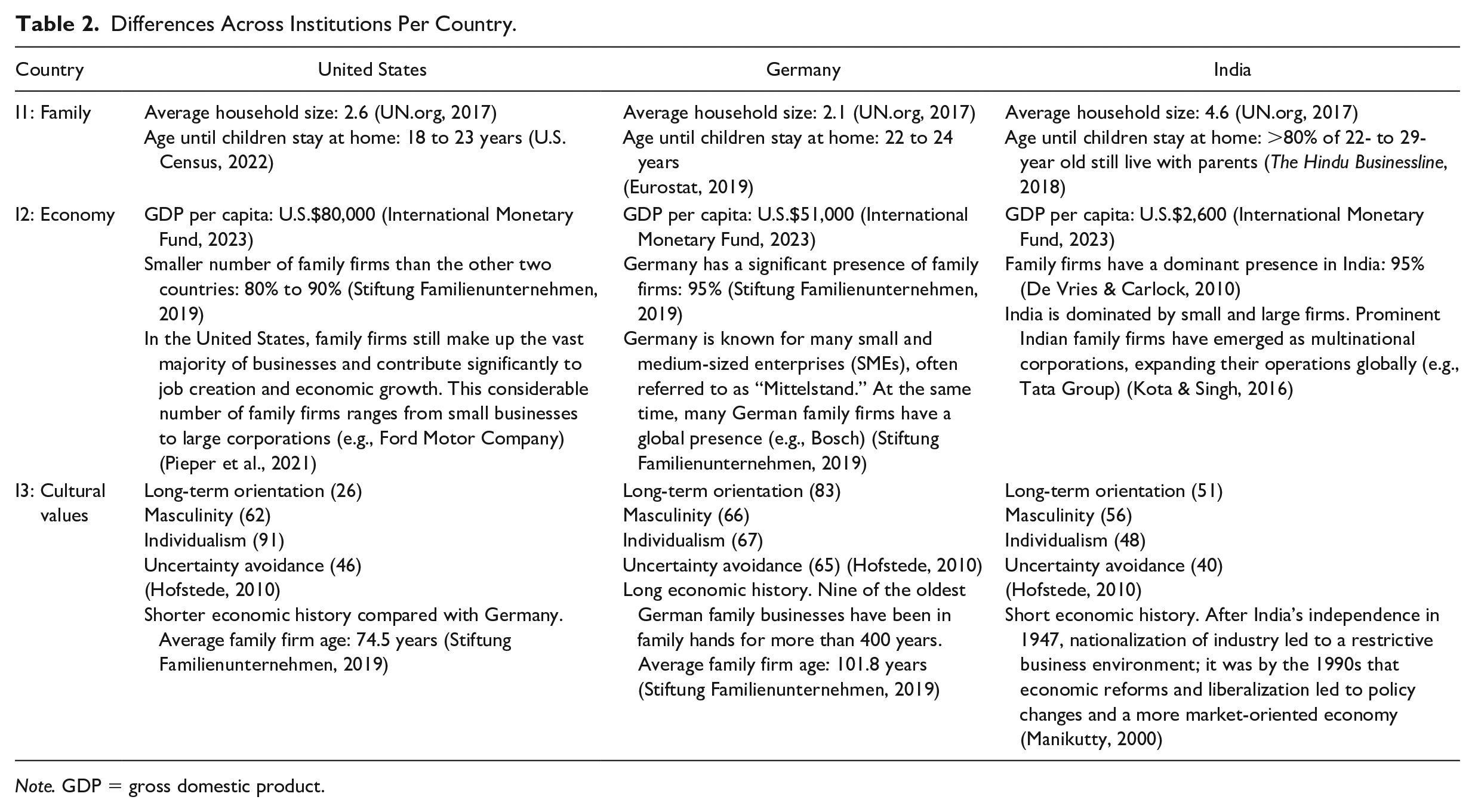
For this exploratory study, we decided to choose countries that are important in terms of their economic activity but show variation across the institutional factors outlined in Table 1. The selection resulted in conducting our research in the United States, Germany, and India. In Table 2, we provide an overview of differences across the three institutions per country. For example, the United States is the largest economy in the world, highly industrialized, and scores high (low) on the cultural value of individualism (long-term orientation). Germany is the most important economy in Europe, has a comparably longer history of widespread economic activity compared with the other two countries, and features more family-owned businesses than the United States (De Vries & Carlock, 2010; Sinha, 2019). Also, Germany is one of the countries with comparatively high scores on long-term orientation and uncertainty avoidance. India is one of the largest Asian economies and is coined by family businesses that are not just family-owned but also family-managed (Sinha, 2019; Soluk et al., 2021). Its economy is also far less developed than the United States and Germany (i.e., GDP per capita reaches only about 3% of the United States and 5% of the German level). In terms of national culture, India scores particularly low on uncertainty avoidance and individualism. Also, in India, families are larger on average, more often consist of multiple generations living together, and family members rely on each other more often and longer to provide income and basic needs. Finally, we would like to stress again the reasoning for our country choice: Our intention is not to conclusively link any of the potentially discriminating factors to the reputational benefits, which family businesses enjoy, but to maximize the likelihood to find differences in the perception of family businesses across countries should they exist—which would provide a motive for more conclusive future research.
Differences Across Institutions Per Country.
Note. GDP = gross domestic product.
Method and Sample
This study aims to investigate whether family businesses are perceived differently across countries. In terms of knowledge representation, we assume that knowledge is stored in associative networks (Anderson & Bower, 1974), which can be accessed via free association tasks (Spears et al., 2006). Participants were asked to write down at least five associations that came to their mind when thinking about the term family business.
In collaboration with a reputable online panel research provider frequently used in academic research, the survey was sent to 500 respondents per country (Germany, India, and the United States), representative of the adult (18–60 years) population in terms of age, social class, region, and gender. One hundred seventeen participants were excluded from the initial sample because of missing data. The final sample included 1,383 participants: 454 participants (Mage = 41 years, 50% female) from the United States, 477 participants (Mage = 41 years, 47% female) from Germany, and 452 participants (Mage = 37 years, 51% female) from India. In each of the countries, about half of the participants indicate that they work (or have worked) for a family firm. Overall, respondents provided 7,322 associations. Each participant received a monetary compensation for completing the survey.
Analysis
This study employs semantic network analyses (Caliandro & Gandini, 2016; John et al., 2006) to analyze individuals’ perception of the signal family business. This type of analysis is an effective tool to examine patterns in social and cultural constructs (Humphreys & Wang, 2018). For instance, Arvidsson and Caliandro (2016) apply a similar network technique to study the social and cultural discourse as well as imagery around the brand Louis Vuitton based on Twitter hashtags. First, we preprocessed our data set by checking for typing errors and identifying collocations (Humphreys & Wang, 2018). Collocations are connected terms that consist of two or more separate words but should be treated as single associations in the analysis (e.g., community oriented or working together). To achieve this, we deleted the whitespace between such word pairs. In addition, we used a stop word list to exclude irrelevant words (e.g., “and,” “I don’t know,” “me,” etc.). Next, we used the software package Wordij 3.0 (Danowski, 2013) to count both the frequency of each association and the number of co-occurrences between all association pairs (Netzer et al., 2012). Finally, the software package Gephi (Bastian et al., 2009) enabled the visualization of the associative co-occurrence networks and the implementation of a clustering algorithm (Brandes et al., 2007). Gephi output allows to illustrate the frequency of a particular association via the size of the node and the degree of co-occurrence between associations via the thickness of the edge between two associations. A thick edge implies that these two associations are frequently elicited by the same person. Finally, a cluster analysis helps to identify underlying thematic patterns of associations and provides important insights into the data structure (Humphreys & Wang, 2018). In our visualization, different clusters are represented by different colors. For comparability, the same settings and thresholds were used for all countries. To enhance readability of the networks, we excluded all associations with a frequency below 5. This rule impacts the relative importance of each cluster as shown in the figure because the percentage of associations exceeding the threshold may vary. Figures 1 to 3 depict the results of the network analysis of the three countries. We first describe each network individually.
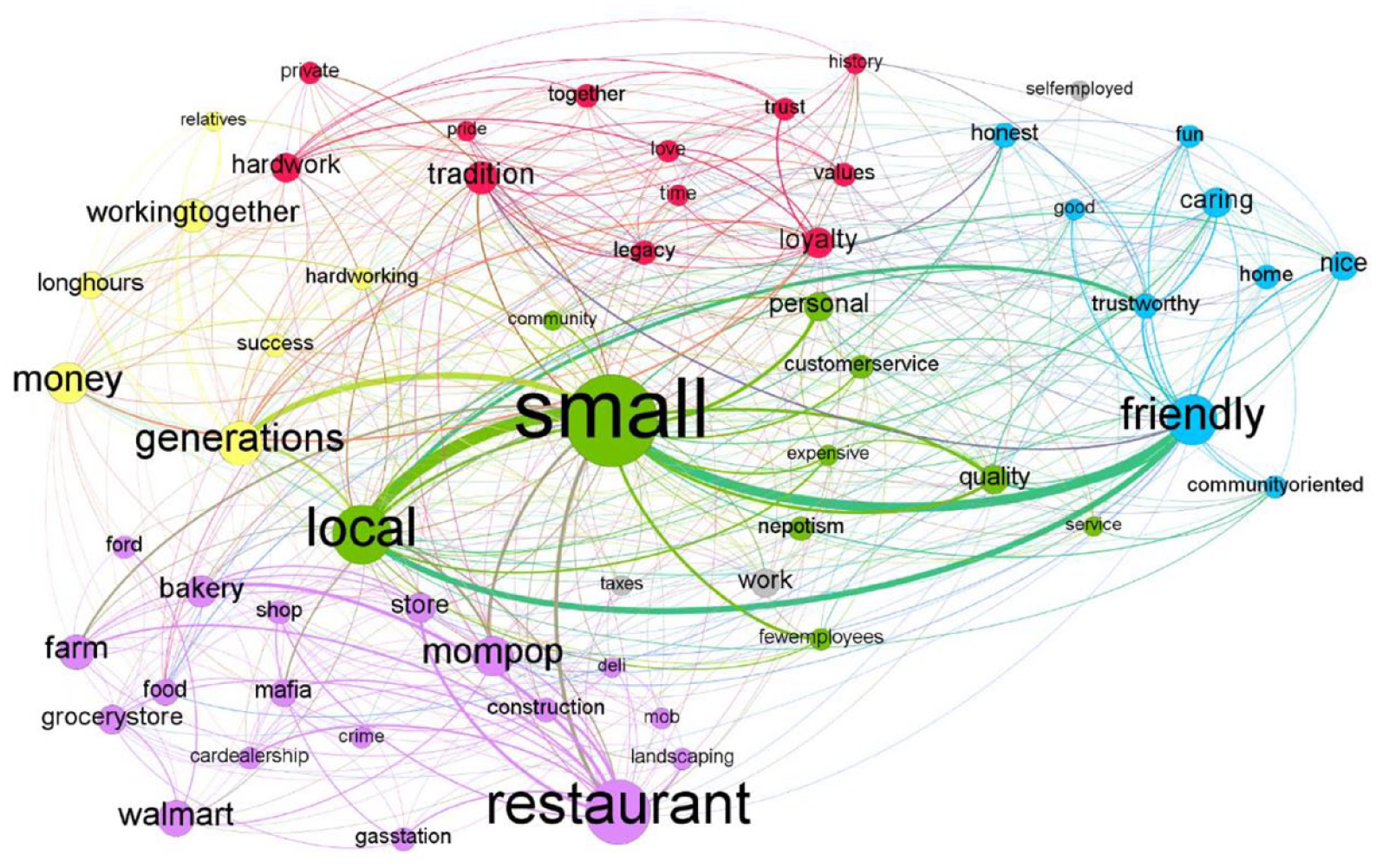
Semantic Network USA.
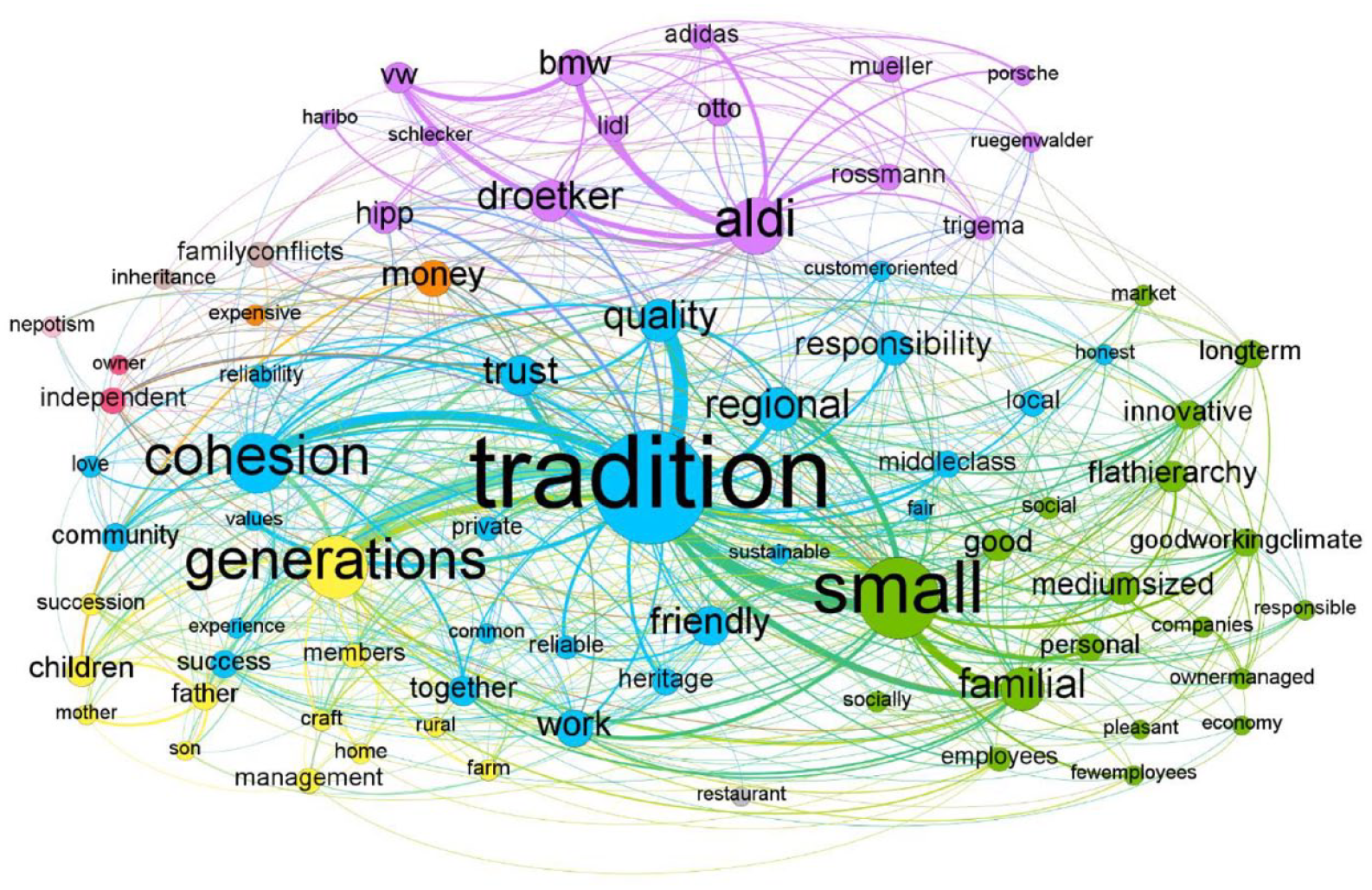
Semantic Network Germany.
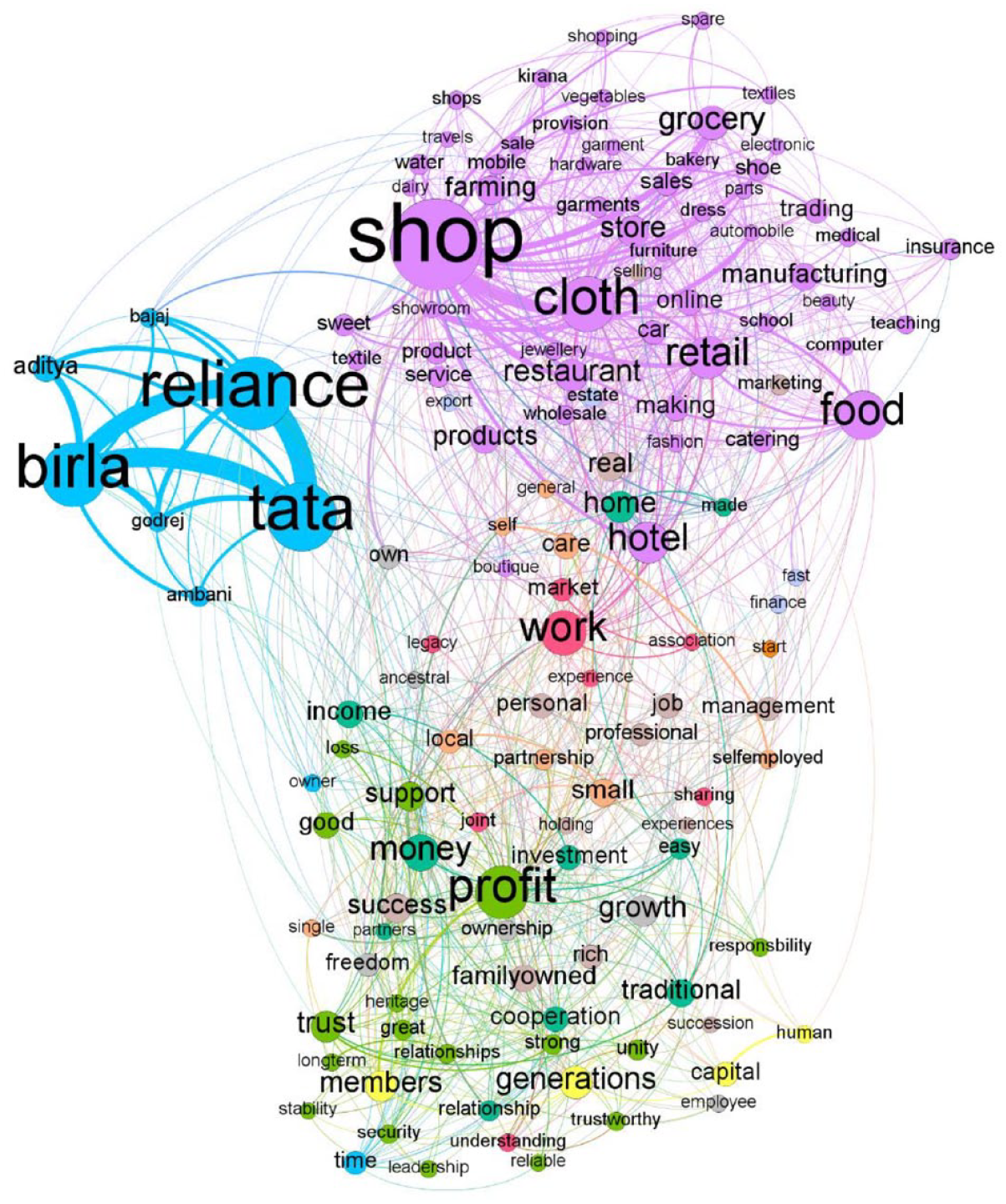
Semantic Network India.
Findings of the United State
U.S. participants provided 903 unique associations. Figure 1 shows the U.S. network. The industry cluster (purple) is the largest part of the network. It contains 19.3% of all associations. Respondents from the United States more often associated the term family business with specific industries rather than with specific companies. Within this cluster, restaurant represents the core association with 53 occurrences, and several interconnections to other industry types, such as mom and pop stores (28 occurrences), farm (19), or bakery (18). Only two named companies (i.e., Walmart and Ford) exceeded the minimum threshold (19 and 7 occurrences, respectively).
The green and blue clusters contain 16.1% and 15.6% of all associations. The green cluster tends to focus on tangible company characteristics, while the blue cluster tends to focus more on qualities related to trust. One could interpret the green cluster to link more strongly with the business part, and the blue cluster to link more strongly with the family part of the term family business. The most dominant association in the whole network is small (109 occurrences). Together with local (66) and friendly (46), small forms a central, closely interconnected triangle within the entire network. This indicates that one core representation of family business for U.S.-Americans is “small, local and friendly.” The green cluster is further composed by associations like quality (17), personal (15), or few employees (10). We also identify a few negative, yet rather infrequent, associations, such as nepotism (8) and expensive (7). As illustrated in Figure 1, the association friendly works as an intermediary between the green and blue clusters as it co-occurs with nodes in both clusters.
Finally, we identify two other related, albeit relatively small clusters (each contains less than 5% of all associations). Neither cluster contains a dominant core association, but rather several interconnected nodes with similar frequency. The red cluster contains associations that could be linked to the heritage of family businesses, like loyalty (20), tradition (18), trust (9), history (7), and pride (6), while the yellow tends to focus more on family ownership, like generations (33), money (25), and relatives (5), and work aspects within a family business like working together (16), hard work (15), or long hours (10).
Findings Germany
German participants provided 897 unique associations. Figure 2 shows the German network. The analysis shows that the largest part of the network is represented by the blue cluster containing 23.7% of all associations. Tradition does not only represent the central core association of this cluster but is also the dominant association of the whole network (133 occurrences). Large parts of the network are structured around this association, and it is also highly interconnected to other clusters. Generally, the blue tradition cluster describes several competencies and attributes that Germans ascribe to family businesses. This cluster tends to focus on business-related organizational characteristics (e.g., quality [35], regional [25]), as well as family-related ones (e.g., cohesion [51], trust [29], friendly [24]). The association tradition is strongly connected to both of those sets signaling that Germans link heritage with roots in the region as well as a signal for trustworthy business practices.
The purple company cluster is the second largest thematic cluster and contains 22.5% of all associations. This cluster consists entirely of large family companies, like Aldi (57), Dr Oetker (26), BMW (22), VW (18), Hipp (17), or Adidas (13). This cluster shows only a few interconnections with other clusters indicating that this cluster represents a specific group of respondents who associate family business with specific corporate brands.
Next, closely linked with the tradition cluster (blue), we find the green cluster (13.7% of all associations) with its core association small (72 occurrences). This cluster largely contains associations that are linked to a family firm’s perceived size and collaboration patterns, such as familial atmosphere (31), flat hierarchy (13), personal (12), good working climate (11), or few employees (5). The yellow cluster (about 10% of all associations) with the core association generations (51) is also highly interconnected with tradition. This cluster mostly focuses on the image of the family running the business and includes associations like children (15), father (12), mother (7), succession (8), management (7), craft (7), or rural (5). Like in the United Sates, we also find a few, yet infrequent, negative associations, such as family conflicts (10), nepotism (7), and expensive (5).
Findings India
Indian participants provided 1,210 unique associations in total (i.e., one third more than in Germany and the United States). Figure 3 shows the Indian network. The analysis identifies the industry cluster (purple) as the largest part of the network containing 20.4% of all associations. Specifically, Indian respondents associated family businesses with a wide variety of shops and industries. The most frequent association is shop (85 occurrences), often in combination with cloth (36), food (23), or retail (22). The company cluster (blue) is the second largest with 13.8% of all associations. This cluster consists of specific Indian companies and brands. The most frequent associations are Reliance Industries (65), Tata Group (61), and the Aditya Birla Group (56). These three central associations are highly interconnected indicating that people from India who associate family business with one of these large conglomerates are also likely to associate it with other companies.
The rest of the network is highly fragmented as illustrated by the number of different clusters identified. The most frequent remaining associations are profit (32) and work (22). Typical anecdotal family business associations, such as trust or size-related connotations, occur rarely, or not at all. Furthermore, we are not able to identify strong interconnections between associations in any of these clusters. Overall, in India, we do not find any dominant core associations that are usually ascribed to specific attributes, qualities, or competencies of family businesses.
Comparison of Networks
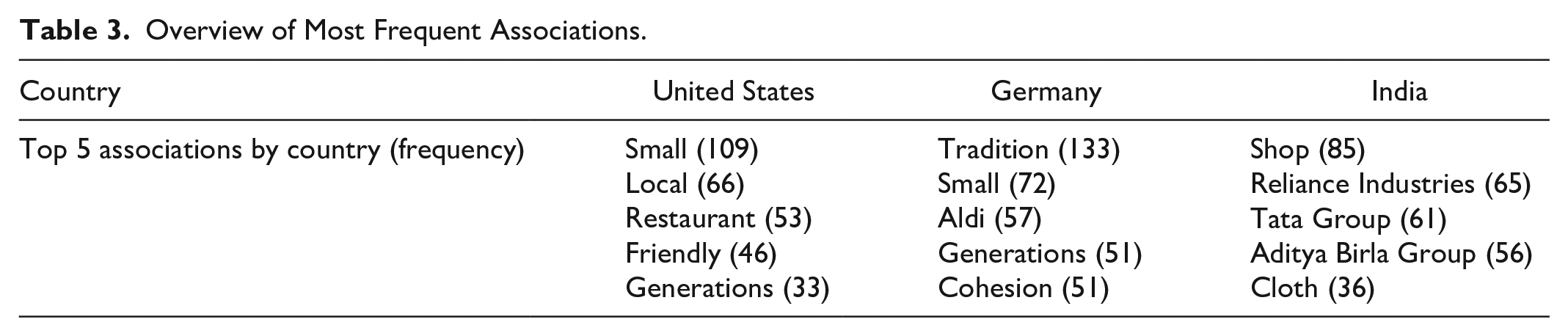
The networks resulting from the German and U.S. samples show a high level of similarity. Differences that stand out are that in the United States, family businesses are more often linked with specific industries than companies (while the opposite was true in Germany) and, most remarkably, the more central association tradition in Germany. This notable distinction may be attributed to the longer history of the German economy, resulting in older family firms compared with their U.S. counterparts as well as the tendency for U.S. family businesses to have a shorter lifespan, as owners are more likely to sell or transfer the business (Stiftung Familienunternehmen, 2019). Regarding the prevailing similarities, respondents in both countries strongly associate family firms with small size, relational qualities, and transgenerational family ownership. Table 3 provides an overview of the most frequent association per country highlighting the striking differences between the two Western countries and India. For example, in India, associations usually linked to family firms, such as local (7) and small (11) are rare, whereas they are common in the two Western countries (e.g., in the United States, small/local appears 109/66 times). Similarly, trustworthiness associations (e.g., trust, reliable, friendly, traditional, honest) also differ in frequency: In India, these associations are rare (e.g., trust [14] and reliable [6]), whereas in both the United States and Germany, these associations can be found as the core of large clusters (e.g., traditional [133] and trust [29] in Germany or friendly [46] in the United States). In the subsequent section, we discuss underlying factors contributing to this main finding.
Overview of Most Frequent Associations.
Preliminary Discussion and Follow-Up Studies
This study investigated the meaning inherent in the concept family business in one of the largest economies in America (the United States), Europe (Germany), and Asia (India), respectively. The key learning is that family business associations and perceptions differ considerably between Western industrialized countries and India. In line with existing literature (Sageder et al., 2018), respondents in Western countries associate family businesses with established family firm-related concepts linked to trust, and largely perceive them as small and local/regional companies whereas these associations are very rare in India. The co-occurrence and clustering analyses also show higher levels of thematic fragmentation in India, which indicates a more ambiguous conceptualization of the term family business. Based on these findings, we conclude that signaling the family nature of a company will impact an organization’s reputation differently depending on the country where that signal occurs.
These intriguing differences inevitably lead to the question why these differences exist. We address this question by first revisiting the three layers proposed in the conceptual framework and how their differential make-up in the United States and Germany compared with India may enhance or reduce the effectiveness of the family firm signal. We then present the findings of two empirical follow-up studies to illuminate the learnings from our study. One study seeks the interpretation of our findings by interviewees who have an understanding of the business context in both India and Western economies, while the other study examines whether the perceived uniqueness of family firms (which both the conceptual framework and the experts suggest as the central explanatory factor for the more generic associations triggered in India) differs across the three countries.
In our theoretical argumentation, we suggest that three embedded layers shape the perception of the family firm signal in a specific market: (1) the perception of the institution family, (2) the make-up of the economic landscape in terms of family firm importance, and (3) the importance of cultural values that align with values typically associated with families. We propose a more beneficial effect of the family firm signal (i.e., the associations it triggers and their valence) in markets where the institution family plays an important role as a welfare-enhancing institution (because positive associations with family are more likely to be transferred to family firms), where the perceived prevalence of family firms is lower (because the signal is a stronger one), and where national culture values qualities usually ascribed to families (because positive associations with family firms should enjoy more valence). Given the exploratory nature of our study and the focus on only three countries, we cannot examine conclusively how each of these factors (and their combination) contributes to the effectiveness of the family firm signal. However, the framework still offers potential explanations for the rather different perception of family firms in India and the less prominent positive qualities associated with family firms compared with the United States and Germany.
With respect to national culture, the two values where Indians differ from Germans and Americans are a higher level of collectivism (which should favor family firms), and a lower level of uncertainty avoidance (which should not favor family firms). In terms of the remaining two values, India is either quite similar (femininity) or in between the other markets (long-term orientation). This constellation does not provide a coherent argument that the family firm signal in India should trigger a different perception. However, both the family and the economy institutions jointly provide tentative explanations. While the percentage of the workforce employed in family businesses is very high in all three markets, Indians are more likely to work in a family business that belongs to their own or to a closely related family member, owing to the prevalence of small companies in India (Poschke, 2018). Furthermore, there appears to be a broad awareness of the perceived prevalence of family firms across various industries and sizes. For example, large conglomerates are particularly associated with the notion of family businesses. This lower distance between one’s private and job affiliation, and the widespread perceived presence of family firms potentially leads to a less distinct mental image or stereotype of family firms and reduces their ability to stand out versus non-family businesses. 2 We therefore propose that the family firm signal in India lacks differentiation power—because family firms are perceived too common and not unique enough to trigger any proprietary associations. To corroborate this explanation, we decided to conduct two additional studies, one to collect qualitative feedback from persons with in-depth knowledge of India and another to investigate whether the family firm signal in India is less able to create a more unique perception of a company using it compared with the United States and Germany.
Follow-Up Study 1: Qualitative Expert Interviews
To better understand potential reasons for the specific understanding of family businesses in India, we decided to speak to experts with a profound understanding of the Indian context who are also able to contrast it with the U.S. and/or German setting. Qualitative approaches provide deep descriptions and profound insights, making them very suitable for exploration of potential factors contributing to the observed disparities between Western countries and India (Denzin & Lincoln, 2011). All experts were born and raised in India: two MBA students, one studying in the United States, the other one in Germany (A: 24 years, B: 26 years), a professor with significant time spent in the United States and Germany (C: 56 years), a management consultant who lives in the United States (D: 29 years), a business development expert working for a family firm in Germany (E: 48 years), a PhD student who lives in Germany (F: 28 years), a luxury brand manager based in Dubai and educated in Europe (G: 38 years), a senior executive manager of a large German company with multiple years of international experience (H: 51 years), another PhD student in the context of family firms who lives in India (I: 32 years), and a leading employee of the Commercial Section of the Austrian Embassy in New Delhi (J: 54 years). We conducted the interviews via online video calls with a duration of approximately 30 to 40 minutes. All interviews followed the same logic: Interviewees first elaborated on how they believe Indians think about family firms and then were asked to highlight how that perception differs from the one held by U.S.-Americans or Germans. We then asked them to elaborate on why they think these differences (if any) exist. To analyze the resulting data, we used open coding, moving back and forth between respondents’ answers and an emerging structure of the overarching arguments (Gioia et al., 2013). After initially analyzing the data independently, we formed an interpretive group in which all four authors discussed respective categorizations and interpretations. We present the results focusing on three interlinked arguments that were mentioned in the majority of the interviews (for specific quotes supporting each topic, see Table 4): ubiquity, distinction, and relevance.
Interview Quotes.
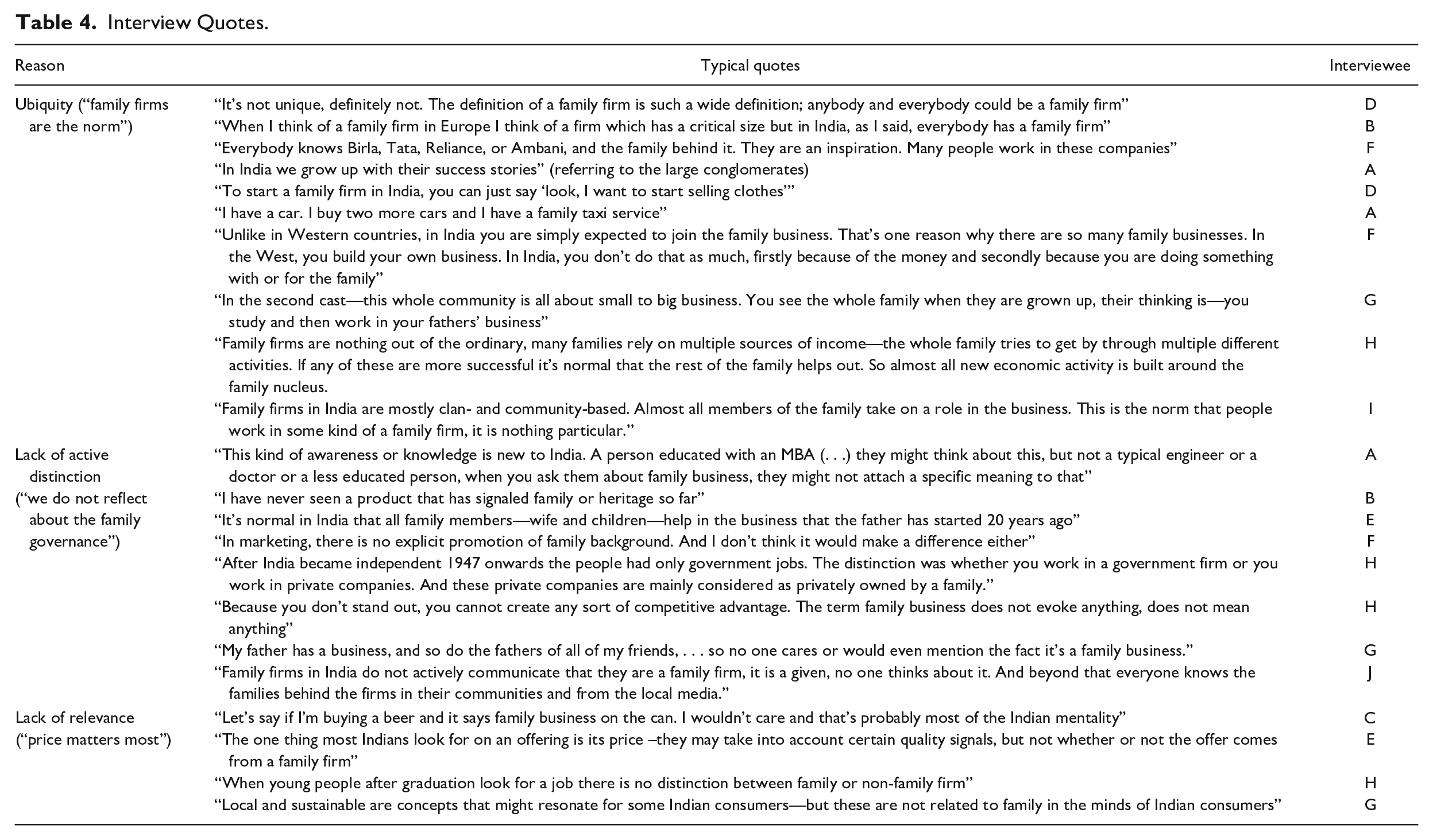
The first and most dominant argument, mentioned consistently by all respondents, focuses on the (perceived) ubiquity of family firms in India. Family firms are the corporate structure that most Indians expect almost automatically when exposed to any firm-specific signal. Interviewees argued that the fact that a large number of individuals is either working in a self-employed position or within a business setting owned by one or more of their family members automatically establishes a very strong link between the concept family firm and experiences with (one’s own) family. This was seen by the experts to deviate from Western countries where exposure to a family firm signal is typically associated with another family (i.e., the family owning and working for that specific firm). Our interview partners also emphasize that “all” Indians are aware that large conglomerates in the country are also family firms (because the families in charge are very well known in the population), which supports the argument why size is no relevant distinction between family and non-family firms in India. Another argument raised for the perceived ubiquity of family businesses in India relates to the collectivist nature of Indian society. Because of a stronger cultural expectation for children to continue and uphold the family business, the business plays a more prominent role in the everyday conversations of family members in comparison with Western societies. In Western contexts, our interviewees argue, individuals seem more inclined to initiate independent business ventures, rather than engaging in familial or cooperative endeavors as commonly expected in India.
The above arguments explain the lower perceived distance between the concept family on one hand and family business on the other hand among Indians and could account for the lack of unique meaning the concept family business carries in India. While stakeholders of companies (e.g., potential or actual employees or consumers) in the United States or Germany often actively interpret the family firm signal employed by an organization (i.e., they distinguish family from non-family firms), such mental processing is hardly common in India according to the interviewees. One reason for that lack of distinction is that only very few organizations actively portray themselves as a family business. For example, one respondent mentioned that the concept family firm in Europe triggers a mental image of a company with a certain size and level of professionalism, and also with specific qualities, behaviors, and values, which leads to the active processing of the signal and the elicitation of a more or less shared belief regarding these companies. In contrast, Indians would rarely enter such a thought process because they do not actively distinguish between companies based on their family versus non-family governance. This logic can create a bidirectional causal chain: On one hand, because the family firm signal is hardly used by Indian companies, Indians are not nudged to distinguish family firms from their peers. On the other hand, because family firm managers do not believe in the potential benefit of employing the signal to enhance stakeholder relationships they limit its use.
A final consideration that may also relate to a broader implication of the family firm signal in marketing interactions, concerns the economic situation of a large portion of the Indian population. Because of the level of poverty, which many Indians still have to endure, the most important decision criterion in making product or service choices often is price. For most Indians, whether or not a firm is a family business pales in comparison with whether or not its products and services can be obtained at competitive prices. While the recent economic success has benefited some parts of the population and has massively reduced extreme poverty, the attribute family firm is, as of today, one that our experts do not consider to contain much differentiating power in the marketplace.
All three of these arguments contribute to the lack of perceived uniqueness as an explanatory factor for the association pattern identified in the Indian market. To examine this assertion, we decided to conduct a further empirical survey.
Follow-Up Study 2: Choice Experiment
We used an experimental choice approach (Granulo et al., 2019; Lude & Prügl, 2018) to examine the extent to which family firm signaling makes a firm appear more unique. Using the same three countries as in the main study, about 200 participants 3 per country saw two product images from a fictional company, respectively. One of the images was manipulated in terms of the family firm nature. Specifically, participants were informed that this company is a family business by placing a signal on the product packaging and in the company description below. Importantly, to rule out potential biases concerning other differences of the two images, a between-subject treatment randomly assigned participants to one of two conditions in which either one or the other company was designated as a family business. After having been exposed to the images (either in condition 1 or condition 2; see Appendix A), participants were asked to choose which of the companies they perceive as more unique (“Which of the two companies do you perceive as more unique?” 1 = “The left one”; 6 = “The right one”). 4 For the later analysis, the data from the two conditions were merged after they had been recoded in a uniform manner (i.e., 1 = company that signals its family firm nature; 6 = company without information about family firm nature).
Building on the approach of Granulo et al. (2019), we then conducted one-sample t-tests against the midpoint of the scale (i.e., 3.5) for each country to examine the extent to which revealing the family firm nature affects the perceived uniqueness of a company. The results show that U.S.-American, M = 3.03, SD = 1.43; t(189) = −4,55; p < .001, 95% CI: (−.679, −.268) and German, M = 3.29, SD = 1.42; t(200) = −2.07; p = .04, 95% CI: (−.404, −.009) participants rated the company that signals its family firm nature as significantly more unique, while no significant differences was identified for Indian participants, M = 3.42, SD = 1.73; t(210) = −.70; p = .49, 95% CI: (−.318, .152).
These results support the proposed account that the perceived uniqueness of family firms is country-specific, offering one explanation for why perceptions toward family businesses can differ across regions. At the same time, these results may also point to an argument made in the interviews, namely, that price matters more than the family business signals—which would still support our conclusion regarding the ineffectiveness of family business signals in India.
General Discussion
Theoretical Implications
Our study adds to the family firm branding literature (e.g., Beck & Prügl, 2018) and the emerging debate about the context-sensitivity of family firm perceptions (Binz Astrachan et al., 2019; Block et al., 2019; Jaufenthaler, 2022, 2023) by investigating the role of the country context in shaping family business reputation. Our association study demonstrates that a family business triggers different clusters of associations in different countries supporting the notion that family firm perception is heterogeneous. Most significantly, meaning clusters linked to family businesses in prior studies (i.e., relationship-, size-, geography-, competence-related) were only confirmed by the U.S. and German samples but are less prevalent in Indian where the understanding of family businesses is more fragmented and generic.
This study also adds to the literature on organizational reputation and the value of brand associations as a diagnostic of brand strength (Andreini et al., 2020). Past studies eliciting thoughts and ideas regarding family firms focused on single countries (Botero et al., 2018; Jaufenthaler, 2022). If the focus was multiple countries, then scale-based measurement of family firm perceptions was the norm (e.g., Block et al., 2019). To our knowledge, this is the first large-scale empirical study to provide qualitative insights regarding the meaning of family firms across multiple countries through the retrieval of free associations, an important building block of corporate reputation (Brown et al., 2006). The differences in family firm perceptions between India and the two Western countries provide evidence that certain organizational characteristics elicit specific meaning that can be traced back to the respective regional context.
These insights also contribute to research on family firms in developing countries. Family firm research has strongly focused on family firms in developed countries (De Massis et al., 2012) although their prevalence in developing countries is comparable. Moreover, the studies that exist have taken an organizational perspective and focused on aspects, such as corporate governance (e.g., Dinh & Calabro, 2019) or entrepreneurship (e.g., Soluk et al., 2021) in family firms. Thus far, however, the question of how external stakeholders perceive a company’s family firm nature across country contexts remains unexplored. By investigating the perceptions of family firms in India, our study provides novel insights to this emerging body of literature.
In addition, we provide theoretical reasons, follow-up interviews with domain and cultural experts, as well as an experiment to understand why family firms in India are perceived differently than their peers in Germany and the United States. In our theoretical framework, we proposed three embedded institutions shaping the dominant perceptions of family firms in a country: family, economy, and culture. Interestingly, we cannot confirm one of this paper’s initial propositions, that in a country with a high level of collectivism and thus high importance of the institution family (like in India) the perception of family firms might be particularly positive. Rather, it seems plausible that this prominent position of the family in collectivist cultures represents one of the reasons for the lack of differentiated associations regarding the signal family business. In more detail, we argue and show that both the family and the economy layer provide several related conclusions regarding the differences found between India and the two Western countries. The perceived ubiquity of family firms, generated not only due to well-known conglomerates, but also due to the strong family involvement in daily life and semiprofessional, self-employed business activities, render the family firm status to a non-unique concept in the eyes of Indians. While the family firm signal in Germany and the United States differentiates an organization from its (non-family firm) peers and allows certain associations to come to mind quickly, its lack of differentiation in India impedes the triggering of such associations; rather, it simply reflects the generally perceived organizational form for businesses in India. According to expert interviews, the lack of active distinction and perceived relevance of the family firm concept to the ordinary Indian citizen may add to this phenomenon. An experimental study further supports our conclusion that family firm status does not make a company stand out in India, while it shapes perceptions of uniqueness in the two Western countries.
Finally, the unique combination of the empirical approaches employed in our paper represents a methodological contribution to family business research. We implement a recently introduced method to provide a thick description of a phenomenon followed by a tentative explanation based on theory and its empirical validation. Most significantly, answering calls that family business scholars should make “astute choices in research designs employing the full range of research methods [. . .]” (Sharma et al., 2012, p. 11), the current research introduces semantic network analysis into the field of family firm branding. This tool offers future research the opportunity to graphically assess association clusters toward the concept family business across various contexts (e.g., between countries, stakeholders, industries), thereby improving our understanding of the facets of the family firm signal.
Managerial Implications
Respondents in the United States and Germany show strong similarities regarding core associations and co-occurrences of associations elicited by the stimulus family business. While some differences can be found—most notably, tradition is much more central in Germany than in the United States—family firm branding in both markets elicits trust-related associations like friendly, caring, honest, as well as perceptions of being rather local and small. In India, however, the association network contains few attributes that match what is ascribed to family businesses in the United States and Germany. In addition to cultural aspects, the decision to emphasize an organization’s family nature one should take into account the suitability for the specific industry context as well as its potential contribution to differentiation through the power of perceived uniqueness.
Amending the desired reputation of a company with its family business nature will trigger different perceptions in different markets and may not be a suitable element to include in a globally standardized campaign. Based on our study, the communication of the family business nature of an organization in India indeed appears to provide little value in terms of creating specific reputational elements. In contrast, an impact on reputation in both the United States and Germany is likely. We therefore would not advise to globally emphasize family business as a key element of a brand’s desired reputation but carefully select markets where a positive impact on brand reputation is likely due to uniqueness perceptions triggered by the family firm signal, contingent on the industry the brand is competing in, the differentiation potential of the association, and the willingness of the family to represent a prominent intangible brand element.
Overall, family owners and managers are well advised to carefully ponder the communication of the family firm signal within their corporate communication. Managers and owners should weigh the reputation-building value of the top-of-mind associations triggered by the family nature of a business. A decision to reveal and emphasize the family business background creates differential benefits in different geographies and should be carefully weighed against the desired reputation and the consequences for the persons involved.
Limitations and Future Research
As with any research, our studies face some limitations. While the geographical scope of our study is broad, we are conscious about generalizing the findings to other markets. In particular, we are aware of the idiosyncrasy of the Indian economy and history and would neither dare to project our findings to nearby geographies or countries with comparable economic circumstances. Additional research focusing on countries that share an economic context, geographical proximity, or a cultural background is required to further our understanding of the reputation-enhancing role that a perception as a family business can provide. We are more confident that the similarity of the learnings for the two more developed economies allows for a projection of the learnings across other markets in Western Europe and North America.
Although our theoretical framework outlines several explanatory factors for cross-country differences in family business reputation (e.g., national culture, economy, family structure), we remain cautious about the extent of the individual and joint roles of each of these layers’ components in driving the similarities and differences found. We encourage future research to examine the contribution of these factors to reputation in a variety of different geographic settings. In particular, given our contribution regarding the role of uniqueness, we expect a declining marginal benefit resulting from the communication of a company being a family business once too many organizations choose to exploit this resource in their stakeholder communication. In contrast, we cannot conclusively advocate against the use of the family firm signal where our research shows a lack of uniqueness (e.g., in India). Because family firm branding is hardly employed thus far one could hypothesize it to provide a source of differentiation if a set of firms sharing certain behaviors or characteristics (beyond just being family firms) started using it.
The network analysis shows a wide range of associations and offers several possibilities for future research. For example, future work in this area can use the detailed illustrations of the network analysis to investigate specific reputational elements or clusters. Also, some noteworthy differences between Germany and the United States (e.g., tradition appears more central in Germany than in the United States) encourage future research to investigate differences between Western countries. In addition, the experimental setup focused on food in a consumer context. We suggest to replicate our learnings in other industries and for other stakeholder groups.
Conclusion
The current research is the first systematic large-scale investigation of the meaning inherent in family business across different countries. Our results indicate that portraying a company as a family business is an effective lever to enhance an organization’s reputation in certain countries only. While we find a strong emergence of reputation-shaping associations (e.g., friendly, local) in the Western hemisphere, our study demonstrates that similar reputational opportunities are not available in other geographical surroundings (e.g., India) where family firms do not evoke clear and specific association patterns and thus are not perceived as unique.
Footnotes
Appendix A
Appendix B
Respondents were asked which of the two companies they perceive as more trustworthy/reliable/warm (1 = “The left one,” 6 = “The right one”). Applying the same analysis procedure as in follow-up study 2, the results show that U.S.-American (Mtrustworthy = 3.11, p < .001; Mreliable = 3.14, p < .001; Mwarm = 3.04, p < .001) and German (Mtrustworthy = 3.21, p = .002; Mreliable = 3.32, p = .048; Mwarm = 3.19, p = .003) participants rated the company that signals its family firm nature as significantly more trustworthy/reliable/warm, while no significant difference was identified for Indian participants (Mtrustworthy = 3.37, p = .29; Mreliable = 3.37, p = 29; Mwarm = 3.43, p = .55).
Declaration of Conflicting Interests
The author(s) declared no potential conflicts of interest with respect to the research, authorship, and/or publication of this article.
Funding
The author(s) received no financial support for the research, authorship, and/or publication of this article.
