



Abstract
Family firms must attract talented employees to stay competitive. They have different employer characteristics than nonfamily firms. For example, although they generally offer lower wages, they also typically offer higher job security and a more cooperative and entrepreneurial work environment. However, drawing on occupational choice theory, we argue that the importance of these unique family firm characteristics depends on the national labor market context in which the family firm is embedded. A multilevel investigation of 12,746 individuals in 40 countries shows that individuals prefer to work in family firms in labor markets with flexible unregulated hiring and firing practices, centralized wage determination, and low labor–employer cooperation. A cross-level analysis further shows that the national labor market context moderates the effects of individual-level factors determining the preference to work in a family firm (e.g., entrepreneurship intention). Our article is the first to consider labor market institutions in research on family firms as employers. Practical implications exist for family firms regarding their employer branding and intrapreneurship strategies.
Keywords
Family firms must attract and retain talented employees to stay competitive. Previous research has frequently indicated that family firms struggle to attract qualified nonfamily employees, particularly at senior management levels (Chrisman, Memili, & Misra, 2014; Vandekerkhof, Steijvers, Hendriks, & Voordeckers, 2015). This highlights the importance of workplace and employer branding strategies (e.g., Backhaus & Tikoo, 2004; Hauswald, Hack, Kellermanns, & Patzelt, 2015). To create such workplace and employer branding strategies and related managerial measures in family firms, it is necessary to better understand why individuals prefer to work in family firms rather than nonfamily firms.
Family firms have different employer characteristics than nonfamily firms. Compared to nonfamily firms, they offer a more stable work environment with higher job security and in which layoffs and downsizing are less likely to occur (e.g., Bassanini, Breda, Caroli, & Reberioux, 2013; Block, 2010; Stavrou, Kassinis, & Filotheou, 2007). Furthermore, family firms typically offer a highly cooperative and entrepreneurial work environment fostering work motivation and intrapreneurship (e.g., Davis, Allen, & Hayes, 2010; Kellermanns & Eddleston, 2006; Neubaum, Thomas, Dibrell, & Craig, 2017; Pearson & Marler, 2010). Family firms, however, also pay lower wages compared to nonfamily firms (e.g., Bassanini et al., 2013; Carrasco-Hernandez & Sánchez-Marín, 2007).
Prior research investigating whether and how these typical family firm characteristics attract specific types of employees has mainly analyzed socioeconomic factors such as gender, age, and education but also included entrepreneurship-related variables such as prior entrepreneurship education or entrepreneurship intention (e.g., Block, Fisch, Lau, Obschonka, & Presse, 2016; Covin, 1994a; Hauswald et al., 2015). However, family firms and their (potential) employees are embedded in a particular (national) labor market context. Previous research outside of the entrepreneurship domain highlights the importance of labor market institutions for individuals’ occupational choice decisions and job-seeking behavior (e.g., Holmlund, 2014; Prifti & Vuri, 2013). Here, we argue that the labor market context also influences individuals’ utilities from working in family firms and thus their preferences. Thus far, however, little is known about this link between labor market characteristics in which family firms are embedded and the individual preference to work in a family firm.
Drawing from occupational choice theory (e.g., Banerjee & Newman, 1993; Boskin, 1974; Ginzberg, Ginsburg, Axelrad, & Herma, 1951), we argue that the high level of job security that family firms offer matters more in labor markets where employees are not well protected by labor market institutions (e.g., legal protection against dismissals). A family firm that is perceived to be an employer that offers job security provides less utility to individuals in a labor market where it is difficult for all firms to lay off employees. Second, the negative image of family firms for paying low wages is less detrimental if centralized wage determination is the norm, and the overall labor market is perceived as struggling to offer differentiated wages. Third, one advantage of family firms is that they provide a cooperative and entrepreneurial work environment; however, this is less beneficial for the attractiveness of family firms if the labor–employer relations in a country are generally cooperative. Finally, we hypothesize that labor market institutions influence the effects of individual-level factors on the preference to work in family firms, for example, the effects of gender and entrepreneurship intention. Using a dataset of 12,746 individuals from the general workforce in 40 countries, we employ multilevel regressions to assess our hypotheses.
Our study offers three contributions to entrepreneurship and family business research. First, we contribute to research on family firms as preferred employers (e.g., Block et al., 2016; Covin, 1994a; Covin, 1994b; Hauswald et al., 2015; Kahlert, Botero, & Prügl, 2017; Poza, Alfred, & Maheshwari, 1997). In addition, we provide the first investigation into country-level determinants of the preference to work in family firms and demonstrate the direct influence of the national labor market context and its institutions thereon. This extends previous research on the determinants of the preference to work in family firms that has mainly investigated individual-level factors.
Second, our study responds to recent calls for a better contextualization of individual behavior and its determinants (e.g., Welter, 2011; Zahra, Wright, & Abdelgawad, 2014). Prior research highlights that the influence of contextual factors on individual-level outcomes is often direct as well as indirect, producing context-specific individual outcomes (e.g., Johns, 2006; Welter, 2011). We show that the effects of individual-level factors (e.g., gender and entrepreneurial intentions) on individuals’ occupational choice decisions are indeed contingent on the labor market context and its institutions. These insights extend our first contribution with regard to family firms as employers. Our results show that family firms can attract a workforce with higher entrepreneurship intentions, in particular in labor market contexts where labor–employer relations are uncooperative. This finding has important implications for research on corporate entrepreneurship and intrapreneurship in family firms (e.g., Kellermanns & Eddleston, 2006; Salvato, 2004; Zahra, Hayton, & Salvato, 2004) seeking to explain how family firms remain entrepreneurial over their life cycle. Our findings also have broader implications for entrepreneurship research in general, as they provide a much more nuanced view of the determinants of individual occupational choice decisions. For example, our findings can be applied to research on individuals and their choices to become entrepreneurs (e.g., Douglas & Shepherd, 2000; Parker, 2009). This research has established that factors such as gender, education, and entrepreneurial intention influence entrepreneurial behavior, but the interaction between these variables and labor market institutions is unclear.
Third, by relying on occupational choice theory (Banerjee & Newman, 1993; Boskin, 1974; Ginzberg et al., 1951), which has already proven fruitful in general entrepreneurship research (e.g., Campbell, 1992; Kihlstrom & Laffont, 1979; Lucas, 1978; Parker, 2009), we introduce a new theoretical framework into the literature on family firms as employers. This framework describes the decision to work in family versus nonfamily firms as a utility maximization choice between two occupations with different characteristics. It thereby offers a theory-based explanation for the effects of individual- as well as country-level factors, including their interactions that together influence individuals’ preferences regarding family firms.
Theoretical Framework and Review of Relevant Literature
Occupational Choice Theory
Based on utility maximization, occupational choice theory describes the decision-making of individuals when confronted with different career options. It models the individual decision for or against choosing a certain occupation as a function of the attributes of this occupation (Banerjee & Newman, 1993; Boskin, 1974; Ginzberg et al., 1951). Thus, when deciding among various occupations, individuals systematically evaluate the expected benefits and costs associated with the potential career options. Such benefits include, for example, expected earnings and nonmonetary benefits, such as autonomy, risk exposure, and the degree of skill utilization. Costs can include expected expenditures related to training, forgone earnings due to unemployment, or abandoned alternative career paths due to a decision regarding a certain occupation that leads the career in a certain direction (Banerjee & Newman, 1993; Boskin, 1974; Ginzberg et al., 1951). Consequently, individuals choose occupations that maximize their expected utility and prefer to engage in those occupations that yield the highest expected utility for them.
In entrepreneurship research, the occupational choice framework is typically applied by modeling a choice between self-employment and wage employment. Parker (2009) describes two studies that pioneered the use of occupational choice theory in entrepreneurship research: Lucas (1978) describes that utility-maximizing agents choose occupations according to their ability, and that the most able become entrepreneurs. Kihlstrom and Laffont (1979) focus on the role of risk aversion in the occupational choice and describes that less risk-averse individuals become entrepreneurs. Later applications of the occupational choice theory in the entrepreneurship domain include Campbell (1992), Douglas and Shepherd (2000), and Douglas and Shepherd (2002). This literature describes the decision to become an entrepreneur as a utility maximization decision where the expected utility associated with self-employment is higher than the expected utility associated with wage employment. Similar to Douglas and Shepherd (2002), Douglas and Shepherd (2000) developed an economic model for entrepreneurial career choices, which indicates that both (wage) employment and self-employment can be characterized by their level of pay, the work effort required, the associated risk, the ability to work independently, and other work conditions. They argue that individuals have either a preference (utility) or an aversion (disutility) for each of these job attributes. Hence, the choice between wage employment and self-employment is subject to the overall utility derived from a combination of these job attributes. Hence, the entrepreneurship literature focuses on the antecedents of the occupational choice decision to engage in entrepreneurship (see Parker, 2009), which include income, age, education, previous professional experience, marital status, parental employment, and risk tolerance (e.g., Douglas & Shepherd, 2000; Douglas & Shepherd, 2002; Parker, 2009; Van der Sluis, Van Praag, & Vijverberg, 2005).
Although most entrepreneurship research focuses on individual-level factors as part of the utility maximization decision, one particular advantage of occupational choice theory is that it allows for the inclusion of contextual factors that provide either utility or disutility to an individual (Banerjee & Newman, 1993). For example, Freytag and Thurik (2007) show the influence of several country-level cultural variables on individuals’ occupational choice decisions, while Audretsch, Bönte, and Tamvada (2013) use occupational choice theory to assess the influence of religion on self-employment choices. Similarly, Gohmann (2012) utilizes an occupational choice model in which the institutional environment affects self-employment decisions. Specifically, he argues and shows that the effects of the institutional environment interact with several individual-level factors.
Characteristics of Family Firms as Employers
Prior research shows that family firms have a number of important characteristics that differ from those of nonfamily firms. These characteristics influence the subjective utility (disutility) gained by working in family firms compared to that of nonfamily firms from an occupational choice theory standpoint. In this study, we focus on three of these characteristics: job security, wage levels, and the work environment. Since the unique characteristics of family firms are most pronounced in firms where the business-owning family has a considerable impact on business activities (Naldi, Nordqvist, Sjöberg, & Wiklund, 2007), we define family firms in a narrow sense as firms where a family controls the company through a clear majority of voting rights and is represented in the firm’s management (Naldi et al., 2007).
Job security
Family firms typically offer greater job security than nonfamily firms. A large body of research supports the notion that family firms are relatively secure employers (e.g., Bassanini et al., 2013; Bjuggren, 2015; Block, 2010). Family firms are less likely to downsize their workforce (Block, 2010; Stavrou et al., 2007), and employment in family firms is less sensitive to performance and product market dynamics (Bjuggren, 2015).
Wage level
Family firms typically pay lower wages than comparable nonfamily firms. This finding holds true for executive (Gomez-Mejia, Larraza, & Marki, 2003; Werner, Tosi, & Gomez-Mejia, 2005) as well as nonexecutive positions (Bassanini et al., 2013; Neckebrouck, Schulze, & Zellweger, 2017; Sraer & Thesmar, 2007).
Work environment
Family firms typically have a more cooperative and entrepreneurial work environment than nonfamily firms. Family owners and managers often act as stewards rather than agents and gain utility from other-focused, prosocial behavior rather than from egocentric, self-serving behavior (Davis, Schoorman, & Donaldson, 1997; Davis et al., 2010). Family firms have been associated with higher levels of labor–employer cooperation, greater employee involvement, empowerment, open communication, leading by example, and entrepreneurial opportunity recognition (e.g., Davis et al., 2010; Neubaum et al., 2017). The literature on intrapreneurship in family firms highlights that it is important for family firms to develop an entrepreneurial orientation and perform entrepreneurial activities critical for enabling continued, intergenerational performance and survival (e.g., Salvato, 2004; Zahra et al., 2004). For example, Zahra et al. (2004) stress that a cooperative organizational culture is an important prerequisite for intrapreneurship in family firms.
A cooperative work environment provides employees with new experiences and challenging jobs, resulting in higher levels of intrinsic motivation and work commitment (Pearson & Marler, 2010). Supporting this argument, managers and employees in family firms are shown to have higher degrees of work motivation and involvement (Bammens, Notelaers, & Van Gils, 2015) and organizational identification (Schröder, Schmitt-Rodermund, & Arnaud, 2011) than managers and employees in nonfamily firms. Leadership in family firms is often characterized by the use of personal forms of power and low power distance (Sharma & Manikutty, 2005), which facilitates knowledge sharing and creates a culture conducive to learning (e.g., Cunningham, Seaman, & McGuire, 2017; Zahra, Neubaum, & Larrañeta, 2007).
Labor Market Institutions as a Context for Family Firms as Employers
Family firms as employers are embedded in a context of labor markets and their institutions. Thus far, labor market institutions have not been considered in previous research on family firms in a systematic way. Labor market institutions establish the institutional environment in which employers and employees interact with each other. These institutions are crucial for the overall structure of the labor market and include, among others, employment protection legislation, labor taxes, minimum wages, unemployment benefits, union density and coverage, and wage bargaining power (Checchi & García-Peñalosa, 2008; Holmlund, 2014).
Research shows a significant cross-country variation in the design of labor market institutions. In contrast to the United States, for example, most European countries have high union density or coverage, which means that they extend collective bargaining contracts to all workers and firms in a particular sector, resulting in a high degree of wage centralization. The United States has significantly lower union density and coverage, resulting in a low degree of wage decentralization. Moreover, employment protection legislation is significantly weaker in the United States than in most European countries (e.g., Freeman, 1998; Salvanes, 1997). Prior research indicates that labor market institutions influence the job-seeking behavior and occupational decisions of individuals (Holmlund, 2014; Prifti & Vuri, 2013).
Hypotheses Development
We argue that labor market institutions shape the preferences and occupational choice decisions of individuals to work in family firms rather than nonfamily firms. We focus on three labor market institutions that can be directly linked to the distinctive employer characteristics of family firms (described earlier) using occupational choice theory. These institutions are (a) flexibility of hiring and firing practices, (b) centralization of wage determination, and (c) cooperativeness of labor–employer relations. In addition to these direct effects, we argue that labor market institutions also have an indirect effect and hypothesize that the effects of gender, education, and entrepreneurship intention on an individual’s preference to work in a family firm are contingent on labor–employer relations at the country level.
Flexibility of Hiring and Firing Practices in the Labor Market and the Preference to Work in Family Firms
Hiring and firing practices are an important labor market institution, which varies considerably across countries (e.g., Dewit, Görg, & Montagna, 2009). Some countries restrict hiring and firing through regulations that require firms to use hiring and firing only in inflexible ways. Other countries refrain from regulating hiring and firing and allow firms to use hiring and firing in a flexible manner. Countries with regulated hiring and firing practices include Germany and France, while countries with flexible practices include Switzerland and the United States (World Economic Forum, 2011).
When hiring and firing is heavily restricted in a country, job security is provided for all employees, while less restricted hiring and firing practices decrease job security because it is easier for firms to lay off employees. Empirical evidence suggests that more restrictive dismissal regulations simultaneously reduce job destruction and hinder job creation (e.g., Haltiwanger, Scarpetta, & Schweiger, 2014; Prifti & Vuri, 2013). Similarly, according to Haltiwanger et al. (2014), more restrictive hiring and firing regulations are a key determinant in reducing the pace of labor reallocations. In other words, higher hiring and firing costs are associated with lower job turnover and hence a higher level of job security for all employees.
On average, family firms provide greater job security than nonfamily firms (e.g., Bassanini et al., 2013; Block, 2010). In terms of occupational choice theory, this creates a (positive) utility for potential family firm employees and constitutes a unique comparative advantage of family firms over nonfamily firms when they seek to attract future employees. This comparative advantage is decreased if labor markets are characterized by restricted hiring and firing practices. If employees are protected by more stringent labor regulations in all firms, the utility gained from working in family firms is reduced. Individuals consider this when seeking to maximize their utility between choosing to work in either a family or nonfamily firm. We hypothesize:
Centralization of Wage Determination in the Labor Market and the Preference to Work in Family Firms
Wage determination refers to the labor market institution in a country that determines how wages are generally set (e.g., Lawson & Bierhanzl, 2004). At one end of the spectrum are mostly European countries, where there is a centralized system of wage bargaining characterized by extensive procedures and a high level of collective agreement coverage (Du Caju, Gautier, Momferatou, & Ward-Warmedinger, 2008). In these countries, trade unions play a significant role in wage determination (Nickell, 1997). At the other end of the spectrum are countries such as the United Kingdom and the United States, where the wage bargaining system is largely decentralized, and collective bargaining is uncommon (Du Caju et al., 2008).
More centralized wage determination decreases wage differentiation for all employees (McGuinness, Kelly, & O’Connell, 2010). In this context, lower wages are raised for equality reasons (Holmlund, 2014). In turn, reduced wage inequality limits the upside potential for high-performing employees. In support of this result, Plasman, Rusinek, and Rycx (2007) show that firm-level agreements on wages result in a wage premium compared with industry-level determinations. Additionally, Card and De La Rica (2006) indicate that this premium is larger for high-wage workers. Finally, centralized wage determination reduces the degree of job turnover and slows down the responsiveness of industry wages to industry-specific shocks (Salvanes, 1997).
Family firms pay lower wages than nonfamily firms (e.g., Bassanini et al., 2013; Neckebrouck et al., 2017). This creates a disutility for the employees of family firms and constitutes a comparative disadvantage for family firms compared to nonfamily firms when they seek to attract future employees. However, we argue that this comparative disadvantage and disutility are reduced if the country has centralized wage determination. The wage differential between family and nonfamily firms is reduced, and the comparative disadvantage of family firms as employers weakens. As a consequence, the relative attractiveness of family firms increases, influencing individuals’ occupational choice decisions. We hypothesize:
Cooperativeness of Labor–Employer Relations and the Preference to Work in Family Firms
The labor market institution of labor–employer relations in a country refers to the overall arrangement of the relations between employees and employers (e.g., Chih, Chih, & Chen, 2010). Labor–employer relations range from being generally confrontational (e.g., France and Spain) to being generally cooperative (e.g., Switzerland and the Netherlands; World Economic Forum, 2011).
A high degree of cooperation in labor–employer relations in a country leads to an overall cooperative climate that increases intrinsic work motivation and enables learning. For example, Buchele and Christiansen (1999) empirically show that cooperative labor–employer relations at the country level encourage workers to make positive contributions to technical and organizational innovations that increase labor productivity. Similarly, several studies show that more cooperative labor–employer relations lead to higher productivity (e.g., Deery & Iverson, 2005). Other studies generally associate more cooperative labor–employer relations with higher product quality, higher organizational commitment, less absenteeism, and fewer conflicts (e.g., Cooke, 1992; Iverson & Currivan, 2003). This possibly signifies a more motivated and committed workforce enabled by better communication and cooperation.
Family firms provide a more cooperative work environment (e.g., Davis et al., 1997; Neubaum et al., 2017). This creates a (positive) utility for the employees of family firms and constitutes a unique comparative advantage of family firms over nonfamily firms when they seek to attract future employees. We argue that this comparative advantage and unique feature of family firms, compared to nonfamily firms, is adversely affected if the labor–employer relations in a country are generally very cooperative. If, in general, work environments are more cooperative, the utility derived from the cooperative work climate offered by a family firm becomes negligible and is less important in the occupational choice decision. We hypothesize:
Cross-Level Relationships Between Labor–Employer Relations and Individual-Level Factors
Entrepreneurship research highlights the importance of contextual factors for shaping individual outcomes (e.g., Hackman, 2003; Welter, 2011; Zahra et al., 2014). Often, the higher level of analysis (i.e., context) interacts with the lower level of analysis (i.e., individual-level factors) and produces a context-specific outcome (Welter, 2011). While the influence of contextual factors on individual-level outcomes can be direct, context also often operates as an indirect, cross-level factor when influencing individuals’ behavior (e.g., Johns, 2006).
Therefore, in addition to the previously hypothesized direct effects, we assume that the labor market context influences the preference to work in family firms also in an indirect way. We investigate the cross-level relationships between the cooperativeness of labor–employer relations and the individual-level factors gender, education, and entrepreneurship intention. We focus on the cooperativeness of labor-employer relations as a moderator since several studies suggest that individual characteristics (e.g., gender, education, entrepreneurship intention) interrelate with the individual desire for cooperation (e.g., Anthony & Horne, 2003; Cunningham et al., 2017). Also, we argue that the cooperative organizational climate offered by family firms (e.g., Davis et al., 1997; Zahra et al., 2004) is a key factor for attracting employees to work in family firms. Our cross-level arguments focus on individuals’ need for and utilities gained from cooperation and the resulting preference for family firms that changes, depending on the overall level of cooperativeness of labor–employer relations.
Gender
Compared to males, females have a higher preference to work in family firms (e.g., Block et al., 2016; Covin, 1994b). Prior research indicates that there are several reasons for this, such as generally increased career opportunities for women in family firms (Covin, 1994b; Frishkoff & Brown, 1993) and more flexible work schedules (e.g., Salganicoff, 1990). Moreover, prior research generally indicates that females care more about cooperation than males (e.g., Anthony & Horne, 2003; Eagly & Crowley, 1986), which likely influences their career and employer choices (e.g., Beutell & Brenner, 1986). This stronger preference for cooperative workplaces may explain why females have a higher preference to work in family firms, as they typically offer a more cooperative organizational climate (e.g., Davis et al., 2010; Neubaum et al., 2017).
H3 assumes that the utility derived from the cooperative climate in family firms is reduced in labor markets with cooperative labor–employer relations. Building on this notion, we argue that the overall level of cooperativeness in labor–employer relations in a labor market moderates the relationship between gender and the preference to work in family firms. In particular, the stronger preference of females (vs. males) to work in family firms should be particularly pronounced in less cooperative labor markets and less pronounced in more cooperative labor markets. Thus, the level of cooperation in labor–employer relations not only influences the attractiveness of family firms in a direct way but also has an indirect effect by influencing the well-documented effect of gender on the preference to work in family firms. We hypothesize:
Education
A higher level of education has been associated with a lower preference to work in family firms (e.g., Block et al., 2016; Covin, 1994a). One explanation is that employees with a high level of education do not need the cooperative climate that family firms are associated with to the same degree as employees with a low level of education. Employees with a high level of education often work in highly specialized jobs or higher positions (Blundell, Dearden, Meghir, & Sianesi, 1999) and already possess a high level of human capital through their education. The need for building human capital through on-the-job learning in a cooperative work climate offered by family firms (e.g., Davis et al., 2010; Neubaum et al., 2017) is lower than that for employees with low levels of education.
The difference between family and nonfamily firms regarding cooperative work climates reduces if the overall level of cooperation in the labor market is high. Accordingly, the preference of highly educated individuals to work in nonfamily firms should also reduce. We hypothesize:
Entrepreneurship intention
Individuals with strong entrepreneurship intentions may prefer working in family firms because they want to learn how to set up and manage an entrepreneurial and founder-led firm by engaging with family firm owners and managers and by benefitting from the entrepreneurial orientation in family firms (Cunningham et al., 2017; Zahra et al., 2007). This learning is facilitated by a generally cooperative stewardship climate in family firms, higher levels of interpersonal trust, strong personal relationships, and low levels of power distance (e.g., Davis et al., 2010; Neubaum et al., 2017; Sharma & Manikutty, 2005). Research indicates that corporate entrepreneurship is of particular importance for family firms, as it is crucial for intergenerational success and the survival of the firm (e.g., Kellermanns & Eddleston, 2006; Zahra et al., 2004). Individuals with strong entrepreneurship intentions may thus choose to work in family firms because they see this career step as a good preparation for their own entrepreneurship plans.
We posit that this “learning advantage” attributed to family firms is reduced or disappears in a labor market context where labor–employer relations are generally cooperative and where all firms offer strong learning possibilities for their employees. Individuals interested in learning about entrepreneurship may no longer prioritize family firms as potential employers but may also consider other types of cooperative firms that would offer them an equally cooperative environment with good possibilities to learn and engage in corporate entrepreneurship or intrapreneurship. We hypothesize:
Data and Variables
Data Sources
We combined several datasets to examine country-level variations in labor market institutions and used country-level and individual-level control variables as predictors of an individual’s preference to work in a family firm. Additionally, we obtained the dependent and independent variables from different datasets, which significantly reduced the problem of common method variance (Chang, Van Witteloostuijn, & Eden, 2010).
Our main data source (for the dependent variable and individual-level control variables) is the European Commission’s Flash Eurobarometer (FE; No. 354) Entrepreneurship in the EU and Beyond report (European Commission, 2012). This dataset was constructed in 2012 and consists of individual-level data from 40 countries (e.g., EU27, United States, Russia, and China). The full sample comprises 42,080 observations (approximately 1,000 per country) from respondents who are 15 years or older and are from different social and demographic groups. For each country, a random sample was drawn and a comparison between the sample and the respective population was carried out. The FE is a fairly representative and vast data source that has been frequently used in previous studies (e.g., Block, Thurik, Van der Zwan, & Walter, 2013; Gohmann, 2012) After excluding observations with missing values for any of the variables used in our regressions, our final sample comprised 12,746 individuals from 40 countries.
We obtained relevant data on labor market institutions and some of the country-level control variables from the Global Competitiveness Report 2011–2012 (GCR; World Economic Forum, 2011). We used the 2011–2012 survey to be consistent with the FE dataset. The GCR is published annually and assesses the competitive landscape of 140 economies in terms of institutions, infrastructure, and other indicators of competitiveness. It is a renowned and frequently used data source for institutional variables (e.g., Judge, Liu-Thompkins, Brown, & Pongpatipat, 2015) that reflects business executives’ opinions; the scores are based on the World Economic Forum’s “Executive Opinion Survey,” which asked more than 13,000 executives worldwide to evaluate their business environment.
We obtained data from the World Bank MSME (micro, small, and medium enterprises) indicator and combined different data sources (i.e., the Amadeus database; La Porta, Lopez-De-Silanes, & Shleifer, 1999; IFERA, 2003) to measure the proportion of family firms to all firms per country. Finally, we included data on Hofstede’s cultural dimensions (Hofstede, 2017).
Variables
Preference to work in family firms
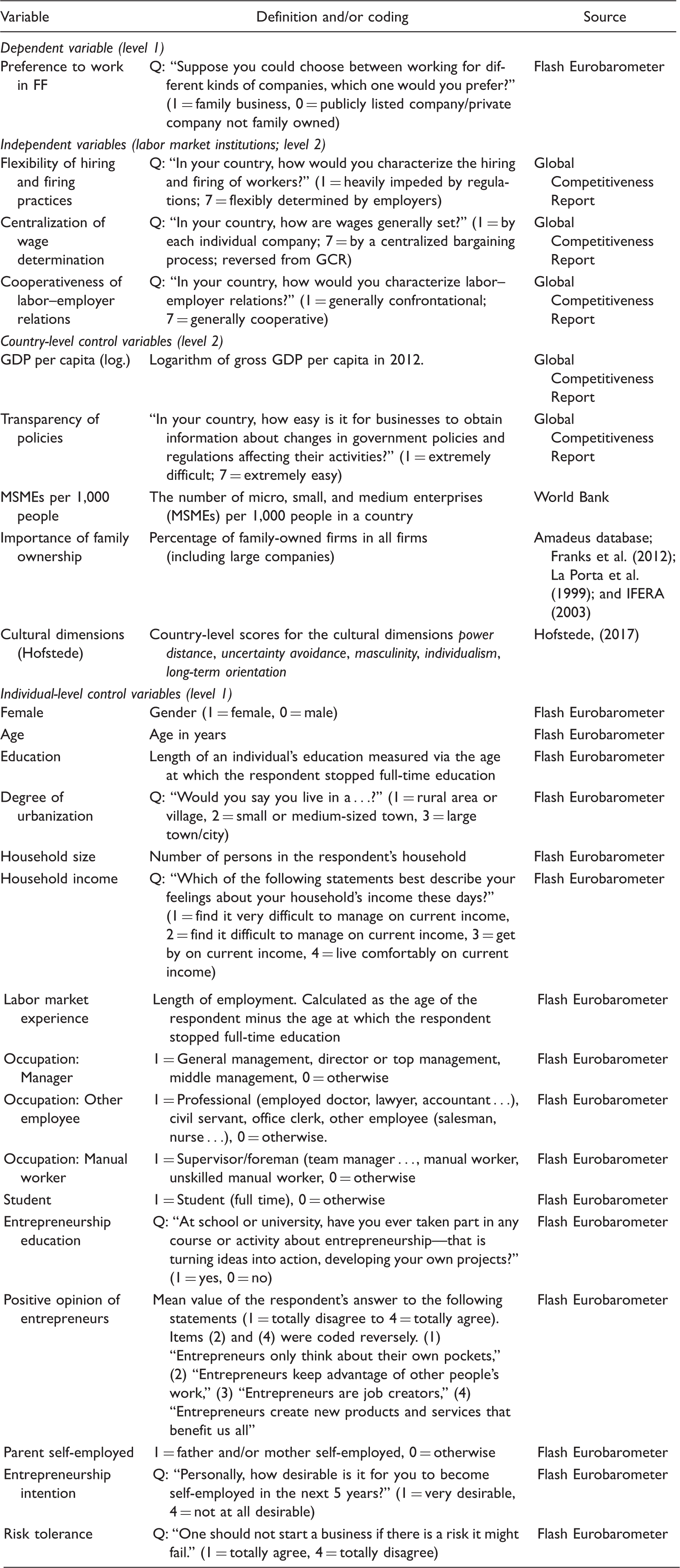
Our dependent variable is the individual preference to work in a family firm. Using the FE, we created a dummy variable to capture respondents’ preferences for working in family firms (preference to work in a family firm) via the item “Suppose you could choose between working for different kinds of companies, which one would you prefer?” Possible answers were “family business” (coded as 1) and “publicly listed company/private company not family owned” (coded as 0).
Labor market institutions
Our independent variables are measured at the country level and obtained from the GCR. The variable flexibility of hiring and firing practices is measured by the question “In your country, how would you characterize the hiring and firing of workers?” (1 = heavily impeded by regulations; 7 = flexibly determined by employers). Centralization of wage determination is measured by the question “In your country, how are wages generally set?” (1 = by each individual company; 7 = by a centralized bargaining process). To ensure better interpretability of the results, we reverse-coded the variable from the GCR. Cooperativeness of labor–employer relations is measured by the question “In your country, how would you characterize labor–employer relations?” (1 = generally confrontational; 7 = generally cooperative). These variables have been widely used in prior empirical studies examining labor market institutions (e.g., Chih et al., 2010; Dewit et al., 2009; Lawson & Bierhanzl, 2004).
Country-level control variables
We control for several country-level factors. Banerjee and Newman (1993) claim that a close link exists between economic development and occupational choice decisions across countries. Indeed, studies associate higher wealth with overall higher preferences for self-employment (e.g., Freytag & Thurik, 2007). To rule out a similar effect on the preference to work in family firms, we control for gross domestic product (GDP) per capita (in U.S. dollars) in logged form using data obtained from the GCR.
Moreover, we control for government quality by using the transparency of government policy-making measure from the GCR. Gohmann (2012) shows that the governmental environment in a country significantly impacts individual occupational choice decisions, as less transparency may create transaction costs and an overall hostile environment. Hauswald et al. (2015) show that family firms are particularly attractive employers in hostile environments.
The prevalence and visibility of family firms substantially differ across countries, and there is considerable diversity in terms of business size, ranging from small mom-and-pop stores to large, publicly listed companies (e.g., Franks, Mayer, Volpin, & Wagner, 2012; Handler, 1989). A different prevalence and visibility of family firms may bias the responses to the question of whether a person would prefer to work for a family firm because individuals may have differing perceptions of family firms depending on how visible they are in their country (Block et al., 2016; Carney, Duran, Van Essen, & Shapiro, 2017). Therefore, we control for the prevalence and visibility of family firms using two variables. First, as family firms are typically overrepresented among small and medium-sized enterprises (Klein, 2000), we control for the proportion of MSMEs in a country. We retrieved these data from the World Bank MSME indicator. More specifically, the item measures the number of MSMEs per 1,000 people in each country. Second, to account for the share of family firms among larger companies, we also control for the importance of family ownership. We retrieved data on the share of family firms among each country’s listed companies from a number of different sources, including the share of family firms among all companies in a country and, in particular, publicly listed companies. We used the Amadeus database to collect information about the percentage of firms owned by family owners for 26 European countries (Franks et al., 2012). We extended these data by information provided by La Porta et al. (1999) and data collected by the International Family Enterprise Research Academy (IFERA, 2003). We were unable to obtain data for Slovenia, Estonia, Malta, and Turkey. Hence, we used the average family ownership importance from the other 36 countries for these four countries.
Finally, cross-cultural research has established that cultural differences play an important role in explaining cross-country differences regarding their occupational choice decisions (Freytag & Thurik, 2007). The most commonly used measure of (national) culture is Hofstede’s cultural dimensions framework (Hofstede, 1980). Thus, we include the following control variables: power distance, uncertainty avoidance, masculinity, individualism, and long-term orientation. The scores used in our analysis are available online (Hofstede, 2017).
Individual-level variables
Prior research highlights the relevance of sociodemographics, occupation-related variables, and entrepreneurship-related variables for determining the preference to work in a family firm. Females have been associated with an overall higher preference to work in family firms (Block et al., 2016; Hauswald et al., 2015). Thus, we included a dummy variable (female) that takes the value of 1 if the respondent is female and 0 otherwise. Older individuals might prefer to work in family firms more than younger individuals because of the increased security and stability they offer (Covin, 1994b; Hauswald et al., 2015). Thus, we included the respondent’s age in years. Family firms struggle with attracting highly educated employees because they often seek higher wages (Bassanini et al., 2013; Covin, 1994a; Neckebrouck et al., 2017). To rule out differences related to different education levels, we accounted for the respondent’s education attainment in years (Adam-Müller, Andres, Block, & Fisch, 2015). Research has also shown that the image of family firms depends on regional characteristics and differs between rural and urban regions (Bird & Wennberg, 2014). Therefore, we control for whether the respondent lives in a rural or urban region (degree of urbanization). Additional variables that previous occupational choice research has controlled for include household size and household income (e.g., Shane, 2009). In contrast to nonfamily firms, family firms show a strong value orientation, prosocial behavior, and more personal relationships; therefore, they might attract employees who seek to work in a firm that incorporates these values (Davis et al., 1997). As a proxy for employees seeking a more personal and altruistic environment, we consider the household size (i.e., the number of people living in the respondent’s household) and argue that people living in larger households will prefer to work in family firms. Because family firms tend to pay less than nonfamily firms (e.g., Bassanini et al., 2013), people who already have high incomes might prefer not to work in family firms to preserve their wealth or continue to increase their income. Therefore, we control for household income, which was measured by whether the respondent “finds it very difficult to manage on the current income” (coded as 1) to “lives comfortably on the current income” (coded as 4).
The next block of variables captures the respondents’ occupational status. We included the labor market experience of the respondents, which refers to the amount of time between the end of full-time education and the respondent’s current age (capped at 65 years to account for retired people). We assume that persons with a longer tenure may develop different preferences regarding working for a family firm than persons new to the job market or still studying. In particular, previous studies have shown that more qualified employees (e.g., senior managers) tend to prefer working in nonfamily firms (Chrisman et al., 2014; Vandekerkhof et al., 2015). We further included a set of dummy variables to capture the respondent’s current occupation. These variables indicate whether an individual is a manager, an employee in a nonmanagement position, a manual worker, a student, or unemployed/at home. Several previous studies indicate that these groups have different preferences for working in family firms (e.g., Block et al., 2016; Chrisman et al., 2014; Covin, 1994b).
We also include entrepreneurship-related variables. More entrepreneurially minded persons might prefer to work in family firms because of their entrepreneurial nature; individuals can obtain entrepreneurial experiences in small, independent businesses (e.g., Cunningham et al., 2017; Zahra et al., 2004). We captured whether the respondents had some form of entrepreneurship education (1 = yes, 0 = no) because entrepreneurship education tends to stimulate entrepreneurial intention and ultimately, entrepreneurial behavior; it could also promote the preference for working in a family firm, as indicated by Block et al. (2016). Then, we accounted for the individual’s positive opinion of entrepreneurs, which indicates whether individuals have a positive or negative image of entrepreneurs. In family firms, workers have more personal relationships with their superiors and possibly even the founder of the company; therefore, people who have a positive opinion of entrepreneurs might be particularly drawn to work in family firms (e.g., Davis et al., 2010). Parental entrepreneurship has been frequently associated with higher entrepreneurial intentions (e.g., Crant, 1996). Therefore, individuals with entrepreneurial parents may prefer to work in family firms. To account for parental entrepreneurship, we measured whether the respondent’s father and/or mother had been self-employed (1 = yes, 0 = no). We also accounted for the respondent’s entrepreneurship intention. As previous research has shown, individuals with high entrepreneurship intentions are particularly attracted to family firms instead of nonfamily firms because of their more entrepreneurial character (Zahra et al., 2004). Finally, we accounted for the respondent’s risk tolerance via their agreement with the statement “One should not start a business if there is a risk it might fail” (1 = totally agree to 4 = totally disagree). Naldi et al. (2007) show that family firms take fewer risks than nonfamily firms.
Descriptive Statistics and Variables.
Note. FF = family firm, FE = Flash Eurobarometer Survey on Entrepreneurship, No.354 (2012), GCR = Global Competitiveness Report 2011–2012.
Descriptive Statistics
Descriptive Statistics and Correlations.
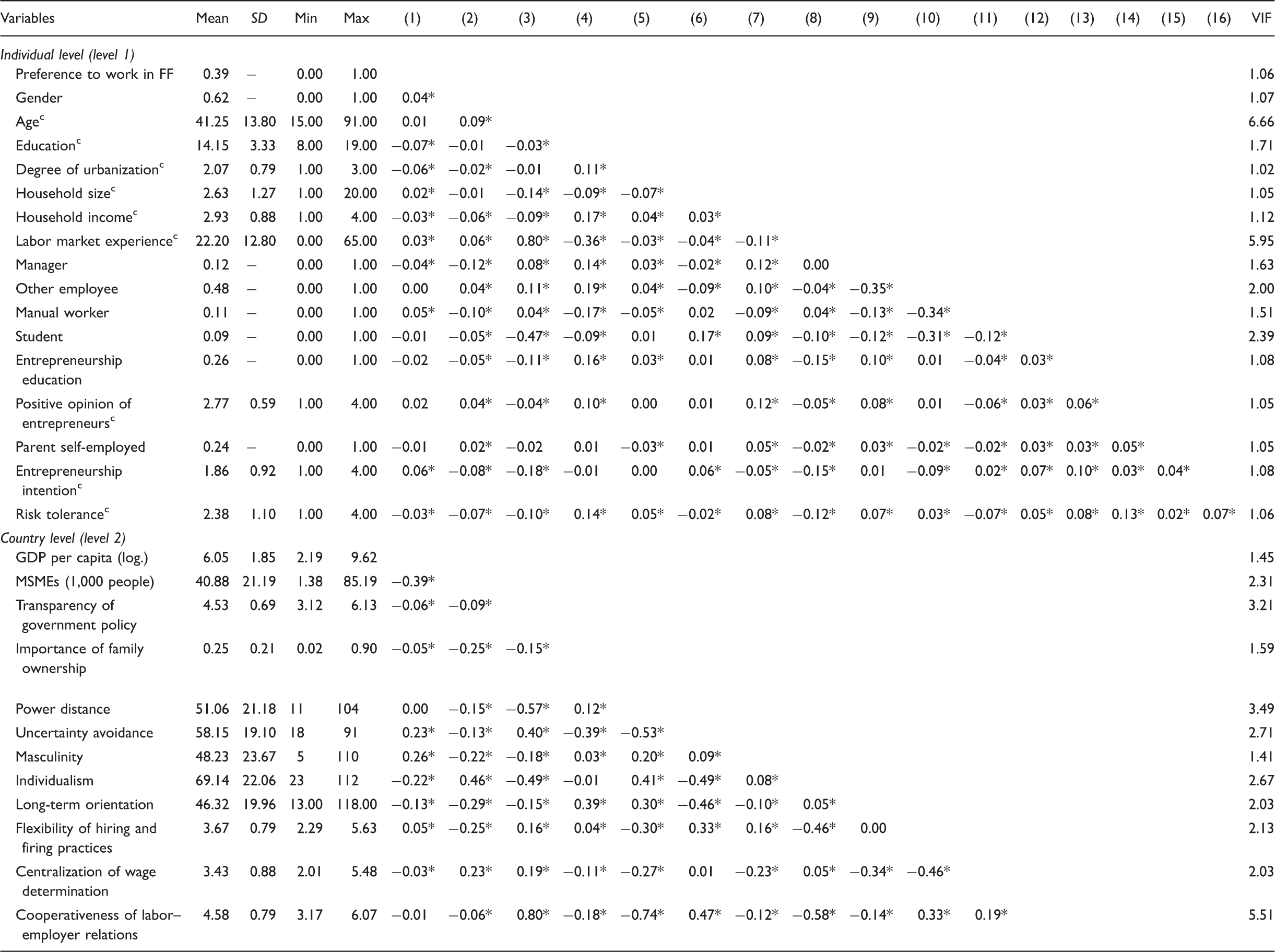
Note. N(L1) = 12,746, N(L2) = 40. FF = family firm; VIF = variance inflation factor, estimated for Model 2 in Table 3.
Variable is group mean centered in regressions; to ensure a better interpretability, the descriptive statistics are displayed for the uncentered variable.
p < .05.
Analysis and Results
Multilevel Logistic Regression Analysis
We used a multilevel logistic regression analysis (also referred to as hierarchical linear modeling) to account for the hierarchical nature of our dataset. There are two levels of data in our dataset: individuals on level 1 (L1) and countries on level 2 (L2).
A condition for the use of multilevel modeling is a sufficient variation in the different levels of analysis (Aguinis, Gottfredson, & Culpepper, 2013). To assess the presence of variations in the individual preference for family firms across countries, we calculated a null model (model with intercept only, not reported). The interclass correlation (ICC) of the null model quantifies the proportion of the total variation in the dependent variable that is due to country differences. The ICC is 0.132, which indicates that 13.2% of the variance in our dependent variable can be attributed to country-level differences (L2), while 86.8% can be attributed to variations at the individual level (L1). While there is no specific threshold for an ideal ICC, other studies report an ICC between 5% and 30% (e.g., Aguinis et al., 2013). Similarly, the significant L2 intercept (σ2 = 0.500, SE = 0.116, p < .001) indicates variations in the dependent variable across countries. Finally, we performed a likelihood ratio test that compared the model fit of the multilevel logistic regression to that of a traditional logistic regression. This test was highly significant, indicating that the model fit improved.
Regression Results
Multilevel Logistic Regressions (Dependent Variable: Individual-Level Preference for Working in a Family Firm).
Note. N(L1) = 12,746, N(L2) = 40 countries. AIC = Akaike’s information criterion; GDP = gross domestic product; MSME = micro, small, and medium enterprises; OR = odds ratios; SE = standard error.
†p < .1 *p < .05. **p < .01. ***p < .001.
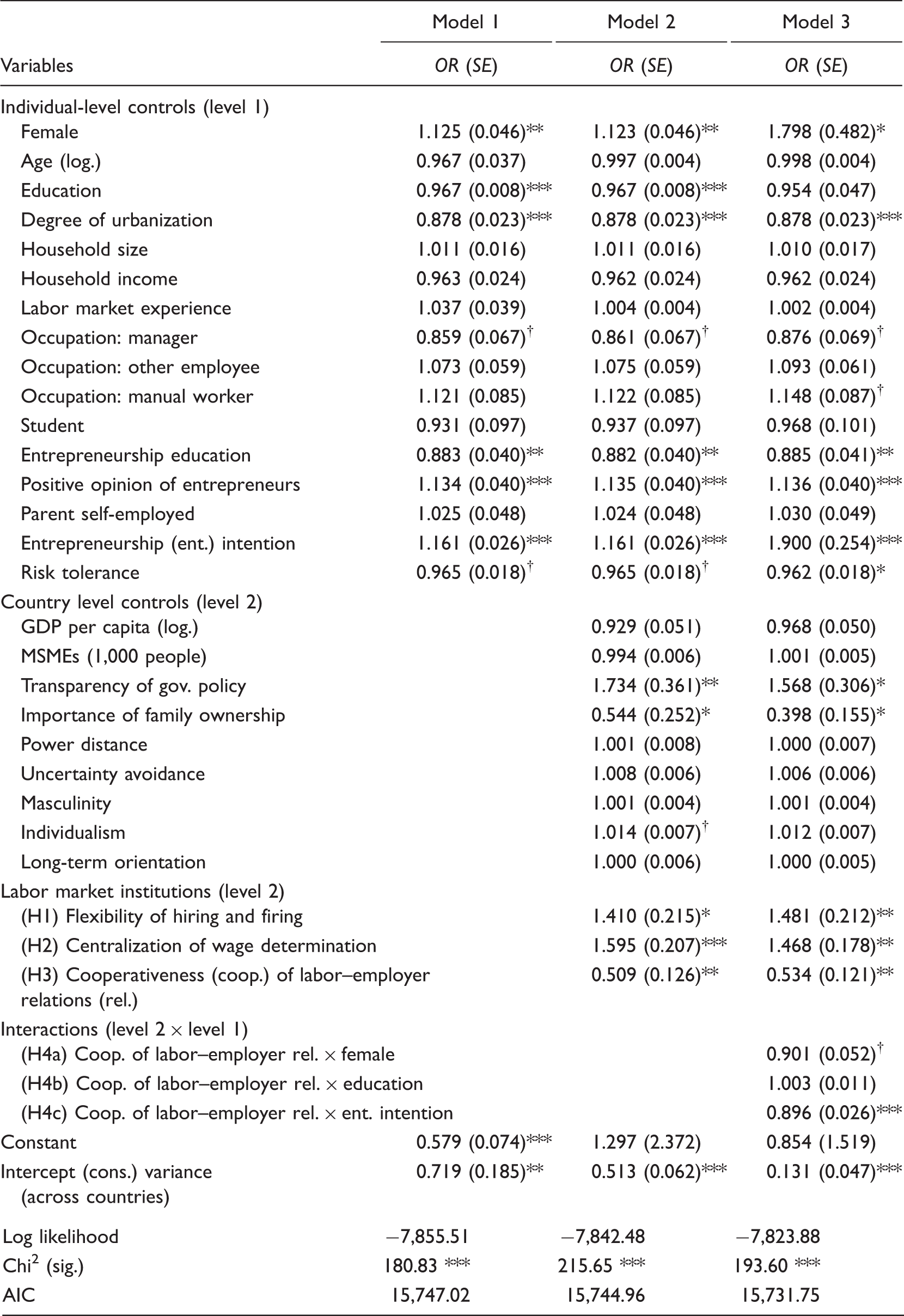
Since there is no R2-measure, other indicators are used to assess the model fit. As shown in Table 3, all of our models show significant chi-square values (p < .001), indicating an overall good model fit. Additionally, Akaike’s information criterion (AIC) measures model misfit (Hox et al., 2010); a lower value indicates a better fit of the model. As illustrated in Table 3, Model 3 has the best fit. In addition, the intercept variance across countries decreases with the inclusion of the country-level variables and interaction effects, which indicates that the inclusion of these variables reduces unexplained variances at the country level. Finally, the random slopes in Model 3 are significant for all three variables, indicating a sufficient variance in the slopes of the variables across countries, which is a precondition for an analysis of cross-level interactions (Hox et al., 2010).
Results regarding direct effects (H1–H3)
The coefficient of flexibility of hiring and firing practices indicates that this variable has a positive and significant effect (p < .01), which is consistent with our expectation that the preference to work in a family firm increases in countries that have more flexible hiring and firing practices. Similarly, the coefficient of centralization of wage determination is significant (p < .01) and indicates a positive effect. Finally, the coefficient of cooperativeness of labor–employer relations is highly significant (p < .01) and shows a negative effect.
Results regarding cross-level interactions (H4a–H4c)
The results regarding the individual-level variables are broadly consistent across our models. Based on Model 2, we find, for example, that the preference for working in a family firm is significantly and positively related to being female (p < .01) and having a higher self-employment intention (p < .001), while it is negatively related to education (p < .001). These findings are consistent with previous research (e.g., Block et al., 2016; Covin, 1994a).
H4a to H4c assume that the effects of these individual-level factors depend on overall labor market institutions. Thus, we create and estimate the effects of cross-level interaction terms. Specifically, we interacted the individual-level variables female, education, and entrepreneurship intention with the labor market institution cooperativeness of labor–employer relations (Model 3).
With regard to H4a, the interaction cooperativeness of labor–employer relations × female is marginally significant (p < .1) and indicates a negative effect. However, this term alone is insufficient for interpretation because of the model’s nonlinearity (Hoetker, 2007). To illustrate the interaction effects, it is necessary to display the marginal effects not only at the mean values for cooperativeness of labor–employer relations but also at the low and high values. To determine the high and low levels of a non-binary variable, prior literature recommends plotting values for each 0.25 SD above and below the mean value up to values of roughly+/-1 SD (e.g., Dawson, 2014; Hoetker, 2007). Hence, Figure 1 displays the marginal effects of the individual-level variables for both low (−1 SD) and high (+1 SD) levels of cooperativeness of labor–employer relations. Panel (a) of Figure 1 shows that females have a higher preference to work in family firms, especially when there is a low level of cooperation in the national labor market, although the effect is not extremely strong. This effect disappears if there is a high degree of cooperation, which suggests that females are particularly attracted to family firms in the absence of cooperation in labor–employer relations at the country level, supporting H4a.
Cross-level interaction plots. (a) Cooperativeness of labor-employer relations x female, (b) Cooperativeness of labor-employer relations x entrepreneurship intention.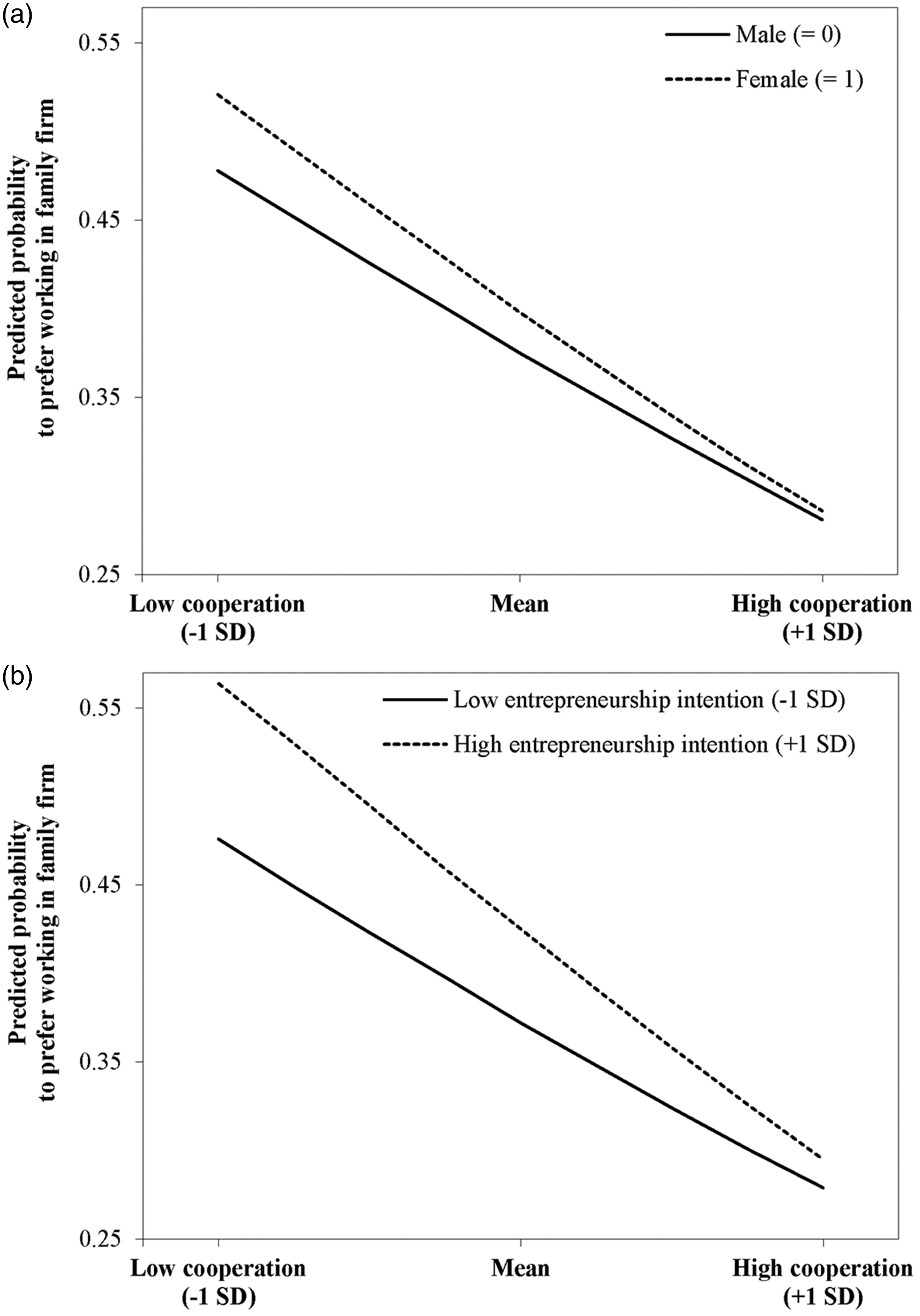
Regarding the interaction term between cooperativeness of labor–employer relations and education (H4b), our regression model (Model 3) does not reveal any significant effects. H4b is not supported.
Finally, the interaction term cooperativeness of labor–employer relations × entrepreneurship intention (H4c) is highly significant (p < .001) and indicates a negative effect (Model 3). This result is supported by the graphical plot in Panel (b). Individuals with high self-employment intentions have a comparatively higher preference to work in family firms when there is low cooperation in labor-employer relations at the country level, while this difference in preferences vanishes in countries where labor–employer relations are generally cooperative.
Discussion
Implications for Theory
Making a contribution to family business research, our study identifies important contextual factors, namely, labor market institutions, which influence an individual’s preference to work in a family firm, directly and also indirectly via an interaction with individual-level variables. This implies that the unique characteristics of family firms, such as long-term orientation and trustworthiness, must be considered in the overall context in which the family firm is embedded. What makes family firms attractive and unique in one contextual environment may have limited effects or even the opposite effects in another environment. Thus far, few studies have investigated how context shapes the perception, behavior, and outcomes of family firms and family ownership. Our study represents a first step in this direction by focusing on the context-dependent attractiveness of family firms as employers.
Our study also contributes to entrepreneurship research. In particular, it fuels a recent debate on the role and importance of context in entrepreneurship research, which has often highlighted the importance of contextual factors for shaping individual outcomes (e.g., Hackman, 2003; Welter, 2011). This research highlights that the influence of contextual factors on individual-level outcomes is both direct and indirect, producing a context-specific individual outcome (e.g., Johns, 2006; Welter, 2011). We show that the effects of individual-level factors for individuals’ occupational choice decisions, such as gender and entrepreneurship intention, are indeed contingent on the labor market context and its institutions. We provide a nuanced view of the determinants of individual entrepreneurial and occupational choice decisions (e.g., Douglas & Shepherd, 2000; Parker, 2009) and are the first to consider labor market institutions.
The cross-level analysis indicates that people with a higher entrepreneurship intention prefer to work in family firms, especially in labor markets with uncooperative labor–employer relations. This has implications for the related literature on corporate entrepreneurship and intrapreneurship in family firms (Kellermanns & Eddleston, 2006). Research finds that family firms can be highly entrepreneurial due to the corporate culture (Zahra et al., 2004) and characteristics of their CEOs (Salvato, 2004). Our results indicate that an additional antecedent of corporate entrepreneurship in family firms may be their workforce, which has higher entrepreneurial intentions than the workforce in nonfamily firms. While this factor is barely mentioned in previous research, our results not only highlight that family firms may be able to attract people with higher entrepreneurship intentions, we also show that this attraction depends on the labor market institutions in which the family firm is embedded, hence explaining differences in the corporate entrepreneurship of family firms across countries.
Our results show that the entrepreneurial nature of family firms attracts a particular set of employees. This finding may also have broader implications for entrepreneurship scholars: A number of studies indicate that start-ups attract different types of employees than established firms do. They typically employ a younger, less educated workforce (e.g., Ouimet & Zarutskie, 2014). Moreover, it is argued that employees in start-ups tend to be especially motivated to work for those firms, as they are often regarded as innovative and dynamic (Sauermann, 2017). Applying the findings of our study to the context of start-ups suggests that the workforce composition and attractiveness of start-ups as employers might also be affected by labor market institutions.
Implications for Practice
Our research has important practical implications for the human resources management (HRM) practices of family firms in an increasingly competitive environment. Prior research finds that family firms often use less professional HRM practices than nonfamily firms do and are perceived as less attractive by potential employees (Cable & Yu, 2006; Williamson, 2000).
One increasingly important HRM tool in the competition for talent to counter such negative perceptions is the use of sophisticated employer branding strategies (Backhaus & Tikoo, 2004; Hauswald et al., 2015). To utilize such employer branding and related managerial measures in family firms, it is necessary to learn more about the reasons why the preference to work in a family firm differs among individuals compared to other forms of potential employment. Our study extends previous research by showing that the labor market context plays a decisive role in determining the relative attractiveness of family firms as employers. In addition to providing a novel comparison of preferences for employment in family firms in a cross-country setting, our findings show that the employer image of family firms must be evaluated in the context of a country’s labor market institutions.
As a part of their employer branding strategy, family firms should highlight that they offer a stable work environment and this should be communicated to their targeted employees; this strategy will have a greater effect in economies with flexible hiring and firing practices.
Limitations and Avenues for Future Research
Our study is not without limitations. For example, the definition and characteristics of family firms vary among countries. Different perceptions of what a family firm is may bias the responses to the question regarding whether a person would prefer to work for a family firm. Another limitation concerns our dataset. Despite its advantages, we could not use the full sample of the FE because only respondents who indicated that they would prefer to be employees (rather than, e.g., being self-employed) were asked whether they preferred to work in family firms. We also excluded retirees. Retirees typically differ from other individuals because they have already passed the stage of actively considering different employment options. Finally, the measurement of our dependent variable is relatively simple, as we use one single question to operationalize the preference to work in a family firm. While we are constricted by the data included in the FE, future research could follow Kahlert et al. (2017) and measure family firms’ attractiveness in a more nuanced way.
Our article opens up several avenues for future research. Our results show that a large portion of the cross-country variance is still unaccounted for, which indicates that other contextual factors explain differences across countries. For example, future research might find it interesting to analyze different formal (e.g., political system) and informal (e.g., culture, religion) institutions in this context. Additionally, our data indicate considerable differences between Asian and non-Asian countries regarding the preference to work in a family firm. Previous research in the domain of family firms often refers to the United States or European countries, while little attention has been paid to Asian countries, such as South Korea or China. However, family firms do play an important role in these economies. South Korea, for example, is home to a variety of extremely large and renowned family firms, such as Samsung and LG Electronics. While we show that family firms as employers are viewed differently across countries, it would be particularly interesting to further investigate precisely how their image as employers differs. In addition, future research could address differences in occupational choice decisions of (potential) family employees and compare these to those of (potential) nonfamily preferences established by this research.
Footnotes
Acknowledgments
We thank the participants at the G-Forum 2016 and a research workshop at the University of Luxembourg for helpful comments on earlier versions of this manuscript.
Declaration of Conflicting Interests
The author(s) declared no potential conflicts of interest with respect to the research, authorship, and/or publication of this article.
Funding
The author(s) received no financial support for the research, authorship, and/or publication of this article.