




Abstract
Longevity is at the core of what makes family businesses special. Unlike most attempts to explain longevity that have focused primarily on the factors within a family business that lead to longevity or the factors outside of an organization’s environment, we adopt a business-history perspective that enables us to show how the interplay between the organization and its environment can help to explain family business longevity. Building on the category literature, we trace the interaction of a small Swedish fourth-generation high-quality furniture manufacturer with its category over a period of more than 120 years. We identify the internal mechanisms driving family business longevity, the external mechanisms driving category development as well as the mechanisms underlying their interaction. Specifically, we provide new insights into how agency exercised by the family business contributes to the shaping of the category they are a member of, thereby nurturing their business longevity.
Introduction
The question of why many firms fail, while others thrive and survive for generations, remains a fundamental puzzle in organization and management studies (Josefy et al., 2017; Napolitano et al., 2015). Even if survival is often an assumed precondition for other desirable outcomes such as growth and financial performance, there is no clear consensus why a business would aim to endure over a long time in the first place, when long-term survival goals can negatively impact short-term financial performance and the chance for making a profitable exit (Josefy et al., 2017). In the case of family businesses, however, research has shown that these firms often prioritize nonfinancial goals such as long-term sustainability (Chrisman et al., 2012; Zellweger, 2007), care for multiple stakeholders (Cennamo et al., 2012), and local prosperity (Randolph et al., 2022). This makes the longevity of family businesses a matter of considerable societal interest (Astrachan & Jaskiewicz, 2008; Colli & Larsson, 2014). As noted by Napolitano et al. (2015, p. 956): “The typical features for extraordinarily long living firms throughout history are relatively small or medium size and family ownership.”
Most previous studies seeking to explain business longevity have focused either on deterministic external factors, such as spatial differences and access to external resources, or on more voluntaristic internal factors, such as different strategic choices, innovation, and values (Riviezzo et al., 2015). For further advancement, Riviezzo et al. (2015) have called for research on business longevity to focus on exploring the dynamic interplay between internal and external factors. While prior studies have suggested that family businesses must abandon family values to survive, we lack an understanding of how some family businesses manage to thrive despite continuing to focus on their family logic (Reay et al., 2015). Answering these calls, we explore how family businesses can achieve longevity by engaging with their external environment over time. To do so, we draw on theories of market categories and categorization that offer a framework for how industries evolve over time through dynamic interaction between category members and their audiences (e.g., Durand & Paolella, 2013; Vergne & Wry, 2014). We utilize a business history approach (Colli & Fernandez Perez, 2020) and adopt an in-depth longitudinal case study design (Pettigrew, 1990) to capture these interactions.
With this article, we make the following contributions. First, by introducing the concept of “categories” into the family business field (e.g., Delmestri et al., 2020; Durand & Paolella, 2013; Lo et al., 2020; Vergne & Wry, 2014), we show that a family business can achieve longevity by exercising agency to influence its category in a way that allows survival without renouncing its values. While prior studies have focused on how internal and external factors shape family firm longevity, we focus on family businesses’ agency to shape their market category, whereby they are nurturing their longevity. Second, we refine current insights into owner families’ logics to strive for family business longevity and how these may vary over time as priorities are reconsidered in view of the position of businesses within the market category. While prior research has commonly assumed that these firms need to give up their family business values to survive over time, our study shows the importance of sticking to a set of values that might even lead to temporarily sacrificing ownership to save the longevity of the business (e.g., Casillas et al., 2019). Third, our historical approach allows us to identify and elucidate a set of mechanisms that explain the dynamics of how even small family businesses can enact agency in forming the category in which they are embedded and capture the varying levels of agency in this interaction over a timespan longer than usually studied.
In the following section, we position our study within the literature on family business longevity and category dynamics. We then outline our research approach, which draws on historical methods for family business research (Colli & Fernandez Perez, 2020). Based on a longitudinal single case study, we trace the history of a family business and its category over a period of more than 120 years. We present our findings along four phases delineated by key transitions. Finally, we derive a model of family business longevity from these findings, which we discuss in relation to firm agency in category dynamics.
Theoretical Motivation
Family Business and Longevity
Although family businesses come in myriad shapes and sizes, they inevitably share a set of common characteristics, given the overlap of family, business, and ownership (Gersick et al., 1997). In this study, we draw on the definition of family business developed by Chua et al. (1999, p. 25; emphasis added) which sees family business as a business governed and/or managed with the intention to shape and/or pursue the vision of the business held by a dominant coalition controlled by members of the same family or a small number of families in a manner that is potentially sustainable across generations of the family or families.
A distinctive feature of family businesses is that they often pursue goals beyond merely increasing their financial returns, typically being driven by the goal of preserving their “socioemotional wealth,” here referring to nonfinancial aspects such as striving for family control and influence, binding social ties, and intrafamily succession (Berrone et al., 2012; Gomez-Mejia et al., 2011), at least until the very survival of the business is at stake (Casillas et al., 2019; DeTienne & Chirico, 2013). Of particular interest to our study focus is how family businesses strive for longevity, that is, for their firm to continue beyond the founding generation. At its most basic level, longevity implies that the name of the firm remains the same over time and that the family remains continuously involved (Sharma & Salvato, 2013). Hence, a major challenge for family business longevity is that of achieving intergenerational succession and transgenerational control (Löhde et al., 2020). Family businesses tend to evolve from a “controlling owner” in the first generation to a “sibling partnership” in the second generation and onto a “cousin consortium” in the third (Gersick et al., 1999). This process of transition toward an ever-larger consortium of owners loosens the ties of family members to the business, reducing their commitment and negatively affecting the firm’s longevity (Aronoff, 2004).
Research investigating the longevity of family firms often focuses on aspects largely internal to the family and its business, such as the entrepreneurial orientation of the family itself (Zellweger et al., 2012), the degree and type of learning undertaken by the owners (Löhde et al., 2020), or the extent of the family firm’s risk-taking (Naldi et al., 2007). Antheaume et al. (2013, p. 958) have summarized the key internal factors assuring longevity as “familiness, stewardship, embeddedness and psychological ownership.”
Other studies have sought to assess, often rather deterministically, how external factors influence the longevity of family businesses (Riviezzo et al., 2015). Different environmental aspects such as governmental institutions (Fernández-Moya et al., 2020), legal frameworks (Carney et al., 2014), and networks (Ciravegna et al., 2020) have been found to greatly influence longevity. Little attention has, however, been paid to the interface between family businesses and the context in which they operate, thereby overlooking the role potentially played by the ongoing engagement of family businesses with their external stakeholders (Le Breton-Miller & Miller, 2015).
Of those studies that have examined the role of context in family business longevity, Simon (1996) famously pointed out that these firms often hold positions as “hidden champions” within their sectors even despite their comparative resource constraints. Owner-managed SMEs in Germany, that is, the German Mittelstand, show a strong connection between innovativeness in this sector and the agency of family businesses (Simon, 1996). Family firms tend to dominate their own narrowly defined categories, attributing this success in part to the interactions of these businesses with their contexts and including the collaboration with customers on product innovation (De Massis et al., 2018). Another type of collaboration identified as key to the question of how family firms can achieve longevity through interactions with their contexts is that of “intercompetitor affiliation” in the sense of affective collaboration with competitors and others within the same sector (Ingram & Lifschitz, 2006). For example, a study of wineries in the Okanagan region of Canada has shown how collaboration on collective marketing, legislative lobbying, and shared quality standards enabled these businesses to reshape their environment and achieve sustainable co-existence and prosperity (Reay et al., 2015).
Notwithstanding the valuable insights gained from these context-focused studies, we still lack a more detailed understanding of how the longevity of family firms is influenced by their own agency to shape these very contexts. Beyond the need for persistence in following the same values and organizational purpose, it is argued that family firms must have the capacity to adapt to changes in their internal and external environment (Miller & Le Breton-Miller, 2005; Sharma & Salvato, 2013). To elaborate a more comprehensive explanation of family business longevity, we propose to go beyond adaptation to attain a better understanding of how family businesses enact agency to engage with their environment. Therefore, we turn next to the literature on categories.
Categories and Firm Survival
Originating from research in psychology and sociology, the concept of “categories” has gained traction in the field of organization and management studies as a way of better understanding an organization’s context and external environment by capturing the interaction of micro- and macro-level dynamics: An organizational category is recognized as such when similar member organizations and a set of associated external audiences come to a mutual understanding of the material and symbolic resources that serve as a basis to assess membership in the category. (Vergne & Wry, 2014, p. 68)
Category membership has implications for firm performance and survival. Hsu et al. (2009) demonstrate that spanning several categories renders negative economic outcomes, and Kovács and Hannan (2015) show that organizations with unclear category membership have lower customer appeal. As such, the category literature is influenced by population ecology (Freeman & Hannan, 1989; Hannan & Freeman, 1977) and industry evolution (Gort & Klepper, 1982; Klepper & Graddy, 1990), thereby establishing the link between industry structure and firm survival (Klepper & Simon, 2000). Building on these two streams of literature, the categories concept further explains the dynamic interaction between firms and their market category.
Categories have been studied from both “within” and “outside.” Research from the “outside” has focused on the perspective of stakeholders and the question of how they engage with established categories and evaluate the members of these categories (Hsu et al., 2009). Stakeholders are here referred to as an “audience,” meaning a group of actors who share a meaningful consensus (Durand & Paolella, 2013) and who enter into a relationship of mutual dependence with an organizational category (Vergne & Wry, 2014). Conceptualized in this way, audiences can thus comprise, for example, consumers, trade associations, media, and social movement groups (Pedeliento et al., 2020). Research in the field has also shown that categories can shift either horizontally to encompass new meanings or vertically through hierarchies (Delmestri & Greenwood, 2016; Hofstadter & Sander, 2013). However, categories can also remain “stable” and “viable.” “Category-stability” depends on a sustained shared understanding among the members of a category as to the features and meaning of that category (Cattani et al., 2008; Negro et al., 2010), while “viability” captures both the change and the continuity of categories (Lo et al., 2020). Processes of market category formation can take the form of emergence or creation. Durand and Khaire (2017, p. 88) define this difference as “the formation of categories that emerge from elements extraneous to an existing market while category creation refers to a situation where a new category consists in redesigning cognitive boundaries around a subset of elements within a preexisting category system.”
In general, an organization is considered a member of a category when its offer is perceived by the audience and other members of that category as clearly falling within the boundaries of that category on account of possessing certain key attributes (Vergne & Wry, 2014). Generally, categories comprise “a number of features that are considered equivalent” (Rosch, 1978, p. 5). Given that organizations often have more than one distinctive feature, they can also be part of one or more categories (Durand & Paolella, 2013). Thus, an important distinction is made between organizations that are part of only one category, referred to as “category specialists,” and organizations that interact within and across categories referred to as “category spanners” (Kovács & Hannan, 2015). Scholars have found that audiences generally prefer category specialists over category-spanning organizations that are harder for them to assess, although this ultimately depends on the combination of the categories that such organizations span (Paolella & Durand, 2016; Rindova et al., 2011). As Durand and Paolella (2013) have argued, this is because organizations that span multiple categories can create a degree of “categorical fuzziness” which can engender misplaced expectations among their audiences. In line with that, Durand and Khaire (2017) argue that an organization in the process of becoming associated as a member of a category will often revisit its positioning, which in turn can sometimes lead to the creation of a new category.
This is echoed in studies of categories from “within,” which have focused on producer-side aspects, that is, on the role of organizations in their categories, membership in categories (who is “in” and who is “out”), and the role of agency in the formation of categories. Members that fulfill all membership criteria have zero distance to the core, while those that partially fit have a “fuzzy” membership (Hannan et al., 2007). For example, scholars have studied the reasons why organizations attempt to create new categories in the first place (Ozcan & Gures, 2018) as well as how they create these categories, for example, by contrasting existing offerings with new ones (Hsu & Grodal, 2021). This line of research has found that when a new category emerges, there is often disagreement as to who should or should not be regarded as a member (Granqvist et al., 2013; Hsu & Grodal, 2015). Given that the members of a category may benefit in different ways from their exchanges with the market (Durand & Khaire, 2017), they may also develop different strategies for positioning themselves within the same category or a new one. Scholars have discussed not only how organizations can hold different positions within categories but also how they can make use of their agency to change the position of the category itself (Delmestri & Greenwood, 2016). According to Glynn and Navis (2013), for example, a firm’s membership in and embodiment of one or several categories and its position within them depends primarily on the organization’s identity. The characteristics of the category change over time so that during category formation, members construct a common identity by emphasizing similarities across the firms that claim membership to the category, while after a new category achieves legitimacy, its members tend to refocus on their own distinctive identity within it (Navis & Glynn, 2010). Navis and Glynn (2010) further describe how this legitimacy is shaped by the interplay between its internal members and actors external to the category.
Vergne and Wry (2014) argue that there is consensus that category members and their audiences can enact their agency to together arrange the structural relationship between categories and agree on how different categories relate to each other so that, for example, businesses are categorized into industries and product types within these industries. What remains a matter of debate, however, is how much agency organizations potentially have as category members in the categorization process compared with how they are perceived and categorized by their audiences (Vergne & Wry, 2014). Research in this direction is devoted to how boundaries of categories can be strategically stretched (Durand & Paolella, 2013), crossed (Kovács & Hannan, 2015), or eroded (Rao et al., 2005). These studies on category fuzziness and spanning suggest a shift in agency: While category audiences can judge category membership as long as there are clear category boundaries, the question is to what extent category members themselves can move within and across categories and thereby take hold of the agency to influence category membership.
Likewise, what remains unclear in the literature to date are the tensions and interactions between organizations and their audiences and the role played by power, resources, and politics in classification processes (Cornelissen, 2012; Santos & Eisenhardt, 2009; Wry & Lounsbury, 2013). The socially constructed nature of categories renders them complex and challenging to study as an analysis requires simultaneous consideration of the agency of the involved actors (member organizations and audiences), the structural conditions of the context (category), and the multitude of shifting market and nonmarket forces at play at any time that shape or change categories (Pedeliento et al., 2020). Although research on categories has flourished in recent decades, the extant scholarship does not adequately acknowledge these debated questions and broader category dynamics (Delmestri & Greenwood, 2016; Delmestri et al., 2020; Durand & Paolella, 2013). The question of where new categories come from (Durand & Khaire, 2017; Lo et al., 2020), the processes through which they are created (C. Jones et al., 2012; Kennedy & Fiss, 2013; Navis & Glynn, 2010), and how category-blending and spanning influence category formation (Durand & Paolella, 2013; Rao et al., 2005) are yet to be fully addressed. Moreover, because studies often conceptualize “category change” as a shift from one state to another in a step-by-step sequential process, they overlook the role of category dynamics that involve parallel coexistence and multiplicity. In consequence, we need further research on how category dynamics contribute to category change (Delmestri et al., 2020; Gollnhofer & Bhatnagar, 2021). To address this gap, our research question is the following:
Answering this question is important because category engagement by family firms—due to their unique features—may be different from that by corporates and entrepreneurial ventures which most research has focused on.
Method
Research Design
Merging insights from organizational and historical research, we draw on a history-informed longitudinal case study design (Langley, 1999; Sinha et al., 2020) to capture business history in its context (G. Jones & Khanna, 2006). Our focus in this single case study (Leppäaho et al., 2015; Stake, 1995) is capturing the development of a business over several generations to advance our understanding of family business longevity (Argyres et al., 2020). History-informed research methods can enhance the study of families in business through the insights generated from tracking a family over a longer period (Colli & Fernandez Perez, 2020). In our qualitative case inquiry, therefore, we study a single focal firm in-depth intending to capture—rather than reducing or simplifying—the complexity of the firm’s development process over a period of more than 120 years (Micelotta et al., 2020). By following a family business in real-time since 2004 and retrospectively back to its inception in 1898, we have been able to explore consistency and change in the firm’s major strategic decisions over time, including its strategic positioning, product development, and customer segments as well as how it engaged with its category in different phases.
We capture the case study with a narrative approach (Dawson & Hjorth, 2012). Narrative research attempts to make sense of experience through stories that can be studied and interpreted as a means of understanding organizations (Cunliffe et al., 2004). In family businesses, it should be noted, the meta-narratives of the family and its business are necessarily intertwined (Hjorth & Dawson, 2016). In tracing the firm’s development over time, we interpret the historical embeddedness of the case and seek to understand the actions of individuals and the meanings of actions in their wider context (Vaara & Lamberg, 2016), thereby taking history seriously as an approach for understanding organizational endeavors (Godfrey et al., 2016). This type of interpretative approach to history is especially useful for narrating the origins of family businesses to explore connections and discern patterns between different levels of analysis (Colli & Fernandez Perez, 2020; Maclean et al., 2016).
Research Context
Our research is designed to generate insights through an in-depth study of a single firm’s history and its engagement with its market category over a time extensive enough to capture even more gradual industrial, institutional, and socioeconomic changes and their influence on the longevity of the business (Buckley & Fernandez Perez, 2016). To that end, our case choice was information-oriented (Flyvbjerg, 2001, p. 79): We have selected a family business with a history of more than 120 years with strong embeddedness in the industry that was willing to grant us extensive access. Having already survived through four generations, the selected business is also a paradigmatic case of a “long-lived” family business (Le Breton-Miller et al., 2004; Löhde et al., 2020). Beyond this characteristic, our case further provided us with an interesting empirical puzzle in that, contrary to the way businesses usually develop by adjusting their value offerings in line with customer demands (Saebi et al., 2017), this family business decided to stick to its original value-based production and design logic and to instead change its main customer segment. The success of this endeavor raises the interesting question of the role this counterintuitive move played in the longevity of the business. Given the need for a better understanding of how firms engage with their category to achieve longevity, our case is highly suitable for addressing this research question.
Our case firm, Karl Andersson & Söner AB (KAS), is a Swedish producer of high-quality design furniture founded in 1898. The firm is currently owned and run primarily by members of the fourth generation of the family, with some of the third generation still highly involved in the business. In 2021, KAS employed 34 people and had a turnover of more than €4.15 million. According to industry experts, the firm has been a significant player in the formation of the category of “Scandinavian Design furniture” (Boman, 1991; Wilhide, 2009), again making KAS an ideal case for investigating the engagement of a family business with its context.
Sources
Following business history research practice, our study is based on an analysis of primary sources, including original texts, artifacts, and the oral history accounts of living actors directly involved in developments as well as secondary sources such as commentaries and writings about the past made later (Colli & Fernandez Perez, 2020; Lipartito, 2013). In approaching these different types of historical sources, we considered their validity, credibility, and transparency in accordance with Kipping et al.’s (2013) recommendations for source criticism. Therefore, we gave careful consideration as to why and by whom each source had originally been created and why it had been preserved (Colli & Fernandez Perez, 2020; Sinha et al., 2020). Because KAS has not changed its facilities since 1945, moreover, the owner family has saved abundant records from the past, especially records related to design collaborations, product development, and production (such as photos and product catalogs as well as original tools used by the founder). Our sources also include a range of books by historians and design journalists on Scandinavian Design, reflecting this topic being of long-standing public interest. Importantly, this combination of historical sources and real-time observations enabled us to merge historical and organizational research and triangulate different types of sources. An overview of our sources is presented in Table 1.
Primary and Secondary Sources.
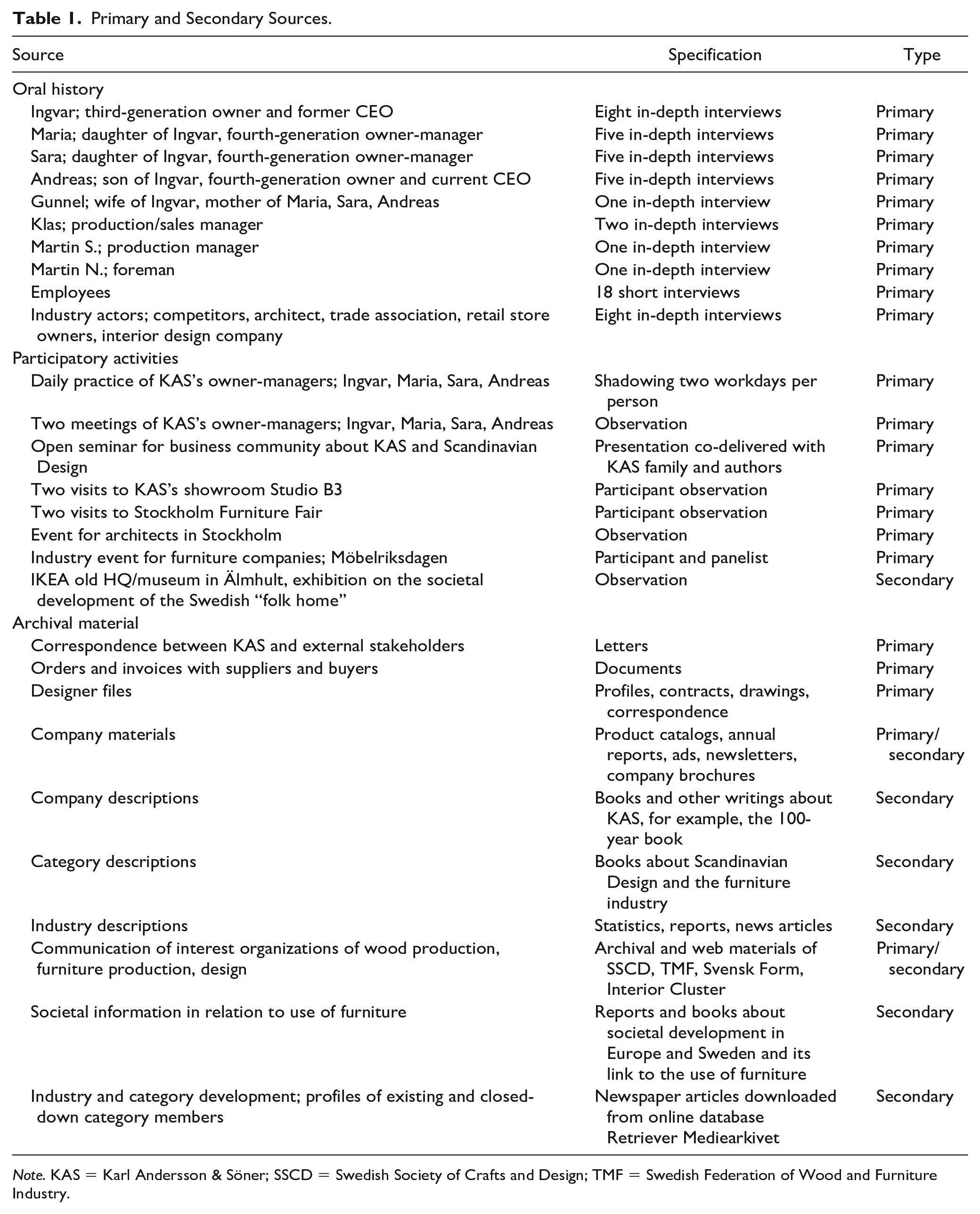
Note. KAS = Karl Andersson & Söner; SSCD = Swedish Society of Crafts and Design; TMF = Swedish Federation of Wood and Furniture Industry.
Oral History and Observations
Our oral history data comprise 54 interviews with 33 different individuals, some of who were interviewed up to eight times since 2004. Most of the interviews were tape-recorded and varied in length (between 1 and 3 hr), resulting in more than 500 pages of transcripts. Eighteen employees were interviewed for only about 20 min each at their workstations, which we documented by handwritten notes.
The interviews were guided by open questions about the firm’s development over time. Throughout our study, a crucial source of information was Ingvar, one of the grandsons of the founder of KAS, with whom we met from 2004 onward regularly to reconstruct his memory of the firm’s development and the interaction of the firm with its market category over time. Ingvar had already spent a lot of time at the firm’s factory in his childhood even before he began working at KAS in 1960, meaning his memories relating to it reached back some 70 years. We also conducted interviews with Ingvar’s wife, Gunnel, as well as 15 interviews with the three fourth-generation members of the family firm. Additional interviews were held with 21 of the firm’s employees. To capture outside perspectives, we conducted eight additional interviews with industry actors including competitors, architects, and designers, focusing in these interviews on accounts related to the category of the business and the role of KAS vis-à-vis the formation of this category.
To counteract the risk of biased “evidence,” putting the family in a positive light (Colli & Fernandez Perez, 2020), we balanced our interviews from within the family with interviews with members outside the family, in total interviewing five family members and 28 nonfamily members. To gain a deeper understanding of the family business and its interactions with different types of external stakeholders, we also undertook various other forms of observations through participative activities between 2006 and 2018 (see Table 1 for an overview). These activities included shadowing each of the four owner-managers and covering their activities and interactions over the course of two full workdays each (Czarniawska, 2007; McDonald, 2005), amounting to 66 hours of observation documented with handwritten notes and summarized into an 18-page long document. In addition to that, we observed 10 meetings, events, and exhibitions, affording us with opportunities to gain a close-up sense of the firm’s engagement with the actors within and beyond its category. Through these observations we identified the role of family values as a driver for action and the types of engagement KAS had with external actors, feeding into our understanding of longevity beyond survival.
Documents and Archives
Recognizing that managers can use history-as-rhetoric and historical narratives as a strategic tool (Sinha et al., 2020), we counterbalanced this by drawing on primary and secondary archival sources to piece together a thick description of the past 120 years. Primary archival materials, especially in form of mail correspondence with designers, invoices, customer newsletters, product catalogs, firm brochures, and advertisements, were collected to aid toward an in-depth understanding of the time span that we were unable to capture in real-time. In addition, we made use of the abundant materials available at the National Archive of Sweden, both in digital form and cataloged in analog collections about the evolution of the industry and the specific category that constitutes the focus of our study. These data were partly primary (e.g., scanned original sources about different exhibitions) and partly secondary (e.g., documents from the Swedish Society of Crafts and Design over time). To triangulate our primary sources and to facilitate our analysis of the firm’s engagement with its category, we also made extensive use of secondary sources such as annual reports, industry statistics, industry reports, and different kinds of publications about the formation and distinct characteristics of Scandinavian Design.
Newspaper Articles
As the furniture industry consists of a range of different actors—comprising producers of different types of furniture, suppliers, and retailers—it is almost impossible to reconstruct the size of the category over time based on statistical sources. Moreover, it is very difficult to identify former category members who did not survive over time. To solve this issue, we conducted a search in the Swedish online database Retriever Mediearkivet for all newspaper articles published on the Swedish furniture industry and Scandinavian design. This database stores printed press articles published in Sweden and covers all major national and regional newspapers as well as industry press. We downloaded the 834 articles containing the search term “svensk OCH möbelbransch” (i.e., Swedish AND furniture industry). We read these articles to extract statements about trends and economic development of the furniture industry at large, the category and audience perceptions, and the companies mentioned. The articles thus provided us with additional evidence regarding the choices made by and the fates of other furniture producers.
Narrative Analysis
Our historical approach enabled us to capture evolutionary dynamics over several decades based on rich data across multiple levels of analysis. Narrative analysis has proven to be especially appropriate in family-business studies of complex issues involving different actors on multiple levels (Dawson & Hjorth, 2012; Short & Payne, 2020). In our multilevel analysis, we defined our case firm as the focal unit upon which we base our analytical generalizations (Hitt et al., 2007). Since analyzing a story always requires “contextualization” to convey the sense of time and place of the plot (Hjorth & Dawson, 2016), our analysis followed the typical steps in a narrative analysis by explicating the story of our case (“what does it say?”), explaining it (“how/why is it said?”), and exploring emerging themes (Czarniawska, 2004; Dawson & Hjorth, 2012).
Following an approach for longitudinal studies like that taken by Austin et al. (2017), we created a case database to manage the vast volume of material compiled over the years, arranging the different pieces of data into a timeline, and triangulating it among different sources to contextualize each piece of information. These raw data were repeatedly studied to identify the elements of the story the data seemed to be telling us (“explication”) and thus served as the basis for composing a thick chronological narrative, akin to Pedeliento et al.’s (2020) study of the gin renaissance and Raffaelli’s (2019) study of the re-emergence of Swiss mechanical watches. The narrative arising from the data in our case covered the emergence of the furniture industry in Scandinavia, the formation of the Scandinavian Design category, and its later repositioning into Swedish Design, as well as the role of KAS as a relevant actor in these category dynamics. Based on our data, we divide this narrative into four phases of category formation, presenting it as the first level of analysis in our findings (“explanation”).
From a circular process of reading and re-reading our data, emerging themes and patterns of dynamics in the interaction between the category and the firm were derived through “conversation” with the narrative between the authors and key case actors (“exploration”). The results of this second-order analysis are presented in short summary sections at the end of each phase narrative as well as, on a more aggregate level, in the discussion section with a focus on the mechanisms that explain underlying category dynamics, agency, and family business longevity. The narrated findings are illustrated with a data table providing exemplary quotes for each phase (see Table 2).
Illustrative Examples From Different Sources a .
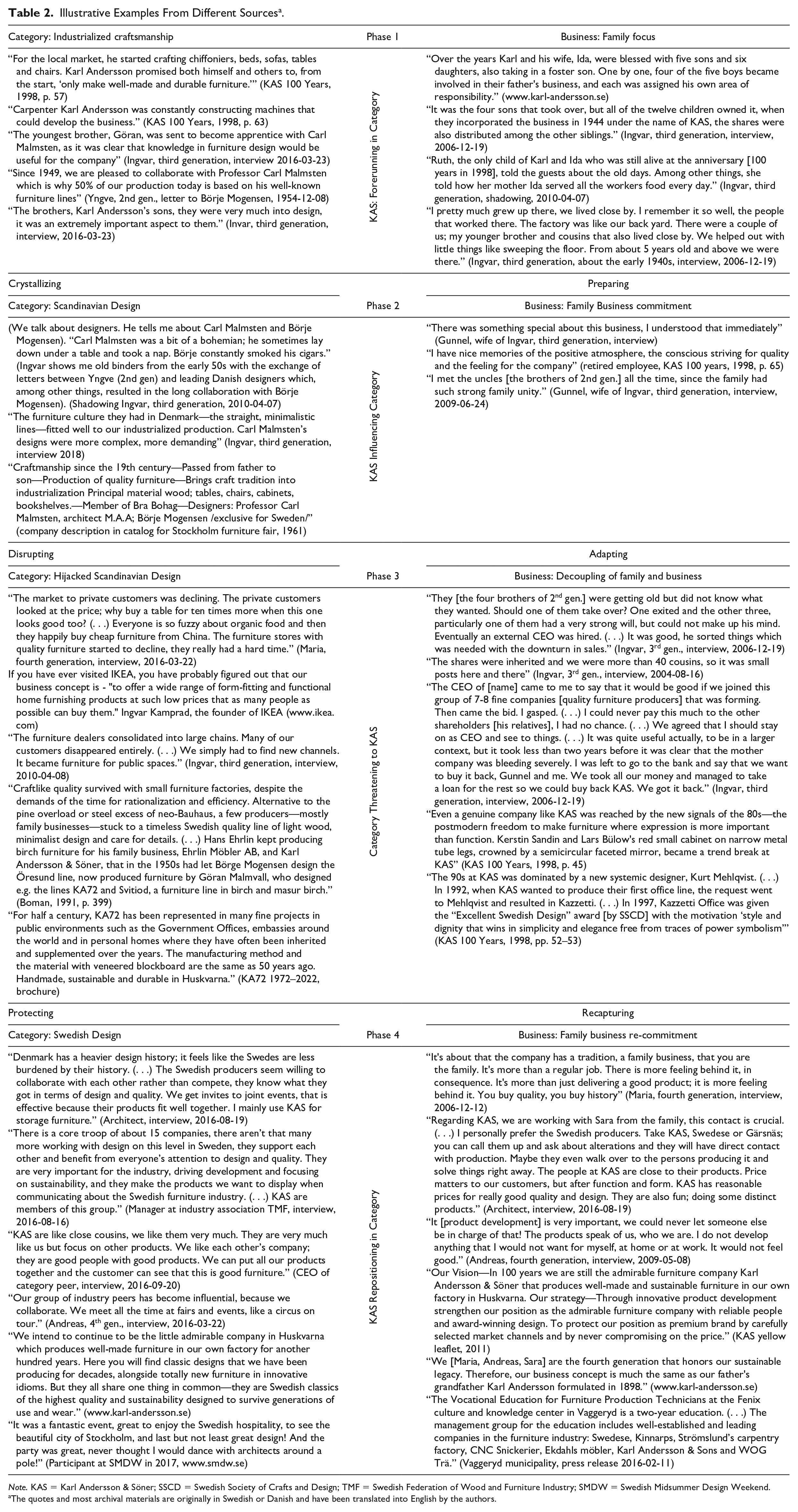
Note. KAS = Karl Andersson & Söner; SSCD = Swedish Society of Crafts and Design; TMF = Swedish Federation of Wood and Furniture Industry; SMDW = Swedish Midsummer Design Weekend.
The quotes and most archival materials are originally in Swedish or Danish and have been translated into English by the authors.
During and after analyzing the data, we consulted with the third-generation family member, Ingvar, presenting to him our findings to elicit his feedback and gain more detailed insights into any instances where our coding was inconclusive. The final stage of analysis can best be described as one of “interpretative creativity” (Austin et al., 2017, p. 7) aimed at reaching beyond the empirical material and arriving at a conceptual abstraction that cannot be directly observed but which gives meaning to what this specific case can teach us about family business longevity in relation to category dynamics.
Given the inseparable nature of the case and its context, our emphasis in this study is not on the generalizability of our findings in a statistical sense but on their case-to-case transferability (Lincoln & Guba, 1985). We reflect on this transferability and other boundary conditions in the final section of this article (Busse et al., 2017).
Findings
In the following, we present our findings in the order of the phases we identified, abstracting insights on the agency of the firm within the category, to better understand family business longevity.
Phase 1: Industrialized Craftsmanship and the Foundation of KAS (1870s–late 1940s)
Almost 70% of Sweden is covered by forest (Trading Economics, 2018), which has played an important role in the development of the furniture industry since the 1870s (Boman, 1991, p. 41). Toward the end of the 1890s, social movements opposed the old bourgeois ideals by promoting an esthetic of simplicity inspired by nature that became popular across the Scandinavian countries that share some key cultural and historical features and social-democratic ideals (Boman, 1991, p. 49).
Industrialization took place later in Scandinavian countries than in most other European nations, meaning furniture continued to be produced in individual craftsmen’s workshops several decades into the 20th century (Eybórsdóttir, 2011). For this reason, even high-quality furniture producers at this time organized their businesses according to a clear craftsmanship-production logic. From the 1920s onward, the “Swedish Society of Crafts and Design” (SSCD) 1 undertook numerous efforts as part of its commitment to raising standards of design in everyday life. Fostered by ideals of beauty, humanism, and democracy, designed objects of high esthetic quality now became more available for the wider population. In pursuing these ideals, an additional motive was to differentiate from other international design trends such as the German Bauhaus school that emerged after the First World War and the influential works of the French designer-architect Le Corbusier (IVA, 1988, p. 17; Hagströmer & Kåberg, 2021). The increasing popularity of design furniture compelled producers to combine craftsmanship with industrialized production to meet growing market demand, leading to the formation of a category of “industrialized craftsmanship.” Thus, the enduring Scandinavian ideal of producing democratic functional-design furniture first emerged.
International interest in furniture from Scandinavia can be traced back to the 1920s when the first exhibitions of Scandinavian design products were held in Europe and the United States. From the 1940s, the development of this design focus was led by Danish designers. In Copenhagen, architects and designers cooperated closely with carpenters, resulting in the rapid development of the design-furniture industry. In 1947, Scandinavian furniture was successfully exhibited at the Triennale di Milano (Impressive Interior Design [IID], 2016). Some of the designers from that time remain style icons today, including Arne Jacobsen, Börge Mogensen, and Hans J. Wegner.
Our case firm, Karl Andersson & Söner AB (KAS), dates back to the emergence of the furniture industry. The founder of the firm, Karl Andersson, was born in 1871 in a small village in southern Sweden. After gaining a master’s certificate as a carpenter in Stockholm, Karl started to produce high-quality furniture at his parents’ farm in 1898. The living members of the third and fourth generation of the family like to recount that the furniture Karl produced for a nearby castle earned him the reputation as the best, and most expensive, carpenter in the county (see the cabinet built by him in Figure 1). Curious about new technological developments, Karl became a pioneer in the region, not only building a windmill to power his saws and investing in kerosene engines but also, and most remarkably, installing electricity in the village (KAS 100 years, 1998). Karl used these technological advancements to improve certain steps in production, such as preparing lumber.
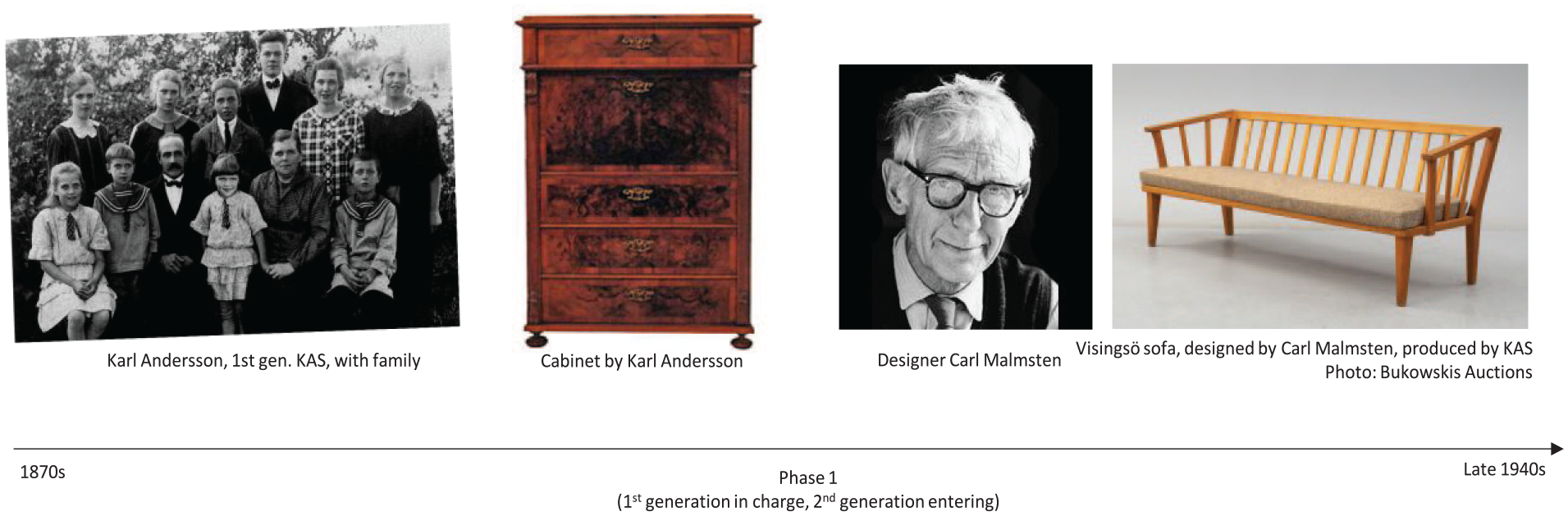
Phase 1 (1870s–Late 1940s).
Karl and his wife Ida had 12 children, several of whom worked in the family’s business (see Figure 1). The first non-family employee was hired 25 years after the firm’s foundation. The Anderssons were a religious family, 2 and their strong Christian values, including their work ethic, modesty, and sense of social solidarity, fueled their clear commitment to the welfare of all family members and employees, especially during the deep recession of the 1930s. During this time, Ida managed the small farm while Karl struggled to make the business work. His commitment to the welfare of his family and employees was impressive in the context of poverty prevailing in Sweden during those decades which led to the emigration of no less than a quarter of the population to the United States (SCB, 2013).
When Karl passed away in 1938, four of his sons took over the management of the business, while all children were included as owners to protect them from poverty. In 1944, they formed the limited firm Karl Andersson & Söner AB. The addition of “& Söner” (i.e., “& Sons”) signaled the role of the family in the business, with the older brothers taking on leading roles in management, sales, and production. While KAS continued to industrialize parts of its production, the firm retained an edge over its competitors in terms of quality by balancing standardized aspects with elements requiring highly skilled craftsmanship. The youngest brother, Göran, was sent to attend a vocational furniture-design training course led by the famous Swedish designer Carl Malmsten. Up to this point, the focus was on the production of well-crafted and durable household furniture made from regionally sourced pinewood, yet, without any design direction. Inspired by the increasing demand for designed objects, however, Göran’s new skills were now leveraged to differentiate KAS from the many carpenters in the region. In 1949, the brothers reached out to Göran’s former teacher Carl Malmsten with a proposal for collaboration. Malmsten subsequently designed two collections for KAS that both became highly successful, soon accounting for half of the firm’s total production (see Figure 1).
In sum, from the 1930s onward, a category of companies focusing on “industrialized craftsmanship” emerged in the Swedish furniture industry (Durand & Khaire, 2017). As the furniture industry per se was still new, no prior categories existed. Instead, the category developed from the previously undifferentiated mass of furniture carpenters. It was driven by a craftsmanship-production logic, meaning that the members within this category combined high-quality craftsmanship with elements of industrialization, allowing for scaling production volumes. At the same time, a category of Scandinavian design products started to develop, with interior design products such as furniture and decoration objects playing an important role (Hagströmer & Kåberg, 2021).
The family business KAS was from its establishment a pioneer in experimenting with emerging technologies, and combined high-quality craftsmanship with industrialized processes, thereby self-selecting into the emerging category of “industrialized craftsmanship.” The audience perceived organizations as category members if they were able to produce volumes that were high enough to be visible and available beyond the local market, providing a competitive advantage to the companies self-selecting into this category. Also, Karl Andersson saw these technological developments as an opportunity to better position the family business as a frontrunner within the category, driven by the strong motive to provide for the family and employees of KAS. The pioneering efforts of KAS, proving that the industrialized production of high-quality furniture was indeed feasible, are acknowledged as a role model in this regard (Boman, 1991, p. 310), thereby underlining the agency that KAS had to position itself in this emerging category. Many of the small furniture producers in the country that continued to produce furniture purely based on craftsmanship, that is, not joining the emerging category, went bankrupt, as they could no longer compete with the more efficient category members. For example, a former employee of the furniture producer Haga, founded in Värnamo in 1928, recalls: “We started to be too little modern. It would have required huge investments to industrialize production,” so the company ended up shutting down (Nilsson, 2012). Similarly in Rydaholm, earlier called the “mecca of the furniture industry” with about 30 manufacturers, all but three firms went out of business due to their failure to industrialize (Andersson, 2014).
Phase 2: The Formation of the Scandinavian Design Category and the Role of KAS (1950–Mid-1970s)
Sweden experienced rapid economic growth after the Second World War, with increasing standards of living, urbanization, and the implementation of a massive state-run housing program all resulting in increased demand for furniture and interior design. In this period, the country’s social democratic regime formed a welfare society that promoted the notion of the “People’s Home” (folkhemmet) which did not differentiate in its interior design between rich and poor (Hård, 2010; Perers, 2020). As a result of this development and in combination with rising disposable household incomes, Swedish customers’ interest in design furniture with a focus on form and function grew significantly (IID, 2016), and the trend toward industrialized production outlined earlier continued to meet rising market demands. Within this category, a subcategory of firms sharing a similar design logic was created.
In 1951, Stockholm organized its first furniture fair. 3 In 1954, in advance of a design show that toured the United States promoting a “Scandinavian way of living” (Hagströmer & Kåberg, 2021; IID, 2016), representatives of the Nordic countries coined the term “Scandinavian Design” to create a clear, internationally commercializable design identity. This exhibition promoted the works of several Scandinavian designers and infused the term with the meaning that it still endures today, that is, beautiful, simple, and clean designs inspired by nature and the climate with an emphasis on enjoyment of the domestic environment (IID, 2016). In 1955, the SSCD organized an influential international design exhibition in the Swedish town of Helsingborg (Hedqvist, 2002). Attracting a million visitors (Stadslexikon Helsingborg, n.d.), the “H55” exhibition had a significant impact on how the design was perceived in Scandinavia (Palm, 2013).
Scandinavian Design in the 1950s was largely synonymous with Danish design (Wilhide, 2009). During the 1960s, Danish designers were contracted by Swedish furniture producers following the role model, as Boman (1991, p. 325) notes, “most notably [of] Börge Mogensen’s collaboration with Karl Andersson & Söner” since 1954. These Danish designers inspired an upcoming generation of Swedish designers (Boman, 1991, p. 326), especially in their use of clean lines and light woods that allowed for industrialized craftsmanship. This collaboration of KAS with Börge Mogensen was inspired by the firm’s successful ongoing cooperation with Malmsten. It was started in 1954, when Yngve Malmvall, one of the second-generation owner-managers of KAS, sent letters to five of the most famous Danish designers. His letter to Mogensen argued that the latter’s designs matched the production skills of KAS, further citing the firm’s collaboration with Malmsten to signal the legitimacy of the business (see Figure 2, containing the original letter and our translation). Mogensen agreed to collaborate after visiting the KAS factory to examine their manufacturing skills. In the resulting contract, Mogensen agreed for KAS to be the exclusive producer of his designs in Sweden. This engagement with one of Denmark’s leading designers was the first collaboration of its kind in the Swedish furniture industry and continues to be an important cornerstone of the firm’s legacy. The collaboration with Mogensen was commonly referred to in interviews with third- and fourth-generation family members and non-family employees, and its importance in the creation of the category of Scandinavian Design in Sweden is confirmed by external sources (Boman, 1991, p. 325).
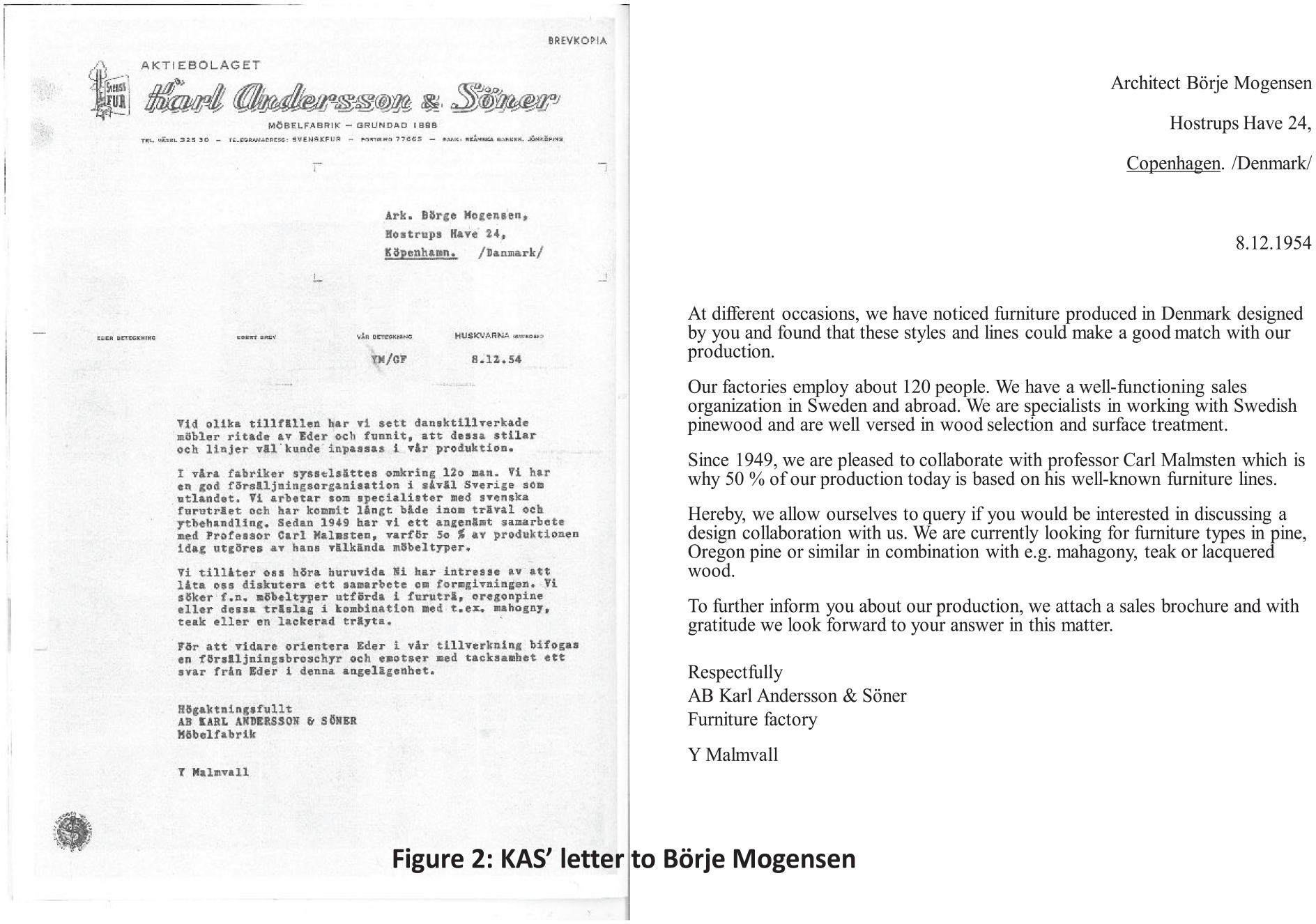
KAS’s Letter to Börje Mogensen.
The firm’s cooperation with Mogensen was crucial for the development of KAS and continued until 1968 when his health rapidly deteriorated. Öresund, the first collection designed by Mogensen in 1955 (see Figure 3), is still in demand today. Although he was always externally contracted, Mogensen played a pivotal role in the evolution of KAS’ identity and market positioning, for example, by designing the firm’s logo (see Figure 3), its offices, and its product catalogs throughout the 1950s. Mogensen’s collaboration with KAS was however also fundamental for Mogensen’s very own development and positioning as a designer as it provided him with the opportunity to design complete collections of furniture for everyday use in larger private homes. As Mogensen’s designs were rather expensive, however, KAS also commissioned a cheaper collection from the Danish designer Arne Karlsen. This collection was intended for smaller apartments and thus conformed to the Swedish idea of “democratic design.” The brothers’ initial contact with Arne Karlsen was facilitated by Mogensen himself.
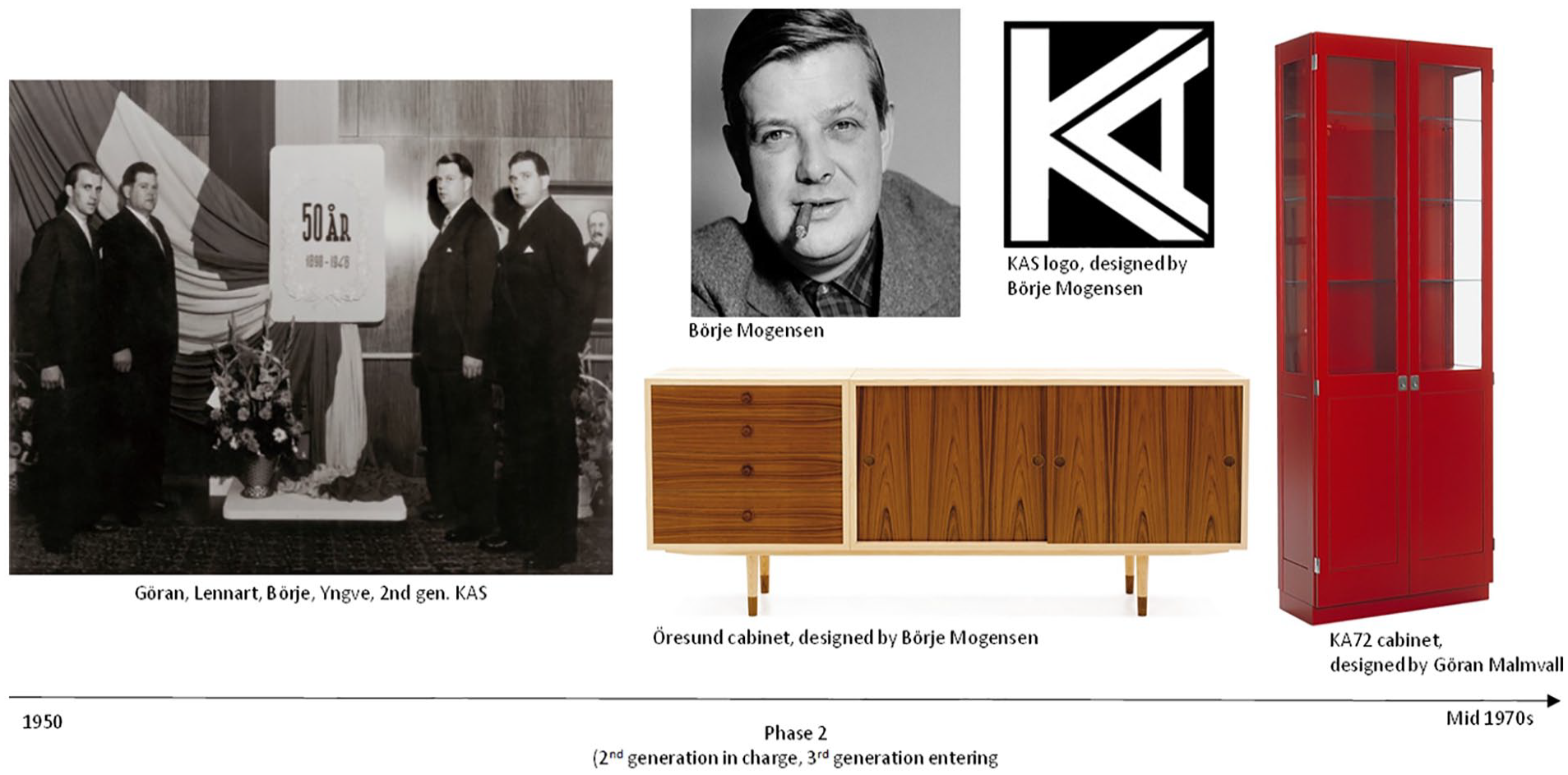
Phase 2 (1950-mid 1970s).
In 1956, KAS was one of eight Swedish high-quality home furniture firms to join the sales organization Bra Bohag (“Good Living”), which coordinated centralized marketing efforts and had been initiated by a leading furniture retailer—another family firm personally known to KAS. Several more firms joined Bra Bohag over the following years. Many retailers created dedicated Bra Bohag departments in their stores and the organization also launched annual product catalogs. In 1962, Bra Bohag opened a permanent exhibition in Malmö as a means of better positioning the umbrella brand and individual firms on the market. Since this exhibition was also open to the public, however, furniture stores saw it as competing with their own activities. The resulting conflicts led KAS and five other companies to leave Bra Bohag later that same year; none of the other five companies still exist today. In 1966, the remaining six companies merged into what is now the company Dux (Vestkusten, 1966).
In 1960, Karl Andersson’s grandchild Ingvar joined the firm after having gained work experience with high-quality furniture producers in Sweden and Germany. During the 1960s, Swedish housing standards evolved from being among the lowest in Europe to among the highest worldwide (Perers, 2020). During this phase, the public sector started to expand in Sweden, with demands for new buildings including universities, hospitals, schools, government agencies, and retirement homes. This led to the growth of the furniture market but also to new demands for durable furniture in these public milieus—a trend that became even more pronounced over the following decades (Boman, 1991, p. 408).
In the 1960s, KAS set up a showroom in Stockholm called Studio B3 to showcase the works of its famous designers, Malmsten, Mogensen, and Karlsen. Over the years, adjacent premises were added to the showroom, and several Swedish members of the Scandinavian Design category—spanning from other types of furniture to lamps and textile products—were invited to share the large studio. These were typically other family businesses well-known to the KAS family. All firms exhibiting at B3 shared similar corporate values, focusing on combining high-quality and durable products “made in Sweden” with a clear design message, enabling further collaborations between category peers, and reaching customers with a more comprehensive offer. 4
Having been trained by Malmsten and inspired by Mogensen, the KAS founder’s son Göran Malmwall took up design himself. In 1972, he created the “KA72” cabinet which became a signature piece and is still produced today (see Figure 3). The KA72 was frequently included in the refurbishment of Swedish embassies led by architect and designer Björn Hultén, showcasing the light and modern quality standard of Swedish design abroad (Gordan, 2014, p. 296).
In sum, in this phase, societal advancements triggered an increase in demand for furniture, leading to a twofold development of the furniture industry: On the one hand, the industrialization trend outlined in the first phase continued, leading to increasing price pressure and the need for differentiation. In other words, the industry was maturing and became more competitive. On the contrary, the audience’s demand for design products represented an opportunity. A group of forerunners crystallized as a new category from the prior category of industrialized craftsmanship to focus on producing Scandinavian design furniture. While the decision to produce design furniture was taken individually by the companies, including KAS—reflecting their agency in this choice to become category members—the category benefited from external actors’ initiative in creating and promoting it as a market category, mainly via exhibitions and fairs with high potential also for reaching an international audience. Only after this, category members started collaborating to promote their joint interests—exemplified by KAS’ joining of Bra Bohag and B3 as platforms to meet their audience together with like-minded category members—clearly displaying their agency in joining and contributing to shaping the category.
For KAS, this phase reflected a shift from “commitment to the family” to “commitment to the family business,” as it prepared itself to survive in a more competitive environment. This increasing level of competition became very evident, for example, in the small town of Malmbäck: While in the 1950s, it was home to 50 furniture producers, by 1971 this number had decreased to 25 firms; today, there are only two furniture producers left in town (Smålands Dagblad, 2021). One member of the third generation of the former family business Lindström & Söner recalls how they went out of business: “We produced different things for IKEA—like dressers and shelves. . . . We were one of the first companies to produce furniture for IKEA, . . . with more than half of our production going to IKEA.” But in 1965, this came to an end: “The requested volumes became too large for our small production capacity and we were not able to expand. IKEA also started to pressure us on prices, so it was impossible to maintain profitability.” The company decided to cancel the collaboration with IKEA but without clearly differentiated designs, this was a challenge. The attempt of positioning the company around sculptured furniture failed and the company ended up closing down: “We no longer saw any opportunity for development” (Nilsson, 2012).
Phase 3: Hijacked Scandinavian Design—A Phase of Competing Logics (Mid 1970s–2000)
Following decades of ever-increasing demand for Scandinavian design products, the 1970s saw fundamental changes in the private-customer market. One major reason for that was a decrease in demand due to a slower pace of new building constructions and less private consumption (DI, 1981). Up to this point, the Swedish furniture industry had been vertically integrated with firms independently organizing their value chain from raw materials to the final product (Johannisson, 1980, p. 119). From the mid-1970s onward, however, IKEA started to disrupt the Scandinavian Design category by offering design furniture at much lower prices. Having hired several well-known designers, IKEA’s founder Ingvar Kamprad summed up the firm’s strategy by articulating his ambition that IKEA’s assortment of products “should in Scandinavia be perceived as typically IKEA and outside of Scandinavia as typically Swedish” (Hedqvist, 2002, p. 142). IKEA’s low-price concept implied an increasing price pressure on Swedish suppliers and the subsequent trend toward outsourcing production to low-cost countries (Boman, 1991, p. 427). The resulting offer of low-price design furniture effectively “hijacked” the Scandinavian Design category by triggering price sensitivity within the main audience of private consumers now seeking cheap design pieces.
High-quality producers struggled to respond to the cost pressure exerted by the advent of IKEA. As a result, the clear design logic that had previously characterized the category of Scandinavian Design was replaced with two competing logics. While some producers followed the price logic of IKEA by either leaving their craftsmanship tradition and fully industrializing production or by outsourcing production, other firms seeking to preserve their legacy and retain production in Sweden shifted their focus onto less price-sensitive customers. By focusing on a combination of public and corporate sector clients, that is, customers who are not the end users, and high-end private customers, KAS and other firms pursued a logic of greater “flexibility.” The rationale for this strategy was based on the fact that the channel to public and corporate sector customers differs from that to private customers as architects and interior designers have a powerful role as gatekeepers mediating the purchasing decisions of clients furbishing public and corporate spaces. These gatekeepers include, for example, furniture with certain designs in their project proposals, which are then selected through procurement processes. Many furniture producers who failed to adjust to either of these competing logics went out of business in this period, and most furniture retail stores either consolidated into larger chains to survive or closed down altogether.
This phase also brought fundamental changes for KAS, not least of which was the recruitment of an external CEO in 1980, who ran the family business as the four second-generation brothers were approaching retirement. While Ingvar, as the third generation involved since 1960 (see Figure 4), continued to manage production, the external CEO collaborated with Ingvar to adjust the business model by focusing on expanding the public sector and corporate customer segment.
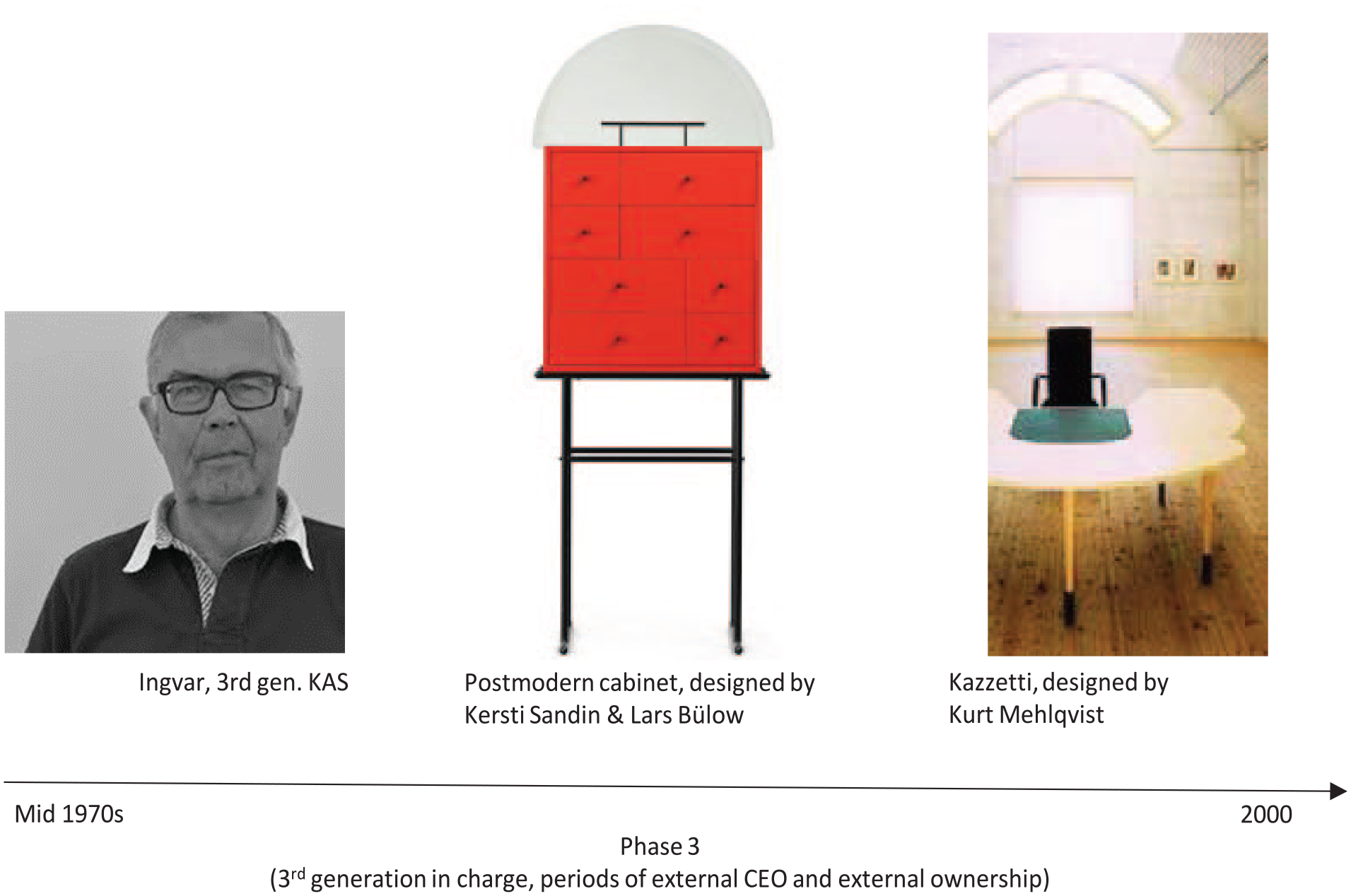
Phase 3 (mid 1970s–2000).
At this point, the ownership of the business was spread among 40 family members, as all of Karl Andersson’s children had inherited shares that were subsequently passed onto their children. Throughout the 1980s, Ingvar was buying shares from cousins not involved in the business and when the external CEO had to leave the firm for personal reasons in 1985, Ingvar took over as CEO himself. To reduce dependence on the declining private-customer segment, Ingvar focused even more on furniture for public spaces and corporate customers. For example, he contracted Björn Hultén to design the highly successful conference-table series Diskus. As noted earlier, Hultén had already developed close contacts with KAS since the embassy refurbishing projects.
Although the demand for Scandinavian Design waned somewhat in the late 1980s as postmodern individualistic designs superseded “functional design” (Hedqvist, 2002), its popularity soared again in the 1990s when this style was once again reinterpreted. In this reinterpretation, every object was treated as an individual unit of design, leading to the creation of bold and unique statement pieces (IID, 2016). Seeking to keep in step with these trends, KAS experimented with less functional designs, including a small red-and-black cabinet on metal legs designed for KAS by Kersti Sandin and Lars Bülow which is now exhibited in the National Museum in Stockholm (see Figure 4).
The next major change for KAS came in 1988 when investment company Polarator, seeking to build a holding of high-quality Swedish furniture firms, made a takeover bid for the family business. Under pressure from family members not involved in the business, Ingvar eventually decided to accept the bid while staying on as CEO and production manager, choosing to see this development as an opportunity for professionalization and helping the business to survive in a tough competitive environment. Ingvar was hopeful as he already knew the other furniture firms acquired by the investment company, all of which were family businesses. However, the profit-maximizing corporate values of the investment company clashed with those of its acquired firms, leading the investment group into financial trouble. One by one, the furniture firms were closed down or attempted to be sold after just a few years. Polarator’s CEO at the time explained, If it is possible to find suitable buyers, they are likely to be sold. But with the current economic situation in the furniture industry, it is difficult to sell . . . These are solid furniture companies, and two of them have a healthy economy with good profitability. Maybe these would be best suited as pure family firms, with owners who are passionate about the business. (Dagens Industri [DI], 1990)
One of these two profitable firms was Horreds Möbler AB, and it indeed ended up as a family firm again—bought back by its founding family. The current CEO tells, In 1936, our grandfather saw the need for well-thought-out and functional furniture. Since then, we’ve been manufacturing our furniture here in the small Swedish mill town of Horred. . . . We take pride in knowledge and craftsmanship as well as in our partnerships with furniture designers and interior architects. (Horreds, 2022)
The other company was KAS: Faced with the dilemma of buying back KAS or seeing it liquidated and thus with no acceptable alternatives for ensuring the survival of the business, Ingvar and his wife Gunnel put in all of their private funds and took out a loan to buy back the shares in 1992. Ownership was then back in the hands of only one branch of the family.
Over the following years, Ingvar and KAS continued to collaborate with well-known designers as well as newcomers while consistently focusing on high-quality design and production, especially for public spaces. In the firm’s positioning toward the public sector and corporate customers in the 1990s, key roles were played by designers Ulla Christiansson and Kurt Mehlqvist (see example in Figure 4), displaying furniture at different fairs, which represented an important platform for KAS to meet its category peers and interact with its audience.
In sum, in this phase, the category of Scandinavian design was significantly disrupted by a combination of different factors. After a long period of market growth, overall demand for Scandinavian design furniture now waned and many producers went bankrupt. The business newspaper Dagens Industri describes the competitive situation as follows: “In Sweden, we have lost 23 smaller-sized companies during the past 20 months. . . . Low-price imports from countries in the East are a huge problem” (DI, 07/12/82). This difficult situation was aggravated by IKEA’s move toward offering low-price interior design products and furniture, disrupting customers’ willingness to pay for higher quality and resulting in hijacking the logic of the category to shift from high-quality design to price. IKEA’s price pressure led to a number of furniture producers that had IKEA as an important customer to either fully industrialize and attempt to compete on prices with production based in Sweden or to shift production to lower-cost countries—alternatively losing IKEA as a customer and often being forced out of the market. For example, in 1996, Dagens Industri reported that about 10 furniture producers in Sweden, with around 50 to 100 employees, had recently gone bankrupt due to losing IKEA as a customer (DI, 19/07/96). The furniture producer Recta had to close down its factory in Tibro and lay off all of its 150 employees when the family firm refused to move production to Poland, leading IKEA to instead choose a foreign supplier (TT, 19/06/02).
As an alternative to following the low-price trend, a number of category members managed to survive in this “hijacked Scandinavian design” category—in which they had lost agency to IKEA and other low-cost producers—by targeting mainly a different audience that was less price-sensitive and still interested in, and able to afford, high-quality design furniture. KAS was among the actors to choose this route, also accompanied by their former peer within the Polarator investment group, Horreds Möbler (Göteborgs Posten, 29/08/98; Östersunds-Posten, 24/10/98). With this, the firms within the sub-category regained agency over their fate. Internally at KAS, the increasingly tough competitive situation in this phase also seriously challenged their survival and saw a shift from a “commitment to the family business” to a “decoupling of family and business.” Due to the spreading of ownership to many family members not vested in the business, the decision to sell the business to external owners (with continued family control over production and strategic positioning) represented a decoupling of the family from the business. However, this decision was taken with the aim of ensuring the longevity of the business by bringing in external owners. Thus, KAS survived this phase by adapting its motives for longevity, temporarily switching focus from the family business to a business legacy, and thereby adapting to the ongoing changes in the category. KAS managed to stay true to its core values of local high-quality production and design, rather than following the emerging cost-driven logic of low prices. Having largely lost its agency to act within the hijacked category, KAS focused on changing its customer segment and orienting itself to a category audience that had first started to emerge during the 1960s, thereby moving from price-sensitive private to public sector and corporate customers.
Phase 4: Back to the Roots—Protecting Swedish Design (Since 2000)
From 2000 onward, the SSCD ceased promoting “Scandinavian Design” and focused instead on promoting furniture and products of Swedish origin as “Swedish Design.” Creating this new category within the—now more fuzzy—Scandinavian design category was in part an attempt to protect the remaining Swedish firms producing a high-quality Scandinavian design by more clearly differentiating their products from high-quality Danish design that at this time had difficulties emancipating itself from its style icons of the past (Hansen, 2006). At the same time, venture capital investors were pressurizing Danish businesses toward “fast design,” with furniture of low quality, durability, and price (Resumé, 2002), including production in low-cost countries. In response, the remaining Swedish high-quality design manufacturers aligned with SSCD’s initiative by stressing their heritage, long tradition of craftsmanship, local production, and sustainability in their market communication. In 2016, the Swedish government institutionalized this initiative of protecting and promoting Swedish Design, involving several industry actors. 5 As part of its national export strategy, a 4-year project was launched to promote international awareness of Sweden as a design nation, that is, by supporting Swedish producers to exhibit at international fairs. 6
This phase brought momentous changes to the KAS family business. In particular, the entry of Ingvar’s three children into the business greatly increased its managerial capacities (see Figure 5). Of this fourth generation, Sara left her career in interior design to start working with sales and marketing for the business in 1996, Andreas quit his engineering position to join KAS as head of production in 2000, and Maria left the computer industry to manage administration at KAS in 2001. In 2002, KAS significantly expanded its factory in Huskvarna, evidencing not only the family’s redoubled commitment to its future as a family business but also signifying the firm’s constancy in “staying true” to its local roots. At the same time, this strategy reflected a crucial shift in dynamics. While previously the furniture produced by KAS had put the name of the designer into focus, now the furniture was labeled primarily as “KAS.” However, it was also a consequence of KAS intensifying its engagement with as-yet unknown designers, often the winners of design or prototype competitions (e.g., Table Newton in Figure 5, winner of the Nordic Design 2009 Award). This engagement represented a break from the firm’s earlier strategy of working only with established and renowned Scandinavian designers. KAS’ fourth-generation head of production Andreas invested a great deal of effort into identifying these designers and was highly involved in collaborating with them from the idea selection stage to prototype development, ensuring that each new piece was representative of the firm’s values and appropriate to its production process. Andreas took over as CEO in 2010, although in practice the four family members run KAS as a team until today.
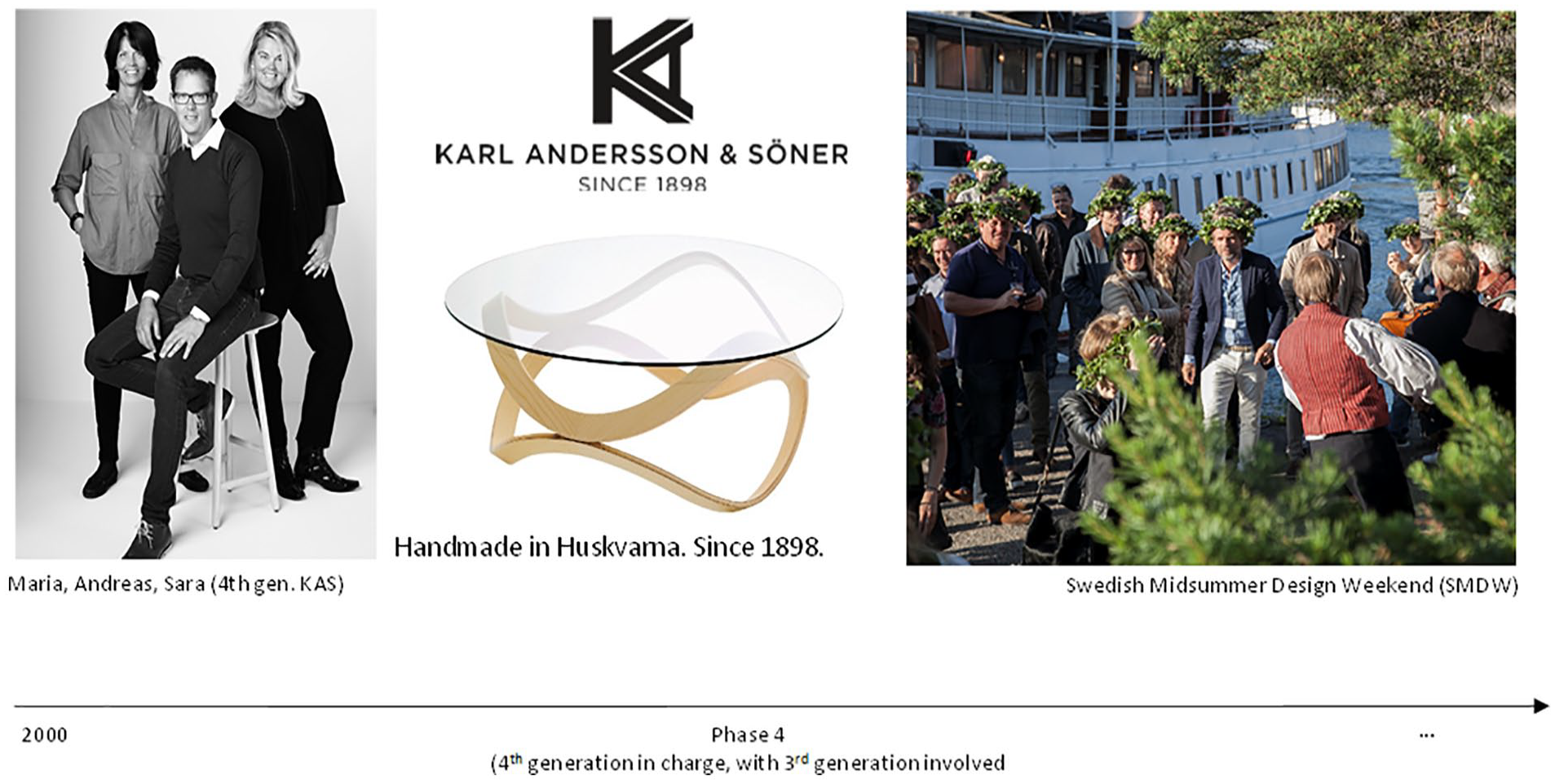
Phase 4 (Since 2000).
The entry of the fourth generation increased KAS’ capacity to engage with the category. In line, Ingvar increased his engagement with Studio B3, acting as its CEO before handing over this role to his daughter Sara. In addition, Andreas joined the Advisory Board of the TMF industry association’s furniture section, Maria joined the Chamber of Commerce, and Sara started to engage in lobbying for anti-piracy legislation at the national level. The outcomes of these engagements included the adoption of a new quality standard in the Swedish furniture industry that benefits local production as well as several legal actions against pirated products (Sydsvenskan, 13/10/16). In addition, KAS contributed to showcasing high-quality design furniture produced in Sweden at different events, thus demonstrating the continuing agency of KAS in shaping its category.
For the public and corporate customers who are now the main focus of KAS’ activities and represent 80% of its sales, the challenge is to persuade architects and interior designers in their role as gatekeepers of public sector procurements to include the firm’s furniture in their project proposals. In 2013, KAS and their peers within the Swedish Design category launched the Swedish Midsummer Design Weekend (SMDW) as an annual 3-day design event to which some 60 architects from several European countries were invited. The SMDW was meant to inform participants about the businesses in the category, making study visits and celebrating traditional Swedish midsummer in the Stockholm archipelago, offering a combined experience of Swedish design and Swedish culture (see Figure 5). The peers participating in this event shared similar core values, that is, a commitment to preserving the legacy of the family business, high-quality design, and sustainable production in Sweden. These values are evident in the corporate communications of these firms as shown in Table 3, which also shows the performance stability of these firms, indicating the relative protection that this Swedish Design category provides for its members despite an otherwise high level of competition in the furniture industry.
Swedish Design Category: Examples of Participants of the Swedish Midsummer Design Week 2016 and 2019.
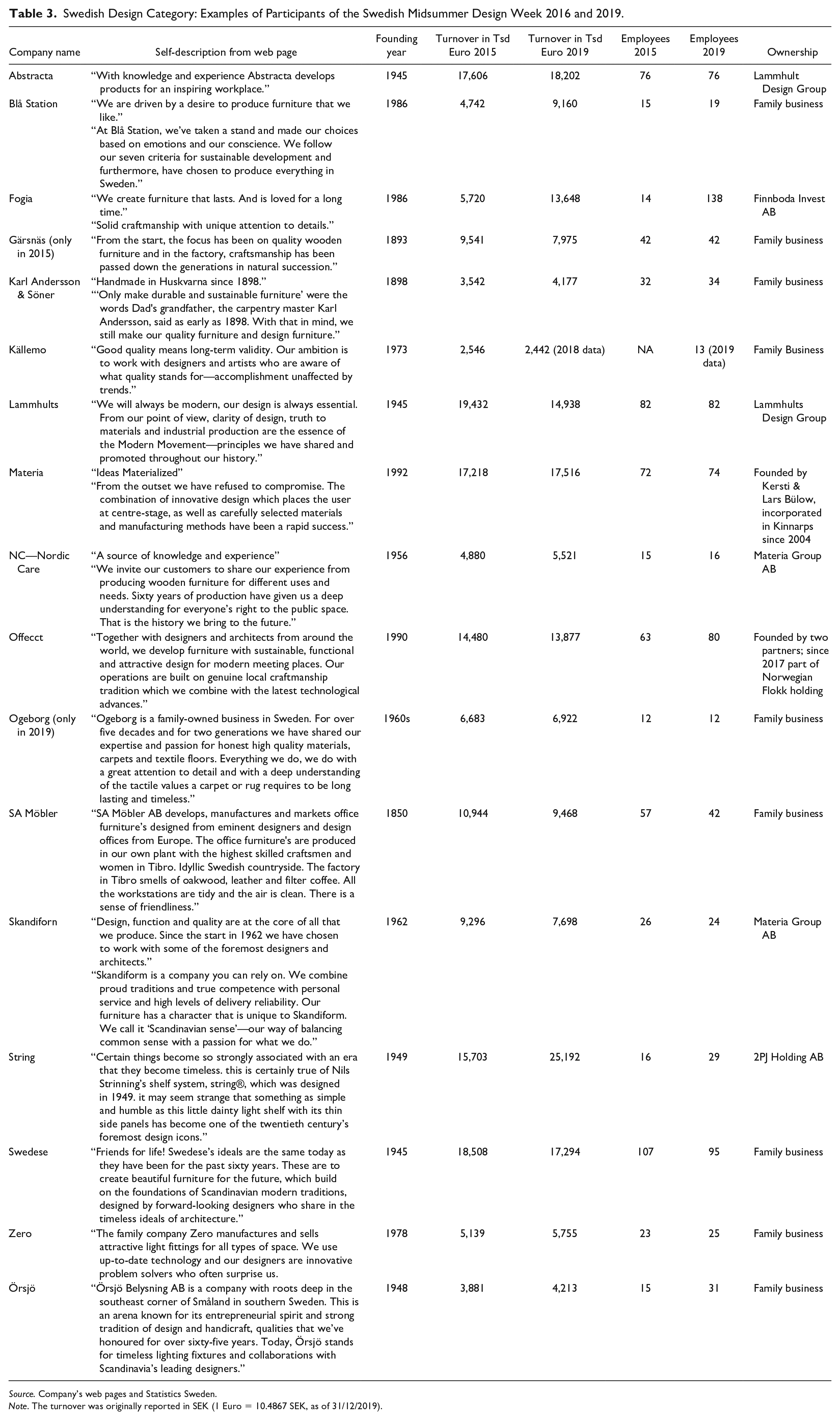
Source. Company’s web pages and Statistics Sweden.
Note. The turnover was originally reported in SEK (1 Euro = 10.4867 SEK, as of 31/12/2019).
In sum, the remaining Swedish high-quality design furniture producers took collective agency and teamed up to jointly establish boundaries to create the sub-category of Swedish Design and thereby protect their market position. They were supported by institutional actors, such as the government and SSCD, to promote this sub-category to the national and international market audience. While continuing to be part of the Scandinavian Design category regarding form and function, the Swedish Design category is a more exclusive group of companies, as membership is restricted by fulfilling the combination of craftsmanship, tradition, design, and durability as category-defining criteria. KAS managed to establish its “re-commitment to the family business,” as the family business recaptured the focus on its original objectives of longevity in line with the family’s values and the terms the family set for itself. To protect the positioning of their firm within the category, the family members started to take on various positions that allowed them to enact agency—from within the category—by influencing institutional actors that could protect the category from the outside. While family ownership is not per se a requirement, the set of membership criteria with heritage and values in focus resulted in family ownership representing the dominant ownership form in this category. In an interview, the CEO of the family-owned category member Blå Station, emphasized their values: Our aim is to combine innovation and material with industrialization and design. We refuse to take the simple capitalist shortcut via low-cost countries or to deviate from our social responsibility. . . . Without knowledge of and respect for our history, we cannot design products for the future. (Expressen, 28/02/11)
Discussion
In the following, we discuss our findings in light of our theoretical framework to unpack mechanisms explaining family business longevity. We discuss the factors of continuity and change (Sharma & Salvato, 2013) that explain how the family business in our study achieved longevity without giving up on their family business values to sustain their socio-emotional wealth (Berrone et al., 2012; Gomez-Mejia et al., 2011). We start with the factors of continuity by presenting how certain aspects remained stable across the four phases and for more than 120 years. Second, we discuss change by presenting the interrelated role of the internal mechanisms driving family business commitment, the external mechanisms driving category development, as well as the mechanisms underlying the dynamic interaction between these internal and external developments.
The Role of Value-Based Continuity Across Phases for Family Business Longevity
Since the foundation of KAS in 1898, the involvement of family members in all fundamental strategic decisions for the business has been consistent, including production, product design, materials, pricing, and positioning. In this way, key aspects of the business have remained much the same for more than 120 years. We identify the following six fundamental continuities: (1) KAS has never changed its product type and thus the firm’s identity and cultural heritage have always been reflected in its products. (2) KAS has never changed its logic of sticking to local production and of having certain parts produced by hand while at the same time making use of technological advancements. (3) KAS has stuck to wood as the principal material of its products. (4) The business has consistently positioned itself in the higher quality and higher price segment of the market, prioritizing quality and design over volume. Continuity is also evident in how KAS has related to external stakeholders, through (5) its strategic—but highly personal rather than transactional—collaborations with designers and architects as well as (6) its strong collaboration with other family businesses in its category. The firm’s decision to engage in different types of collaboration reflects the importance consistently placed by the firm on working with like-minded businesses that share their values. The consistency of these strategic factors that are reflected in the firm’s business model ultimately has its roots in the values of the family and their determination to stay true to their roots and cultural origins. Honoring these continuities has also meant a preference for remaining a smaller-sized firm. By keeping production local and advanced, KAS has been able to safeguard its products against copying from competitors. Beyond this, it was also important for the family to be physically close to their origins near Huskvarna, especially as the roots of the firm lay in the cultural heritage of this region and Sweden’s traditional closeness to nature.
In sum, the consistency of the firm’s vision and focus on quality and design has been sustained through the determination of the family over four generations to retain control over vital decisions related to its core and stable set of values and priorities. There is also continuity in how KAS has interacted with its external environment through its decision on how to do business based on a core set of values. These factors are essential for how the family business achieved longevity in a way that preserved its socio-emotional wealth (Berrone et al., 2012; Gomez-Mejia et al., 2011). These stable factors also confirm the key factors facilitating longevity suggested by Antheaume et al. (2013): familiness, stewardship, embeddedness, and psychological ownership. To answer how KAS survived when the category it was positioned in changed and most competitors failed, we turn to how they not just showed consistency in some respects but also changed in others through engaging with and therefore shaping their market category.
The Role of External, Internal, and Interaction Mechanisms of Change for Family Business Longevity
Beyond the factors of continuity that explain the role of value-based stability across phases, we also abstract mechanisms of interaction and change within and between phases that explain family business longevity and category development (see Figure 6).
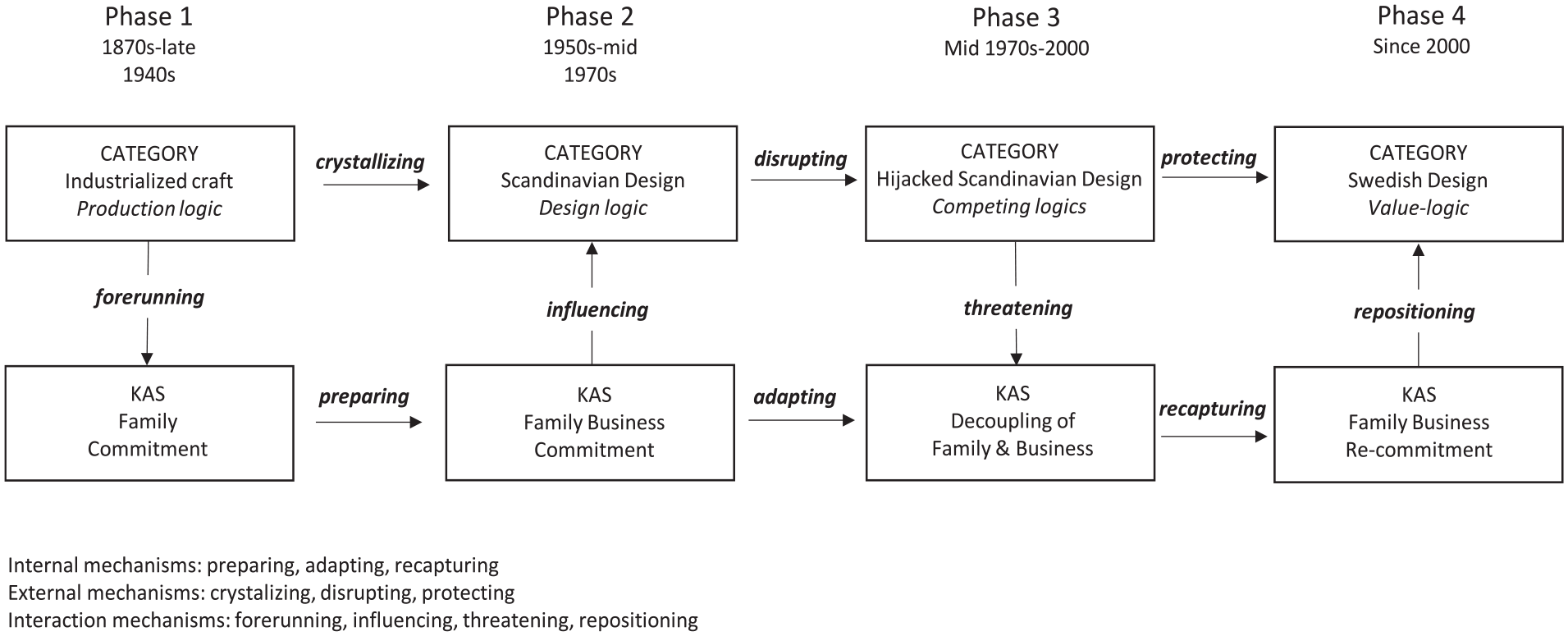
Integrative Model of Category Development and Family Business Longevity.
External Mechanisms Driving Category Development
We identify three external mechanisms that explain how the category in which KAS is embedded has evolved over time through four main phases: (1) “industrialized craftsmanship,” (2) “Scandinavian Design,” (3) “hijacked Scandinavian Design,” and (4) “Swedish Design.” The external mechanisms are depicted in Figure 6, by the arrows between the categories, labeled as “crystallizing,” “disrupting,” and “protecting.”
The first shift depicting a category creation took place in the 1950s when the initial category of “industrialized craftsmanship” crystallized into the category of ‘Scandinavian Design’: By the 1950s, a self-selected collective of businesses began to follow a design logic focused not only on producing high-quality furniture but high-quality design furniture. Importantly, while the earlier loose category of industrialized craftsmanship had allowed for a broad membership of furniture producers, “Scandinavian Design” was a more specific category restricted to members with a certain level of expertise in design. Since the new category redrew the cognitive boundaries around a subset of member characteristics within a preexisting category system, it illustrates the “category creation” type of formation conceptualized by Durand and Khaire (2017). This dynamic has similarities to the shift in architecture identified by C. Jones et al. (2012), where a specialist subgroup with its own clear architectural style formed from a broader traditional category. The creation of the Scandinavian design category was enabled by institutional audience actors engaging to push for the labeling of “Scandinavian Design,” helping the process of legitimization (Navis & Glynn, 2010) in the eyes of the market audience and the category’s specialist members that shared similar values and design attributes (Vergne & Wry, 2014).
The second shift from “Scandinavian Design” to “hijacked Scandinavian Design” reflected a disruption of the category in phase two that led in turn to a hijacked category in phase three. This disruption occurred as new players entered the market and changed the playing field, most notably IKEA, and illustrates the “category emergence” that occurs when elements extraneous to the existing category are brought in and change the category (Durand & Khaire, 2017). Through mass production and outsourcing, these actors hijacked the meaning of Scandinavian design by copying its style in the production of cheap furniture and design objects. The resulting categorical fuzziness made it harder for the audience to assess the difference between the genre specialists, fulfilling all category membership criteria, from new entrants offering seemingly similar cheaper options (Kovács & Hannan, 2015). Hence, the new offer of cheap design furniture was widely accepted among the audience of the category in which KAS was embedded despite it not being crafted in Scandinavia. The new low-cost players led to the erosion of category boundaries and subsequent contamination of the categorical purity (Rao et al., 2005). This development meant that most specialist members of the Scandinavian Design category were unwilling or unable to adjust their business model from local high-quality production to outsourced low-quality mass production. In consequence, many were pushed out of the market, as they could no longer compete with low-price players. Thus, while the “visible label” that defined the category in terms of its design logic remained, the “invisible label” by which businesses within the category had previously accomplished membership (i.e., high-quality local production of Scandinavian design products) now changed along with the category’s shift to competing logics. Logics were competing in terms of low prices and mass consumerism on the one hand versus flexibility in adjusting the business model to serve a different audience—public and corporate customers—to remain true to a value-based legacy characteristic of many family firms in the category.
The final category development from “hijacked Scandinavian Design” to “Swedish Design” occurred between Phases 3 and 4. Similar to when the Scandinavian design category was first created, a subgroup of actors enacted agency in creating a new category within it, by rearranging existing cognitive boundaries to benefit the members that can fulfill them (Durand & Khaire, 2017). This shift was supported by the efforts of external intermediaries such as SSCD to protect the small enduring group of prototypical Swedish actors of the original category of local high-quality production of Scandinavian Design furniture. This protection was achieved through the creation of the “Swedish Design” sub-category in which members differentiated themselves not only from low-quality design and mass production but also from Danish design which had formerly dominated the Scandinavian Design category but which had struggled to renew itself after its glory days in the 1950s and 1960s. This sub-category within Scandinavian Design aimed to re-purify the category by “returning to the roots” and stressing again the values predominant before the hijacking—thereby neither representing a stretching of the category (Durand & Paolella, 2013) nor a category expansion (C. Jones et al., 2012), but rather the creation of a new, smaller sub-category with stricter boundaries created from within (Durand & Khaire, 2017). A similar development had been identified in reintroducing mechanical Swiss watches as high-status products (Raffaelli, 2019). Agency for change was rallied by collaborations among like-minded peers in this category, as exemplified by the Swedish Midsummer Design Weekends. In their endeavors to protect this category against another wave of hijacking in the future, its members drew clear boundaries, highlighting not only high-quality design but also high-quality local production, legacy, and the cherishing of Swedish craft traditions. The characteristics and criteria for membership of this latest category included the need for a genuine heritage and a continuous history of local production, thereby excluding any newcomers regardless of their financial backing, ideally constructed for family businesses.
Internal Mechanisms Driving Family Business Longevity
We identified three internal mechanisms that enabled the family business to endure over 120 years, which is longer than most firms survive (Löhde et al., 2020). These internal mechanisms can be summarized as “preparing,” ‘adapting,’ and “recapturing” the family business’ stance toward longevity, depicted as the arrows between phases on the family firm level in Figure 6. Thus, the succession of family business members across four generations was accompanied by and reflected in three shifts in the primary objective of the family business: (1) a shift from the initial “commitment to the family” to a ‘commitment to the family business’; (2) a shift to “decoupling of family and business” to facilitate the firm’s survival; and (3) a shift to a “re-commitment to the family business.”
The first of these shifts occurred in the 1950s as the second generation took over the business, entering into a sibling consortium (Gersick et al., 1999). Karl Andersson had originally set up the firm with the primary purpose of providing for his large family at a time of widespread poverty in Sweden, hence his overarching commitment was initially to his family. As the second generation of the family grew up, however, Karl turned his focus to preparing for succession and for KAS to become a family business rather than a business set up for family purposes. This shift in the objectives of the owner helped prepare the firm to survive changes taking place in its environment as the market category, within which KAS interacted, crystallized and became more competitive. The commitment of the second-generation family members was important for longevity in enabling future intrafamily successions and increased capacity to manage business transformation.
The second shift in objectives from a “commitment to the family business” to a “decoupling of family and business” was related to problems arising in the third generation when ownership got diluted to a large number of family members, at the same time as the competitive situation in the industry became very tough. In this stage of the cousin consortium (Gersick et al., 1999), the increased number of owners led to a weakened commitment to the business (Aronoff, 2004). Selling the business to external owners (with continued family control over production and strategic positioning) represented a decoupling of the family from the business, meaning an adapting of the aim of family business longevity to ensure its survival as a business by bringing in external owners. This illustrates an interesting version of how family businesses are willing to take drastic measures when the survival of the business is threatened (Casillas et al., 2019; DeTienne & Chirico, 2013). However, instead of sacrificing business values, in our case study, the family sacrificed ownership to stay in control of products and production. This constitutes an unexpected move according to the family business literature, as maintaining ownership control is typically seen as a fundamental aspect of socio-emotional wealth for securing family influence (Berrone et al., 2012). KAS survived however by adapting its objective while also adapting to ongoing changes in the category, including the “hijacking” of the category of “Scandinavian Design” by mass producers, meaning rapid adaptation was crucial for the firm’s survival. Given the family’s control over production, KAS managed to stay true to its core values of local high-quality production and design rather than following the emerging cost-driven logic.
The third shift to a “recommitment to the family business” in Phase 4 was driven by the aim of recapturing the original objectives of the business. This included the regaining of ownership control when the active family branch of the third generation managed to buy back the company. The business was once again in the hands of the family with the primary aim to ensure its longevity in line with the family’s values and the terms the family set for itself (Reay et al., 2015). This shift was particularly important as members of the fourth generation of the family joined the business refocusing their family business identity. These family members are the three children of the family branch that remained active in the business and therefore were raised in the same household, similar to how the second generation is usually socialized, but with a longer business heritage. The recaptured family business commitment helps explain why they were able to withstand changes to the new characteristics of the contaminated “Scandinavian design” category since actors with a strong organizational identity face weaker pressures to conform to audience expectations (Kovács & Hannan, 2015).
Mechanisms at the Intersection of Category Development and Family Business Longevity
Beyond factors of continuity that explain value-based stability across phases, and beyond internal and external factors of change between phases, it is the mechanisms that relate to the interaction between categories and businesses that are particularly salient for a new understanding of family business longevity. These mechanisms explain how KAS has engaged with its category over time and are illustrated by the arrows between category and organizational level in Figure 6: “forerunning,” ‘influencing “threatening,” and “repositioning.” The direction of these arrows symbolizes the differences in agency in the category that KAS managed to exercise in different phases and thus relates to an area of category research that is little explored (Durand & Khaire, 2017; Durand & Paolella, 2013; Vergne & Wry, 2014).
In the first phase, KAS was one of many businesses within a loose production-driven category that allowed for a broad membership. This phase saw industrialization, new technological innovation, and increased spending power in Sweden. Without any intention to influence the category, the founder’s curiosity for new technology put KAS in a favorable position. As an early adopter, KAS was thus finding itself well-positioned in the formation of a market category for industrialized craftsmanship and could secure its longevity at a stage of industry evolution that otherwise saw a major shake-out from the market. Being at the more innovative end of the spectrum in the early days, KAS became a forerunner in its category.
Following the shift in the second phase from a production-driven logic to design logic in the business and its category, together with the firm’s shift from a “commitment to the family” to a “commitment to the family business” by the joining the second generation, KAS succeeded in further adapting and positioning itself to prosper in the new Scandinavian Design category while retaining its focus on quality and core values. As one of the first firms in Sweden to engage in collaborations with leading designers, KAS could exercise agency to influence the development of this new category despite its small size. This influence was amplified by the fact that the SSCD and other actors involved in the formation of the category at this time were strongly promoting the construct of “Scandinavian Design” in the Nordic countries and abroad. The firm’s already long-established relationships with designers now proved core in setting the tone for Scandinavian Design based on design collaborations combined with competence in production that managed to incorporate industrialized production with craft quality. In a collaboration between like-minded peers and enthusiast audience groups, KAS was part of defining the categorical membership characteristics in a way that made them category specialists (Kovács & Hannan, 2015). The Scandinavian design category thus arose with clear boundaries albeit with much fewer members. KAS, being one of them, was in a perfect position to nurture longevity in line with their family business values.
The influence of KAS on the development of its category declined significantly as the category shifted between Phases 2 and 3 from a well-defined category driven by design logic to a phase of contestation with competing logics, leading up to the need to “divide or reconcile” (C. Jones et al., 2012). In C. Jones et al.’s study (2012), this resulted in an acceptance of pluralism and expansion of the category, while in our case the boundary crossing pulled off by new entrants imposed a need to follow a low-price and high volumes logic or end up without customers. Indeed, with this change in directionality, KAS was now threatened by the “hijacked Scandinavian Design” category of which they were part. Determined to stay true to its roots, cultural heritage, and family values, KAS resisted adjusting to the newly prevalent cost-based logic but lacked the agency to influence or counter these developments. Instead, KAS responded to this challenge by seeking new audiences for its products in the public and corporate sector, again, through family members reaching out to old industry connections. Where prior research has pointed out the importance for family businesses to have close collaborations with their customers (De Massis et al., 2018), KAS showed little interest in adapting to customer expectations and instead collaborated with selected competitors. This period of being threatened by the category proved crucial to the firm’s longevity, but in a way not yet addressed in the category literature. We find that the firm survived by changing its audience, contradicting the common assumption that category membership is largely audience-driven (Durand & Khaire, 2017).
In the final phase, KAS was once more surrounded by a group of like-minded and typically also owner-managed businesses that repositioned themselves and created an exclusive sub-category of “Swedish Design” focused on values instead of price and differentiating itself from the blurred broader category hijacked by low-price, low-quality mass-produced “Scandinavian Design” furniture. This member-driven formation follows a pattern similarly found by Navis and Glynn (2010) who show how the members constructed a common identity by emphasizing similarities across the firms that claim membership to the category. In this process, KAS again exercised agency to influence their repositioning to perfectly align with their own identity of high-quality design furniture produced in Sweden. This time, to stress the heritage, also being an old family business became an important member characteristic that further fortified the category boundaries and elevated the identity of the members (see Table 3 on how category members express their identities in similar ways).
By this time, the business had been recaptured by the family after a period of decoupling business and family, leading to a re-commitment to the family business by third- and fourth-generation family members. In the category of “Swedish Design,” KAS is now positioned as one of the prototypical members with authentic family business values and a long-term heritage of high-quality “Scandinavian Design” furniture, produced in Sweden with the use of technologically advanced craft. Similar to the active role KAS had initially played in the creation of the “Scandinavian Design” category, the family business in this phase took a leading role in driving and repositioning the category of “Swedish Design” in accordance with the family’s original values, and once again with the members of two generations running the business together with a good prospect for continued longevity.
Contributions
Through a history-informed study, we seek to contribute to a new understanding of longevity in the field of family business research by addressing the question “How do family businesses engage with their category to influence business longevity?” Specifically, we contributed as follows:
First, drawing on “categories” research (e.g., Delmestri et al., 2020; Durand & Paolella, 2013; Lo et al., 2020; Vergne & Wry, 2014), our longitudinal case study shows that a family business whose family-based values conflicted with the market does not have to, as suggested by prior research, renounce these values. Instead, it can achieve longevity by exercising agency to shape their market category, thereby aligning the market category with the family values over time.
Second, we refine research on how owner-families adapt their logics to ensure legitimacy within a field over time. While prior research has commonly suggested that family firms adjust or renounce their family business values to survive, our study shows that sticking to a set of family values can also be effective. Doing so led to temporarily sacrificing family ownership in our case study, but, in the end, ensured the longevity of the business (e.g., Casillas et al., 2019).
Third, the historical approach we used to analyze a case study over an untypically long timespan enabled us to identify the mechanisms explaining the development of a small family business, its market category, and the intricate interaction between the family business and its market category over time. The mechanisms at the intersection of category and family business development are particularly intriguing as they highlight how a family business used its agency to shape the category in which it was embedded while simultaneously being shaped by its category.
Future Research Avenues and Conclusion
In light of our conclusions, it is necessary to reflect upon the boundaries of this work (Busse et al., 2017). Although our single case study is necessarily context-specific, we align with Braguinsky and Hounshell (2016) and their study of Japanese cotton-spinning in contending that identified processes are meaningfully generalizable to other contexts. Regarding the transferability of our findings, we believe our core insights into how family businesses engage with their categories to achieve longevity can also be translated to other industries as can our identification of the mechanisms driving category dynamics. The history-inspired approach adopted in this study opens up a broad avenue for future research on family business (Colli & Fernandez Perez, 2020; Colli & Larsson, 2014), including the role of the family in different time periods and the role of the family business in societal development. Our study is also meant to inspire others to adopt a categories lens (Delmestri et al., 2020; Durand & Paolella, 2013; Vergne &Wry, 2014) to explore the ways in which family businesses innovate, expand, and/or internationalize. More specifically, we suggest future research to further investigate how family businesses interact with their audiences and how “being a family business” is perceived by audiences in different industries and across different periods in history. We also suggest further exploration of the revival of out-competed product classes that counteracts theories of industry evolution as found in Raffaelli’s (2019) study on mechanical watches and in our case on recreating a “Swedish Design” furniture category by returning to the former values of the original “Scandinavian Design” category and, most importantly, the role of long-lived family businesses in such developments. To conclude, longevity is what makes many family businesses special. Unlike prior works that focused on how factors within a family business or its environment shape organizational longevity, we adopted a business-history perspective to shed light on the interplay between the organization and its environment. Our study showed that even a small family business can have agency to shape its market category, thereby helping to ensure its longevity. We hope our study will generate more interest in studying the intricate relationship between family businesses and their market categories over time.
Research Question/s
How can a business-history perspective improve our understanding of family business longevity?
How can family businesses achieve longevity by interacting with their environment?
How does a family business exercise agency to shape the market category they are a member of?
How can a small family business develop over generations without giving up on their core values?
Practical Implications
What makes some family businesses survive for centuries while others fail? Must family businesses adapt to their environment and give up on their family values to survive? In this study, we trace how a small family business has thrived for more than 120 years by sticking to their family values. We show how family business longevity can be achieved by taking agency in influencing the market category in the industry the family business operates in to create favorable conditions that fit with its values. Our study also includes a historical overview of the Swedish furniture industry and the emergence of Scandinavian Design.
Footnotes
Acknowledgements
We acknowledge valuable feedback received from participants at the JIBS paper development bootcamp and CeFEO research seminars at Jönköping International Business School. In particular, we thank Mark Ebers, Anders Melander, and Leif Melin for important input at various stages of this project. Last but not least, we thank the FBR editor and the Special Issue editors as well as three anonymous reviewers for their specific and constructive suggestions during the review process.
Copyright Agreement
Authors of accepted manuscripts will need to submit a completed copyright agreement form granting the publisher the right to copy edit, publish, and copyright the material. This form (and link for submitting it) will be sent to you in a separate email. Kindly follow the instructions in that email to submit your form into the system.
All three of us have filled in the form and opted for Gold Open Access.
Implications For Practice
These should be targeted toward practitioners and will be used by SAGE and FFI to disseminate your work to the practitioner communities through podcasts, executive summaries, and partnerships with other publications. If your article is selected for such dissemination, we would appreciate your help in facilitating these efforts.
Please send these three additions to me via email (
Author’s Note
Julia Grimm is now affiliated to Stockholm University, Sweden.
Declaration of Conflicting Interests
The author(s) declared no potential conflicts of interest with respect to the research, authorship, and/or publication of this article.
Funding
The author(s) received no financial support for the research, authorship, and/or publication of this article.
